September’s colour direction splits into three distinct camps: warm amber-to-copper tones that mirror early autumn light, cool ash-and-platinum finishes that push against the season, and high-contrast statement pieces — a teal panel, a split-dye red — that treat hair as a deliberate design choice rather than background texture. The common thread is intentionality. Every shade here works because it was placed with precision, not defaulted to from a swatch book.
Use these twenty looks as a visual brief for your next salon appointment. Save the ones that match your baseline (natural level, undertone, maintenance tolerance), then talk through the technique — balayage versus foil, gloss versus permanent — with your colourist. September hair colour trends 2026 reward specificity: the more clearly you can articulate what you want, the closer the result lands to the reference image.
Rich Espresso Layers With Blown-Out Volume
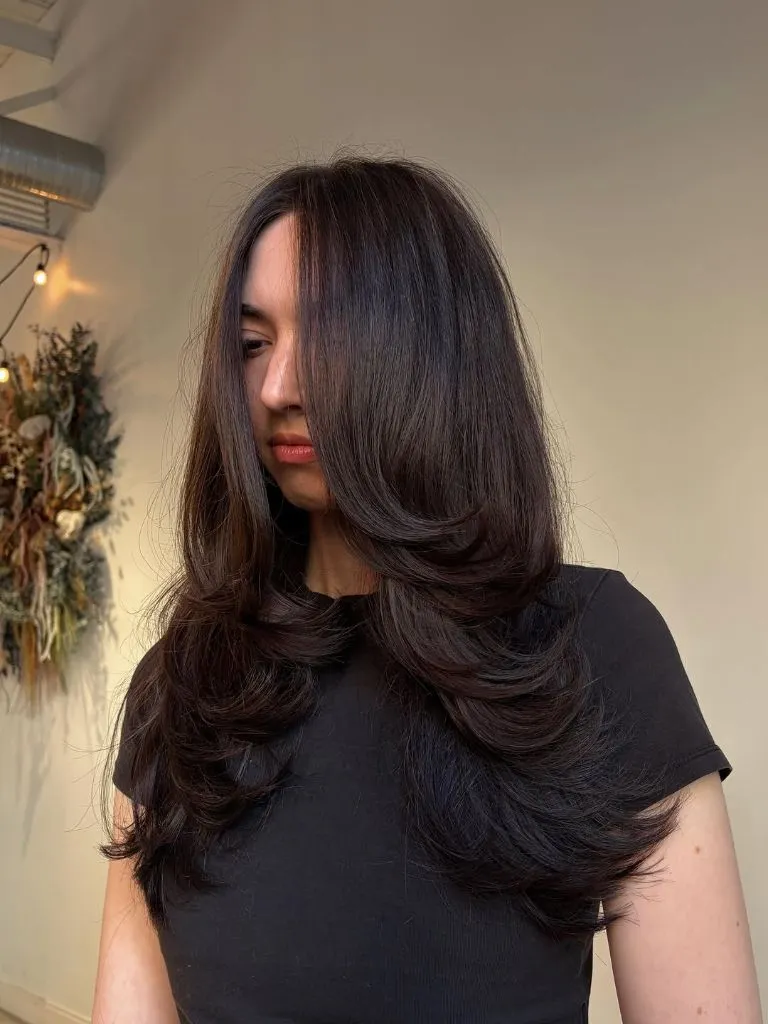
This single-process dark brunette draws its impact from light behaviour, not colour variety. The deep espresso base — roughly a level 2 to 3 — stays uniform from root to tip, which means every visual shift comes from the cut’s layering and the roundbrush blowout that kicks the ends outward. That outward movement catches overhead light along the mid-shaft, creating a high-shine ribbon effect across otherwise flat, dark hair.
To get this result without the salon blowout every morning, ask for internal layers that start at the collarbone rather than face-framing pieces. A velcro roller set on dry hair gives you the same lifted, swept silhouette in about ten minutes. If the espresso feels too dark against your complexion, a single shade lighter — a dark chocolate at level 3 to 4 — preserves the same depth without washing you out.
This works best on medium to thick hair because the density supports the volume at the ends. Fine hair can mimic it, but you’ll need a volumising mousse at the roots and a lighter hand with any finishing oil to avoid collapse. If you’re considering a dark brunette shade for autumn, this is the low-commitment entry point — one process, no bleach, no maintenance schedule beyond a gloss refresh every six weeks.
Warm Money Pieces Frame A Dark Base
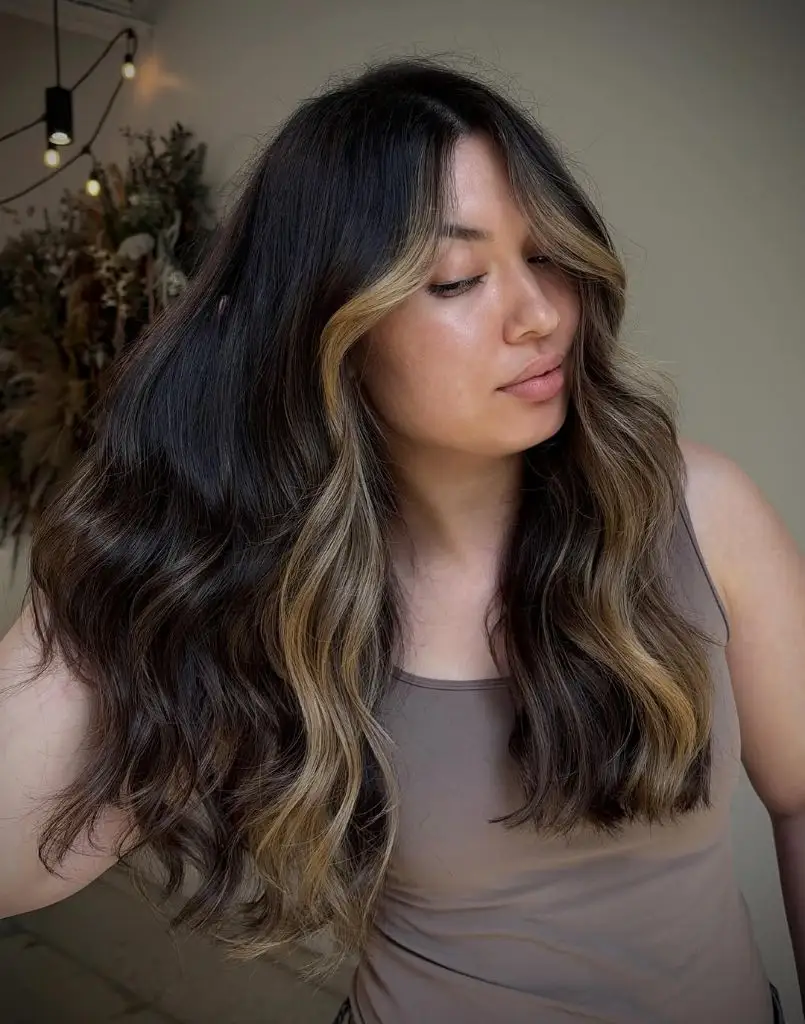
The contrast ratio here is the story. A natural level-2 black base stays untouched through the crown and back, while bold golden-blonde money pieces sweep from the part line down past the jaw. Those front sections are lifted to roughly a level 8 and toned warm, landing somewhere between honey and antique gold. Against the dark surround, they read almost metallic.
You can dial the drama up or down by adjusting width. Thicker panels — two inches or wider — give this editorial, graphic feel. Narrowing them to pencil-thin ribbons pulls the look closer to a traditional face frame. The wave pattern also matters: these loose, slightly irregular bends keep the pieces moving so they don’t sit as stiff blocks of colour against the black.
The tradeoff is upkeep. Because the money pieces are so much lighter than the base, visible regrowth appears within four to five weeks. If that bothers you, ask your colourist to shadow-root the blonde sections with a demi-permanent a half shade darker at the scalp — it buys an extra two weeks before the grow-out feels obvious. This pairing flatters warm and neutral undertones especially well.
Split Copper-and-Black With A Blonde Streak
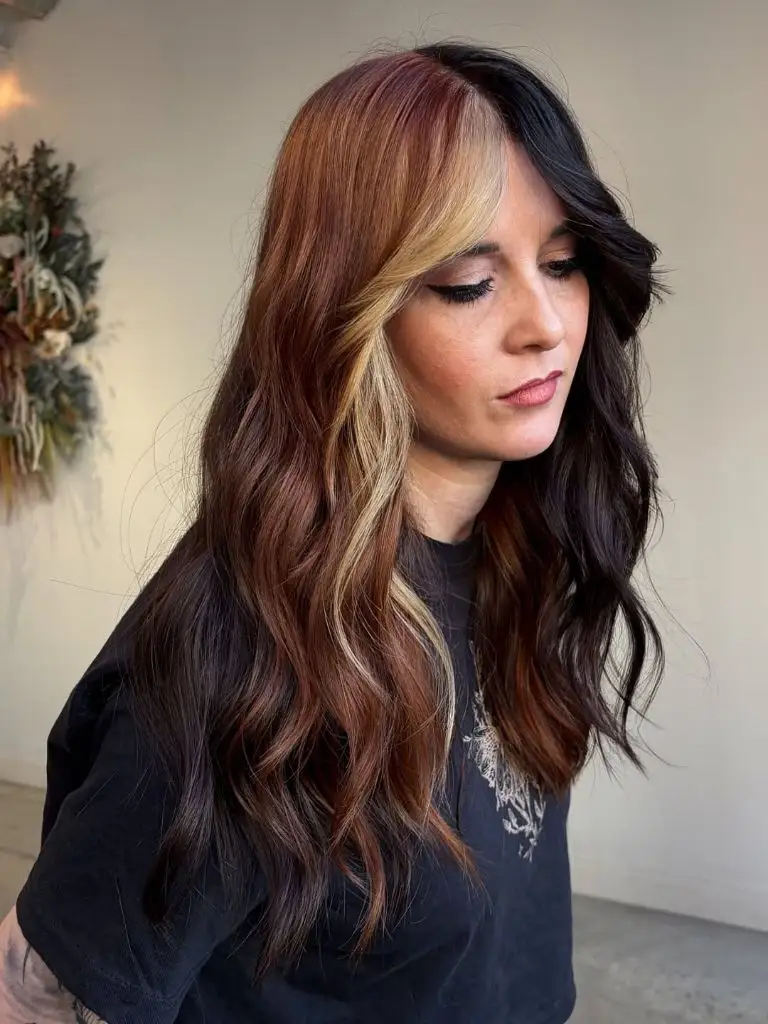
Three distinct zones operate here without looking costume-ish, and the reason is tonal logic. The dominant copper occupies the right side and most of the length, sitting around a warm level 6. The left side stays dark — a cool-toned level 2 black — and a single blonde panel at the front right, roughly level 9, acts as a highlight accent. Each colour belongs to a different part of the spectrum, yet they connect through the warm undertone shared by the copper and blonde.
Replicating this exactly requires a colourist who’s comfortable with placement mapping. The key instruction is that the split shouldn’t follow a hard centre part — it wraps slightly behind the ear on the dark side, so from the front you see mostly copper with a dark shadow, not a literal half-and-half divide. That asymmetry is what keeps it wearable.
This is a commitment look. You’re maintaining three processes on different schedules — the copper fades fastest, the blonde needs toning, and the black is the most stable. Budget for a gloss appointment every four weeks if you want the copper to stay vibrant rather than washing out to a muddy strawberry. It suits anyone drawn to creative colour who still wants to read as polished rather than punk.
Lived-In Balayage With Dimensional Blonde
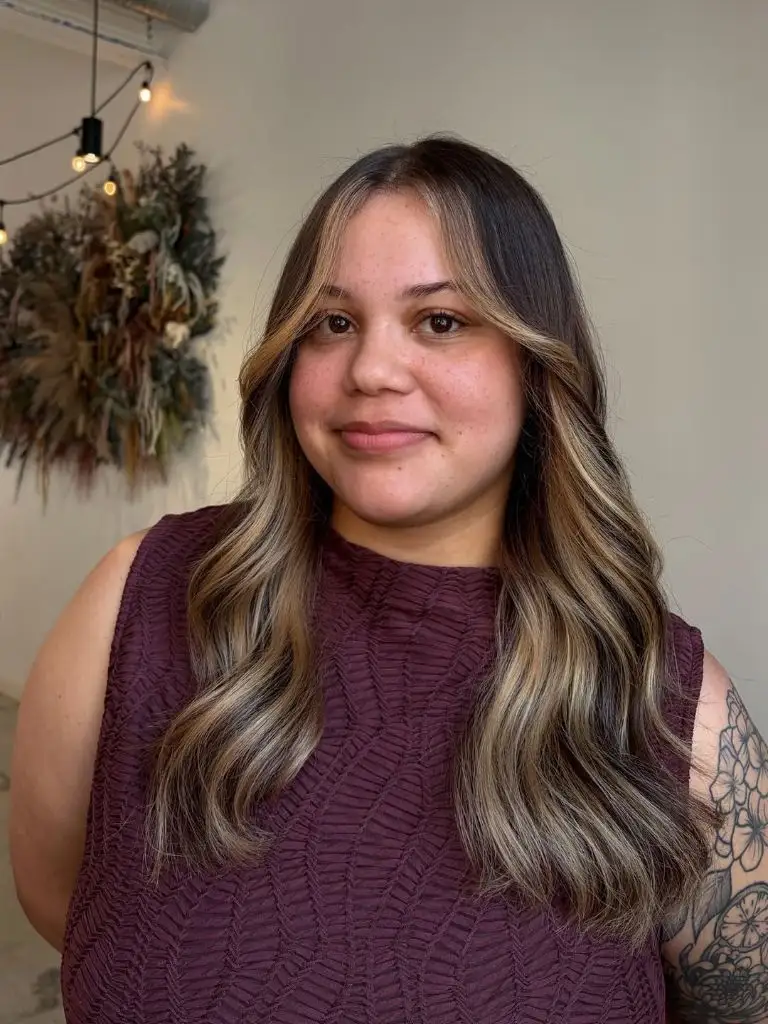
The appeal of this look is that it doesn’t try too hard. A level-4 brunette root melts into a blend of level-7 and level-8 blonde through the mid-lengths, with the lightest concentration falling around the face. No section is a single, flat shade — the colourist has woven at least two tonal values through the balayage, producing a sandy warmth that shifts as the hair moves.
For anyone with naturally dark hair, the key detail to communicate is that the transition zone — where brown meets blonde — should be long and diffused, not a hard line at ear level. That gradient is what makes it read as grown-out rather than freshly dyed. A texturising spray or salt spray enhances the dimension by separating the strands enough to show the tonal variation underneath.
This is one of the most forgiving September hair colour trends 2026 options for anyone who doesn’t want to live at the salon. The rooted base means regrowth blends rather than clashes, and the warm blonde tones age gracefully without turning brassy the way cooler platinums can. A purple shampoo once a week and a gloss every eight to ten weeks will keep it dialled in.
Auburn-Black Split With Blonde Fringe Accent
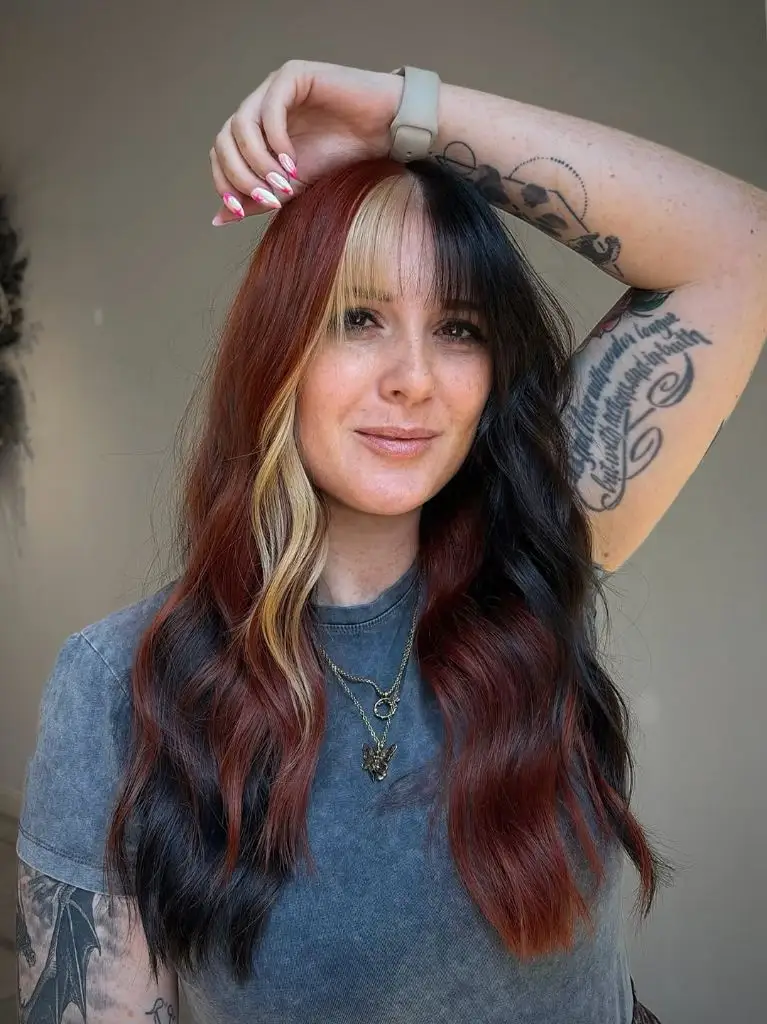
This is a more aggressive version of the three-zone concept, and the bangs are doing most of the heavy lifting. A deep auburn — somewhere between a level 5 copper and a level 4 mahogany — covers the majority of the hair, while a black shadow sits along the left side and underneath. The blonde accent is concentrated almost entirely in the curtain fringe, pulling the eye straight to the centre of the face.
The bangs make or break this. Without them, the auburn-and-black split would feel incomplete, like half a look. The blonde fringe gives the composition a focal point and connects the warm and cool halves of the palette. If you don’t want bangs, you could substitute a wide face-framing panel on one side, but the effect will be less centred and more asymmetric.
Maintenance here is moderate — the auburn will need a colour-depositing conditioner or a demi-gloss every three to four weeks to keep its vibrancy, and the blonde fringe will require toning to prevent it from yellowing. The upside is that the dark sections require almost nothing. If you’ve been exploring bold autumn hair colour ideas, this balances editorial impact with genuine wearability.
Deep Burgundy With A Satin Finish
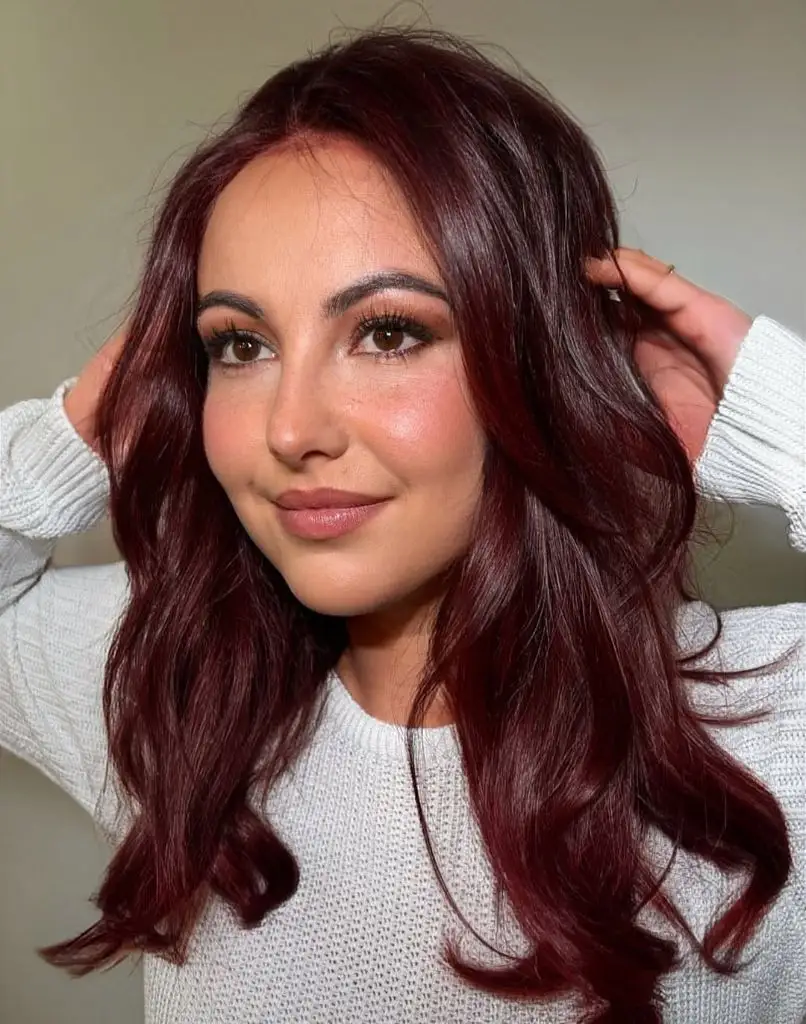
Monotone colour at this level of saturation lives or dies by the finish, and this is a clinic in getting the surface right. The burgundy sits at a rich, cool-leaning level 4 with strong red-violet pigment — think merlot rather than cherry. Because there’s no balayage or highlights breaking it up, every strand reflects light uniformly, and that uniformity is what produces the satin sheet effect you see here.
Achieving this requires starting with a clean canvas. Any pre-existing highlights or uneven porosity will cause the burgundy to absorb inconsistently, leaving hot spots and patchy depth. If you have prior lightening in the hair, a filler step — a semi-permanent copper or warm base applied before the burgundy — ensures even absorption.
The colour will fade. Reds and violets have the largest pigment molecules of any colour family, and they wash out faster than browns or blacks. Plan for a colour-depositing mask twice a week and sulphate-free shampoo as non-negotiables. In return, you get one of the most striking single-process shades of the season — it reads sophisticated rather than alternative, and it complements warm, cool, and neutral skin tones with equal ease.
Ash-Brunette Balayage With Cool Face Framing
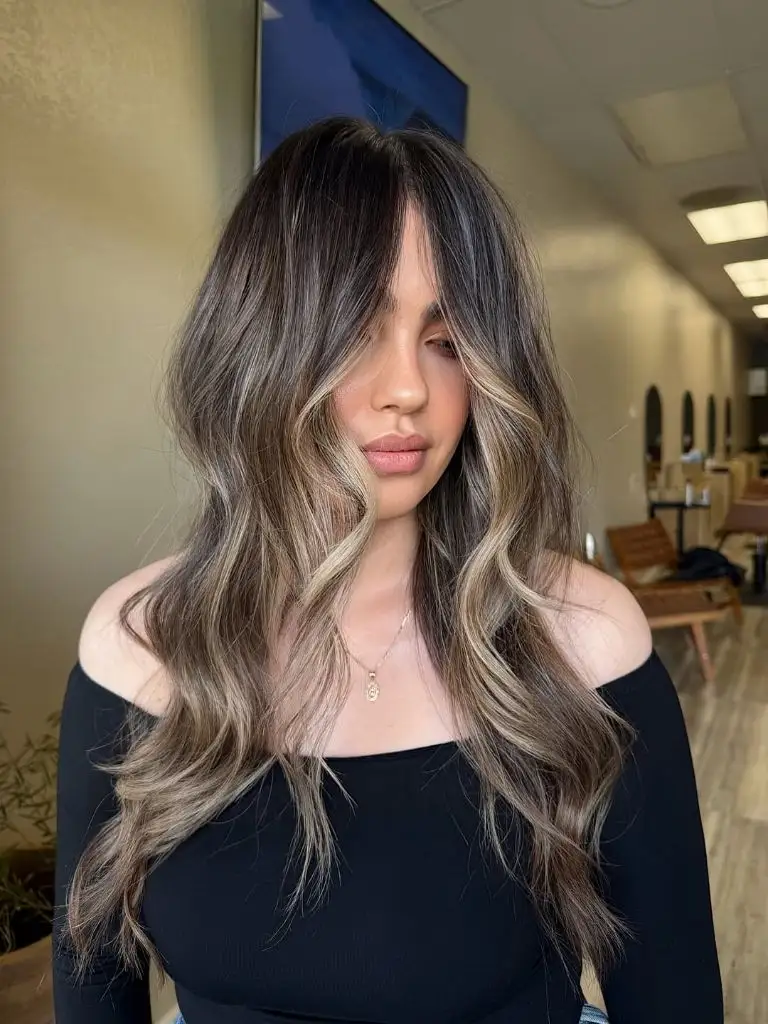
Everything about this palette is temperature-controlled. The base is a cool level-4 brunette — no red, no gold — and the balayage pulls into an ashy level-7 blonde through the front sections and lower lengths. That deliberate avoidance of warmth gives the whole look a smoky, almost grey-adjacent quality that feels distinctly autumnal without relying on the copper-and-caramel palette most people default to in September.
The wave pattern here is important because it prevents the ash tones from reading flat. Soft, loose bends — not tight ringlets, not bone-straight — catch and release light along the lighter sections, creating a shifting quality that static, straight hair wouldn’t produce. If you’re styling at home, a 1.25-inch barrel and alternating curl directions will get you close.
The tradeoff with ash tones is brassiness. Underlying pigment in dark hair is warm, so any lifted section will want to pull gold as it fades. You’ll need a violet or blue-toned shampoo on a regular rotation, and a toning gloss appointment every six to eight weeks to keep the cool finish intact. This suits those with cool or neutral undertones best — if your skin runs very warm, the ash might create an unflattering contrast.
Warm Chocolate Waves With Subtle Dimension
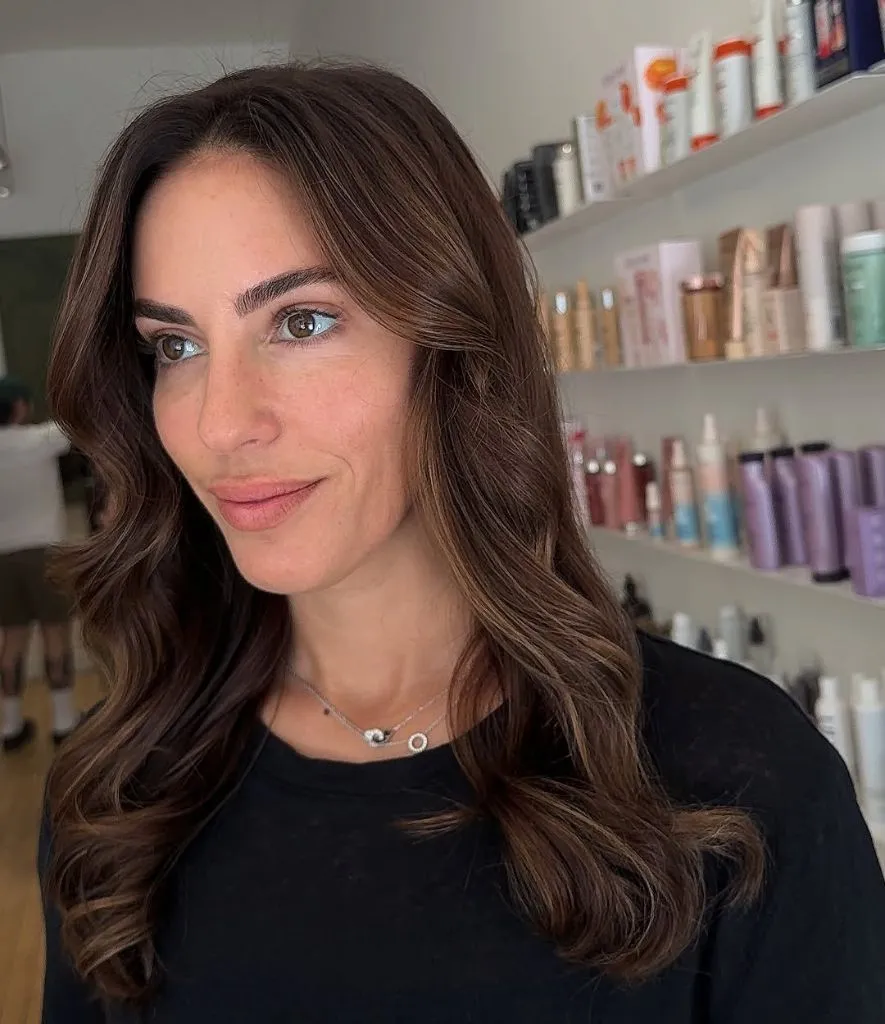
Sometimes the best colour work is the kind nobody can identify as colour work. This medium chocolate brown — a level 5 with warm, nutty undertones — looks entirely natural, and that’s the point. The dimension comes from micro-fine highlights woven through the mid-lengths, maybe a half shade lighter than the base, producing the kind of tonal variation that virgin hair has in sunlight but processed hair often loses.
A single-process gloss over natural or previously coloured hair can get you most of the way there. The highlights are optional but recommended if your hair has been box-dyed to a flat, uniform shade — they reintroduce the subtle shifts that flat colour strips away. Ask for a level 5 to 6 warm-toned balayage with no more than two levels of lift.
This is the default recommendation for anyone who wants a change but can’t commit to visible maintenance. The regrowth is nearly invisible, the fade is graceful, and the warm tone flatters almost every skin tone from fair to deep. It’s also a strong foundation shade — if you decide in November that you want to go warmer or add face framing, this base gives your colourist plenty of room to build.
Bronde Waves With Sun-Kissed Placement
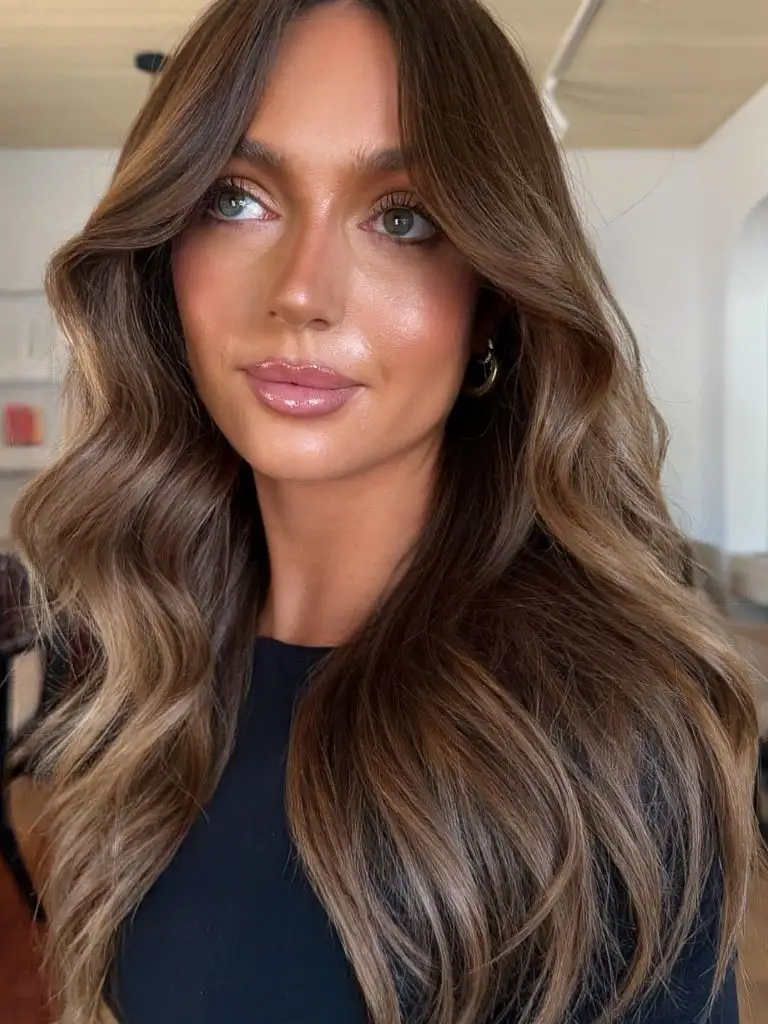
Bronde — that indeterminate zone between brown and blonde where neither fully commits — has been a staple for years, but the execution here is what separates it from the generic. The placement favours the outer perimeter and the face frame, leaving the interior and root zone distinctly darker. That creates depth from above but brightness from the front, which photographs particularly well.
The tonal range spans about three levels: a cool level-5 root transitioning through a warm level-7 mid-shaft to a creamy level-8 at the ends. The warmth increases as it descends, mimicking the way the sun lightens hair unevenly over a summer. To hold this gradient, a demi-permanent toner at the root and a separate formula through the lengths is standard practice.
If you’re maintaining bronde from a summer colour and wondering whether to shift it for autumn, the answer is usually to deepen the root by one level and add a half-shade of warmth to the blonde. That keeps the dimension without looking like you’re clinging to July. For more guidance on transitioning summer hair colour into fall, the root-deepening technique is the simplest single adjustment with the biggest impact.
Black Hair With Teal Face-Framing Panels
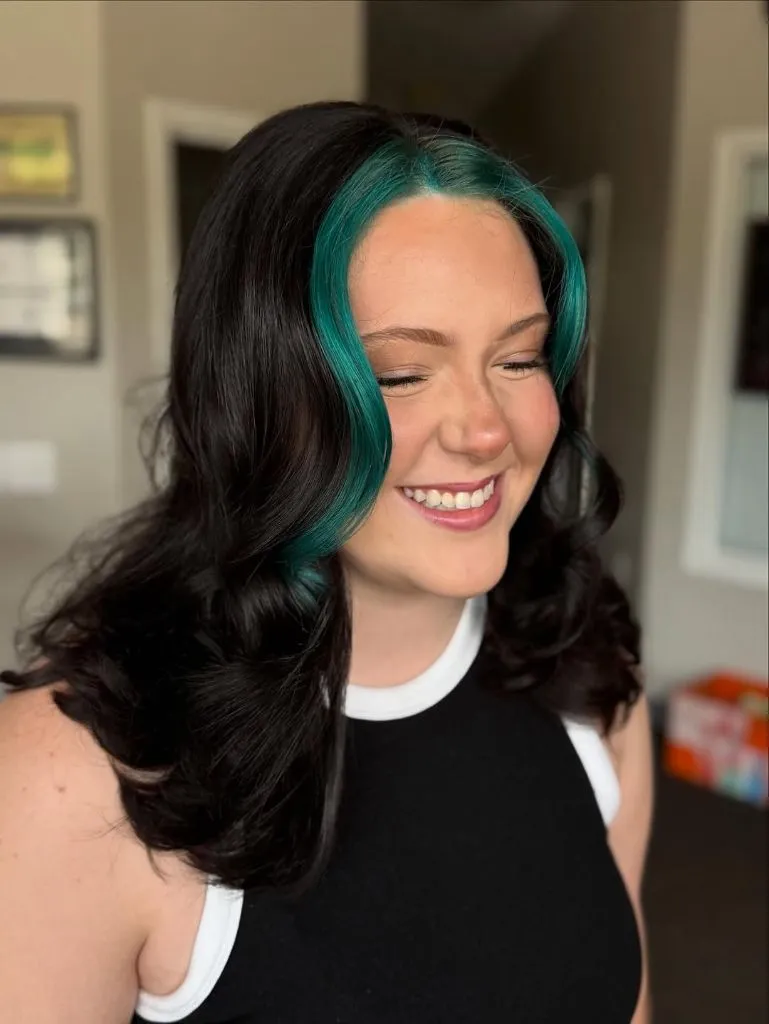
Colour blocking works when it follows a spatial rule, and this one is clean: jet black everywhere except two symmetrical teal panels that start at the part line and sweep down past the cheekbones. The teal is a true jewel tone — saturated, slightly blue-green, no pastel dilution — and it’s been applied to pre-lightened sections that were lifted to at least a level 9 to get that pigment to land at full intensity.
The styling reinforces the colour structure. Those old-Hollywood barrel curls hold the teal panels as distinct, sculptural shapes against the dark backdrop. If you wore this straight, the teal would blend into the black at the edges and lose its graphic punch. The curl separation is what preserves the boundary between the two colours.
This is a fashion-colour commitment. Teal fades to a murky green within three to four weeks without intervention, and refreshing it means either a colour-depositing conditioner in the exact shade or a salon visit. It’s also not workplace-neutral in every context. But for anyone whose environment supports creative colour, it’s one of the most visually striking September hair colour trends 2026 — bold without being chaotic, and deliberately placed rather than randomly streaked.
Voluminous Caramel-Brown With Bouncy Ends
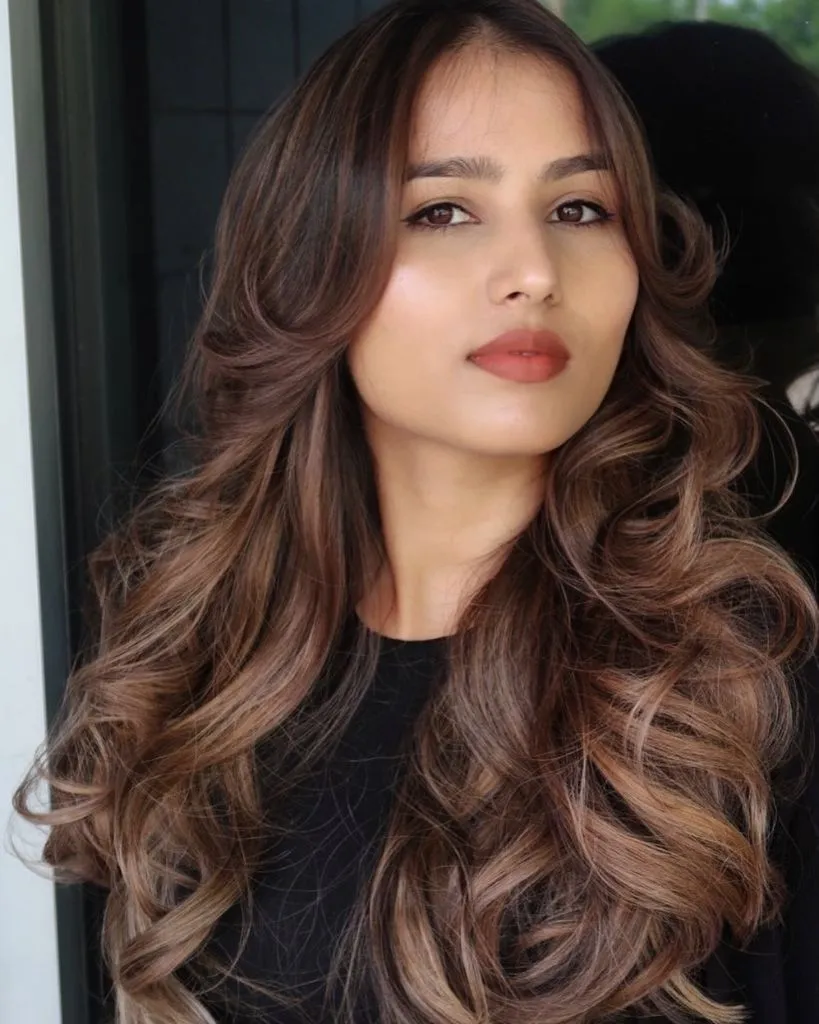
The curls here aren’t an afterthought — they’re the colour’s delivery mechanism. A warm caramel-brown base, landing around a level 5 to 6 with golden undertones, is deepened at the root to a level 4 and lightened at the ends to a level 7. That three-level gradient from dark to light is subtle on straight hair, but these full, bouncy barrel curls compress and expand it, making the tonal range look twice as dramatic.
To recreate the curl pattern, you need a 1-inch barrel and consistent wrapping from mid-shaft to ends, leaving the roots smooth. The volume at the crown comes from either backcombing or a root-lift spray applied to damp hair before blowdrying. Both work — the difference is durability, with the spray lasting longer in humidity.
This palette sits firmly in the warm camp, so it’s most flattering on warm and olive undertones. If your skin is cool-toned, swapping the caramel for a more neutral mushroom brown preserves the same curl-enhanced dimension without the gold pulling against your complexion. The maintenance is moderate: a gloss every six to eight weeks and a trim every ten to keep the ends dense enough to hold those curls.
Vivid Red With Full Saturation
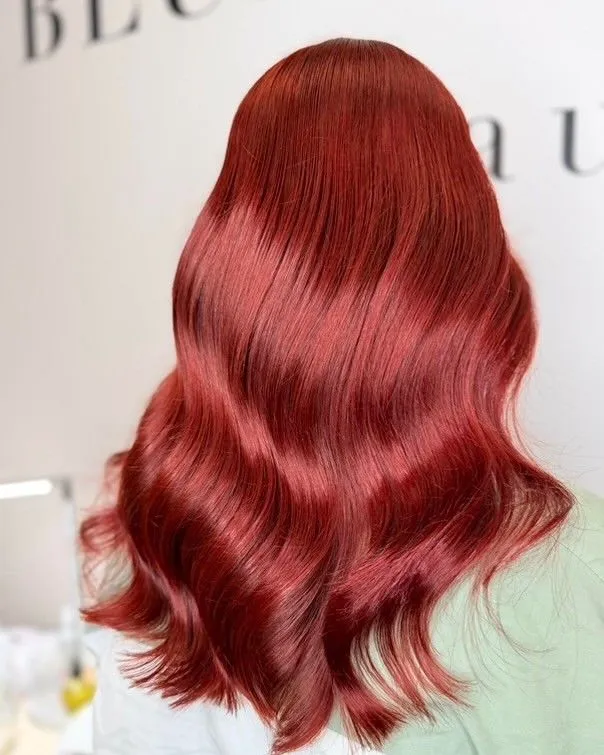
This is red with the volume knob turned all the way up. The shade sits in true-red territory — not auburn, not copper, not burgundy — somewhere around a level 6 with maximum red pigment concentration. Viewed from behind, the uniformity is the statement: no roots, no highlights, just an unbroken wall of colour that catches light as a single, glossy surface.
Achieving this level of saturation on anyone who isn’t naturally a light level 6 or 7 requires significant pre-work. Darker bases need pre-lightening to remove underlying pigment before the red can deposit evenly, and lighter bases need a filler to prevent the red from washing out translucent. This is a multi-step process and not a candidate for at-home box dye if you want the true vibrancy shown here.
The fade is fast — faster than almost any other shade in this collection. Red pigment molecules are the most escape-prone, and every wash dilutes the saturation. Colour-safe shampoo, cold water rinses, and a red-depositing mask are baseline requirements. Some people find the maintenance exhausting; others find the impact worth the effort. If you’re testing the waters, try a demi-permanent version first — it gives you four to six weeks of intensity before fading to a softer, rosier version of itself.
Cool Brunette Waves With Seamless Depth
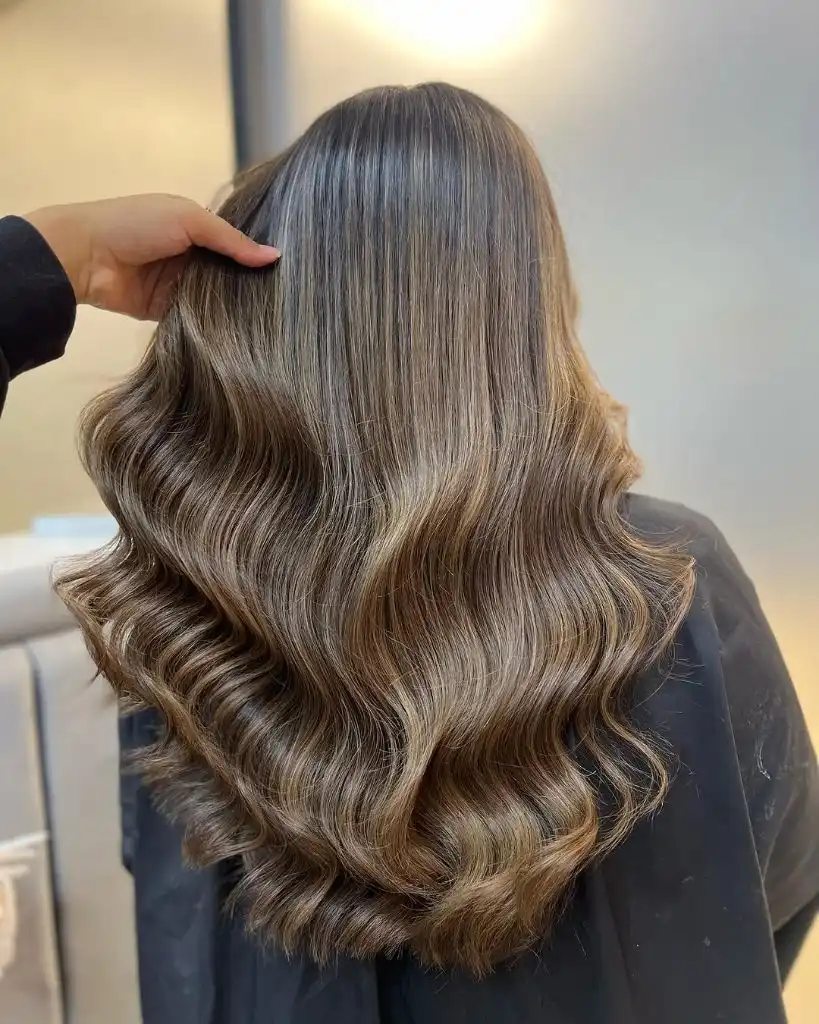
The word that best describes this is polished. A cool level-4 brunette root descends into a level-5 to level-6 mid-length with restrained ash-toned highlights threaded through the lower half. The waves are the old-money kind — uniform, smooth, S-shaped, with no frizz and no flyaways — and they give the colour’s subtle dimension enough movement to register without shouting.
This is a blowout finish, not a curling iron finish. The smoothness and regularity of the wave come from tension styling with a round brush, then setting with clips or flat pins at the ridge of each wave while the hair cools. A curling iron can approximate it, but the surface won’t be as glass-smooth unless you follow with a pass of the flat iron on low heat.
Who this suits broadens to nearly everyone because the colour is so neutral — not aggressively warm, not aggressively cool, just a refined brunette with enough depth variation to avoid looking flat. It’s a strong option for professional environments where natural-looking hair colour is the expectation but you still want your colourist to do something more interesting than a single-process brown.
Warm Caramel Balayage With A Dark Root
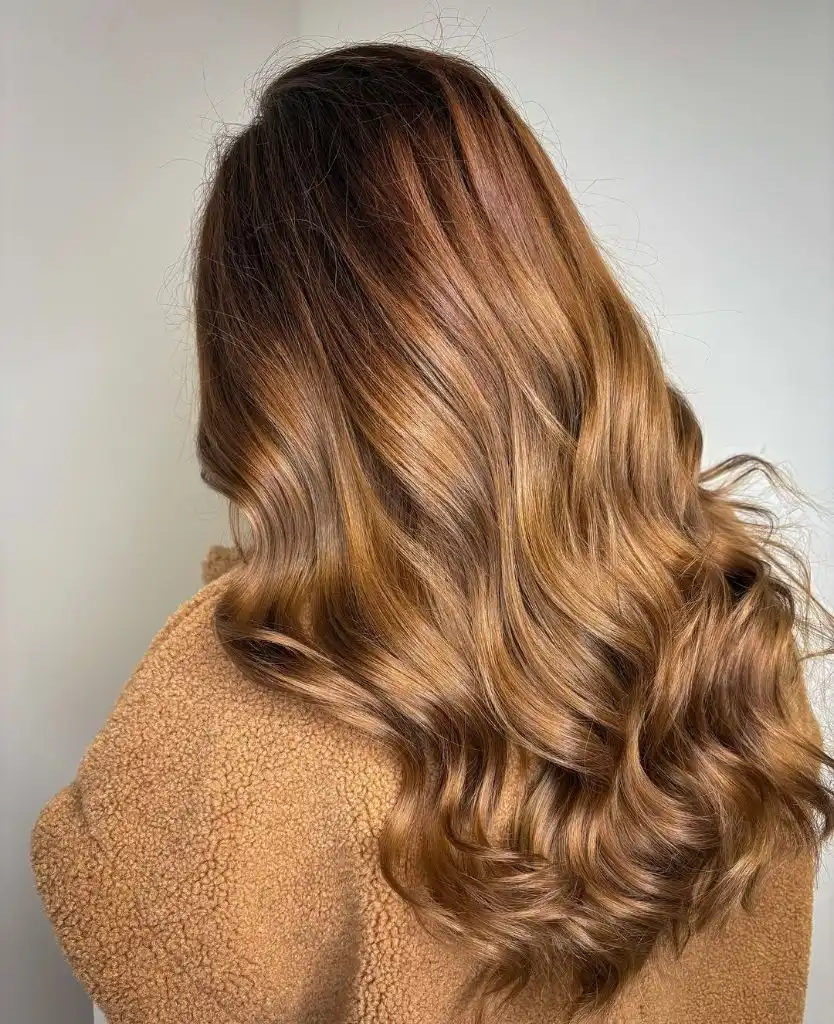
The root-to-tip journey here covers about four levels, from a level-3 dark brown at the scalp to a warm, golden level-7 caramel at the ends. What makes it land is the speed of the transition: the dark zone is compact — about two inches of root — and then it melts quickly into the warmer shades, so the overall impression is blonde-leaning rather than brown-leaning, even though the natural base is dark.
If your natural hair is in the level-3 to level-5 range, this is one of the more achievable balayage targets because the dark root is intentional, not a maintenance failure. You’re asking for lift through the mid-lengths and ends only, which means less overlap on previously lightened sections and less cumulative damage over time.
The golden-caramel tone works best in warm lighting and daylight — it can read slightly flat under fluorescent office lights, so keep that in mind if you spend most of your day indoors under harsh overheads. A gloss with a touch of gold pigment every six weeks will keep the warmth from drifting into neutral-beige territory as the toner fades.
Textured Platinum Lob With Rooted Dimension
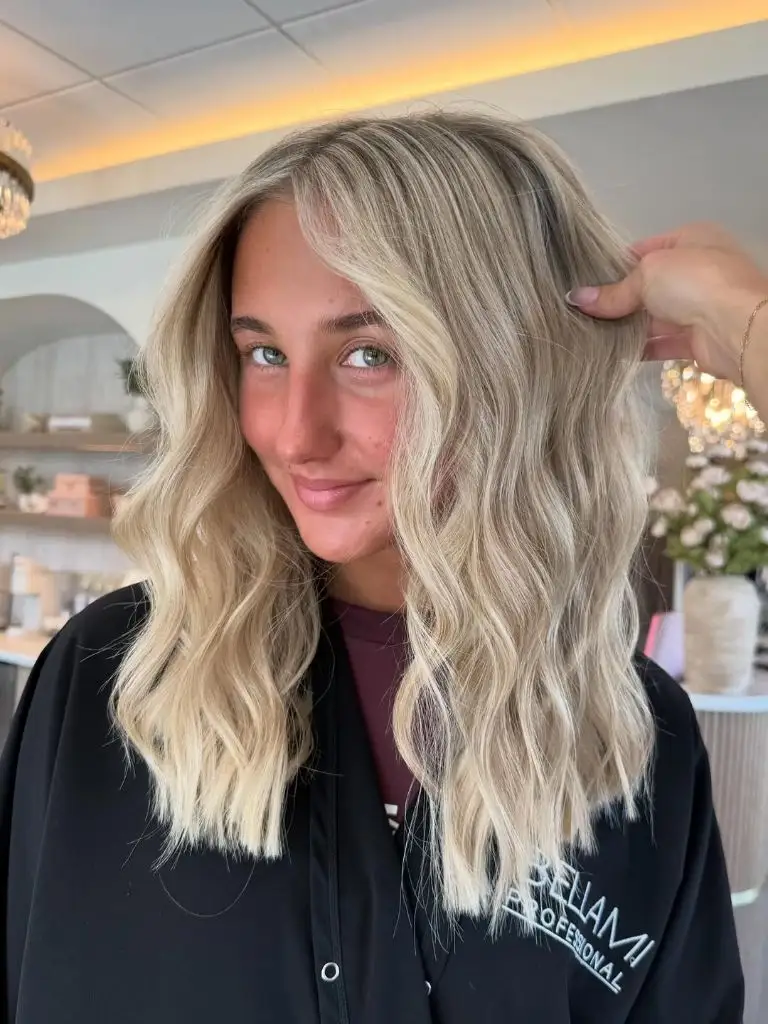
Platinum at a lob length is tricky because the short shape leaves nowhere to hide uneven lightening. This execution handles it well: the root is a deliberate, soft shadow at level 6 to 7 that fades into a creamy level-9 platinum through the mid-lengths. The texture — choppy, beachy, slightly undone — disguises any minor inconsistencies in the lift and makes the overall palette feel relaxed rather than high-maintenance.
The cut matters as much as the colour here. A blunt lob at this length would look very different — more polished, more intentional, more demanding of perfectly even colour. The textured, piece-y finish diffuses the eye and lets the platinum read as casual. If you’re going this light, discuss with your colourist whether your hair’s condition can handle the lift; anything above a level 7 starting point might get there in one session, but darker bases will need multiple appointments.
Platinum maintenance is non-negotiable: toning every four to six weeks, purple shampoo on rotation, bond-repair treatments to counteract the structural damage from high-lift bleach. The upside is that the shadowed root here buys you an extra two to three weeks before the grow-out feels conspicuous, which makes it more sustainable than a root-to-tip platinum.
Layered Brunette With Curtain Bangs

The colour here is a single-process level-4 cool brunette, and the entire personality of the look comes from the cut. Curtain bangs split at the centre and sweep to either side of the face, while medium layers from the chin down kick outward with a slight flip at the ends. That combination frames the face twice — once with the bangs, once with the layered body — creating a shape that reads youthful and intentional without any colour complexity.
If your hair is naturally this shade and you’ve been considering whether colour is necessary, this is evidence that it isn’t. A clear gloss over virgin hair will enhance shine and smooth the cuticle, giving you the same light-catching surface without altering the pigment at all. Gloss-only appointments are faster, cheaper, and zero-damage.
The curtain bang requires maintenance of its own — a trim every three to four weeks to keep it at the right length, plus a round-brush blowout on the fringe section to get the outward sweep. If you’re not willing to style bangs daily, this won’t work as intended. But for anyone who is, the payoff is a polished, face-flattering shape that works across casual and formal settings equally well.
Bright Blonde Blowout With Lifted Roots
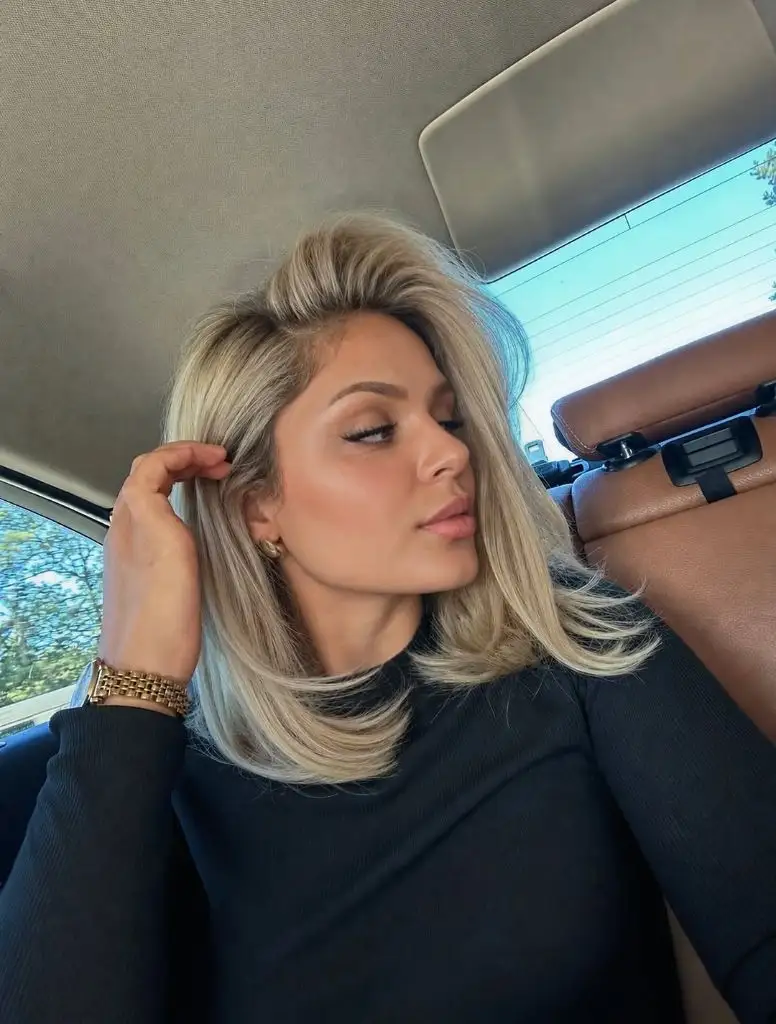
This is high-impact blonde: a creamy level-9 base with just enough root shadow at level 7 to prevent it from looking flat. The blowout is a throwback — volume concentrated at the crown, flipped ends, smoothed sides — and that structure turns the blonde into something architectural rather than just a colour. The light hits the lifted roots and reflects down the smooth shaft, creating a continuous shine line.
The shade leans warm without tipping into yellow, which is the most flattering blonde zone for most skin tones. To specify this at the salon, ask for a “warm vanilla” tone rather than “icy” or “ash” — the warm base keeps the blonde from looking grey or washed-out against the skin, which is a common complaint with cooler platinums.
The styling is the real time investment here. This blowout requires a round brush, sectioning clips, and about thirty to forty minutes of hands-on drying. A Velcro roller set can hold the shape while you finish getting ready, and a light-hold hairspray at the end locks the volume without making it crunchy. If daily blowouts aren’t realistic, this is also a strong candidate for a weekly professional blowout service.
Seamless Dark-to-Blonde Sombré
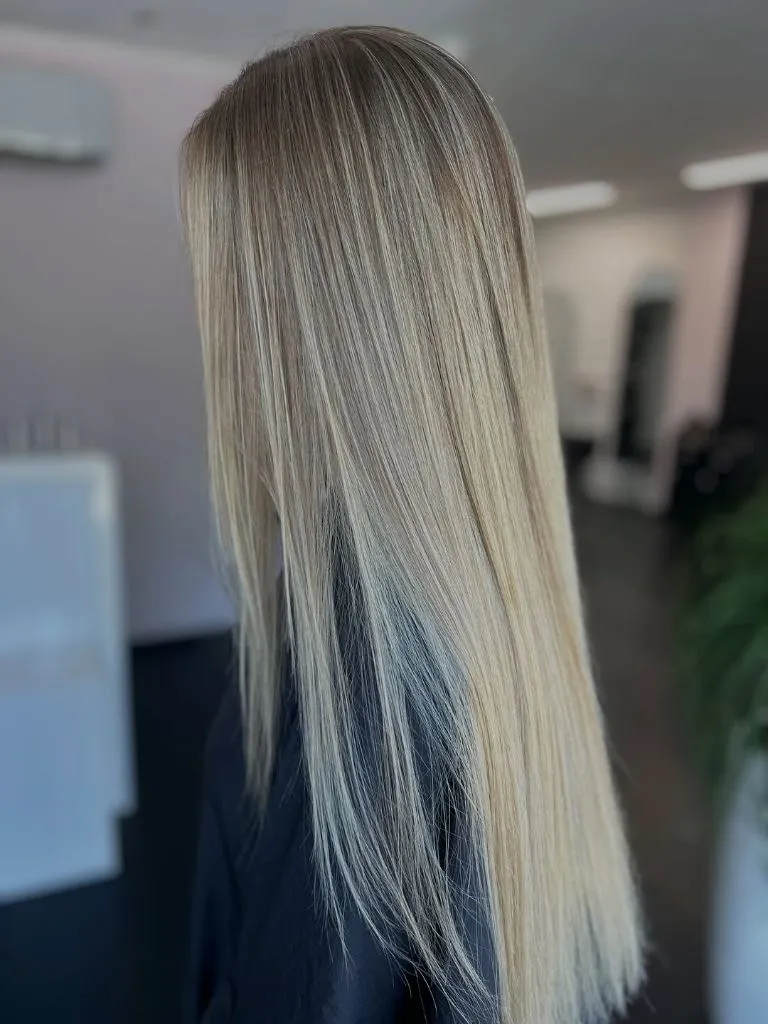
Sombré — the softer sibling of ombré — depends entirely on how invisible the transition line is, and here it’s genuinely invisible. A level-5 ash-brown root zone dissolves into a level-8 to level-9 cool blonde through the mid-lengths, with no obvious point where one ends and the other begins. The straight styling makes this seamlessness especially impressive because there’s no wave or curl to camouflage a hard line.
Wearing this straight is a statement of confidence in the technique. Any unevenness in the melt would be immediately visible on flat, smooth hair, so this only works if the colourist’s blending is precise. If you’re showing this as a reference photo, pair it with the explicit note that you plan to wear it straight — that tells the colourist to spend extra time on the transition zone.
This is among the lower-maintenance options for anyone who wants significant blonde without constant root touch-ups. The dark root is the design, not the problem, and it can grow for twelve or more weeks before looking untended. It works across most undertones, though the cooler-leaning blonde here particularly complements cool and neutral skin. If you run warm, ask for the blonde to lean golden rather than ash and you’ll get the same structural effect with a warmer feel.
Warm Toffee Brunette With Glossy Curled Ends
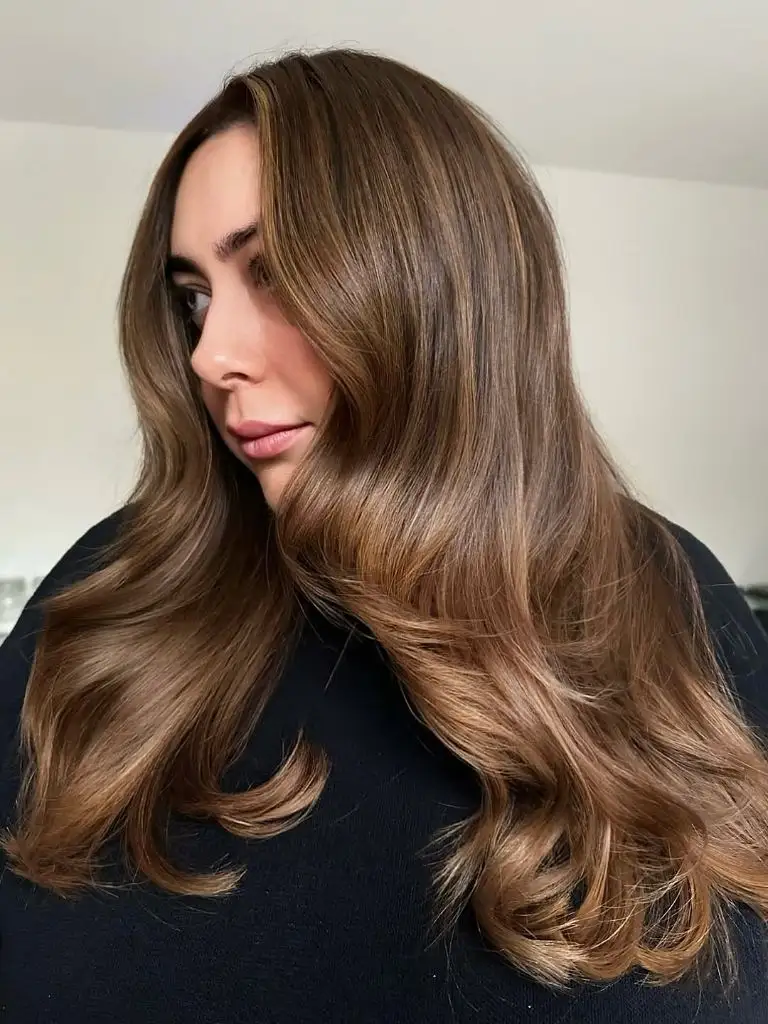
The colour here is warm, rich, and monochromatic in the best way. A toffee-brown level 5 to 6 with golden-caramel undertones carries from root to end, with only the slightest lightening at the very tips where the curls catch the most light. The gloss level is notable — this is clearly freshly coloured or freshly glossed hair, with a cuticle surface smooth enough to reflect light as a continuous sheen.
To achieve this specific finish, a gloss or glaze appointment is essential. Permanent colour alone won’t deliver this level of shine — you need the additional cuticle-sealing effect that a demi-permanent topcoat provides. Apply it as a separate step after the base colour, or as a standalone service on naturally warm brunette hair that already sits in the right tonal range.
This is a September hair colour trend for 2026 that plays well in nearly every context. It’s office-appropriate, it photographs beautifully in autumn light, and it transitions into winter without needing adjustment. The curled ends — set with a 1.5-inch barrel and brushed through for softness — add movement without competing with the colour. If you want a shade you can rely on for three to four months without a major refresh, this warm toffee is as close to set-and-forget as colour gets.
Natural Dark Blonde With Soft Texture
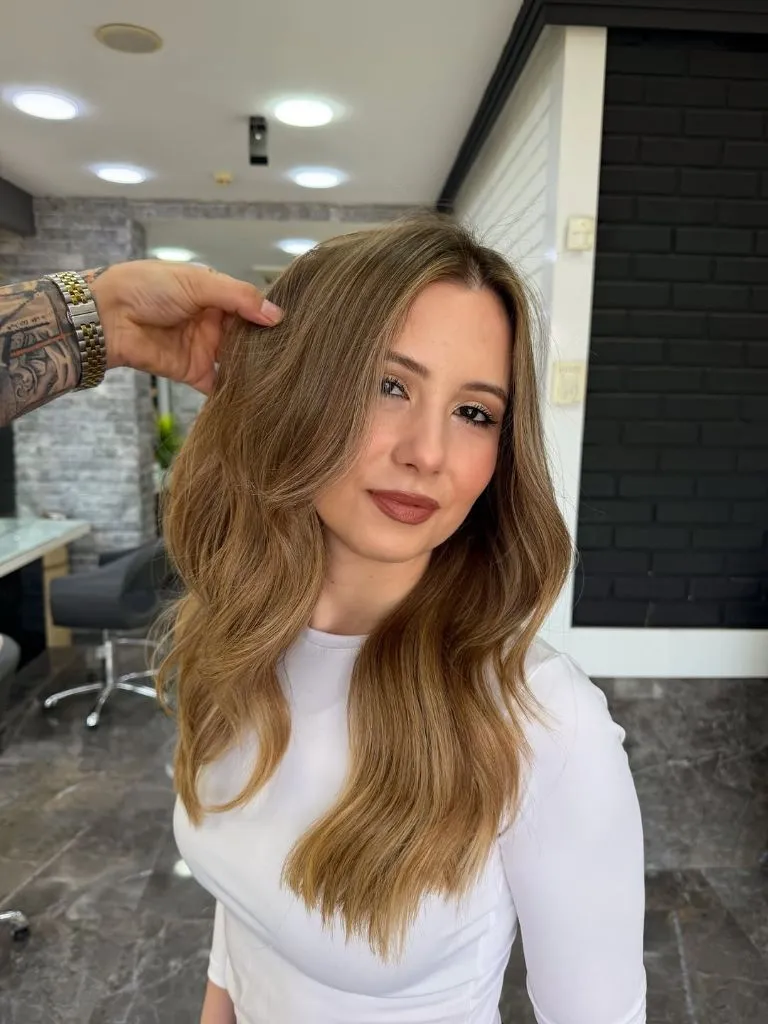
There’s a specific shade of dark blonde — around a level 7 with neutral-to-warm undertones — that reads as the most universally natural hair colour in Western contexts. This is it. No highlights, no lowlights, no dimension tricks: just a clean, even, well-toned dark blonde that sits exactly where genetics might have put it. The soft wave adds just enough texture to keep it from looking like a wig or a flat colour swatch.
The colour itself could be achieved through a single-process tint on anyone within two levels of the target, or through a toner on pre-lightened hair that’s been lifted to the right canvas. The finish — soft, slightly matte, not glass-shiny — suggests a tint rather than a gloss, which gives it that “born with it” quality that glossier finishes sometimes undermine.
If your colourist asks what you want and you’re struggling to articulate it beyond “natural,” this photo is the answer. It’s the colour equivalent of no-makeup makeup: carefully calibrated to look like nothing was done, which paradoxically requires precision. The maintenance is minimal — touch up every eight weeks, no toner appointments between, no special products beyond standard colour-safe care. For anyone who wants a foundational shade before deciding whether to add face-framing highlights for autumn, this is the cleanest starting point.