There is something quietly satisfying about a sport that asks you to move in every direction — forward, lateral, backward — and still look composed doing it. Padel, with its enclosed glass courts and fast-paced doubles play, demands clothing that can handle sudden pivots, overhead smashes, and long rallies without riding up, bunching, or overheating. Figuring out what to wear for padel court outfits is less about following tennis conventions and more about understanding how fabric, cut, and structure behave under pressure. The court is smaller than a tennis court, but the movement intensity is high, and every garment choice gets tested within the first few points.
The smartest approach is to start with one anchor piece — usually the bottom — and build around it. A skirt with built-in compression shorts, a dress with a clean hemline, or a tailored short that sits above the knee without shifting. Once that foundation feels secure, everything else follows: the top can be looser or more fitted, the layers can be functional or purely aesthetic, and the footwear becomes the final structural decision. Comfort during lateral movement matters more than any trend, and the best padel outfits tend to reflect that priority without sacrificing visual intention.
The Navy Athletic Dress with White Piping
A one-piece athletic dress remains one of the most streamlined choices for padel, and a navy version with fine white piping along the neckline and zipper achieves a look that reads both polished and ready to compete. The V-neck silhouette elongates the torso while the A-line skirt provides room for a full range of leg movement during low volleys and wide defensive stances. Navy as a base color absorbs sweat visibility better than lighter tones, which is a practical advantage during longer sessions. The white trim creates a subtle contrast line that defines the garment’s structure without adding bulk. The overall proportion — fitted through the bodice, relaxed through the hem — mirrors what works best in high-movement sports where the upper body rotates frequently.
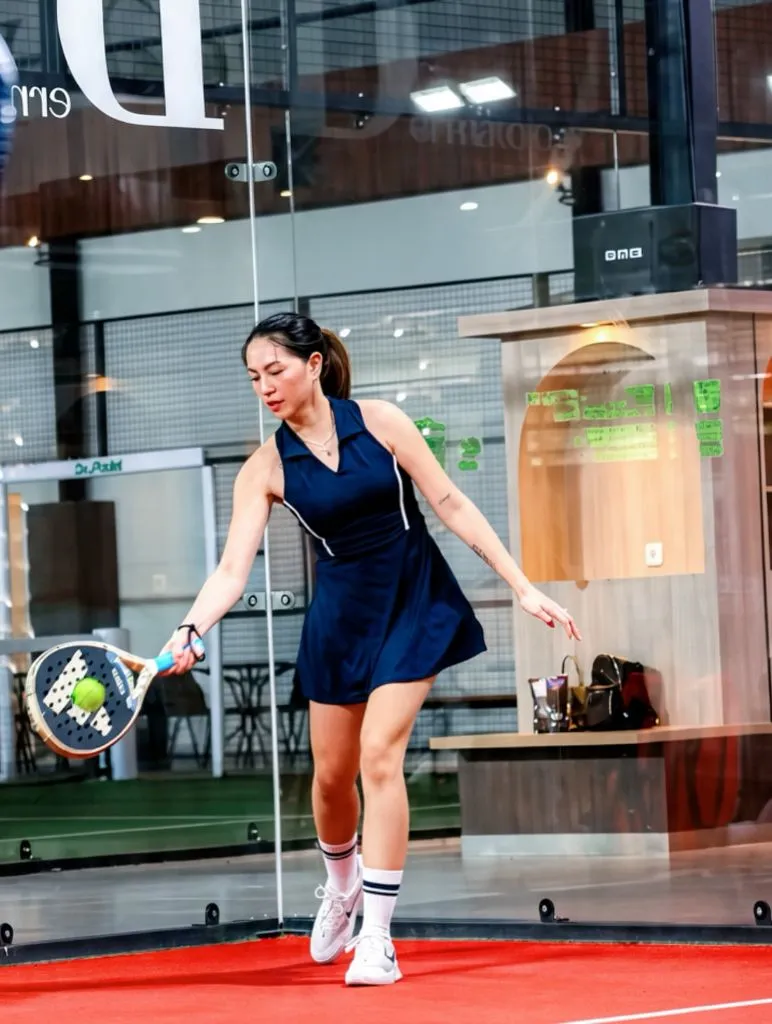
For players who prefer separates over a one-piece, the same visual effect can be achieved with a navy sleeveless polo and a matching flared skort. The key is maintaining that clean color continuity from shoulder to hem so the eye reads it as a single silhouette. White sneakers and striped crew socks complete the frame without competing for attention. If the court runs warm or indoor lighting makes darker fabrics feel heavier, switching to a lighter navy — almost a steel blue — keeps the same discipline without the heat retention.
The reason this combination works so reliably is proportion. The fitted top half and the releasing bottom half create a visual rhythm that flatters most body types while also being mechanically sound for overhead shots and quick direction changes. Piping or trim acts as a quiet architectural detail — it gives the garment visual edges without adding seams or weight. Navy and white together carry a timeless sports-heritage quality that never reads as trying too hard.
The Cropped Tank and Pleated Dark Skirt
Separates give more control over individual fit, and a cropped athletic tank paired with a pleated dark skirt is one of the most effective two-piece combinations on a padel court. The crop sits at the natural waist or just above the skirt’s waistband, creating a sliver of visual break that makes the outfit feel modern without exposing too much during overhead motion. A navy or black pleated skirt with a red-striped waistband introduces a single accent color that anchors the eye. The pleats themselves serve a functional purpose — they expand with movement and fall back into place at rest, which is exactly what lateral shuffling demands.
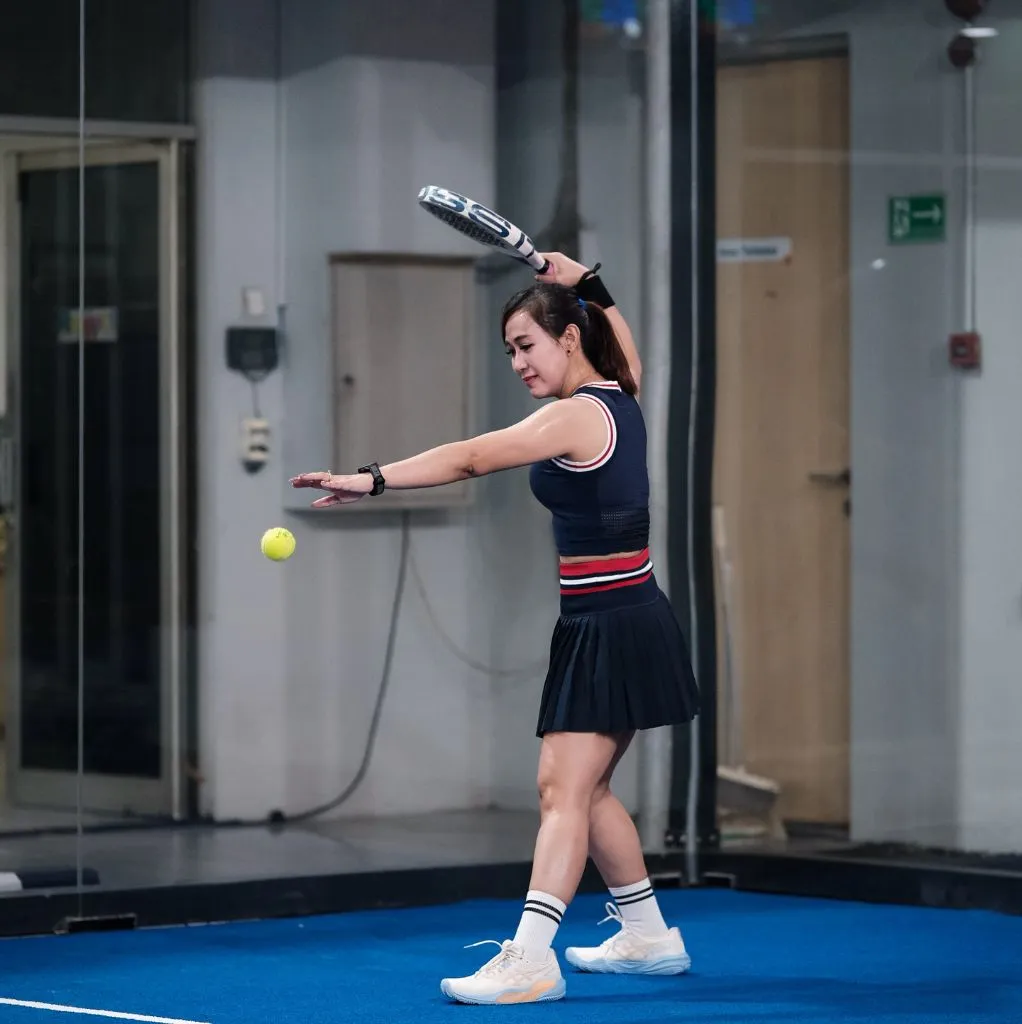
This outfit adapts well to different weather conditions. In cooler indoor courts, adding a lightweight long-sleeve layer over the tank preserves the silhouette while managing temperature. In warmer settings, the breathability of the exposed midsection helps regulate body heat during extended play. The tradeoff with pleated skirts is that heavier fabrics hold shape better but breathe less, while lighter technical fabrics move beautifully but may lose their pleat definition over time. Choosing a skirt with permanent press pleating solves this, though they tend to cost slightly more. If you are planning outfits for the transitional season ahead, the same styling logic applies to September outfit ideas that balance warmth and movement.
What makes this pairing visually successful is the contrast between the smooth, fitted tank and the textured, moving skirt. The eye processes two distinct zones — a stable upper body and a dynamic lower half — which mirrors the actual mechanics of padel play. The accent stripe on the waistband works like a belt in traditional fashion: it defines the transition point and keeps the outfit from reading as a uniform.
The White Polo Tee and Bow-Tied Pleated Skirt
There is a particular subset of padel style that borrows from classic country club aesthetics and softens it with contemporary details. A fitted white polo tee with black collar trim, paired with a white pleated skirt accented by a black ribbon bow at the waist, sits squarely in this territory. The monochromatic white palette keeps the look cohesive and clean, while the black accents — collar, bow, and possibly a visor — provide the necessary visual punctuation. A checkered pattern peeking from beneath the skirt hem adds a layer of detail that only reveals itself in motion.
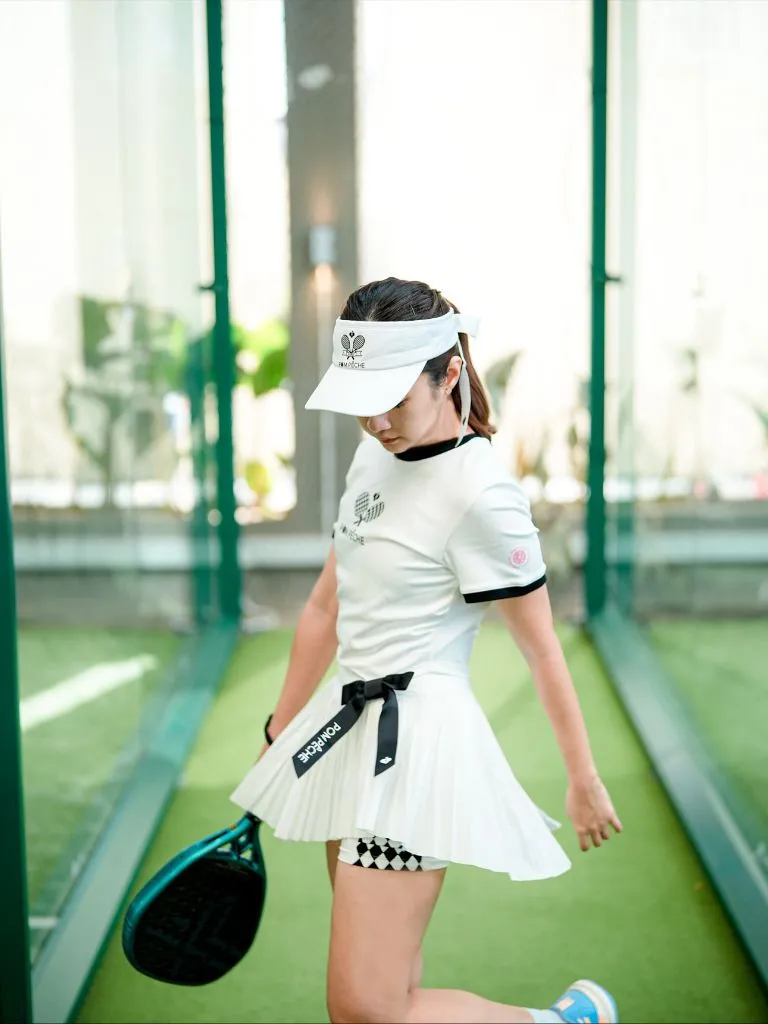
The practical consideration with all-white on a padel court is maintenance. Artificial turf courts with sand infill can leave marks on white fabrics, and sliding into glass walls — a common defensive move — can add scuffs. Choosing technical white fabrics with stain-resistant finishes makes this look sustainable for regular play. The bow detail, while charming, should be secured so it does not loosen mid-match; a stitched or pinned bow is preferable to a tie-on one. A visor with the same brand insignia as the top creates a unified look without requiring a full cap, which can feel heavy during intense rallies.
The design principle at work here is controlled ornamentation. Every decorative element — the bow, the checkered lining, the collar contrast — is small and intentional. Nothing competes with the overall white field, so the outfit reads as elegant rather than busy. This is the opposite of maximalism; it is strategic restraint applied to sportswear, and it works because the court itself provides enough visual complexity with its blue or green surface and glass reflections.
The Long-Sleeve Cream Top with Light Skirt
Court coverage does not have to mean warmth sacrifice, and a long-sleeve cream or off-white fitted top paired with a white flared skirt demonstrates how to maintain a soft, light palette while protecting arms from indoor air conditioning or sun exposure on outdoor courts. The long sleeves add a layer of formality and visual weight to the upper body, which balances nicely against the lightness of a skirt that moves with every step. The fitted nature of the top prevents excess fabric from interfering with the paddle grip or follow-through.
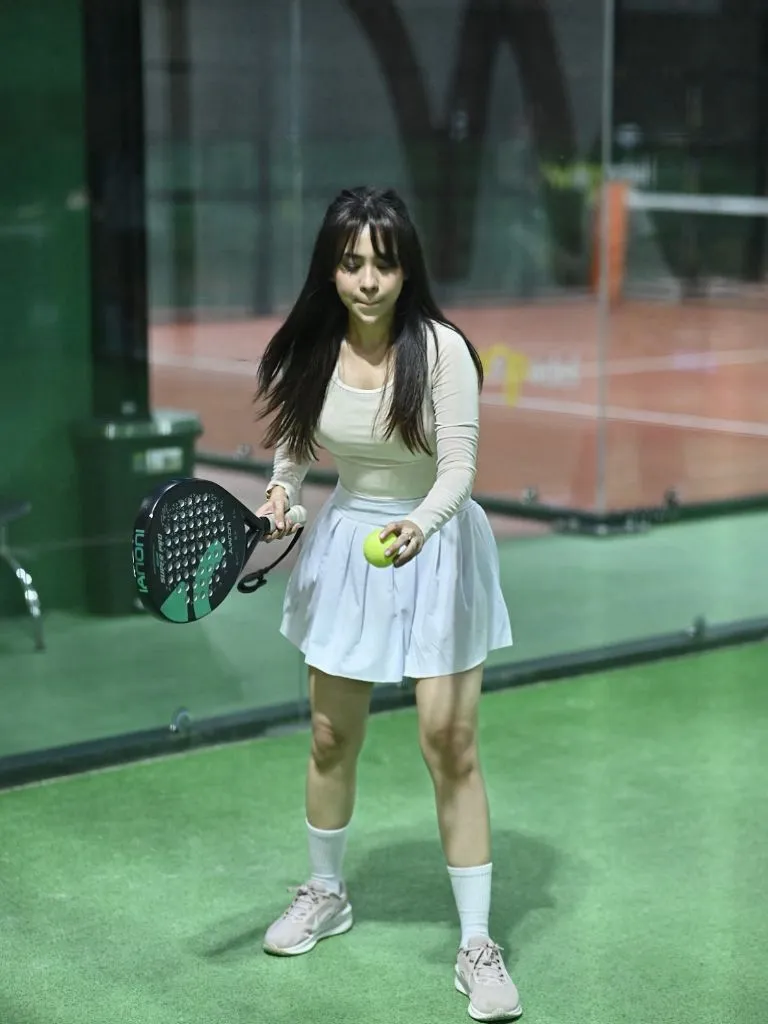
This combination works particularly well for evening sessions or air-conditioned indoor facilities where bare arms can feel uncomfortable after the initial warm-up fades. The tradeoff is that long sleeves retain more heat during sustained play, so moisture-wicking fabric is non-negotiable. A four-way stretch material allows full arm extension during serves and smashes without pulling at the shoulders. For those who find the monochrome cream look too subdued, a padel racket with a bold color — green, orange, or graphic black — becomes the accent piece that the outfit itself does not provide.
The success of this look comes from its softness. In a sport often associated with bright colors and loud patterns, an all-cream or all-white outfit with no hard contrasts creates a kind of visual quiet. It lets the body’s movement become the focal point rather than the clothing. This is a design choice rooted in confidence — the understanding that simplicity, when executed in the right fabrics and fit, needs nothing added.
The Cream Polo and Scalloped Beige Skirt
Tonal dressing — wearing varying shades of the same color family — translates beautifully to padel because it creates a long, unbroken visual line from shoulder to hem. A cream zip-front polo with scalloped sleeve edges paired with a beige pleated skirt with scalloped hemline achieves this effect with a deliberately soft, almost vintage femininity. The scallop detail appears twice, on sleeves and hem, creating a repeating design motif that ties the two separate garments together as though they were designed as a set. The beige-to-cream gradient reads as intentional and composed.
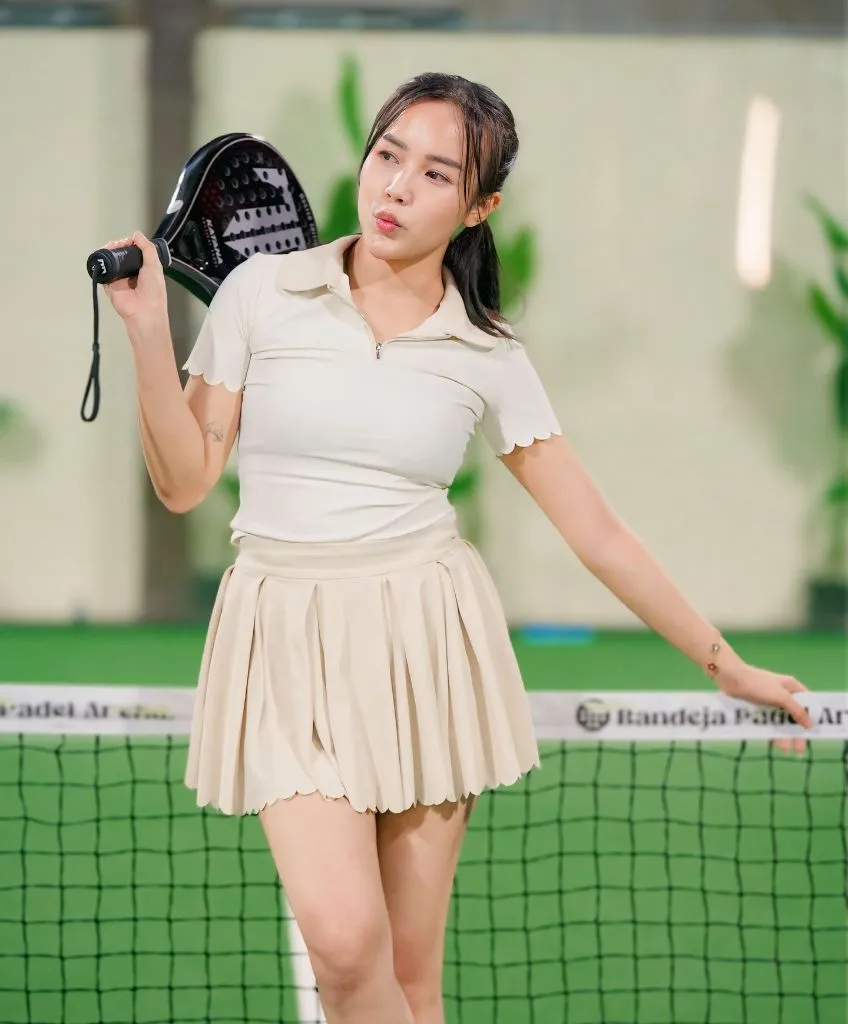
The scalloped edges are a detail worth considering carefully — they look distinctive in photos and at rest, but during aggressive play, the cut of the scallop should sit above any point where the fabric might catch on the paddle or wrist. A mid-thigh skirt length with this hemline works well because it clears the knee on all movements. If the full tonal look feels too uniform, a white shoe with a contrasting sole or a metallic detail on the paddle wrist strap introduces just enough difference to break the monotony. The fabric weight should stay light; beige and cream in heavier materials can read as more appropriate for brunch than backhands.
What makes tonal padel outfits effective is the absence of visual distraction. On a busy court with glass reflections, colorful advertising banners, and a partner across the net, wearing one unified color story keeps the silhouette clean and the outfit from competing with the environment. The scallop detail adds personality without volume, which is the exact calibration that works in athletic fashion — enough interest to feel considered, not so much that it distracts.
The Collared Green Dress with White Trim
A structured one-piece in a deep forest green with a contrasting white collar brings a decidedly refined sensibility to the padel court. The collared design borrows from golf and tennis heritage, but the longer sleeves and pleated skirt portion make it feel less conventional and more like a considered fashion piece. The white collar and white hem trim create two horizontal lines — one at the neck, one at the skirt edge — that frame the green body of the dress like a border on a painting. The effect is architectural and deliberate.
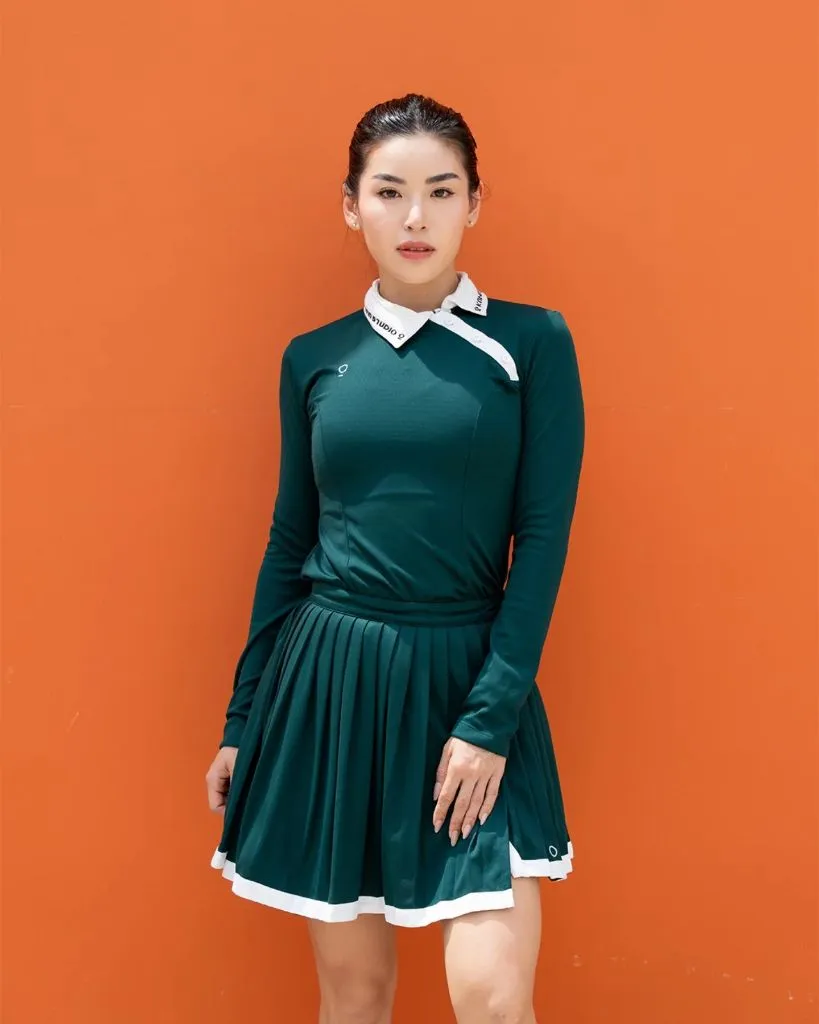
Green is an underused color on padel courts, which means it carries a natural distinctiveness. On blue artificial turf, it provides a striking chromatic contrast; on green courts, it creates an interesting camouflage-like harmony. The long sleeves make this dress better suited to cooler conditions or shaded courts, and the structure of the collar means it should sit flat even during forward-leaning ready positions. For those who want the color impact without the full coverage, a sleeveless version of the same silhouette with a mock collar would preserve the formality while allowing more airflow.
The principle here is borrowed contrast — using two colors that exist in high opposition (dark green and bright white) at strategic points to define the garment’s geometry. It is the same logic used in architectural trim on buildings: the white edges make you aware of the green’s depth. On court, this makes the player visually distinct and the outfit memorable, which matters in a sport increasingly visible on social media and in lifestyle coverage.
The Light Blue Sleeveless Dress on Blue Court
Wearing a color that nearly matches the court surface is a bold aesthetic choice, and a pale blue sleeveless dress with a pleated skirt on a blue artificial turf court creates an unexpectedly cohesive image. The dress blends with the environment in a way that feels intentional and almost cinematic. The pleats catch light differently than the matte turf, so even in similar tones, the texture difference keeps the player visually distinct. A black smartwatch and subtle necklace serve as the only contrast points.
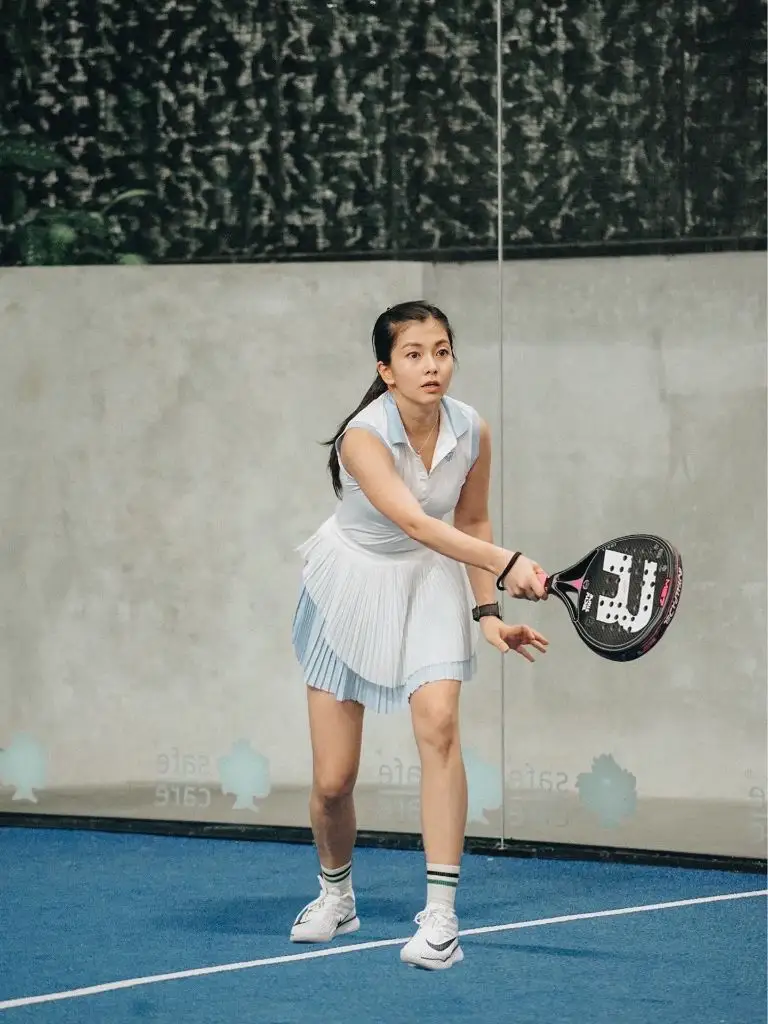
This monochromatic-to-environment approach works best when the garment has visible structure — pleats, a defined collar, or a clean hemline — that separates it from the flat background. Without those details, the player risks disappearing into the court, especially in photographs. White shoes and striped socks help ground the figure against the blue field. The sleeveless cut is ideal for warm indoor courts, though it offers less protection during wall dives. A simple armband or sweatband in white adds a functional accent while also breaking up the blue visually.
The design lesson here is about context-aware dressing. Understanding the color of the court surface and choosing to either contrast with it or harmonize with it is a sophisticated styling decision. Harmonizing, as in this case, creates a mood — calm, composed, connected to the space. It works particularly well in indoor padel facilities where the lighting is consistent and the court color is uniform. It is a quieter way to make a strong impression.
The All-Pink Pleated Set with Headband
Pink on the padel court is not subtle, and it is not meant to be. A matching pink sleeveless polo and pleated skirt, completed with a coordinating pink headband, creates a unified statement that draws attention through saturation rather than pattern. The monochrome approach in a warm, mid-tone pink reads as playful but not juvenile, especially when the fit is tailored and the fabric has enough structure to hold its shape during aggressive play. The skirt’s tulle-like quality adds a softness that makes the outfit feel less athletic and more editorial.
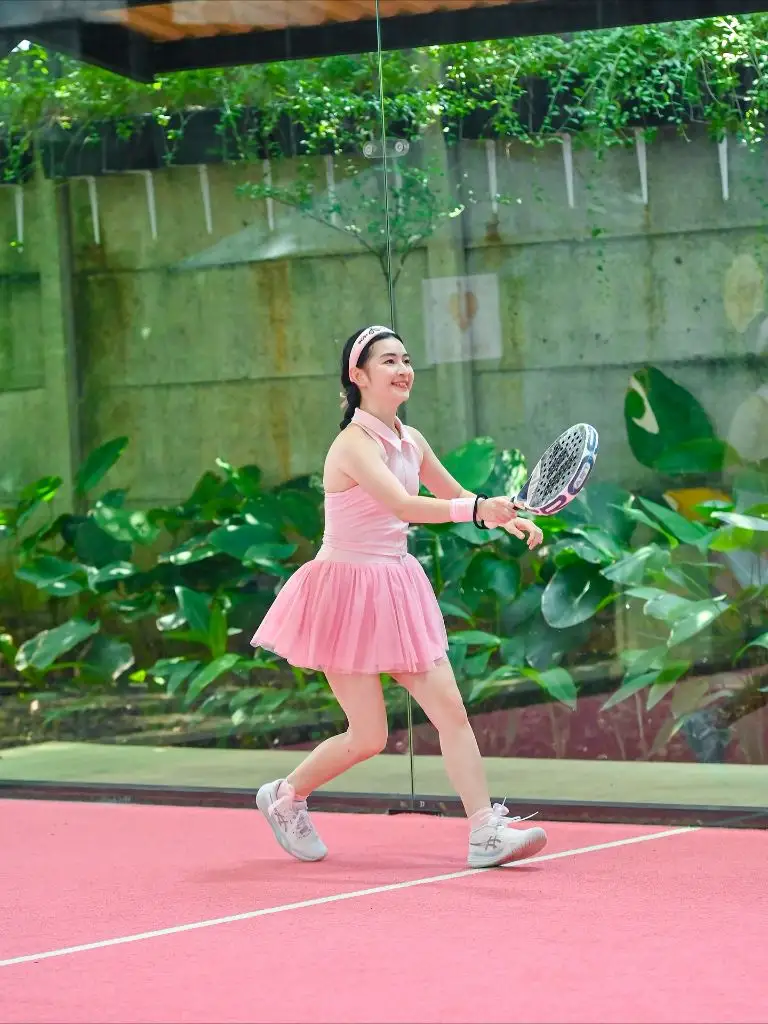
Pink shows well against both blue and green court surfaces, which gives it strong visual pop in photographs and from spectator distance. The headband serves double duty — it keeps hair managed during play and completes the color story from head to skirt. The practical tradeoff is that lighter pinks can show sweat marks more readily than darker tones, so choosing a fabric with a matte finish or built-in moisture management helps maintain the clean look through longer sessions. White shoes keep the base neutral and let the pink dominate, which is the right hierarchy for this outfit.
Monochromatic saturated outfits work because they simplify the visual equation. When every element shares the same hue, the viewer’s attention goes to silhouette and movement rather than pattern or color blocking. On a padel court, where motion is constant and fast, this simplification is actually an advantage — it makes the player read as a single, cohesive shape moving through space, which is both aesthetically pleasing and practically undistracting.
The Green Sweatshirt and Pink Skirt Off-Court
What to wear for padel court outfits extends beyond the glass walls and into the transition between playing and socializing. A green embroidered crewneck sweatshirt layered over a pink tennis-style skirt — with a pink cap and a designer bag on the bench beside — bridges the gap between sport and lifestyle. The green and pink combination is a complementary color pairing that feels fresh and seasonal. The sweatshirt’s relaxed fit contrasts with the skirt’s shorter, more structured hemline, creating an intentional high-low balance.
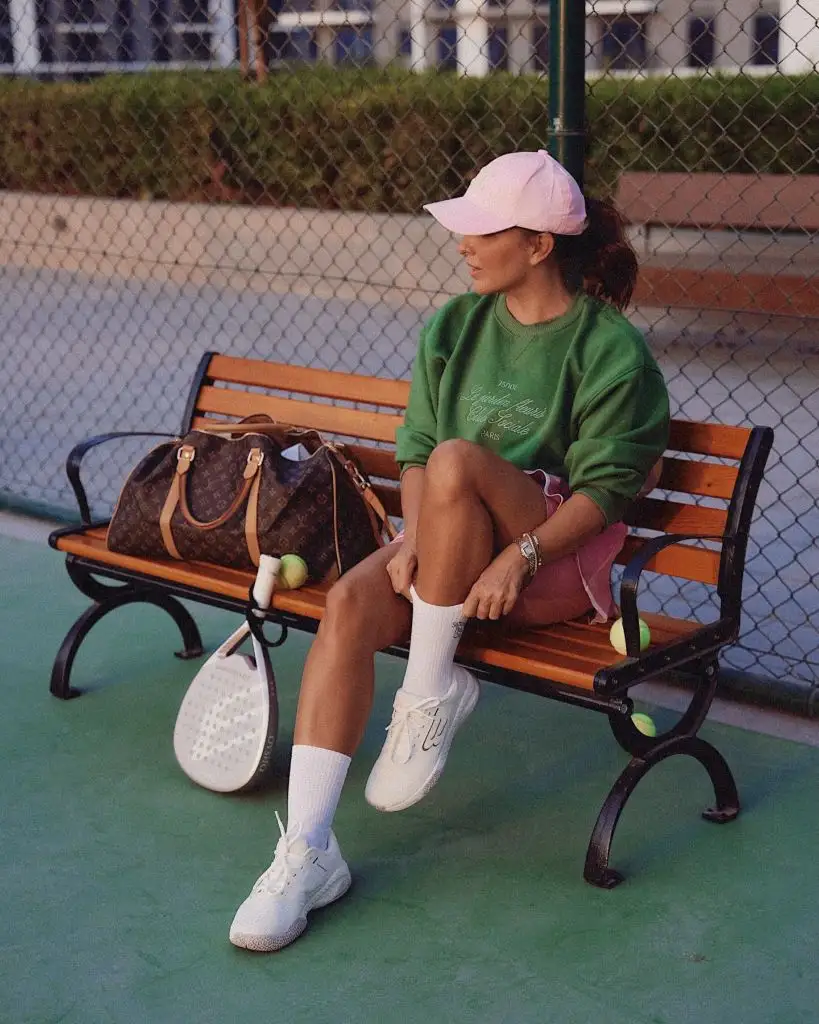
This is the outfit for the player who goes straight from the court to coffee, brunch, or errands. The sweatshirt hides any perspiration from the session, and the skirt, already designed for movement, transitions seamlessly to walking or sitting. The cap adds sun protection for outdoor courts and doubles as a style piece off-court. Keeping the sneakers white and the socks high gives the look a retro-athletic reference that ties the sportswear origin back in. For those exploring seasonal wardrobe transitions, this kind of layering is similar to how September fashion trends emphasize mixing athletic and casual pieces.
The design insight here is about intentional mismatching. The sweatshirt is oversized; the skirt is fitted. The green is deep; the pink is pastel. These contrasts, when placed together deliberately, create tension that reads as stylish rather than confused. The designer bag is the unifying signal — it tells the viewer this outfit was chosen, not thrown together. Off-court padel dressing is its own category, and it thrives on this kind of confident juxtaposition.
The All-White Racerback Dress for Doubles
White remains the most traditional choice for racket sports, and a racerback-cut white dress on a blue padel court carries a clean authority that louder outfits sometimes lack. The racerback design frees the shoulder blades completely, which is critical for overhead smashes and high volleys where full arm extension determines shot quality. The skirt portion flares slightly, allowing the wide stance required in the ready position. A SIUX or similar brand paddle and white court shoes complete a kit that is entirely functional and entirely considered.
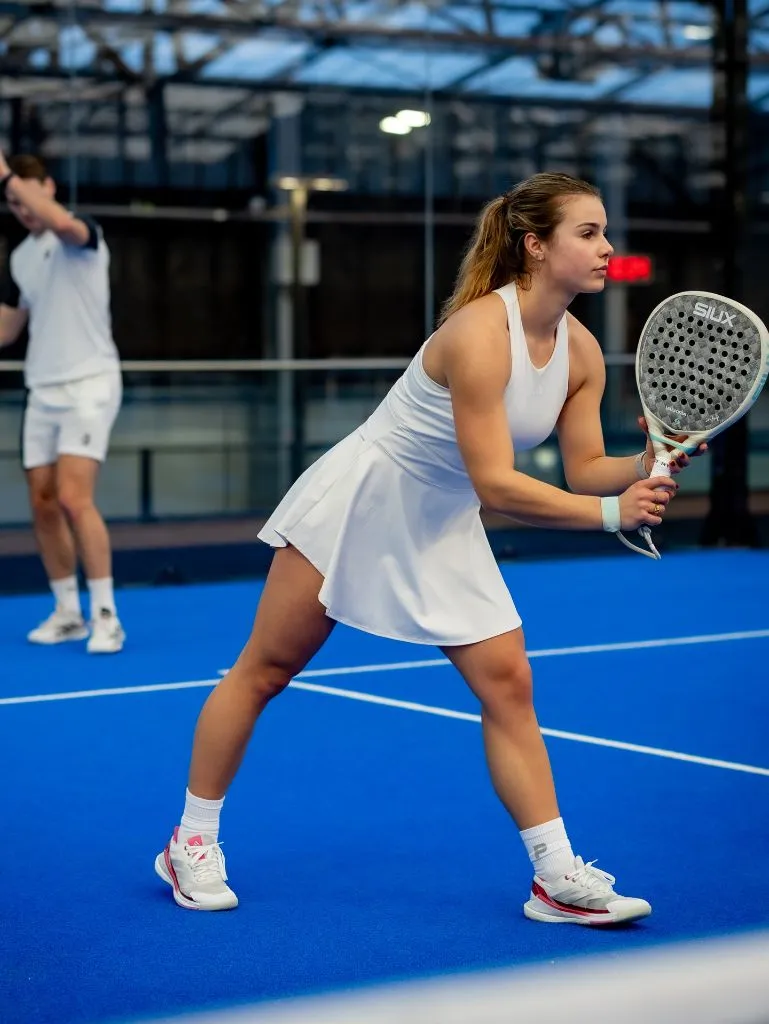
The racerback cut does require attention to undergarments — a built-in bra or a matching white sports bra prevents any strap visibility that would break the clean line. For players who prefer more coverage across the back, a Y-back or crossover-back design offers a similar range of motion with slightly more fabric. White dresses on blue courts photograph exceptionally well because the contrast is stark and the player stands out immediately. The one maintenance consideration is that white technical fabric requires prompt washing after play to prevent yellowing from sweat and turf dust.
The reason the all-white look persists across decades and across racket sports is its visual clarity. There is no color to interpret, no pattern to process — just shape, movement, and the court behind it. This forces attention toward the player’s form and technique, which is perhaps why it has been the default in competitive settings. On a padel court, where the glass walls already add visual complexity, wearing white is a kind of visual restraint that lets everything else — the game, the architecture, the energy — speak.
The Black Adidas Jacket over White Match Skirt
Layering before and between sets is its own styling opportunity, and a black Adidas zip-front hoodie worn over a white flared skirt creates one of the most immediately recognizable padel-adjacent silhouettes. The black jacket brings visual weight to the upper body while the white skirt stays light and mobile. This is the warm-up look, the post-match celebration look, and the courtside socializing look, all depending on whether the zipper is up, half-down, or the jacket is draped over the shoulders.
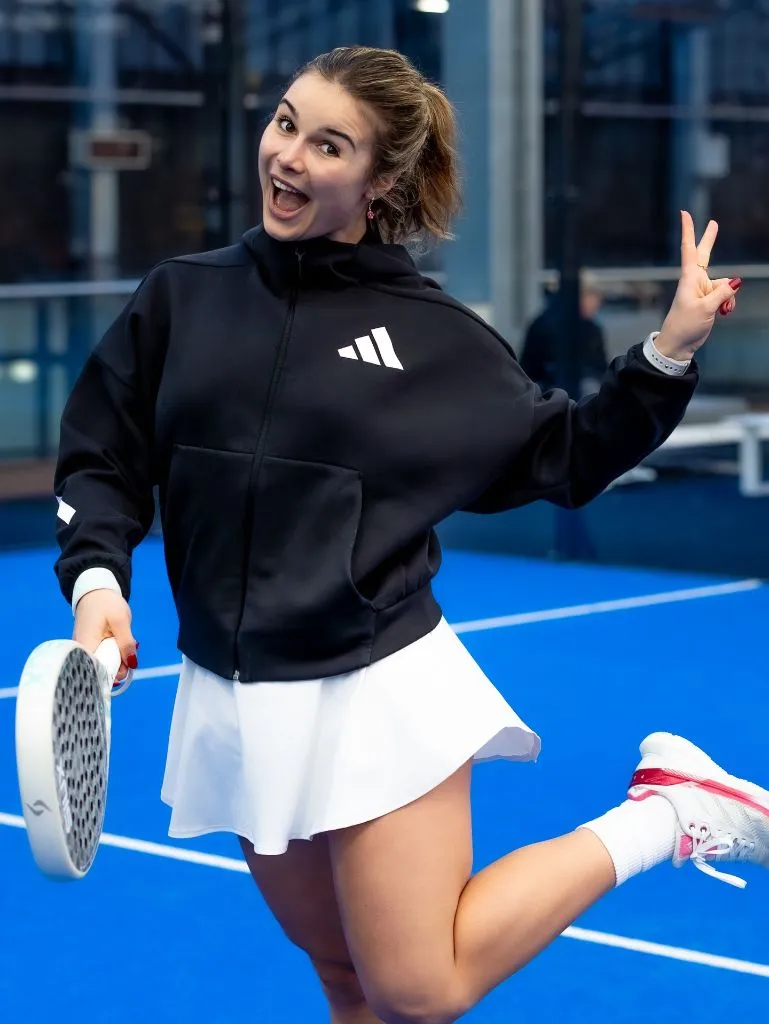
The practical advantage of a structured athletic jacket over a hoodie or pullover is that it can be removed quickly between points during warm-up. A front zip is faster than pulling something over the head, and it does not disturb a ponytail or headband. The jacket pocket also provides a place for a spare ball or phone during breaks. The tradeoff is that most athletic jackets are not designed to be worn during actual play — they are too warm and restrictive — so this is purely a transitional garment. Choosing one with a slightly cropped length keeps it from covering the skirt’s movement, which maintains the outfit’s visual balance.
The black-and-white combination works here for the same reason it works everywhere: it is the highest-contrast pairing possible. The eye immediately reads the division between the two zones, which creates a graphic quality that looks sharp in any lighting. On a padel court, where the blue surface provides a third color, this two-tone outfit sits naturally in the composition without clashing. It is effortless in the way that only deeply considered simplicity can be.
The Casual Group Session in Mixed Separates
Padel is a doubles sport, and the visual dynamic between partners and across the net adds a dimension to outfit planning that solo sports lack. Three players sitting courtside in a mix of cream tanks, navy polos, black tops, and neutral or white shorts create a palette that is cohesive without being coordinated. The padel rackets — in orange, black, and white — add the accent colors that the outfits deliberately leave out. This is the aesthetic of a regular session between friends, where individual style exists within a shared visual language.
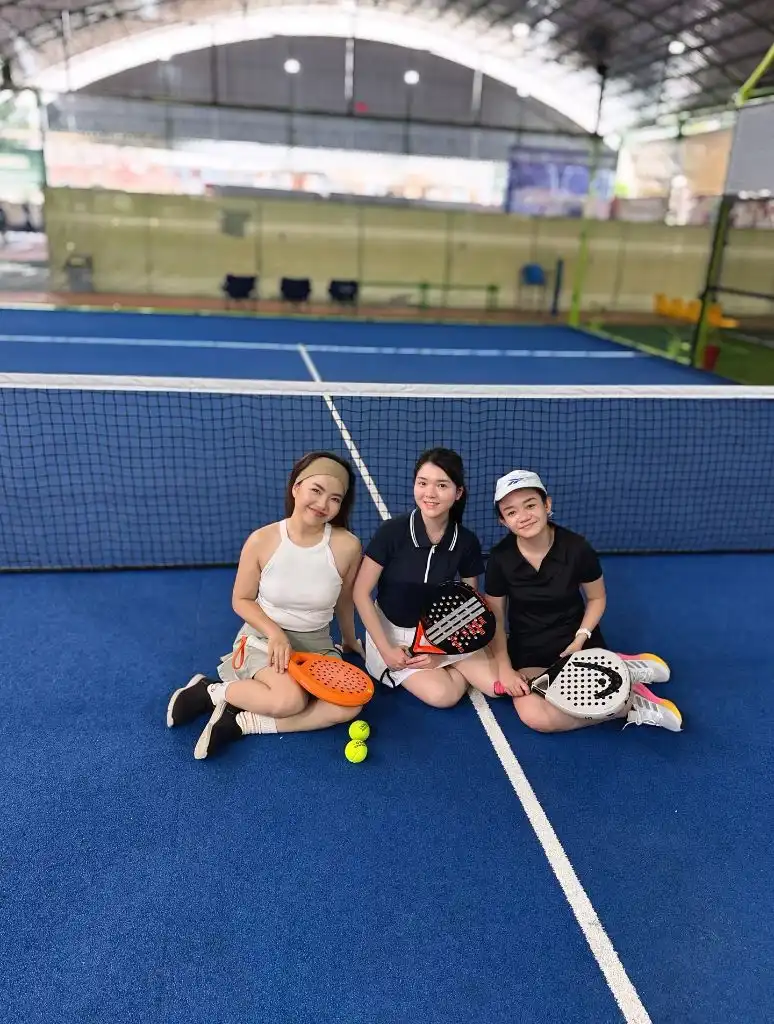
For regular group play, having a personal uniform — a go-to combination that fits well and performs consistently — is more practical than planning a new outfit each session. A rotation of two or three tops in neutral tones and two reliable skorts or shorts in black, navy, and white covers every combination without thinking. The socks matter here too: mid-calf athletic socks in white with a simple stripe are the standard, and they protect the ankle during the quick lateral movements that padel demands. Matching shoes are less important than matching comfort levels — a shoe that grips artificial turf well is worth more than one that coordinates with the top.
Group padel style works best when it operates on a shared palette rather than a shared outfit. If everyone independently gravitates toward neutrals and clean lines, the group photographs well together without looking like a team. This unspoken coordination is the hallmark of a regular playing group that takes both the sport and the style seriously. The court becomes the backdrop, the outfits become individual expressions, and the rackets — always the most colorful element — tie the frame together.
The Navy Polo and White Pleated Skirt Standard
Some combinations earn their status as defaults because they simply work without qualification. A fitted navy polo with a zip collar and white trim, paired with a white pleated skirt, is the padel equivalent of a white shirt and blue jeans. The navy reads as serious and sporty; the white reads as fresh and mobile. Together, they divide the body into a stable upper zone and a lighter, more active lower zone. A padel racket with red and black detailing and a tennis ball held casually complete the image of someone who plays regularly and dresses accordingly.
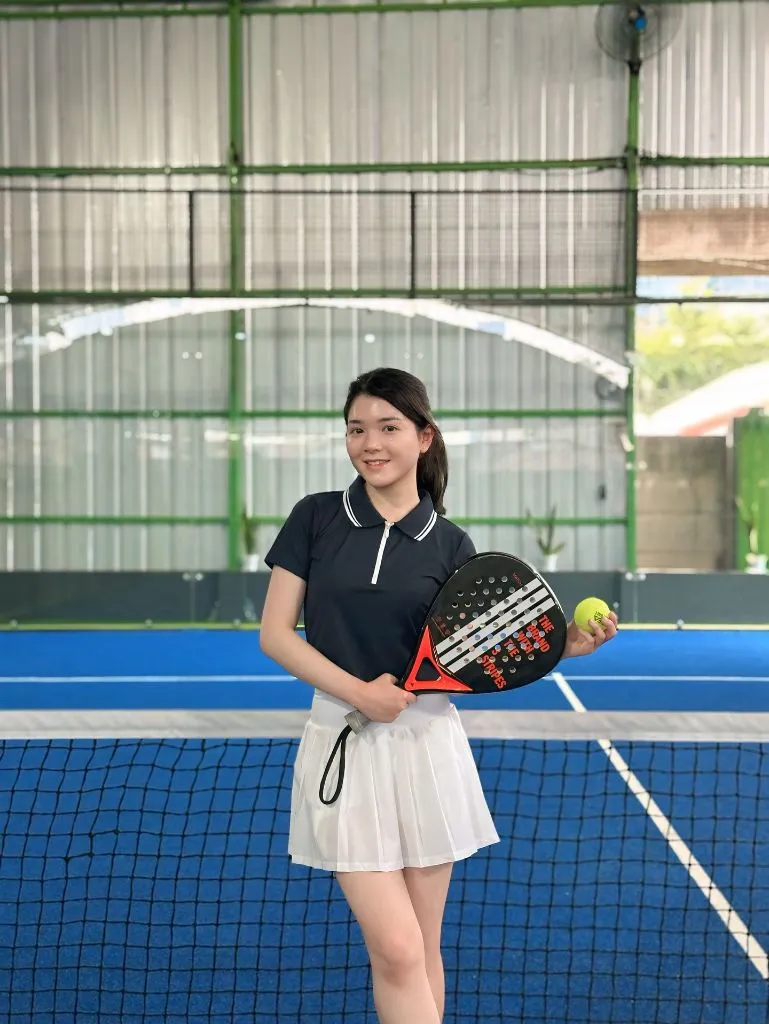
This is the outfit to recommend to anyone asking what to wear for padel court outfits for the first time. It is available at virtually every price point, from fast-fashion athletic lines to premium padel-specific brands. The navy polo should be moisture-wicking with enough stretch to allow full shoulder rotation, and the white skirt should have built-in shorts or compression lining for confidence during low shots and lunges. The only styling decision left is the shoe — a padel-specific shoe with a herringbone or omni-sole tread pattern is ideal for artificial grass, though many players start with general court shoes and adjust later.
The navy-and-white standard endures because it carries no ambiguity. It does not try to be trendy, seasonal, or fashion-forward. It exists to serve the game while looking clean and intentional. In a sport growing rapidly across Europe, the Middle East, and Southeast Asia, this combination has become a kind of universal padel language — immediately recognizable, universally flattering, and always appropriate. Sometimes the most powerful design choice is the one that requires the least explanation.
The Padel Collective Sweatshirt with Pleated Skirt
The emergence of padel-specific lifestyle brands means there are now garments designed not just for playing but for identifying with the sport’s culture. A beige crewneck sweatshirt with a “Padel Collective” emblem on the chest, worn over a lavender or white pleated skirt with padel racket in hand, makes the sport affiliation explicit while keeping the overall look relaxed and wearable. The sweatshirt’s oversized fit and the skirt’s structured pleat create the same high-low tension found in the best athleisure combinations.
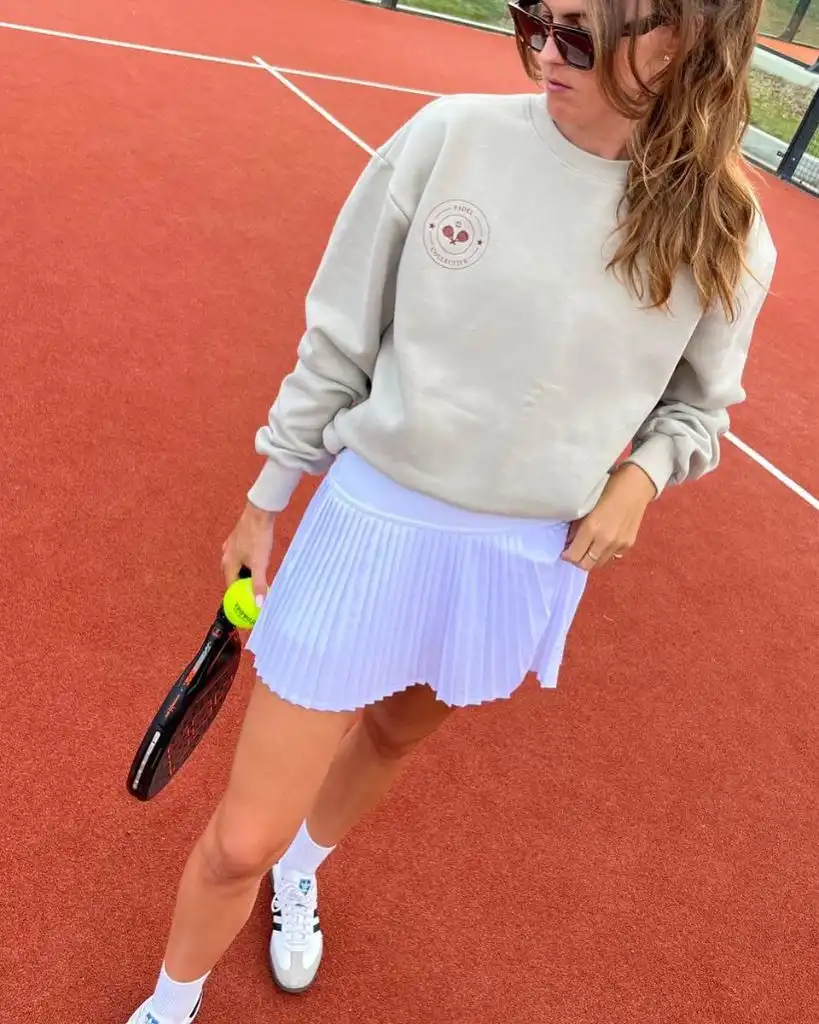
This is a pre-game or post-game outfit rather than one designed for actual play. The sweatshirt is too warm and heavy for match conditions, but it serves as a statement of belonging to the padel community. Pairing it with a court-ready skirt and proper shoes means the player can shed the top layer and be ready to play almost immediately. The sunglasses, visible here, are another off-court detail — useful for outdoor courts between sets but never during play. Choosing a sweatshirt in a neutral tone like beige or gray keeps it versatile enough to wear outside the padel context entirely.
Community-signaling garments are relatively new in padel but well-established in surf, skate, and running cultures. The “Padel Collective” branding functions the same way a surf shop logo does — it tells a viewer what the wearer’s world includes. In a sport still building its identity outside Spain and Argentina, these garments do real cultural work. They normalize padel as a lifestyle, not just an activity, and they give players a visual vocabulary that extends beyond the court’s glass walls.
The White Scalloped Sports Bra and Wrap Skort
Minimalism in padel wear reaches its most refined expression in a white matching set — a scalloped-edge sports bra paired with a wrap-style skort, both in clean white. The scalloped edges soften what would otherwise be a purely technical garment, adding a decorative detail that reads as intentional design rather than afterthought. The wrap skort provides the ball-pocket functionality visible in the image while the overlapping fabric gives the visual complexity of a skirt with the security of shorts beneath. On a J’hayber-branded court, the white set stands out against the blue turf with photographic clarity.
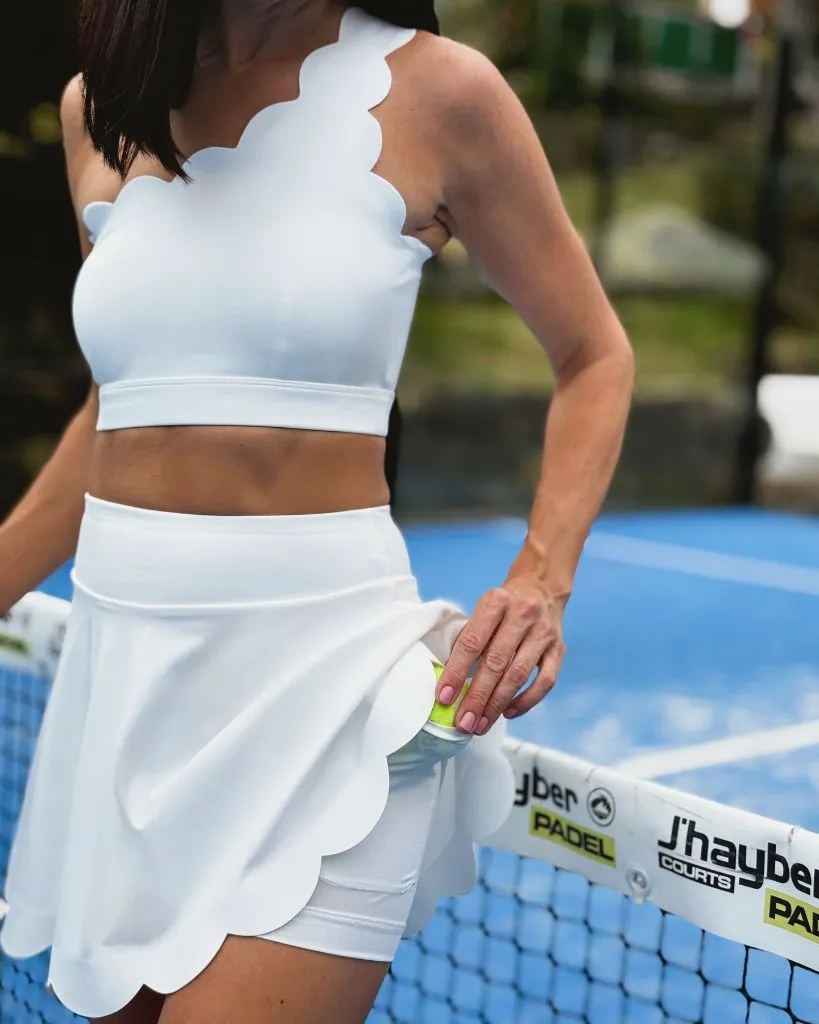
Two-piece minimal sets require confidence in fit. The sports bra should provide medium-to-high support without a compressive feeling that restricts breathing during long rallies, and the skort waistband should sit flat without rolling during bending movements. The tradeoff with crop-top-style padel outfits is sun exposure on outdoor courts and temperature sensitivity in air-conditioned indoor ones — a lightweight pullover kept courtside handles both scenarios. White-on-white matching sets are also available in pale blue, blush, and sage, which offer the same clean minimalism with slightly more visual warmth.
This outfit works because it strips padel wear down to its essentials and then adds exactly one design element — the scallop — to signal that the simplicity is a choice, not a default. The wrap skort’s asymmetry adds visual interest from the side angle that a standard skirt does not provide. In a sport where movement is constant and the player is visible from all angles through glass walls, this kind of thoughtful three-dimensionality in garment design is both functional and aesthetically relevant.
The Branded Sweatshirt with Statement Text
Some padel outfits make their point through words rather than silhouette. A navy crewneck sweatshirt printed with “Serving Sass & Smashes — Designed for the doubles champ” worn with a neutral skort on a tournament-branded court brings personality and humor into what can be an overly serious sartorial space. The sweatshirt’s graphic includes a padel court illustration in teal and white, turning the garment into both clothing and commentary. This is courtside wear, warm-up wear, and Instagram-content wear all at once.
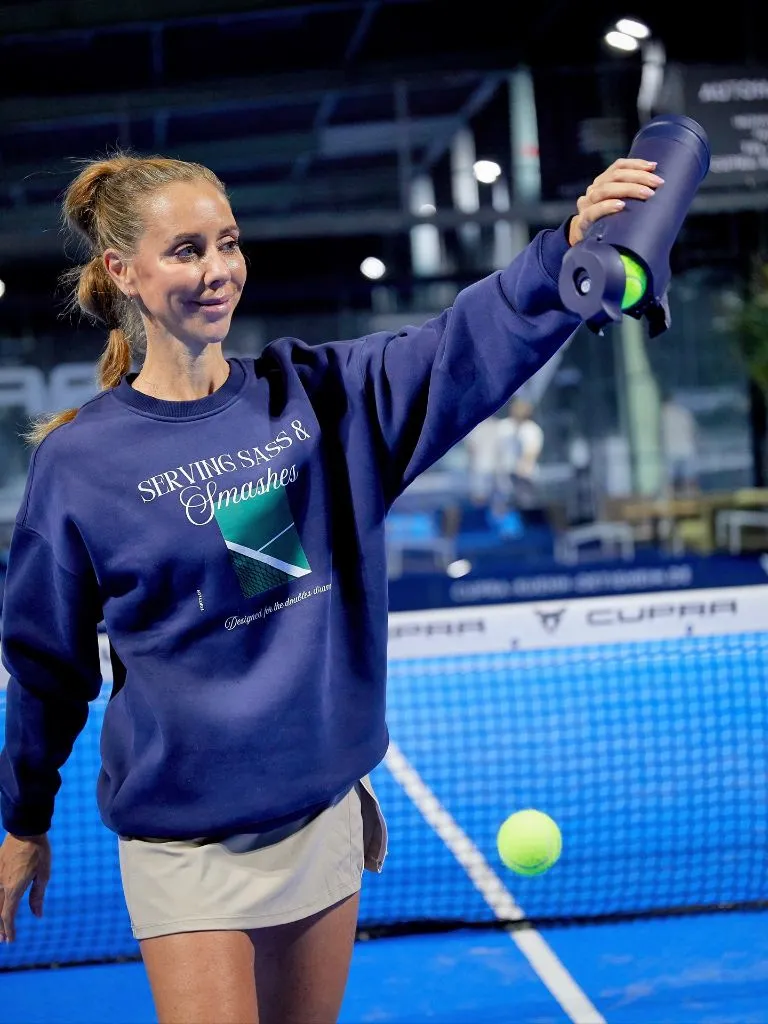
Statement sweatshirts work best as the outermost layer of a more conventional playing outfit beneath. A clean tank or polo under this sweatshirt means it can come off at match time and go back on for photos, socializing, or the walk to the car. The navy color is practical for hiding post-match dampness, and the graphic placement — centered on the chest — keeps it visible whether the wearer is standing, sitting, or mid-laugh on the sideline. For players who prefer their clothes to do the talking literally, this is the category to explore.
The broader design point is that padel fashion is developing its own language of in-group humor and reference. “Doubles champ” and “serving sass” are phrases that only make sense within the padel and racket sports context. This specificity is what separates padel lifestyle wear from generic athleisure — it rewards the viewer who understands the references. As the sport grows and its culture deepens, expect this category of text-driven sportswear to expand alongside the more classic performance pieces.
The White and Navy Two-Tone Sleeveless Set
Color blocking — placing two distinct colors in clearly defined zones — creates some of the most visually effective padel outfits because the court environment already operates in blocks of color. A white sleeveless V-neck top with a navy skirt, both from a matching brand line, divides the body crisply at the waist. The visor and logo details carry the navy tone upward, preventing the eye from reading the outfit as only bottom-heavy. A white padel racket mirrors the upper zone, while the green artificial turf provides the environmental third color.
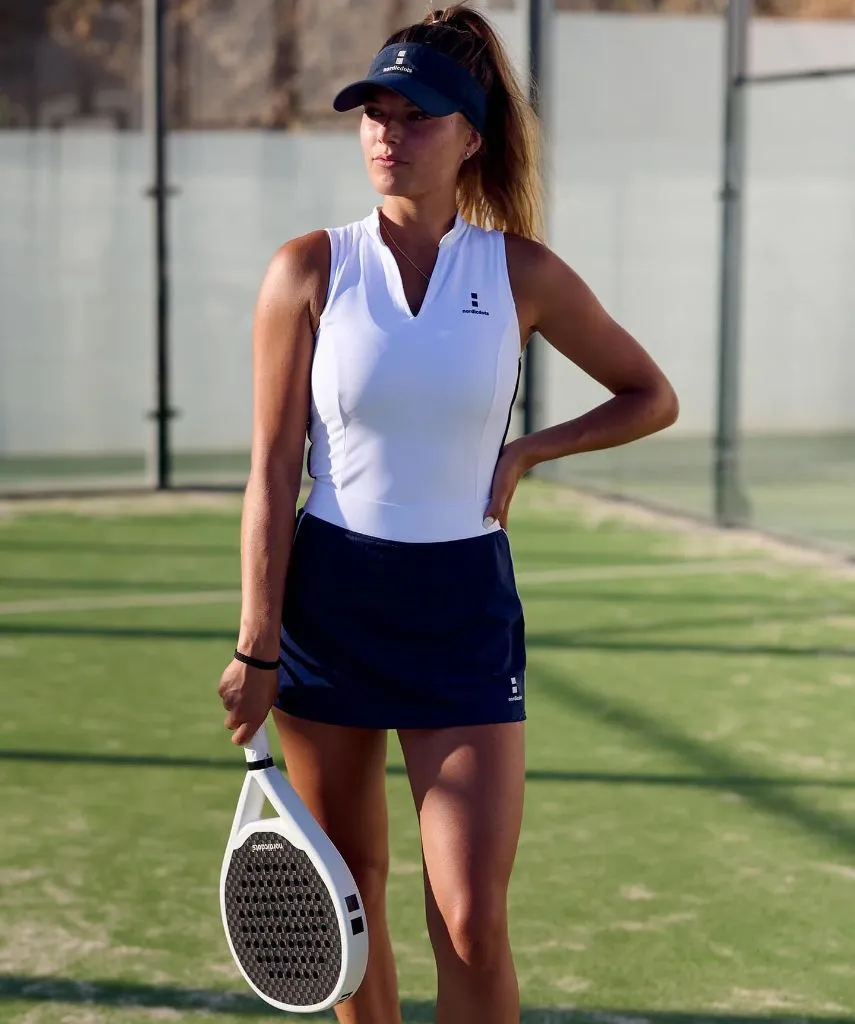
This what to wear for padel court outfits choice is one of the most photographed because the two-tone split photographs cleanly from any distance. The sleeveless design allows full arm definition, which many players prefer for both performance and aesthetic reasons. The skirt length — sitting just above mid-thigh — is standard for padel and allows unrestricted lunging. For players in hotter climates, this combination breathes well and dries quickly, though the white upper may benefit from a UV-protective fabric treatment for regular outdoor use.
The two-tone approach works because it borrows from graphic design principles. A clear division of color creates a focal point at the waist, which happens to be the body’s center of rotation in padel. Every forehand, backhand, and serve initiates from this point, and the color division emphasizes that mechanical reality. It is one of the rare cases where an aesthetic choice and a functional truth align perfectly, and the result is an outfit that looks as good in motion as it does in a mirror.
The Red Dress and Coordinated Partner Look
Padel’s doubles format opens the door to partner coordination, and a red sleeveless zip-front dress matched with a partner in a white dress with red trim creates a visual pairing that reads as a team without the rigidity of identical uniforms. The red dress is bold — warm, saturated, and immediately attention-commanding against any court color. The white partner dress echoes the red through its accent trim, creating a relationship between the two outfits that feels planned but not forced.
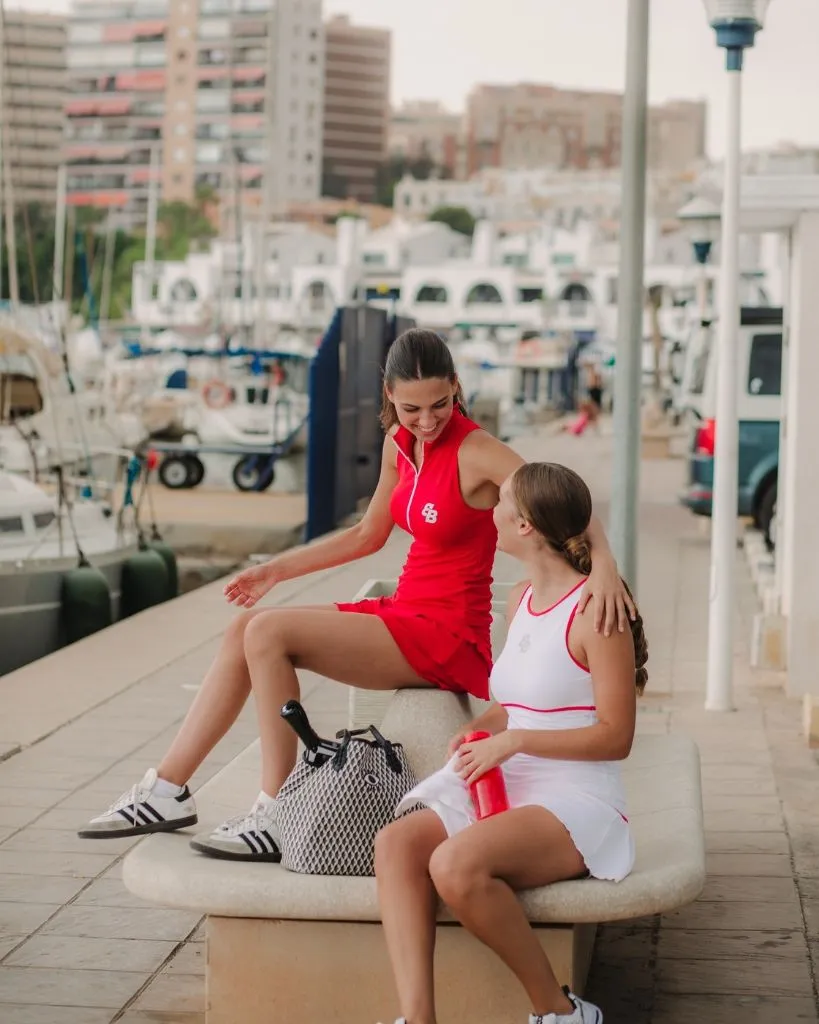
Coordinating with a partner requires agreeing on a shared palette rather than a shared garment. One player takes the primary color, the other takes the accent or inverse. This approach works with any pairing — navy and white, black and coral, forest green and cream. The key is that both players’ outfits share at least one color so they read as a pair from across the court or in photographs. This style of coordination is also practical for tournaments where team identification matters but formal uniforms are not required.
The design lesson from partner coordination is about relationship rather than repetition. Two identical outfits can look like a costume; two related outfits look like a collaboration. The red and white pairing here draws from the same logic that makes complementary colors work in interior design or poster art — each color makes the other more vivid through proximity. On a padel court, where two players share a side and a camera frame, this mutual enhancement makes the visual impact stronger than either outfit would achieve alone.
The Lavender Pink Bubble Skirt on Outdoor Court
Not every padel skirt needs to be pleated or A-line. A bubble skirt in a soft lavender pink — fuller at the hip with a gathered hem that creates volume — introduces a silhouette not commonly seen on court and immediately reads as fashion-forward rather than purely functional. Paired with a matching sleeveless top and a white visor, this outfit turns the outdoor padel session into something closer to a fashion editorial. The J’hayber-branded net in the foreground and tropical plantings behind the glass walls complete a scene that could appear in a lifestyle magazine.
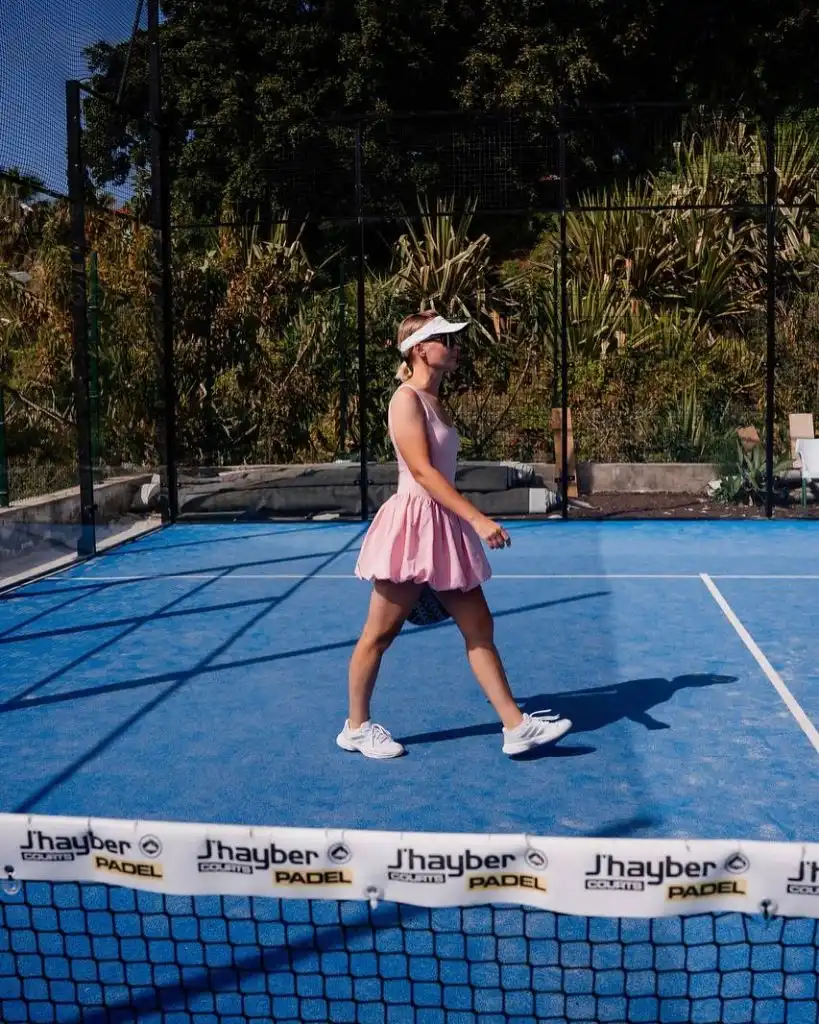
The bubble skirt’s volume does come with practical considerations. The gathered hem can ride up during aggressive movement and the extra fabric creates more air resistance, which is negligible in recreational play but noticeable to competitive players. For casual social sessions where style weighs as heavily as performance, this tradeoff is acceptable. The lavender pink tone works particularly well in golden-hour outdoor light, where it warms naturally and photographs with a soft, desaturated quality that flatters. White shoes keep the base clean and avoid competing with the skirt’s volume.
This outfit works because it challenges the assumption that sportswear must minimize fabric. The bubble skirt adds volume where most padel outfits subtract it, and this unexpectedness is precisely what makes it visually arresting. Fashion within sport functions best when it knows the rules well enough to break them intentionally. The skirt still allows movement; it simply redefines the shape of that movement. On a court surrounded by glass, where the player is visible from every angle, this kind of dimensional silhouette adds interest that flat, fitted garments cannot.
The Diverse Doubles Team in Individual Styles
One of padel’s strengths as a social sport is its inclusivity, and this is reflected beautifully in a group photo of four players, each expressing their own style within the padel framework. A player in a lavender hijab with matching skirt, another in a gray tank and navy skort, a third in an all-black high-neck outfit, and a fourth in a navy cropped tank with a red-accented skirt — together they demonstrate that what to wear for padel court outfits has no single answer. Each player has made distinct choices about coverage, color, and silhouette while sharing the common elements of athletic fabric, court shoes, and padel rackets.
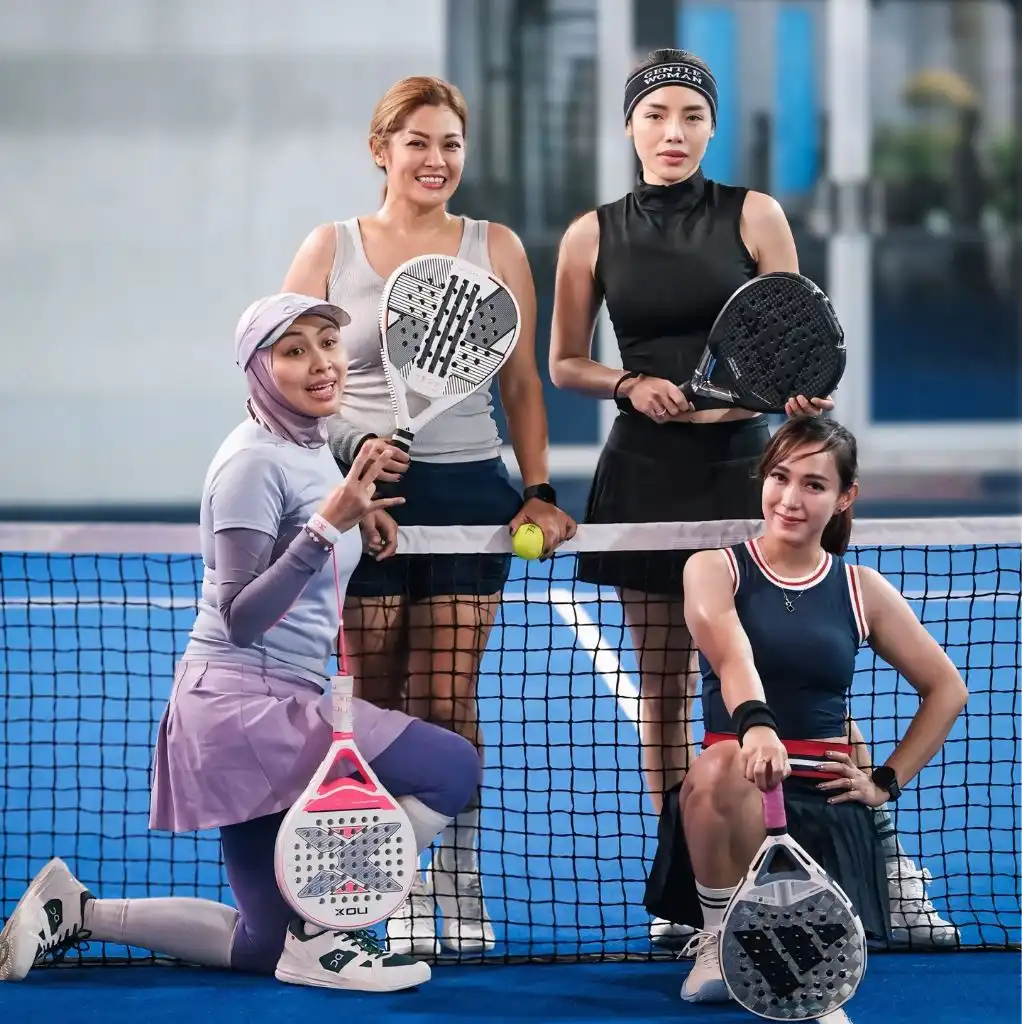
For players who require or prefer more coverage, padel accommodates full-length athletic leggings, long-sleeve tops, and sport hijabs without compromising on performance. The key is choosing fabrics with the same moisture-wicking and stretch properties as their less-covered counterparts. Brands are increasingly designing for this range of needs, which means finding technical sportswear in coverage-appropriate styles no longer requires compromising on aesthetics or function. The player’s comfort — physical, cultural, and psychological — always dictates the best outfit choice.
This image captures what padel style looks like at its healthiest: varied, personal, and unified by the sport rather than the wardrobe. The glass court behind them, the net between their positions, and the rackets in their hands are the common elements. Everything else — the colors, the cuts, the coverage levels — is individual. The strongest design principle in padel fashion may be this one: there is no uniform, only intention. Each player decides what they need from their clothing, and the sport is flexible enough to accommodate every answer.
The Light Blue Dress at an Indoor Padel Club
Indoor padel facilities with multiple glass-walled courts, branded barriers, and overhead lighting create a specific atmosphere that certain outfits complement better than others. A light blue sleeveless dress with a flared skirt, worn at a facility branded with MR PORTER and Barakat signage, demonstrates how a single clean garment can hold its own in a visually complex environment. The blue of the dress sits slightly lighter than the court surface, creating enough separation to keep the player distinct. Pink sneakers add an unexpected accent that prevents the look from feeling too safe.
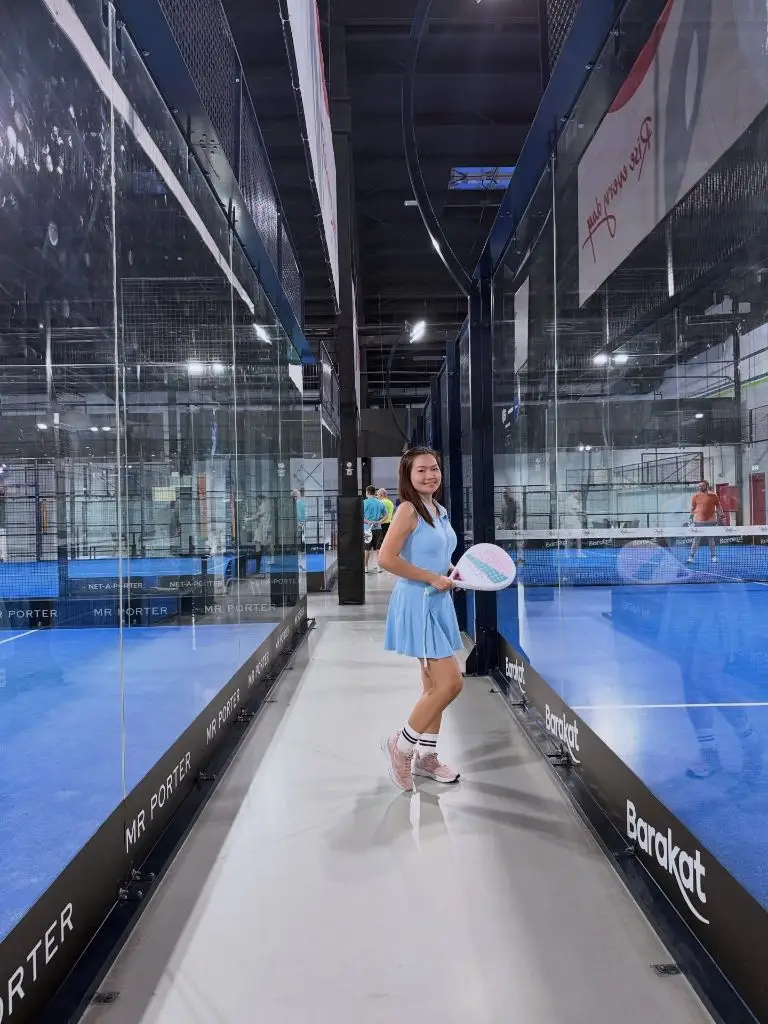
Indoor courts offer more predictable conditions — consistent temperature, no wind, even lighting — which means fabric choice can prioritize feel and drape over weather protection. A lighter, less technical fabric works fine in these controlled settings, and the absence of sun means UV protection is unnecessary. The dress format is ideal for players who do not want to think about matching separates. Grab the dress, grab the shoes, grab the racket. For anyone building a broader seasonal wardrobe that values this same simplicity, the principle mirrors how September hairstyle ideas emphasize ease and practicality.
The success of this outfit in its particular setting is about proportion between person and space. The large indoor facility, with its multiple courts visible in the background and its glass-and-steel architecture, could easily overwhelm a player in a subtle outfit. The flared skirt adds enough volume to give the figure presence within the frame, and the light blue color catches the overhead lighting in a way that darker colors would absorb. It is a small example of how understanding your environment — not just your body — leads to better outfit decisions.