A coat is the loudest piece in any winter photograph, but the Trendy Coats 2027 conversation only makes sense once you stop staring at the coat itself and read the shape it draws around the body. Length, shoulder line, where the belt lands, how far the hem falls past the knee — these decide the outfit far more than the fabric or the season’s tag. Palette, proportion, and the single accessory that survives the layering do the rest.
Before scrolling, pick two things to track: where the coat ends, and where the darkest point of the outfit sits. Those two coordinates tell you whether the composition is anchored, top-heavy, or floating. Weigh the trade-off between coverage and shape — a long coat gives drama but eats the waist, a short one keeps a waist but loses gravitas. None of what follows is a rule, only a set of workable answers.
1. Chocolate Coat Wraps a Fringed Scarf
A long chocolate-brown coat in a smooth wool-looking fabric controls the whole vertical, falling nearly to the ankle in a clean single-breasted line. Because the coat, the scarf, and the boots all sit in the same deep brown family, the outfit reads as one continuous colour field from shoulder to floor. The only real interruption is a strip of pale blue denim showing between the coat and the boot.
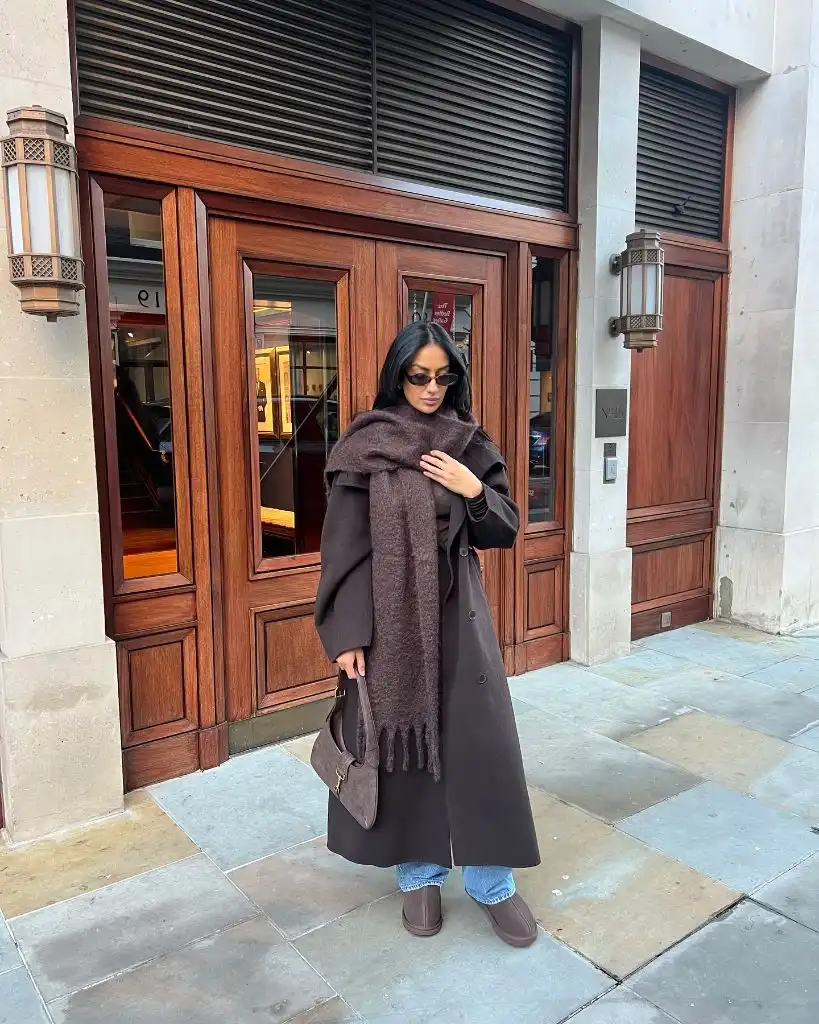
The fringed scarf is heavier than the coat itself in visual weight — thick, brushed, with visible fringe hanging past the waist. It sits directly on the coat in the same tone, so the eye reads it as texture rather than colour. A small suede-looking bag in the same brown continues the palette at hip height. Tiny rectangular sunglasses keep the head sharp against the softness below, and the pale jeans function as the only break in an otherwise fully tonal composition.
The lesson is about restraint inside a monochrome. When every visible piece leans into the same brown, the differences between them — matte wool, brushed scarf, dry denim, soft suede — become the entire story. To soften it, swap the jeans for a cream trouser; to push further, drop the denim break and go head-to-toe brown from throat to floor.
2. Plum Coat Meets a Checked Scarf
A long plum-brown coat sits at the centre of the frame, cut wide through the shoulder and long enough to fall past the calf. The colour is deep and warm, and against a stone church and bare trees the coat reads as the darkest vertical line in the picture. Straight black trousers continue that line down to a pale cream shoe, so the outfit is essentially one long dark column with a bright endpoint.
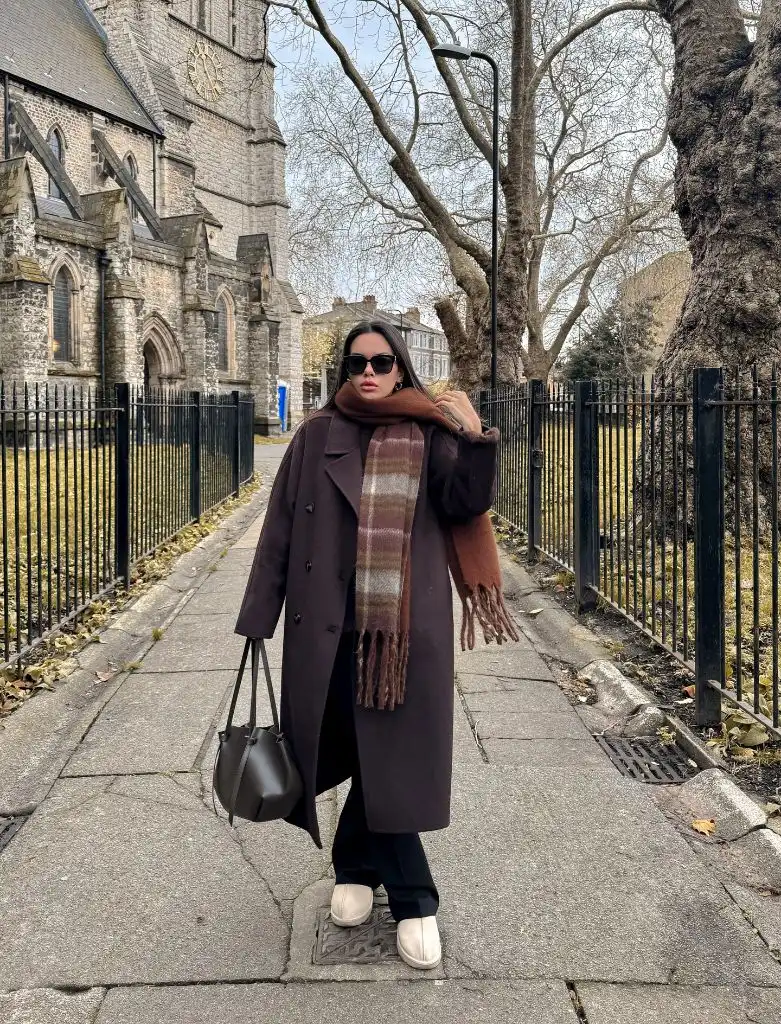
A checked scarf in rust, brown, and cream is the composition’s single point of pattern. It sits high at the neck with the fringe dropping to mid-chest, echoing both the coat’s plum tone and the shoe’s cream at the same time. A small structured black bag held at the hip stays quiet, and rectangular black sunglasses match it at the face. The palette is warm brown plus black plus one pale, and every element is placed once — no repetition, no clutter.
The transferable principle is scarf-as-bridge: a patterned scarf can carry three colours if each of those colours already exists elsewhere on the body. Compared with the tonal brown look above, this reads sharper because of the black trouser. The honest limitation is that a very long coat over slim trousers can shorten a smaller frame; the cream shoe here does the work of lifting the eye back up.
3. Grey Peacoat Frames a Denim Column
A heather-grey double-breasted coat sits mid-frame with a long, straight cut that stops at the calf. The shoulder is soft and slightly dropped, the notched lapel wide, and because the coat is left open, it reads more as two vertical grey panels than as a full block. The dark townhouse door and black railings behind sharpen the coat’s outline.
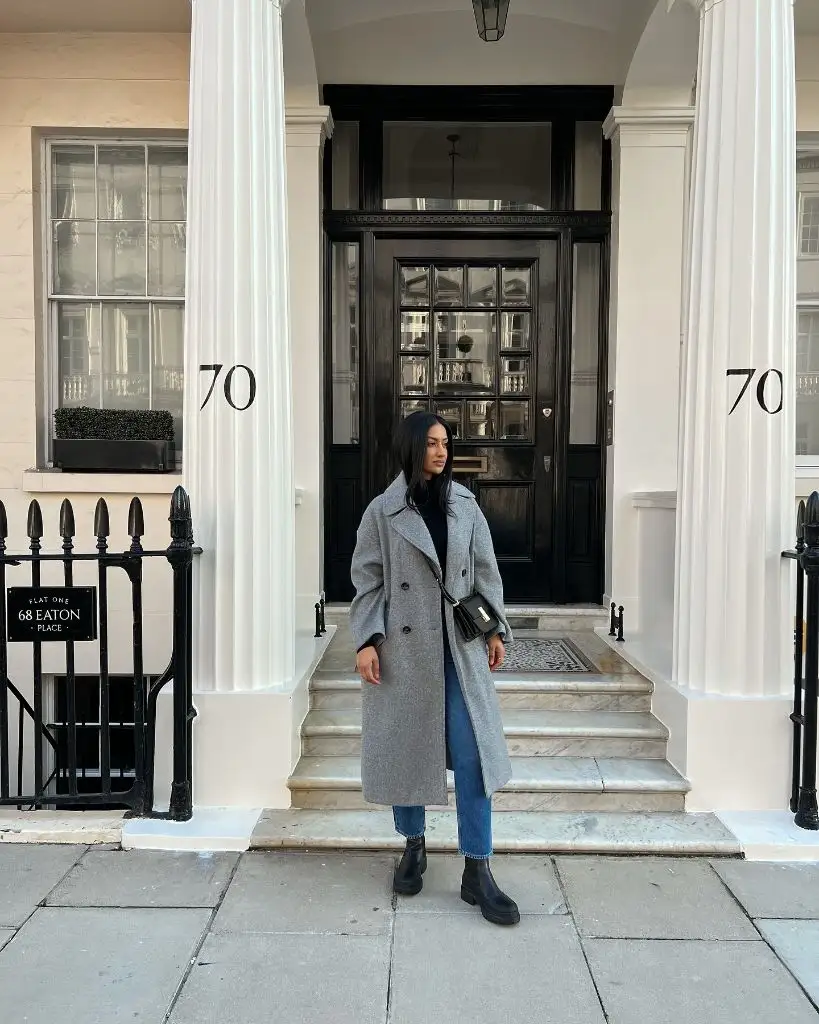
Inside the coat, a black knit and mid-blue straight jeans form a lean two-tone column. The jeans hit exactly at the top of a chunky black Chelsea boot, so the leg reads clean and defined even under a heavy coat. A small black crossbody bag is worn on a short strap, sitting at the ribs rather than the hip, which shortens the visible waist and keeps the composition tidy. Every dark element — knit, boot, bag, door — echoes at the same value.
Among Trendy Coats 2027, a long grey wool is one of the most forgiving base pieces, because it neutralises whatever sits under it. The transferable principle is boot height matching hem height: when the coat ends near the top of the boot shaft, the leg reads longest. Swap the chunky boot for a slim one and the outfit softens; swap the jean for a black trouser and it turns immediately more formal.
4. Black Robe Coat Balances Wide Trousers
A long black robe-style coat with a shawl collar and no visible buttons controls the whole frame, worn loose and open. It falls almost to the floor, which drapes the body in a single dark vertical from shoulder to shoe. Wide taupe trousers underneath push out through the leg in a completely different colour and material, so the outfit becomes a study in one dark column and one light one, side by side.
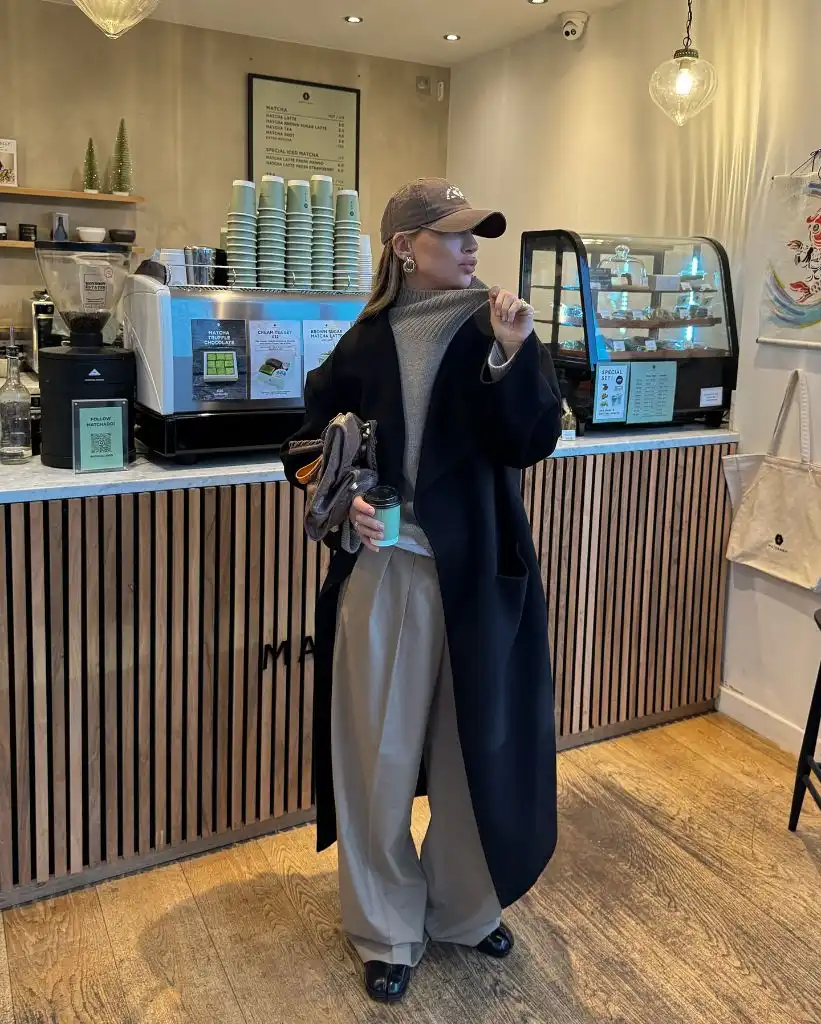
The palette is a warm neutral triangle. A soft grey knit at the neck sits between the black coat and the taupe trouser, mediating the two extremes. A brown cap on top and glossy black loafers at the floor bracket the composition with two matching dark points. The bag tucked under the arm is small and hard to read, deliberately un-showy. Only the pale coffee cup — soft green in colour — adds a second warm accent at hand height, and it lasts the length of one photograph.
Compared with the more nipped and belted coats elsewhere in this set, this reads deliberately architectural. The trade-off is that a long open coat over wide trousers erases the waist entirely, and the shoulder becomes the whole silhouette. If you like the drape but want more shape, close the coat with a self-belt at the natural waist and keep the trouser exactly this wide.
5. Taupe Coat Softens Sheer Winter Legs
A soft taupe wool coat runs from shoulder to mid-calf, single-breasted with dark buttons and a wide notched lapel. The fabric reads as brushed and warm, and the colour sits somewhere between beige and cool brown. Because the coat is left open across a matching taupe knit and a short skirt, the whole upper body becomes a single warm neutral shape.
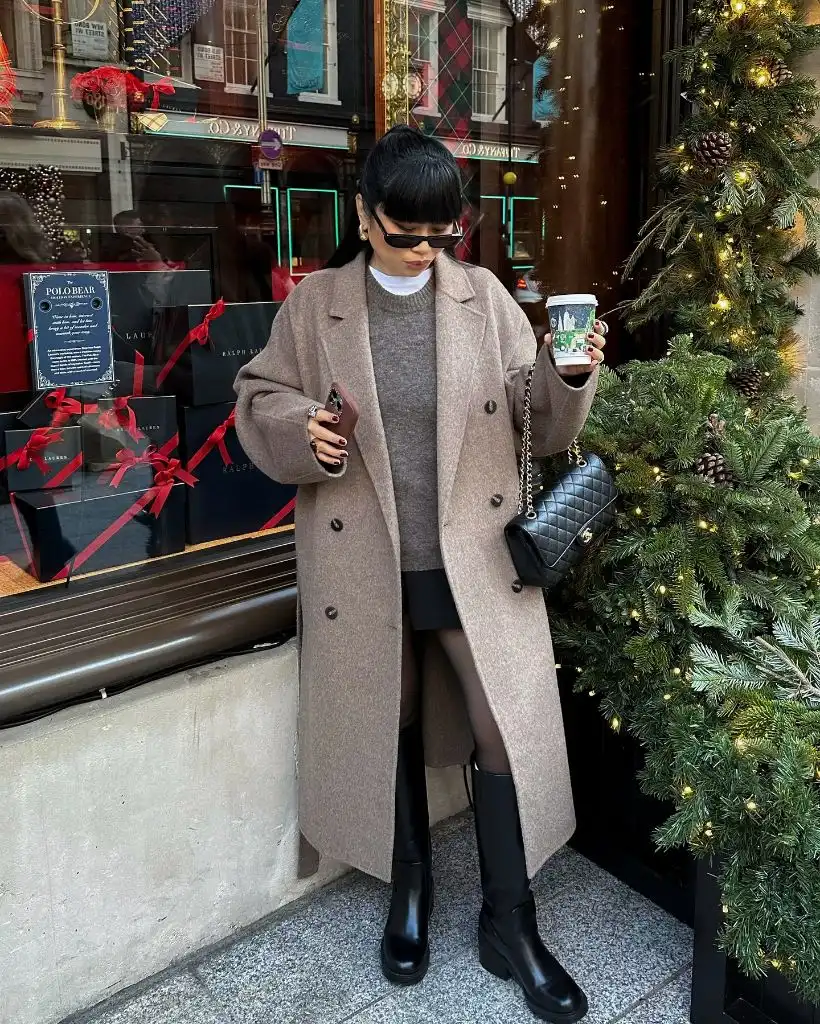
Below the coat, sheer black tights and tall block-heeled black boots take over. That sudden shift from warm taupe to full black at the leg is the composition’s sharpest contrast point, and it is placed at exactly the point the coat ends. A small quilted black shoulder bag hangs on a gold chain and doubles the dark accent at the hip. Small black sunglasses and a very dark straight fringe repeat the same value at the face, so the black notes form a triangle top-hip-floor.
For anyone drawn to Trendy Coats 2027, the practical detail is that a warm coat needs at least one dark endpoint to keep the outfit from floating. Compared with the full-length tonal browns earlier, this one deliberately breaks the line at the knee. To soften it, swap the sheer tights for opaque ones; to push further, add a red lip and the whole outfit sharpens.
6. Camel Coat Meets Croc Boots
A long camel coat with a wide notched lapel takes up almost the entire frame, held open at the front and caught in motion so the hem swings out to one side. The wool-looking fabric catches the sun and reads as a warm honey, and because the arched dark doorway behind sits in exactly the same brown family, the coat appears to step out of its own background.
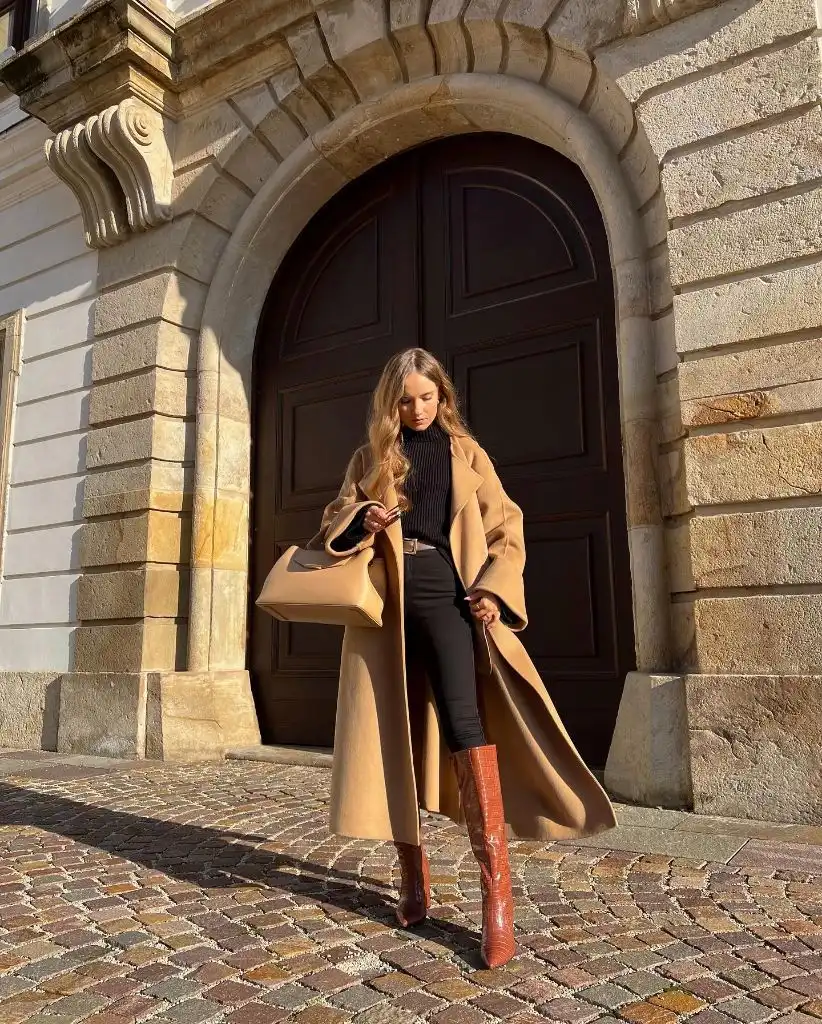
Inside the coat, a black turtleneck and slim black jeans form a lean dark column, belted at the natural waist. Cognac croc-effect knee boots pick up the coat’s warmth at floor level and add the only real pattern in the outfit — small scaled texture, glossy finish. A structured cognac bag matches the boots exactly, so the browns are echoed twice at hand and foot. The composition reads as three colours only: camel, black, cognac.
The transferable principle is anchoring: a warm coat needs at least one deep dark to sit against, or it will drift. Compared with the softer taupe above, this one is louder because of the boot pattern and the polished finish. The lesson here is about scale of accent — a full-shaft patterned boot is already loud, so the bag has to match it exactly rather than introducing a second pattern.
7. Grey Robe Coat Extends a Metallic Shoe
A short grey robe-style coat with a self-belt sits at the top of the composition, cut oversized through the sleeve and body. The belt is tied loose, the shawl collar wraps forward, and two patch pockets sit low on the front. The coat is only hip-length, so the trouser underneath does most of the vertical work.
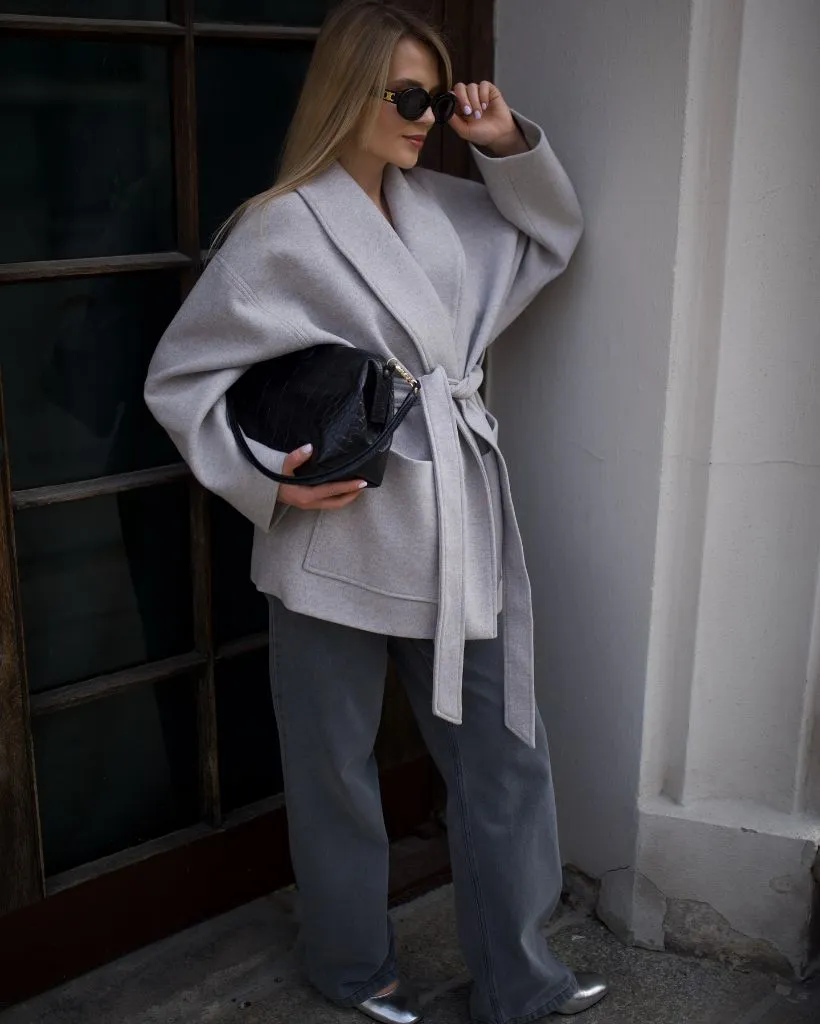
Wide grey jeans continue the palette down in a slightly cooler tone, and the small mismatch in grey between coat and trouser is what stops the outfit from reading as a tracksuit — it looks intentional rather than matched. A quilted black shoulder bag with a gold clasp sits at the elbow and provides the single sharp dark note. Silver pointed flats at the floor are the surprise: reflective, small, and completely unexpected against the soft grey. Round tortoiseshell sunglasses add gold to the face.
I like the restraint of that lower taper — everything above the shoe is soft and slouchy, and one small metallic point holds the whole outfit together. To soften it, swap the silver for a matching grey shoe and the outfit tips into full loungewear. Keep the silver, and it stays a considered daytime look.
8. Cream Coat Contrasts a Slip Dress
A long cream coat falls straight from the shoulder to below the knee, held open across a black slip dress. The coat’s wool-looking fabric reads soft and slightly brushed, and against a rough stone courtyard the colour looks almost warmer than it is. Because the coat is worn over rather than around the body, the black slip inside becomes a clear vertical stripe running down the centre of the outfit.
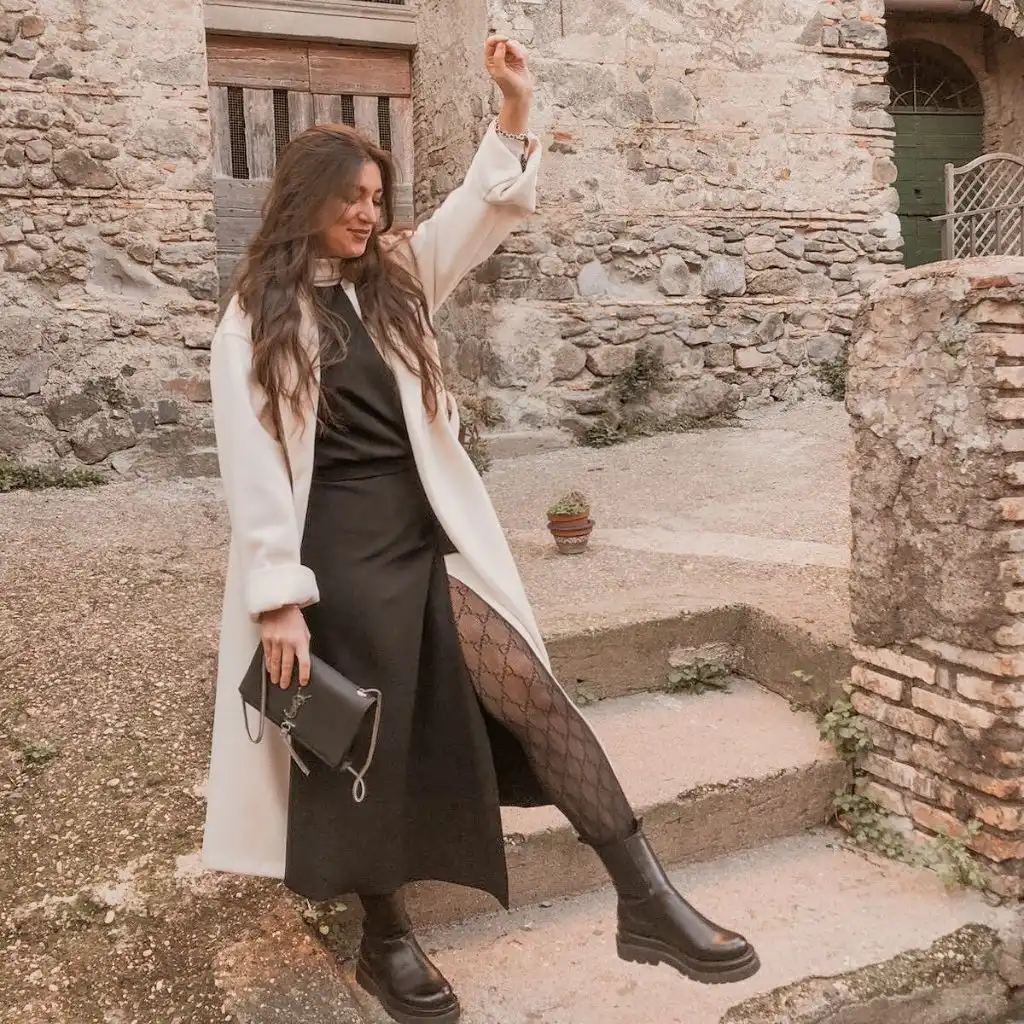
The slip is satin-looking, high-necked at the front and long enough to fall past the knee, so it reads as a dress rather than a top. Patterned monogram tights add a small repeating motif at the leg, and chunky black Chelsea boots close the palette at the floor. A small black bag on a fine chain provides the last dark note. The colour story is exactly two — cream and black — and everything else is texture: brushed wool, satin, sheer, leather-looking.
Compared with the belted robe above, this one drops the waist entirely and lets the slip dictate the silhouette. The honest limitation is upkeep: a pale cream coat over any darker inner layer will collect fibre transfer at the collar and cuff. If that matters, keep the inner layer smooth satin rather than fuzzy wool, exactly as done here.
9. Windowpane Check Frames a Long Column
A long black and cream windowpane check coat controls the entire frame, buttoned closed and hanging straight from the shoulder in a slightly A-line cut. The check is oversized — rectangles roughly the size of a hand — and the pattern is the only visual event in the photo. Behind the phone, a cream top peeks out at the neck and lightens the collarbone.
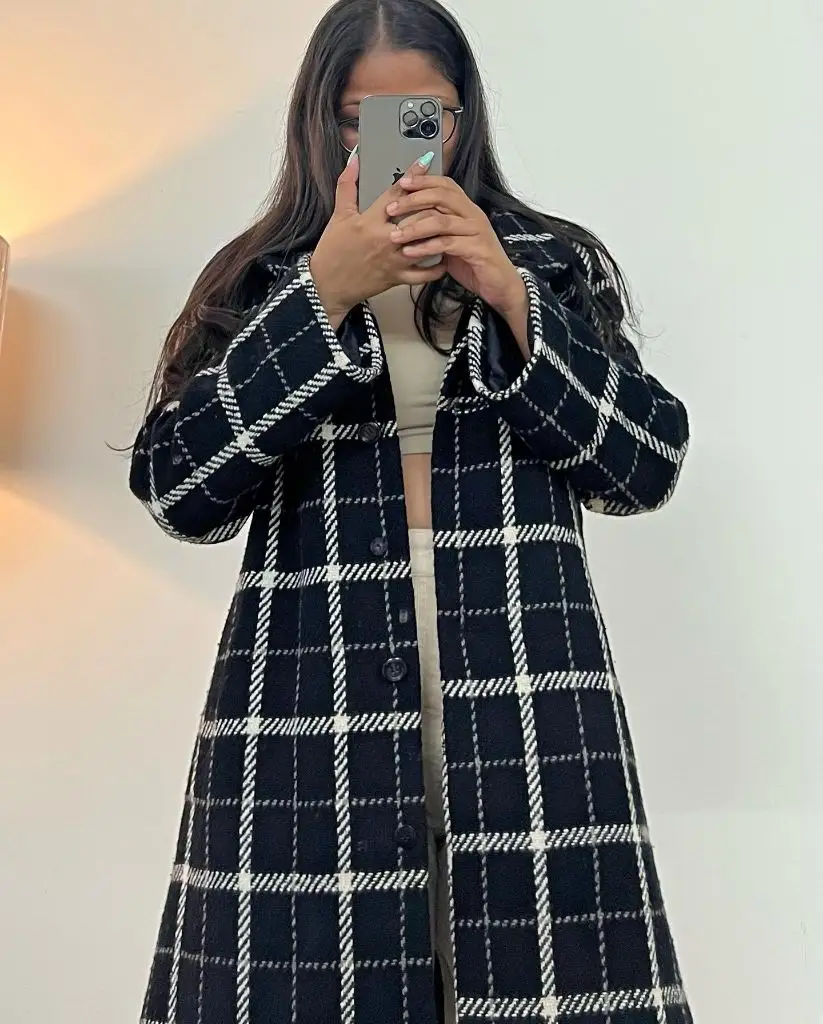
Under the coat, a cream top and pale trousers continue the coat’s lighter grid colour, so the visible non-coat pieces read as one soft off-white block. That decision matters — pairing a bold check with a plain palette lets the pattern breathe. The buttons run in a single vertical row down the front, and the pockets fall at the hip, adding two more horizontal lines to the grid. There are no visible accessories, jewellery, or shoes in the frame.
The lesson is about pattern scale: a large-scale check works best when it is the only decision made above the neutrals. To soften it, swap the windowpane for a smaller houndstooth in the same colours; to push it further, add one dark boot and stop. Never introduce a second pattern anywhere else in the outfit or the grid breaks down into noise.
10. Cognac Shearling Softens a Sunny Facade
A long cognac shearling-style coat is the entire outfit’s centre of gravity. It falls to the ankle, with a cream shearling collar and a cream shearling front trim running the full length of the button placket. That double stripe of cream inside the warm cognac frames the body vertically and instantly gives the coat a shape it would otherwise not have when unbuttoned.
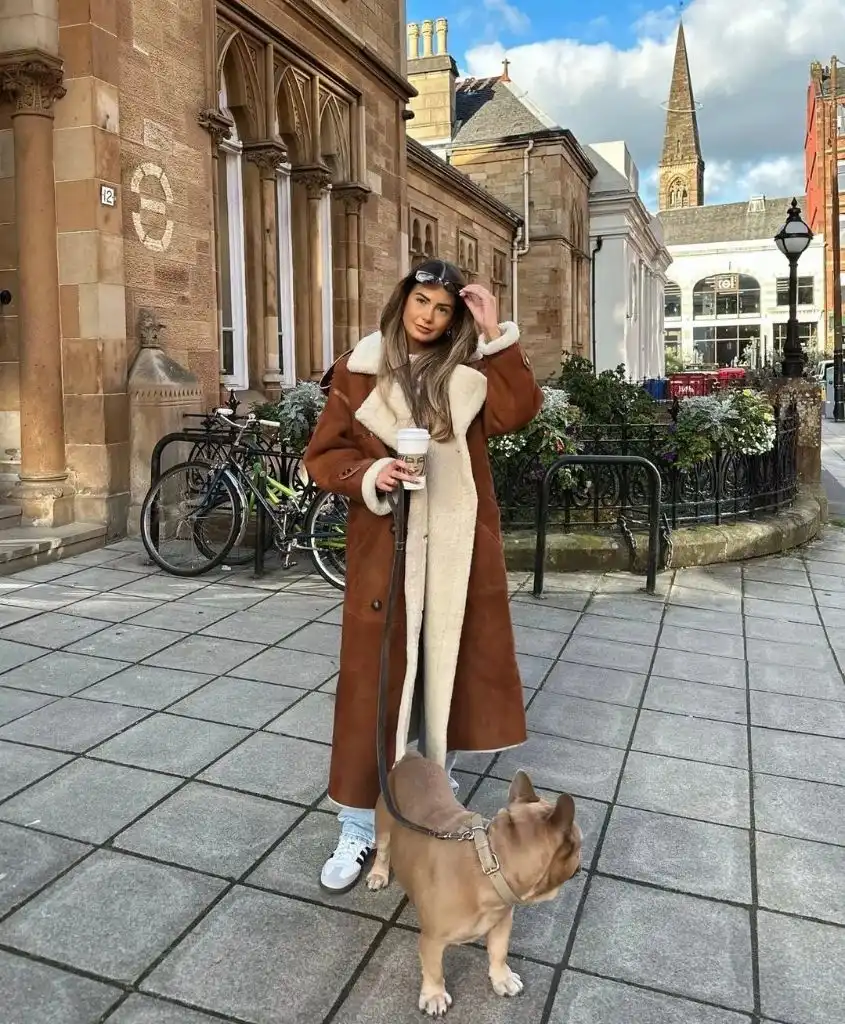
The palette echoes the setting. Warm sandstone building, autumn planting, and the coat’s cognac all sit in the same golden-brown family, so the coat looks planted rather than styled on. White sneakers at the floor and a takeaway coffee cup at the hand introduce two clean bright points, and the dog on the lead becomes an accidental beige-cream accessory. There is no bag, no jewellery — a rare and quiet choice.
The transferable principle is trim as tailoring: a coat with a contrasting internal stripe (shearling, satin, leather-looking) always has more shape than a solid one, whether or not it is belted. Compared with the plainer cream coats earlier, this one holds its silhouette open because the cream lining does the work a belt normally would. Sneakers keep it daytime; swap in a boot and it turns evening.
11. Taupe Coat Balances a Waistcoat
A long taupe coat sits open over the shoulders in an oversized cut, sleeves pushed back slightly and lapels wide. The colour is a soft warm grey-beige, and against a bright green hedge and a scatter of amber leaves, the coat reads as the neutral that everything else in the frame settles against. It falls to just above the ankle in a straight column.
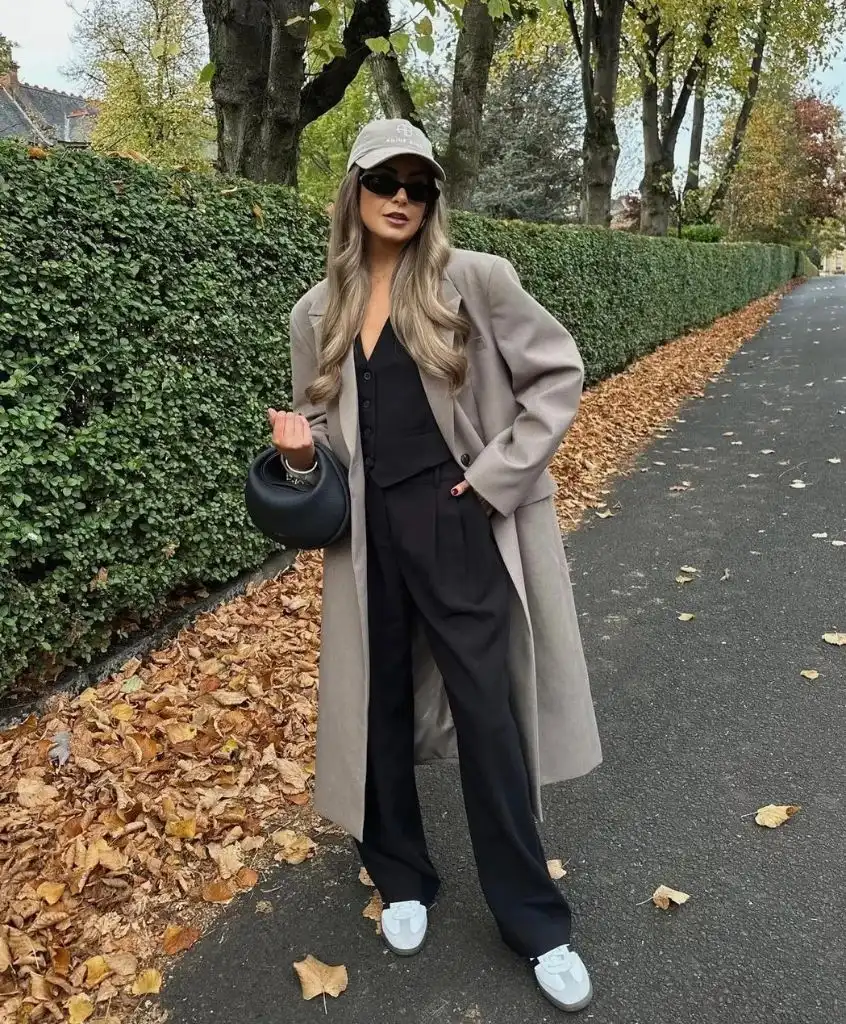
Underneath, a black buttoned waistcoat and wide black tailored trousers create a full black suit-set that reads as one piece of tailoring. That contrast between the soft coat and the sharp black waistcoat is the whole point — one is casual, one is formal, and neither is fighting. A small black rounded bag, a grey cap, and white trainers form a triangle of accessories at hip, head, and foot, each one small and useful.
Among Trendy Coats 2027, a long taupe over black tailoring is one of the more reliable formulas because the coat neutralises the sharpness of the suit underneath. Compared with the more feminine slip-and-coat pairings above, this reads noticeably more androgynous. The trade-off is height: an ankle-length coat over full-length trousers can flatten a shorter frame, so a trainer with a visible white sole helps to lift the endpoint.
12. Black Coat Wraps a White Column
A long black coat with a soft dropped shoulder and wide sleeves is held open across a fully white inner outfit. The coat itself is the darkest element in the entire photograph, and against a pale washed-brick wall its outline reads sharp on both sides. Because the coat is worn slightly off the shoulder, the white column inside is fully visible from throat to shin.
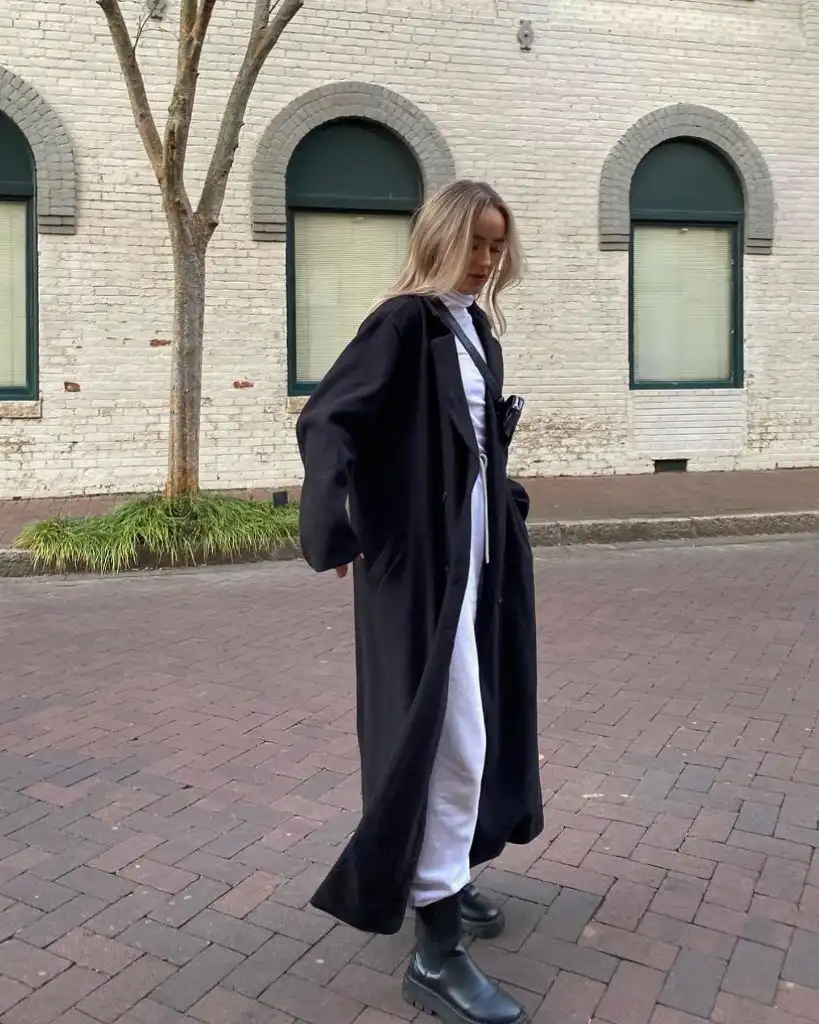
Inside, a long white turtleneck dress runs uninterrupted from the neck to below the knee, so the inner layer is a single tall stripe of white. Black chunky Chelsea boots close the outfit at the floor and match the coat exactly in value, which brackets the white between two black points top and bottom. Blonde hair falls over the coat’s collar and softens the join. There is no bag, no belt, no jewellery visible — the whole composition is three colours only.
The lesson is about placement of the darkest element: a black coat framing a lighter inner layer is almost always more flattering than a black coat over black, because the eye is drawn inward to the pale column rather than dispersed across the outline. To adapt it, swap the white dress for cream and the contrast softens; swap it for red and the coat becomes a picture frame.
13. Shearling Coat Meets a Long Scarf
A knee-length coat in a two-tone shearling-style construction — black leather-looking body panels with wide cream shearling trim on the collar, cuffs, and hem — sits at the centre of the composition. The contrast is graphic: a black rectangle bordered in cream, running from throat to mid-thigh. It reads more like a piece of design than a coat.
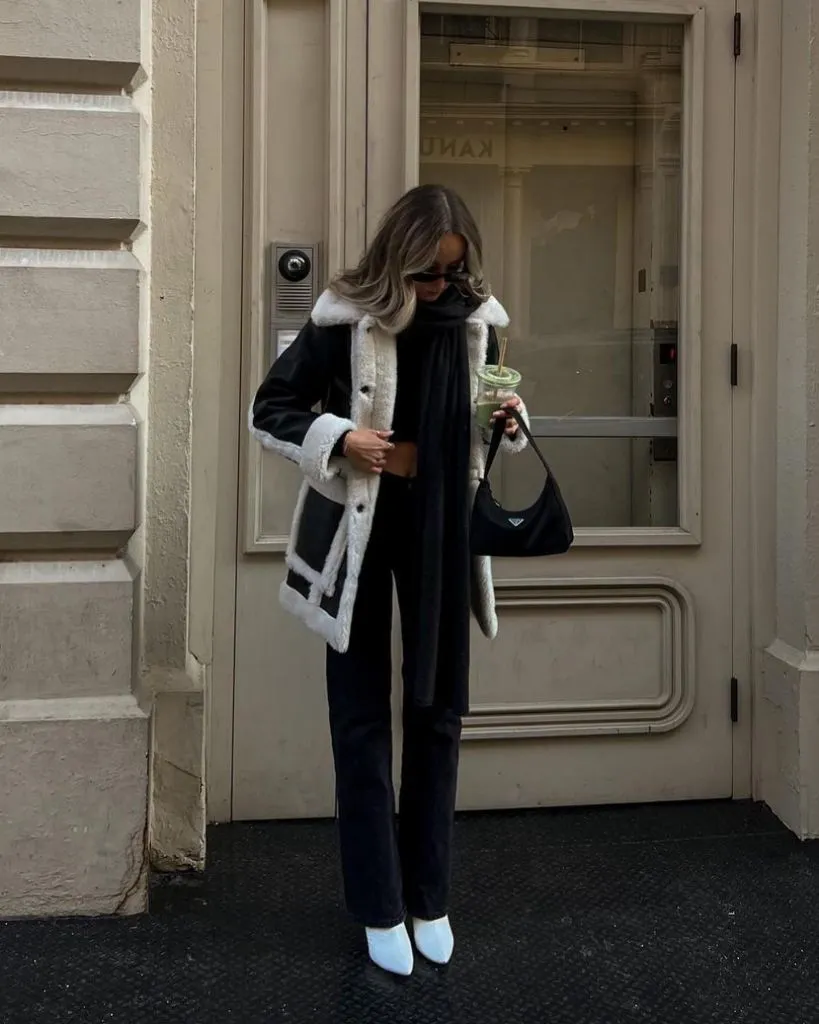
A long black scarf hangs straight down the front and passes the coat’s own hem, extending the black vertical line lower than the coat itself would. Black straight jeans continue the dark column, and white pointed boots at the floor pick the shearling’s cream back up in a completely different material. A small black shoulder bag on a fine strap doubles the dark accent at the hip. Only a green matcha cup breaks the two-tone palette, briefly.
Compared with the softer, all-cream shearling earlier, this one is deliberately graphic. The transferable principle is that a two-tone coat needs one matching endpoint elsewhere in the outfit — here, the white boot — or the trim will read as a mistake rather than a design choice. Push it further with a red lip; soften it by swapping the white boot for black, and the coat becomes the only cream note in the frame.
14. Ivory Teddy Coat Extends a Dark Inner Layer
A long ivory teddy-style coat runs from shoulder to ankle in a soft curly pile, cut straight with wide patch pockets low on the front. The coat is worn open, and against a warm stone building the pale pile catches the sun and reads almost cream. Because it is unbuttoned, the coat functions as two long ivory panels rather than a single block.
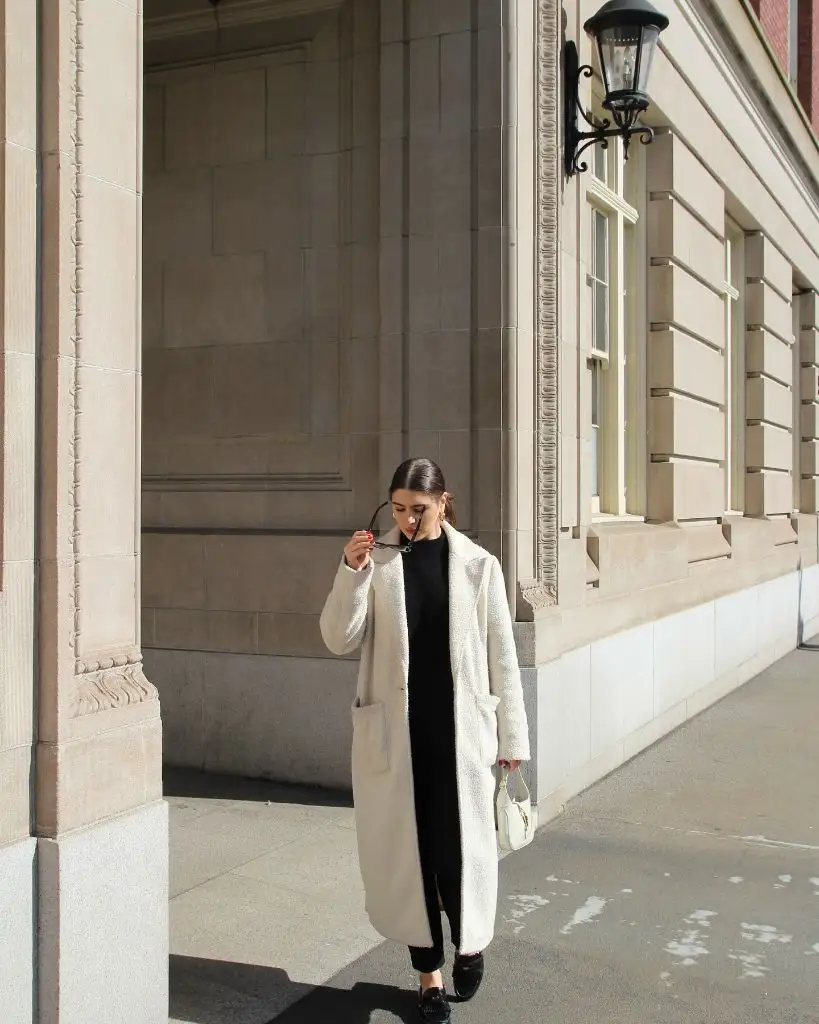
Inside the coat, a black turtleneck and black straight trousers create a lean dark column from throat to floor, closed at the bottom by black loafers. A small cream shoulder bag on a short strap picks the coat’s colour back up at the hip and rounds out the palette. Small dark sunglasses held near the face add a second dark point at the top of the frame. Long dark hair is pulled back, so the neckline stays visible.
The transferable principle is called framing: a pale coat around a fully dark inner layer creates a soft outline effect similar to a picture frame around a photograph. Compared with the black coat over white above, this one is warmer and quieter because the pale is textured rather than smooth. The honest limitation is length in real weather — a floor-length teddy will pick up grit at the hem before anything else, so this is a dry-day coat.
15. Brown Coat Sharpens a Column Silhouette
A long deep-brown coat sits at the centre of the composition, worn open across a black knit dress and cut precisely enough to read as tailored. The shoulder line is structured with a slight upward point, the lapel wide, and the coat’s hem reaches the ankle. Backlit by low sun in a stone colonnade, the brown reads almost warm chocolate.
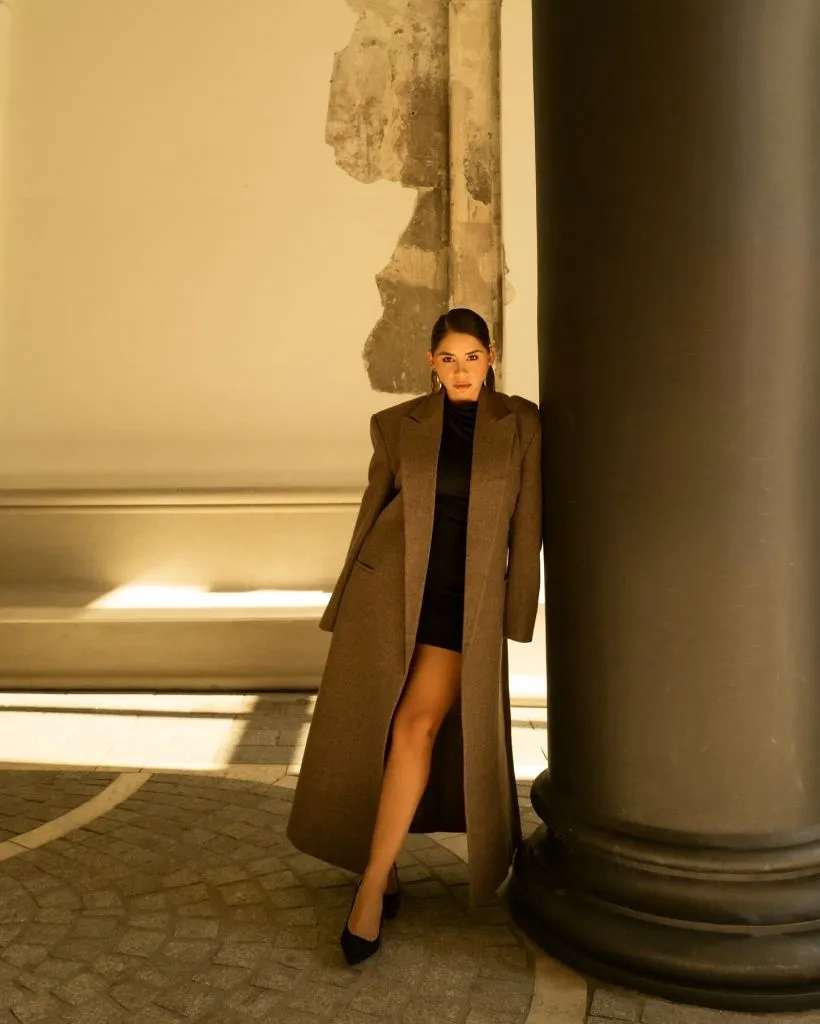
Inside the coat, a short black turtleneck dress leaves the leg bare from mid-thigh to the ankle. That decision is the whole outfit: everything above the hem is warm and covered, everything below the hem is skin, and the leg becomes the composition’s longest single stripe of pale. Small gold hoops catch the sun at the face, and pointed black flats close the outfit at the floor. A slick low bun keeps the neckline visible and the shoulder line clean.
The lesson is about contrast placement: an ankle-length coat over a short dress reads more elegant than provocative because the coat itself covers everything the dress does not. To adapt it for real winter, swap the bare leg for a sheer or opaque tight in the same black as the dress. To push it further, keep the leg bare and add a longer boot — but you lose the elongated skin line that makes this composition work.
16. Herringbone Coat Frames Red Ankle Boots
A long grey herringbone coat controls the frame, double-breasted with a wide notched lapel and a slightly dropped shoulder. The fine chevron pattern reads as a mid-grey from a step back, and up close the pattern gives the coat texture that solid wool would not. It falls to mid-shin in a straight, slightly A-line cut.
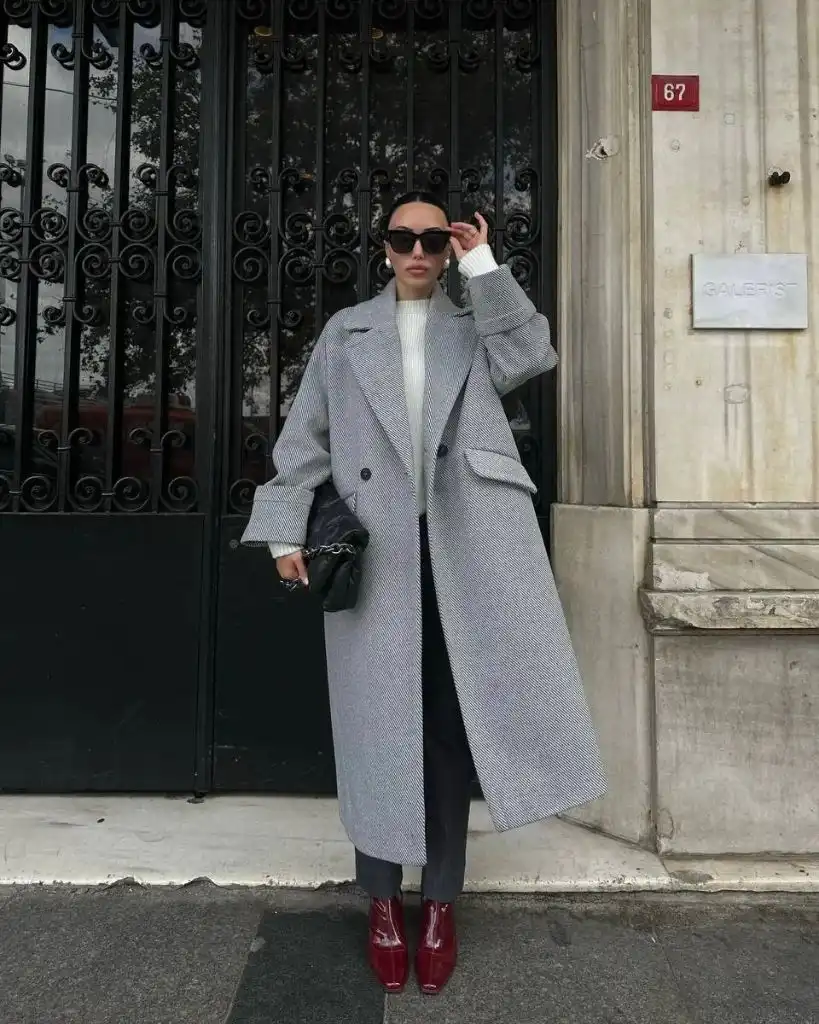
Underneath, a cream turtleneck lifts the collarbone area and softens the coat’s cool grey. Dark grey jeans continue the palette down but at a slightly different value, so the leg reads as a separate section from the coat. The composition’s real event is at the floor: glossy cherry-red pointed ankle boots, saturated and reflective, which are the single point of true colour in the whole photograph. A quilted black bag on a silver chain adds a second dark note at the hip.
The transferable principle here is one-point colour: when everything above the ankle is grey, cream, and black, a saturated red shoe carries the entire outfit without needing repetition. Compared with the tonal-brown looks earlier, this one deliberately isolates its colour rather than echoing it. The trade-off is fragility — a glossy pointed toe scuffs quickly on wet pavement, so this is a considered-day shoe.
17. Camel Coat Meets a Draped Neck Wrap
A long camel coat with a straight cut and a wide notched lapel sits at the centre of the frame, buttoned closed and belted at the waist. The wool-looking fabric is soft and slightly brushed, and the colour is a mid warm camel that pulls in the sandstone tones of the buildings behind. The coat falls to mid-shin and holds a clear vertical line.
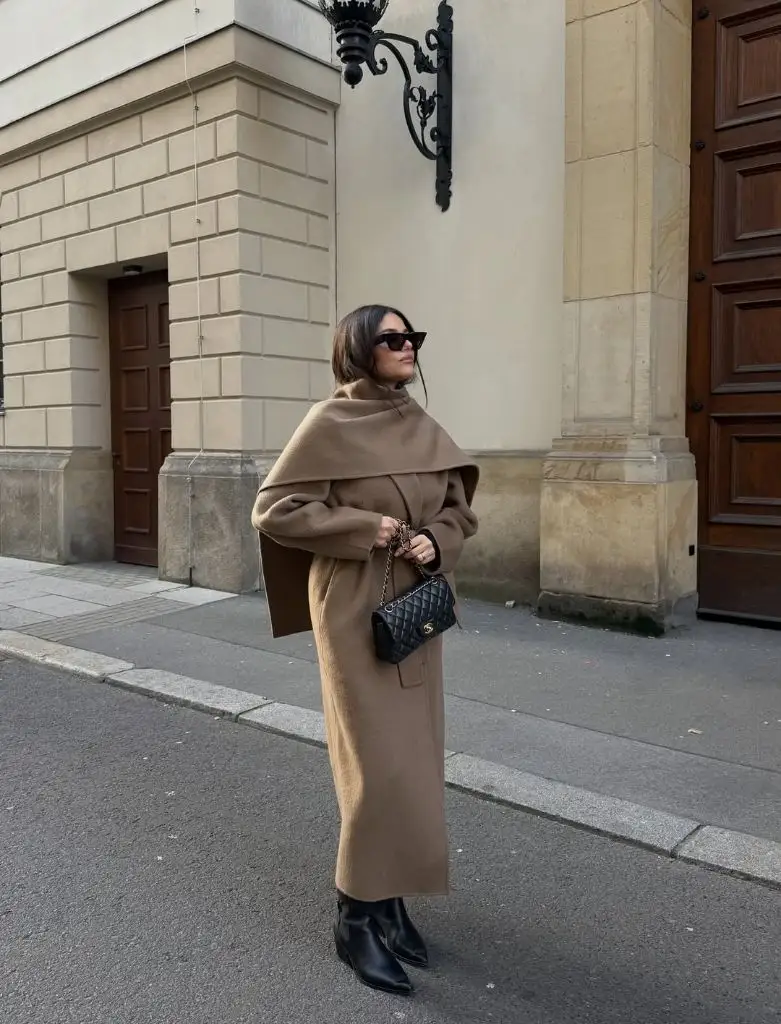
A camel knit scarf or wrap sits high on the neck and drapes over the shoulders like a small cape, in exactly the same warm colour as the coat. That doubling of camel — coat plus wrap — creates a layered warm collar around the throat and face without adding another colour to the palette. A small quilted black bag on a gold chain and pointed black ankle boots close the outfit with two matching dark points at hip and floor.
Compared with the more architectural black robe earlier in this set, this reads notably softer because the neck is wrapped rather than framed by a lapel. The honest limitation is bulk at the shoulder — a scarf wrap adds visible volume across the collarbone, which flatters some frames and swamps others. If it swamps yours, drop the wrap and keep the coat’s own belt as the only defining line.
18. Charcoal Coat Sharpens a Slick Boot
A long charcoal herringbone coat is worn open and swings slightly with movement, showing a fully dark inner outfit — black knit, dark leggings, tall black boots — underneath. The coat’s fabric is fine chevron that reads as near-black from a distance, so the whole silhouette reads as a single dark tall column with the coat’s texture as its only surface event.
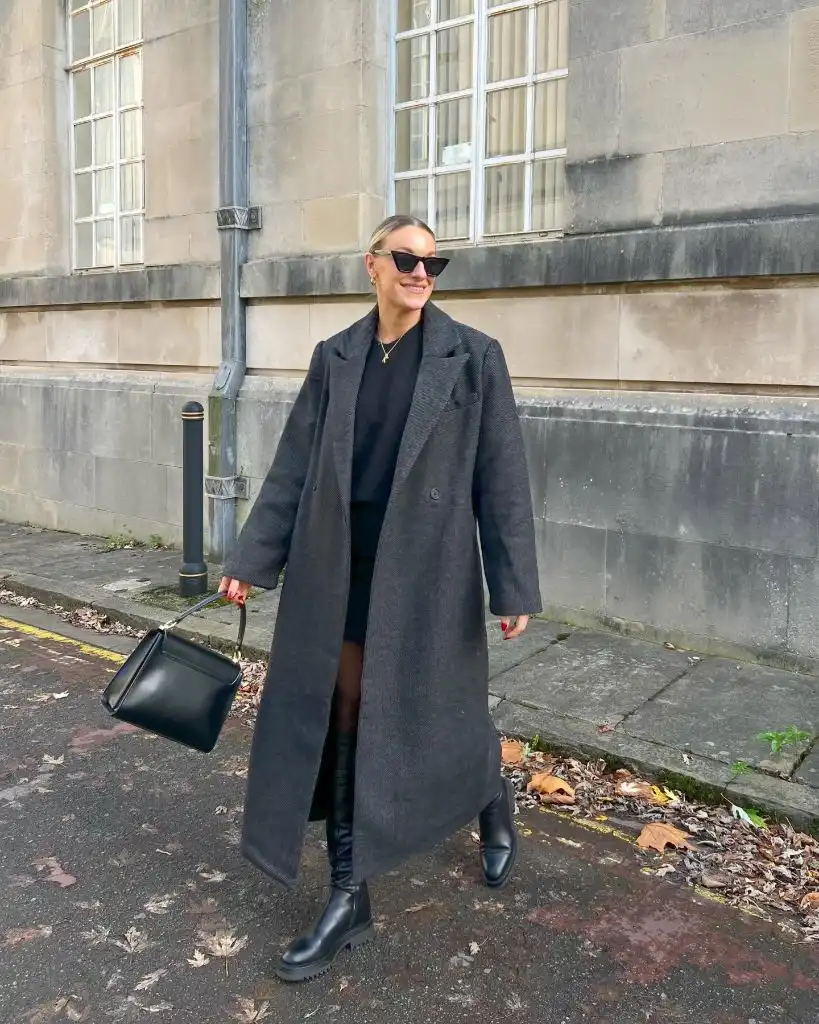
A structured black bag with a top handle sits at hip height, its shape sharp and rectangular against the coat’s softer wool. Small black rectangular sunglasses, a red manicure, and a slick low bun keep the head clean, and there is no visible jewellery. The palette is essentially one colour — near-black — differentiated only by material: brushed wool, matte knit, glossy leather-looking boot, structured leather bag.
The lesson here is about texture as colour. When everything sits at the same value, the difference between fabrics becomes the outfit’s whole hierarchy. Compared with the coats that use one bright accent, this one refuses colour entirely, and the composition holds because there are four different surfaces to look at. To soften it, add one cream layer — a scarf, a knit at the neck — and the near-monochrome breathes.
19. Herringbone Coat Extends a Zip Layer
A long grey herringbone coat sits open across a burgundy half-zip pullover and a short skirt. The coat is oversized through the sleeve and shoulder, falls to mid-shin, and the fine chevron pattern gives it a soft directional texture. The palette is grey, burgundy, and cream, and each colour appears exactly once.
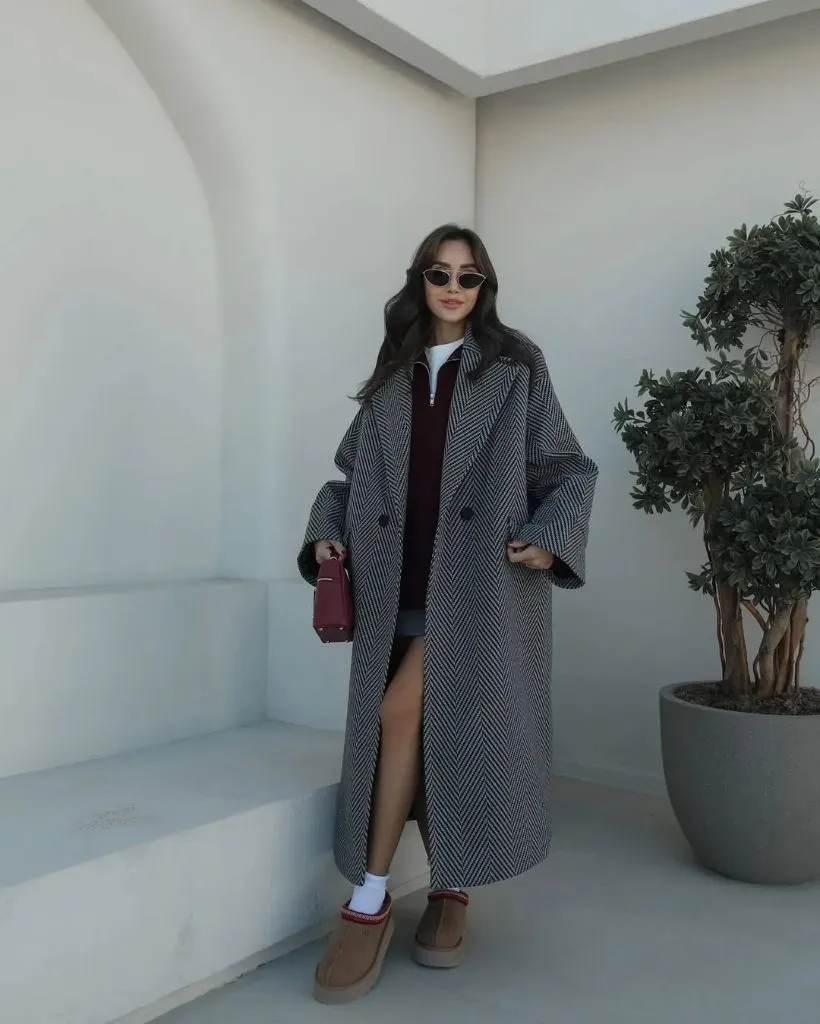
The burgundy pullover is the middle-value colour and sits directly against the face, warming what would otherwise be a very cool grey composition. A small structured red bag held at the hip repeats the warm red family, and pale platform boots with a red woven trim at the top pick up both the cream and the red at the floor. That triple echo — pullover, bag, boot trim — is what makes the burgundy read as considered rather than accidental. White ankle socks show above the boot as an extra small cream note.
Compared with the fully tonal grey outfits earlier, this one uses warmth strategically. The transferable principle is that a single warm colour needs to appear at least twice on the body for the palette to feel resolved. Push the boot into a solid burgundy for a more coordinated look; keep the current cream and the outfit stays casual and campus-adjacent.
20. Brown Coat Anchors White Wide Legs
A long dark-brown coat is worn open over a black cardigan and wide white jeans, cut oversized through the shoulder and long through the sleeve. The coat falls to just below the knee, which lets the white trouser take up almost the entire lower half of the outfit. Against a pale concrete plaza, the brown reads as the darkest vertical element in the picture.
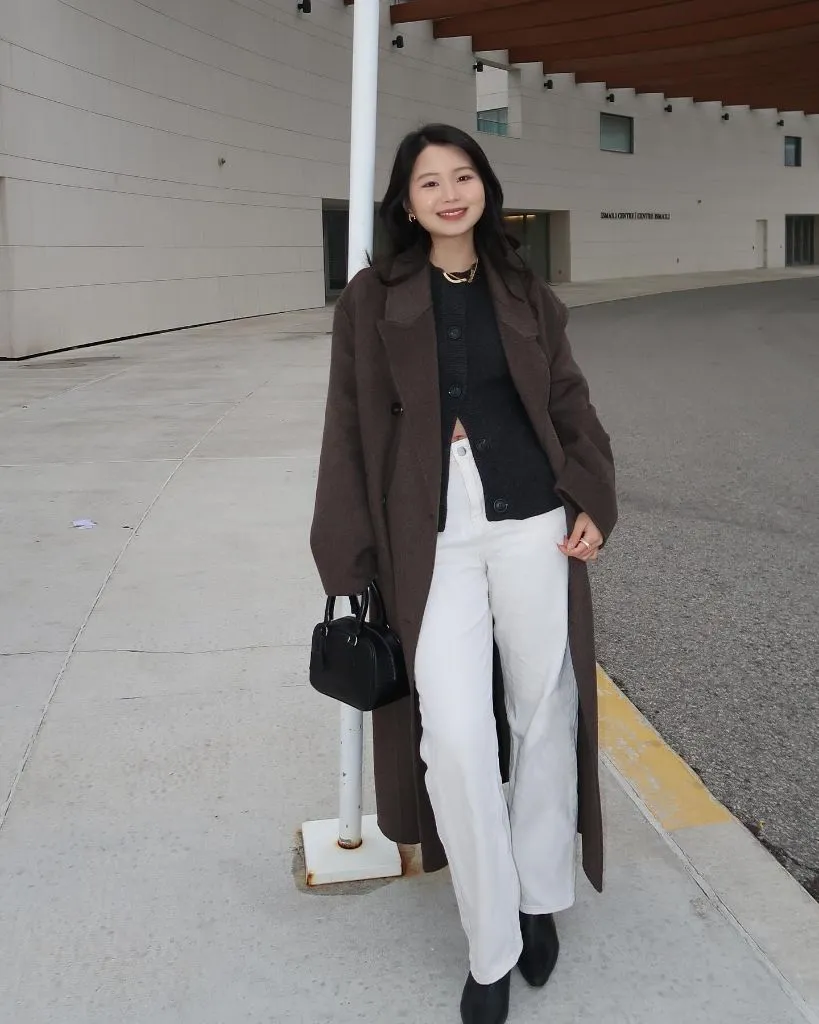
Inside the coat, a black buttoned cardigan sits high at the collar and continues the dark note through the torso. Wide white jeans then take over from waist to floor in a completely different value, so the outfit divides cleanly into two halves — dark above, bright below. A small structured black bag with a top handle sits at hip height and matches the black ankle boots at the floor, keeping the darker accents grouped on one side.
The lesson is about proportional halves. When the coat is knee-length rather than ankle-length, the trouser gets to do half the work, and choosing a wide bright trouser makes the composition feel taller rather than heavier. Compared with the ankle-length brown coats earlier, this one lets the white leg carry the weight, which is a more forgiving option for shorter frames.
21. Black Coat Meets Vintage Denim
A long black wool coat is worn slouched on a park bench, the shoulder line dropped and the coat’s hem trailing to the ground beside the seat. The coat’s fabric reads matte and slightly brushed, and against a bright autumn park background — orange leaves, green benches, blue sky — the black is by far the darkest element in the picture. It reads as gravity in the composition.
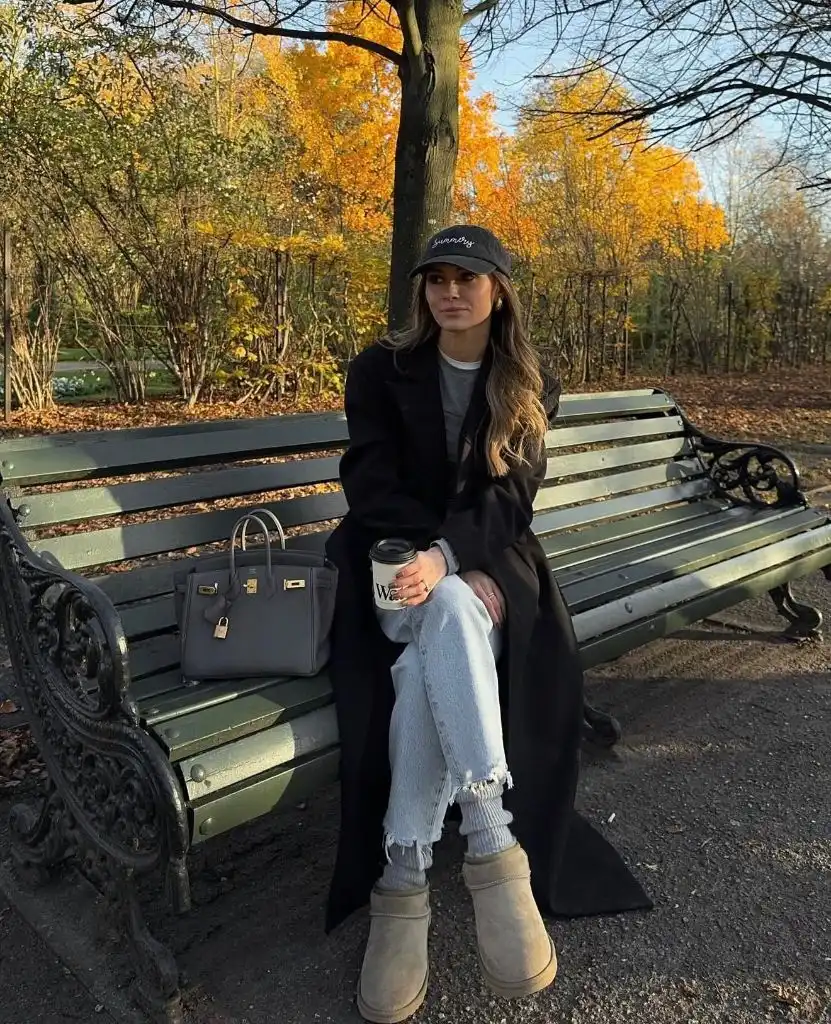
The pieces inside the coat lean casual on purpose. Distressed light-blue vintage-looking jeans, a grey knit, a black cap, and short sand-coloured ankle boots make up a weekend uniform that would look thrown together without the coat. A structured taupe bag on the bench does the work of a jacket usually can’t — it introduces a warm second neutral that connects the boots and the jeans back to the outfit. A takeaway cup in the hand adds the smallest visible white note.
Among Trendy Coats 2027 seen from the street, this is the most useful category — a heavy black coat that formalises anything under it. The transferable principle is coat-as-verb: the same denim and knit worn without the coat look scruffy; worn with it they read intentional. Add a sharper boot to push the whole outfit into evening territory; keep the current soft boot and it stays daytime.
22. Grey Coat Meets a Beanie and Leather
A long grey wool coat is caught in a mirror selfie, worn open over a grey V-neck knit, a white tee, and black leather-looking trousers. The coat’s shoulder is dropped and slightly slouched, the sleeve rolled to show the cuff of the knit underneath. Overhead lift lighting flattens the shadows and pushes the grey to look softer than it probably is in daylight.
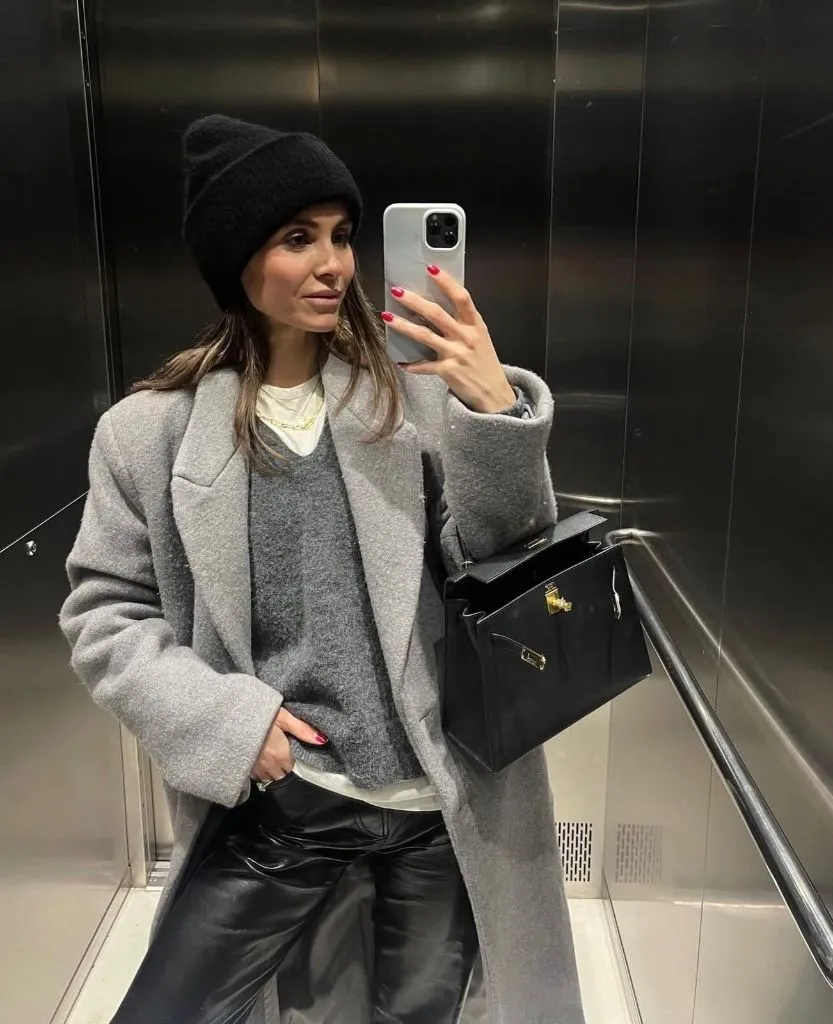
A black beanie sits pulled low over the ears and provides the first dark note, then the leather-looking trousers repeat that black at the leg, and a structured black bag with a gold turn-lock closes the triangle at the hip. A gold necklace over the white tee catches the elevator light and doubles the gold from the bag. The palette is essentially two neutrals — grey and black — with white and gold acting as small connective bright points.
Compared with the more tailored belted looks earlier in this set, this one is deliberately relaxed at the top and sharp at the bottom. The transferable principle is texture stacking within one palette: brushed wool, soft knit, cotton tee, and leather-looking trouser sit in the same tonal range but read as four different surfaces. Swap the leather for denim and the outfit tips into weekend; keep the leather and it stays evening-ready.
23. Cream Coat Meets Long Black Boots
A long cream coat with a soft dropped shoulder controls the vertical, held open across a full black inner outfit. The coat is caught mid-step on the stone stairs, so the hem swings and one side falls higher than the other, showing more of the black underneath. Against a heavy carved dark door, the cream reads as the brightest element in the picture.
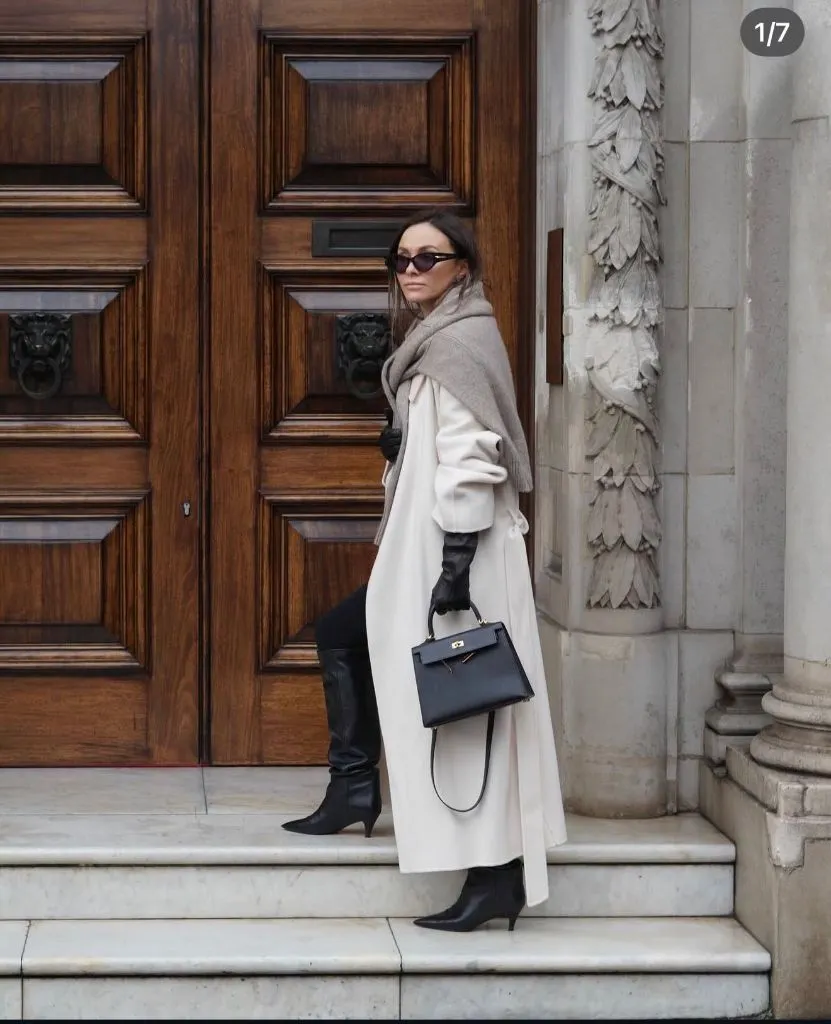
A taupe knit is draped over the shoulders as an extra warm layer at the neck, adding a third neutral between the cream coat and the black inside. Black trousers, tall black kitten-heel pointed boots, and a small structured black bag continue the darker column from waist to floor. The bag is worn low on a longer strap, so it sits at hip height rather than the elbow, which lengthens the visible torso.
The transferable principle is layered neutrals: cream, taupe, and black together read richer than any two of them alone, because the taupe acts as a bridge between the extremes. Compared with the cream-plus-black looks earlier, this one softens the contrast by inserting the taupe wrap. To simplify, drop the taupe and the outfit becomes graphic; keep it and it stays cinematic. The kitten-heel boot keeps the whole silhouette light rather than heavy.
24. Brown Coat Meets a Fair Isle Knit
A dark brown wool coat sits open on a bench outside a shopfront, the collar wide and the shoulder dropped. The coat is knee-length, cut roomy, and the hem falls to the wooden seat rather than the floor. Because most of the outfit is layered against the coat rather than under it, the coat functions almost as a backdrop for the Fair Isle knit inside.
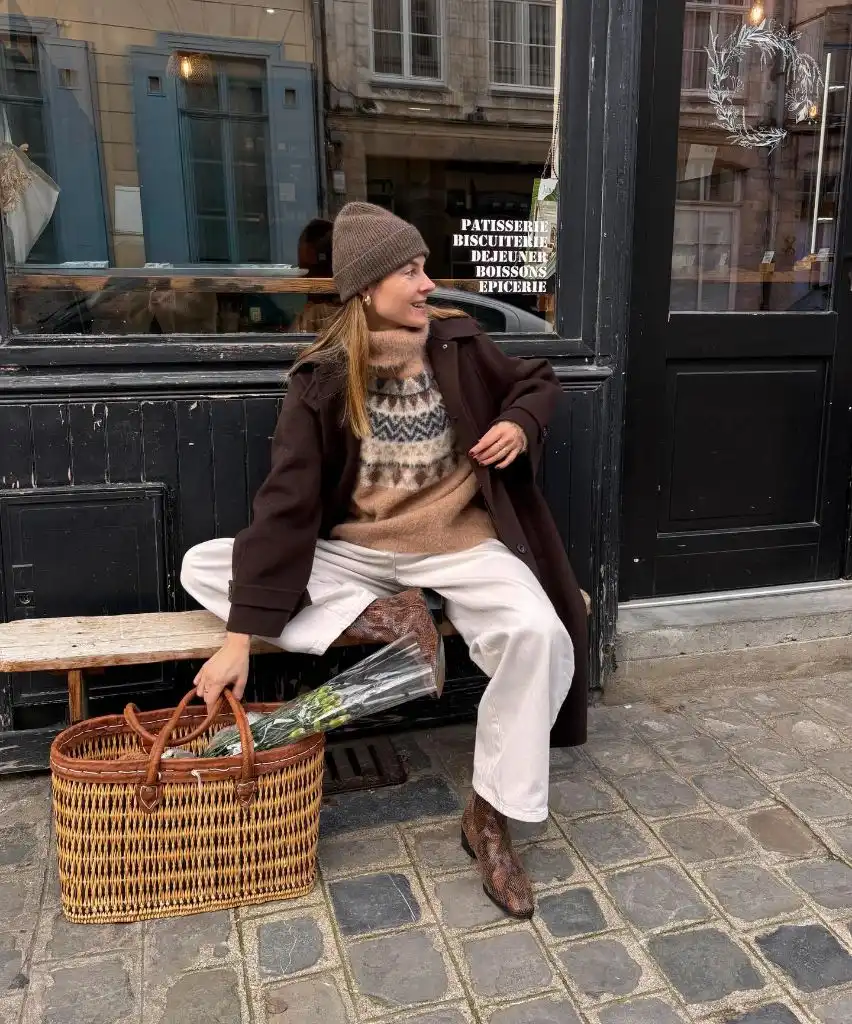
The Fair Isle knit is the composition’s centrepiece — camel, cream, and dark brown motifs across the yoke and body, with a folded turtleneck at the top. It sits in the same warm palette as the coat, so the two pieces read as a set rather than a clash. Cream wide corduroy trousers continue the lightest colour of the knit down to snake-print ankle boots that pick the darker browns back up. A wicker basket with fresh flowers and a brown beanie complete a very rural, very specific palette.
I like the restraint of keeping every colour within the brown-cream family, so the pattern in the knit can do all the work without competing accents. Compared with the sharper city coats earlier, this reads notably softer and more countrified. To keep the look but urbanise it, swap the wicker basket for a plain brown leather-looking tote and drop the beanie — the coat and knit will do the rest.