There is something about painting a tiny pumpkin onto a fingernail that makes the whole season feel closer. The act itself is small, but the result carries weight — a miniature still life sitting at the end of each finger, pulling autumn into every gesture. Halloween pumpkin nails for 2026 have moved well past the basic orange-and-black formula, settling into a space where folk art, texture play, and seasonal storytelling all coexist on a single hand. The designs this year lean into detail without losing warmth, and the best ones feel less like costumes and more like quiet seasonal portraits.
Choosing the right pumpkin nail design comes down to one decision: how much of the nail do you want the design to occupy? Some looks treat the pumpkin as a small accent on an otherwise clean nail, while others let the motif take over every surface. Starting with your comfort level around intricacy is more useful than starting with a color palette. If you tend toward shorter nails or minimal maintenance, a single accent nail with a painted pumpkin and solid color on the rest will carry the theme without overwhelming it. If you enjoy the process and want something that reads from across a room, full-coverage illustrative sets are worth the chair time.
Friendly Pumpkin Faces on Warm Yellow
A brighter, warmer take on the jack-o’-lantern face concept, these nails use a goldenrod yellow base instead of traditional orange, with softer, friendlier facial expressions — round eyes, gentle smiles, and simple triangle noses. The vertical lines are more subtle here, closer in value to the base color, which keeps the pumpkin texture present without making it the dominant feature. The overall impression is cheerful and slightly naive, like a children’s book illustration brought to nail scale.
This is the version to choose if you want Halloween pumpkin nails for 2026 that feel festive without feeling spooky. The warm yellow reads as autumnal sunlight rather than carved lanterns, and the friendly faces would not look out of place at a daytime harvest festival. The square shape keeps things structured, but rounding the edges to a soft square would amplify the friendly quality even further. One thing to watch: the yellow base may require three coats for full opacity, especially over bare nails, so plan for a slightly longer application time.
The shift from orange to yellow is a small change with a large tonal effect. It moves the entire design from Halloween-specific to broadly fall-appropriate, which extends its wearability window from October into November. The friendly faces versus the menacing faces of the previous set demonstrate how the same structural idea — full-coverage color plus illustrated face — can produce completely different moods depending on expression and palette temperature.
Black and Pumpkin Checkered Patchwork
Glossy black nails alternate with accent nails covered in a checkerboard pattern of tiny pumpkins and white daisies on a black-and-white grid. The contrast between the plain black nails and the busy pattern nails is dramatic, creating a visual push-pull that keeps the hand from looking either too simple or too cluttered. The pumpkins in the pattern are small and repeated, turning them into a textile motif rather than individual illustrations.
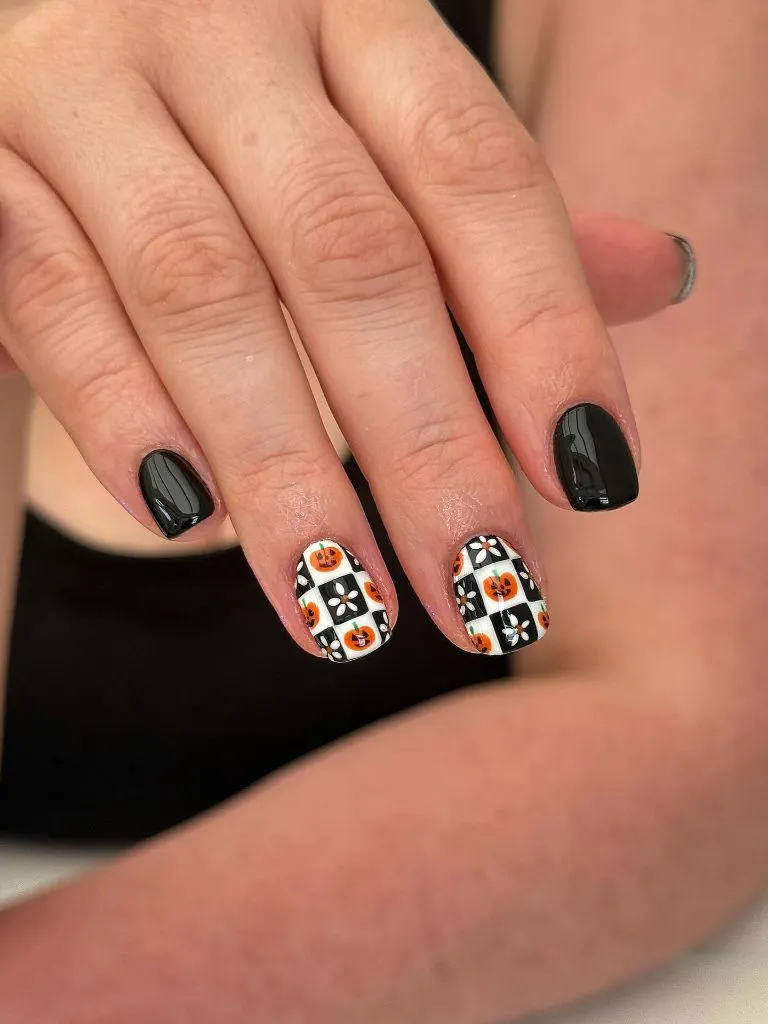
The patterned nails in this set are likely achieved with stamping plates or nail stickers rather than freehand painting, which makes this one of the more reproducible designs on this list. If you are doing nails at home, finding a pumpkin-check nail wrap or water decal is the most efficient path. The plain black nails need to be truly glossy and chip-free to maintain the contrast — a good top coat matters here more than in most designs. Keeping the pattern to just two accent nails, as shown, is the right proportion; putting it on all ten would overwhelm the hand and lose the graphic impact.
The design principle is figure-ground contrast. The solid black nails are the ground; the patterned nails are the figure. Neither would be as strong without the other. The checkered layout itself adds a retro, almost quilted quality to the pumpkin motif, pulling it out of the purely Halloween category and into something that nods at vintage textiles. Substituting navy or forest green for the black would soften the contrast while adding a different seasonal layer.
Burnt Orange Shimmer with Pumpkin Accent Nail
Most of the nails on both hands are coated in a deep burnt orange shimmer polish that shifts between copper and rust depending on the light. The accent nails — one on each hand — break from the shimmer with a sheer pink base and a single hand-painted pumpkin, detailed with golden stem and vine lines. The simplicity of the composition makes it one of the most wearable options here: nine nails of solid shimmer, one nail of quiet illustration.
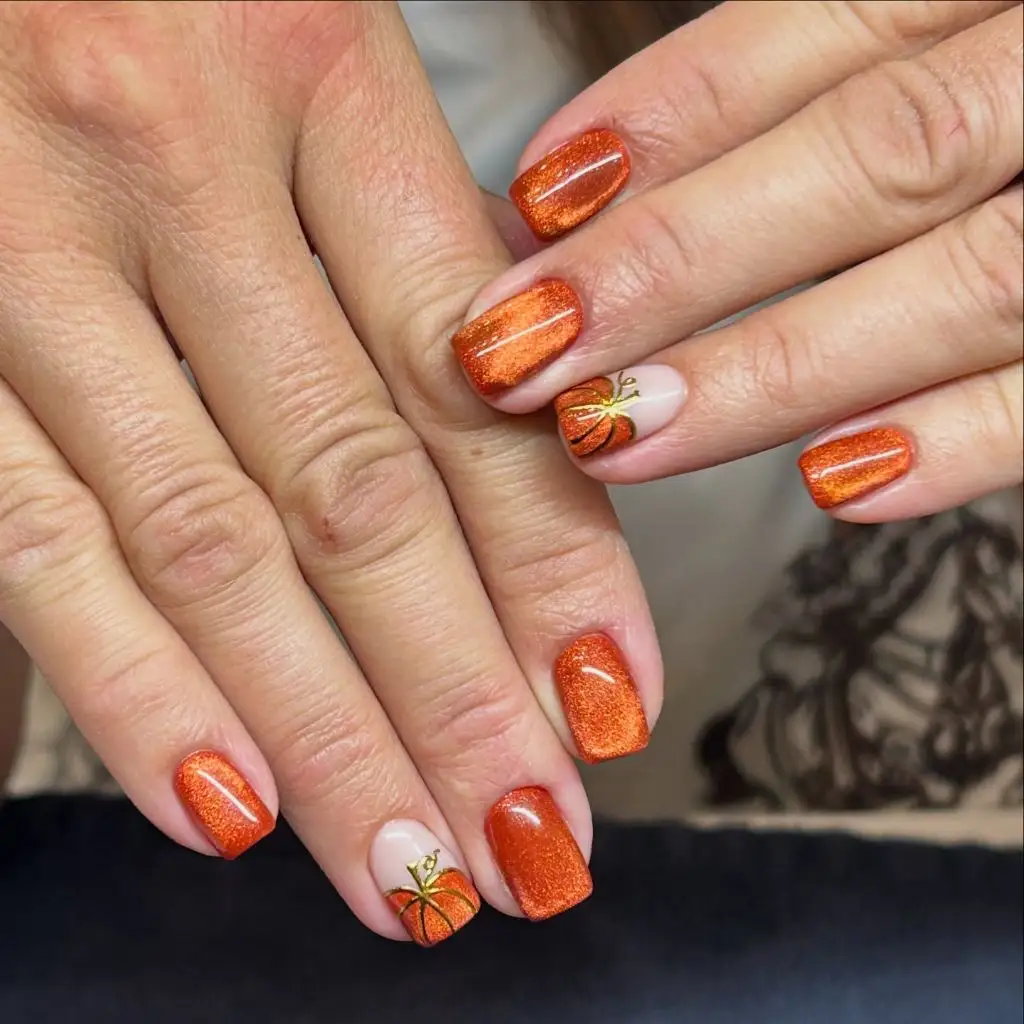
This set works well for someone who wants seasonal color without narrative designs on every nail. The shimmer polish does the heavy lifting, reading as autumnal and rich without any explicit Halloween imagery. The pumpkin accent nails are small enough to feel like a whispered reference rather than a shout. For even more subtlety, you could skip the pumpkin entirely and just do the shimmer — but the accent nail is what makes the set feel considered rather than default. A matte top coat over the shimmer would create a velvet-like finish that reads as more sophisticated, though you would lose some of the light-catching depth.
The relationship between the shimmer and the painted pumpkin is one of texture contrast. The shimmer nails are reflective, shifting, almost liquid in their surface quality, while the painted pumpkin is flat, matte, and still. That tension between movement and stillness is what gives the design its quiet sophistication. Any deep jewel-toned shimmer — burgundy, forest green, midnight blue — could replace the burnt orange and create the same structural dynamic with a different seasonal association.
Cartoon Halloween Medley on Almond Shape
Every nail carries a different brightly colored Halloween character — a green slime drip, a candy corn, a ghost with a bow, a spider web, a jack-o’-lantern, and bats on a purple sky. The almond nail shape softens the graphic cartoon style, and the use of five or six distinct colors (green, purple, orange, yellow, pink, black) across the set creates a candy-bag energy that is deliberately over-the-top.
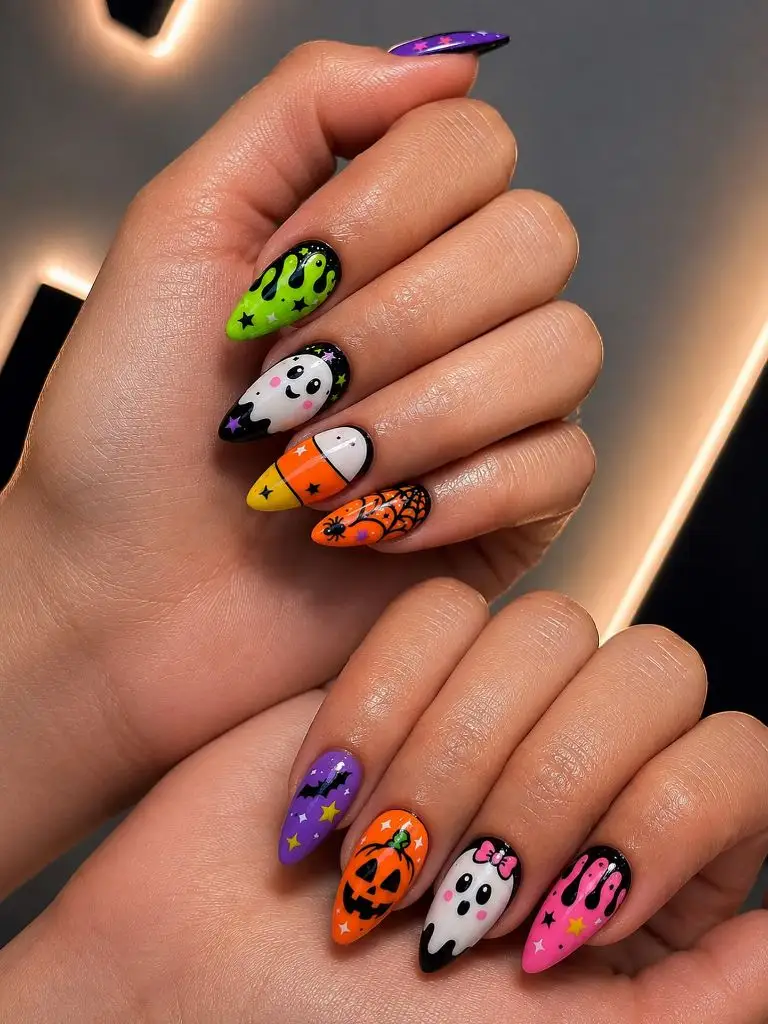
This is a maximalist set that requires a skilled nail artist and a full appointment block. Each nail is essentially a separate miniature painting, and the bright, flat colors demand clean edges to look intentional rather than messy. If you want the cartoon effect with less chair time, choose three of the characters and fill the remaining nails with solid versions of the palette colors — a purple, an orange, and a black, for instance. The pumpkin face nail is the strongest single design in the group and could anchor a simpler version of this set on its own. You might also consider these playful Halloween nail art designs for more character-driven inspiration.
The design philosophy here is abundance — the idea that more is more, and that Halloween is a holiday that rewards visual excess. What keeps it from tipping into chaos is the consistent illustration style: every character is drawn with the same line weight, the same level of simplification, and the same black outlines. That stylistic unity is the invisible thread holding ten very different images together as one coherent set.
3D Cat and Candy Charms on Pink Base
Long coffin-shaped nails in a soft pink base are decorated with three-dimensional charms — black cats, orange pumpkin-shaped beads, striped candy pieces, and white bows — attached to the nail surface. White swirl accents and small pearl dots add texture to the base between the charms. The overall effect is more like a decorated dessert or a jewelry piece than a traditional manicure, leaning heavily into the kawaii-meets-Halloween aesthetic.
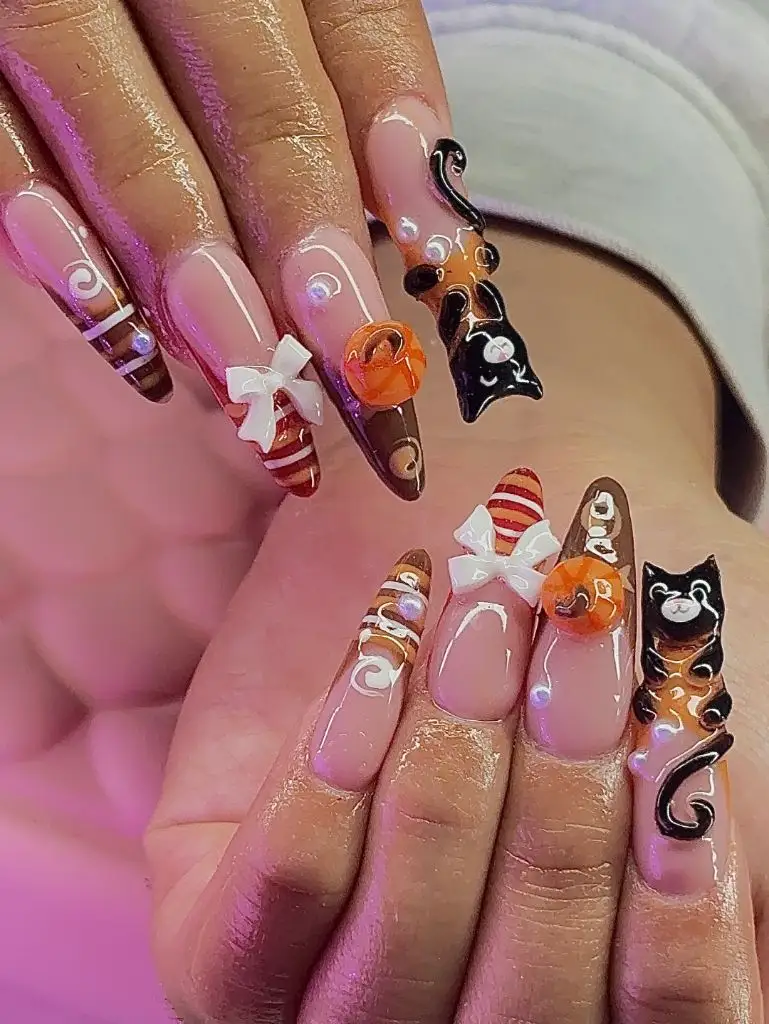
The practical reality of 3D nail charms is that they limit what you can do with your hands. Pulling on clothes, typing on a keyboard, and washing hair all become more deliberate activities when raised elements sit on your nails. If the charm look appeals to you but the lifestyle fit does not, consider flat versions of the same motifs — a painted black cat, a drawn candy cane, a flat bow — which can capture the same whimsy without the snag risk. The pink base is a smart choice here because it keeps the skin tone flattering even as the decorations get busy.
The charm-based approach treats the nail as a platform rather than a canvas, which is a fundamentally different design philosophy than painting. Each charm is a pre-made object placed in a composition, more like arranging a shelf than painting a picture. The cats extending past the nail edge are a particularly bold choice — they break the rectangle of the nail and create a silhouette that changes the shape of the fingertip itself. For a less dramatic version, keeping all charms within the nail boundary preserves the playful quality while maintaining a more conventional hand profile.
Checkerboard, Ghost, and Pumpkin Mix on Short Nails
Short, square-ish nails carry a mix of designs: black-and-nude checkerboard, small white ghosts, spider webs at the French tip line, and pumpkins rendered in warm yellow-orange. The shorter nail length means every design element has to be scaled down, and the successful miniaturization is what makes this set impressive — the tiny ghosts are still clearly ghosts, the webs are still legible, and the checkerboard squares are evenly spaced despite the small surface.
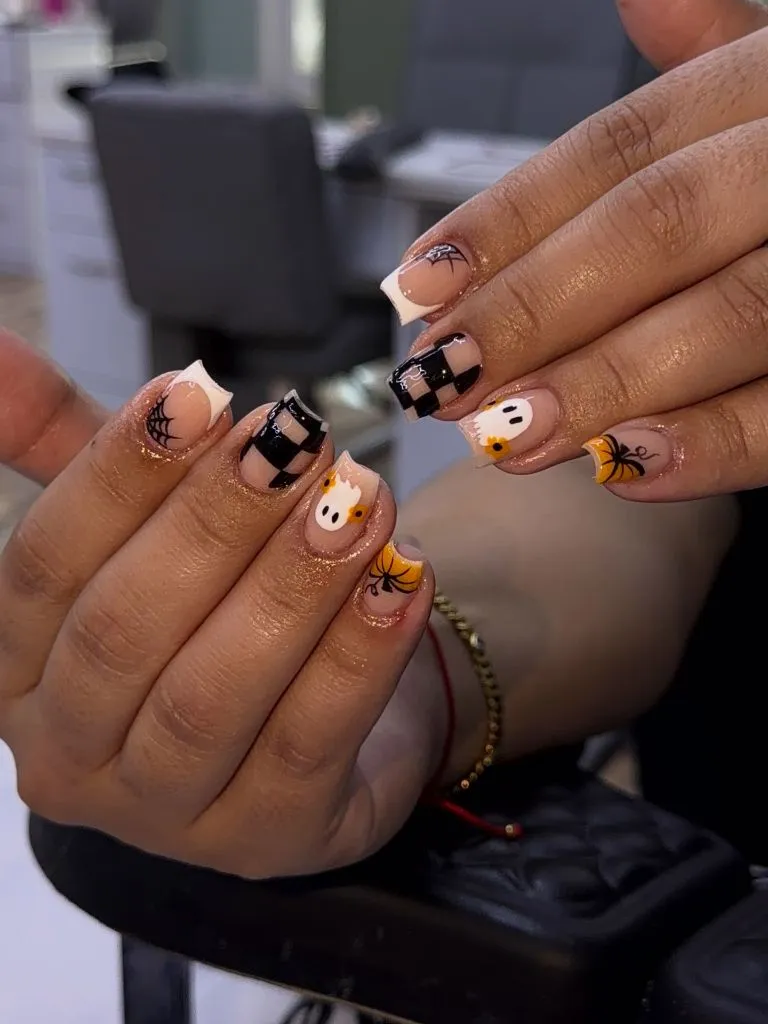
Short nails are often underrepresented in nail art inspiration, so this set is worth bookmarking if you keep your nails close to the fingertip. The key to making detailed designs work on short nails is reducing the number of elements per nail — one ghost per nail, not two; a half-checkerboard rather than a full grid. The glitter shimmer visible on some of the base nails adds dimension without adding visual complexity, which is a useful trick for short-nail sets. A clear or nude base, as used here, also helps by not adding another color to an already diverse palette.
The design principle is economy. Every element earns its place because there is no room for filler. The checkerboard nail works as a geometric counterpoint to the organic shapes of the ghosts and pumpkins, and the spider web French tip is a clever way to add a Halloween element using only lines — no filled shapes, no color blocks, just thin black threads meeting at corners. That kind of structural thinking is what separates a well-designed short-nail set from one that just feels small.
Stiletto Nails with Black Cat and Pumpkin Folklore
Extra-long stiletto nails in chocolate brown and warm amber tones are decorated with detailed folk-art elements — a 3D black cat perched on one nail, a painted pumpkin on another, spiraling gold patterns, moons and stars, and a bone-shaped motif that nods toward Day of the Dead aesthetics. The stiletto shape amplifies the dramatic, almost witchy quality of the design, and the brown palette gives it a specifically autumnal grounding that pure black would not.
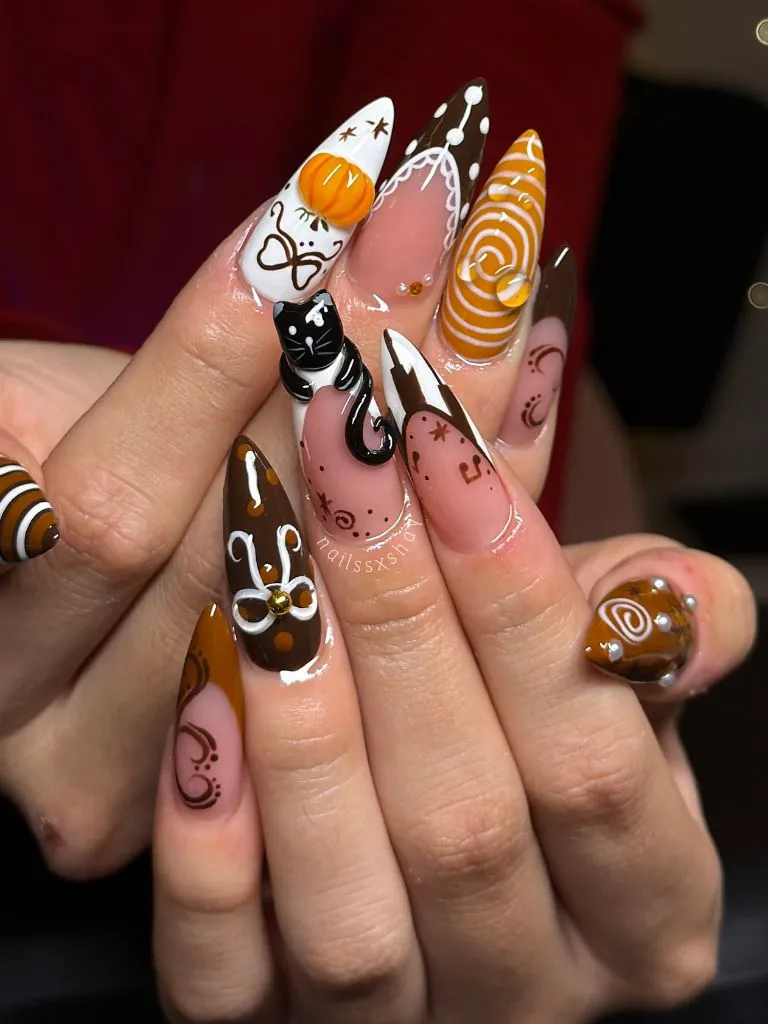
This is a statement set that requires both length and skill. The 3D cat sitting on the nail tip is a technical achievement that not every nail tech can execute, so if this design appeals to you, look for an artist who specifically posts sculptural work in their portfolio. For a more achievable version, keep the brown palette and gold patterns but skip the 3D elements — a painted cat silhouette on a brown base can carry the same narrative. The folklore feel comes more from the color choices and the pattern language (spirals, moons, organic shapes) than from any single element.
Halloween pumpkin nails for 2026 find one of their richest expressions in this folk-art direction. The brown and gold palette recalls harvest festivals, spice markets, and woodcut illustrations — a visual tradition that predates commercial Halloween by centuries. The mix of cultural references (the pumpkin, the black cat, the crescent moons, the bone shapes) creates a layered narrative that rewards close looking. Each nail tells part of a story, and the stiletto shape gives the whole hand a slightly dangerous elegance that suits the witchcraft undercurrent.
Halloween Candy and Cat Confections on Coffin Nails
Another stiletto-to-coffin set with a confectionery theme: the nails feature painted candy elements (striped wrappers, round lollipops), a 3D black cat, mushroom-spotted tips, and a small pumpkin rendered in dimensional gel. The pink-toned base and the overall pastel-plus-brown palette give this a sweet-shop quality, as if Halloween were filtered through a bakery window.
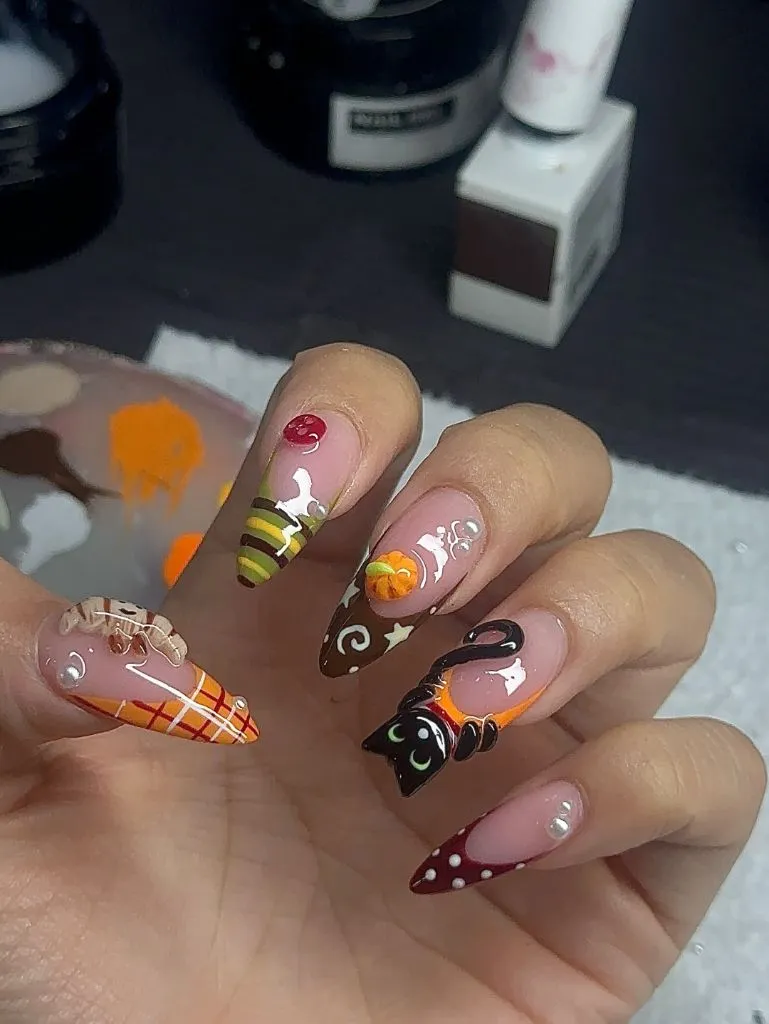
The confectionery approach to Halloween nails works best when every element leans into the sweetness — the bows, the round shapes, the warm pinks and oranges all contribute to that softness. If any single nail went too dark or too sharp, it would break the cohesion. For a simpler take, a solid pink base with one candy-striped accent nail and one painted pumpkin would capture the theme without requiring a full illustration set. The mushroom-tip detail (red with white spots) is an unexpected touch that bridges the Halloween and cottagecore aesthetics.
This design is an exercise in theme layering. The Halloween references (cat, pumpkin, candy) are wrapped in a presentation style (confectionery, pastel, bows) that belongs to a different aesthetic entirely. That collision is what makes it interesting — it is not straight horror and not straight pretty, but something in between that feels original. The 3D cat on the nail tip serves as the set’s darkest element, grounding the sweetness just enough to remind you this is still a Halloween design.
Blue and Orange Cartoon Halloween Storyboard
All ten nails are painted in alternating blue and orange with detailed cartoon characters on each — a spider hanging from a web, a striped candy swirl, a white ghost saying “Boo,” a grinning cat, and more. The blue is an unusual choice for Halloween nails, pulling the palette away from the expected black-and-orange toward something that feels more like a vintage Halloween greeting card or an animated television special.
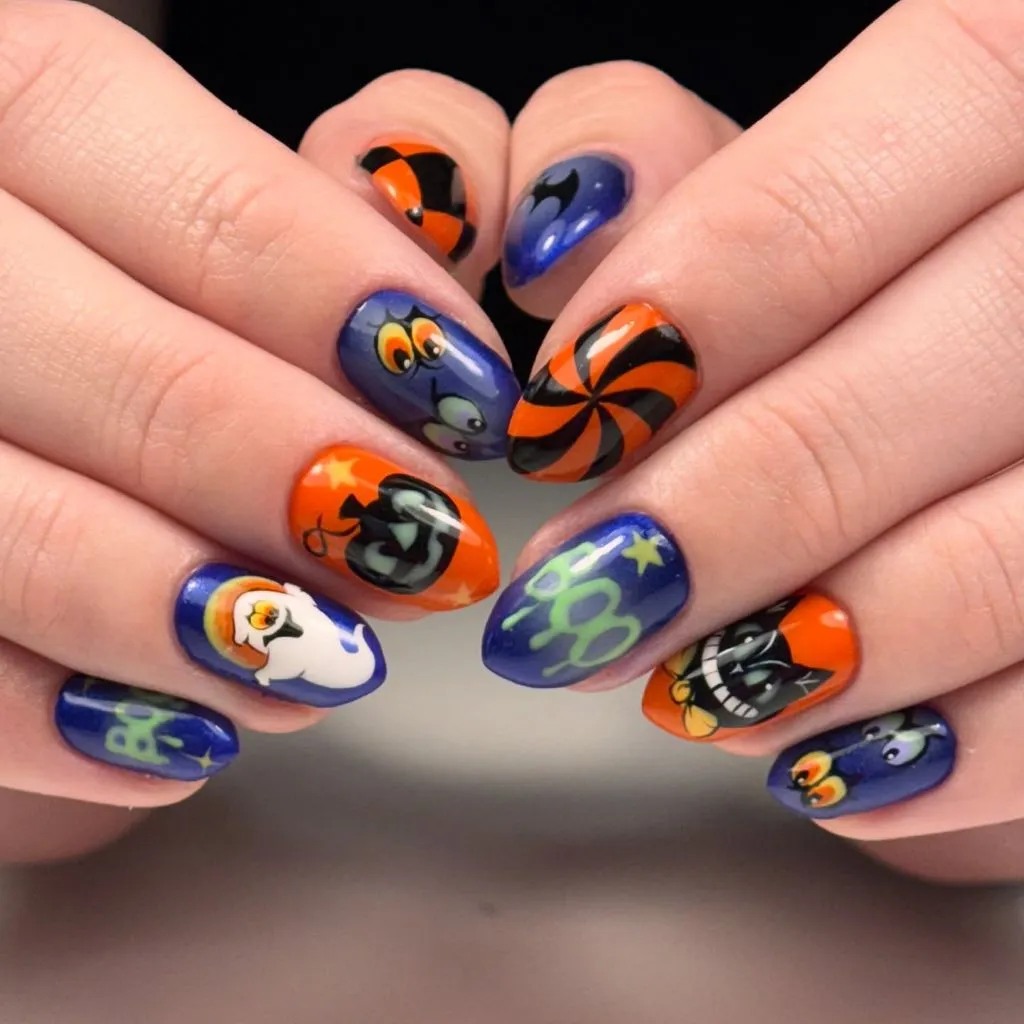
The complementary color pairing of blue and orange is one of the strongest in color theory, and this design leverages that natural vibration to make every element pop. The illustrations are rendered in a slightly retro cartoon style — thick outlines, simple shapes, expressive eyes — that suits the playful tone. To scale this down, choose four nails for the illustrated characters and paint the remaining six in alternating solid blue and solid orange. The cartoon style is forgiving of slight imperfections in freehand work, which makes it more achievable at home than photorealistic approaches.
The storyboard quality — where each nail reads as a different panel in the same narrative — is the organizing logic. Unlike sets where every nail carries the same motif, this one rewards looking at each finger individually, then stepping back to see the full picture. The blue background on half the nails creates a nighttime sky effect, while the orange backgrounds carry the warmth of lantern light. Together, they suggest a complete Halloween scene: night sky, glowing pumpkins, creatures in between.
Minimalist Orange with Ghost and Pumpkin Line Art
Four visible nails show a study in restraint: solid orange on the outer nails, and soft pink or nude centers with minimalist line drawings of a ghost and a pumpkin. The ghost is rendered in white with tiny dot eyes and a single curved line for the body. The pumpkin is similarly reduced to its essential shape — a round form with a dark stem and minimal leaf detail. No backgrounds, no additional characters, no glitter.
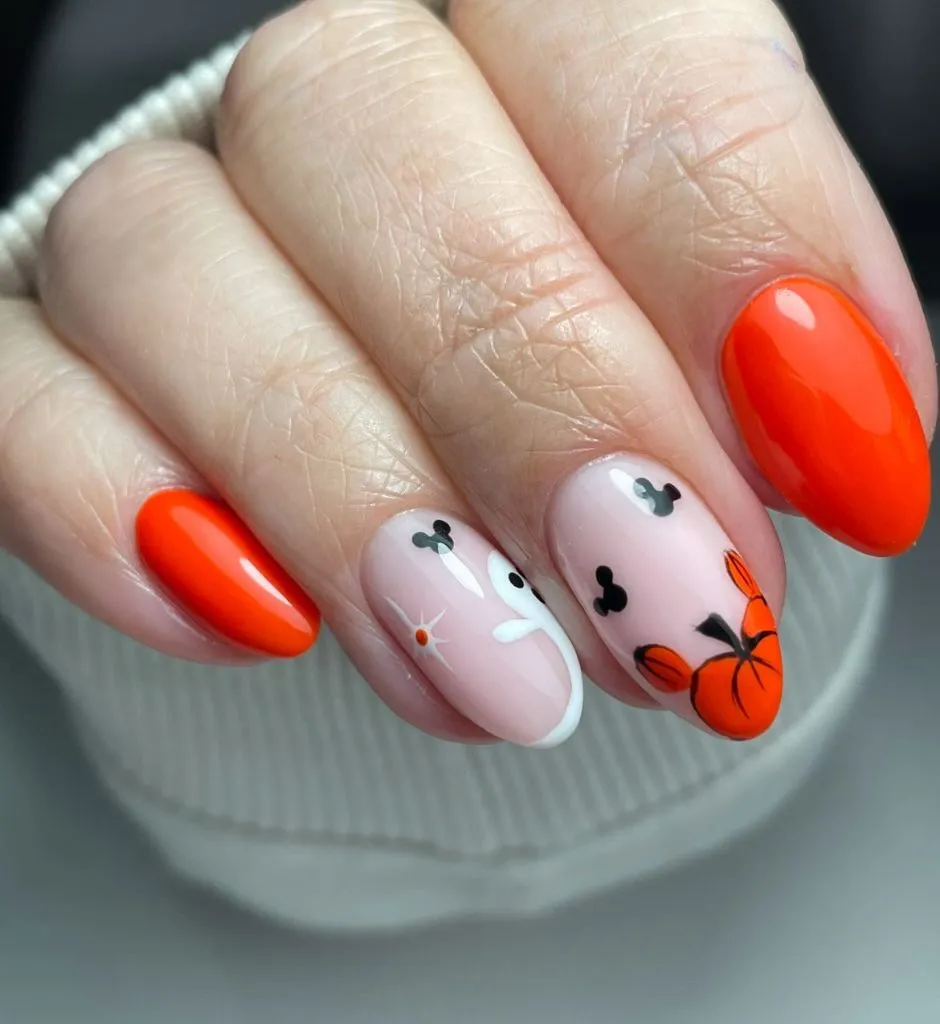
This is the design for someone who wants to acknowledge the season without making a visual statement. The orange is warm and saturated enough to read as intentional rather than accidental, and the illustrated nails are genuinely charming in their simplicity. The almond nail shape adds a softness that complements the gentle line art. This entire set could be executed at home with two polish colors (orange and nude), a white gel pen, and a black fine-tip nail art pen — no special skills required beyond a steady hand and patience.
The minimalist approach succeeds because of what it removes. There are no competing patterns, no texture variations, no dimensional elements — just color and line. That clarity makes the ghost and pumpkin illustrations feel more present, not less. The eye has nowhere else to go, so it sits with the small drawings and notices their proportions, their expressions, their charm. Simplicity is not the absence of design; it is design with everything non-essential stripped away.
Dark Copper Shimmer with Sculptural Pumpkin
A set of short almond nails in deep copper and dark brown shimmer polish, with one accent nail featuring a small sculptural pumpkin built in 3D gel. The pumpkin sits at the tip of the nail, its segments clearly defined and its surface matching the shimmer finish of the surrounding nails. The watermark visible in the image credits @_thejadeaesthetic, suggesting this is salon-level work from a specialist artist.
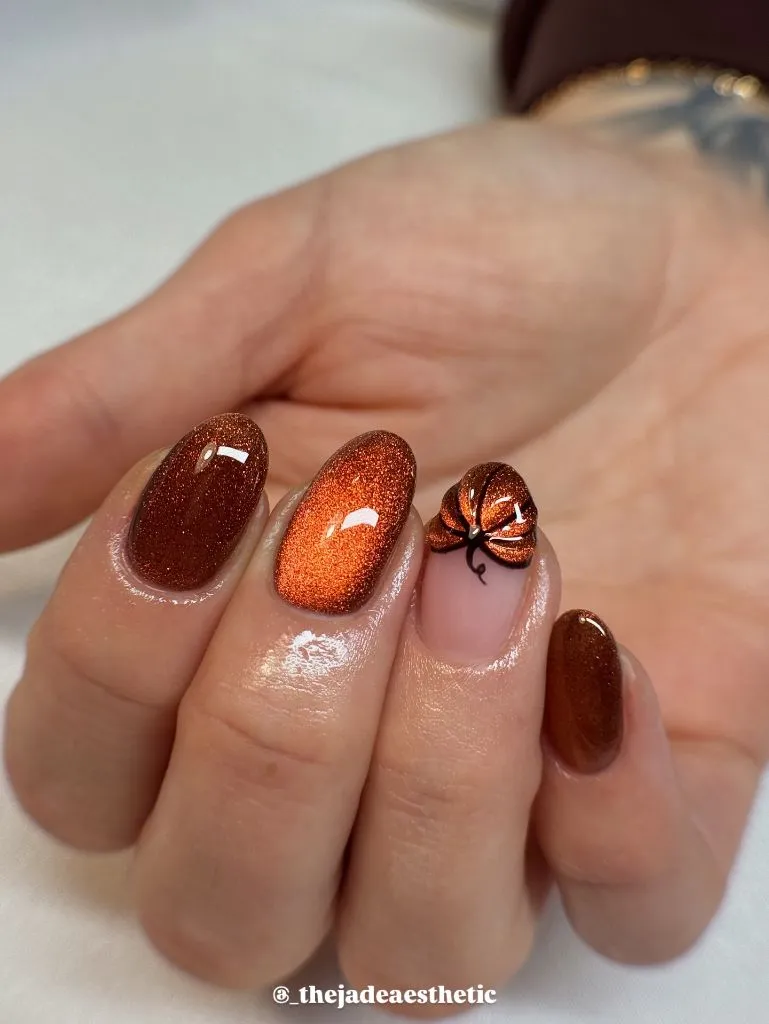
The single sculptural pumpkin on one hand is a masterclass in focal point placement. With nine nails of shimmer creating a unified, luxurious backdrop, the tenth nail draws every bit of attention. If you want this effect without the 3D element, a flat painted pumpkin in the same copper shimmer — perhaps with a darker outline — would create a trompe-l’oeil version of the dimensional piece. The short nail length makes the 3D pumpkin more practical than it would be on longer nails, since there is less leverage for it to catch on things.
This set demonstrates that Halloween pumpkin nails for 2026 can exist in a sophisticated, almost jewelry-like register. The shimmer finish on every nail reads as metallic and luxurious, closer to a piece of burnished copper cookware than a craft store pumpkin. The 3D accent is the only whimsical element, and even it maintains the metallic palette rather than breaking into bright orange. The result is a set that says “autumn” and “pumpkin” without ever saying “costume.”
Ghost Gallery on Charcoal Shimmer
Every nail is painted in a dark charcoal shimmer base and features a different ghost — some wearing witch hats, some carrying small jack-o’-lanterns, some with flowing white robes that trail down the nail surface. The ghosts are painted in white with minimal features (two dot eyes, sometimes a small colored accessory), and their flowing forms create organic, downward-moving shapes against the dark background.
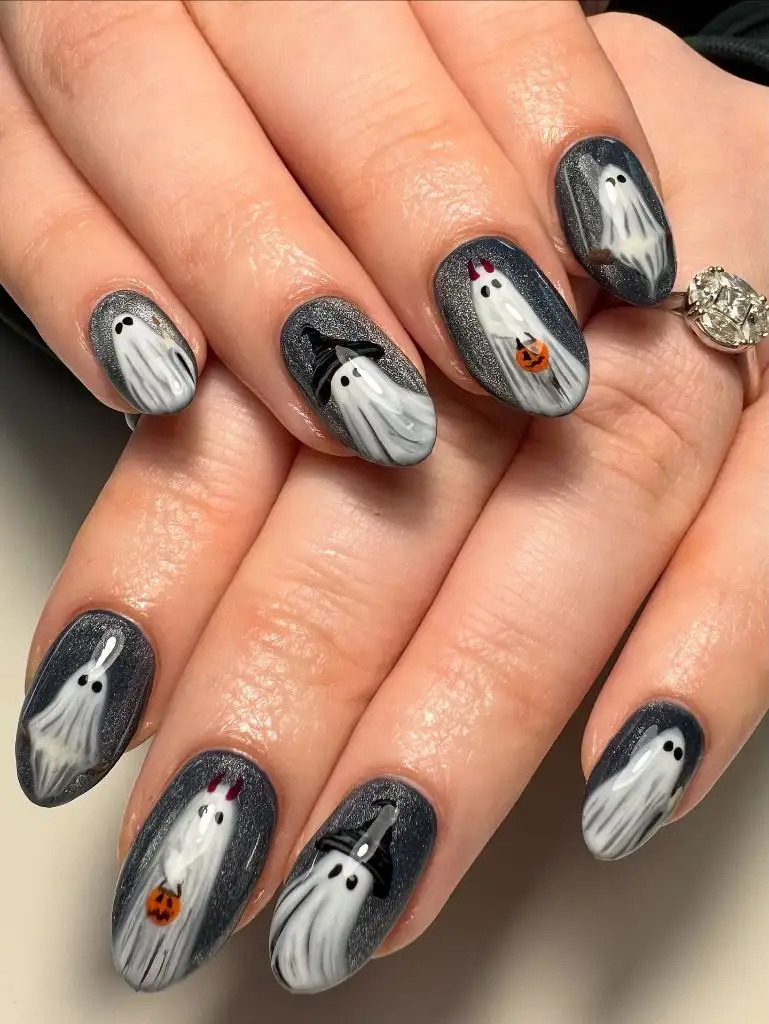
This set has a genuinely atmospheric quality that most Halloween nail designs only gesture toward. The charcoal shimmer reads as a misty night sky, and the ghosts feel like they are emerging from that mist rather than sitting on top of it. To achieve this effect, the base needs to be a true charcoal with silver or blue micro-shimmer — a flat black or a warm brown would not create the same atmosphere. The white paint for the ghosts should be slightly translucent at the edges and opaque at the center, which creates the ethereal, fading-into-fog quality that makes these so evocative.
The ghost-on-every-nail approach could easily feel repetitive, but the variation in accessories and poses prevents that. One ghost has a witch hat. Another holds a pumpkin. A third is just floating peacefully. These small differences create personality without requiring different motifs, and the consistent charcoal background ties them into a single world. The design proves that a narrow concept — just ghosts, just one background — can support a full ten-nail set if the variations within that concept are thoughtful enough.
Soft Ghost and Pumpkin Doodles on Short Natural Nails
Very short, natural-length nails with a barely-there nude base carry the most pared-down Halloween pumpkin nails for 2026 in this collection. One nail is solid pumpkin orange with two small white ghosts. Another has a sheer base with orange drip marks. A third shows a mummy-wrap texture. And the remaining nails carry nothing more than tiny dot-eyes or faint orange smudges that suggest a season without illustrating it directly.
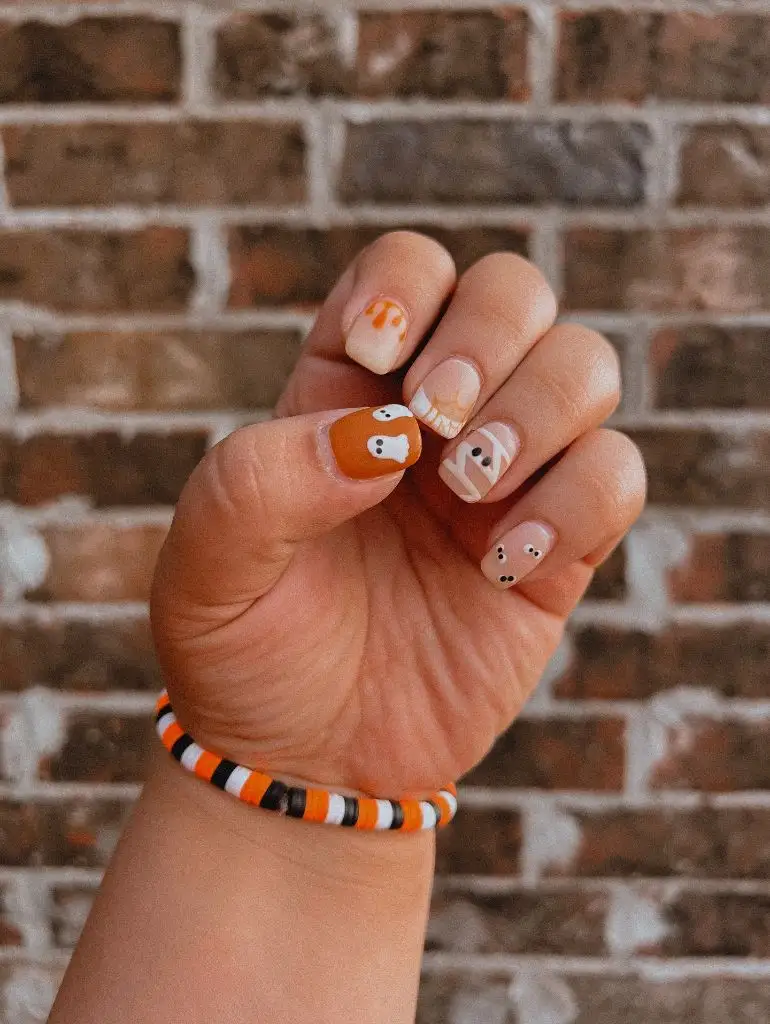
If you have never tried nail art before, this is the set to start with. The designs are genuinely simple — the ghosts are two dots and a U-shape, the mummy wrapping is just overlapping beige lines, and the orange drips are literally dripped polish allowed to run slightly. The short nail length works in the design’s favor here, making each small element fill the nail surface proportionally. A Halloween-colored beaded bracelet, like the one visible in the image, extends the seasonal mood beyond the nails themselves and costs almost nothing to add.
The beauty of this approach is its honesty. It does not pretend to be salon-level artistry, and it does not need to. The slightly imperfect dot eyes, the hand-smudged orange, the not-quite-symmetrical ghost shapes — these imperfections are features, not flaws. They give the nails a doodled, sketchbook quality that feels personal and unforced. In a season full of elaborate nail art, there is real charm in something that looks like it was done at a kitchen table with a few bottles of polish and a toothpick.
Snoopy Halloween Scene on Blue and Purple
Two thumbnail-sized paintings depict Snoopy in classic Halloween scenarios — one on a light blue background with the beagle dressed as a witch riding a broomstick among bats, and another on a purple shimmer background showing Snoopy atop the Great Pumpkin. The illustration quality is high, with clean lines, accurate character proportions, and effective use of a limited palette within each tiny frame.
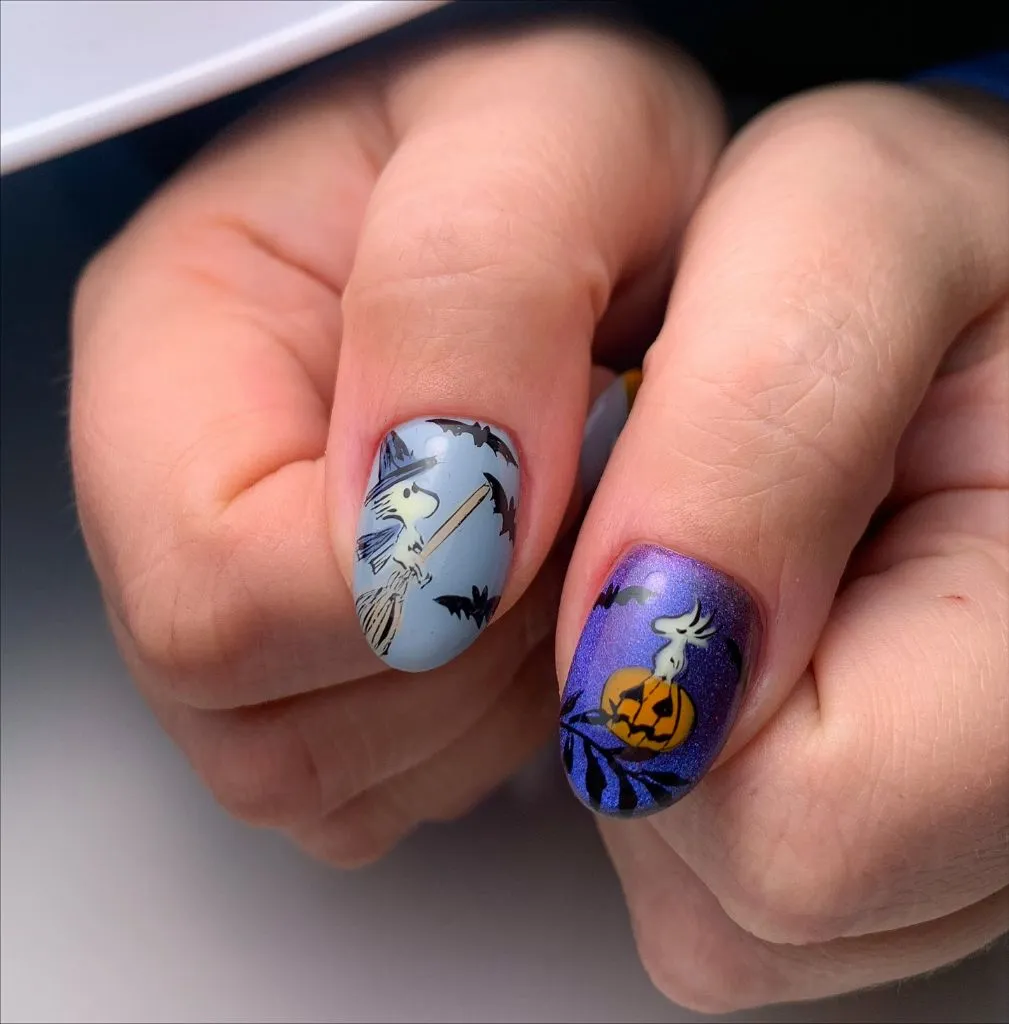
Character nail art like this requires either a very skilled nail artist or high-quality water-slide decals. If you are using decals, the blue and purple base colors should be applied first and fully cured, then the decal positioned and sealed with a clear top coat. The shimmer in the purple base adds depth that a flat color would not, making the Snoopy illustration feel like it exists within a space rather than sitting on a surface. These work best as accent nails within a larger set — paired with solid blue, purple, and orange nails on the remaining fingers.
The nostalgia factor is the engine of this design. The Peanuts Halloween special is a shared cultural memory for many people, and placing it on a nail turns a personal reference into a wearable one. The blue and purple palette is also a useful departure from the orange-and-black standard, proving that Halloween nails can live in cooler tones while still being immediately recognizable as seasonal.
Orange Stripes with Peeking Black Cat
An orange-and-white striped nail features a black cat face peeking over a white scalloped edge, with small pointed ears, yellow eyes, and a crescent moon visible above. The striped pattern mimics a circus tent or candy packaging, and the cat’s placement — half-hidden, as if looking over a fence — adds a narrative element that a centered cat portrait would not.
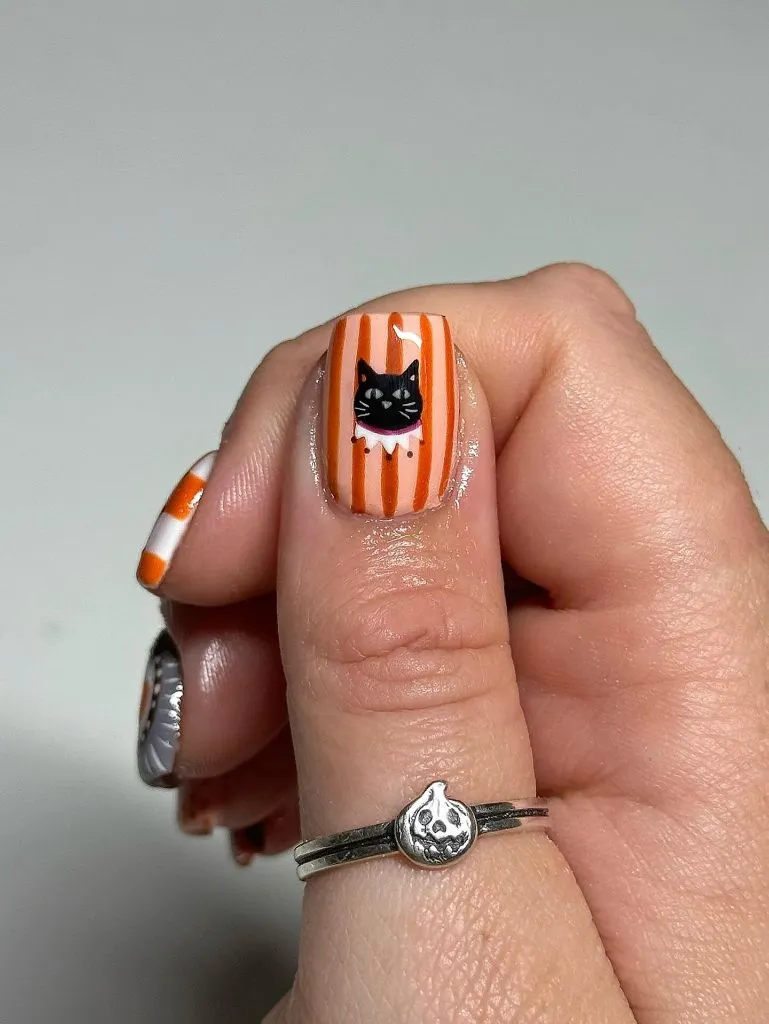
The peeking composition is what makes this nail special. By hiding the cat’s body below the scalloped white edge, the design suggests more than it shows, engaging the viewer’s imagination. The stripes behind the cat create depth — they read as a background wall or curtain — which gives the tiny scene a sense of space. To recreate this, paint the stripes first, add the white scalloped edge about one-third up from the tip, and then paint the cat face peeking over. The crescent moon in the upper area is a finishing detail that places the scene at nighttime.
The pumpkin ring visible on the thumb is a nice complementary detail, extending the Halloween vocabulary beyond the nails. But the design lesson here is about cropping. By showing only part of the cat — ears, eyes, and the top of the head — the nail art creates curiosity and movement. A fully visible cat sitting in the center of the nail would be pleasant. A half-hidden cat peeking over an edge is memorable. The difference is compositional intelligence, not skill level.
Pumpkin Cameo with Argyle and Checkered Accents
Short square nails carry a mixed-pattern set: one nail with an orange-and-brown argyle diamond pattern, another with an orange-and-white checkerboard, a third with a pink base and orange polka-dot tip, and the centerpiece — a grey nail with a hand-painted pumpkin inside a dotted oval frame, recalling a vintage cameo brooch. The patterns are all different but share the same narrow orange-brown-cream palette, which holds them together.
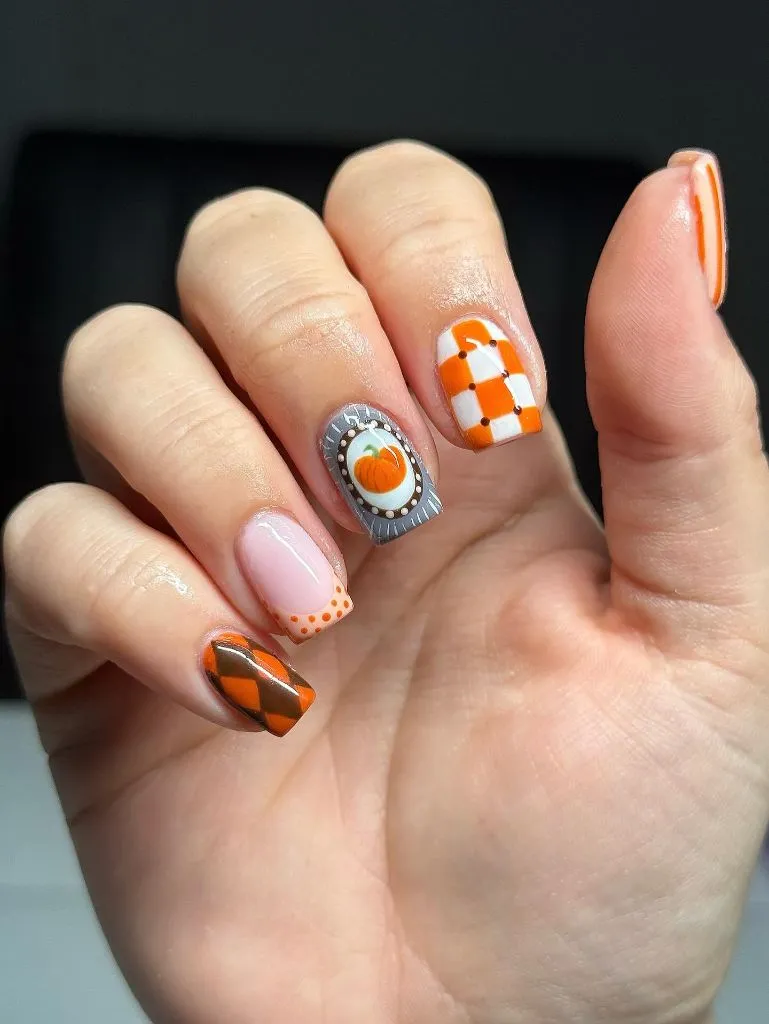
The cameo nail is the anchor of this set — it is the only illustrative element, surrounded by geometric patterns that provide texture without competing for attention. If you are doing this set at home, the argyle and checkerboard can be achieved with thin tape or striping tape, and the polka dots with a dotting tool. The pumpkin cameo is the only freehand element, and even that is simplified by the oval frame, which gives you a clear boundary to work within. The grey base on the cameo nail is an underused color in Halloween palettes, and its neutrality makes the orange pumpkin glow.
The mix of patterns — argyle, checkerboard, polka dot, cameo — could easily feel disjointed, but the shared color family prevents that. Every pattern uses some combination of orange, brown, cream, and grey, and none introduces a color that the others do not share. This is the design equivalent of a capsule wardrobe: limited inputs, maximum combinations, everything coordinated without matching. The pumpkin cameo at the center is the seasonal stamp that tells the viewer this is a Halloween set rather than just an autumn one.
Pumpkin French Tips with Ghost Accents on Square Nails
Square nails with a nude base feature oversized pumpkin tips — the pumpkins are painted at the free edge of the nail, their round tops rising into the nail bed area like half-moons. Tiny white ghosts appear on one or two accent nails, and small four-pointed star sparkles in dark green or gold are scattered across the remaining negative space. The pumpkins are painted in a saturated red-orange with visible segment lines and dark stems.
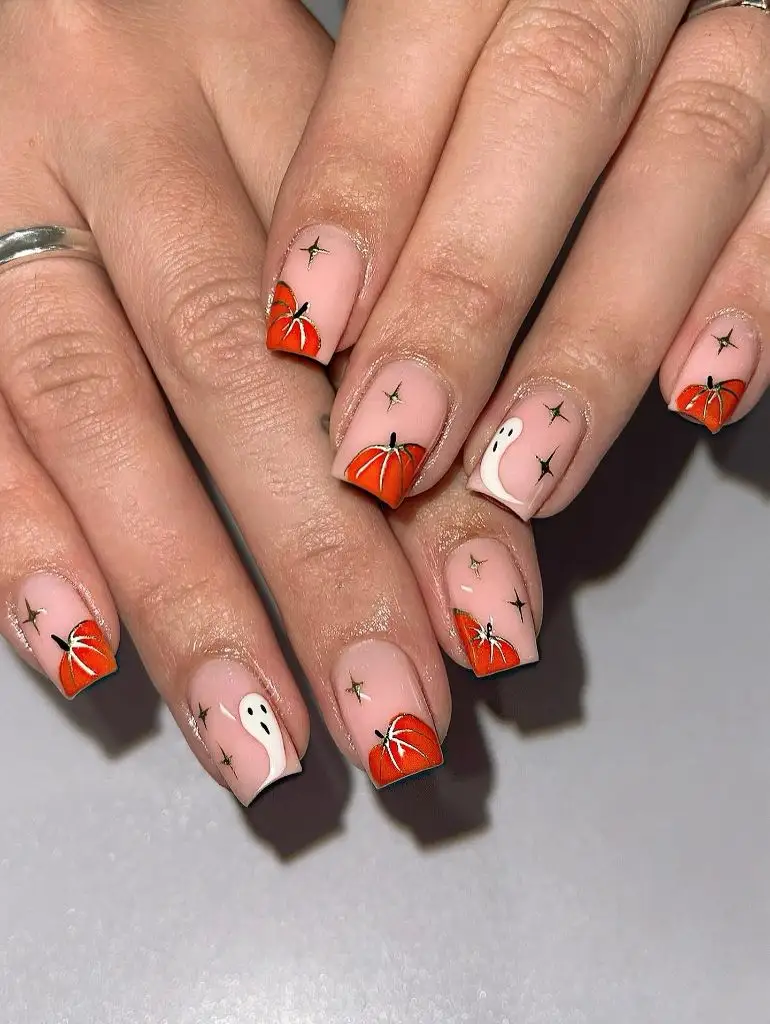
This is a clever structural idea: using the pumpkin itself as the French tip shape. Instead of the traditional curved smile line, the pumpkin’s round top creates the border between the bare nail and the colored tip. It reads as a French manicure from a distance and as a pumpkin set up close. The ghosts are small and positioned off-center, which keeps them from competing with the pumpkin tips. If you want to simplify, skip the ghosts and just do the pumpkin French tips with the scattered sparkles — the concept is strong enough to carry the set alone.
The sparkle accents deserve attention. They are four-pointed stars, not circles or dots, which gives them a hand-drawn, storybook quality that matches the illustrated pumpkins and ghosts. These small marks — easy to add with a fine brush and a dark polish — do disproportionate work in filling the negative space without cluttering it. The overall effect is a Halloween set that feels illustrated rather than decorated, as if someone drew a holiday scene across your fingertips with a fine-point pen and a few pots of paint.
Pink Glitter Bow Nails — A Non-Pumpkin Seasonal Alternative
Extra-long coffin nails in baby pink with hot pink floral and bow designs, accented with rose gold glitter and small rhinestones. This set contains no pumpkins, no ghosts, no black, and no orange — it is included here as a deliberate counterpoint, showing what a fully non-Halloween approach to October nails can look like. The bows and flowers are rendered in a hand-painted style with strong red-pink lines on a pastel ground.
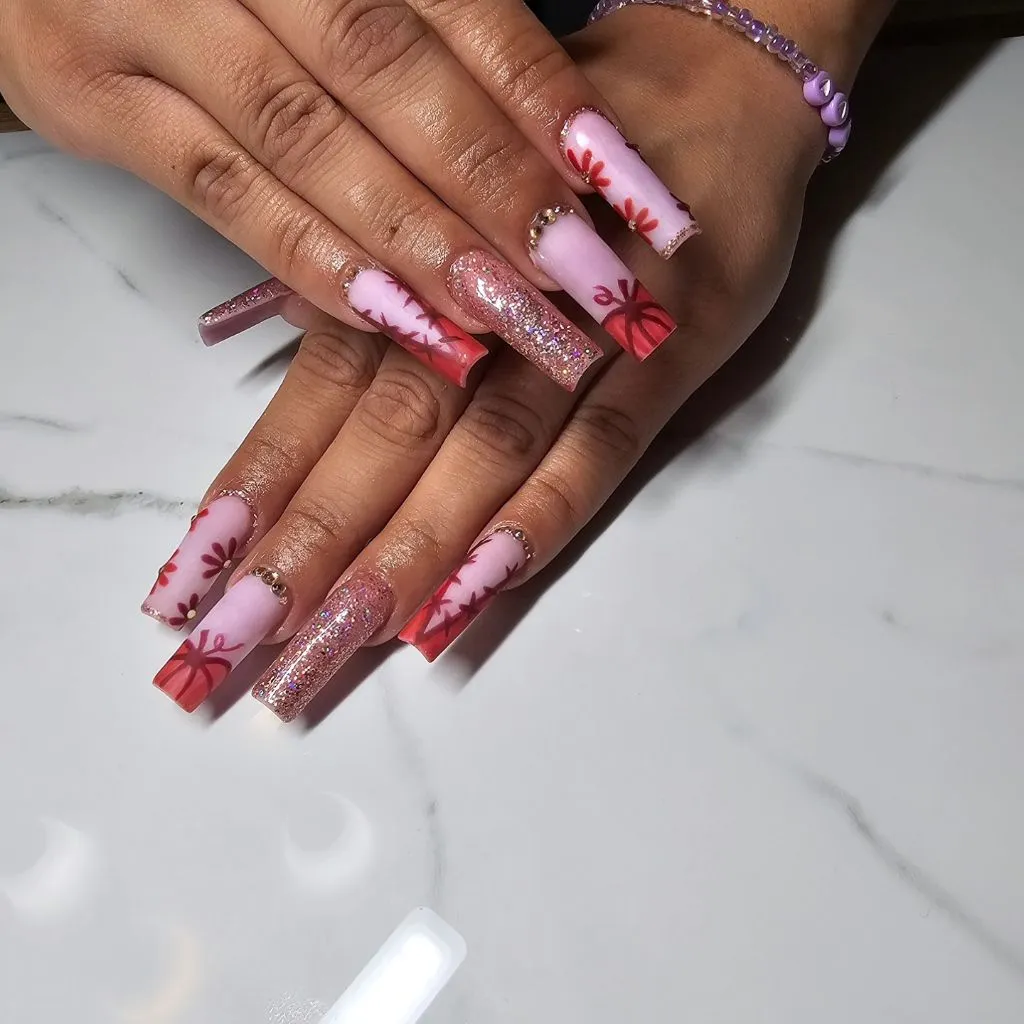
If pumpkins and ghosts are not your vocabulary but you still want a set that feels seasonally intentional, the all-pink approach with warm-toned accents (rose gold rather than silver, warm pink rather than cool pink) reads as autumnal without any Halloween imagery. The glitter nails alternating with the painted nails create rhythm, and the rhinestones at the cuticle line add a formal quality. This set would work for an October wedding, a fall gala, or simply for someone who prefers pink year-round and does not want to pause for a holiday palette.
Including a non-Halloween option in a Halloween nail roundup is a design courtesy. Not everyone wants seasonal imagery on their hands, and acknowledging that broadens the conversation. The warm pink tones here actually share more color DNA with pumpkin-adjacent palettes than you might expect — rose gold is just copper softened with pink, and copper is just a step away from pumpkin orange. The connection is there if you look for it, which makes this set a graceful opt-out rather than a total departure.
Orange Ombré French with Plaid and Spider Accent
Almond-shaped nails with an orange ombré French tip — the color fades from the free edge toward the center of the nail and dissolves into the bare base. Two accent nails break the ombré pattern: one with an orange plaid design (red and cream lines crossing over the orange base) and another with a small spider or pumpkin illustration at the tip. The rest of the nails are clean ombré, creating a set that is mostly understated with two points of seasonal specificity.
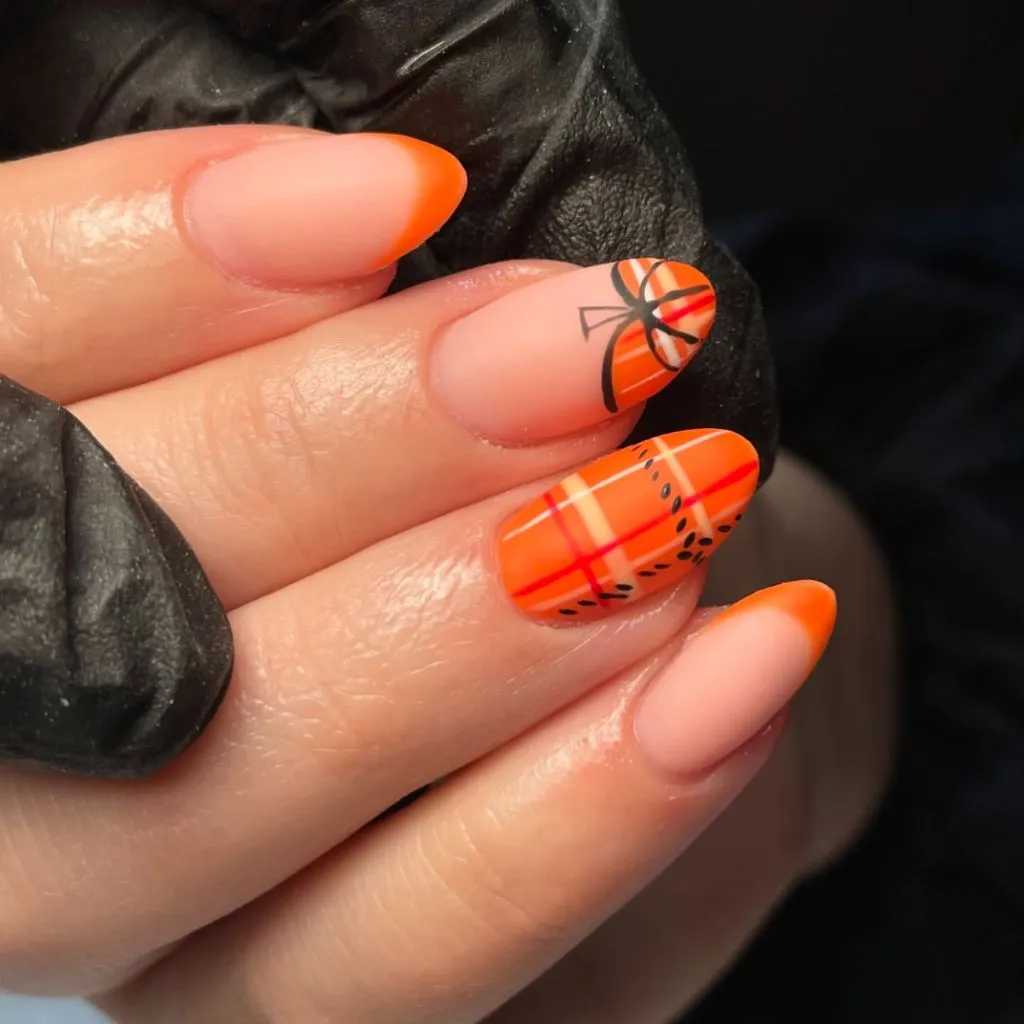
The ombré French tip is one of the more sophisticated nail trends of recent years, and applying it in pumpkin orange is a smart seasonal adaptation. The gradient softens the color, preventing it from reading as flat or costume-like, and the bare nail visible through the center keeps the hand looking clean. The plaid accent nail adds a textile reference — flannel, autumn blankets, harvest tablecloths — that deepens the seasonal association without adding another Halloween character. If the plaid feels too complex, a single thin line in a contrasting color across the orange tip would create a similar effect with less effort.
This set is proof that seasonal nails do not need to be literal. There are no jack-o’-lanterns here, no ghosts, no bats — just orange, plaid, and a hint of spider. The seasonal reading comes entirely from color and pattern associations, which makes it arguably the most versatile set in this collection. You could wear these to a business meeting, a date, or a pumpkin patch and feel appropriately dressed for all three. The almond shape completes the polished impression, curving the orange tips into a form that feels organic and intentional.
White French Tips with Teal and Orange Pumpkin Vine Art
Almond nails with a classic white French tip on most fingers, interrupted by two accent nails featuring hand-painted pumpkins — one in teal, one in red-orange — with gold vine and leaf details curling around and between them. The white French tips provide a familiar, clean framework that makes the pumpkin art feel like a seasonal update to an everyday manicure rather than a complete departure.
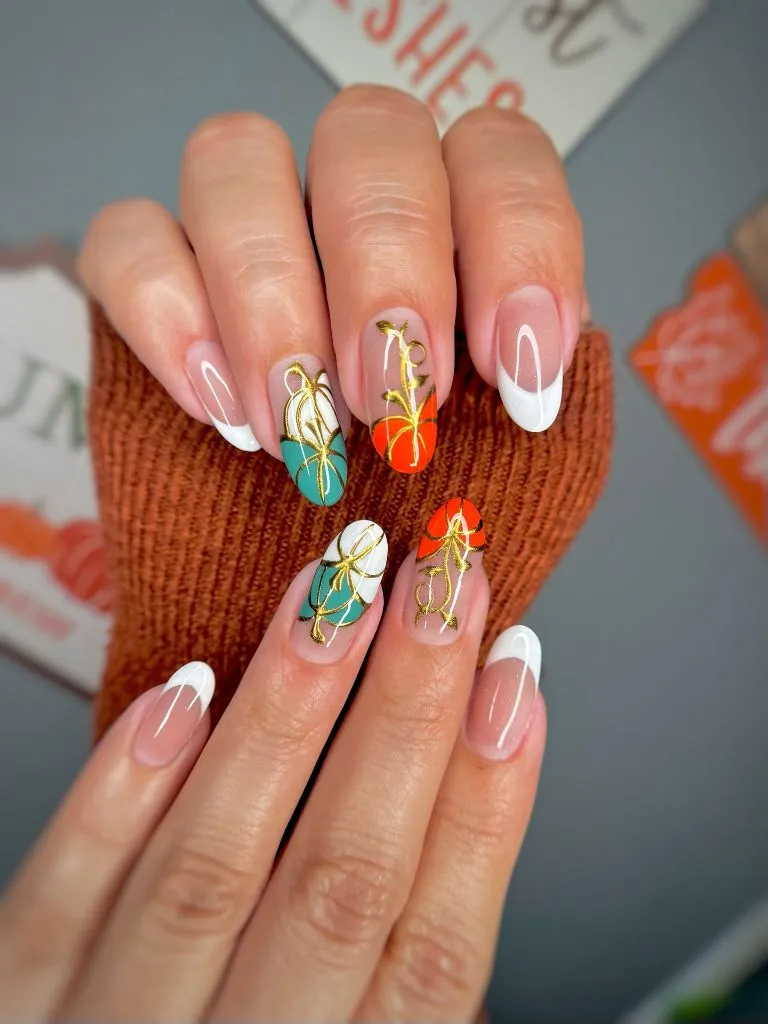
The teal pumpkin is a notable choice. Teal pumpkins have become associated with allergy-friendly trick-or-treating through the Teal Pumpkin Project, so this color carries a real-world reference beyond just aesthetics. Even without that association, the teal-and-orange pairing is a complementary color combination that vibrates with energy. The gold vine work connecting the pumpkins to the nail surface adds a decorative-arts quality — think illuminated manuscripts or botanical illustration — that makes this set feel elevated. The vines also serve a compositional purpose, filling the space around the pumpkins so they do not float in empty negative space.
This is the set to choose if you want Halloween pumpkin nails for 2026 that could transition seamlessly into Thanksgiving. The white French tips are timeless, the pumpkins are rendered as decorative objects rather than Halloween characters (no carved faces, no spooky expressions), and the gold accents add a formality that suits November gatherings. Swapping the teal for a sage green or dusty blue would push the palette even further into harvest territory while maintaining the complementary color dynamic with the orange.
Autumn Cameo Pumpkins on Warm Tortoiseshell
This set treats each nail like a small medallion, framing hand-painted Halloween motifs inside oval borders that recall vintage brooches. The tortoiseshell base — achieved through layered amber, brown, and translucent gel — provides a resinous depth that makes the white ghosts and black bats pop without competing for attention. Alternating nails carry checkered patterns in burnt orange and cream, distributing visual rhythm across the hand so that no single finger carries all the narrative weight. The overall palette sits in a narrow range of brown, orange, and ivory, which keeps ten very different designs from reading as chaotic.
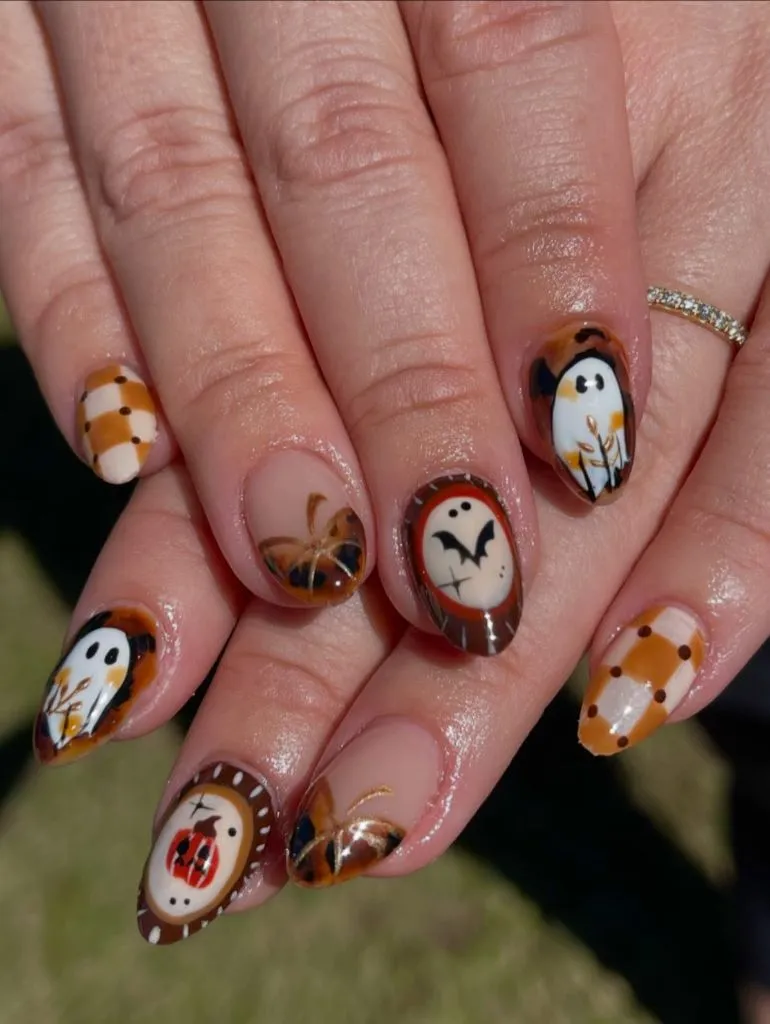
To simplify this look, keep the tortoiseshell effect on three or four nails and reserve the illustrated cameos for just the ring and middle fingers. The checkered accent can be done with nail wraps rather than freehand painting, cutting the appointment time significantly. The key tradeoff is that the handmade cameo borders — those tiny dotted frames — are what give the set its artisan quality, so skipping them flattens the personality a bit. If your nail tech is comfortable with fine-line work, prioritize the ghost cameo and the bat cameo over the pumpkin, since those read more clearly at small scale.
What makes this design hold together is restraint within abundance. Every nail is different, yet the shared color temperature — nothing cooler than a warm ivory, nothing hotter than a dark amber — creates a family resemblance. The cameo framing device is the real design principle here: it tells the eye where to look on each nail, preventing the busy details from becoming visual noise. Substituting the tortoiseshell base with a solid chocolate brown would simplify production while preserving most of the mood.
Black French Tips with Ghost and Jack-o’-Lantern Accents
Square-shaped nails with a negative-space base and glossy black French tips create a clean architecture that gives the Halloween illustrations room to breathe. The ghost on the index finger is positioned at the cuticle line rather than centered, which creates a sense of the figure drifting upward into the clear space. The jack-o’-lantern on the ring finger sits inside a black drip frame, anchored to the tip but reaching upward with its stem. Small star-shaped sparkle marks scattered across the remaining nails act as connective tissue between the two narrative fingers.
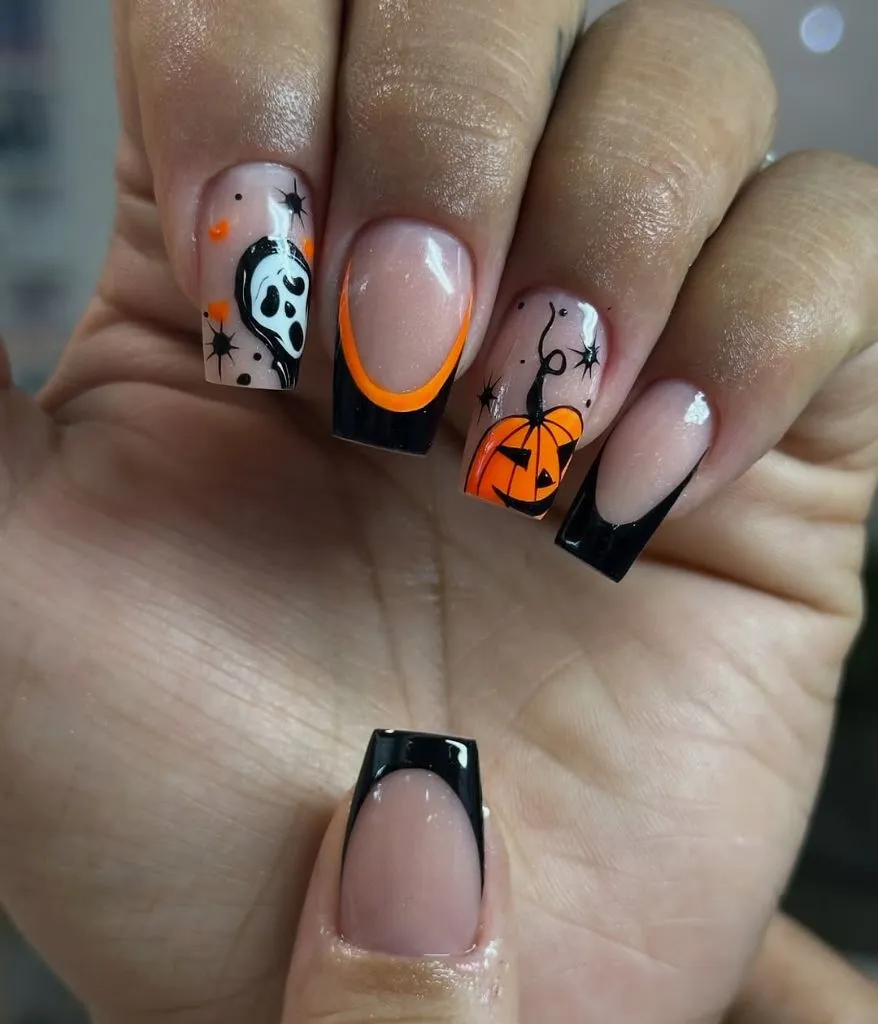
This is one of the more wearable Halloween pumpkin nails for 2026 because the black French tip alone reads as a complete manicure — the illustrations are bonuses, not requirements. You could do this set with just the tips and the tiny sparkle marks and still have something seasonally appropriate for an office or event. The square nail shape supports the graphic quality of the design, but a soft square or squoval would work without losing the effect. If the orange feels too bold, a muted burnt sienna pumpkin would shift the whole mood toward gothic rather than playful. For more ideas on pairing dark tips with seasonal art, explore these spooky Halloween nail ideas with black French tips.
The strength of this set is its use of negative space as a compositional tool. The bare nail between the cuticle and the tip functions like a margin in a well-designed page — it gives the eye a rest and makes the illustrations feel intentional rather than squeezed in. The orange curve on the middle finger, bridging the French tip with a crescent accent, is a subtle touch that ties the color story together without adding another full illustration.
Full-Coverage Jack-o’-Lantern Faces on Square Nails
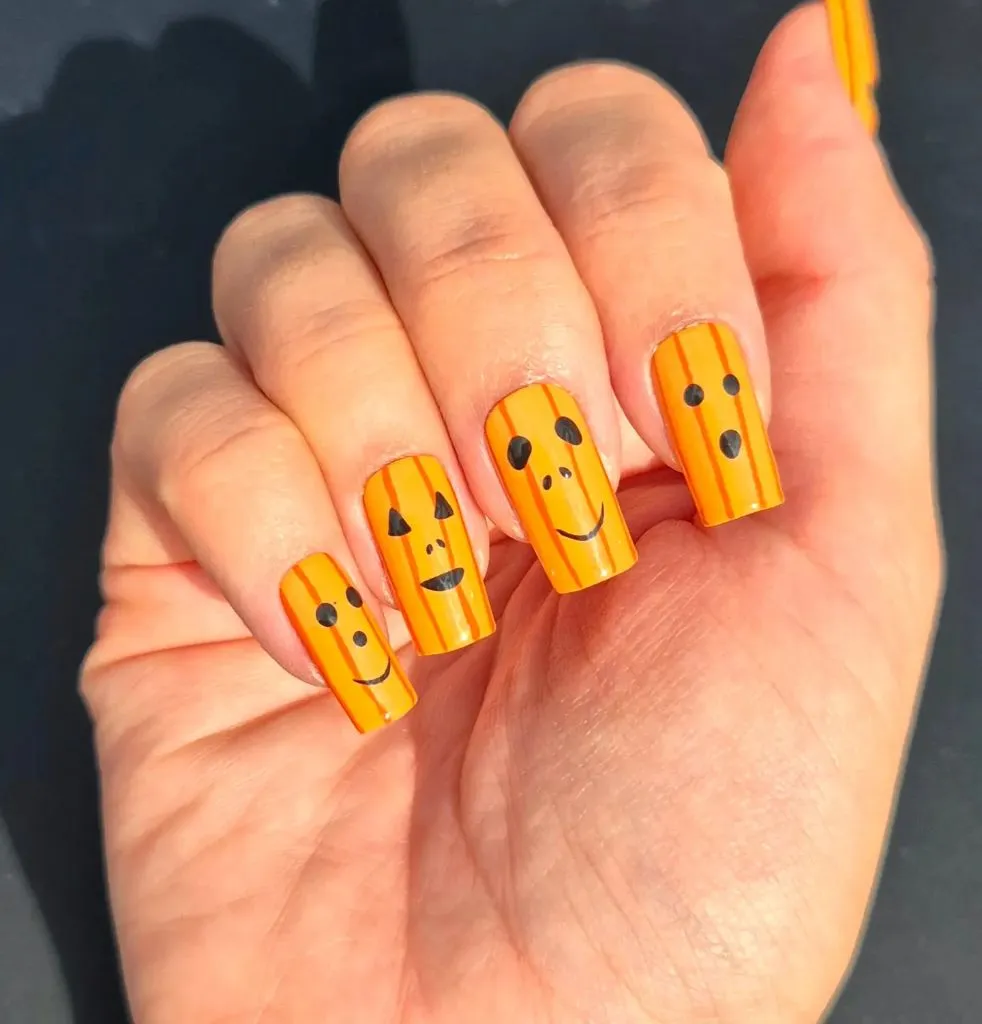
Each nail becomes its own jack-o’-lantern, painted solid orange with vertical darker lines mimicking the ridges of a real pumpkin and finished with a different carved face on every finger. The expressions range from menacing cross-eyed grins to stitched-shut mouths, giving each nail its own personality while the uniform orange background holds them together as a group. The nail shape — medium-length square — supports the flat, graphic quality of the faces, making them read like tiny posters rather than miniature paintings.
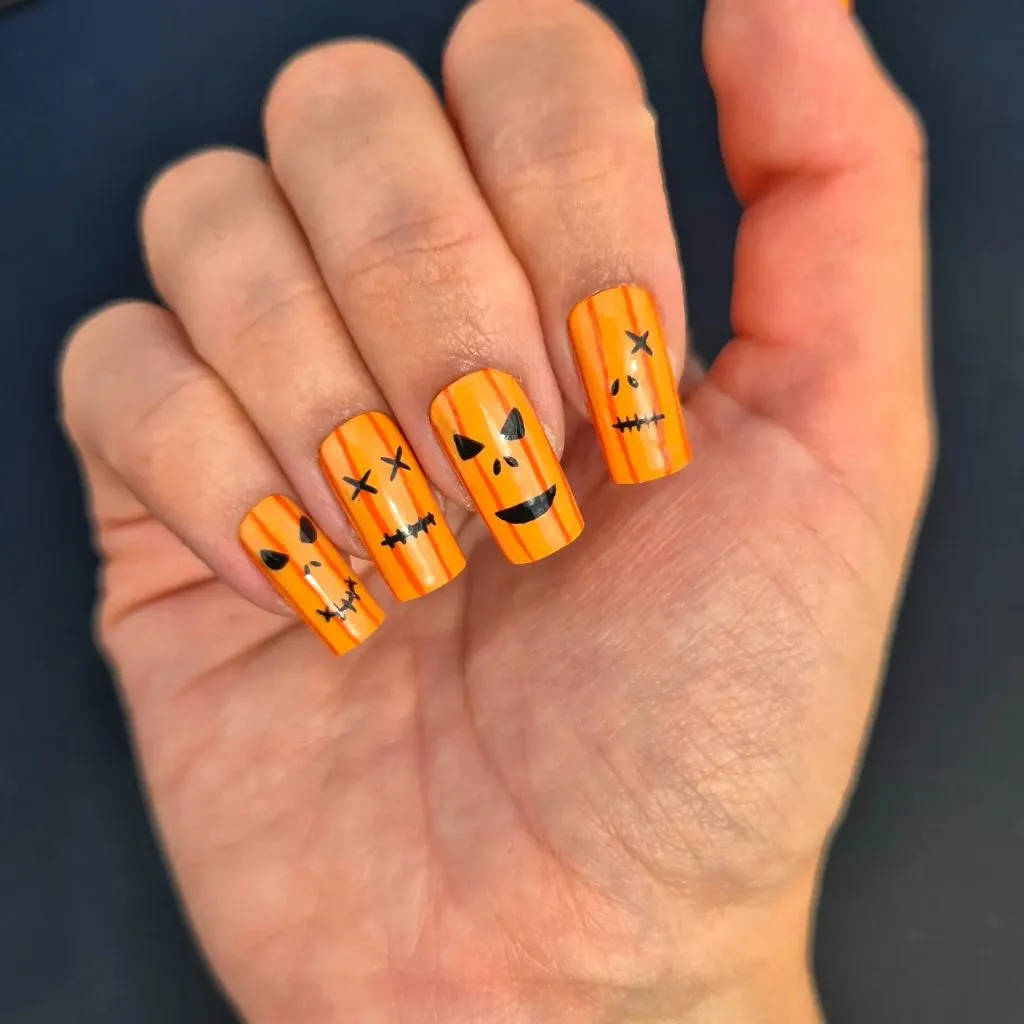
This is a surprisingly approachable design for at-home execution. The base color is a single opaque orange, the pumpkin ridges are just slightly darker orange lines pulled vertically, and the faces are simple black shapes — triangles, curves, and X marks. A thin nail art brush or even a dotting tool can handle most of the face details. The tradeoff is that any unevenness in the face shapes becomes very visible against the flat background, so steady hands or a patient disposition help. Keeping the faces simpler on the pinky and thumb, where the nail surface is smaller or curves more steeply, prevents cramped-looking designs.
The design principle at work is repetition with variation — same format, different content. It is the same reason a row of carved pumpkins on a porch looks good even when none of them match. The uniform color and shape create the pattern, and the changing faces create the interest. Swapping the bright orange for a muted mustard or a deep terracotta would shift this from a Halloween costume look to something more aligned with early fall decor.
Glitter Pumpkin Baubles on Nude Base
Three-dimensional glitter pumpkins sit on a nude or sheer pink base, outlined with fine gold or bronze lines that give each pumpkin a stained-glass quality. The pumpkins are built up with textured gel, creating a raised surface you can actually feel, and their glitter finish catches light differently depending on the angle. Small black four-pointed star accents are scattered on the bare nail around each pumpkin, adding just enough graphic contrast to keep the design from feeling entirely soft.
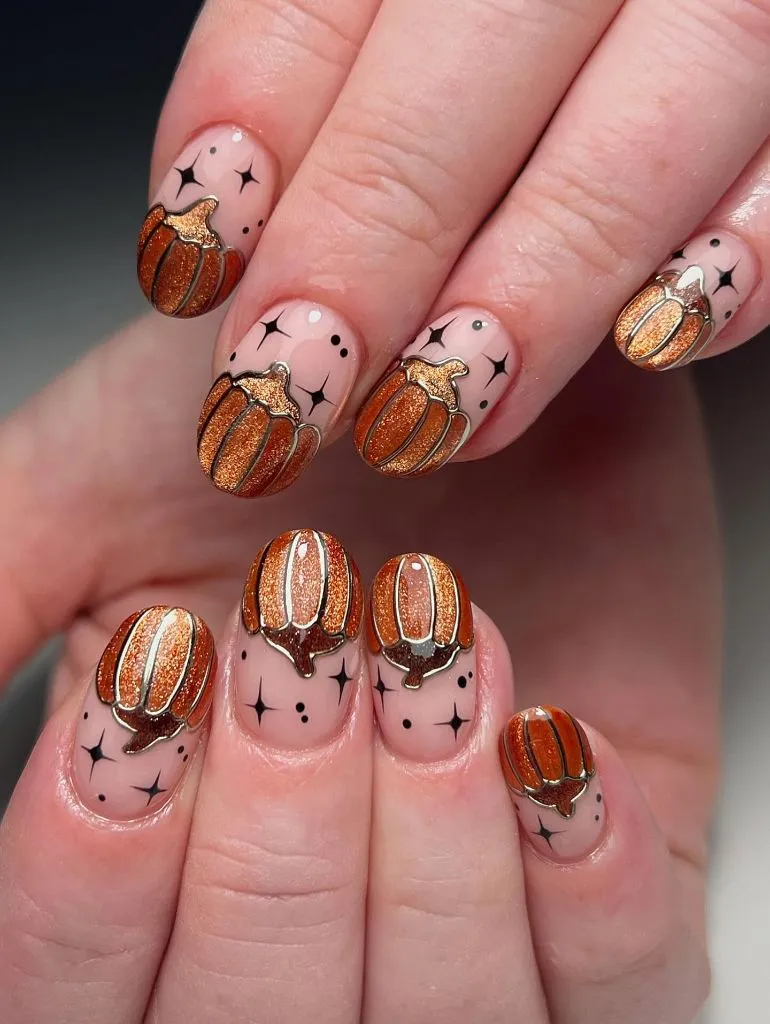
The 3D element is both the appeal and the practical challenge. Raised gel pumpkins can catch on fabrics, hair, and zippers, and they are more prone to lifting or chipping at the edges than flat designs. If longevity matters more than dimension, ask your nail tech to paint the pumpkin flat but keep the glitter and gold outline — you will get eighty percent of the visual impact with much better wear. The nude base means regrowth is less noticeable, which makes this a good choice if you want the set to last through the full month of October.
This design works because of the contrast between the maximalist pumpkins and the minimalist base. The nude nail acts almost like a gallery wall — clean, neutral, designed to disappear so the art stands forward. The gold outlines are doing critical work here: without them, the glitter pumpkins would blur into shapeless sparkly blobs. That outline is the difference between a pumpkin and a smear. For a cooler tone, try silver outlines with copper glitter on a milky white base.