Early winter outfits are easier to judge once you stop looking at individual pieces and start reading the composition: where the break falls, how much of the body each layer covers, which surface is loudest, and how much quiet space is left around it. A coat is rarely the reason a look holds together. Proportion, palette spacing and the placement of the darkest point usually are.
Before scrolling, decide what you are comparing. Look first at where the outer layer stops, then at how many colours appear and how often each one repeats, then at which single point ends the eye’s travel. The trade-off is nearly always volume against definition: the more texture sits on top, the more the base underneath has to stay still. None of these arrangements is a rule.
1. A Grey Column Carries the Cream Scarf
A single grey coat does nearly all the structural work here, running from shoulder to ankle in one unbroken line and swallowing most of the frame. It hangs open, so a narrow strip of the body stays visible down the centre: grey knit first, then blue denim widening toward the pavement. The coat is the largest dark field in the picture, and everything else is arranged inside it or against it.
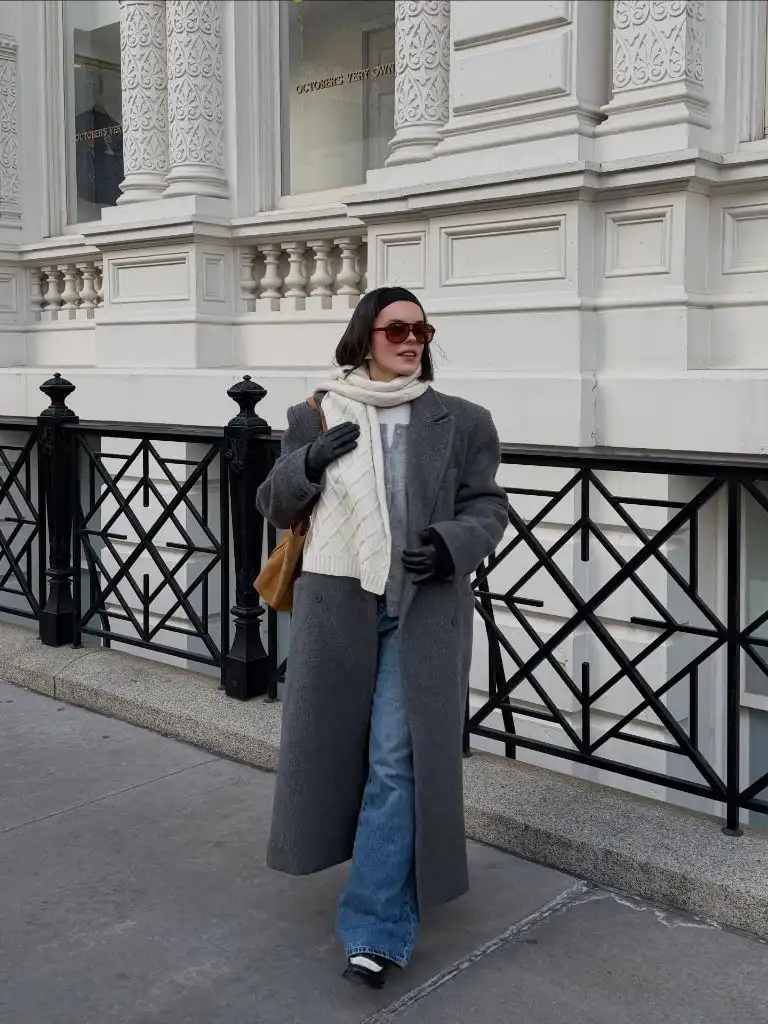
The cream cable scarf is the only bright block, and it lands high, just under the chin, pulling attention upward before the eye travels down the denim. Black gloves and dark shoes bracket the look at both ends, while a small tan bag supplies the one warm note. Texture handles the rest: the coat reads brushed and matte, the scarf reads chunky and dimensional, the denim reads soft and washed.
The transferable point concerns endpoints. A coat this long needs something to stop the eye near the face, or the whole composition drains downward and the head floats free of it. The scarf does that job here; a pale hat or a light collar would do it too. Swap it for a dark scarf and the same arrangement reads considerably heavier.
2. Cropped Plum Coat Meets Pinstripe Wrap Skirt
Cropped and rounded, the deep plum jacket occupies the upper third and stops right at the hip, which sets an unusually high break for cold-weather dressing. Below it, a charcoal pinstripe wrap skirt falls to just above the knee, and dark tights carry that same depth down into tall black boots. The proportion is short over short, which is rare against the floor-length coats elsewhere in this set.
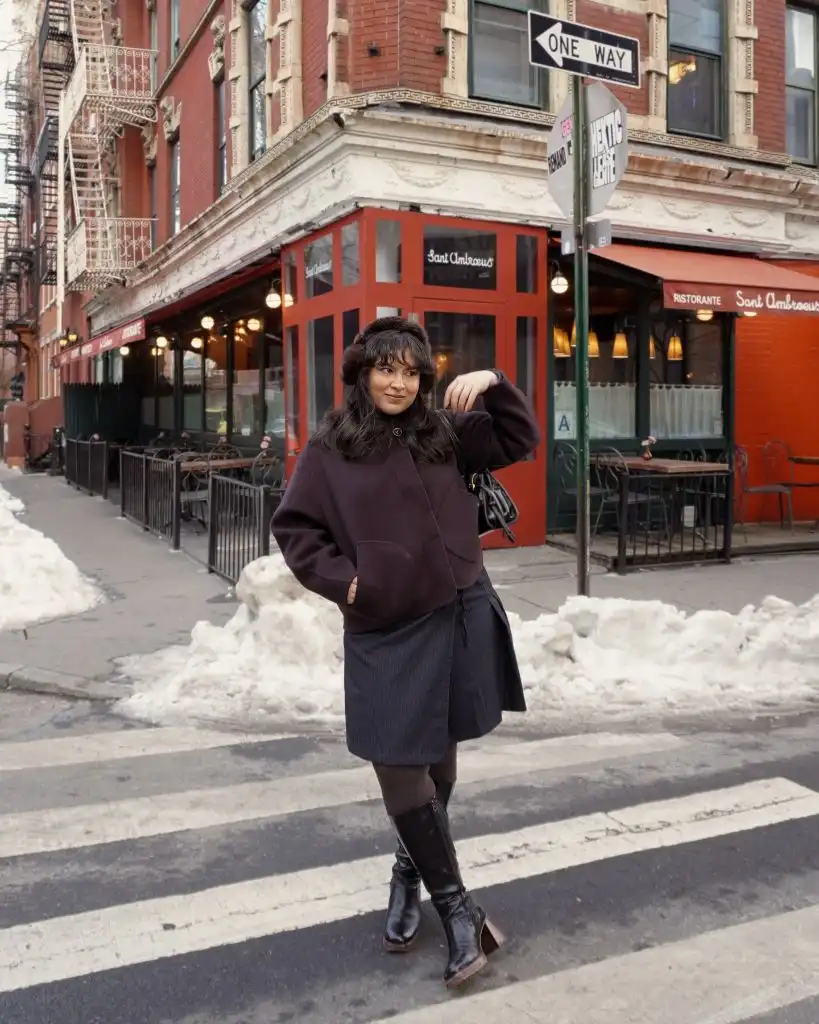
Colour repeats quietly rather than matching exactly. The fur-style headband picks up the jacket’s depth, the small black bag echoes the boots, and the skirt’s fine pinstripe is the only pattern in play. Because the jacket is the widest and roundest shape in the frame, the narrow skirt and slim boot shaft keep the lower half compact by comparison. The sharpest contrast falls at the knee, where dark tights meet the boot’s edge.
The honest limitation is that this proportion asks the leg to carry a lot of visual work, and rounded outerwear over a short hem can read top-heavy in flat winter light. If that bothers you, a slightly longer skirt or a lower boot shaft evens the ratio without changing a single colour in the palette.
3. Brown on Brown Softens a Black Hem
Almost everything above the hem stays inside one brown family. A long double-breasted coat in deep chocolate hangs open over a ribbed zip-neck knit of nearly identical depth, and the bag strap crossing the shoulder repeats the tone a third time. The single break is a short black skirt, which draws a dark horizontal through the middle and stops the brown from running uninterrupted to the leg.
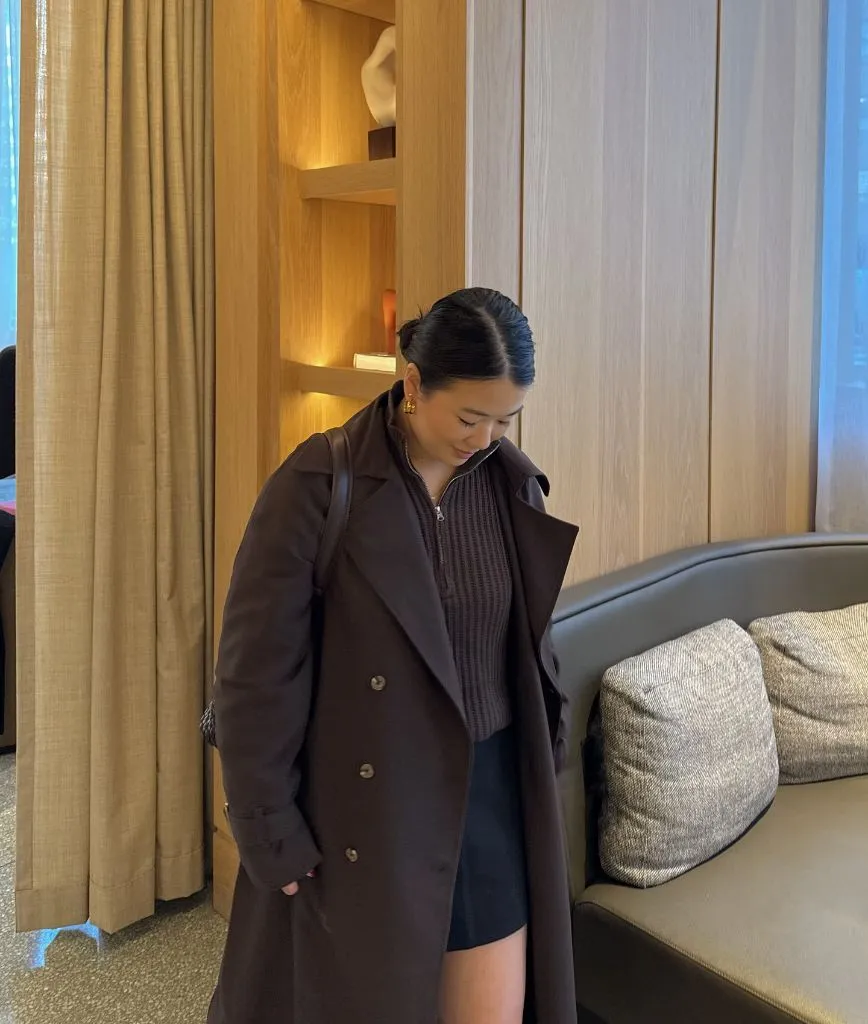
Because the tones sit so close together, the composition depends on surface rather than colour. The coat looks smooth and flat, the knit looks ribbed and dimensional, and the strap looks glossier than either. The material is not identifiable from a photograph, so the visible sheen difference is the useful detail rather than any fabric claim. Gold earrings and a fine chain supply the only metallic points in an otherwise matte frame.
Push it further by dropping the black entirely and letting a brown skirt continue the column to the knee; pull it back by choosing a longer hem so the tonal run reads calmer still. Compared with the plum look above, this one trades colour contrast for texture contrast and arrives somewhere noticeably quieter.
4. Patterned Knit Takes Over an All-Black Base
Pattern is the whole event. A cream sweater covered in dark geometric motifs sits over plain black leggings, and that same black returns in the small structured bag resting on the snow. Everything below the waist is a solid dark field, which lets the sweater’s repeat carry all of the visual weight without competing against a second surface anywhere in the frame.
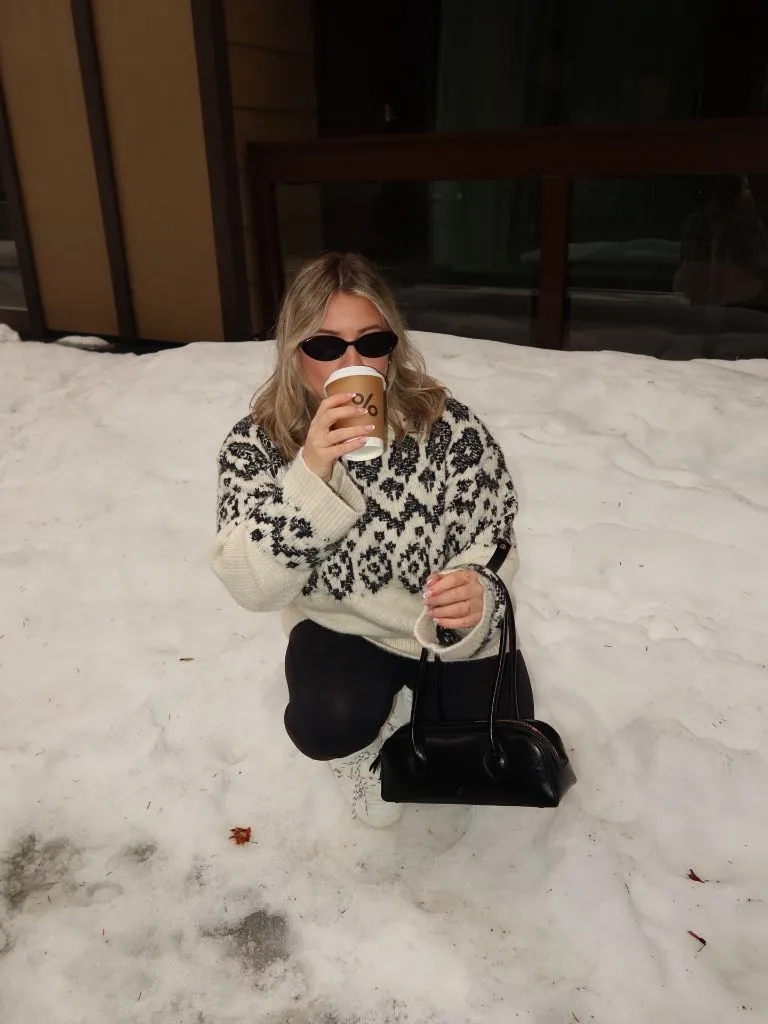
Two accessories echo the sweater’s darker elements: narrow black sunglasses at the top of the figure and the bag at the bottom, so the pattern’s second colour is bracketed rather than stranded. Pale boots pressed into the snow return to the sweater’s base tone, closing the loop at the feet. The snow itself functions as negative space, and the outfit reads cleanly against it because the value contrast is so high.
For anyone building early winter outfits around one patterned knit, the practical rule is visible here: keep every other surface flat and restrict the accent colours to the two already living inside the pattern. Introduce a third and the knit stops being the subject of the picture.
5. Cropped Fur Frames a Long Black Line
Volume is concentrated entirely in the top half. A cropped brown fur-look jacket balloons through the sleeve and shoulder before stopping high on the hip, while black wide-leg trousers fall straight and heavy beneath it. The silhouette is round over long, and the brown is the only warm colour anywhere in an otherwise black lower half.
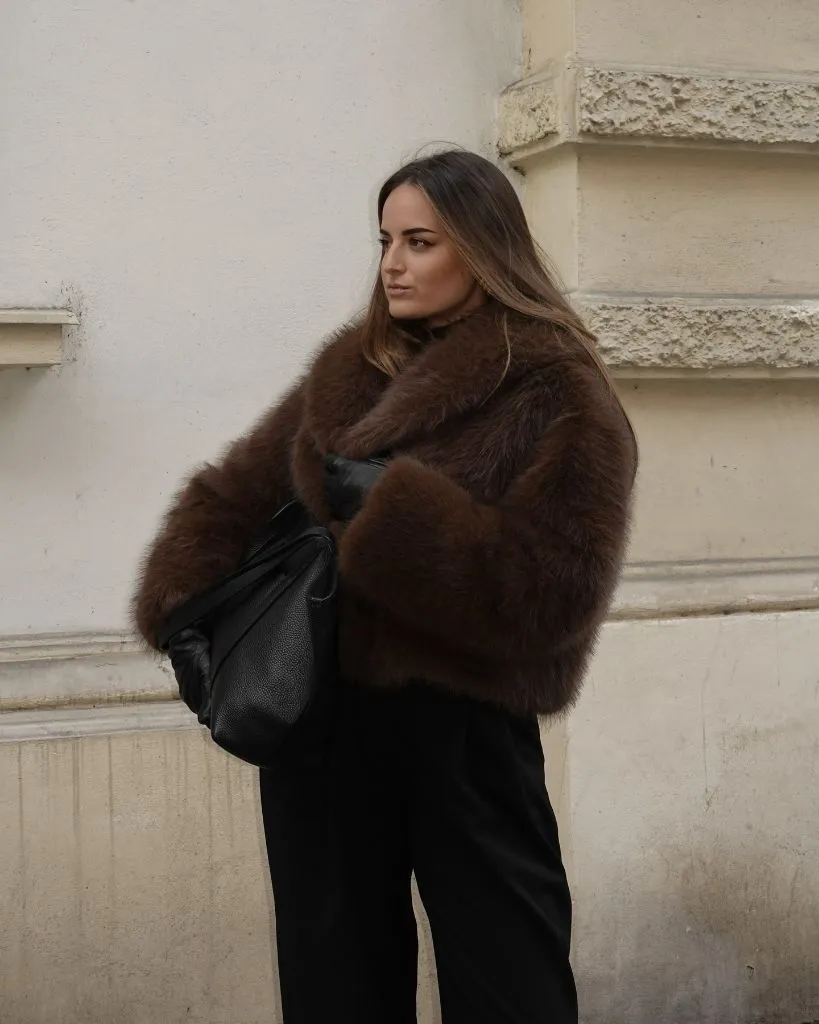
Black absorbs everything else. The gloves disappear into the bag, the bag disappears into the trousers, and that consolidation is precisely what allows the jacket to stay loud. A pale stone wall behind supplies a light background that separates the brown outline cleanly, so the jacket’s perimeter stays legible rather than muddy. Hair falls over the collar in a similar mid-brown, softening the boundary between head and shoulder.
The lesson is about consolidation rather than coordination: one texture, one colour, everything else absorbed into a single field. The same thinking runs through plenty of layered winter outfits for women, where the loudest surface only works because the supporting pieces have agreed to stop competing.
6. Pink Knit Sets the Only Colour Note
Shot from above, the frame is filled by a soft pink cable knit sitting dead centre. The cables run vertically and catch light along each twist, so the surface reads ridged rather than flat. Below, pale blue jeans continue at a similar light value, and the sand underfoot repeats that brightness a third time, leaving almost no dark area anywhere in the picture.
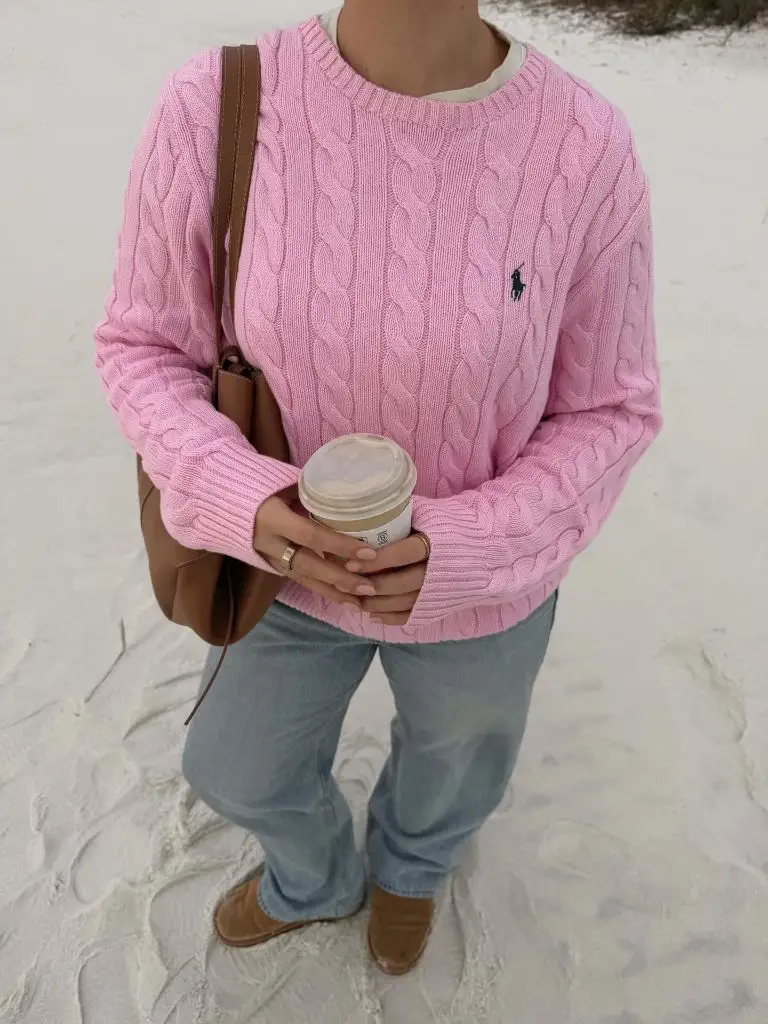
The tan shoulder bag and tan shoes share one warmth and sit at opposite ends of the body, quietly framing the pink between two neutral points. A sliver of cream collar shows at the neckline, easing the jump from skin to colour. Everything is low contrast apart from the small dark embroidery on the chest, which becomes the only genuinely sharp point in the whole composition.
Compared with the near-black looks above, this one runs almost entirely in pale values, and that is its limitation as much as its appeal: it depends on good light. Under grey skies the pink and the denim collapse toward each other, edges disappear, and the outfit stops holding its shape.
7. Cream Scarf Cuts Through Textured Fur
Cream runs top to bottom, and the fur-look jacket is the interruption rather than the base. A white beanie, a long cream scarf, cream mittens and cream trousers form a continuous pale column, and the mottled taupe jacket sits across the middle of it like a wide horizontal band. The scarf hangs long enough to break that band vertically, right through the centre.
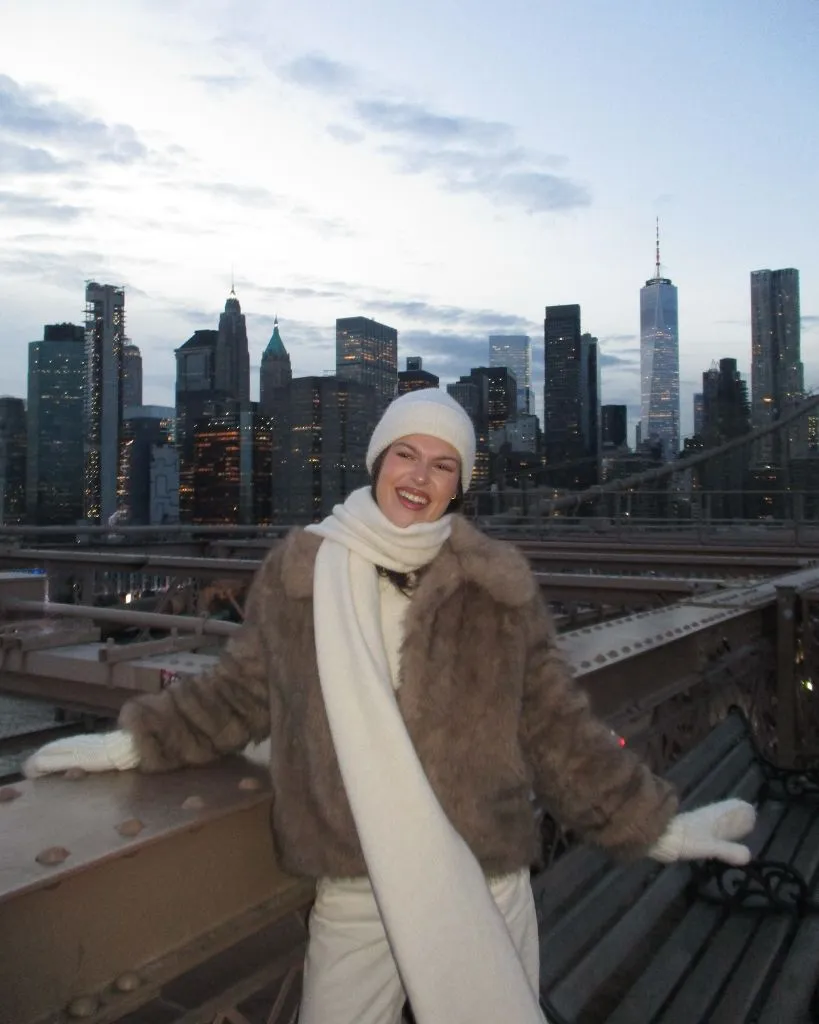
That vertical scarf is the key structural piece. Without it, the jacket would cut the body into two pale halves at the hip; instead the eye travels straight down the middle without stopping. The jacket’s tonal variation reads as texture rather than as pattern, and the mittens repeat the scarf’s tone exactly, so the outstretched arms end in the colour they began with. The skyline behind holds the only dark value.
If you want more definition, one dark point at the feet would give the pale column a proper endpoint. As it stands the outfit floats, which suits the setting. Compared with the black-based looks in this set, it also asks considerably more of you in terms of visible wear.
8. Short Jacket Shifts the Waistline Upward
The mirror makes this proportion easy to measure. A cropped cream fur-look jacket stops at the natural waist, and from that point down, mid-blue flared jeans widen steadily to the floor. The break sits high, roughly a third of the way down the body, and a visible belt marks it precisely instead of leaving the eye to guess where the torso ends.
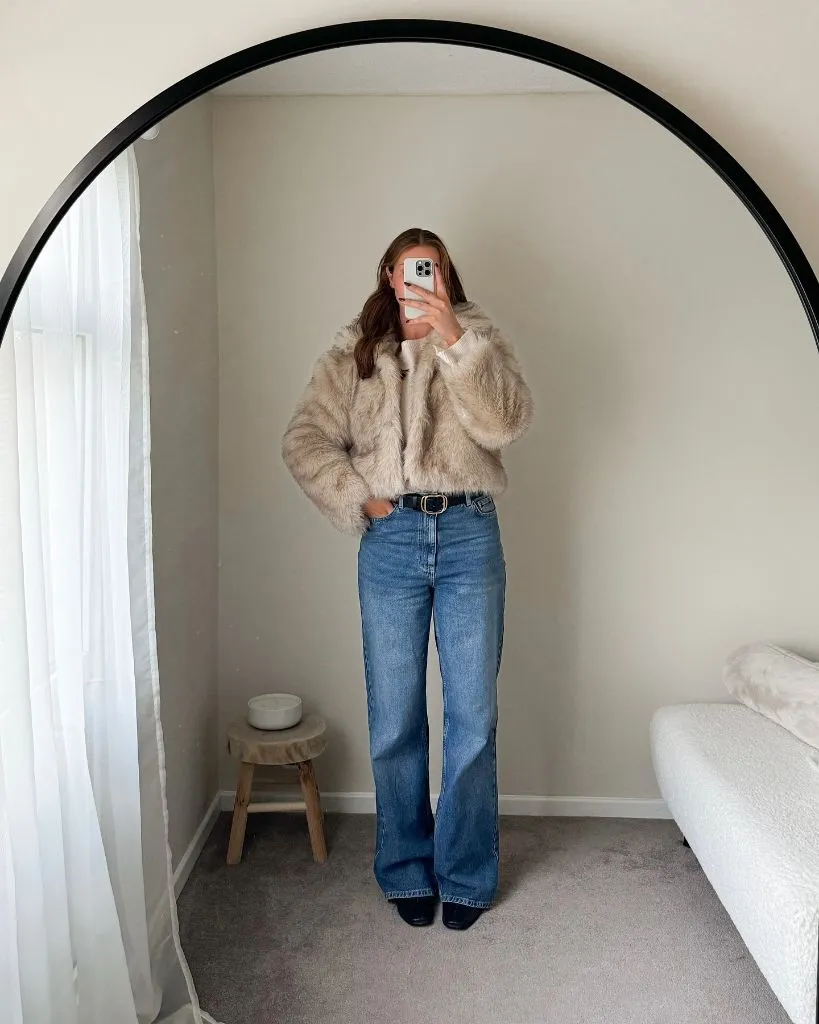
That thin dark belt with its gold buckle is the smallest element in the frame and the most useful one, drawing a hard line between two soft masses. Dark boots at the hem share its value, so the two darkest points bookend the denim between them. The jacket’s tone sits close to the wall colour behind it, which is exactly why the belt earns its place.
Among early winter outfits built on a cropped fur shape, this is the clearest demonstration of why a visible waist marker helps. Remove the belt and the jacket’s own hem takes over the job less accurately, since a soft pile edge blurs the line instead of drawing it.
9. Burgundy Repeats From Cap to Bag
One colour appears three times at three different scales. The shaggy burgundy coat is the largest field by some distance, a burgundy cap sits directly above it, and a small glossy burgundy bag hangs below. Grey trousers are the only departure from that scheme, and they function as a neutral base rather than reading as a second colour in the palette.
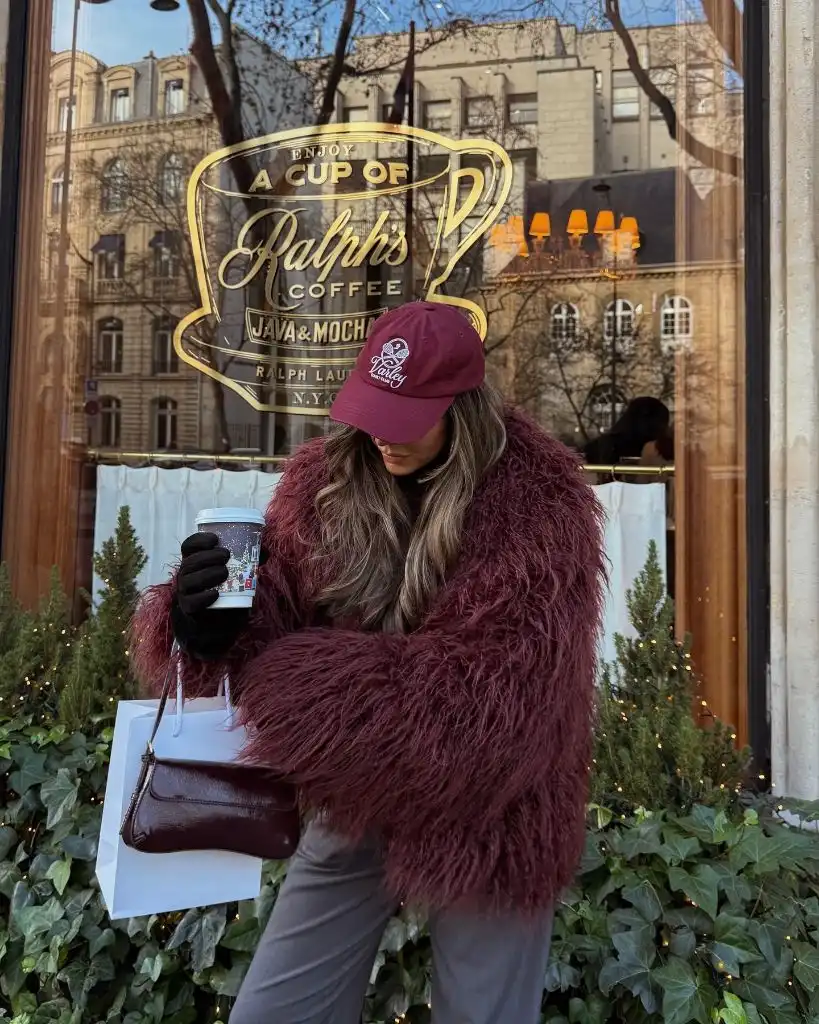
The repetition works because the textures diverge so widely: long shaggy pile on the coat, flat cotton-looking twill on the cap, a hard shine on the bag. Black gloves separate the sleeve from the cup, giving the hand a defined edge against all that movement. The white paper bag is incidental, but it contributes the one bright rectangle in a frame otherwise built from deep tones.
The trade-off with a long-pile coat is upkeep and bulk. It flattens wherever it presses, and it does not sit well under a cross-body strap or a seatbelt for any length of time. Carried on the arm, as here, the pile stays intact and the outline holds its shape.
10. Curly Cream Texture Anchors Slick Black Trousers
Two surfaces do all the talking. A cream curly-pile jacket takes the entire top half, cropped at the hip and wide through the sleeve, and black wide-leg trousers with an obvious sheen take the bottom. The division lands exactly at the waist, light above and dark below, with no midtone anywhere between them to soften the transition.
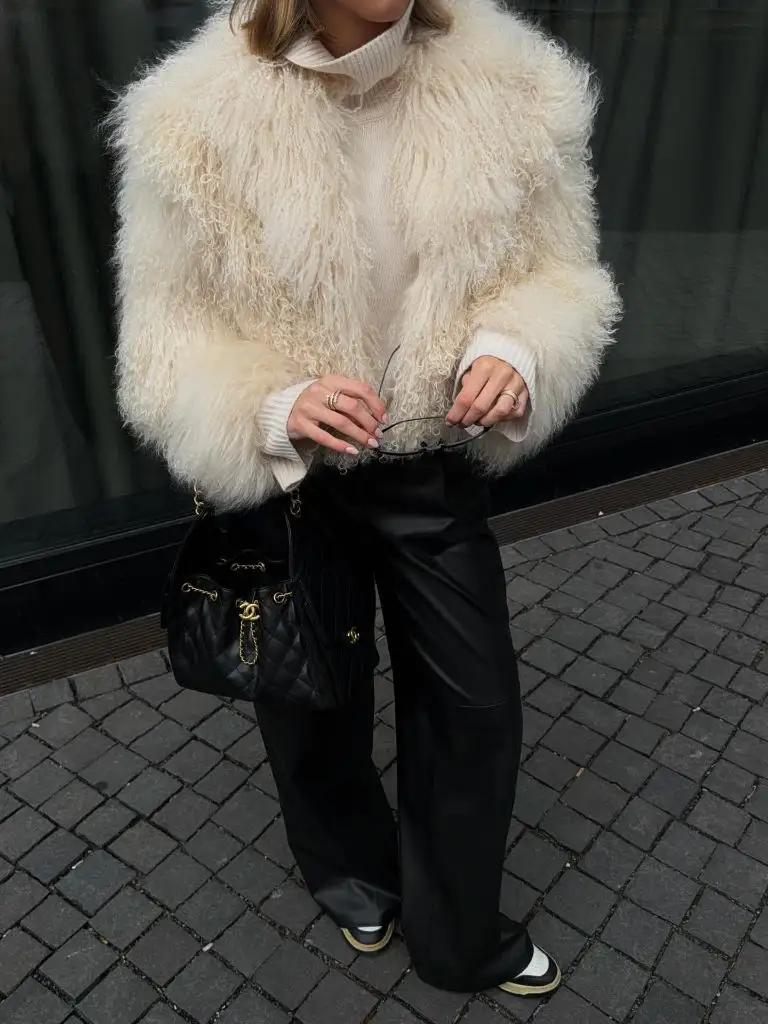
A cream ribbed turtleneck extends the pale field down to the wrists, so the jacket does not float as a detached block. The quilted black bag repeats the trousers’ depth and adds gold hardware, the only metal besides the rings. Sneakers at the hem bring cream back one last time, closing the palette with the same two colours it opened on. Nothing here is a third colour.
The material is not identifiable from an image, so read the trousers’ sheen as the useful detail rather than a fabric claim: that shine is what separates them from ordinary dark trousers and makes the contrast against matte pile so sharp. Reduce it and the pairing loses most of its tension immediately.
11. Belted Cape Shape Breaks the Torso
The brown jacket’s cut is the entire story: a high buttoned funnel neck, very wide dropped sleeves, and a self-belt tied at the natural waist with the hem finishing just beneath it. It reads almost as a cape, holding its rounded volume away from the body while the light jeans below stay narrow, straight and completely plain by comparison.
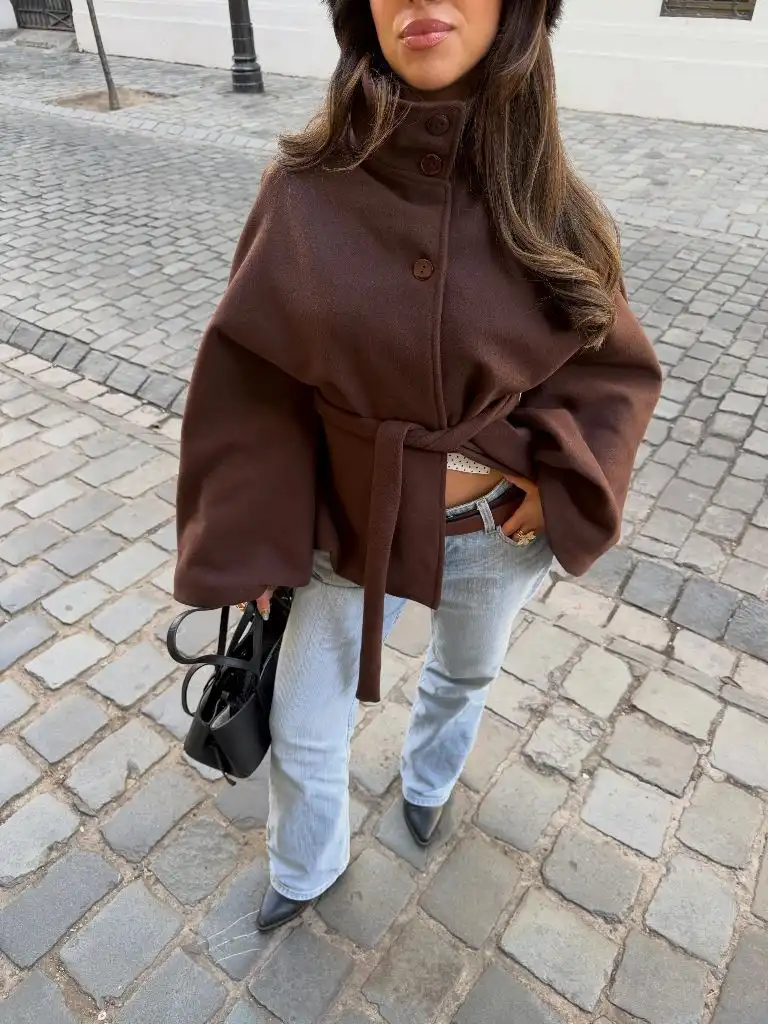
Below the belt, a thin band of skin and a glimpse of printed fabric appear before the jeans begin, which lightens the middle of the frame rather than closing it. The bag, the boots and the belt buckle are all black or near-black, forming a quiet triangle of dark points around the brown. Cobblestones behind supply a busy grey texture that the flat coat surface sits cleanly against.
A tied belt on a wide-cut jacket gives you control the cut alone does not, and where you place it changes the result. Tied higher, this would exaggerate the sleeves further; tied looser, the shape would spread sideways and the jeans would lose the length they currently keep.
12. Blush Fur Opens Over Head-to-Toe Black
Black runs from the neck to the boot in one continuous line, and a pale blush fur-look jacket is laid over it like a bracket. The jacket stays open, stops near the hip, and is wide enough at the collar to frame the face without touching it. Everything visible inside that opening holds the same dark value from top to bottom.
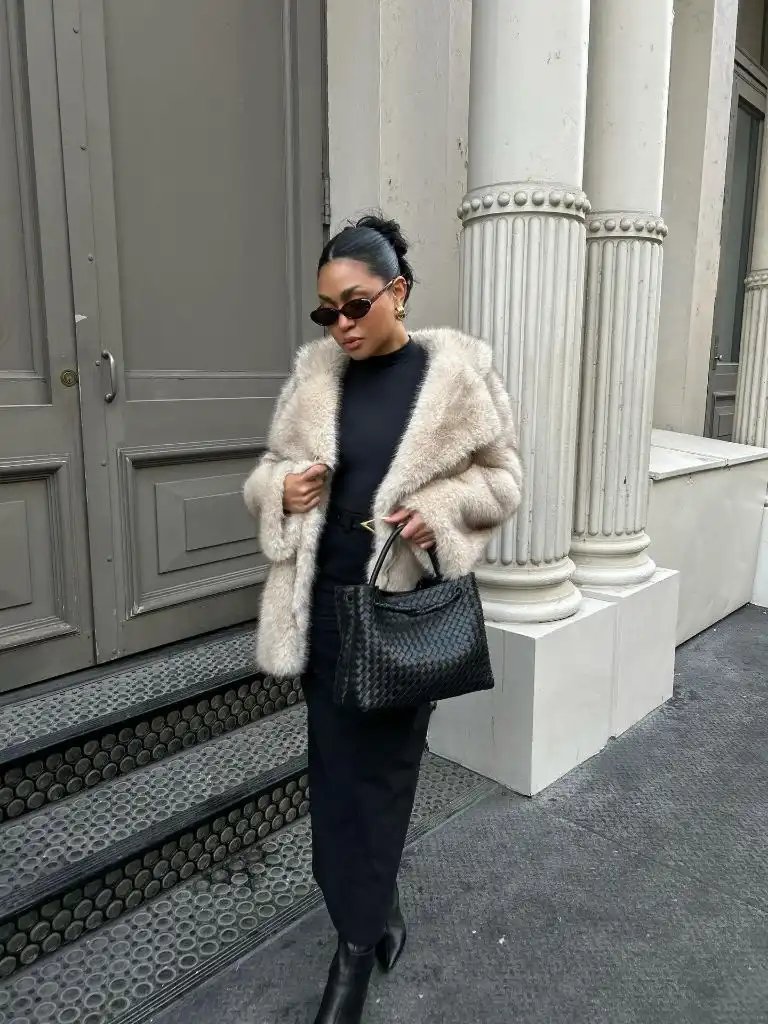
The woven black bag earns its place by being the only patterned surface present: a regular basketweave set against smooth knit and irregular pile. Small dark sunglasses repeat the black high in the frame, and the pale stone columns behind sit close in tone to the jacket, softening its outer edge while the black core stays sharp. The hierarchy is unusually clean.
Compared with the cream curly jacket earlier, this pile is flatter and shorter, so I find it reads more tailored and less costumed. If the fluffier shapes in this set feel like too much, that difference in pile length is the adjustment worth making, rather than a change of colour or length.
13. Floor-Length Fur Absorbs the Whole Silhouette
Scale is the point. The dark brown fur-look coat reaches the ankle and widens through the sleeve, so it occupies nearly the entire body outline and leaves only a narrow strip of grey trouser and a pair of brown loafers visible at the very bottom. Nothing in the frame comes close to competing with it for area.
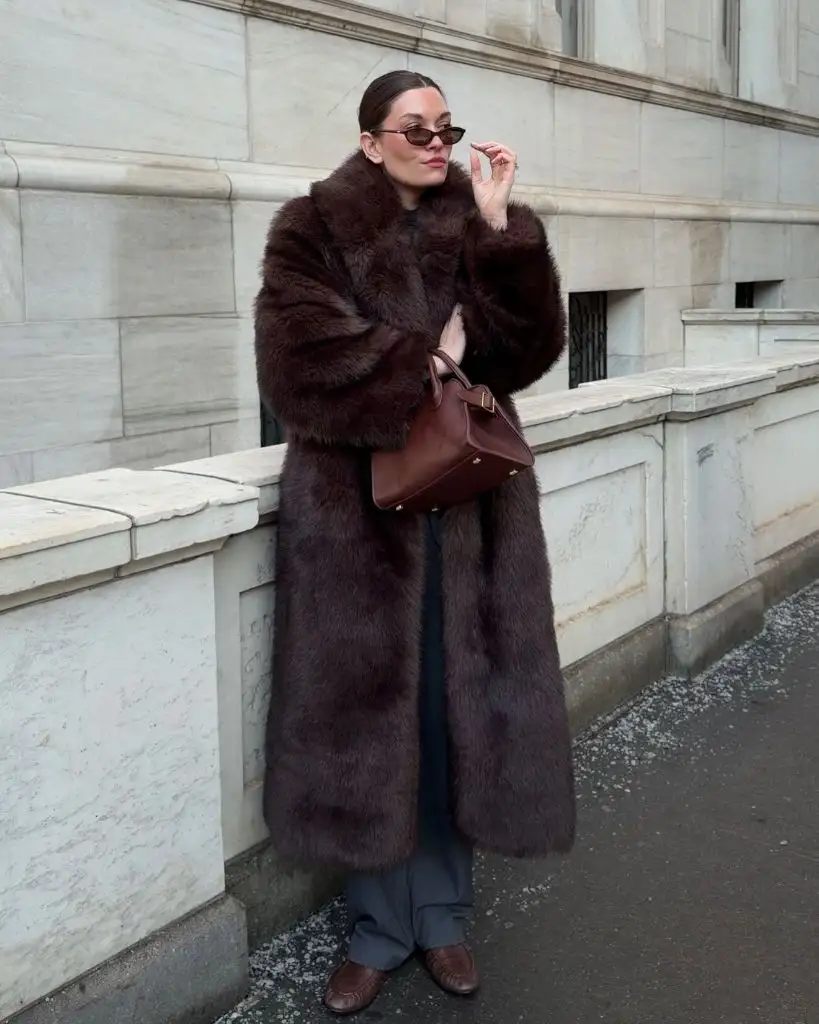
Two smaller browns stop the coat from reading as one undifferentiated mass: a structured top-handle bag held at the waist and loafers at the hem in a matching-looking tone. Both are smooth, giving the eye a place to rest against all that pile. Grey trousers work as a cool neutral underneath, and the pale marble behind holds the coat’s silhouette in clear, uninterrupted outline.
Full-length pile is the most demanding item in this set to wear and to store. It is not a background look, it marks where it rubs, and it wants a low-friction layer underneath. Judge it on outline first, because outline is essentially the whole of what it offers.
14. Spotted Print Interrupts Pale Denim Calm
Seated on a bench, the spotted fur-look jacket fills the upper half of the frame and its irregular dark markings are the only pattern in view. Light blue jeans stretch out below as a flat, uniform field with no detail at all. The contrast between an active surface and a completely calm one is what the whole composition rests on.
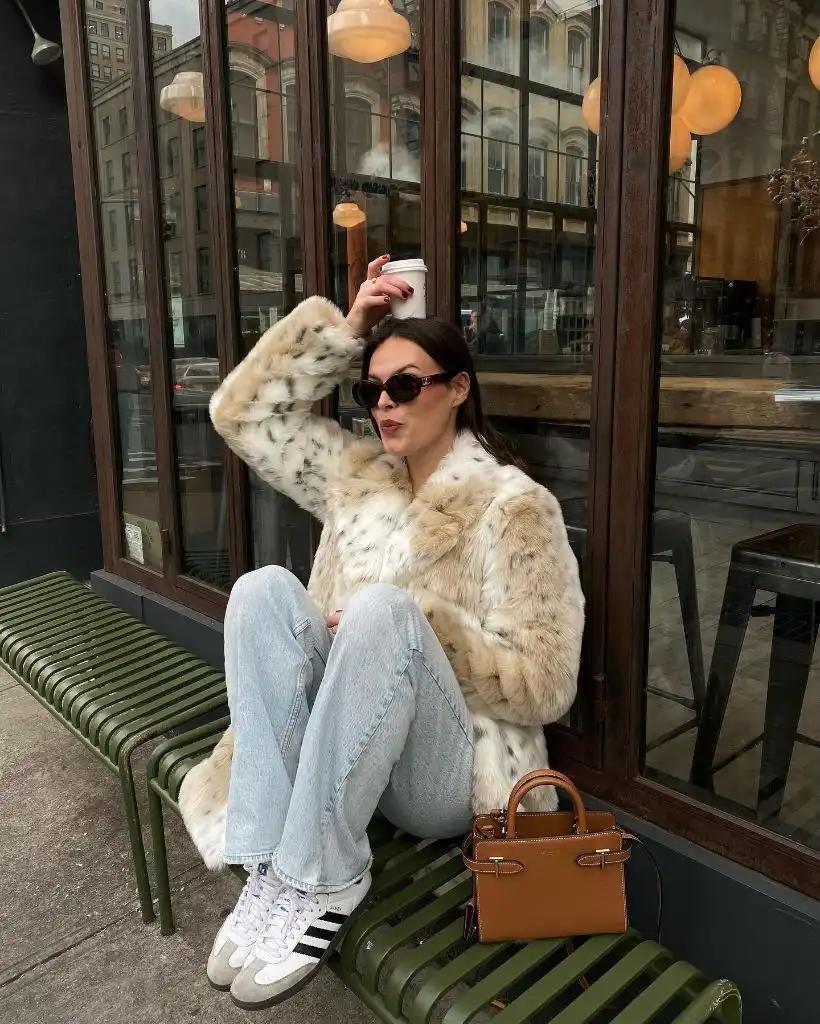
The jacket’s cream base returns in the white sneakers, and its darker spots find an echo in the sunglasses and the sneaker stripes, so the print’s two values are both accounted for elsewhere. A tan bag on the bench matches nothing exactly but sits comfortably in the same warm range. Because the denim is pale rather than dark, the spots register as texture rather than as a bold graphic.
Pair a busy pile like this with dark denim and it becomes a much heavier proposition; pale denim, as here, keeps it firmly casual. That single adjustment is worth testing before deciding a printed fur is too much for daytime, because the print itself is rarely the problem.
15. Multi-Tone Shag Sharpens a Plain Base
Colour is scattered rather than blocked. The cropped shaggy jacket mixes cream, tan, rust and near-black in irregular vertical clumps, which keeps its surface restless even though the shape underneath is very simple. Beneath it, a cream turtleneck and mid-blue jeans stay entirely plain, and the grey concrete wall behind removes any further competition from the background.
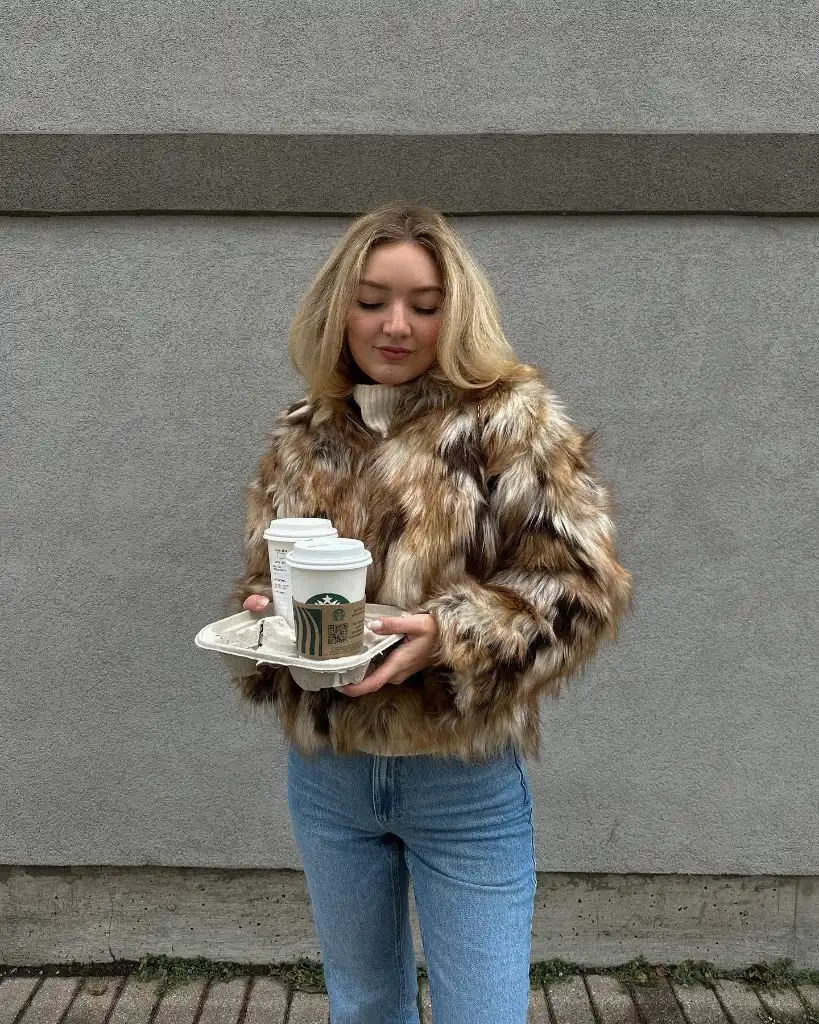
The cream turtleneck is the connector, picking up the palest tone in the jacket and carrying it to the throat so the face is not framed by the darkest clumps. Jeans supply the only cool colour in the frame. Everything else, including the cardboard cup tray, sits inside the same warm beige range, which is partly coincidence and partly why the picture feels so settled.
Compared with the single-tone burgundy shag earlier, this jacket needs a plainer base because it already contains four colours of its own. The reliable approach to early winter outfits built on a multi-tone pile is to borrow only its lightest shade for the layer underneath, then stop.
16. Long Grey Wool Extends a Simple Base
A light grey coat runs to the ankle with a wide notched lapel and stays open its full length, which turns it into two long vertical panels rather than one solid block. Between them sits a cream knit tucked into mid-blue jeans, with a slim brown belt marking the waist. The interior line is narrow, the exterior line is wide, and the gap between them is consistent.
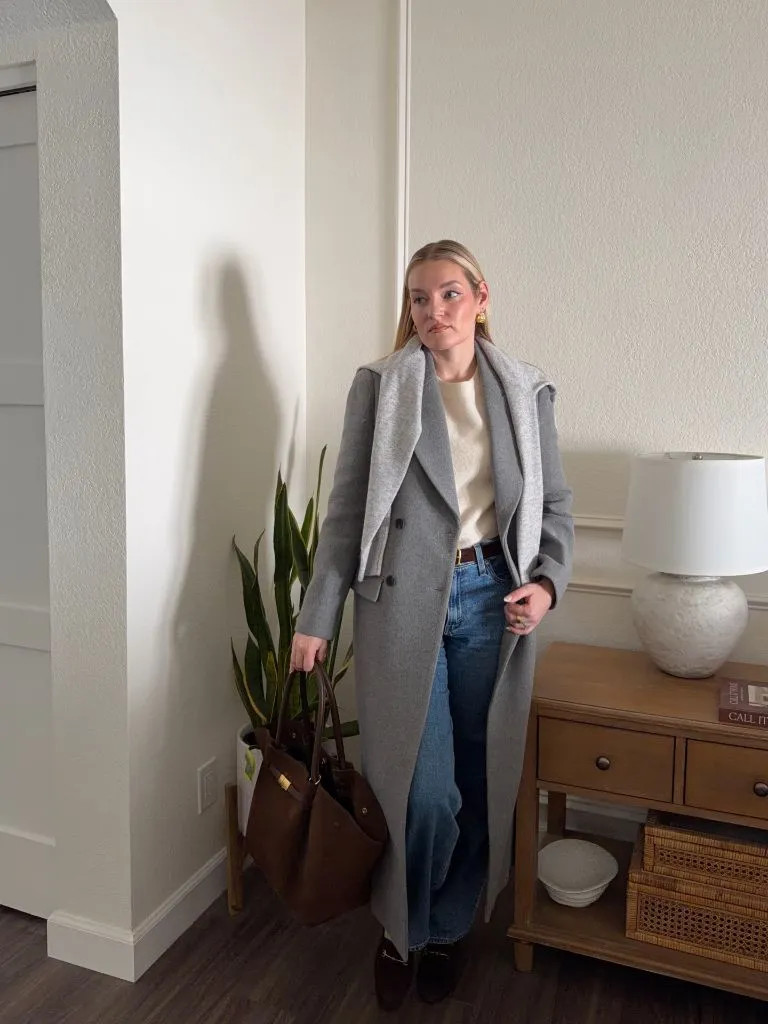
Brown appears three times at increasing scale: the belt, the loafers, then the large soft tote carried at the side. That progression gives the cool grey and blue a warm counterweight without introducing a fourth colour into the scheme. Gold earrings sit against pulled-back hair, and since the coat’s grey is pale, the tote ends up the darkest object in the frame and the natural resting point.
A pale coat needs one dark accessory somewhere or the whole arrangement dissolves, particularly indoors under warm light. The same balance appears repeatedly across warm winter work outfits, where the coat sets the temperature and a single deep-toned bag provides the endpoint.
17. Fur Stole Splits an Olive Bomber
An olive bomber with a soft, slightly napped-looking surface takes the top, cropped and boxy through the body, and a long pale fur stole runs straight down its front from shoulder to hip. That stole divides the jacket vertically, which is the reason a square cut does not read as wide here. Dark brown wide trousers continue the line all the way to the floor.
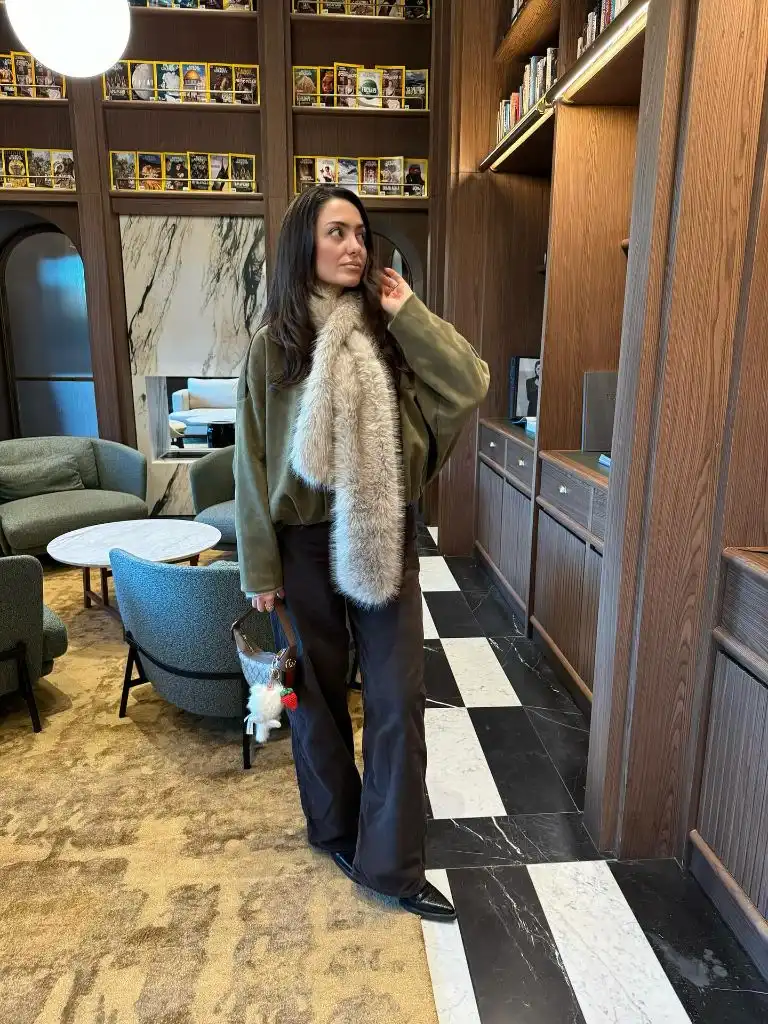
The stole’s cream and grey tones lift the face out of the olive and stand as the lightest values in a frame otherwise built from olive, brown and black. A small bag with a white charm hangs at the hip and repeats that pale note lower down. Pointed black boots finish the line cleanly. The checkerboard floor is busier than anything worn, which is a fair test of how quiet the outfit truly is.
The takeaway concerns direction. A vertical accessory laid over a cropped, square jacket restores the length that the cut removes, and a scarf, a long chain or an open overshirt would achieve the same thing. Worn without it, this jacket would need a slimmer trouser to keep its proportion.
18. Checked Coat Balances Burgundy Trousers
The checked coat is both the busiest surface in the picture and the longest, falling below the knee in a small brown-and-cream grid. It hangs open over a camel knit tucked into deep burgundy wide-leg trousers, so the pattern operates as a frame around a plain central panel made of exactly two solid colours.
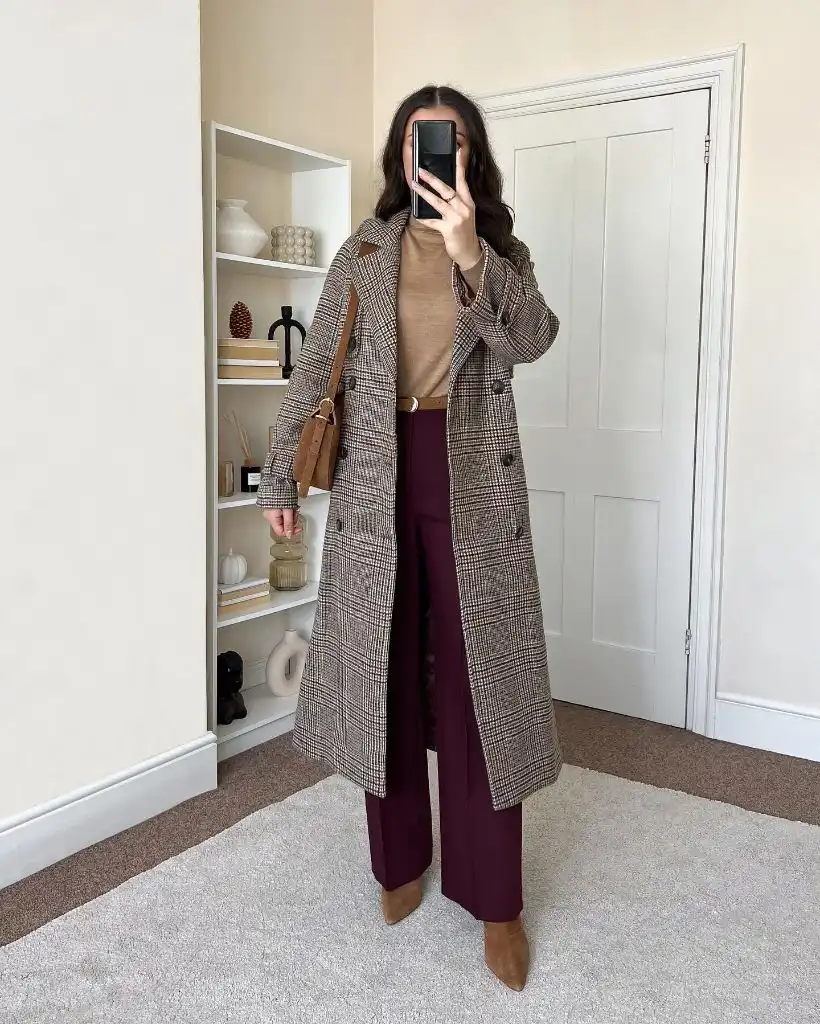
Burgundy is the decision that makes this hold. A neutral trouser would let the coat’s pattern spread across the whole figure unchecked; the deep red stops it and gives the lower half an identity of its own. Tan boots return to the camel of the knit, and a small tan bag on the shoulder repeats that warmth a third time. A thin belt marks the waist beneath the coat.
For anyone drawn to early winter outfits with pattern in the outer layer, the useful move is to lift one colour from inside the check and use it twice, then let a single unrelated colour take the legs. Two patterns at this length would simply argue with each other.
19. Stripes Punctuate an Open Beige Trench
A beige trench forms two long panels down the front of the body, and between them sits a knit with wide cream and black horizontal stripes. Those stripes are the only pattern and the only strong contrast in the frame, and because the coat hangs open they appear as a narrow vertical strip rather than spreading across the full torso.
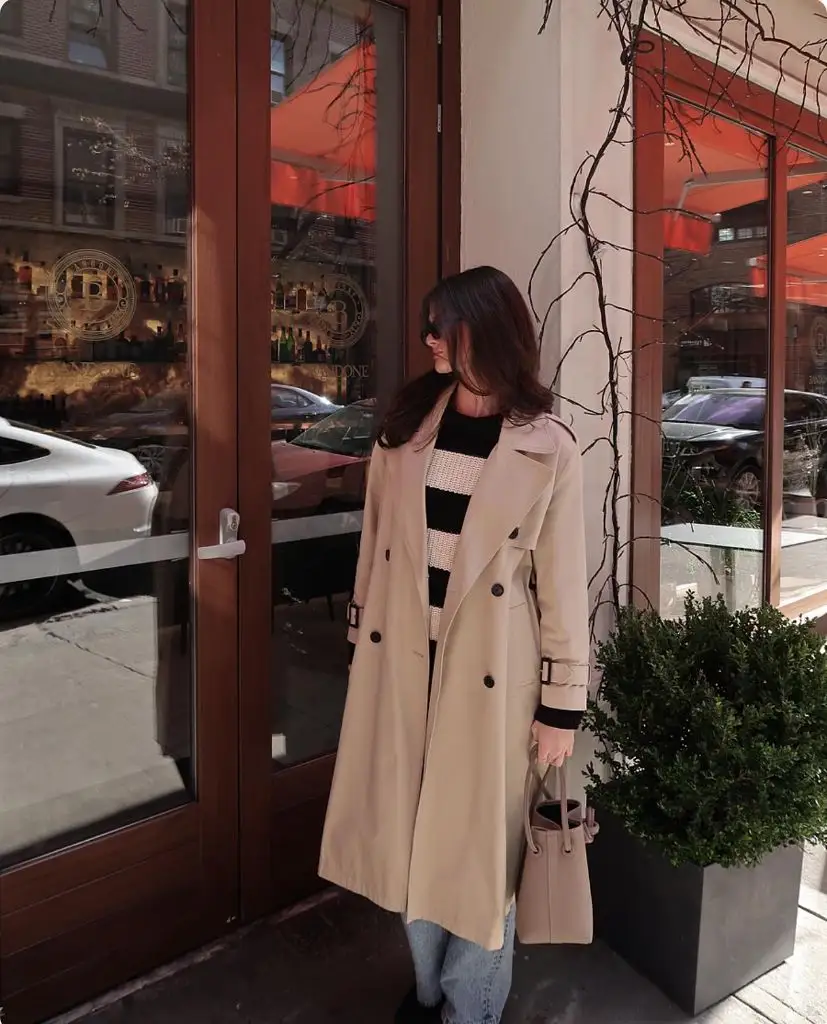
That narrowing is precisely what keeps a horizontal stripe from widening the body. Below, light jeans and dark shoes finish the line, while a soft blush bag sits so close in tone to the coat that it recedes rather than interrupts. Warm wood and a red-lit window behind push the beige slightly pink, which is worth remembering whenever you judge a neutral coat from a photograph.
Compared with the checked coat above, this is the more forgiving structure: a plain coat over a patterned inner layer is easier to control than the reverse. If you own one loud knit and one quiet coat, this arrangement will earn more wear than the other way round.
20. Camel Coat Wraps a White Base
Pale neutrals run the full height of the figure, with a long camel-cream coat open over a white knit and white wide-leg trousers. The values sit so close together that the outfit reads as one soft column, and its shape depends entirely on the coat’s tailored shoulder and lapel rather than on any break in colour.
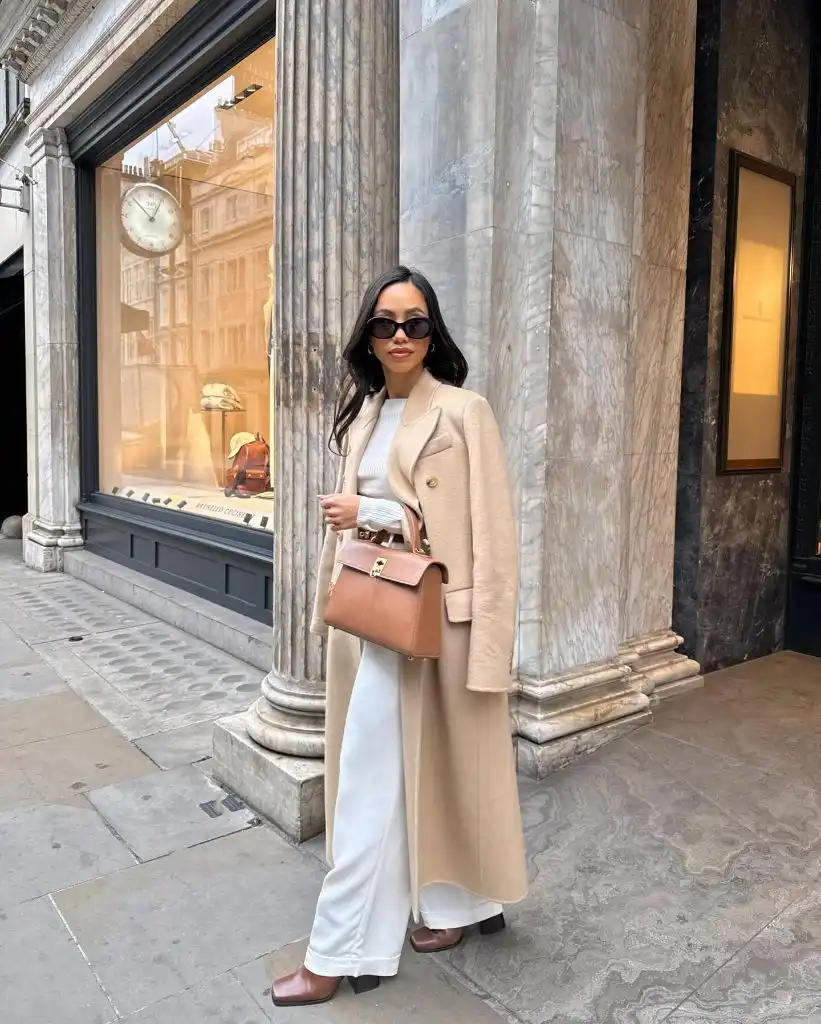
Two mid-brown objects carry the structure: a tan top-handle bag held at the waist and square-toed brown boots at the hem. They are the only medium-dark points present, and they land at two of the three places the eye naturally pauses. Dark sunglasses provide the third, near the face. Without those anchors the column would have no punctuation anywhere along its length.
The principle transfers to any tonal look. When your colours sit close together, place the darker accents at the waist, the feet and the face, and leave everything between them uninterrupted. It is a quieter method than contrast, and it does require cleaner lines to be convincing.
21. Charcoal Outer Layer Separates Cream and White
Charcoal wool-looking fabric runs from shoulder to ankle and covers most of the body, worn open over a cream sweater and off-white wide trousers. The dark coat operates as the frame and the pale centre as the picture, and because both front edges hang straight, the pale strip between them stays roughly the same width the whole way down.
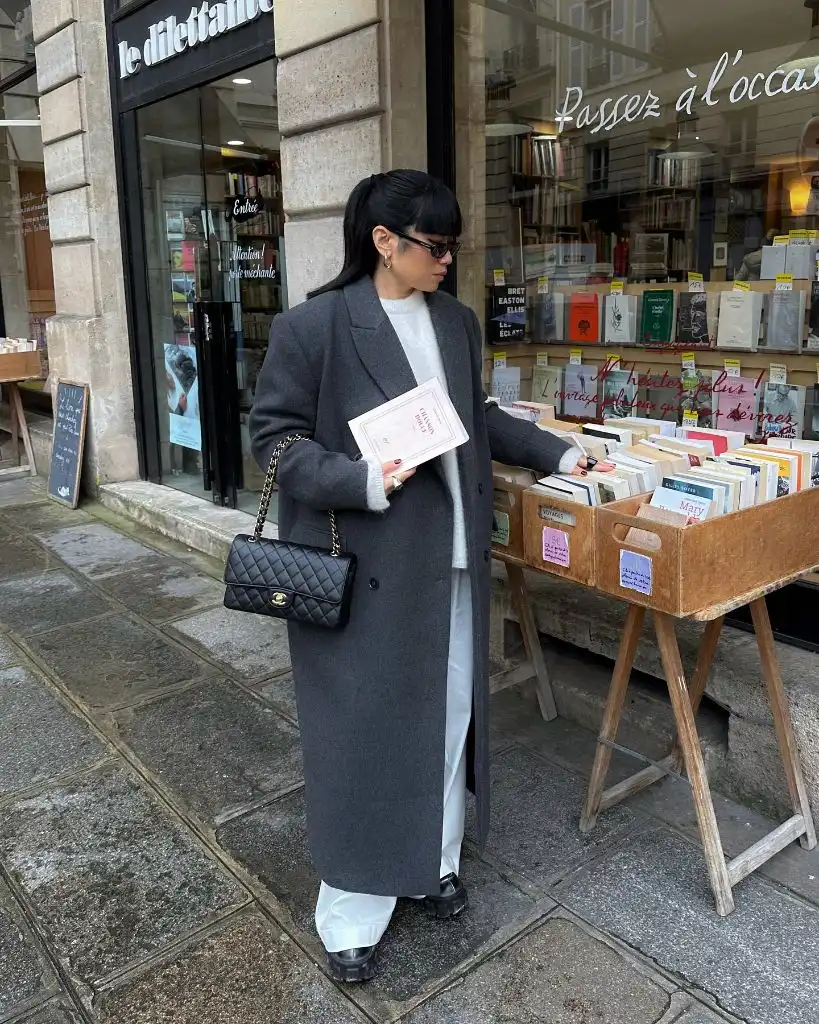
The quilted black bag on its gold chain sits at the hip, exactly where that pale strip is widest, and it holds the eye there before releasing it down to the black loafers. Cream sleeves emerge from the coat’s cuffs, repeating the sweater at the hands so the light colour registers at three separate points rather than one. Hair, sunglasses and shoes share the darkest value.
I like the restraint of that unbroken white trouser line; it gives a heavy coat somewhere to go. Compared with the grey coat that opened this set, the only real difference is the colour of the base underneath, and it changes the temperature of the entire look.