There is a moment each year when hair decisions stop being about novelty and start being about structure, and winter haircuts are easier to judge once you look past the individual cut and study how the whole head is composed. Proportion between root and end, where the shortest layer lands, how much weight sits at the perimeter, how a colour shifts from dark to light across a length — those relationships explain far more than any single style name ever will.
Before scrolling, it helps to fix on three comparisons: where the widest point of the shape falls, whether the colour is doing the shaping or the scissors are, and how visible the grow-out will be in three months. Weigh density against movement, because a heavy perimeter reads polished but resists air, while heavy layering reads soft but loses that clean endpoint. No single formula here functions as a rule.
1. Defined Curls Fill a Mid-Length Shag
Curl pattern dominates entirely. Warm chestnut hair with a genuine spiral pattern falls to just below the shoulder blades, layered through the top so that volume builds around the crown and upper back before loosening into longer, looser spirals at the ends. The tone is consistent — a warm brown with copper surfacing wherever a curl turns toward the light.
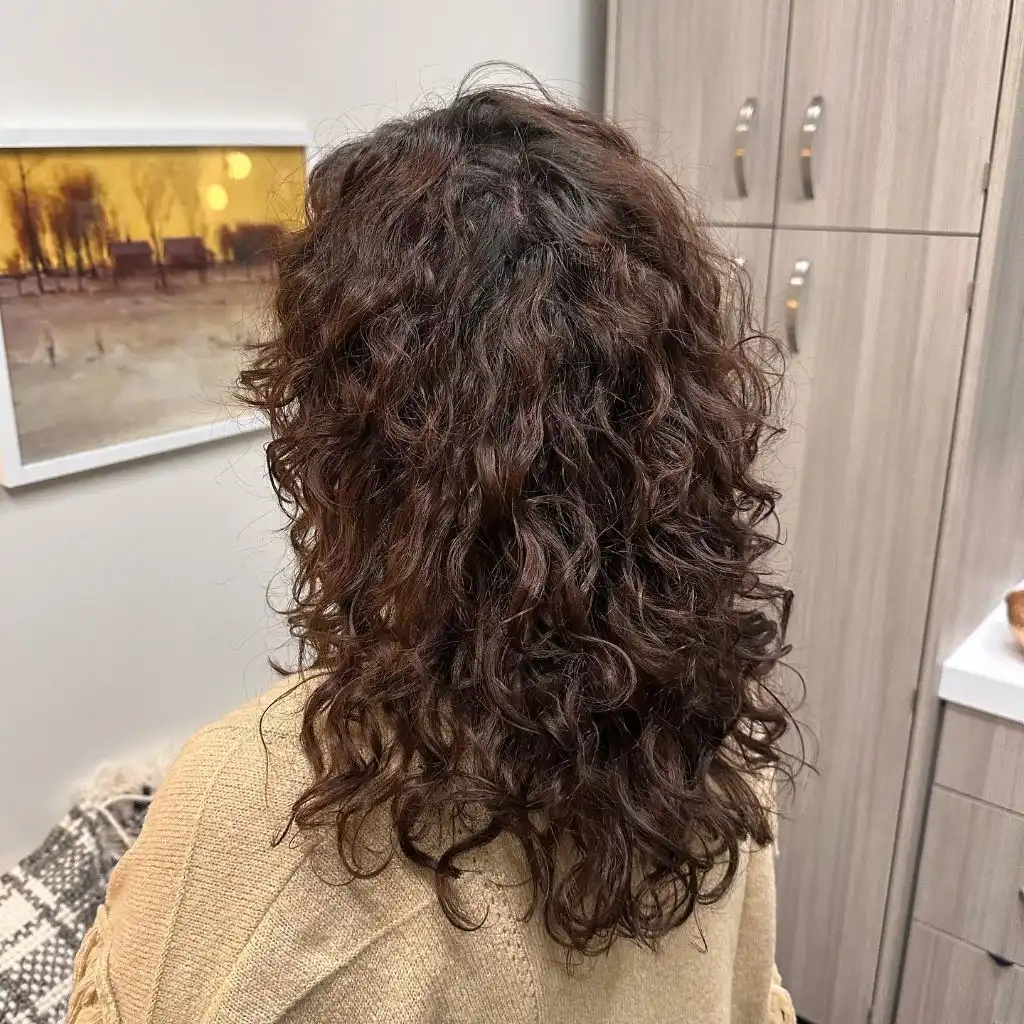
A cream cardigan and pale wood cabinetry behind keep the palette low and warm, so the copper glints in the curl read as part of the same family rather than as highlights. Layering is what makes this work: cut one-length, this density would sit as a solid mass, but the shorter internal sections let the curls separate and create the small pockets of negative space that give the shape its depth.
For anyone drawn to winter haircuts on textured hair, the practical detail is that layers must be cut to the curl’s spring, not to the stretched length — a difference of several inches that determines whether the shape lands where it was intended.
2. Long Layers Carry Caramel Through Dark Brown
Length dominates immediately. The hair falls well past the chest in a single long sweep, and the colour runs from a near-espresso root through progressively warmer caramel toward the ends. The layering is long and gradual, with the shortest pieces landing around the jaw, so the outline narrows slowly rather than stepping in at any one point.
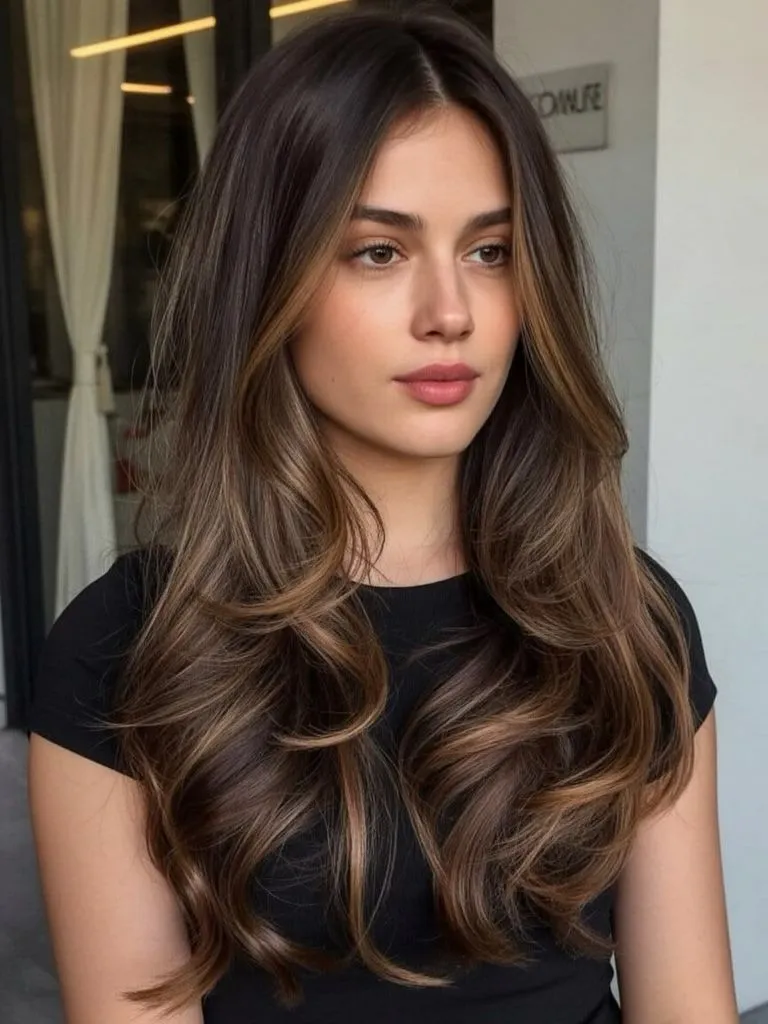
A plain black top does most of the supporting work. It removes any competing colour from the lower half of the frame, which lets the warm ribbons register clearly against the darker base. The waves are directed away from the face at the top and allowed to spiral loosely below the shoulder, so the lightest tones collect exactly where the curl opens up. That placement is the reason the colour reads dimensional instead of striped.
Compared with the softer, more diffuse brown above, this is a colour-led shape rather than a cut-led one. The trade-off is visible: warm caramel over a dark base fades toward brass before it fades toward nothing, so the maintenance conversation is about toning intervals, not just root regrowth.
3. Loose Waves Extend a Sandy Root Shadow
Here the length is the headline again, but the tonal arrangement is reversed. A soft mushroom-brown root melts into a sandy, bronde mid-length, and the hair extends well below the ribcage in wide, uniform S-waves. The part is central and slightly undone, and the colour lightens so gradually that there is no identifiable line anywhere between root and end.
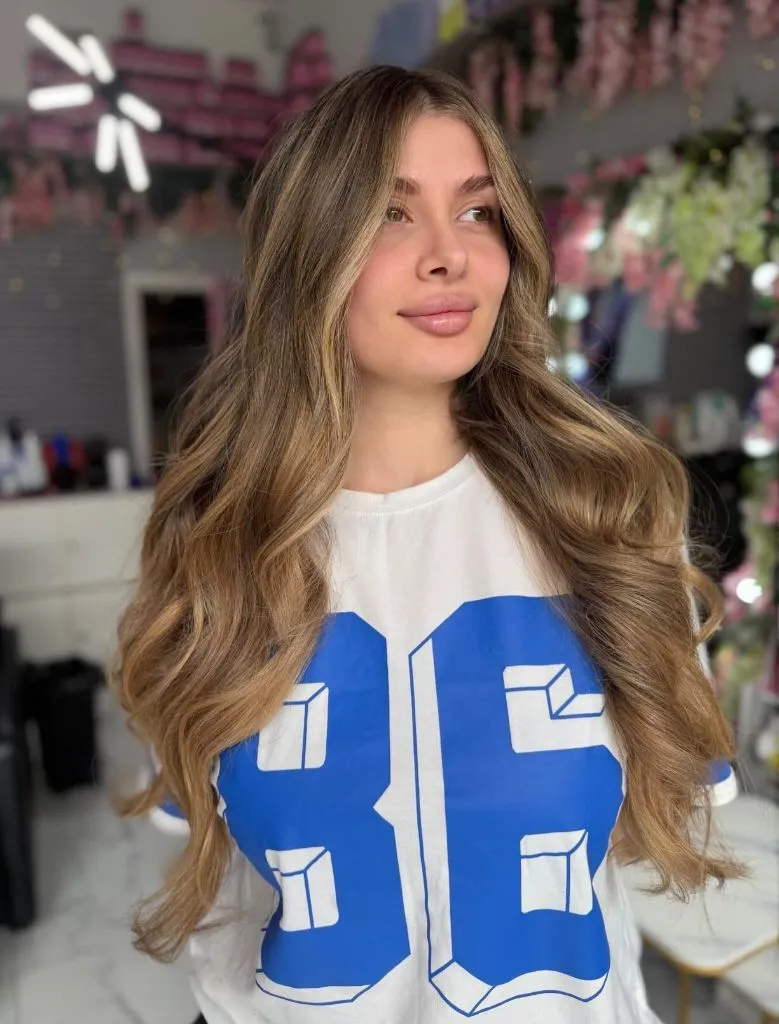
An oversized white tee with a large blue graphic is the loudest object in the photo, and it works in the hair’s favour by anchoring the bottom third of the frame with something flat and geometric. Against that hard-edged block, the curl pattern reads even softer. The waves are barrel-set and brushed out, so the surface stays glossy-looking rather than defined; the material of that shine is not identifiable, so treat it as a styling observation, not a product one.
The transferable principle is about the root shadow. Keeping two or three levels of depth at the scalp buys months of grow-out tolerance, which matters more in winter when salon visits get spaced further apart than anyone plans.
4. Copper Saturation Anchors an Unbroken Perimeter
Colour takes complete control of this composition. A warm, even copper runs from root to tip with no lighter ribbons and no visible shadow, and the length falls to mid-back in one continuous, barely layered sweep. Seen from behind, the perimeter is the clearest line in the image — slightly rounded, dense, and consistent all the way across.
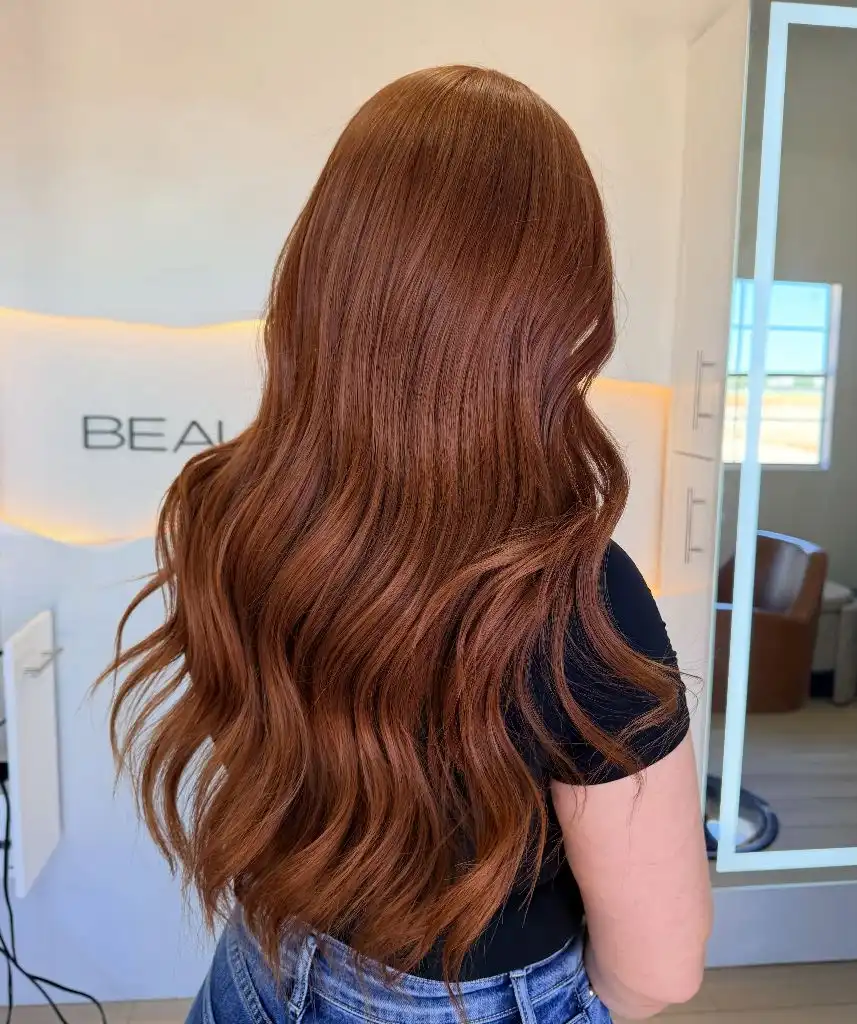
Everything around it is turned down. A black short-sleeve top and mid-blue denim keep the lower frame neutral, and the pale salon wall behind removes any competing warmth. Because the colour field is uninterrupted, the only variation comes from light hitting the wave crests, which produces those brighter bands through the mid-lengths. That is the useful detail: on a single-tone red, shine does the job that highlights would do elsewhere.
For anyone drawn to saturated red among winter haircuts, the practical caution is fade. Copper molecules are large and sit high in the cuticle, so they leave faster than any brunette, and cooler washing plus a colour-depositing conditioner is the difference between six weeks and ten.
5. Cool Ash Ribbons Break Up Deep Brown Waves
Depth leads here, and the tone is decidedly cool. From the back, the hair reads as a dark walnut brown lifted by fine ash-beige ribbons that surface mainly through the mid-lengths and around the outer edges of the wave. The length reaches the mid-back, the perimeter is soft rather than blunt, and the waves are set in a regular, almost mirrored pattern down both sides.
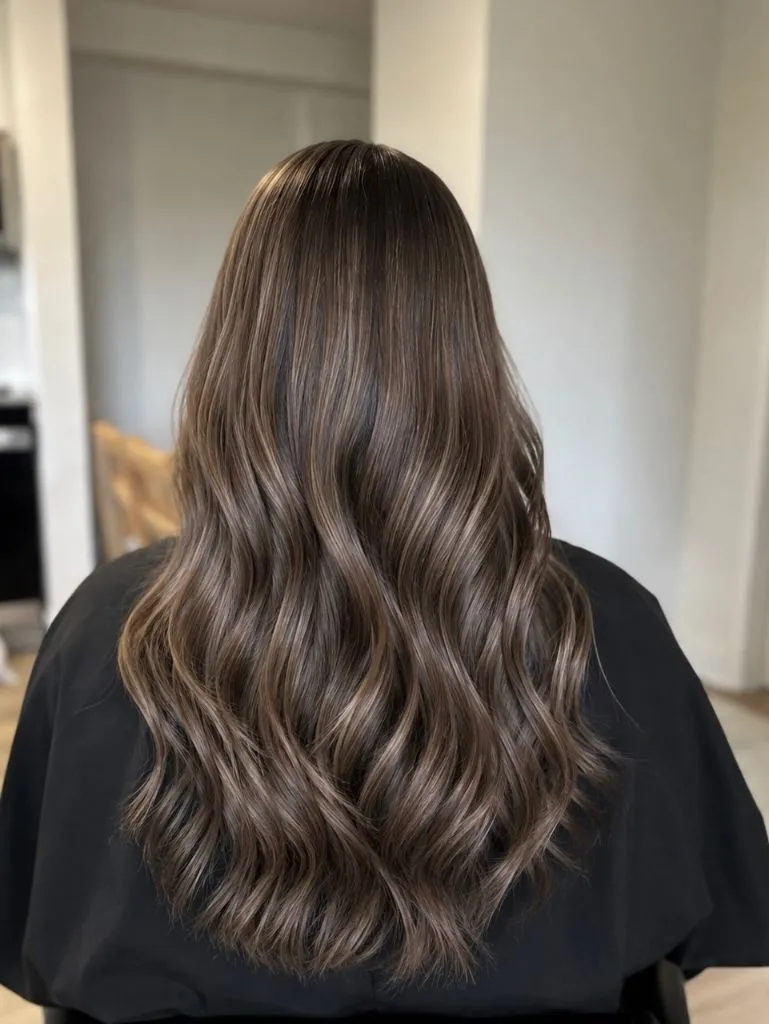
The black cape and the empty white wall behind it strip out every distraction, which is exactly why the tonal work is so legible. Ash ribbons on a dark base can easily read grey in the wrong light; here they stay clean because the base itself has no red warmth to fight. The sharpest endpoint is the curl tips, where the lighter tone concentrates and gives the outline definition it would otherwise lack.
Set beside the copper above, this is the low-maintenance option by a wide margin. If you want more of it, look at how depth is layered in these dimensional brunette hair color ideas before committing to full-head lightening.
6. Straight Ends Sharpen a Blunt Collarbone Line
The dominant feature is the endpoint. Hair falls to just below the shoulder blades, pressed straight, and finishes on a near-horizontal line with only the slightest inward curve at the corners. Above that line, the colour moves from a dark brown root through a mid-brown body into distinctly lighter, honeyed ends, so the lightest area and the hardest edge occupy the same place.
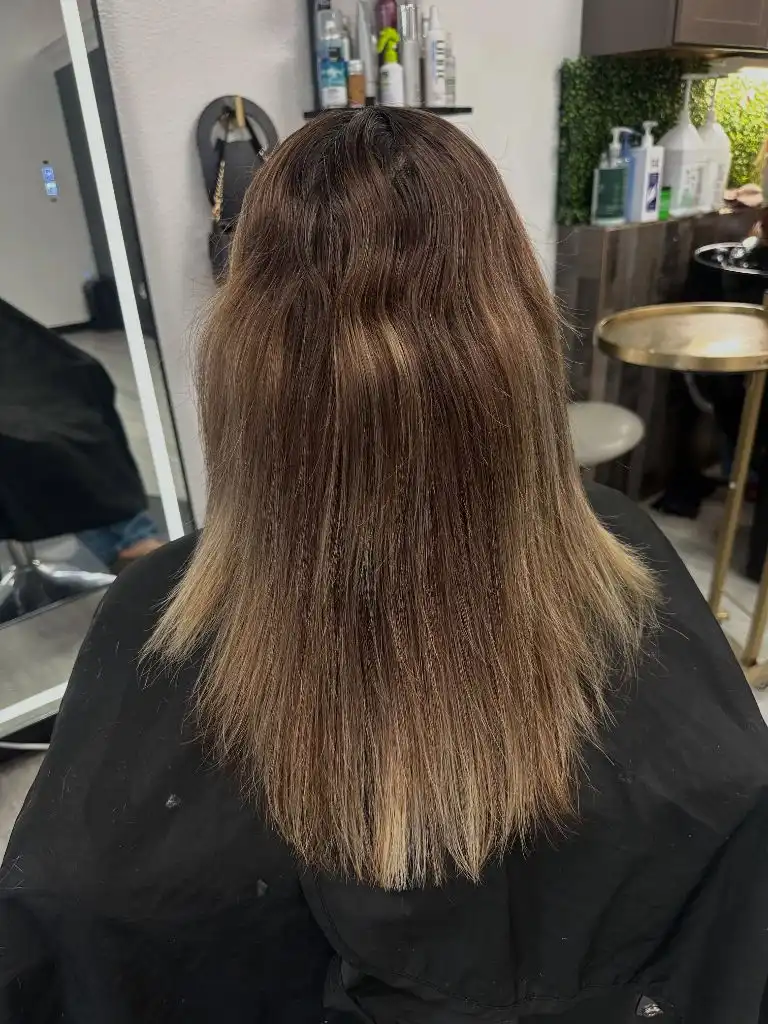
Because the hair is worn flat rather than waved, the gradient reads as vertical bands instead of woven ribbons. That is not a flaw, but it is a different effect: straightened hair shows every horizontal transition in a balayage, while curl hides them. The black cape again keeps the field neutral, and the visible salon shelving in the background is busy enough that the eye returns to the one clean line the hair provides.
The trade-off is candour itself. A blunt, straightened finish exposes dryness at the ends more than any layered shape, so this works best when condition is genuinely good rather than as a way to disguise it.
7. Undone Texture Softens a Long Rounded Outline
Bulk is the organising element. Very long, dense dark brown hair falls past the mid-back with a natural, slightly frizzed wave that widens the silhouette considerably through the lower half. There is no visible colour work at all — the tone is uniform espresso — so the entire read is about mass, outline, and where that mass sits relative to the body.
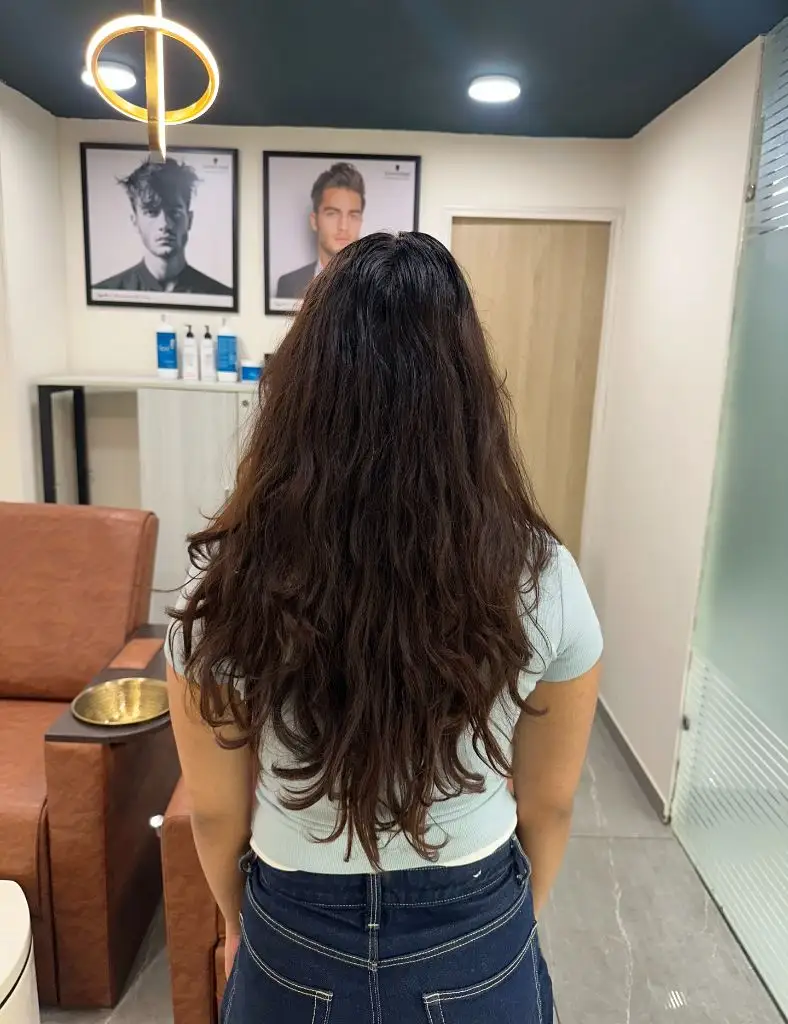
A pale mint ribbed top and dark denim keep the lower frame simple and let the hair occupy most of the vertical space. The shape narrows slightly at the nape then flares from the shoulder down, which is the classic triangle that heavy, minimally layered length produces on wavy texture. Compared with the controlled barrel waves earlier in this set, this reads notably more natural and notably less directed.
The adaptation is straightforward. Removing internal weight through the lower two-thirds — not shortening the length — pulls that flare back in without sacrificing the drop, and it is the single most useful request for anyone whose density outgrows their outline.
8. Fine Highlights Lighten a One-Length Lob
Light is the dominant force in this frame, and it falls almost entirely on the top of the head. The hair is a mid-length lob, straight, cut to a soft one-length line just below the shoulder, and threaded with fine sandy highlights that concentrate at the crown and around the parting. Underneath, a darker base stays visible, so the head reads brightest at the top and cools as it descends.
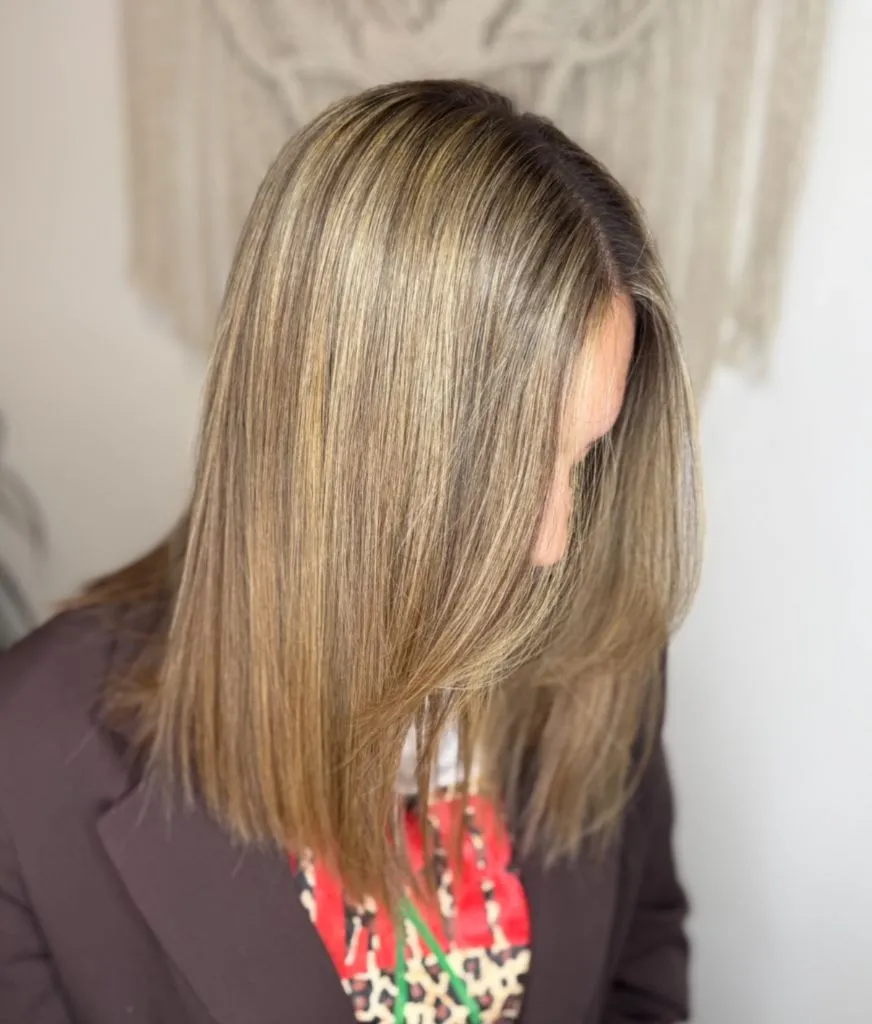
A dark plum blazer and a small flash of red and green print at the chest sit low in the frame, giving the pale hair something dense to rest against. The hair falls forward over the face rather than being swept back, which means the parting itself becomes the focal line. Fine, closely woven highlights like these blur rather than stripe, and that blur is what keeps the transition to the darker under-section from looking like an accident.
I like the restraint of the placement here. Concentrating lift where the light naturally hits costs less time in the chair than a full head and grows out with far less of a line.
9. Curtain Pieces Interrupt a Flicked Mid-Length
The face-framing sections dominate. A long curtain piece falls from a centre part down past the cheekbone on one side, and it carries the brightest colour in the whole image — a warm sandy blonde set against a cool dark brown base. Below it, the cut sits at around collarbone length with visible, actively flicked layers pushing outward at the ends.
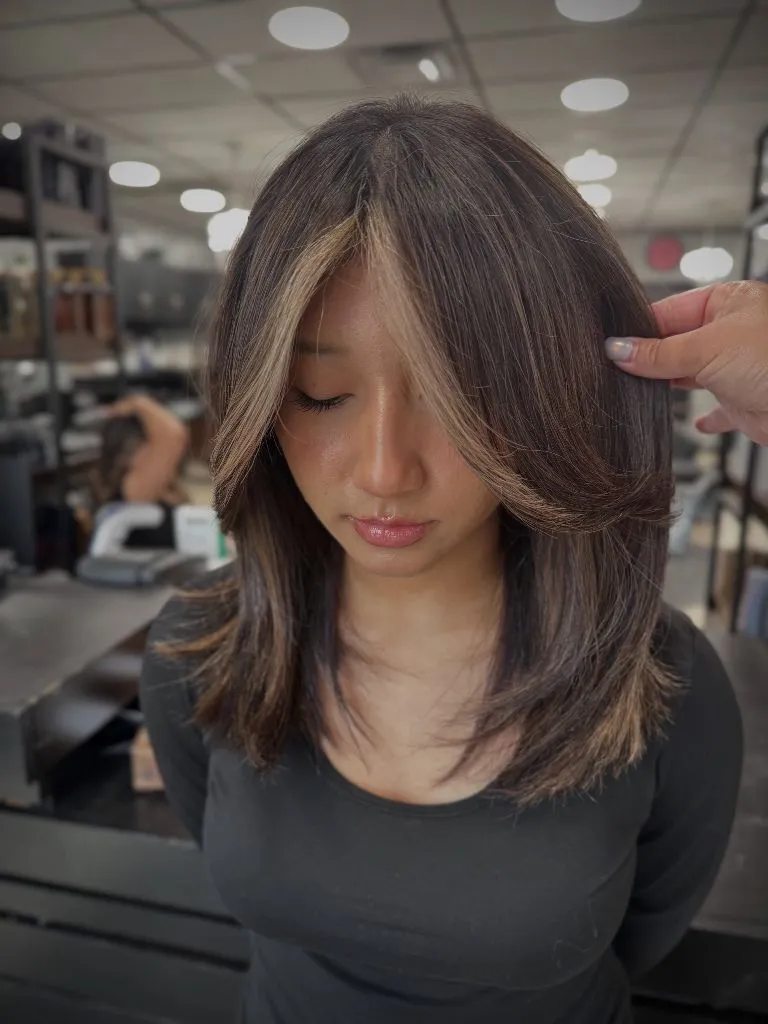
The rest of the palette does very little on purpose. A plain dark grey top and a bright, cluttered salon background mean the only tonal event is the contrast between the pale front section and the deep base behind it. Layers are cut short enough at the sides to flip away from the jaw, which builds width at exactly the point where the light colour sits. Hierarchy holds because the lightening is confined to a narrow band rather than scattered.
The honest limitation is that a strong front section requires the flick to survive. Worn flat and tucked, the same colour placement reads much heavier, so this is a cut that asks for a round brush most mornings.
10. Warm Blonde Panels Widen a Straight Fall
Symmetry runs the composition. Long hair is parted dead centre and falls straight past the chest on both sides, with a deep, unlifted root occupying the top few inches and warm blonde taking over from roughly eye level down. The two panels read almost as mirrored blocks of colour, dark above, gold below, meeting in a horizontal transition rather than a woven one.
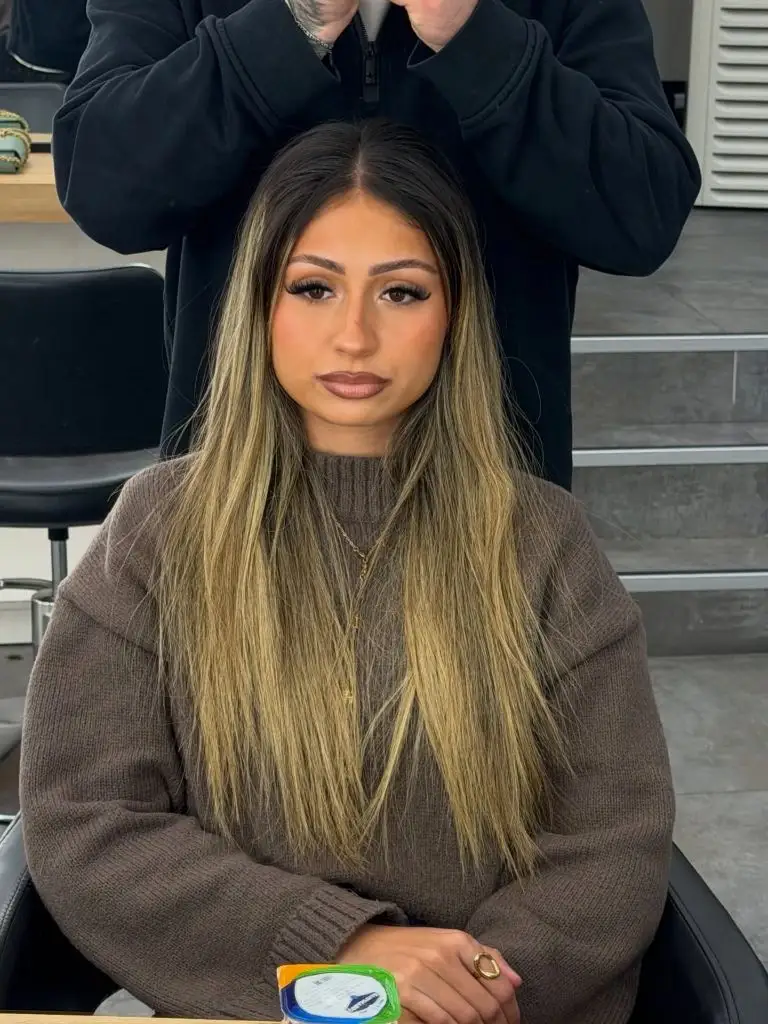
A brown knit and a slim gold chain keep the lower frame in the same warm family as the ends, so nothing competes tonally. The hair is worn poker-straight, which — as with the earlier straightened gradient — puts the root-to-length transition entirely on display. Here that is clearly intentional; the shadowed root is deep enough and even enough to function as a design element instead of regrowth.
Among winter haircuts, this is one of the more forgiving colour strategies for growing out lightened hair, because a deliberate dark root has no deadline. The trade-off is that it needs length to work; on anything shorter than the collarbone, the proportion of dark to light tips out of balance.
11. Deep Cherry Sets the Whole Colour Field
Saturation is the entire idea. A deep cherry-burgundy covers every strand with no lighter placement anywhere, and the length sits at just past the shoulder with a loose bend through the lower half. Because the tone is so uniform, the shape registers only through the way light lands on the wave crests near the ends and along the top of the head.
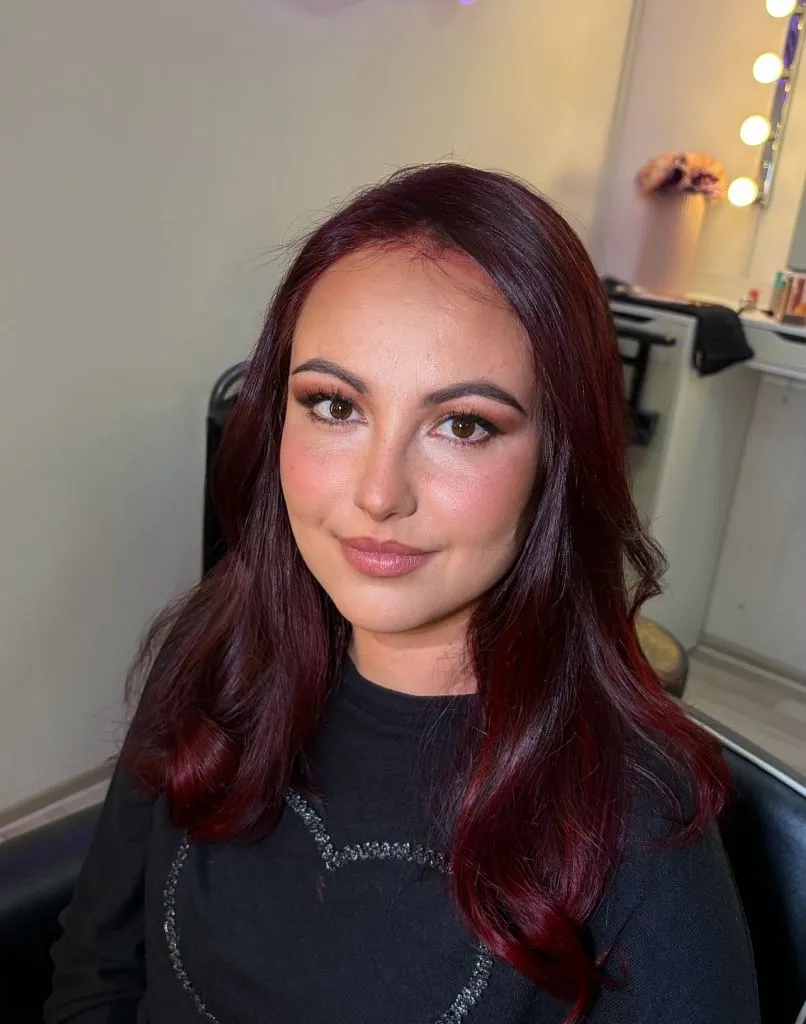
A black top removes any colour competition from below, and warm bulb lighting behind pushes a slight red glow around the perimeter. Neutral, warm-toned makeup keeps the face in the same temperature family, so the hair does not read as a separate event stuck on top of a cooler complexion. That temperature matching is what makes strong fashion colours look intentional rather than costume-like.
The comparison worth making is with the copper earlier in this set. Both are single-tone reds, but violet-based burgundy sits darker and fades toward a dusty plum, while copper fades toward brass — so the choice is really about which fade you would rather live with.
12. Curled Ends Lift a Berry Gradient
From behind, the gradient is the dominant structure. The colour begins as a dark, almost black-cherry at the crown and intensifies into a brighter raspberry through the last few inches, with the change happening low enough that the top two-thirds read as one dark mass. The cut is mid-length, and only the final section is curled, which concentrates all the movement at the bottom edge.
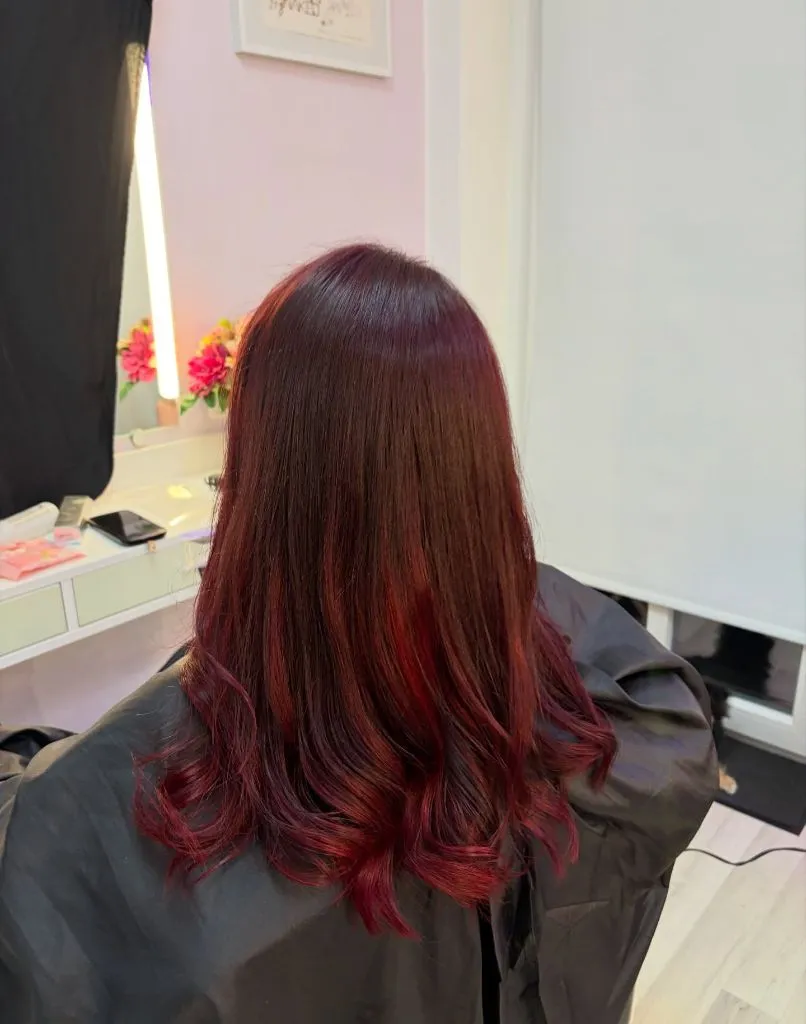
The grey cape and pale pink salon wall are soft enough to let the brightest berry tones register clearly at the perimeter. Above the curl, the surface is smooth and reflective, which produces a broad highlight band across the crown; that band and the bright ends bracket the darker middle and give the whole thing depth it would not have flat. Nothing else in the frame carries colour, and that restraint is doing real work.
If you want this quieter, keep the same base and pull the brighter tone back to a narrower band at the very tips. The gradient still reads, but the grow-out becomes a non-event.
13. Mahogany Depth Meets Soft Face Volume
The tone here is warmer and browner than the two reds preceding it — a mahogany with visible copper lifting through the mid-lengths rather than a true burgundy. Length sits just below the shoulder, the part is off-centre, and the hair is styled with noticeable lift at the roots so the widest point of the shape falls level with the cheekbones rather than at the ends.
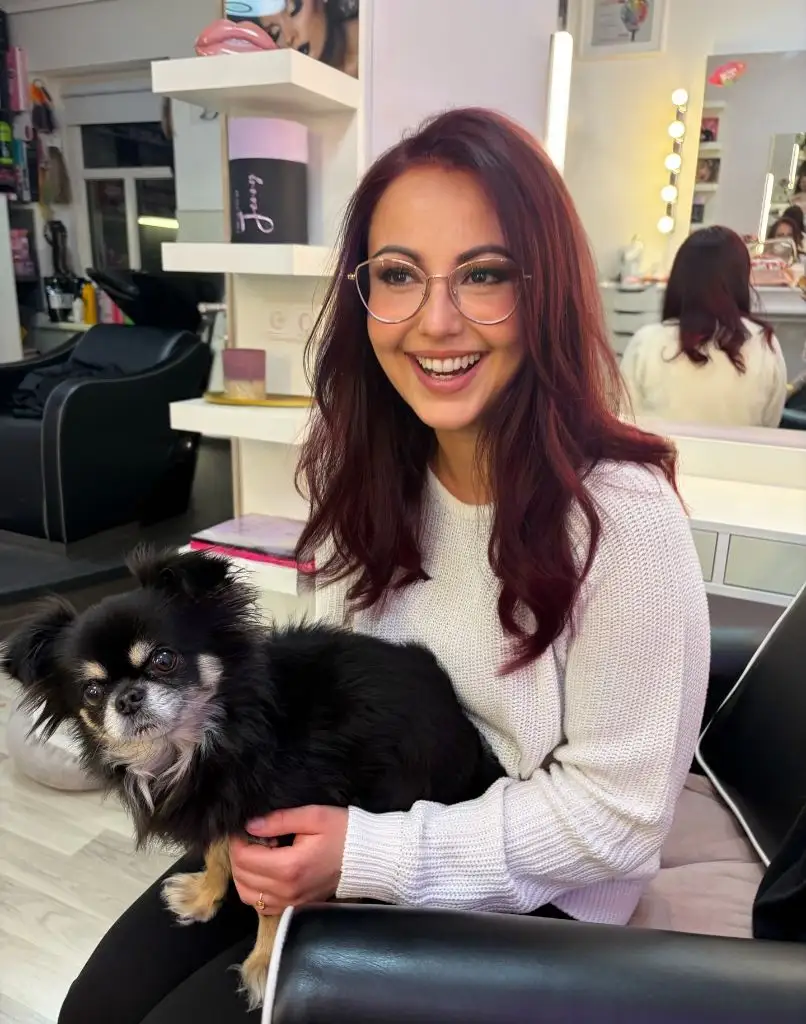
A cream knit sweater brightens the base of the frame and keeps the red from reading heavy, while rose-gold glasses frames pick up the same warm metal note in the hair. That small echo matters more than it sounds; when eyewear temperature matches hair temperature, the face stops looking divided into zones. The busy salon background is the only visual clutter, and the hair’s mass is enough to hold against it.
After that high-contrast berry gradient, this reads notably softer. It is the version I would suggest to anyone testing red for the first time, because a mahogany base stays close enough to brown that a bad week is still wearable.
14. Silver-Toned Waves Cut Through Dark Brunette
Contrast level is the defining quality. A near-black base carries cool, almost silver-beige ribbons that run in long vertical strands from around eye level to the ends, and the hair falls in wide, brushed-out waves well past the chest. The lightening is placed in narrow slices rather than broad panels, so the effect is linear — stripes of light reading against a very dark field.
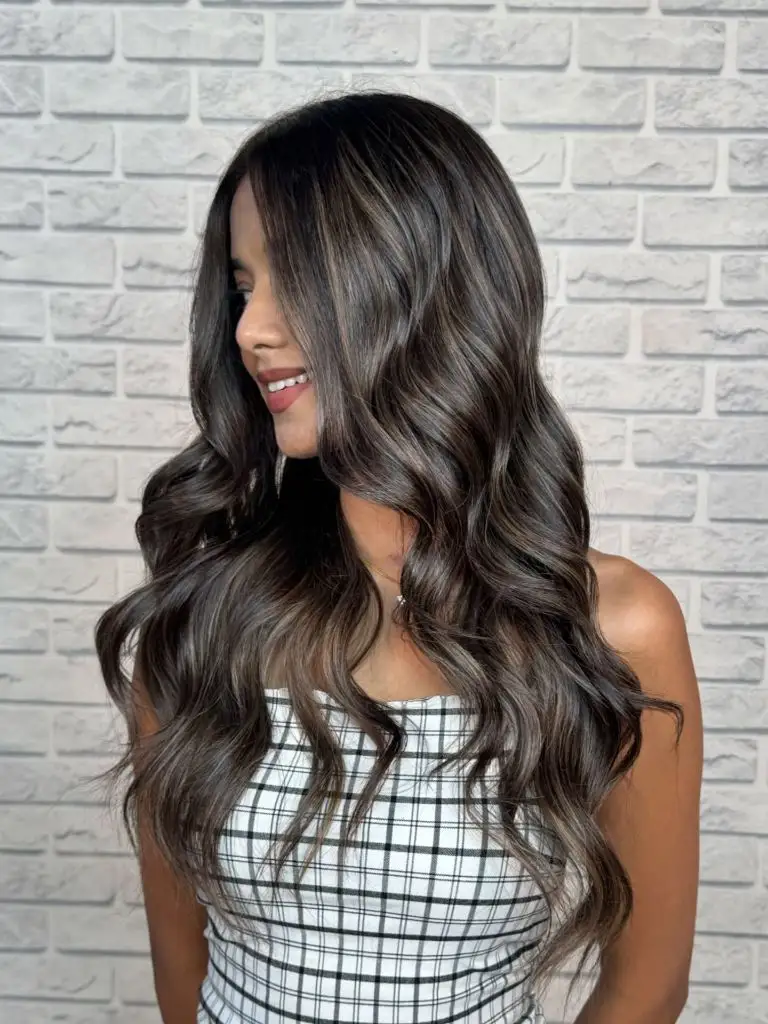
A black-and-white checked strapless top repeats that same high-contrast, light-on-dark logic in miniature, which is a neat accidental rhyme between garment and colour work. The white brick wall keeps the background bright so the darkest sections of hair still hold an edge. Waves are set uniformly and combed through, meaning each silver slice bends with the curl and catches light at the crest — that is where the contrast peaks.
The limitation is real: pulling a dark base to a clean cool blonde requires substantial lift, and cool tones on dark hair drift warm quickly. Expect toner appointments between colour appointments, not instead of them.
15. Auburn Ribbons Thread a Bouncy Blowout
Movement dominates before colour does. The hair is cut to just below the shoulder with long layers through the sides, blow-dried into a full, bending shape that swings forward across one shoulder. Within that shape, fine auburn and warm chestnut ribbons run through a dark brown base, most visible where the front section sweeps down past the cheek.
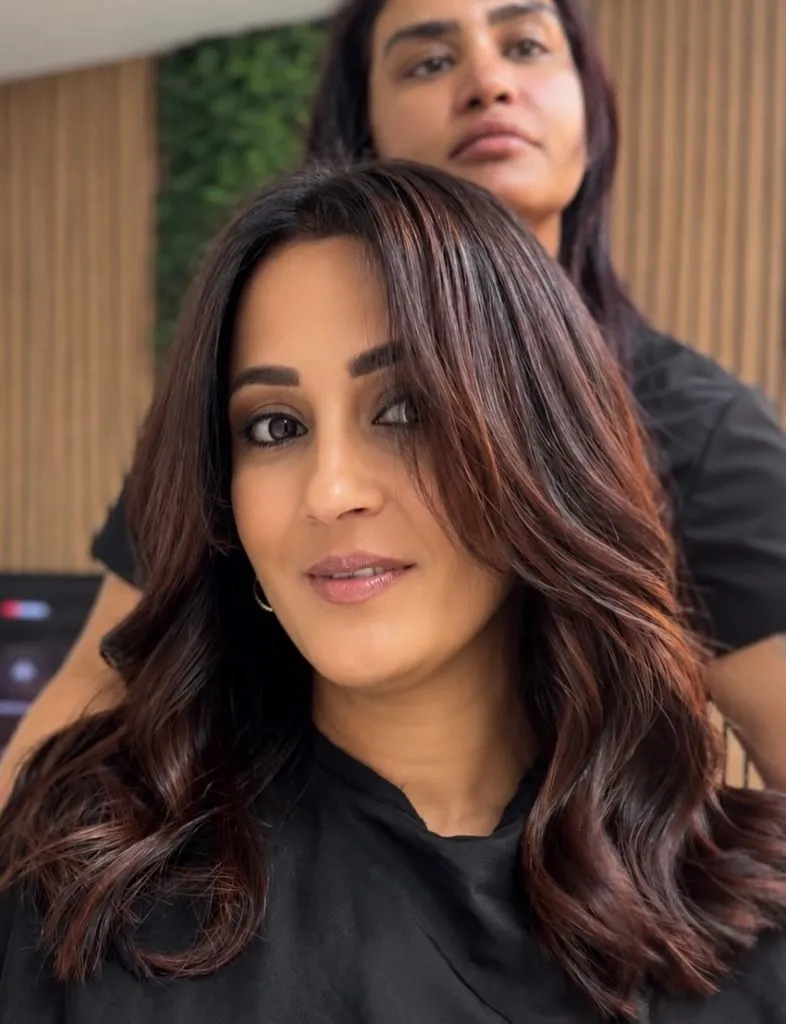
A black cape and a slatted wood wall behind keep the background warm but low-contrast, which lets the reddish threads read without shouting. The highlight placement is narrow and scattered rather than pooled, so on a straight day this would look almost tonal, and only the curl reveals how much colour is actually in there. That is a deliberate strategy — colour built for movement rather than for a flat mirror.
Anyone weighing a similar side-swept shape should look at how the parting placement changes the volume balance in these middle parting hairstyles, since the same cut behaves quite differently once the weight is split evenly.
16. Blunt Fringe Squares Off an Angled Bob
The fringe governs everything. A full, blunt-cut fringe sits just at eyebrow level, dense enough to read as a solid horizontal band, and beneath it the bob angles from a shorter back toward longer front sections that finish around the collarbone. The colour is a deep dark brown with subtle warm red catching through the fringe and along the length where light hits.
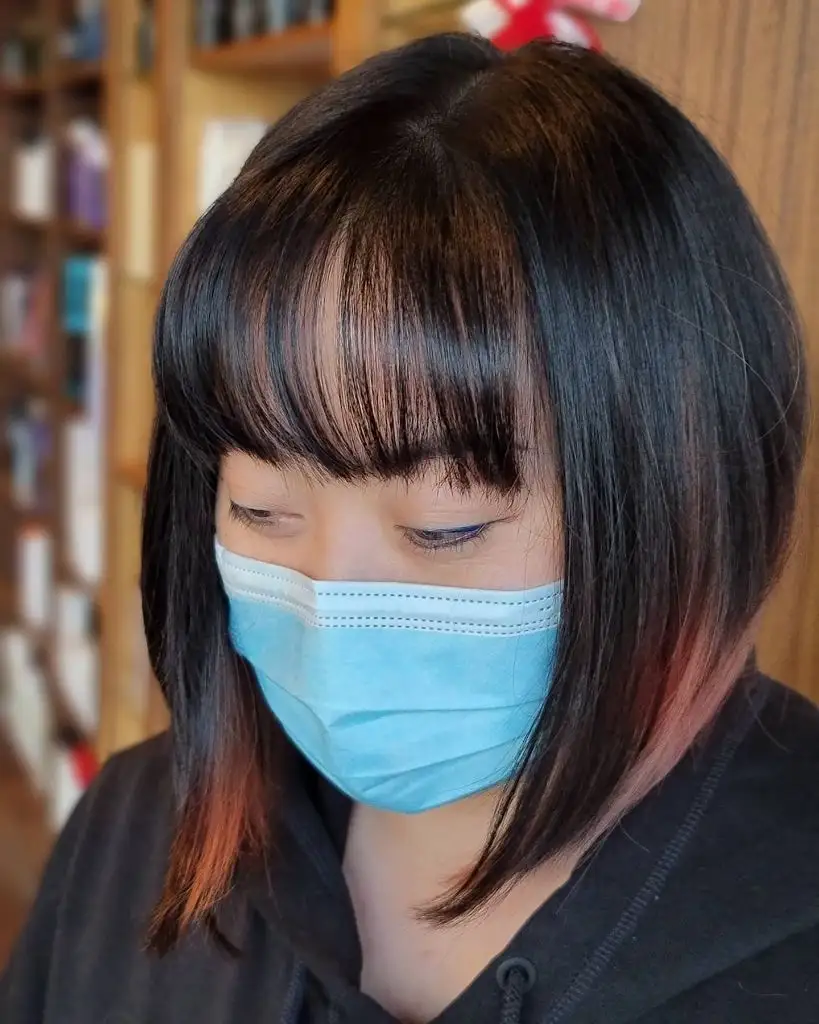
A plain black hoodie and a warm wood shelving unit behind keep the frame simple, and the pale blue mask is the only bright object — which, incidentally, makes the fringe line read even harder by contrast. The hair is pressed flat and reflective, so the geometry of the cut is fully exposed: two straight vertical falls at the sides and one straight horizontal across the forehead. There is no softening anywhere, and that is the point.
The upkeep note is unavoidable. A blunt fringe at this weight needs trimming every two to three weeks, and it does not compromise gracefully with hats — which is a genuine consideration for a cut worn through cold months.
17. Forward Graduation Tightens a Sliced Bob
Graduation drives this shape. Seen in profile, the bob stacks short and rounded at the back and lengthens steadily toward the front, finishing below the chin in a clean diagonal. The colour is a warm caramel-brown lit with fine golden slices through the mid-section, with a distinctly darker root band across the top holding the whole thing down.
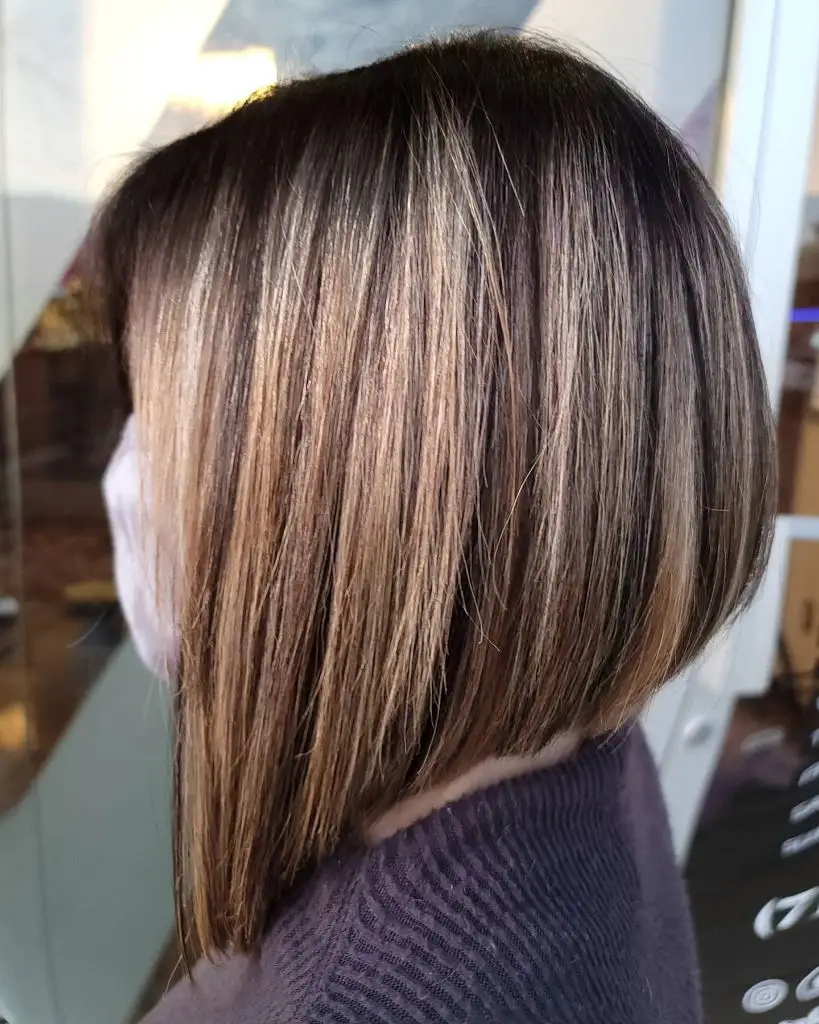
A soft plum ribbed sweater sits below, close enough in depth to the darker root that the pale mid-lengths become the brightest zone in the frame. Because the hair is straight and the cut is graduated, every highlight slice runs parallel to the cutting line, which makes the angle read even steeper than it is. Colour and geometry are working in the same direction here rather than against each other.
Compared with the fringed bob above, this one carries all its structure at the back and none at the front. That makes it easier to grow out — the length simply catches up — but it does need the round-brush finish to keep that stacked corner from collapsing.
18. Rounded Layers Balance a Heavy Dark Length
Weight distribution is what to watch. The hair is a rich dark brown, cut just past the shoulder, with long rounded layers that curve away from the face and finish in soft, outward-turning ends. Volume gathers at the sides rather than the crown, giving the silhouette a wide, slightly bell-shaped outline that sits lower than in most of the earlier examples.
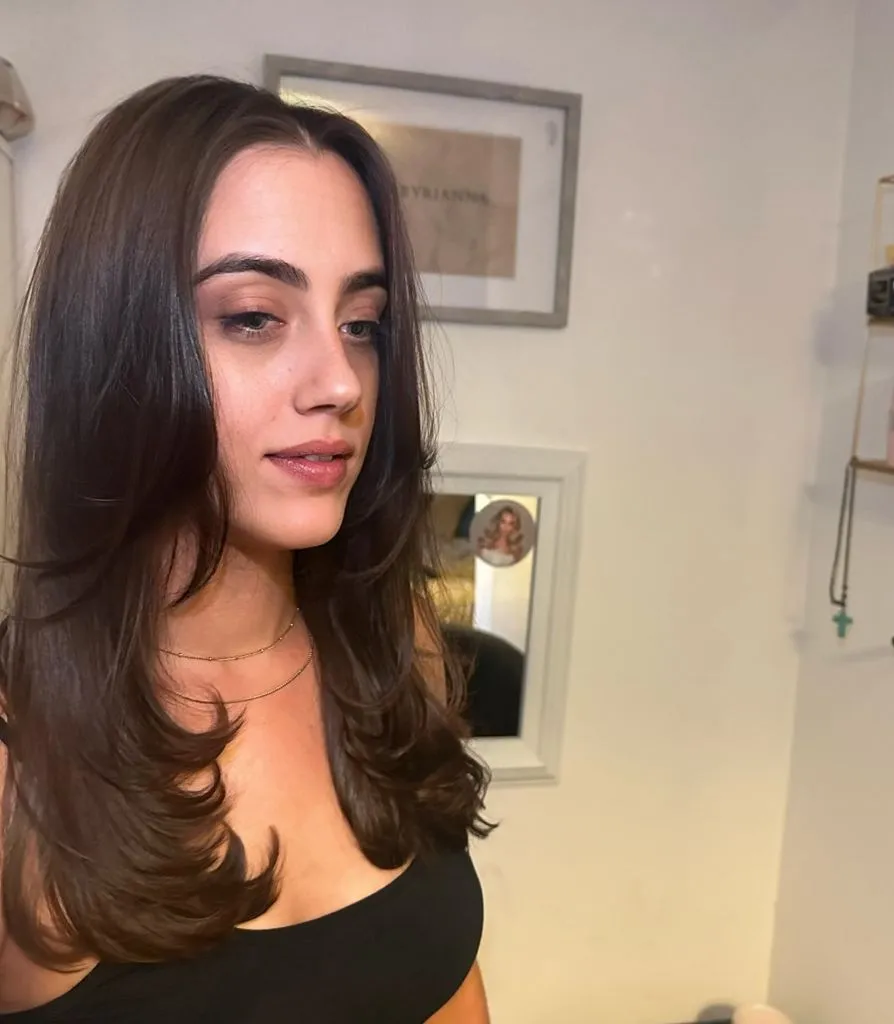
A black one-shoulder top and a pale, near-empty wall behind reduce the frame to two tones, so the only real event is the curve of the cut. Fine warmer strands surface where the light strikes the outer layers, but there is no deliberate colour work visible — the dimension comes from the layering catching light at different depths. That is worth noting: a well-graduated cut produces its own shading on virgin hair.
The transferable principle concerns scale. Rounded layers add width, so they suit narrower face shapes and read heavier on fuller ones; moving the shortest layer down by two inches is usually enough to correct the balance either way.
19. Sharp Diagonal Line Takes Over a Bob
The cutting line is unmistakably the subject. This bob drops from a short, rounded back to a long front point that reaches well below the chin, and the angle is steep enough to read as a straight diagonal across the profile. The colour is a very dark brown-black with a faint violet cast surfacing at the ends under the salon lighting.
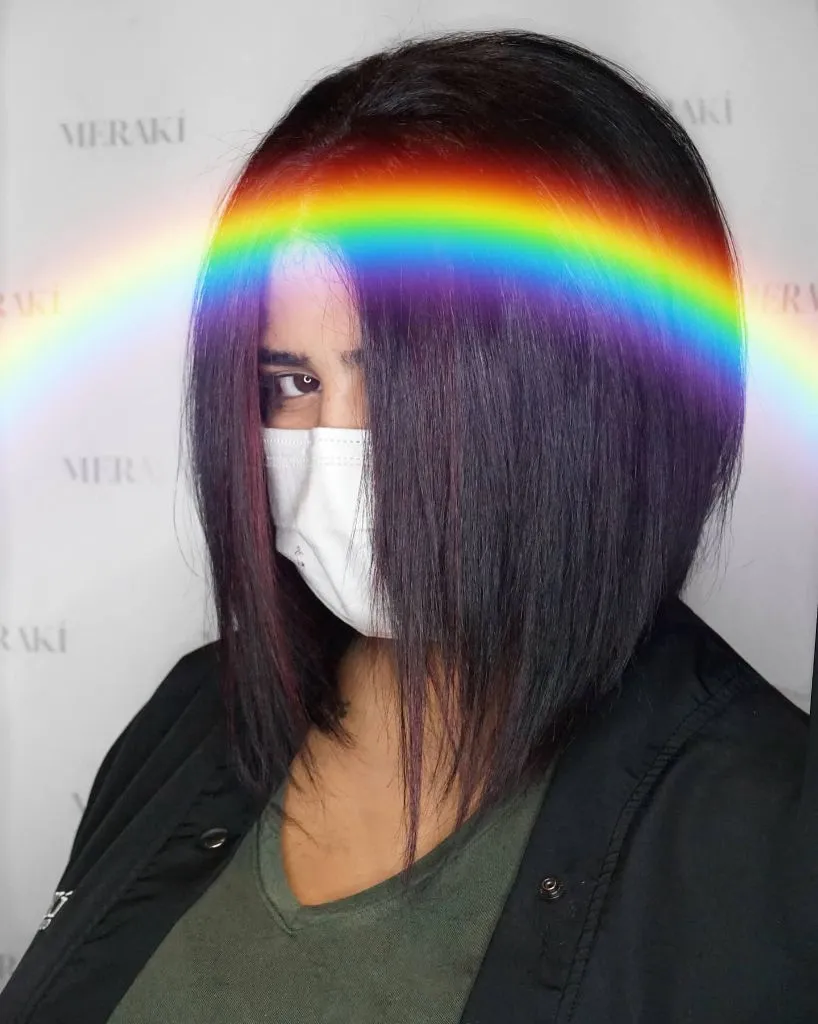
Everything else in the frame is either black — the jacket, the olive top reading dark — or blank white wall, so the hair’s outline is the only shape with any information in it. The surface is smooth and flat, which is essential; on this degree of angle, any wave would soften the line and lose the entire concept. A lens flare across the image is incidental, though it does show how much shine the flat finish holds.
Set against the graduated bob a couple of items back, this is the more extreme version of the same idea. It is not a background haircut, and it commits you to straightening as a routine rather than an option.
20. Windblown Texture Frames a Soft Middle Part
Volume controls this one. The hair sits at collarbone length, parted loosely down the centre, and the top section has been lifted so far off the scalp that the outline reads wider at the crown than at the ends. Colour is a mid-to-dark brown with almost no tonal break, which means the entire composition is being carried by shape and air rather than by contrast.
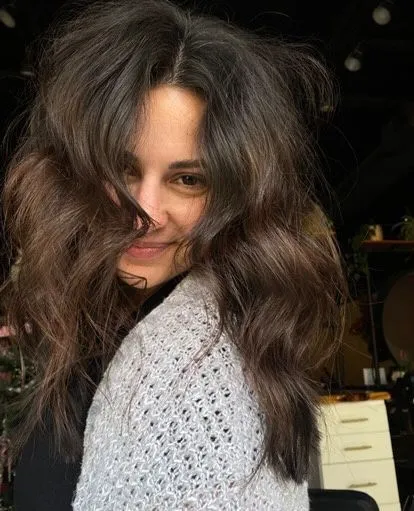
The supporting details stay deliberately quiet. A cream open-knit top with a visible loose stitch sits against the hair as the only real texture rival, and because it is pale and low in visual weight, the brown keeps its dominance. Strands fall across the cheek instead of being tucked back, which softens the perimeter and stops the shape from reading as a defined cut. The sharpest contrast in the frame is simply hair against skin.
The honest limitation is upkeep of a different kind: this look depends on movement, not precision, so it will not survive a flat blow-dry or a damp commute intact. If you want the same silhouette with more reliability, ask for internal layers through the mid-lengths rather than surface texture, since built-in shape holds longer than styled shape.
21. Micro Bangs Separate Wave From Face
A short, wispy fringe sets the whole proportion. It sits high, well above the brow, and is cut with enough separation that skin shows through in places — which keeps it light rather than solid. Below it, dark brown hair falls to just past the shoulder in soft, irregular waves, layered so the sides fall forward around the jaw.

A rust-coloured knit provides the only strong colour in the frame and sits in the same warm register as the brown, while round gold-rimmed glasses draw a hard circular line right where the fringe ends. That interplay — soft, broken fringe against a precise metal circle — is the most interesting relationship in the composition. The salon shelving behind is busy but pale enough to stay in the background.
Compared with the heavy fringe earlier in this set, the difference is entirely in density. A wispy micro fringe grows out into a curtain piece within weeks, whereas a blunt one grows out into a problem, and that alone makes it the lower-commitment choice.
22. Golden Ribbons Warm a Long Wavy Shape
Brightness controls the frame. Long hair falls past the chest in loose, evenly spaced waves, coloured in a warm blonde that lightens noticeably through the mid-lengths and ends while a soft mid-brown holds at the root. The waves are wide and low-tension, so the lighter tone spreads across broad surfaces rather than concentrating in tight spirals.
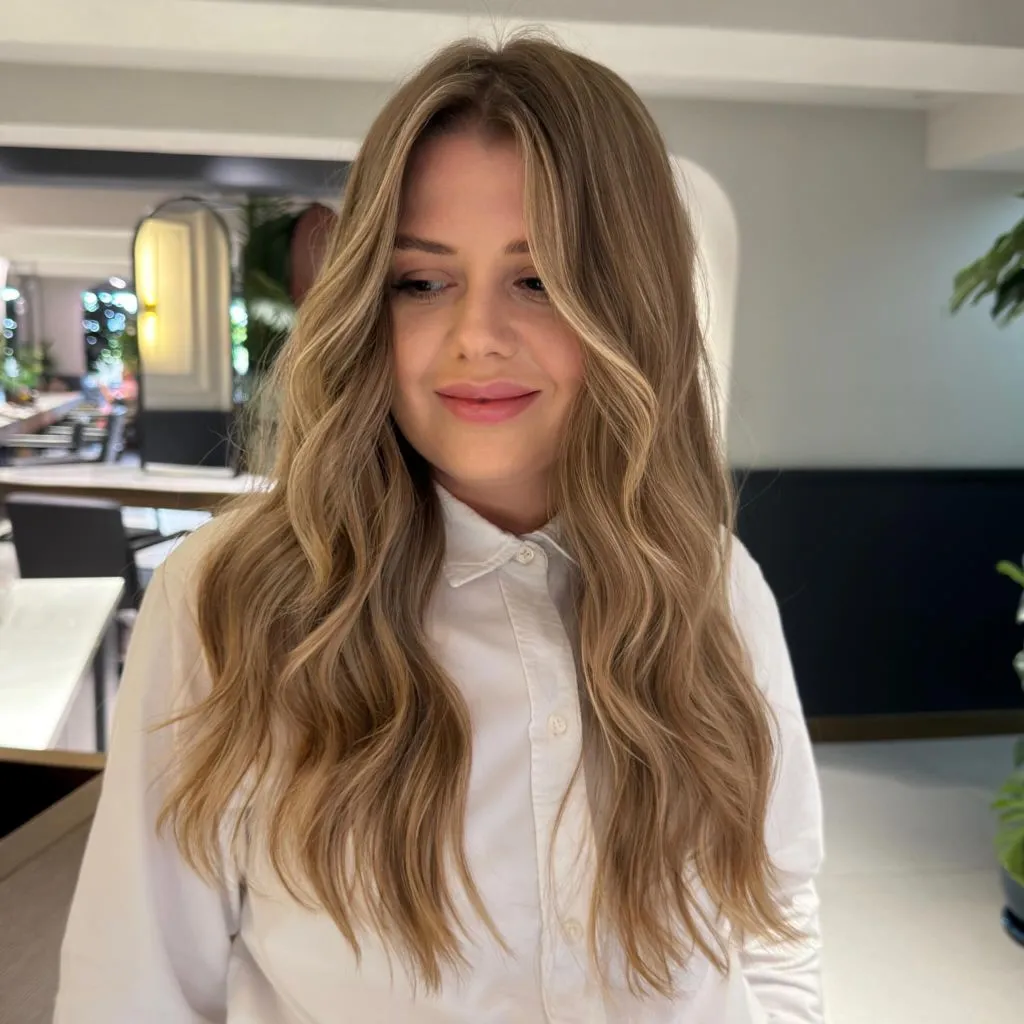
A crisp white shirt sits directly beneath and does something specific: it sets a clean cool white against the warm gold, which makes the hair read warmer than it would against cream or beige. Face-framing sections are lighter than the back, brightening the area around the jaw and cheek, and the restaurant background is blurred enough to add no competing detail. Hierarchy is simple — hair first, shirt second, nothing third.
Placed next to the ash-toned brunette earlier, this shows how far temperature alone shifts a result. Same length, same wave, entirely different mood, and the only variable that changed was whether the lightened pieces were pushed cool or warm.
23. Single-Length Copper Blonde Holds a Straight Drop
The shape is as plain as it gets, and that is the point. Very long hair, parted centrally, falls dead straight to below the waist in one unbroken length with no visible layering and only the faintest taper at the perimeter. The colour is a soft copper-blonde, consistent from root to tip, with the slightest brightening where the light catches the surface.
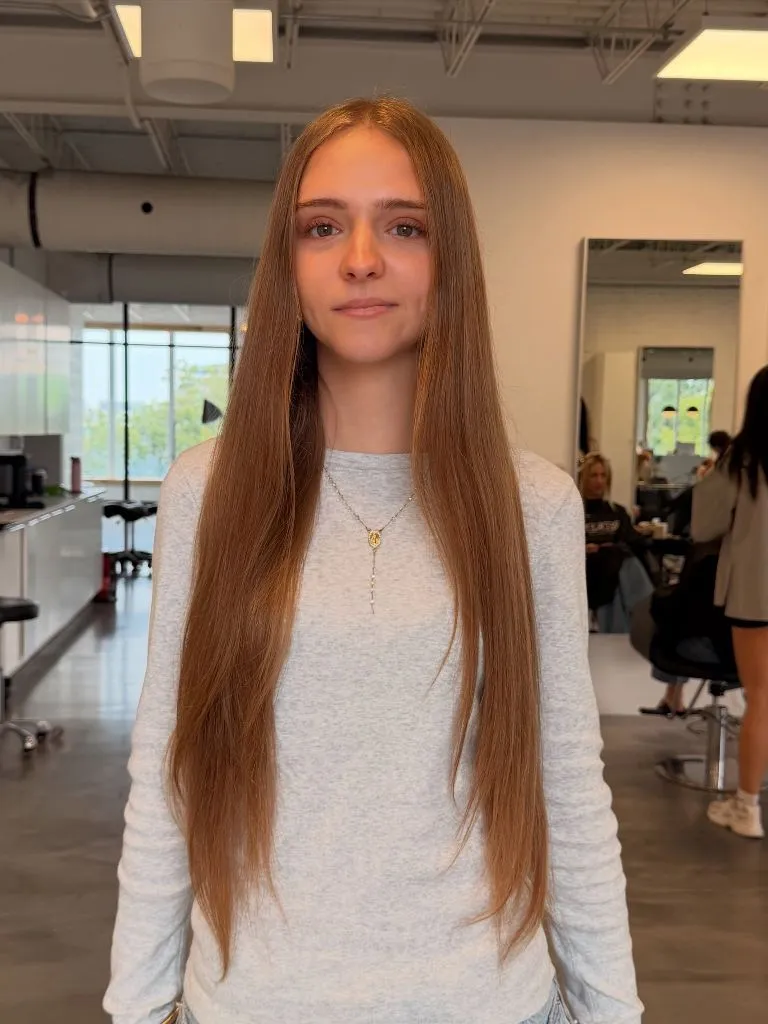
A pale grey long-sleeve top and a bright, open salon interior keep everything around the hair light, so the colour registers as gentle rather than vivid. Because there is no cut structure and no colour placement to look at, the entire read comes down to surface: how flat it lies, how evenly it reflects, how clean the bottom line is. The material of that sheen is not identifiable from a photo, so treat the evenness itself as the useful observation.
The honest limitation is that one-length hair at this extreme requires condition to carry it, since there is nothing else for the eye to do. Regular perimeter trims of half an inch keep the endpoint solid without ever shortening the drop meaningfully.