There is a quiet skill to winter dressing that becomes visible only when you stop counting pieces and start reading composition. The best Winter Outfits Aesthetic Ideas hold together because of proportion, palette echo, and where the eye is allowed to rest — not because any single garment is remarkable. A tweed coat, a fur hat, a pair of pale jeans: the same items appear across every feed. What separates a considered look from a busy one is how those familiar parts are stacked, spaced, and coloured against each other.
Before scrolling, decide what you want to notice first in each image. Track the dominant volume, then the sharpest contrast point, then whichever surface breaks up the field — a scarf, a boot, a bag. Weigh the trade-off between warmth and shape, because heavy layering almost always steals waist definition and asks you to give it back somewhere else. No single formula in this set is a rule; each is one workable answer.
1. Oversized Blazer Meets Long Grey Skirt
The composition is controlled by a soft oatmeal blazer cut wide through the shoulder and long through the sleeve, so the top half reads as a single beige block. Underneath, a black knit sits high on the neck and a long grey knit skirt falls straight down, dividing the frame into three horizontal bands — beige, black at the collar, grey below the waist. The proportions are deliberately loose rather than nipped.
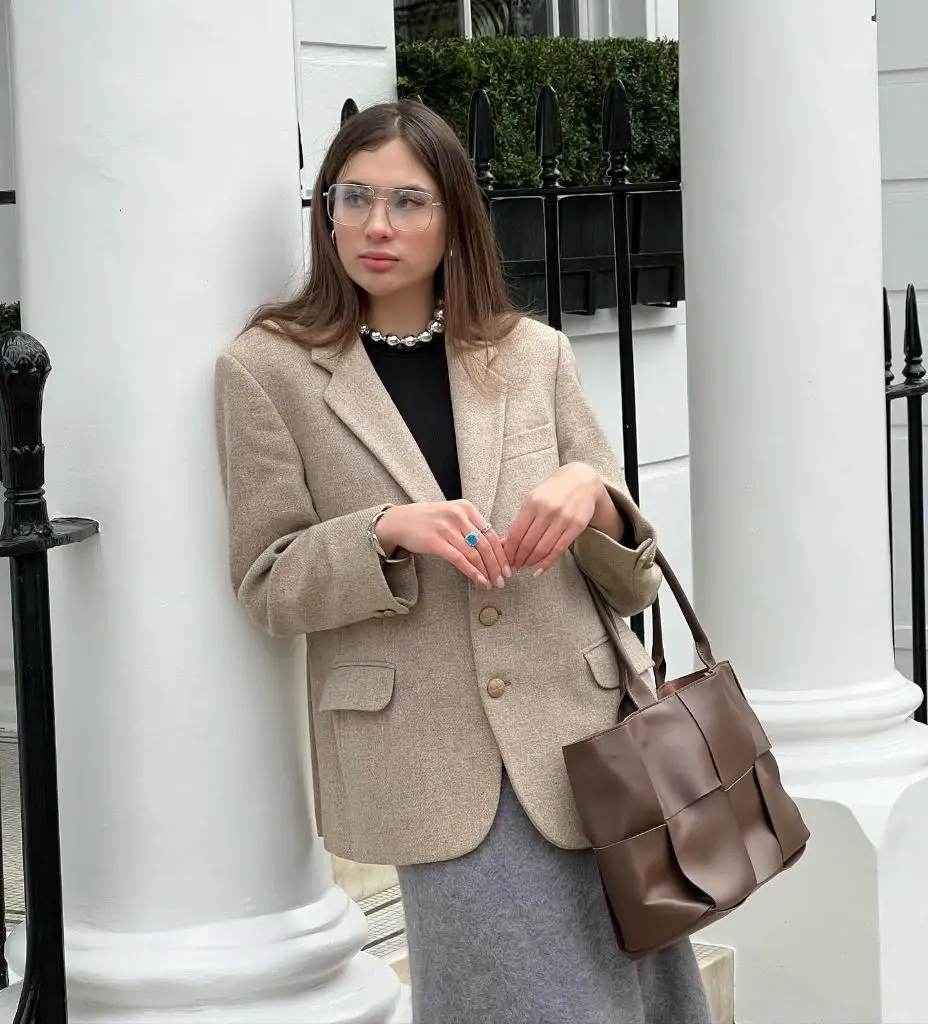
The supporting cast is small and warm. A chunky silver bead necklace and clear-frame glasses land at the same height, so the face is framed by two neat metallic notes rather than one. A brown woven-looking tote picks up the mid-tone between the blazer and the skirt, and its geometric surface is the only pattern in the outfit. Everything else is solid, which is why the tote reads as the secondary focal point without competing with the coat.
The lesson is about scale restraint: only one piece is truly oversized. The skirt is long but narrow, the knit is fitted, the bag is medium. If every element went wide, the silhouette would collapse into a shape. To adapt it, keep the blazer roomy and let one lower piece stay lean, whether that is a straight skirt, a cigarette trouser, or a slim jean.
2. Faux Fur Coat Carries a Snowy Backdrop
A spotted cream-and-tan faux fur coat dominates the frame, and the palette of the coat is more or less the palette of the whole picture — cream snow, dark evergreens for contrast, a matching fur hat on top. The coat falls to mid-thigh with heavy volume through the sleeves, and the underlayers below are all in the same sand-cream family, so the eye stops at the fur pattern rather than at any seam.
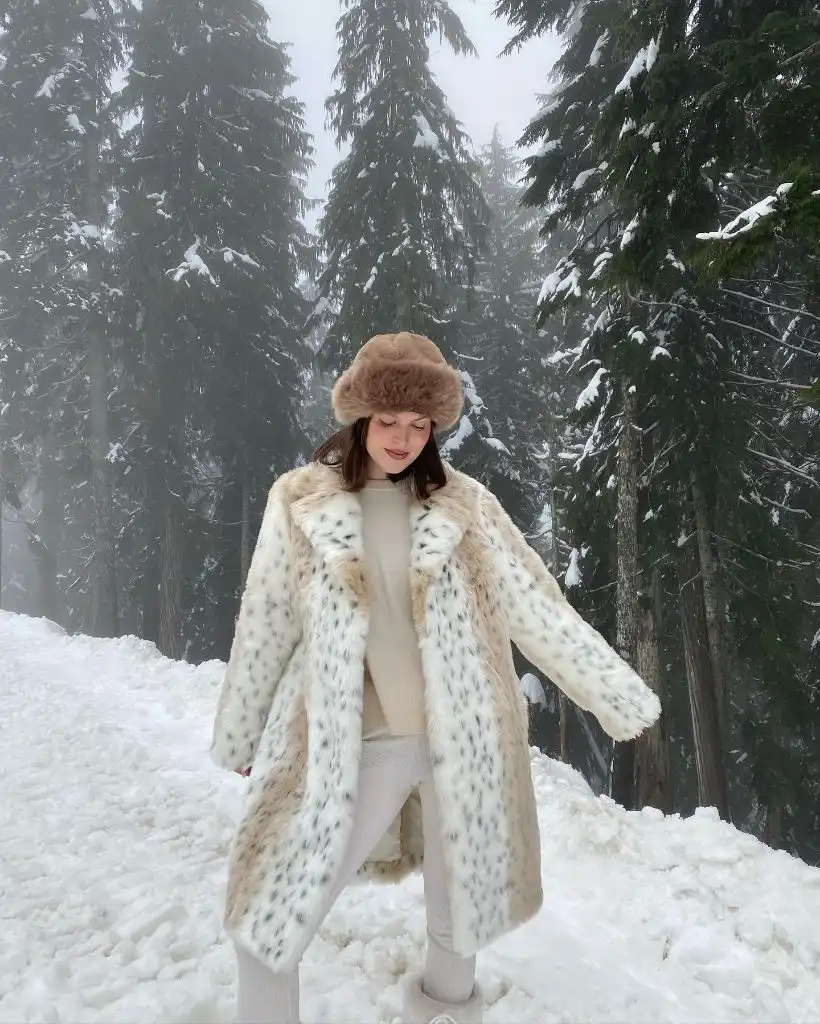
Underneath, a pale knit and cream jeans function almost as negative space. The fur hat repeats the coat’s colour without repeating its pattern, which keeps the head from disappearing into the background. There is no bag, no jewellery, no contrast boot — a rare choice, but it makes sense here, because the print is already doing the work of a pattern, a texture, and an accessory at the same time.
The honest limitation is upkeep and setting. A pale, patterned fur reads beautifully against snow and fog, but photographs quickly on grit or wet pavement. If you want the same silhouette in a city context, a plain cream teddy or a solid camel shearling will hold the proportion without asking the weather to cooperate.
3. Houndstooth Coat Frames a Cream Hood
The long brown houndstooth coat sets the whole tone: a dense small-scale pattern that reads as a warm mid-brown from a step back. It is cut generously through the body, double-breasted, and stops just above the ankle, so it becomes the vertical line of the outfit. A cream teddy-style hooded piece pushes up out of the collar and immediately frames the face in a lighter tone.
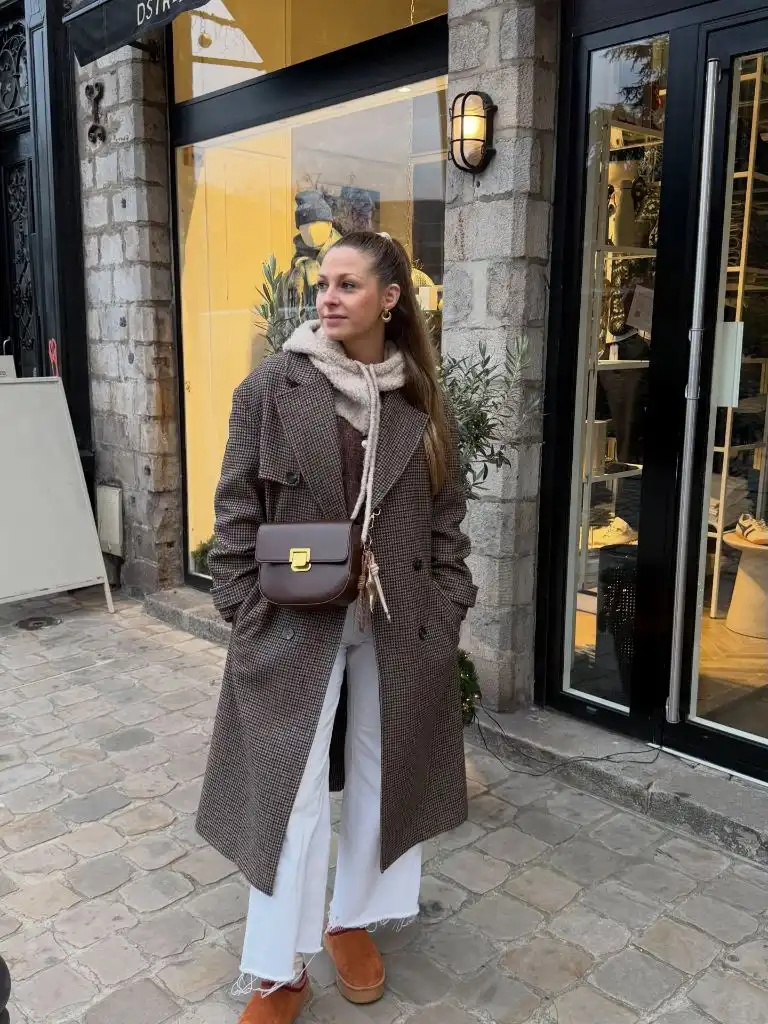
The palette is a study in browns leaning warm. A small burgundy crossbody bag with a gold clasp sits at the waist and gives the eye a single darker anchor. White wide-leg jeans crop clean at the ankle, and tan clog-style boots pick the coat’s lightest brown back up at the floor, closing the loop from head to shoe. Nothing here shouts; the pattern carries the interest, and every solid around it stays quiet.
Compared with the more tapered shapes elsewhere in this set, this reads relaxed rather than sharp. The trade-off is waist definition — a long open coat over a hood will always widen the torso. If that matters to you, add a slim belt at the coat’s own waist seam, or leave the hood down so the neck reads longer.
4. Cable Knit Softens Fluid Trousers
An ivory cable knit dominates because of its texture, not its cut. The stitch is dense and three-dimensional, and the sleeves push slightly past the wrist, so the top half reads as a single soft cream shape. The trousers below are a fluid taupe with a front pleat, sitting high on the waist and falling wide to the floor. That contrast between chunky knit and smooth drape is the whole point of the outfit.
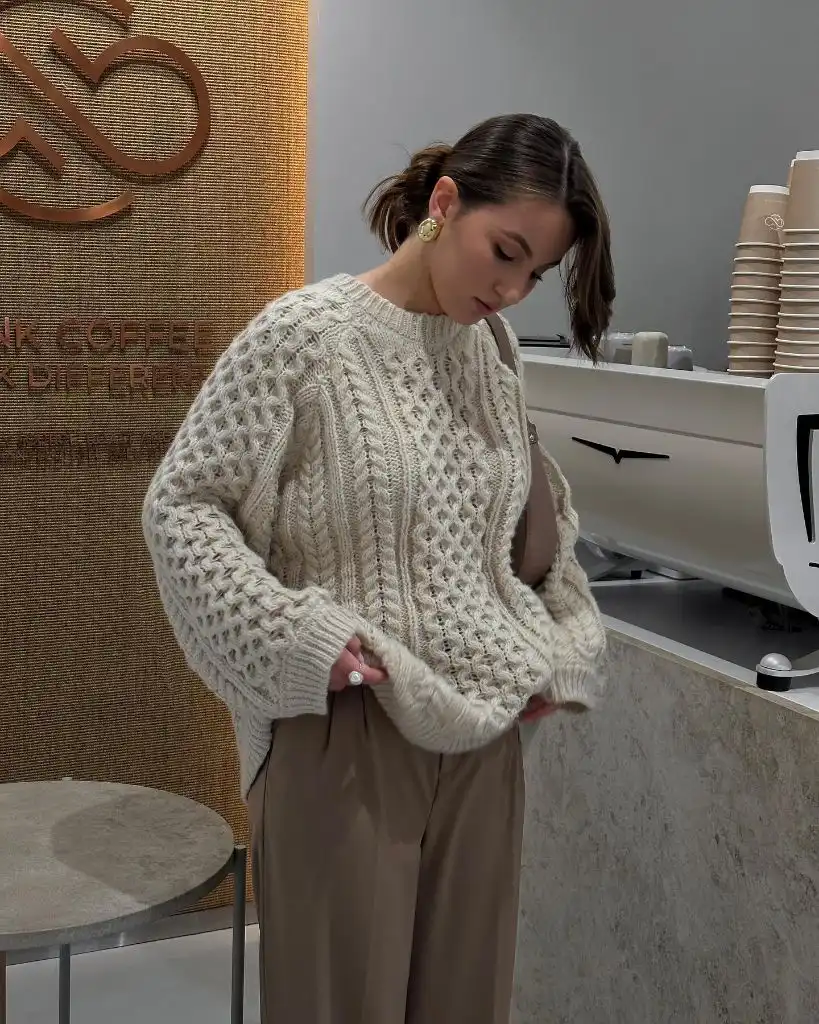
The supporting details are minimal on purpose. A gold textured earring catches the light near the face, and a small pearl detail sits at the cuff, so both accent points are at the extremities of the cream field. The trousers pick up the beige tones in the background wood and cups, which is why the palette feels quiet rather than staged. There is no belt, no visible bag strap breaking the line — the knit is the only interruption.
The transferable principle is texture-first dressing: when one piece carries strong surface interest, everything around it should be smooth. Among Winter Outfits Aesthetic Ideas that rely on knit, this is a useful example of how a heavy sweater reads as elegant rather than bulky, because the trouser underneath is soft, high-waisted, and completely plain.
5. Wool Coat Anchors a Suede Tote
A long dark coat in a soft wool-looking fabric sits open across the frame, and because it is worn seated, the coat’s weight is carried by the shoulders and pools on the bench. The palette is dark-plus-mid: charcoal coat, grey crew knit, blue straight jeans, brown boots. The composition splits neatly at the waist, where a pale blue collared shirt peeks out from under the knit and lightens the whole midsection.
calls files/s/NU
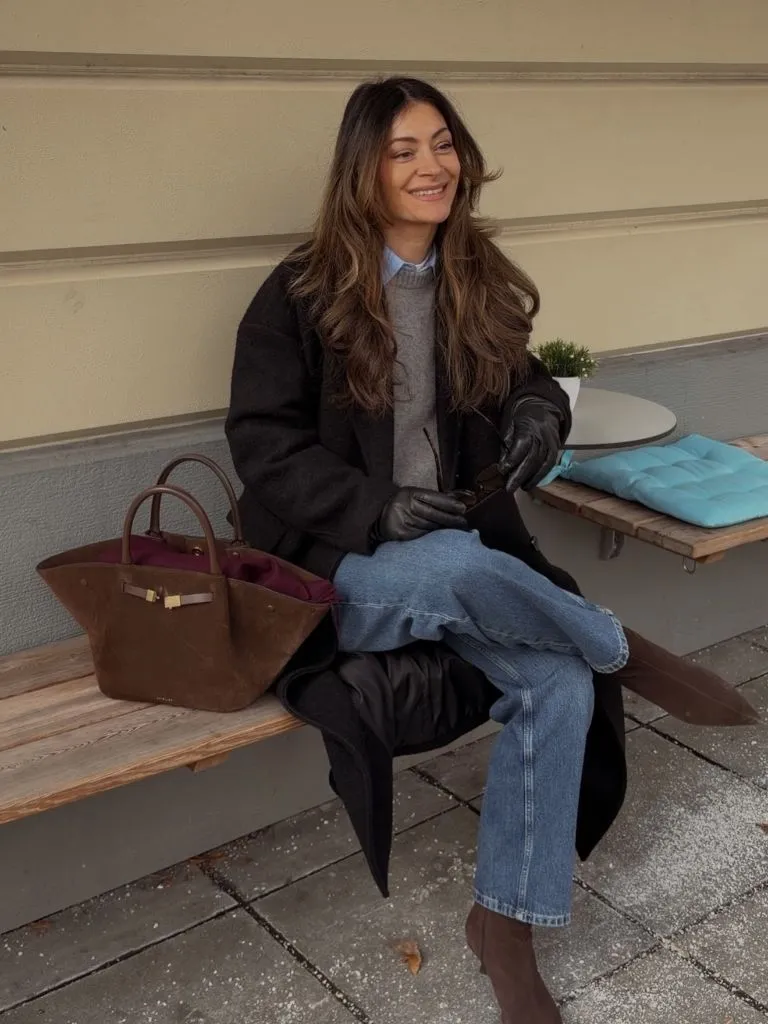
The brown suede-looking tote is the secondary character. It sits on the bench in the foreground, and its warm mid-brown echoes both the boot and the wooden bench, so the accessory feels rooted in the setting rather than dropped in. Black leather-looking gloves keep the hands as a dark punctuation mark against the pale jeans, and the burgundy lining flash inside the tote adds a single hidden accent — enough to notice, not enough to compete.
The honest limitation of this outfit is bulk when seated: a long heavy coat gathers into folds at the hip and hides the waist entirely. Standing, the same pieces read leaner. If most of your day is at a table, a shorter coat in the same palette will keep the colour story without the pooling fabric.
6. White Fur Scarf Cuts Through Black
The dominant piece is a long black coat in a brushed-looking wool, worn open over a black midi skirt and black knee boots. Almost everything below the collar sits in the same value, which means the outfit reads as a single dark vertical from shoulder to floor. Against that near-monochrome column, the white fur scarf wound around the neck functions as a bright, high-contrast horizontal.
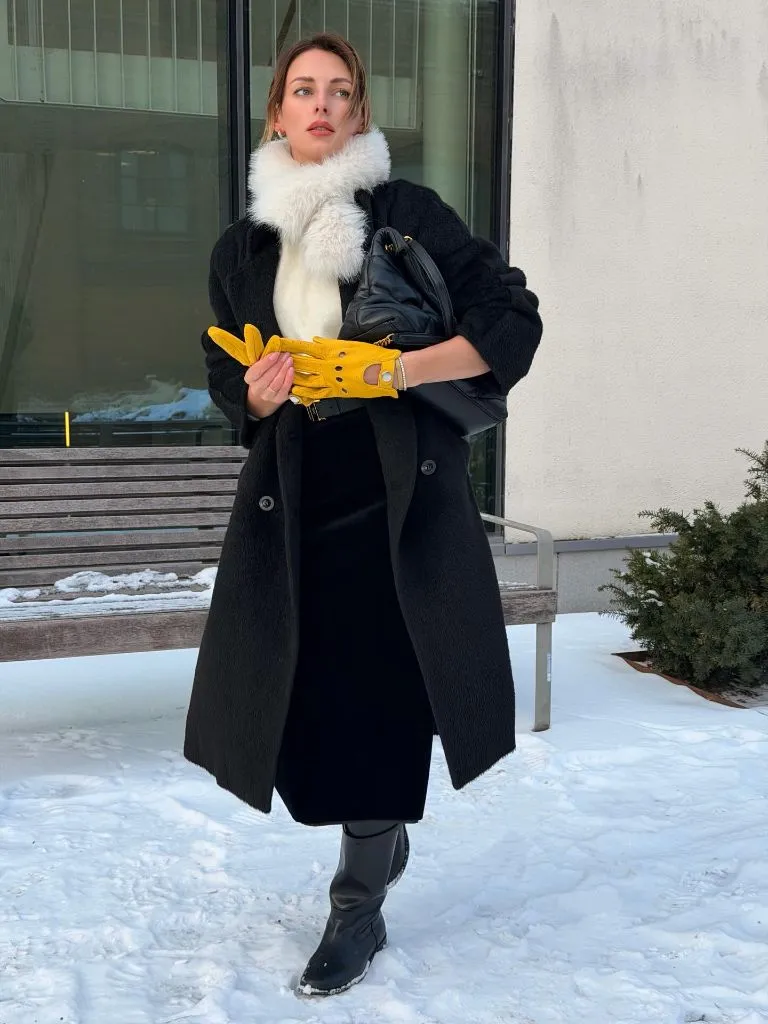
Yellow suede-looking driving gloves are the surprise. They sit at hand height, roughly where a bag would usually take focus, and their warm mustard tone is the only true colour in the frame. Because the rest of the outfit is disciplined black, the gloves can be loud without tipping into costume. A small black shoulder bag stays tucked under the arm, deliberately quiet, so the eye moves face — scarf — gloves — floor in that order.
The lesson is about controlled colour placement: one accent, one location, everything else in service. To soften it, swap the yellow for a warm cognac and the outfit tips from directional to classic. To push it further, keep the yellow and add a second tiny match — a nail, a lipstick — but only one, or the composition loses its hierarchy.
7. Belted Peacoat Sharpens a Wide Collar
A grey wool peacoat with an exaggerated wide collar controls the top half of the frame. The lapels flare outward past the shoulder line, which visually broadens the chest and, by contrast, narrows the waist where a self-fabric belt cinches the coat closed. It is a short coat, hitting at the hip, so the composition splits cleanly at the belt into two near-equal halves.
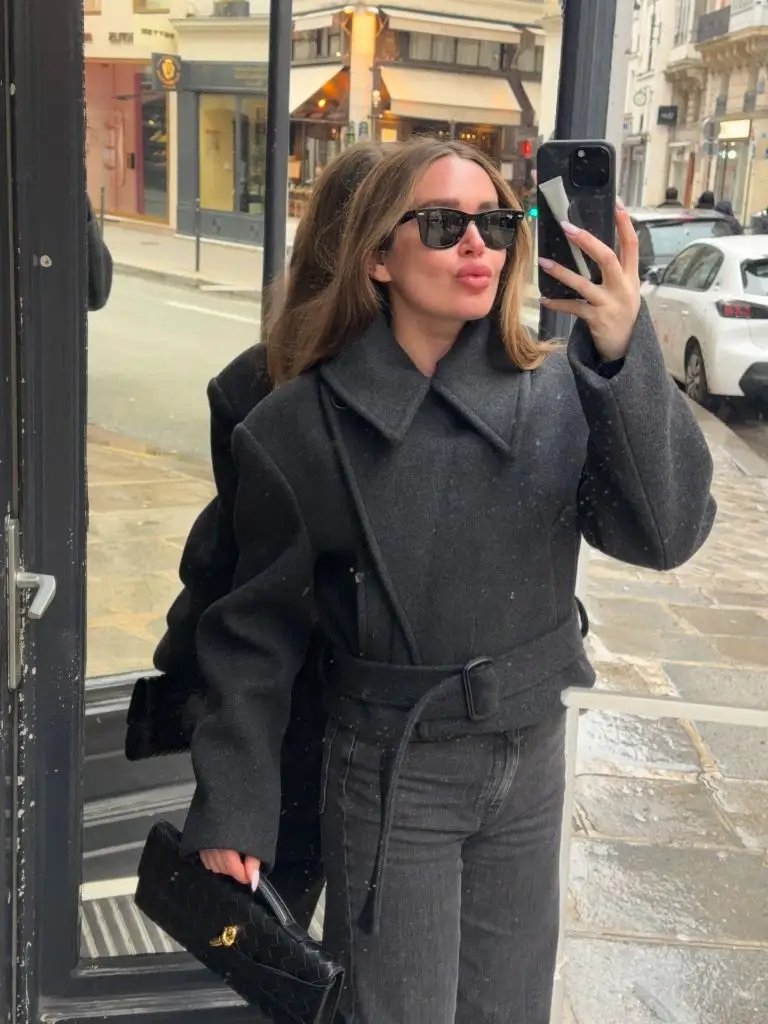
Dark grey jeans continue the palette down, and because they sit almost in the same tonal family as the coat, the outfit reads as a soft monochrome rather than a contrast. A small black quilted bag with a gold chain is the punctuation — glossy where everything else is matte, structured where the coat is soft. Black sunglasses at the top of the frame answer the bag at the bottom, so the two shiny black points bracket the composition.
Compared with the longer coats above, this reads noticeably shorter and sharper at the waist. The trade-off is warmth: a cropped belted coat exposes the hip and thigh, which is fine in a mild city winter and less useful in real cold. If you want the shape without the compromise, layer a long lean knit underneath so the length reads long even when the coat itself does not.
8. Long Grey Coat Extends the Vertical Line
The floor-length grey faux fur coat is the outfit. It reaches to the ankle, ties at the waist with a self-belt, and its brushed surface holds the light the way real fur does, so the whole silhouette reads as one long soft column. Because the hem nearly touches the pavement, the vertical line of the body is extended well beyond its actual height.
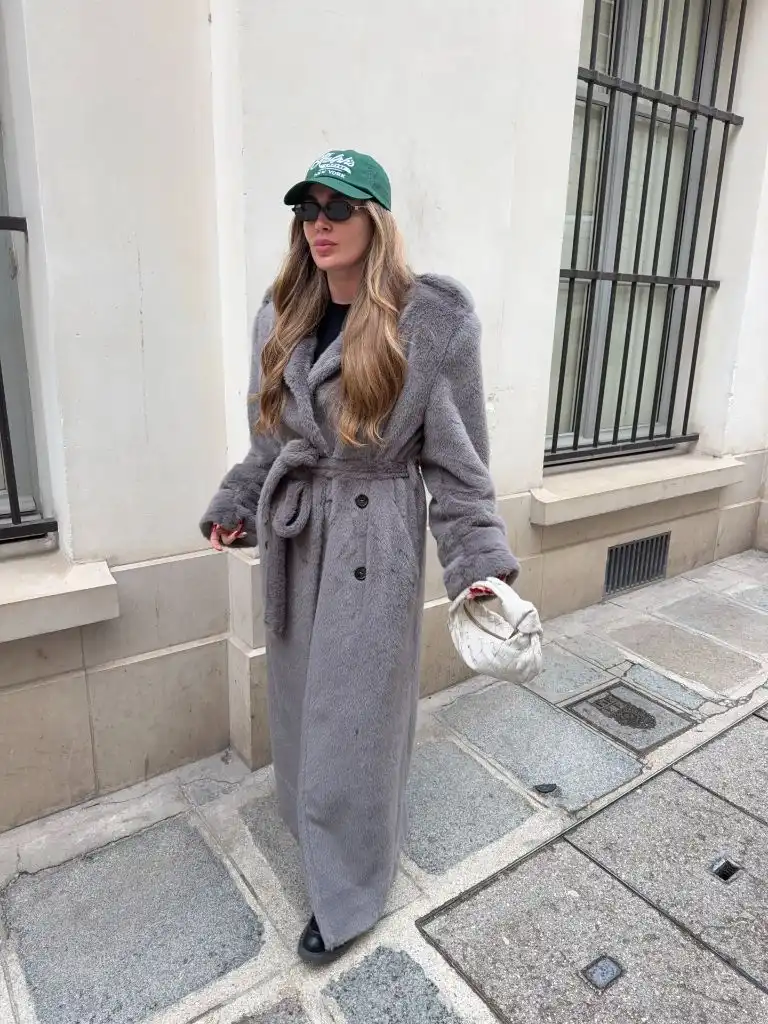
Everything else is tuned down to let the coat carry. A green baseball cap with a small logo is the only real colour, and it sits at the top of the frame like a period at the end of the composition. A tiny white knotted bag adds a second bright note at hand height. Black rectangular sunglasses and black boots — glimpsed only just — provide the darker punctuation. Long loose hair falls over the coat and softens the shoulder line.
For anyone drawn to Winter Outfits Aesthetic Ideas that rely on a single long coat, the practical detail is that the belt matters more than the coat’s length. Tied, this shape has a waist; left open, the same piece would drown a smaller frame. Keep the tie in the front and slightly loose so the fabric still drapes.
9. Black Fur Balances Wide Denim
A black faux fur jacket takes up most of the upper frame, cropped at the hip and cut wide through the sleeve and shoulder. Photographed from behind, the volume is even more obvious — the fur rounds outward in every direction and holds a soft halo of light against the pale stone wall. Below, black wide-leg jeans fall straight and long, so the outfit is essentially two dark shapes stacked.
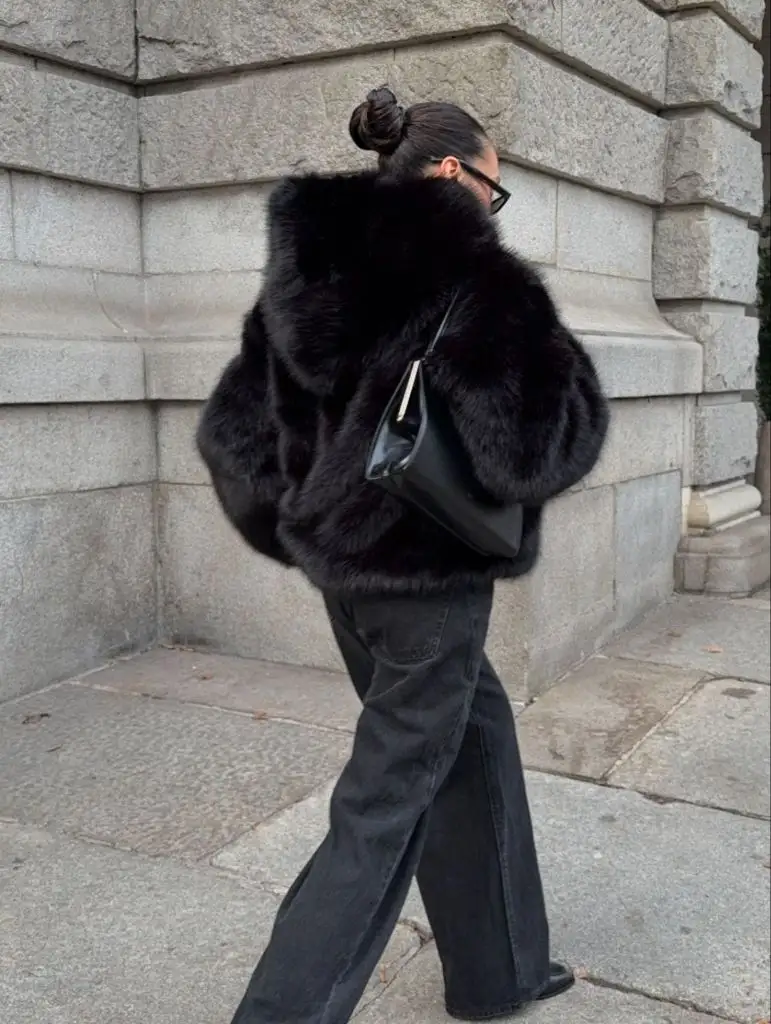
The palette is entirely black on black, which makes texture the story. The fur is matte and directional; the jeans are a dry cotton-looking denim; the small shoulder bag tucked under the arm is glossy leather-looking, which catches the light and reads as the sharpest point in the frame. A slick bun keeps the neckline exposed and stops the fur from swallowing the head. There is no other accessory, and none is needed.
The transferable principle is that all-black works when three different surfaces are in play. Compared with the near-monochrome grey outfits above, this one is louder because of scale — the fur is bigger than the head. Push it further by swapping the wide jean for a straight leather-looking trouser, or soften it by choosing a fur that sits closer to the body.
10. Aviator Jacket Balances a Lace Skirt
A black aviator-style jacket with a shearling-looking collar and cuffs commands the top half, cropped at the waist and cut boxy through the shoulder. The finish is glossy leather-looking, which throws highlights under the street lights. Below, a short white lace-trimmed skirt or slip peeks out and lightens the middle of the frame before the outfit falls back into black at the knee-high boots.
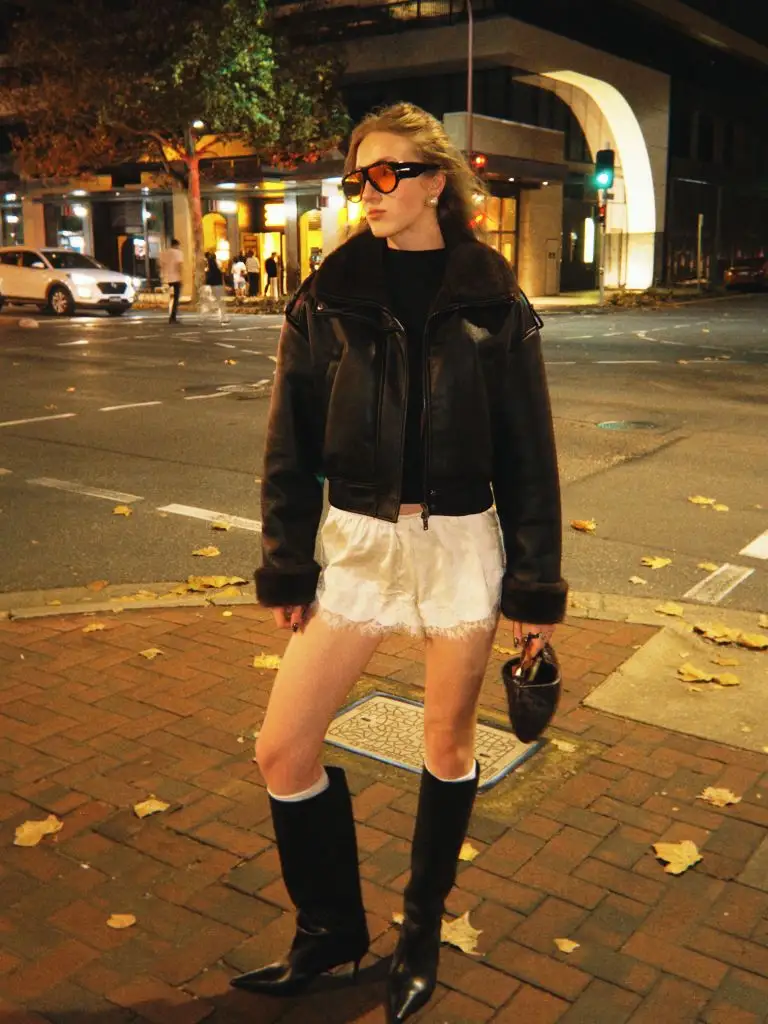
The composition is built on hard/soft contrast. The jacket is heavy, structured, and matte-glossy at once; the lace is delicate and translucent; the boots return to hard black leather-looking material with a pointed toe. Orange-tinted sunglasses and a small dark bag are the only accessories, and both stay compact so the leg — the palest section of the outfit — stays the focal point. Fallen leaves on the pavement pick up the same warm tone as the lenses.
The honest limitation is seasonal reach. A bare leg between a lace hem and a boot shaft is a warmer-winter or dressed-up-night look, not a daytime cold-weather option. To adapt it for lower temperatures, add sheer black tights, which will darken the middle section slightly and shift the balance towards the jacket rather than the leg.
11. Trench Coat Restates a Classic Silhouette
A beige double-breasted trench coat controls the frame, buttoned closed and cinched at the waist with its own wide belt. The classic shape is intact — storm flap at the shoulder, gun-flap detail, buckled cuff straps, sharp lapels — and because the coat is fastened rather than left open, the silhouette is defined by the belt rather than by whatever sits underneath. A cream cable knit shows only at the neckline.
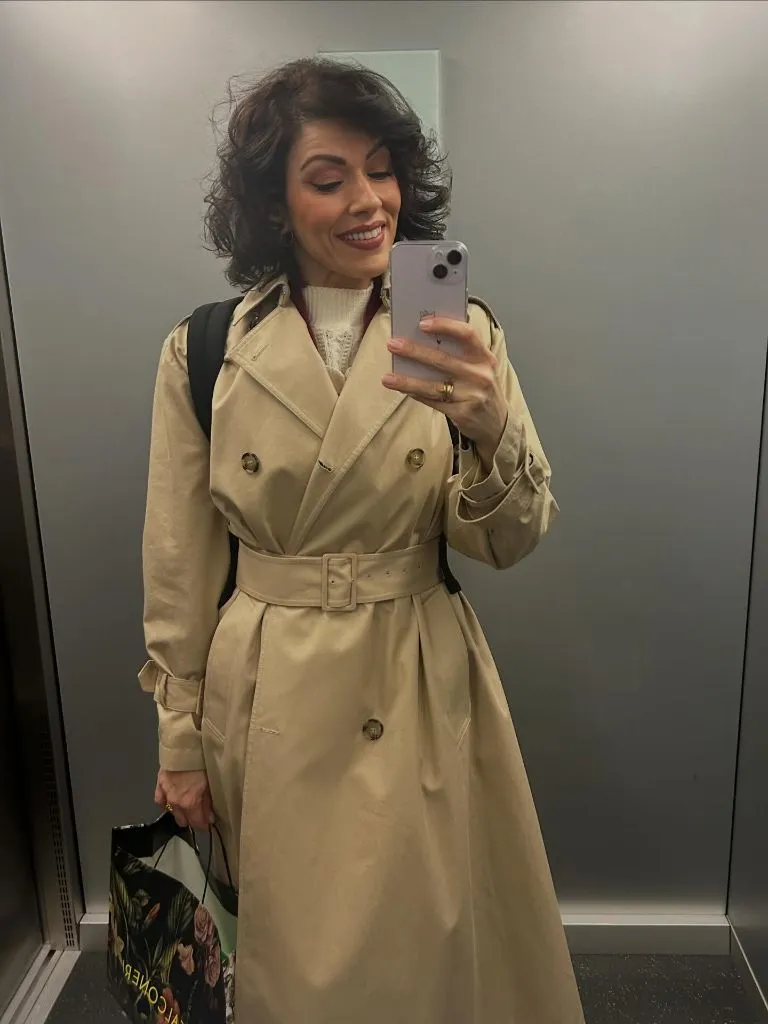
The palette barely moves. Coat, knit, and background all sit in the same warm neutral range, so the composition reads as tonal rather than contrasted. A black backpack strap crosses the shoulder and provides the only real dark line in the frame — an unusually functional accessory choice against a very traditional coat. A small floral shopping bag introduces the only pattern, at hand height, so the pattern lives below the belt where it does not compete with the collar.
The transferable principle is that a trench holds its shape best when it is buttoned. Compared with the open coats earlier in this set, closing the front reintroduces a waist that layering usually removes. If the coat is your main piece of the season, a slim belt pulled one hole tighter than usual is often more flattering than the size you nominally are.
12. Teddy Coat Wraps Around a Black Dress
A long camel teddy coat in a curly boucle-looking pile dominates the frame. It is worn open, falling below the knee, with a self-belt loosely tied at the waist rather than pulled tight. The pile catches the hallway light and reads as a warm caramel, and because the coat is unbuttoned, it functions almost like a robe framing the outfit inside.
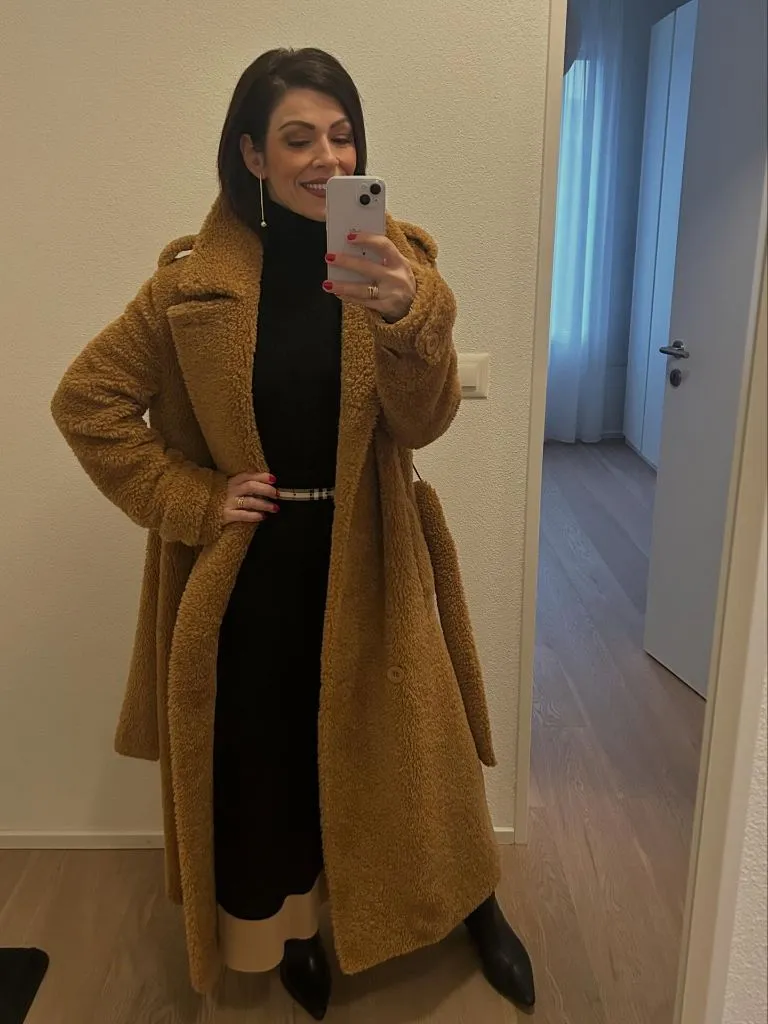
Inside the coat, a black turtleneck midi dress runs from the neck almost to the ankle in a single unbroken line, and a thin patterned belt marks the waist at exactly the height of the coat’s own belt. That doubled waistline is what stops the outfit from reading as shapeless — two horizontal marks at the same height, one soft, one sharp. Pointed black boots continue the dark vertical line to the floor.
The lesson here is about hierarchy: the coat is loud in texture, the dress is loud in length, and the belt reconciles them by giving the eye a fixed centre. To soften the pairing, drop the belt and let the coat fall open — the outfit becomes gentler but loses its waist. Keep it, and the composition stays legible even from across a room.
13. Silver Belt Interrupts a Leather Mini
A sleeveless black leather-looking mini dress sits at the centre of the composition, cut straight across the chest with a high halter-style neckline. The finish is matte with a soft sheen, and the shape is close to the body without being tight. Because the dress is short and dark, most of the visual weight is concentrated in a compact rectangle at the top half of the frame.
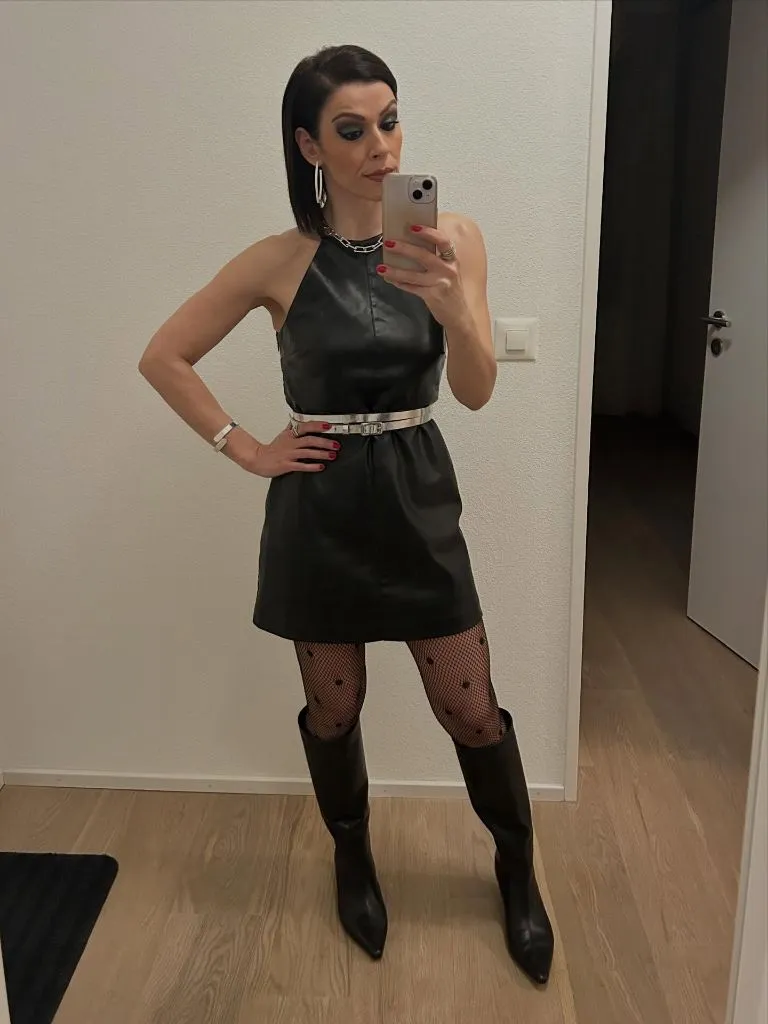
A wide mirror-finish silver belt cuts across the waist and is the sharpest contrast point in the outfit — bright, hard, and horizontal against the soft matte black above and below. Sheer black tights with small polka dots continue the dark column down the leg, but the pattern breaks up what would otherwise be a solid stretch of black, adding a fine visual texture. Tall pointed boots close the line at the floor. A silver cuff bracelet echoes the belt on the arm.
Compared with the layered coat looks elsewhere in this set, this reads notably sparer — no coat, no bag in frame, one accent metal repeated twice. The trade-off is warmth again: a leather mini with tights is a going-out temperature, not a walking-around-in-January one. Add a cropped structured jacket and the balance shifts without losing the belt as the focal point.
14. Fair Isle Sweater Meets Straight Jeans
A cream and black Fair Isle-style sweater controls the top half. The yoke pattern sits high across the chest and shoulders in a band of geometric motifs, and the body of the sweater below the yoke is a plainer cream knit. That two-part construction — busy top, quiet bottom — is what makes the pattern feel considered rather than overwhelming.
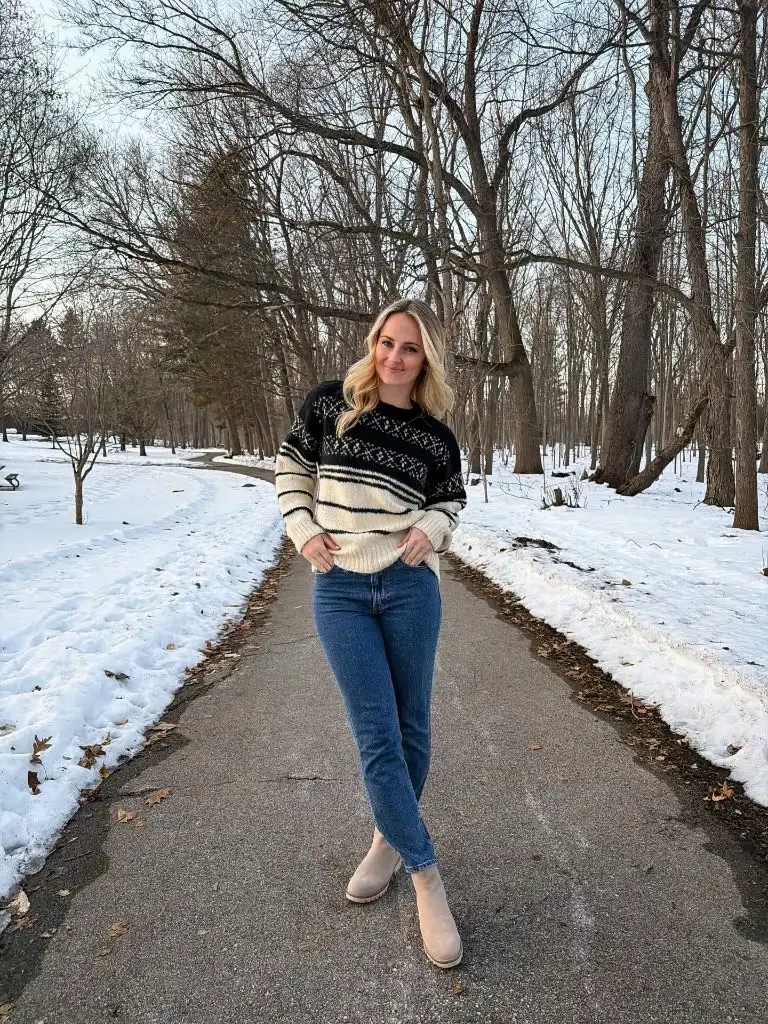
Straight-leg mid-blue jeans sit at the natural waist and fall clean to the ankle, where cream suede-looking Chelsea boots pick the sweater’s lightest tone back up. The palette is essentially three notes — cream, black, and mid-blue — and each one appears in exactly one place, so the eye has no ambiguity about where to look. The winter park setting, all pale sky and bare branches, reads as an extension of the outfit rather than a separate frame. For a walkable take on everyday winter dressing, this is the template.
The transferable principle is pattern containment. When a knit has a strong graphic yoke, keep the rest of the outfit plain, and repeat the knit’s palest colour once at the shoe. Push it further by adding a scarf in the same cream, and it becomes a full winter uniform. Add a second pattern anywhere and the hierarchy collapses.
15. Burgundy Cardigan Warms a Black Skirt
A soft mohair-looking burgundy cardigan controls the composition. It is short, softly cropped at the hip, buttoned all the way up with small pearl-looking buttons, and the knit has a faint halo of fibres that catches the lamplight. The colour is a deep, warm oxblood — not red, not brown — and because it sits directly against a cafe interior of aged wood, it reads as a natural extension of the setting.
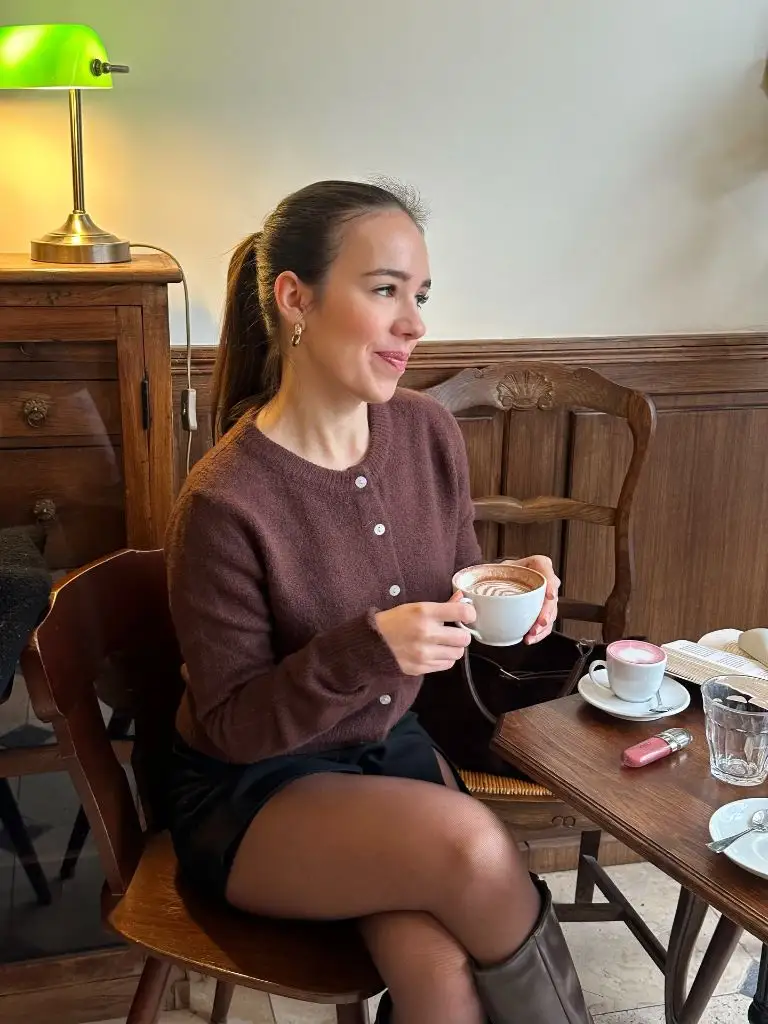
Below the cardigan, a short black skirt and sheer black tights create a dark middle section, and tall brown leather-looking boots pull the warm palette back down to the floor. A brown suede-looking bag sits on the chair behind, so the browns are answered twice at different heights. Gold hoop earrings and a slick ponytail keep the head neat, and the only real accent of colour beyond the cardigan is the pink of a matcha on the table.
The lesson is about warm palette layering: burgundy, brown, and sheer black together are almost always kinder to the face than burgundy against pure black. Compared with the sharper black-and-white looks elsewhere in this set, this one reads notably softer, and the reason is temperature — every colour here leans warm.
16. Military Jacket Frames a Lean Column
A brown herringbone-looking jacket controls the frame with a distinct silhouette: mandarin collar, four large flap pockets, and a slightly nipped waist. It is cut short, ending at the hip, so the tailoring is fully visible and the shape reads as structured rather than draped. The palette of the jacket is a warm mid-brown flecked with black, which sits well against the pale stone archway behind.
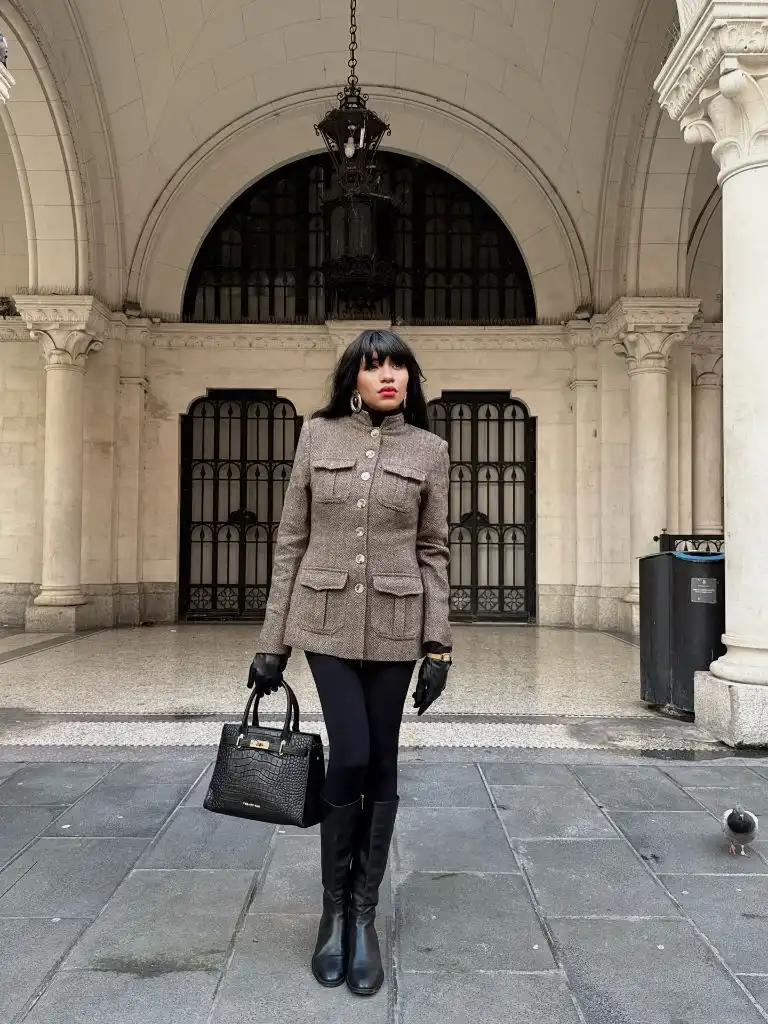
Below the jacket, everything is black and lean: fitted black leggings or slim trousers, tall shaft black boots, black leather-looking gloves, and a small structured croc-print-looking bag held at the side. That long unbroken black column from waist to floor is what makes the short jacket read as long-waisted rather than cropped. Large silver hoop earrings and a red lip provide the two small bright accents at face height.
The transferable principle is contrast in construction: a structured tailored top over a slim stretchy bottom will almost always flatter, because the eye reads structure as the “designed” part and the leggings as neutral ground. Among Winter Outfits Aesthetic Ideas that work for a smaller frame, a short military-style jacket over head-to-toe black is one of the more reliable formulas.
17. Bright Scarf Interrupts a Cream Coat
A long cream coat dominates the vertical, falling well past the knee in a straight relaxed cut. The colour reads as an off-white or ecru against the snow, so the coat almost merges with the background at the edges and holds together mainly at the centre, where the buttons and the front opening are. Under the coat, a cable knit in the same cream continues the tonal layering.
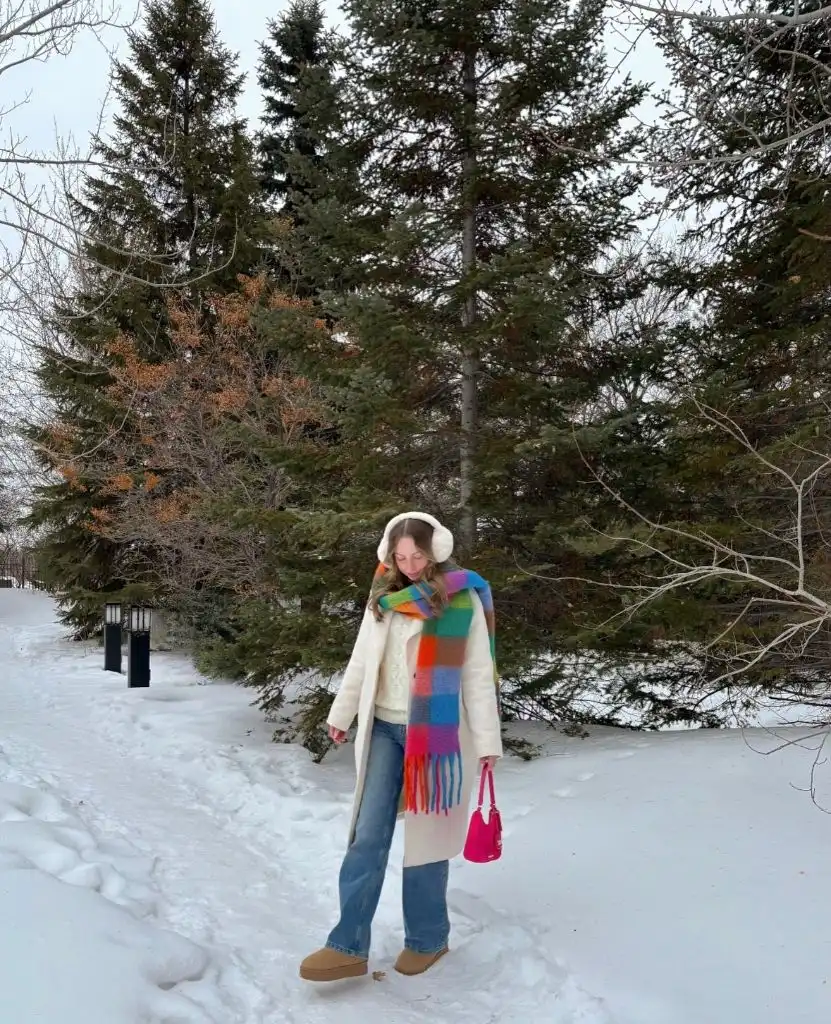
A multicolour checked scarf in blues, oranges, greens, and pinks is the single loudest element. It runs down the front of the coat like a bright vertical stripe, and because everything else in the frame is either cream, snow, or dark evergreen, the scarf carries the whole colour story on its own. A hot-pink mini bag picks one colour out of the scarf and repeats it at hand height. Cream earmuffs and tan platform boots close the palette top and bottom.
Compared with the disciplined single-accent looks earlier, this one leans into colour rather than restraining it. The trade-off is that a rainbow scarf dictates the rest of your closet for the day — you cannot add a second accent without the outfit tipping into busy. Keep the coat pale, the jean plain, and the bag matched to exactly one scarf colour, and the composition still reads calm.
18. Red Cardigan Anchors Grey Trousers
A bright red cardigan controls the frame, worn buttoned and slightly cropped so the waistband of the trouser is visible underneath. The red is saturated and warm, and because the photograph is taken from the back, the cardigan reads as a solid red rectangle at the top of the composition. A small white shirt tail peeks out at the hem, softening the join between the red and the grey.
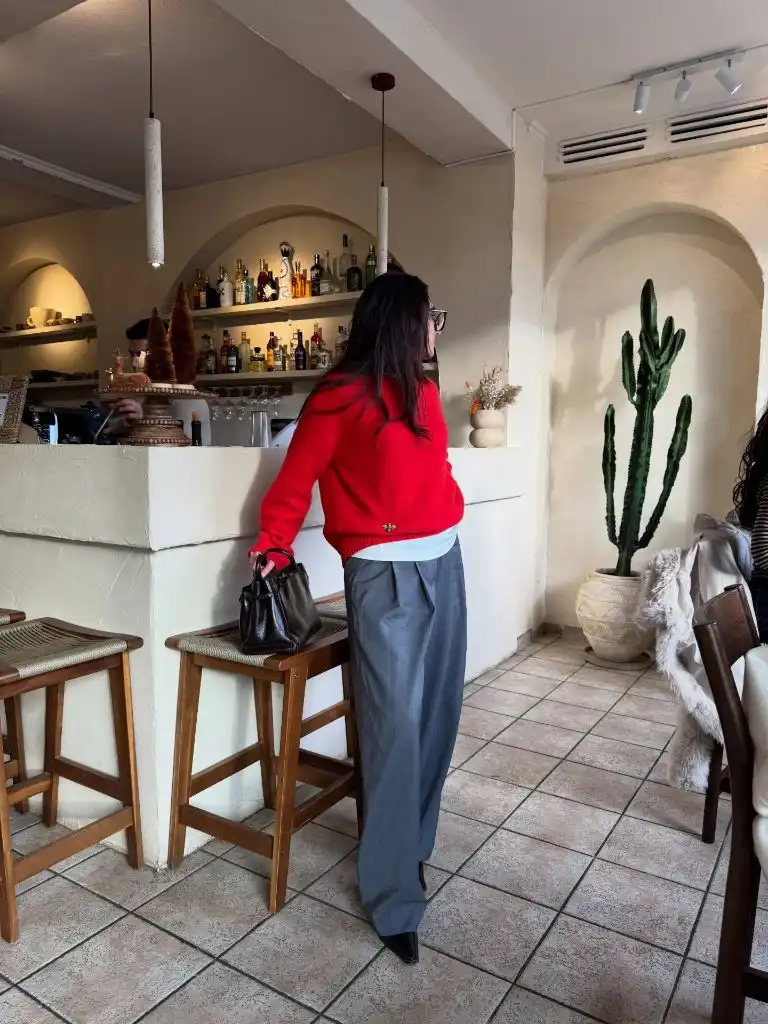
Grey wide-leg pleated trousers make up the entire lower half. They sit high on the waist, fall long and clean past the ankle, and pool slightly over pointed black boots. The palette echo is subtle — the black bag on the stool matches the black boots exactly, and the grey trousers match the grey stone floor of the setting, so the outfit reads as anchored to the room. Long dark hair falls straight down the red and provides the only visible interruption to the cardigan’s surface.
The lesson is about placement of the loud colour. Red works most easily when it sits above the waist, because that puts it near the face, and when the rest of the palette is grounded in neutrals that repeat elsewhere in the frame. To soften it, swap the red for a rust or a burgundy; to push it further, add a red lip and stop there.
19. Bomber Jacket Balances Striped Trousers
A washed beige bomber jacket sits at the top of the frame with a slightly boxy cut and elastic-looking cuffs and hem. The finish is dry and slightly crinkled, which reads as well-worn cotton rather than technical fabric. Underneath, a black and white striped knit shows at the neckline and hem of the jacket, adding a fine horizontal pattern at both ends of the torso.
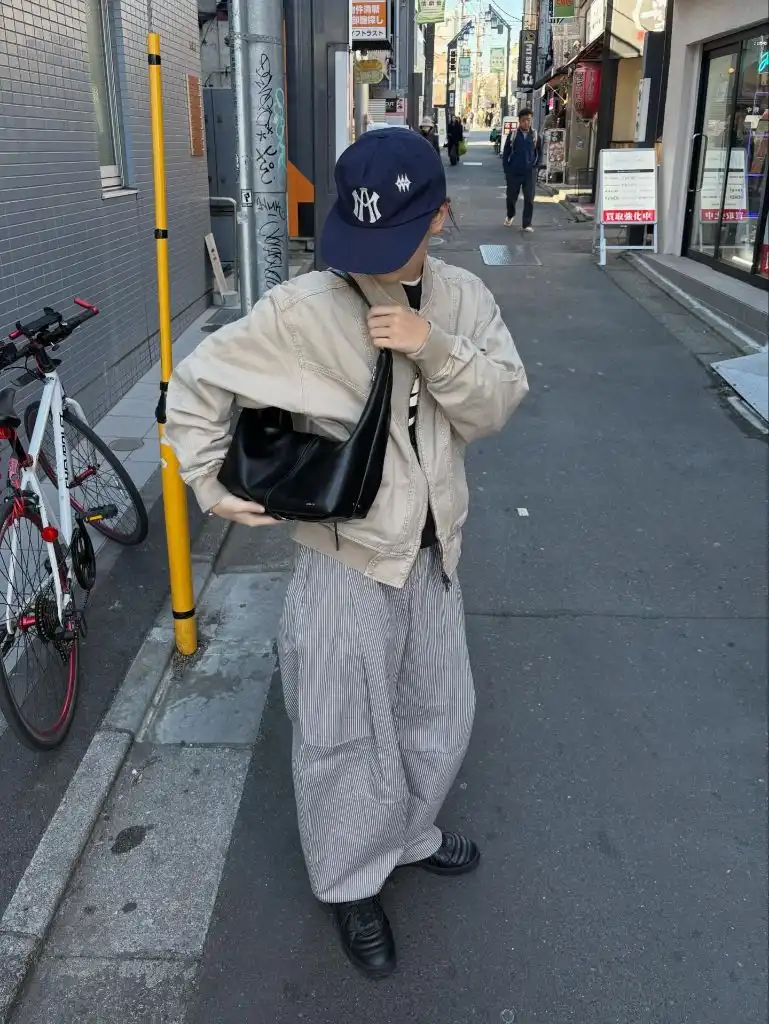
The trousers are the surprise: wide-leg pinstriped in a fine cream and grey vertical, cut baggy through the thigh and long enough to break heavily over the shoe. That vertical stripe sits directly against the knit’s horizontal one, and the whole outfit becomes a small study in two competing pattern directions kept in the same neutral palette. A navy cap with a small logo, a glossy black shoulder bag, and black chunky shoes provide three dark anchor points at head, hand, and foot.
Compared with the sharper tailored looks elsewhere in this set, this reads deliberately looser and more androgynous. The transferable principle is that two patterns can share a frame if their colour palettes overlap almost entirely, and if their directions are perpendicular. Match the palette but not the direction, and the eye reads it as considered rather than clashing.
20. Teddy Coat Softens a Winter Facade
A short cream teddy-style coat controls the frame at hip length, boxy through the sleeve and slightly oversized through the body. The pile of the fabric reads as curly and matte, and the coat’s colour is close to the pale storefront behind, so the shape only fully resolves at the darker edges of the collar and cuffs. A cream fur hat sits on top and repeats the same tone at head height.
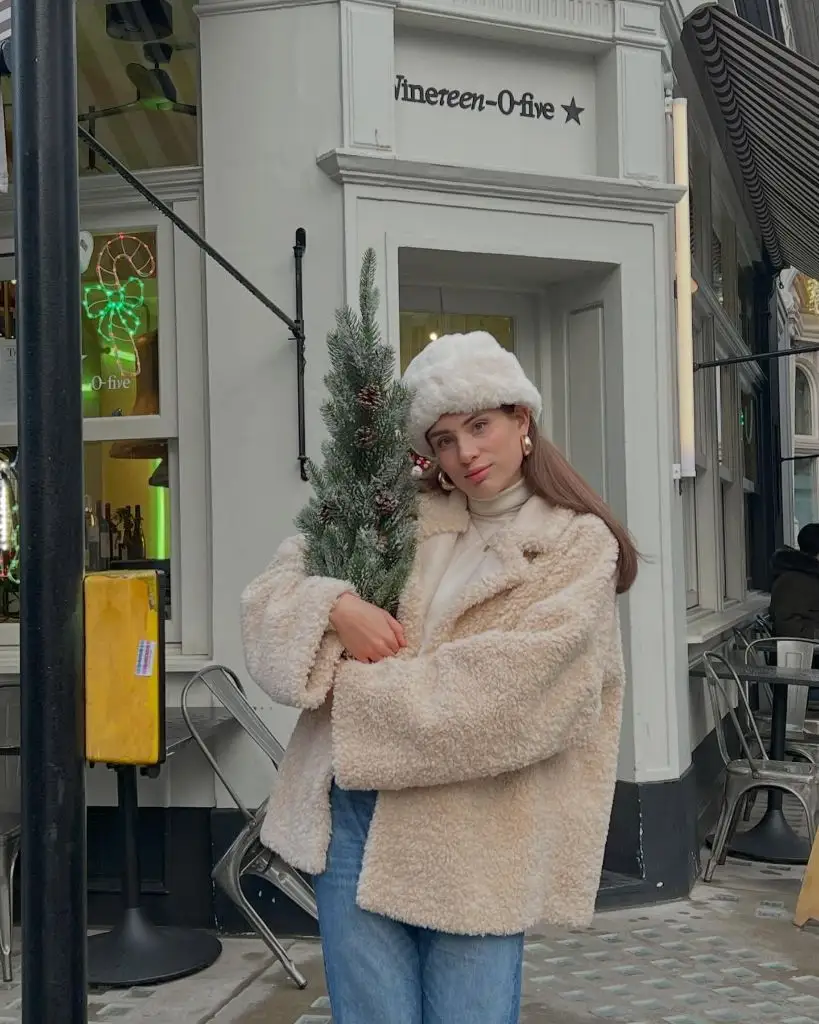
Under the coat, a cream turtleneck continues the tonal cream from collar to jaw, so the entire upper half of the outfit sits in one soft palette. Mid-blue straight jeans finally introduce a second colour at the bottom of the frame, and a small gold hoop earring is the only metallic point. A little decorative tree held in the arm reads as a prop rather than an accessory, but it does add the season’s greens without shifting the outfit’s palette.
I like the restraint of this one — three cream pieces stacked without any belt or contrast bag to break them up. The honest limitation is that pale pile coats show wear at the cuff faster than any other winter piece; a short teddy stays cleaner longer than a full-length one, which is a quiet argument for choosing coat length by lifestyle rather than by trend.
21. Brown Fur Meets a Dark Street
A dark brown faux fur jacket takes up most of the frame, cropped just below the hip and cut with a wide notched lapel and soft rounded shoulders. Photographed at night under a warm street light, the fur reads as a rich sable brown with darker shadows, and the volume of the coat carries almost all of the visual weight of the composition.
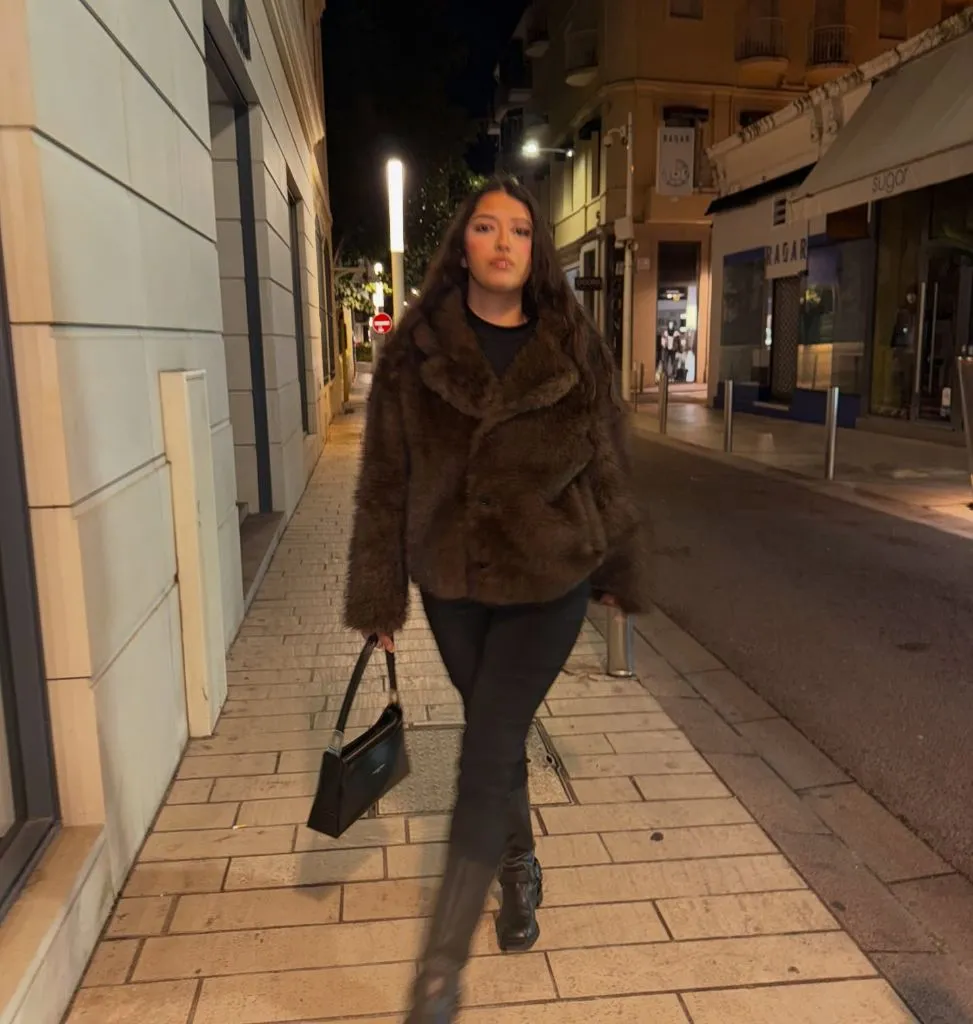
Everything below the fur is quiet and black: a black top at the collar, straight black jeans, glossy black boots, and a small structured black bag held at the side. Because the entire lower half is a single dark column, the fur has nothing to compete with, and its texture becomes the only real surface event in the frame. Long dark hair falls over the collar and softens the join between head and jacket, so the fur reads as continuous with the silhouette rather than sitting on top of it.
The lesson here echoes the earlier black fur look but flips the temperature. Compared with that cooler all-black version, brown-on-black reads warmer and less severe, because the brown pulls in the warmth of the street light and reflects it back. Keep the shape short and the bag small, and the outfit stays urban rather than tipping towards costume.