Winter light is unforgiving on blonde hair, and the most convincing looks in this set become easier to judge when you stop grading individual highlights and start reading the composition. Blonde Winter Hair Color Ideas work best when you look at how root shadow, mid-lengths, and ends are proportioned against one another, where the brightest colour field sits, and how contrast is either allowed to speak or deliberately kept quiet across the whole head.
Before scrolling, decide what you actually want to compare. Notice first where the eye lands — root, cheekbone, or ends — then track how much darker the base is than the lightest ribbon, and how wide the transition zone runs. Weigh the trade-off between a bright, uniform surface that flatters photographs and a rooted, dimensional finish that grows out gracefully. No single formula here functions as a rule.
1. Cool Ribbons Lead a Sandy Base
The dominant field is a cool, sandy blonde running through the mid-lengths, with brighter almost-platinum ribbons drawn from the mid-shaft down toward the ends. The root is left a soft mushroom shade rather than lifted, which sets the top third noticeably deeper than the perimeter. Waves are loose and open, so the light catches in vertical stripes rather than pooling in one bright patch.
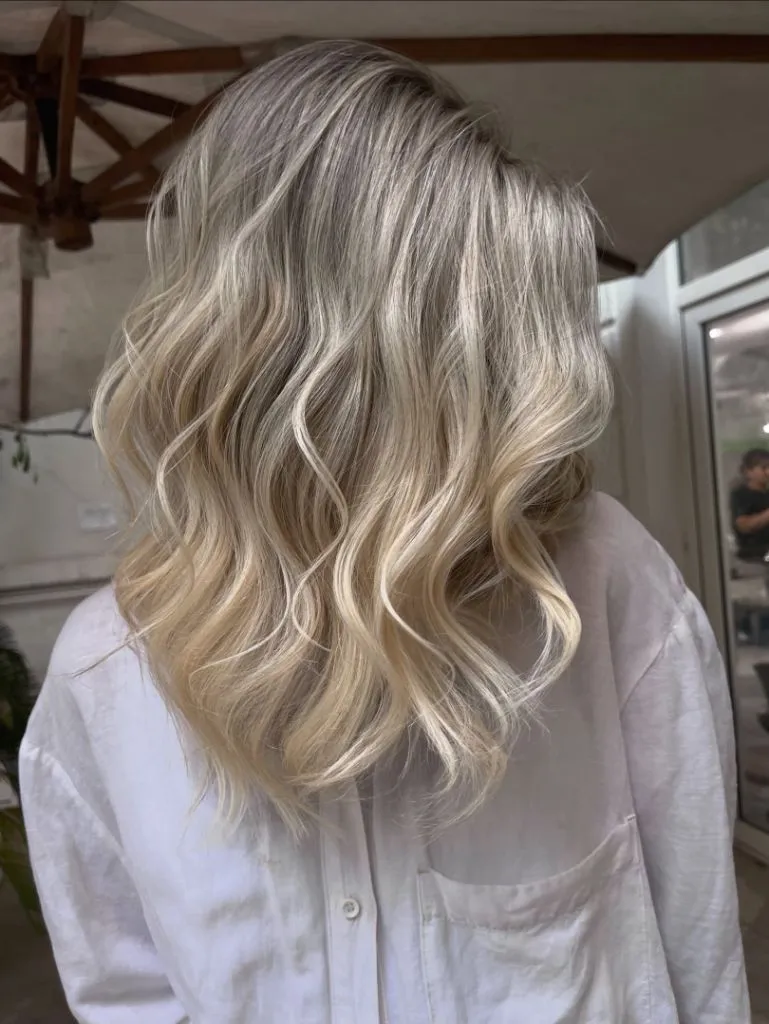
The supporting palette is quiet on purpose. A white shirt sits against the hair without competing, and the wooden beam and pale wall keep the background in neutrals, which lets the cool tone of the blonde read as the loudest note in the frame. The sharpest contrast falls where the platinum pieces meet the mushroom root, not at the ends, which is why the eye keeps travelling upward toward the crown rather than settling on the tips.
The transferable principle here is placement. If you want a cool blonde that still looks lived-in, keep the brightest ribbons narrow and vertical rather than painting a full money-piece around the face. The trade-off is upkeep at the parting: a mushroom base grows in softly, but the platinum stripes will need a gloss refresh before they turn brassy.
2. Icy Surface Carries a Dark Under-Layer
The composition is built on a very pale, almost silver-white top canopy that dominates everything visible from the front. Underneath, a shadowed darker layer is only just readable at the nape and behind the ear, giving the shape depth without breaking the surface. The proportion is roughly nine parts light to one part dark, and the parting itself is pulled slightly off-centre so the swoop covers one eye.
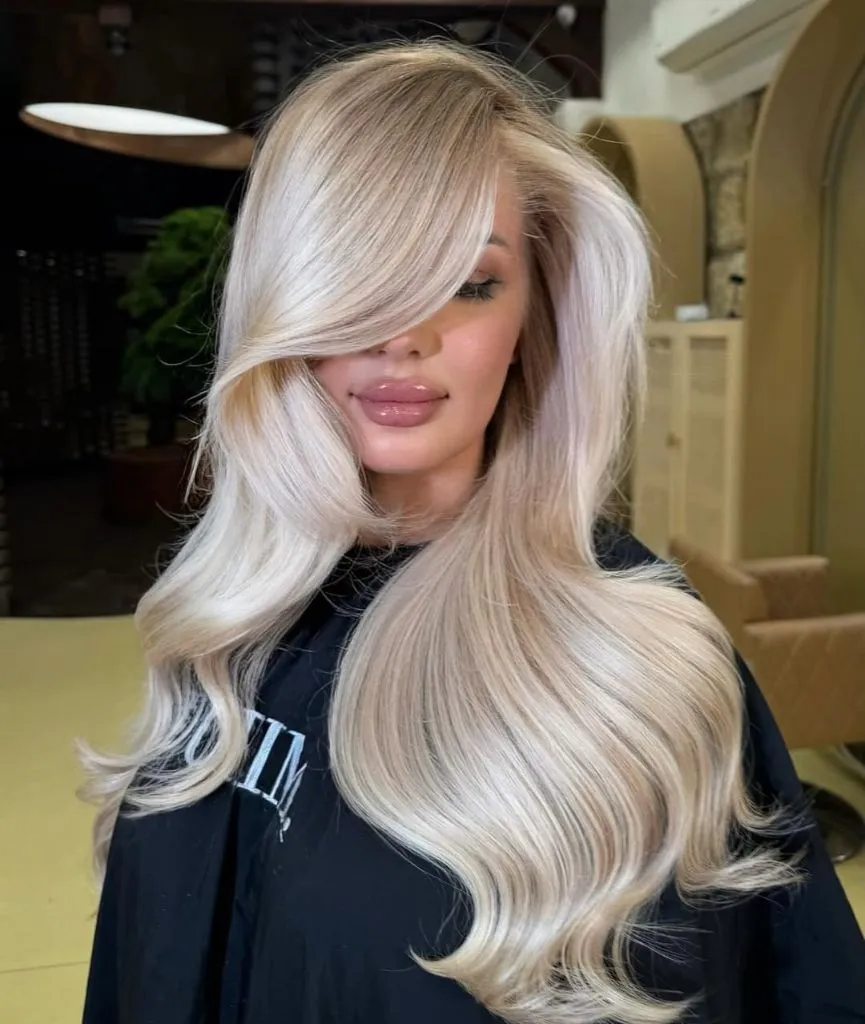
Everything else in the frame stays low-key so the hair can stay loud. The black cape, the beige salon wall, the muted lighting — none of them pull colour from the palette. The waves are set in a controlled Hollywood pattern with a clear endpoint at the tips, and the sheen is uniform along the shaft, which is what makes the tone read as icy rather than yellow. The eye lands first on the swoop, then follows the curve down.
Compared with the sandier first example, this one is a much higher-commitment colour. The honest limitation is maintenance: a canopy this pale generally means regular toning, bond work, and a haircut that keeps the ends blunt enough to hold light. Softening it would mean letting a little warmth back into the mid-lengths rather than pulling every strand to the same value.
3. Buttery Mids Frame a Bright Face
Here the brightest colour field is concentrated around the face and through the top layer, while the back and lower sections settle into a warmer buttery blonde. The proportion divides roughly in half — cool bright framing above the cheekbone, warmer honey below the collarbone — which pushes light toward the features and lets the ends stay softer. The parting is centred and clean.
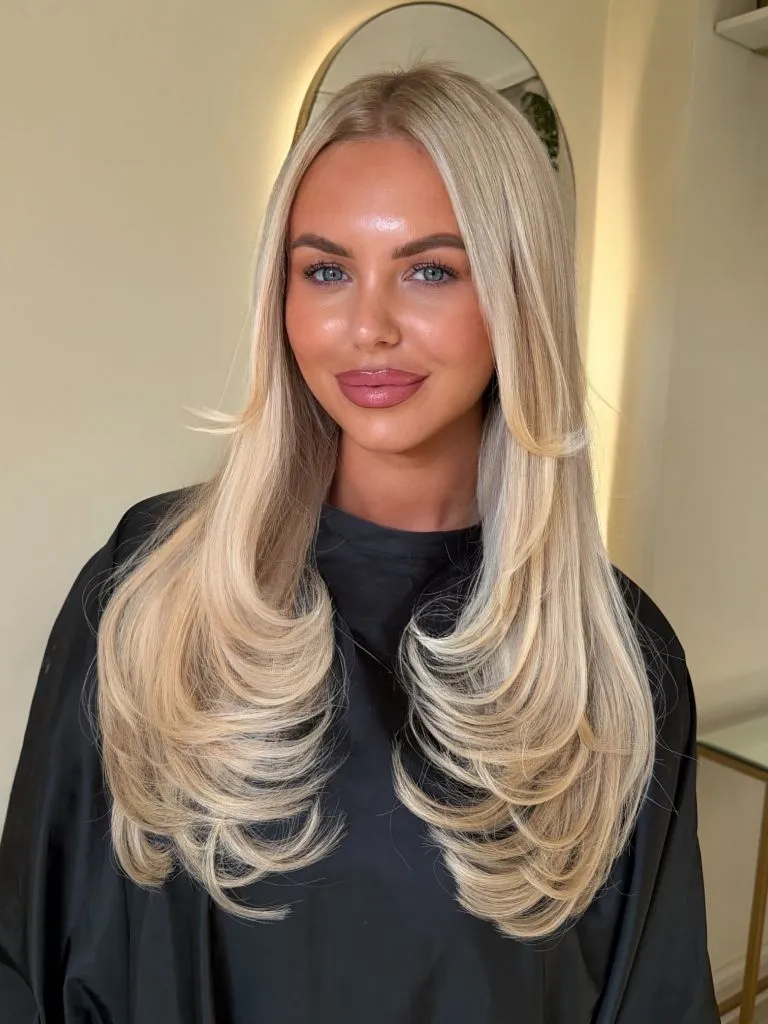
The supporting cast is deliberately minimal. A black cape, warm skin, and pinkish-nude lip all cooperate with the buttery mids rather than fighting them, and the flicked ends give the perimeter a defined endpoint so the colour has somewhere to land. The palette echoes itself: cool at the temples, warm at the jaw, warm again at the lips. That repetition is what makes the hierarchy sit still instead of feeling patchy.
For anyone drawn to Blonde Winter Hair Color Ideas that still photograph warm, this is a useful reference — the face frame does the cool work while the body of the hair keeps a golden temperature. If you wanted to push it further, you could narrow the bright pieces to a true money-piece and leave everything behind the ear untouched. That version grows out even more quietly.
4. Warm Golds Meet a Deeper Shadow Root
The dominant note in this frame is warmth. A honey-to-gold blonde carries the mid-lengths and ends, while a distinctly deeper, almost bronze root sits across the top three inches. The contrast between root and length is the loudest visual choice here, and it is intentional — the root is not a mistake to be corrected but a shadow that anchors the composition. Curled ends round the perimeter into a soft frame.

Everything supporting the hair leans warm on purpose. Amber-tinted sunglasses, sunlit skin, and a plain black top let the gold read as the palette’s clearest note, and the white window grid behind adds negative space so the colour field is not competing with pattern. The sharpest contrast lands where the shadow root meets the first bright pieces at the crown, which is what makes the shape look taller and the face longer.
Compared with the cooler ribbons in the first item, this reads notably warmer and more forgiving to grow out. The trade-off is that a golden palette can tip brassy quickly in winter light, so a warm — not violet — gloss keeps the tone honest. I like the restraint of leaving the root deep instead of blending it away; it does most of the structural work here.
5. Buttercream Canopy Softens a Full Shape
A high-volume, buttercream-toned canopy dominates the whole frame. The colour is warm but low in saturation, closer to soft vanilla than gold, and it wraps the head in a rounded silhouette that reads almost helmet-like from this angle. The proportion is generous — hair takes up more than half the image — and the ends are turned under in a smooth C-curve rather than left open.
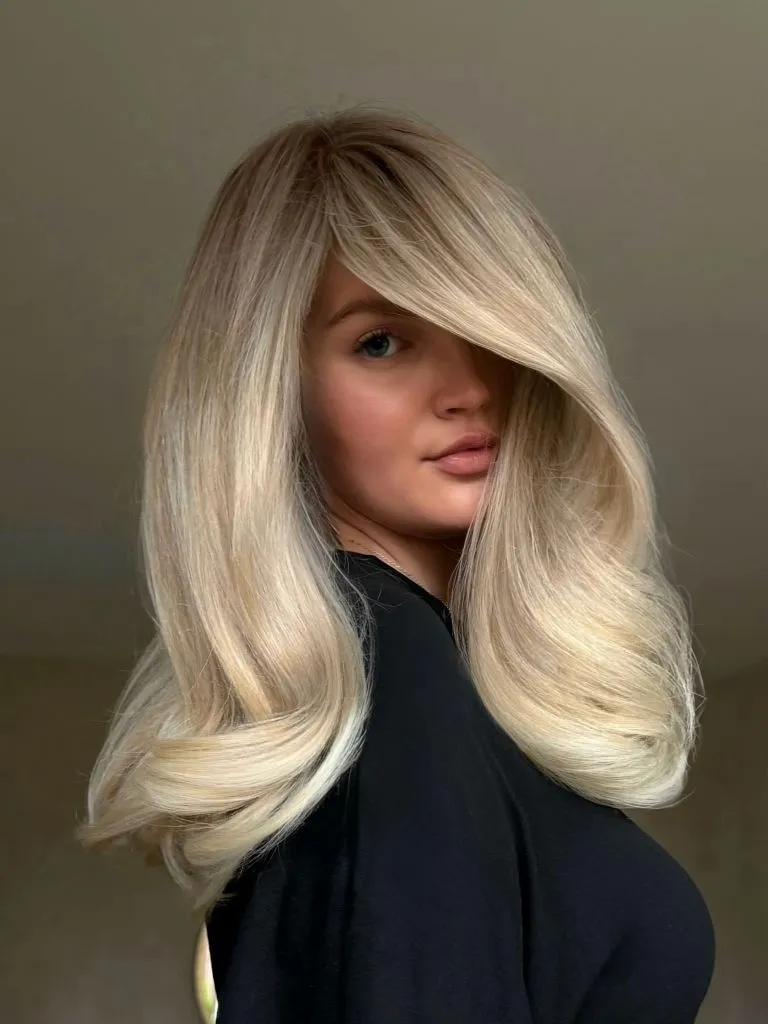
The palette repeats itself in low-contrast pairs: cream hair against beige wall, black top against dark background, warm skin against warm strands. Because the surrounding colour field is so quiet, the hair does not need any accessory to hold attention. The visible sheen along the top shaft is the useful detail here — the material of the finish is not identifiable in a photo, so the reflectivity is what tells you the tone is healthy rather than dull.
To soften this further, you could break the roundness with a looser bend or a visible parting; to push it, you could add a defined face-frame piece to interrupt the smooth curve. The honest limitation is that this much volume through the mid-shaft needs a blow-dry to hold. It is not a wash-and-go look.
6. Highlights Frame a Natural Root
The dominant reading here is a piece of the front section held up to the light, showing fine, closely spaced highlights that run through a warmer natural blonde base. The proportion is unusual because the hand becomes part of the composition — the framed section takes up almost a third of the image, forcing the eye onto the strand-by-strand detail rather than the overall silhouette.
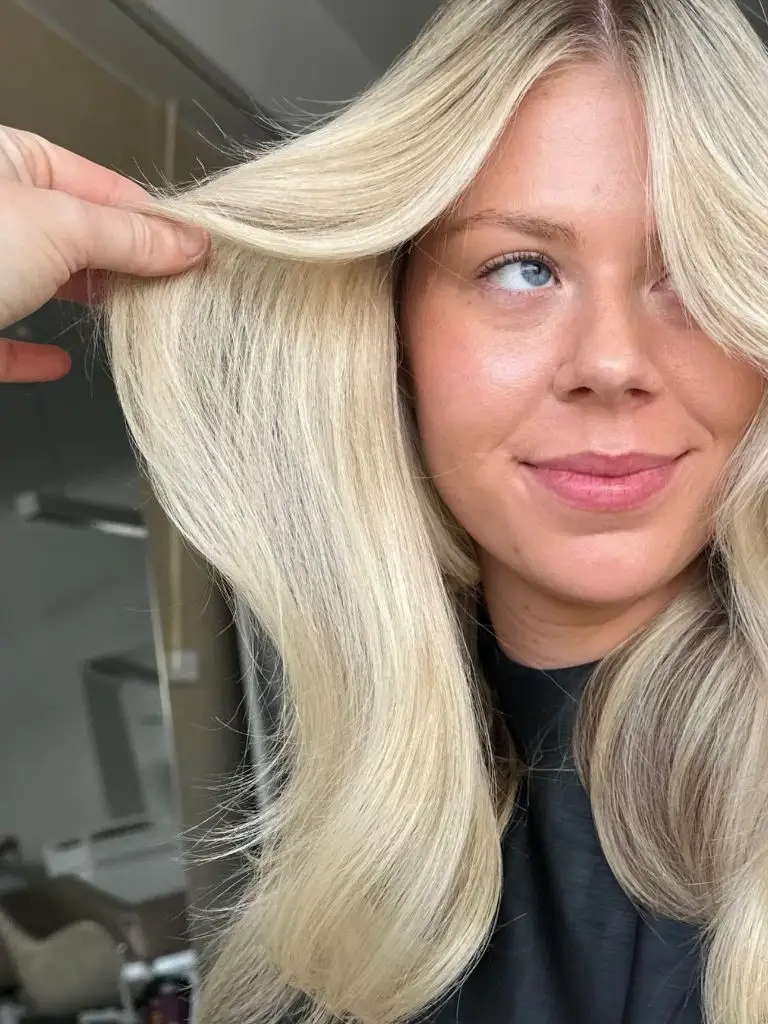
The supporting cast is entirely secondary: the smile, the background salon, the dark top — all of them stay quiet so the strand pattern can read clearly. What is worth noticing is the ratio of bright to base. There are more bright pieces than natural ones through the mid-shaft, but at the root the natural tone is still legible, which is why the grow-out will look intentional rather than banded. The endpoint of each highlight fades into the base rather than stopping in a hard line.
The transferable principle is spacing. Fine, closely spaced highlights read as texture at conversational distance and as colour at photo distance, which is why they photograph well without looking heavy. The limitation, honestly, is time in the chair — this kind of density takes hours, and the difference from a lower-density version is only visible up close.
7. Split Root Sets a Cool Perimeter
The composition splits vertically. The top two inches sit in a deep, mushroom-brown root, and everything below the ears drops into a much cooler, ashier blonde. The transition is soft rather than a hard line, but the contrast between the two zones is the strongest visual event in the frame. The hair is worn straight and centre-parted, which exposes the split clearly.
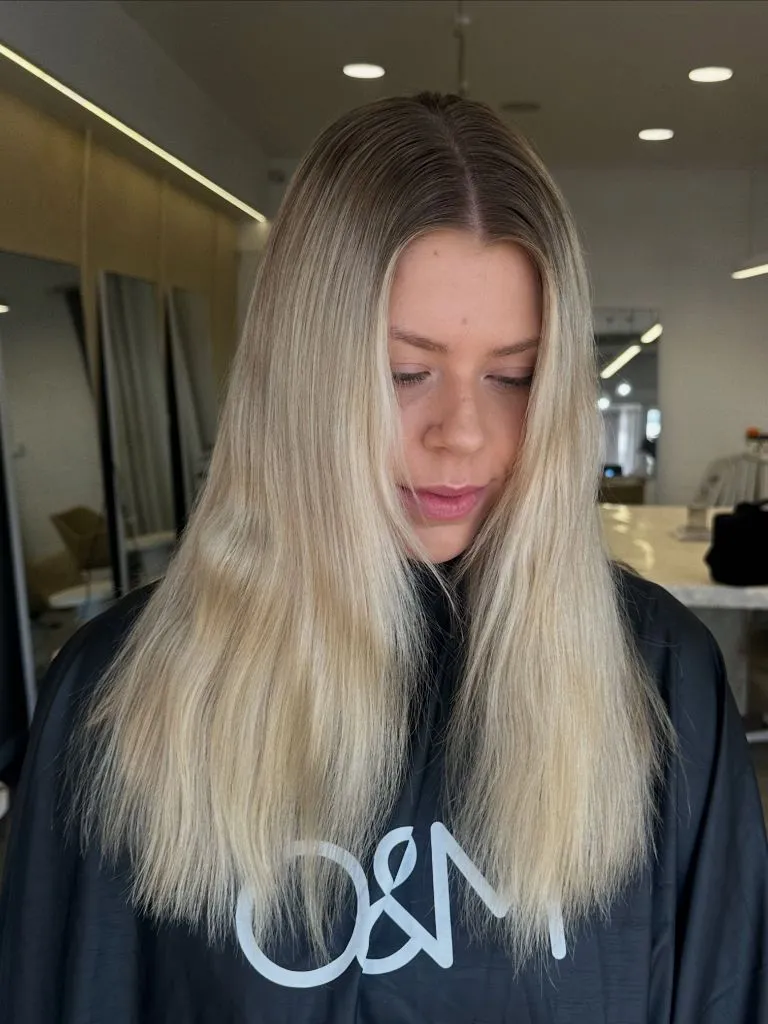
Everything around the hair supports the cool reading. The O&M cape is a matte black, the salon light behind is neutral white, and there is no warm colour anywhere in the frame to pull the blonde back toward gold. The sharpest contrast is at the root, but the useful contrast is at the perimeter, where the cool blonde ends in a straight, blunt cut. That endpoint is what stops the length from looking wispy despite the fine texture.
Compared with the seamless golds two items above, this reads deliberately zoned. The lesson here is about grow-out strategy: a rooted, ashy blonde like this can go months between appointments because the deep top is already part of the design. If you want to push it further, add a face-frame — the current version is quiet from the front and does most of its work in profile.
8. Beige Base Anchors Ribbon Highlights
The whole image is anchored by a mid-tone beige blonde that runs from root to tip with almost no shadow at the top. Through this base, distinct ribbons of brighter blonde travel vertically down the waves, catching light in defined strips rather than a diffused glow. The proportion of bright to base is roughly a third to two-thirds, which keeps the overall reading warm.
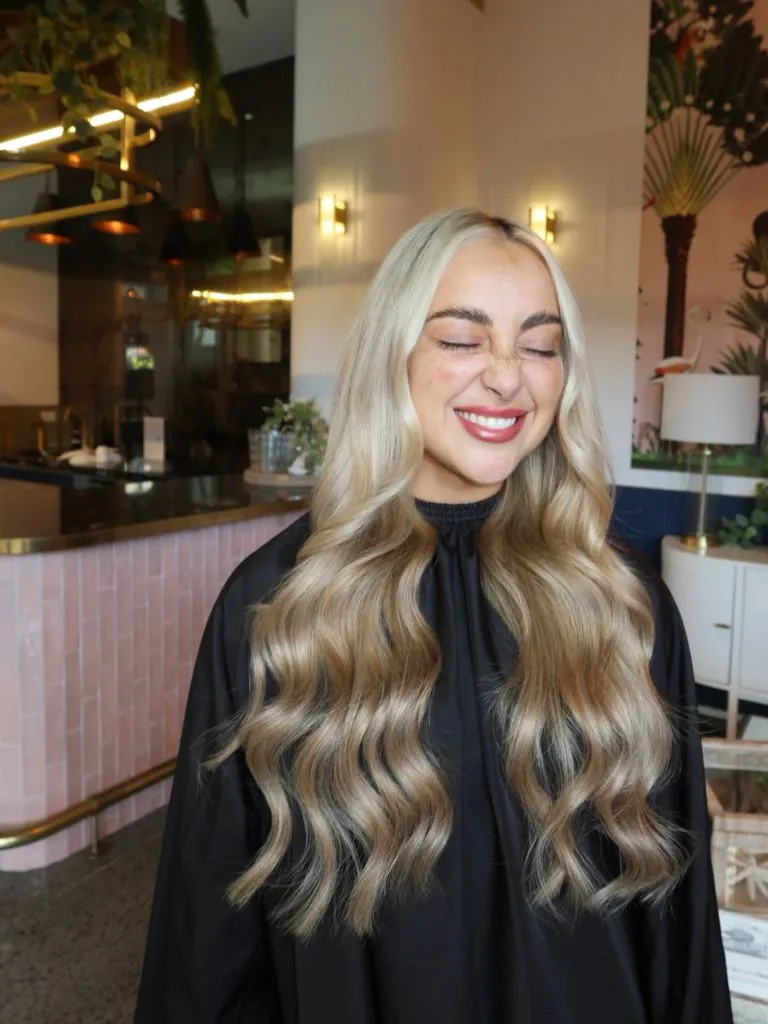
The palette echoes in the background — pink tile, warm brass fixtures, a green plant — but none of it is strong enough to compete with the hair. What holds the hierarchy together is the wave pattern. Because the waves are consistent and open, the ribbons follow the curve and read as intentional stripes, not as a foil pattern showing through. Among Blonde Winter Hair Color Ideas that still want visible dimension, this is the version that reads warmest without turning fully golden.
Softening it would mean tightening the value range between base and ribbons; pushing it would mean bringing the bright pieces higher toward the root. As it stands, the trade-off is a slightly older-looking colour on camera compared with a cooler ash — warm blondes photograph closer to skin tone and can lose some of their edge under bright light.
9. Honey Field Balances a Bright Face Frame
Warmth dominates here. The colour field is a deep honey-gold across the whole length, and against that base, brighter buttery pieces are placed only at the front — starting at the temples and sweeping down through the face-framing sections. The rest of the head stays uniformly warm. The parting is centre, and long curtain pieces open around the cheekbones like brackets.
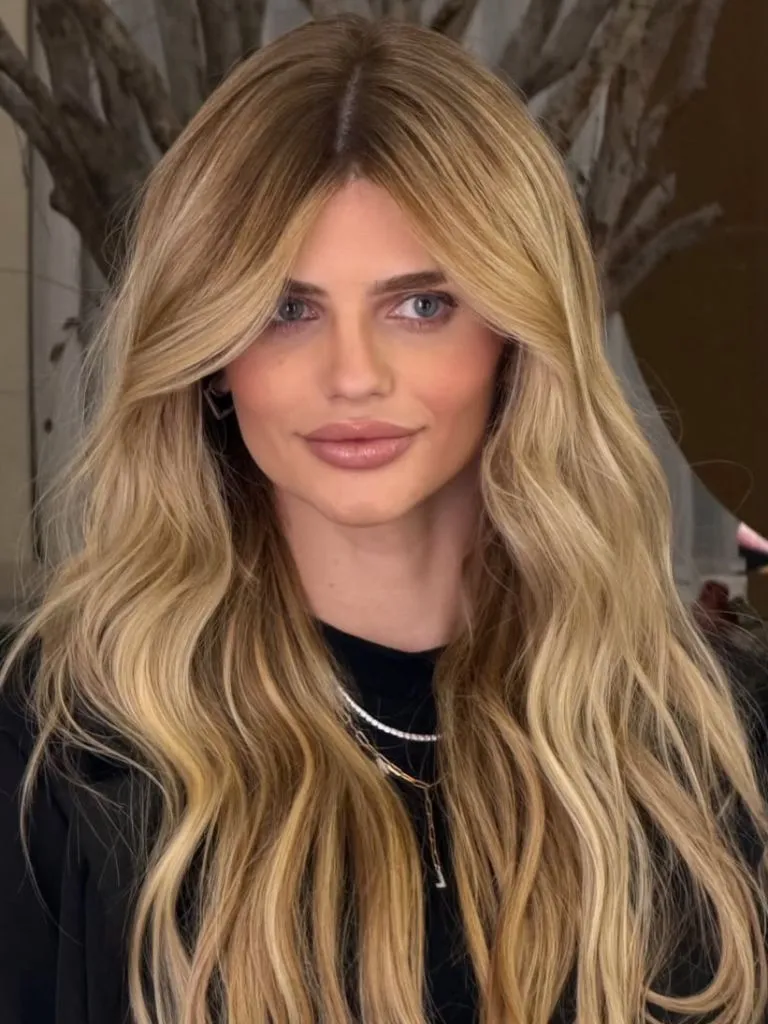
The supporting cast is warm to match. Bare tree branches behind, a black top, a nude-brown lip — everything sits in the same temperature range, which lets the two-tone hair read as a single considered choice rather than a colour correction problem. The sharpest contrast in the frame is not tonal but placement-based: bright at the face, deeper everywhere else. That is what keeps the light on the features.
The transferable principle is targeted brightness. If you want a warm winter blonde that still opens the face, you do not need to lift the whole head — a defined bright pair at the temples does the work while the mass stays honey. The limitation is that these front pieces will need refreshing more often than the body, because they carry the most eye traffic.
10. Platinum Roots Interrupt a Pale Blonde
Unusually, the brightest area is at the root, not the ends. A platinum, almost white band runs across the top of the head, and the colour cools slightly through the mid-lengths into a soft creamy blonde. This is a reversal of the classic shadow-root formula. The proportion is roughly a third bright root to two-thirds paler length, and centre-parted waves let the effect be seen from the crown outward.
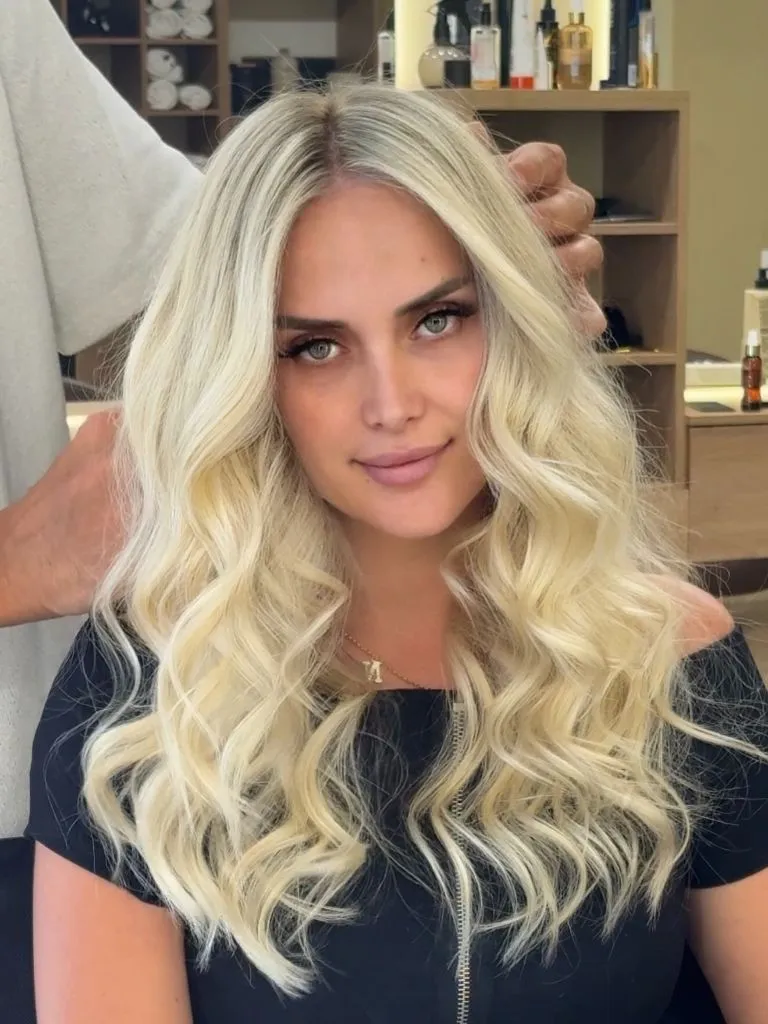
The palette around it stays warm — skin tone, black zippered top, wood shelving — which sharpens the coolness of the platinum by contrast. What supports the hierarchy is the wave pattern: open, S-shaped bends that carry the eye down without pooling in any one spot. The sharpest endpoint is at the tips, where the cream ends in a slightly ragged perimeter rather than a blunt line, which keeps the shape soft despite the bright top.
Compared with the split-root ashy version further up, this is its inverse — the same technique, reversed direction. The honest limitation is grow-out. A bright root is beautiful for a few weeks but will show a natural darker regrowth quickly, so this reads as a moment rather than a low-maintenance colour. You would want to know that going in.
11. Vertical Streaks Break Up a Buttery Base
The composition reads as vertical stripes. Against a mid-toned buttery blonde base, wide bright streaks fall from the crown to the ends, spaced far enough apart that each one reads individually. The proportion is roughly balanced — the bright and base sections occupy similar visual weight — and the waves are set in a loose, spiral pattern that keeps the streaks moving rather than lining up in parallel.
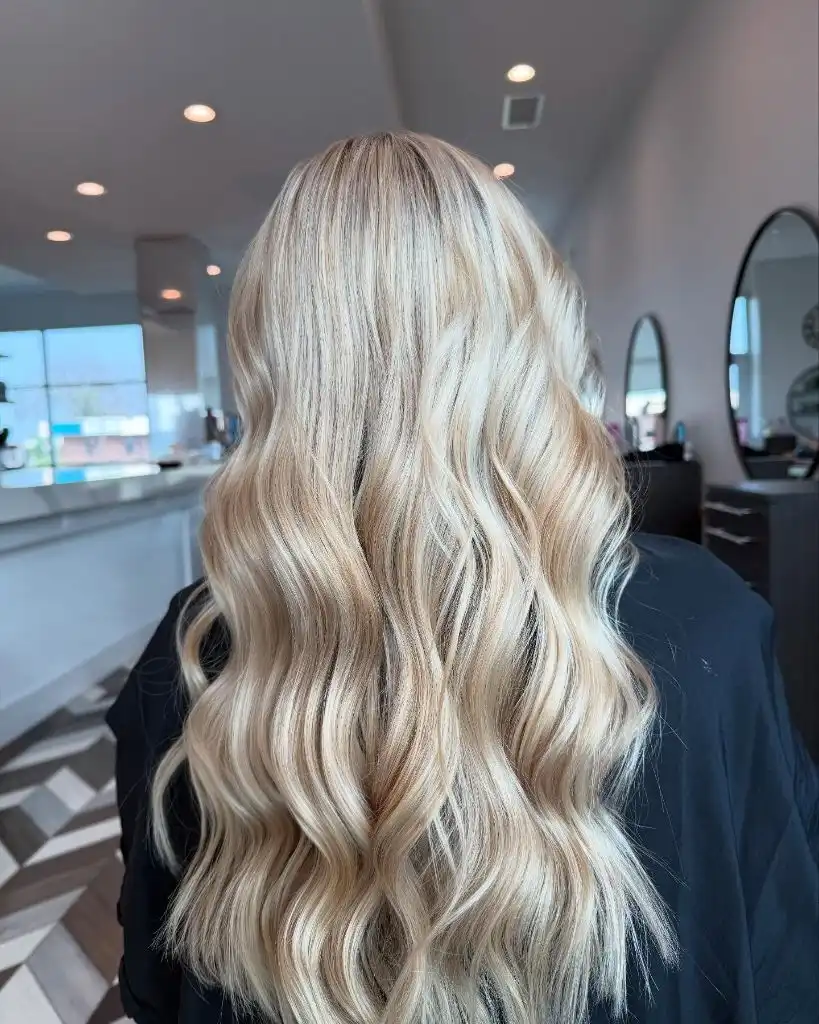
The salon background — chevron floor, mirrors, ceiling lights — adds negative space around the hair but does not compete. What holds the composition together is the endpoint. The streaks do not stop at the same length; they fade at slightly different points, which is why the perimeter reads soft instead of striped. This is a chunkier interpretation of the ribbon technique seen earlier, and it photographs bolder because the width of each streak is greater.
For anyone drawn to Blonde Winter Hair Color Ideas with visible contrast, this is the version to consider when you want the dimension to read from across a room. To soften it, you would narrow the streaks; to push it further, you would widen them into full panels. The trade-off is that wider pieces show grow-out more obviously than fine ones.
12. Bright Ends Extend a Rooted Top
Here the darkest area is at the crown — a warm bronze root band — and the colour gets progressively brighter through the length until the ends read almost white-blonde. The proportion is a graduated three-part scale: bronze root, honey middle, cream ends. Loose beach-style waves carry the transition, and the parting is centred so the melt is visible along the whole top.
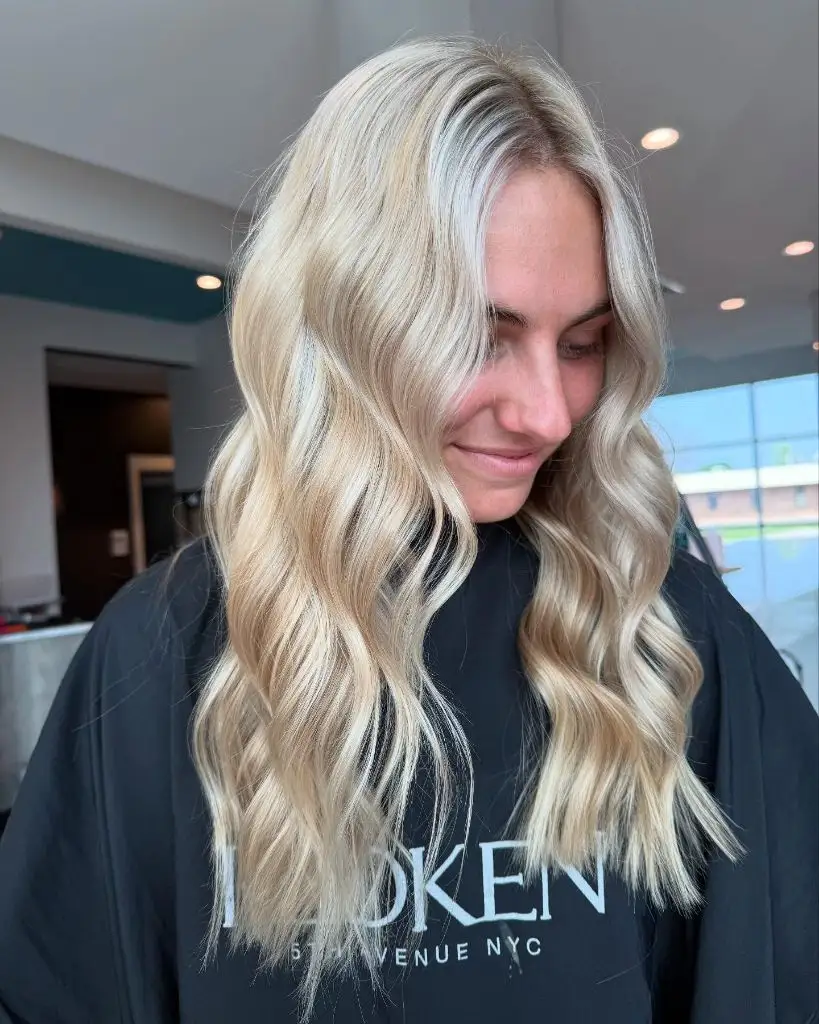
The palette outside the hair keeps quiet — dark salon cape, muted background — so the three-part gradient does all the work. What supports the hierarchy is the wave placement. Because the waves start higher up, near the ears, the colour transition reads as an S-curve rather than a straight line, and the bright ends land in the visual sweet spot around the shoulders. The endpoint is soft, slightly piecey, which keeps the cream from looking artificial.
The transferable principle here is graduated depth. Rather than picking a single blonde and committing to it, you can build the colour as a scale, which grows out with the same intention it started with. Compared with the platinum-root reversal above, this reads more classic and considerably lower-maintenance — the deepest tone is already at the root, so regrowth is part of the design.
13. Contrast Pieces Sharpen a Soft Lob
The dominant shape is a mid-length lob with a bright, high-contrast money-piece at the front and lower-contrast dimension through the back. The proportion between the bright framing pieces and the rest is dramatic — the two temple sections read as almost platinum, while everything past the ear settles into a warmer neutral blonde. Loose bends give the shape movement without volume.

The supporting cast is warm — beige sweatshirt, warm indoor lighting, gold cross necklace — which sharpens the cool blonde at the temples by contrast. What holds the composition together is placement discipline: the bright work is confined strictly to the front, so the cut retains its structural weight elsewhere. The sharpest contrast falls between the temple pieces and the shadow at the parting, and the eye lands there first before moving outward.
For a shorter length like this, the useful judgement is about ratio. A high-contrast money-piece on a lob has more visual real estate per square inch than the same piece on long hair, so a little goes a long way. If you wanted to push it further, you could bring the bright work slightly into the parting; to soften it, thin the temple sections to fewer strands.
14. Curtain Bangs Frame a Rooted Blonde
A distinct set of curtain bangs sweeps across the forehead, and behind them a rooted, sandy blonde runs through curled, layered lengths. The bangs are the dominant feature — they occupy the top third of the composition and split into two directions from a centre point. The proportion below is layered rather than uniform, with the ends flicked out in a defined C-shape at each layer break.
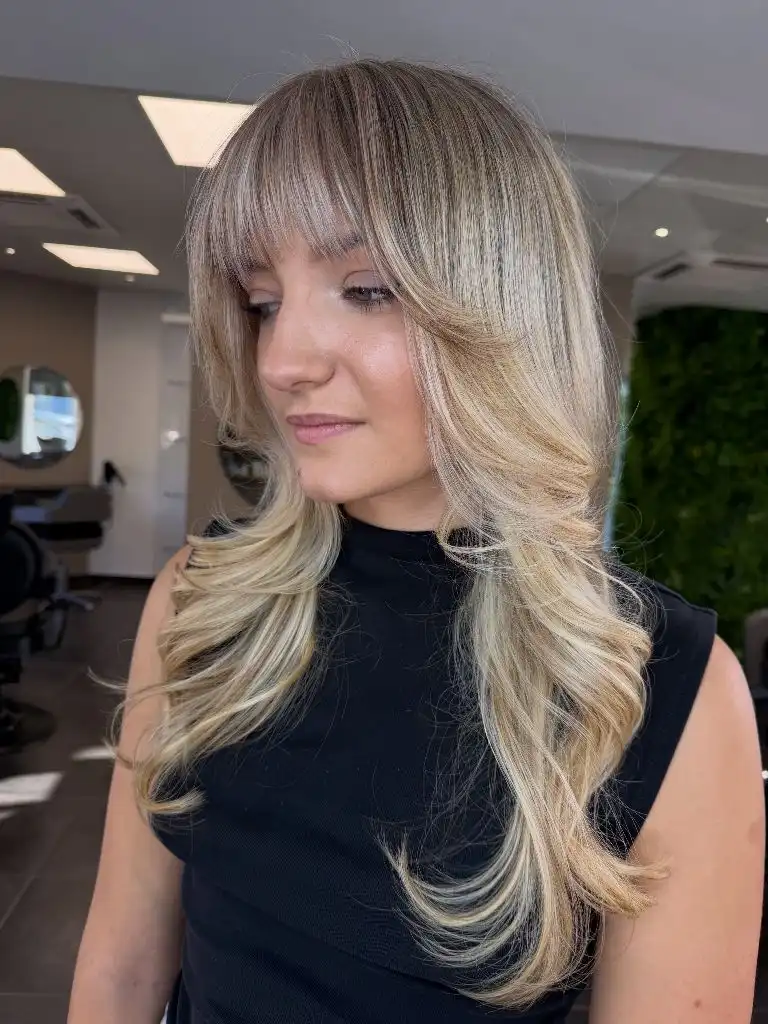
The palette in the background — pale grey wall, black turtleneck, green plant — keeps everything else quiet so the layered movement can be the second most important visual event. What supports the hierarchy is the layering itself, which creates repeated horizontal breaks down the length. Each break catches light differently, which is why the colour reads as more dimensional than it technically is; the cut is doing colour work.
Compared with the smooth blowout further up, this reads much more textural. The trade-off with layered flicks is styling time — the ends need a round brush or an iron to hold that turned-out shape, and one wash flattens the effect. If you want the same colour without the maintenance, you could keep the rooted blonde and let the perimeter fall straight instead.
15. Sunlight Warms a Two-Tone Blonde
The composition is defined by natural light. A warm, low sun hits the front sections, pulling them into a golden reading, while the back and interior sections stay in their cooler natural blonde. The proportion here is not chosen by the colourist so much as revealed by the light source — roughly half the visible hair reads hot gold, half reads neutral. Loose straight lengths hang past the shoulders with a slight bend at the ends.
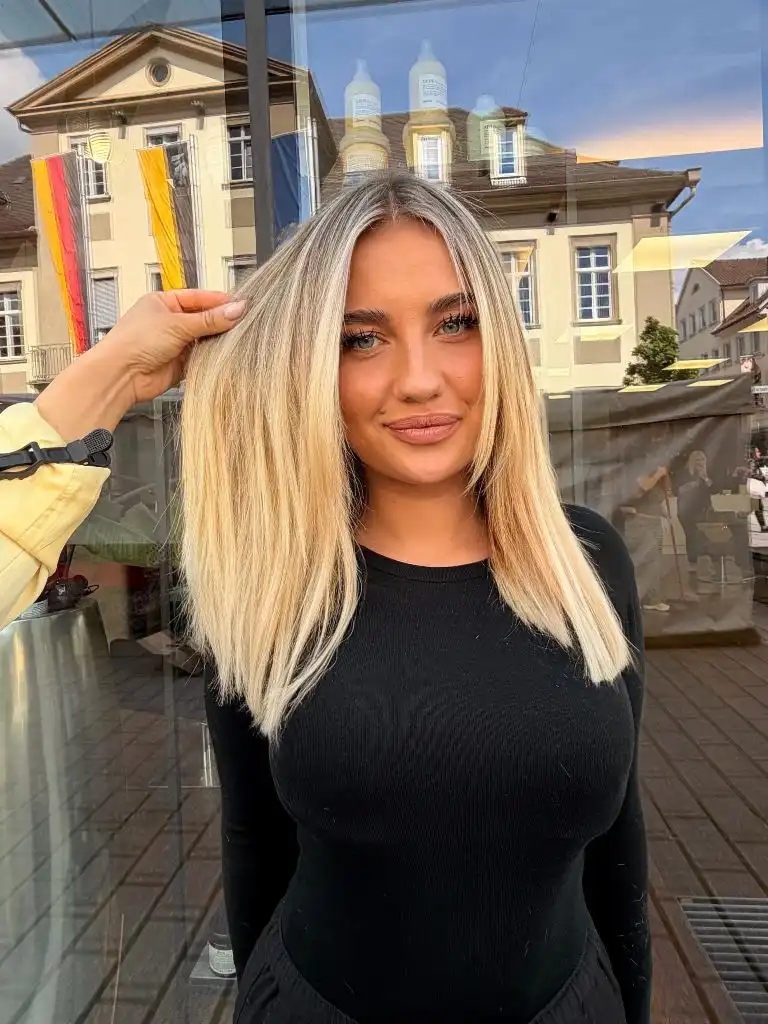
The supporting cast is generous — a European square with flags, buildings, a passerby — but it recedes into blur so the hair holds focus. What holds the composition is the reflected window behind, which repeats the warm-cool division: warm light on the buildings, cool sky above. The sharpest contrast is the deeper root band peeking through at the crown, which prevents the sunlit gold from looking flat.
The honest observation here is that light does a lot of colour’s work. A blonde that looks warm in direct sun can read almost ashy indoors, so it is worth checking a colour in both settings before committing. Compared with items shot under salon light, this one is essentially a different palette wearing the same base — a useful reminder that photographs are lighting first, colour second.
16. Face Frame Softens Long Layers
Long layers dominate the shape, with the top layer starting around the cheekbone and cascading down through progressively longer sections. The colour is a bright, neutral blonde carried evenly from mid-shaft to ends, with a subtle darker root that keeps the top from floating. The proportion of layer to length is generous — the shortest layer at the face is roughly half the length of the perimeter — which gives the shape airy movement.
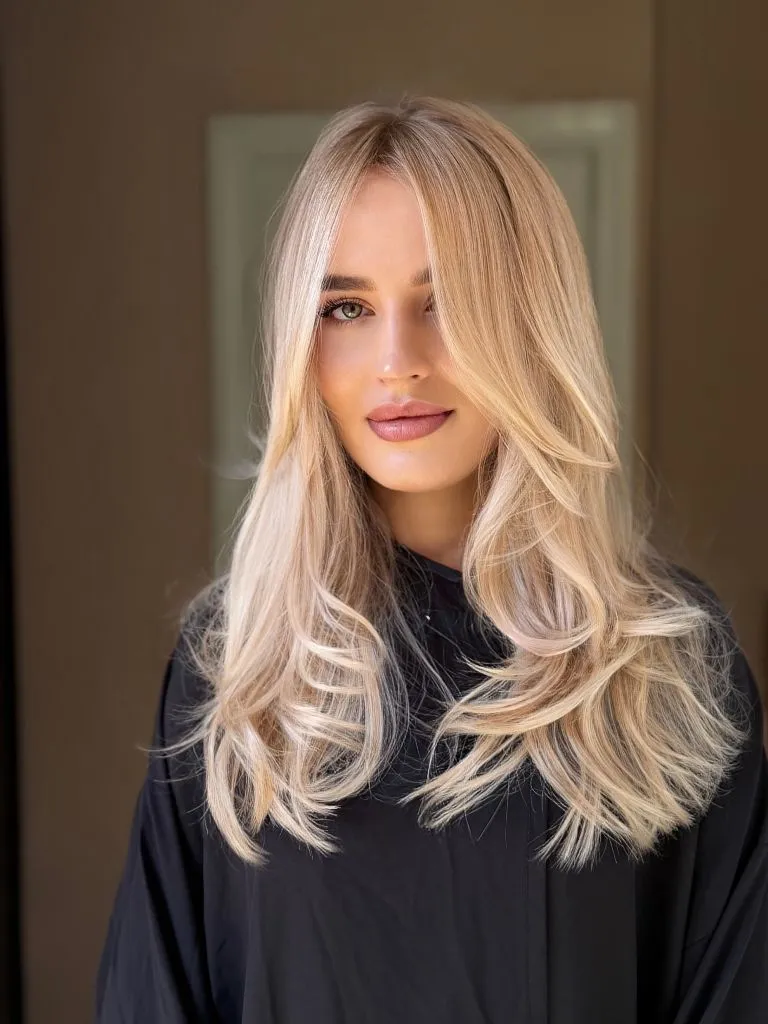
The supporting palette is deliberately dim — a dark doorway behind, a black top, low ambient light — which lets the hair be the only bright object in the frame. What holds the composition together is the way the layers flick outward at different points, creating a rhythm of C-shapes down the length. The endpoint is slightly feathered rather than blunt, and that softness is what keeps the layers from looking overly sculpted.
The transferable principle is that a face-frame does not always need to be a colour choice; it can be a cut choice. Here the shortest layer at the temple opens the face by shape rather than by brightness, which is a subtler tool. For a fuller take on this direction, the layered haircut ideas on our site show how the same layered logic reads across different lengths.
17. Backlit Waves Deepen a Warm Blonde
Strong side light hits the back and side of the head, which makes the perimeter of the waves glow brighter than the interior. The dominant tone is a warm, honey blonde, but backlighting exaggerates the brightness at the edges and deepens the shadow at the crown. The proportion of light to shadow is roughly balanced, split along the vertical centre of the head, and the waves are loose and open with a curled endpoint.
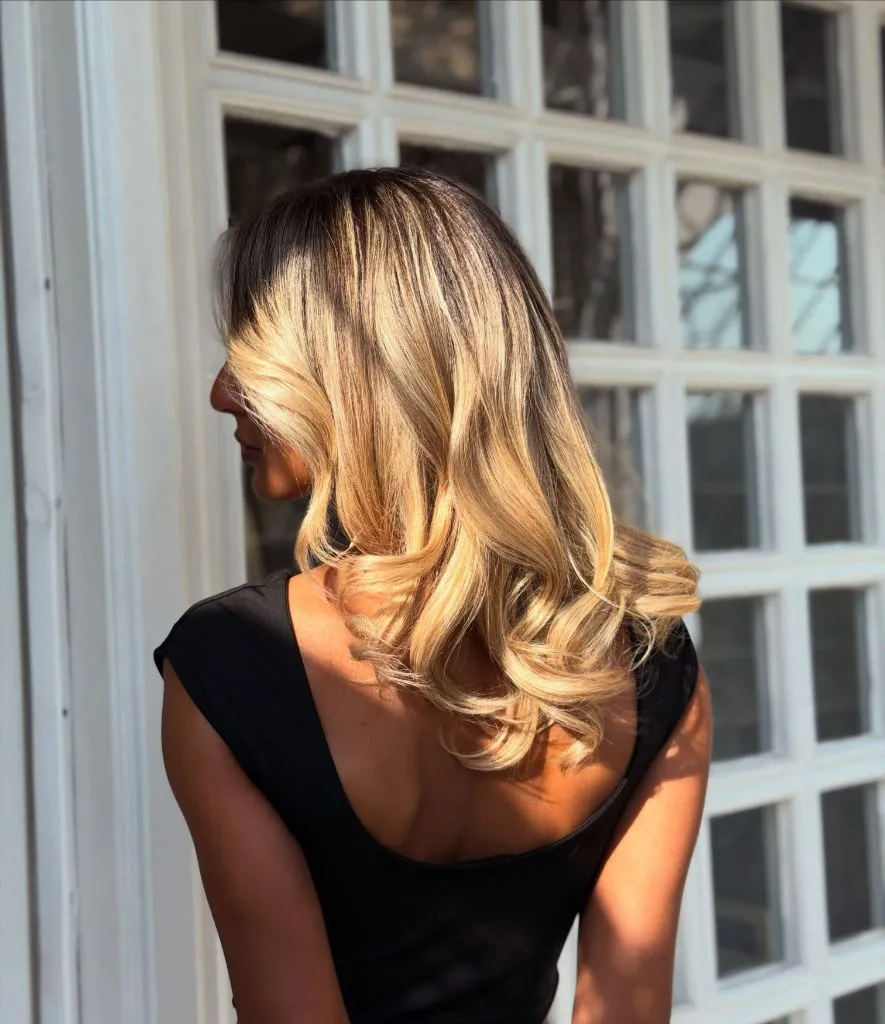
The white multi-pane window behind fills the frame with structured negative space, which sharpens the outline of every wave against the grid. What supports the hierarchy is the backlight itself: it creates a bright rim along the outside of the shape and leaves the inside darker, so the colour reads as fuller and more three-dimensional than it would in flat light. The sharpest contrast lands at the crown, where the deeper root sits against the bright rim below.
The useful judgement here is honest about photography. A warm honey blonde photographed with strong side light will always look more dimensional than the same colour under overhead salon light, so if a reference image is backlit, adjust expectations. Compared with the earlier sunlit blonde, this one is closer to portrait lighting and reads more controlled.
18. Ash Dimension Cuts Through a Cream Base
The base tone across most of the frame is a soft cream blonde, but running through it are cooler, ashier pieces that create visible dimension without shifting the overall temperature. The proportion is subtle — the ash pieces make up perhaps a fifth of the total colour — but they are placed with intent through the mid-lengths and ends. Beach waves keep the pattern moving down the back.
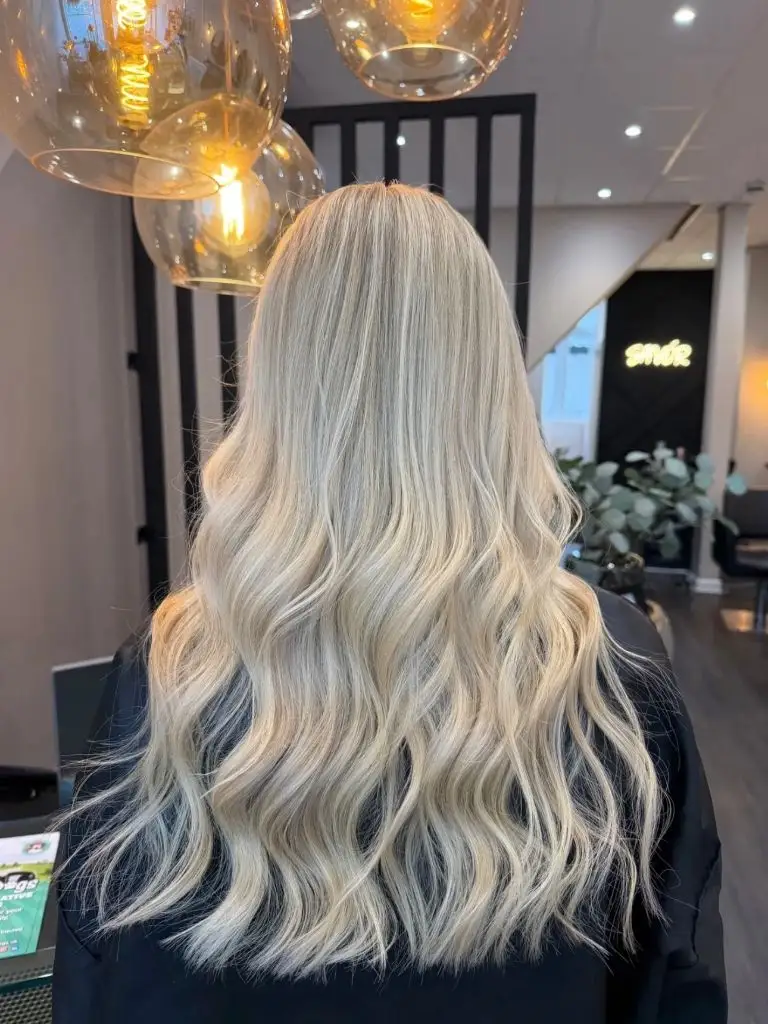
The salon environment adds warm amber lights above and darker wood elements around, which pulls the base blonde slightly warmer than it would read in daylight. What supports the hierarchy is the placement of the ash: it appears where the waves curve inward, catching the shadow of the bend, which makes the dimension look natural rather than painted. The endpoint is slightly wispy, which is common with lightened lengths and keeps the perimeter from looking too heavy.
Among Blonde Winter Hair Color Ideas that want dimension without visible stripes, this is a good reference for the low-contrast approach. The trade-off is that ash tones sit closer to the base value, so the effect is quieter — you have to look at the photo for a moment to see the work. That subtlety is either the appeal or the limitation, depending on what you want.
19. Cool Gloss Sets a Uniform Icy Tone
A final gloss step is the dominant story here. The whole length reads as a uniform icy blonde, with almost no variation between root and ends, and the surface shine is so even that individual strands are hard to separate visually. The proportion of light-to-shadow is minimal — this is essentially a single-value colour — and the shape is a smooth, side-parted swoop with rounded waves at the length.
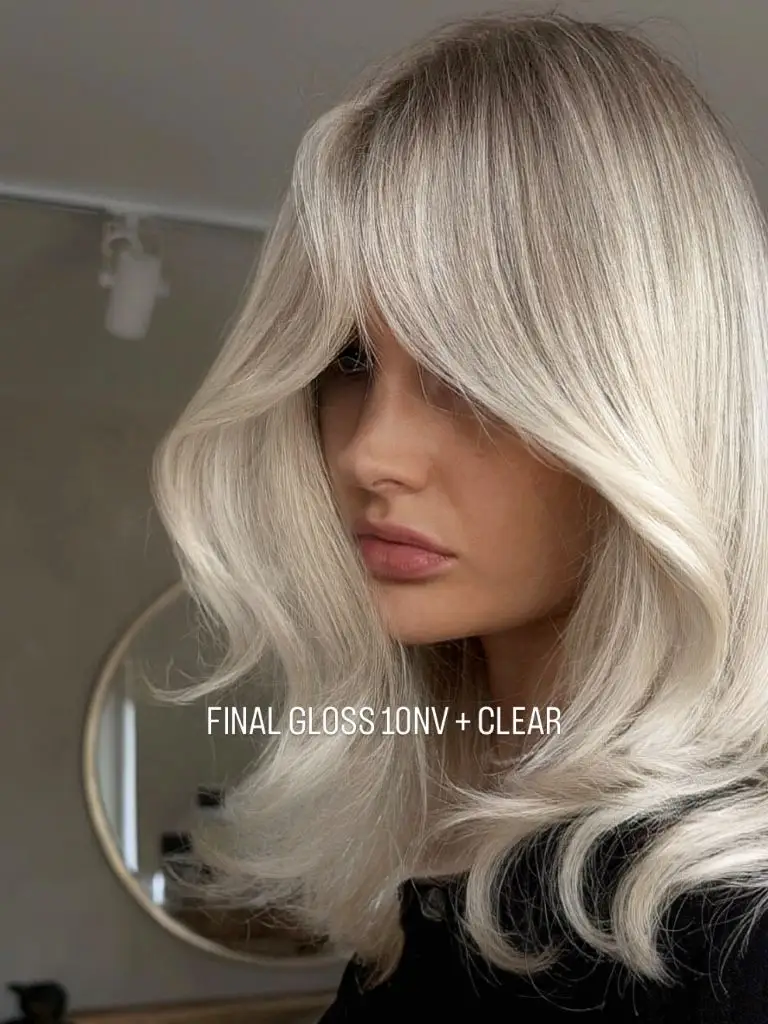
The supporting cast is intentionally sparse — a beige wall, a circular mirror, a dark top — and the overlaid text names a specific gloss formulation, which is worth noting only because it explains what the eye is seeing. The material of the finish is not identifiable in the same way in a photo, so the visible sheen is the useful detail rather than any product claim. The sharpest contrast in the whole frame is between the pale hair and the dark clothing, which makes the perimeter of the shape read very clean.
Compared with the dimensional ash blonde immediately above, this is the maximally simplified version — a single cool tone, no visible melt, no contrast pieces. The honest limitation is that a uniform icy colour needs to be maintained on a schedule, and even small yellow shifts show clearly. For direction on styling this kind of finish, the blowout and wave tutorials on our site cover the shapes it holds best.
20. Bright Ribbons Extend Through a Rooted Lob
The final composition returns to a familiar structure — a soft rooted top melting into brighter mid-lengths and ends — but scaled to a mid-length lob rather than long hair. The proportion is roughly a third shadow root, two-thirds bright length, and the brightest pieces are stacked as vertical ribbons running through the waves. Loose S-bends distribute the light down the shape.
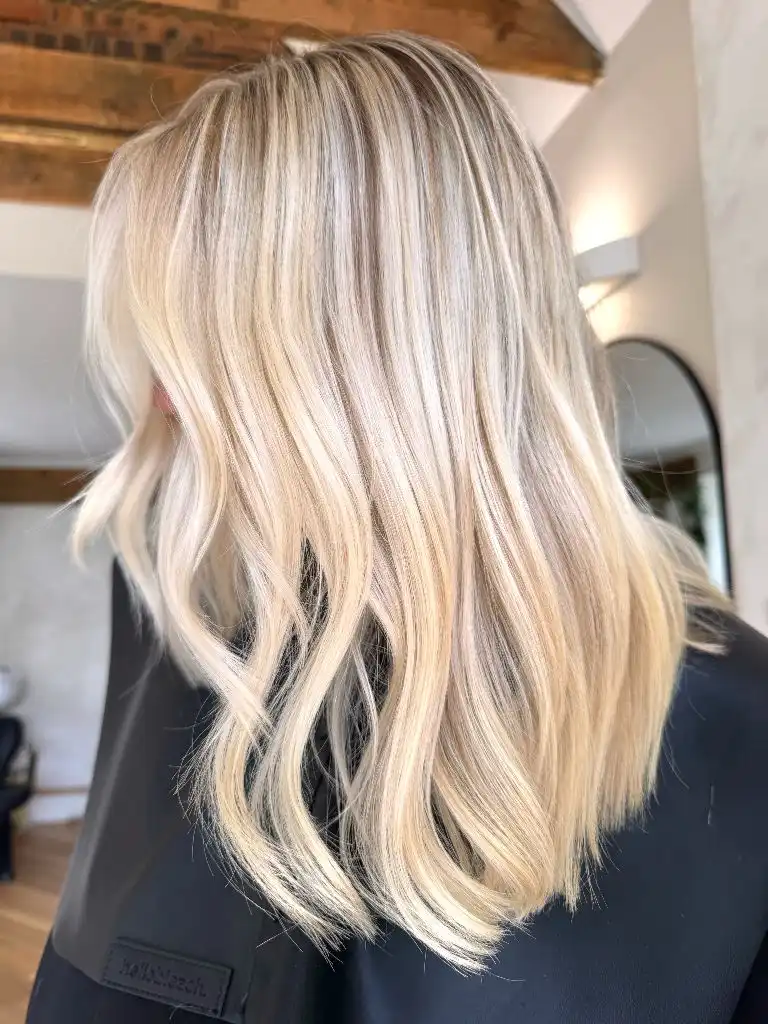
The palette around it stays neutral — wood beam, white wall, dark blazer — which lets the hair hold the frame. What supports the composition is the wave pattern: because the S-bends are wider than the earlier spiral versions, each ribbon of brightness reads as a long curve rather than a compact stripe, which suits the shorter length. The endpoint is slightly textured, with the ends left piecey rather than blunt, and that texture keeps the lob from feeling too polished.
Set against the full set, this final example works as a summary rather than a departure. It uses the same rooted-plus-ribbon logic seen throughout, adapted to a shorter cut. The transferable principle across all twenty images is that dimensional blonde is a placement question first and a tone question second — where the brightness sits matters more than exactly which shade of blonde carries it.