Trendy hairstyles for women over 30 become far more legible when you stop evaluating individual cuts in isolation and instead study how each style is composed — where the volume sits, how the perimeter line relates to the jawline and shoulders, what ratio of texture to smoothness governs the overall silhouette, and whether the colour palette works with or against the skin tone visible at the neckline. Proportion, scale, and the distribution of visual weight matter more than any single trend name, and that analytical frame is what holds the twenty styles below together as a useful set rather than a disconnected gallery.
Before scrolling, it helps to decide what you are actually comparing. Notice first where each style places its heaviest volume — at the crown, the mid-lengths, or the ends — because that single choice reshapes the head-to-shoulder proportion more than length alone. Then weigh the trade-off between finish and upkeep: a style that reads as polished on day one may demand daily heat, while a more textured shape often ages better between salon visits. Pay attention to how much of the neck and collarbone each cut reveals, since that negative space is doing real compositional work. No single formula here is a rule; the goal is to see why each arrangement holds together on its own terms.
1. Flipped Ends Anchor a Rounded Bob Silhouette
A dark brunette bob sits just above the shoulders, and the element that controls the entire composition is the outward flip at the ends. The flip widens the lowest portion of the silhouette, giving the style a bell-like perimeter rather than the inward taper most bobs default to. Volume is concentrated in the mid-shaft and lower lengths, leaving the crown relatively close to the head. The colour is a single, uniform dark brown with no visible highlights.
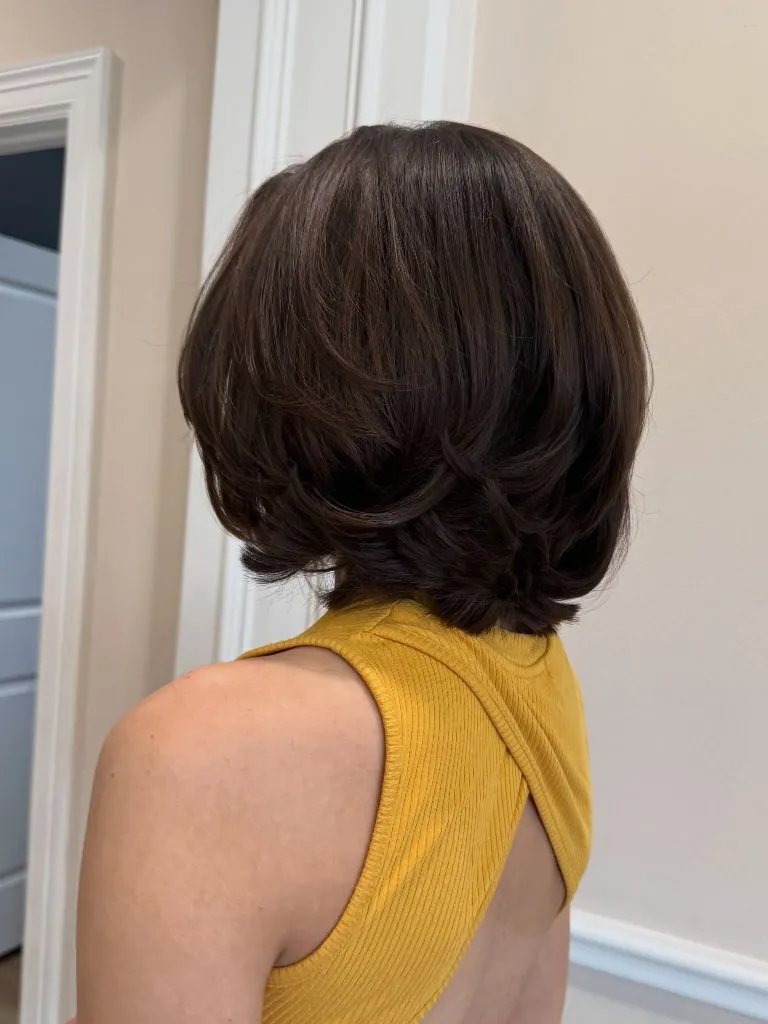
The mustard-toned top visible at the neckline creates a warm contrast against the cool-leaning brown, and that colour relationship is worth noting because it sharpens the line where hair meets fabric. There is no parting visible from this angle, so the shape reads as one continuous mass — the weight is evenly distributed left to right. The texture looks smooth through the mid-lengths with a slight bend only at the very tips, which keeps the flip from reading as accidental or wind-blown. Restraint in the interior texture is what lets the perimeter detail stay legible.
The transferable principle is about endpoint behaviour: a single directional change at the very last inch of hair can redefine a silhouette without adding layers or colour. If you want the effect but less width, a subtler flick rather than a full flip would narrow the bell shape while still breaking the blunt-cut default. This is also a style where grow-out is visible quickly, since the flip depends on a precise cutting line that shifts as length increases — expect maintenance every five to six weeks to keep the geometry clean.
2. Layered Cascade Creates a Descending Volume Gradient
Here the dominant visual event is a long, layered cut in very dark hair where volume builds progressively from a flat, smooth crown down to heavily flipped and curled ends. The shortest visible layer begins near the chin line, and each subsequent layer adds width, so the silhouette is an inverted triangle — narrow at the top, wide and active at the bottom. The hair colour appears to be a natural, near-black brunette with no highlights or dimension tricks.
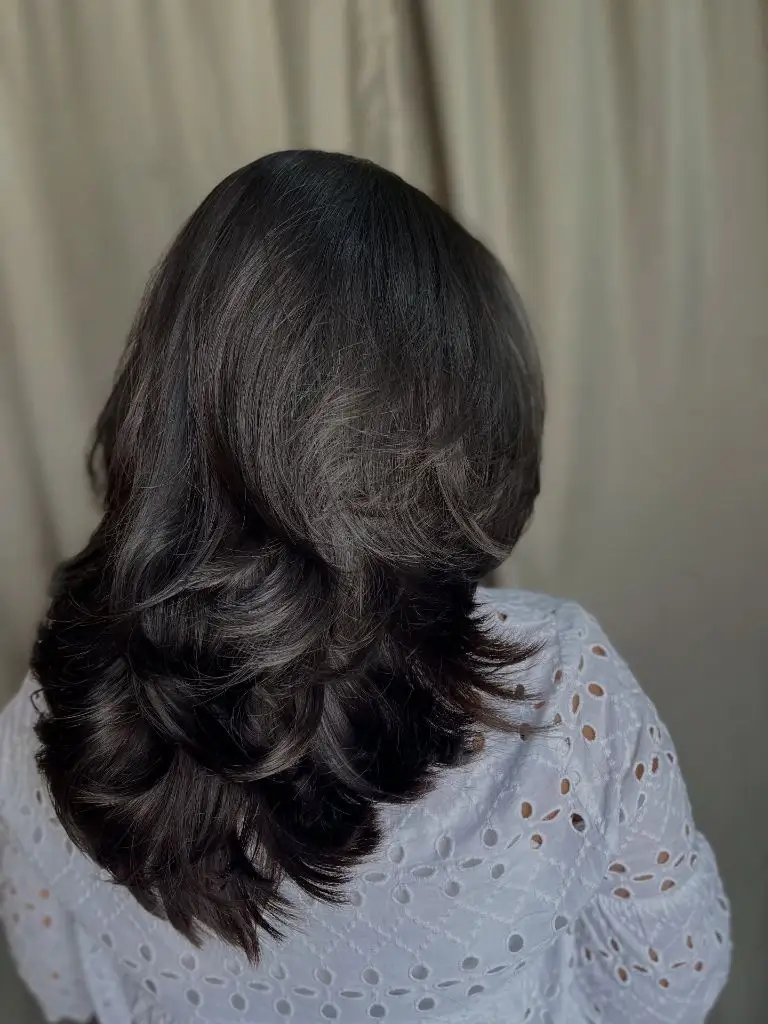
The white eyelet-fabric top echoes through small perforations that allow skin to show, and that dotted openness at the shoulders provides a textural counterpoint to the dense, heavy hair above it. Each layer curls outward and slightly under, creating a scalloped edge that softens what would otherwise be a sharp triangular outline. The scale of the curls is consistent — medium barrel, uniformly spaced — and that regularity gives the cascade a deliberate, salon-finished quality. Light catches the outermost strands, adding a faint sheen gradient from matte roots to glossy-looking tips.
Compared with the compact bob in the previous item, this style trades containment for drama: the visual weight is three times as spread out, and the maintenance demand rises accordingly. Keeping this level of curl definition in longer layers typically requires both heat styling and product, so it is not a wash-and-go proposition. The honest limitation is that humidity will disrupt the scalloped edge within hours, making this a better choice for controlled environments than for outdoor events in warm climates.
3. Blunt Perimeter Meets Side-Swept Volume
A chin-length bob dominates this composition, and the controlling element is the perfectly blunt perimeter line that cuts straight across at jaw level. The hair colour is a warm, honey-toned brunette — lighter and warmer than either of the two preceding styles — and the overall shape reads as a smooth, inward-curving mass with no layering visible from the front. Volume is distributed evenly around the head with a slight bias toward the left side, where the hair sweeps across the forehead.

The blue-green patterned top provides a cool-toned backdrop that makes the warm hair colour pop forward, and that palette contrast is doing the heavy compositional lifting here. The surface of the hair looks glossy and uniformly smooth, suggesting either a blowout finish or a flat-iron pass. The parting is off-centre, which prevents the symmetry of the blunt line from reading as too rigid. Earrings or accessories are not visible, so the hair shape itself carries all the visual interest without competition. The overall effect is clean, geometric, and deliberately minimal.
The lesson here is about how a single unbroken line — the blunt perimeter — can carry an entire style when the surface finish supports it. Any frizz or uneven texture would weaken the geometry, so this cut demands consistently smooth styling. For anyone exploring trendy hairstyles for women over 30, this is a useful reference point for how much impact a strong perimeter can have without any layering, colour work, or accessories entering the conversation at all.
4. Feathered Layers Frame the Shoulder Line
A medium-length cut in dark brunette hair anchors this image, and the dominant feature is the pronounced feathering that begins at chin level and fans outward toward the shoulders. The layers flip away from the face and neck in distinct, separated sections, creating visible negative space between each feathered strand. The overall silhouette is widest at the shoulder line and tapers inward at both the crown and the nape, making a diamond-like shape when viewed from behind.
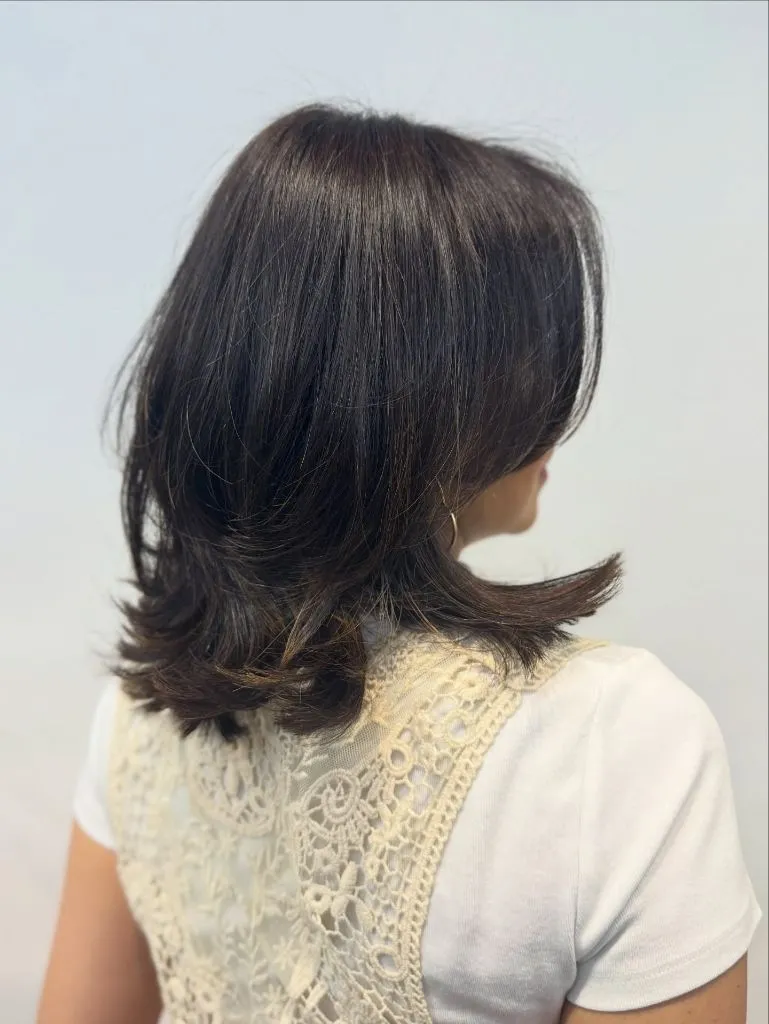
The lace-detailed top visible beneath adds a secondary texture layer — the geometric pattern of the lace reads against the organic sweep of the hair, and that contrast is worth studying. A small hoop earring catches a glint of light at the jawline, providing the only metallic accent and marking the transition from the smooth upper section to the textured lower section. The crown is flat and close to the head, which is what allows the feathered ends to command attention; if the roots had volume too, the layered tips would lose their hierarchy.
This is a style where the flip direction matters enormously. The outward orientation opens the silhouette and reveals the neck, while the same layers curled inward would create a completely different, more contained effect. If you want to test whether feathered layers suit your face shape before committing, a stylist can add movement with a round brush blowout on existing long layers — no cutting required. The trade-off is that feathered ends lose their definition faster than blunt cuts, so this shape benefits from regular trims every four to five weeks.
5. Natural Curl Pattern Carries All the Volume
Dense, defined curls dominate this composition so completely that every other element recedes into a supporting role. The curl pattern appears to be a natural type-3 spiral, tightly coiled with consistent diameter from root to tip, and the sheer volume of the hair creates a wide, rounded silhouette that extends well beyond the shoulder line on both sides. The colour is a deep, near-black brunette, and the overall mass reads as one unified texture field with no layering visible through the curls.
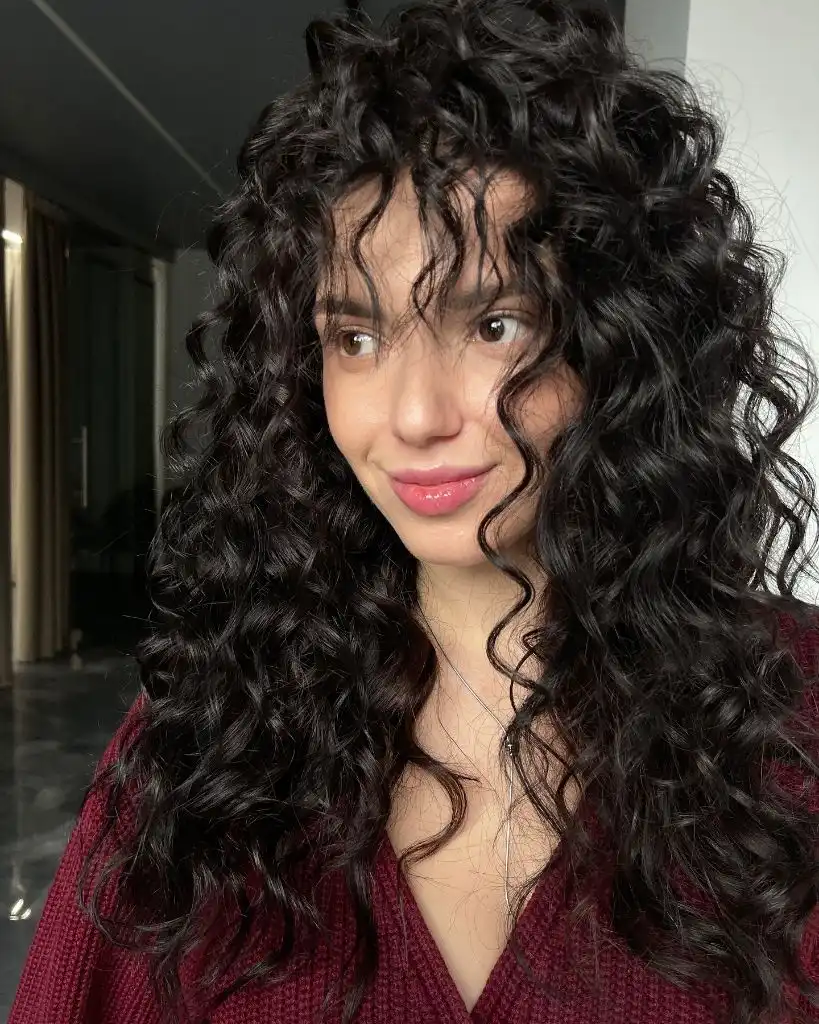
The burgundy knit top provides a dark, warm base that lets the hair silhouette define the frame without colour competition from below. Curtain-style bangs — also curled — sit across the forehead and act as a soft top border, connecting the side volume across the face rather than leaving the forehead exposed. Light catches the outermost curl spirals, creating a subtle halo of sheen that separates the perimeter from the background. The interior of the curl mass stays darker and more shadowed, which gives the style a sense of depth rather than flatness.
After the smoother, more structured shapes above, this style reads as the most texturally complex in the set so far. The transferable idea is that when natural texture is this pronounced, the styling task shifts from creating shape to preserving and defining the shape that already exists — hydration and curl definition products replace heat tools. The honest limitation is that shrinkage can make length unpredictable day to day, and the wide silhouette may not suit every professional context, though it carries undeniable visual authority.
6. Half-Up Knot Separates Two Texture Zones
The organizing principle here is a clear horizontal division: the top half of the hair is gathered into a small twisted knot at the crown, while the lower half falls in loose, soft waves past the shoulders. This two-zone structure creates a contrast between the smooth, pulled-back upper section and the textured, free-moving lower section. The colour is a warm strawberry blonde that lightens toward the ends, adding a subtle vertical gradient to the horizontal split.
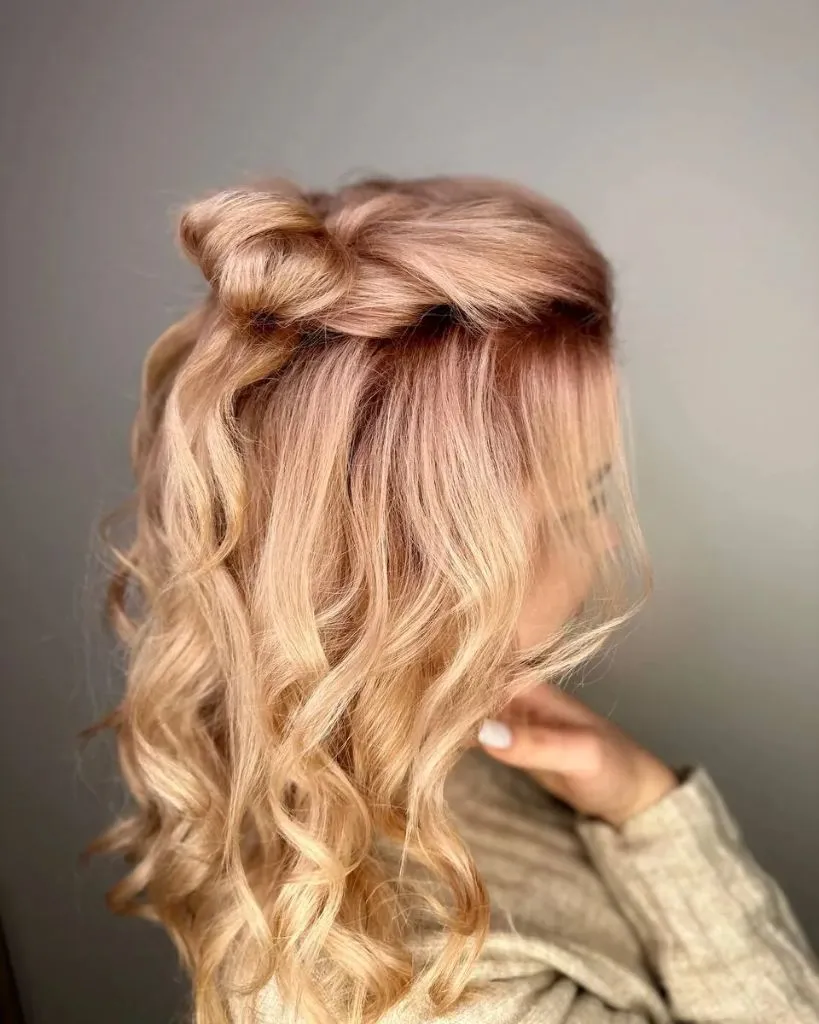
The knot itself is small and slightly messy — not a polished bun but a casual twist that allows a few shorter strands to escape around the face. This deliberate imperfection softens what could otherwise read as a severe pull-back. The waves below are medium-gauge, consistent in size, and appear to have been created with a curling tool rather than formed naturally, given their uniform spacing. The beige-toned top blends with the hair colour, reducing contrast at the shoulder line and keeping attention on the knot as the compositional anchor.
The practical value of this half-up structure is versatility: it controls volume at the crown while still allowing length and movement below, and it works on second-day or third-day hair when the root area has lost its freshness. If the knot were placed higher, the style would read younger and more casual; lower, and it begins to approach a chignon territory. For anyone browsing trendy hairstyles for women over 30, this split-zone approach is one of the more adaptable frameworks because the ratio of up-to-down can be adjusted to suit the occasion without changing the fundamental technique.
7. Tight Braid Extends the Head Silhouette Downward
A single, thick braid pulled from a sleek, flat crown dominates this image, and its visual effect is to extend the head’s vertical line dramatically downward past the shoulder. The braid itself appears to be a standard three-strand plait, tightly woven with no loose strands, and it hangs straight and heavy. The hair colour is a medium-to-dark brunette with subtle lighter sections woven through the braid, adding a faint striped dimension within the plait structure.
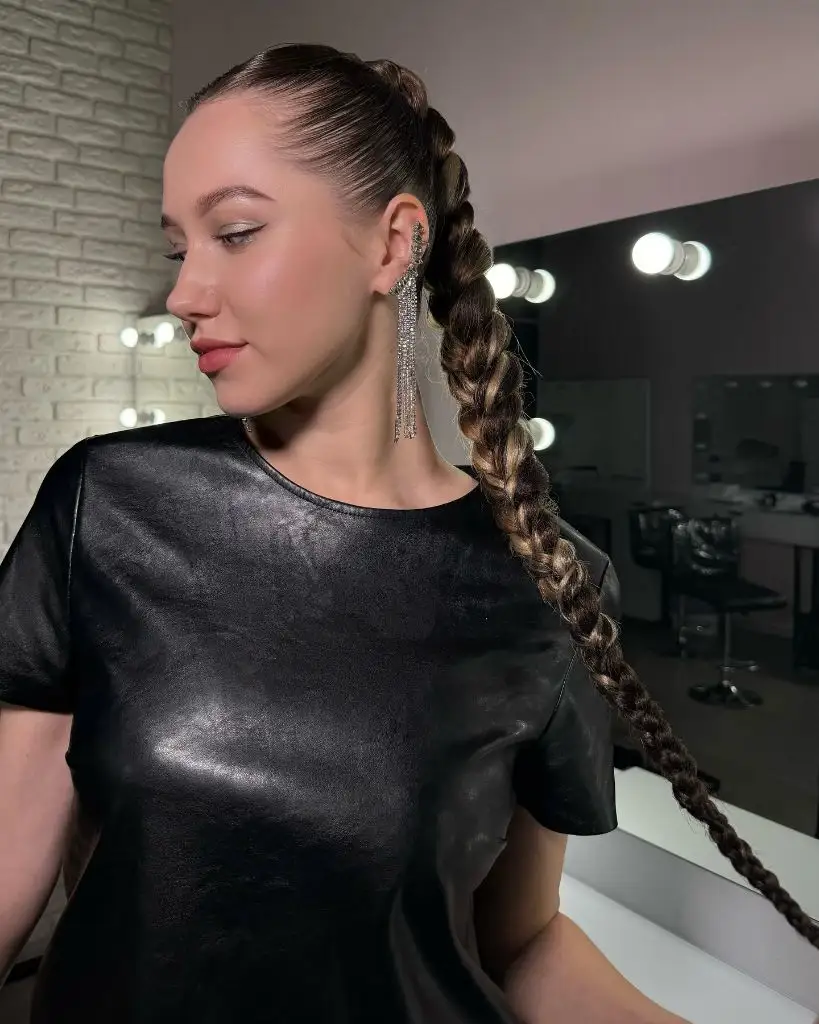
The black leather-looking top and crystal fringe earring create a high-contrast, editorial frame that positions this as a deliberate evening or event style rather than a casual daytime look. The slicked-back front section eliminates all volume above the ears, which is what gives the braid its graphic, elongated impact — without that flatness at the roots, the braid would look like an afterthought rather than the focal point. The earring’s vertical drop echoes the braid’s downward direction, reinforcing the compositional pull toward the floor.
Compared with the half-up knot in the previous item, this style commits entirely to control: there is no free-flowing section, no softness at the perimeter, no intentional imperfection. That commitment is its strength and its limitation. The look demands clean edges and a secure hold throughout the day, which typically means gel or pomade at the hairline and a setting spray on the braid. If you find the full slick-back too severe, leaving a few face-framing tendrils loose would soften the effect without undermining the braid’s linear authority.
8. Twisted Low Ponytail Balances Weight and Width
A low ponytail with a visible twist at the gathering point anchors this back-view composition, and the dominant feature is the interplay between the structured twist at the nape and the voluminous, wavy lengths that cascade below it. The hair transitions from a dark brunette root to warm honey-blonde ends, and that ombré gradient adds a vertical colour progression that reinforces the downward flow. The widest point of the silhouette falls at the mid-back where the waves expand outward.
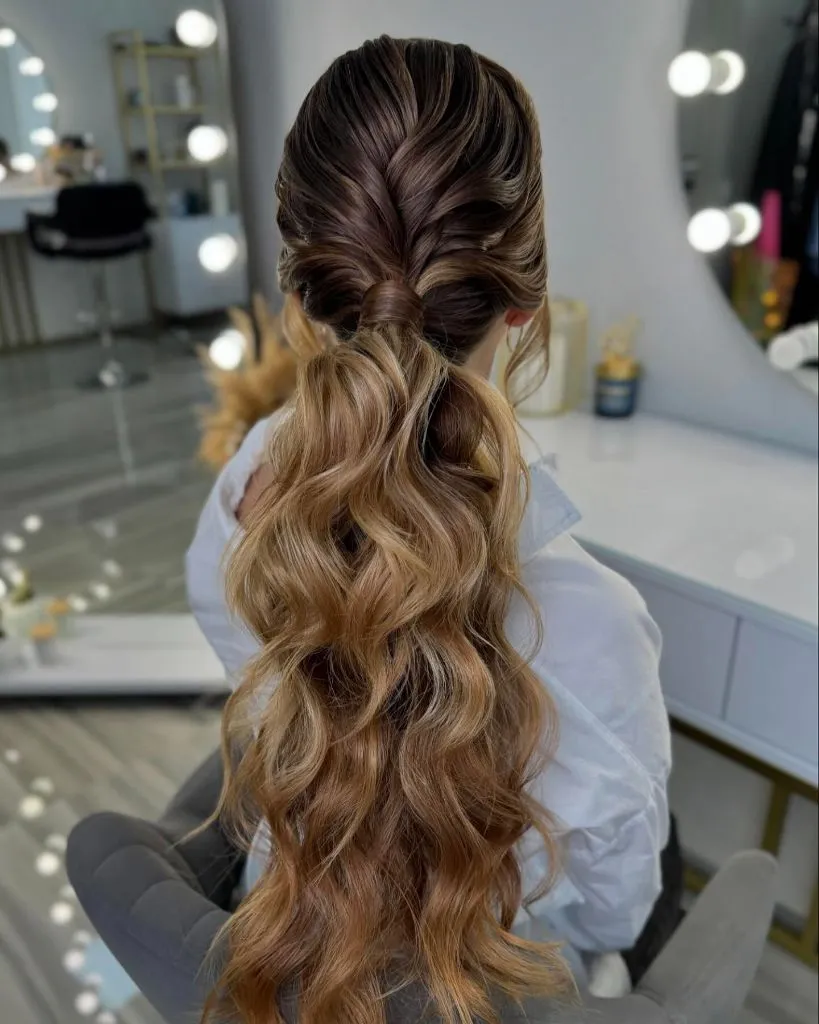
The twist at the nape functions as a visual hinge: above it, the hair is smooth and directed; below it, the texture opens up into loose, irregular waves that read as softer and more organic. This contrast between control and release is the mechanism that makes the style hold together compositionally. The white top visible at the shoulders stays neutral, allowing the hair colour gradient to be the primary visual event. Salon mirrors in the background suggest this was styled professionally, and the consistency of the wave pattern supports that reading.
This is a strong example of how a single structural detail — the twist — can elevate a basic ponytail into something that reads as considered. The style also illustrates a useful principle about where to place complexity: the twist sits at the most visible transition point, so a small effort there carries disproportionate visual impact. The trade-off is that the twist needs to be secure enough to hold the weight of long, thick hair below it, which often means pins or a wrapped elastic rather than a simple tie, adding setup time.
9. High Sleek Ponytail Sharpens the Profile
The dominant element is extreme: a high ponytail gathered at the crown, with the hair pulled so taut that the silhouette of the head is unbroken from forehead to elastic. The hair hangs perfectly straight below the gathering point, falling well past the shoulders in a single, dense sheet of near-black colour. There is no texture, no wave, and no layering — the entire impact comes from the height of the placement and the mirror-smooth surface.
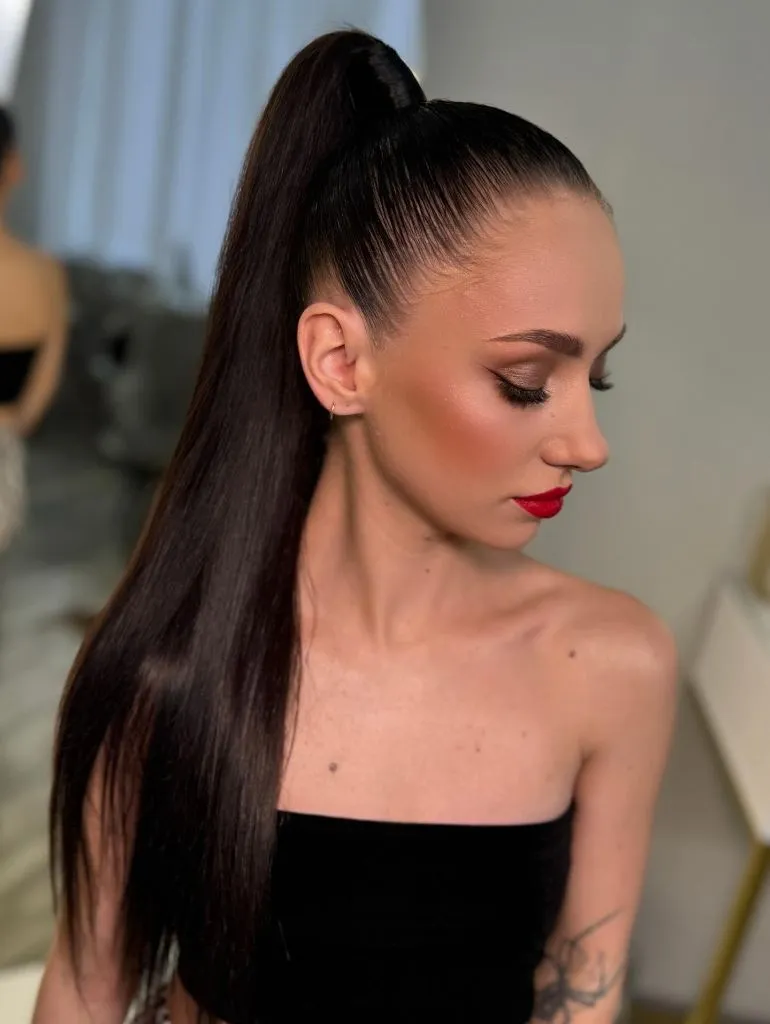
A black strapless top and bold red lip create a minimal, high-contrast frame that keeps attention on the ponytail’s line. The hair wrapping the elastic is a polished detail — no visible band, just a clean cylinder of hair at the apex. From the profile view, the ponytail extends the vertical axis of the head upward before gravity pulls it down, creating an angular, almost architectural shape. The absence of any accessory or earring is itself a compositional choice: nothing competes with the geometry.
After the twisted, ombré ponytail above, this version strips the concept down to its most graphic form. The takeaway is that height and sleekness together read as formal and intentional, while a lower, textured ponytail reads casual — same structure, different register entirely. The honest limitation is comfort and tension: a ponytail this tight can cause headaches over a long evening, and repeated wear at the same tension point can stress the hairline. Alternating the placement height between wears is a practical concession worth making.
10. Loose Waves Frame the Face With Soft Symmetry
Long, dark brunette waves fall on both sides of the face in a nearly symmetrical curtain, and the dominant impression is softness — the waves are wide-gauge, loosely formed, and uniformly distributed from the mid-lengths to the ends. A centre or near-centre part splits the volume evenly, and the hair sits close to the head at the roots before expanding outward at cheek level. The colour is a rich, cool-toned dark brown with no highlights or colour variation visible.
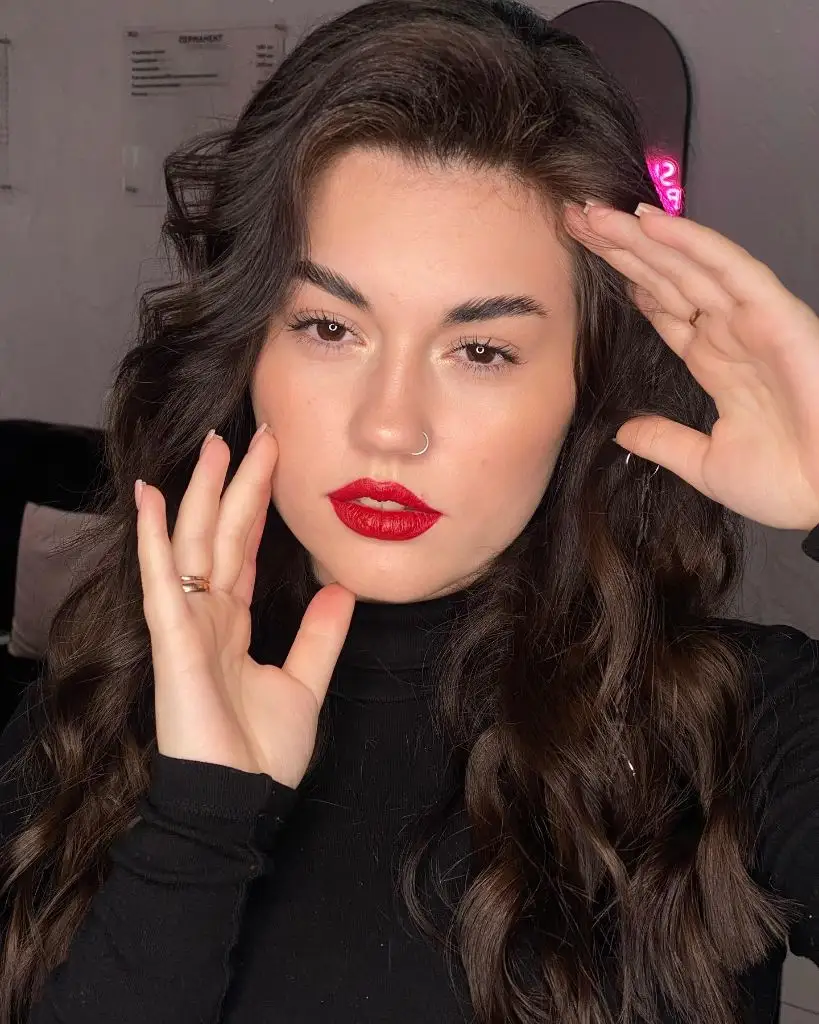
The black turtleneck-looking top disappears into the dark hair, which effectively erases the shoulder line and makes the face the sole bright element in the frame. A bold red lip anchors the lower third of the face and provides the strongest colour contrast in the entire image. A small nose ring adds a metallic pinpoint that catches light without disrupting the overall softness. The waves themselves are not ringlets — they are open, S-shaped bends that preserve length while adding just enough movement to prevent the hair from reading as flat.
The lesson here is about how symmetrical, face-framing waves create a natural oval border around the features, which is why this shape has remained a reliable choice across decades. Pushing the part to one side would introduce asymmetry and change the compositional mood entirely. If you want to explore variations on this approach alongside other styling ideas, the style guides at womenfashiontips.com offer additional context for pairing hairstyles with seasonal wardrobes. The low-maintenance appeal is real — these waves hold well as they loosen over two or three days.
11. Half-Up Bow Shape Anchors Pearl-Draped Curls
The organizing structure here is a half-up arrangement where the gathered section at the crown has been shaped into what reads as a bow or butterfly form — two symmetrical loops of hair flanking a central knot. Below that anchor, long ringlets fall in defined spirals, and delicate pearl-strung chains drape through the curls. The hair colour is a warm medium brunette with lighter, honey-toned sections visible in the lower lengths.
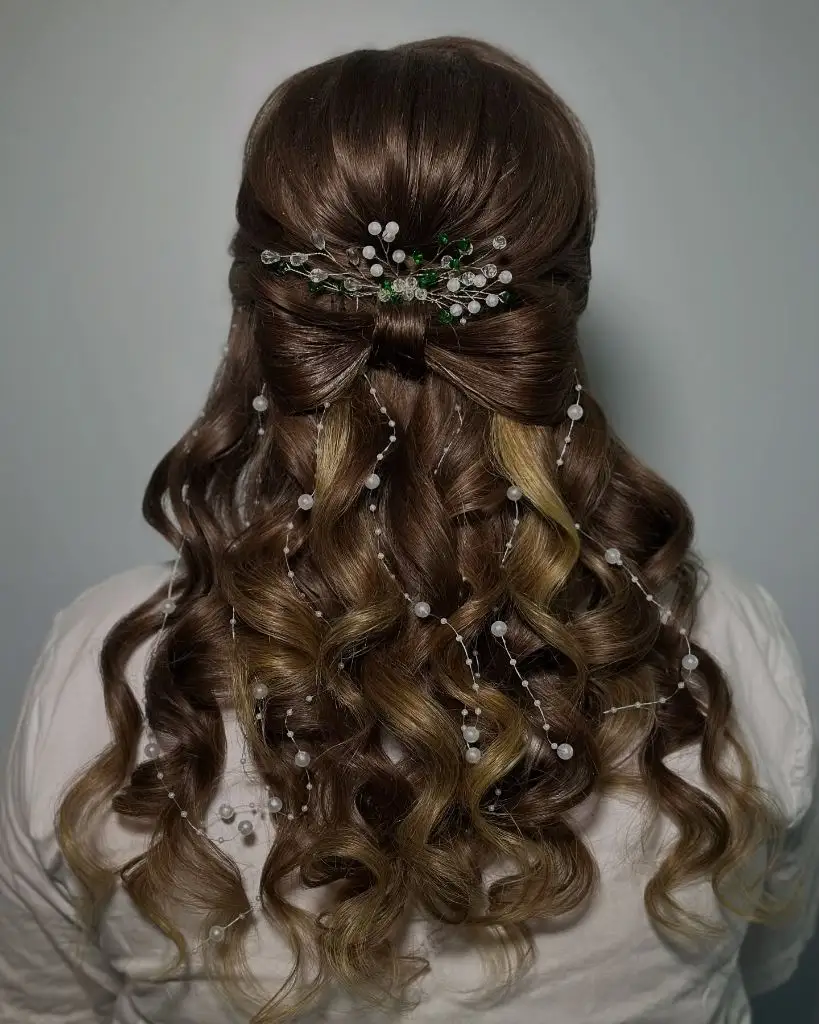
The pearl accessories are the secondary system that gives this style its event-specific character. They follow the vertical lines of the curls rather than crossing them, which means they reinforce the downward flow instead of interrupting it. A small floral or crystal hair pin sits at the centre of the bow, marking the apex of the composition. The white top beneath keeps the palette soft and bridal-adjacent. Each ringlet is uniform in gauge and spacing, suggesting hot-tool work or roller sets rather than a natural curl pattern — the regularity is the tell.
This is the most accessory-dependent style in the set so far: remove the pearls and the bow detail, and you have a standard half-up curly style. That dependency is not a flaw — it simply means the impact is occasion-specific rather than daily-wear. The bow structure at the crown requires considerable pinning and product to hold its shape, so this is a style best executed by a professional for a specific event. I like how the pearls add dimension without adding colour, keeping the palette restrained even as the structural complexity increases.
12. Uniform Barrel Curls Build a Dense Texture Field
Viewed from behind, the entire visible area is filled with medium-barrel curls in a warm, coppery brunette, and the effect is a single, dense texture field with almost no flat or smooth sections. The curls are remarkably uniform in size and spacing — each one a consistent spiral that sits neatly beside its neighbour — and the overall silhouette is wide and rounded, ending just past the shoulders. The colour has a warm, reddish undertone that catches light and creates visible highlights along the outer curve of each curl.
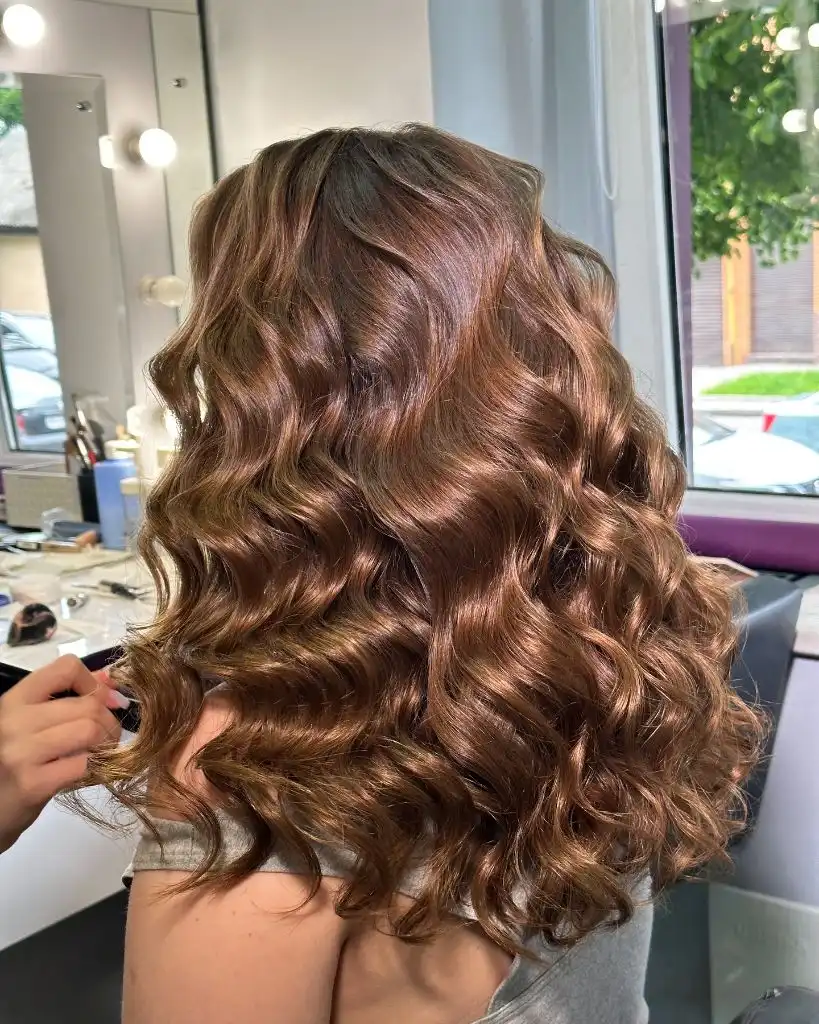
A salon setting is visible in the background, and a hand holding what appears to be a styling tool confirms this is a freshly finished style. The curls sit in rows that are almost grid-like in their regularity, which distinguishes this from the natural curl pattern seen earlier in the set — those were varied in diameter and direction, while these are clearly tool-made and intentionally identical. The grey top beneath stays neutral, and the background window light creates a sheen gradient from the inner curls to the outermost layer.
The transferable principle is that uniformity of curl size, more than curl type, is what creates this polished, finished-event quality. Mixing two or three different barrel sizes would immediately shift the look from formal to casual. The trade-off is longevity: tool-made curls of this consistency typically loosen within hours, especially in humid conditions, and maintaining the grid-like placement through an evening requires hairspray and minimal touching. For anyone drawn to trendy hairstyles for women over 30, this level of curl precision signals occasion wear rather than everyday styling.
13. Hollywood Waves Set a Vintage Rhythm
The dominant feature is a set of deep, S-shaped waves in a warm chestnut brunette that fall from a side part to just past the shoulders. Unlike the barrel curls above, these waves are continuous — each one flows into the next in an unbroken rhythmic pattern, creating the classic Hollywood wave effect. The silhouette is narrower than the previous item because the waves compress the hair into parallel ridges rather than allowing it to expand into individual spirals.
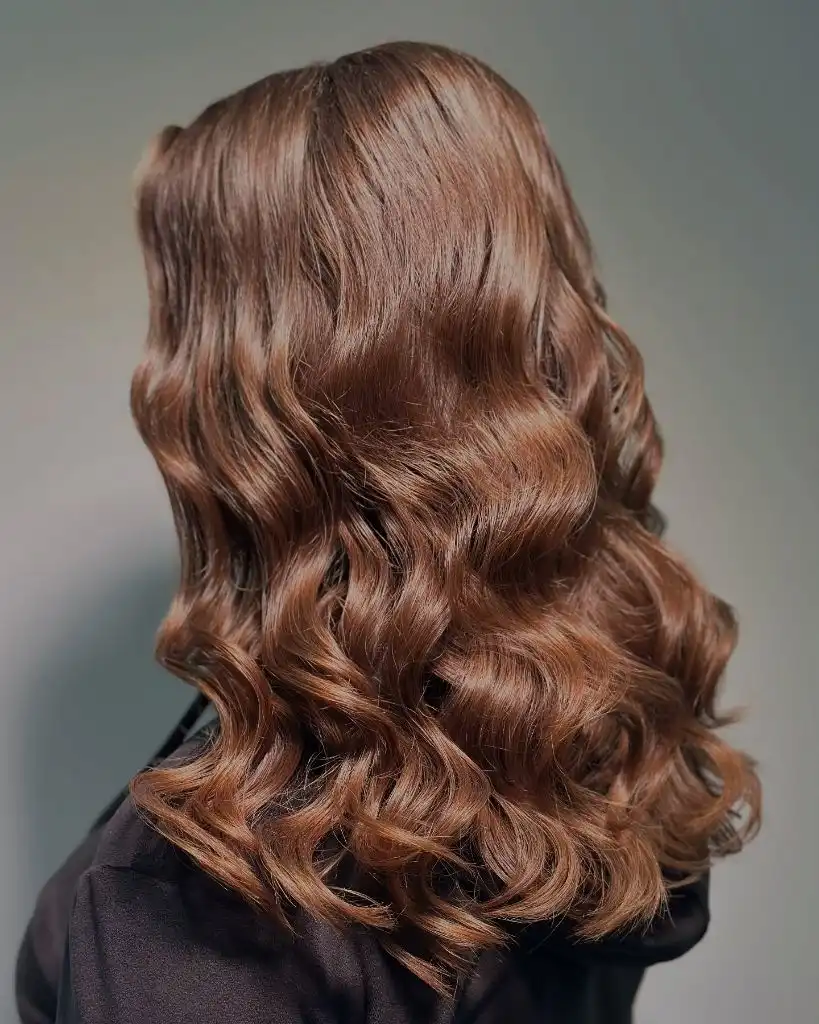
The waves are deepest and most defined at the mid-lengths, where the S-curves are at their widest amplitude, and they tighten slightly toward the ends. This tapering gives the silhouette a gentle narrowing at the bottom that prevents it from looking bottom-heavy. The dark top beneath creates a clean edge at the shoulder, and the absence of any visible accessories or parting details keeps all attention on the wave pattern itself. The surface sheen is high and continuous across each ridge, which is characteristic of styles finished with a pressing or smoothing technique after the wave is set.
Compared with the barrel curls in the preceding item, these Hollywood waves read as more controlled and more deliberately retro. The difference is structural: curls separate from each other, while waves connect. If you want the vintage feel with less rigidity, loosening the waves with a wide-tooth comb after setting will soften the ridges while preserving the overall rhythm. The upkeep note is that this level of wave definition typically requires a setting technique — either pin curls, a waving iron, or flat-iron manipulation — and resists being reproduced quickly on a weekday morning.
14. Accent Braid Interrupts a Straight Fall
Long, straight hair in a warm light brunette falls past the shoulders, and the single compositional interruption is a thin braid placed along the face-framing section on one side. The braid is decorated with small gold rings spaced at intervals, adding metallic accents to what is otherwise a completely minimal, unadorned style. The rest of the hair is smooth, flat, and parted to allow the braid to sit as a distinct linear element against the straight curtain behind it.
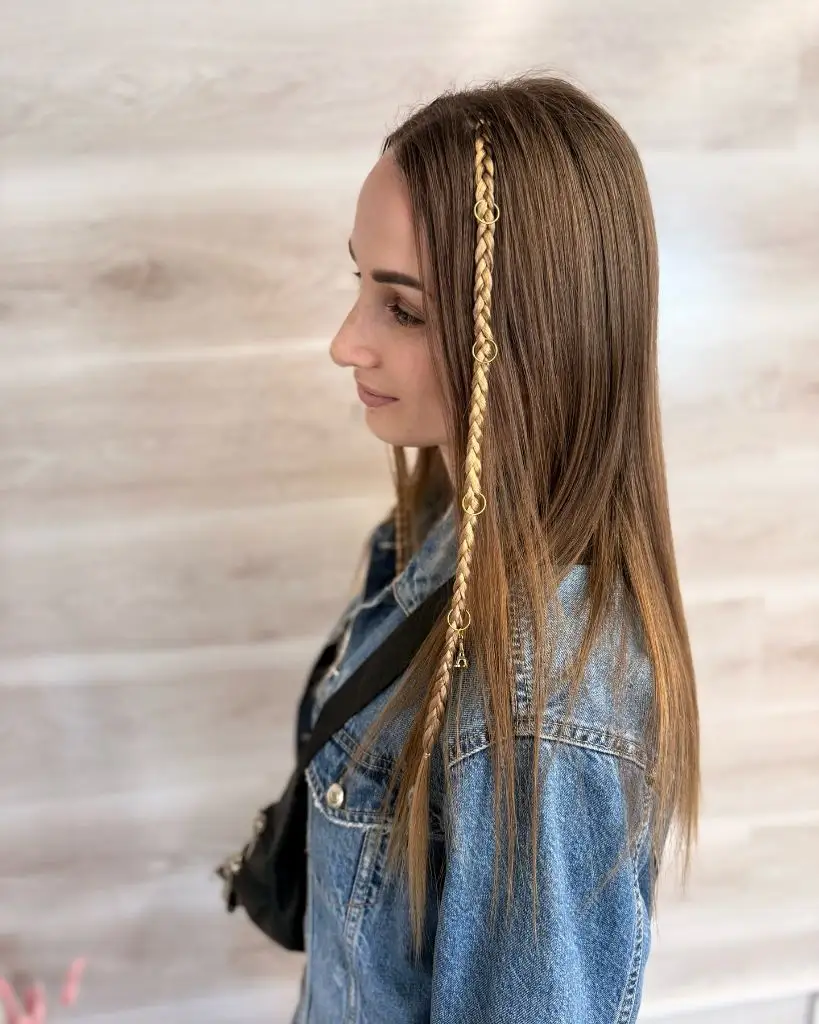
The denim jacket provides a casual textural base that positions this as a daytime, everyday style rather than an event look. The gold rings on the braid are the highest-contrast elements in the frame — they catch light against the muted hair colour and the faded blue denim, acting as small focal points that draw the eye down the braid’s length. The braid itself appears to be a simple three-strand plait, kept tight and neat. The straight hair behind it is the quiet backdrop that makes the braid legible; without that flat surface, the accent would get lost.
The principle at work is economy of detail: one small, specific intervention in an otherwise simple style creates more visual interest than multiple competing elements would. The gold rings push the look toward a boho or festival register, so removing them would make the same braid read more minimal and office-appropriate. I find the restraint effective here — the temptation with accent braids is to add more, and this image demonstrates why one is enough. The limitation is that the braid’s front placement means it is visible primarily from one angle, making it a detail that rewards face-to-face interaction more than a rear or side view.
15. Blunt Lob With Subtle Gradient Holds a Clean Edge
A straight, blunt-cut lob ending just below the chin anchors this composition, and the dominant quality is the precision of the perimeter line — there is no layering, no texturing, and no visible thinning at the ends. The colour transitions from a medium ash brunette at the roots to a slightly lighter, warmer tone at the tips, creating a soft vertical gradient that adds dimension without any dramatic colour break. The parting is slightly off-centre, and the hair falls in flat, smooth panels on both sides.
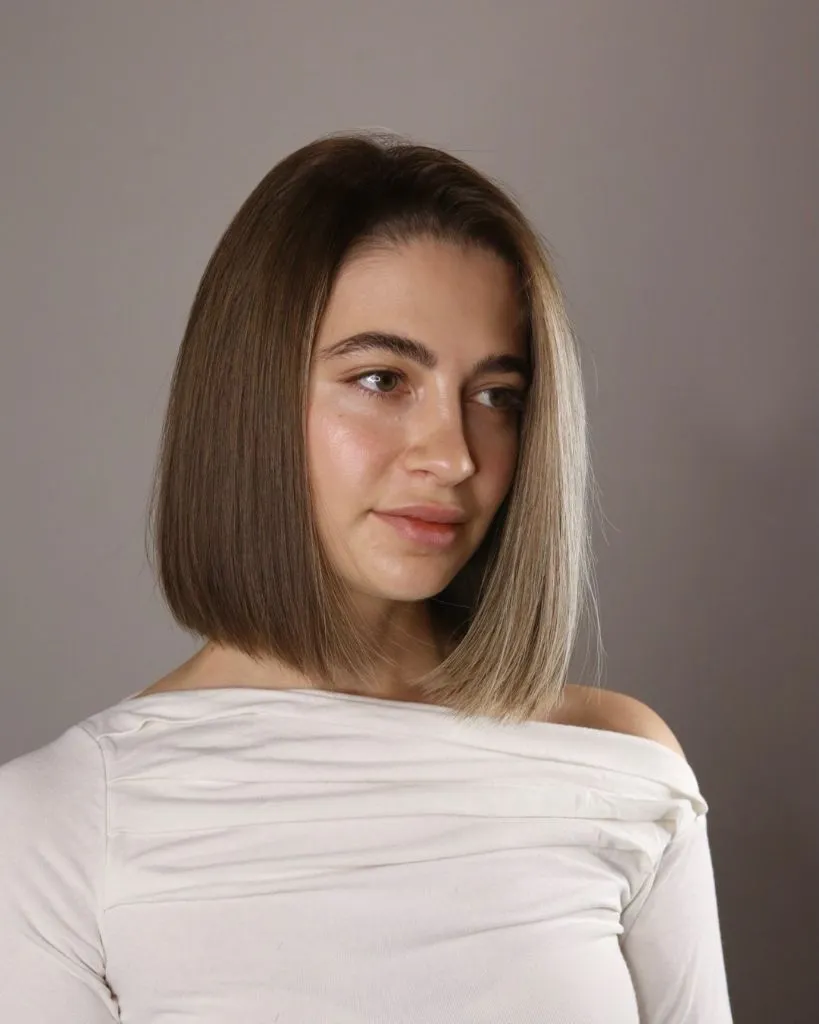
The off-shoulder white top provides a bright, clean base that makes the hair’s subtle colour gradient more visible than it would be against a dark background. The overall shape is almost architectural in its simplicity — two flat planes of hair meeting at the chin line, with the blunt edge providing a hard horizontal stop. There are no accessories, no earrings visible, and no styling product evident beyond a smooth finish. The flatness at the crown suggests either naturally straight hair or a careful blowout, and the lack of flyaways reinforces the controlled impression.
This is perhaps the most minimal style in the entire set, and that minimalism is its defining feature. The trade-off is clear: any imperfection — a single wave, a section that flips, an uneven growth pattern — will be immediately visible against this level of precision. Among trendy hairstyles for women over 30, the blunt lob occupies a specific position: it signals intentionality and requires consistent upkeep, but it pairs with virtually any wardrobe or occasion without competing for attention. It is the baseline against which the more complex styles in this set measure themselves.
16. Voluminous Blonde Curls Expand the Frame Outward
Large, barrel-curled blonde hair fills the composition from shoulder to shoulder, and the dominant impression is sheer width — the curls expand the visible silhouette well beyond the natural shoulder line, creating a generous, glamorous proportion. The colour is a warm golden blonde with slightly lighter pieces at the front that frame the face, and the overall palette reads as warm and high-contrast against the black top beneath. A deep side part directs the volume asymmetrically, with more mass falling to one side.
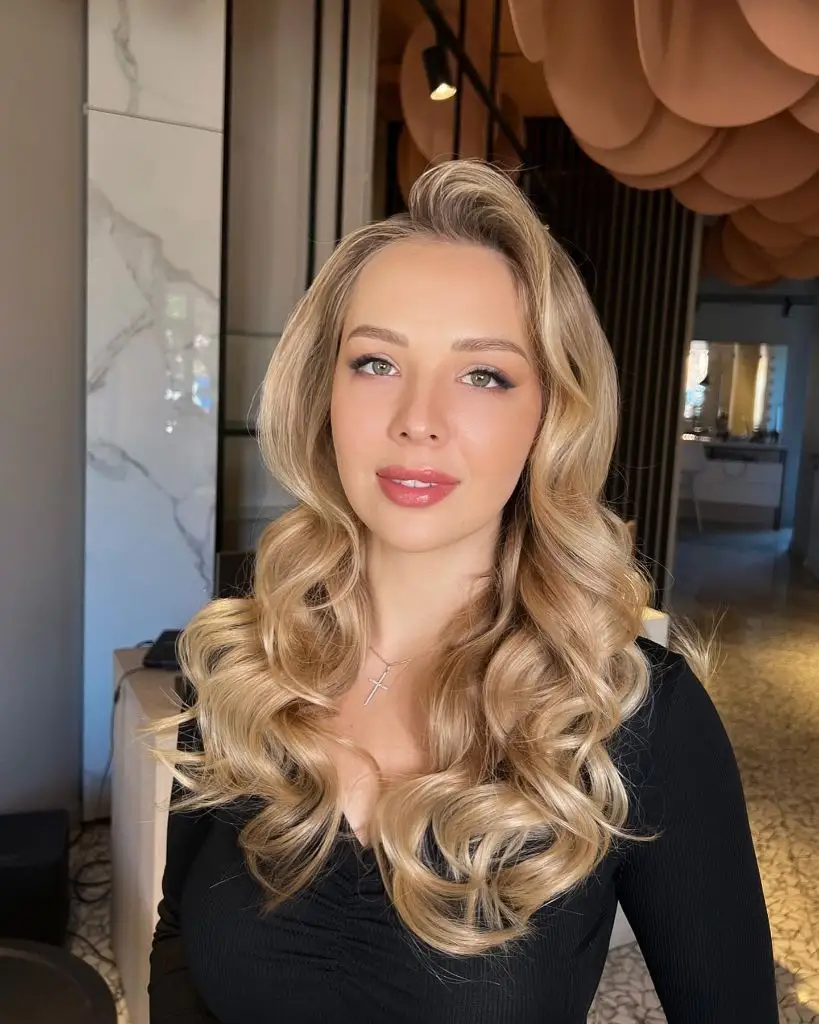
The curls are larger in diameter than the barrel curls seen earlier in the set — these are bouncy, open spirals rather than tight ringlets, and they maintain their shape from mid-length to ends without collapsing. A small cross pendant necklace provides the only accessory, sitting at the centre of the chest and acting as a quiet vertical anchor amid all the horizontal width of the curls. The face-framing pieces are lighter and slightly more separated, creating a brightness gradient that draws attention inward toward the features. The overall finish looks glossy and well-conditioned.
The compositional takeaway is that curl size directly controls how formal or casual a voluminous style reads: these large, open curls land in a polished-glamour register, while the same volume in smaller curls would shift toward a more textured, editorial direction. If you find this level of width overwhelming, reducing the curl count at the back while keeping the face-framing pieces would narrow the rear silhouette while preserving the front impact. The style demands long, healthy hair — thinning or damaged ends would not support curls of this diameter without looking sparse at the perimeter.
17. Textured Low Ponytail Softens a Twisted Crown
A low ponytail gathered at the mid-nape dominates this back view, but the visual interest lives in the crown section, where the hair has been twisted and woven into an irregular, textured arrangement before joining the ponytail. The hair is very dark, near-black, and the twists at the crown create shadows and ridges that give the upper section dimensional complexity. Below the gathering point, the ponytail falls in loose, slightly messy waves with visible flyaways at the edges.
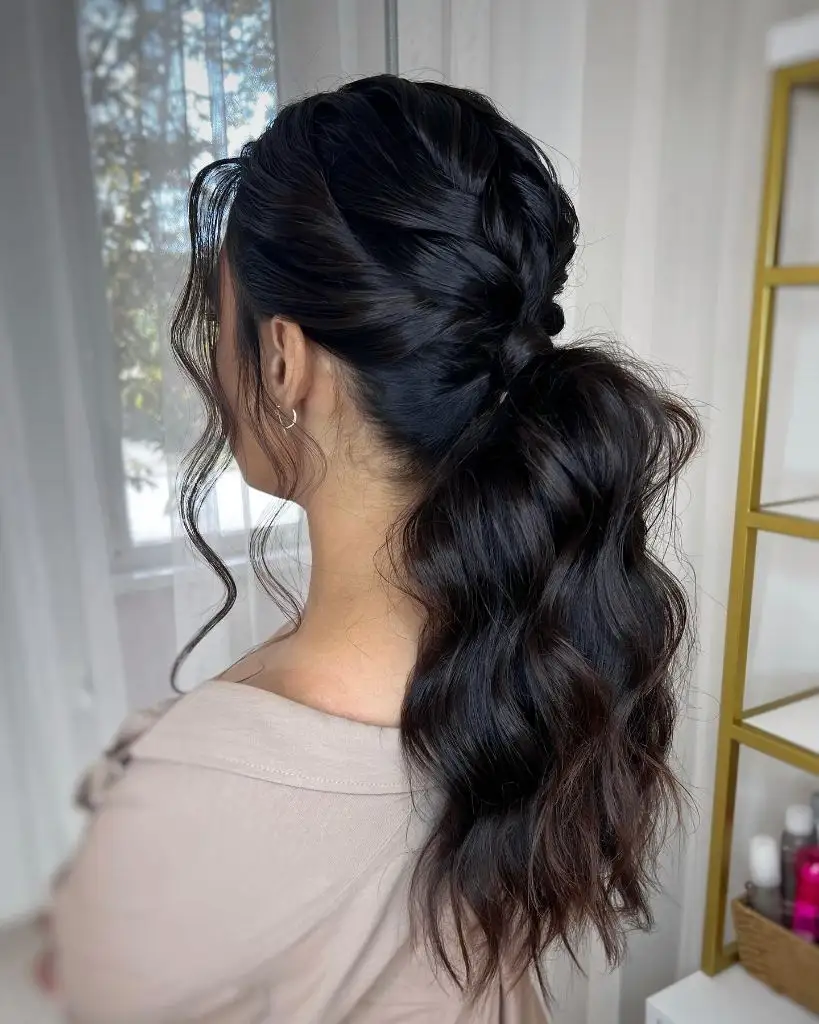
A few face-framing tendrils have been pulled loose at the temples, and these wisps soften the transition from the controlled crown to the open face. The beige-toned top stays neutral and does not compete with the hair’s dark colour. The ponytail’s texture is deliberately imperfect — the waves are varied in size and direction, and some strands separate from the main mass, which keeps the overall mood relaxed rather than rigid. A window with natural light in the background adds a soft backlight that catches the flyaways and turns them into a subtle halo around the ponytail.
Compared with the sleek high ponytail earlier in the set, this version occupies the opposite end of the formality spectrum: low placement, visible texture, intentional imperfection. The trade-off is that this deliberate messiness requires careful calibration — too much loose hair reads as unkempt rather than styled, while too little defeats the relaxed intention. Pairing this approach with accessories or fashion choices from resources like womenfashiontips.com can help contextualize the casual-formal balance for specific occasions. The style works well on second-day hair, which is a genuine practical advantage.
18. Layered V-Shape Distributes Movement Evenly
Viewed from behind, a medium-length cut in dark brunette hair reveals a clear V-shaped outline, with the longest point at the centre back and shorter layers framing the sides. The dominant quality is the even distribution of movement: every layer flips and curves outward by a similar degree, creating a consistent rhythm across the entire back section. The hair colour is a single, uniform dark brown with no highlights, and the overall impression is of healthy, thick hair with natural body.
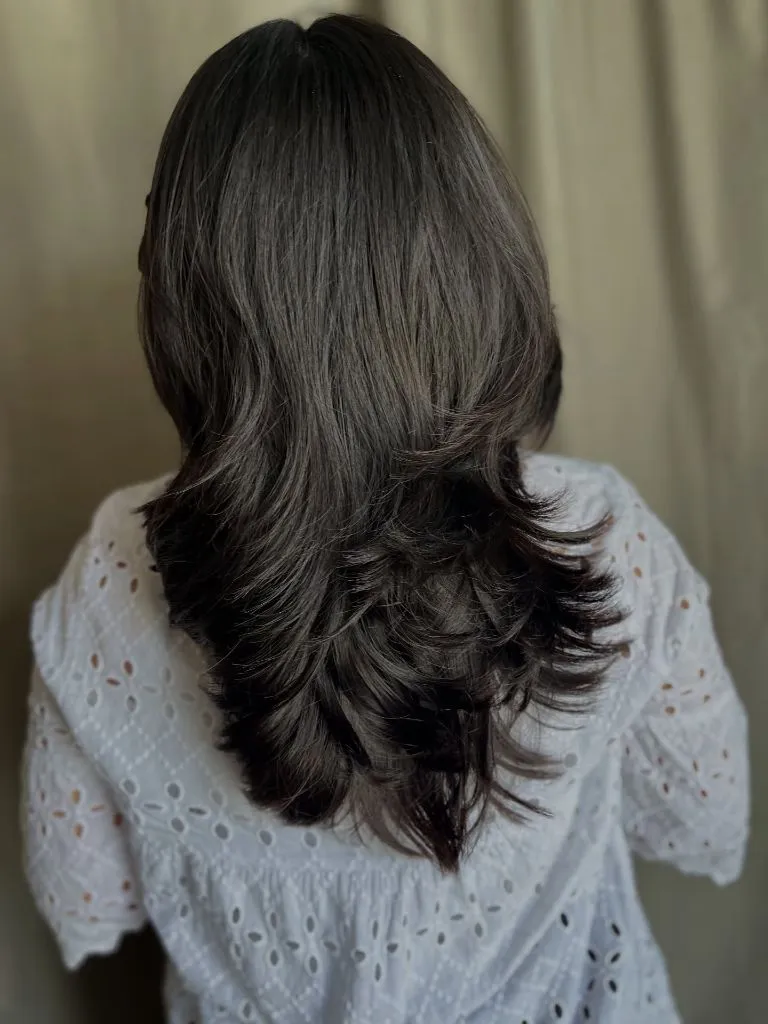
The white eyelet top — similar in fabric to the one seen in the second item — provides a light, textured base that contrasts with the dark hair without introducing competing colour. The layers are graduated smoothly, with no abrupt jumps in length, which is what creates the flowing V rather than a choppy, disconnected shape. The ends show a natural-looking outward flip that appears to come from the cut itself rather than from styling tools, as the curl direction is varied and organic rather than uniform. The crown section is smooth and flat, directing all compositional energy to the lower two-thirds.
The V-shape is one of the more forgiving structures for long or medium-length cuts because it accommodates natural growth patterns — hair grows at the perimeter without immediately disrupting the outline the way a blunt cut would. This makes it a practical choice for anyone who wants to extend the time between salon visits. The adaptation worth noting is that a U-shape rather than a V would soften the centre point and create a rounder, less angular back view, which may suit rounder face shapes or those who prefer a gentler silhouette from behind.
19. Angled Bob Sharpens the Jaw-to-Nape Transition
A dark brunette bob with a pronounced angle — shorter at the nape, longer at the front — controls this composition, and the dominant feature is the diagonal line it creates from the back of the head forward to the chin. The shorter back section reveals the nape and creates visual lightness, while the longer front pieces add weight and direction toward the face. Volume sits primarily at the crown and mid-lengths, with the ends lying flat and smooth.
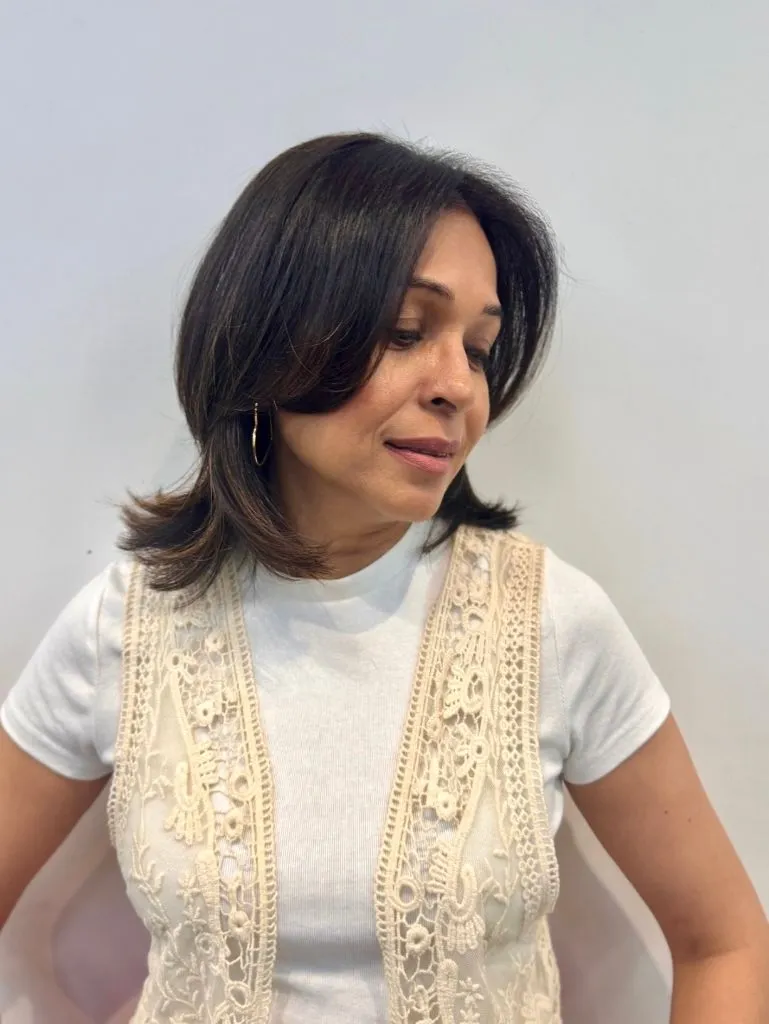
The lace-trimmed vest over a white tee introduces a vertical texture that runs parallel to the hair’s forward-falling direction, and that alignment makes the composition feel cohesive. A small hoop earring is visible and marks the midpoint of the angle — the spot where the hair transitions from exposing the neck behind it to covering the jaw in front. The surface finish is smooth and slightly glossy, with a subtle inward curve at the front tips that keeps the longer sections from looking stringy or thin. The overall palette is restrained: dark hair, white and cream clothing, gold jewelry.
The angled bob is a staple among trendy hairstyles for women over 30 precisely because the diagonal line creates the illusion of a sharper jawline without any other intervention. The degree of the angle is the variable worth controlling — a steep angle creates more drama and a stronger forward pull, while a gentler angle reads as a standard bob from most angles. The practical note is that the angle requires consistent trimming to maintain its geometry; as the shorter back section grows, the diagonal flattens and the style loses its defining characteristic within six to eight weeks.
20. Pearl-Studded Updo Lifts All Weight to the Crown
An elaborate updo gathers all the hair into a large, sculptural form at the crown, and this total upward displacement is the dominant compositional move. The hair is a warm golden blonde, and the bun-like structure is large enough to significantly alter the head’s proportional silhouette — it adds height and width above the natural crown line. Small pearl pins are scattered across the surface of the style and along a curled tendril that escapes from the base of the updo, adding delicate white points against the warm gold.
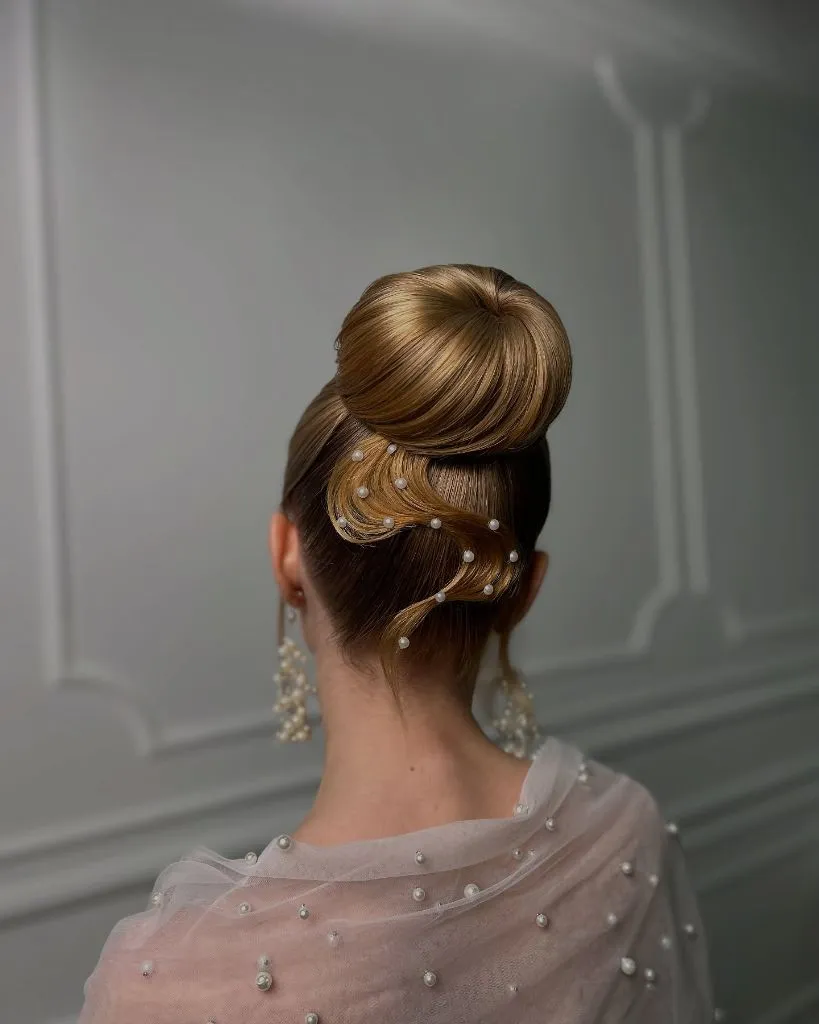
The sheer, pearl-dotted fabric of the top echoes the pearl pins in the hair, creating a deliberate material conversation between the clothing and the styling accessories. Pearl drop earrings extend this motif downward, so the pearl becomes a unifying element that ties together three separate zones: hair, ears, and shoulders. The nape is fully exposed, and a single curled strand falls from the base of the bun, providing the only softness in an otherwise tightly controlled arrangement. The overall colour palette — gold, cream, and pearl white — stays within a narrow warm-neutral range.
This is the most architecturally ambitious style in the set, and its event-specific nature is obvious: this is bridal or formal-occasion territory, not a Tuesday afternoon option. The curled tendril at the nape is doing important work — without it, the updo would read as severe, but that single soft element introduces enough organic movement to keep the style from feeling rigid. The limitation is structural dependency on pins, product, and professional execution; this is not a style that can be self-replicated easily, and it requires a specific hair length and density to achieve the volume visible in the bun without padding or extensions.