Trendy haircuts for women over 50 in 2027 become far easier to evaluate when you stop fixating on any single detail — a fringe line, a colour choice, a layering pattern — and instead study how each cut is composed as a whole. Proportion between crown volume and nape length, the contrast of colour against skin tone, the scale of texture relative to face shape, and the spacing of layers through the silhouette all matter more than any isolated trend label. These are the structural forces that make a haircut read as intentional.
Before scrolling through the twenty shapes below, give yourself a comparison framework. Notice first where each cut places its visual weight — high at the crown, low at the ends, or evenly distributed. Then look at how the perimeter finishes: does it taper to a point, curve inward, or end bluntly? The trade-off worth weighing throughout is volume against maintenance, since fuller silhouettes often demand more frequent reshaping while closer crops hold their geometry longer. No single formula here qualifies as a rule, and the most useful takeaway will come from noticing which structural decisions repeat across very different lengths and colours.
1. Layered Crown Lifts a Tapered Nape
A deep auburn-toned pixie controls this composition from the crown, where short, stacked layers create the tallest point of the silhouette. The colour sits in the dark burgundy-to-copper range, and the volume concentrates above the ear line while the nape tapers closely to the neck. The back view reveals that the cut’s entire architecture is about pushing height upward while keeping the lower perimeter narrow and clean.
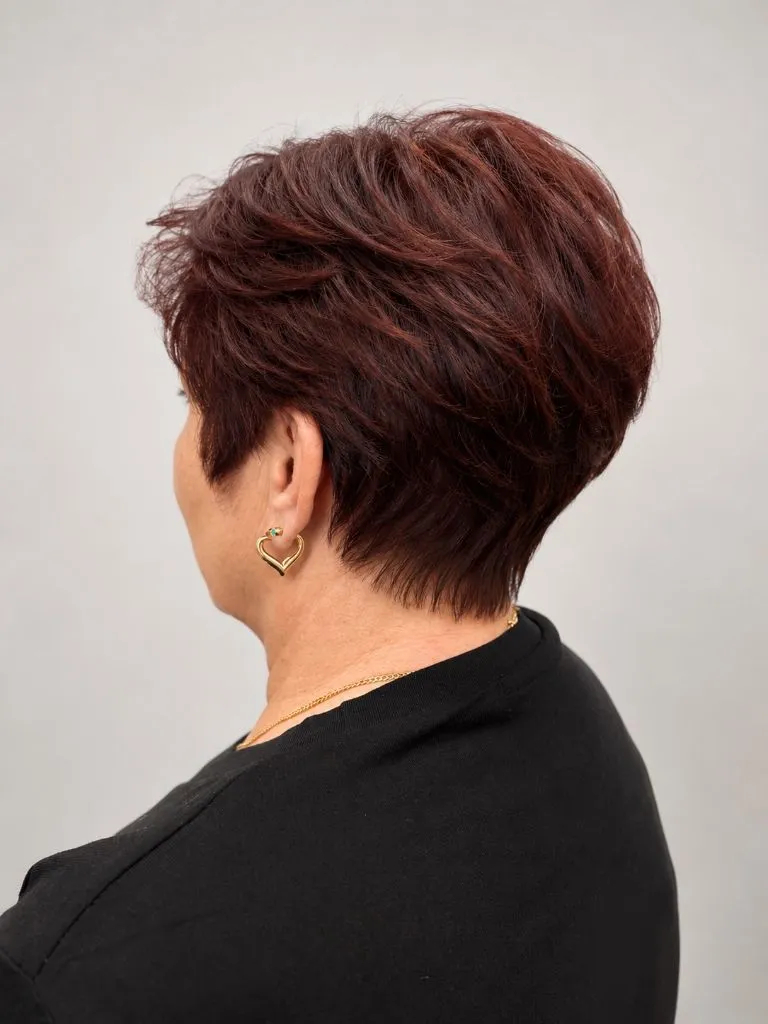
The secondary texture comes from the wispy, slightly separated ends through the mid-lengths, which keep the shape from looking too helmet-like. A heart-shaped gold earring and a thin chain at the neckline sit below the cut’s endpoint, reinforcing how high the hair’s visual weight actually lives. The warm red tone is consistent from root to tip, which means the colour supports the shape rather than competing with it — there is no highlight or lowlight breaking up the surface.
The transferable principle is purely architectural: when volume is concentrated at the crown and the nape is kept tight, the eye reads length in the neck and lift in the profile, even on a very short cut. If you wanted to soften this, letting the nape grow even a centimetre longer would relax the contrast between the full top and the close sides without losing the overall proportion.
2. Curtain Fringe Anchors a Shaggy Mid-Length
Here the dominant element is a heavy curtain fringe that falls past the eyebrows and immediately frames the face, setting the entire tone for a shoulder-length shag. The medium brown colour is uniform, and the layers begin quite high — almost at cheekbone level — then cascade outward with visible texture through the ends. This is a cut built around movement rather than structure.
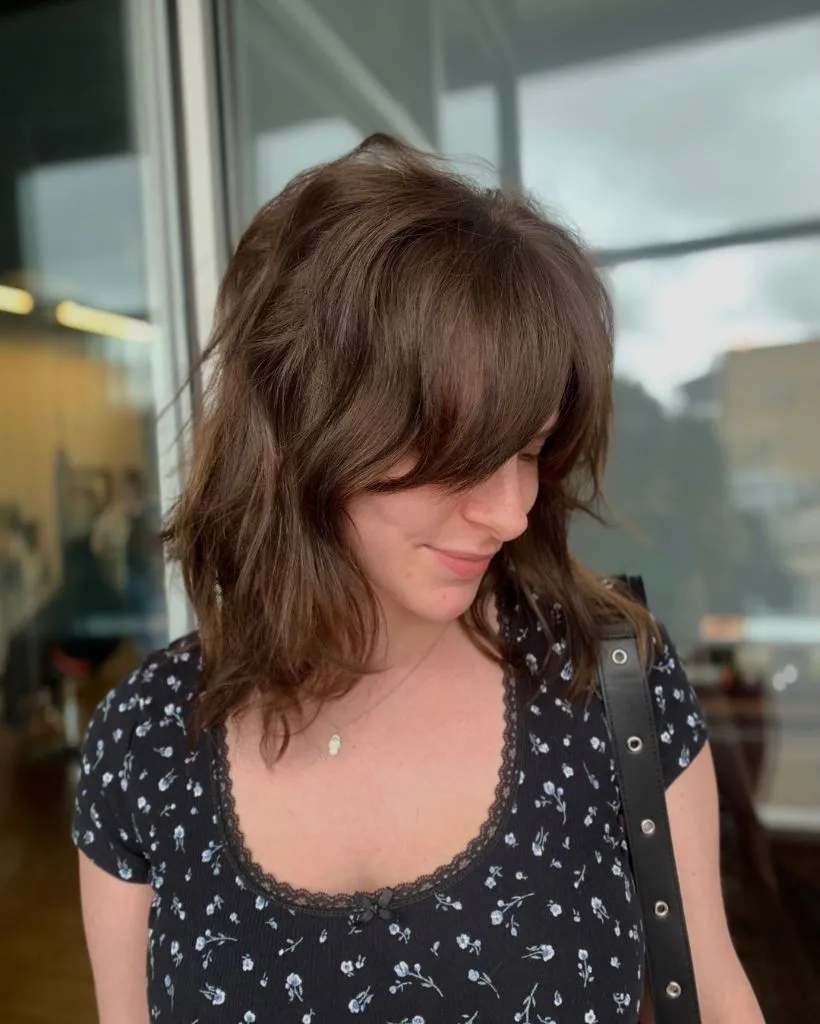
The supporting elements are the face-framing pieces that separate from the fringe and curve toward the jawline, creating a second, narrower frame inside the wider silhouette. The ends throughout appear deliberately roughened — possibly razor-cut or point-cut — which gives the whole shape an undone quality that prevents the heavy fringe from reading as too polished. The dark floral top disappears behind the hair, letting the texture stay the focal point.
Compared with the tight, upward-focused pixie above, this cut distributes its weight almost entirely downward and outward. The honest limitation is upkeep: a fringe this heavy needs trimming every few weeks to stay above the sight line, and the shaggy layers will lose their separation as they grow. For anyone exploring trendy haircuts for women over 50 2027, this shape works best on hair with some natural wave that holds the textured movement without daily styling intervention.
3. Side-Swept Layers Frame a Smooth Lob
A chocolate-brown lob dominates this composition, falling just past the collarbone with the ends gently flipped outward. The side parting sends the hair across the forehead in a smooth, diagonal sweep, and the layers are cut long enough that they blend rather than separate. Warm caramel-toned highlights run through the mid-lengths, adding dimension without disrupting the overall colour field.
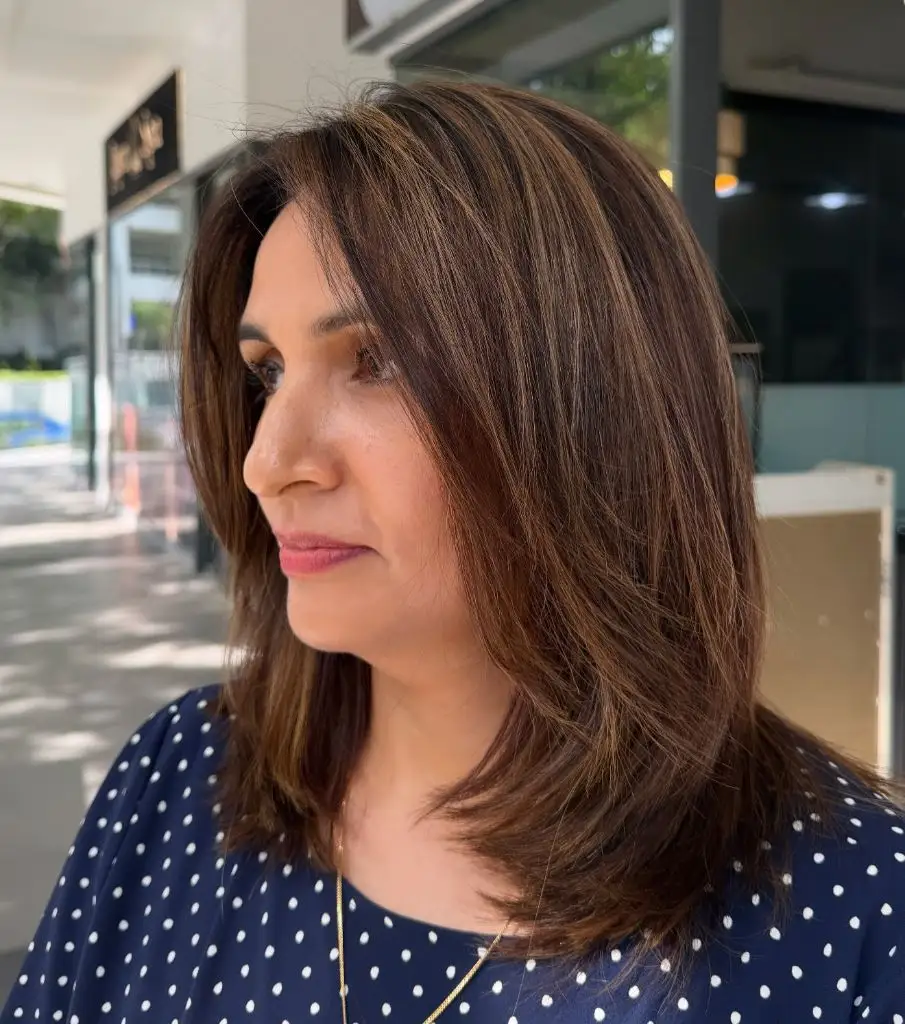
The highlights function as the secondary hierarchy: they catch light along the front sections closest to the face and thin out toward the back, which means the brightest point of the hair sits exactly where the eye goes first. The blue polka-dot top provides a cool-toned backdrop that makes those warm brown and caramel tones appear richer by contrast. The surface reads smooth and well-conditioned, with minimal flyaways, which keeps the palette clean.
The practical takeaway here is about endpoint behaviour. The slight outward flip at the ends adds width at the shoulders, which can balance a narrower jawline but may add unwanted breadth if that is not the goal. Swapping the flip for a slight inward curl would close the silhouette and create a more contained shape. This is a useful reference for how subtle the difference between an open and closed perimeter can be at the same length.
4. Silver Layers Cascade Below the Shoulders
A full head of silver-grey hair takes over this frame, falling several inches past the shoulders with visible layering that begins at mid-length and builds volume toward the ends. The back view shows a rounded, almost bell-shaped silhouette — widest at the lower third, with the crown sitting flat by comparison. The colour is a natural-looking silver that shifts between cooler steel tones at the roots and warmer white tones through the ends.
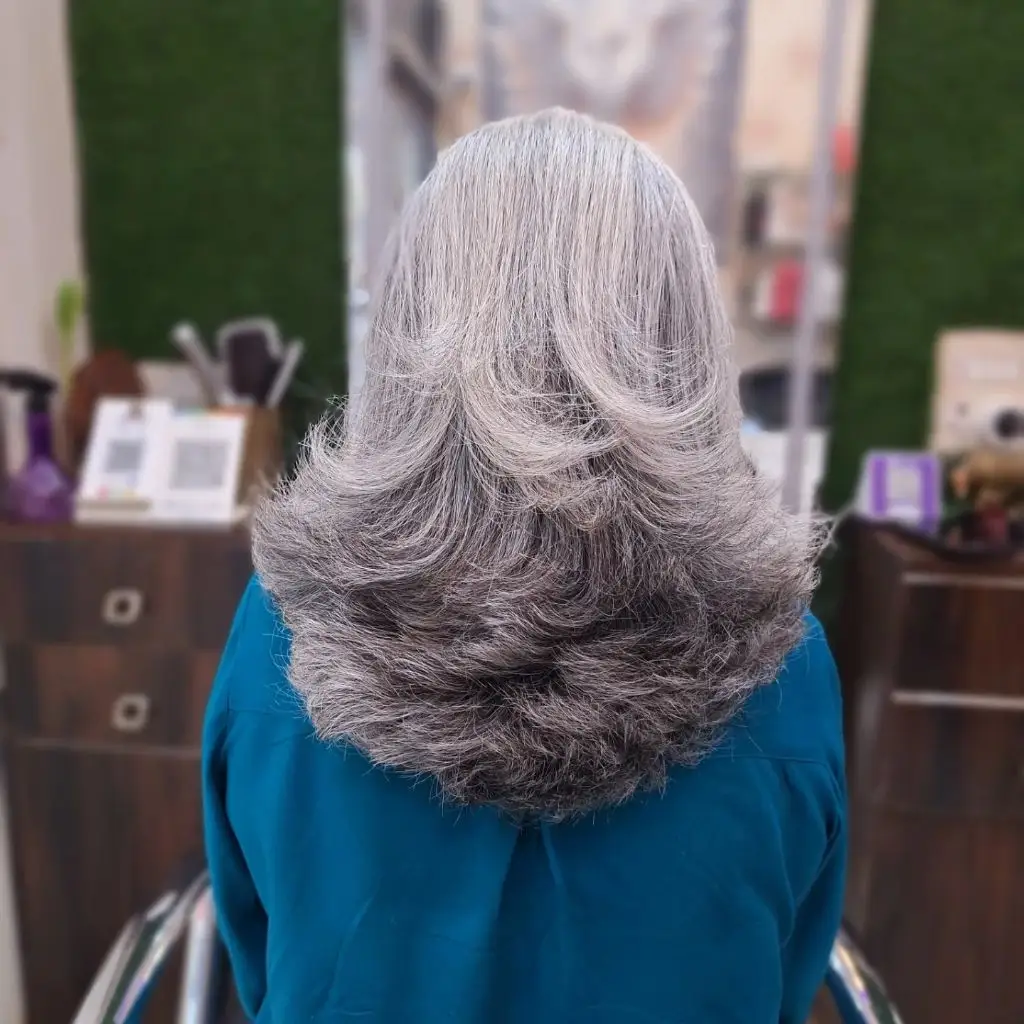
The layers do the real structural work here. Each tier flips outward slightly, creating horizontal lines that stack from mid-back to the bottom edge. A teal top beneath provides strong colour contrast, making the silver appear brighter and more deliberate. The setting is clearly a salon, with products and tools visible in the background, and the hair looks freshly styled with heat, given the uniformity of the curl direction through those lower layers.
The limitation worth noting is that this shape places all its visual weight at the bottom, which can pull the eye downward rather than toward the face. If the goal is to keep attention at eye level, building more volume or layering at the crown would redistribute the proportion. After the smooth, controlled lob above, this reads as a dramatically different approach to medium-length hair — one that fully embraces volume rather than containing it.
5. Swept-Back Volume Meets Loose Curls
A strawberry-blonde colour dominates this composition, with the hair swept back from the face and falling in loose, open curls past the shoulders. The front view shows volume concentrated at the crown and temples, pushed upward and back, which creates a retro-leaning proportion. The face is fully exposed, with no fringe or face-framing pieces interrupting the forehead line.
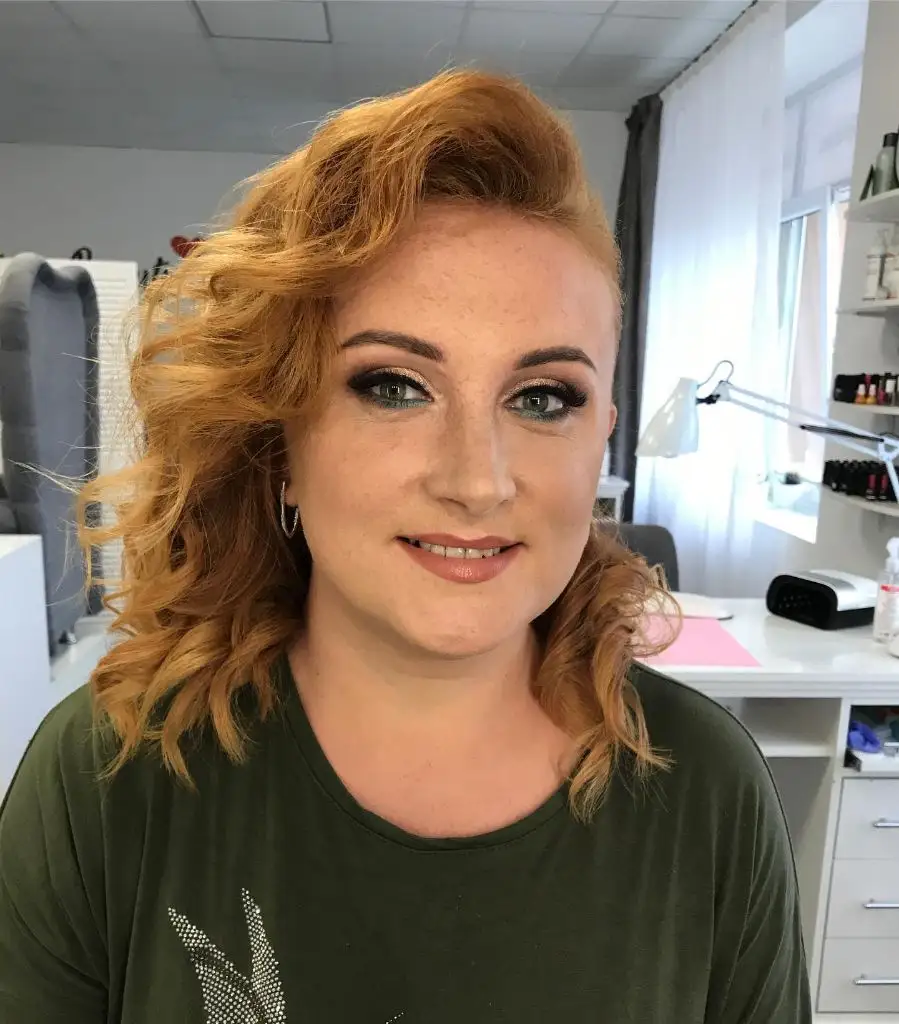
The curls through the mid-lengths and ends serve as the secondary texture, softening what could otherwise be a stiff, blown-back shape. The green-toned top sits low in the frame and offers a muted complement to the warm copper-blonde palette. Eye makeup with a smoky, metallic quality echoes the warmth of the hair without competing with it. The overall effect is a composition where the hair’s height and the face’s openness share the visual hierarchy almost equally.
The styling investment here is the honest consideration. Maintaining this much lift at the crown while keeping the curls soft and separated likely requires a combination of root-lifting product and a large-barrel curling tool. For anyone drawn to trendy haircuts for women over 50 2027 who also wants this kind of volume, the trade-off is daily effort versus a wash-and-go expectation — this is not a low-maintenance shape.
6. Curled Mid-Length Builds Outward Width
The same strawberry-blonde colour appears here in profile, but the composition reads differently because the curls are more defined and the width extends further from the head. The hair falls to just below the chin, with each curl forming a distinct S-shape that takes up considerable horizontal space. The ear is just barely visible beneath the volume, which tells you how much lateral expansion the styling creates.
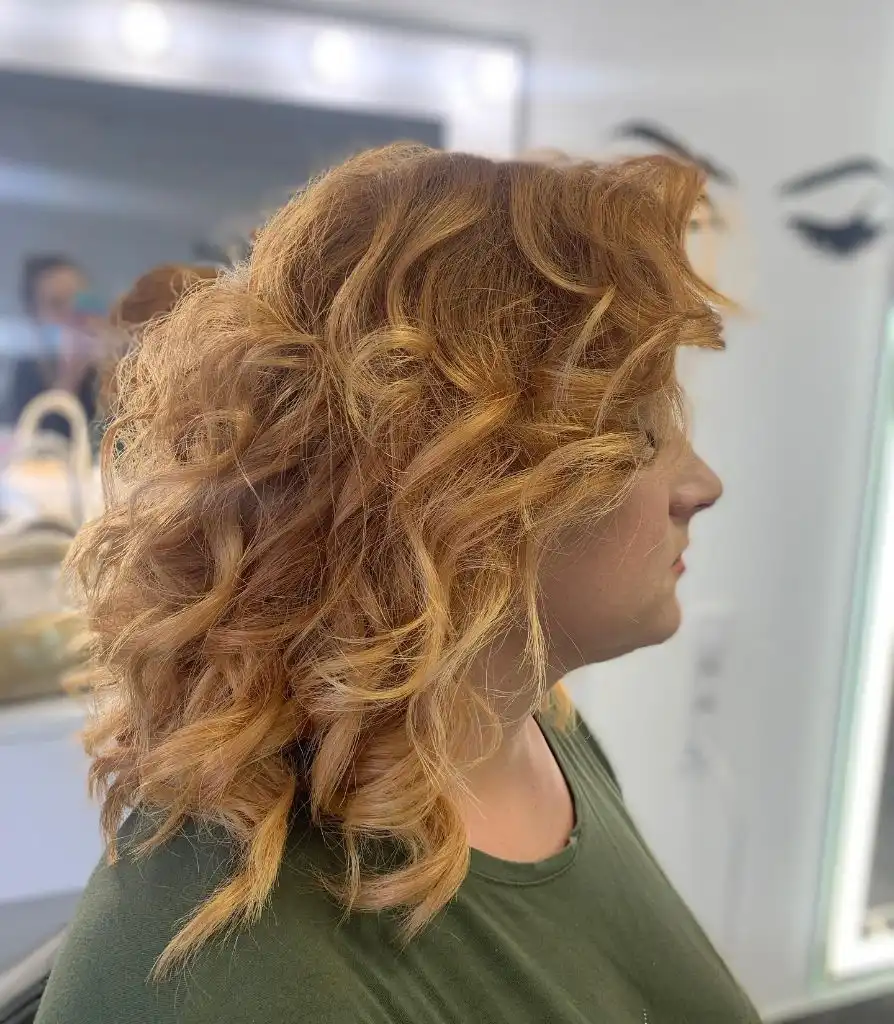
Compared with the front view in the previous item, this profile reveals that the silhouette is rounder and wider than it appeared head-on. The curls are not uniform — some are tighter near the crown, looser toward the ends — which gives the shape a natural, unstructured quality despite clearly being styled. The background shows a salon mirror and another person, confirming this is a professional styling result rather than an everyday look.
The useful observation is about silhouette testing. A cut and style can appear balanced from the front but dramatically different from the side, especially when curls add width. If you are considering this kind of volume, checking the profile proportion is essential — the side view is where you will see whether the shape flatters or overwhelms. The difference between these two angles of the same hair is itself a lesson in how photographs can mislead when only one perspective is available.
7. Blonde Layers Taper to Feathered Ends
A dark-rooted blonde takes centre stage here, viewed from behind, with the hair reaching just past the shoulder blades. The layers are cut in a noticeable gradient — shorter near the crown, longer toward the bottom — and the ends show a feathered, slightly thinned quality that softens the perimeter. The colour transitions from a warm medium blonde at the roots to a lighter, cooler blonde at the tips.
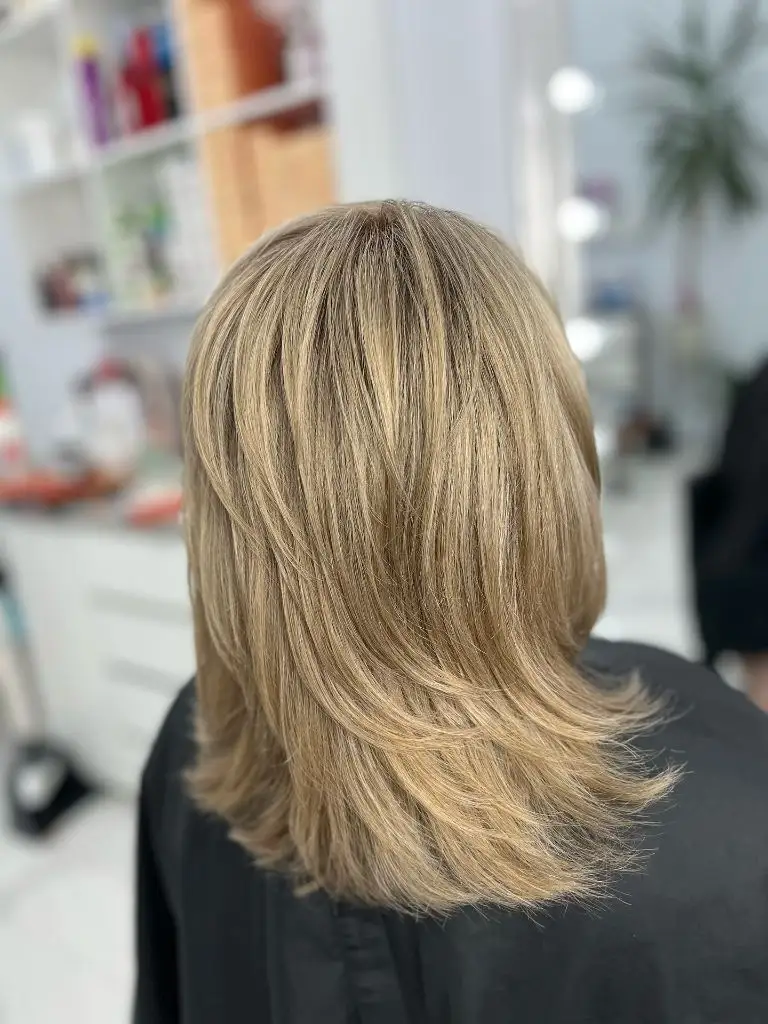
The salon setting is visible with products on shelves behind, and the hair appears freshly blow-dried with the ends flicked outward in alternating directions. This gives the lower half of the shape a sense of movement without the tight curl definition seen in the strawberry-blonde set. The layering keeps the silhouette from appearing heavy, even though there is substantial length. The root-to-tip colour gradient functions as a built-in dimension tool, making the flat back view feel less one-note.
The transferable lesson concerns the feathered endpoint. Thinning the ends this way removes bulk and creates a softer finish, but it also means the hair will need regular trims to prevent those light ends from looking stringy as they grow. If you prefer a blunter, weightier perimeter, keeping the ends thicker at the cost of that airy movement is the direct trade-off. For this length range, the choice between feathered and blunt endpoints changes the character of the entire shape more than any other single decision.
8. Close Crop Rounds the Back of the Head
A short, rounded crop in warm chestnut brown fills the frame here, viewed from directly behind. The hair hugs the skull with minimal layering, creating an almost spherical shape from the crown to the nape. There is no visible taper or undercut — the length appears even throughout, with the perimeter ending cleanly at the natural hairline. A few lighter strands near the front suggest either early greying or very subtle highlighting.
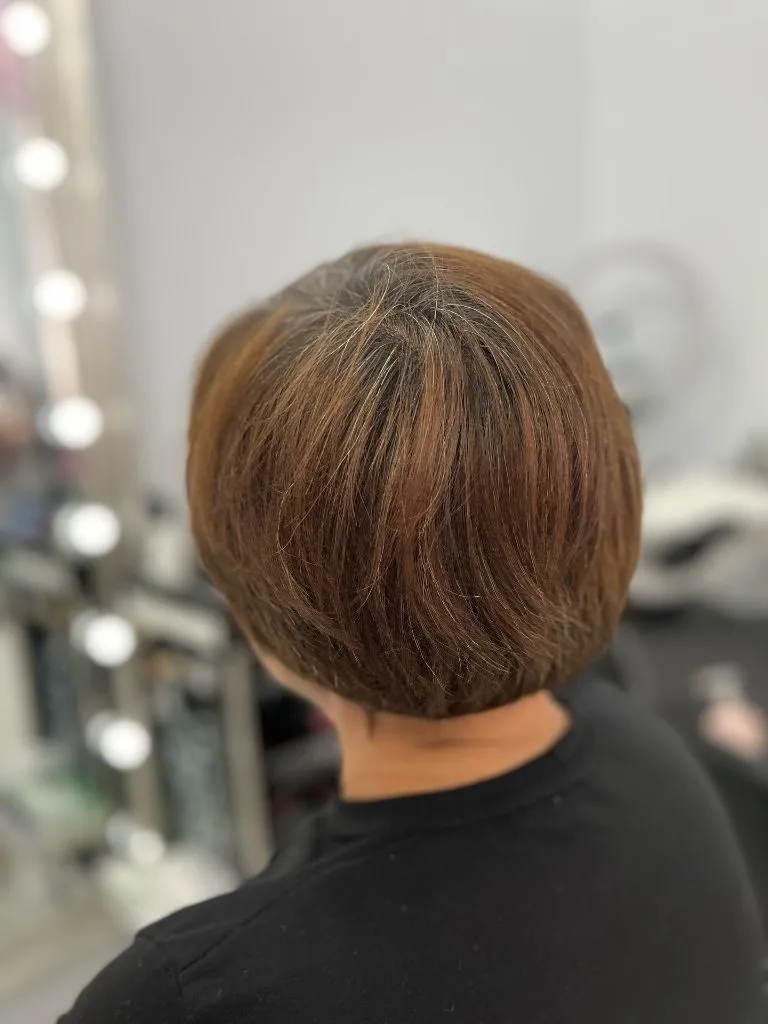
Salon mirror lights are visible in the background, and the hair has a smooth, polished surface that suggests blow-drying with a round brush to achieve that uniform curvature. Unlike the stacked pixie in item 1, which pushed volume upward, this shape distributes volume evenly around the head. The dark top beneath disappears, letting the hair’s rounded geometry be the only visual element above the shoulders.
The honest limitation is that this cut is unforgiving of cowlicks, uneven density, or irregular head shape — everything is visible when the hair sits this close. The strength, though, is its simplicity and the minimal grow-out disruption. Because the layers are so uniform, a few weeks of growth will not dramatically alter the proportions the way a stacked or undercut pixie would shift. I like the restraint of this shape — it does one thing well and does not try to do anything else.
9. Straight Auburn Mid-Length With Centre Part
Viewed from above and slightly behind, this composition is dominated by straight, glossy-looking auburn hair falling past the shoulders. A clear centre part divides the hair into two symmetrical curtains, and the colour shifts from a darker root to a warmer, almost copper mid-length and end. The surface is remarkably smooth, with minimal texture or wave, which turns the colour gradient into the primary visual detail.
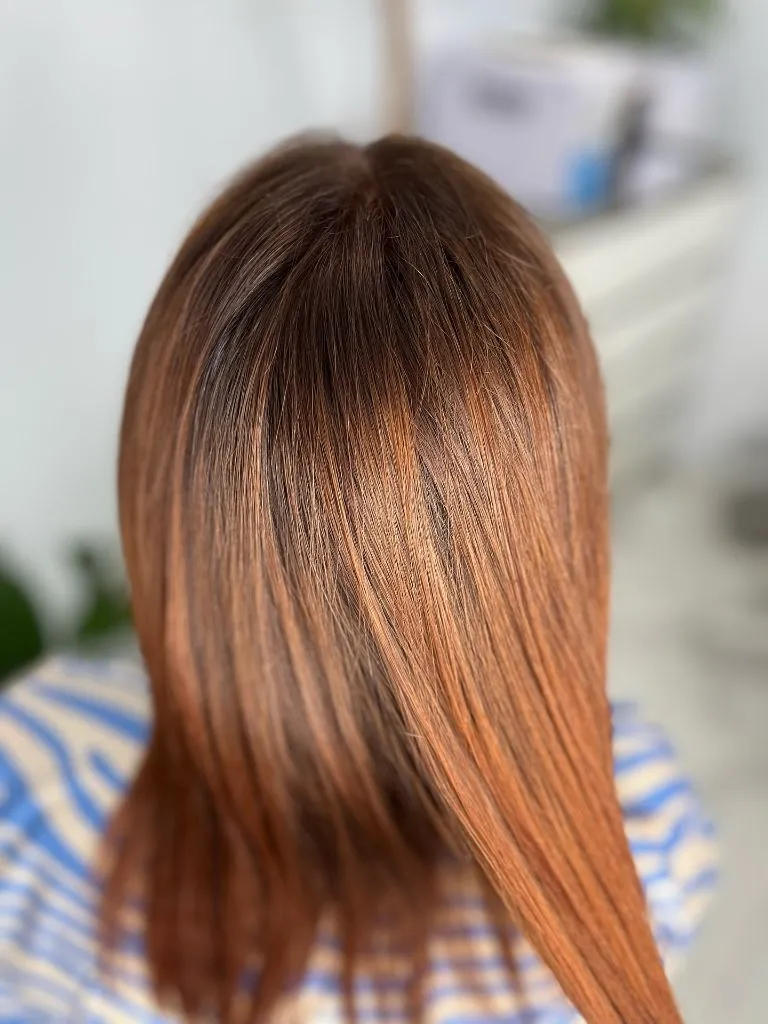
The lack of layering is the key supporting characteristic. Because there are no layers to break up the surface, the hair reads as a single, uninterrupted colour field from root to tip. A striped blue-and-white top is partially visible at the bottom of the frame, offering a cool contrast that emphasises the warmth of the hair. The smoothness and sheen suggest a keratin or straightening treatment, though the material and process are not identifiable from the image alone.
This is a useful counterpoint to the heavily layered shapes that dominate this set. The centre part and blunt length create a very different proportion — one that elongates the face vertically and narrows the silhouette horizontally. The trade-off is versatility: without layers, the options for changing shape through styling are limited. For anyone considering this approach among trendy haircuts for women over 50, the key question is whether the simplicity reads as elegance or as a shape that needs more movement to stay interesting in the profile view.
10. Tapered Pixie With Undercut Nape
A cool-toned, ash-blonde pixie is viewed from behind, revealing a tapered nape that fades into an undercut. The top is left longer with visible texture — slightly wavy, separated strands that move in different directions. The contrast between the textured crown and the close-cut lower section is the defining structural element. The colour appears to be a blend of ash blonde and subtle lavender-grey, though exact tones are difficult to confirm.
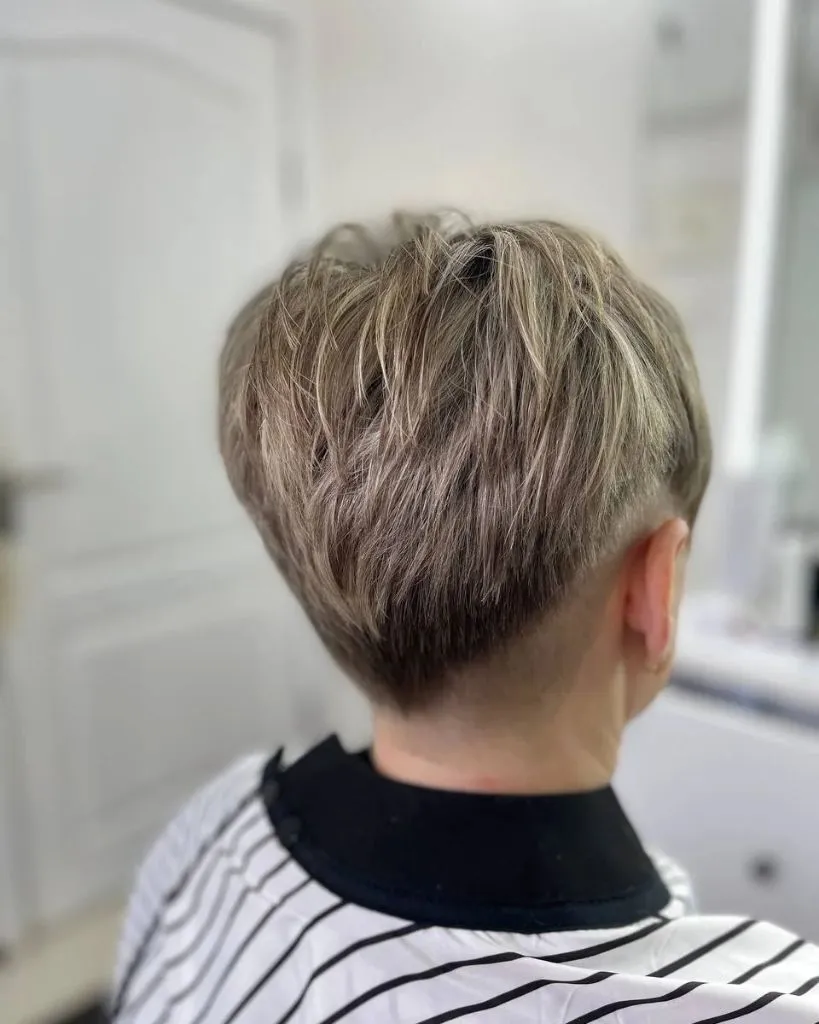
The striped salon cape provides a graphic backdrop that makes the soft, irregular texture of the hair more apparent by contrast. The undercut at the nape is not dramatic — it is a graduated fade rather than a sharp disconnection — which keeps the overall shape readable as a pixie rather than a more extreme fashion cut. The ears are partially exposed, sitting right at the boundary between the longer top and the shorter sides.
Compared with the rounded, even crop in item 8, this pixie introduces a deliberate two-zone structure: volume above, close-cut below. The practical advantage of this approach is that the undercut section grows in cleanly and can extend the time between salon visits without the shape falling apart. The top, however, will need periodic texturizing to maintain that separated, piece-y quality. This is a cut that gets better with a little grow-out rather than worse, which is a rare quality.
11. Textured Short Crop Holds a Natural Wave
Another short crop viewed from behind, this one in a warmer brown tone with scattered silver strands. The texture is the distinguishing element: instead of the smooth, round surface in item 8, this hair shows a natural wave pattern that creates visible movement across the back of the head. The layers appear slightly longer than a standard pixie, especially through the crown and upper nape area.
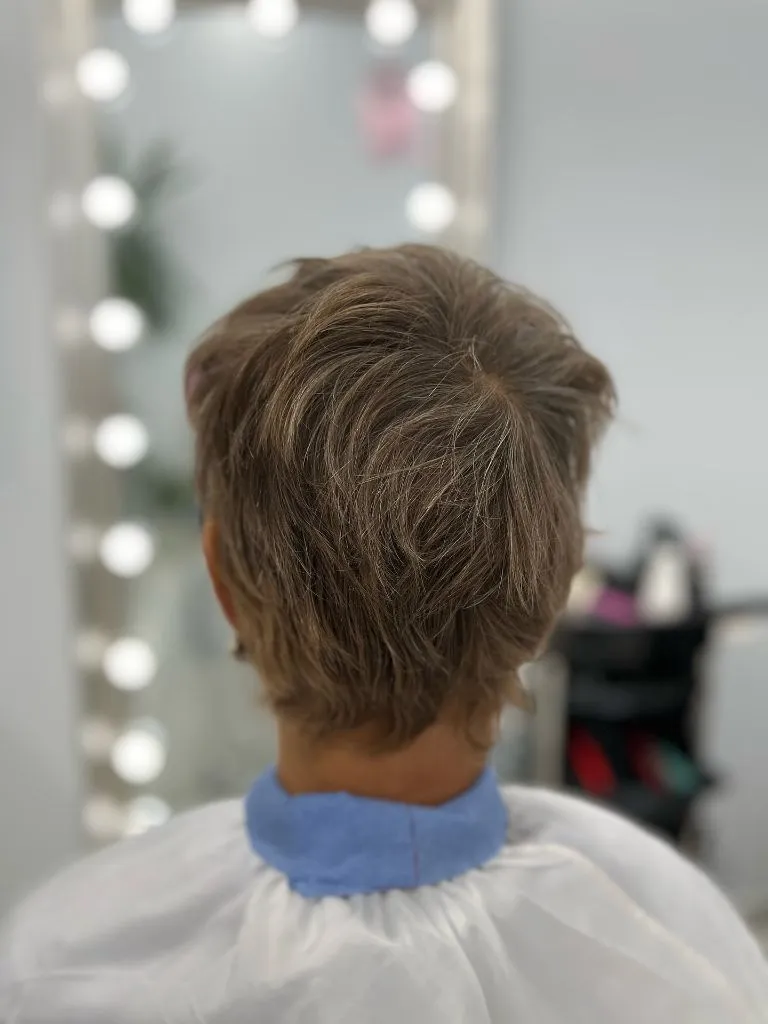
A salon cape is visible at the collar, and the mirror lights behind confirm a professional setting. The wave pattern introduces a randomness that the more sculpted pixies in this set do not have — the hair moves in slightly different directions depending on the natural growth pattern. A blue collar beneath the cape adds a small colour detail that echoes the cool undertones in the silver strands, creating an unintentional but effective palette link.
The takeaway is about embracing existing texture rather than fighting it. If you have natural wave, a cut like this uses it as a built-in styling mechanism that adds dimension without product or heat. The silver strands function the same way — as natural highlights that add visual interest where a single-process colour would flatten the surface. The limitation is control: you cannot fully dictate the direction of wave patterns, which means this shape will look slightly different every day. For many people, that variability is the appeal.
12. Long Blonde Balayage Falls Ruler-Straight
A long, straight silhouette dominates this frame, with hair reaching past mid-back. The colour is a graduated balayage, moving from a medium brown-blonde at the roots to a very pale, almost platinum blonde at the ends. The ends are cut to a soft V-shape, and the surface is extraordinarily smooth — there is no visible wave, frizz, or texture break anywhere along the length. A pink-cased smartwatch on the stylist’s wrist provides the only colour accent.
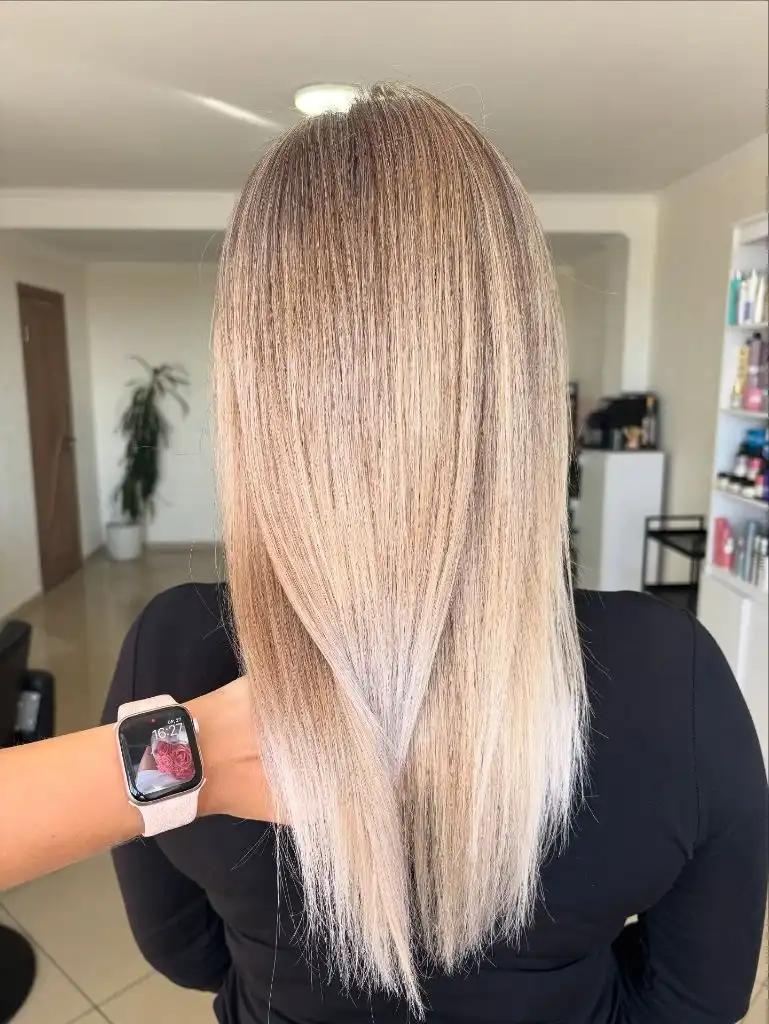
The root-to-tip colour graduation is the primary supporting detail. Because the hair is so straight and smooth, the colour transition reads almost like an ombre swatch — the eye tracks from dark to light in a continuous, unbroken gradient. The salon interior behind, with product shelves and a plant, confirms professional finishing. The black long-sleeved top creates a dark background that makes the lightest sections of the hair appear even brighter.
This is the longest shape in the set, and it raises a direct question about proportion for anyone surveying these options. At this length, the hair becomes a significant portion of the total silhouette, and maintaining this level of smoothness requires regular conditioning treatments and careful heat management. The V-shaped endpoint is a subtle but important detail — it prevents the blunt heaviness that a perfectly straight perimeter would create at this length, while a U-shape would add softness. Even a small change in the endpoint geometry shifts how the entire length reads.
13. Curled Updo Pinned at the Crown
This composition moves away from down-styles entirely: blonde hair is gathered, curled, and pinned into an updo that sits at the crown and upper back of the head. The curls are loose and looping, with individual sections visible rather than blended into a smooth chignon. The colour is a warm golden blonde, and the entire shape has an intentionally undone, organic quality that avoids the rigidity of a formal bun.
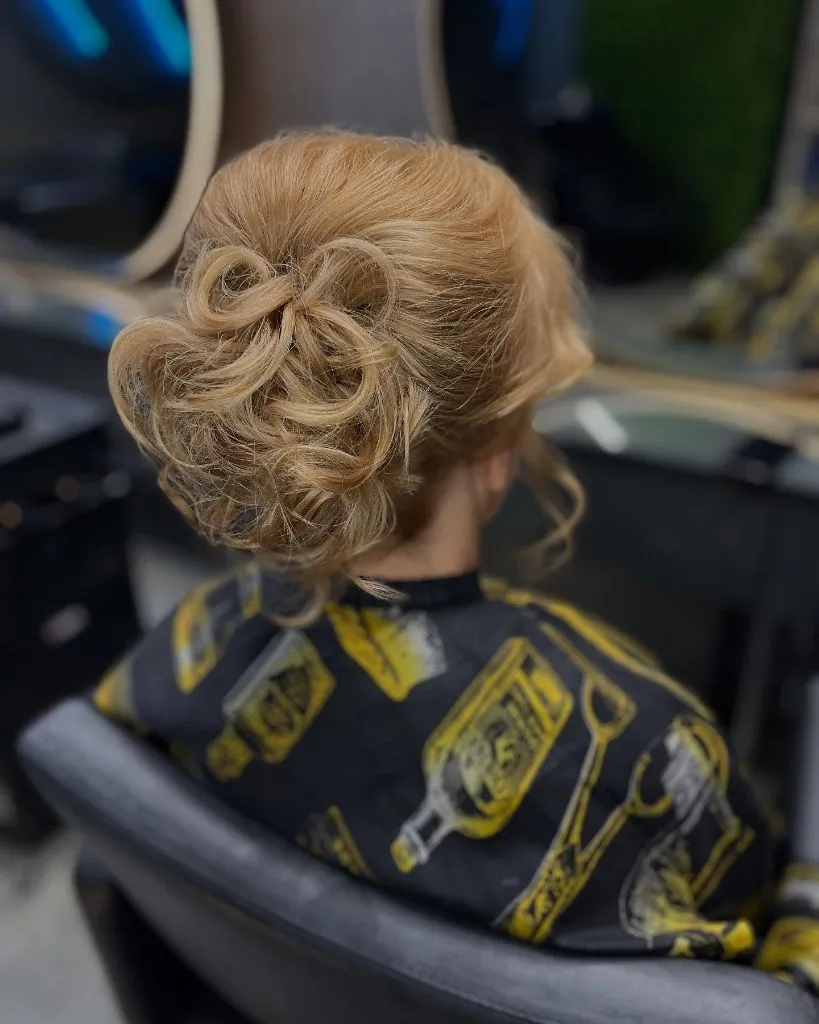
A salon cape with a yellow pattern on black is visible beneath, and the salon chair and mirror confirm a professional setting. The curls are the secondary detail — they provide the surface interest that keeps the updo from reading as a simple ponytail twist. Each loop catches light at a different angle, creating small highlights and shadows across the surface of the gathered hair. No accessories or pins are visible from this angle, which means the structure holds through technique alone or with hidden pins.
The relevant observation is that updos work as a shape option for the same lengths that produce very different results when worn down. The same hair that creates a long, heavy silhouette in item 12, for example, could be reworked into something like this — a compact, elevated shape that puts all the visual weight near the top of the head. For special occasions or simply when a change of proportion is wanted, an updo is a temporary architecture change rather than a permanent cut decision. The limitation is skill: this particular arrangement would be difficult to replicate without a second pair of hands.
14. Short Dark Crop With Wispy Fringe
A dark, almost black, short crop is viewed from the front, with a soft wispy fringe falling across the forehead. The hair sits close to the head with slight volume through the crown, and the fringe is the lightest, most mobile section — thin enough to show skin through it. Pearl stud earrings and a houndstooth-patterned jacket with a suede-looking brown collar establish a polished, professional context below the hairline.
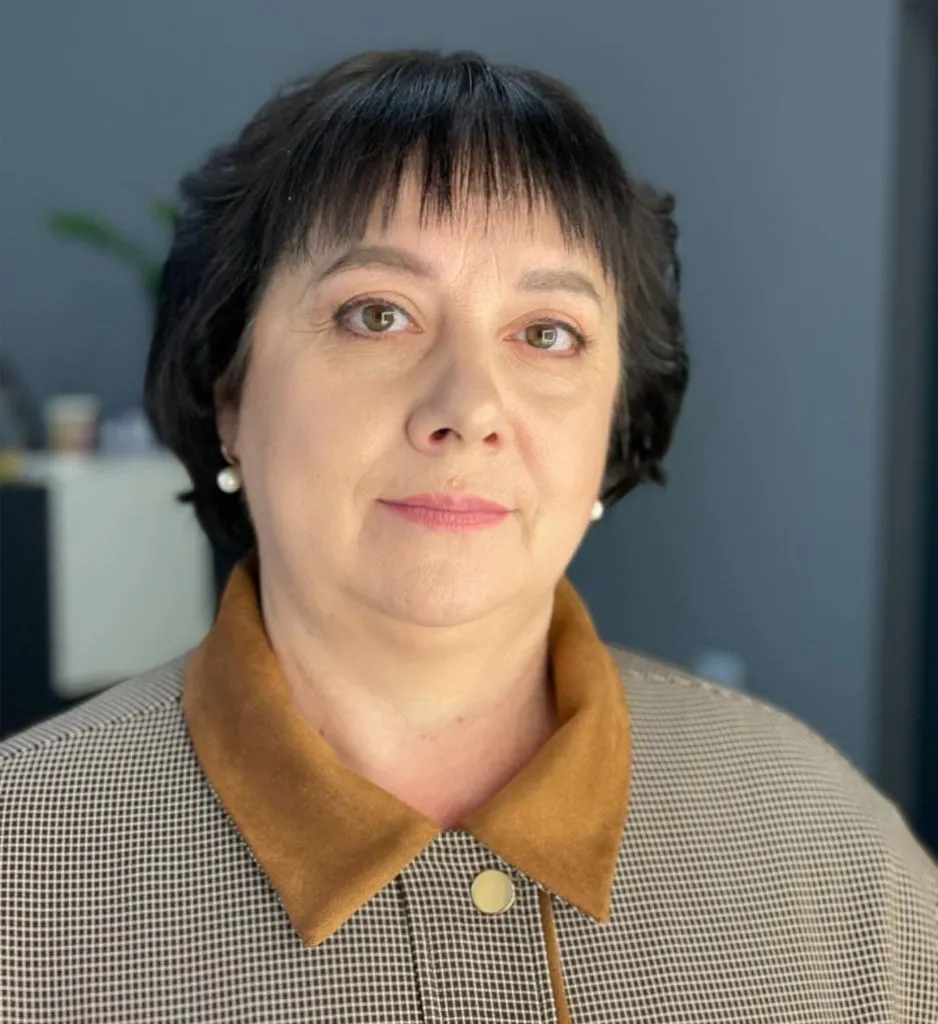
The fringe is the supporting detail that defines this look’s character. Without it, the cut would read as a simple close crop; with it, the forehead is softened and the eye is drawn to the brow line. The dark colour against a blue-grey background creates a cool, quiet palette with almost no warm tones, reinforced by the neutral clothing. The overall impression is of restraint — nothing competes, nothing is extraneous.
I find this the most composed image in the set so far. Every element — the cut, the colour, the clothing — works within the same understated register. The practical advantage of a fringe this wispy is that it blends seamlessly as it grows, rather than creating an awkward curtain stage. The limitation is that very fine or thinning hair may not support even this light a fringe without looking sparse. For anyone exploring shorter options at this age range, this demonstrates how a minimal fringe can shift the entire feeling of a close crop without adding real length.
15. Twisted Low Bun With Textured Waves
A rich chestnut-brown low bun is the focal point, with the hair twisted into a gathered knot at the nape rather than the crown. Visible waves run across the surface from the front through to the gathered section, creating texture that distinguishes this from a smooth, pulled-back style. The side profile shows face-framing tendrils at the temple and jaw, which soften the overall line. The colour is warm and consistent, with subtle lighter strands catching the light.
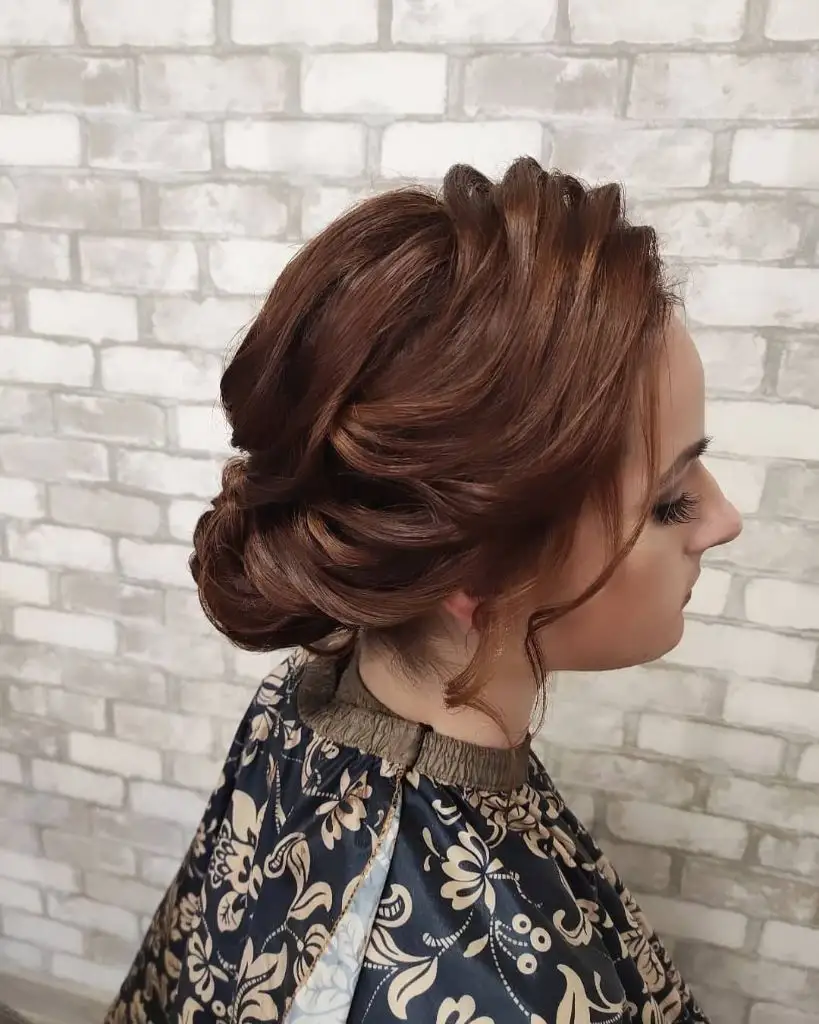
The white brick wall behind provides a high-contrast backdrop that makes the warm hair tones appear deeper. The floral-patterned top with a gathered neckline introduces a soft, decorative element that complements rather than competes with the hair’s texture. The waves across the crown are wide and deliberate — not the tight, defined curls of items 5 and 6, but broader undulations that create surface interest without adding significant volume.
The comparison with the updo in item 13 is instructive. That arrangement sat high and loose with visible individual curls; this one sits low and compact with broader texture. The placement of the bun changes the proportion dramatically — a high bun elongates the neck and lifts the visual centre, while a low bun keeps the weight at the nape and emphasises horizontal width. Neither is inherently better; the choice depends on whether you want to lengthen or ground the silhouette.
16. Burgundy Bob Sharpens the Nape Line
A deep burgundy-red bob viewed from behind reveals a clean, precisely cut nape line that defines the bottom edge of the shape. The colour is dark — nearly black at the roots, with visible red and cherry tones emerging through the mid-lengths, especially where light hits. The bob tapers slightly at the sides and sits above the collar, with the perimeter forming a clean, deliberate curve rather than a straight horizontal line.
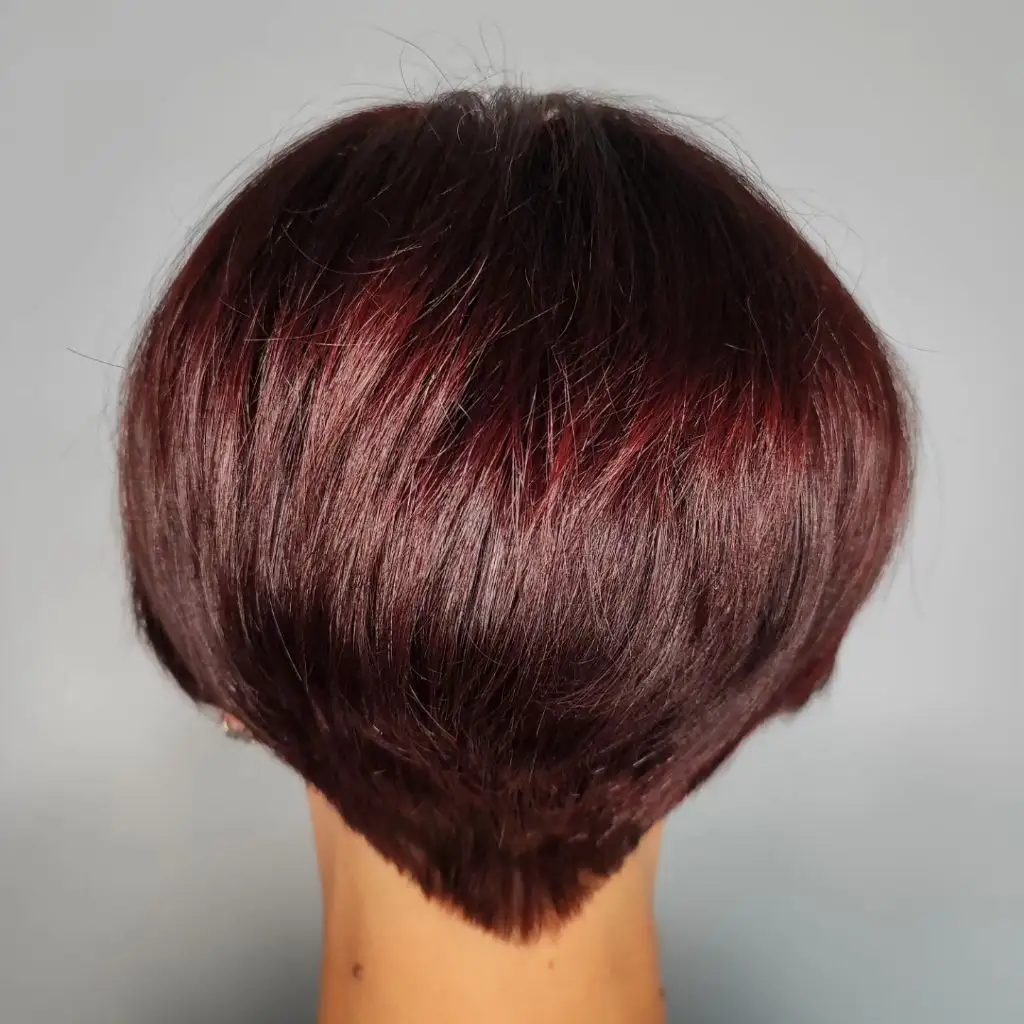
The red tones are the supporting hierarchy. They appear most prominently in the section between the crown and the nape, where the hair falls at an angle that catches light from above. Against the neutral grey background, the burgundy reads as richer and more saturated than it might against a warm-toned wall. The cut’s surface is smooth with minimal layering, which lets the colour shift be the primary source of dimension rather than texture.
The practical note here is about colour maintenance. Burgundy and red-family tones fade faster than most other shades, which means this vibrancy requires regular refresh treatments — a glossing session every few weeks or a semi-permanent re-application. The cut itself, however, is low-maintenance: a one-length or nearly one-length bob holds its shape well as it grows. The combination of a high-maintenance colour with a low-maintenance cut is a smart trade-off that keeps the overall effort budget manageable.
17. Graduated Dark Bob Curves Inward
Another short bob, but with a markedly different structure: this one is darker, with a plum-purple undertone, and the ends visibly curve inward toward the nape. Viewed from behind, the graduated layers create a rounded, almost tulip-shaped silhouette that is widest at the ear line and narrows as it reaches the nape. A delicate chain necklace crosses the exposed upper back, marking the boundary between hair and skin.
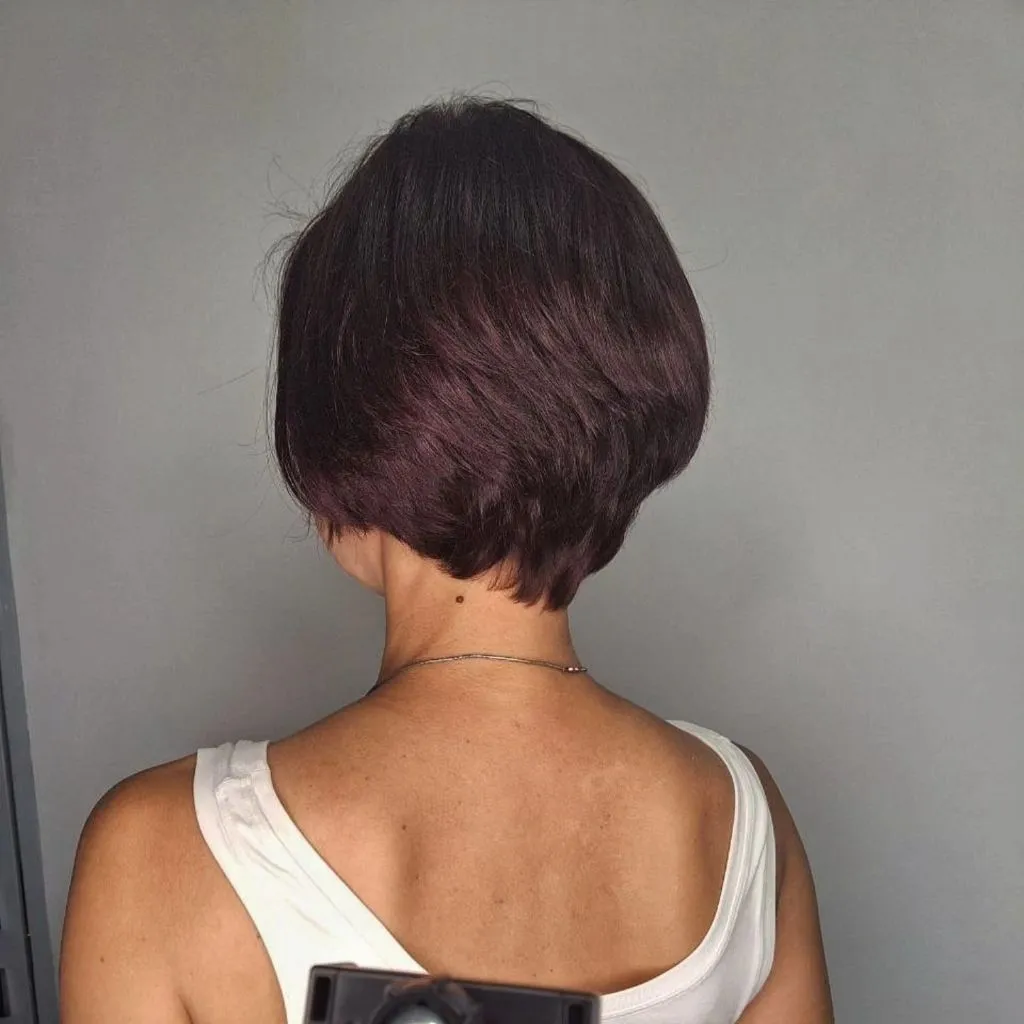
Compared with the burgundy bob in item 16, which ended in a crisp horizontal line, this shape curves. The graduation means the inner layers are shorter than the outer ones, which is what produces the inward curl at the perimeter. The white tank top provides sharp contrast against the dark hair and the grey background, making the shape’s outline clearly readable. The surface is smooth but not as reflective as the burgundy bob, suggesting either a different finishing product or a matte-toned hair colour.
The lesson here is about endpoint direction. An outward flip opens a silhouette and adds width; an inward curve closes it and adds containment. Both are valid choices, but they produce fundamentally different proportions even at the same length. If you have a graduated bob that flips outward and you want more structure, simply blow-drying the ends inward with a round brush can achieve this look without a new cut. The shape does the communicating, not the length.
18. Platinum Pixie With Visible Root Shadow
A bright platinum blonde pixie is captured from above and slightly behind, revealing a clear root shadow where the natural dark-brown base grows in at the crown. This two-tone effect is the defining visual element — the dark roots create a centre point from which the pale blonde radiates outward. The hair is straight, smooth, and swept back from the face in a single direction.
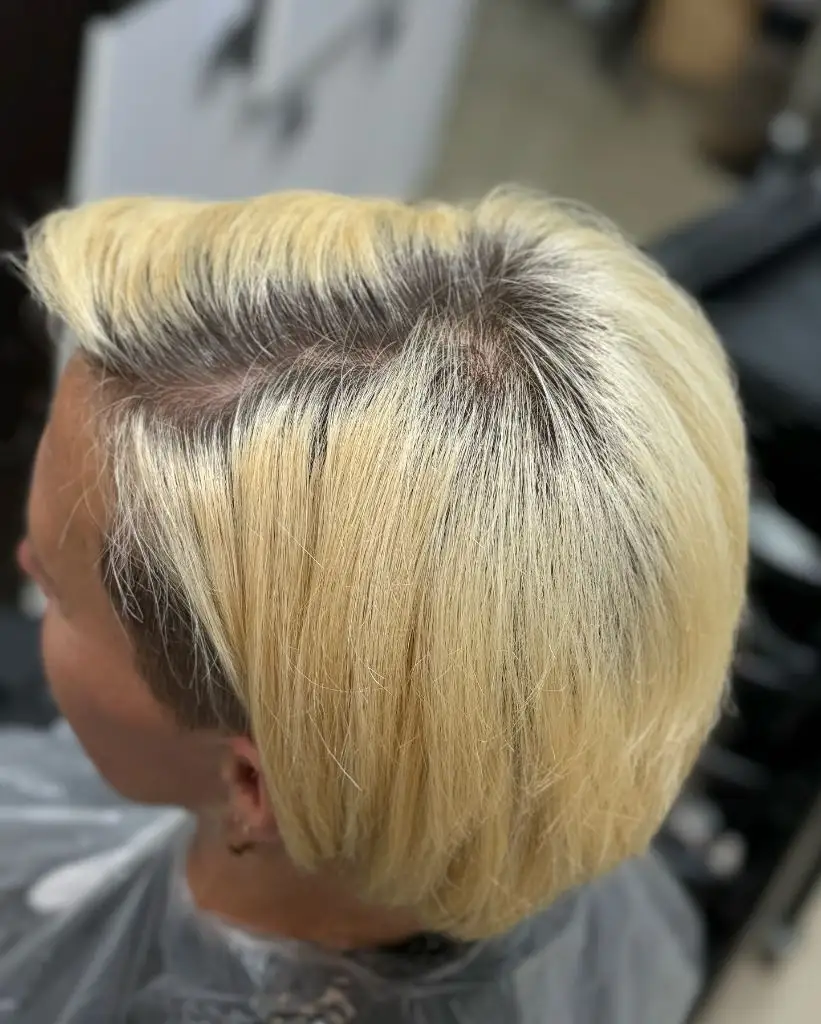
The root shadow works as built-in contrast, adding depth and dimension that a fully bleached head would lack. The hair’s surface is sleek and appears recently coloured, with no banding or uneven tones through the blonde sections. The salon setting is evident from the tools and station visible at the edges. This is a cut where the colour is doing as much structural work as the shape itself — the dark root draws the eye to the crown, while the pale lengths draw the eye outward.
The maintenance reality is significant. Platinum requires regular toning to prevent yellowing, and the root shadow — while fashionable — means regrowth is visible within weeks. However, the root shadow technique actually works in favour of grow-out: because the dark roots are part of the intended design, the demarcation line is less jarring than it would be on a fully blonde cut. This is a clever strategy for anyone who wants a dramatic blonde without committing to salon visits every three to four weeks.
19. Ash Blonde Bob Held at the Crown
A soft ash-blonde bob is shown in three-quarter profile, with a stylist’s hand holding the hair at the crown to display the shape. The bob falls to just below the ear, with a slight outward flip at the ends and a clean line along the nape. The colour is a cool, sandy blonde with no visible highlights or lowlights — a single, consistent tone throughout.
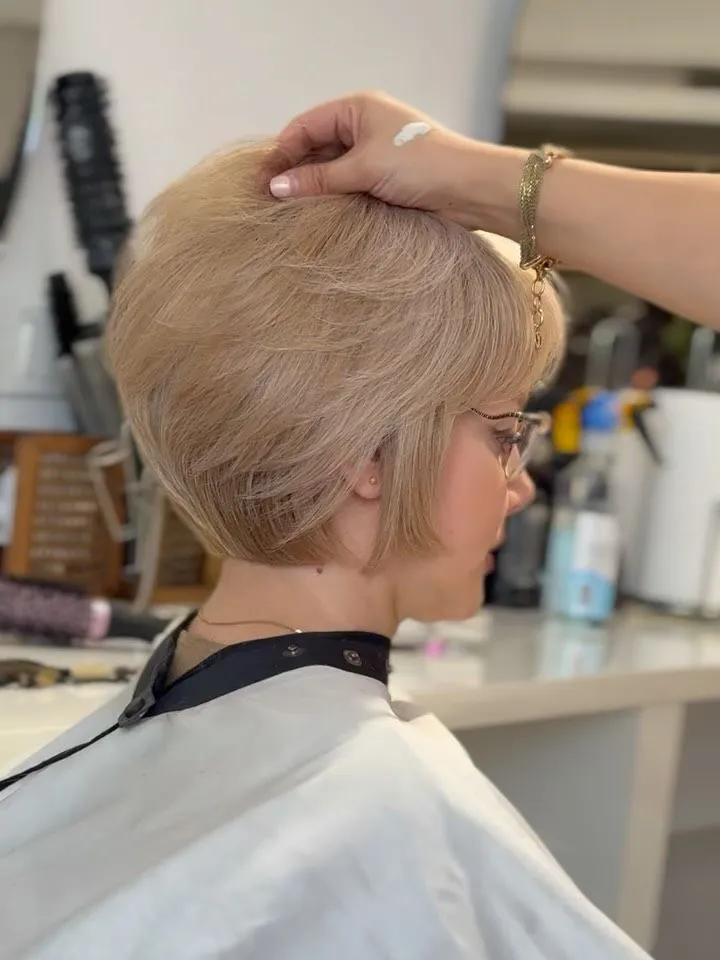
The glasses visible at the temple add a practical detail that anchors this image in everyday wearability rather than editorial styling. The salon background is busy with tools, bottles, and colour charts, which provides context for the professional setting. The bob’s volume is moderate — not flat against the head, not dramatically puffed out — and the ends flip outward just enough to keep the perimeter from feeling severe. The salon cape beneath draws no attention, letting the hair shape stay the focus.
After the high-contrast platinum pixie above, this reads notably quieter — a shape and colour designed to integrate rather than stand out. The useful observation is that a chin-length or just-below-ear bob is one of the most adaptable cuts in this entire set, because it can be styled sleek, curled, tucked behind the ears, or pinned up in ways that longer and shorter cuts cannot accommodate equally well. The trade-off is that this middle-ground length can sometimes lack the decisiveness of a very short or very long shape.
20. Dark Layered Blowout Frames the Face With Volume
A long, dark brown blowout falls past the shoulders with dramatic inward-curling ends that frame the face on both sides. The layers are long and graduated, starting below the chin and increasing in volume toward the bottom, which creates a triangular silhouette — narrow at the crown, wide at the endpoints. A face mask obscures the lower face, making the hair the uncontested focal point of the entire image.
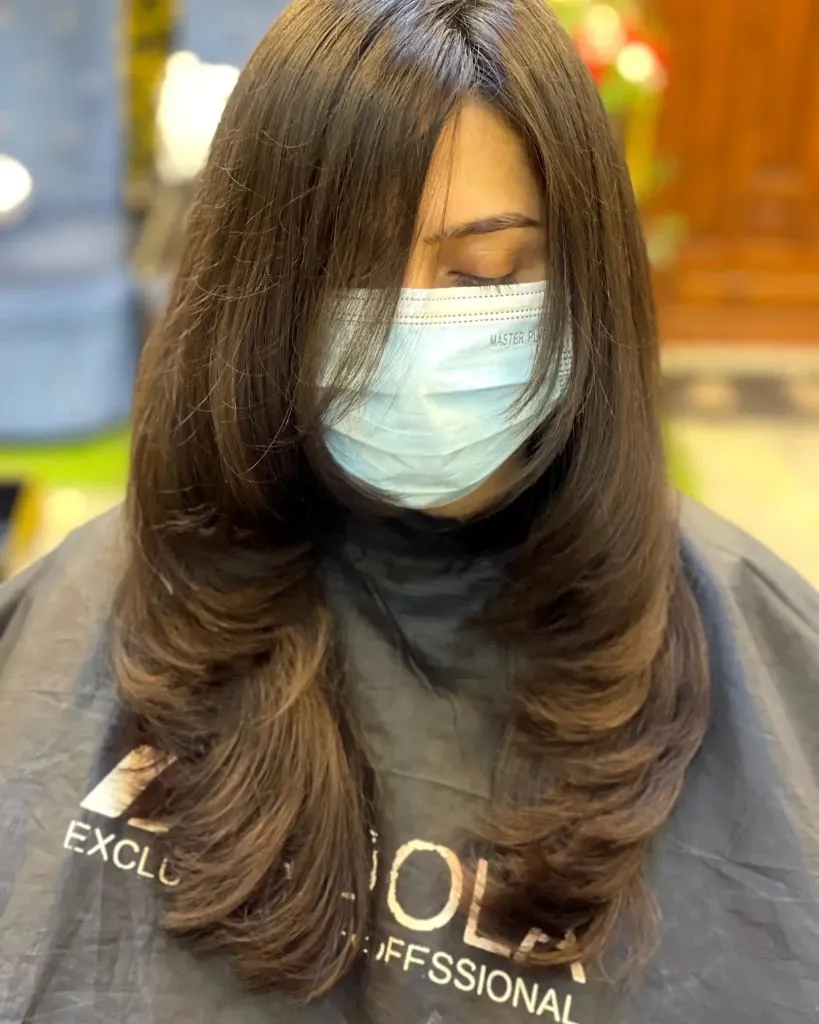
The salon cape is visible with what appears to be professional product branding, and the background is warm-toned with typical salon lighting. The curls at the ends are uniform in direction and size, which indicates a round-brush blowout technique rather than a curling iron. The dark colour is consistent from root to end, with no highlights, which means all the visual interest comes from the shape and movement of the layers rather than from colour variation.
The silhouette here is the widest in the set at the endpoint, which creates a bold, frame-filling proportion. This is a style-forward blowout rather than an everyday shape, and maintaining this exact volume and curl direction at home would require significant time with a round brush and dryer. The contrast with the straight, flat presentation in item 9 is stark — same general length range, same dark colouring, but two completely different characters. That difference is created entirely by layers and styling technique, which underscores how much a cut’s architecture matters independently of length and colour.
21. Salt-and-Pepper Layers Build a Feathered Frame
A short-to-medium cut in natural salt-and-pepper colouring creates a feathered frame around the head, viewed from the side. The layers are short enough to show movement individually — each one curves outward slightly, building a stacked, wing-like shape from the crown to the nape. The colour is a blend of dark charcoal-grey and silver-white strands, with the darker tones concentrated at the roots and the lighter ones appearing more through the ends.
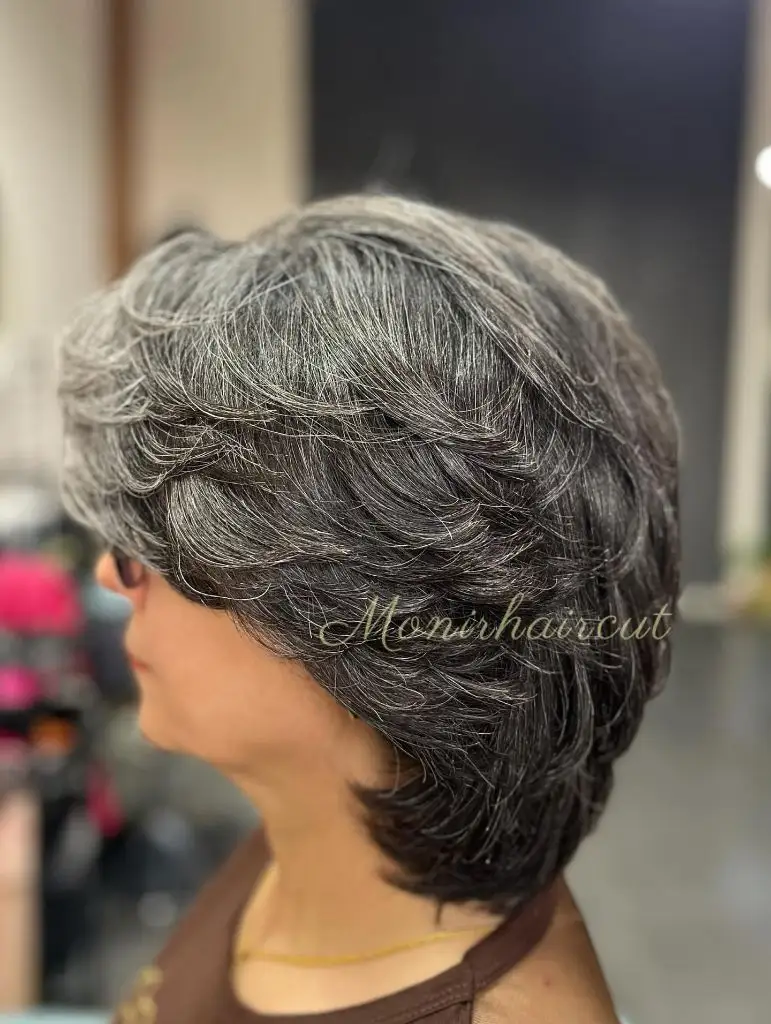
A watermark reading “Monirhaircut” is visible across the mid-section of the hair. The layers create a rhythmic pattern — each one slightly longer than the one above it, fanning outward to produce volume without bulk. A gold chain at the neckline and a warm brown top ground the palette, while the dark salon background keeps all attention on the hair’s texture and movement. The overall silhouette reads as structured but not stiff, with enough separation between layers to see the technique.
This is one of the most technically accomplished cuts in the set, because the layering has to be precise enough that each section sits at a distinct length while still blending into a cohesive whole. The natural grey colouring actually enhances the visibility of the layers — the lighter and darker strands create their own highlighting effect, which a single-process colour would flatten. The transferable principle is that embracing grey rather than covering it can add the very dimension that highlights are typically applied to create.