Style advice aimed at women past thirty often carries an undercurrent of correction, as though turning a page on your twenties means you should also surrender color, volume, or anything that reads as playful. That pressure is worth naming so you can set it aside. Trendy outfits for women over 30 do not require a uniform of beige blazers and sensible flats, and the photographs collected here make that clear without saying a word. You get to keep experimenting.
The useful question is not whether a piece is age-appropriate but whether the proportions, contrast, and placement within the outfit are doing something deliberate. A good outfit decision begins before the mirror, in the relationship between a top’s volume and a trouser’s width, between a shoe’s color and a bag’s weight, between the surface texture of a jacket and the finish of the fabric beneath it. This article moves through more than twenty real outfits and judges each one on four visible variables: silhouette and proportion, color contrast or tonal restraint, the role of accessories in anchoring or interrupting a look, and the way footwear closes or opens the overall reading. Each section works from a single photograph and describes only what can be seen.
1. An Orange Sweatshirt Anchors Bold Color Against Cargo Volume
The first detail that registers here is the saturated orange of the oversized sweatshirt, which carries metallic lettering across the chest and falls well past the waist. Below, wide olive cargo trousers gather loosely around the ankles, and the entire silhouette reads as generous and intentional rather than accidental. A yellow chain-strap bag sits at the shoulder, doubling down on warmth.
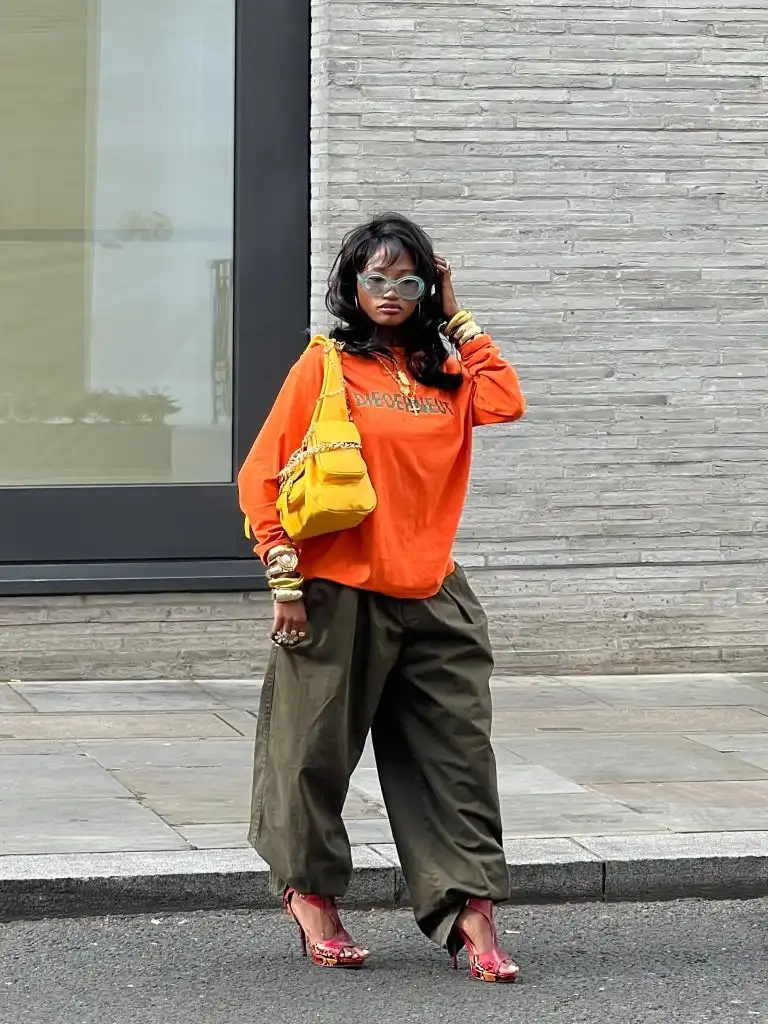
Photo via Instagram
The proportion is the engine of this outfit. The sweatshirt’s drop shoulder and boxy cut mean the upper half carries real width, and the cargo trousers answer with their own volume rather than trying to slim the frame. That symmetry of looseness is what keeps the silhouette balanced. The yellow bag mirrors the orange rather than competing with it, while the red strappy heeled sandals at the hem introduce a sharp, narrow line that grounds the look. Gold bangles stacked on both wrists add repetition without introducing a new color family, and the round-frame sunglasses echo the soft metallic tone on the sweatshirt text.
The appeal is the refusal to neutralize any single element. Orange could read as a statement against quieter trousers, but instead everything here commits fully to its own register. Casual outfit ideas that rely on one bold piece surrounded by muted basics are common; this outfit shows what happens when two or three pieces each carry their own visual weight and the silhouette still holds together because the proportions have been matched rather than opposed.
2. A Plaid Shirt Opens Over a Relaxed Denim Silhouette
A brown plaid button-up shirt is worn open and slightly off one shoulder, revealing a grey tank underneath. The trousers are light-wash, wide-leg jeans with a visible knee rip, and the overall palette moves between cool denim and warm brown. A dark brown structured bag hangs in the crook of the arm, and black flat sandals finish the look at the feet.
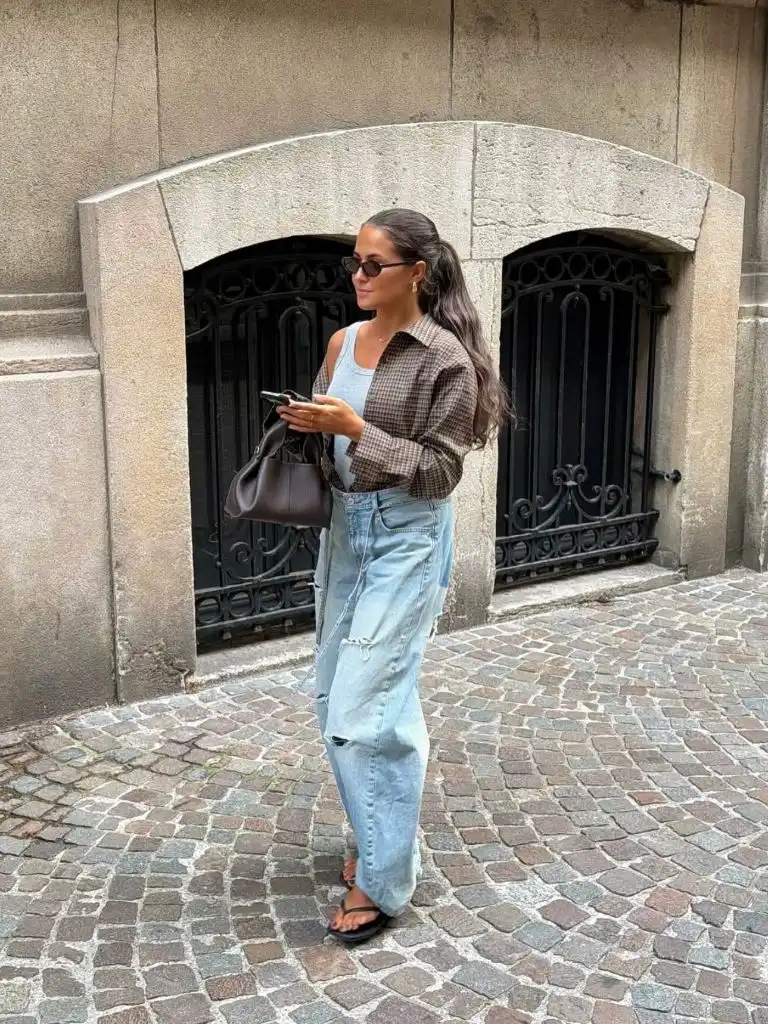
Photo via Instagram
The layering here is quiet but effective. The plaid shirt is doing the work of a light jacket, adding structure to the shoulders without adding warmth or bulk, and its open front lets the grey tank read as the outfit’s center. The jeans are wide enough to create a strong vertical from hip to hem, and the single rip at the knee introduces a break that keeps the denim from looking stiff. The dark brown bag is the heaviest tonal note, and it sits close to the body, pulling the eye inward against the lighter wash below. Gold drop earrings and a delicate necklace stay within the warm metallic family without competing with the shirt’s pattern. The cobblestone setting and arched stone backdrop suggest a European context, but the outfit itself reads as transportable to any mild day.
This is a study in weight distribution. The plaid carries the visual density up top, the pale jeans carry the volume below, and the flat sandals allow the denim to puddle slightly at the ankle rather than stacking. Outfits built on layered shirt styling often benefit from keeping the inner layer plain enough to serve as breathing room between pattern and bottom half.
3. A Fair Isle Cardigan Sharpens a White Mini Skirt
A brown-and-cream Fair Isle patterned cardigan with visible buttons sits over a white flared mini skirt. The hemline lands well above the knee, and white crew socks are scrunched above tan suede platform clogs. A large tan leather tote rests on the stone balustrade behind, and the backdrop is a lake framed by steep green mountains.
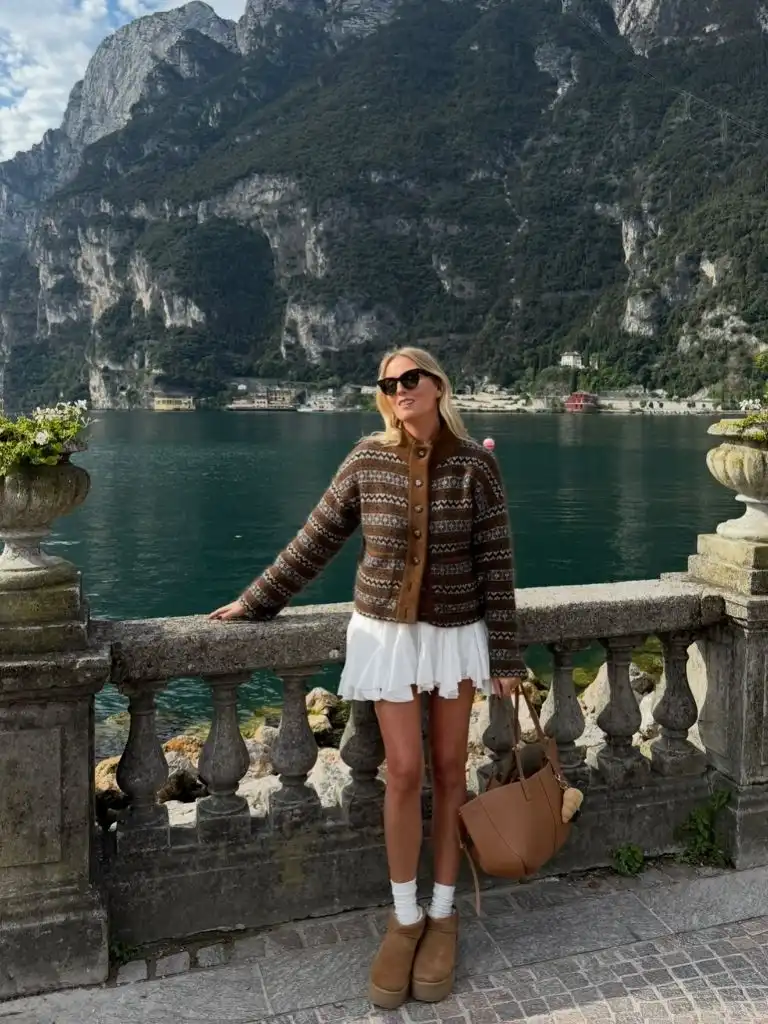
Photo via Instagram
The success of this outfit is the tension between the cardigan’s dense, patterned knit and the airy white skirt below. Fair Isle knit reads as structured and heavy, and the white cotton flare beneath reads as light and playful, so the junction at the waist is doing most of the compositional work. The tan suede clogs repeat the warmest tone in the cardigan and provide a chunky, grounded base that the mini skirt needs to avoid feeling insubstantial. White socks peeking above the clogs mirror the skirt’s brightness and create a visual echo that ties the lower half together. The tan tote behind reinforces the earthy color story without cluttering the frame, and dark sunglasses add the only true contrast point above the neckline.
The best detail is the way the socks and clogs work as a unit. Without the white socks, the gap between skirt hem and shoe would break the tonal flow. With them, the white reads as continuous from skirt to ankle, and the clogs become an intentional anchor rather than an interruption. Pairing knitwear with a shorter hemline works when the knit is cropped enough to show the waist and the shoe carries enough mass to balance the bare leg.
4. Brown Suede Grounds a Minimal Two-Tone Base
A brown suede blazer-style jacket sits open over a dark brown crewneck, which is tucked into white wide-leg jeans. The shoes are dark flat thong sandals, and a deep brown bag tucks under the arm. A long pendant necklace with a round gold disc falls below the chest, and sunglasses with slim brown frames sit on the face.
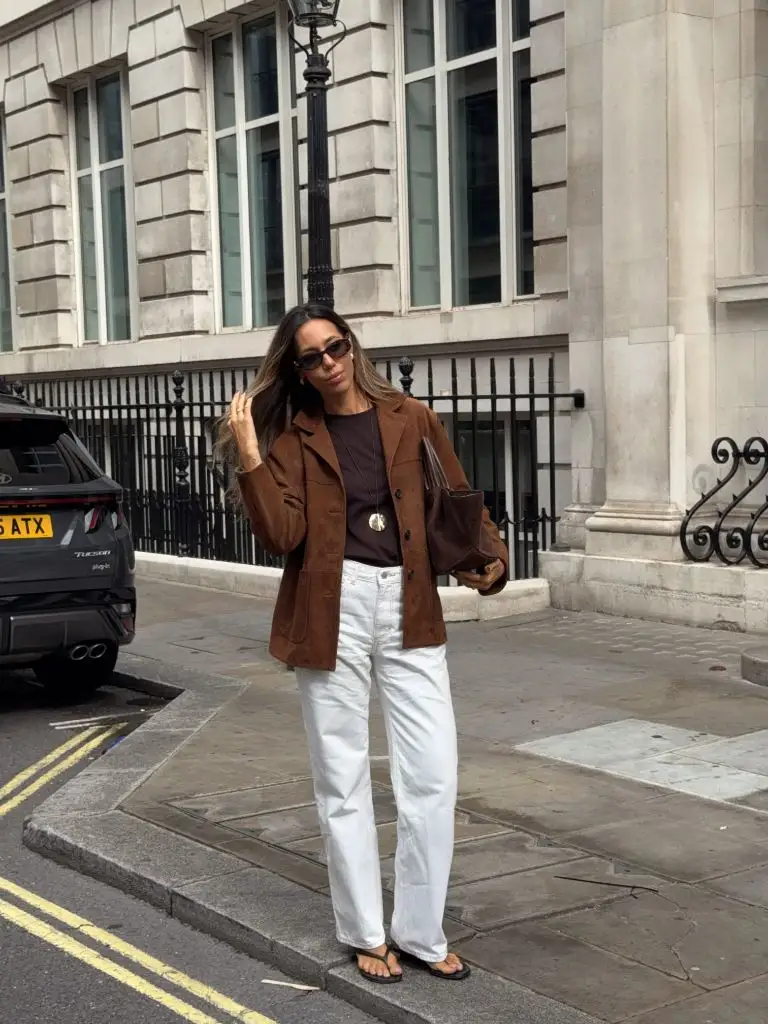
Photo via Instagram
The palette here is deliberately restrained: three tones of brown from caramel suede through chocolate jersey to the dark bag, stacked against bright white trousers that start at a defined waist. The suede jacket provides texture contrast against the matte knit beneath, and the white jeans carry the volume. The flat sandals keep the hemline low and relaxed, allowing the trouser leg to break slightly at the ground. What anchors the upper half is the pendant necklace, which adds a single metallic note at the center of the chest and draws the eye downward past the jacket’s lapel. The London street setting, visible in the yellow-marked curb and UK license plate behind, frames the outfit as a street style look built for walking rather than posing.
The strength here is the tonal layering. Brown-on-brown can flatten when every piece shares the same finish, but the suede, the matte jersey, and the smooth leather of the bag each catch light differently. The white jeans then serve as the high-contrast interruption that makes the brown register as intentional rather than monotone. A tonal outfit needs at least one surface variation per layer to avoid looking unresolved.
5. A Wrapped Blazer Carries a Monochrome Power Suit
A deep chocolate-brown oversized blazer with exaggerated shoulders is cinched at the waist by a diagonal black-and-white striped fabric sash. Matching wide-leg trousers extend to the floor, and pointed black boots emerge beneath the trouser break. A black structured bag sits under one arm, and a sleek low bun, small sunglasses, and gold earrings keep the accessories minimal.
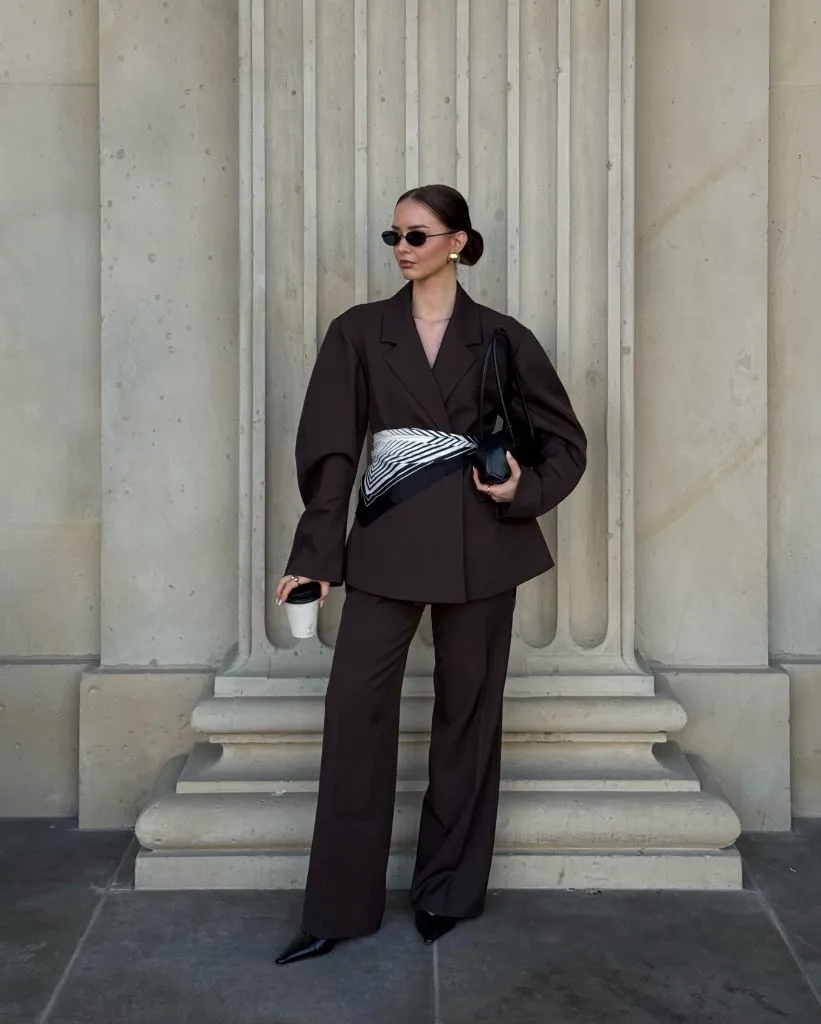
Photo via Instagram
The silhouette here is architectural. The blazer’s padded shoulders create a wide frame, and the cinched waist produced by the striped sash introduces a dramatic inward pull that gives the outfit an hourglass reading despite the generous trouser width below. The striped sash is the only pattern in the outfit, and its black-and-white graphic energy works because everything else remains in one muted tone. The wide trousers fall without a taper, meaning the line from hip to hem stays consistent, and the pointed boots visible at the hem add a sharp directional finish. The stone column behind provides a formal, almost classical setting that matches the outfit’s structured severity. This kind of suiting approach sits comfortably within the current workwear ideas that treat the blazer as a sculptural piece rather than a matching uniform element.
I like the way the sash redraws the waistline without a belt. A leather belt would read as conventional, but the fabric wrap creates a softer, more deliberate interruption. The principle is useful: when a blazer is this oversized, defining the waist with something unexpected keeps the volume from reading as borrowed rather than chosen.
6. A Brown Suede Bomber Softens a Striped Shirt Layer
A dark brown suede zip-up bomber jacket sits over a light blue-and-white vertically striped button-up shirt, with the shirt cuffs rolled out beyond the jacket sleeves. Blue jeans with a straight, relaxed leg complete the lower half, and brown-and-cream retro-style sneakers provide the base. A dark brown woven leather drawstring bag rests beside the seat.
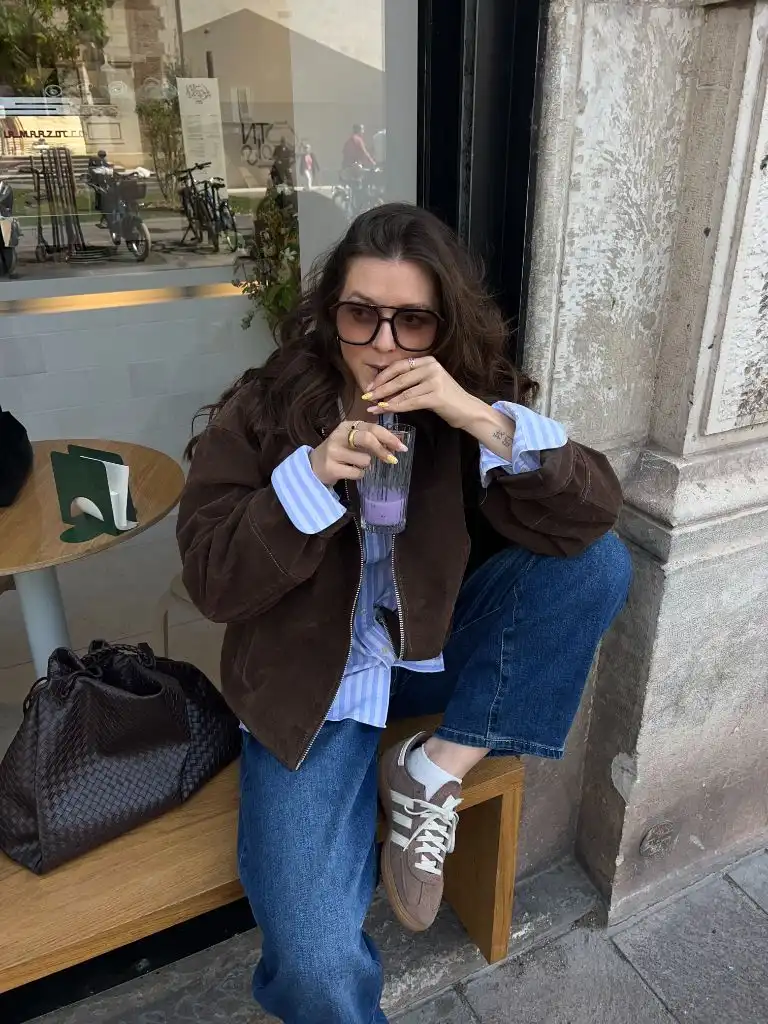
Photo via Instagram
The visible cuff of the striped shirt extending past the bomber sleeve is the detail that lifts this outfit from casual to considered. That flash of pale blue-and-white stripe against the dark suede provides the outfit’s primary contrast moment and signals that the layering is intentional. The jeans are a middle wash, connecting the blue in the shirt to the lower half, and the retro sneakers in brown and cream pull the bomber’s warmth down to the feet. The woven leather bag beside the seat is a darker brown and adds a texture that echoes the suede without matching it exactly. Large tortoiseshell glasses frame the face as the only accessory above the collar. The cafe environment, with its wood and concrete surfaces, mirrors the outfit’s earthy warmth.
The value is in the cuff detail. A bomber jacket typically ends at the wrist, and when worn over a plain tee, the transition is invisible. Pushing a patterned shirt sleeve past the jacket sleeve introduces a rhythm break that makes both layers legible. The transferable principle is simple: everyday outfit combinations gain dimension when the inner layer is allowed to announce itself at the edges rather than disappearing entirely.
7. A Burgundy Jacket Frames Cream and Blue Beneath
A dark burgundy oversized jacket, possibly a waxed or coated cotton, sits open over a pale blue-and-white striped shirt. The trousers are cream or off-white with a relaxed straight leg that puddles slightly at the ankle over dark brown lace-up shoes. A small brown suede bag with visible hardware is carried over one shoulder, and the glasses appear to be tinted prescription frames.
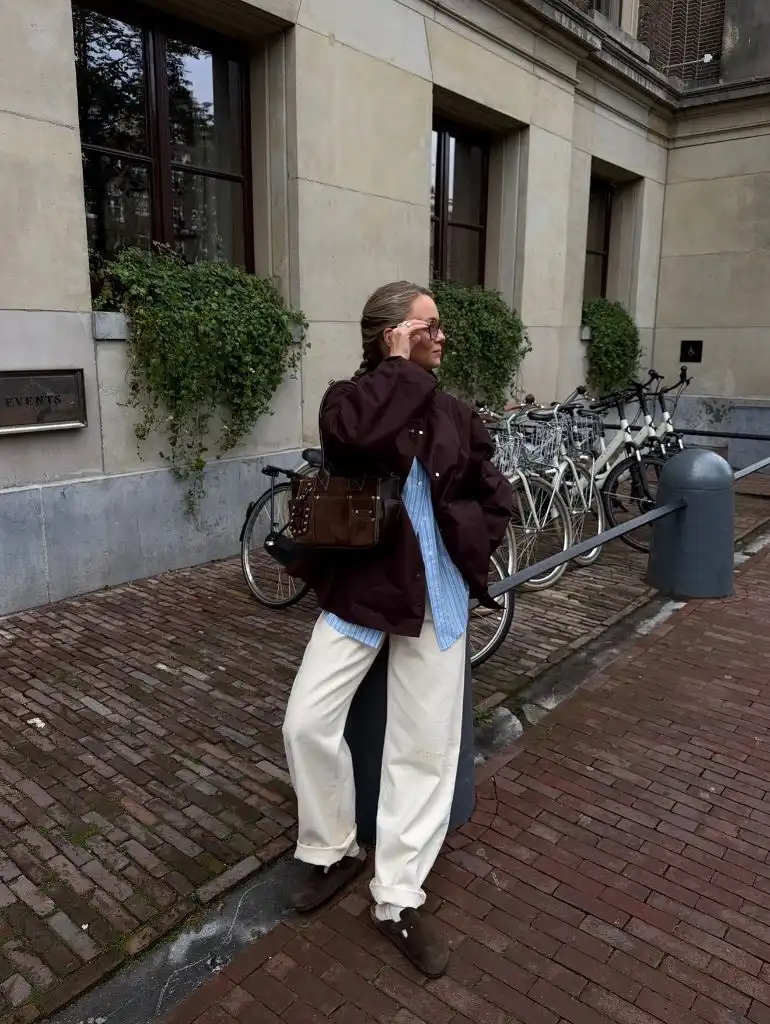
Photo via Instagram
The three layers here operate on a clear light-to-dark gradient from the cream trousers through the blue-striped shirt to the deep burgundy shell, and that gradient is what gives the outfit its visual order. The burgundy jacket carries the most intensity and frames everything beneath it, while the striped shirt provides the transitional midtone. The cream trousers carry the most volume and lightness, so the eye travels naturally downward. The brown suede bag introduces a texture that differs from the jacket’s smooth surface, and the brown shoes repeat the bag’s tone at the opposite end of the body. The brick-paved street and the row of bicycles behind situate this in a Dutch or Northern European setting, and the slightly overcast light plays well with the muted, layered palette.
This is a lesson in outerwear as framing device. The jacket does not match anything else in the outfit, but its dark value contains the lighter pieces within it, the way a picture frame defines the image inside. When layering three distinct tones, letting the outermost piece carry the darkest value tends to produce a cleaner reading because the layers feel stacked rather than scattered.
8. An Olive Suede Layer Quietens a White-and-Brown Palette
An olive-toned suede jacket or overshirt, open at the front, is worn over a white long-sleeve base layer. White straight-leg trousers are belted at the waist with a dark belt, and olive-brown chunky lace-up sneakers provide the base. A brown cap reading what appears to be “Favorite Daughter” covers the eyes, and a dark brown structured bag sits on the step beside a green iced drink.
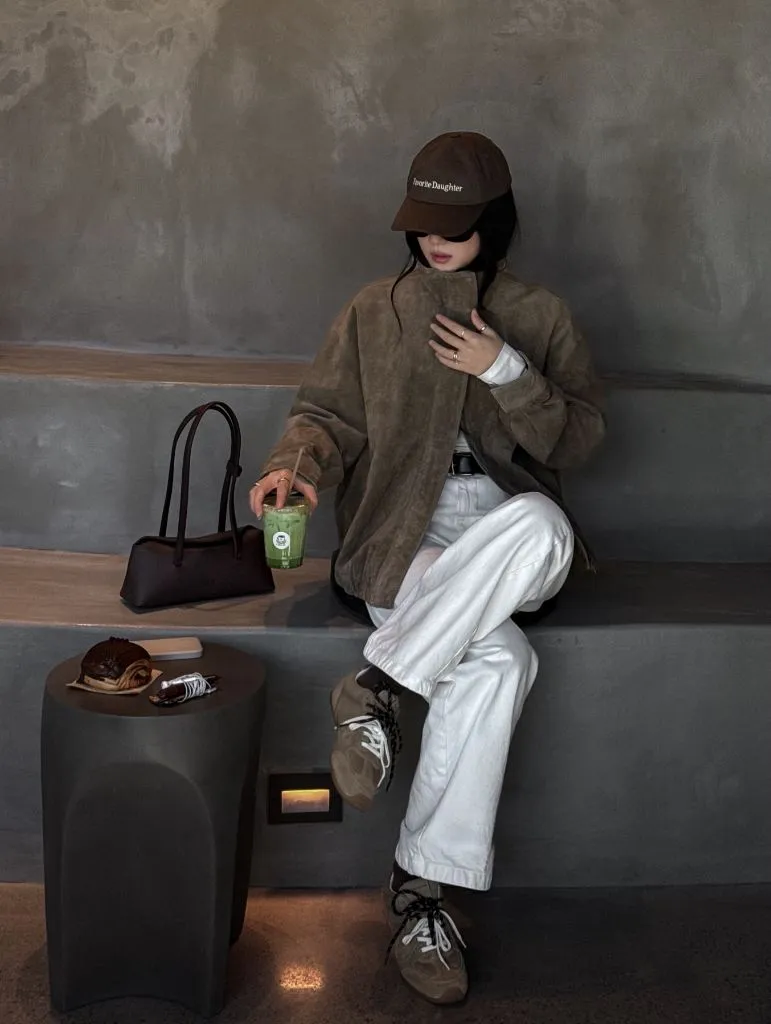
Photo via Instagram
The color story here is tightly edited: olive, white, and dark brown, with no departures. The suede jacket introduces an earthy softness that the white trousers need to avoid looking clinical, and the chunky sneakers bridge the olive of the jacket and the brown of the cap and bag. The dark belt at the waist is the only truly dark horizontal line in the outfit, and it serves as the dividing point between the looser upper half and the straight trouser silhouette below. The concrete step seating and moody grey wall behind push the warm outfit tones forward, making the olive and brown feel richer by contrast. This kind of controlled palette work is the backbone of many minimalist fashion approaches that rely on texture variation within a narrow color range.
What stands out most is the cap’s role. It introduces the darkest value at the highest point of the body, which balances the dark bag at the lowest point and creates a frame within which the white and olive layers sit. A cap in a neutral outfit is never just a casual afterthought; it anchors the top of the silhouette the way a shoe anchors the bottom.
9. Tan Suede Boots Lift a Tonal Beige Blazer Look
A beige oversized blazer sits over what reads as a white or light base layer, and the hemline suggests a short skirt or shorts beneath, though the exact piece is not fully visible. Tan suede cowboy-style boots reach mid-calf with a slouchy, gathered shaft, and a beige intrecciato-weave hobo bag sits on the shoulder. Sunglasses are held close to the face, and the overall palette stays within beige, tan, and cream.
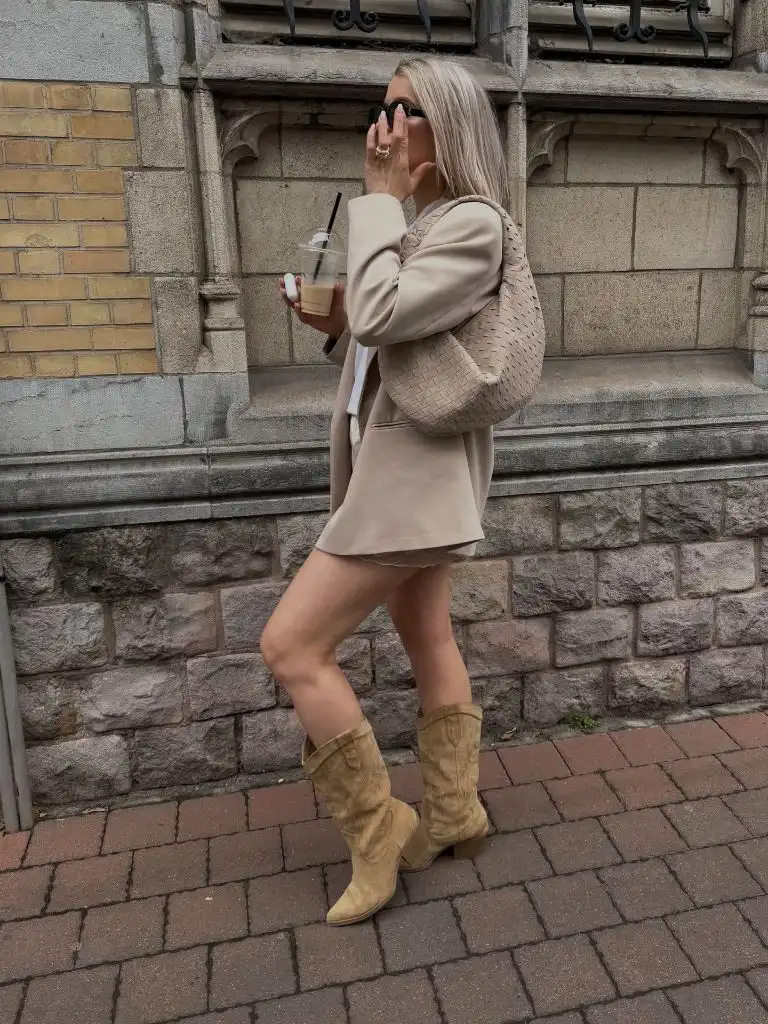
Photo via Instagram
This photograph does not clearly show the lower garment beneath the blazer, so the useful reading is about the visible relationship between the blazer, the boots, and the bag rather than the complete silhouette. The blazer’s oversized cut creates a boxy shape that ends at mid-thigh, and the cowboy boots start below the knee, leaving a gap of bare skin that introduces the outfit’s only real contrast. The boots’ suede texture and gathered shaft add surface interest in a palette that could otherwise read as flat. The woven bag repeats the beige family but its intrecciato texture differentiates it from the smooth blazer fabric. The stone building behind provides a grey backdrop that pushes the warm tones forward.
The effect is tonal confidence. Wearing this many shades of one color family requires that each piece offers a different texture or finish, and here the smooth blazer, the suede boots, and the woven leather bag each do exactly that. The tonal dressing principles that make monochrome work depend on surface contrast substituting for color contrast, and this outfit demonstrates that exchange clearly.
10. A Plaid Flannel Interrupts Dark Flowing Trousers
An oversized red-and-blue plaid flannel shirt is worn untucked over dark flowing trousers that appear to be a satin or matte jersey. A navy knit beanie sits on the head, and dark sunglasses frame the face. A large green leather tote hangs from one arm, and the shoes are simple flat sandals with visible blue straps. A green juice is held in one hand alongside a phone.
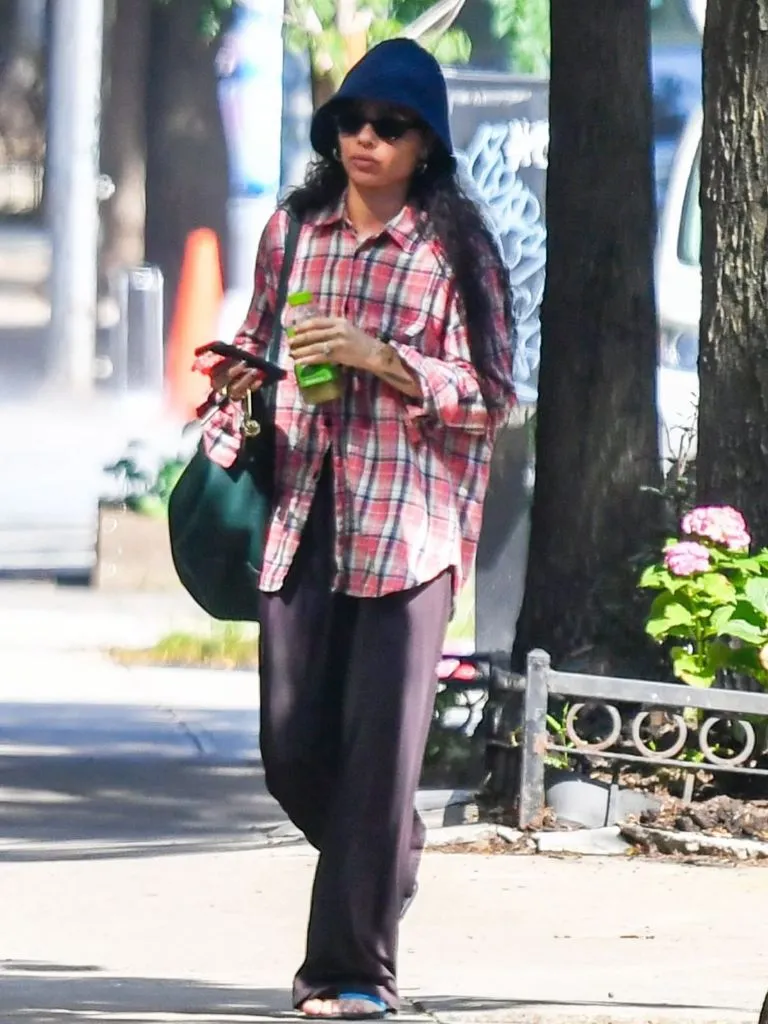
Photo via Instagram
The contrast between the casual, worn-in flannel and the fluid trouser fabric is the central tension. The flannel reads as weekend and thrifted, while the dark, draping trousers suggest something more refined, and the combination works because neither piece tries to win. The green tote introduces a third color that might seem unexpected but actually connects to the green juice and the foliage behind, creating an accidental harmony with the surroundings. The navy beanie pulls the blue tones from the plaid and moves them to the top of the frame, which organizes the outfit vertically. The flat sandals allow the trousers to skim the ground, and the overall silhouette is long and unhurried.
The appeal is the mixing of fabric weights. Flannel against satin or jersey creates a surface tension that makes each piece more visible, and this principle extends to any outfit that pairs something structured up top with something fluid below. When the fabrics differ enough in hand and drape, the shape of the outfit writes itself.
11. A Black Blazer Structures Relaxed Wide-Leg Denim
A black oversized blazer with strong shoulders is worn over a white base layer, and the lower half is dark-wash, wide-leg jeans that fall to the floor. A Louis Vuitton monogram small bag sits on the shoulder, and the shoes appear to be white-and-grey sneakers. The image is a mirror selfie, and the word “black” is overlaid on the photo in white text.
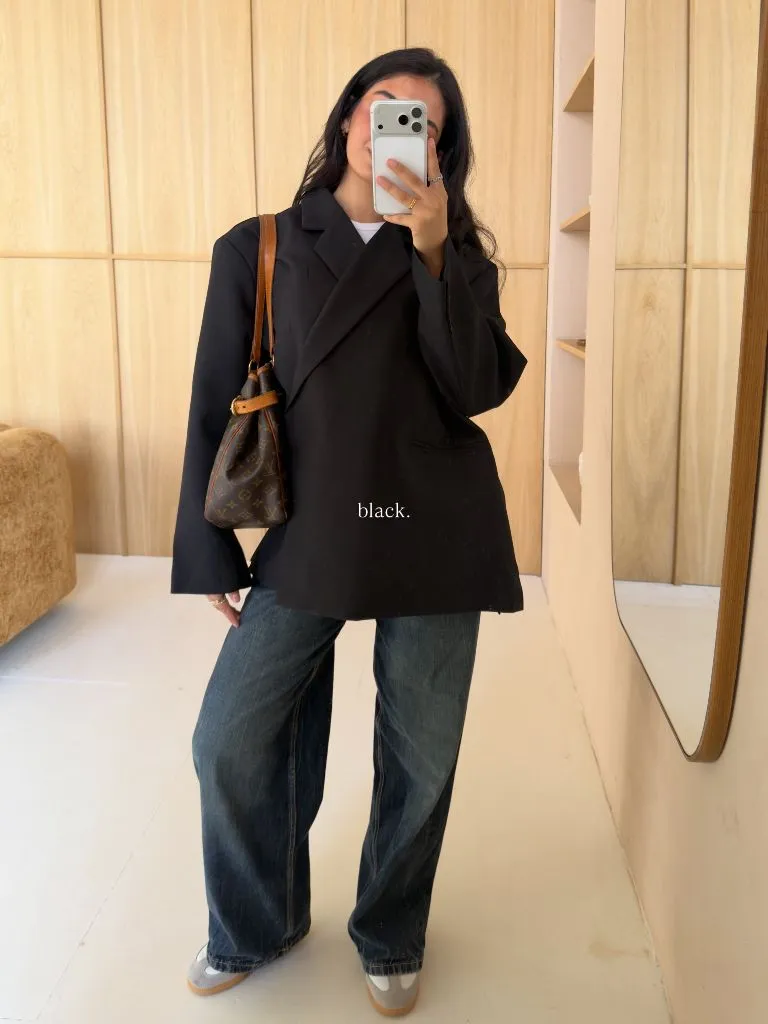
Photo via Instagram
The blazer is doing all the structural work here. Its padded shoulders and clean lapels give the upper half a defined frame, while the jeans below are wide enough to obscure the shoe entirely from most angles. That contrast between tailored above and relaxed below is one of the most reliable proportion formulas in women’s fashion styling, and this outfit executes it simply. The monogram bag introduces pattern at the shoulder that breaks the blazer’s solid black plane, and the white tee visible at the neckline echoes the sneaker color down at the hem. The warm wood and neutral tones of the room behind keep the focus on the outfit rather than the setting.
This is the most pared-back combination in this collection. Black blazer, white tee, dark jeans, and sneakers is a formula, but the oversized cut of the blazer and the generous width of the denim are what make this particular version feel current rather than safe. The takeaway is that familiar pieces gain new proportion when their fit shifts, and a blazer that falls past the hip changes the reading of every piece beneath it.
12. A Navy Shirt Balances White Cropped Trousers and Lace-Up Boots
A deep navy button-up shirt with a relaxed fit is worn with the sleeves slightly pushed up, over white cropped straight-leg trousers. White lace-up ankle boots with a low block heel complete the lower half, and a white crossbody bag with studded hardware crosses the torso. A navy hood or headscarf frames the face beneath dark sunglasses, and a green iced drink is held overhead.
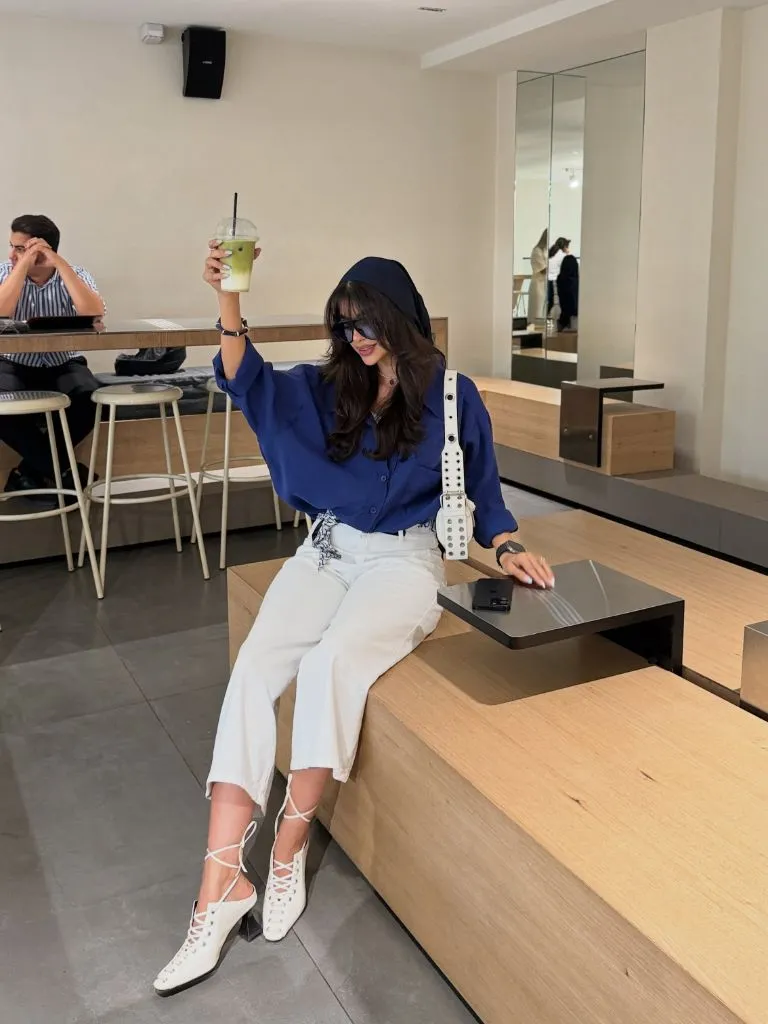
Photo via Instagram
The navy-and-white palette here is clean and binary, and the outfit’s strength comes from maintaining that discipline across every visible piece. The shirt is the only dark element, and it concentrates all the visual weight in the upper half, while the white trousers, boots, and bag form a continuous light field below. The lace-up boots add detail and texture at the ankle without introducing a new color, and the studded strap on the crossbody bag provides a small metallic interruption that keeps the white from reading as plain. The cafe interior behind, with its wood surfaces and muted walls, does not compete with the outfit’s high contrast.
The best detail is the hood or head covering that matches the shirt’s navy. It extends the dark value to the top of the frame, meaning the navy bookends the outfit above and at the center while white dominates below. The resulting reading is balanced and deliberate. Two-color outfits work best when one color is clearly assigned to the upper frame and the other to the lower, rather than alternating unpredictably between them.
13. A Printed Shearling Jacket Warms a Casual Denim Seat
A floral-and-botanical printed jacket with cream shearling trim at the collar and cuffs is the focal piece, worn over medium-wash straight-leg jeans. Brown-and-white sneakers with visible lacing detail sit on the feet, and a small tan suede handbag rests on the pavement beside the subject. Red-tinted oversized sunglasses are held near the face, and a low bun gathers dark hair at the nape.
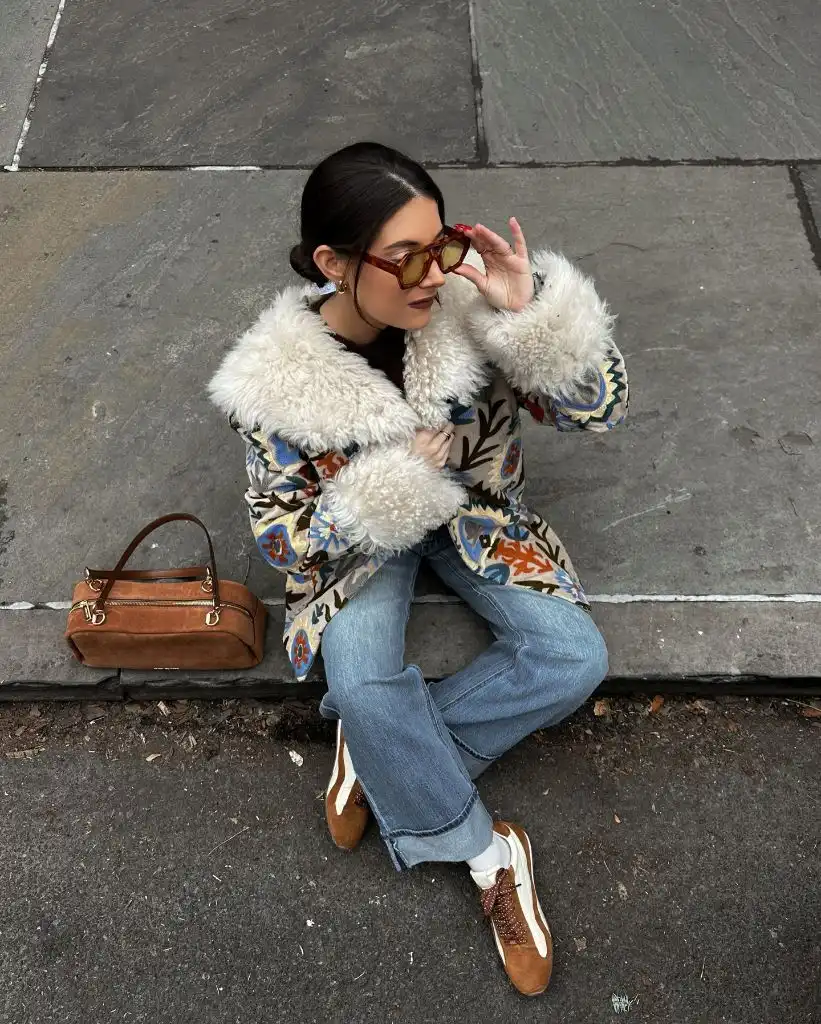
Photo via Instagram
The jacket is unquestionably the hero. Its botanical print in blues, browns, oranges, and creams carries more visual information than the rest of the outfit combined, and the shearling trim softens its edges while adding textural density. The medium-wash jeans are neutral enough to let the jacket speak, and the brown-and-white sneakers pick up the brown tones in the print without competing with its complexity. The tan suede bag on the ground echoes the cream shearling, reinforcing the outfit’s warm base. The red-tinted sunglasses are the single color that does not appear in the jacket, and that independence is what makes them register as an accessory choice rather than a match. Outfits anchored by a statement jacket often benefit from keeping the lower half this simple.
The strength here is restraint everywhere except the jacket. One high-information piece can carry an entire outfit when everything around it steps back, and the denim-and-sneaker base does exactly that. The transferable principle is that a complex garment does not need complex companions; it needs space.
14. An All-Black Coat Grounds Leggings and Tan Boots
A black double-breasted overcoat falls to below the knee over a black top and black leggings. Tan UGG-style short boots provide the only non-black element below the neck, and a black baseball cap with embroidered text sits on the head. No visible bag, and the accessories are limited to a few rings.
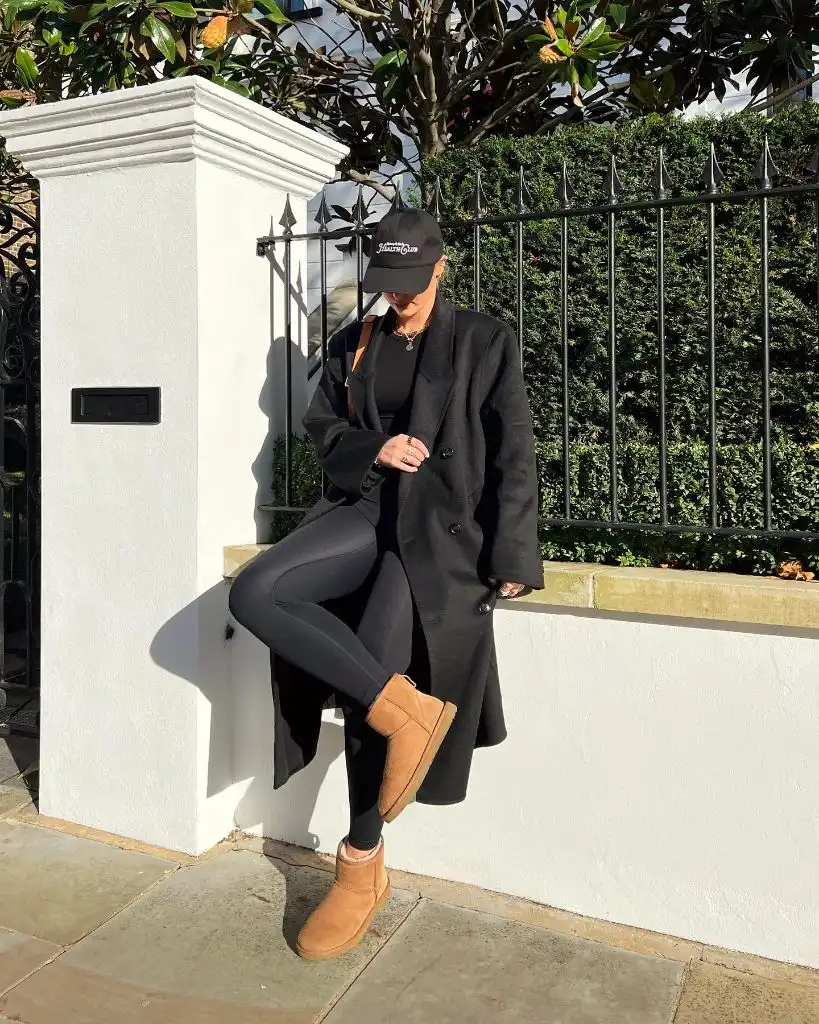
Photo via Instagram
The all-black column from cap to legging hem creates a single unbroken vertical line, and the tan boots at the base are the sole interruption. That interruption is significant: without the boots, the outfit would merge into one dark mass, but their warm suede tone introduces enough contrast to give the eye a landing point. The overcoat’s structured shoulders and double-breasted closure provide tailored shape to the upper half, while the leggings below are as streamlined as possible. The white gate pillar and green hedge behind provide a bright frame that pushes the dark silhouette forward, and the casual boots against the formal coat create a tension between polish and ease.
This is a useful demonstration of how one contrasting element can define an otherwise monochrome outfit. The boots do not match anything else, and that is precisely their role. When building an all-dark look, the single point of warmth or lightness becomes the most important decision, because it determines where the eye rests and whether the outfit reads as intentional darkness or simply an absence of color choice.
15. A Black Bomber Carries a Woven Bag and Easy Jeans
A black bomber jacket with ribbed cuffs and collar sits over a white or light base visible at the neckline. Dark grey-wash jeans are visible below, and a large dark burgundy intrecciato-weave hobo bag hangs from one arm. Slim dark sunglasses frame the face, and gold hoop earrings provide the only metallic accent. A white takeaway coffee cup is held in one hand.
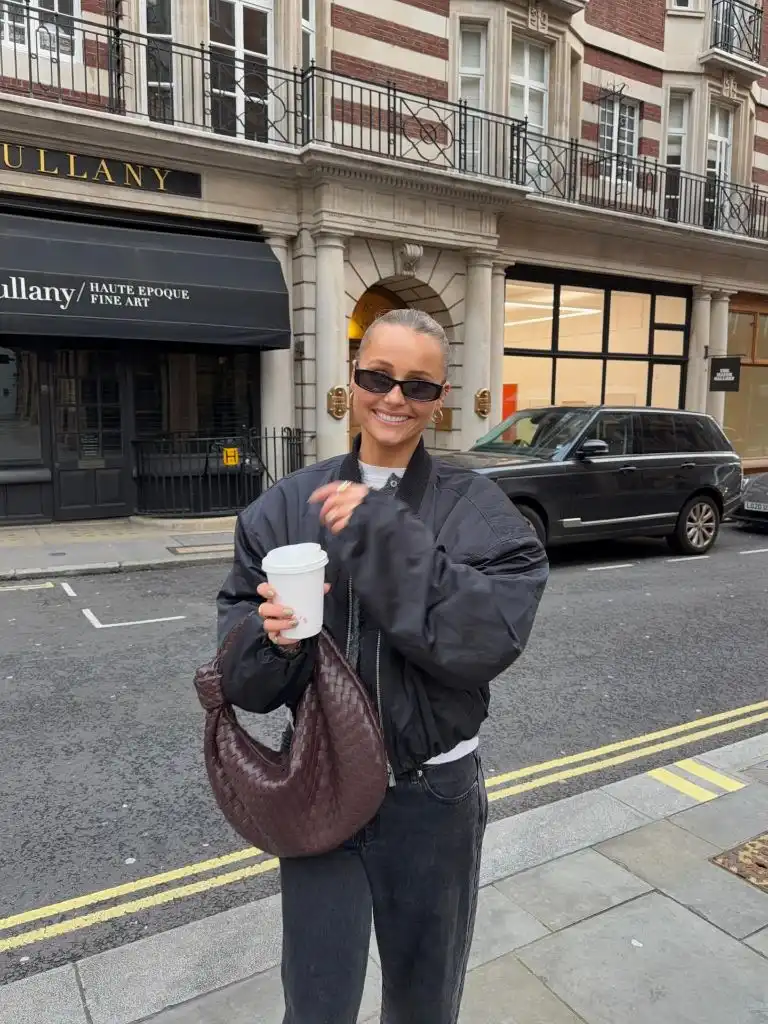
Photo via Instagram
The bomber jacket provides a clean, rounded shoulder that differs from the sharp blazer shoulders seen in other outfits in this collection, and that softer line makes the overall silhouette read as relaxed. The burgundy woven bag is the outfit’s color anchor; it introduces warmth against the black and grey without being loud. The jeans are dark enough to nearly match the jacket, which extends the dark column from shoulder to ankle and makes the bag the clear focal point. The gold hoops add a small warm echo near the face. The London street behind, with its Mullany Haute Epoque signage and Range Rover, provides context but does not compete with the outfit’s tight palette. This kind of restrained accessory-driven outfit shows how a single bag choice can redirect the tone of an otherwise neutral combination.
The effect is that the bag is doing the talking. Everything else has stepped into a supporting role, and the burgundy weave registers as the deliberate choice around which the outfit was built. When most of an outfit sits in one value range, the piece that departs from it carries disproportionate weight, and that piece should be the one with the most interesting surface.
16. A Layered Red Scarf Reframes a Classic Trench Palette
A beige trench-style coat with plaid-lined cuffs sits over a white blouse, and a bright red knit scarf is wrapped over both shoulders, creating the outfit’s dominant color note. White trousers are partially visible below, and a large tan leather tote with a floral silk scarf tied to the handle hangs from one arm. A navy padded headband, large sunglasses, and gold jewelry complete the accessories. A pink phone case and a white coffee cup occupy both hands.
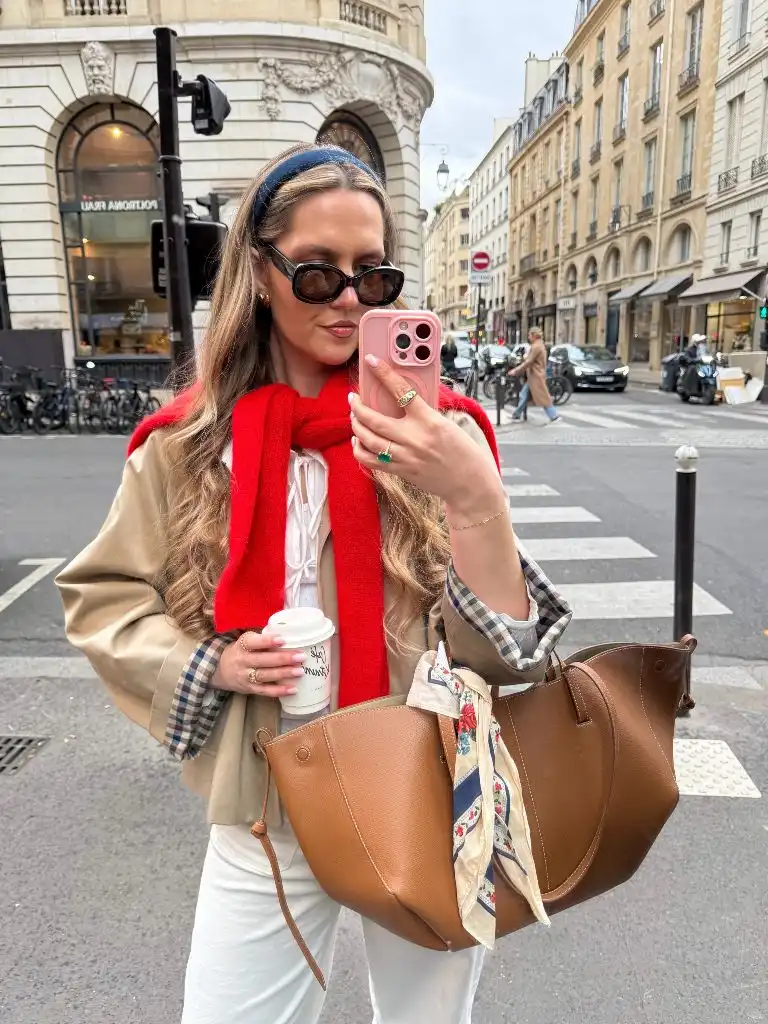
Photo via Instagram
The red scarf is doing the compositional work of a statement necklace, pulling all attention to the center of the frame and creating a bright focal point against the neutral beige-and-white base. The trench coat reads as classic, and the plaid cuff lining adds a detail that echoes the scarf tied to the tote bag, producing a sense of layered personality. The Parisian street behind, with its Haussmann-era building line and crosswalk, provides a setting that the trench coat belongs to almost too perfectly, but the red scarf disrupts that expected elegance with pure chromatic energy. The navy headband at the top of the frame is a quieter counterweight that grounds the warmth below. Multiple fall outfit ideas circle the trench coat as a starting point, and this photograph shows how one saturated accessory can change the entire mood.
The value is in the scarf’s position. Draped over both shoulders rather than wrapped tight at the neck, it covers a broad area and claims more visual territory than a typical scarf placement would. The bigger the color block, the more intentional it reads, and a scarf that sits wide reads as a design choice rather than an afterthought against the cold.
17. A Beige Turtleneck Grounds White Trousers and Black Boots
A beige ribbed turtleneck sweater with a relaxed fit is paired with white wide-leg trousers and black pointed ankle boots with a kitten heel. A tan suede shoulder bag with a slim strap crosses the torso diagonally. The face is not visible in the frame, and the setting is a beige sofa against a jute rug, which means the background nearly matches the sweater.
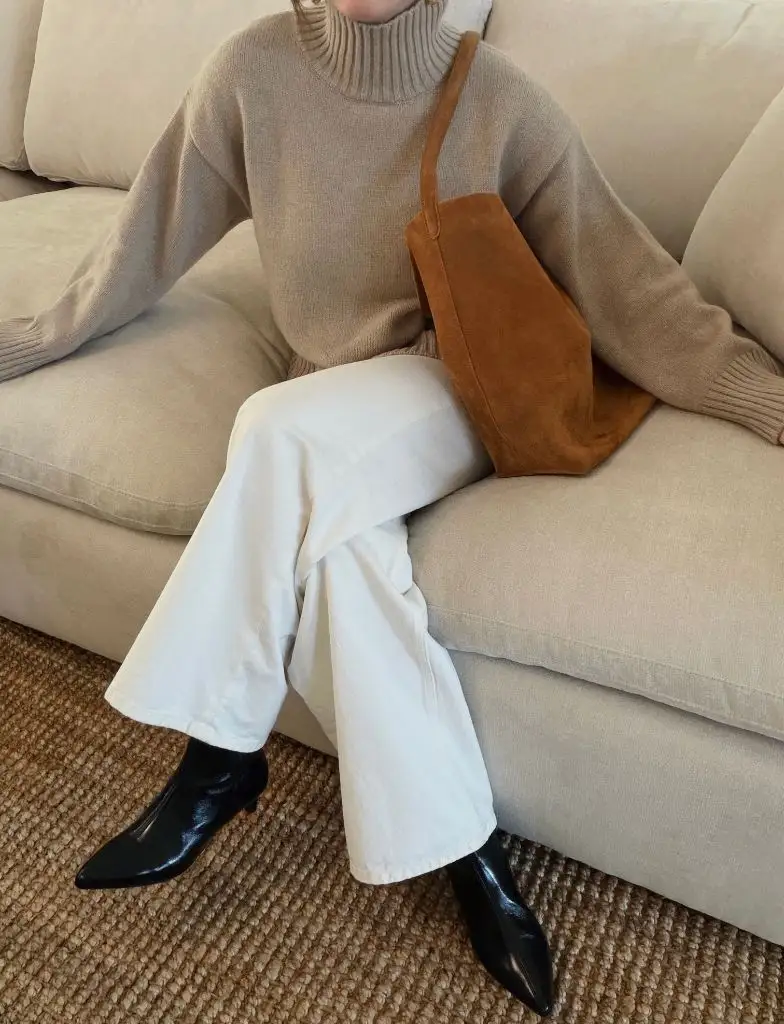
Photo via Instagram
The background here is worth discussing because it nearly disappears the sweater. The beige sofa, the beige rug, and the beige knit create a tonal environment where only the white trousers and the black boots register as contrast. That near-camouflage effect is actually the outfit’s quiet strength: it demonstrates how a single dark element at the base can anchor an otherwise floating palette. The black boots are sharp and pointed, and their slim heel introduces a vertical that the wide trouser leg needs to avoid looking heavy. The tan suede bag adds a slightly warmer brown than the sweater, providing just enough tonal separation to read as a distinct piece.
This is the outfit in this collection that most closely follows the principles of neutral wardrobe building, and it works because the three tones, beige, white, and black, are placed in a clear gradient from top to bottom. The pointed boot toe is doing more work than it might seem; a rounded or chunky boot would soften the base and let the wide trousers dominate. The sharp point keeps the eye moving downward with direction.
18. A White Blazer Extends an All-Cream Monochrome
A white or ivory oversized blazer is draped over the shoulders above a pale pink cable-knit sweater vest, and white wide-leg trousers continue the light palette to the ground. White pointed-toe boots with a slim heel emerge below the trouser hem, and a small white structured bag is held in one hand. Round sunglasses sit on the face, and the setting is a modern storefront with grey and glass surfaces.
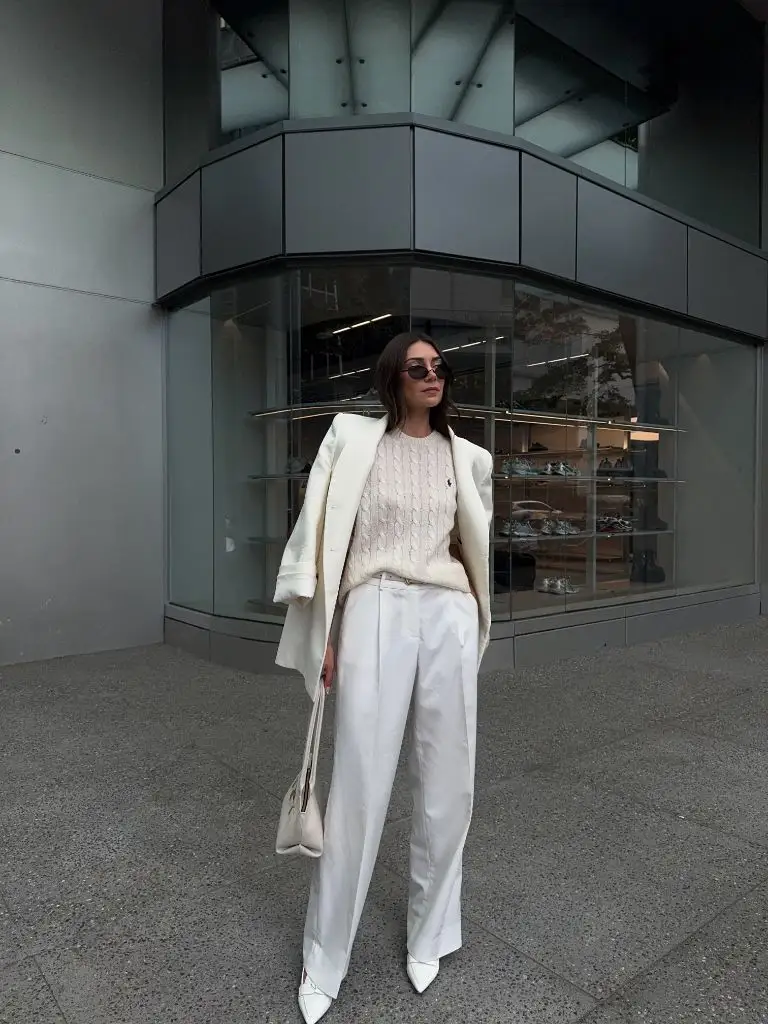
Photo via Instagram
This outfit is nearly entirely white, and the pale pink cable-knit sweater vest is the single soft departure that prevents it from reading as bridal or clinical. The cable-knit texture is doing crucial work: in a palette this light, surface texture is the only thing that differentiates one piece from another, and the visible cable pattern gives the eye something to register at the center of the outfit. The blazer draped over the shoulders without arms in the sleeves creates a wider frame than a worn blazer would, and the trouser-to-boot transition is seamless because both are white. The grey building behind provides the contrast that the outfit itself does not.
What stands out most is the confidence of committing this fully to one value. Most all-white outfits break the monotony with a contrasting belt or bag, but here the bag is also white, which means the look depends entirely on shape and texture variation. The cable knit, the smooth blazer, and the trouser drape each provide their own surface language. The lesson is that monochrome does not mean monotone when fabrics are chosen with care.
19. A Striped Polo Layers Under a Black Blazer With a Grey Scarf
A black oversized blazer sits over a grey scarf or shawl draped around the shoulders, and beneath that a white-and-grey striped polo or henley is visible at the chest. White wide-leg trousers provide the lower half, and black chunky loafers ground the look. A white baseball cap, large sunglasses, and a black coffee cup complete the visible accessories, and a small dark bag is tucked under one arm.
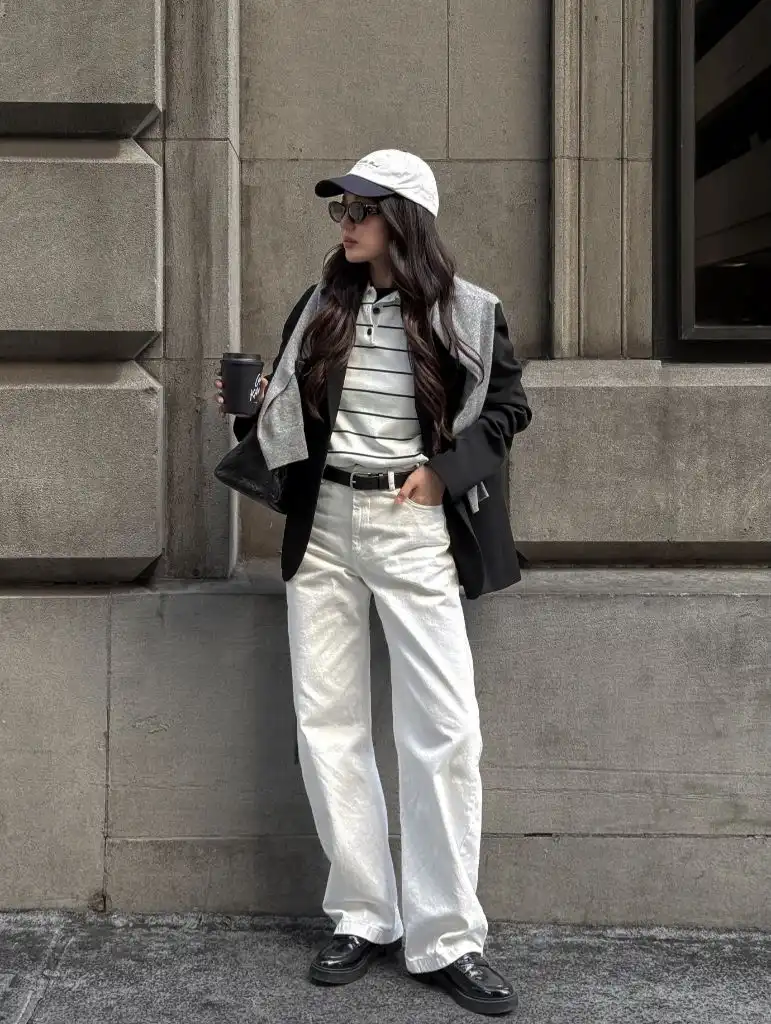
Photo via Instagram
The layering density here is the highest in this collection. Four visible layers from the polo to the scarf to the blazer to the cap create a stacked reading that adds visual richness without color complexity. The palette is limited to black, white, and grey, and the striped polo is the only pattern, which means the outfit’s interest comes from the overlap of textures and shapes rather than from hue. The white trousers are wide and full-length, and the black loafers at the base mirror the blazer at the top, bookending the white volume in between. The grey concrete wall behind extends the palette into the environment. Outfits built around layered blazer combinations gain depth when each layer is partially visible rather than fully concealed.
The appeal is the scarf as an intermediate layer. Placed between the polo and the blazer, it adds a third texture at the shoulder that softens the blazer’s hard tailoring without removing its structure. The principle is that layering works best when each piece is legible at the edges, even if it is mostly covered, because partial visibility creates the sense of depth that makes layering look deliberate.
20. A Leather Jacket Darkens Faded Wide-Leg Jeans
A black leather jacket with a slightly worn, matte finish sits over a black crewneck, both tucked or layered into faded wide-leg jeans belted with a black leather belt. A black embossed leather tote bag hangs from one hand, and the shoes are not visible at the bottom of the frame. A delicate pendant necklace provides the only metallic element, and dark sunglasses frame the face. The setting is a grey stone building with iron railings and stone steps.
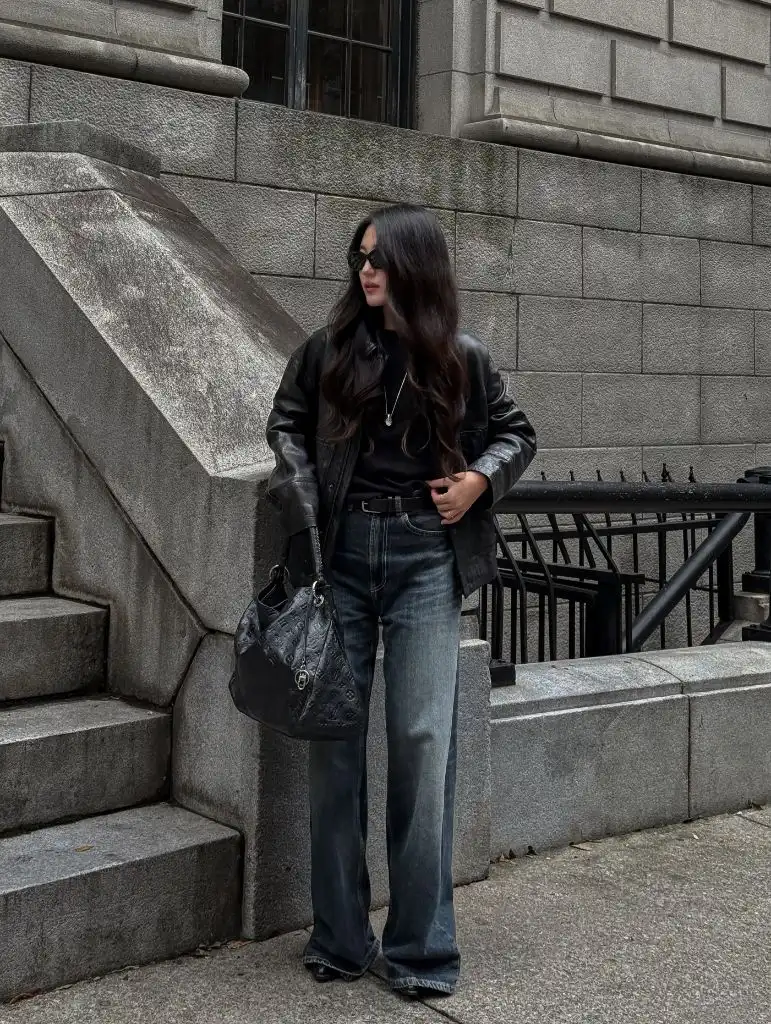
Photo via Instagram
The leather jacket’s worn matte finish is key to this outfit’s mood. A glossy or new-looking leather would push the reading toward evening or edge, but the slightly aged surface here reads as lived-in and easy, which lets the jeans set the casual tone. The faded denim provides the outfit’s only color departure from black, and the fade itself, which is stronger at the thighs and lighter at the calves, creates a subtle gradient within the jeans. The black belt defines the waist sharply, and the embossed tote bag adds a surface pattern in the same dark tone, which means the eye reads it as texture rather than decoration. The pendant necklace breaks the all-black chest area with a small point of light.
This is a grounding outfit. Every piece signals restraint, and the total effect reads as someone who has made these decisions many times before. A worn leather jacket over plain black and denim is not a new combination, but the specific choices here, the matte finish, the wide leg, the embossed bag, the single pendant, show that familiarity with a formula does not preclude care within it.
21. A Black Lace Camisole Refines a Leather Jacket and White Jeans
A black leather jacket, slightly cropped, sits open over a black lace camisole with visible scalloped edging at the hem. White or cream wide-leg trousers fall to the ground below, and black pointed-toe flat mules provide the base. A small dark bag is held close, and a pendant necklace echoes the thin metallic line seen in the previous outfit. Sunglasses and long dark hair complete the frame, and the setting is a stone building wall with clean horizontal lines.
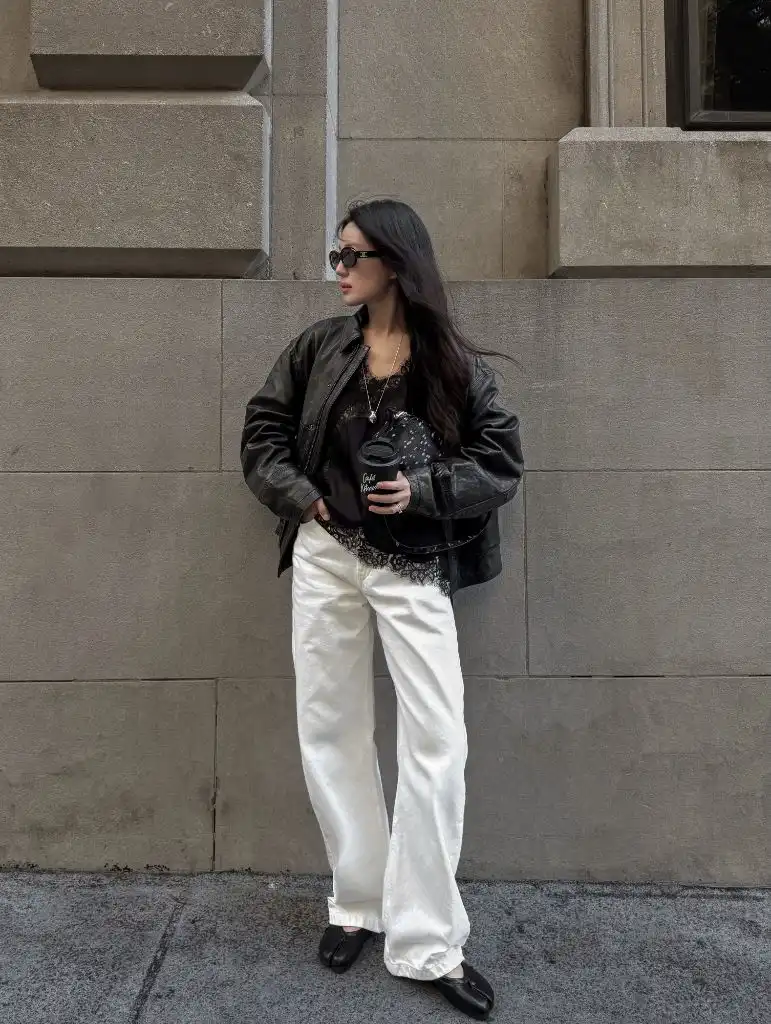
Photo via Instagram
The lace camisole is the detail that changes this outfit’s register. Without it, the combination of leather jacket, white trousers, and flat mules would read as clean-casual. With the lace, the chest area introduces a delicate, textured element that creates tension against the leather’s toughness. The scalloped lace edge is visible below the jacket’s hem, and that small strip of patterned fabric is enough to shift the entire reading toward something more considered. The white trousers provide the same bright base seen across several outfits in this collection, and the pointed mules sharpen the lower line without adding height. This interplay between hard and soft textures is a hallmark of refined casual outfits that want to signal ease without sacrificing detail.
The best detail is the lace hem peeking below the jacket. It is visible by only an inch or two, but that narrow strip of transparency and pattern is doing more work per square centimeter than any other element. The principle is that contrast does not need to be large-scale; a small insertion of a different texture at a visible junction is often enough to elevate the entire composition.
22. A Light Blue Shirt Opens Against Black Tailored Trousers
A sky-blue button-up shirt with utility-style chest pockets is worn with sleeves slightly rolled, tucked into high-waisted black tailored trousers with a wide, flowing leg. Black-and-white patterned slingback heels are visible at the hem, and a small burgundy woven clutch bag is held in one hand. Gold earrings, bracelets, and dark sunglasses complete the accessories. The stone building behind suggests a Southern European city.
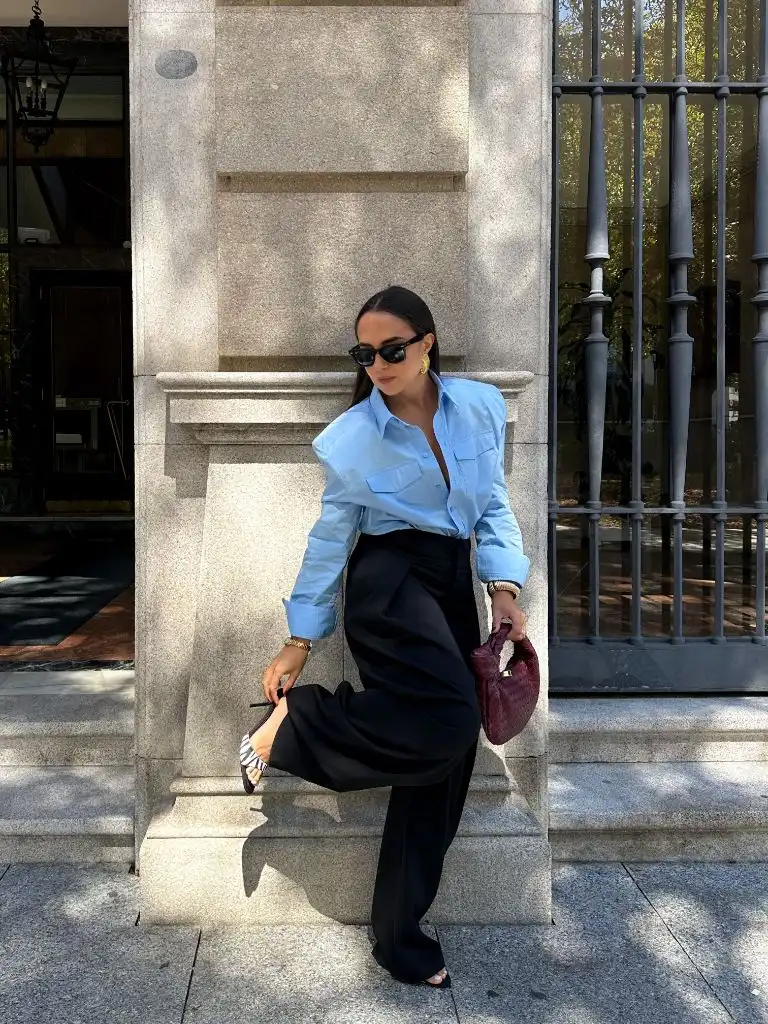
Photo via Instagram
The blue-and-black combination is simple, but the proportions are what make it register. The shirt’s relaxed volume above the waist contrasts with the trousers’ sharp high waist and wide drape below, and that transition at the waistline is where the outfit pivots from casual to tailored. The utility pockets on the shirt add a structural element that keeps the blue from reading as dressed-up, while the flowing black trousers carry a formality that the shirt alone would not suggest. The patterned slingback heels introduce the outfit’s one moment of graphic energy, and the burgundy clutch provides a warm color note that the rest of the outfit withholds. Many approaches to smart-casual dressing rely on exactly this kind of register mixing, pairing a workwear-inspired top with a trouser that belongs to a dressier context.
The strength here is the heel choice. A plain black pump would merge with the trousers, and a flat sandal would drop the formality below what the trousers want. The patterned slingback splits the difference, adding personality at the ankle and visual interest at the one point where the outfit meets the ground.
23. A Graphic Long-Sleeve Tee Softens a Plaid Midi Skirt
A white oversized long-sleeve tee with a graphic star print and text reading “ODBC STUDIO 1506” is worn loosely over a light blue-and-brown plaid midi-length skirt. A patterned knit beanie in pale pink sits on the head, and a Louis Vuitton monogram cylindrical bag is held in one hand. The setting is a rustic bakery interior with bread, baskets, and warm wood surfaces.
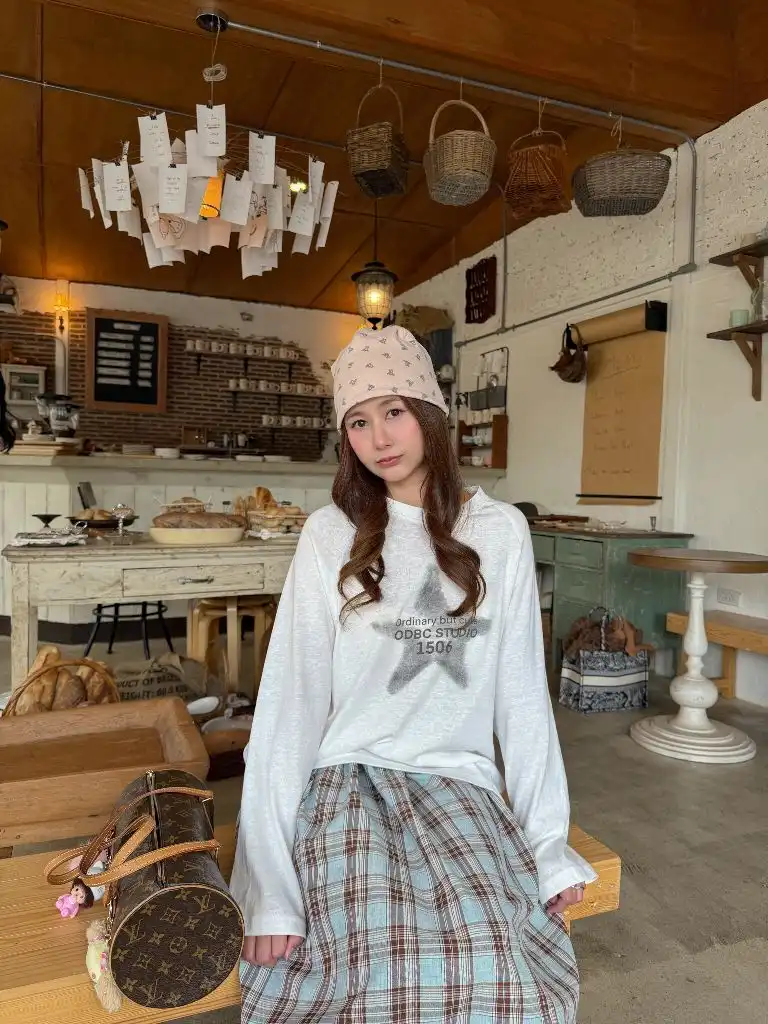
Photo via Instagram
The outfit reads as deliberately youthful without tipping into costume, and the plaid skirt’s midi length is what maintains that balance. The oversized tee falls past the natural waist and overlaps the skirt’s waistband, which creates a relaxed junction rather than a defined one. The plaid pattern in the skirt introduces soft browns and blues that connect to the star graphic’s grey tones, so the two patterned pieces coexist without clashing. The pink beanie adds a gentle color at the crown that the outfit otherwise lacks, and the monogram bag introduces a vintage-luxury texture against the casual cotton. The bakery setting, with its hanging paper notes and bread-laden counters, mirrors the outfit’s artisanal, unhurried mood. This kind of pattern mixing relates to the broader conversation around creative pattern combinations that work when the scale and value of the patterns differ enough to stay legible.
I like the way the beanie and the bag are the two most recognizable pieces, yet they occupy opposite ends of the spectrum from hand-knit warmth to structured leather. That range is what keeps the outfit from collapsing into one register, and the white tee between them acts as neutral territory where both influences can coexist.
24. A Striped Tee Simplifies a Denim-and-Cap Silhouette
A dark-and-cream horizontal striped long-sleeve tee is tucked or half-tucked into medium-dark wide-leg jeans. A dark green baseball cap faces backward, and a dark brown leather tote bag hangs from one shoulder. The subject is photographed from behind, walking through what appears to be an open urban plaza with trees and public art visible in the background.
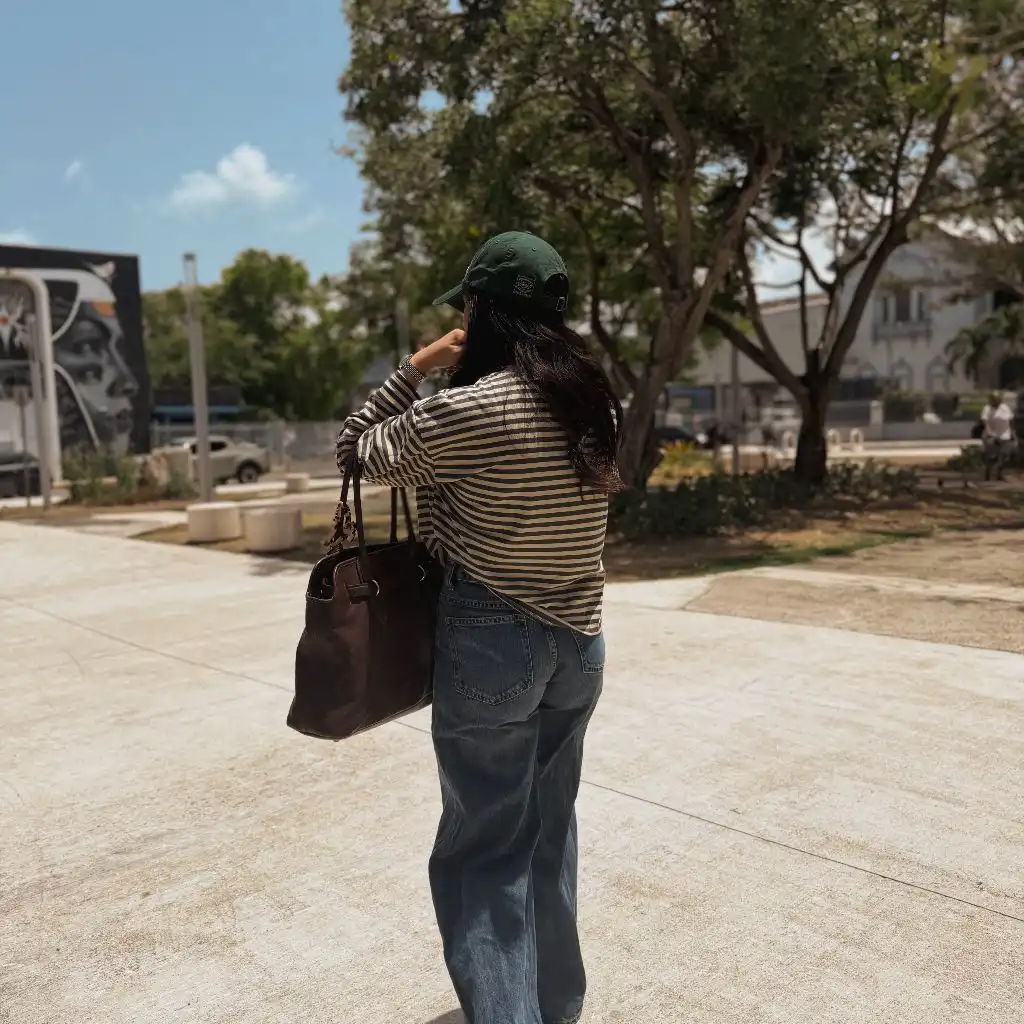
Photo via Instagram
The back view gives this image a candid quality that several of the more posed photographs in this collection do not have, and it shifts the reading toward how an outfit looks in motion rather than in stillness. The horizontal stripes create consistent visual rhythm across the shoulders and back, and the dark jeans below continue the outfit’s tonal weight into the lower half. The green cap is the one color departure, and seen from behind, it anchors the top of the silhouette with a defined point of contrast. The brown tote bag sits against the striped back, and its smooth leather reads clearly against the knit texture beneath. The bright sky and open plaza behind provide visual space that lets the outfit’s simplicity register as intentional.
The effect is ease without emptiness. This outfit contains four pieces and no visible jewelry, yet it reads as complete because each piece carries a different role: the stripes provide pattern, the jeans provide volume, the cap provides color, and the bag provides texture. Trendy outfits for women over 30 do not need complexity to feel finished; they need each element to contribute something distinct.