The pressure to dress “correctly” in winter when you wear a larger size can make getting dressed feel like a negotiation rather than a creative act. Winter outfits for plus-size women do not need to follow a formula built around hiding or minimizing. You get to decide what proportion means on your body, what textures you want against your skin, and how much or how little structure a coat should carry. None of that requires permission from a trend forecast.
The useful question is not which pieces are “flattering” but which visible decisions create the effect you actually want. A good outfit begins before the mirror, in the relationship between a coat’s length and the trouser beneath it, or between a knit’s volume and the way a hemline falls. This article moves through twenty-five real outfits and reads each one for the variables that matter most: proportion between layers, color contrast or repetition, texture and fabric weight, silhouette from shoulder to shoe, and the way accessories anchor or interrupt a look. Every observation comes from what is genuinely visible in the photograph, nothing invented, nothing assumed. The goal is not a shopping list but a set of transferable principles you can carry into your own wardrobe, regardless of what is already hanging there.
1. A Cream Coat Frames a Layered Blue-and-White Base
The strongest visible detail here is the layering depth. A cream or oatmeal long coat sits draped over the shoulders without being buttoned, revealing a light blue open button-down shirt beneath it, and under that, a fitted white crewneck top. The bottom half is dark navy or black tailored trousers with a pleated front, and a black woven leather tote hangs from the left arm.
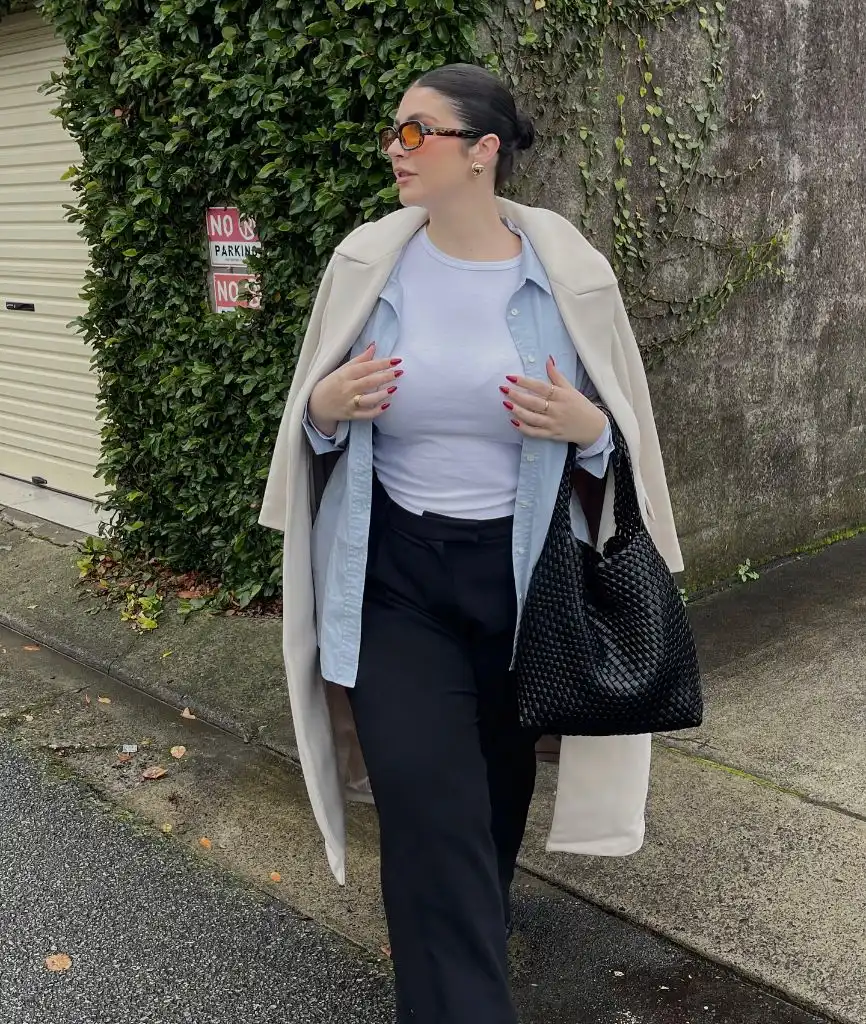
Photo via Instagram
The three-layer structure on top works because each layer is a slightly different tone moving from dark at the bottom through white to pale blue to cream. The eye travels outward through those tones rather than stopping at any single edge. The coat’s length, falling well below the knee, gives the silhouette a vertical pull that the wide trouser leg echoes. The woven bag adds a textural interruption against the otherwise smooth fabrics, and the red nails provide the only warm accent, which keeps the palette from reading as entirely passive. The unbuttoned coat creates a narrow central column of lighter color framed by the heavier cream on either side, and that framing is doing more work than any single piece.
The appeal is the way restraint in color lets the layering itself become the point of interest. When every layer sits within a close tonal range, the outfit reads as considered without needing a statement piece. The transferable principle is that a long coat over multiple layers can feel deliberate rather than bulky if the tones graduate rather than clash.
2. An Abstract Print Balances Wide Denim Volume
A loose, painterly abstract-print blouse in olive, yellow, blue, and black dominates the upper half of this image. The blouse has a relaxed fit through the body and slightly gathered sleeves. Below, wide-leg light-wash denim jeans flare significantly from the hip, and the footwear is a pair of neutral woven-strap sandals. A tan structured bag sits on the right shoulder.
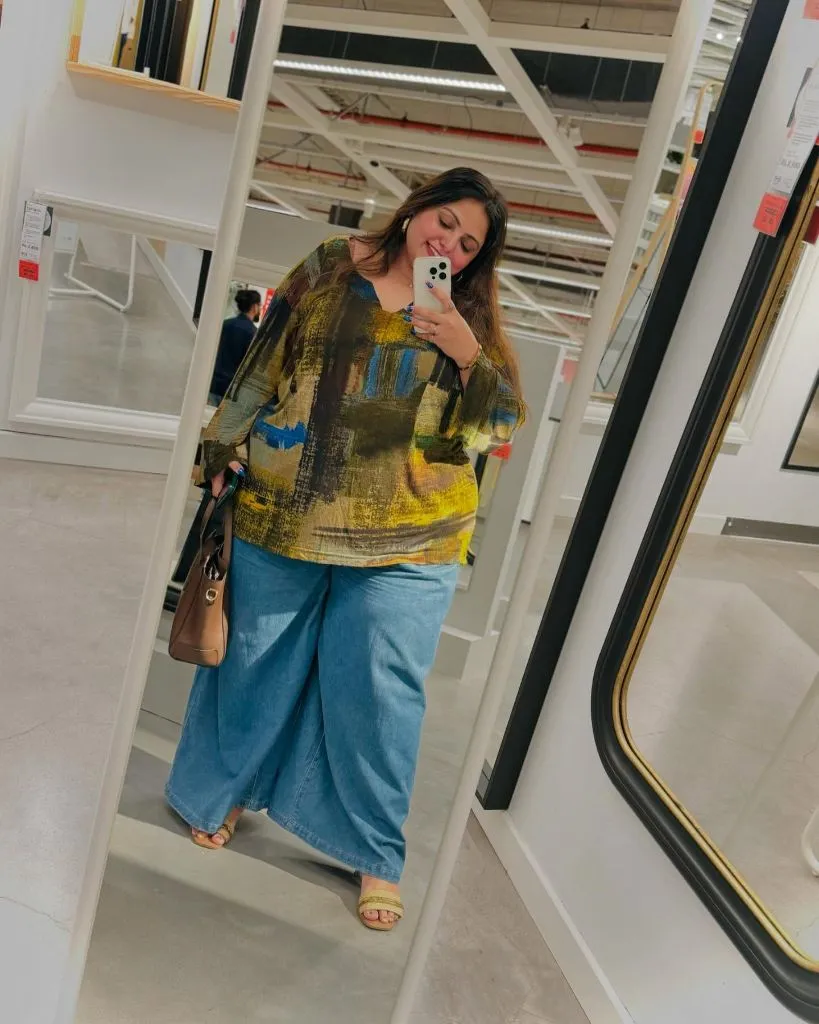
Photo via Instagram
The print does the heavy lifting here. Its colors are warm and saturated enough to hold attention against the large expanse of pale denim below. The wide jeans create substantial volume at the bottom, and without the visual weight of the print on top, the outfit could read as unanchored. Instead, the dark brush strokes in the blouse give the upper body enough density to balance the lower half. The tan bag repeats the warmest tones in the print without introducing a new color family, and the sandals stay neutral enough to avoid competing. The mirror selfie setting, taken in what appears to be a furniture store, shows the full silhouette clearly, and the proportions read as intentional rather than accidental.
This is a demonstration that volume on both halves works when the top carries enough visual weight through pattern rather than structure. The principle is straightforward: a bold, multicolor print can anchor an oversized bottom without the need for a fitted or tucked-in silhouette, as long as the print’s density matches the fabric’s spread.
3. A Camel Coat Grounds an Athleisure Set
The outfit here is a matching grey sweatsuit, a cropped hoodie with the drawstring visible and joggers cuffed at the ankle, worn under a long open camel-toned coat. White chunky sneakers anchor the bottom. A black baseball cap and dark sunglasses sit on top, and a small black crossbody bag with a wide dark strap crosses the torso diagonally.
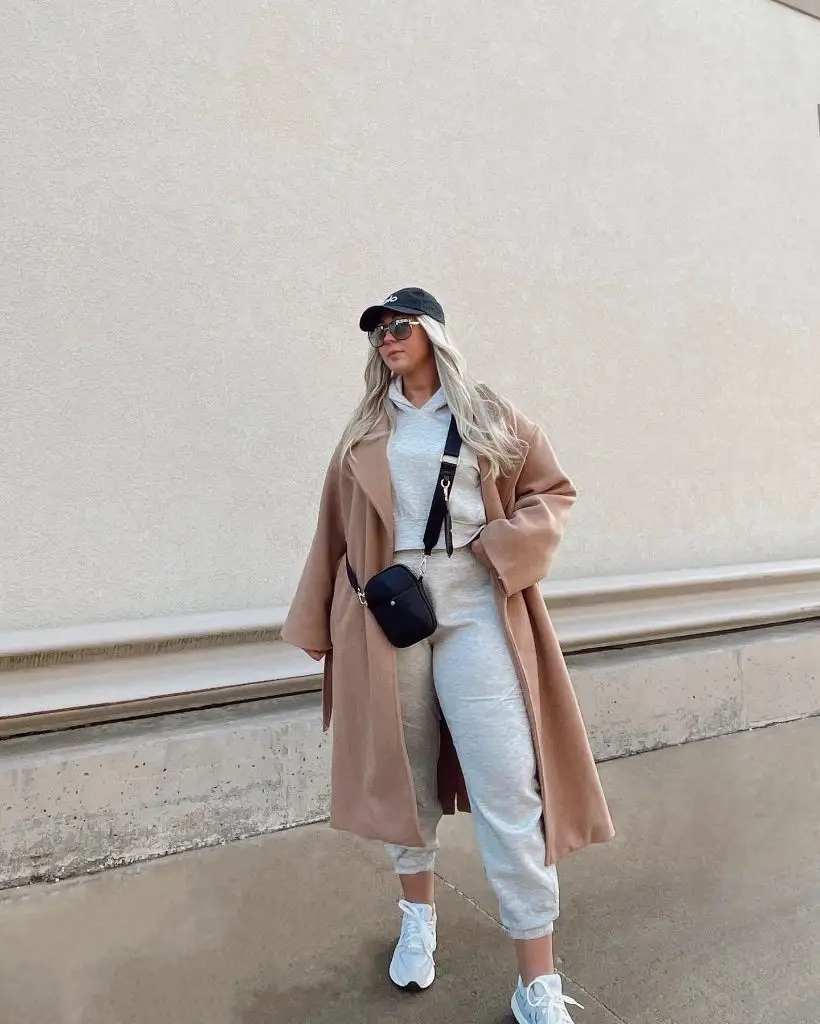
Photo via Instagram
The camel coat is doing the structural work that the sweatsuit deliberately avoids. Without it, the grey set would read as purely casual. With it, the silhouette gains a defined shoulder line and a vertical length that reframes the joggers as a deliberate choice rather than a default. The crossbody bag’s strap creates a diagonal line that breaks the otherwise symmetrical front panel, and its black tone connects to the cap and sunglasses, forming a small accessory family. The white sneakers repeat the lightness of the grey rather than grounding the look in something dark, which keeps the overall palette soft. The cuffed jogger hem exposes the ankle and creates a visible break between the pant and the shoe, which prevents the bottom half from reading as heavy.
The strength here is the coat’s ability to change the category of the outfit underneath it. A matching knit or fleece set gains formality and shape when a structured outer layer frames it. The transferable idea, relevant to many winter layering approaches, is that a single tailored piece over a relaxed base shifts the entire reading of a look.
4. A Grey Sweatshirt Carries a Minimal Errand Look
This photograph shows a grey crewneck sweatshirt worn with black leggings and white leather sneakers. The setting is the open door of a dark-colored SUV, and the person sits at the edge of the driver’s seat looking at a phone. A black bag strap is visible on one shoulder, and a gold watch and bracelet sit on the left wrist. Sunglasses rest on top of the head.
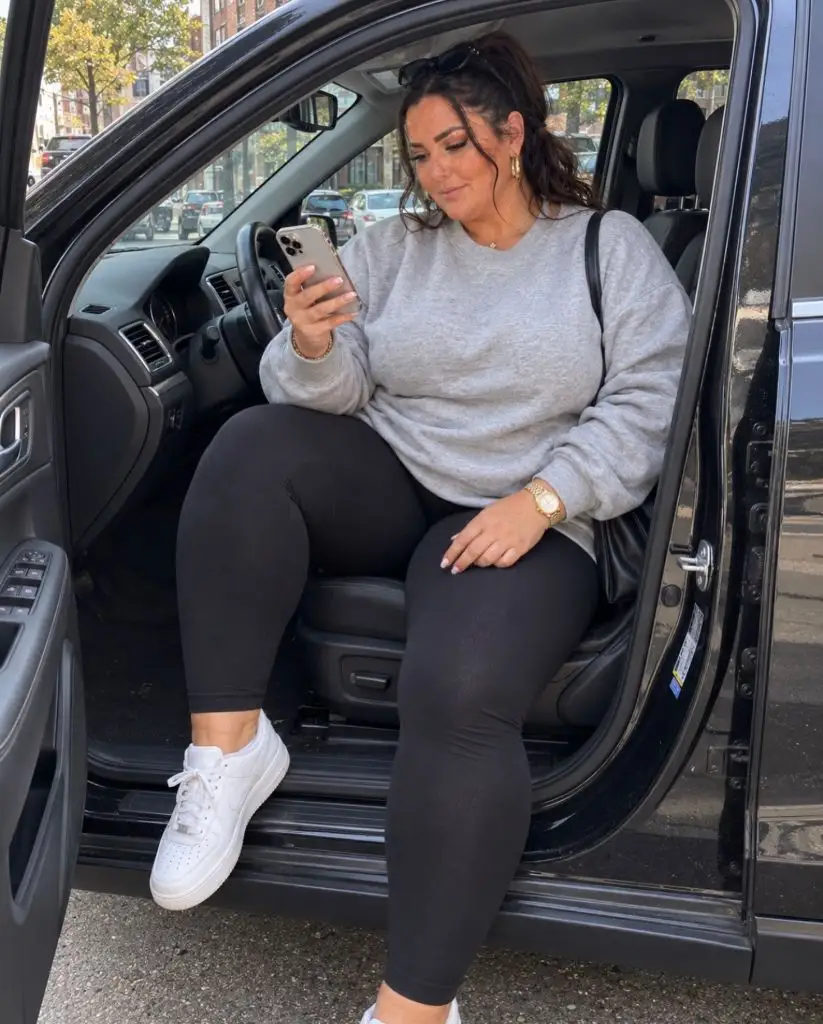
Photo via Instagram
The simplicity here is the point. There are only two fabric tones, grey and black, plus white at the feet. The sweatshirt has enough weight and a slightly oversized cut that it creates a clean line across the hip rather than clinging. The leggings provide compression and a smooth silhouette from hip to ankle, and the white sneakers break the dark lower half with enough contrast to keep the eye moving downward. The gold jewelry, the watch, bracelet, and earrings, introduces warmth without adding complexity, and the sunglasses on the head serve as a casual accessory that keeps the hairline tidy. The car doorway context makes this read as a real errand outfit rather than a styled editorial moment.
I like the honesty of this image. It does not pretend to be more than a well-chosen version of the simplest possible winter formula. The principle it offers is that when color and silhouette are this restrained, small metallic details and clean footwear are enough to move the outfit from forgettable to intentionally casual.
5. Plaid Structure Sharpens a Relaxed Denim Base
A black, grey, and white plaid hooded zip-up jacket is the central piece here. It has a structured shoulder and a slightly boxy fit, with a grey jersey hood visible underneath the collar. Below, loose-fit light blue jeans fall straight to the shoe, and a black structured shoulder bag hangs from one hand. The visible footwear appears to be a dark sneaker or low shoe.
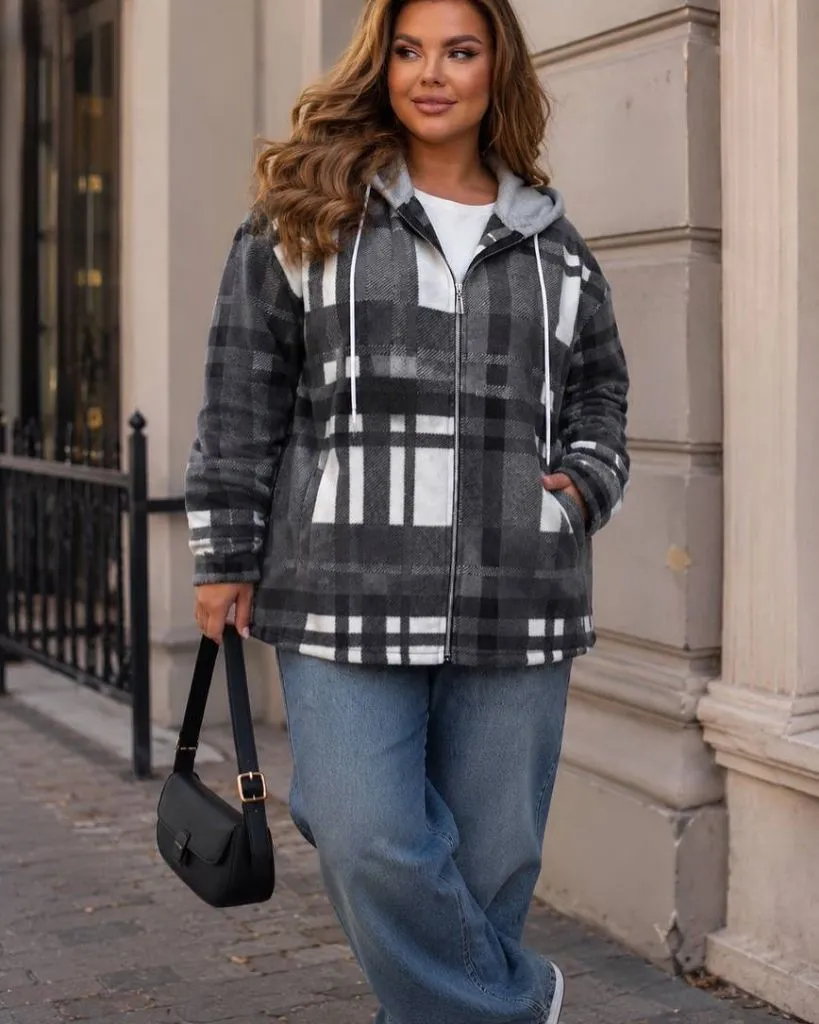
Photo via Instagram
The plaid pattern works because the scale is large and the contrast is high. The white bars against the charcoal and black ground create enough graphic energy to anchor the top half without accessories. The grey hood peeking out softens the neckline and introduces a third neutral that bridges the jacket’s black tones with the lighter denim below. The jeans are loose but not voluminous, sitting in a relaxed straight cut that balances the jacket’s boxiness without competing for width. The black bag and dark shoes keep the accessories in the same tonal family as the jacket’s darkest tones, which creates a frame at the top and bottom of the silhouette.
The effect is a winter outfit that reads as put-together without leaning on formality. The plaid does the work that a more minimal jacket would need accessories to do. For anyone considering how pattern weight interacts with denim looseness, this is a useful reference: the busier the jacket, the simpler the bottom half can afford to be.
6. A Herringbone Belted Coat Anchors a Full Silhouette
The entire visible outfit here is essentially one piece: a long, belted, double-breasted herringbone coat in grey and white. It falls past the mid-calf, with wide lapels, a self-fabric belt tied at the waist, and button details. Beneath it, only the hem of dark trousers and white pointed-toe shoes are visible. The background is a weathered wooden fence.
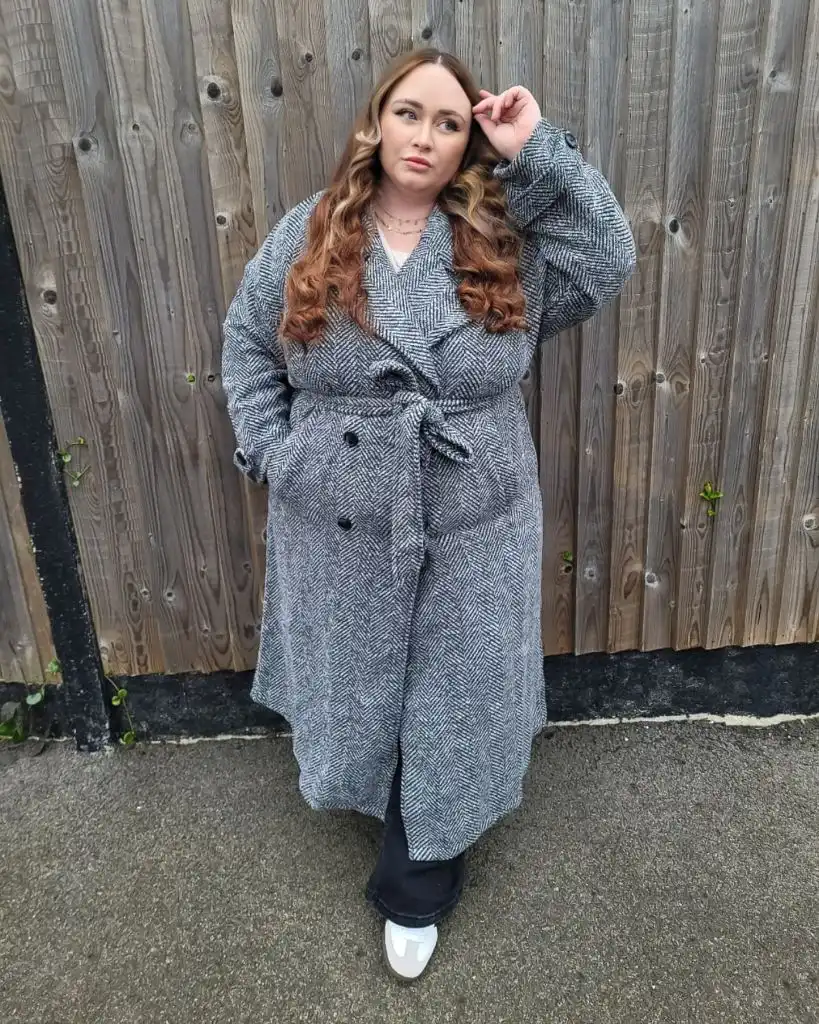
Photo via Instagram
This image is worth noting for what it cannot show as much as what it can. Because the coat covers nearly the entire body, the outfit analysis is really a coat analysis. The herringbone weave gives the fabric visual texture that a solid grey would not have, and the belt creates a defined waist point that gives the silhouette an hourglass proportion even through heavy wool. The wide lapels frame the face and draw the eye upward, while the coat’s length ensures the trousers and shoes serve only as a quiet base. The white shoes at the bottom echo the lighter threads in the herringbone and prevent the silhouette from landing too heavily.
This is the kind of winter outfit where a single piece does all the proportional work. The coat’s belt, lapel width, and hemline are the only design decisions that matter. The takeaway is that when a coat is this dominant, its internal structure, the belt placement, the lapel scale, the fabric pattern, becomes the outfit itself, and the pieces underneath become secondary support.
7. A Green Plaid Shacket Opens a Dark Knit Dress
A cream-and-green plaid shacket, an oversized shirt-jacket hybrid, sits open over a dark forest-green fitted knit dress that falls just above the knee. Beige suede ankle boots with a stacked heel complete the lower half. A long pendant necklace hangs at the center of the chest, and the setting is a modern interior with a framed abstract print and a grey cabinet.
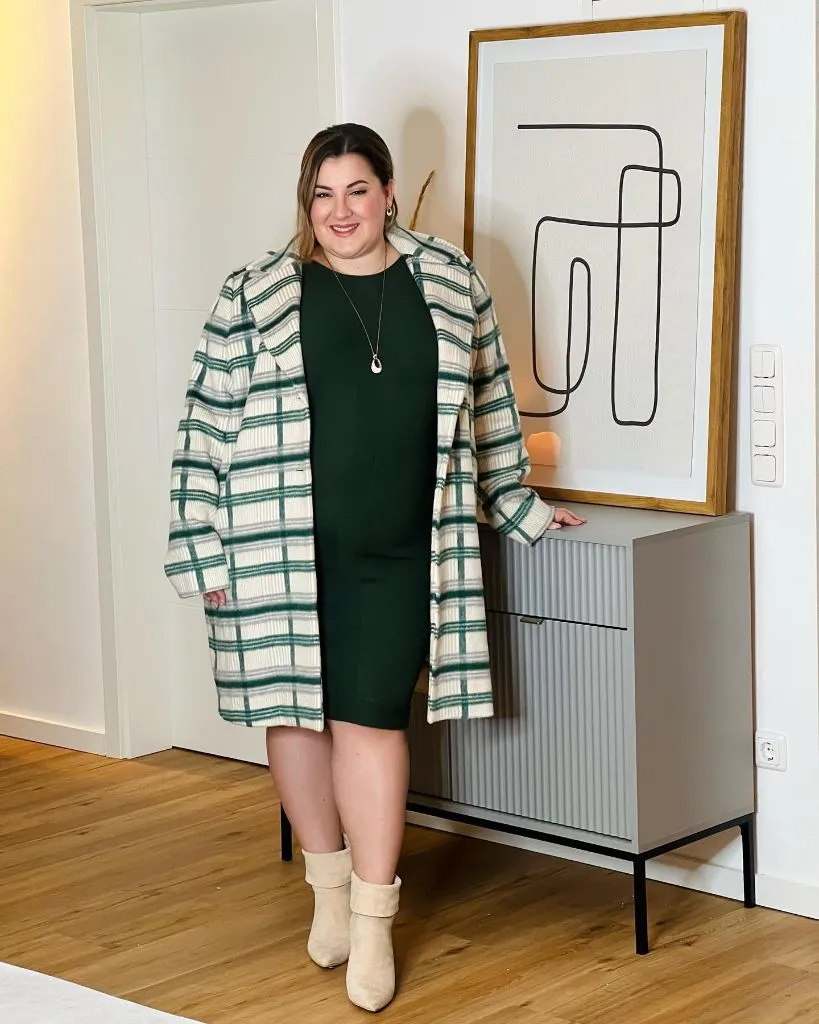
Photo via Instagram
The color repetition is what makes this work. The green in the plaid shacket picks up the green of the dress, but the cream ground of the jacket lightens and expands the palette so the two greens do not collapse into each other. The dress is fitted and stops above the knee, creating a visible break before the boots begin, which gives the legs definition. The suede boots in a warm beige introduce a softer texture against the knit dress and the woven jacket, and their heel adds a slight vertical lift. The pendant necklace draws a vertical line down the center of the dress, emphasizing the narrow column the shacket frames. The overall proportion is a wider top layer over a narrower base, which works well for those exploring seasonal dress styling.
The best detail is the tonal relationship between the plaid and the dress. Repeating a color across two different textures and patterns creates cohesion that feels instinctive rather than coordinated. The principle: when an outer layer shares a color with the base piece, the outfit reads as a single idea rather than separate decisions.
8. A Sherpa Coat Frames a Winter Mountain Palette
A cream sherpa coat with a wide collar and slightly oversized fit sits open over a dark brown ribbed knit top or dress. A white fur or faux-fur headband covers the crown of the head. Black narrow sunglasses rest on the face. The setting is a snowy mountainside with evergreen trees and a dark-colored cabin visible behind.
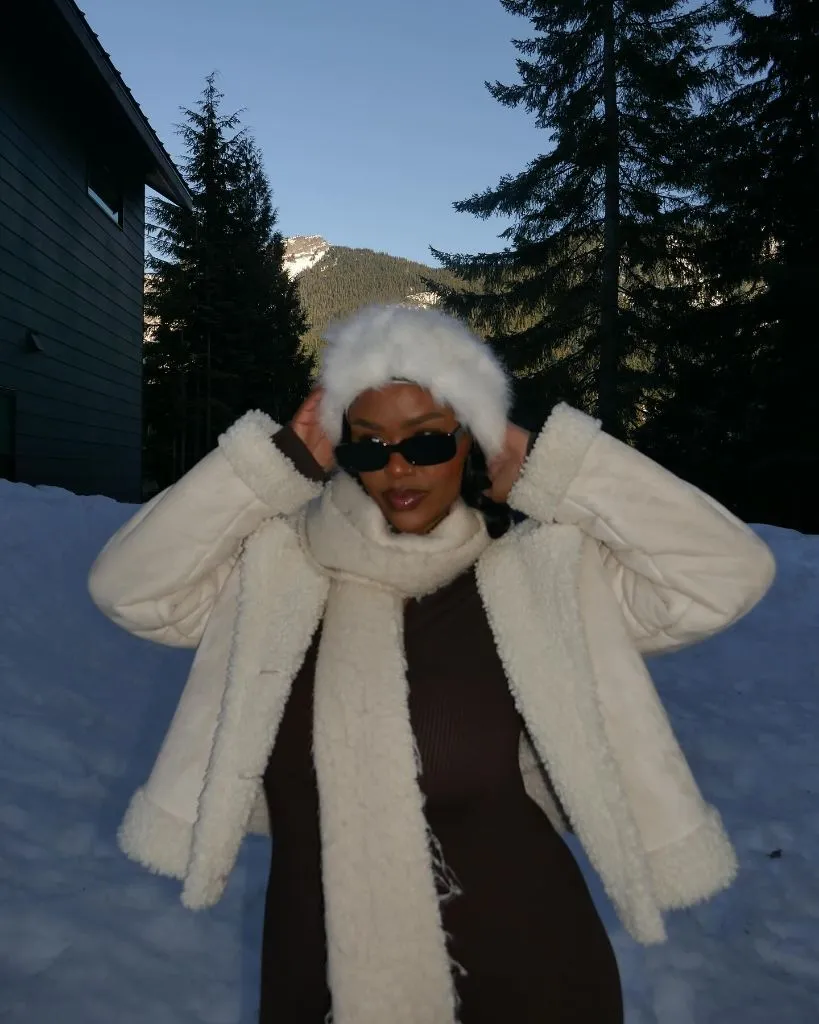
Photo via Instagram
The coat’s texture is the dominant feature. Sherpa has a visual density that reads as warm before any styling decision is made, and the cream color here keeps it from feeling heavy despite the bulk. The dark brown underneath creates a strong contrast column at the center of the frame, which gives the silhouette depth rather than reading as a single pale mass. The white headband repeats the cream tone at the top of the frame, bookending the sherpa’s color and keeping the palette unified. The black sunglasses are the sharpest contrast point in the entire image and sit right at the center of the face, creating a focal anchor. The snowy background reinforces the winter palette without being part of the outfit, though it does make the cream tones feel contextually appropriate.
The value is the texture contrast between the soft, dimensional sherpa and the smooth, ribbed knit beneath. Winter outfits for plus-size women gain visual interest when the outer layer has a different surface quality than the inner one. The principle is that sherpa or shearling textures carry enough visual weight on their own that the pieces beneath can stay simple and dark.
9. A Dark Graphic Knit Adds Edge Under a Puffer Vest
A dark puffer vest, black or very deep navy, sits open over a grey-and-black graphic or animal-print oversized sweater. The sweater appears to have a distressed or abstract pattern. Underneath, loose-fit blue jeans are partially visible. Red-toned hair, layered necklaces, and a colorful wristband add detail. The setting is a bedroom mirror selfie with a decorated shelf visible behind.
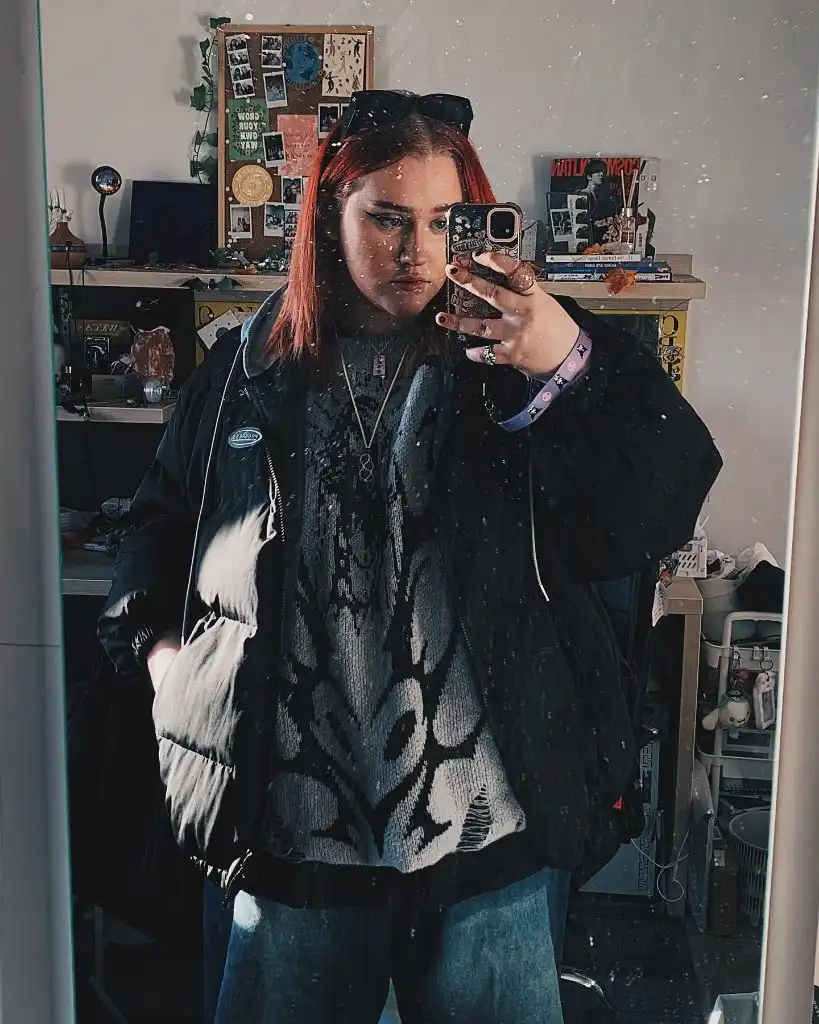
Photo via Instagram
The puffer vest creates shoulder structure without adding sleeve bulk, which lets the sweater’s volume exist on its own terms below the shoulder line. The graphic pattern on the sweater introduces visual complexity in the mid-body, and its grey-and-black tones stay within the same neutral range as the vest, so the pattern does not fight the outerwear. The layered necklaces create a small cluster of detail at the neckline that anchors the eye between the vest’s collar and the sweater’s crew neck. The jeans, visible mostly at the thighs and below, ground the bottom half in a different texture and wash that prevents the outfit from reading as all-dark. The bedroom context, with its posters, shelf items, and soft lighting, gives this a personal, unstaged quality.
The strength here is the way the vest adds structure to an otherwise relaxed silhouette without imposing formality. Puffer vests work well as a middle ground between a full coat and no outerwear at all. For anyone layering oversized knitwear in winter, the vest functions as a frame that adds shape without adding unnecessary sleeve volume.
10. A Blazer Lifts a Leather Skirt and Ribbed Knit
A blush or nude-toned oversized blazer with the sleeves pushed up sits over a black ribbed mock-neck top and a black faux-leather mini skirt with a ruffled hem. Black chunky lace-up platform boots extend to mid-calf. A red small structured bag provides color at the hip. Bold pink lipstick and round glasses complete the visible details.
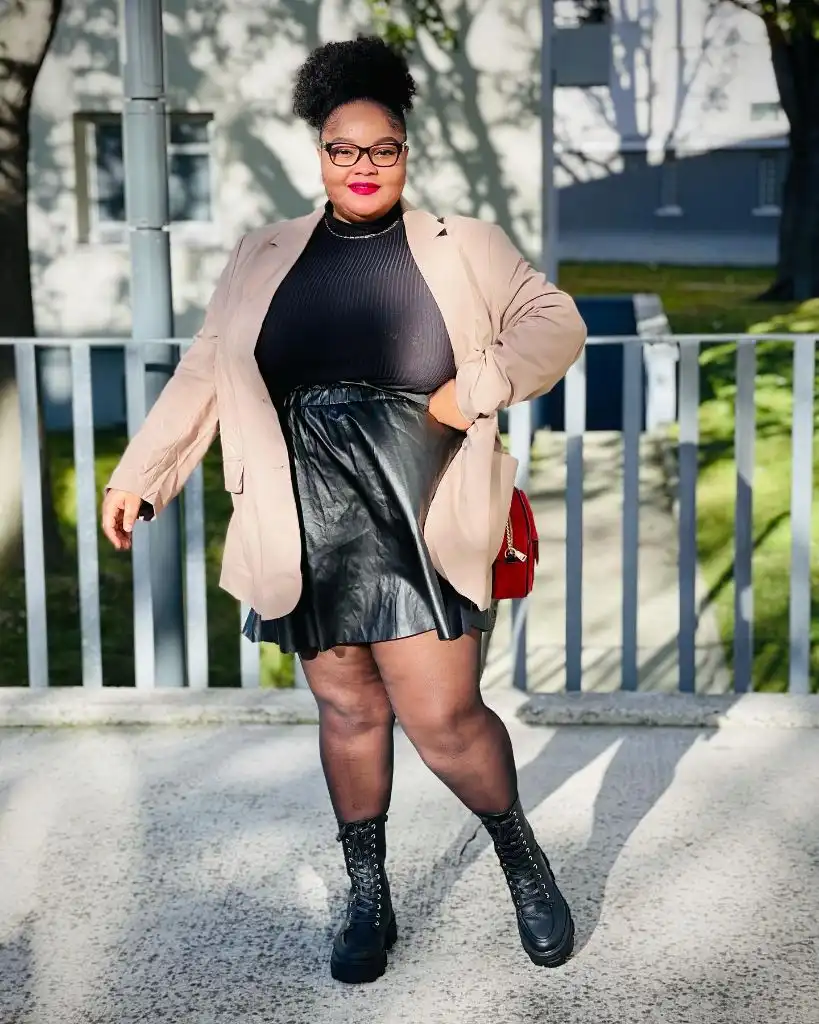
Photo via Instagram
The blazer’s tone is what separates this from an all-black outfit. Its warm nude shade sits far enough from the black pieces to create genuine contrast, and its oversized shoulder gives the upper body width that the narrow skirt and boots counter below. The leather skirt’s ruffled hem introduces movement and a softer edge that the platform boots’ solidity contrasts with. The red bag is the only saturated color in the outfit and acts as a deliberate interruption, pulling the eye to the hip and breaking the vertical black column. The platform boots add height and visual weight at the base, grounding the look against the lighter top half. The park or bridge setting, with metal railings and green trees, places the outfit in natural light that shows the texture differences clearly.
This is a winter outfit that uses formality, the blazer, and edge, the leather and platforms, simultaneously. The useful idea is that a single light-toned layer over a dark base creates enough tonal separation to prevent monochrome from reading as uniform, a concept relevant to many dark winter combinations.
11. An Olive Shirt Meets a Leopard Midi Skirt
An olive green button-down shirt, relaxed and slightly cropped at the hip, is worn over a leopard-print midi skirt that falls just above the ankle. Black chunky loafers with a gold hardware detail sit at the base. A black handbag hangs from one hand, and red earrings and dark sunglasses are visible. The setting is an outdoor concrete staircase between buildings.
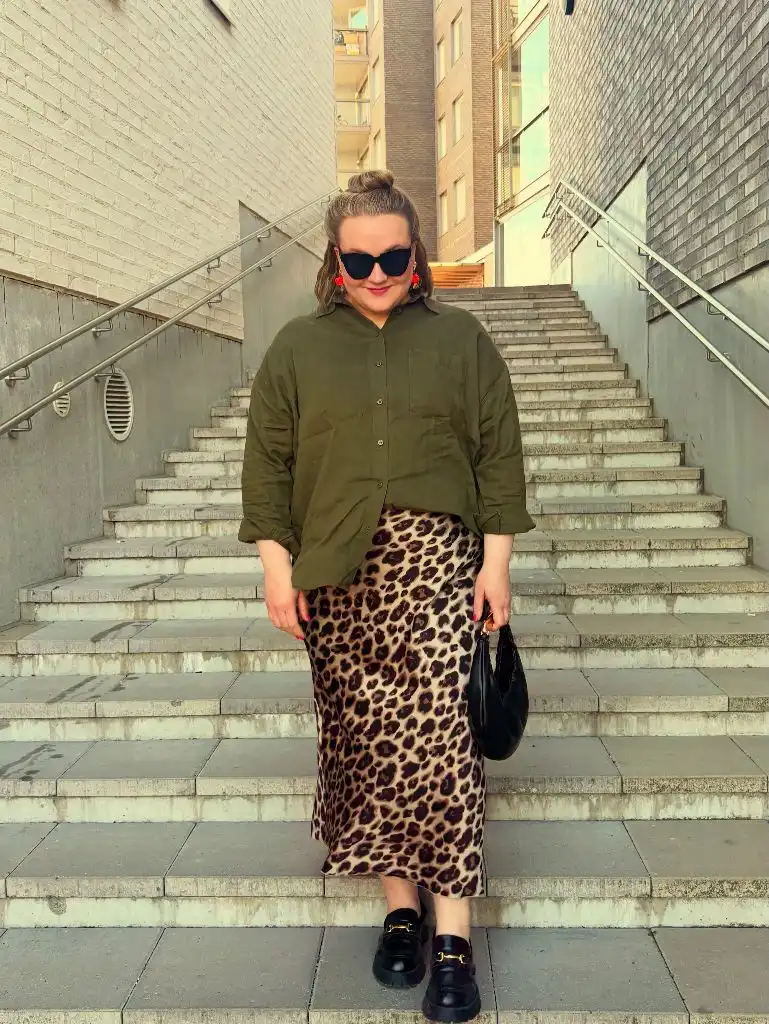
Photo via Instagram
The olive and leopard combination works because olive functions as a near-neutral that does not fight the pattern’s warm brown and black tones. The shirt’s relaxed fit keeps the top half simple, letting the skirt carry the visual complexity. The midi length creates a long, unbroken line of pattern from the waist to the ankle, which gives the leopard print room to read as elegant rather than busy. The black loafers and black bag repeat each other at the bottom and side of the frame, and their structured shapes create a contrast against the flowing skirt. The red earrings introduce a complementary accent that sits far enough from the print to feel intentional rather than competitive.
What stands out most is the balance between the shirt’s plainness and the skirt’s boldness. The outfit does not try to make both halves equally interesting, and that asymmetry in visual weight is what makes it feel composed. When working with animal print in cooler months, a muted solid on top tends to let the pattern speak without visual crowding.
12. A Brown Puffer Anchors a Layered Winter Set
A dark brown or burgundy-toned short puffer jacket with a fur-trimmed hood sits open over a cream or light pink sweatshirt. A pink crossbody bag and a large plaid scarf in pink, cream, and blue tones wrap around the neck. Black cargo-style pants fall to the ankle, and black high-top Converse sneakers complete the base. The setting is outdoors against a concrete wall with a dusting of snow visible.
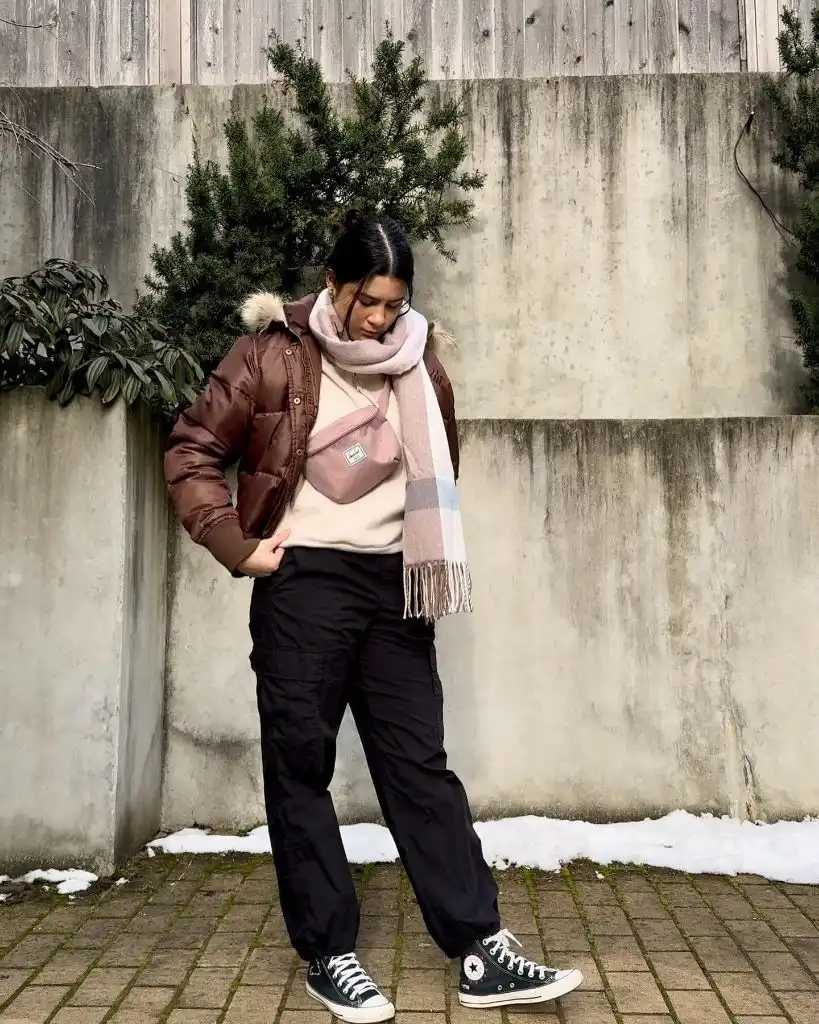
Photo via Instagram
The scarf is doing more work than it might first appear. Its large plaid pattern in soft pinks and neutrals creates a visual bridge between the dark puffer and the light sweatshirt, and its fringed ends add movement and texture in the mid-torso zone. The puffer’s short length stops at the waist, which means the cargo pants’ full length is visible and the silhouette’s proportion is a compact top over a long bottom. The black Converse keep the base casual and flat, and their canvas texture contrasts with the nylon puffer and the soft knit scarf. The crossbody bag in pink connects to the scarf’s palette and creates a diagonal strap line across the torso.
The effect is a layered winter outfit that manages multiple textures, including nylon, knit, woven plaid, and canvas, without looking cluttered. The compact puffer plus long cargo pant proportion creates a clear division at the waist. The takeaway is that short outerwear over long, straight-leg bottoms can elongate the lower body and simplify the silhouette’s reading.
13. A White Faux-Fur Coat Softens a Camel Knit Base
A white faux-fur coat with a wide collar sits open over a camel or tan turtleneck sweater. Light-wash jeans are visible from the waist down, and a brown leather belt with a gold buckle marks the transition. A tan suede bag is held in one hand. Wire-frame glasses and a gold pendant necklace add quiet detail. The background is an ornate wooden door with decorative ironwork panels.
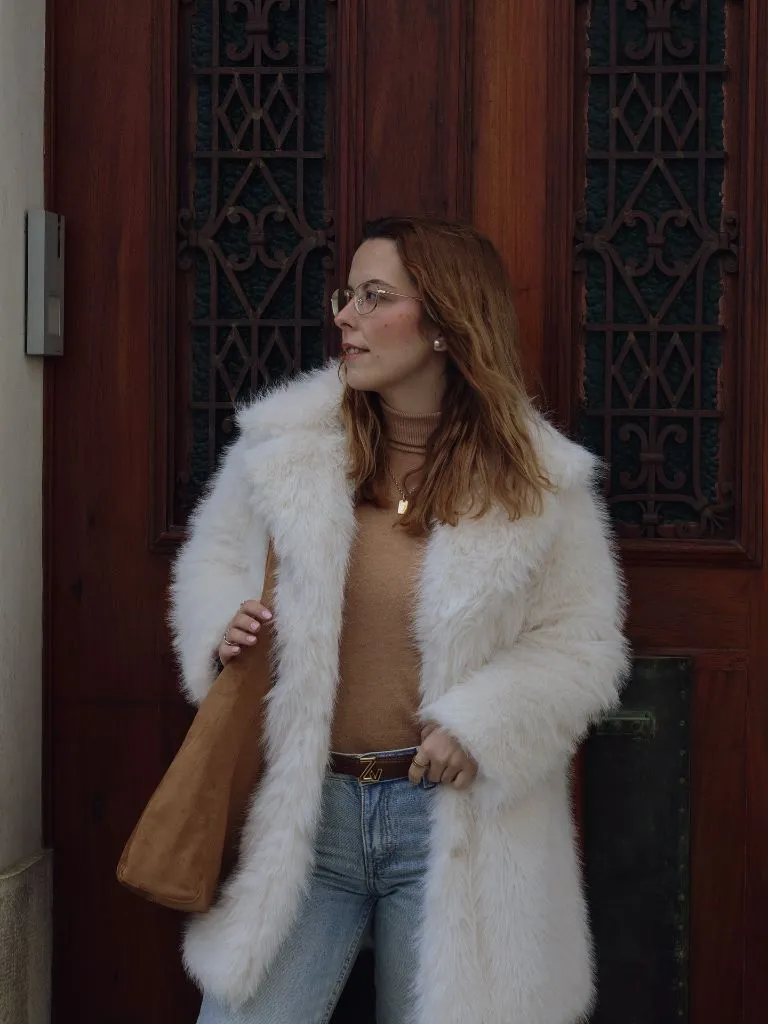
Photo via Instagram
The white fur against the warm camel creates a temperature contrast that the eye reads as intentional. The fur’s texture is voluminous and soft, while the turtleneck beneath is smooth and fitted, and that surface-level difference is what prevents the two light tones from blending into each other. The brown belt acts as a horizontal line that separates the top half’s warmth from the cooler wash of the jeans, and its gold buckle echoes the pendant necklace, creating a quiet metallic thread through the outfit. The tan bag reinforces the camel family without being an exact match, which keeps the warm tones varied rather than uniform. The architectural background, with its dark carved wood, provides a rich contrast frame that makes the light outfit stand forward visually.
This is a warm-neutral palette executed with enough textural variation to avoid monotony. When every piece lives in the cream-to-tan range, the differences in surface, smooth knit versus fur versus suede versus denim, become the primary source of visual interest. That texture-led approach to neutral winter dressing is worth noting.
14. A Black Coat and Lilac Scarf Create a Color Accent System
A long black wool coat, buttoned or wrapped, falls past the knee. A lilac or lavender knit beanie and a matching oversized fringed scarf provide the only color. Blue jeans with a raw or cropped hem are visible below the coat, and black leather boots or Chelsea boots sit at the base. A green drink is held in one hand. The setting is a brownstone street with ivy-covered walls and an iron gate.
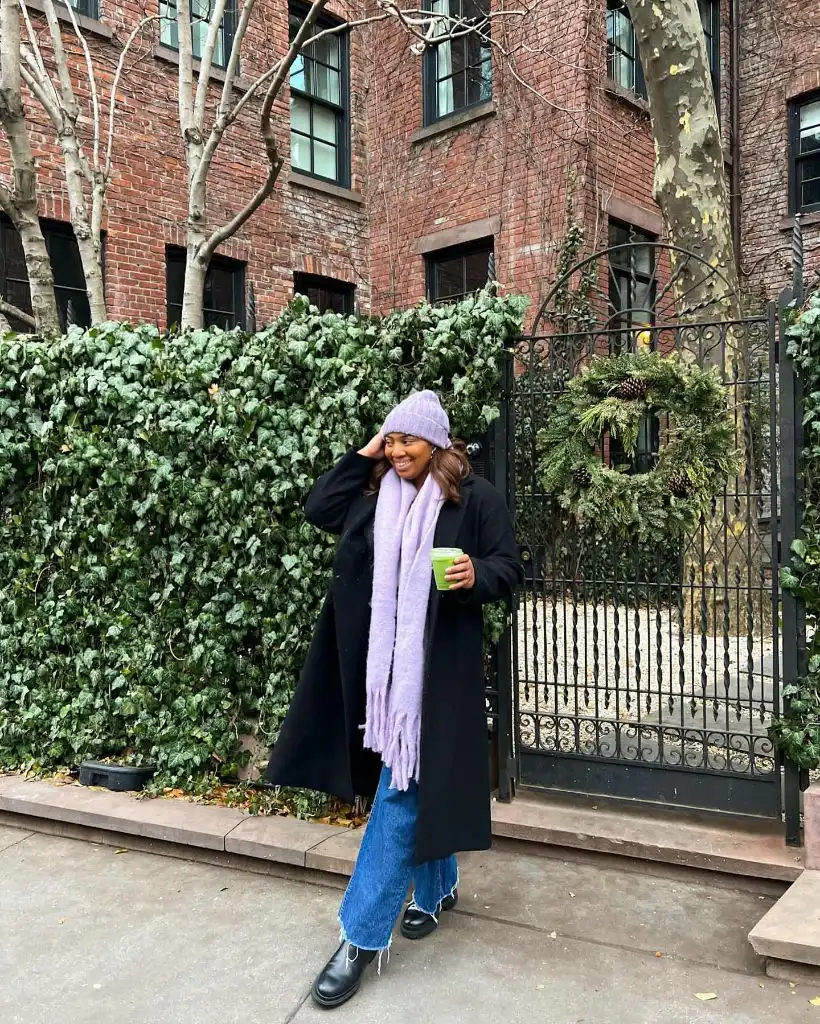
Photo via Instagram
The lilac accessories are the entire story of this outfit. Against the black coat, the scarf and hat read as a deliberate color intervention rather than afterthoughts, and their matching tone creates cohesion between two separate pieces that might otherwise feel scattered. The coat’s length provides a dark, clean column, and the jeans’ blue adds a third neutral tone between the black and the lilac. The raw hem of the jeans creates a casual edge that the structured coat does not suggest, and that tension between polished outerwear and undone denim gives the look personality. The green drink in hand adds an unexpected secondary color that sits naturally in the frame.
The best detail is the decision to match the beanie and scarf in an identical shade rather than introducing two different accent colors. This is a winter outfit where accessories are the design. The lesson is one of the most reliable in cold-weather styling: a dark, simple coat becomes a canvas for whatever color the accessories carry, and matching that color across two or more pieces amplifies its effect.
15. A Cream Cable-Knit Set Creates a Tonal Column
This image shows a matching cream cable-knit set: a turtleneck sweater with voluminous balloon sleeves and wide-leg cable-knit trousers. The texture is prominent, with visible cable patterns running vertically on both pieces. Gold hoop earrings, a gold watch, and rings add metallic detail. The person sits in a modern chair by a large window, holding a phone. The setting reads as a cafe or lounge with plants and natural light.
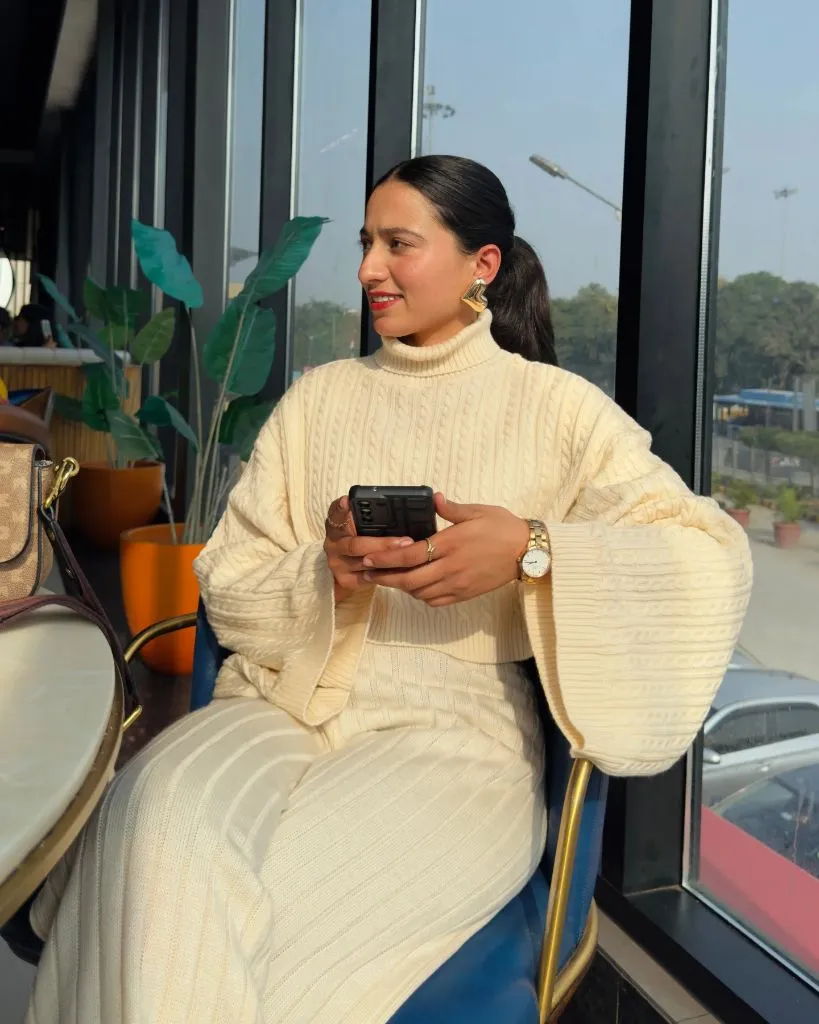
Photo via Instagram
The monochrome knit set eliminates the need for any color or pattern decisions and lets the texture carry all of the visual interest. The cable pattern creates vertical lines that read as structural even in a soft, relaxed fabric, and because both pieces share the same pattern, the body reads as a single unbroken column from the turtleneck to the trouser hem. The balloon sleeves add width at the forearm, which balances the wide-leg trouser below and creates a uniform volume rather than a top-heavy or bottom-heavy proportion. The gold accessories, particularly the earrings and watch, introduce just enough warmth and shine to keep the monochrome from reading flat.
The appeal is the simplicity of the formula. A matching knit set in a single neutral tone is one of the easiest winter outfit decisions to make because the coordination is built in. The principle is that when the texture is this visible and consistent, the outfit does not need color, pattern, or layering to feel complete. The texture itself is the design.
16. An Oversize Camel Coat Defines a Striped-Knit Look
A long, double-breasted camel wool coat with gold buttons falls past the knee, worn over a black-and-cream striped knit sweater. Beige or khaki wide-leg trousers are visible below, and black loafers appear at the base. A dark head scarf or silk scarf is tied around the head, and a gold chain necklace sits at the collar. A black bag or clutch is carried in one hand. The setting is a European-looking cobblestone sidewalk.
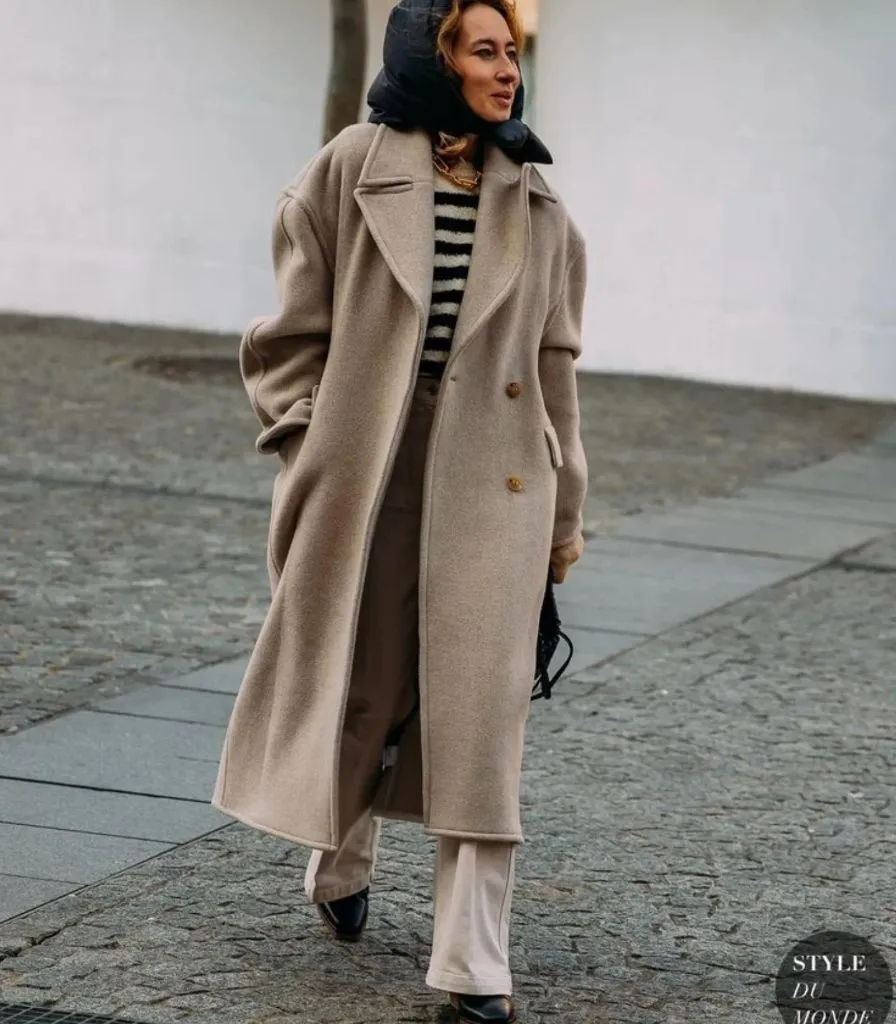
Photo via Instagram
The stripe of the sweater is the only pattern in the outfit, and its placement at the center of the frame, framed by the solid camel coat on either side, gives it a contained, deliberate quality. The coat’s camel tone and the trouser’s beige tone are close but not identical, which creates a subtle tonal shift rather than a flat match. The black loafers repeat the sweater’s black stripes and pull the dark tone to the base, grounding the overall warm palette. The dark head scarf frames the face with the same dark value, bookending the black at top and bottom. The gold buttons on the coat echo the gold chain, forming a small metallic language across the torso.
This is a study in how a structured coat contains and elevates the pieces inside it. The Breton-style stripe could read as casual on its own, but the coat’s tailored shoulder and gold hardware shift the outfit toward something more polished. The useful observation for anyone building layered neutral outfits is that a single patterned piece placed between two solid tones gains more visual authority than it would on its own.
17. A Deep Plum Faux-Fur Coat Commands the Frame
A long, deep brown or plum-toned faux-fur coat with a spread collar sits open over what appears to be a matching brown knit sweater or top. Dark wide-leg jeans are visible below, and tan suede pointed boots complete the lower half. A tan suede shoulder bag is held in one hand. The setting is an ornate wooden doorway with glass panels and carved detailing, and a black-and-white checkered marble floor.
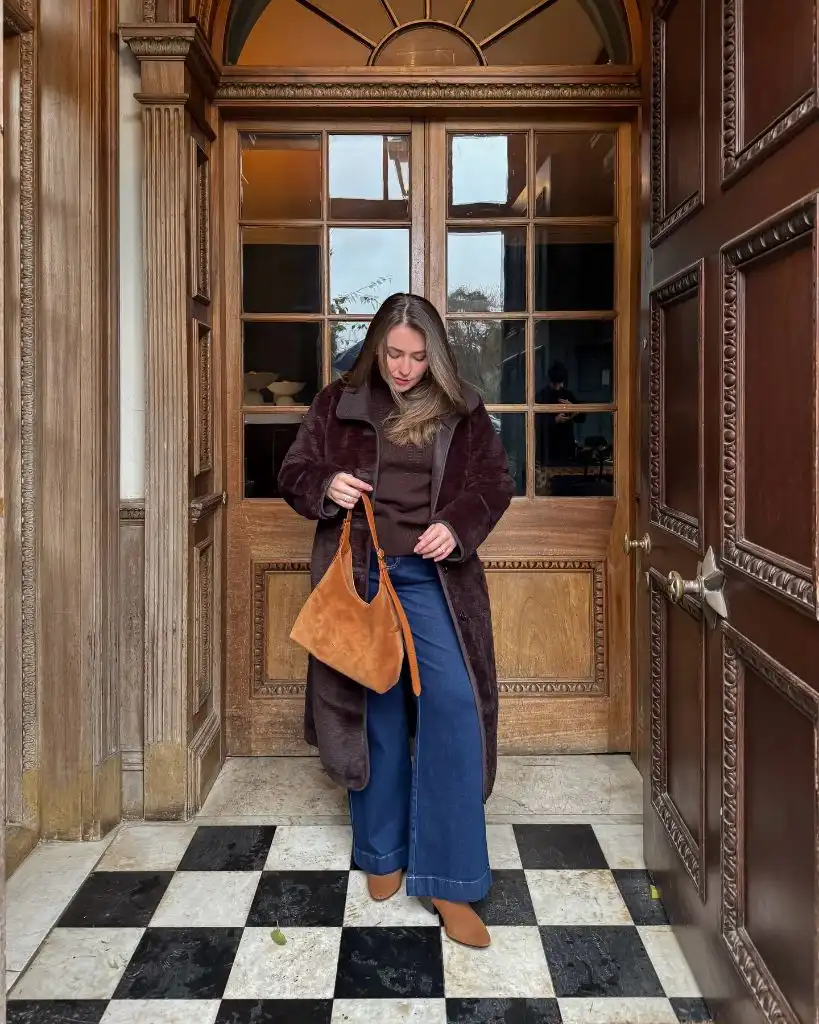
Photo via Instagram
The coat’s depth of color and texture dominate the image. The faux fur has a plush, dimensional surface that absorbs light differently than the smooth knit beneath it, and the dark plum-brown shade is rich enough to function as a near-neutral without losing warmth. The dark jeans create a long, straight-leg line from the waist down, and their indigo or deep blue wash sits comfortably between the coat’s warmth and the tan boots’ lightness. The suede boots and bag in matching tan introduce a lighter, drier texture that balances the fur’s heaviness, and the pointed toe of the boots adds a sharper line against the wide jeans. The architectural setting, with its carved wood and marble, elevates the frame without being part of the outfit.
The value is the coat’s ability to function as both the outfit’s warmest and most visually complex element simultaneously. When a coat carries this much texture, the pieces beneath it can stay plain and still feel considered. The principle for winter outfits for plus-size women here is that a statement coat reduces the number of decisions every other piece needs to make.
18. A Dark Mink-Tone Coat Grounds Tailored Black Trousers
A short, hip-length coat or jacket in a dark mink or deep mahogany tone with a plush, possibly fur or faux-fur texture sits over a dark top. Wide-leg black tailored trousers with a slight flare fall to the shoe. A black structured handbag, resembling a classic top-handle style, is carried in one hand. A dark headband pushes the hair back, and purple-tinted sunglasses sit on the face. The setting is an old stone archway or cloister with warm golden light.
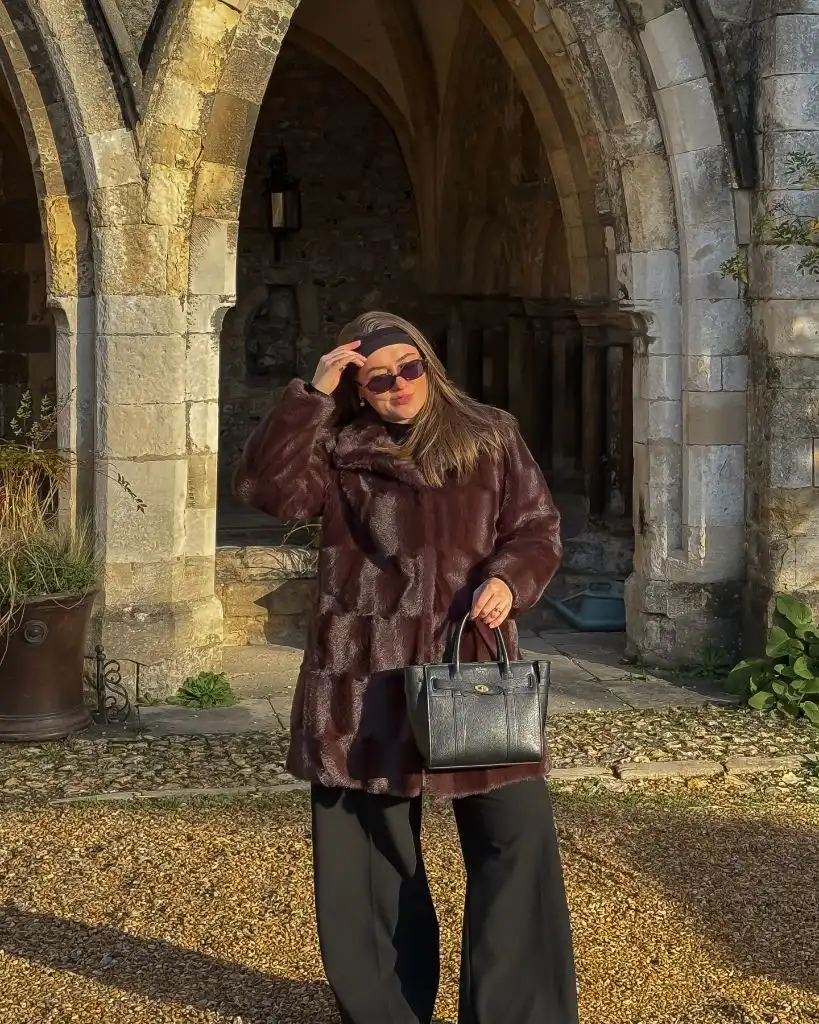
Photo via Instagram
The short jacket length against the long trouser creates a high-waist visual, with the eye reading the leg line as beginning where the jacket ends. The dark tones of the jacket and trousers are close in value but differ in texture, and that textural contrast is the primary source of interest. The structured handbag introduces a polished, angular shape against the fur’s softness, and its small scale relative to the body creates a proportion that reads as refined. The stone archway’s warm golden lighting catches the fur’s surface and reveals tonal variation in what might otherwise read as a flat dark color. The flared trouser hem adds width at the ankle that echoes the jacket’s volume at the shoulder.
The effect is an outfit that relies on two dark tones and two contrasting textures to create a complete look. The headband and sunglasses keep the face area clean and minimal, which lets the jacket-and-trouser combination speak for itself. When building a dark winter ensemble with textured outerwear, the takeaway is that keeping accessories minimal lets the fabric conversation between coat and trouser become the outfit’s defining feature.
19. A Camel Sweater Balances a Pleated Black Skirt
A relaxed camel or tan crewneck sweater with dropped shoulders is worn tucked or half-tucked into a black pleated mini skirt. Black tights cover the legs, and black ankle boots with buckle details sit at the base. The person has curly dark hair and stands against a warm-toned stone wall. The overall palette is a two-tone study in camel and black.
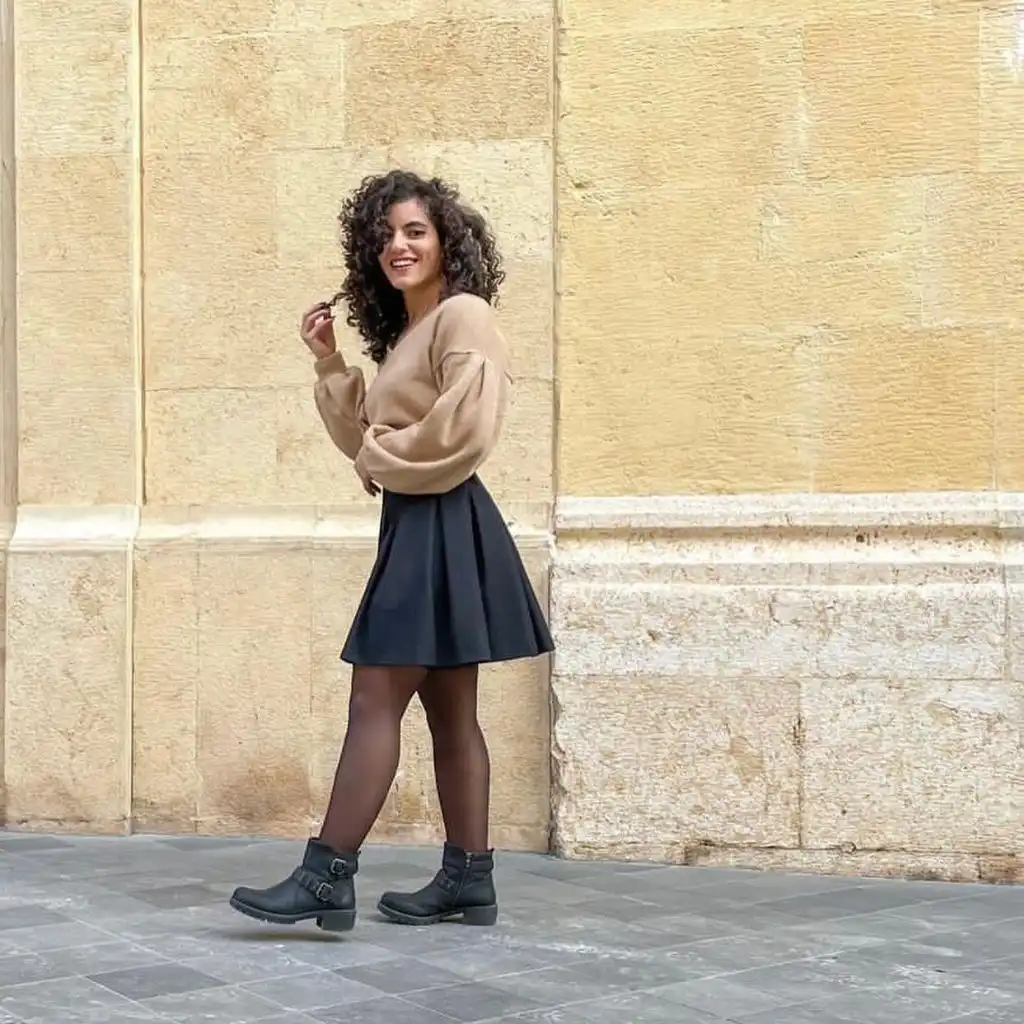
Photo via Instagram
The two-tone palette is clean and high-contrast. The camel sweater occupies the top half and the black takes everything from the waist down, creating a clear horizontal division. The pleated skirt adds movement and shape in the transition zone, and its flare provides a softer line than a straight or pencil skirt would. The black tights extend the dark tone from skirt to boot without interruption, which creates a continuous leg line and maximizes the visual length below the waist. The buckle boots add a hardware detail at the ankle that prevents the all-black lower half from reading as completely plain. The stone wall background, warm and textured, harmonizes with the sweater’s camel tone and frames the outfit in a complementary setting.
This is a straightforward two-tone formula with enough textural variation in the skirt’s pleats and the boots’ buckles to feel complete. The principle is that a strong horizontal color break at the waist can simplify an outfit’s structure while the individual textures within each color zone keep it from reading as flat or uniform.
20. All-Black Layers Gain Contrast From a Chain Bag
A black crewneck sweatshirt or oversized top is worn with black faux-leather or coated leggings that create a high-shine surface on the lower half. Black chunky sneakers extend the monochrome to the floor. A small light blue or silver chain-strap bag crosses the torso, and a small black pouch-style bag hangs from the neck. The setting is a bedroom mirror selfie with neutral decor and a monstera plant.
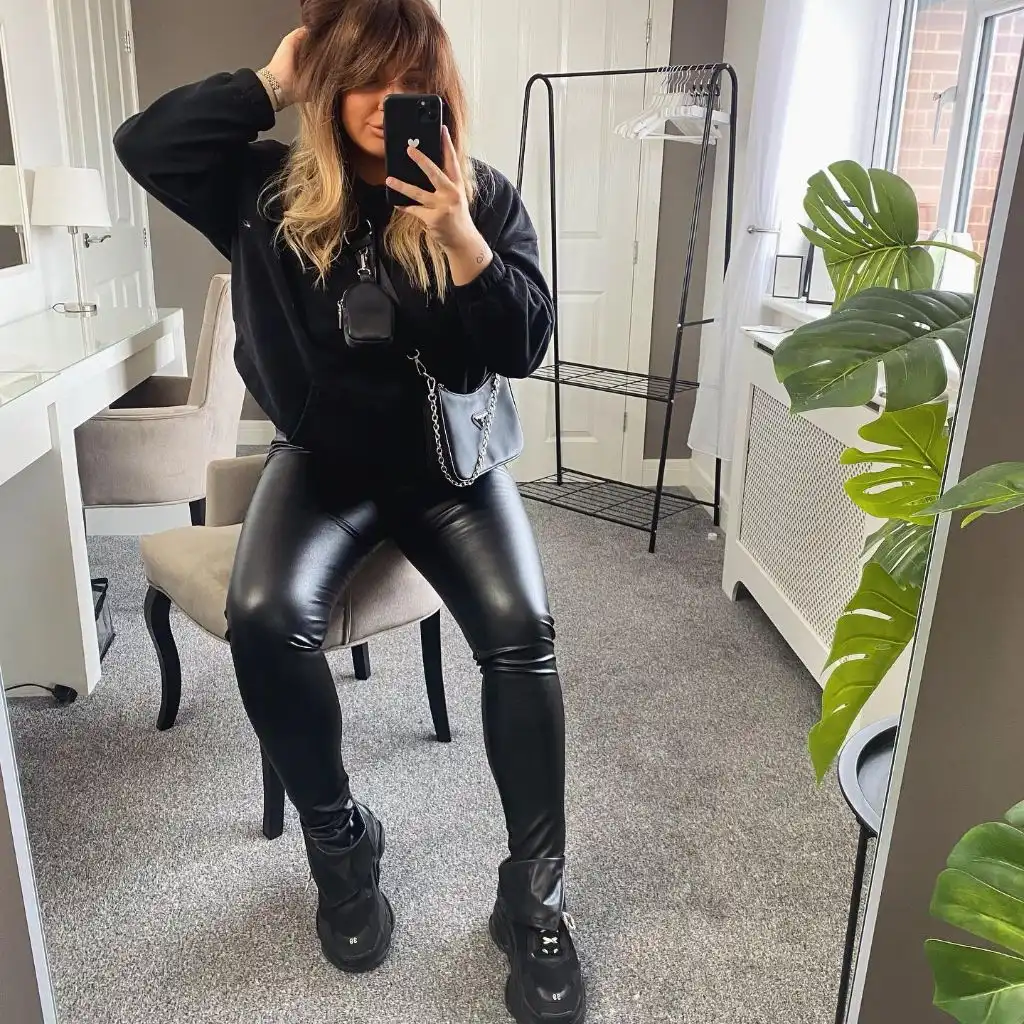
Photo via Instagram
The entire outfit is black, which means the only variation comes from surface quality and the single non-black element: the small blue or silver chain-strap bag. The leggings’ high shine creates a visible texture difference against the matte sweatshirt, and that shine-matte contrast is what keeps the monochrome from reading as a single undifferentiated block. The chunky sneakers add bulk at the base, which anchors the fitted leggings above them. The small chain bag introduces a metallic line and a cool-toned accent that breaks the black just enough to register. The double-bag styling, with both a crossbody and a neck pouch, adds a layered accessory element that compensates for the outfit’s tonal simplicity.
The strength here is the understanding that monochrome does not mean monotexture. The contrast between the leggings’ coated surface and the sweatshirt’s jersey knit provides enough visual difference to read as a deliberate all-black styling choice rather than a default. The principle is that in a single-color outfit, texture contrast replaces color contrast as the primary design tool.
21. A Burgundy Puffer Adds Warmth to Light Denim
A burgundy or wine-toned lightweight quilted puffer jacket, zipped up, is the only upper-body piece visible. The jacket has a standing collar and a slightly cropped or hip-length cut. Light-wash distressed jeans are partially visible below. The setting appears to be a clothing store with denim stacked on shelves behind.
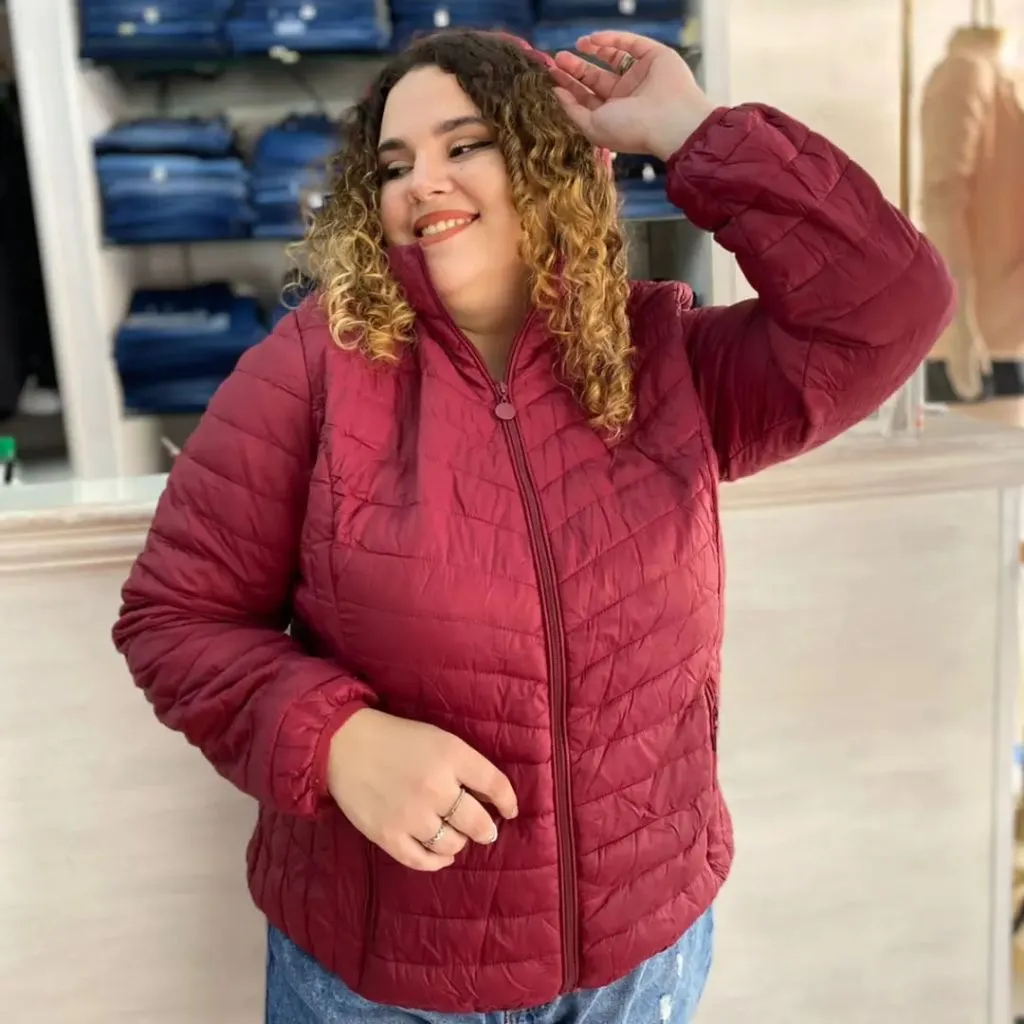
Photo via Instagram
The burgundy color is doing more than keeping warm. It sits in a rich, saturated zone that reads as intentional and seasonal without being as expected as black or navy. The quilted pattern adds subtle surface texture in a chevron or diagonal line, which gives the jacket’s surface visual direction. The standing collar frames the face and neck area cleanly, and the jacket’s cropped length means it sits at or just below the natural waist, which creates a clear proportion point above the jeans. The light-wash denim provides a contrast in both color value and texture that prevents the outfit from reading as heavy.
The appeal is the color choice. Burgundy functions as a warm neutral in winter that pairs as easily with denim as black or grey would, but with more visual energy. For plus-size women building a functional winter jacket wardrobe, the principle is that a cropped or hip-length puffer creates a defined waist point that longer puffers often obscure, and a rich color adds personality that basic black does not offer.
22. A Black Button-Down Shirt Refines Washed Grey Denim
A black cotton or poplin button-down shirt with a structured collar and full-length sleeves is worn untucked over grey-washed wide-leg jeans that fade toward the hem. The shirt appears slightly oversized, and the collar is worn up, framing the neck. The setting is indoors against a dark curtain, and the lighting is warm and directional.
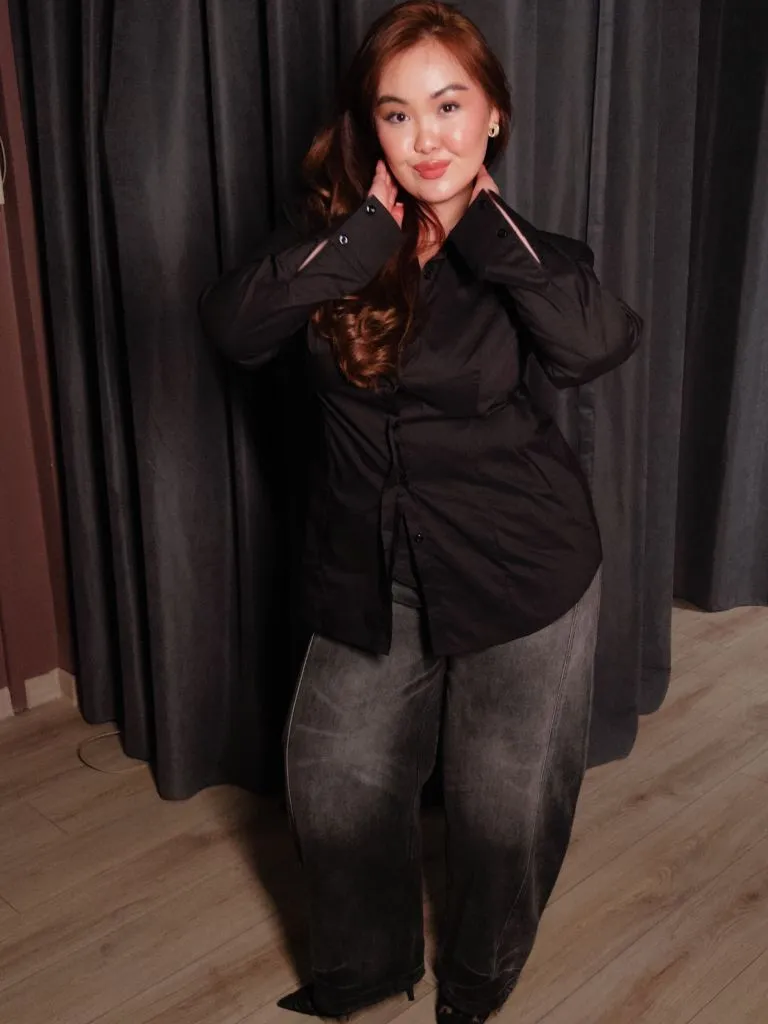
Photo via Instagram
The shirt’s crispness is the contrast point against the jeans’ relaxed, faded finish. The black poplin has a smooth, slightly structured surface that holds its shape at the collar and cuffs, while the grey denim is soft, washed, and wide enough to create movement when standing. The collar worn up adds height to the neckline and frames the face with a structured edge that the shirt’s body does not repeat. The fade pattern on the jeans, darkest at the waist and lightening toward the hem, creates a subtle gradient that makes the bottom half more visually dynamic than a uniform wash would. The dark curtain background nearly matches the shirt’s tone, which pushes the lighter jeans forward in the frame.
This is a two-piece outfit that relies entirely on the contrast between crisp and soft, dark and washed. There are no visible accessories competing for attention, and the outfit’s success is in its restraint. The takeaway is that a structured button-down in a dark, smooth fabric reads differently from a sweatshirt or knit over the same jeans, and that difference in surface quality can shift an outfit from casual to considered without changing the silhouette.
23. A Dusty Pink Blouse Softens a Dark Trouser Base
A loose, dusty pink or mauve blouse with a subtle print and a V-neckline is worn untucked over black straight-leg trousers or jeans. White sneakers sit at the base. A black leather bag is held at the hip, and sunglasses are held in one hand. A gold chain necklace is visible at the collar. The setting is an outdoor walkway at night under overhead lighting with green signage visible in the background.
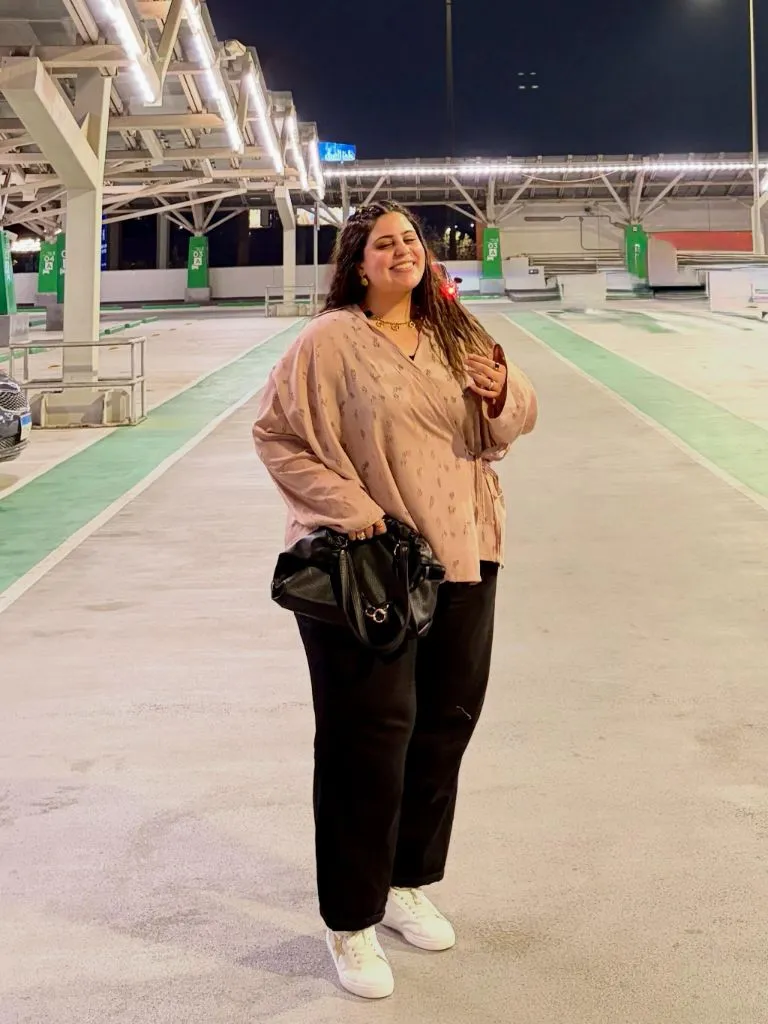
Photo via Instagram
The blouse’s dusty pink tone is soft enough to avoid reading as bright, but warm enough to stand distinctly against the black lower half. The V-neckline opens the chest area and creates a frame for the gold necklace, which adds a small metallic accent that connects the warm top with the neutral bottom. The blouse’s relaxed, slightly billowy fit gives the upper body movement, while the straight-leg trousers keep the lower silhouette clean and defined. The white sneakers introduce a third tone at the base that lightens the outfit’s landing point, preventing the all-black bottom from feeling too heavy. The nighttime setting, with its artificial overhead lighting, gives the pink fabric a slightly warm, glowing quality.
The effect is an outfit that works because the upper and lower halves have different visual temperatures. The warm, soft blouse and the cool, structured trousers create a contrast in mood as well as color. The principle applicable to evening casual winter styling is that a soft-toned top over a dark bottom reads as both relaxed and intentional, especially when the footwear stays light.
24. An Olive Wrap Shirt Anchors Wide-Leg Light Denim
An olive green wrap-front shirt with rolled or gathered sleeves is worn tucked or wrapped at the waist over wide-leg light-wash denim jeans that flare from the hip to the floor. A small cream crochet or woven bag with bamboo handles is held in one hand. A gold chain necklace and bracelets provide accessory detail. The setting is outdoors at night in front of an illuminated building with domed architecture, suggesting a resort or cultural site.
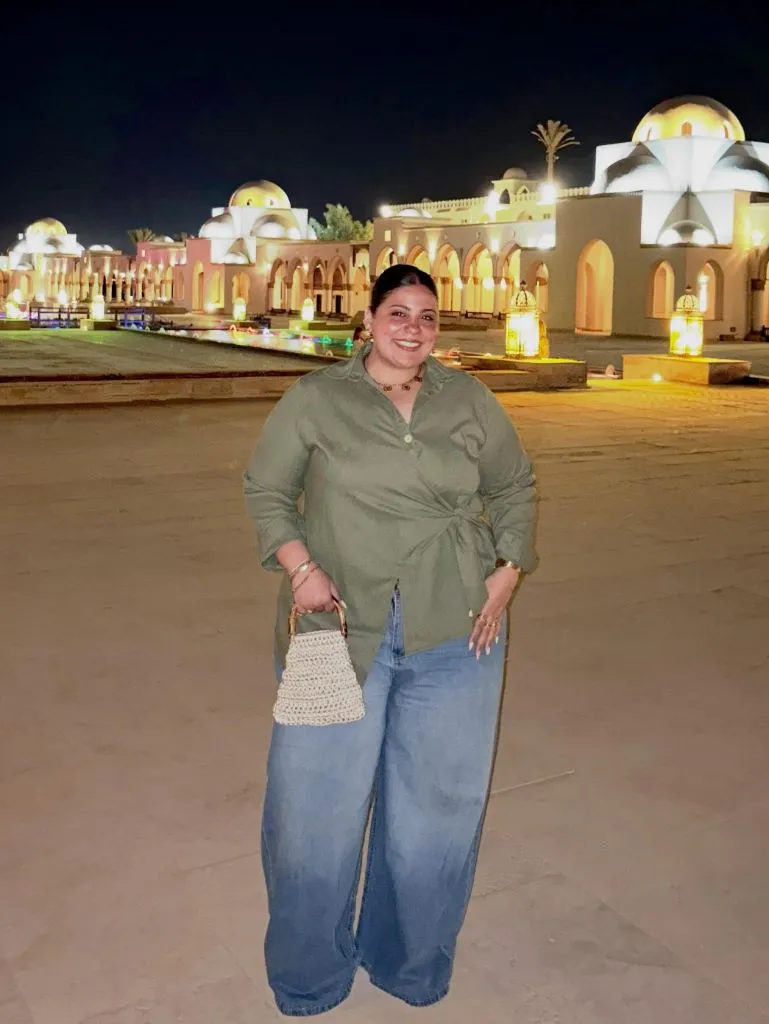
Photo via Instagram
The wrap detail on the shirt creates a defined waist point that the wide jeans would otherwise obscure. The olive tone sits in the same warm-neutral family as the gold jewelry, and those repeated warm tones create a cohesive upper-body palette. The light denim’s width is significant, nearly palazzo-width, and it creates a flowing, relaxed lower silhouette that the structured wrap shirt counterbalances. The cream crochet bag introduces a handmade, artisanal texture that softens the outfit’s overall tone, and its small scale keeps it from competing with the jeans’ volume. The illuminated building behind provides a warm ambient light that enhances the olive and gold tones.
This is a look that uses one structural decision, the wrap closure, to organize the entire silhouette. Without the wrapped waist, the oversized shirt and wide jeans would create an undefined column. With it, the proportions read as deliberate. The principle is that a single point of definition, whether a wrap, a belt, or a tucked hem, can transform two voluminous pieces into a proportioned outfit.
25. A Sheer Blue Top Elevates Wide Black Trousers
A navy blue sheer mesh or tulle long-sleeve top with an abstract watercolor or cloud-like print sits over what appears to be a dark camisole or tank underneath. Wide-leg black trousers with a high waist and double-button closure create a flowing lower silhouette. Silver or metallic hoop earrings are visible, and the overall styling is minimal. The setting is a clean white studio background.
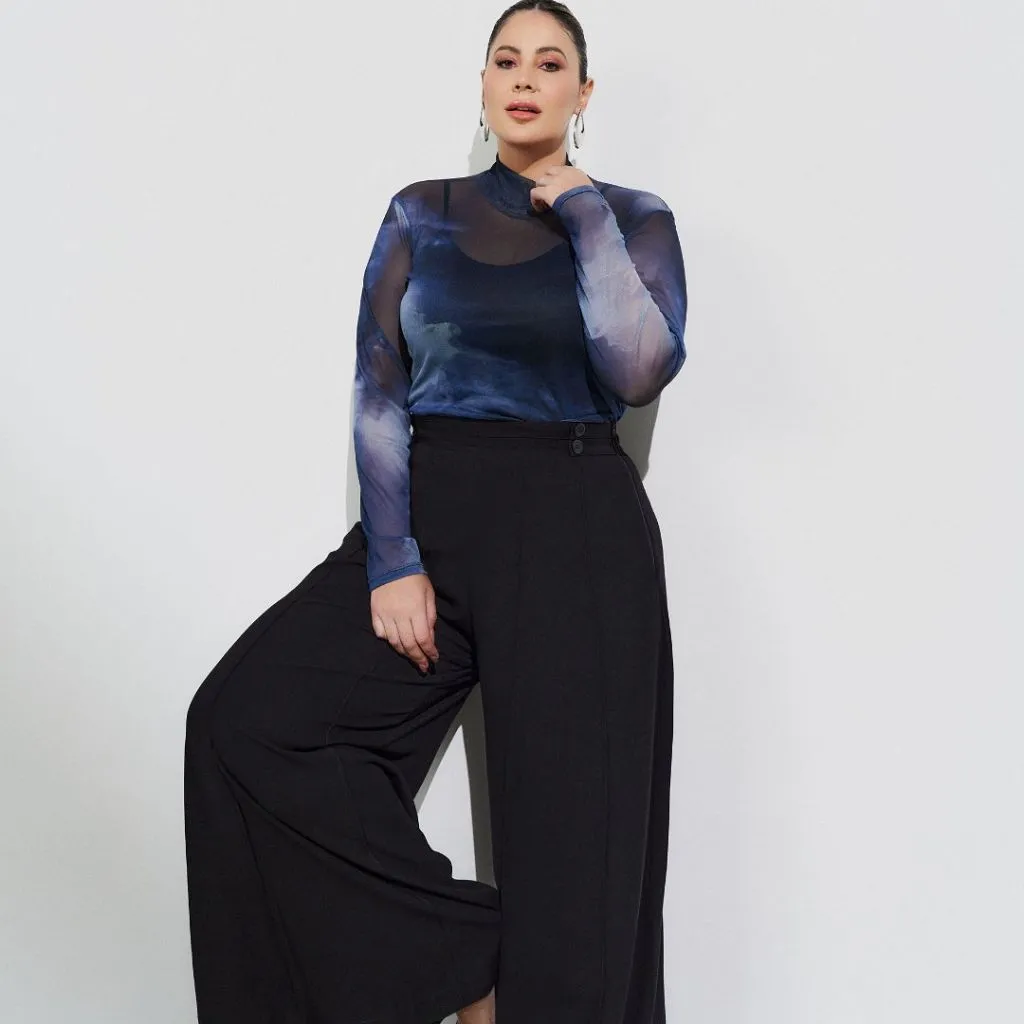
Photo via Instagram
The sheer top introduces a layer of visual complexity that the simple trouser silhouette does not provide on its own. The watercolor print, moving through shades of navy, purple, and grey, gives the fabric a painterly quality that reads as elevated even though the shape of the top is relatively simple: a mock neck with fitted long sleeves. The transparency shows the darker camisole beneath, which adds depth and prevents the print from floating without a base. The wide trousers are the same dark value as the camisole, so the lower body reads as an extension of the underlayer rather than a separate piece. The silver earrings pick up the cooler tones in the print and keep the accessories within the same temperature as the clothing.
The best detail is the way the sheer layer creates visual interest without adding physical bulk. For anyone exploring winter outfits for plus-size women that feel occasion-appropriate, this demonstrates that a single textured or printed element on top can carry the entire outfit when the bottom half stays quiet, dark, and wide. The sheer print does the talking, and everything else stays supportive.