Halloween stopped being a solo affair the moment families realized that showing up as a coordinated unit says more than any individual costume ever could. There is something quietly satisfying about a group that walks down the street and reads as one visual statement, where every member — from the tallest adult to the smallest toddler — fits into a shared story. Family Halloween costumes for 2026 lean hard into this idea, moving past the days of mismatched store-bought outfits and toward intentional, styled ensembles that feel designed rather than assembled. The shift is not about spending more. It is about thinking in terms of palette, silhouette, and narrative cohesion before anyone picks up a single accessory.
Choosing a group costume starts with one honest question: what is the anchor? Sometimes it is a film franchise. Sometimes it is a color story. Other times it is a single character that the youngest member wants to be, and the rest of the family builds outward from there. The strongest group costumes share a visual through-line — a repeated material, a consistent color temperature, or a recognizable world — rather than forcing every person into an identical outfit. Comfort matters more than perfection, especially when small children are involved. Plan for movement, plan for weather, and let the concept do the heavy lifting rather than the construction.
Space-Age Metallics With a Feminine Twist
A trio dressed head to toe in silver creates an immediate visual impact, particularly when the material choices layer sheen against matte, tulle against foil. This look works because the palette is ruthlessly narrow — silver, white, and a single accent of blue — while the textures do all the talking. Sparkle tutus for the children and a structured foil skirt for the adult anchor the silhouettes into distinct age-appropriate shapes without breaking the theme. Star-shaped headbands and blue-tinted goggles act as small punctuation marks, giving each person a focal point near the face that draws the eye upward. The sneakers ground it. Without them, the whole composition would tip into pageant territory.
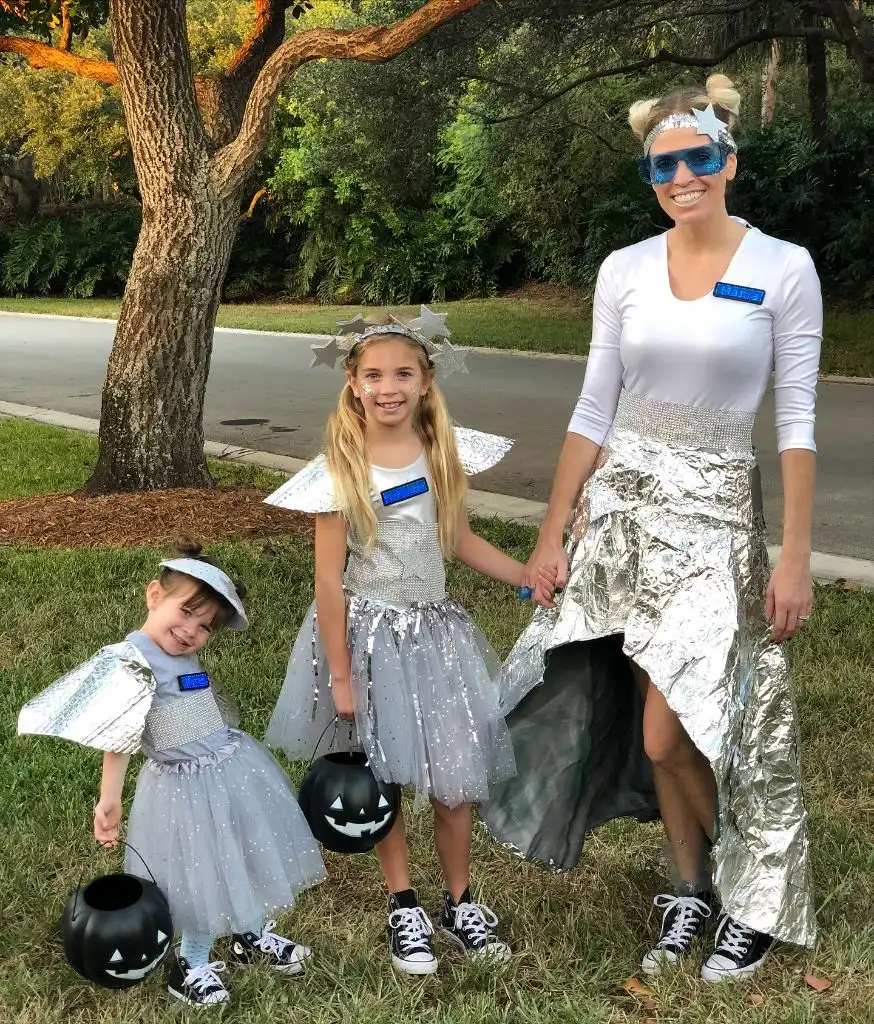
For a simpler version, skip the foil skirt entirely and let everyone wear silver or grey tutus over white leggings. The headpieces can be made from craft store star garlands hot-glued to plain headbands in under ten minutes. If you are dressing a toddler, prioritize soft fabrics over anything crinkly or stiff — foil can irritate skin and rip within the first hour of wear. The black Converse worn by everyone in this look is a smart, underrated choice: it unifies the group from the ankles down without adding visual noise.
The reason this works as a family Halloween costume concept is the strict color discipline. When you limit a group to one metallic tone and one neutral, every textural variation reads as intentional rather than chaotic. The wings on the children add dimension without overwhelming their small frames. Silver is also one of the easiest palettes to source affordably, since craft stores and dollar stores carry foil, tulle, and metallic accessories in abundance every October.
Vintage Circus Performers in Blush and Gold
Circus-themed family costumes tend to go loud — primary colors, oversized wigs, rubber noses. This version takes the opposite approach. The entire family operates within a blush, gold, and cream palette, and the result feels closer to a Wes Anderson film than a big top. The father’s plaid blazer and theatrical face paint create contrast against the warmer tones worn by the rest of the group, which gives the composition tension without disrupting its softness. The children carry props — an accordion, a wand-topped balloon — that read as period-appropriate accessories rather than afterthoughts.
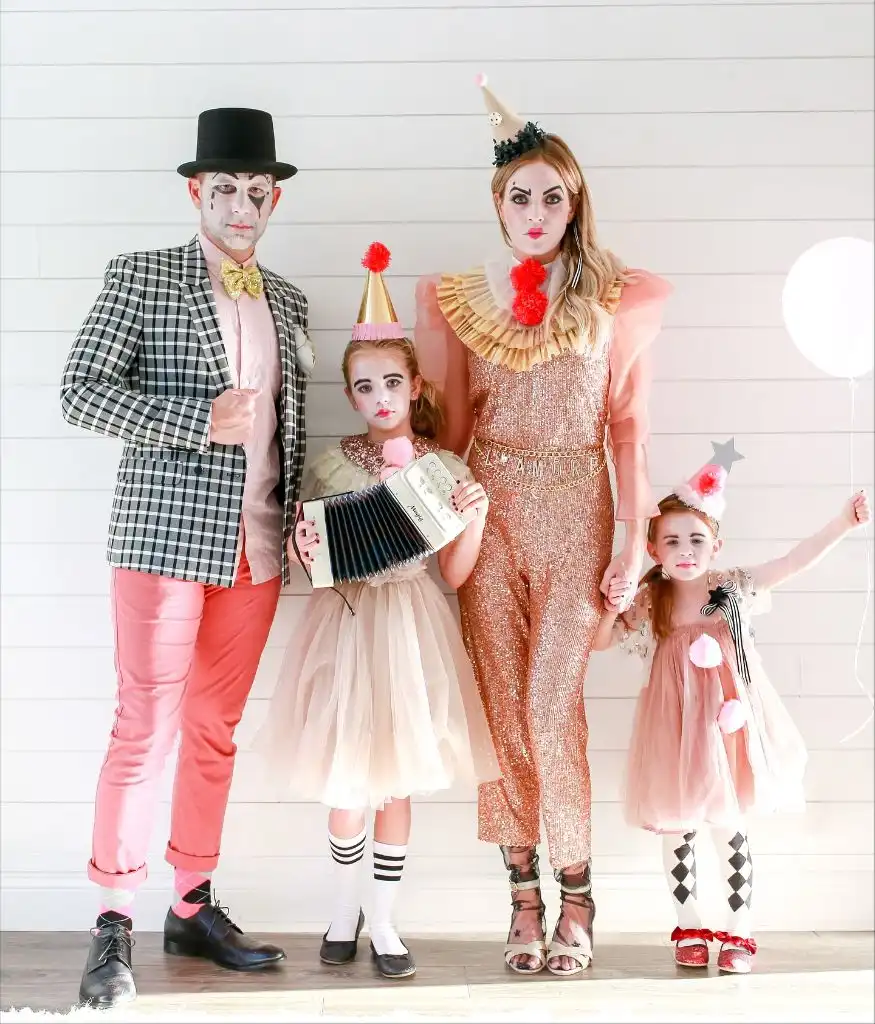
The key adaptation here is understanding that this look is really about face paint and headpieces, not about sewing. A rose-gold sequin jumpsuit for the adult anchor is a single-purchase commitment; the children’s outfits are largely tulle skirts and dresses they may already own in neutral tones. Party hats can be made from metallic cardstock. If you want to simplify further, drop the props entirely and let the makeup and hats tell the story. The striped socks on the child are a small but effective detail that reinforces the circus motif without requiring a full costume piece.
What makes this composition hold together is the restraint in color temperature. Every element sits within the warm end of the spectrum, from the peach pants to the gold collar ruff to the blush tulle. Swap any single element for a cool tone — a blue hat, a silver sequin — and the illusion fractures. This is a useful principle for any themed group costume: temperature consistency matters more than exact color matching. If everything reads warm, it reads unified.
Monsters, Inc. With Bold Character Blocking
Adapting a Pixar film for a family of three requires some decisions about who carries the visual weight, and in this case the answer is clear: the Sulley costume dominates through sheer scale and color saturation. The blue and purple onesie fills the frame, while the Mike Wazowski interpretation — a neon green dress with a single oversized eye graphic — plays the complementary role both literally and on the color wheel. The baby as Boo in a purple top completes the trio with minimal effort and maximum recognition. The yellow hard hat and scream canister prop tie the look to the film’s workplace setting rather than just its characters.
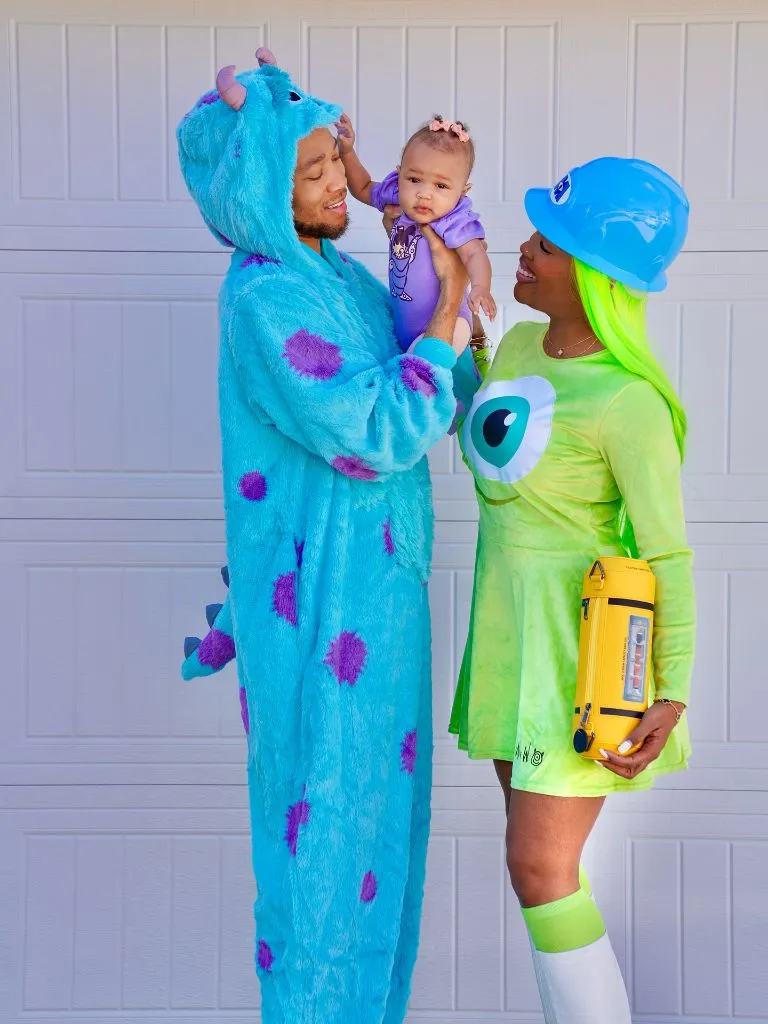
This is one of the more purchase-ready family Halloween costumes for 2026 because both the Sulley onesie and the Mike dress are widely available as single pieces. The baby’s costume is essentially a colored onesie and nothing more. For warmer climates, the Sulley suit will run hot — consider a lightweight fleece version rather than the plush fur option, and plan to have the wearer take breaks indoors. The neon green dress works well with or without the hard hat, so if headwear frustrates the wearer, the look still holds.
The design logic here is complementary color contrast. Blue and green sit adjacent on the wheel, but the saturation of both is pushed high enough that they vibrate against each other rather than blending. The purple accent from the baby bridges the two without competing. This kind of deliberate color blocking is what separates a family costume that reads as designed from one that reads as three people who happen to be standing together.
Witches and Spooky Face Paint for a Classic Halloween Mood
Not every group costume needs a franchise behind it. Sometimes the theme is simply Halloween itself — witches, zombies, face paint, and caution tape. This family leans into the holiday’s traditional imagery without committing to a single character. The child’s face paint is theatrical enough to carry their entire costume, while the adults wear simple black clothing with witch hats added as the only costume-specific pieces. The decorated interior with carved pumpkins and “Zombie Zone” tape creates an environmental context that makes the simple costumes feel more complete in photographs.
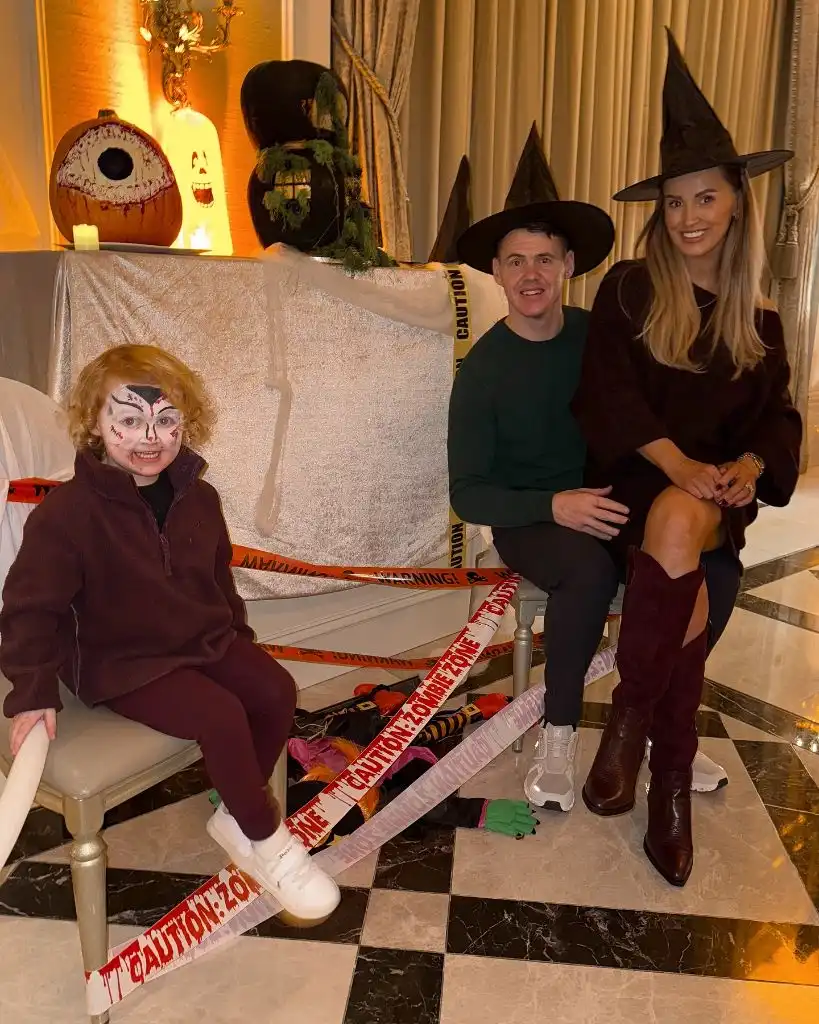
If your family prefers low-effort, high-impact dressing, this approach is worth studying. The adults are wearing clothes that could pass as normal outerwear — a green sweater, a black dress, tall boots — with hats doing all the thematic work. The child’s elaborate face paint is the true centerpiece, and investing in a professional or semi-professional face painting session can produce results that outshine any purchased costume. The tradeoff is longevity: face paint smudges, and small children tend to touch their faces. Apply a setting spray and carry touch-up supplies.
What this grouping demonstrates is the power of environmental styling. The same outfits photographed against a blank wall would feel incomplete. Surrounded by decorated pumpkins, themed tape, and atmospheric lighting, they feel intentional. For families who want to keep clothing simple, putting effort into the backdrop — whether it is your front porch or a designated photo corner inside — compensates for wardrobe restraint and often produces better photos overall.
Mixed Monster Costumes With Inflatable Props
There is a school of thought in family costuming that says everyone should match, and then there is this: a family where each member picks their own creature and the cohesion comes from energy rather than palette. A child in a Hulk muscle suit, another riding an inflatable dinosaur, a teen in a gothic clown dress, and an adult in all black with no costume at all — and somehow it works. The yard decorations, including a massive inflatable clown, frame the family as residents of a haunted world rather than performers of a single story.
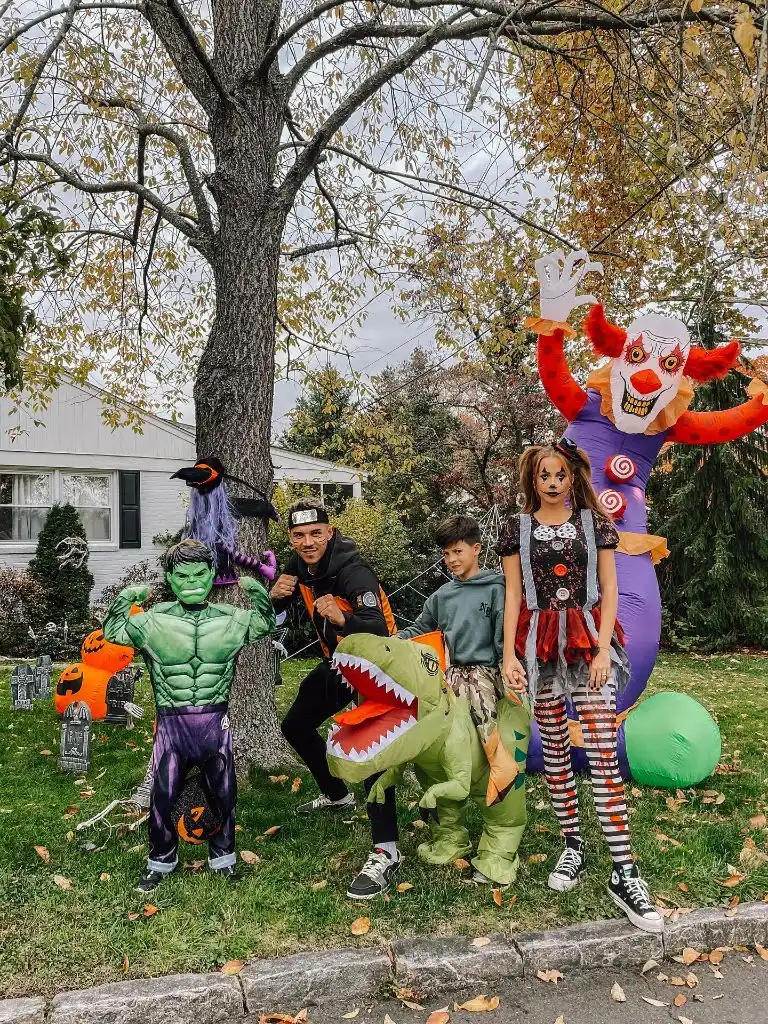
Inflatable costumes are a strong choice for children between ages five and twelve because they generate delight through novelty and require zero styling beyond stepping into them. The dinosaur ride-on costume is a reliable crowd-pleaser that works at trunk-or-treats, school parades, and neighborhood walks. The tradeoff is mobility — inflatables need battery-operated fans, restrict arm movement, and can deflate at inopportune moments. Always carry spare batteries. The muscle suit for the younger child is a simpler mechanical commitment with the same level of instant recognition.
The reason this no-theme approach still reads as a family costume is proximity and attitude. When four people stand together on a decorated lawn and all project “Halloween” — even through wildly different references — the viewer groups them instinctively. This is a useful fallback when family members cannot agree on a single franchise: let everyone pick their own monster, commit to theatrical body language, and let the holiday itself be the unifying concept.
Wednesday Addams and the Undead Family
The Addams Family has always been fertile ground for group costumes, but this particular interpretation sharpens the reference by pulling from the Netflix-era visual language of Wednesday. The central figure wears the now-iconic braided hair, plaid blazer, and knee-high socks, while the two children commit fully to zombie styling with blood-splattered hospital gowns and undead walking poses. The adult in the back wears a hoodie with darkened eye makeup — understated, almost civilian, but unmistakably part of the same tonal world.
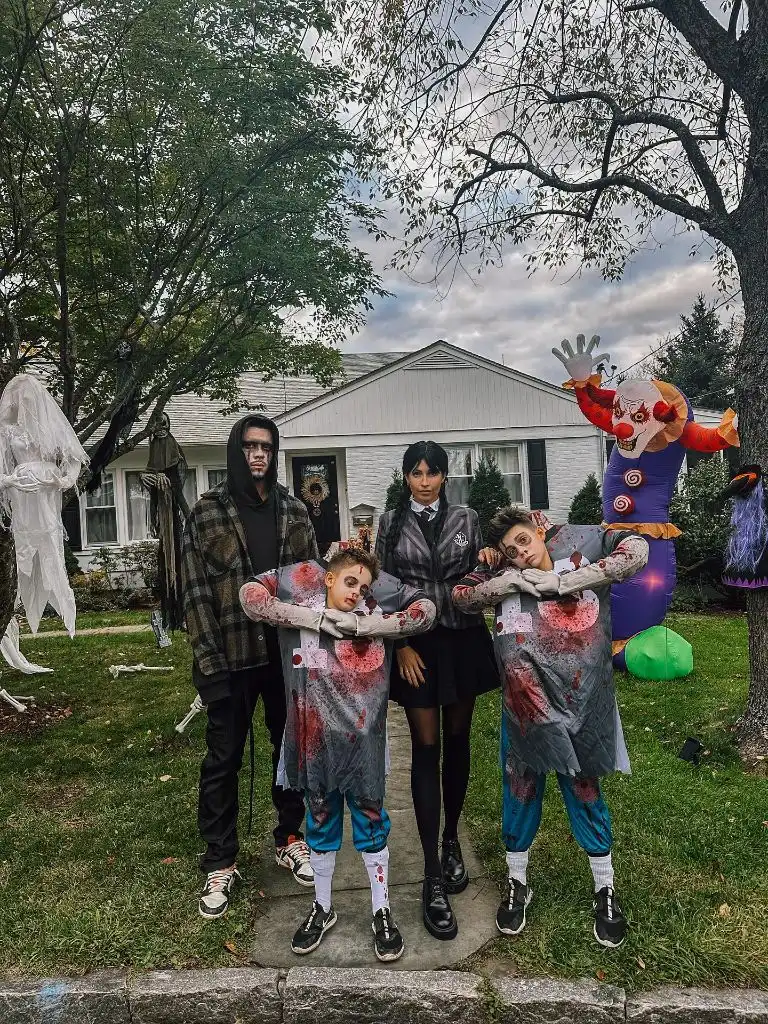
The blood-spatter technique on the children’s costumes can be achieved with a toothbrush and red fabric paint in about twenty minutes per garment. Start with a cheap grey or white long-sleeve shirt from a thrift store and flick diluted paint in random patterns — irregular looks more realistic than careful placement. For the Wednesday costume, the blazer and skirt likely already exist in a closet or can be sourced secondhand. The wig or temporary hair dye is the single purchase that makes the look land. If you are building family Halloween costumes for 2026 around a pop culture reference, choosing one with a strong silhouette — like Wednesday’s uniform — ensures recognition even at a distance.
The composition works because of tonal consistency. Every element sits in the grey-black-red spectrum, and the background decorations — ghost figures, an inflatable clown — reinforce the horror context without competing with the costumes. The children’s matching zombie outfits create visual rhythm through repetition, while the two adults frame the group with height and contrasting levels of costume commitment. This kind of asymmetry — one person fully costumed, one barely costumed — actually strengthens the group read rather than weakening it.
Marvel Avengers Assembly With Toddler Hulk
Superhero family costumes risk looking generic because the source material is so widely merchandised, but this group sidesteps that by committing to character-specific body language. The Thor costume on the tallest member carries authority through the raised fist and broad stance. The Spider-Man suit on the other adult is playful, mid-web-shooting pose, which creates dynamic asymmetry in any photograph. The toddler in an Iron Man suit with the faceplate flipped up adds the crucial cute factor, while the baby in a green onesie — a minimal Hulk reference — proves that infants need almost nothing to participate in a group theme.
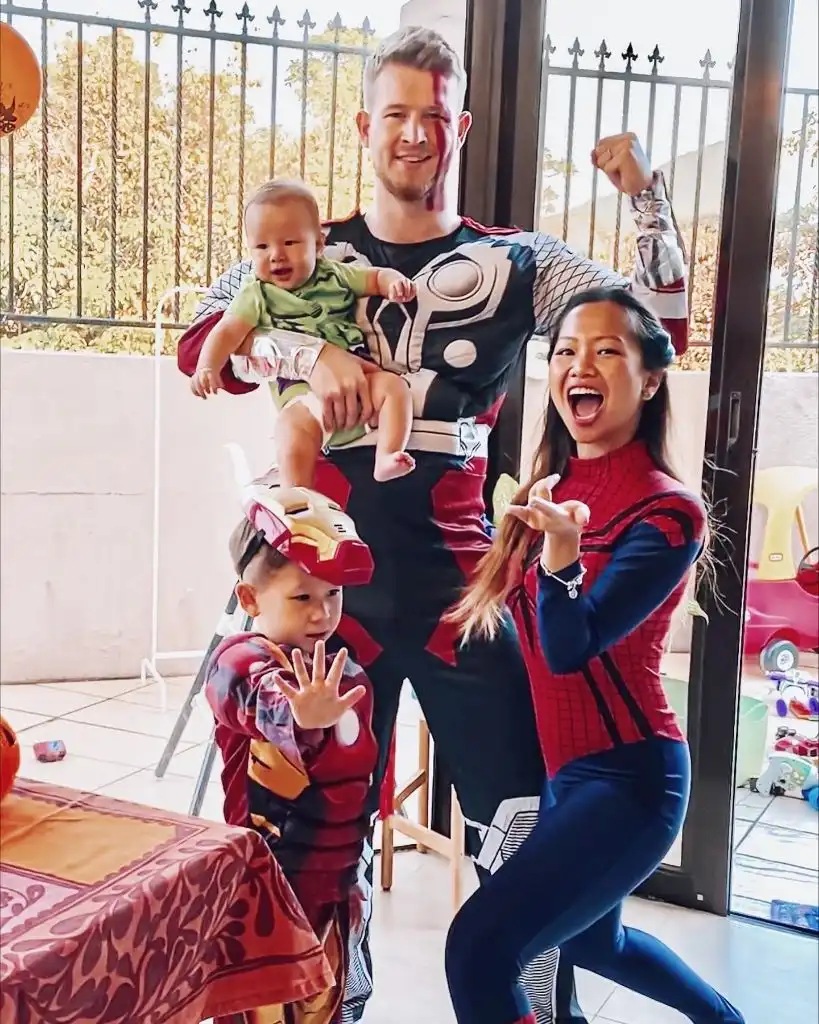
Superhero bodysuits are among the most comfortable group costume options because they function as pajamas with branding. The stretchy fabric moves with the wearer, the sizing tends to be forgiving, and cleanup is a single trip through the washing machine. The main consideration is temperature regulation — these suits run warm in heated indoor environments. For outdoor trick-or-treating in cooler climates, they layer perfectly over thermal underwear without losing their shape. The toddler Iron Man suit may intimidate with its sculpted chest piece, but most versions are foam-backed fabric that stays lightweight. For more ideas on coordinating children’s Halloween looks, see creative costume ideas for kids and families.
The Avengers concept works for families of any size because the character roster is essentially infinite. A family of three can do Thor, Loki, and baby Hulk. A family of six can add Black Widow, Captain America, and Hawkeye. The visual coherence comes not from matching colors but from the shared universe — everyone is an Avenger, and that narrative thread does the work of unification. This scalability makes superhero ensembles one of the most practical group costume frameworks available.
Dinosaur Explorers With an Inflatable T-Rex
A dinosaur-themed family channels the same nostalgic energy as Jurassic Park without requiring anyone to source screen-accurate costumes. The older child wears an inflatable dinosaur ride-on suit that guarantees laughs, while the father dresses in a safari-style vest and explorer hat that reads as “paleontologist” with zero ambiguity. The baby wears a dinosaur-printed hat and a onesie in warm tones, and the mother keeps things simple in a light cardigan. The party decorations behind them — dinosaur cutouts, streamers, balloon letters — suggest this might double as a birthday theme, which is a smart way to get more mileage from a single concept.
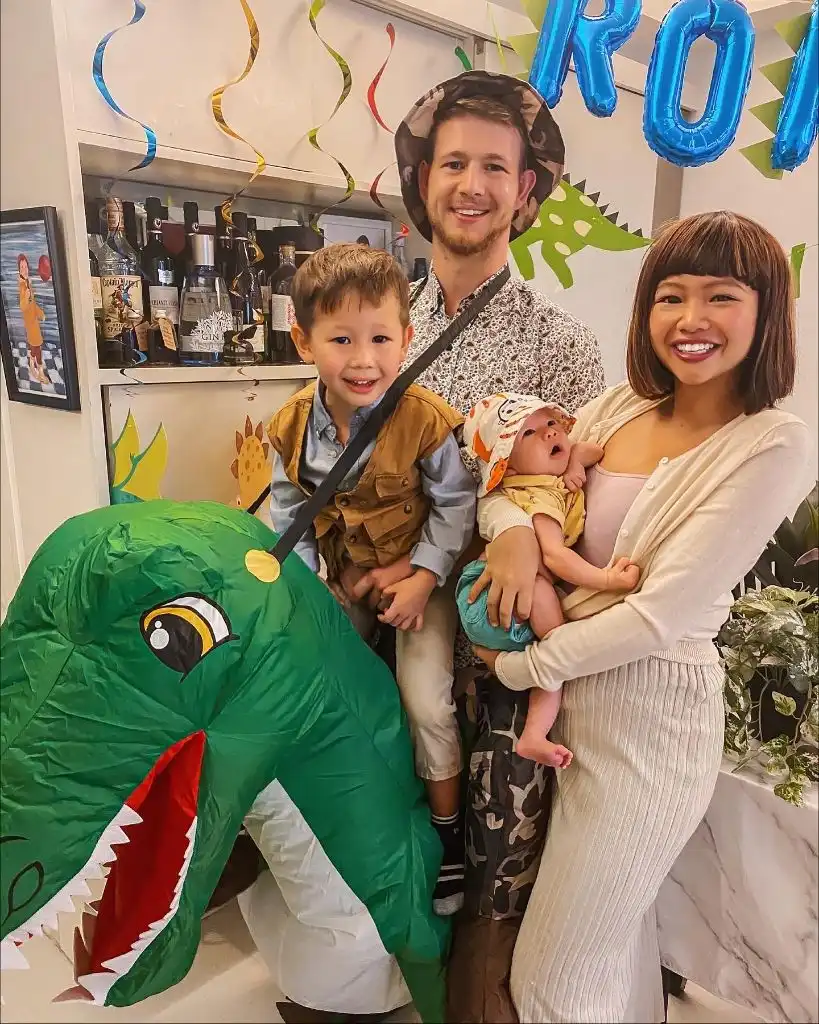
To replicate the explorer half of this look, thrift a khaki or tan vest and pair it with a patterned button-down shirt and camo-print pants. A wide-brimmed hat from any outdoor retailer completes the silhouette. The inflatable dinosaur suit for the child is available at virtually every Halloween retailer and runs between twenty and forty dollars depending on size and detail level. For a baby too young for a full costume, a dinosaur bonnet or hat is sufficient — the surrounding context of the group will communicate the theme. The key is committing to the explorer aesthetic on at least one adult so the dinosaurs have something to play against.
This concept thrives on the predator-prey dynamic built into the narrative. Explorers and dinosaurs are inherently in tension, and that story creates visual interest even in a still photograph. The inflatable costume adds physical comedy — it is oversized, wobbly, and impossible to take seriously — which balances the more composed explorer outfits. When planning family Halloween costumes for 2026, consider this principle: the best group concepts contain an internal relationship between the characters, not just a shared setting.
The Incredibles in Matching Red and Black
Few family costume concepts are as immediately legible as The Incredibles, and the reason is the uniform. Every member wears the same red-and-black bodysuit with the iconic “i” logo, which eliminates all decision-making about individual character differentiation. The family becomes a single graphic unit. The tallest member’s flexed arm creates vertical emphasis, while the smaller children at knee and hip height build a natural pyramid composition. The youngest child in a plain red long-sleeve — no logo, no suit detailing — still reads as part of the team because the color match is so strong.
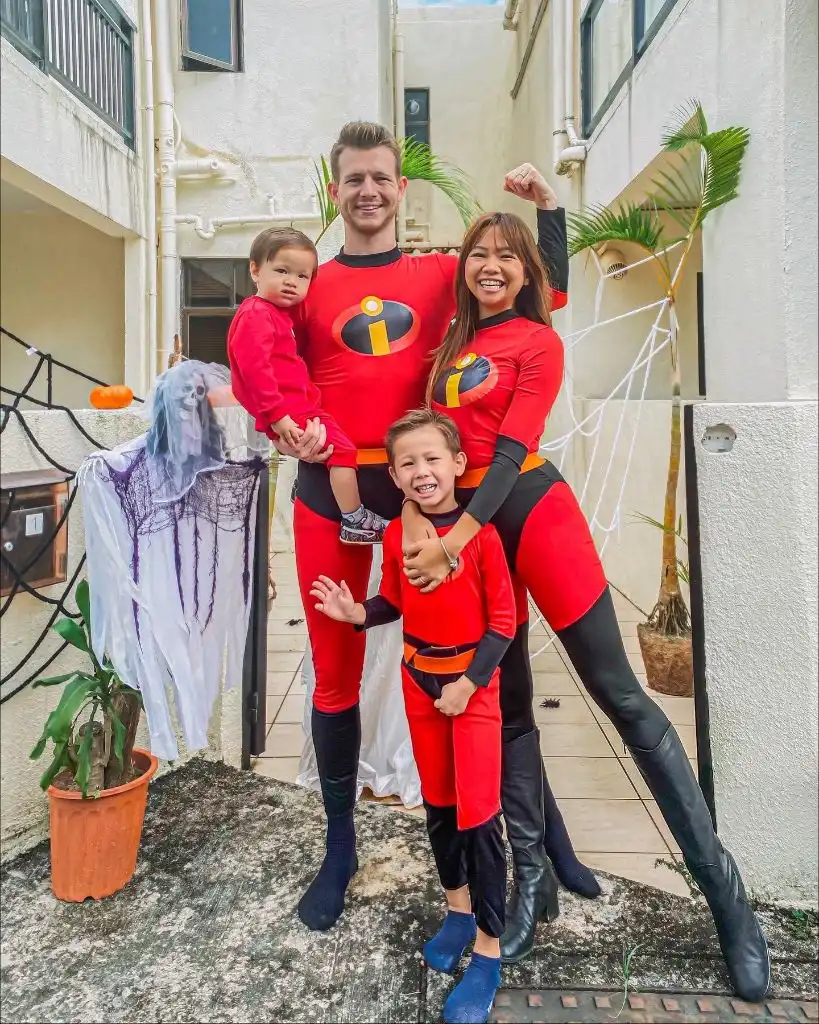
The Incredibles suits are available as a family pack from several costume retailers, and the per-unit cost drops significantly when purchased as a set. The bodysuit construction is tight-fitting spandex, which means sizing accuracy matters — order based on measurements rather than general size labels. For adults who prefer less compression, look for versions with a relaxed fit through the torso. Black boots or shoes complete the look cleanly; avoid sneakers in bright colors, as they break the uniform effect. The baby does not need the official suit at all — a red onesie or long-sleeve shirt achieves the same result.
The power of this costume concept lies in its uniformity. When every member of a group wears the same outfit, the eye processes them as a team before it processes them as individuals. This is the same principle behind sports uniforms and military dress — identical clothing signals shared purpose. For families who want maximum impact with minimum conceptual complexity, a uniform-based franchise like The Incredibles, the Ghostbusters, or a sports team offers the most efficient path from idea to execution.
Batman Universe With Catwoman and Riddler
The Batman franchise offers something that many superhero properties do not: a roster of characters with wildly different visual identities that still share a tonal world. This family splits between heroes and villains — one child as Batman in full armored suit, another as Robin in green and yellow, an adult as Catwoman with black bodysuit and mask, and the other adult as the Riddler in a question-mark-covered green blazer with pink lapels. The color contrast between the dark hero costumes and the bright villain costumes creates a natural split down the center of the group.
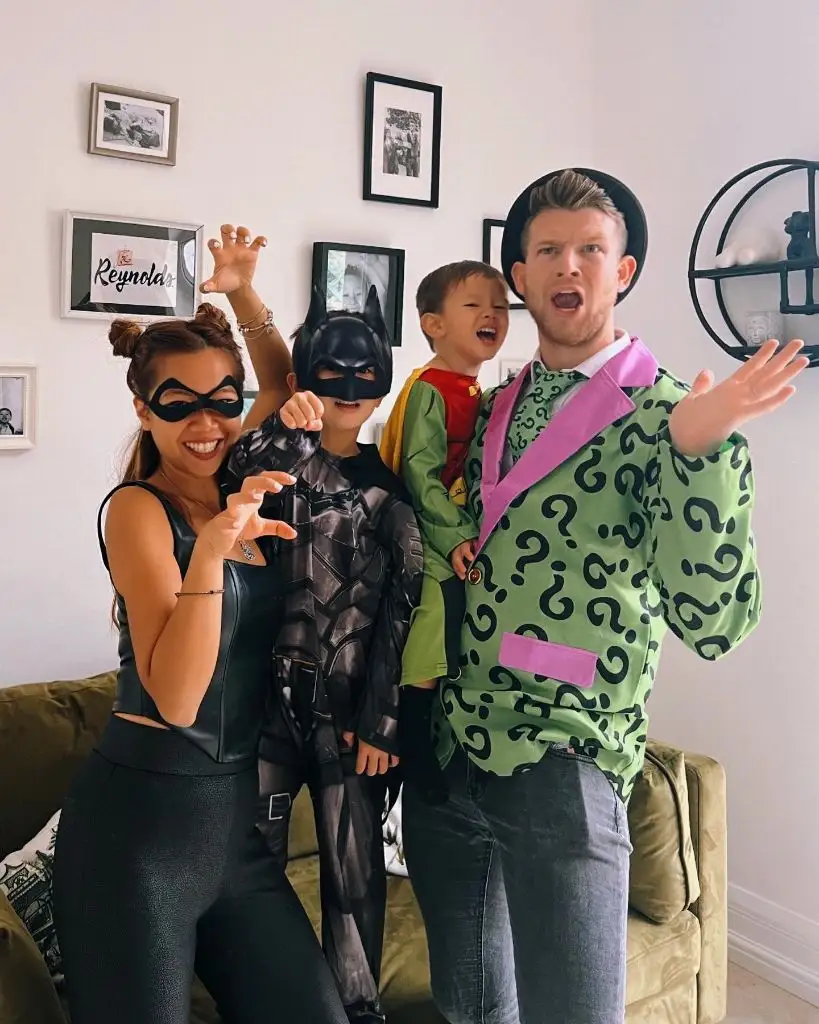
The Catwoman costume is one of the most wardrobe-friendly options in the superhero genre: black leggings, a black tank top, cat ears, and a mask. Everything except the mask is likely already owned. The Riddler suit requires a printed or painted blazer, which can be achieved by hand-stamping question marks onto a thrift store jacket using fabric paint and a foam stamp. Budget an afternoon for this project. The Batman suit for the child is a standard retail purchase, and the Robin costume can be assembled from a green shirt, yellow cape, and black mask. For families where the children have strong character preferences, letting them choose first and building the adult costumes around those choices tends to produce better cooperation and better photos.
The design success here comes from the hero-villain pairing, which creates narrative tension within the group. The family is not just standing together — they are playing against each other. The mother’s Catwoman is allied with the child’s Batman but also visually opposes the father’s Riddler. These internal relationships give photographers and onlookers something to interpret, which is what transforms a group costume from a visual statement into a conversation piece.
Harry Potter Characters on Diagon Alley
Harry Potter remains one of the most reliable franchise options for family costuming because the character roster spans a wide range of body types, ages, and costume complexity. This group features an adult as Professor McGonagall — complete with a tall wizard hat, emerald cape, and a plush owl on the shoulder — while the other adult goes as Hagrid with a long brown wig, bushy beard, and leather vest. The child as Harry Potter wears the Gryffindor robe, round glasses, and a lightning bolt scar, pointing a wand directly at the camera. The Diagon Alley backdrop, whether a photo backdrop or an actual theme park visit, completes the world-building.
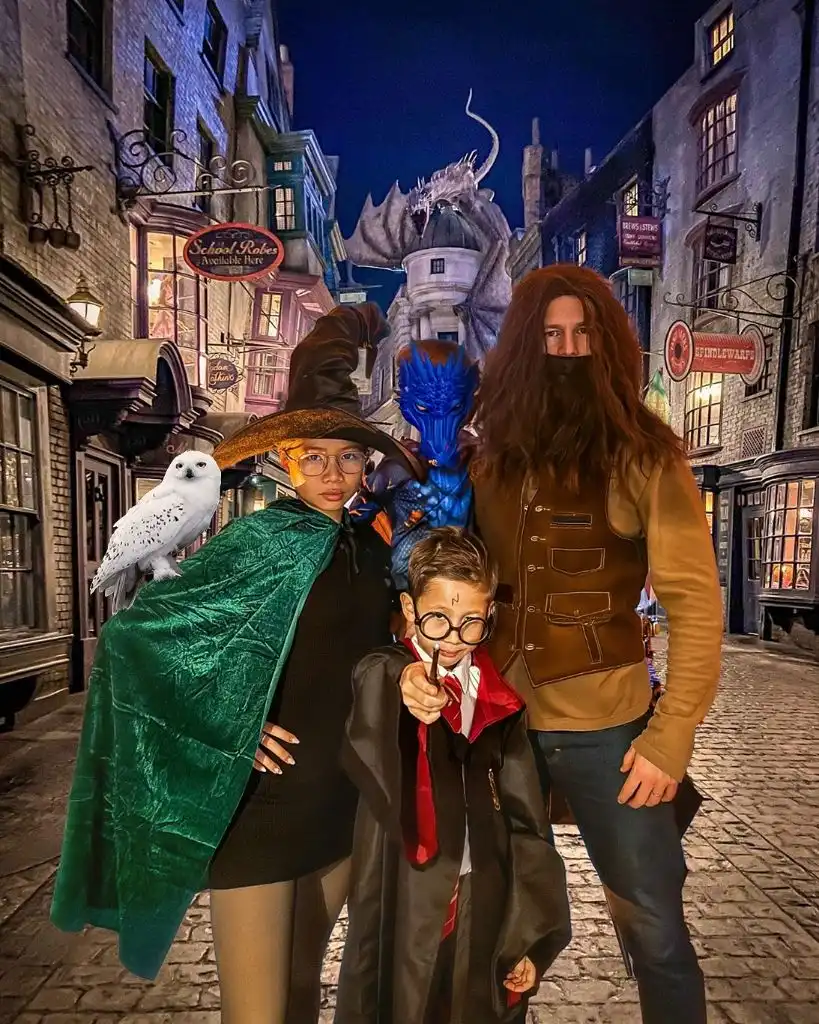
The Hagrid costume requires the most commitment in terms of accessories — the wig and beard are essential, and cheap versions look noticeably cheap. Invest in a mid-range wig with some volume and texture, and pair it with a beard that attaches securely enough to survive a full evening. The McGonagall look depends almost entirely on the hat and cape; under the cape, regular dark clothing works fine. Harry’s costume is the most standardized and therefore the easiest to source. For families with more than three members, adding a Hermione, Ron, or Dumbledore expands the group without requiring any new conceptual work.
What makes the Harry Potter family costume enduringly effective is that each character is recognizable from a single accessory: glasses and scar for Harry, pointed hat for McGonagall, oversized frame and beard for Hagrid. This one-detail legibility means the costumes work at a distance and in dim lighting, both of which are practical considerations for trick-or-treating. When choosing a franchise for your group, prioritize characters that are identifiable from their silhouette alone — this ensures the costume communicates even when details are lost.
The Little Mermaid With Ursula as the Scene-Stealer
Disney villain costumes tend to outshine their protagonist counterparts, and this Little Mermaid family grouping proves the rule. The Ursula costume commands the frame with purple body paint, grey wig, a black tulle skirt, and a tentacle-like green boa — the kind of costume that requires genuine artistic commitment. Beside her, the father plays Prince Eric in a simple white shirt and red sash, holding a child dressed as Ariel with a flowing red wig. The younger child as Sebastian wears a red lobster suit that is simultaneously the simplest and most charming element in the composition.
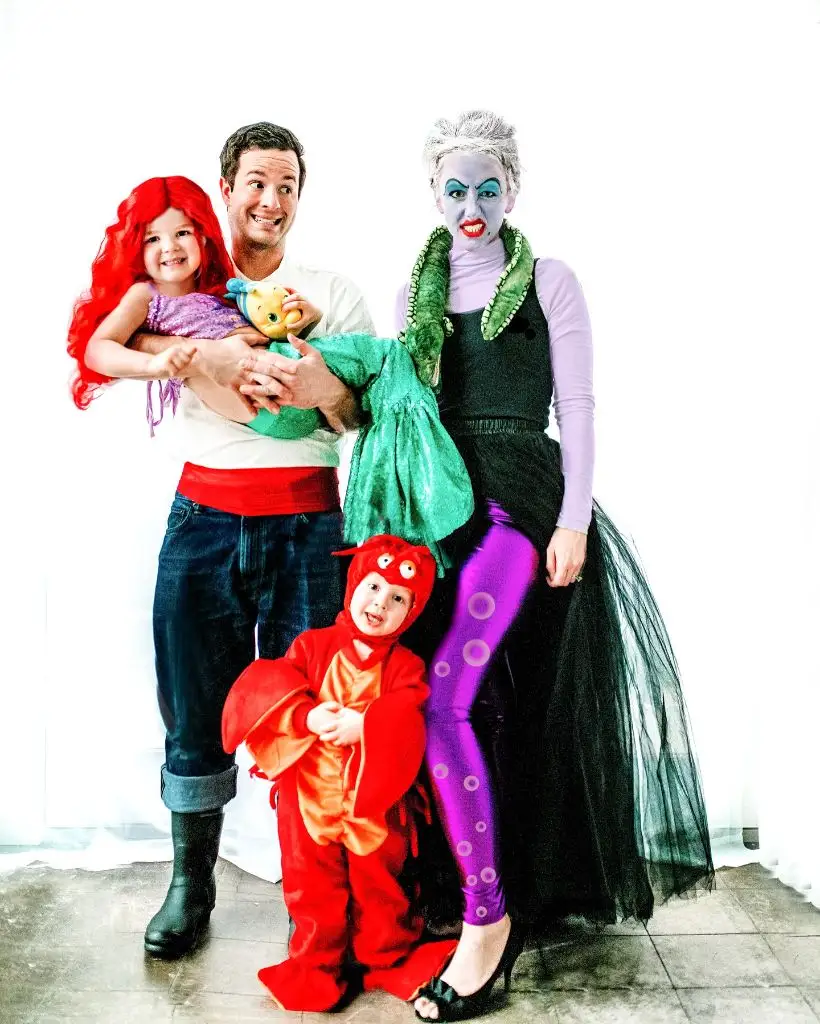
The Ursula costume is the high-investment piece here, requiring body makeup, a structured skirt, and styled wig. If full body paint feels like too much, a purple long-sleeve shirt achieves eighty percent of the effect with twenty percent of the effort. The tentacles can be suggested through a black tulle skirt alone. Eric’s costume is intentionally minimal — white shirt, red fabric sash, jeans rolled to mid-calf, boots — and works because the other characters provide enough context. The Sebastian lobster suit for toddlers is available pre-made and is one of the more comfortable full-body costumes for small children, since the plush fabric is soft and the hood stays on better than most character hats.
The lesson from this grouping is that one ambitious costume can carry an entire family. When one person commits to a complex, visually dense character — Ursula, Maleficent, Cruella — the other family members can wear relatively simple outfits and still benefit from the halo effect. This is a practical strategy for families where one adult enjoys the creative process and the other prefers a hands-off approach. Let the enthusiast anchor the group, and let everyone else draft behind them.
Three Little Pigs and the Big Bad Wolf
Fairy tale costumes offer a structural advantage over franchise costumes: everyone already knows the story, so the costumes communicate instantly regardless of the viewer’s age or pop culture fluency. This family does the Three Little Pigs and the Big Bad Wolf with a light touch — the two adults wear pig ears and pig noses over regular clothes (overalls and pink shirts), the baby wears a pig hat and overalls, and the older child wears a full-body wolf costume with plush fur and claws. The wolf is the only one in a purchased costume; everyone else is in styled everyday clothing.
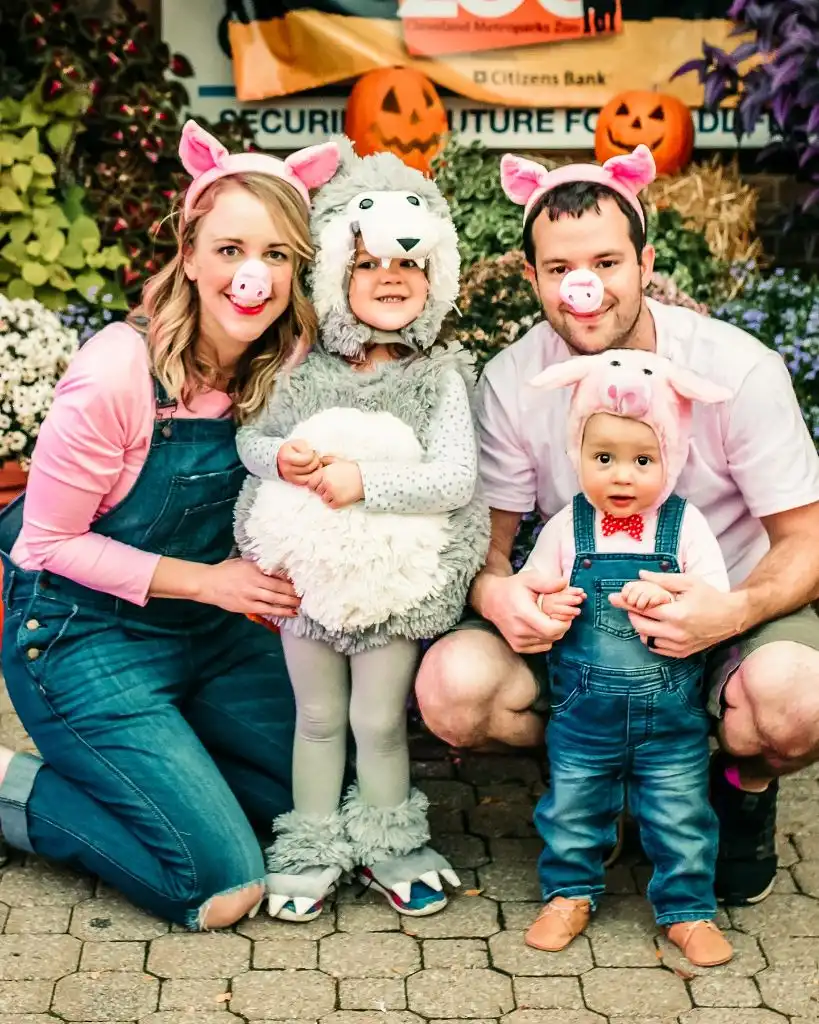
The pig accessories — ears headband and a foam snout that hooks over the nose — are sold as a set for a few dollars at any Halloween or party supply store. The overalls are the wardrobe piece that sells the farmer-pig aesthetic, and they are reusable as actual clothing after October. The wolf costume for the child is the single true costume investment, and at this age, children tend to enjoy wearing full-body animal suits because they feel like wearing a stuffed animal. Make sure the wolf hood allows for clear sightlines and does not obstruct peripheral vision, especially if trick-or-treating involves crossing streets. For other storybook-inspired costume ideas, see classic family costume themes that work for all ages.
This concept demonstrates a principle worth remembering: asymmetric commitment within a group costume is not a flaw. Having one person in full costume and three people in accessories-over-regular-clothes creates a visual hierarchy that is actually easier to read than four equally detailed costumes. The eye goes to the wolf first, then scans the pigs, and the story assembles itself. Simplicity on most members allows complexity on one member to shine.
Super Mario Bros. With Princess Peach and Yoshi
The Super Mario universe remains one of the strongest options for family Halloween costumes for 2026 because its character designs are defined by color rather than detail. Luigi is green and blue. Mario is red and blue. Princess Peach is pink. Toad is white and red. Yoshi is green. You can identify every character from across a street based on color blocking alone. This family executes all five characters, with the adults as Luigi and Toad, the older children as Mario and Peach, and the toddler as Yoshi. The front porch stacked with carved pumpkins creates a seasonal frame that grounds the bright costumes.
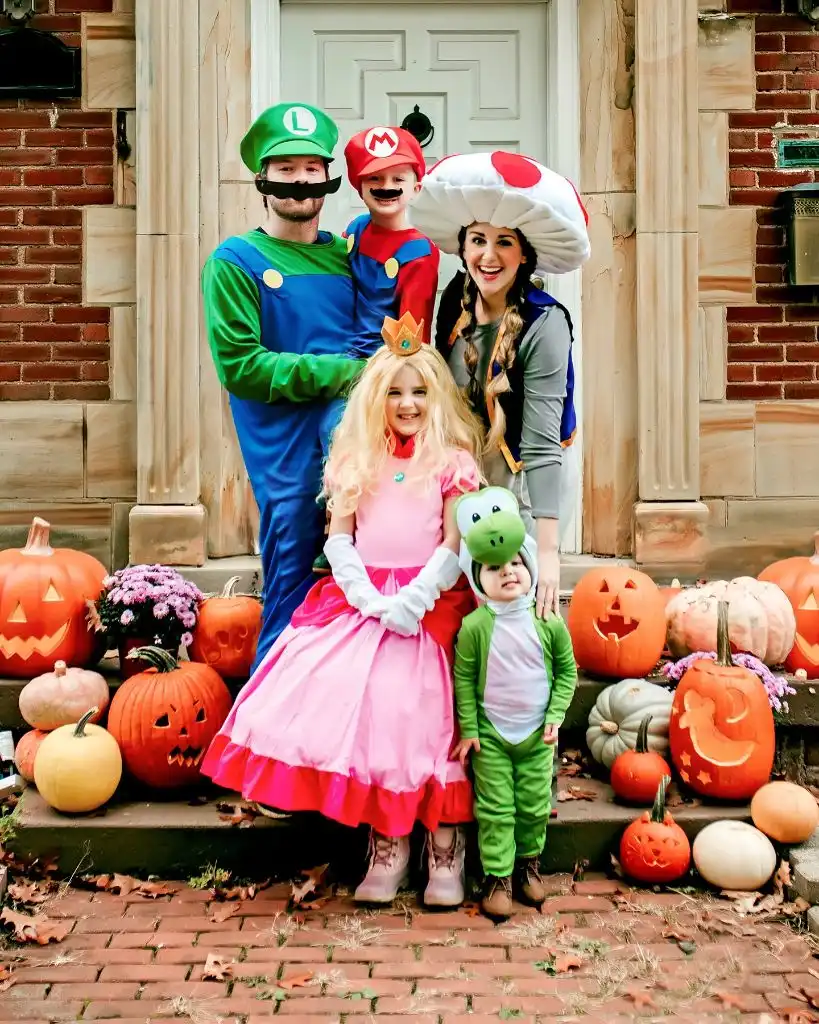
The Mario and Luigi costumes are built from colored overalls and long-sleeve shirts, plus the iconic caps and stick-on mustaches. The Toad costume requires a mushroom-cap hat, which is available pre-made or can be constructed from a wide-brim hat covered in white and red fabric. Princess Peach needs a pink dress, blonde wig, and a small crown — the dress can be any floor-length pink gown, including a repurposed bridesmaid dress or prom dress. Yoshi for the toddler is a green hooded onesie with a white belly panel and a small shell on the back. All of these costumes prioritize comfort and mobility, which matters when the group includes children under five.
The reason Mario characters work so well for groups is that the franchise was designed for visual clarity at low resolution. These characters were originally rendered in eight-bit pixels, which means their defining traits are large, simple, and unmistakable. That same clarity translates perfectly to costume form: big color blocks, bold accessories, and zero ambiguity. When evaluating any franchise for group costume potential, ask whether you could identify the characters as colored rectangles. If yes, the costumes will work.
Pokémon Trainers and Their Favorite Catches
A Pokémon family costume splits naturally into two categories: humans and creatures. The adults play Ash Ketchum and Jessie from Team Rocket, establishing the trainer-versus-villain dynamic, while the children dress as Pikachu, Charizard, and Jigglypuff. This division means the adult costumes can lean casual — a blue vest and red cap for Ash, a white uniform with red “R” and pink wig for Jessie — while the children’s costumes lean playful and plush. The Pokéball prop held between the two adults is a small but effective narrative detail that connects the human and creature halves of the group.
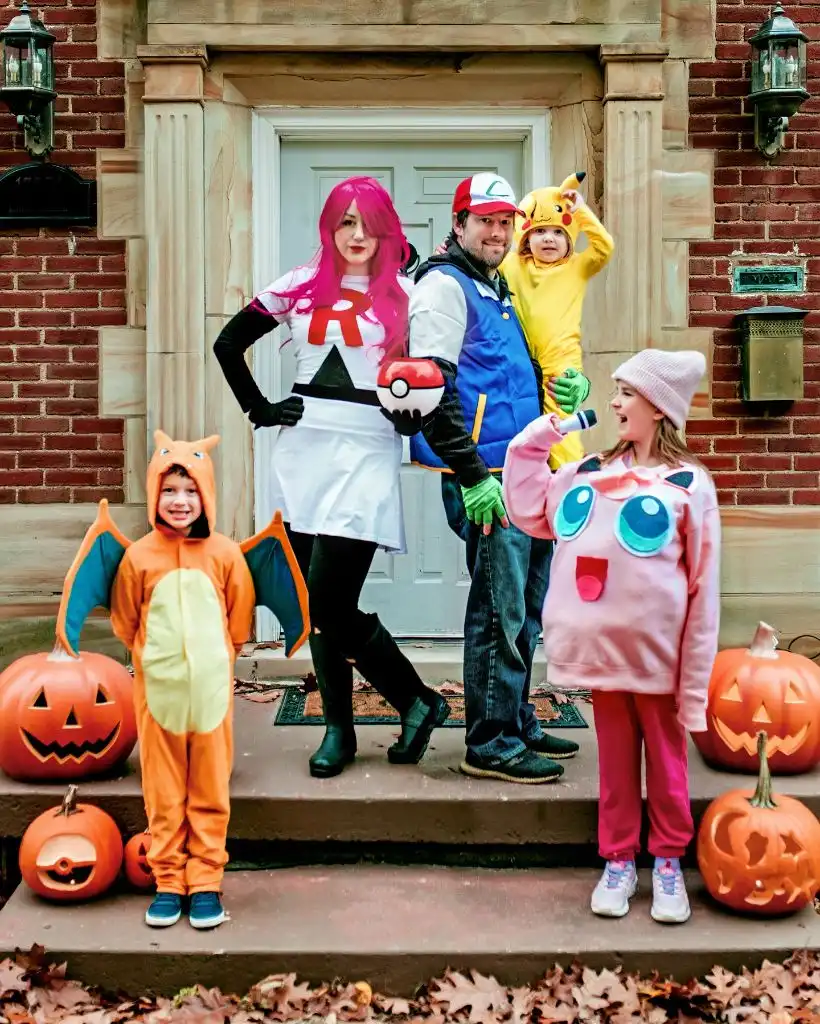
The Charizard onesie for small children is widely available and doubles as pajamas through the rest of the year, which justifies the purchase beyond a single night. The Jigglypuff costume can be assembled from a pink sweatshirt, felt cutouts for the eyes and mouth, and a pink beanie — this is a strong DIY option for anyone who wants to avoid a full-body suit. Pikachu costumes range from simple yellow hoodies with ear attachments to full plush suits; for a toddler being carried, the simpler version is usually better. The Team Rocket uniform for the adult is a white dress or tunic with a large red “R” ironed or sewn onto the chest, paired with black gloves and boots.
The Pokémon concept works for large families because the creature roster is literally over a thousand characters deep. Every child can pick their personal favorite without any overlap, and the adults can choose from dozens of trainer and villain characters. This infinite scalability, combined with the fact that Pokémon characters are designed to be cute and recognizable, makes the franchise one of the most adaptable options for groups of any size. The color diversity across different Pokémon also ensures the group photograph will be vibrant without any deliberate color coordination.
Toy Story Characters Across Three Generations
Toy Story group costumes scale beautifully because the franchise has enough characters to accommodate extended family gatherings, and this image shows exactly that. Grandparents appear as Mr. and Mrs. Potato Head, the parents dress as Barbie and the Green Army Man, the children wear Woody and Buzz Lightyear suits, and a toddler is carried as a toy in a pink outfit. The range of costume complexity is enormous — from the sculpted Potato Head body worn by the grandmother to the simple green body paint and cap worn by the father — but the shared Toy Story universe keeps every person visually linked.
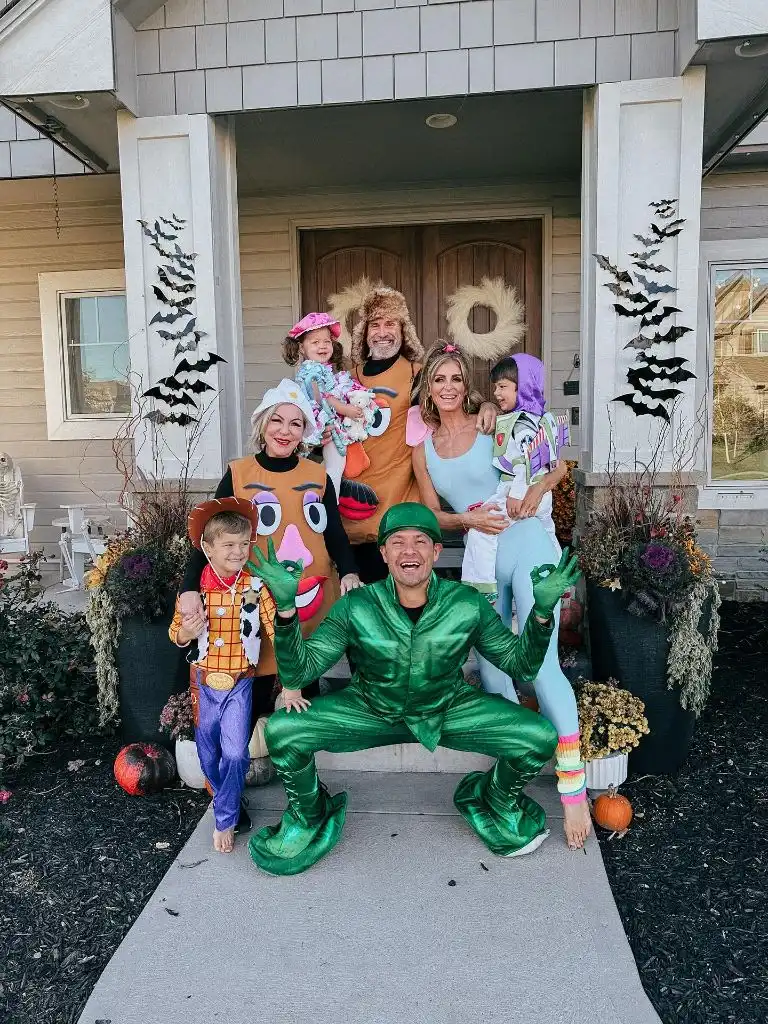
The Woody and Buzz costumes for children are among the most commonly sold Halloween costumes in the United States, which means they are available at every price point from budget to premium. The Green Army Man look requires green clothing, green face paint, and a green base to stand on for the full toy-soldier effect — or, as shown here, a full green metallic suit that commits to the bit entirely. For the Potato Head costumes, expect either a pre-made inflatable or a DIY build from cardboard and felt, which can take a full weekend. These are the statement pieces that will dominate photos and are worth the time investment if any family member enjoys crafting.
Toy Story works across generations in a way that few other franchises manage, because adults who grew up with the original 1995 film are now parents and even grandparents. The emotional resonance of the property means that adults wearing these costumes are not performing fandom — they are expressing genuine attachment. This emotional authenticity translates in photographs and in person. When a costume concept spans generational knowledge, it gains a warmth that purely aesthetic coordination cannot replicate.
Farmers and Their Baby Chicken
Some of the most effective family costumes require almost nothing that was not already in the closet. Two adults in plaid flannel shirts, denim overalls, and cowboy boots are farmers — add freckle dots with an eyeliner pencil and the character is complete. Between them, a baby wears a white feather boa wrapped into a body suit with yellow leggings and a crocheted chicken hat. The entire concept requires one craft project (the chicken outfit) and zero purchases for the adults. The fall porch setting with pumpkins and mums provides seasonal context that makes the simple costumes feel fully realized.
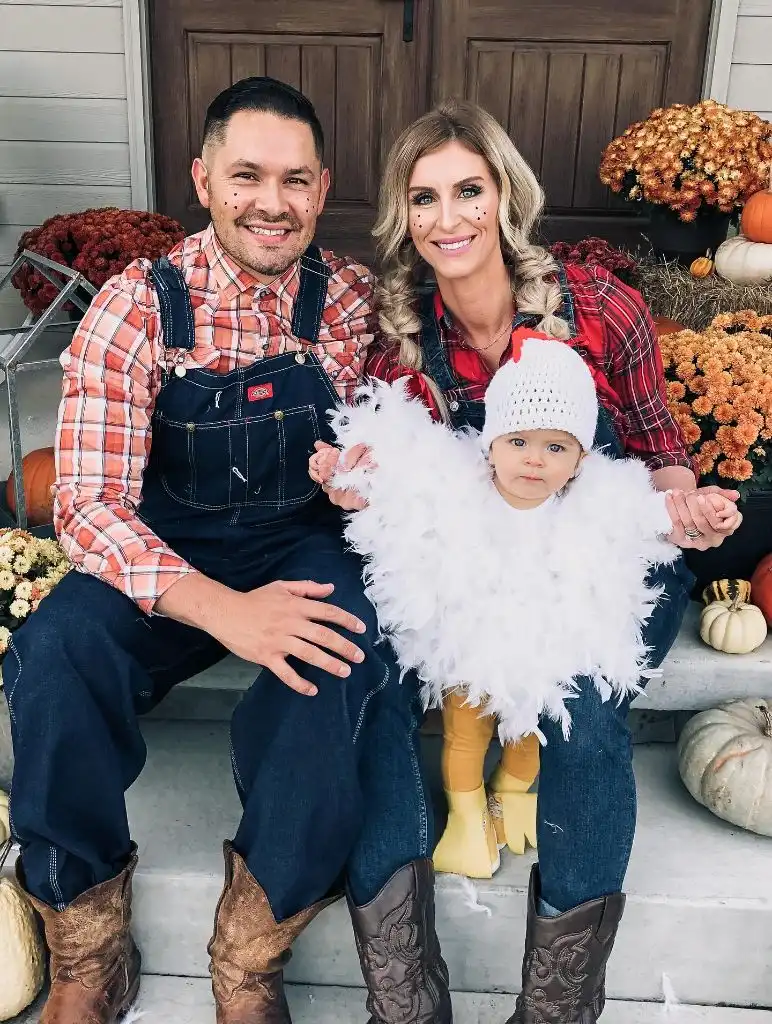
The chicken costume for the baby is the kind of project that looks impressive but is mechanically simple: a white onesie, a feather boa safety-pinned around the torso, yellow tights or leggings, and a small crocheted or knit hat with a beak and comb. The hat is the only piece that requires real skill or a dedicated purchase. Everything else can be sourced from a craft store in a single trip. For the adults, the freckle dots are a surprisingly effective finishing touch — three or four dots on each cheek with brown eyeliner takes thirty seconds and sells the character more than the overalls alone.
This costume demonstrates that concept clarity matters more than material investment. “Farmers and a chicken” is a story anyone can understand instantly, from a two-year-old to an eighty-year-old. The baby does not need to look like a realistic chicken — the feathers and the yellow legs communicate the idea, and the context of two adults in farm clothing completes the picture. When planning family costumes on a budget, look for concepts where the relationship between the characters is the costume, rather than any individual outfit.
DC Superheroes With Baby Wonder Woman
A superhero family where every member is a different hero creates a visual buffet — the eye has to work to take it all in, but the shared genre keeps the group cohesive. This version features Batman (dad), Catwoman (mom), Spider-Man (older son), Superman (younger son), and baby Wonder Woman, spanning both DC and Marvel universes. Purists might object to the franchise mixing, but the practical result is that every family member wears their personal favorite, which means everyone is happy. The adult Batman and Catwoman costumes are clean and monochrome, which provides a dark frame for the brighter children’s costumes in the center.
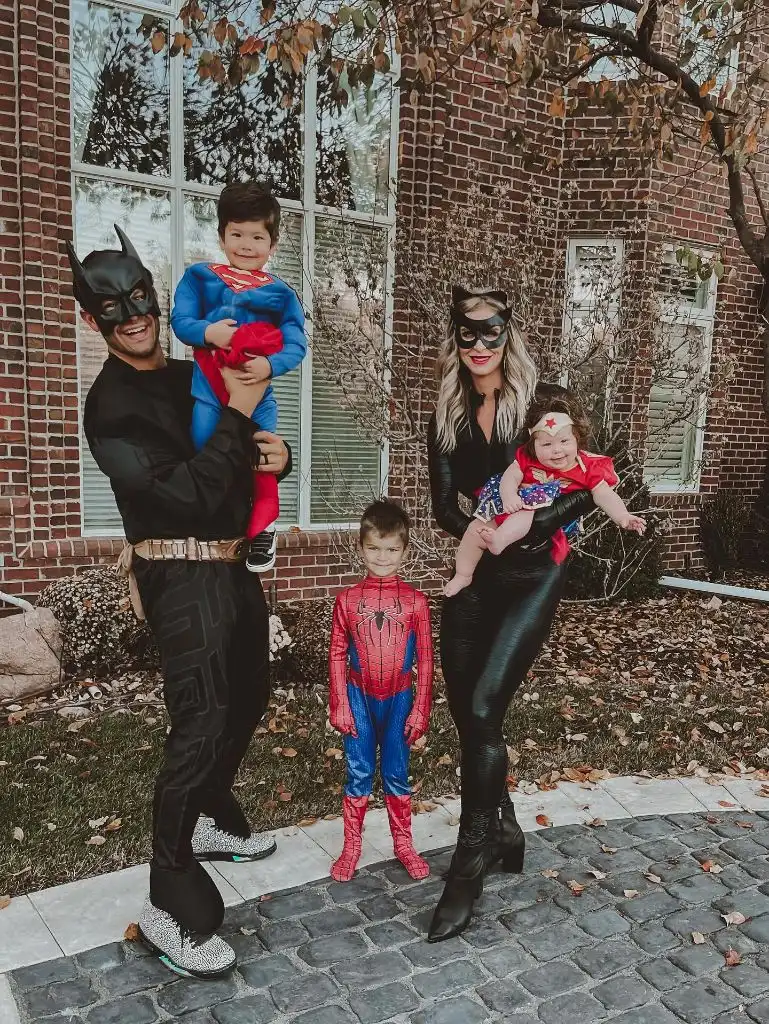
The Spider-Man suit for the older child is a full-body print that requires no accessories — just zip it up and go. The Superman cape-and-suit combo for the younger child has the same simplicity. The baby’s Wonder Woman outfit is a onesie with a printed bodice and a small headband, requiring zero cooperation from the infant. For the adults, the Batman suit is a printed compression top with a cape, mask, and utility belt, while the Catwoman look is black leggings, a black top, cat ears, and a mask — minimal purchases for maximum recognition. The patterned sneakers on the Batman-clad father are a humanizing detail that keeps the whole thing from feeling too serious.
Mixing franchises within a single family group is more common than themed purists might expect, and it works because the overarching genre — “superheroes” — provides sufficient cohesion. The viewer processes the group as “a superhero family,” not as “a DC family with one Marvel interloper.” This is a liberating realization for families where children have strong and incompatible character preferences. Let the genre be the theme, and let individuals choose within it freely.
Snow White Royalty With Baby Dwarf
Disney princess family costumes benefit from the built-in formality of the source material — the fabrics are rich, the colors are saturated, and the silhouettes are dramatic. This Snow White grouping features a mother in a full-length purple and blue gown with a tiara, a father in a military-style prince jacket with gold epaulettes, a toddler daughter in a yellow-and-blue Snow White dress, and a baby costumed as one of the Seven Dwarfs in a miniature cap and vest. The evening light catches the satin of the adult gown, which adds a photographic dimension that casual cotton costumes cannot achieve.
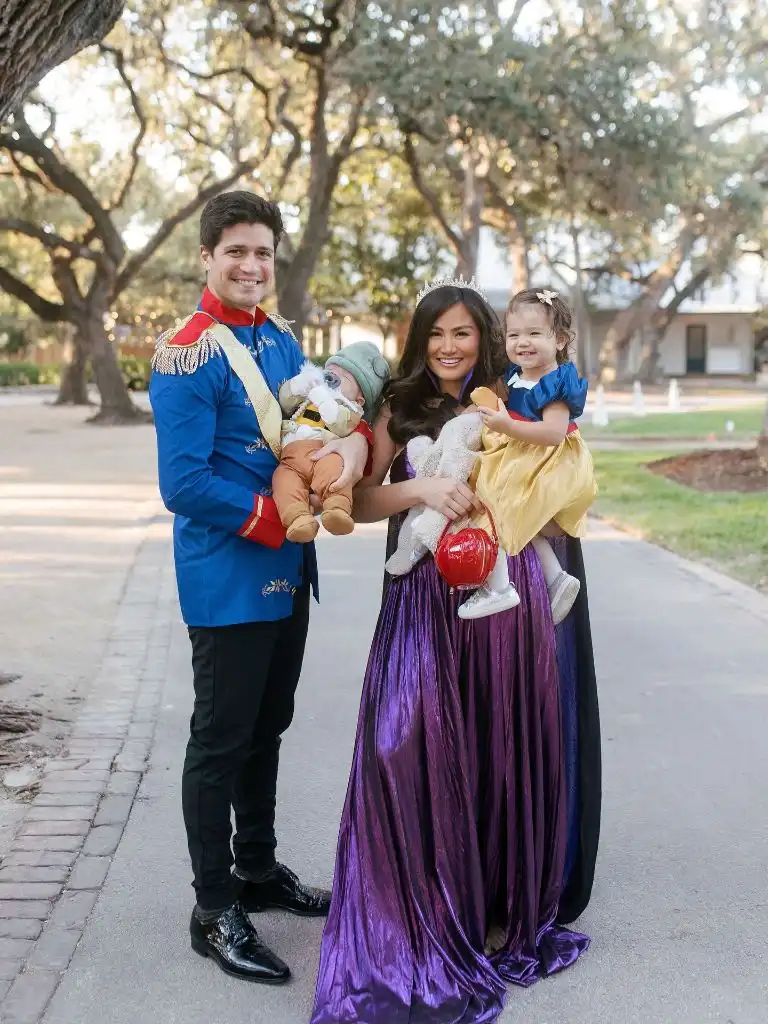
The prince costume is available as a military-style jacket from costume retailers, but a close approximation can be assembled from a blue blazer, gold ribbon trim, and epaulette accessories from a craft store. The Snow White dress for the toddler is one of the most widely available children’s costumes in the Disney catalog. The baby’s Dwarf costume is likely a onesie with a felt vest and a small character hat — Grumpy and Doc are the most commonly available, but any of the seven works. The mother’s gown is the investment piece; look for Renaissance faire or cosplay retailers for quality options that sit above the flimsy party-store tier without reaching couture prices.
The formality of this costume concept gives it a photographic gravity that more casual themes lack. When a family dresses as royalty, the posture changes, the expressions adjust, and the photographs take on a portrait quality. This is worth considering if the primary goal of the family costume is to produce a strong annual photo. Formal costumes with structured silhouettes and rich fabrics photograph better in low light and at distance than casual or athletic-wear-based costumes, which tend to flatten in images.
Emperor’s New Groove Trio With Baby Llama
Deep Disney cuts reward the viewer who recognizes them. Yzma’s purple hat-and-black-dress combination, Kronk’s blue-and-gold tunic, and a baby in a white llama suit compose a family grouping from The Emperor’s New Groove that will register instantly with anyone who knows the film and delight them precisely because it is unexpected. The Yzma costume is architecturally ambitious — the oversized purple headpiece is a foam-and-fabric construction that requires dedicated crafting time — while the Kronk tunic is simpler to assemble from a belted blue garment with gold fabric accents.
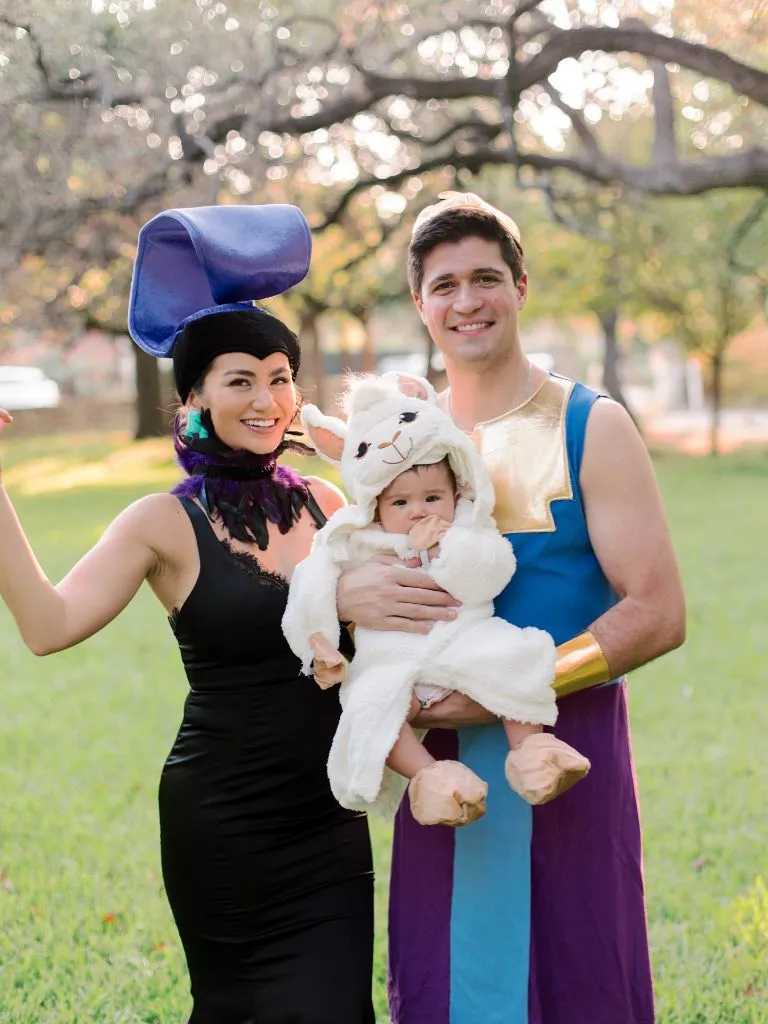
The llama suit for the baby is widely available as a plush onesie and is one of the coziest costume options for infants, doubling as outerwear on cold October evenings. The Yzma headpiece is the make-or-break element of this costume — without it, the character loses its most recognizable feature. If constructing it from scratch feels daunting, search for cosplay tutorials that use upholstery foam as a base, which can be carved, shaped, and covered in purple fabric with relative ease. The feather choker and dangling earrings are small accessories that add significant character specificity. Kronk’s costume requires the least effort: a blue dress or tunic, a gold fabric panel on the chest, and a belt.
This grouping illustrates the value of choosing a less-common reference. At any given Halloween event, there will be dozens of Elsas and several Buzz Lightyears, but there will almost certainly be zero Yzmas. Rarity creates memorability. When everyone at the party asks “Who are you?” and you have a good answer, the costume has done its job twice — once visually and once conversationally. For families who enjoy the theatrical side of Halloween, obscure-but-recognizable characters offer the highest return on creative investment.
Jurassic Park Explorers With Velociraptor Kids
Jurassic Park family costumes separate cleanly into two groups: the humans who work at the park and the dinosaurs who escape from it. This family executes both roles with conviction. The adults wear park ranger and scientist costumes — khaki shorts, a pink knotted shirt, a blue button-down with a Jurassic Park logo badge, a red bandana — while the children dress as a velociraptor in a detailed scale-print bodysuit and a baby dinosaur in a brown onesie with clawed feet. The porch setting with cornstalks and pumpkins adds autumnal texture behind the tropical-adventure costumes.
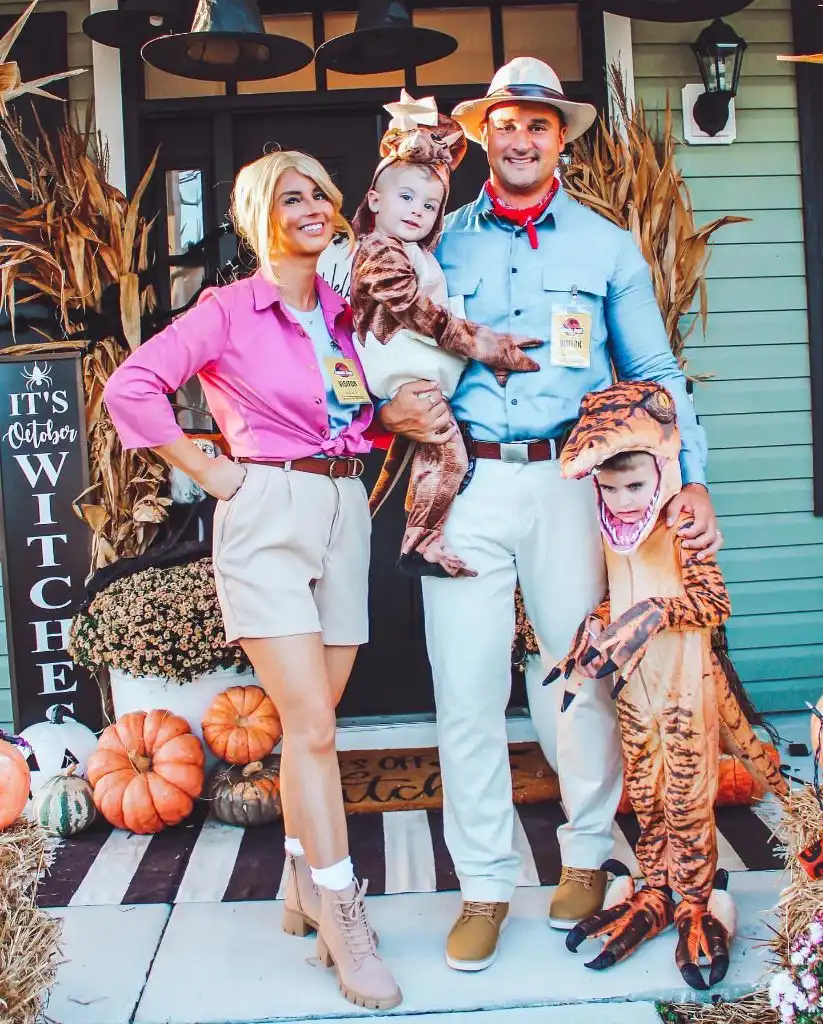
The adult costumes here are assembled entirely from regular clothing — the only costume-specific elements are the Jurassic Park logo badges, which can be printed on adhesive paper and stuck to a shirt. This makes the explorer half of the look one of the most affordable and comfortable options for parents who will be walking for hours. The velociraptor suit for the older child is a full-body printed costume with a hood and clawed gloves, available from major costume retailers. The baby’s dinosaur onesie is a standard infant Halloween purchase. For the adults, committing to character-appropriate shoes — boots for both — sells the explorer aesthetic more effectively than any single garment.
The Jurassic Park concept taps into the same predator-prey dynamic as the dinosaur explorer grouping discussed earlier, but with the added specificity of a beloved film franchise. The logo badges, the knotted shirt, and the khaki palette all reference specific characters from the 1993 film, which means the costumes communicate on two levels: as a generic adventure theme to casual observers, and as a precise movie reference to fans. Dual-layer legibility like this is a hallmark of the strongest group costume concepts.
The Flintstones as a Family of Three
A family of three has a natural Flintstones casting: Fred, Wilma, and baby Pebbles. The father wears the iconic orange-and-black animal-print tunic with a blue tie, the mother wears a single-shoulder white dress with oversized pearl necklace and bracelets, and the baby is in a green top with a black headband and a bone-shaped hair accessory. The costumes are structurally simple — two tunics and a baby outfit — but the character recognition is immediate because the Flintstones’ designs are so visually distinct. Flip-flops instead of shoes reinforce the prehistoric theme while keeping everyone comfortable.
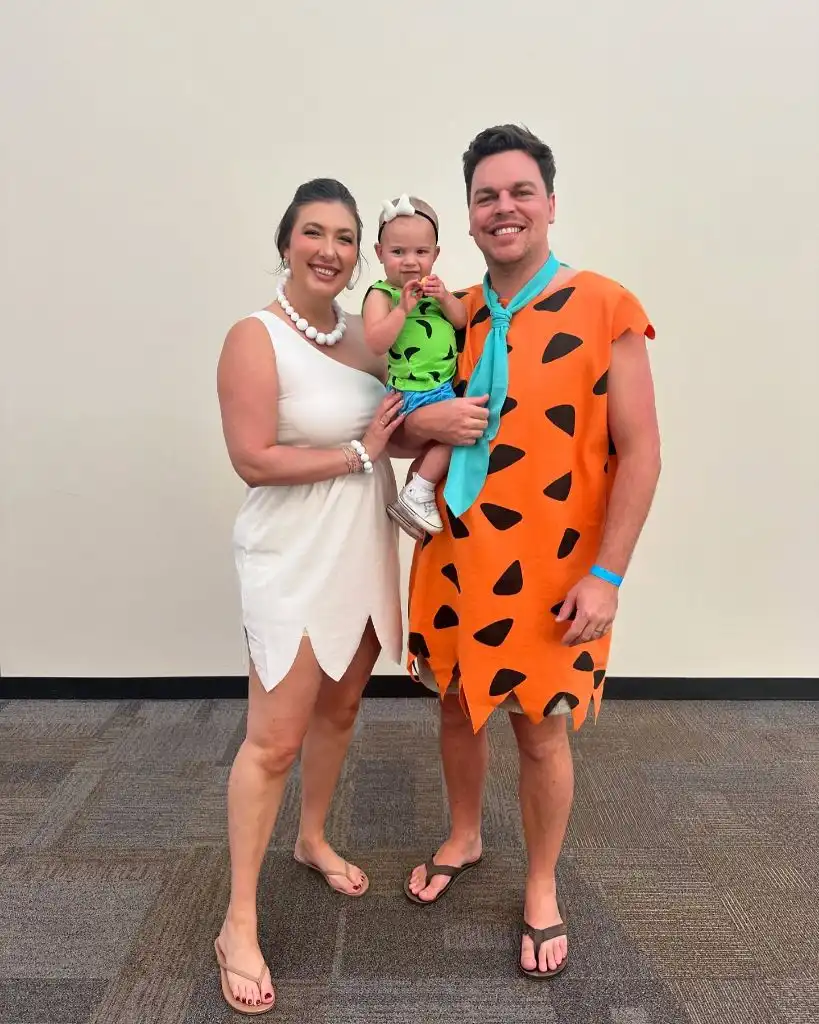
Fred’s tunic can be made from orange felt or fleece with black triangle patches sewn or glued on — a half-hour project at most. The blue tie is a piece of blue fabric draped and pinned. Wilma’s dress is a white sheet or white fabric draped and belted, with a jagged hemline cut for the prehistoric look. The pearls should be large — think craft store wooden beads painted white and strung on twine — because proportion sells the cartoon aesthetic. Pebbles needs only a green onesie and a headband with a small bone shape attached, which can be cut from white felt and stuffed lightly with cotton.
The Flintstones work because the character designs are caricatures, and caricatures translate easily to fabric. The exaggerated pearl necklace, the oversized tie, the improbable animal print — all of these elements are bold enough to read across a room or across a street. Cartoon-based family costumes generally outperform live-action-based ones in terms of instant recognition, because the original designs were built for clarity. When considering family Halloween costumes for 2026, cartoons and animated properties offer a reliable path to legibility.
Toy Story Core Four With Baby Alien
Toy Story appears twice in this collection because it genuinely supports multiple family configurations without repetition. This smaller family version features the mother as Jessie in her cow-print chaps and red cowgirl hat, the father as Woody with his yellow plaid shirt and brown vest, the daughter as a Buzz Lightyear dress variant, and the baby as a Little Green Alien in a blue-and-green plush suit. The front porch with pumpkins and fall wreaths provides a warm backdrop that grounds the bright costume colors.
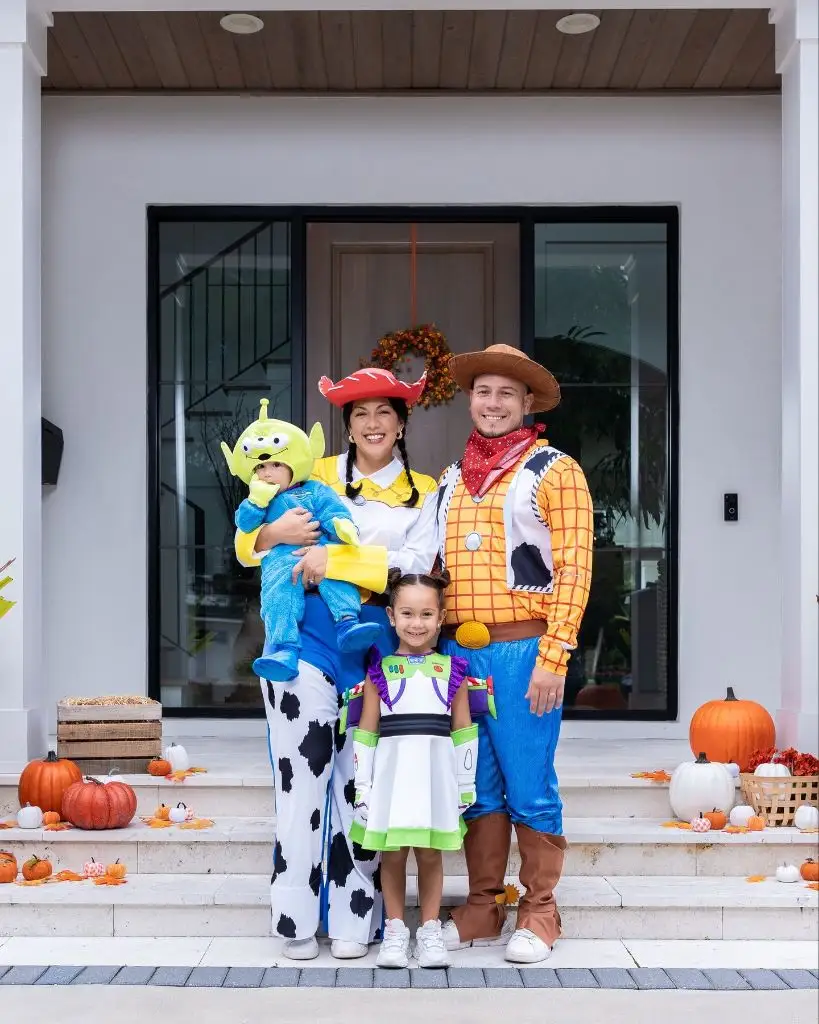
The Jessie costume is recognizable from three elements: the cow-print, the red hat, and the yarn-style braid. The cow-print can appear as chaps, pants, or even just boot covers — any placement works because the pattern is so specific to the character. Woody similarly needs only the plaid shirt, vest, and cowboy hat to land. The Buzz Lightyear dress for the daughter is a creative adaptation that translates the character’s space suit into a children’s dress with the same color blocking — purple, green, and white — which proves that costumes do not need to replicate source material exactly to be recognizable. The baby’s Alien suit is a plush hood-and-body outfit that keeps an infant warm and looks adorable in photographs.
Toy Story is worth revisiting as a family costume option because it solves a problem that many franchises create: it offers characters for every age and every level of costume enthusiasm. Woody and Jessie are easy and comfortable for adults. Buzz Lightyear is exciting for children who want something bold. The Alien is perfect for babies and toddlers who need something soft and simple. This kind of distributed difficulty — some costumes easy, some costumes involved — is the mark of a franchise that translates well to family costuming.
Lilo and Stitch at the Pumpkin Patch
Lilo and Stitch costumes work for families of three because the casting is self-evident: two adults split Stitch and Lilo, and the baby wears a miniature Stitch suit. The adult Stitch wears a blue plush onesie with oversized ear details and leans into physical comedy by kissing the Lilo-dressed partner, who wears a red Hawaiian-print dress and a green leaf crown. The baby Stitch sits on Lilo’s lap in a smaller version of the same blue suit, creating a visual echo between the two Stitch costumes that adds playful repetition. The pumpkin patch setting, with hay bales and oversized gourds, is a classic October photo location that enhances the seasonal feeling.
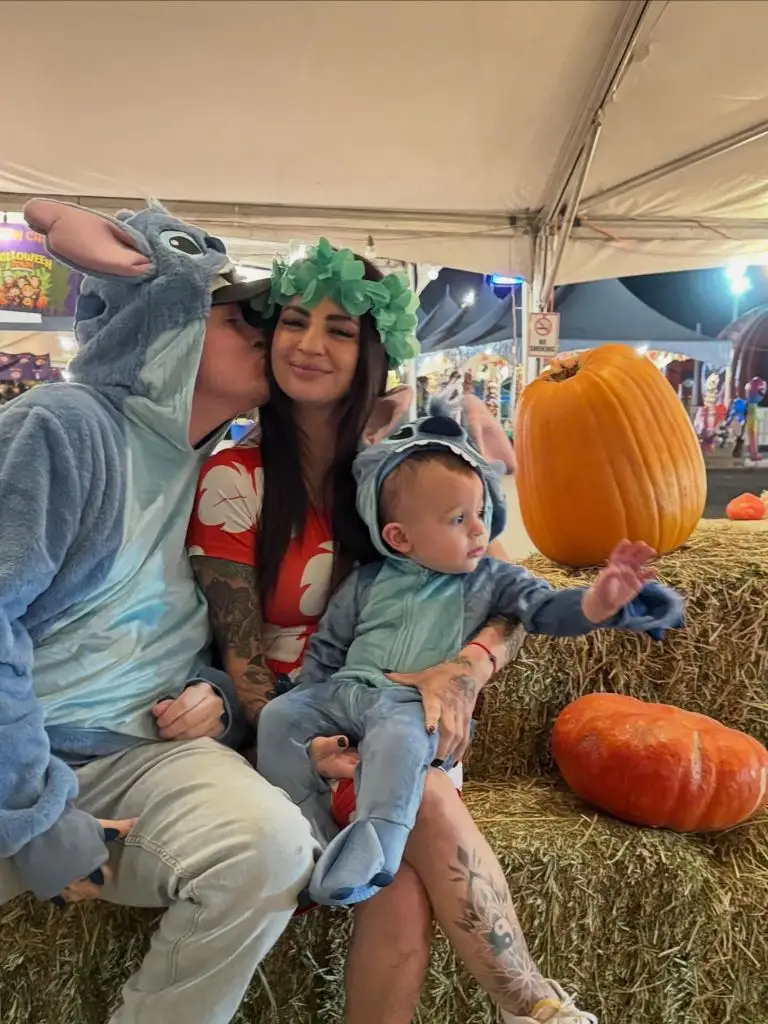
The Lilo costume is one of the simplest adult costumes in any Disney family grouping: a red muumuu-style dress with a white floral print, available at many retailers or easily sewn from a single pattern. The leaf crown can be assembled from craft store faux leaves and a headband. The Stitch onesie for the adult is a loungewear piece that many Disney fans already own, which makes this costume functionally free for some families. The baby Stitch suit should be plush-lined for comfort and warmth, especially at outdoor evening events where temperatures drop. If the baby resists the hood, the costume still reads correctly from the body color alone.
The emotional core of Lilo and Stitch — the concept of “ohana,” or chosen family — gives this costume a layer of meaning that purely aesthetic groupings lack. When a family dresses as these characters, they are not just referencing a film; they are making a statement about belonging and togetherness. This kind of thematic resonance is difficult to engineer deliberately but easy to access when the source material already carries it. For families who want their costume to feel personal rather than performative, choosing a franchise with emotional significance to the family adds a dimension that no amount of crafting can replicate.
Pirate Family With a Baby Parrot
Pirates offer one of the most flexible costume frameworks because the aesthetic is broadly defined rather than character-specific. No one needs to be a particular pirate — just a pirate. This family dresses both adults in pirate-adjacent clothing: brown pants, white billowy shirts, vests, boots, and leather accessories. The baby, held by one parent, wears a rainbow-feathered tutu and a red headband, serving as the parrot perched on a pirate’s arm. The concept is simple, the execution is warm, and the baby’s costume is the clear centerpiece despite being the smallest element in the frame.
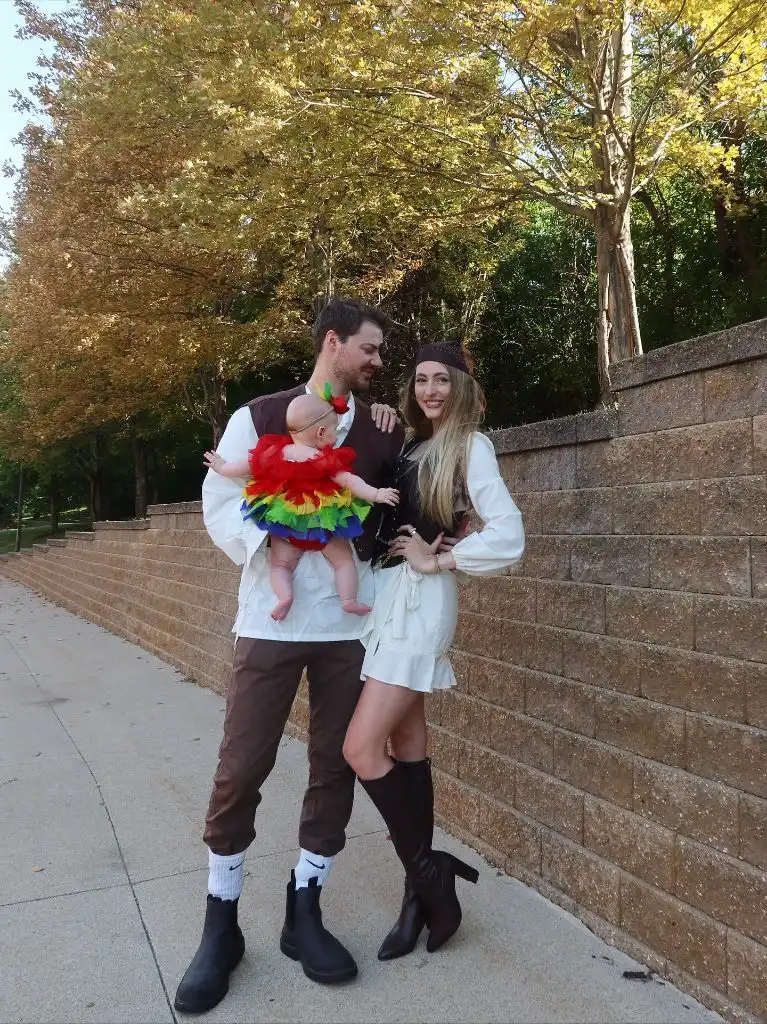
The pirate outfit for adults can be assembled almost entirely from existing wardrobes. A white button-down with rolled sleeves, a dark vest, brown or black boots, and a bandana or tricorn hat is sufficient. Add a toy sword or a sash and the silhouette is complete. The baby parrot costume is the creative heart of this grouping: a rainbow tutu made from strips of colored tulle tied to an elastic waistband, paired with a red or green onesie underneath. The feathered effect can be enhanced with craft feathers hot-glued to the tulle, though the color alone is often enough. The headband with a small feather serves as the finishing detail.
Pirates work as family costumes because the concept is archetypal rather than referential. You do not need to have seen a specific film or read a specific book to understand “pirate family with a parrot.” This universality means the costume communicates to every audience — toddlers at a trunk-or-treat, teenagers handing out candy, and grandparents watching from the porch. When in doubt about whether a costume concept is too niche, ask whether it requires source knowledge to understand. If it does not, it will work in every context Halloween presents.