A cabin weekend is a wardrobe stress test: freezing mornings on the porch, overheated afternoons by the fire, muddy trails, and a dinner that somehow needs to look pulled-together from the same small suitcase. The outfits that survive are rarely the most fashionable in isolation — they are the ones built on a system. Insulating base, textural middle, weather-proof outer, and footwear that handles gravel without complaint. The 24 ideas below treat cabin dressing as an engineering problem with aesthetic consequences, balancing warmth, packability, and the kind of visual interest that reads well against wood paneling and snow. For the broader cold-weather foundation these outfits draw from, our Winter Fashion for Women guide maps the seasonal essentials.
What distinguishes 2027’s cabin aesthetic from earlier cozy-core waves is restraint. Instead of piling on every soft thing at once, the strongest looks pick one hero texture — cable knit, corduroy, flannel, faux fur — and let the rest of the outfit stay quiet. Color follows the landscape: bark brown, pine green, stone gray, with the occasional deliberate jolt of plum or lilac. Quilted outerwear has also gotten sharper, cut closer to the body in colors that photograph well against snow. Related reading: Trendy Down Jackets 2027 breaks down the insulated silhouettes worth packing.
1. Contrast Soft With Sleek: Cream Cable-Knit Sweater, Chocolate Satin Skirt, and Ankle Boots
The friction between a heavy cable knit and liquid satin is what makes this outfit work. A cream cable-knit sweater, thick enough to stand away from the body, sits over a chocolate satin midi skirt that moves every time you do. Brown ankle boots ground the softness with structure, while a camel shoulder bag and small gold hoops keep the accessories in the same warm-neutral family. Nothing here is precious — the knit is a workhorse, the satin is the surprise — and that imbalance is exactly the point.
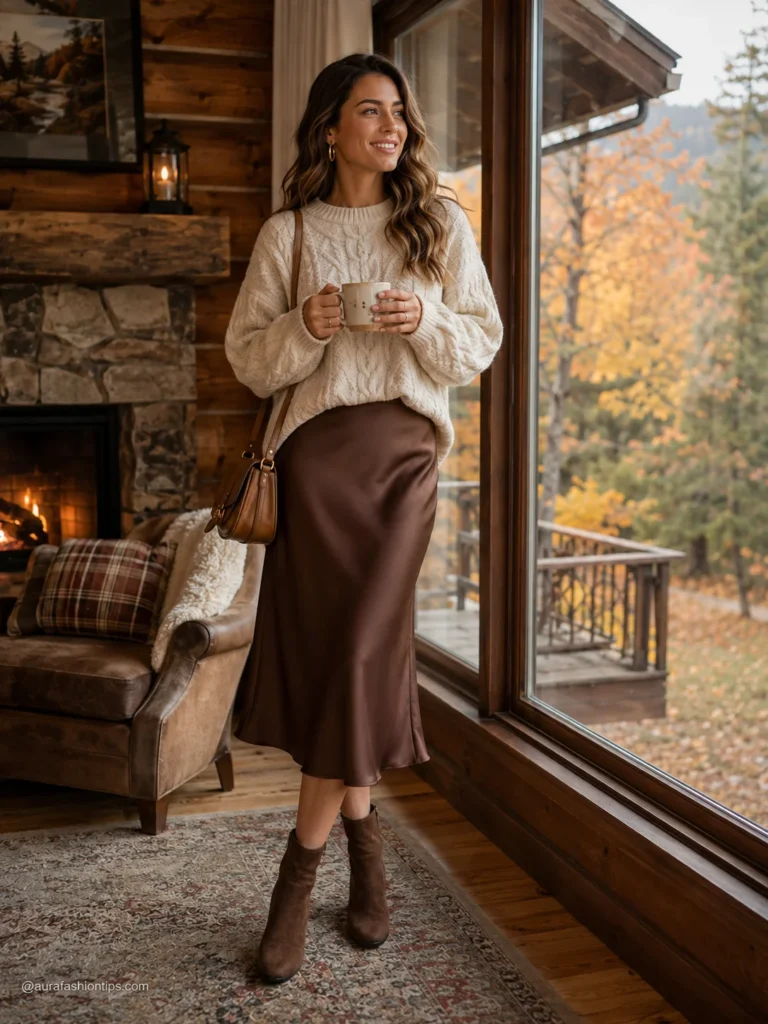
Photo via aurafashiontips.com
The styling principle is texture opposition: matte against sheen, heavy against fluid. Keeping both pieces in the cream-to-chocolate range means the contrast reads as intentional rather than clashing, and the tonal palette flatters the warm wood tones of a cabin interior. The skirt’s midi length is doing practical work too — more coverage than a mini, less bulk than a maxi, and it layers cleanly over fleece tights when the temperature drops.
This is a fireplace-dinner outfit, built for golden-hour photos with a warm drink in hand. In genuine cold, the satin needs thermal tights underneath and the ankle boots want thick socks; the sweater carries most of the warmth duty. It packs flat and the skirt barely wrinkles, which makes it one of the smarter “dressed-up” options for a two-night trip.
2. Let Burgundy Do the Talking: Cardigan, Ivory Tee, Dark Denim, and Tan Boots
Burgundy is doing the seasonal signaling here so nothing else has to. A button-front cardigan in deep wine red opens over a fitted ivory tee, with dark straight-leg jeans and tan ankle boots completing a formula that is almost aggressively simple. A small crossbody bag keeps the hands free for coffee cups and trail maps. The cardigan’s buttons matter: worn open it reads relaxed, buttoned to the top over the tee it reads tidy, which gives one garment two jobs across the weekend.
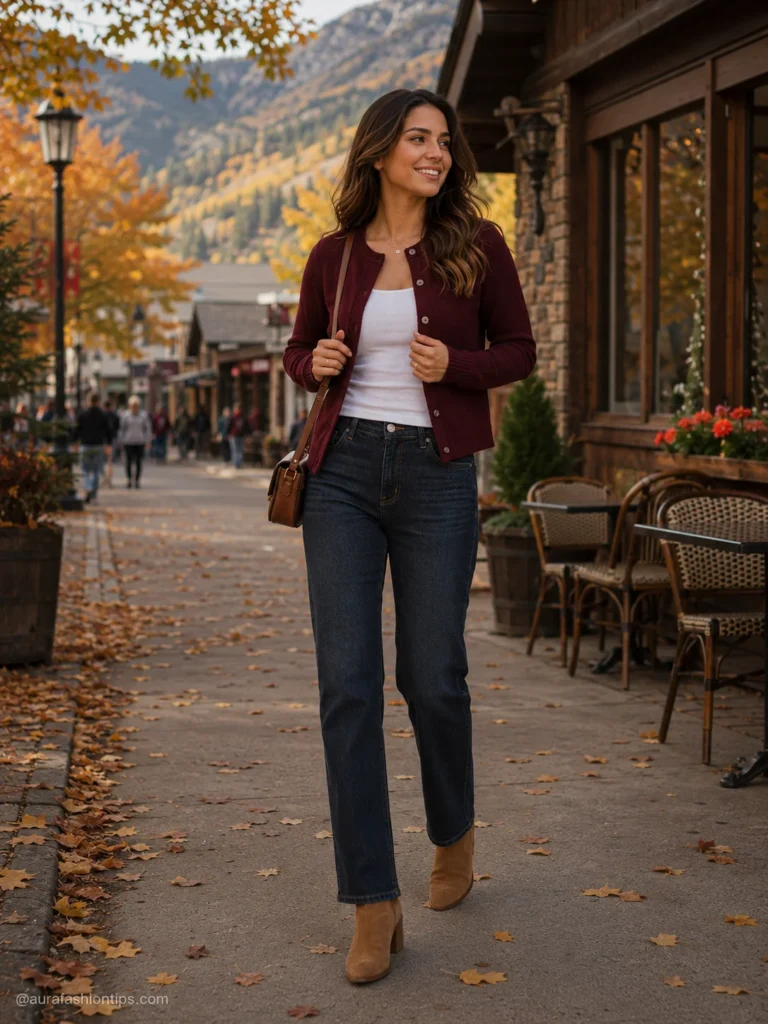
Photo via aurafashiontips.com
The cardigan functions as the removable middle layer, which is the correct architecture for cabin days that swing twenty degrees between morning and afternoon. Dark denim keeps the lower half visually quiet and hides the inevitable scuffs of cabin life better than light wash. Tan boots warm up the palette and echo the bag, so the whole outfit stays inside one autumnal color story. For more on building outfits around removable layers, Layered Fall Looks maps the same logic across a full season.
Wear this into town for breakfast, a mountain café, or a casual afternoon of exploring. The cardigan alone is not enough for real cold — plan a coat over it — but as an indoor-to-mild-outdoor outfit it is hard to beat. The jeans need no ironing, the boots handle uneven ground, and the burgundy photographs beautifully against pine green backgrounds.
3. One Dress, Zero Decisions: Dusty Rose Sweater Dress With Knee Boots and a Beige Coat
Some weekends you do not want to think in separates, and a ribbed sweater dress in dusty rose solves the entire equation in one piece. The ribbing adds vertical structure so the knit does not read as shapeless, taupe knee-high boots cover the leg warmth problem, and a long beige coat finishes the silhouette for anything outdoors. A mini handbag and a delicate necklace are the only accessories needed — the dress’s soft color is already the statement.
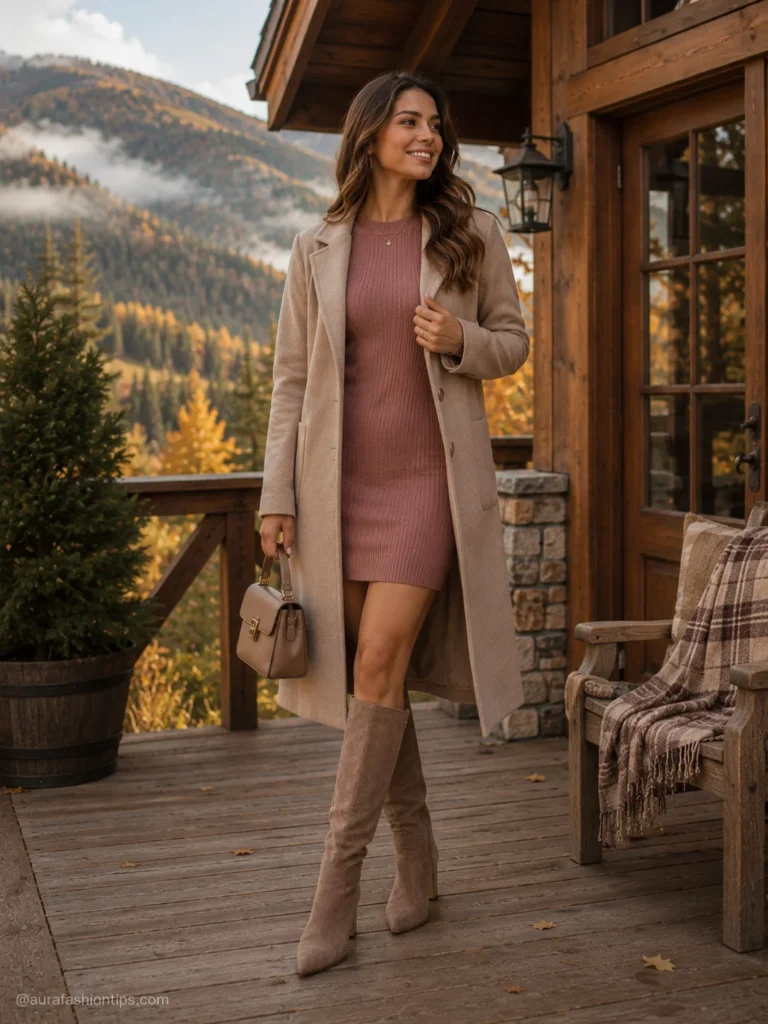
Photo via aurafashiontips.com
Dusty rose works here because it is desaturated enough to behave like a neutral — it pairs with taupe, beige, and cream without competing. The knee boots are non-negotiable for warmth; a sweater dress with bare legs and ankle boots is a fall-city formula, not a cabin one. The long coat extends the column of the dress, which keeps the proportions long even under bulk. You’ll find the same spirit in Elegant Winter Outfits for Women, where single-piece dressing gets the same considered treatment.
This is the romantic-weekend pick: dinner at the lodge restaurant, an evening stroll, photos in falling snow. A wool-blend dress holds heat far better than cotton knit, and opaque tights under the boots close the last gap. Pack it folded, not rolled, to protect the ribbing.
4. Work the Earth Tones: Forest Green Mock-Neck, Cream Corduroys, and Chelsea Boots
Forest green and cream is a combination that never has to try. A mock-neck sweater in deep pine green anchors the top half, while cream corduroy pants bring a soft, brushed texture that catches light differently than denim. Brown Chelsea boots and a small leather bag finish a look that feels rooted and calm. A tan belt defines the waist where the sweater meets the corduroy, a small detail that keeps the earthy palette from going shapeless.
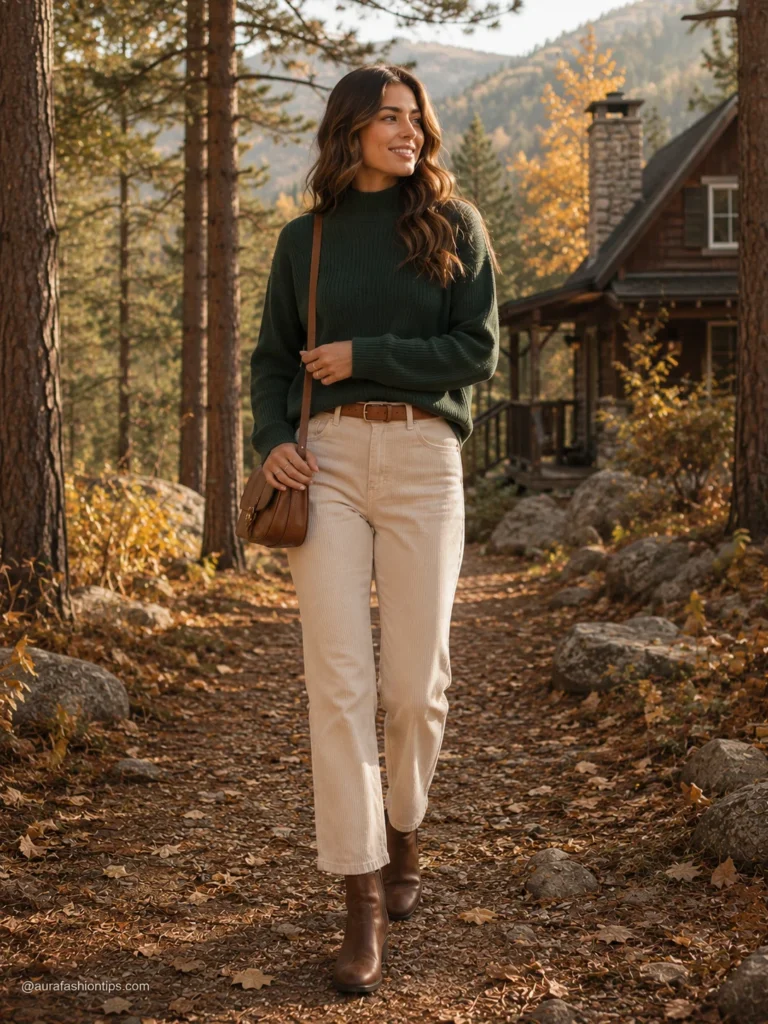
Photo via aurafashiontips.com
Corduroy is the underused cabin fabric: warmer than denim, more structured than leggings, and its ridged surface adds visual depth without pattern. The mock neck — lower commitment than a full turtleneck — frames the face and holds warmth at the collar where heat escapes. Green against cream is a high-contrast pairing in value but not in temperature, so the outfit feels vivid without feeling loud.
Best for daytime plans: cabin breakfast, nature walks, sightseeing in a mountain town. Corduroy resists wind better than most pants fabrics, and Chelsea boots slip on fast for porch coffee runs. Cream pants will show dirt, so this is the fair-weather day-trip outfit rather than the hiking one.
5. Lighten the Palette: Powder Blue Oversized Knit With White Denim and Suede Boots
Not every cabin outfit has to be brown. A powder-blue oversized knit brings a cool, airy note to the mountain setting, paired with white straight-leg jeans for a clean structural base. Beige suede boots and a cream scarf keep the warmth literal and tonal, while gold stud earrings add a small glint. The oversized cut is deliberate — it drapes rather than clings, which reads relaxed without reading sloppy.
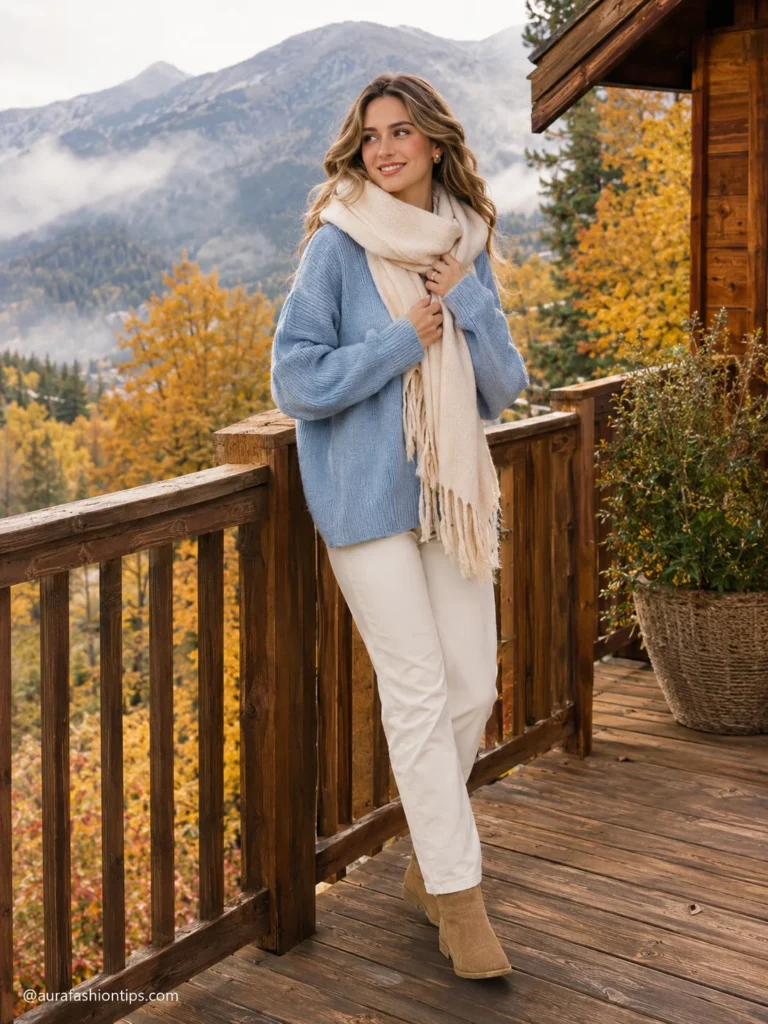
Photo via aurafashiontips.com
Powder blue against snow and pale sky is a tonal strategy: instead of contrasting the landscape, the outfit harmonizes with it. The oversized knit traps warm air around the torso, which is genuine insulation, not just a look. White denim in winter works when the wash is crisp and the cut is straight — skinny white jeans read summery, straight-leg reads architectural. The cream scarf closes the neck gap that oversized knits always leave.
This suits crisp, bright mornings: coffee on the deck, scenic walks, cabin photos where the light is doing the work. White denim is a fair-weather choice — save it for days without mud — and the suede boots want a weatherproofing spray before the trip.
6. Go Retro-Warm: Rust Fitted Sweater With Black Flare Knit Pants
Rust is autumn’s loudest warm neutral, and a fitted rust sweater lets it speak clearly. The fitted top balances black flare knit pants, a silhouette with a seventies echo that stays comfortable because the pants are knit, not denim. Black ankle boots extend the leg line, a tan belt breaks the dark lower half, and a structured shoulder bag adds polish without formality. The whole look has a retro current without tipping into costume.
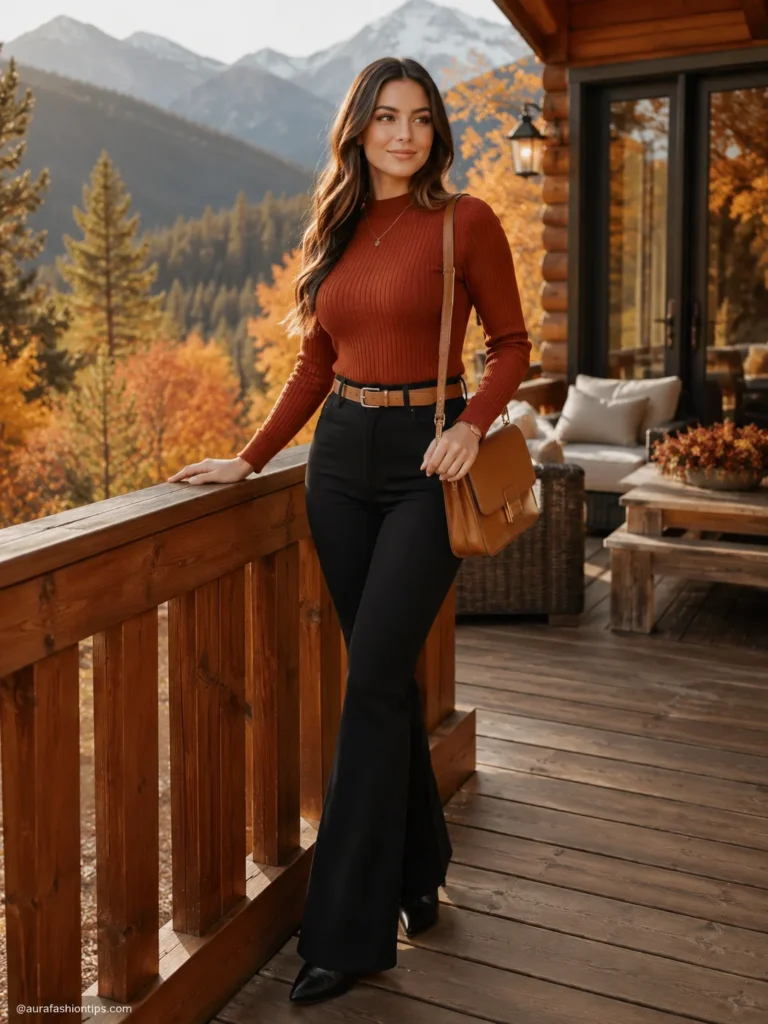
Photo via aurafashiontips.com
The fitted-on-top, flared-on-bottom proportion is doing the classic work of balancing volume, and it flatters because the eye travels the full length of the flare. Rust against black is a warm-cool contrast that feels seasonal without any plaid or pumpkin clichés. Knit flare pants are the stealth cabin MVP: they look like trousers in photos and feel like loungewear everywhere else. A companion piece, Classic Old Money Winter Outfits, explores the same rich-autumn palette with a more tailored hand.
Wear it for dinner, a wine night by the fire, or any evening plan where jeans feel too casual. The knit pants handle sitting cross-legged on cabin floors better than any tailored trouser. In deep cold, thermal leggings disappear underneath the flare without changing the line.
7. Preppy Cabin Uniform: Ivory Half-Zip, Plaid Mini Skirt, Tights, and Riding Boots
The ivory half-zip sweater is the quiet anchor that lets the plaid mini skirt be the personality. A brown-and-beige check in a classic scale keeps the pattern heritage rather than trendy, black tights make the short skirt viable in real cold, and riding boots add the equestrian polish that plaid always invites. A brown crossbody keeps the accessories matched to the skirt’s darkest tone.
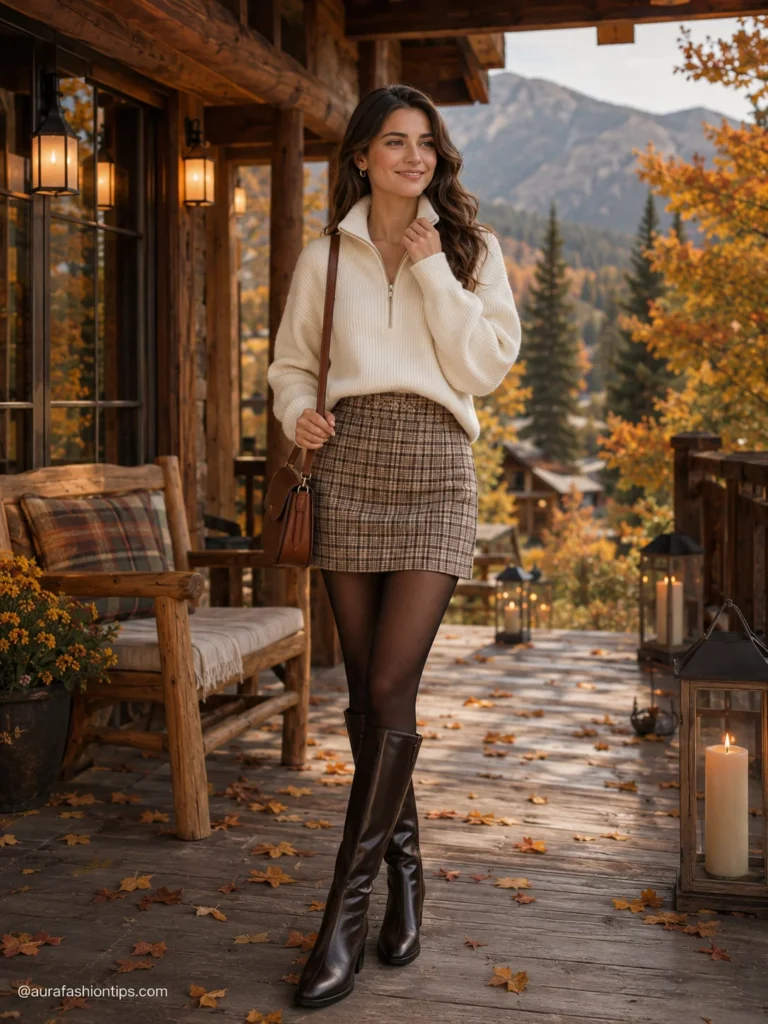
Photo via aurafashiontips.com
The half-zip is a smarter collar than a crewneck for cabin temperature swings — zipped up it seals the neck, zipped down it vents. Plaid at a medium scale reads preppy; too large and it goes lumberjack, too small and it goes school uniform. Black tights are doing thermal work that matters: a mini skirt without them is a fair-weather garment, with fleece-lined tights it becomes a winter one.
This is the cute-brunch outfit: cabin café mornings, fall photos, weekend exploring where the walking is light. Riding boots handle gravel paths better than their polished look suggests. If the wind picks up, the skirt’s weight matters — a lined plaid holds its line where a flimsy one flies.
8. Color as the Accessory: Plum Ribbed Sweater, Wide-Leg Jeans, and a Camel Coat
Plum is the entire accessory strategy here — one saturated color doing the work that jewelry and bags usually do. A fitted ribbed plum sweater tucks into medium-wash wide-leg jeans, cream sneakers keep the footwear easy, and a camel wool coat thrown over the top adds the long layer that makes everything look considered. A small shoulder bag stays out of the color story’s way.
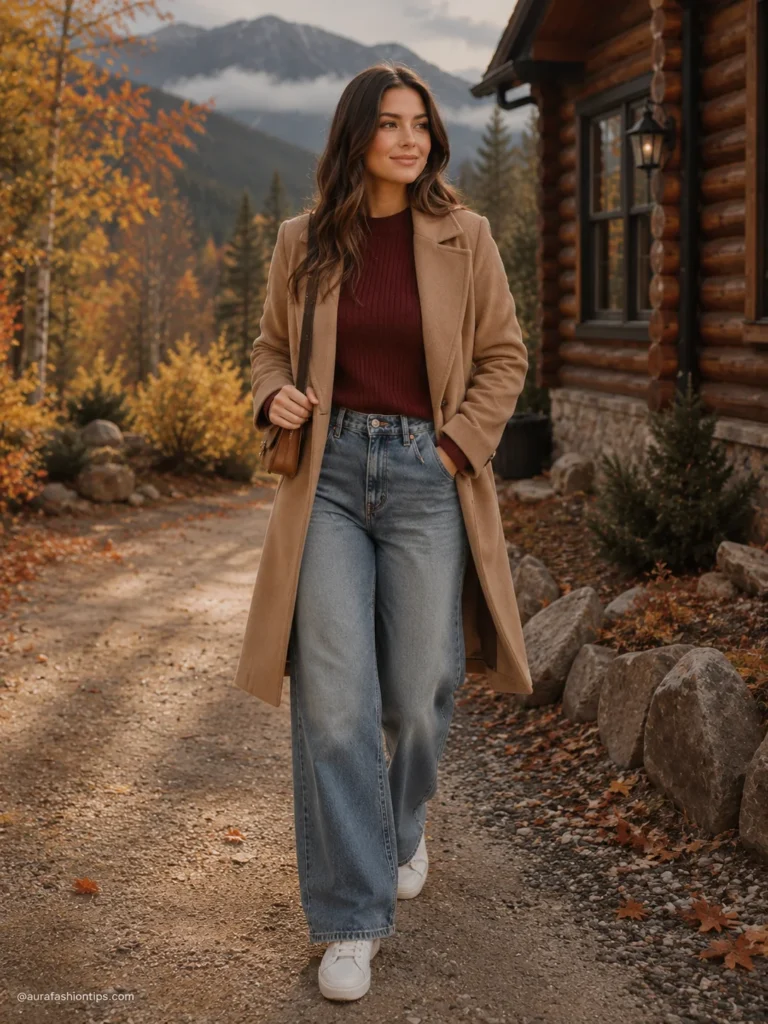
Photo via aurafashiontips.com
The fitted ribbed top against wide-leg denim is the essential volume equation: shape on top, drape below. Plum sits between red and purple, which makes it read as seasonal without the obviousness of burgundy — it is the less-expected jewel tone. The camel coat is the classic third piece that converts a jeans outfit into a planned one; its warm tan bridges the cool plum and the blue denim so the palette coheres.
Built for days with real walking: sightseeing, coffee dates, casual outings where sneakers are non-negotiable. The coat handles the cold the sweater cannot, and the whole outfit layers without bulk. Cream sneakers will show trail dust, so keep them for town days.
9. Dinner at the Lodge: Camel Turtleneck With a Black Pleated Midi Skirt
A camel turtleneck and a black pleated midi skirt is the cabin equivalent of a dinner suit — soft, covered, and quietly formal. The turtleneck’s fine knit keeps the top sleek, the pleats give the skirt movement that photographs beautifully, black knee boots handle the weather the skirt cannot, and a mini top-handle bag with gold earrings finishes the look with restraint.
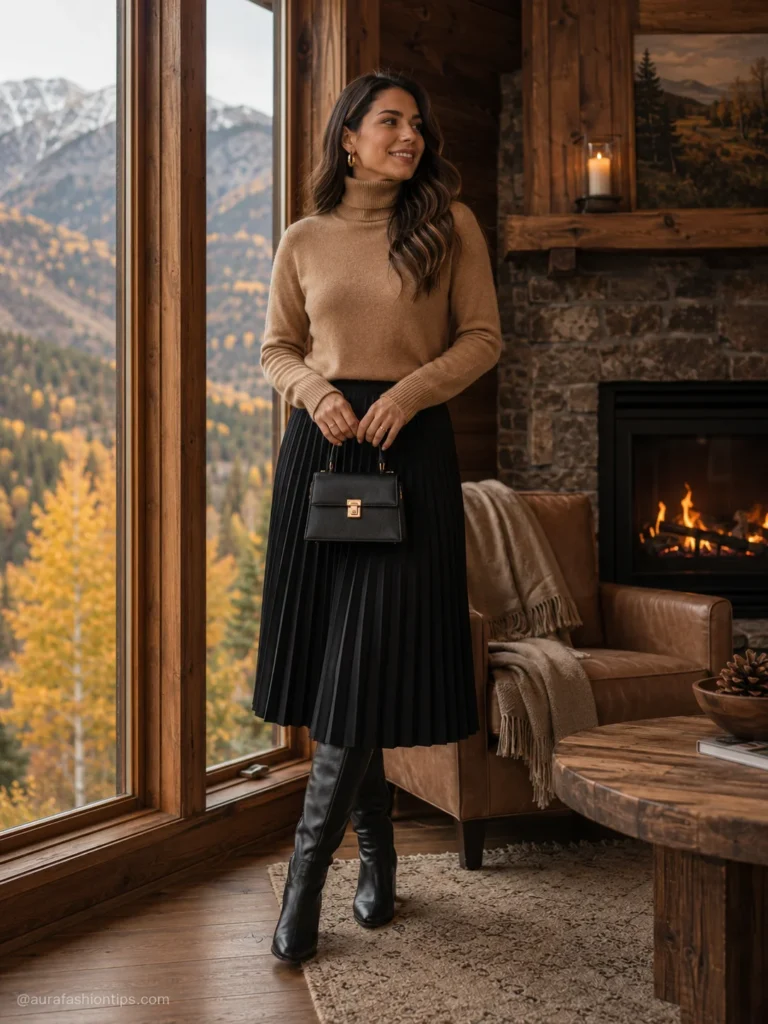
Photo via aurafashiontips.com
Camel and black is one of the highest-contrast neutral pairings available, which is why it reads as dressed-up even in knit fabrics. The pleats are structural: they create vertical lines that lengthen the leg and add dimension that a flat skirt lacks. Knee boots under a midi skirt leave only a sliver of leg exposed, and with opaque tights that sliver disappears entirely — this is how a skirt becomes a genuine winter garment.
Reserve it for the trip’s dressiest evening: a lodge restaurant, a cabin date night, an anniversary dinner in the mountains. The turtleneck provides real neck warmth, the boots handle parking-lot ice, and the whole outfit packs into almost no suitcase space.
10. Playful Outerwear: Lilac Quilted Puffer Over a Gray Knit Set
A matching gray knit set — soft top, soft pants — is the coziest possible base, and the lilac quilted puffer on top is what makes it an outfit instead of loungewear. White sneakers keep it fresh, a cream beanie adds the head warmth the puffer’s collar misses, and a small backpack carries the day. The lilac is the deliberate surprise: a pastel outer layer against winter gray reads playful rather than precious.
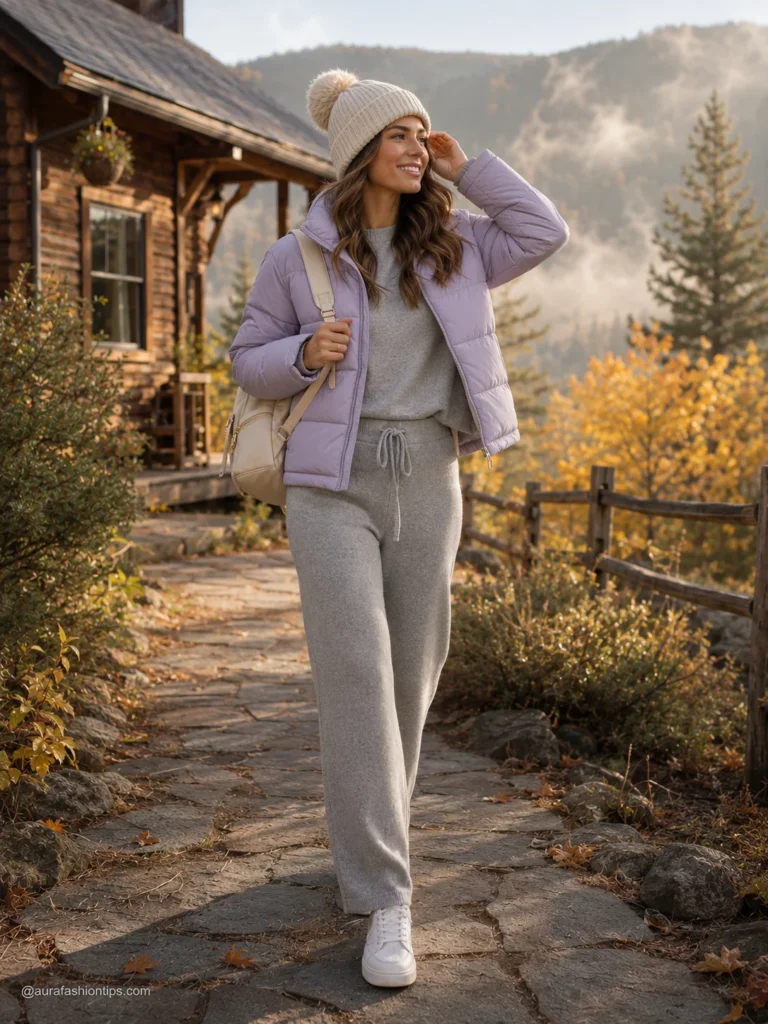
Photo via aurafashiontips.com
The matching knit set is doing the coordination work — two pieces that were designed together always look more intentional than separates. The puffer’s quilting adds a third texture against the knit’s softness, and lilac against gray is a low-contrast pairing that feels modern rather than sweet. A cropped or hip-length puffer keeps the knit set’s silhouette visible instead of swallowing it. For the fuller picture on choosing insulated outerwear in non-neutral colors, Trendy Puffer Jackets 2027 is worth your time.
This is the lazy-morning uniform: coffee runs, slow cabin mornings, quick walks where comfort is the entire brief. The knit set alone is indoor wear; the puffer, beanie, and sneakers are what make it street-legal. In real cold, swap the sneakers for insulated boots and the formula still holds.
11. Trail-Ready Comfort: Sage Chunky Knit, Fleece Leggings, and Hiking Boots
Sage green and chocolate brown is a palette pulled straight from the trailhead. A chunky sage sweater — the kind with visible, honest knitting — goes over dark brown fleece leggings, cream hiking boots handle actual terrain, and a beige beanie with a mini backpack completes the practical picture. Nothing here is decorative; every piece earns its place on a cold morning.
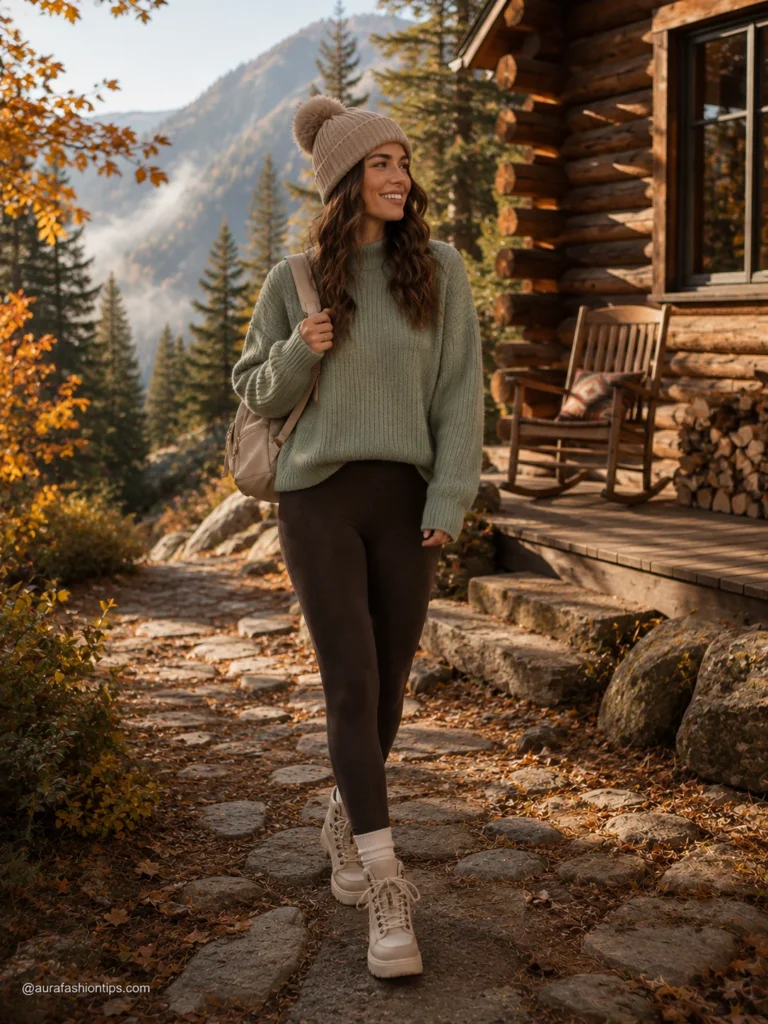
Photo via aurafashiontips.com
The chunky knit is genuine insulation — thick yarn traps more warm air than fine knits — and the sage color keeps it from reading as purely utilitarian. Fleece-lined leggings are the correct legging for winter; standard leggings are an autumn garment pretending otherwise. Cream boots lighten a palette that could go muddy, and the beanie covers the heat loss the chunky collar cannot. This pairs naturally with the ideas in Comfy Winter Outfit Ideas for Women, which builds whole wardrobes on the same comfort-first logic.
Wear it for nature walks, trail mornings, and any day where the plan involves actual distance. The hiking boots need breaking in before the trip — new boots on a mountain path is a blister guarantee. The sweater’s bulk means it travels worn, not packed.
12. Snow-Day Classic: Cropped Chunky Sweater, Wide-Leg Corduroys, and Faux Fur Boots
White sweater, brown corduroys, fur boots, snow on the porch — this is the cabin postcard in outfit form. A cropped chunky white sweater shows just enough waist to keep the wide-leg corduroys from overwhelming the frame, and faux fur boots handle the snow the outfit is clearly standing in. The cream-on-brown palette is warm against a white landscape, which is exactly why it photographs so well.
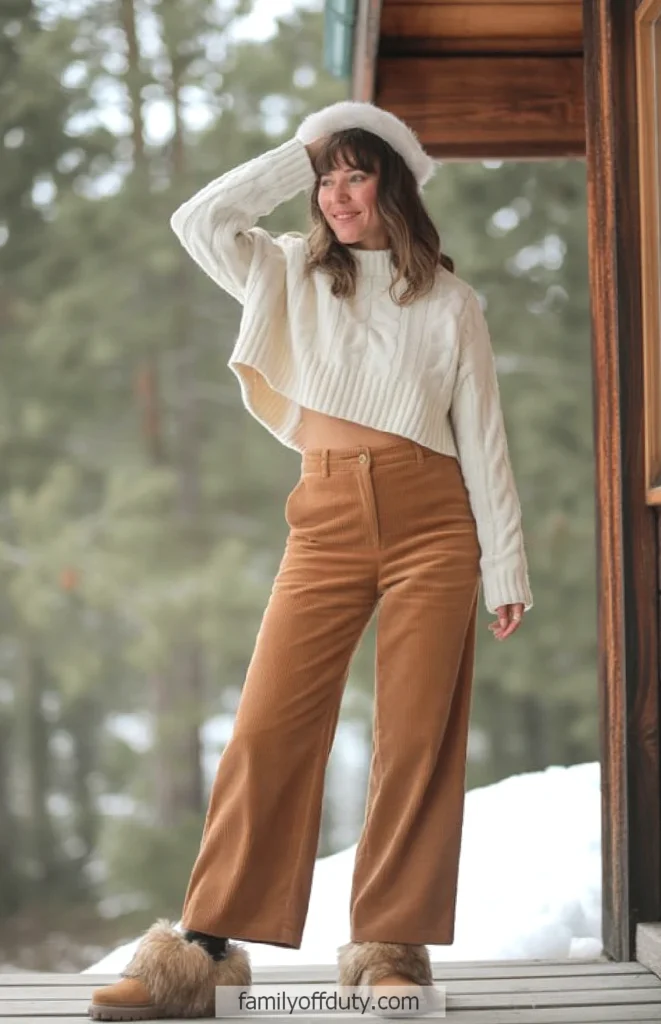
Photo via familyoffduty.com
The cropped length is a proportion tool, not a warmth sacrifice — worn over a thermal base layer, the midriff never sees air. Wide-leg corduroy moves beautifully and its texture reads rich in photos, while the fur boots’ bulk is balanced by the cropped top above. The same logic behind our How to Wear Uggs guide applies here: heavy boots need a defined waist or cropped layer above them to keep the silhouette intentional.
Built for snowy days: porch coffee, snow photos, short walks in real winter weather. The fur boots are the warmth engine — insulated, grippy, and forgiving of slush. The white sweater will show every cocoa spill, so consider this the day-one outfit, not the fireside-lounging one.
13. Belt It and Brave the Cold: Sweater Dress Under a Belted Puffer Coat
A belted puffer coat changes the entire proposition of winter outerwear — cinched at the waist, it reads as a coat with a shape rather than a sleeping bag with sleeves. Worn open over a beige sweater dress with knee-high boots, it handles a snowy mountain setting without surrendering the outfit underneath. The belt is the whole trick: it creates the waist the puffer’s volume erases.
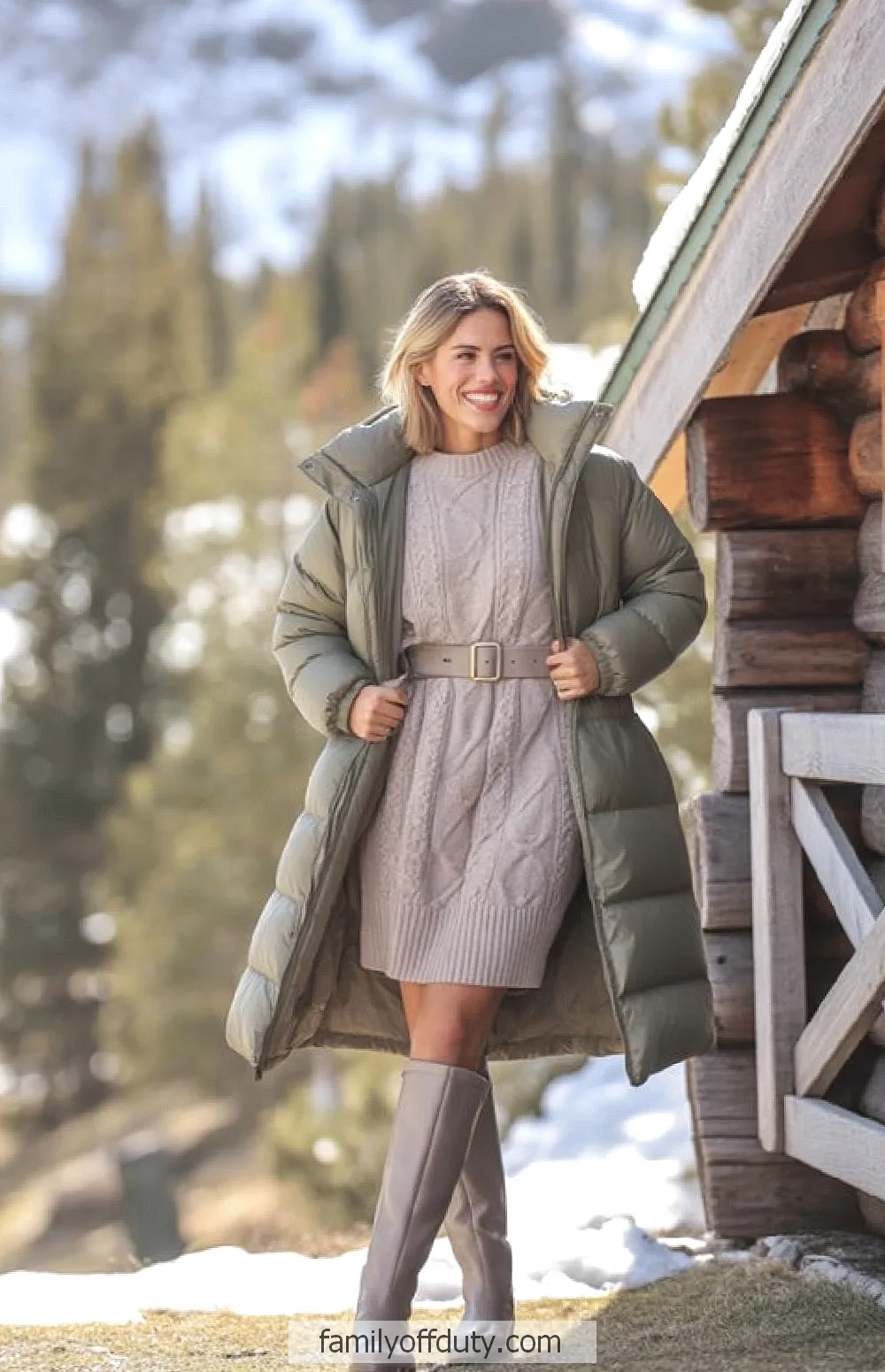
Photo via familyoffduty.com
The belted puffer is 2027’s answer to the shapelessness problem that kept puffers out of dressier contexts. An olive or neutral belted coat over a light dress creates a dark-light contrast that keeps the eye moving, and the knee boots close the warmth gap between hem and coat. The sweater dress underneath needs to be substantial — a fine-gauge dress collapses under a heavy coat, while a chunky ribbed one holds its own. See also our Trendy Coats 2027 for more structured outerwear that works over dresses.
This is the deep-winter dress outfit: snowy excursions, mountain-town dinners, any plan where the temperature says pants but the occasion says otherwise. The puffer does the thermal heavy lifting; the dress just has to look good in the warm moments between. Gloves and a scarf are mandatory — the coat covers the torso, not the extremities.
14. Soft Luxury, Loud Setting: Cashmere Sweater, Pleated Skirt, and Faux Fur Earmuffs
Cashmere against a snowy forest is a study in deliberate contrast — the softest fabric in the harshest setting. A cream cashmere sweater pairs with a pleated skirt, and faux fur earmuffs add both warmth and a focal point at the face. The earmuffs are doing double duty: they protect the ears that a beanie would flatten-hair over, and they add the textural moment the outfit’s clean lines need.
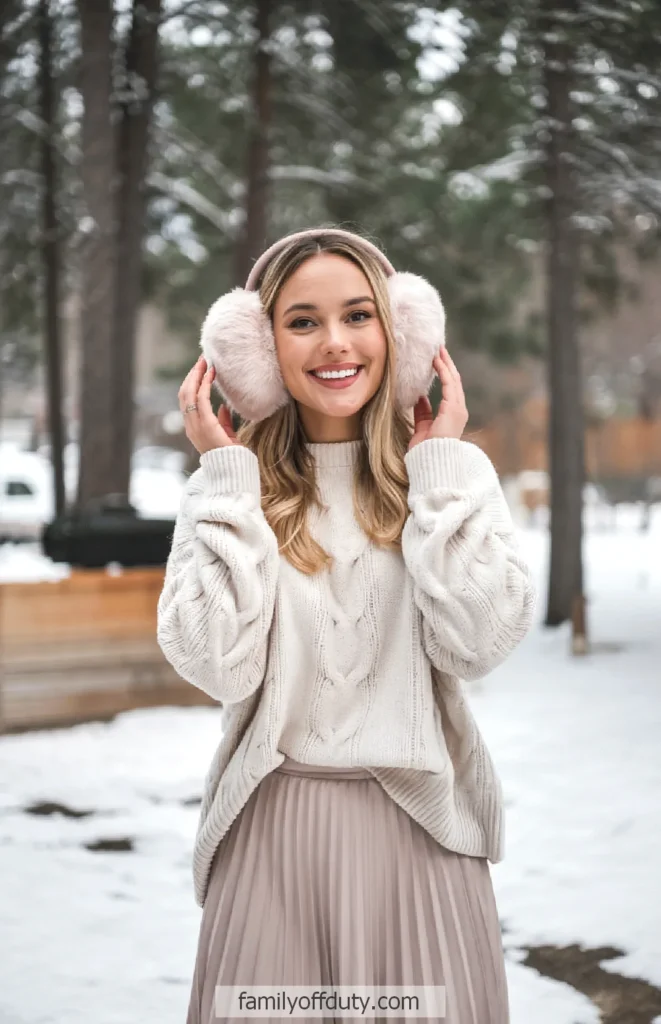
Photo via familyoffduty.com
Cashmere’s value in cold weather is warmth-to-weight: it insulates better per gram than standard wool, which matters when you’re layering under a coat. The pleated skirt’s movement contrasts the sweater’s stillness, and the earmuffs introduce fur texture without the commitment of a fur-trimmed coat. Keeping the palette pale — cream, ivory, soft beige — lets the snowy background complete the picture instead of competing with it. A useful counterpoint lives in Trendy Winter Outfit Ideas for Women, which approaches winter texture from a bolder angle.
Wear it for snowy photo walks and scenic forest paths where the setting is half the outfit. Cashmere hates rough treatment — this is not the firewood-carrying look — and the skirt wants thermal tights underneath for anything below freezing. The earmuffs pack flat, which is more than can be said for most winter headwear.
15. Cloud-Like Warmth: Fluffy Cropped Jacket, Leggings, and a Knit Beanie
A fluffy cropped jacket — teddy, sherpa, or brushed faux fur — over black leggings is the outfit equivalent of a weighted blanket. The cropped cut keeps the volume from swallowing the frame, the leggings keep the lower half streamlined, and a knit beanie finishes the head-to-toe softness. In a snowy mountain landscape, this reads as intentional coziness rather than pajamas-outside, which is a line that depends entirely on the jacket’s quality.
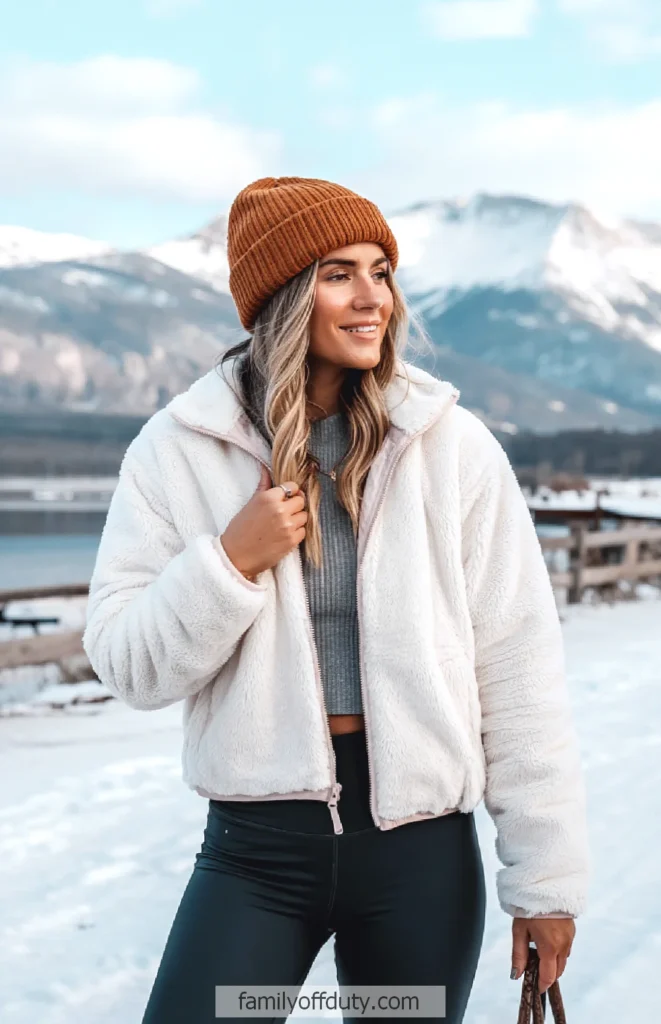
Photo via familyoffduty.com
The cropped length is load-bearing here: a hip-length fluffy jacket over leggings can read shapeless, but cropped shows the waist and restores proportion. Texture is the entire design — fluffy against smooth — so the color palette should stay simple; black leggings and a neutral jacket let the texture be the event. The beanie’s ribbed knit adds a third, finer texture at the top. For more on building outfits around statement faux fur, Faux Fur Jacket Outfit Ideas goes deeper on proportions.
This is the snow-day errand outfit: quick trips into town, sledding-adjacent plans, anything where maximum warmth with minimum fuss is the brief. Fleece-lined leggings are strongly advised — standard leggings under a cropped jacket leave the legs underdressed for real cold. The jacket’s pile will collect snow; shake it off before heading indoors.
16. Heritage Pattern Play: Fair Isle Pullover With a Corduroy Mini Skirt
Few patterns say winter cabin like fair isle, and a traditional yoke-patterned pullover carries the whole nostalgic weight of the genre. Paired with a corduroy mini skirt and lace-up boots, with a knit hat for good measure, it lands squarely in heritage territory without feeling like a costume. The snowy forest behind it is practically a requirement — this outfit was designed by and for that backdrop.
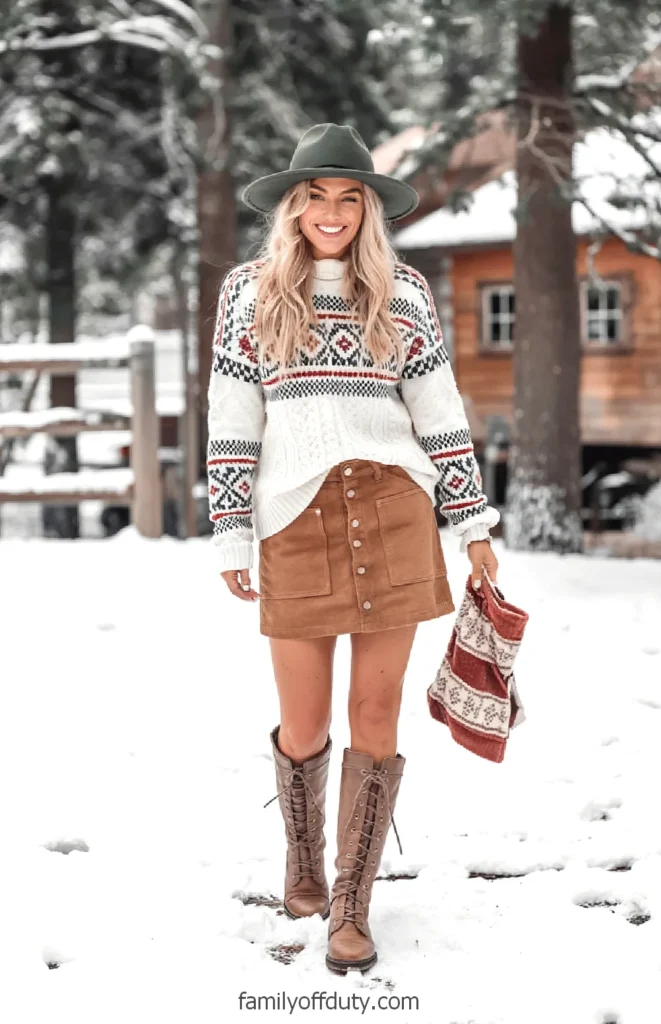
Photo via familyoffduty.com
Fair isle’s geometry does the visual work, so everything else should stay solid — the corduroy mini in a deep tone, the boots in brown or black, the hat in a color pulled from the pattern. Corduroy against the sweater’s stranded knitting gives two heritage textures in conversation, and the lace-up boots’ ruggedness keeps the sweetness of the pattern in check. If this palette appeals to you, Aesthetic Winter Outfits for Women explores pattern-led winter dressing with a similar eye.
Built for the classic cabin photo day: snowy trails, pine forests, the holiday-card shot. The mini skirt needs fleece tights — non-negotiable — and the boots should have real tread, because heritage style should not mean slipping on ice. Wool-blend fair isle holds warmth far better than acrylic versions.
17. Shacket Season: Plaid Overshirt, Knit Crop Top, and High-Waisted Wide-Legs
The shacket — shirt-jacket hybrid — is the cabin layering piece that refuses to retire, and worn open over a knit crop top with high-waisted wide-leg pants, it hits the current proportion perfectly. The plaid brings the pattern, the wide-legs bring the drape, and the cropped knit underneath keeps a defined waist in the equation. Outside a wooden cabin, this is the uniform of someone who packed correctly.
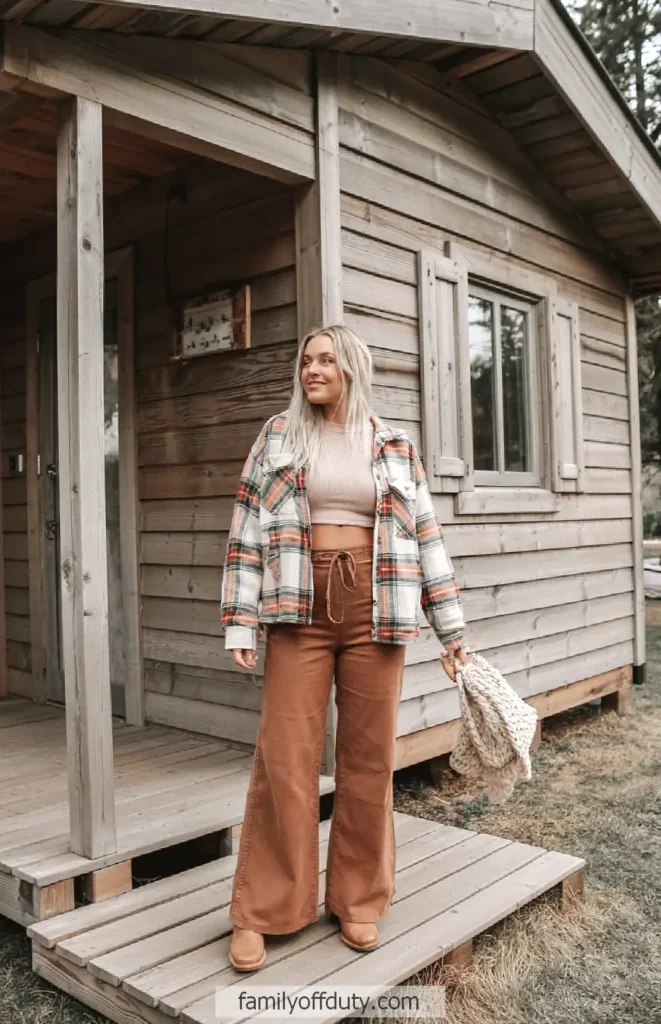
Photo via familyoffduty.com
The shacket works because it occupies the exact middle ground between shirt and coat — structured enough to be outerwear, soft enough to be comfortable. Worn open, its vertical lines lengthen the torso; the high waist of the wide-legs meets the cropped top at the natural waist, so no midriff is actually exposed to cold air. Brown pants with a classic plaid keeps the palette woodsy and grounded. For more ideas in the same lane, see our Casual Winter Outfit Ideas for Women.
This is the exploring outfit: mountain trails, cabin-town wandering, days with mixed indoor-outdoor plans. The shacket layers over a sweater if the temperature drops and ties around the waist if it climbs. Sturdy boots or sneakers both work underneath the wide-legs — the hem hides the choice.
18. Texture Over Everything: Ruffle-Hem Sweater, Velvet Skirt, and Patterned Tights
When the snow is falling and the path is white, texture is what keeps an outfit from disappearing. A ruffle-hem sweater brings soft volume at the hip, a velvet skirt adds light-absorbing depth, and patterned tights — subtle fair isle or geometric — fill the leg space with interest. Walking a snowy path in this, the outfit holds its own against the landscape instead of washing out.
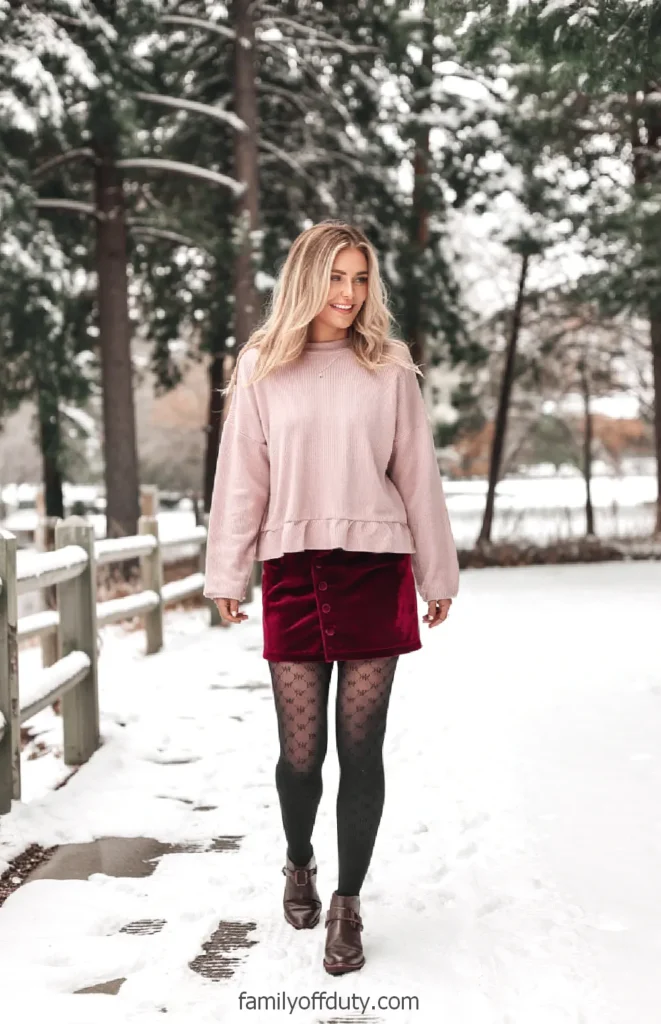
Photo via familyoffduty.com
Velvet’s matte richness is the anchor — it reads as evening even in daylight, which gives a daytime walk a dressed-up undertone. The ruffle hem softens the sweater’s edge so the top doesn’t go boxy, and patterned tights are the detail that rewards a second look; keep the pattern small-scale so it reads as texture from a distance. Dark tones throughout — deep green, burgundy, charcoal — keep the look wintry rather than festive-costume.
Wear it for evening-adjacent plans: a late-afternoon walk that ends at dinner, a fireside gathering where you want to look considered. The velvet skirt wants protection from snow-melt — brush it off rather than letting damp sit. Boots with grip matter here; velvet and ice are a bad combination without them.
19. French Cabin Ease: Long-Sleeve Wrap Dress, Tights, and a Wool Beret
A long-sleeve wrap dress in beige or camel, opaque tights, and a wool beret is the outfit that makes cabin dressing look easy because the dress does the tailoring. The wrap silhouette defines the waist without a belt, the long sleeves handle arm warmth, and the beret adds the kind of insouciant polish that turns a simple dress into a look. By a snowy cabin, the effect is quietly cinematic.
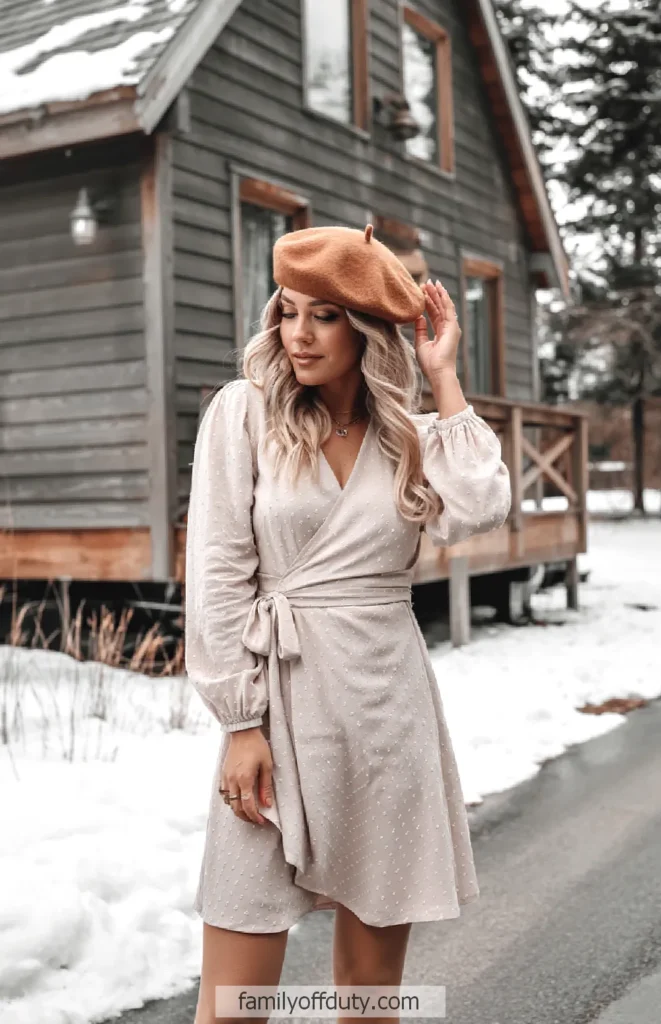
Photo via familyoffduty.com
The wrap dress is a proportion cheat code: the V-neckline lengthens the neck, the tie waist creates shape, and the skirt’s A-line skims without clinging. In a knit fabric it becomes genuine winter wear rather than office wear. The beret sits at an angle that frames the face and covers the ears partially — it is style with a side of function. Keeping dress, tights, and beret in one tonal family makes the outfit read as a single considered gesture. The layering logic here echoes Best Comfy Winter Outfits, where single-piece dressing carries the same weight.
This suits slow days: lingering over cabin breakfast, reading by the window, an afternoon that might include a short walk. A long coat over the top extends it into real cold; without one, it is a mild-day or indoor-to-car outfit. The beret packs flat and survives suitcase compression, unlike most structured hats.
20. The Travel-Day Formula: Plaid Flannel Worn Open Over a Thermal and Jeans
The drive to the cabin is an outfit problem of its own — hours in a car seat, then stepping straight into mountain air — and the answer is layers that work seated and standing. A plaid flannel shirt worn open over a thermal base layer, with straight jeans and boots, handles both. The flannel is the adjustable thermostat: buttoned in the cold parking lot, open in the heated car, tied at the waist if the afternoon surprises you.
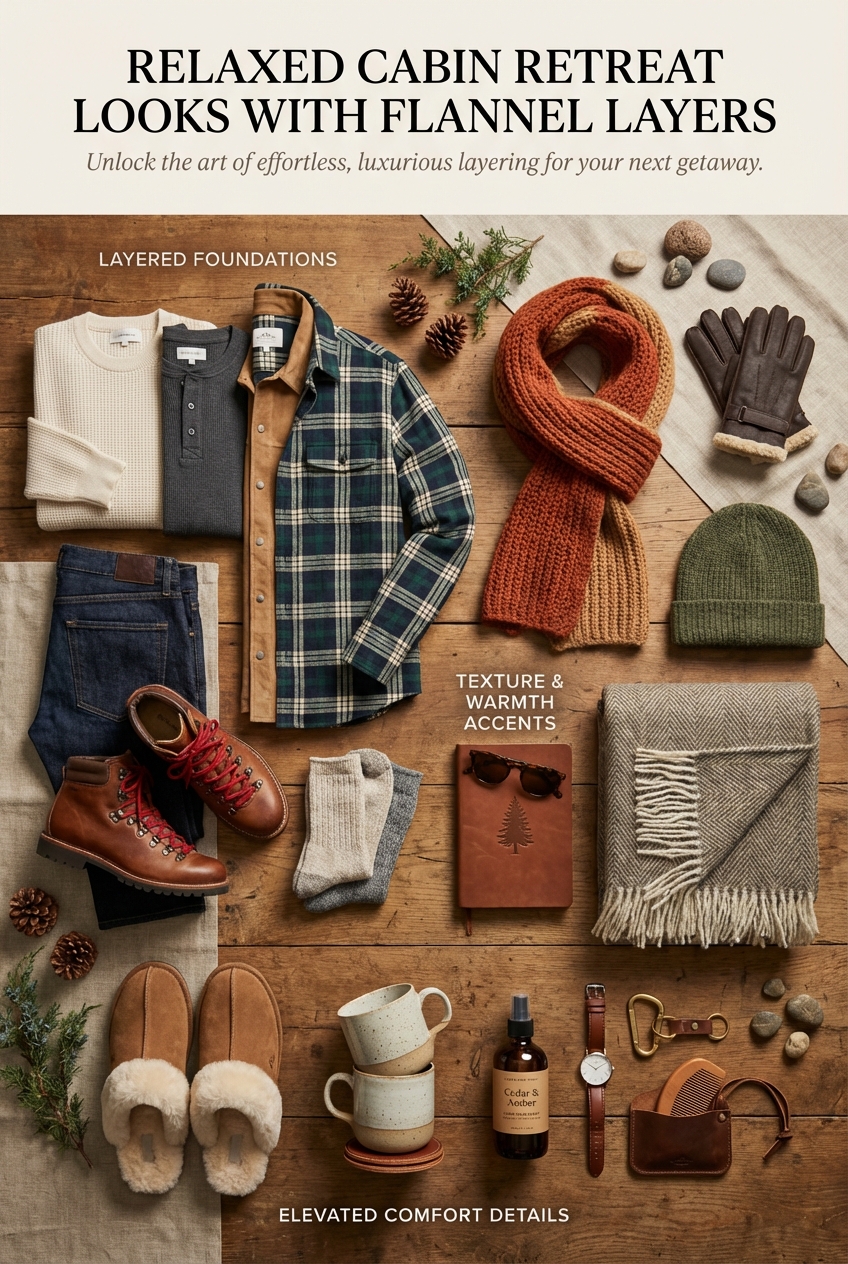
Photo via mytrendboutique.com
Flannel’s brushed surface is the key textile fact: the napping softens the fabric and traps air, making it warmer than its weight suggests. Worn open, it functions as a light jacket with the visual interest of a pattern; the thermal underneath does the actual insulating. Jeans with some stretch survive the car ride without the waistband becoming an enemy, and boots mean no shoe change on arrival. A mid-scale plaid in muted tones — forest, rust, navy — reads cabin without reading costume.
Wear it door to door on travel day, then rewear the pieces all weekend — the flannel over a different base, the jeans under a different sweater. That reusability is the point: travel-day clothes should be the hardest-working items in the suitcase, not a separate category. A beanie in the coat pocket covers the arrival chill.
21. Double Duty Layers: Flannel Shirt Under a Chunky Knit
Layering a flannel shirt under a chunky knit sweater gives you two patterns of warmth in one outfit: the flannel’s brushed cotton against the skin, the knit’s lofted yarn over it. Let the flannel’s collar and hem peek out from under the sweater — that visible edge is what turns layering from practical to deliberate. With jeans and boots, it is the cabin uniform at its most honest.
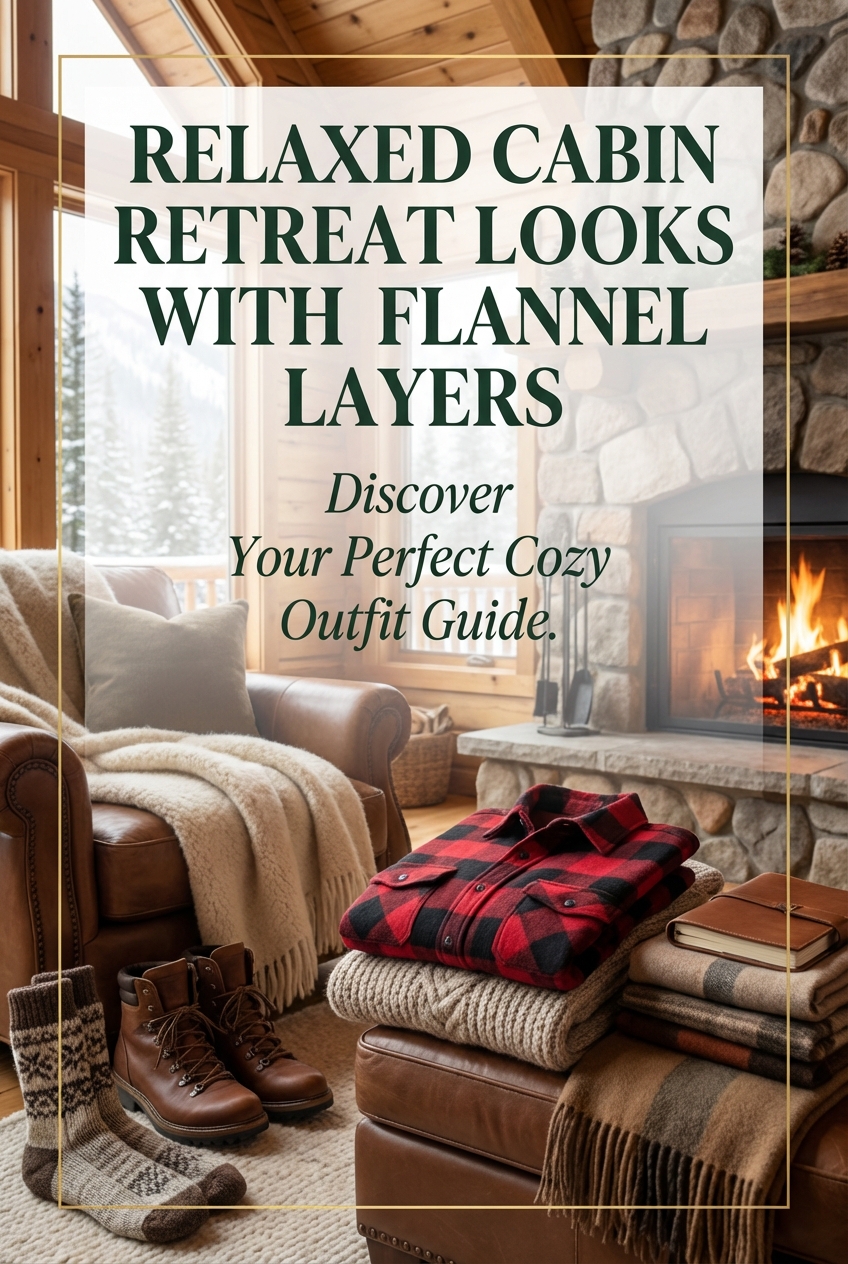
Photo via mytrendboutique.com
The visible-layer trick has rules: the underlayer should be thinner than the overlayer, and only one of the two should carry a pattern. A plaid flannel under a solid chunky knit is the correct combination; two patterns at different scales can work, but it is advanced. The flannel’s collar framing the sweater’s neckline adds structure that a plain tee underneath cannot. This is also a temperature-regulation system — shed the sweater indoors, and the flannel alone is a complete look.
Best for the full active day: mornings that start cold, afternoons by the fire, evenings that cool fast. The sweater comes off and on all day without a wardrobe change. Choose a flannel with a relaxed cut — one that pulls across the shoulders is a sizing problem, not a layering failure.
22. Pack Less, Style More: The Two-Flannel Mix-and-Match Capsule
Two flannel shirts — one plaid, one solid — plus a thermal, jeans, and a knit can generate most of a weekend’s outfits, and this is the proof. The plaid brings the pattern days, the solid brings the quiet days, and worn together — one open over the other, or the solid tied at the waist — they multiply. It is the smallest possible packing list that still looks like choices were made.
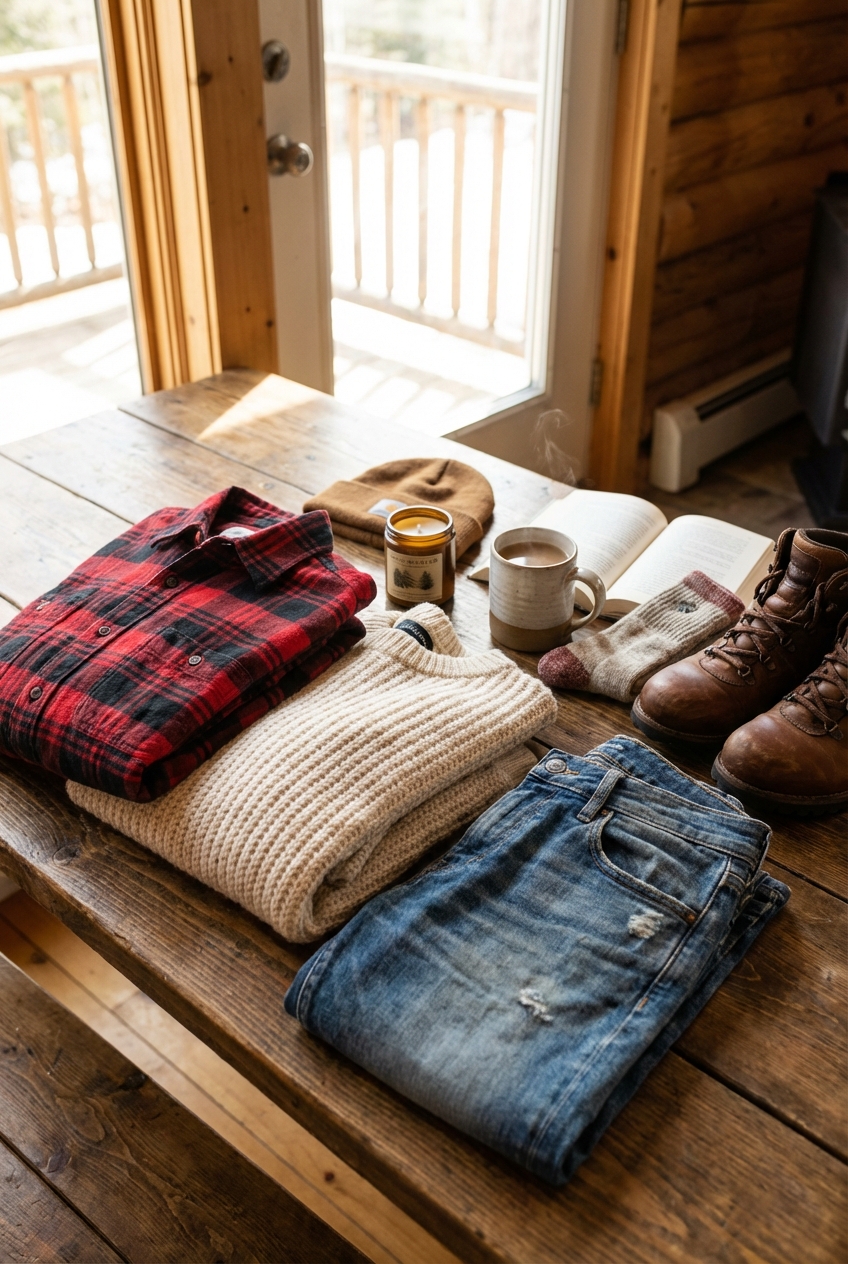
Photo via mytrendboutique.com
The capsule logic depends on palette discipline: keep both flannels inside one color family — say, earth tones — and every combination works. If the plaid is busy, the solid should be truly solid; if you want two patterns, change their scale so they don’t compete. A neutral base layer underneath both means either flannel can be shed without leaving you in an awkward middle state. You’ll find the same spirit in Winter Outfits for Women, where small wardrobes get the same systematic treatment.
This is less an outfit than a packing strategy, and it suits the traveler who hates overpacking. Friday: plaid buttoned over the thermal. Saturday: solid open over a tee, plaid tied at the waist for the afternoon. Sunday: repeat Friday’s formula with the solid — it reads as a different outfit and costs nothing in suitcase space.
23. Buttoned Up for the Day: Plaid Flannel Over a Base Top With a Beanie
Buttoned to the top over a fitted base layer, with jeans and a beanie, the plaid flannel becomes the day’s outer shirt — structured enough for town, relaxed enough for the trailhead. This is the version for days when the flannel is the warmest thing you’ll wear, the crisp afternoons where a coat would be overkill. The beanie covers the warmth the open collar concedes.
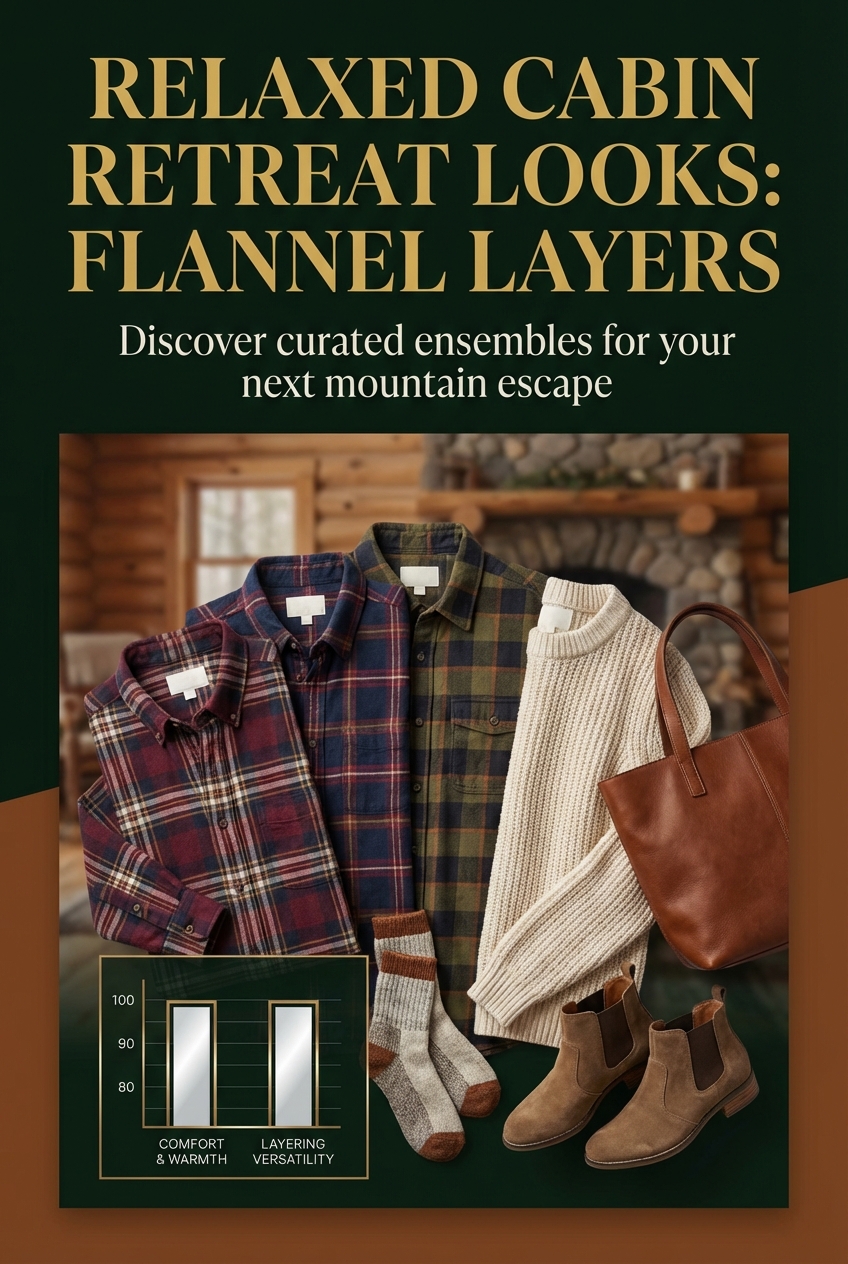
Photo via mytrendboutique.com
Buttoned versus open is a real stylistic fork: open reads relaxed and shows the base layer, buttoned reads tidier and shows the pattern uninterrupted. A fitted base underneath keeps the buttoned flannel from blousing, and rolling the sleeves to the forearm adds the casual signal the buttoned front withholds. The beanie should pick up a color from the plaid — that small echo is what makes accessories look chosen rather than grabbed.
Wear it for the active middle of the trip: a day of exploring, a hike that isn’t serious enough for technical gear, lunch in a mountain town. The flannel’s cotton breathes better than a synthetic midlayer, so it handles exertion without overheating. If the wind picks up, this is the outfit that wants a vest over it, not a full coat.
24. Fireside Wind-Down: Flannel Wrap Over Chunky Knit Loungewear
Evenings at the cabin have their own dress code, and it is this: a chunky knit, soft knit pants or leggings, thick socks, and a solid flannel worn as a wrap over everything. The flannel functions as a shawl-cardigan hybrid — draped over the shoulders by the fire, pulled closed for the walk to the bedroom. It is the outfit for the hours when nobody is taking photos but everyone is still awake.
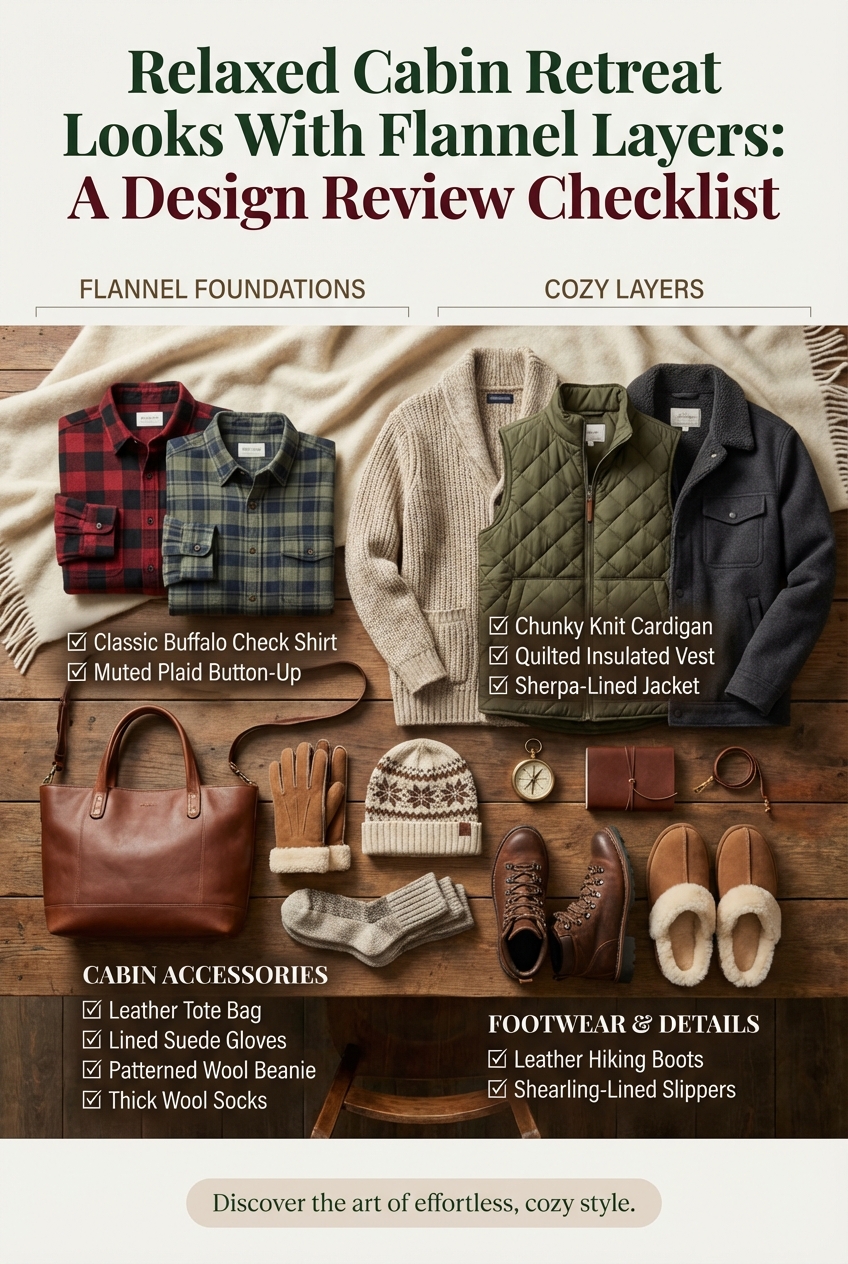
Photo via mytrendboutique.com
The solid flannel is the correct choice for the wrap role — a plaid worn as a shawl reads as a blanket, while a solid reads as a garment. The chunky knit underneath provides the actual insulation; the flannel adds a wind-blocking layer and the ritual of wrapping up. Thick socks are non-negotiable — cabin floors are cold, and slippers slide on wood. Keep the palette tonal so the whole thing feels like one soft idea rather than assembled pieces.
This is the nightcap outfit: board games, late conversations, the last log on the fire. It also doubles as the morning uniform — add boots and a beanie and you’re on the porch with coffee. The flannel-as-wrap is the most reworn piece of the weekend; choose the softest one you own for the job.