Winter is prime protective-style season. Cold air pulls moisture out of hair, wool hats and scarves create friction at the hairline, and dry indoor heating leaves ends brittle — which is exactly why braids earn their keep from December through February. A well-installed set keeps your natural hair tucked away, stretches your wash-and-style routine for weeks, and still gives you a finished look every morning with almost no daily effort. Related reading: Fall Braid Hairstyles 2025 2 takes the same concept further.
The 2027 take on winter braids leans into versatility: knotless installs that lie flat under beanies, chunky styles that hold their shape against heavy coats and scarves, and low buns and crowns that sit comfortably under hats. Color is having a moment too — warm ombrés, golden-brown highlights and burgundy shades that read rich against winter wardrobes. Below are 24 ideas, each with honest notes on technique, styling and upkeep, so you can pick the set that fits your winter calendar. For the fuller picture, Short Fall Hairstyles for 2025 is worth your time.
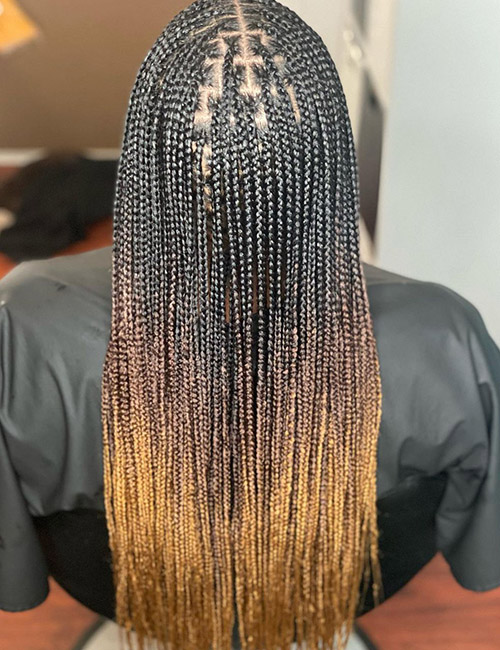
Waist-Length Knotless Braids with Warm Ombré Ends
Courtesy of: papaganlar.net
The base here is a full head of medium knotless braids that fall past the waist, with the last several inches fading from a deep natural black into a warm copper-brown ombré. Because knotless braids start with your own hair and feed extensions in gradually, the roots lie flat — a real advantage when you want to pull a beanie on without a bulky base pushing it up. The ombré color does the visual heavy lifting: it keeps very long braids from reading flat and adds dimension when hair is worn down over a dark winter coat. We covered this territory more deeply in Easy Chic Winter Hairstyles for Women in 2025 2026 That Elevate Your Everyday Style.
Ask your braider for medium-size knotless braids with pre-stretched ombré hair, and request that the color transition sit low enough that regrowth won’t create a harsh line at the roots. Styling is simple — wear them down, or sweep them into a low pony on windy days. Expect four to eight weeks of wear with edge care and a satin scarf or bonnet at night. The trade-off is weight and install time: waist length means a long appointment and heavier hair, so this suits someone who wants maximum versatility in exchange for a fuller head of braids.
High Braided Topknot with a Sleek Cornrow Base
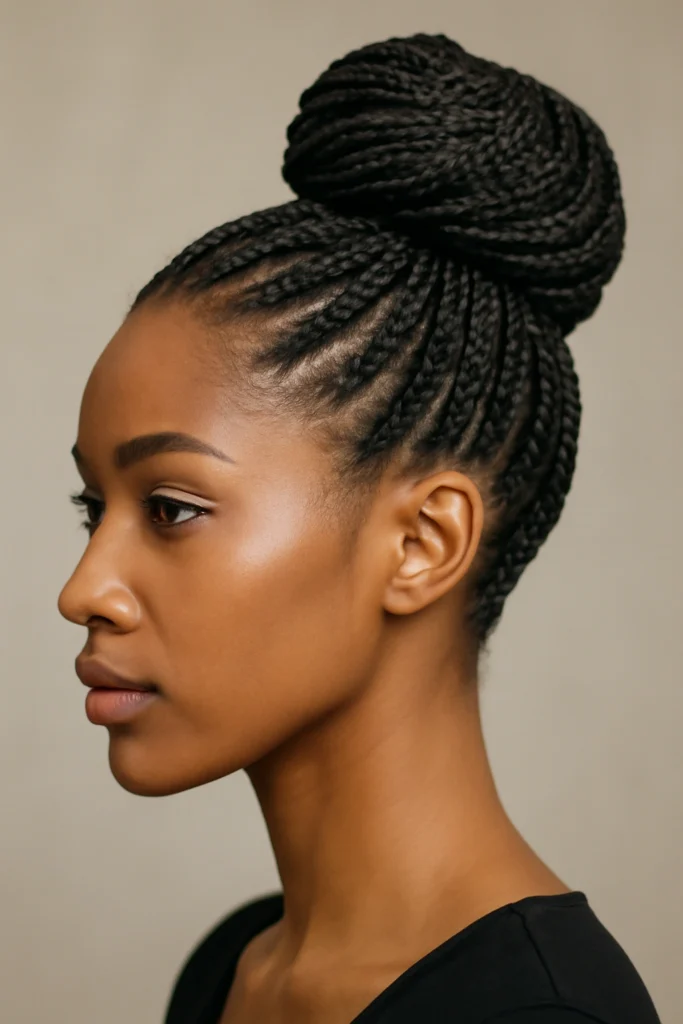
Photo credit: hairtical.com
The foundation here is a set of sleek medium cornrows braided upward and gathered into a tall, full topknot — no loose braids, just one sculptural bun. Because the base is cornrowed flat to the scalp, the style sits close at the sides and hairline, which keeps it comfortable under a beanie and neat around coat collars. The bun itself is built from the braided lengths, giving it a thick, rope-textured finish that holds its shape all day.
Ask your braider for cornrows directed toward the crown with enough extension length to wrap a full bun, then have the lengths coiled and pinned into the knot. To refresh, smooth the hairline and re-pin any loosened coils. Expect two to four weeks of wear — the cornrow base shows regrowth sooner than box braids. The trade-off is tension at the crown: everything pulls upward, so this suits healthy edges and works best as a shorter-wear style rather than a months-long protective set.
Boho Knotless Braids with Loose Curly Ends
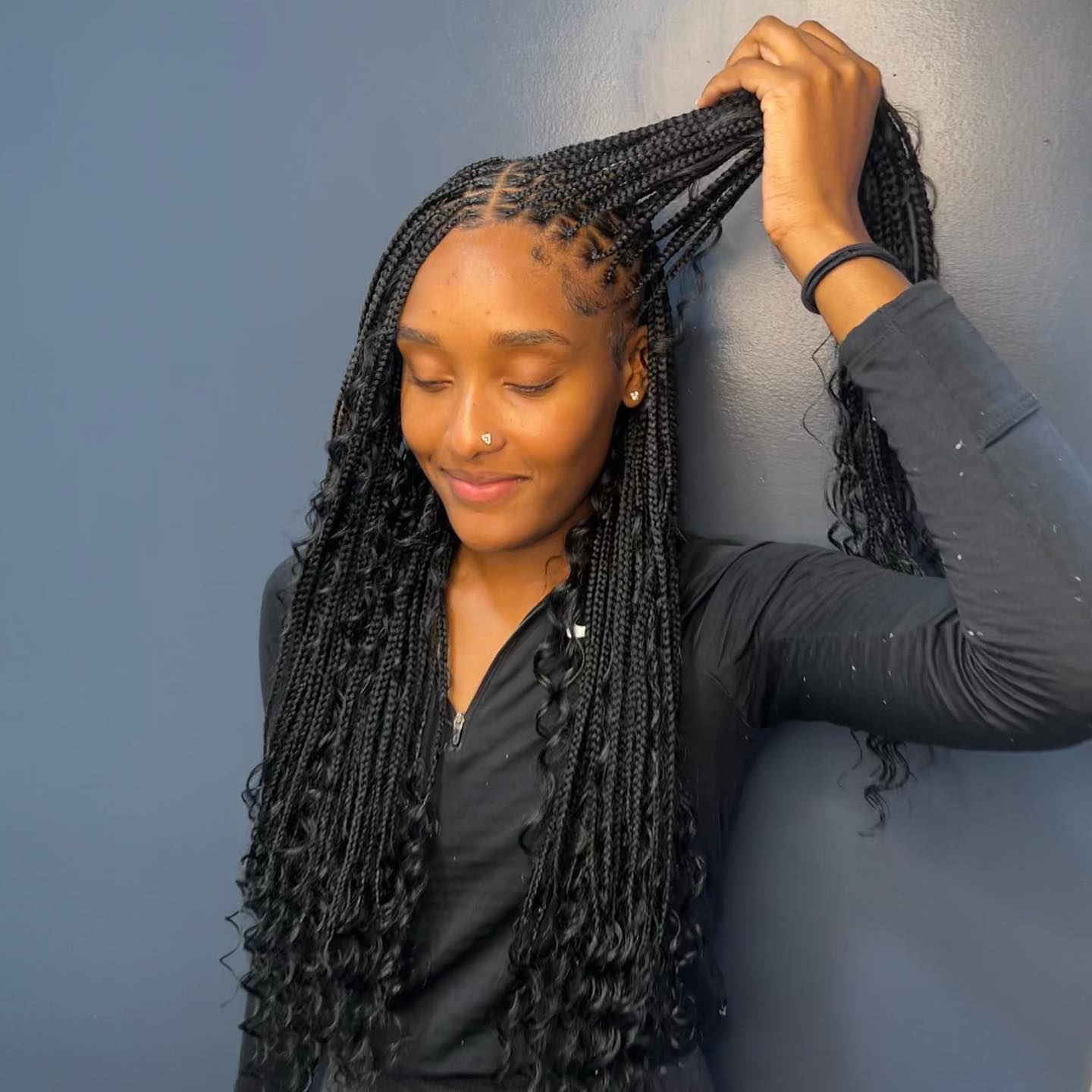
Image credit: exploretrending.com
Boho braids take a standard knotless install and leave curly strands out along the length, finishing with loose, defined curls past the braided ends. The result reads softer and more romantic than a clean braid set — the curls move like loose hair while the braided base stays protective. In winter this texture plays well against chunky knits and faux-fur collars, where a little softness around the face balances heavy outerwear.
The technique matters: ask for human-hair curls or high-quality synthetic curls added throughout, not just at the ends, and a light curl-defining mousse to keep the loose pieces from frizzing in dry heated air. At night, pineapple the curls under a satin bonnet. Expect three to five weeks before the curls start to look tired — refreshing them with a quick re-curl is usually easier than a full reinstall. The trade-off is upkeep: the loose hair needs more moisture and detangling than the braided portion, so this is a higher-maintenance protective style.
Side-Swept Braided Bob with a Deep Part
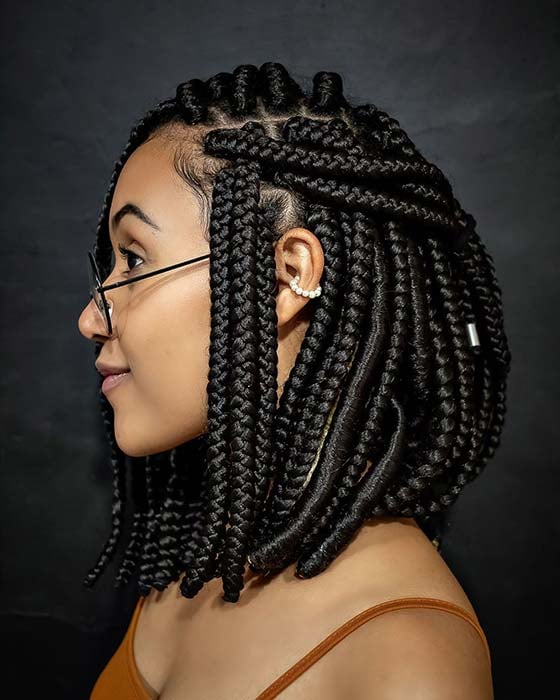
Source: exploretrending.com
A braided bob cuts the commitment of long braids down to chin-to-collarbone length, parted deeply and swept to one side for an asymmetric fall. Shorter braids mean less weight, faster installs, and easier washing — and the side sweep frames the face while keeping one side tucked neatly behind the ear, which pairs well with statement earrings. In winter, a bob sits above coat collars entirely, so there’s no hair getting trapped under scarves. A companion piece, Winter Hair Colors, explores the same palette.
Ask for shoulder-grazing box or knotless braids with a defined side part and slightly angled ends (longer at the front) for the sweep to hold. Styling takes seconds: flip the part, smooth edges, go. Wear runs four to six weeks, and take-down is mercifully quick. The trade-off is styling range — bobs don’t go into high buns or long ponytails, so this suits someone who wants a polished, low-effort set over maximum versatility.
Stitch Cornrows with Curved Precision Parts

Stitch braids are cornrows built with a feed-in technique that creates crisp, raised “stitched” lines along each part — and the curved, swooping partings here turn a classic into a design. The precision parting is the whole look: clean curved lines, symmetrical on both sides, with the braids themselves kept medium-thin so the pattern reads clearly. It’s a style that photographs beautifully and holds up under hats because everything sits close to the scalp.
This is a specialist technique, so book a braider known for stitch work and bring a reference for the parting pattern you want. Edges should be laid with a light gel rather than heavy wax to keep the parts crisp. Wear is typically two to four weeks — shorter than box braids, since regrowth shows fast on scalp-hugging styles. The trade-off is precision over longevity: stunning for the first two weeks, but the design blurs as hair grows, so plan this one around an event or a fresh-style window rather than a long protective stretch.
Fulani Braids with Silver Hair Cuffs
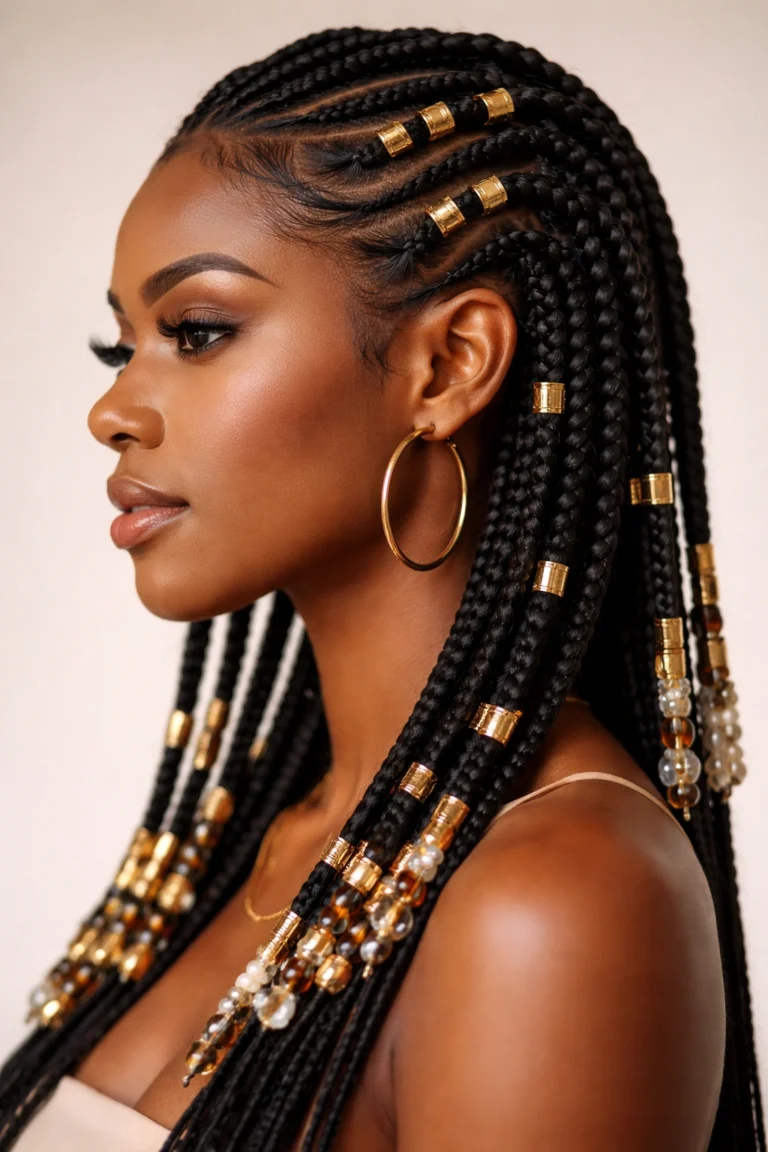
Courtesy of: hairtical.com
Fulani-inspired braids combine cornrows at the front — often with a center braid accented by beads or a hanging piece — with loose box braids at the back, and here silver cuffs and rings are threaded along the plaits. The metal accents catch winter light in a way beads sometimes don’t, and they read festive without needing any color in the hair itself. The front cornrows keep the hairline sleek under hats, while the back braids give you length to style.
Ask for the classic Fulani layout: center cornrow, curved side cornrows, and free-hanging braids behind, with cuffs distributed evenly rather than clustered. The cuffs slide on and off, so you can refresh the look or remove them for washing. Wear runs four to six weeks. The trade-off is small-part maintenance — the front cornrows show regrowth first, and metal cuffs can snag knit hats, so push the hat slightly back or choose cuffs that sit mid-shaft rather than at the roots.
Feed-In Braided Ponytail with a Wrapped Base
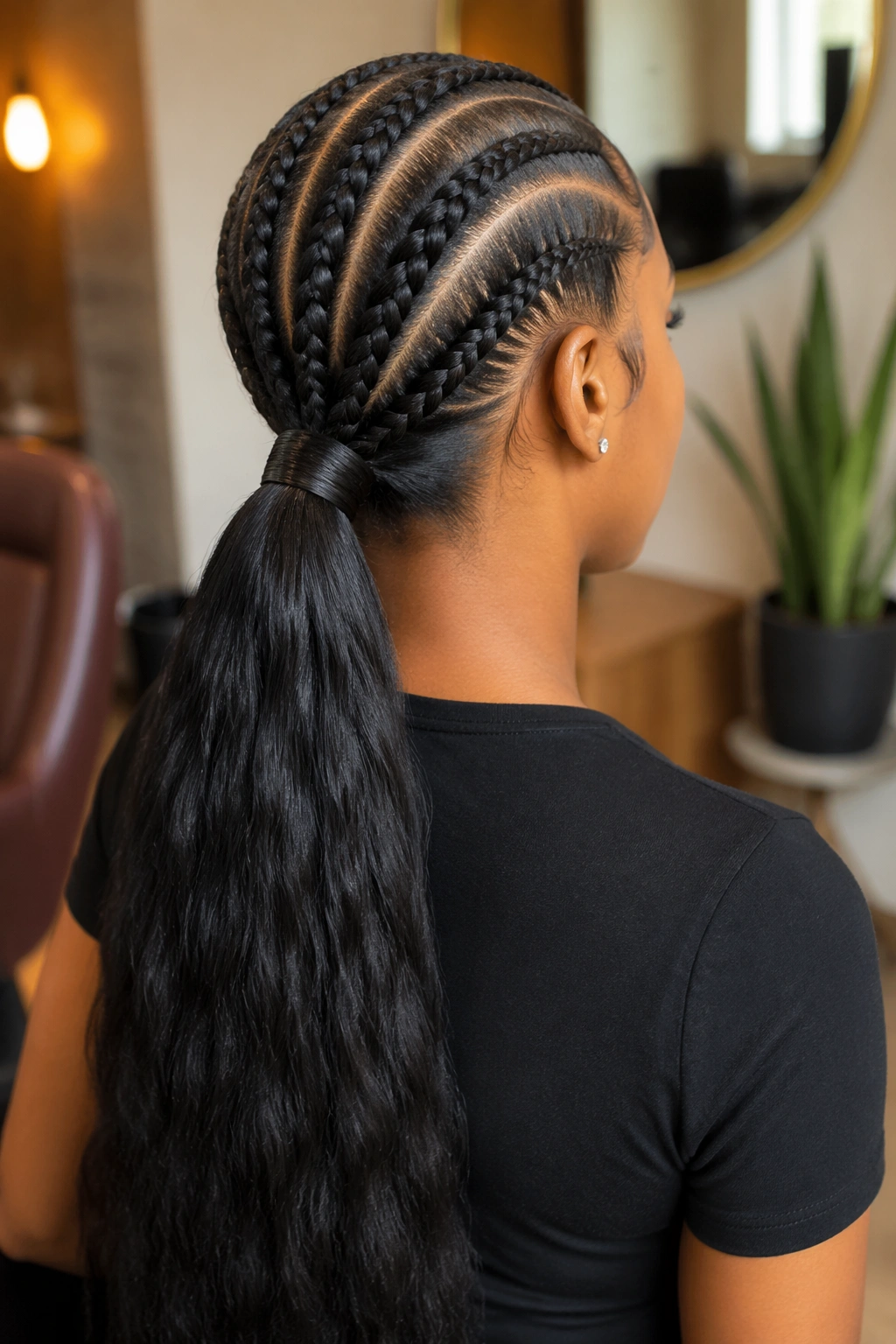
Photo credit: boldhairstyles.com
This is a single sleek feed-in braid (or a set of cornrows) pulled into a sleek, long braided ponytail, with a section of hair wrapped around the base to hide the elastic. It’s the winter workhorse for anyone who trains, commutes, or just wants hair fully contained: one contained tail, zero loose ends catching on zippers and coat hardware. The wrapped base elevates it from gym hair to a deliberate style. For a different spin on the same theme, browse Best Old Money Short Hairstyles.
The key is a smooth foundation — braided-back cornrows or a slicked base with strong-hold gel, then extensions fed in for length. Wrap a braid around the base and pin it underneath. This style lasts two to three weeks, sometimes longer with the pony re-wrapped. The trade-off is tension at the hairline: high ponies pull, so this isn’t an everyday-long-term protective style for fragile edges. Treat it as a two-to-three-week style, then give the hairline a break.
Medium Knotless Braids with Golden-Brown Highlights
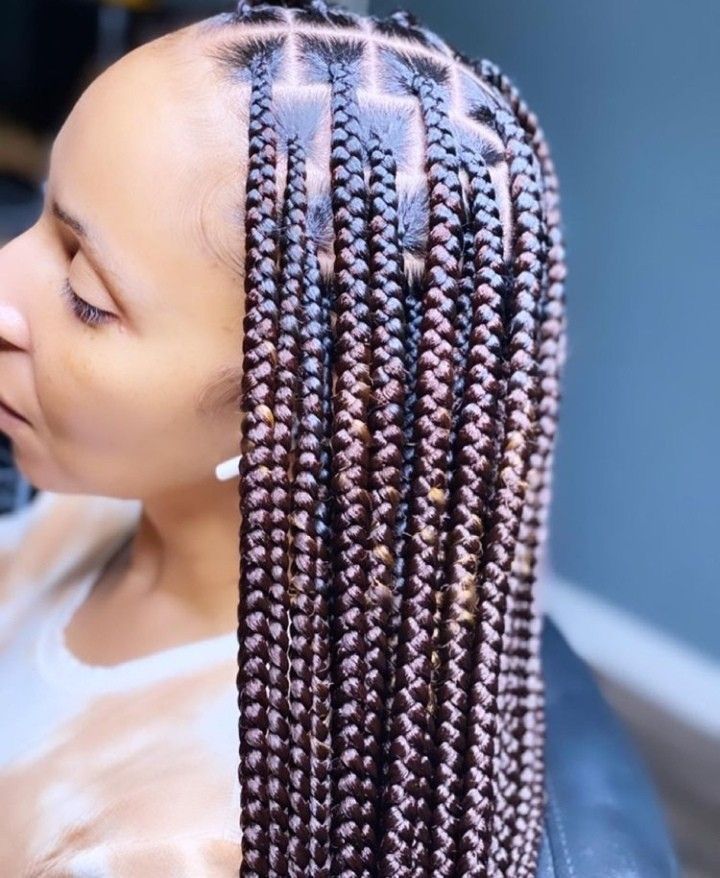
Image credit: papaganlar.net
A full set of medium knotless braids gets dimension from golden-brown highlight braids woven throughout — a few lighter plaits scattered through a dark base. The effect is subtle in indoor light and warm in sunlight, which is exactly what winter hair needs when everything else in the wardrobe goes dark. Knotless roots keep the install comfortable and flat under headwear.
Ask your braider to mix one pack of golden-brown braiding hair into three or four packs of your base color, distributing the lighter braids evenly rather than in one section. No extra styling skill needed — the color does the work. Wear is the standard four to eight weeks for knotless. The trade-off is color matching: lighter synthetic hair can look brassy against some skin undertones, so check the shade in natural light before committing, and know that colored braiding hair sometimes feels slightly coarser than black.
Two-Strand Twists in a Deep Burgundy Shade

Source: touchedbymagicbeautyllc.square.site
These two-strand twists are done in a deep burgundy shade from root to tip, giving the whole head a rich wine-colored finish that reads seasonal without going novelty. The twists are medium in size with clean parts, and the color looks almost black in low light before warming to burgundy in the sun — a subtle-to-striking effect depending on where you are. Rope twists lie flatter and feel lighter than braids, which makes them comfortable under winter headwear.
You can achieve this with pre-colored braiding hair or by having the extensions colored before install; either way, check the shade in natural light first since burgundy can pull very dark or very red. Keep twists sealed at the ends with hot water and refresh the roots with light mousse as frizz appears. Wear runs four to six weeks. The trade-off is color fade and root contrast — colored twists show regrowth more obviously than black, so plan for the roots to be the first thing that needs attention.
Long Senegalese Twists with a Sleek Rope Finish

Senegalese twists — the rope-twist technique done with smooth kanekalon for a sleek, uniform finish — are worn here long and loose, falling past the shoulders with a glossy, defined rope texture. The even, polished surface of each twist catches light beautifully, and the length gives you styling options: wear them down, half-up, or swept over one shoulder. It’s an elegant, low-bulk protective style that moves well with winter layers. We break down a similar look in Fall Hairstyles for Women 40.
Ask for small-to-medium Senegalese twists at mid-back length or longer, with clean parts for the sleekest result. The smooth texture means frizz shows more than on textured twists, so a light mousse and satin bonnet at night keep them crisp. Wear is typically four to six weeks. The trade-off is that the signature sleekness softens with time — roots frizz first, so this style looks its best in the first month and suits someone who values polish over maximum longevity.
Shoulder-Length Passion Twists with Loose Texture
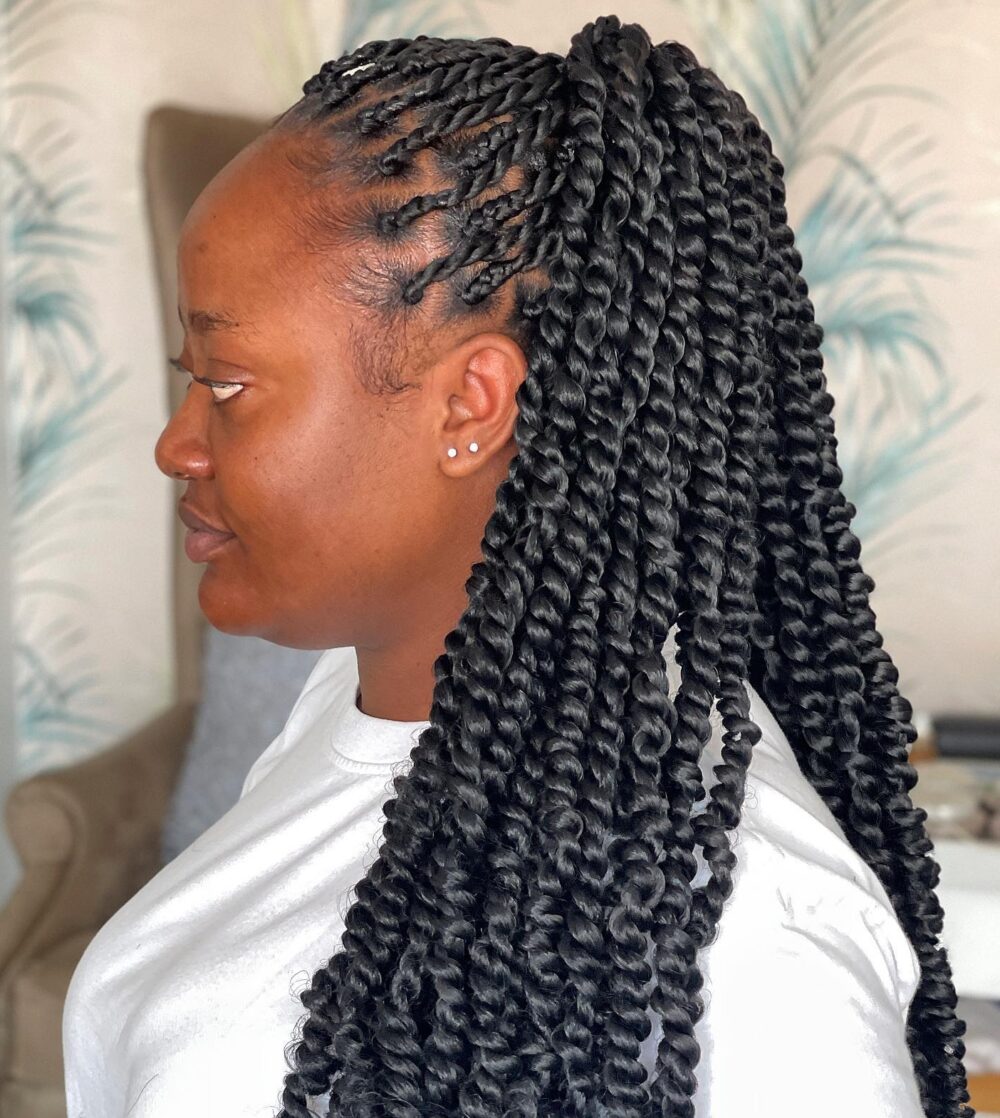
Courtesy of: exploretrending.com
Passion twists use wavy, water-wave-textured hair to create twists that look soft, full and slightly undone — here kept at shoulder length for a lightweight winter style. The airy texture is the appeal: it mimics loose natural hair more than any other twist style, and the shorter length keeps it bouncy rather than weighed down. It’s a good middle ground if box braids feel too structured.
Request water-wave crochet or braiding hair and a twist size on the fuller side — passion twists look best with some volume. Because the hair is textured, frizz blends in rather than standing out, which extends the fresh look to five or six weeks. The trade-off is tangling: the wavy texture can matte at the nape where it rubs against coats, so a satin scarf tucked between hair and collar on the worst days genuinely helps.
Goddess Braids with Curly Strands Woven Through
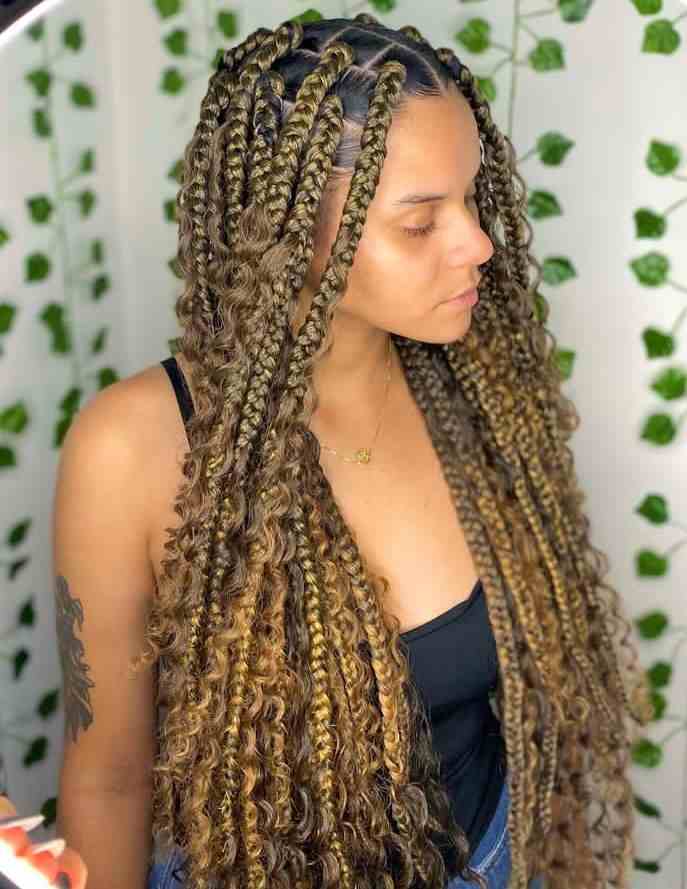
Photo credit: claraitosblog.com
Goddess braids blend cornrows at the scalp with free-hanging box braids, and this version weaves loose curly strands through the braids for a half-braided, half-curly finish. You get the scalp neatness of cornrows with the movement of loose curls — a style that looks intricate but wears easily. The curls soften the geometry of the cornrows, which photographs well and feels less severe than an all-braided set.
Ask for feed-in cornrows (straight-back or a creative pattern) transitioning into knotless-style braids with curly pieces added throughout. The curls need the same care as boho ends: light mousse, satin bonnet at night, and gentle finger-detangling. Wear is three to five weeks. The trade-off, again, is the two-texture upkeep — the braided base will outlast the curls, so this is best for someone happy to refresh curls or accept a softer finish in the final weeks.
Triangle-Part Box Braids with Medium Density
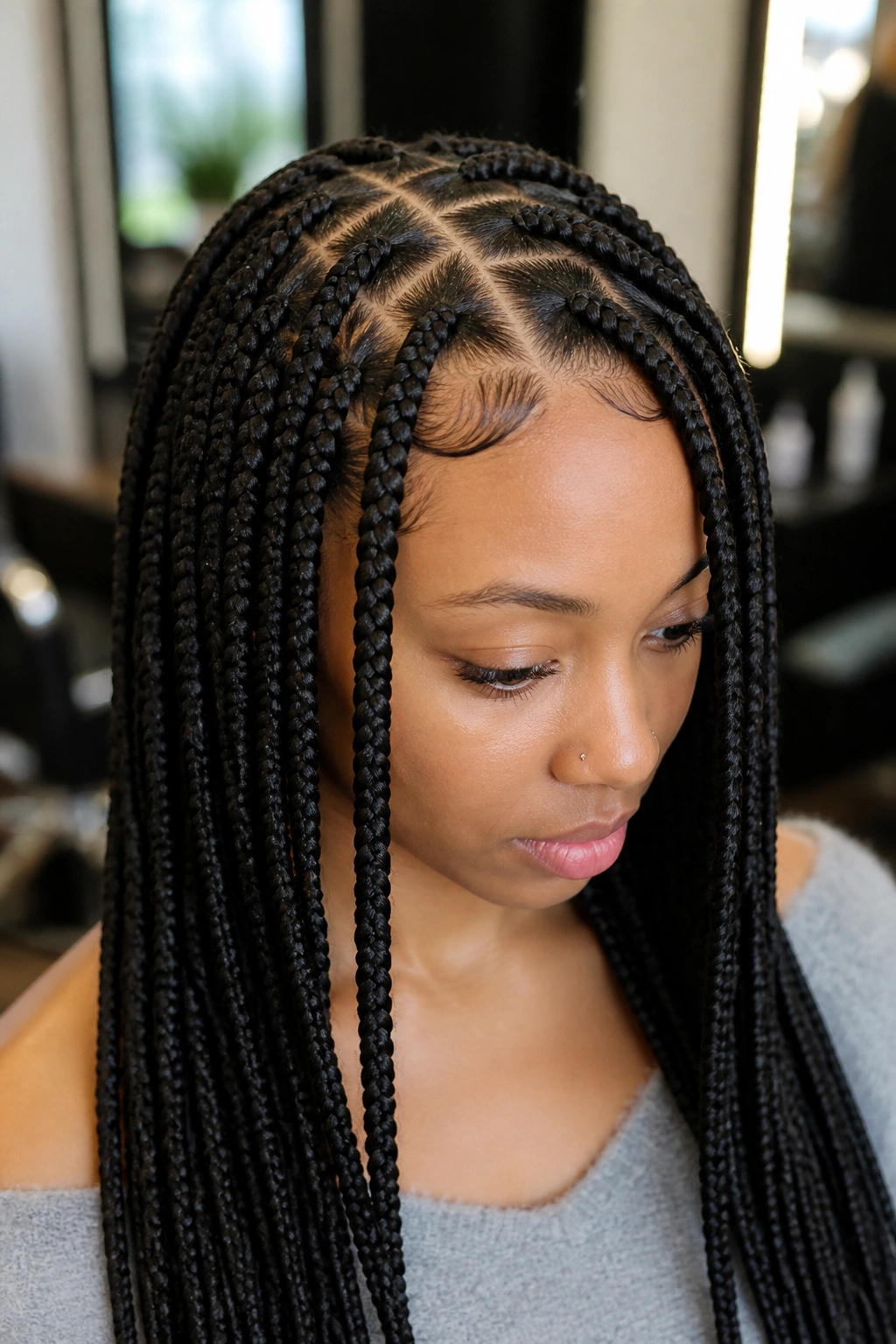
Image credit: hairstyleloom.com
Instead of the usual square grid, these box braids are parted in triangles — a small geometric switch that changes the whole look. The triangular parts create a subtle zigzag rhythm across the scalp that reads modern and intentional, especially when the braids are worn pulled back. Medium density (not too many, not jumbo) keeps the parts visible without an overwhelming head of hair. This pairs naturally with the ideas in Formal Winter 2025 2026 Hairstyles for Women 25 Chic Styles.
Ask specifically for triangle parting and medium-size braids; the parting takes more time than squares, so expect a slightly longer appointment. Everything else about wear mirrors standard box braids: four to six weeks, washable, versatile in updos. The trade-off is purely practical — triangle parts take longer to install and slightly longer to take down, and regrowth blurs the geometry first, so the signature detail is sharpest in weeks one through three.
Butterfly Locs with Distressed, Airy Texture
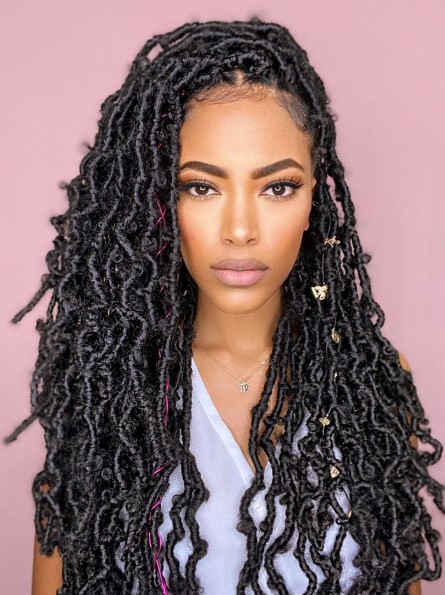
Source: thehairstylish.com
Butterfly locs are faux locs wrapped with wavy hair to create looped, “butterfly wing” texture along each loc — airy, lightweight and bohemian. Kept at shoulder to mid-back length, they have movement that standard faux locs don’t, and the distressed texture hides regrowth better than sleek styles. In winter the fullness frames the face nicely against turtlenecks and scarves.
Installation is usually a crochet method over cornrowed or braided natural hair, which keeps tension low. The loops can snag on chunky knits, so smooth scarves are kinder than open weaves. Wear runs four to six weeks. The trade-off is the texture itself: the loops that make butterfly locs beautiful also catch on everything — earrings, zippers, wool — so this style asks for a little mindfulness with accessories and outerwear.
Sleek Bantu Knots with a Defined Middle Part

Via hairtical.com
Bantu knots — hair sectioned, twisted and coiled into small knots across the head — are worn here as the finished style, not just a curl set, with a sharp middle part. It’s a bold, sculptural look with deep roots, and the small knots sit flat enough to work under a loose beanie. Worn as a style in their own right, bantu knots are also one of the lowest-tension options on this list.
Section cleanly, twist each section and coil it into a knot, securing the ends underneath. Smaller knots read more modern; larger ones feel more traditional. Wear is one to three weeks depending on how sleek you keep them — they’re easy to redo section by section. The trade-off is longevity: knots loosen with moisture and friction, so this is a shorter-wear style best planned for a week or two of impact rather than a full protective stretch — though the twist-out you get after is a bonus second style.
Low Halo Braid Wrapped Around the Head
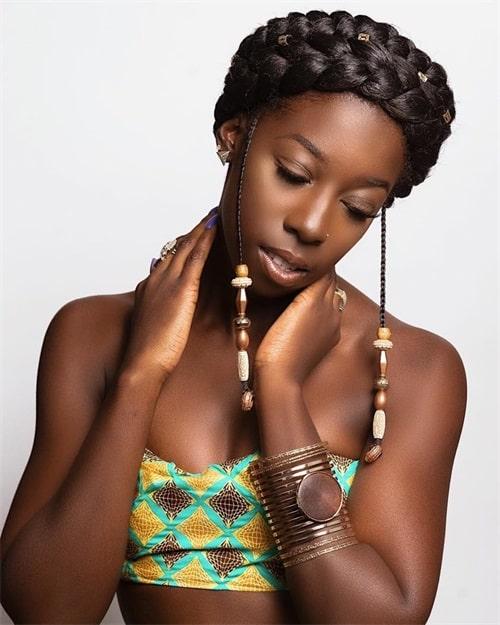
Courtesy of: nadula.com
A single thick braid wraps around the head like a crown, pinned low near the hairline — the ultimate hat-friendly style, since there’s nothing on top for a beanie to crush. The version shown adds thin beaded accent braids hanging at the temples, a decorative touch that dresses the crown up for events. It’s elegant enough for evenings and practical enough for every day, and it keeps every end tucked away from winter air. On natural or stretched hair it can be done with your own hair; with extensions it becomes a longer-lasting protective style. For more ideas in the same lane, see our Low Maintenance Summer Hairstyles for Black Women.
For the protective version, ask for a cornrow-based halo or a wrapped extension braid pinned around the perimeter. Bobby pins and a light edge control keep it neat. Wear is one to three weeks on natural hair, longer with extensions. The trade-off is that halos loosen with activity — it’s a pinned style, not a braided-in one, so it needs a quick pin check on high-movement days and may not survive intense workouts intact.
Long Lemonade Braids Swept to One Side
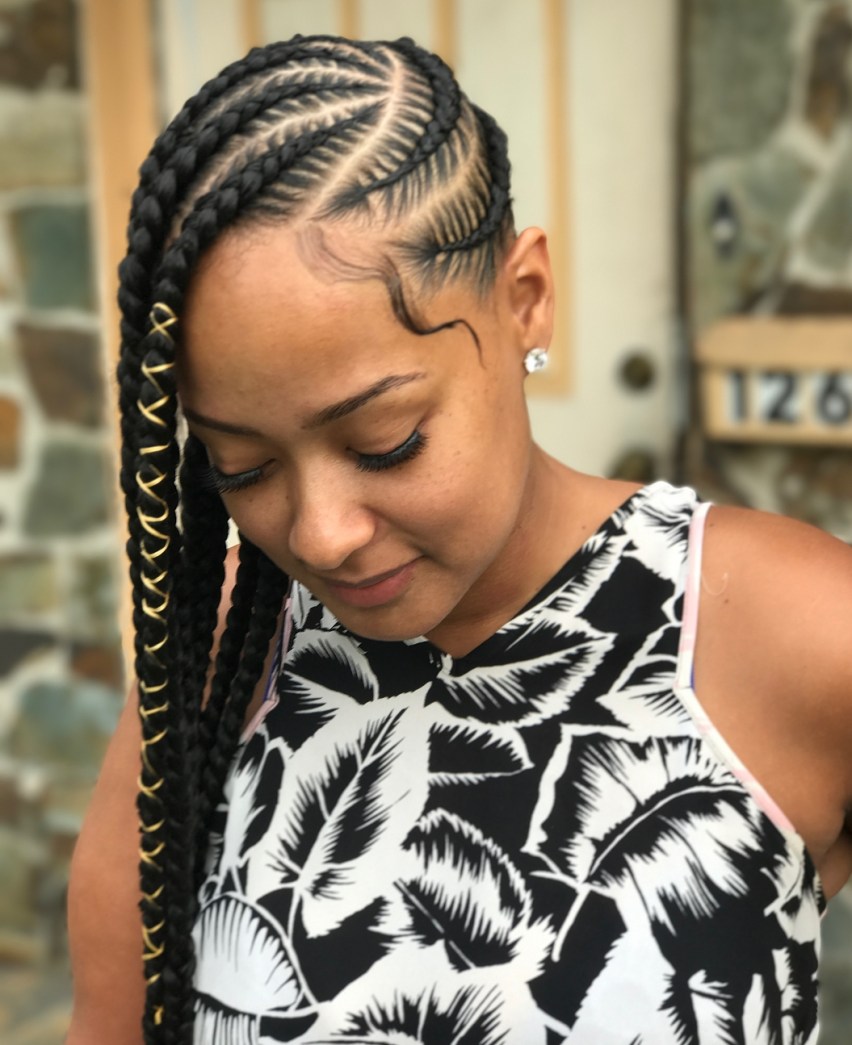
Photo credit: papaganlar.net
Lemonade braids — cornrows braided to fall over one shoulder, named for the iconic side-swept look — get the long winter treatment here, with small-to-medium cornrows cascading past the chest on one side. The asymmetry is flattering on most face shapes and keeps hair off one side of the neck entirely, which is genuinely useful when you’re wrapped in a scarf. Beads at the ends are optional but add movement.
Ask for neat side-swept cornrows with feed-in extensions for length, and decide on bead placement before the braider finishes. The swept side stays tidy; the exposed side of the scalp should be moisturized since it’s fully visible. Wear is two to four weeks. The trade-off is the same as all cornrow styles: scalp-hugging means regrowth shows quickly, and sleeping on one side every night can loosen that side’s braids faster — a satin bonnet is non-negotiable.
Tribal Braids with Wooden and Gold Beads
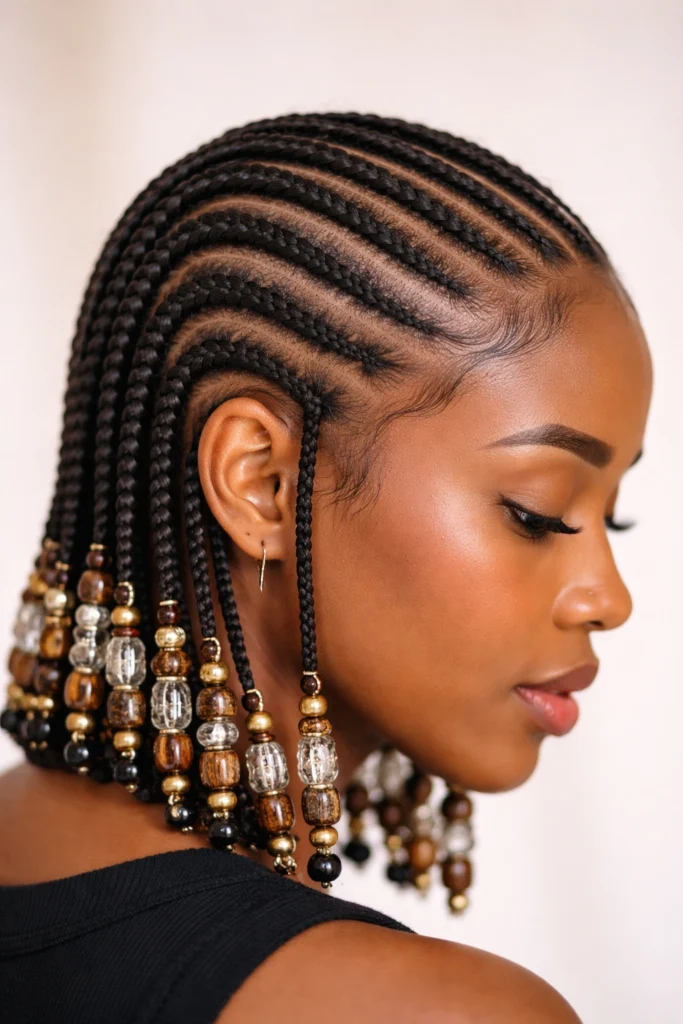
Image credit: hairtical.com
Tribal-inspired braids layer cornrows of varying sizes — often with a center design braid — and finish with wooden beads and gold cuffs stacked near the ends. The mixed beadwork gives the style a handcrafted, cultural richness that plain braids don’t have, and the weight of the beads adds beautiful swing to the ends. It’s a statement style with deep roots and a lot of personality.
Plan the bead layout with your braider: beads go on at the end, so bring your own if you want specific ones. The style itself wears four to six weeks, but check bead security weekly — beads loosen as braids shrink slightly with washing. The trade-off is weight and noise: beaded ends are heavier and they click against each other (and against desks, car headrests, and coat buttons). If you want the look with less heft, keep beads to every other braid.
Chin-Length Knotless Bob with Textured Ends
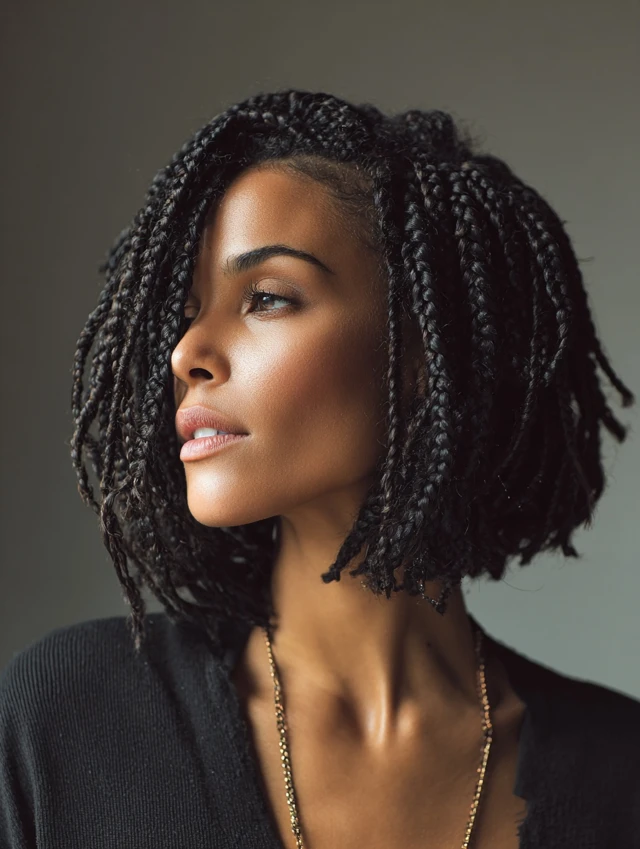
Source: forhairstylesinspo.com
A knotless bob that hits at the chin with textured, slightly tapered ends — a finish that makes short braids feel styled rather than simply short. The piece-y ends give the bob movement and a deliberate edge, and the chin length keeps everything above scarf lines. It’s playful, face-framing, and one of the fastest installs on this list. The same theme, explored from another angle, is in Stylish Summer Braids Hairstyle 2026.
Ask for a chin-length bob with the ends left slightly tapered so they fall with natural texture; a quick pass with hot water sets the shape. Styling is wash-and-go — the cut is the style. Wear is four to six weeks. The trade-off is the shaped finish’s lifespan: the textured ends relax over time and with washing, so the signature detail is crispest early on. A mid-wear hot-water reset of the ends brings it back.
Cornrows Pulled into a Long Braided Ponytail
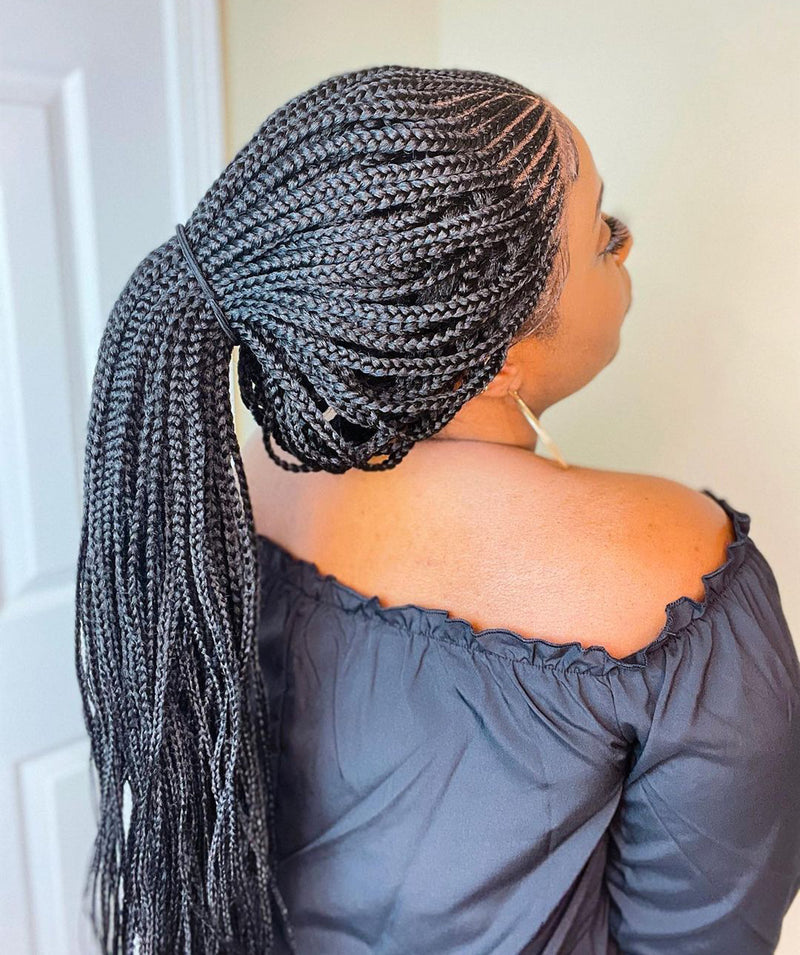
Via luxluxehair.com
Neat medium cornrows run straight back and gather into a long braided ponytail at the nape — maximum neatness with minimum fuss. The cornrows install quickly, the low pony keeps hair contained under coats and scarves, and the whole style has a sleek, athletic polish. It’s a strong pick for anyone who wants a protective style without a multi-hour appointment.
Ask for even medium cornrows — eight to ten across — braided into a ponytail with extensions for length, wrapped at the base. The style lasts two to three weeks looking sharp. The trade-off is tension and longevity: cornrows pull more per row than loose braids, and the ponytail’s weight adds to it, so this is a shorter-wear style and not ideal for tender heads or fragile edges on repeat.
Braided Space Buns with Curved Cornrow Parts
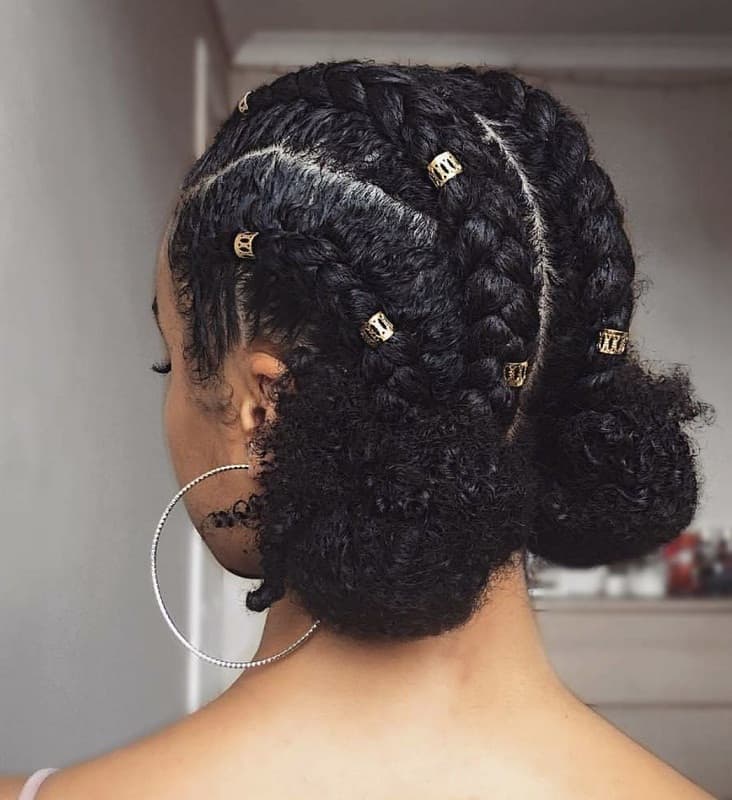
Courtesy of: hairstylecamp.com
Two high buns built from braids, set on curved cornrow partings — playful on top, precise underneath. The curved parts keep it from reading juvenile: it’s a deliberate, graphic style rather than a costume. High buns keep hair off the neck and collar, though they do sit where a beanie would — this is a hat-off style, best for indoors days or mild weather outings.
The foundation is cornrows curved toward two crown points, with the remaining braided hair wrapped into buns. Symmetry matters, so this needs a braider with a good eye. Wear is two to four weeks. The trade-off is placement: high buns and winter hats don’t mix, and sleeping in high buns is uncomfortable, so this is a daytime style that you’ll likely take down or re-pin nightly — factor that into whether it fits your routine.
Honey-Blonde Knotless Braids with Dark Roots

Photo credit: exploretrending.com
A full head of long knotless braids in a warm honey-blonde shade, with dark roots showing at the partings for a natural grow-out effect. The all-over blonde is bold — it brightens the face and pops against dark winter clothing — while the darker roots keep it from looking wig-like and buy time before regrowth becomes obvious. Knotless roots keep the install flat and comfortable under hats despite the dramatic length. Our Cornrow Hairstyles for 2025 rounds up more takes on this exact idea.
Ask your braider to use a honey or golden-blonde braiding hair throughout, keeping your natural root color visible at the base of each braid for the rooted effect. Blonde synthetic hair can feel slightly coarser than black, so a light leave-in helps the lengths stay soft. Wear is the standard four to eight weeks for knotless. The trade-off is upkeep of the color story: as roots grow, the contrast increases, so this style has a sweet spot in weeks two through six when the grow-out looks intentional rather than overdue.
Sleek Cornrow Low Bun with a Center Part
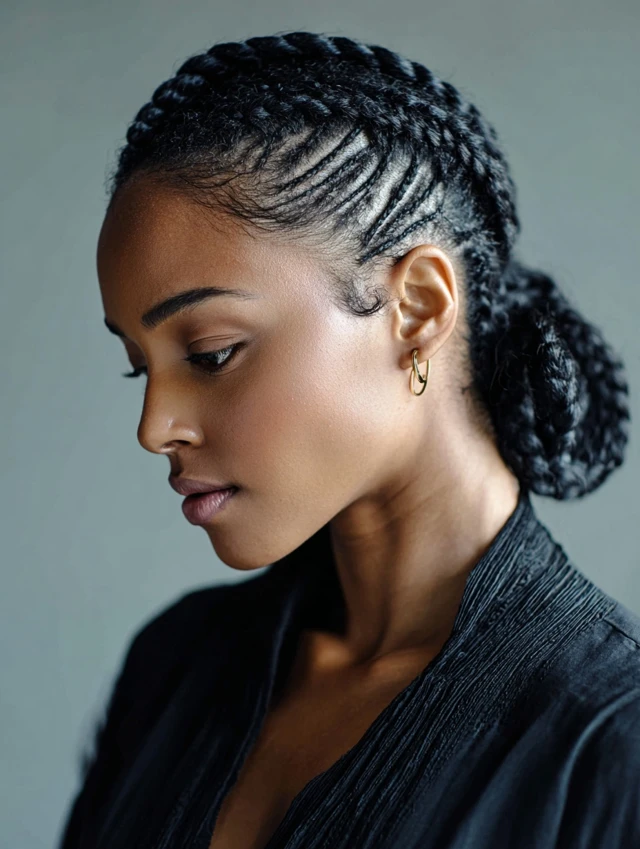
Image credit: yourstyleinspo.com
Cornrows flow back from a sharp center part into a smooth low bun at the nape — minimal, architectural, and endlessly wearable. The center part gives it symmetry and polish; the low bun keeps the silhouette clean under any coat or hat. This is the style for anyone who wants braids to read as refined rather than relaxed — it works for offices, events, and everything between.
The foundation needs to be immaculate: clean center part, smooth feed-in cornrows, and a neatly wrapped bun. Edge control should be light to avoid buildup along the part. Wear is two to four weeks. The trade-off is that simplicity shows everything — any regrowth, frizz or uneven part is immediately visible, so this style demands either a fresh install or acceptance of a softer finish after week two.
Half-Up Knotless Braids with a Wrapped Crown
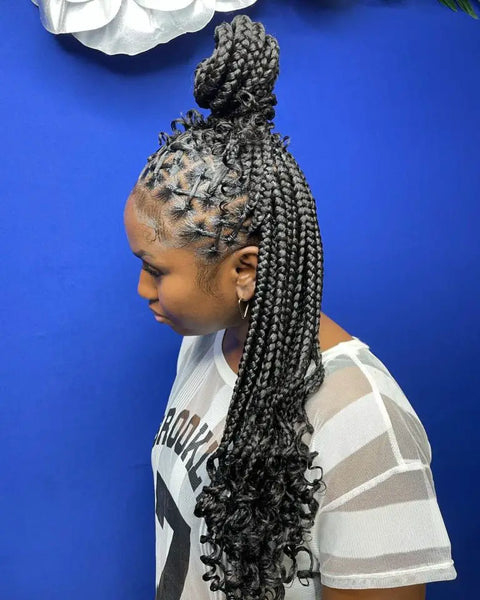
Source: jaliza.com
The top half of a knotless install is gathered into a crown and wrapped, while the bottom half flows free — the best of both worlds. You get the face-clearing practicality of an updo with the length and movement of wearing braids down, and the wrapped crown adds a finished detail that makes it event-ready. It’s also a good mid-wear refresh: when the front braids start looking tired, sweeping them up buys another week or two.
Gather the top section, twist or braid it back, and wrap it around its base, pinning underneath; leave the rest down. No special install needed — this is a styling option for any long knotless set. The trade-off is all-day hold: half-up styles loosen, especially on silky braiding hair, so carry a couple of pins for touch-ups, and know this works best on medium-density installs with enough hair to wrap a substantial crown.
## Conclusion
Across these 24 styles, the strongest winter choices share three traits: flat, comfortable roots that sit well under hats, ends that stay tucked or sealed against dry air, and a maintenance rhythm you can actually keep through the season. Knotless installs and low buns win on comfort; chunky braids and locs win on install speed and fullness; cornrow-based styles win on precision but ask for more frequent refreshes. Choose based on how long you want the style to last, how much nightly care you’ll realistically do, and whether your winter involves more beanies or more evenings out — then commit to the satin bonnet, because every style on this list lasts longer with one. You’ll find the same spirit in Short Fall Hairstyles Ideas.
## FAQ
**How long do winter braids for Black women usually last?**
Most braided styles last two to eight weeks depending on the technique. Knotless box braids and Senegalese twists typically go four to eight weeks; cornrow-based styles like stitch braids and lemonade braids usually look sharpest for two to four weeks, since regrowth shows faster on scalp-hugging styles.
**Are knotless braids better than traditional box braids for winter?**
Knotless braids start with your natural hair and feed extensions in gradually, so the roots lie flatter and there’s less tension at the hairline — a real advantage under beanies and during months when you want minimal manipulation. Traditional box braids with the knot at the root are sturdier and often cheaper to install, so the better choice depends on your edges and your budget.
**How do I keep braids moisturized in cold weather?**
Light, regular moisture beats heavy occasional treatments: a diluted leave-in spray or light oil on the scalp once or twice a week, ends sealed if they’re exposed, and a satin bonnet or scarf every night. Avoid heavy butters that build up on braids, and don’t skip wash day just because the style is protective — a diluted shampoo rinse every couple of weeks keeps the scalp healthy.
**Can I wear a beanie over braids without ruining them?**
Yes, with two precautions. Choose styles with flat roots — knotless braids, low buns, halos — so the hat doesn’t have to fight bulk, and always wear a satin-lined beanie or a satin scarf under a wool one, since wool wicks moisture and creates frizz through friction. High buns and tall topknots are the exception; they don’t fit under hats, so save those for hat-free days.
Final Thoughts
Across these 24 styles, the strongest winter choices share three traits: flat, comfortable roots that sit well under hats, ends that stay tucked or sealed against dry air, and a maintenance rhythm you can actually keep through the season. Knotless installs and low buns win on comfort; chunky braids and locs win on install speed and fullness; cornrow-based styles win on precision but ask for more frequent refreshes. Choose based on how long you want the style to last, how much nightly care you’ll realistically do, and whether your winter involves more beanies or more evenings out — then commit to the satin bonnet, because every style on this list lasts longer with one.
- Trim every six to eight weeks to keep the shape sharp.
- Use a heat protectant before every hot-tool session.
- Tone blonde or highlighted hair every six weeks to keep brassiness away.
- Match the upkeep schedule to your routine before committing to high-maintenance color.
The best color is the one that still looks intentional at week six.