A strong silhouette does most of the work in a costume. Before the accessories, before the face paint, before the candy bucket even enters the frame, it is the shape of the outfit against a doorstep or a darkening sky that makes someone pause. Halloween costumes for girls 2026 are leaning hard into that principle — structured wings, layered tulle, architectural headpieces, and fitted bodices that create recognizable outlines from twenty feet away. The shift is away from costumes that rely on a printed logo or a licensed mask to communicate the character, and toward designs where the form itself tells the story.
Choosing a costume with a strong silhouette means thinking about the body of the outfit first, not the extras. A layered skirt that moves well creates drama on its own. A fitted top with a single bold accessory — a horn, a hat, a pair of wings — gives structure without bulk. The practical question is always whether the child can sit, walk, climb porch steps, and carry a bag without the costume fighting them. The best designs this year answer that by building the visual impact into the garment itself, so nothing needs to be held, balanced, or constantly adjusted.
Dark Unicorn With Feathered Wings and Tulle Layers
The dark unicorn silhouette works because it stacks three distinct visual layers into a single readable shape: the vertical horn, the horizontal wing spread, and the volumetric tulle skirt. Each layer occupies its own zone — head, shoulders, waist down — so they reinforce rather than compete. The palette is monochromatic black, which means the eye tracks shape and texture instead of color. Curled two-tone hair adds a secondary rhythm without breaking the dark mood. The lace fingerless gloves and choker are small-scale details that reward a closer look, but the costume reads clearly from a distance purely on form.
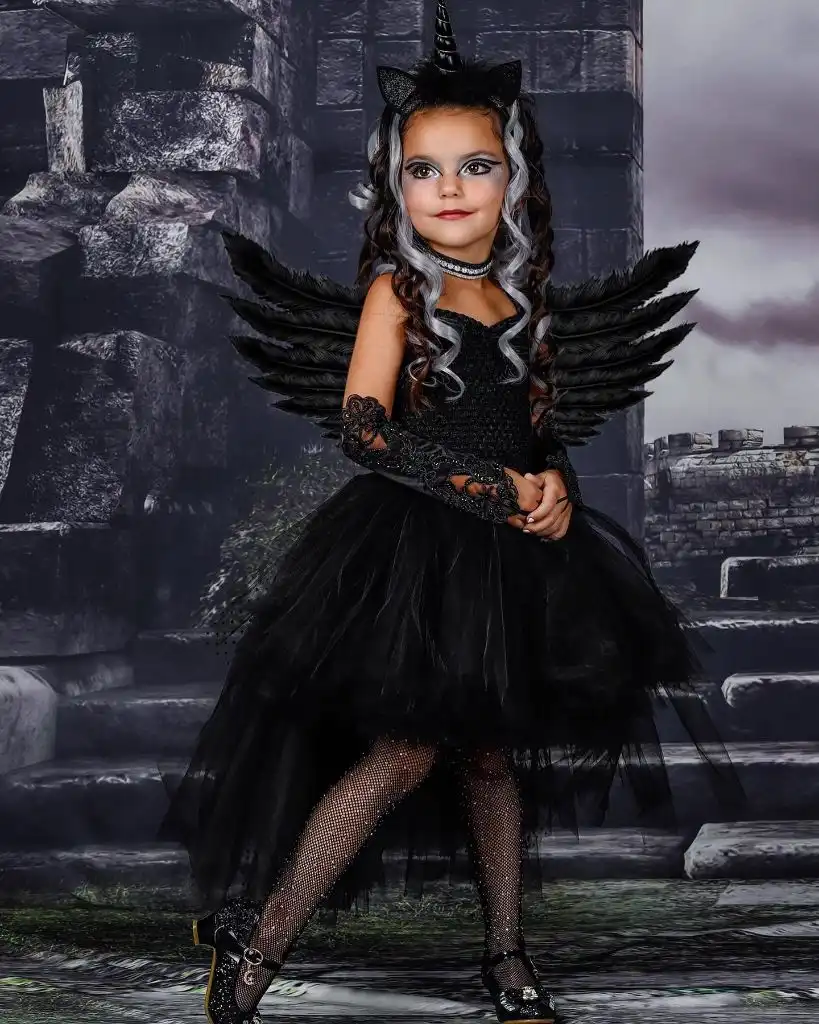
For a simpler version, skip the feathered wings and use a tulle cape instead — it preserves the shoulder-level drama without the bulk that can catch on doorframes or crowd against car seats. The fishnet tights with sparkle are a nice textural layer but can be swapped for plain black tights on cooler nights without losing the overall effect. If wear time is long, consider flat boots instead of heeled ones; the silhouette is strong enough from the waist up to carry the look regardless of footwear. The headband-mounted horn is a smart construction choice because it stays put without pins or spirit gum.
This costume demonstrates a useful design principle: when you limit your color palette to one tone, every structural decision becomes more visible. The tulle’s asymmetric hem, the feather direction on the wings, the glove texture — all of these register because there is no color contrast pulling attention elsewhere. A deep plum or midnight navy version would work nearly as well. The key is the discipline of the single-tone approach paired with varied materials. If you’re exploring more ways to coordinate looks around a focused visual concept, dark-toned costume accessories for layered styling can offer useful starting points.
Vintage Clown Ensemble With Striped Leggings and Miniature Top Hat
This costume builds its silhouette from contrasting proportions: an oversized polka-dot bow tie against a fitted splatter-print bodice, a ragged tulle skirt against structured striped leggings, and a miniature top hat perched against the natural volume of pigtails. The visual tension between order and disorder is what makes the vintage clown concept land. The suspenders add vertical lines that visually lengthen the torso, while the tulle puffs outward at the hip, creating a shape that is instantly recognizable as theatrical without being bulky. The red, black, white, and grey palette keeps it cohesive enough that the eye does not scatter.
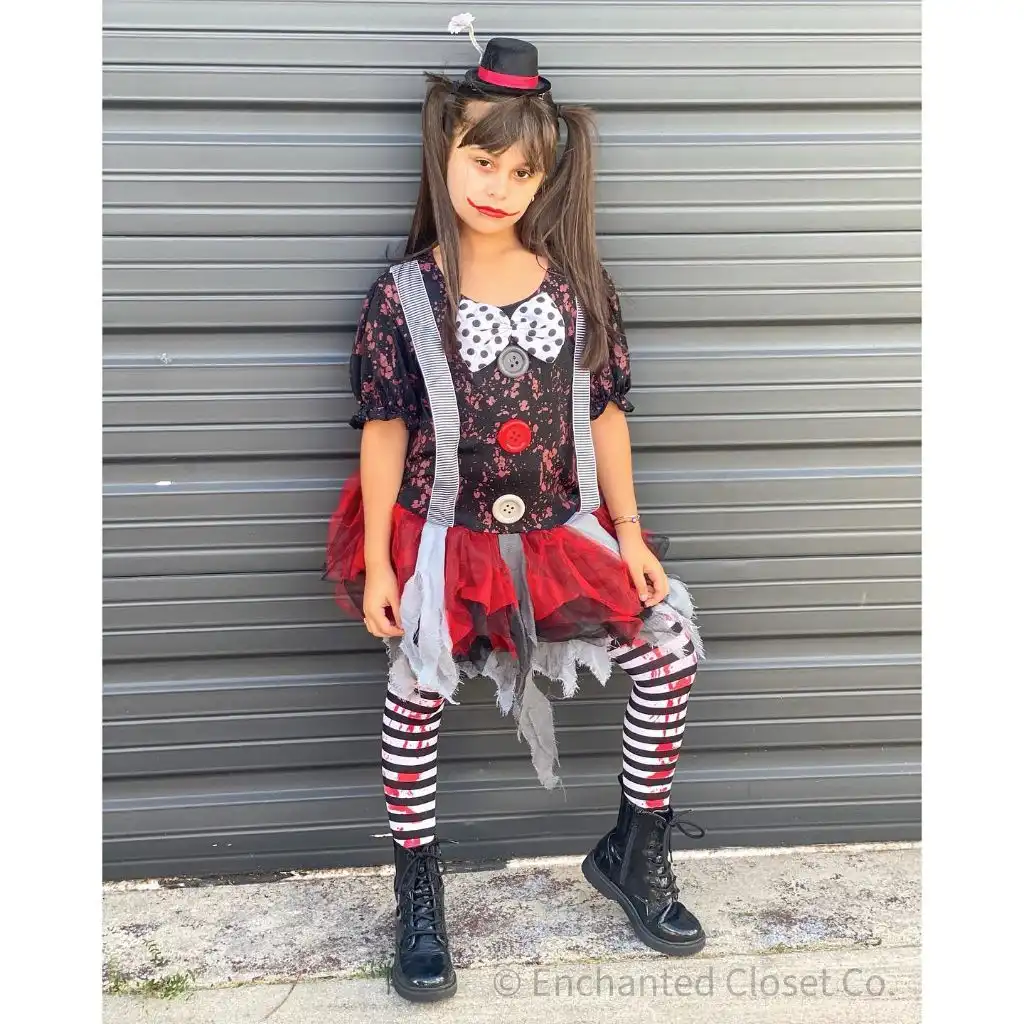
The miniature top hat can be secured with a comb clip or elastic, which matters because a child will forget it is there within minutes if it is stable. The splatter-paint effect on the shirt can be replicated at home with a plain black tee and a flick of white and red fabric paint — a fifteen-minute project that dries overnight. Striped tights are widely available in Halloween sections, but dance-supply shops often carry better-fitting versions with reinforced toes. The combat boots ground the look practically and visually, giving a solid base that handles sidewalks and grass equally well.
What makes this work as a silhouette is the push and pull between tight and loose, structured and tattered. The leggings cling. The tulle floats. The suspenders draw clean lines. The hem shreds into chaos. That contrast is the engine of the whole design — remove any one element and the tension drops. A similar principle applies to a scarecrow or a ragdoll variation: the readable outer shape stays distinct because the internal elements argue with each other in a controlled way.
Gabby’s Dollhouse Cat Costume With Ear Headband
Not every strong silhouette requires volume or layers. This costume proves that a clean, fitted, color-blocked outfit with a single statement headpiece reads just as clearly. The pink cat-ear headband is the focal point, and everything below it supports without competing: a striped metallic top, a coral cardigan, and solid blue pants. The proportions are relaxed and natural, which makes the costume comfortable for extended wear and immediately understandable as a character. The Gabby badge pinned to the cardigan is a small narrative detail, but the silhouette would still work without it.
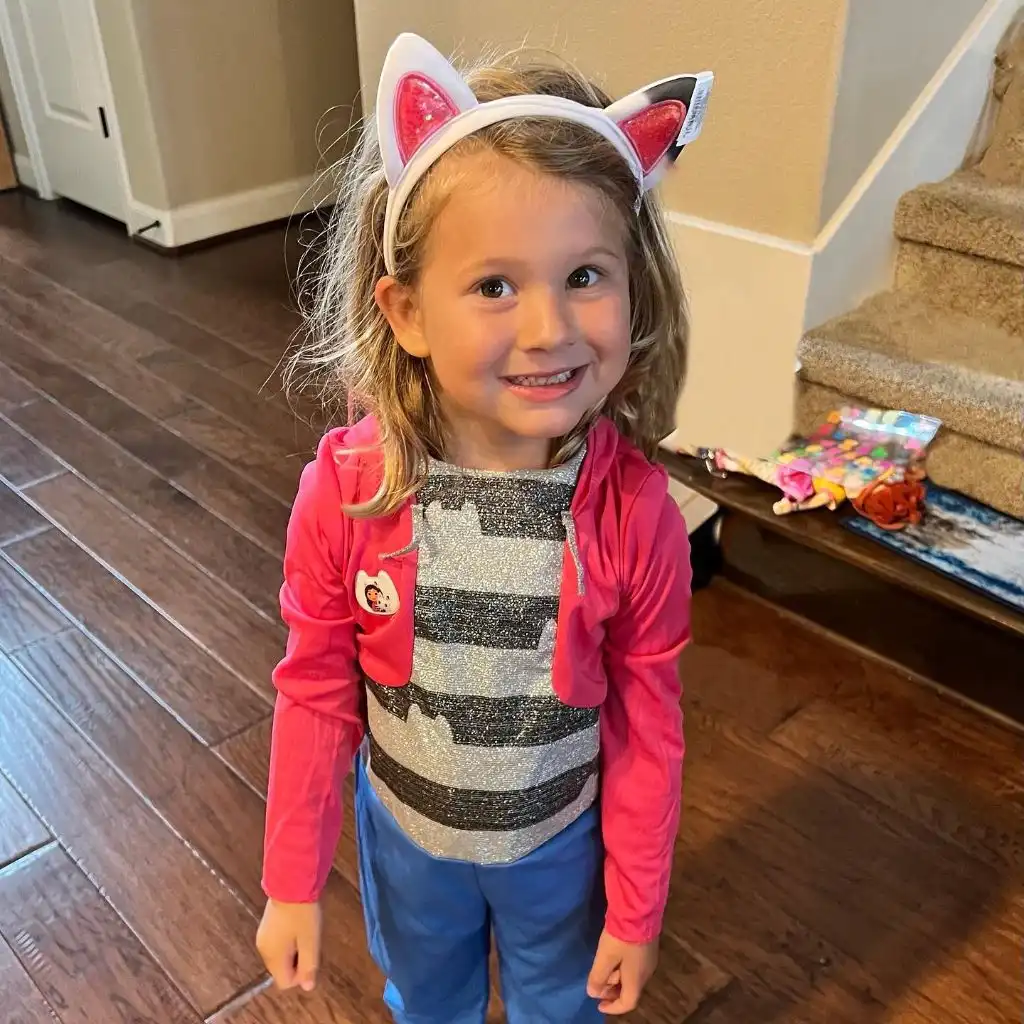
This is one of the most practical Halloween costumes for girls 2026 has to offer, because every piece is wearable clothing. The cardigan goes back in the closet the next day. The headband stores flat. There is nothing to trip on, nothing that catches wind, nothing that needs repair between houses. For younger children especially, this kind of build — real clothes assembled into a recognizable character — eliminates the struggle of getting into and staying in a traditional costume. If it gets cold, a jacket goes over the top without destroying the look.
The design principle here is economy. One strong accessory, placed at the highest point of the body, does all the character communication. The outfit below simply needs to be in the right color range. This approach scales well: a red headband with horns over a red outfit, a crown over a yellow dress, a witch hat over an all-black base. The lesson is that a silhouette does not need to be complex to be strong. It needs to be unambiguous.
Jack Skellington Pinstripe Suit With Oversized Head
Scale disruption is one of the most effective silhouette tools, and this Jack Skellington costume uses it perfectly. The oversized round head against the narrow pinstripe suit creates an immediately iconic proportion — top-heavy, slightly eerie, unmistakable from any angle. The black-and-white palette is as restrained as possible, which forces the shape to do all the storytelling. Skeleton-print gloves add detail at the hand level without complicating the clean line of the suit. The setting against a dusky sky with gravestones helps, but the costume would read just as well on a bright suburban sidewalk.
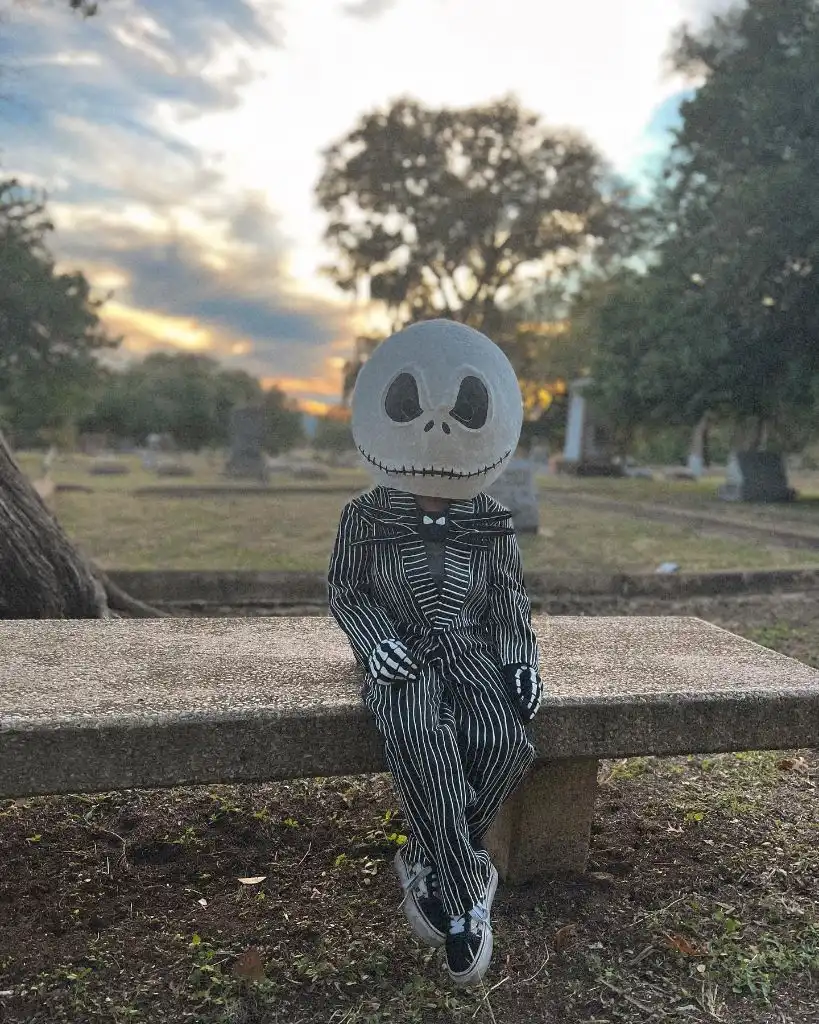
The oversized head is the hardest element to manage practically. Visibility and ventilation are the two concerns — look for versions with mesh-covered eye openings large enough for peripheral vision, and a chin opening or ventilation holes at the back to prevent overheating during a long trick-or-treat route. The pinstripe suit itself is essentially pajama-comfortable, which is a real advantage for younger wearers. Sneakers, as shown, are the right call; character shoes would add nothing and subtract mobility. If the large head becomes too cumbersome mid-evening, the suit alone with simple face paint continues the character just fine.
This costume is a reminder that proportion is its own language. An oversized element at the top of the silhouette reads as whimsical or surreal. The same suit with a fitted mask would feel entirely different — sharper, more sinister. The round head softens the whole composition. That is a transferable insight: any character with a disproportionately large head element — a pumpkin, a moon, a cartoon animal — gains an automatic friendliness that works well for younger children while still creating a commanding shape.
Super Mario Trio With Princess Peach in the Center
Group costumes often fail because the individual silhouettes blur together. This Mario, Luigi, and Princess Peach arrangement avoids that problem by giving the center figure a completely different shape language. The two flanking figures are vertical — overalls, caps, lean posture. The center figure is radial — a full pink tulle gown that pushes outward in every direction. The contrast between the straight lines and the sphere of fabric makes the grouping read instantly as a composition rather than three people standing next to each other. The color blocking is equally deliberate: green, pink, red, each fully saturated and occupying its own column of space.
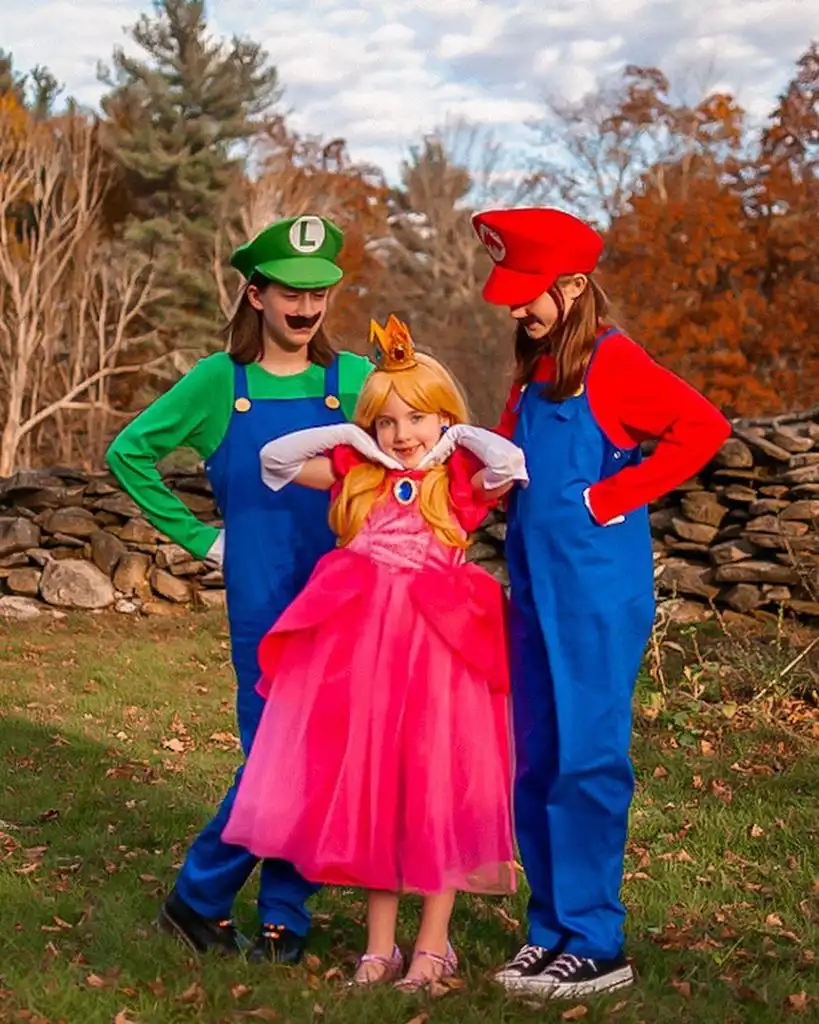
Princess Peach’s gown is the structural anchor of this group, and it needs enough volume to hold its shape through the evening. A petticoat or crinoline underneath keeps the skirt full without adding much weight. The blonde wig and crown are the character identifiers at the top of the silhouette. For the Mario and Luigi costumes, the key practical detail is the hat staying on — a chin strap or hidden elastic makes a significant difference over several hours. White gloves are a small addition that cleans up the hand silhouette and makes poses more theatrical. If the group wants to simplify, even just the hats and overalls over colored long-sleeve shirts would communicate the characters.
The compositional lesson here applies beyond group costumes: placing a round or voluminous shape between two linear ones creates a natural focal point. The eye goes to the difference. This is why a ball gown in a lineup of suits catches attention, why a circle in a row of squares reads as the subject. When planning a group, assign one person the expansive silhouette and let the others frame it.
Ninja Warrior With Red Accents and Face Mask
The ninja silhouette is inherently strong because it eliminates everything unnecessary. This version uses a black base with red piping to define the edges of each garment piece, creating an outline within the outline. The face mask removes the lower half of the face from the composition, which forces the eyes to become the focal point — a simple but effective visual narrowing. The wide belt with metallic detailing adds a horizontal break at the waist, giving the eye a place to rest between the hooded top and the loose pants. The pose, with one arm extended, shows how a costume designed for movement looks best when the wearer actually moves.
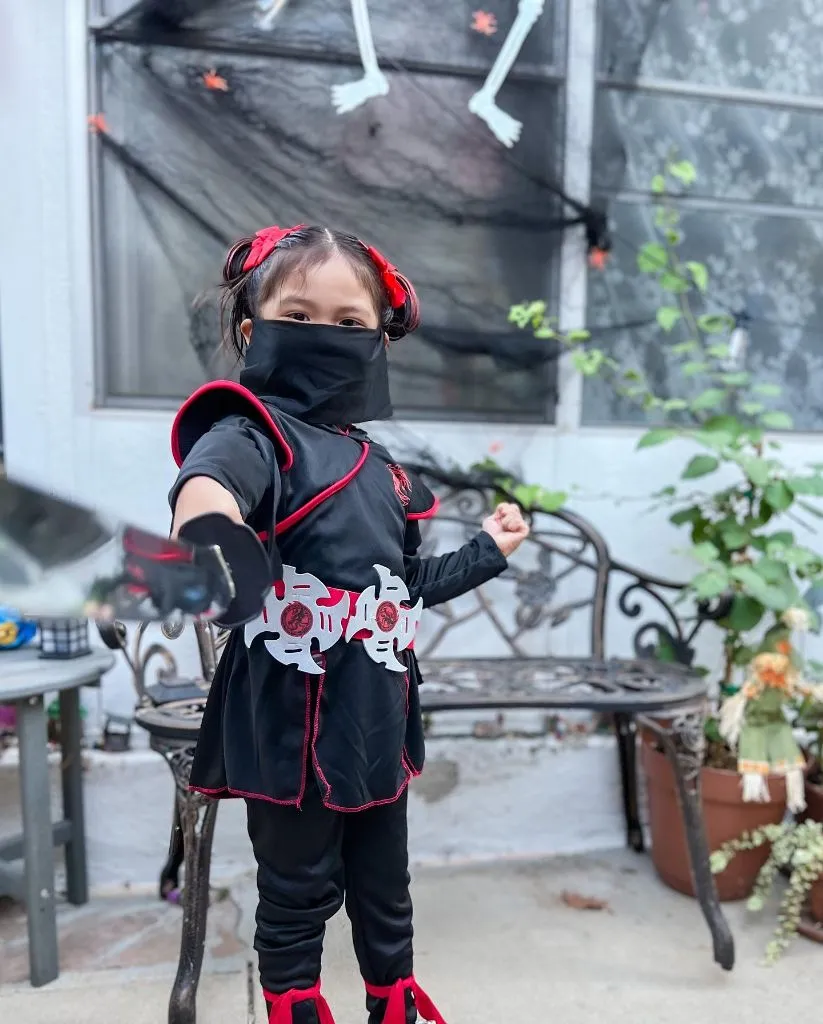
The face mask is the element most likely to be removed halfway through the evening, so the costume should still work without it. This one does — the hooded vest and belted tunic create enough character on their own. The red-soled shoes are a nice design echo of the red piping throughout, and flat-soled martial arts shoes or sneakers in black or red would serve the same function. For warmer climates, the long sleeves under the vest can be swapped for short sleeves without losing the layered look. The belt is the most visually important accessory piece; keep it even if everything else gets simplified.
What makes the ninja work as a Halloween costumes for girls 2026 option is that it is entirely about shape and attitude rather than ornamentation. There are no sequins, no tulle, no glitter. The impact comes from clean lines, a covered face, and a confident stance. That restraint is itself a design statement, and it stands out precisely because so many other costumes go in the opposite direction. A similar principle applies to spy, assassin, or martial artist costumes — the power is in what is hidden and streamlined, not what is added.
Monarch Butterfly With Orange Tutu and Antennae
This butterfly costume demonstrates how a small, well-proportioned design can hold its own against much larger ensembles. The black velvet top and orange-and-yellow tutu create a warm-to-dark color gradient that mimics actual monarch wing patterning without being literal about it. The pom-pom antennae on the headband are the top-of-silhouette identifier, and the butterfly wand extends the wing motif into the hand without requiring actual wings strapped to the back. The fuzzy black shoe accents repeat the texture of the velvet top, creating a visual frame from head to feet.
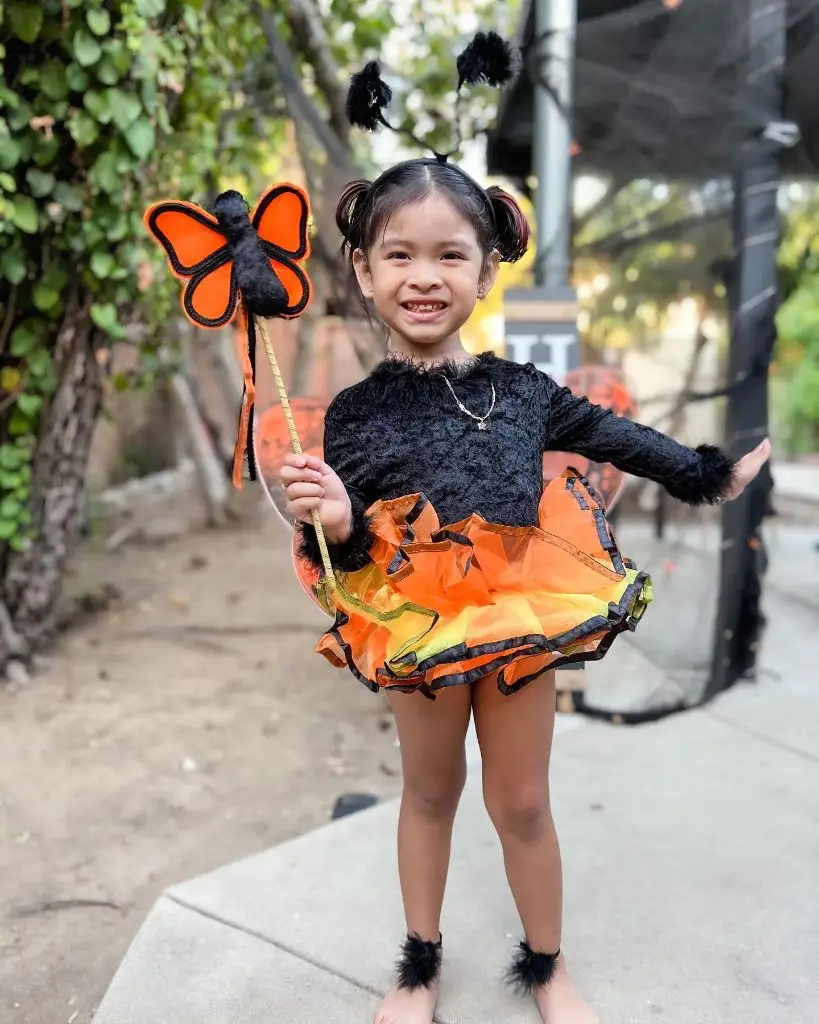
Skipping the strap-on wings is a smart choice for a young child who will be climbing in and out of a car, reaching into candy bowls, and potentially being carried. The tutu does the color work that wings would normally handle, and it takes up less space. If wings are desired, soft fabric wings on elastic loops are more forgiving than rigid wire-frame versions. The wand gives the child something to hold, which at this age is often comforting and keeps hands occupied. The entire costume is soft — no hard edges, no sharp pieces, no choking hazards — which matters for the youngest trick-or-treaters.
The design principle is biomimicry interpreted through costume materials. The orange and black palette, the fuzzy textures, the antennae shape — all of these reference the monarch butterfly without attempting a realistic reproduction. That abstraction is what makes it a costume rather than a nature exhibit. It also makes it more versatile: change the tutu to purple and green and the same structure becomes a dragonfly, or swap to red and black for a ladybug. The silhouette template — fitted dark top, colorful tutu, themed headband — is endlessly adaptable.
Pennywise and Georgie Duo From “IT”
Horror duos work best when the two silhouettes are in direct opposition, and this Pennywise-and-Georgie pairing gets that exactly right. Pennywise is layered, ruffled, pale grey, and deliberately oversized in the collar and sleeves. Georgie is simple, fitted, bright yellow, and small in every proportion. The red balloon, held between them, is the connective element — the single color that exists in both of their visual worlds. The face paint on Pennywise transforms the upper silhouette from human to something else, while Georgie’s clean face and concerned expression provide the contrast that makes the horror legible.
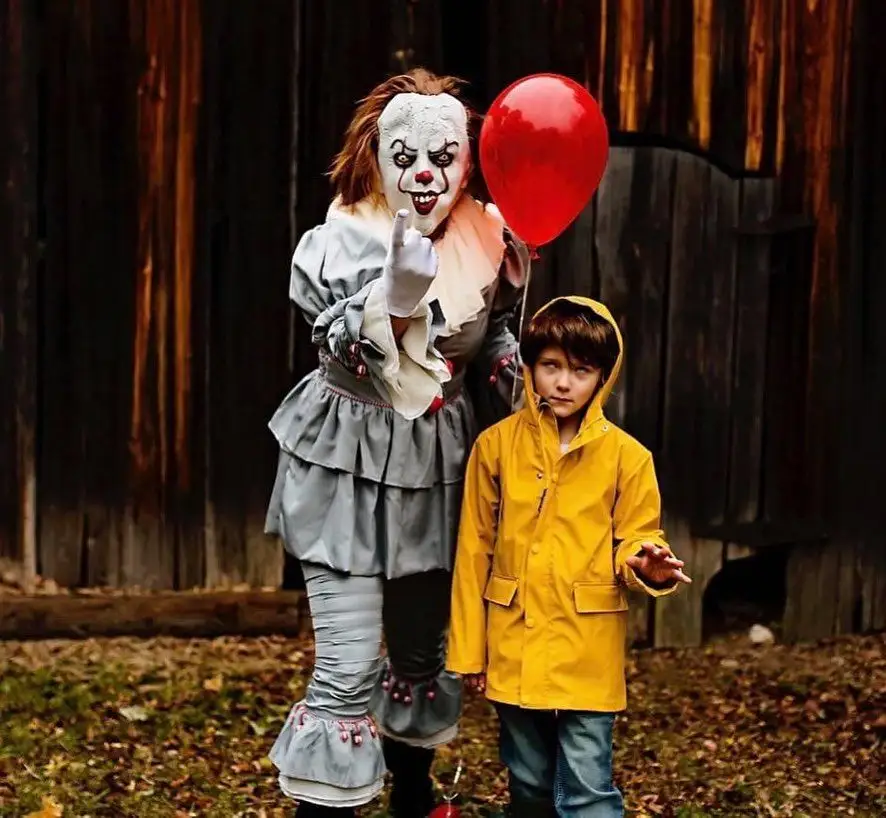
Georgie’s costume is functionally just a yellow rain slicker, which makes it one of the easiest and most weather-appropriate Halloween builds possible. If it actually rains, the costume improves. Pennywise requires more construction — the ruffled collar, the period-style clown suit, the face paint — but a pre-made version handles the structural work and leaves only the makeup to manage on the night. The balloon should be helium-filled and tied to the wrist to free up hands. For safety, bring a spare balloon; one will likely pop before the end of the evening.
The reason this duo creates such a strong visual impact is the narrative tension embedded in the silhouettes themselves. One figure is predatory — large, elaborate, advancing. The other is vulnerable — small, plain, retreating. You do not need to know the source material to read that story from across a parking lot. That narrative legibility is the highest achievement of costume silhouette design: when the shape tells you how to feel before your brain identifies the character.
Monster High Duo With Metallic Fabrics and Pink Hair
Character duos from the same franchise can easily blur into visual sameness, but this Monster High pairing avoids that by splitting the palette and the material language. One figure is emerald green with metallic sheen and horizontal banding — structured, reflective, cool-toned. The other is hot pink and burgundy with mesh sleeves and a beaded bodice — textured, warm-toned, and slightly more organic in line. The hair treatments are similarly opposed: structured buns with bows versus a sleek ponytail with a vivid color streak. Standing together, they form a complementary pair that covers more visual ground than either would alone.
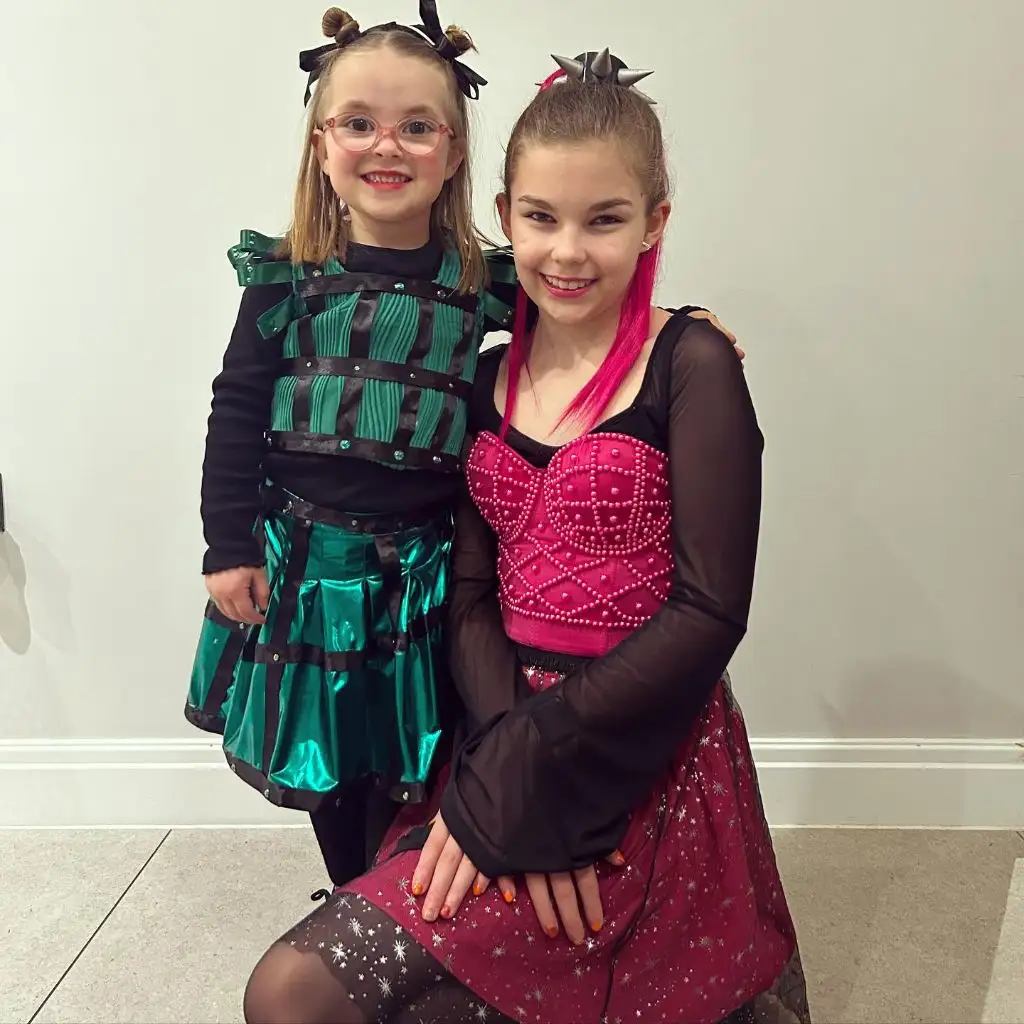
Metallic fabrics look impressive but can be stiff and warm to wear. Choosing a metallic that has some stretch or is layered over a jersey base will help with comfort over several hours. The hot pink hair extension can be a clip-in rather than a full wig, which reduces itching and stays put through movement. The glasses on the green-costumed figure are a clever character detail that also serves a practical function if the wearer actually needs corrective lenses. If simplifying, the core of each costume is really the color plus the hair — get those right and the rest can be improvised from closet basics.
The underlying principle is chromatic opposition within a shared aesthetic universe. Both costumes are clearly from the same world — they share a fashion-forward, slightly punk sensibility — but they occupy opposite ends of the color wheel. Green and pink are near-complements, and placing them side by side creates a vibration that draws the eye. This is a reliable strategy for any duo costume: agree on the aesthetic, then split the palette. It works for superheroes, fairy tale characters, or any franchise with multiple characters.
Wednesday Addams in Victorian Mourning With Parasol and Veil
The Wednesday Addams silhouette has been reinterpreted every year for decades, but this version pushes it into full Victorian mourning dress and gains something genuinely haunting in the process. The long braids, the veiled hat, the parasol, the platform boots — every element extends the vertical line while adding a layer of concealment. The face behind the veil becomes a suggestion rather than a feature, which is unsettling in the way that good Halloween design should be. The pinstripe vest over a sheer high-neck blouse adds a masculine tailoring element that complicates the otherwise gothic-feminine silhouette.
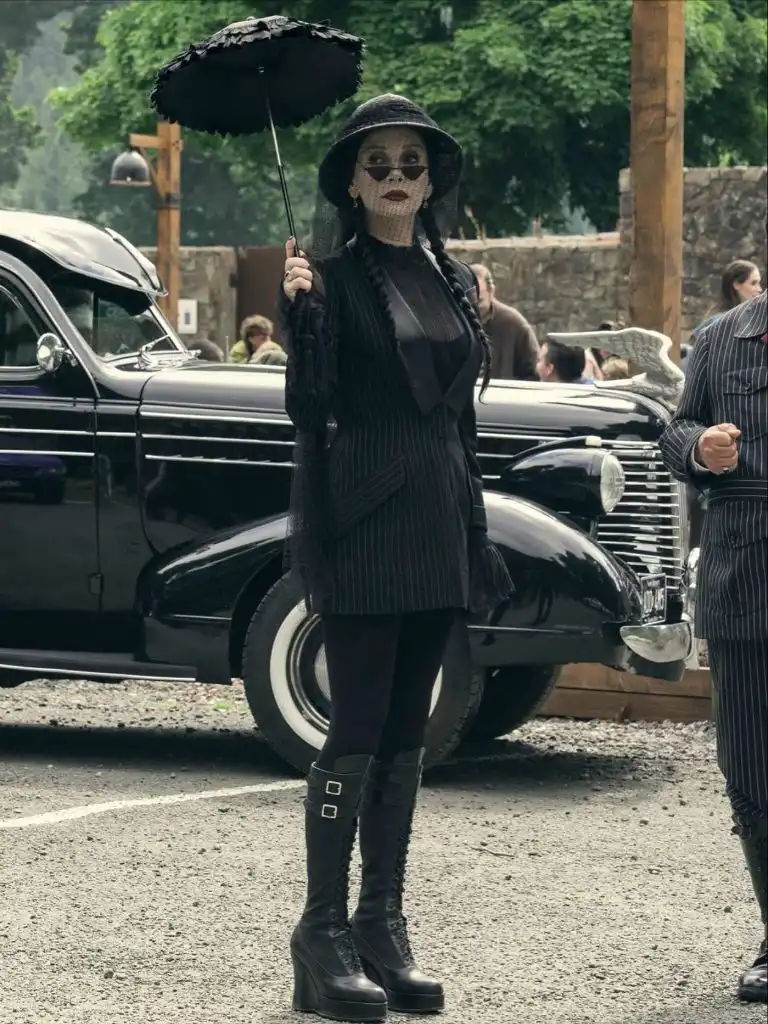
The parasol is a beautiful prop but requires one free hand at all times, which means the candy bag goes in the other hand and there is nothing left for a flashlight or a parent’s hand. Consider whether the parasol is for photos only or for the full evening, and plan accordingly. The platform boots add height and drama but may be challenging on uneven ground — a low-heeled Victorian boot achieves a similar period look with better stability. The veil can be pinned up when visibility becomes an issue after dark. This is a costume that benefits from being slightly simplified as the evening progresses, shedding layers while remaining in character at each stage.
The design insight here is that concealment is a form of elaboration. Covering more skin, adding a veil, holding a parasol that shadows the face — all of these subtractive gestures paradoxically make the costume more complex and more compelling. The figure reveals less and the viewer projects more. That dynamic is the heart of gothic fashion generally, and it translates perfectly to Halloween. For anyone drawn to this aesthetic, Victorian-inspired styling with dark palettes and layered accessories offers a rich territory to explore beyond a single evening.
Pastel Unicorn and Cowgirl Best-Friend Pair
This pairing works because the two costumes share almost nothing visually and yet feel perfectly calibrated as a pair. The unicorn is pastel, iridescent, layered in tulle, and topped with a horn and floral crown — ethereal and vertical. The cowgirl is pink gingham, cow print, hot pink tulle, and a wide star-studded hat — bold, patterned, and wide. Together they cover the entire range from delicate to assertive, from cool pastels to warm pinks. The matching energy of the pose — both leaning in, both grinning — does the work that matching costumes usually do, but without the visual monotony.
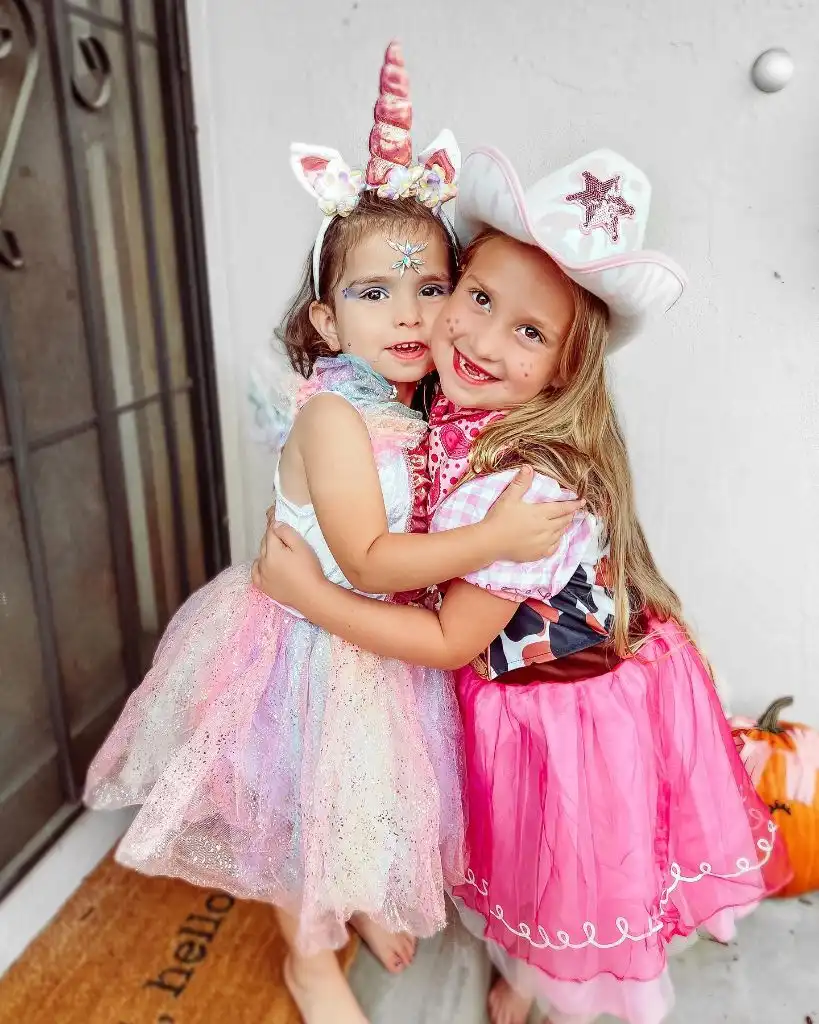
The unicorn headband with a horn and ears is lightweight enough to stay on all evening, and the face gems add sparkle without the mess of loose glitter. The cowgirl hat needs to be sized carefully — too large and it falls over the eyes, too small and it perches awkwardly. A hat with a chin cord, even a decorative one, prevents loss. Both costumes here use tulle skirts as their volume element, which creates an unexpected visual rhyme between the two despite their different color stories. For warmth, a white or pastel long-sleeve tee under the unicorn dress and a denim jacket over the cowgirl top both work without breaking character.
The principle at play is complementary contrast within a shared emotional register. Both costumes are joyful, colorful, and age-appropriate. Neither is trying to be scary. But they are visually opposite enough that standing together creates a more interesting composition than either would alone. This is a useful framework for best-friend costumes: match the mood, not the look. Let each person express a different visual idea within the same emotional tone, and the pairing will feel intentional without feeling forced.
Scarlet Witch Cosplay With Glowing Orb Prop
Props that produce their own light change the way a silhouette reads after dark, and this Scarlet Witch costume leverages that effect with a glowing orb held at chest height. The orb casts red-orange light upward onto the face and the tiara, creating a dramatic under-lighting that transforms the upper body into something genuinely cinematic. The dark red bodysuit and cape are the structural silhouette, but the light is the event. Without the orb, this is a well-made cosplay. With it, it becomes a photograph.
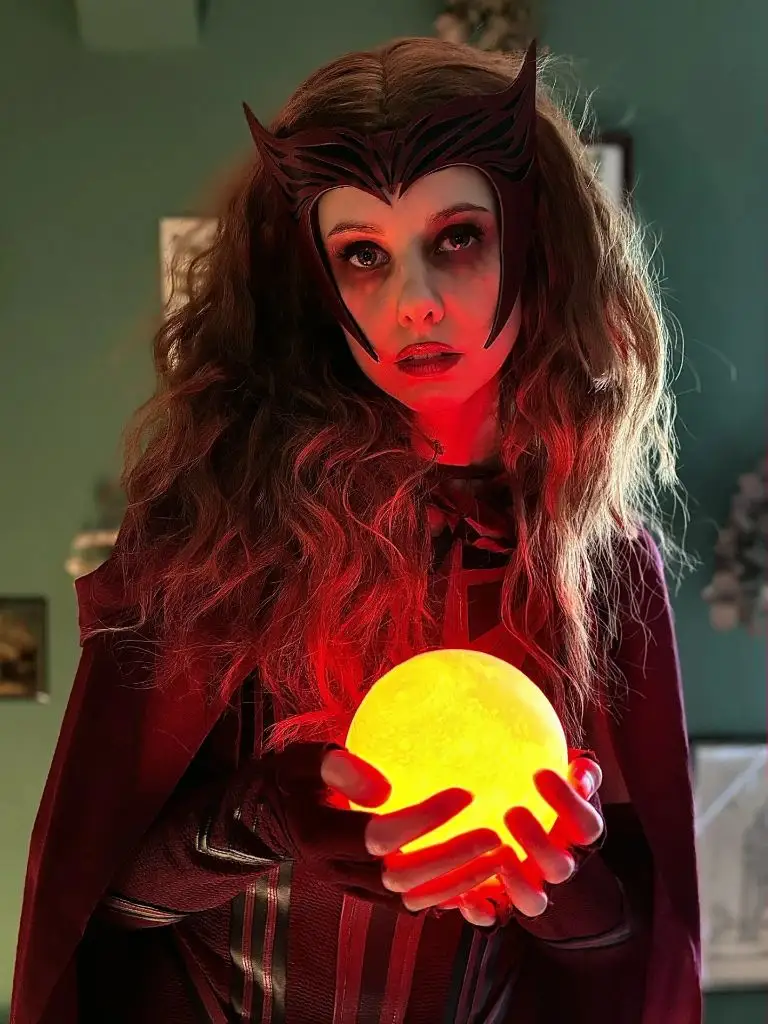
The glowing orb is likely a moon lamp or a color-changing LED sphere, both of which are inexpensive and available in multiple sizes. Choose one that fits comfortably in both hands and has a warm-to-red color setting. Battery life should be checked in advance — a lamp that dies at 7:30 PM loses the costume its defining feature. The tiara can be made from craft foam and spray-painted, or purchased pre-made from cosplay suppliers. The wig should be secured with a wig cap and pins, especially if the evening involves any wind. The cape needs to be short enough not to drag on wet ground.
This costume illustrates how a single prop can restructure an entire silhouette. The orb creates a bright center point that anchors everything around it — the hands frame it, the cape frames the hands, the tiara frames the face above. It is a concentric composition, like a target, and the eye goes directly to the center. Any costume that incorporates a light source — a lantern, a wand with LEDs, a glowing staff — gains this same compositional advantage after sunset. The practical takeaway is that Halloween is an evening event, and designing for how a costume looks in the dark is at least as important as how it looks in daylight.
Green Fairy With Flower-Covered Bodice and Matching Wings
The fairy costume is one of the most common Halloween costumes for girls 2026 will see, which means the execution has to be specific to stand out. This version succeeds by committing fully to a single color family — green and white with purple floral accents — and by covering the bodice in three-dimensional flowers rather than relying on printed fabric. The flowers give the torso real texture and depth that catches light differently as the wearer moves. The wings are translucent and positioned to frame rather than overwhelm the body, and the matching wand extends the butterfly motif into the hand.
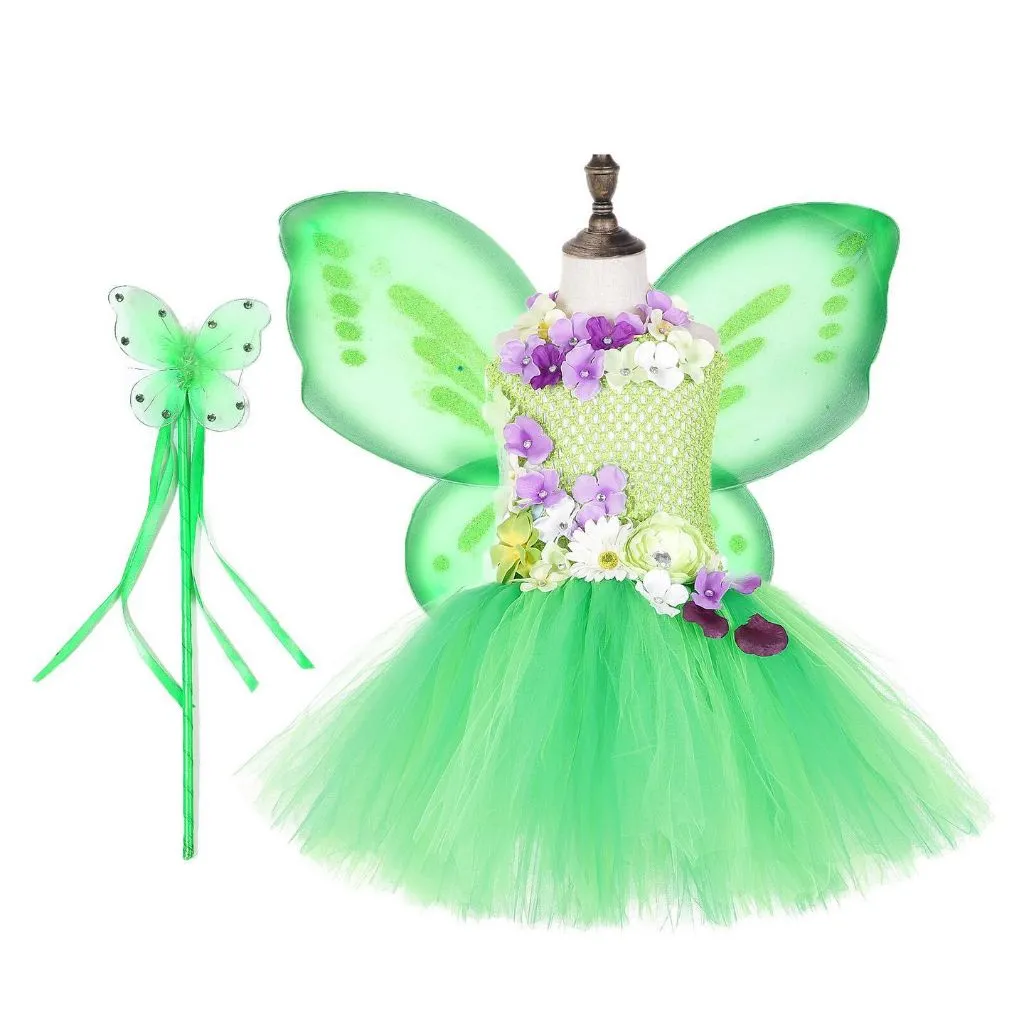
This costume set appears to be a tutu dress with attached or separate wings, which simplifies dressing considerably — one piece on, wings clipped, wand in hand, done. The flowers on the bodice should be checked for secure attachment before wearing; a few drops of fabric glue on any loose petals prevents a trail of flowers down the sidewalk. The tutu length here is mid-thigh, which allows full range of movement for climbing, running, and sitting. For cooler weather, green tights and a long-sleeve green tee underneath maintain the monochromatic effect while adding warmth.
The design success here is textural commitment. Flat fabric says “costume.” Three-dimensional embellishment says “character.” The flowers make this look like something that grew rather than something that was sewn, and that organic quality is what separates a memorable fairy costume from a generic one. The same principle applies to any nature-themed costume: adding real or realistic dimensional elements — mushrooms, leaves, moss, bark textures — transforms the surface from flat to inhabited.
Blue Celestial Witch With Moon-and-Star Dress
This witch costume replaces the standard black-and-green palette with deep blue and gold, and the result is a silhouette that reads as more celestial than sinister. The dress uses a black base with blue satin overlay panels printed in moons and stars, and the matching hat echoes the same motifs. The layered skirt — blue satin over black tulle — creates a graduated hem that adds visual interest below the waist. The buckle detail on the hat is a nice period touch that grounds the fantasy in something vaguely historical.
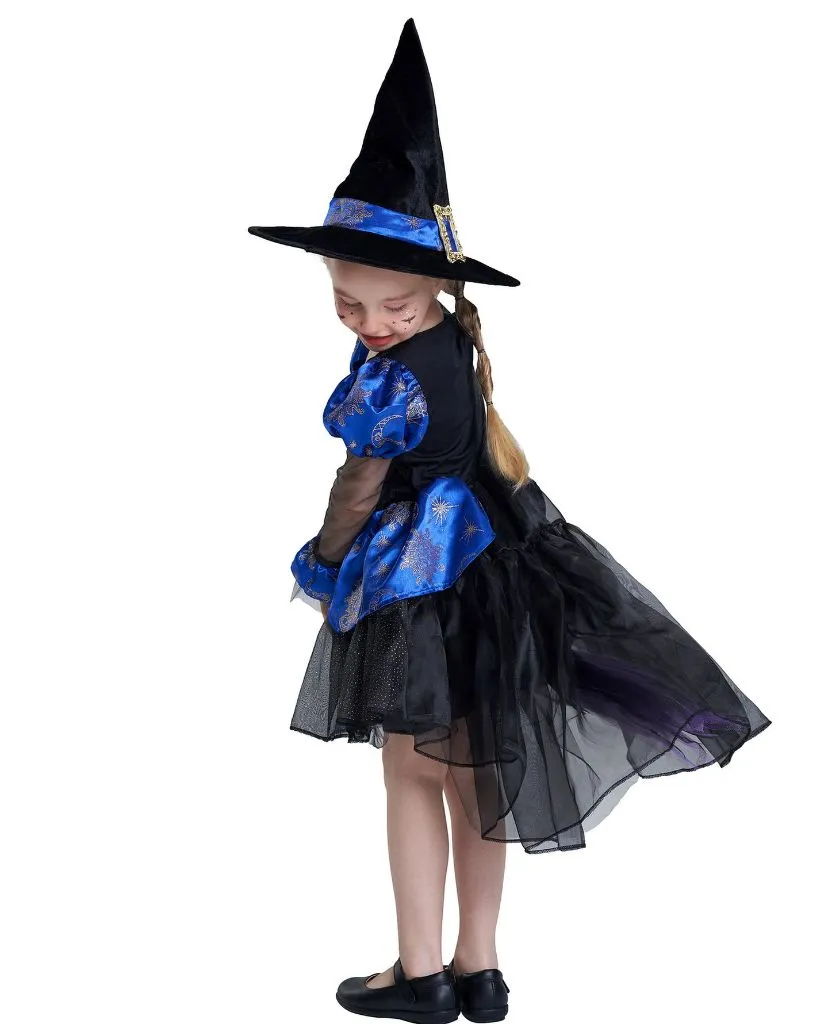
The hat is the most important element to get right, and it should sit firmly without sliding. A headband sewn into the interior brim is the most reliable method. The puffed sleeves add shoulder width, which balances the wide hat brim and prevents the costume from looking top-heavy. The black flat shoes are the right choice — they disappear into the lower silhouette and let the skirt be the focus. For a slightly older wearer, adding a wand or a spell book would extend the character without changing the structural balance.
The color substitution from traditional witch black to celestial blue is an example of how palette alone can rewrite a costume’s emotional register. Black witch reads as spooky. Blue witch reads as mystical. Purple witch would read as regal. The silhouette is identical in each case — pointed hat, fitted bodice, full skirt — but the feeling shifts entirely with the hue. This is a low-effort, high-impact strategy for anyone who likes a classic shape but wants a less conventional mood.
Blue Stargazer Witch With Oversized Bow Hat and Lolita Styling
When costume design borrows from fashion subcultures, the result often carries more visual weight than either source would alone. This stargazer witch draws from Japanese Lolita fashion — the ruffled hem, the buttoned bodice, the tights with celestial print — and layers it with a fantasy witch archetype through the oversized bow-trimmed hat and vivid blue wig. The gold accents on the bow, buttons, and star-patterned tights create a secondary metallic rhythm that ties the upper and lower body together. The overall silhouette is narrow at the shoulders and wider at the hat and hem, creating a diamond shape that is unusual and immediately arresting.
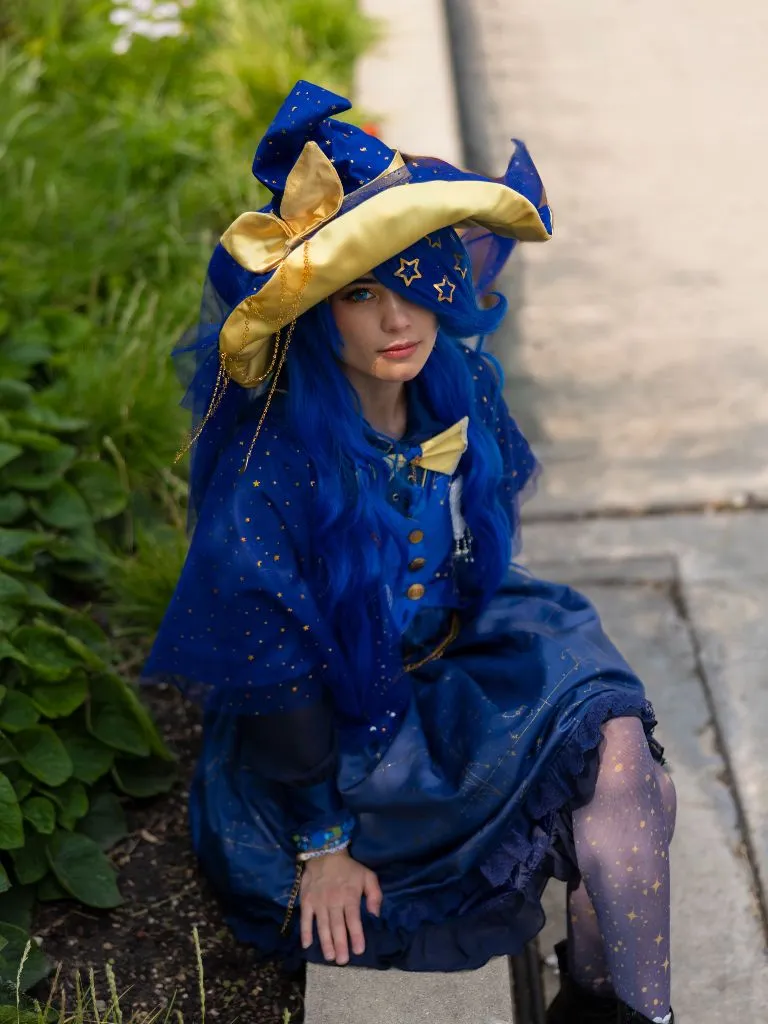
A full wig in a saturated color is the most transformative single element in this build, and it is worth investing in one with an adjustable cap and heat-resistant fibers that hold a style. The hat can be constructed from stiffened fabric over a wire frame, or sourced from cosplay vendors who specialize in oversized headwear. The tulle cape with gold star print is a layering piece that adds volume in photos but can be removed for practical moments without losing the character. The star-print tights are the kind of detail that elevates the entire lower half from generic to considered.
The principle here is cross-pollination between costume and fashion subculture. Lolita styling provides the construction quality, the attention to detail, and the silhouette discipline. The witch archetype provides the narrative and the permission to be fantastical. Together they produce something that looks designed rather than assembled, which is the difference between a costume someone wears and a costume someone inhabits. For anyone willing to invest the construction time, this hybrid approach produces results that feel genuinely original.
Cottagecore Witch With Quilted Hat and Herbal Basket
The cottagecore aesthetic has been filtering into Halloween costume design for several seasons now, and this version is one of the most fully realized interpretations. A patchwork quilted witch hat, an embroidered sherpa-lined jacket, a flowing plum dress, and a woven basket — the silhouette is soft, rounded, and warm rather than angular or threatening. The broom is handmade with dried flowers woven into the bristles, which commits to the aesthetic down to the props. The entire palette is autumnal and muted: plum, cream, dusty pink, brown.
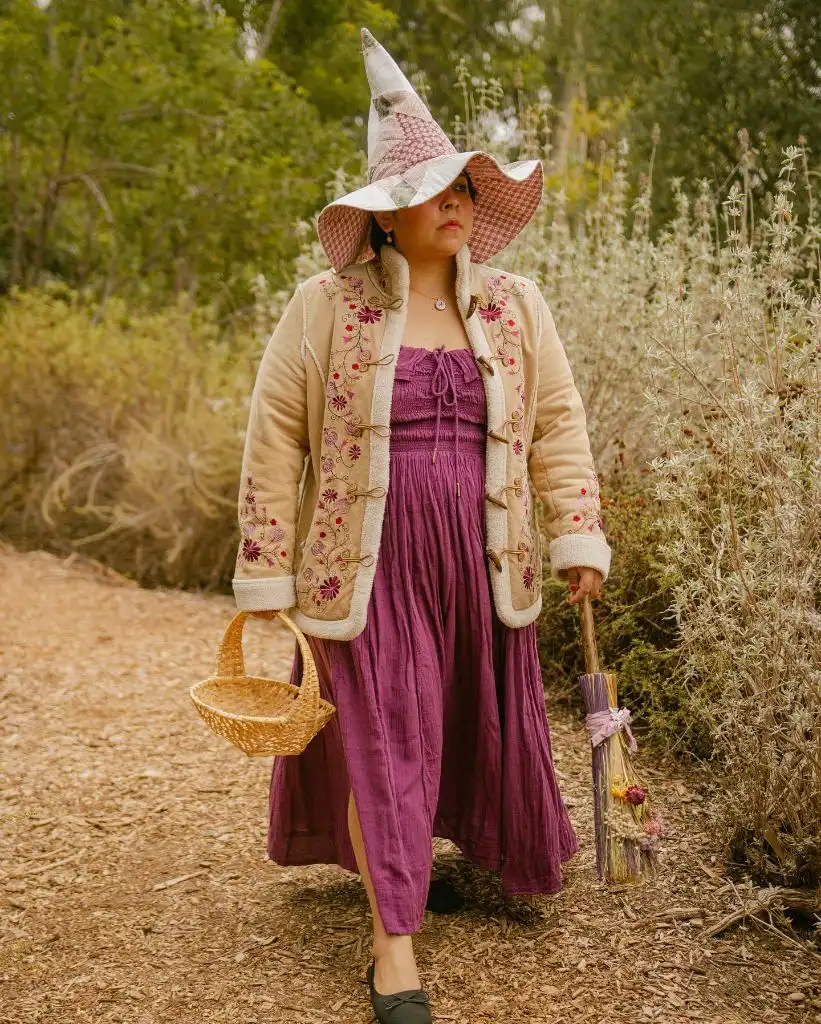
Every piece of this costume can be sourced from a thrift store and a craft bin, which makes it one of the most accessible builds on this list in terms of budget. The quilted hat can be sewn from scrap fabric or an old quilt square, stiffened with interfacing to hold its point. The dress is simply a maxi dress in a deep tone. The jacket is the layering piece that adds both visual and literal warmth, which makes this costume naturally suited to cooler climates. The basket holds candy, which means no separate trick-or-treat bag is needed — a functional elegance that most costumes lack.
The insight is that a strong silhouette does not require drama. This costume is quiet, gentle, and grounded, and it reads just as clearly as a dark unicorn or a Scarlet Witch because every element agrees with every other element. There is no single show-stopping piece. Instead, the strength is in the coherence — everything says the same thing, and the cumulative effect is more powerful than any individual component. For anyone who prefers warmth and softness to edge and spectacle, this is the template.
Forest Elf With Knit Cardigan and Prosthetic Ears
Cosplay-grade prosthetic ears paired with everyday clothing is a costume strategy that creates an uncanny, quietly fantastical effect. This forest elf wears a long variegated knit cardigan over a lavender peasant dress, with a crown of purple flowers and pointed ears that extend the head silhouette laterally. The color palette — green, blue, purple, lavender — mimics a forest at the edge of twilight. The knit texture of the cardigan gives the outfit a handmade, lived-in quality that commercial elf costumes rarely achieve.
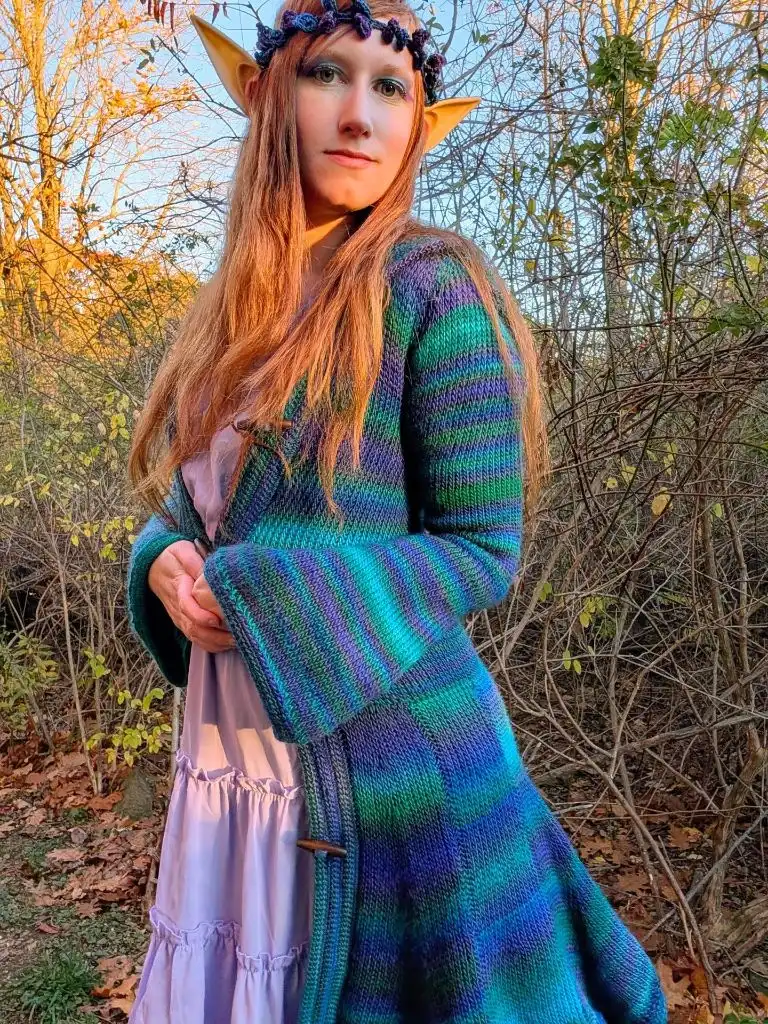
Prosthetic ears are attached with spirit gum or medical-grade adhesive, and they should be tested a day in advance to check for skin sensitivity. The knit cardigan is a real garment that can be worn year-round, which makes this a cost-effective build — the only Halloween-specific purchases are the ears and the flower crown. The dress is any lightweight cotton or rayon maxi in a soft color. For a child version of this costume, the prosthetic ears can be replaced with ear-shaped headband attachments, which are easier to manage and equally effective at a distance.
The principle is subtlety as a silhouette strategy. The ears extend the width of the head by only a couple of inches, but that small change registers as deeply wrong to human pattern recognition, which expects a smooth curve from temple to jaw. That subtle disruption is more psychologically effective than a full mask or heavy makeup, because it sits in the uncanny valley between human and other. This is advanced costume thinking — not louder, but stranger.
Mushroom Forager With Sculptural Cap and Corset
This costume commits to a single sculptural element — the enormous mushroom cap hat — and builds everything else around it in support. The green corset and cream bloomers are period-adjacent without being tied to a specific era, and the leather boots ground the look in something functional. The lantern in one hand and the book in the other are narrative props that imply a character with a purpose: someone going somewhere, doing something, not just standing in a costume. The forest setting reinforces the concept, but the costume would read correctly on any sidewalk.
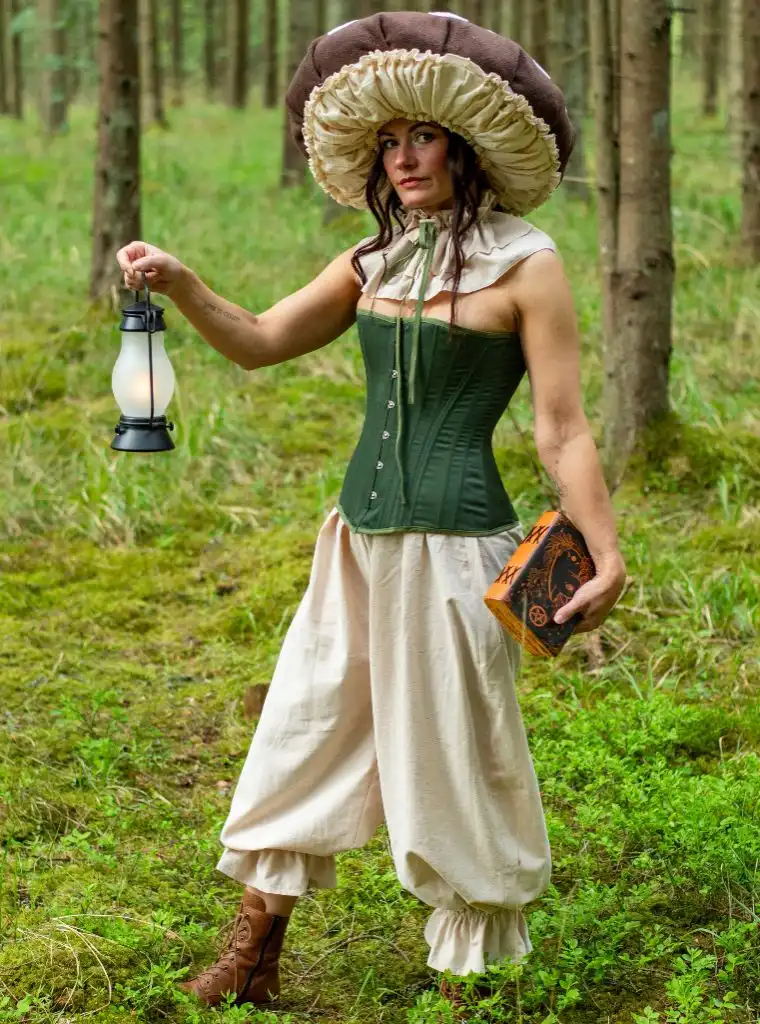
The mushroom cap is the engineering challenge. It can be constructed over a wide-brim hat base using batting for the rounded top and gathered fabric for the gills underneath. The weight should be distributed evenly to avoid neck strain over a long evening. The corset provides structural support for the torso that helps with posture under the hat’s weight, which is a functional benefit beyond the aesthetic one. The bloomers allow full range of movement and are genuinely comfortable — a significant advantage for costumes expected to last several hours. The LED lantern is both a prop and a practical light source after dark, serving double duty.
This is a costume that works because of its commitment to a single visual idea carried through every layer. The color palette is forest floor: brown, cream, green. The textures are natural: linen, leather, woven wicker. The shape is organic: a dome, a curved corset line, billowing fabric. Nothing breaks the world-building. That total commitment is what separates a costume from a look — when every choice, from the button placement to the boot lacing, serves the same story, the silhouette stops being clothing and starts being a character.
Creepy Vintage Doll With Button Dress and Black Wig
The vintage doll costume is a study in controlled creepiness through proportion and detail. The cream dress with oversized black buttons down the center creates a strong vertical line that mimics actual doll clothing construction. The black lace trim and tulle underskirt add texture without color, keeping the palette restricted to cream and black. The straight-cut black wig with a white bow is the element that most strongly signals “doll” — it is too uniform, too glossy, too symmetrical to be natural hair, and that artificiality is the entire point. Striped stockings visible at the hem add one more pattern layer and visually shorten the distance between hem and boot.
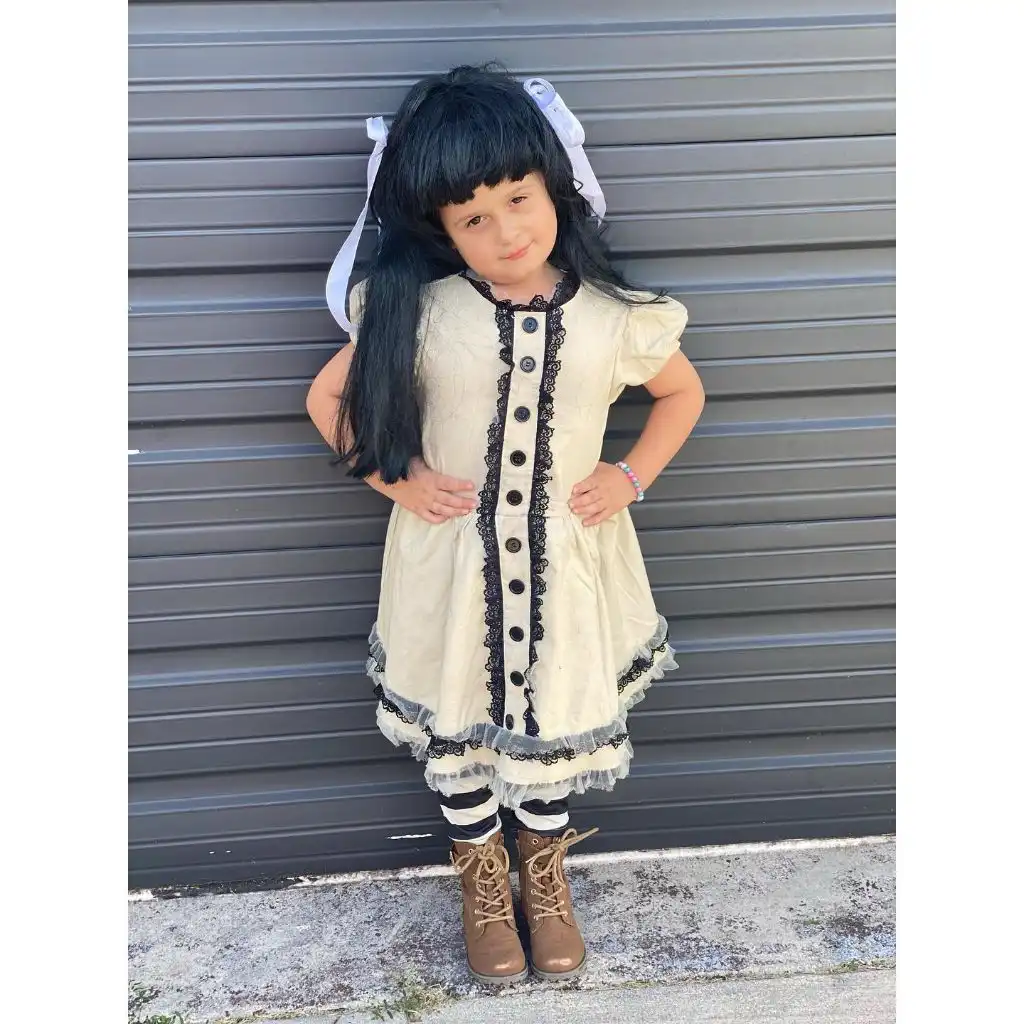
The wig needs a secure cap underneath, especially for active trick-or-treating. The buttons down the front of the dress should be securely sewn — decorative buttons sometimes have shallow stitching that releases with movement. The brown lace-up boots are a good match for the vintage feel and provide ankle support on uneven ground. The entire costume can be built from a plain cream dress, purchased buttons, lace trim from a fabric store, and a wig — making this one of the easier handmade builds. Tea-staining the fabric first gives it the slightly aged, yellowed look that sells the vintage quality.
The design logic here is the uncanny familiar. Everything about this costume is almost normal — a dress, a bow, stockings, boots — but each element is slightly off from what you would see on an actual child. The buttons are too large. The hair is too dark and too even. The skin appears too pale. The expression is too composed. That accumulation of small wrongnesses is more effective than any single dramatic element would be, because it creates unease through recognition rather than through spectacle. This is horror design at its most elegant: nothing is overtly frightening, and everything is subtly wrong.