Winter Fashion for Women 2026 2027 becomes far easier to read once you stop cataloguing individual garments and start looking at how each look is assembled. Proportion, scale, contrast, spacing and palette do the real work. A coat only becomes interesting in relation to the hem below it, the colour sitting beside it, and the amount of negative space left around the finished silhouette. The pieces matter less than the arithmetic between them.
Before scrolling, it helps to decide what you are actually comparing. Notice where the visual weight sits first, then find the endpoint at the feet, then count how many colours are genuinely in play. The recurring trade-off is volume against definition: every added layer buys warmth and costs you a waistline or a leg line. Some looks pay that willingly, others resist it, and neither approach functions as a rule.
1. Fur Collar Leads a Brown Column
Everything here answers to the collar. A wide, dense, tawny fur-look stole sits high on the chest and spills past the shoulders, occupying roughly the top third of the frame and pushing the head into a small pocket of space above it. Beneath it, a boxy brown leather-looking jacket reads almost plain by comparison, and mid-blue jeans take over the bottom half in one uninterrupted stretch.
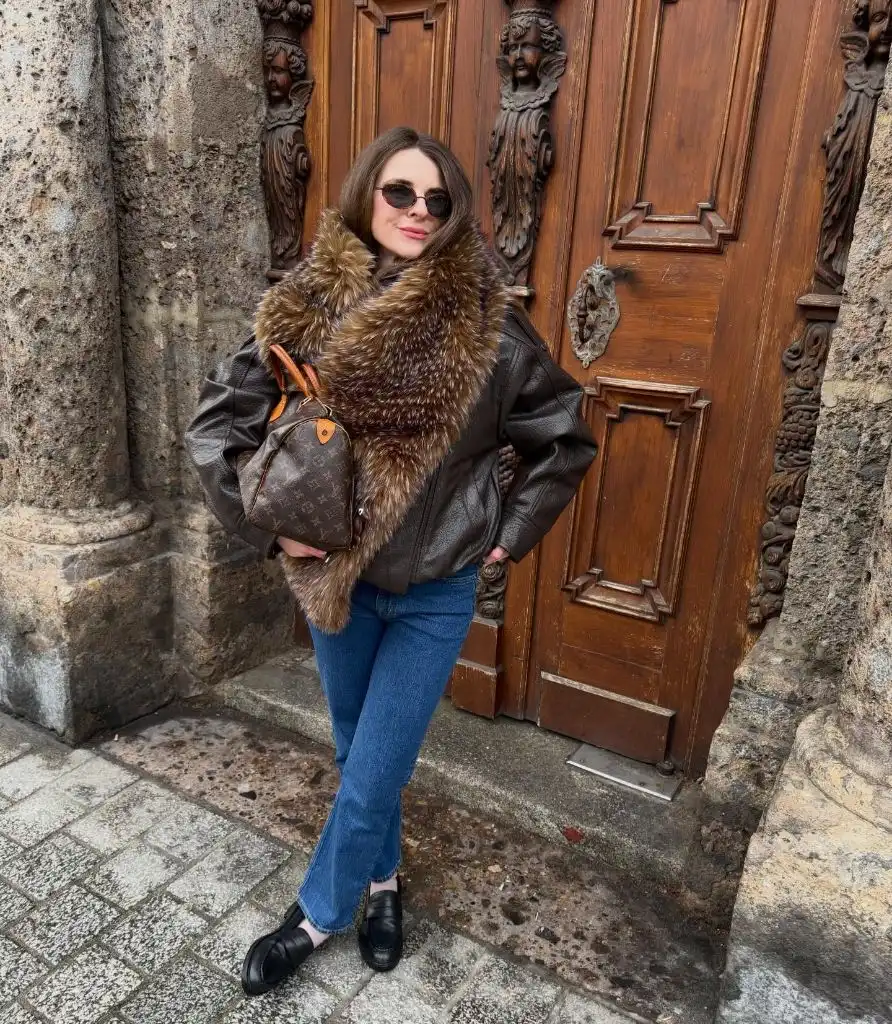
The supporting pieces stay deliberately low in contrast. The monogrammed bag repeats the same brown-on-tan register as the collar, so it registers as texture rather than as a second focal point, and its warm handle picks up the lighter tips in the fur. Jeans and black loafers supply the only cool notes, and the flat black shoe gives the eye a firm endpoint after all that upward movement. Tiny dark sunglasses keep the face uncluttered.
The transferable idea is that a collar this large needs the waist left alone. Nothing is belted, tucked or cinched, which is why the volume reads as intentional instead of accidental. If you want it calmer, drop the collar depth by half and keep the same three-colour palette; the structure survives, the drama does not.
2. Yellow Beanie Cuts Through Cream Shearling
Seated compositions change the maths, and this one is built around a cropped cream shaggy jacket that fans out sideways rather than down. Its curled, high-pile surface fills the centre of the frame from shoulder to hip, and because the sitter is folded up on a bench, the pale wide-leg denim wraps around it in two directions at once. Nothing about the outline is vertical.
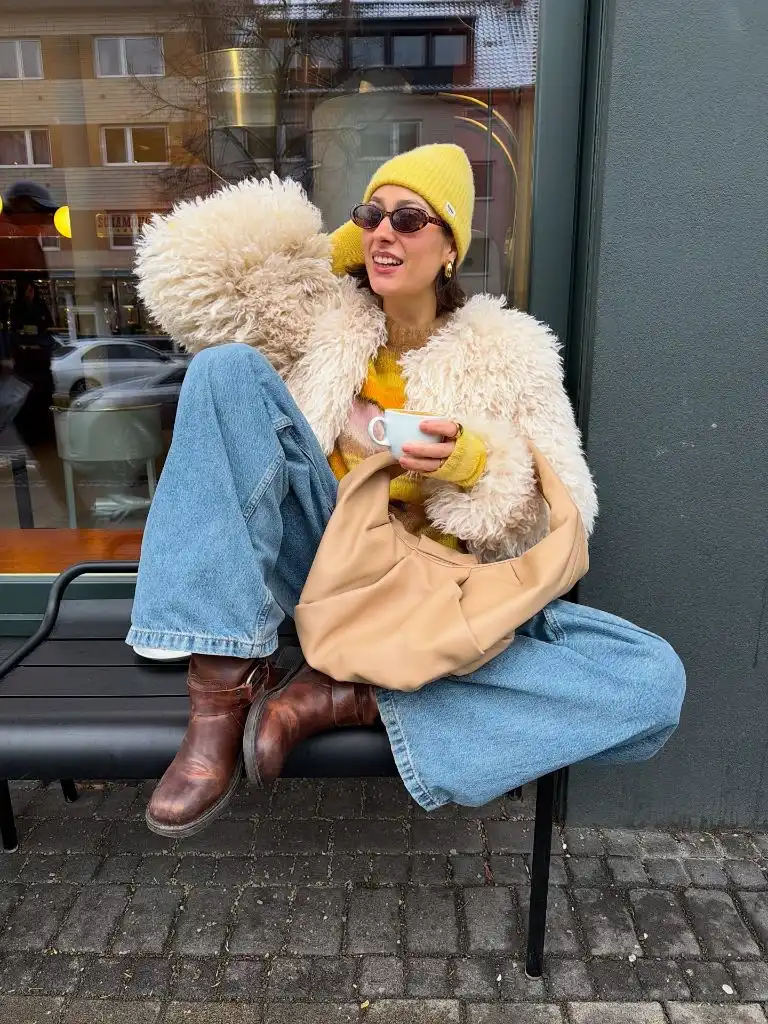
Two yellows carry the whole colour argument: a saturated beanie at the very top and a softer marled knit at the chest, with a gold earring bridging them. Because the jacket and jeans are both light and low-contrast, that yellow does not have to compete. The scuffed brown boots are the darkest thing present and act as a weight at the far corner, stopping the pale mass from floating. A tan bag stays tonal on purpose.
Worth noting honestly: high-pile cream flattens where you sit on it and shows every mark along the cuffs and hem. Compared with the collar-led look above, this one distributes its texture over the whole torso, which is warmer but far less forgiving in photographs taken after a long day.
3. Long Black Coat Frames a White Knit
A knee-skimming black coat controls this entirely, hanging open in two long panels that run almost the full height of the body. Those panels function as a frame, and what they frame is a narrow strip of cream fluffy knit at the chest. Below it, a short dark skirt and sheer-looking tights leave a stretch of leg visible before tall black boots close the line.
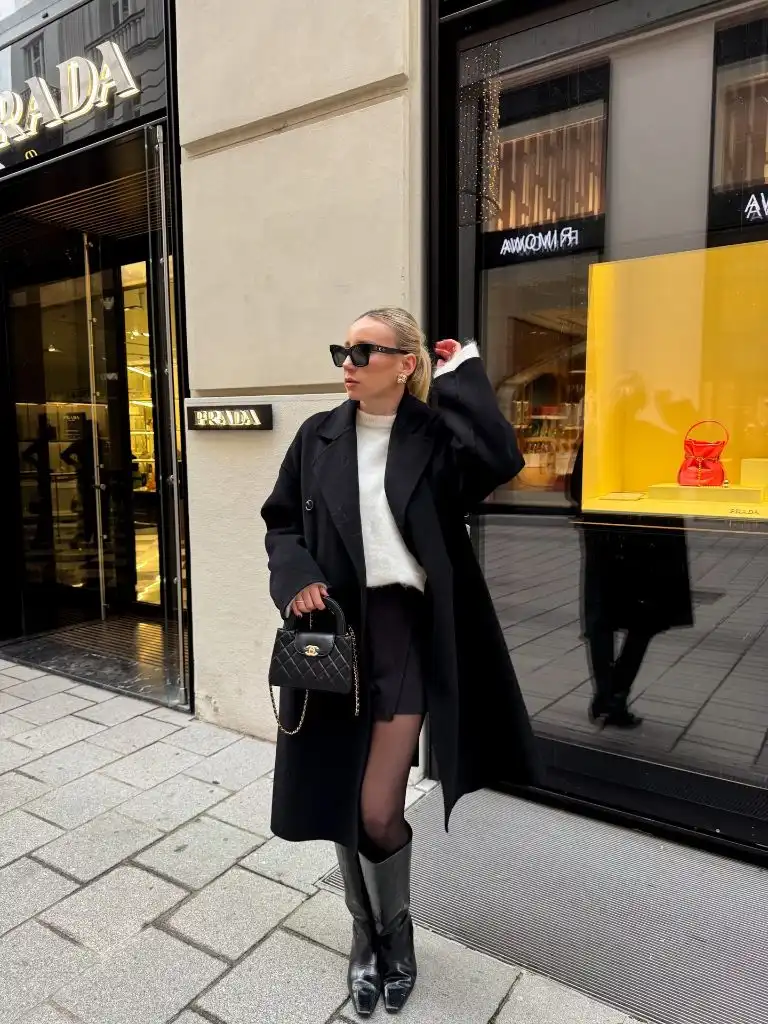
The palette runs on two values only, and the sharpest contrast falls exactly at the chest where pale knit meets dark lapel. A small quilted-looking bag with a gold chain repeats the gold of the earring, and the boots share the coat’s flat black so the eye reads the outer edge as continuous. The shop windows behind supply their own yellow glow, which the styling wisely ignores rather than answering with a warm accent.
Among winter looks for women built around a single long coat, this is a clean example of why the fluffy layer is kept small. Enlarge the knit and the coat stops framing anything. Shorten the boot shaft instead and you lose the leg’s uninterrupted dark run.
4. Argyle Vest Breaks Up Burgundy Leather
The diamond-patterned vest is the only pattern in the frame, and it earns that position by sitting dead centre. Grey, charcoal and dark red lozenges cover the torso from shoulder to hip, and a boxy burgundy leather-looking jacket brackets it on both sides without closing over it. Wide grey jeans drop straight from the hem in a loose, slightly puddled line.
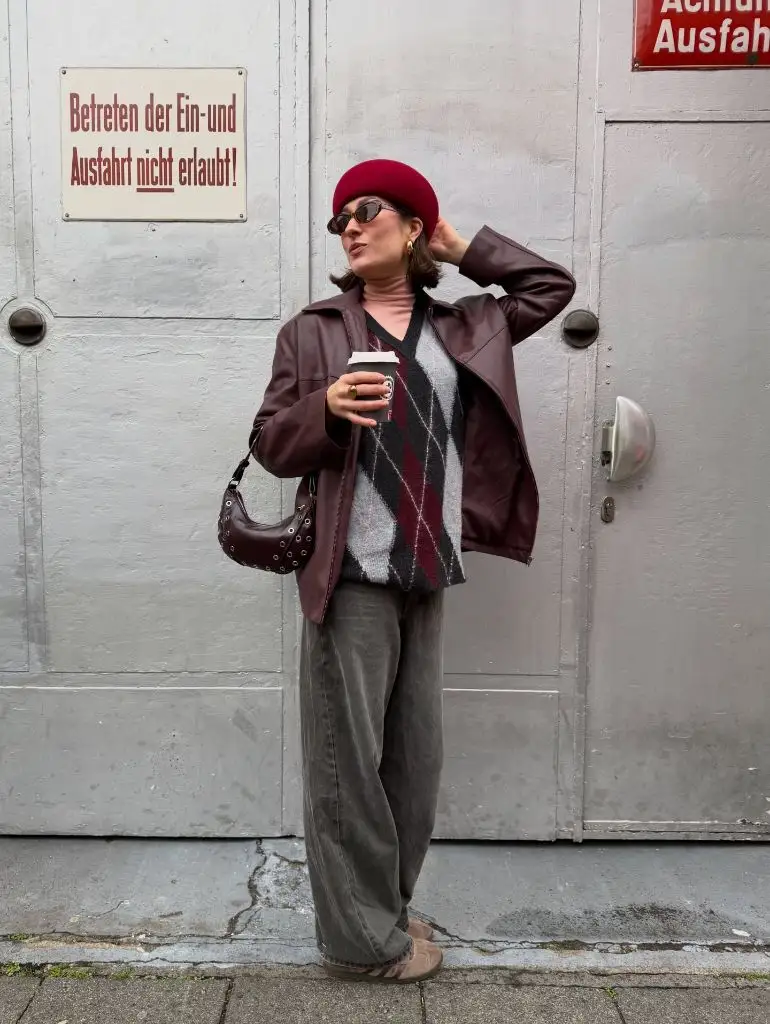
Red appears three times at deliberate intervals: the beret at the top, the jacket through the middle, the small studded bag at the hip. That repetition is what holds the hierarchy, because the vest’s pattern already contains the same dark red and therefore reads as connected rather than imposed. A pale pink turtleneck softens the transition to the face, and the muted beige trainers deliberately refuse to be an endpoint, keeping all the interest above the knee.
The lesson concerns pattern placement more than colour. A patterned layer works hardest when solid blocks flank it, and if you would like more on building looks this way, the layered winter outfit combinations elsewhere on the site cover the same principle with heavier knits. Swap the beret for bare hair and the whole thing quietens considerably.
5. Cropped Shag Jacket Isolates One Red Field
Cropped at the ribcage, the ivory high-pile jacket leaves a clear horizontal band of red knit exposed across the midsection, and that band is the brightest thing in the frame. The photograph is taken from above and cuts off at the shoulders, so proportion is measured here in thirds: pale texture at the top, flat red in the middle, pale wide denim from the hip down.
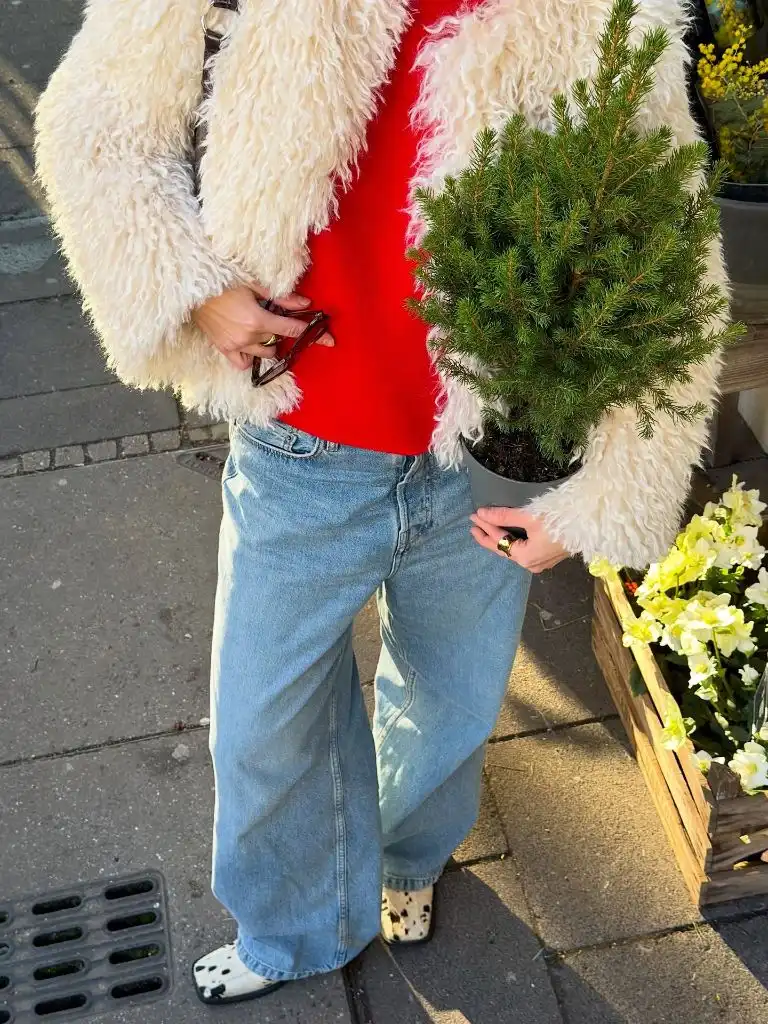
Almost nothing else is asked to work. The denim is washed light enough to sit in the same value range as the jacket, which means the red never has to fight for attention, and a gold ring plus a tortoiseshell frame in the hand supply the only warm metal and the only small detail. The spotted white clogs at the bottom echo the jacket’s cream and add a scatter of black that answers the dark sunglasses being held.
I like the restraint of leaving that red as a single unbroken field with no scarf or bag crossing it. Push it further by matching the shoe pattern to nothing at all; pull it back by choosing a deep brick instead of true red, which keeps the structure and lowers the volume.
6. Ivory Layers Absorb the Whole Silhouette
This is the most tonal look in the set. A long ivory coat, an ivory scarf hanging in two straight vertical panels, ivory gloves and a soft ivory hat all share one narrow value range, so the body reads as a single pale column against a dark glazed façade. Only the black boots and a small dark shoulder bag break out of it.
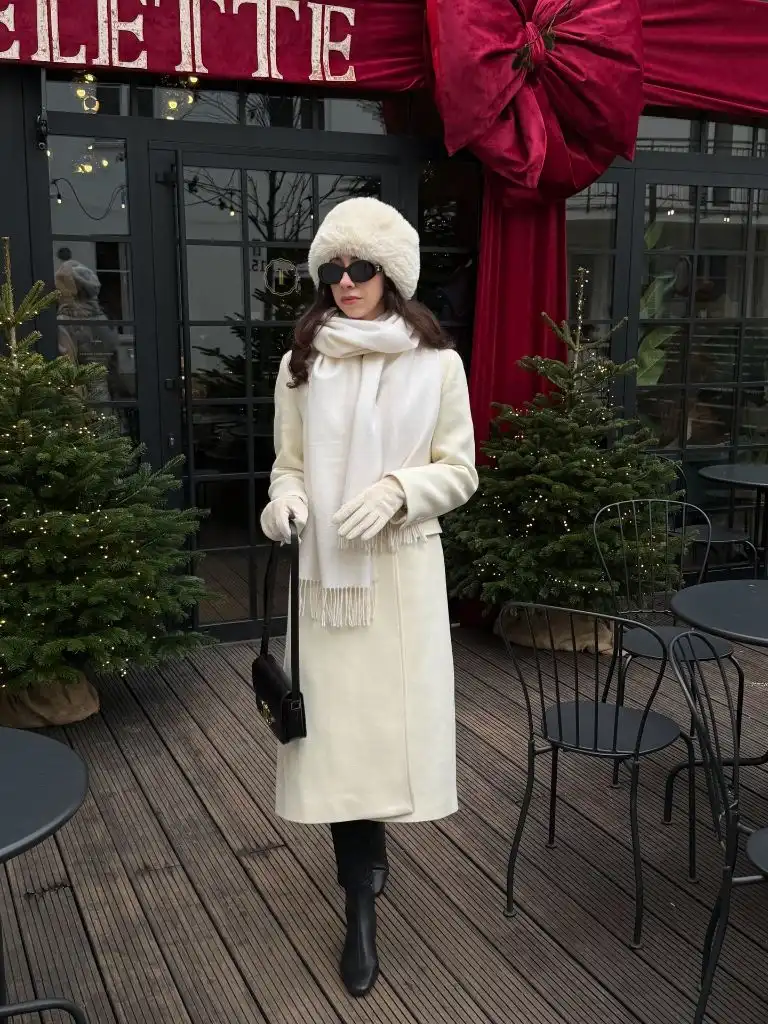
Because the colour never changes, texture becomes the only differentiator: the hat’s short dense pile, the scarf’s fringed flat weave, the coat’s smoother face. The material is not identifiable from a photograph, so those surface differences are the useful detail rather than any fabric claim. The background does half the work, since dark green doors and a deep red awning throw the pale figure forward, and the black bag sits at hip height as the one hard punctuation mark.
The honest limitation is upkeep. Head-to-toe ivory shows every splash from a wet pavement, and the scarf’s fringe is the first casualty. If that feels impractical, hold the coat and hat in cream and change the scarf to camel, which preserves the column while giving the eye one seam to rest on.
7. Belt Anchors an Oversized Brown Coat
Volume is the subject here, and the belt is the answer to it. A long chestnut faux-fur-looking coat expands well past the shoulders and continues below the knee, but a self-tie belt pulls it in at the natural waist, converting what would be a rectangle into two softer trapezoids. Above it, a wide shawl collar rises to frame the jaw.
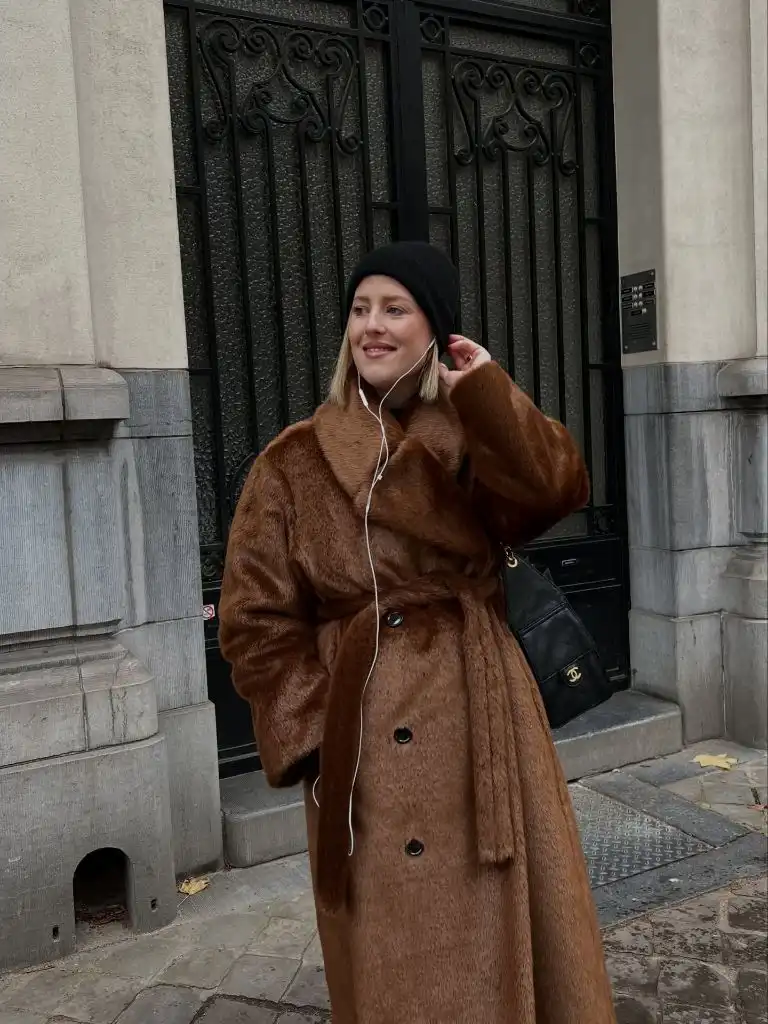
The accessories are kept small and dark for exactly that reason. A close-fitting black beanie compresses the head so the coat’s width reads as deliberate contrast, and a black quilted bag on a chain hangs just below the waist, marking the place where the silhouette narrows. White earphone cables run down the front and, unplanned as they are, they add a thin vertical line through the middle of all that horizontal fur.
Compared with the unbelted first look, this shows how much a single cinch changes the reading of the same amount of bulk. The trade-off is that belting a high-pile coat crushes the pile permanently along the waistline, so the crease becomes part of the garment over time.
8. Pale Fur Jacket Widens the Upper Half
Nearly the entire frame is one texture. A short pale-grey fur-look jacket with long, loosely directional pile sits high and wide, its shoulders extending well beyond the body and its hem stopping at the hip. Only a narrow sliver of dark grey denim appears at the bottom edge, which makes the top-to-bottom ratio unusually lopsided.
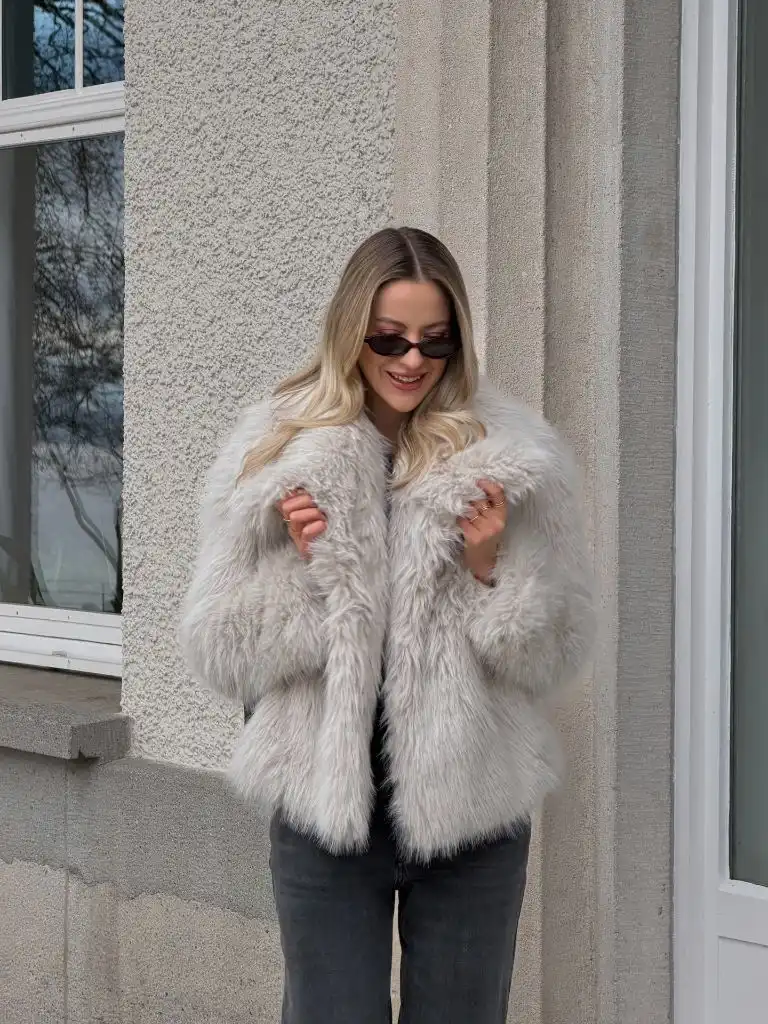
Everything else is calibrated to disappear. Long blonde waves fall over the collar in almost the same value as the pile, so hair and jacket merge into a single soft mass, and the only firm shapes are the slim dark sunglasses and two thin gold rings on the hands drawn up into the lapels. The rendered wall behind shares the jacket’s off-white, which removes the outline and leaves the shape reading as a soft cloud rather than a garment with edges.
After the belted coat above, this reads notably less structured, and the difference is entirely about where the hem lands. A hip-length version of this pile needs a slim, dark, straight leg beneath it. Choose anything wide and the body loses its narrowest point altogether.
9. Matte Black Softens Under a Fur Hat
Seated indoors, this look is built from a single colour and three different finishes. A boxy black leather-looking jacket with a high snap collar dominates the upper frame, its grained surface catching the light in broad patches, while matte black wide trousers spread across the seat below with no visible break at the waist. A tall black fur hat closes the composition at the top.
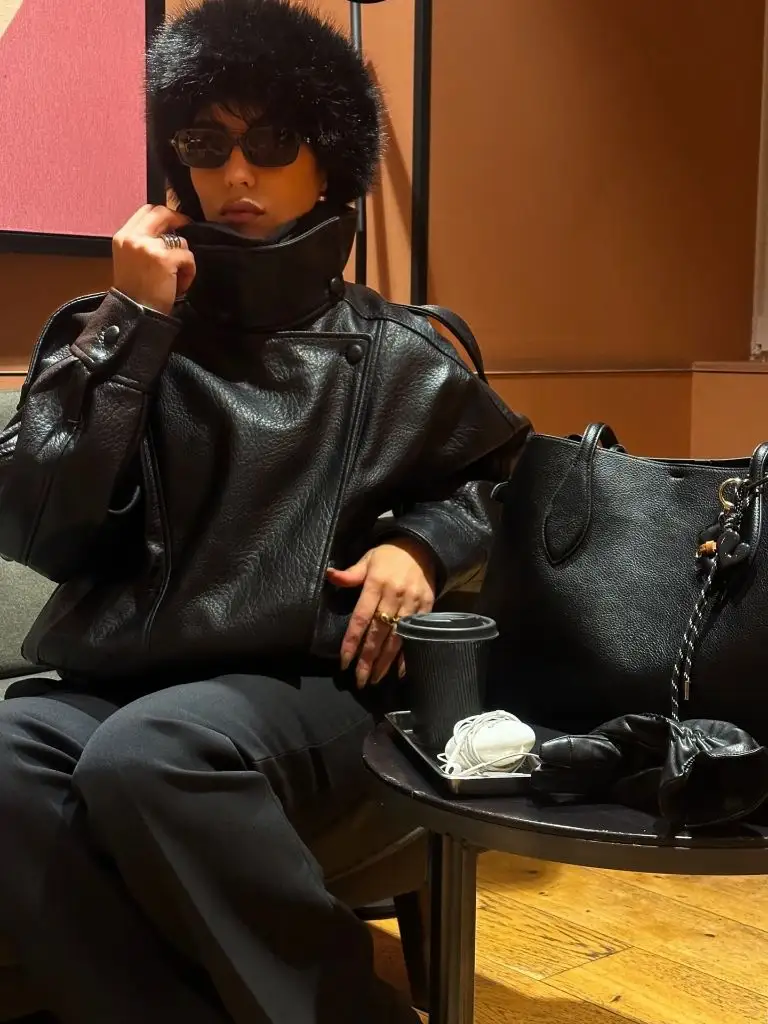
The interest lies entirely in surface hierarchy: fluffy at the head, glossy through the torso, dead flat across the legs. A soft black tote and a gathered black pouch add two more finishes at the right of the frame, and the warm terracotta wall behind is what makes any of this legible, since an all-black look photographed against dark walls collapses. A single gold ring and a takeaway cup are the only non-black elements.
For anyone drawn to monochrome winter dressing, the practical detail is that black-on-black only works when the finishes genuinely differ and the background is warm or pale. Add a fourth texture and it starts to look busy; remove one and the whole thing flattens into a shadow.
10. Grey Denim Extends the Lower Line
Two washes of denim divide this look almost exactly in half. A mid-blue denim shirt with an oversized pointed collar and buttoned cuffs occupies the top, and wide, floor-brushing grey jeans take everything below the waist, made longer still by snow filling the lower frame. A dark brown belt marks the join with a thin horizontal stroke.
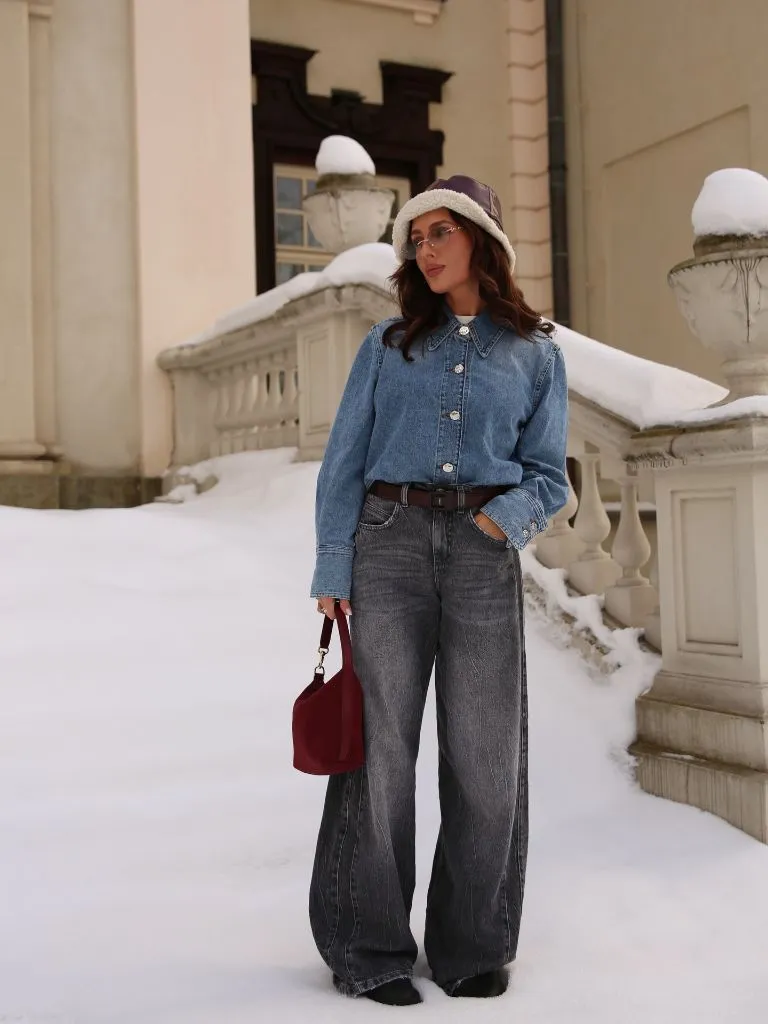
The two accessories both borrow from elsewhere in the picture. A dark plum bucket hat with a shearling-style brim answers the small burgundy shoulder bag hanging low at hip level, and those two deep reds are the only warm points in a composition otherwise made of blue, grey and white. Fine-rimmed glasses keep the face light, and the pale stone balustrade and snow behind mean the jeans read as the darkest mass present.
Among winter fashion for women this season, the useful mechanic is the tonal denim split: same fabric family, two clearly separated values, one belt to declare the waist. Push the contrast harder with black trousers and you lose the softness that makes this hold together.
11. Knit Trousers Balance a Shaggy Volume
A honey-beige shaggy coat with long curled pile sits mid-thigh and flares outward from the shoulders, forming the widest point in the frame. What keeps it from reading as top-heavy is the trouser: a cream cable-knit wide leg that continues the volume all the way to the ankle instead of tapering under it, so the outline reads as one soft rectangle rather than a triangle.
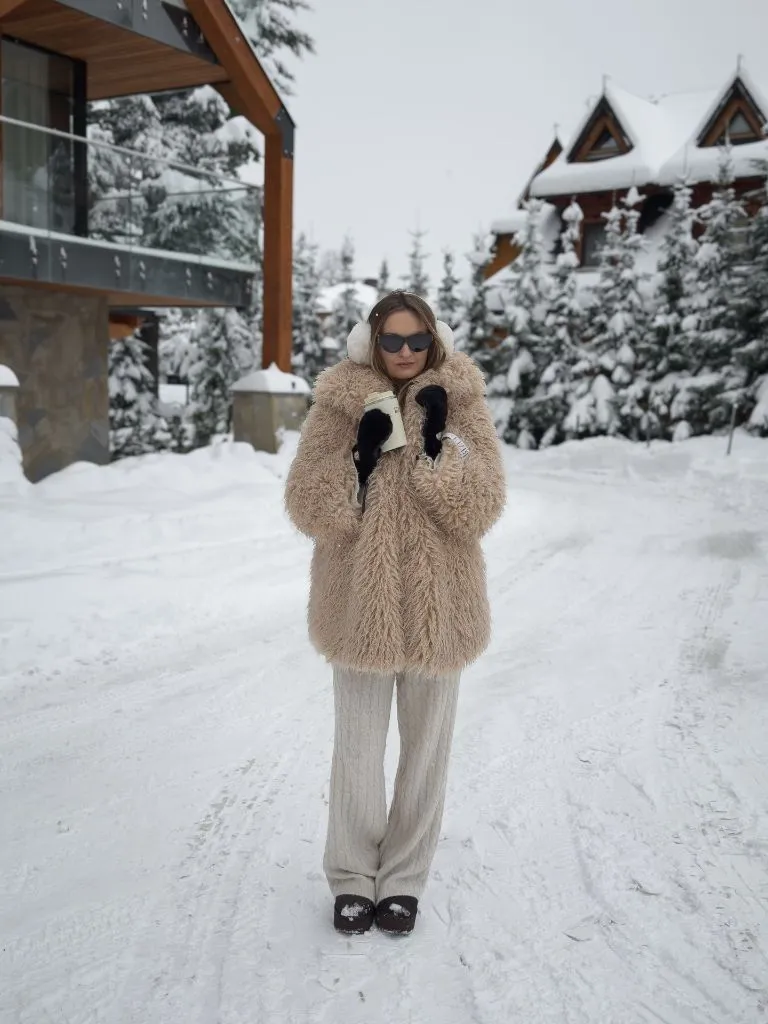
Colour is doing almost nothing, which is the point. Coat and trousers sit two steps apart in the same warm neutral family, white earmuffs disappear into the snow behind, and the only dark elements are the sunglasses, a pair of dark gloves held at the chest and the clog-style boots at the hem. Those boots are essential; without a dark endpoint the figure would dissolve into the snowfield entirely.
Compared with the hip-length pale fur higher up, this is the more wearable route to the same softness because the length carries the weight downward. The limitation is bulk when seated: knit trousers plus deep pile means a lot of fabric gathering at the lap.
12. Cropped Knit Splits the Back Silhouette
Photographed from behind, the composition divides at the ribcage. A brushed brown knit ends high, a narrow band of white cotton hem shows beneath it, and olive-brown wide trousers with patch pockets fall from there to the pavement in a long, heavy line. The white strip is thin, but it is the only bright interruption in the whole frame.
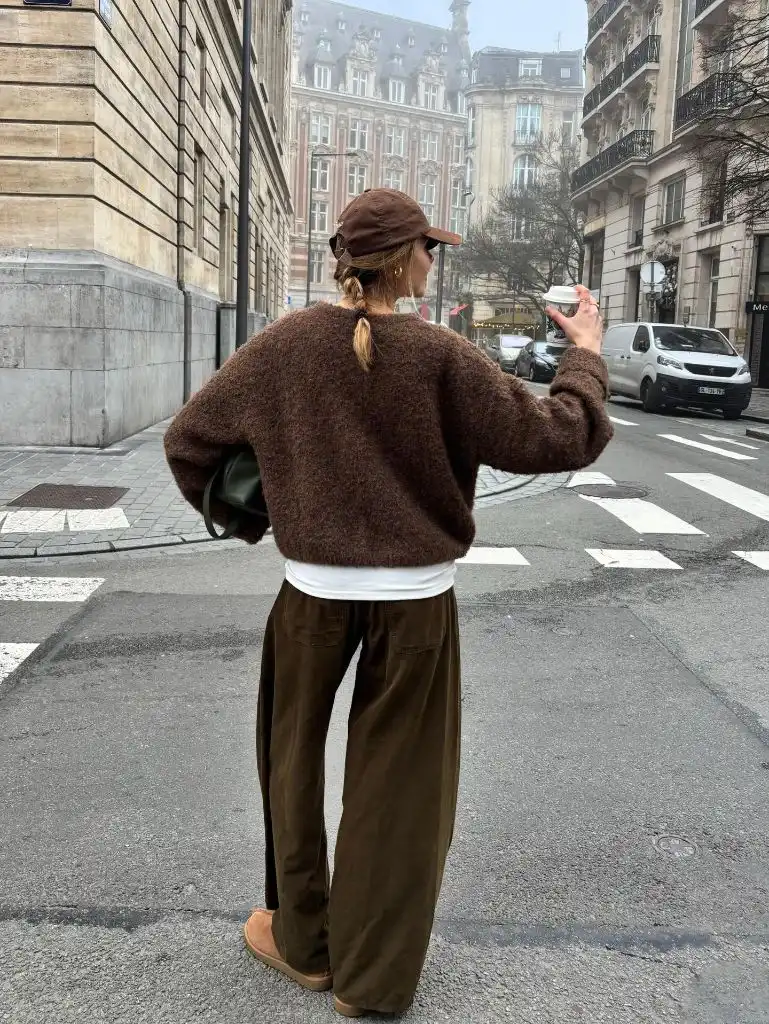
Three browns are stacked without ever matching: the cap and knit share a reddish tone, the trousers shift greener, and the suede-look boots go pale and sandy at the very bottom. That gradual lightening downward is what stops the look from reading as a single flat block. A dark green bag tucked under one arm and a raised takeaway cup add the only geometry, and the cream Parisian stone behind sets the whole warm palette off cleanly.
I find that exposed white hem more effective than any belt would have been, since it declares the waist without adding hardware. If you want a quieter version, match the hem to the knit; the proportion stays intact and the eye simply moves faster to the shoes.
13. Deep Red Takes Over the Frame
This is a close crop, so the coat is not shown in full and the colour has to carry everything. A deep wine-red belted coat with an exaggerated wide lapel fills the lower two-thirds, its tie knot visible at the waist and its dropped shoulder line pushing the sleeve out into the snow behind. Long copper-brown hair falls across the lapel in a warm, closely related tone.
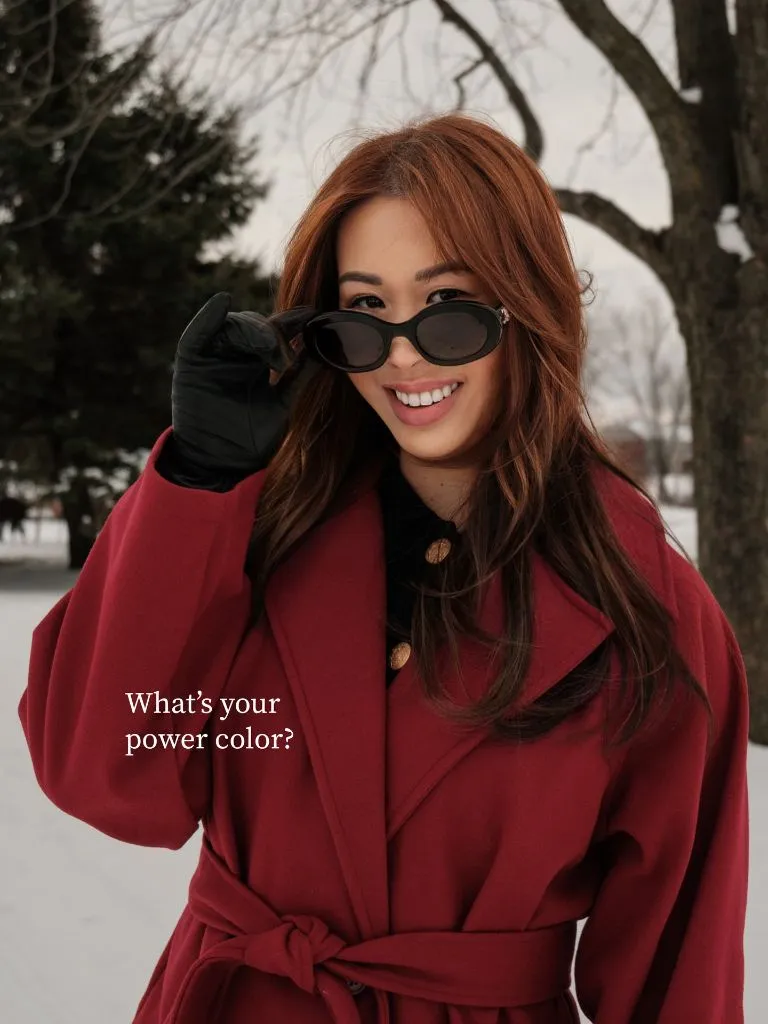
Only three other elements register. A black turtleneck fills the neckline and stops the red from touching the face directly, black leather-looking gloves and oval sunglasses repeat that same flat black at two different heights, and a pair of warm gold-toned buttons sits where the lapel crosses. The snow and bare branches behind are almost colourless, which is precisely why a saturated red reads this cleanly rather than looking heavy.
The comparison worth drawing is with the tonal ivory look earlier: both are single-colour propositions, but red demands that everything else drop to black or nothing. Hair this warm also sits in the coat’s own family, so a cooler hair tone would read as a second colour entirely.
14. Ice Blue Scarf Interrupts a Brown Teddy
Warmth dominates until the scarf arrives. A dark cocoa boucle-textured coat, oversized through the shoulder and long past the hip, covers most of the frame in a dense curled surface. Straight down the centre runs a pale ice-blue scarf with fringed ends, splitting the brown mass into two roughly equal halves and pulling the eye vertically rather than across.
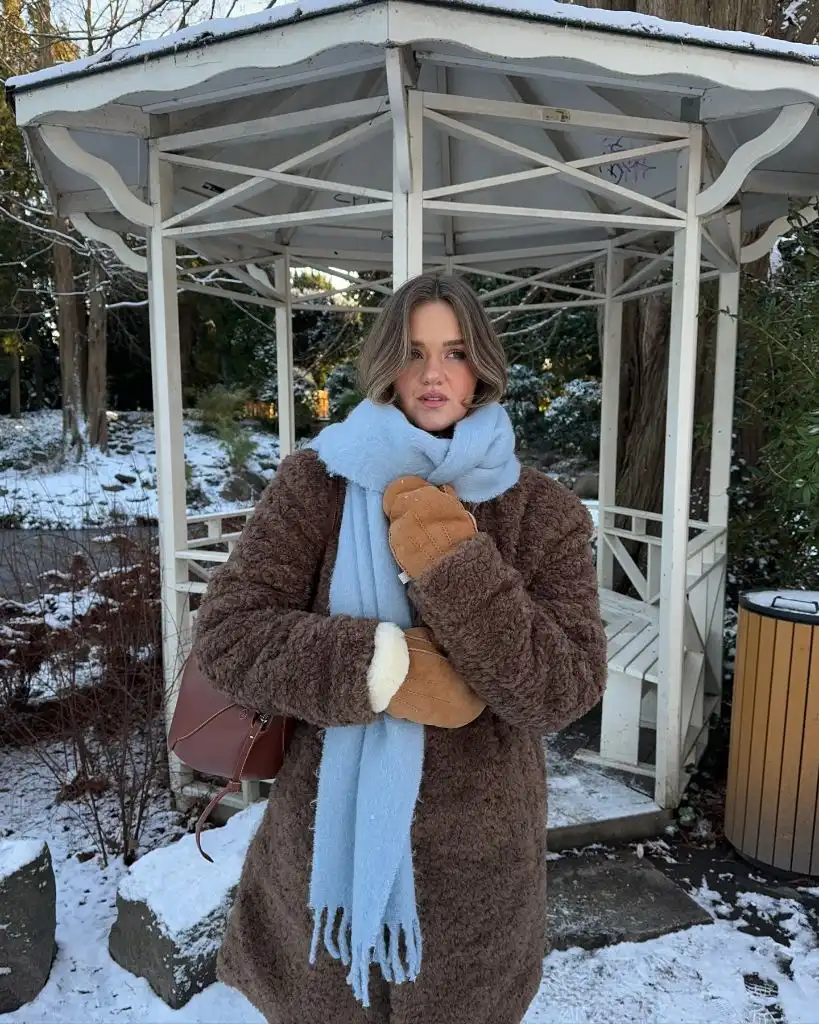
The remaining pieces sit firmly on the warm side to protect that single cool note. Tan shearling-style mittens with cream cuffs are held at the chest, exactly where the scarf crosses, and a rust-brown bag hangs at the hip in the coat’s own family. Behind, a white painted gazebo and patchy snow supply the cool half of the picture, which means the blue scarf is not isolated so much as connected outward to the setting.
The transferable principle is that one cool accent inside a warm palette works best when it also runs the longest line in the outfit. A short blue scarf tucked at the neck would look accidental; this length makes it structural.
15. White Trousers Lighten a Camel Column
A long camel coat with a dense short pile hangs open from a wide notch collar and reaches mid-calf, so the top three-quarters of the body is one continuous warm block. Where it ends, bright white wide-leg trousers continue straight to cream loafers, and the pale zebra stripes of the crossing beneath repeat that white in horizontal bands across the frame.
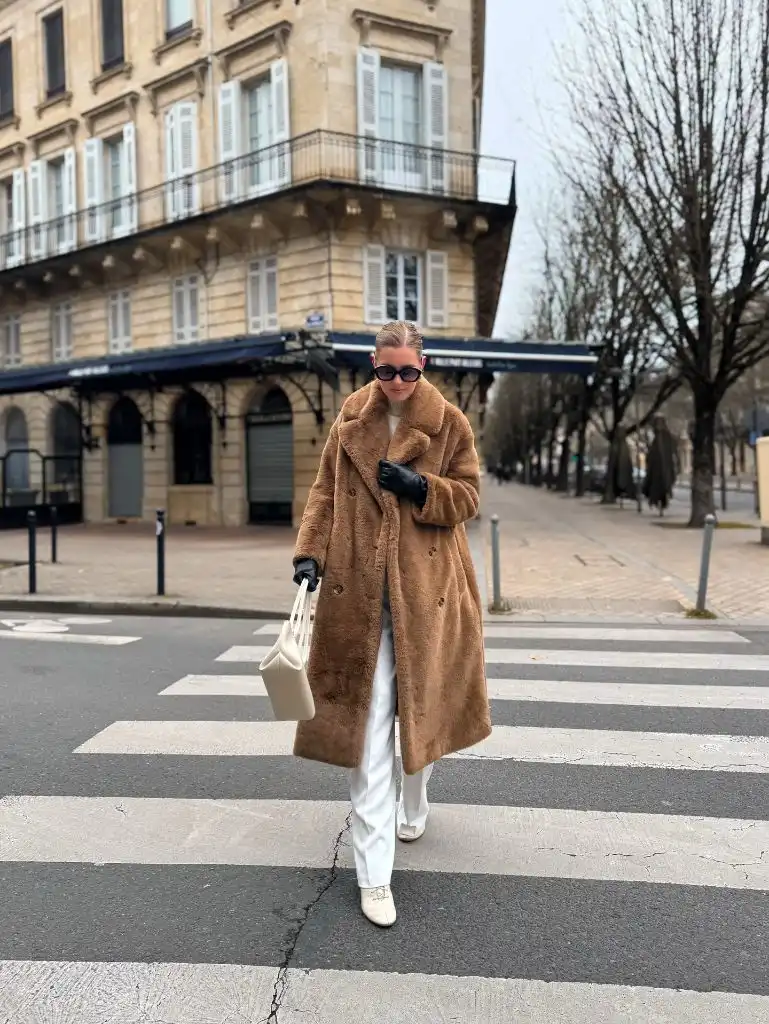
Cream appears at three heights and holds the whole hierarchy: the turtleneck at the collar, the structured tote at the hand, the loafers at the endpoint. Against that, black leather-looking gloves and black sunglasses are the only dark accents, placed close together at the centre of the composition so they read as a single deliberate cluster. The limestone building behind shares the coat’s tone, which is why the white trousers, not the coat, are the brightest thing present.
For anyone building a camel-based wardrobe, the useful comparison is with the brown teddy above: same texture family, opposite decision below the waist. Pairing this with dark trousers instead would shorten the leg noticeably, and the elongated white column of tailored winter looks like this is what makes the coat’s length legible.
16. Fur Cuffs Punctuate a Wrap Coat
Movement makes this one unusual to read. A mid-thigh chocolate wrap coat with a self-tie belt is worn with both arms raised, so the sleeves become the widest elements in the frame. Each cuff carries a deep band of tonal fur-look trim, matched by a thick fur collar that runs the full length of the lapel down to the belt.
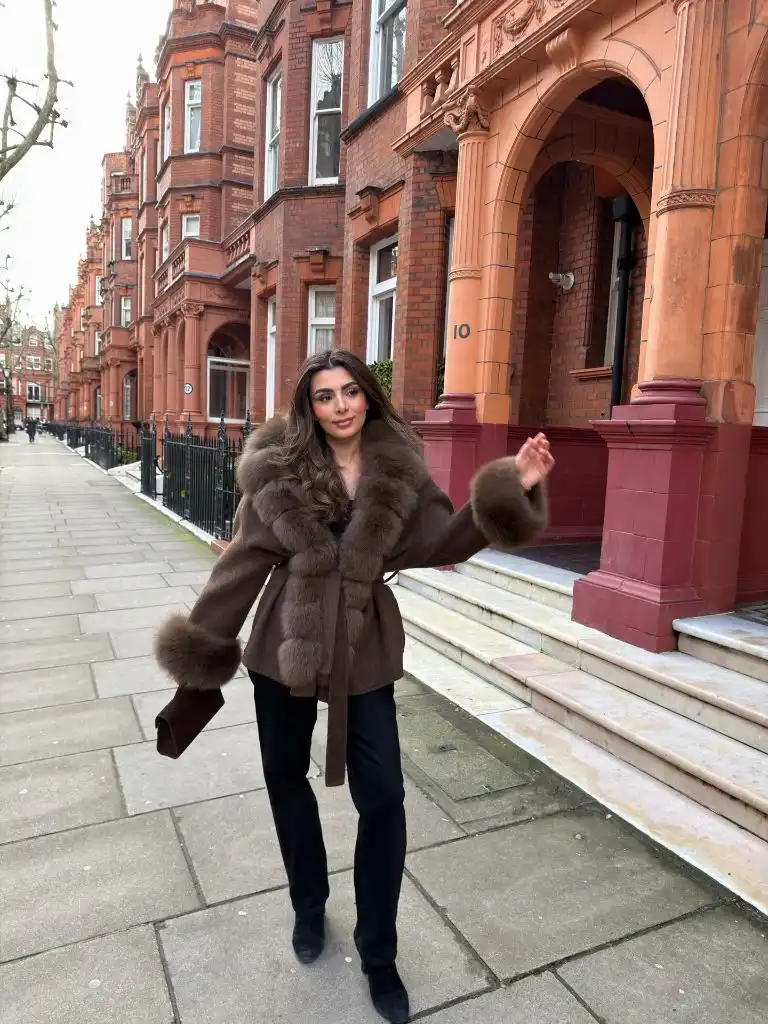
Because the trim and the coat body share one brown, the only real contrast is textural, and the composition relies on the setting for its colour: terracotta brick, oxblood painted stonework and pale flagstones behind. Below the belt, straight black jeans and dark boots take over completely, keeping the lower half plain so the sleeves can stay busy. Long dark hair falls across the collar and softens the join between fur and face.
The trade-off with cuffs this deep is functional rather than aesthetic. They sit exactly where your hands work, so they collect wear first and restrict a sleeve push-up entirely. If that bothers you, keep the collar trim and lose the cuff band; the coat’s line survives unchanged.
17. Black Fur Trim Weights an Olive Puffer
Contrast here is placed rather than spread. A short olive quilted puffer with a glossy face zips high to a fur-trimmed collar, and two thick bands of black fur-look trim sit at the lower sleeves and the hem, forming a dark horizontal ring around the hips. Below that, pale cream ski-style trousers with a black side stripe drop straight to silver-toned boots.
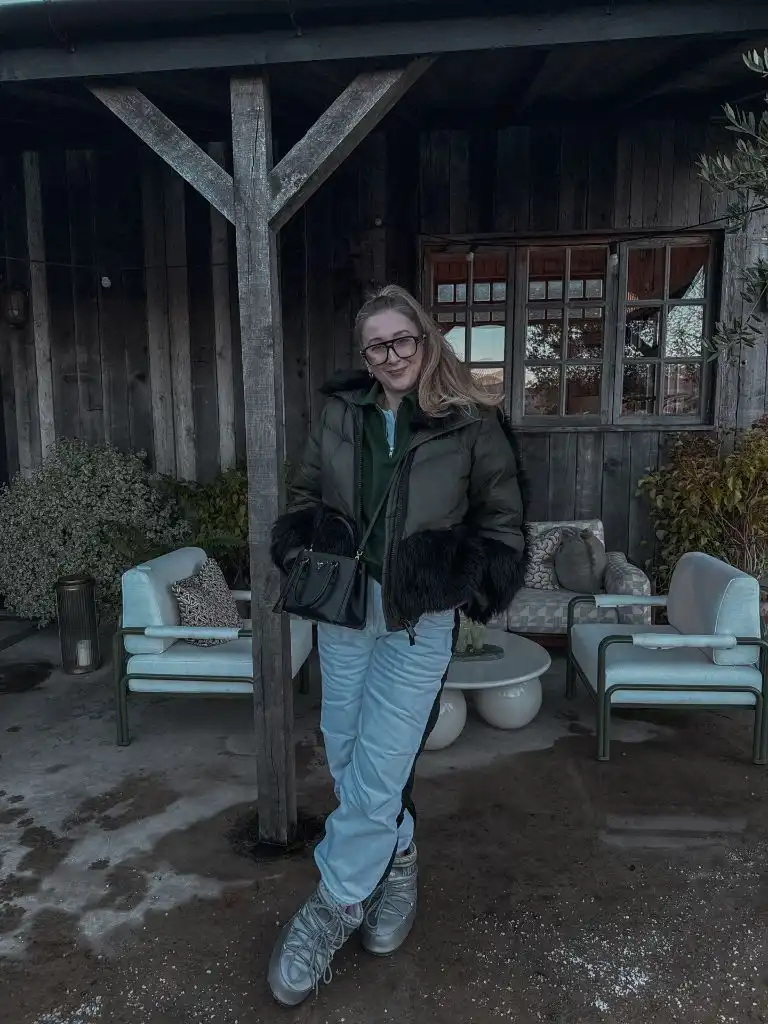
The dark stripe running down the outer leg is the detail that makes the trim read as intentional, since it carries the same black from hip to ankle and links the top block to the metallic boot. A deeper green hoodie collar shows at the neck, adding a second olive value, and a small black bag with gold hardware hangs at the same height as the fur band. The weathered dark timber and dim evening light flatten everything slightly, which is worth noting.
Compared with the daylight looks above, this is the clearest case of a palette that depends on ambient light. In brighter conditions the cream trouser would read much whiter and the fur bands sharper, so judge the placement rather than the tones.
18. Camel Trench Holds an All-Black Base
The trench is the only colour and it functions as a container. Worn open, its two long panels run from shoulder to below the knee in a soft sand tone, with epaulettes, a wide storm flap and a hanging belt end providing all the internal detail. Inside that frame sits a completely black outfit, unbroken from neck to hip and continuing into wide black trousers.
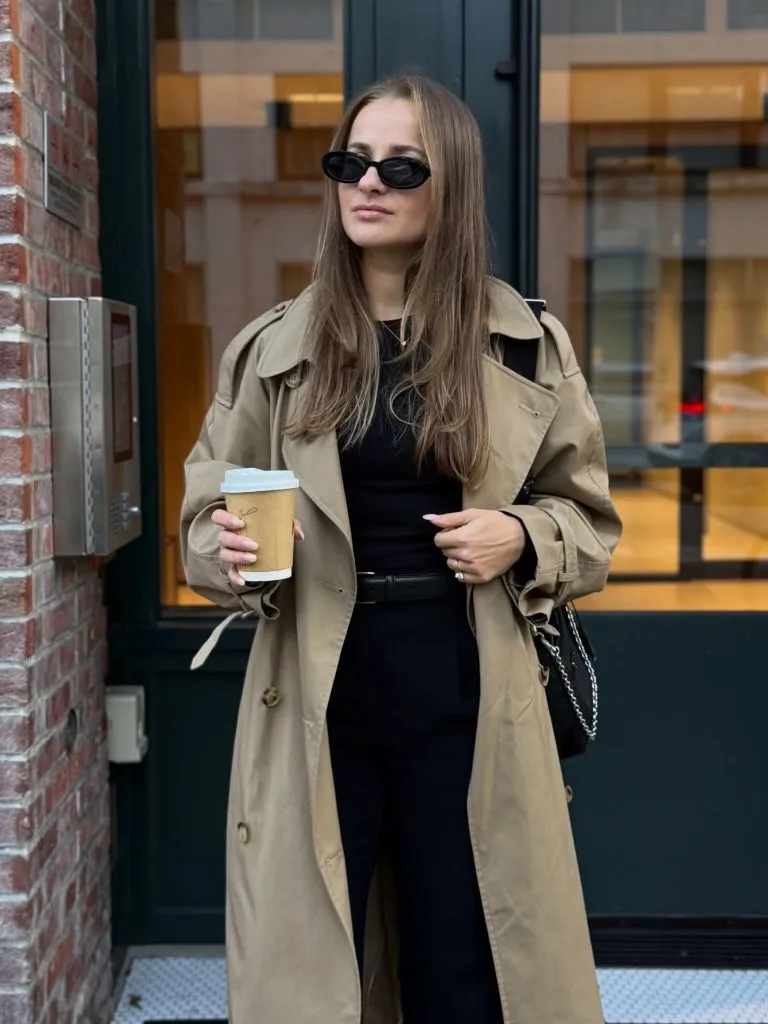
The black elements are separated only by hardware: a slim belt at the waist and a chain-strap bag at the shoulder, both catching a little light against the matte base. Long mid-brown hair falls forward and picks up the trench’s warmth, which stops the coat from looking disconnected from the face. Red brick on one side and a dark green doorframe on the other keep the coat as the lightest thing in the picture.
Set against the fur-heavy looks in this set, this reads as the quietest option and the most repeatable. The lesson is about the vertical: a black core inside a lighter open coat narrows the body without any tailoring doing the work.
19. Barrel Trousers Set the Whole Proportion
Proportion, not colour, is the subject. A pair of dark charcoal trousers curves outward through the thigh and pulls sharply back in above the ankle, creating a rounded barrel shape that occupies more than half the frame. Above them, a taupe cardigan is tucked in at a high waist, with a white shirt collar standing at the neck and white cuffs turned back over the wrists.
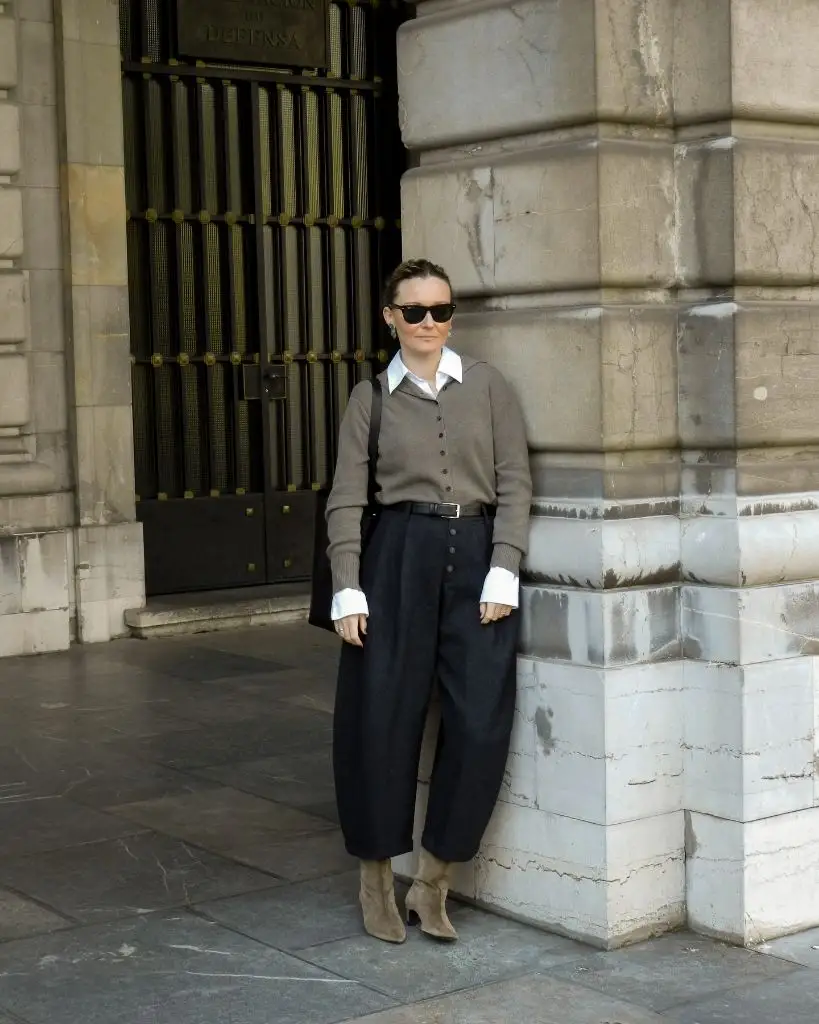
The white appears in three small, evenly spaced places — collar, two cuffs — which is what keeps the eye travelling around the upper body instead of settling on the trouser. A thin black belt marks the waist precisely, a black shoulder bag hangs flat against the hip, and pale taupe suede-look ankle boots emerge from the narrow hem, echoing the cardigan and closing the palette in a loop. Grey and cream stonework behind stays neutral throughout.
I like the discipline of that lower taper; it is what allows a full thigh to read as tailoring rather than as slouch. Push the shape further with a shorter hem, or soften it by leaving the cardigan untucked, which trades the waist for ease.
20. Plaid Skirt Separates Two Brown Tones
The garment doing the most work sits in the middle. A brown and cream plaid midi skirt, gathered and asymmetric at the hem, is layered over dark grey jeans, so pattern occupies the exact centre of the body with solid colour above and below. Cropping the composition further, a short dark chocolate fur-look jacket sits at the waist and a matching fur hat closes the top.
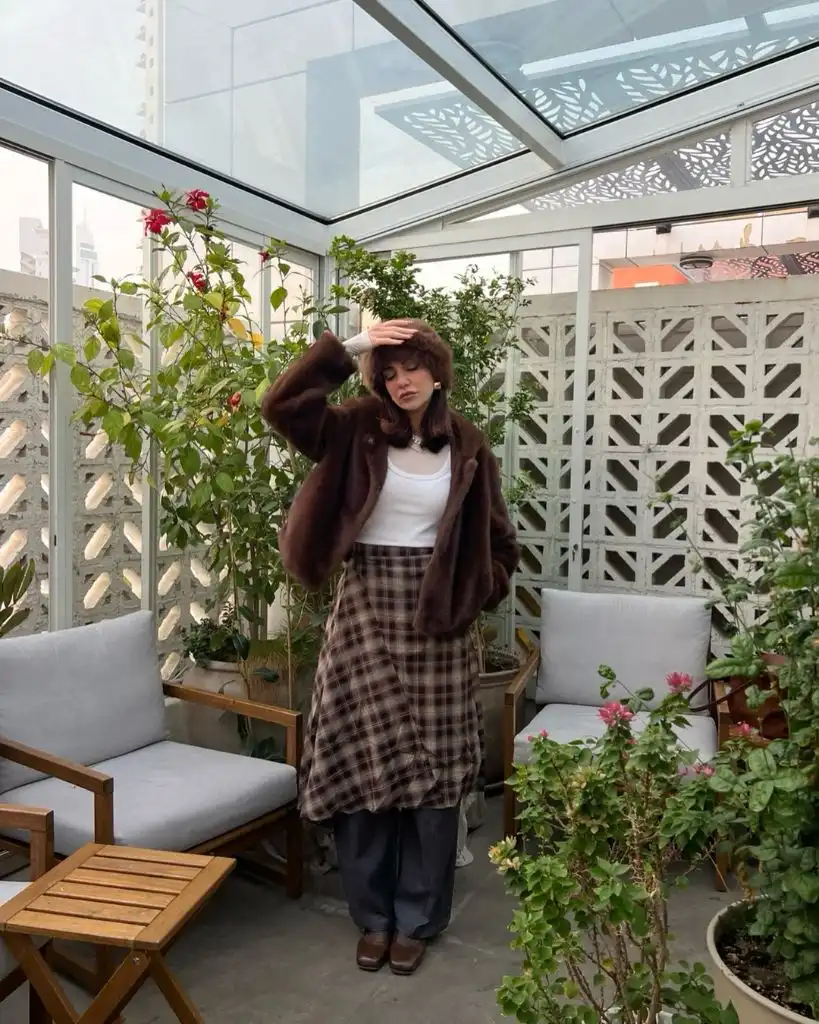
A white ribbed tank shows between the open jacket panels and provides the single light break, positioned high enough to lift the face away from all that dark fur. The skirt’s cream grid picks up that white and carries it downward, which is the connection that makes the layering legible rather than random. Dark brown shoes at the hem return to the jacket’s tone, and the glass-roofed terrace with its green planting supplies the only colour outside the brown family.
The honest note is that a skirt over trousers adds real bulk at the hip and needs the top layer to end above it, as this one does. Lengthen the jacket and the whole idea collapses into shapelessness.