Winter light is unforgiving on hair, and a winter hair color for Black women earns its keep by how the whole head reads, not by how a single strand catches the flash. Look past the shade name and study the composition: where the root sits against the mids, how the ends resolve, whether the highlights travel with the shape or fight it. Proportion, endpoint, and the balance between shine and shadow decide whether a color looks intentional or noisy.
Before scrolling, set a small decision lens. First, notice the root depth and how far the lift travels from the scalp. Second, notice where the brightest piece lands relative to the face and jaw. Third, weigh upkeep against payoff, because contrast that reads clean in a photograph often demands more maintenance than a tonal blend. No single formula is a rule; the point is to see the trade-offs before choosing a direction.
1. Honey Lift Leads a Rounded Bob
The dominant element is a warm honey blonde that occupies most of the visible canopy, sitting over a darker root that only shows in narrow shadowed sections at the crown. The cut is a rounded, chin-grazing bob with a curled-under perimeter, so the color reads as a single glowing dome rather than as separated pieces. Scale matters here: because the shape is compact, the lightness reaches its brightest point at the widest part of the curve.
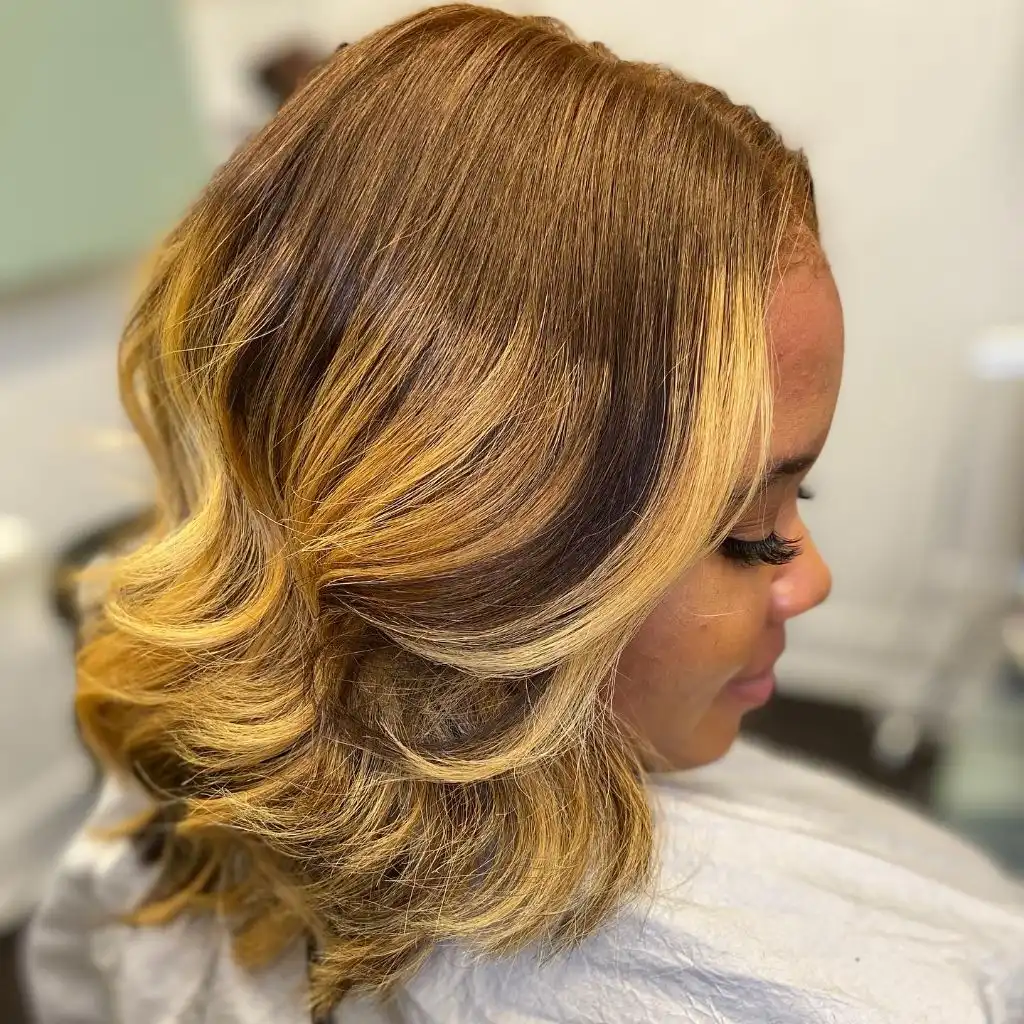
The supporting cast is quiet on purpose. The darker root acts as an anchor, keeping the eye from floating off the top of the head, while the mid-lengths carry the warmest gold and the ends settle into a slightly softer wheat tone. There are no competing accessories, no visible jewelry, no patterned garment. That restraint lets the palette move from cool shadow at the scalp to warm honey at the tips without any other colour asking for attention.
The transferable principle is about placement rather than lift level. Keeping the root shadow visible on a bob buys grow-out time and gives the shape dimension from above, which is exactly what winter overhead light tends to flatten. If the contrast feels too warm, a half-shade cooler at the ends would keep the same architecture without pushing into brassy territory.
2. Mushroom Blonde Frames a Long Center Part
A soft mushroom-blonde ribboning dominates a long, straight, center-parted style, with the lightest pieces concentrated in the money-piece sections that fall just past the collarbone. The base is a cool medium brown, and the highlights are painted rather than banded, so the transition reads as vertical stripes of light rather than horizontal chunks. The overall silhouette is long, flat, and glossy, which lets the color do all the visible work.
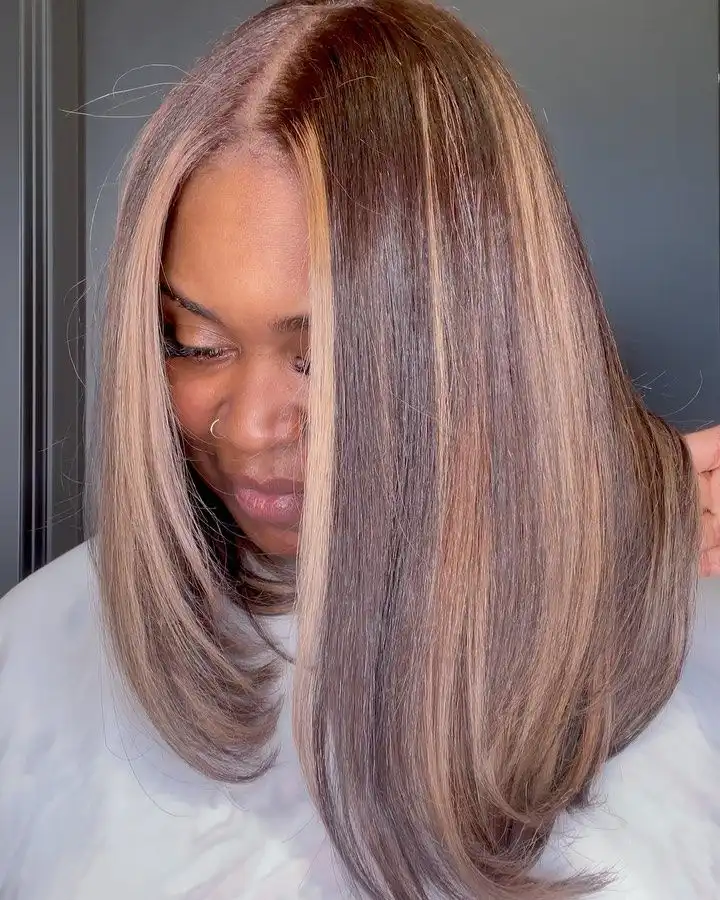
The supporting elements reinforce that verticality. The parting is razor-clean, the ends are blunt without being heavy, and the front pieces frame the cheekbone before the color deepens again toward the interior. The palette avoids gold entirely, which is what keeps this reading as winter rather than late-summer. The neutral top and pale background remove any competing colour field, so the only contrast in the frame is scalp shadow against cool blonde.
Compared with the honey bob above, this is the lower-contrast, higher-maintenance option. The painted placement grows out gracefully, but the cool tone will want a purple-based toner refresh to stay out of yellow. For anyone drawn to this winter hair color for Black women, the practical detail is that the flatter you iron it, the more visible every band of colour becomes, so the finish choice is part of the color choice.
3. Copper Red Takes Over a Feathered Cut
Vivid copper red owns the entire canopy, saturated evenly from root to tip with no shadow at the scalp and no fade at the ends. The cut is a layered, feathered bob with visible flicks stacked above the shoulder, and the color is uniform enough that the layers register as texture rather than as separate tonal pieces. Because the tone is so warm and so bright, it functions almost as a single colour field with movement drawn on top.
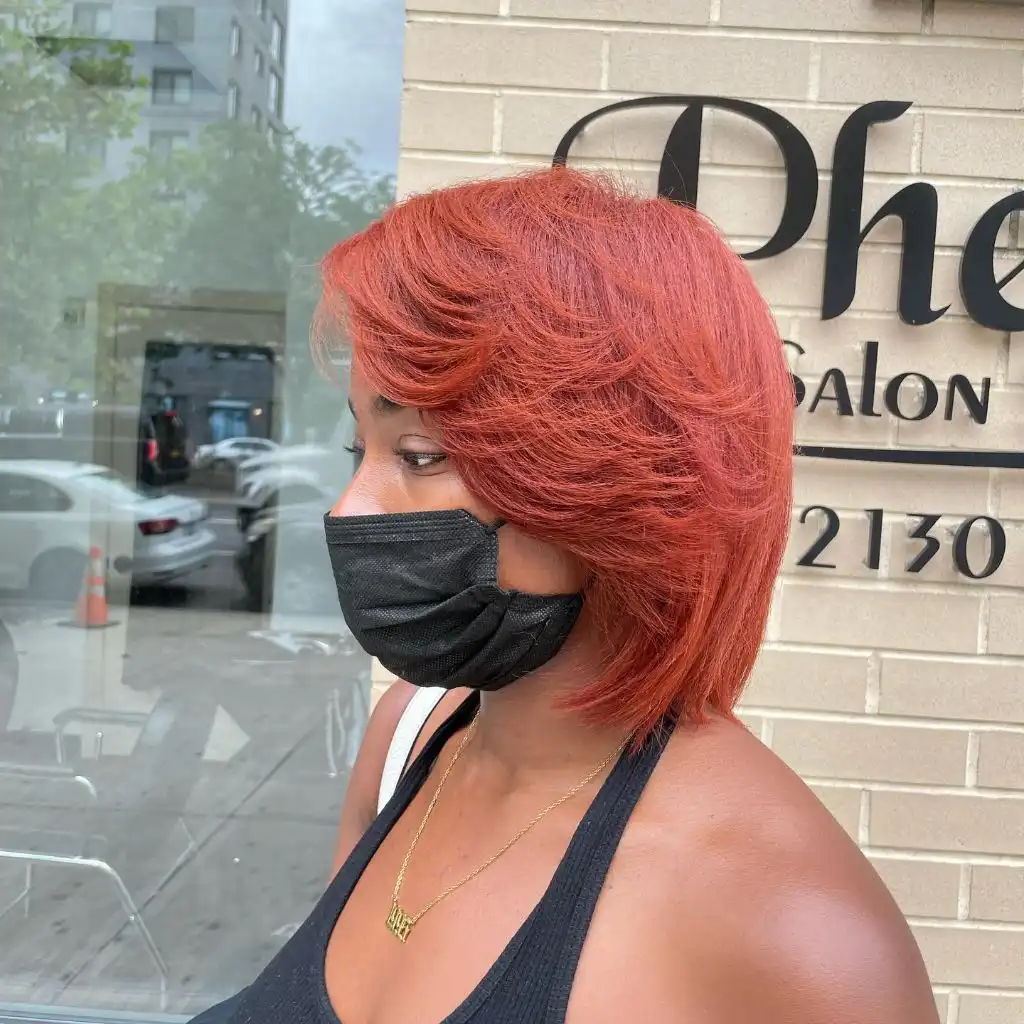
The supporting cast is deliberately dark. The black mask, black tank, and gold chain sit against the copper without competing, and the beige brick behind the head neutralises the wall so nothing else in the frame is warm. The strongest endpoint is the outermost flick at the jawline, where the copper catches the light and separates cleanly from the mask. Everything below the neck stays low-contrast so the color can stay loud.
The honest limitation is upkeep. Copper this saturated fades quickly, especially through washes, and it demands a colour-safe routine to hold this level of vibrancy through a full winter. If that maintenance is not realistic, dropping half a level to a rust or brick tone gives similar visual heat with meaningfully longer intervals between salon visits.
4. Subtle Caramel Ribbons Warm a Dark Base
A near-black base carries the composition, with thin caramel ribbons woven through the mid-lengths and ends in a long, softly curled shape. The highlights are narrow and irregular, which is what stops them from banding, and they concentrate more heavily around the face than through the interior. The dominant impression is dark hair with warmth living inside it, not a two-tone contrast look.
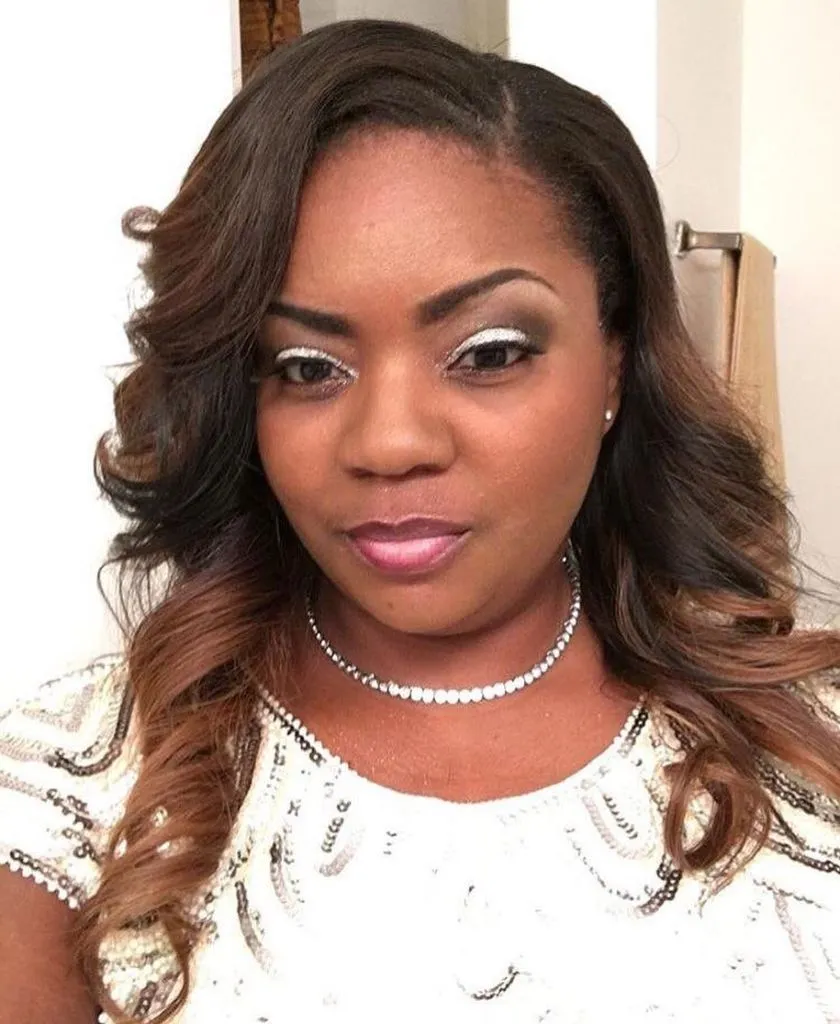
The supporting elements lean formal. A silver-look choker and an ivory sequined neckline add sparkle at the collar, and the curl pattern is set into loose, brushed-through waves rather than defined ringlets. The palette moves from cool jewelry at the base of the neck up into warm caramel at the ends, which means the warmest point of the entire frame is the hair itself. That hierarchy keeps the color reading as the styled feature rather than the outfit.
The lesson here is about placement over percentage. A small amount of warmth, concentrated where the curl catches light, does more visible work than a full head of highlights on straight hair would. If the goal is winter dimension without a commitment to lightening, this is the lower-risk direction to ask for.
5. Golden Blonde Carries a Layered Back View
From behind, a warm golden blonde dominates a short, heavily layered cut, with stacked flicks running from crown to nape in three clear tiers. The darker roots are visible only as narrow shadows between the layers, and the brightest gold sits on the top surface of each flick where daylight catches it. The silhouette is dome-shaped, wider at the top than at the base, which is unusual and part of what gives the color room to display.
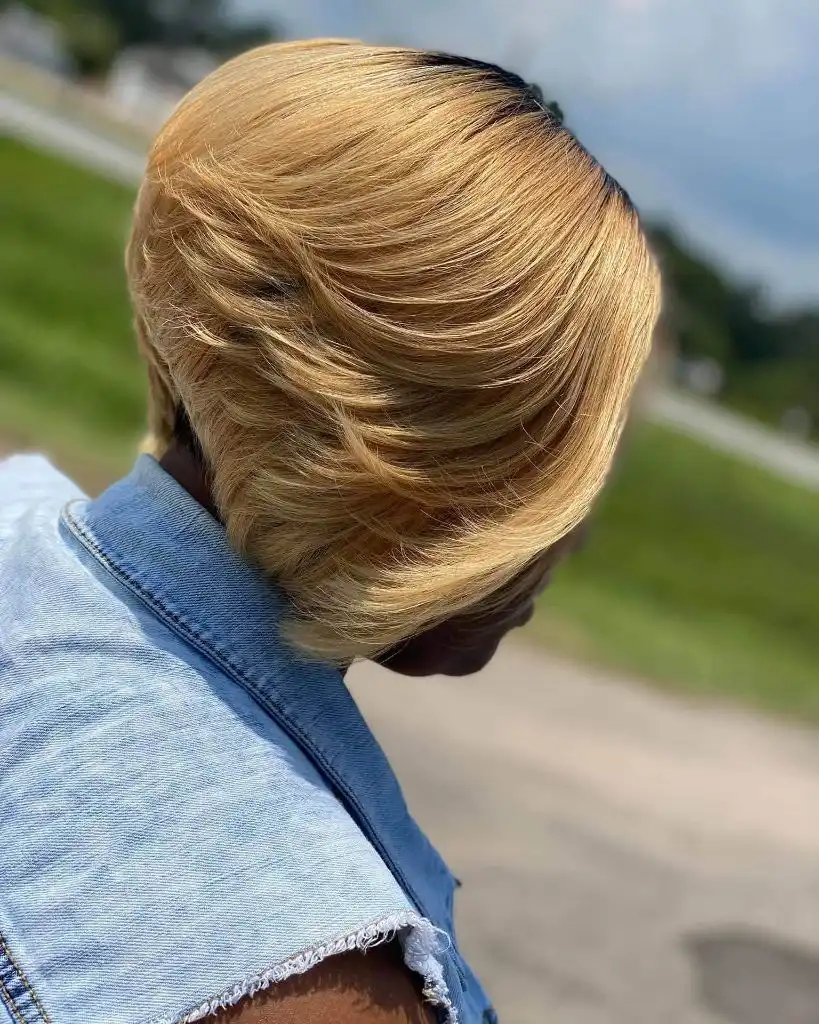
The supporting cast is minimal because the back view removes the face from the equation. A pale denim vest sits low in the frame, and the outdoor background of grass and road stays neutral enough that nothing competes with the gold. The clearest endpoint is where the lowest tier of layers meets the neck; that soft edge, rather than the crown, is where the eye finally rests. The tiers themselves function as internal contrast, holding the color’s hierarchy without any outside help.
Compared with the honey bob in the first item, this is the more architectural version of a similar palette. Layers this defined need a regular trim to keep the flicks reading as intentional rather than grown-out, so the color choice and the cut discipline are joined at the hip.
6. Deep Espresso Anchors a Center-Parted Blowout
Near-black espresso covers the full length, styled into a smooth center-parted blowout with softly curled ends that turn inward at the collarbone. There is no visible highlight, no root shadow, no ombre; the color reads as a single deep field, and the composition depends entirely on shine and shape. The parting is clean, the crown is flat, and the bend at the ends is the only place the hair changes direction.
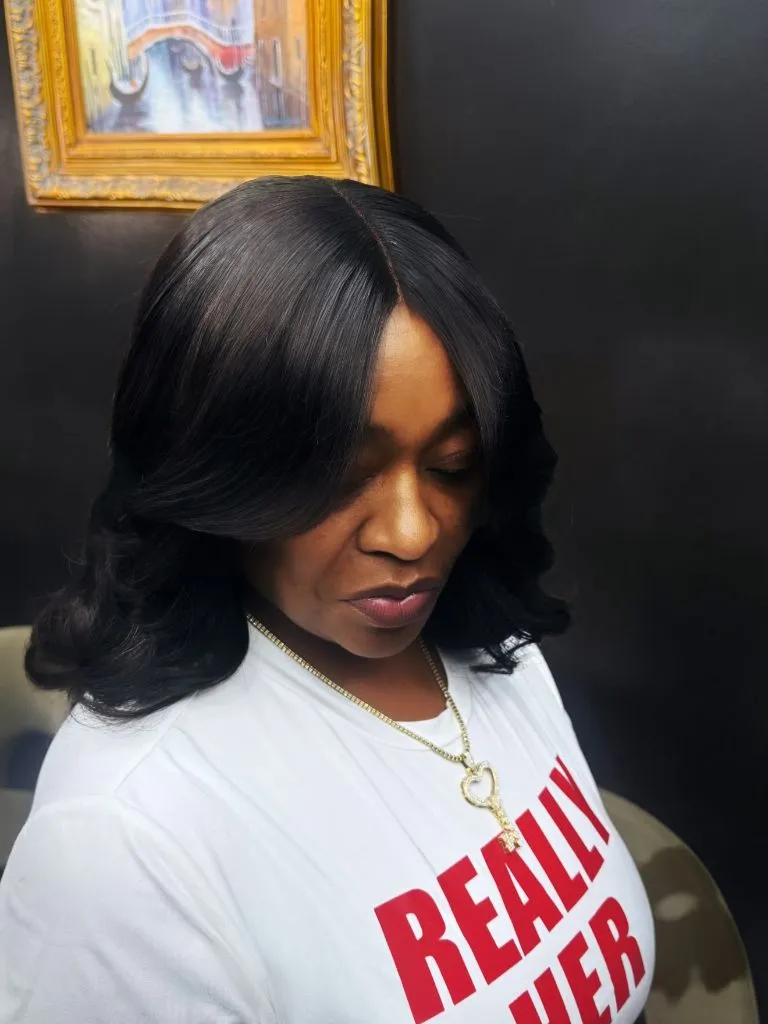
The supporting cast is intentionally small. A white tee with red block lettering sits below the frame, a gold pendant hangs at the neck, and a framed painting adds warm ochre to the upper background. Because the hair has no internal contrast, all of the visible contrast comes from the perimeter against the white shirt and the dark wall. The palette relationship is between hair and garment, not within the hair itself.
For anyone drawn to a winter hair color for Black women that reads polished with almost no upkeep, this is the reference. The trade-off is that solid dark hair is completely dependent on finish. If the shine drops, the shape has nothing to fall back on, so the styling routine is doing at least half of the visible work.
7. Merlot Melt Carries a Curled Back Silhouette
A merlot-toned melt sits over a dark scalp, with the deepest wine tones concentrating through the mid-lengths and ends of a long, waved shape seen from behind. The root stays almost black, and the transition from dark to burgundy happens gradually through the upper third, which keeps the two zones from banding. The strongest curl definition is at the ends, where the wine tone catches the most light.
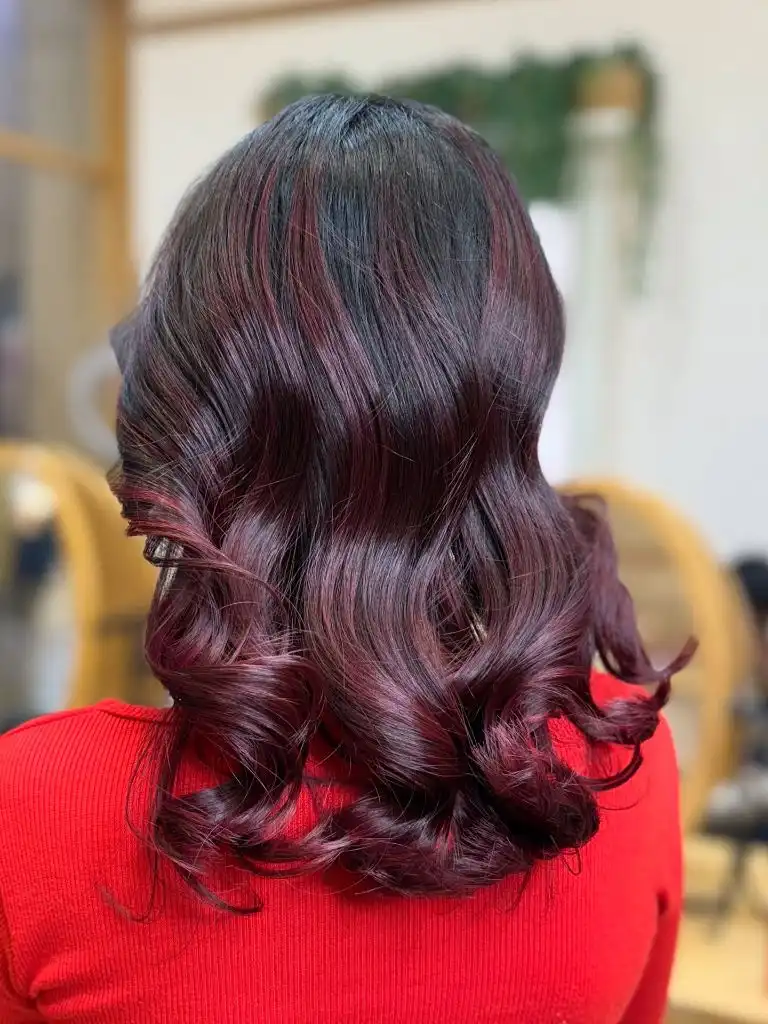
The supporting cast pushes the warmth intentionally. A bright red top at the shoulders echoes the burgundy of the ends, so the palette reads as a controlled monochrome from mid-length down. The salon background is neutral wood and greenery, which keeps the outside frame quiet. The clearest endpoint is the curled tip of each wave, where wine meets ambient light and separates from the darker interior of the curl. Similar techniques show up in other approaches to Fall Nail Ideas for Black Women, where warm burgundies work as the anchoring tone rather than an accent.
The honest limitation is grow-out visibility. Because the root is intentionally kept dark and the wine sits below it, this melt actually grows out more gracefully than most red placements, which is part of the appeal. If the burgundy feels too dense, requesting a half-shade brighter at the very ends only would open the composition without changing the architecture.
8. Glossy Jet Black Sets a Long Body Wave
Uninterrupted jet black covers a very long, side-parted body wave, and the color reads as a single dense field the entire way down. The waves are large and open, bending in the same direction from crown to hip, which lets light travel across the surface in continuous horizontal bands. Because there is no tonal variation, the composition depends on wave scale and shine placement rather than on color contrast.
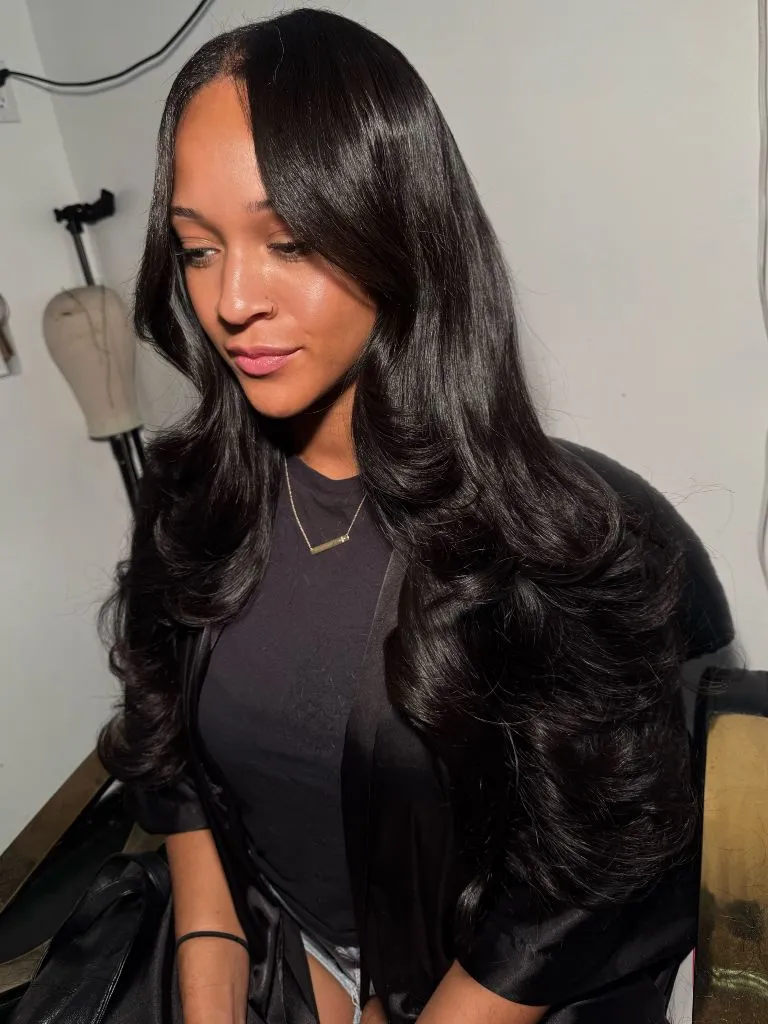
The supporting elements stay in the same colour family. A black tee and a satin-looking robe keep the entire lower frame in the same tonal register as the hair, so the only contrast in the image is skin against the dark field. That decision makes the shine the loudest detail; every highlight band along a wave is visible because nothing else in the frame is competing for brightness. The palette is essentially one colour with different sheens.
Compared with the espresso blowout above, this is the same commitment to a single dark field but with much more length to police. The trade-off is bulk and weight through winter hats and coat collars. I like the restraint of leaving it entirely tonal, but shorter necks may find the sheer volume around the shoulders worth reconsidering.
9. Dark Cherry Extends Down a Long Wave
A dark cherry tone dominates the full length of a long, loose wave, with the color reading slightly warmer in the mids and cooler near the root. The base looks like a near-black cherry rather than a true red, which is what keeps it wearable at this saturation. The shape is a middle-part with soft body waves running from ear-level to well below the bust, and the color travels evenly through every section.
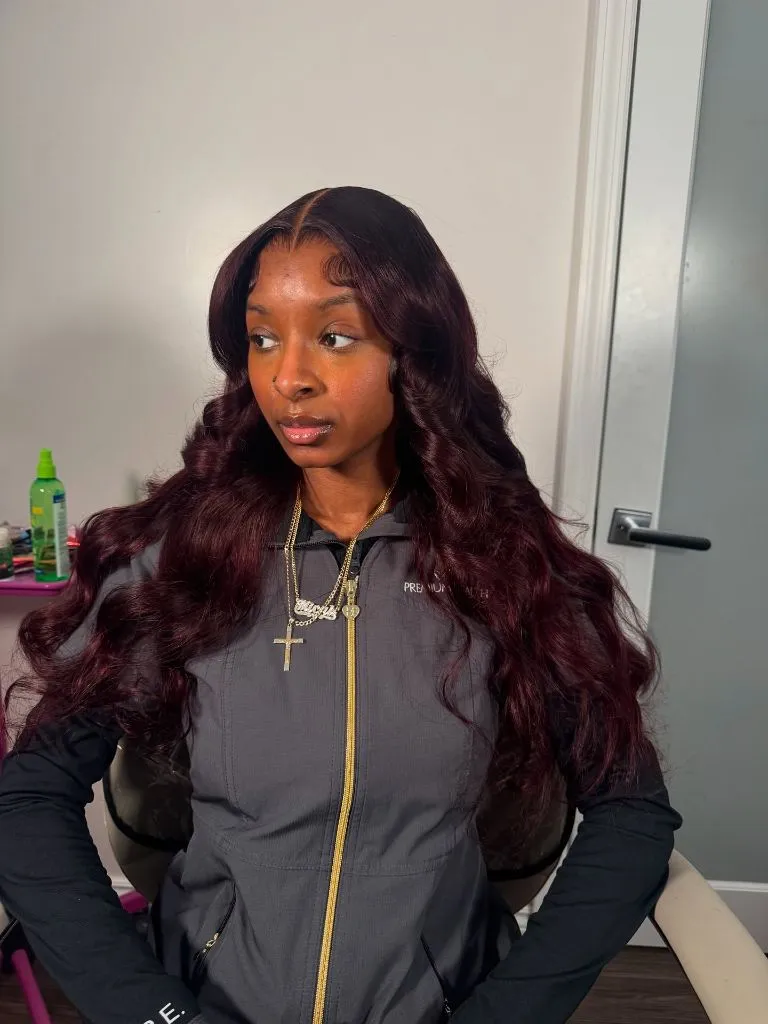
The supporting cast is grey. A charcoal zip-front jacket removes all colour competition from the neckline, and a gold cross necklace sits centered without breaking the frame. The palette relationship is between cherry hair, grey garment, and neutral wall, which means the only warm element in the entire image is the hair itself. The clearest endpoint is the deepest wave near the ribcage, where the cherry darkens against the fabric.
The lesson here is about saturation restraint. A dark cherry gives the visual reward of a red without the upkeep spike of a copper or a true bright red, and it reads as jewel-toned rather than costumey under indoor winter light. Pushing it any brighter would break the composition; keeping it at this depth is what makes it work.
10. Peekaboo Blonde Cuts Through Dark Layers
A near-black layered bob dominates the frame, and a single pale blonde face-framing piece cuts vertically down the right side, sweeping across the forehead before falling past the jaw. The rest of the hair stays uniformly dark, and the flicked ends turn outward at chin level. The dominant proportion is roughly ninety percent dark to ten percent blonde, and that ratio is what makes the light piece function as a stripe rather than as a highlight.
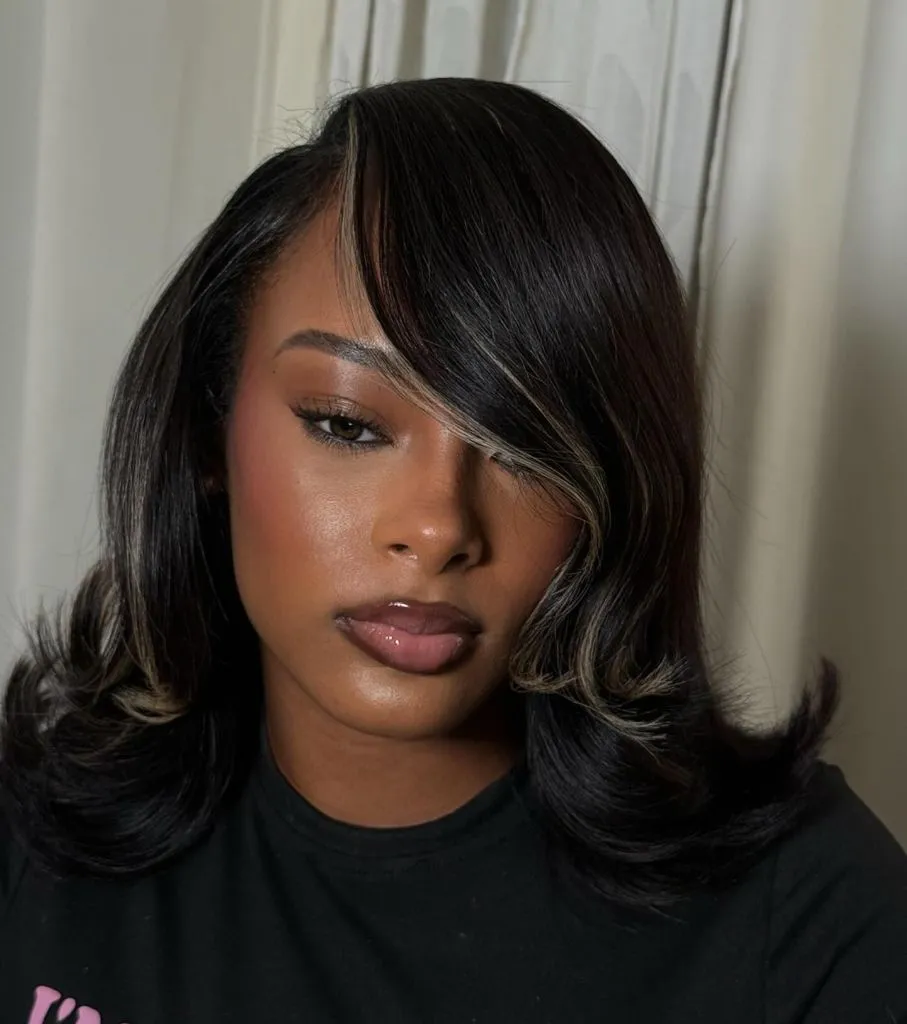
The supporting cast is quiet. Full glossy lips, defined lashes, and a plain black tee keep everything else in the frame in the dark register, so the blonde piece has no competing brightness. The strongest endpoint is where the blonde streak crosses the eyebrow, because that intersection is where the highest contrast in the image lives. Everything else about the makeup and clothing is calibrated to leave that one piece alone.
The transferable principle is about ratio. A single peekaboo piece works because it stays small enough to read as intentional; adding a second on the opposite side often collapses the effect into ordinary chunky highlights. For anyone considering this winter hair color for Black women, the practical detail is that the streak needs to be lifted several levels above the base, which means a bond-repair routine is not optional.
11. Cornrows Anchor an Auburn Feed-In Braid Set
The dominant elements are tight, side-swept cornrows moving diagonally across the scalp in a controlled pattern, transitioning into longer auburn-toned braided lengths at the nape. The scalp work occupies the entire visible upper half of the head, and the color shift from the natural root sections to the auburn feed-in extensions happens gradually as the braids leave the scalp. The proportion is scalp-heavy, which is unusual and part of what makes the geometry read.
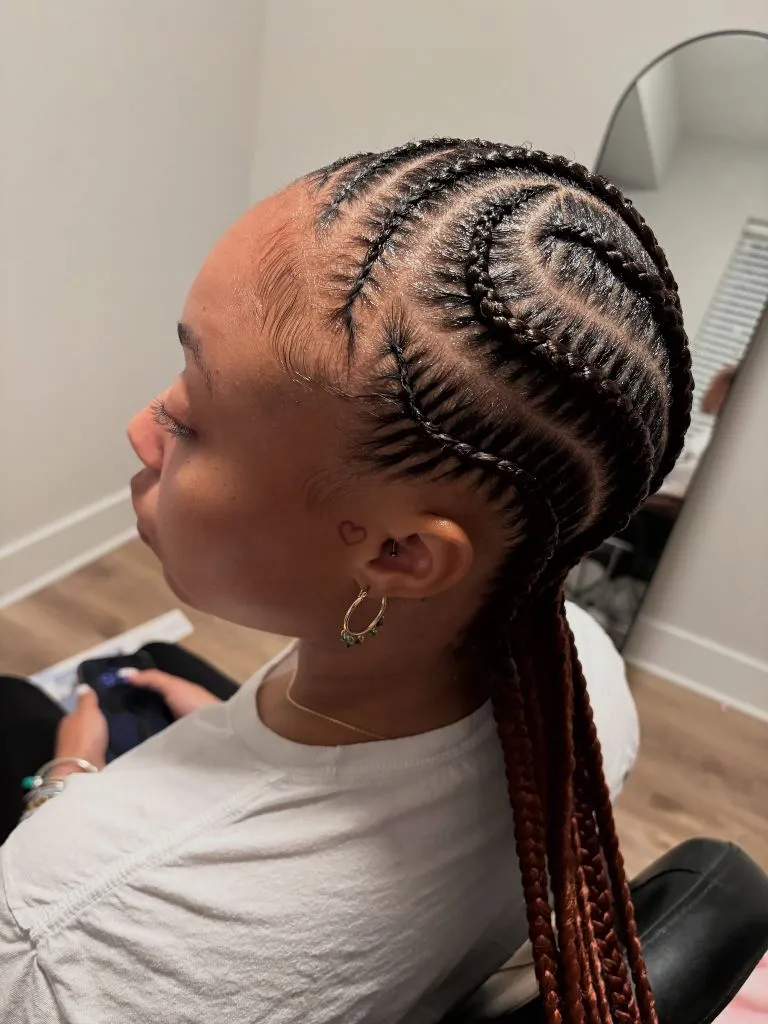
The supporting cast reinforces the geometry. A small gold hoop with beading at the ear sits inside one of the swept sections, and a white tee keeps the lower frame plain so the pattern of parts stays legible. The palette is a controlled warm brown-to-auburn, with no jumps in tone. The clearest endpoint is the point where the last cornrow releases at the back and joins the loose braided lengths; that transition is where the eye naturally rests.
Compared with the peekaboo bob above, this is the opposite philosophy: contrast built from structure rather than from color. The honest limitation is scalp time. Braid patterns this tight demand skilled installation and disciplined edge care, and the auburn tone in the added hair will fade with sun exposure faster than the natural sections around it.
12. Honey Brown Extends Through Knotless Braids
Long knotless braids in a honey brown tone dominate the composition, parted into small, even square sections across the crown. The color is close to a light chestnut with warm gold undertones, and it stays consistent from where each braid begins to where it ends well below the shoulders. Because the sections are small and the parting is neat, the scalp pattern reads as a grid that organises the entire canopy.
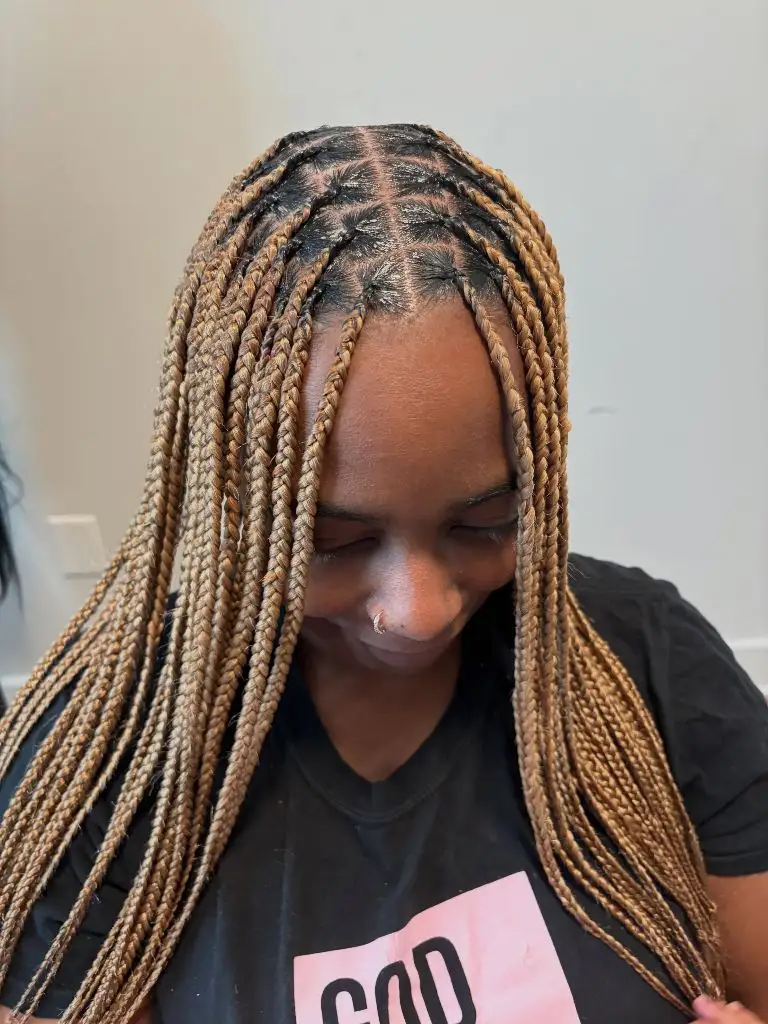
The supporting cast stays out of the way. A black tee with a pale block print keeps the palette low, and the plain wall behind removes any background colour. The strongest tonal contrast is between the natural darker root at each part and the honey brown of the braid immediately below, which means every section has its own small internal contrast. That repetition is what gives the style its rhythm.
The transferable principle is about tone selection. A honey brown reads warmer against deeper skin than a caramel would, without pushing into true blonde territory, which keeps the braid installation looking natural rather than costume. If the tone feels too gold, requesting a half-shade cooler in the same value range would keep the plan without shifting the base architecture.
13. Sleek Ponytail Meets a Half-Up Bun
The dominant structure is a sleek, low-shine half-up half-down style, where a small top-knot sits high on the crown and the remaining length hangs straight and long down the back and shoulder. The parting is razor-sharp, the baby hairs are laid in tight curls at the temple, and thin caramel highlights run vertically through the down section. The proportion divides the head into a compact top and a long flat tail below.
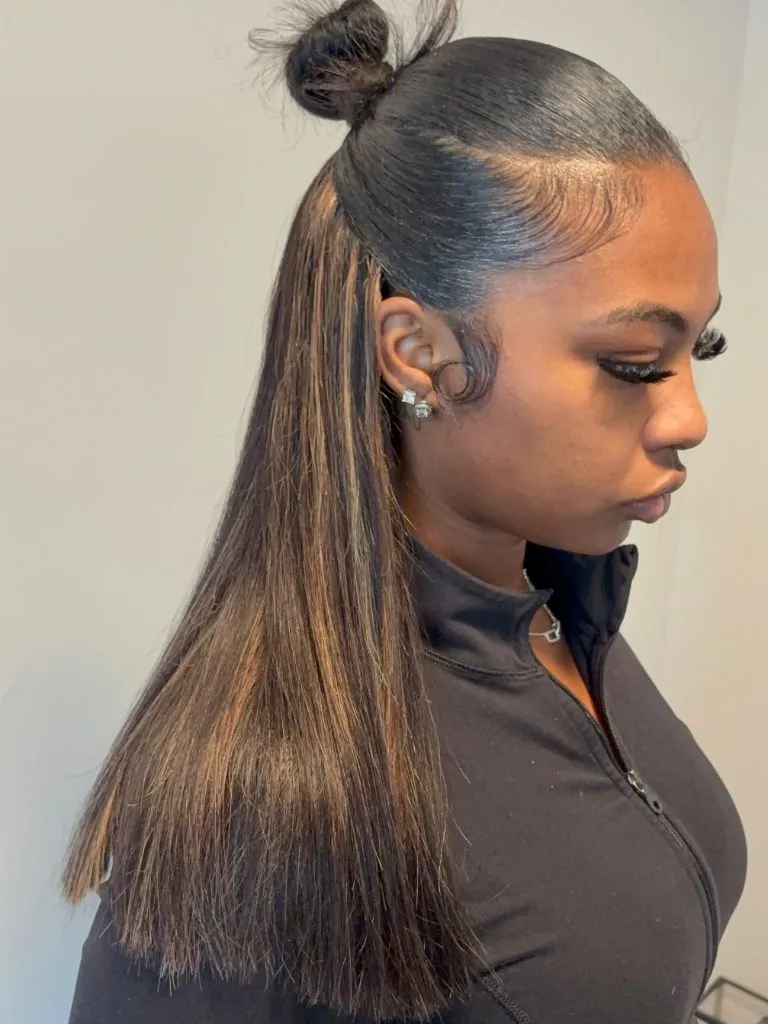
The supporting cast is precisely styled. Hoop earrings stack at the ear, a fitted black zip-top keeps the neckline clean, and the makeup is understated so nothing pulls focus from the parting. The palette is deep espresso with thin warm ribbons, and the sharpest contrast in the frame is between the laid edges and the skin at the temple. The endpoint is the tip of the ponytail, which sits flat against the fabric of the top.
The lesson here is that colour placement can be quiet when the styling is loud. Thin caramel pieces on a sleek pull like this catch light with movement rather than sitting still, which is why they don’t need to be dense to read. Adding more highlight would fight the discipline of the styling; keeping them narrow is what makes the whole thing hold.
14. Chocolate Balayage Frames a Curtain Waves
A rich chocolate brown covers the full length of a long, side-swept wave, with subtle warmer balayage pieces distributed through the mids and ends. The dominant impression is depth rather than lift; the base stays close to natural, and the lighter pieces only appear where curl catches light. The shape is a long face-framing curtain, with a slight bend near the eye and open waves falling to the ribcage.
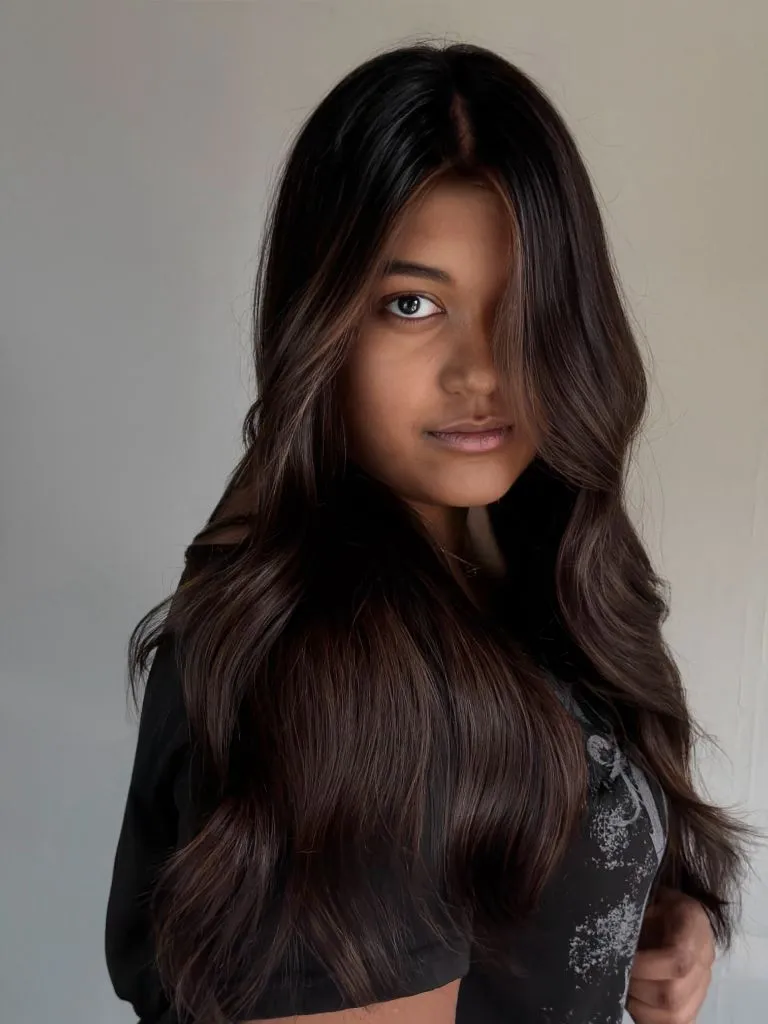
The supporting cast is soft. A black graphic tee sits low in the frame, a fine chain rests at the collarbone, and the neutral wall behind keeps everything muted. The palette moves from a deep root through a warm chocolate mid to a slightly brighter end, but every step is small enough that the overall read is one colour with dimension. The clearest endpoint is the wave that crosses the chest, where the balayage pieces separate most visibly.
The honest limitation is that this level of subtlety only shows on hair styled with defined movement. On straight, flat hair, the same placement can disappear into the base and read as a single flat colour, which is why the wave here is doing structural work. For anyone drawn to this winter hair color for Black women, the practical detail is that the finish matters as much as the tone.
15. Middle Part Body Waves in Uniform Jet Black
A uniform jet black covers a middle-parted body wave that falls just past the bust, with soft bends that turn outward at the ends. The color is a single unbroken field, without a single visible highlight or shadow variation from root to tip. The shape is a classic long wavy blowout, and the composition depends entirely on the interaction of the smooth parting, the wave rhythm, and the outward flick at the perimeter.
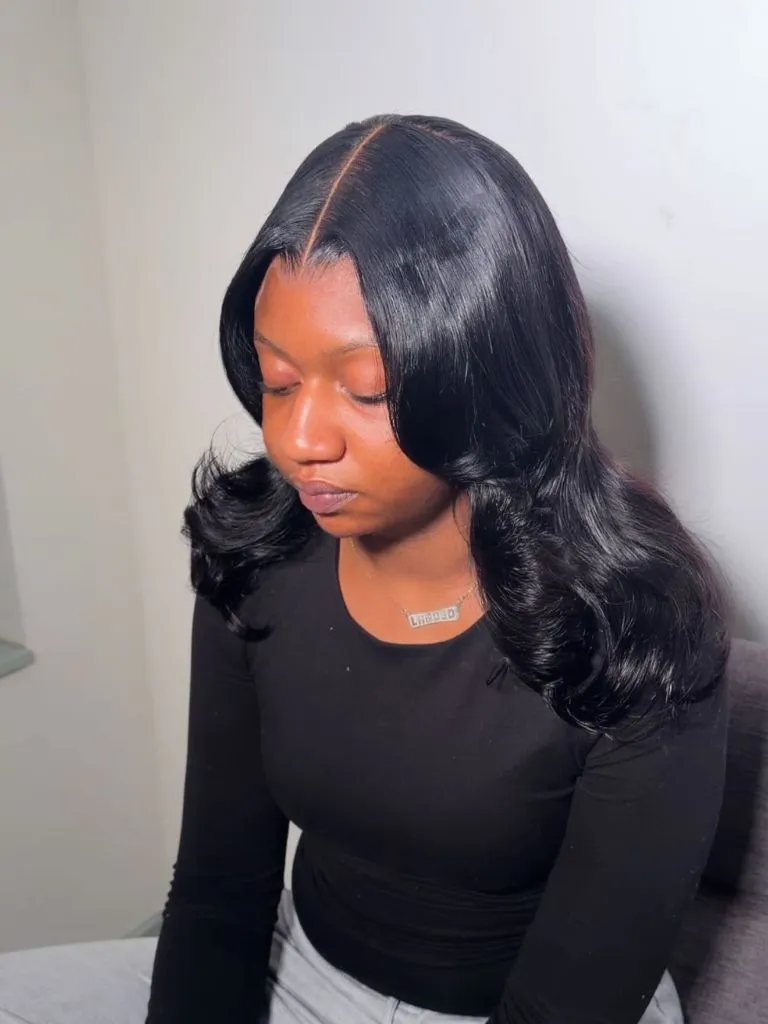
The supporting elements repeat the palette. A fitted black long-sleeve, a name-plate necklace at the collarbone, and a grey background create a monochrome frame where the hair, garment, and background sit within a narrow tonal range. The sharpest contrast is skin against the dark field. The clearest endpoint is the outward flick at the end of each side, which catches light and separates from the shadow of the interior. Similar tonal restraint appears in several looks in the archive of winter outfit references, where a single deep hue does all the work.
Compared with the espresso blowout earlier, this is the same one-colour approach but softened by wave rather than by curl at the ends. The honest limitation is that any dryness or frizz breaks the illusion instantly, since there is no colour variation to distract. Weekly deep conditioning is part of the styling plan, not a bonus.
16. Espresso Waves Frame a Long Face-Framing Shape
A deep espresso brown, warmer than a true black, dominates a long straight-to-waved shape with subtle darker root shadow and slightly lighter mids. A visible curl bend appears only at the very ends, sitting near the elbow, while the length above stays smooth and heavy. The dominant impression is a natural-looking dark brown, differentiated from a jet black by a hint of warmth that only shows in direct light.
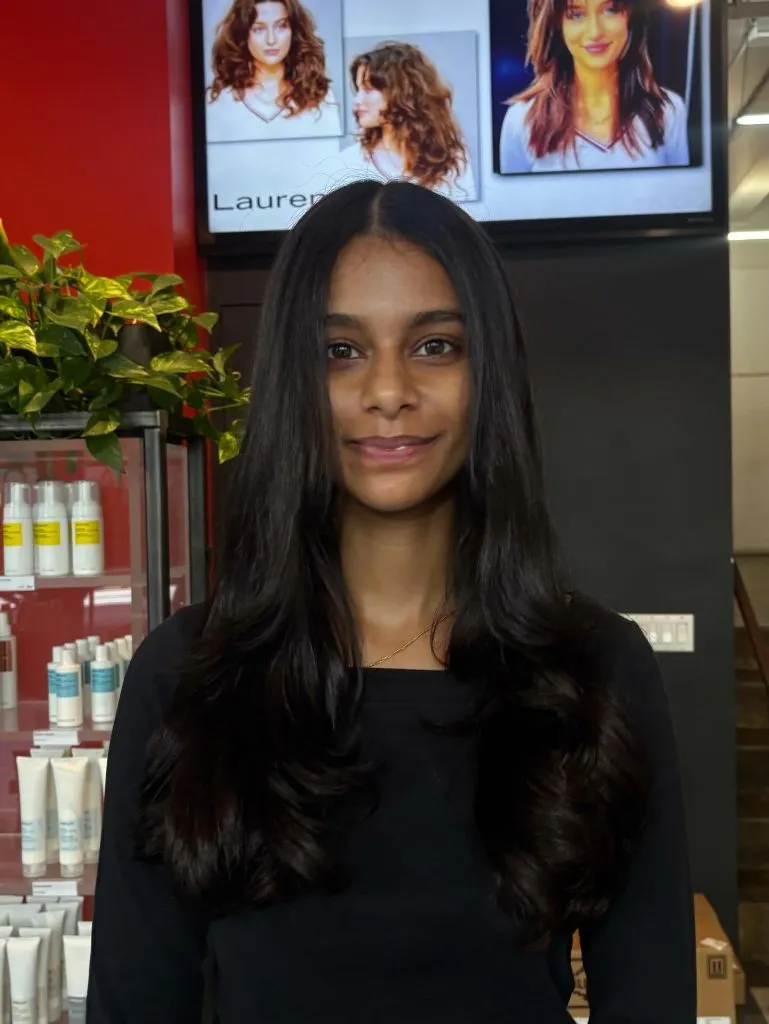
The supporting cast is soft and unforced. A plain black long sleeve, a delicate chain, and a warm salon background with plants and product shelves keep the palette natural. There are no highlights competing, no accessories in the hair, and no makeup that pulls focus from the shape. The strongest endpoint is where the wave finally curves inward at the bottom, providing the only real change in direction across the entire length.
The transferable principle is about warmth calibration. A true jet black can read heavy against warm skin tones in winter light; nudging half a step toward espresso keeps the depth while softening the edge between hair and complexion. If the goal is dark hair that still looks alive, this is a more forgiving reference than a flat black would be.
17. Boho Braids Soften With Loose Curly Pieces
The dominant structure is a bohemian braid set: small, tight braids interspersed with loose curly extension pieces that break up the braided grid and fall in tight spirals around the face and shoulders. The color is a deep near-black throughout, so the visual complexity comes entirely from the alternation between smooth braided sections and textured curly ones. The proportion is roughly half-and-half, which is what gives the style its softer read.
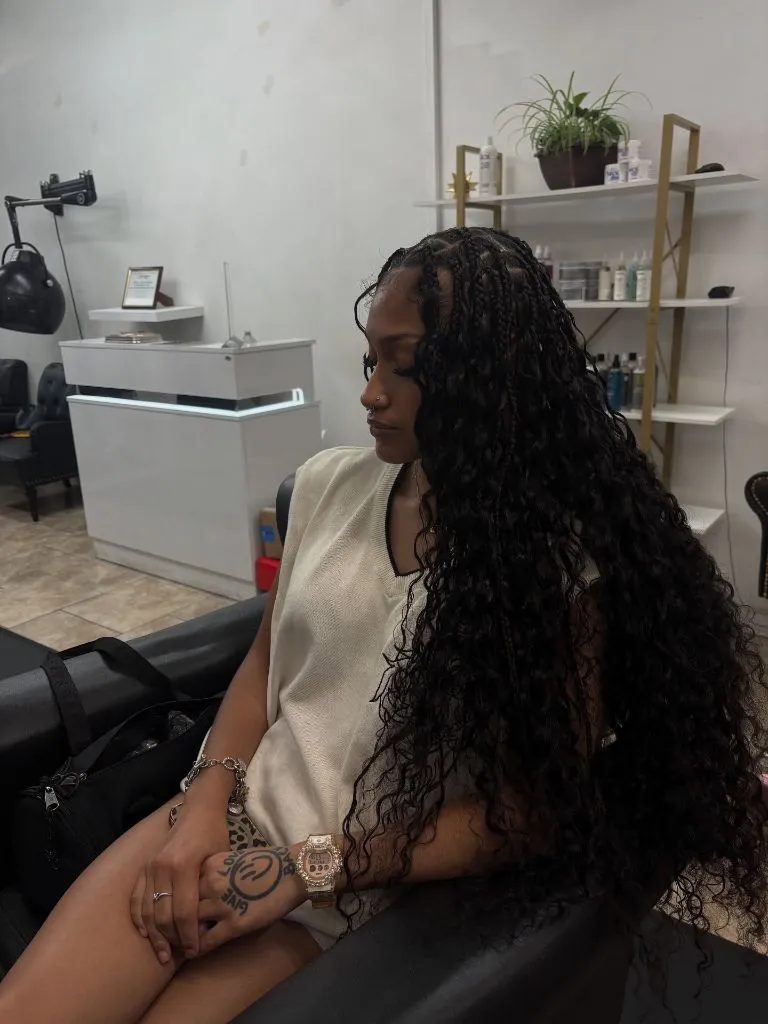
The supporting cast is neutral. A cream-toned drape covers the shoulders, a chunky watch and stacked bracelet sit at the wrist, and a light-filled salon background keeps everything else quiet. The palette is fully monochrome dark, and the sharpest contrast in the frame is between the curl texture and the smooth braid texture rather than between colours. That texture-only contrast is a specific choice, and it lets the shape read as soft rather than geometric.
Compared with the tighter cornrow set earlier in this run, this is the loosened, less architectural version of a braided install. The trade-off is longevity; loose curly pieces need more daily refreshing than tight braids do, and the boho effect fades faster if the curly sections aren’t maintained. For a lower-effort version, requesting fewer curly pieces and more clean braids would push the balance back toward structure.
18. Dense Curls Build a Full Perimeter Silhouette
Uniform near-black dense curls fill the entire back-view frame, running from the crown to well past the ribcage in a triangular silhouette that widens as it descends. The curl pattern is small, tight, and consistent throughout, with no visible variation in tone or definition between the interior and the perimeter. The dominant impression is volume as the primary design choice, with color functioning as a neutral background for the texture.
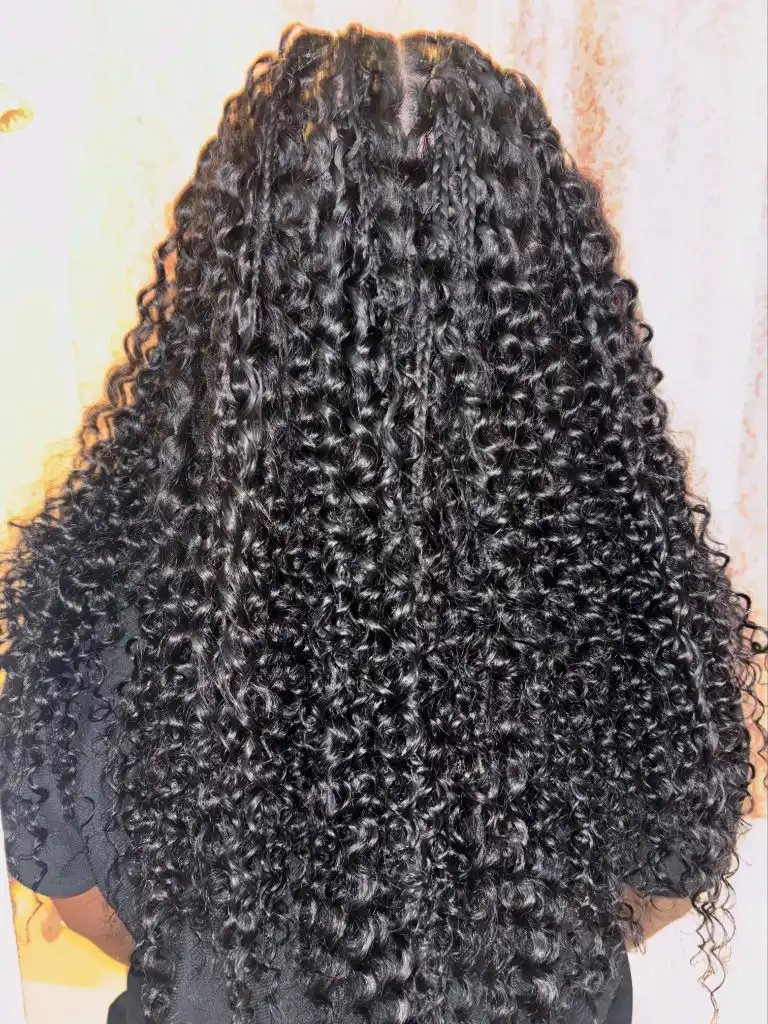
The supporting cast is almost invisible. A dark garment at the shoulders and a warm cream background keep the entire frame in a two-tone palette. Because there is no color variation to distract, the entire visual weight sits on curl definition and perimeter shape, and the strongest endpoint is where the curls finally break at the widest point of the silhouette. The palette is monochrome; the composition is all shape.
The honest limitation is scale. A curl silhouette this dense reads dramatic in a full-length photograph, but under a winter coat, half of the perimeter compresses and the shape shifts. The lesson here is that heavily textured looks are seasonal in a practical sense; if daily outerwear will flatten the sides, a shorter, lighter version delivers more visible payoff.
19. Long Dark Waves Rest on a Cream Collar
Long, loosely waved dark hair in a rich near-black tone dominates a three-quarter portrait, with the length swept slightly to one side and the ends falling past the collarbone. There is faint warm depth in the mids that reads as tonal rather than as highlighted, and the wave pattern is open and irregular rather than uniformly set. The composition depends on the way the hair rests against a light-colored collar, creating the sharpest contrast at the shoulder.
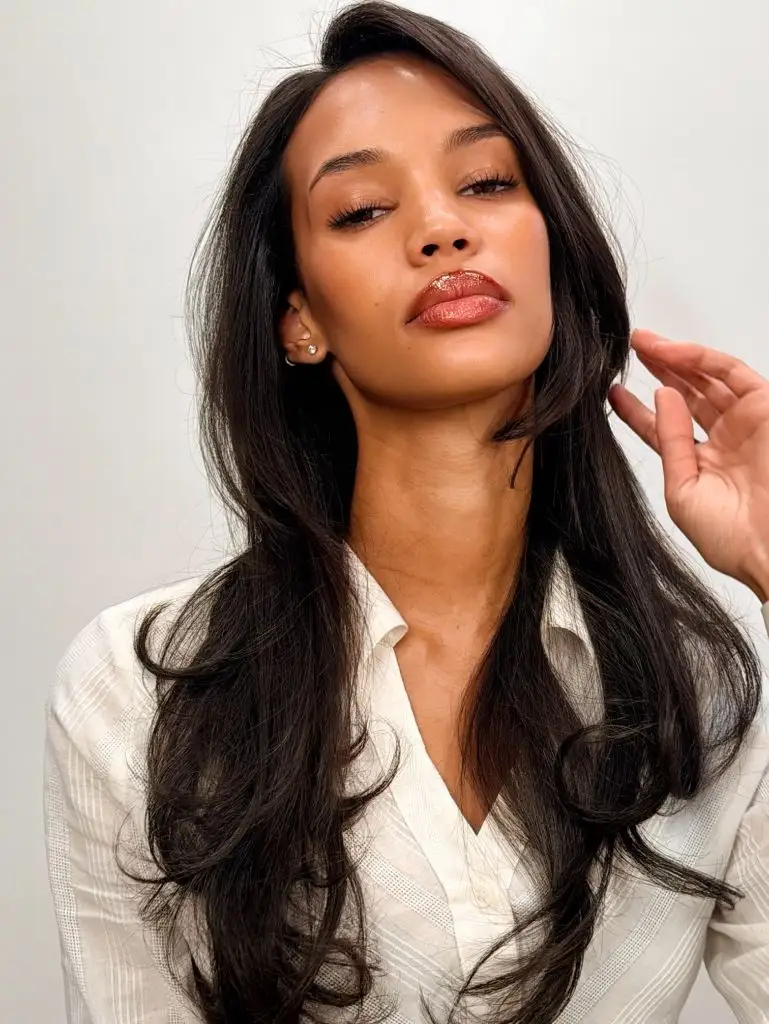
The supporting cast is intentionally light. A cream patterned collared shirt, warm skin, and glossy lip color put every element in the frame except the hair into a soft neutral register. The palette relationship is dark hair against pale garment, and the clearest endpoint is the perimeter of the waves where they meet the shirt. Because the waves are broken and irregular, the perimeter itself has a soft, non-uniform edge that keeps the look from feeling styled to a point.
The transferable principle is about wave discipline, or the lack of it. Perfectly set waves photograph beautifully but read stiff on a normal day; a looser, more broken wave like this holds through weather and movement and still reads as intentional. If the goal is winter hair that survives a hat, this is the version to ask for.
20. Copper Bob Curves Into a Rounded Dome
Warm copper brown dominates a heavily layered rounded bob seen from a raised angle, with darker roots blending gradually into brighter copper through the mids and ends. The cut is stacked at the back, creating a dome silhouette that curves outward from the crown before turning under at the perimeter. The color placement follows the layer stack, so each tier catches slightly more warmth than the one above it, and the overall reading is a warm autumnal copper adapted for winter light.
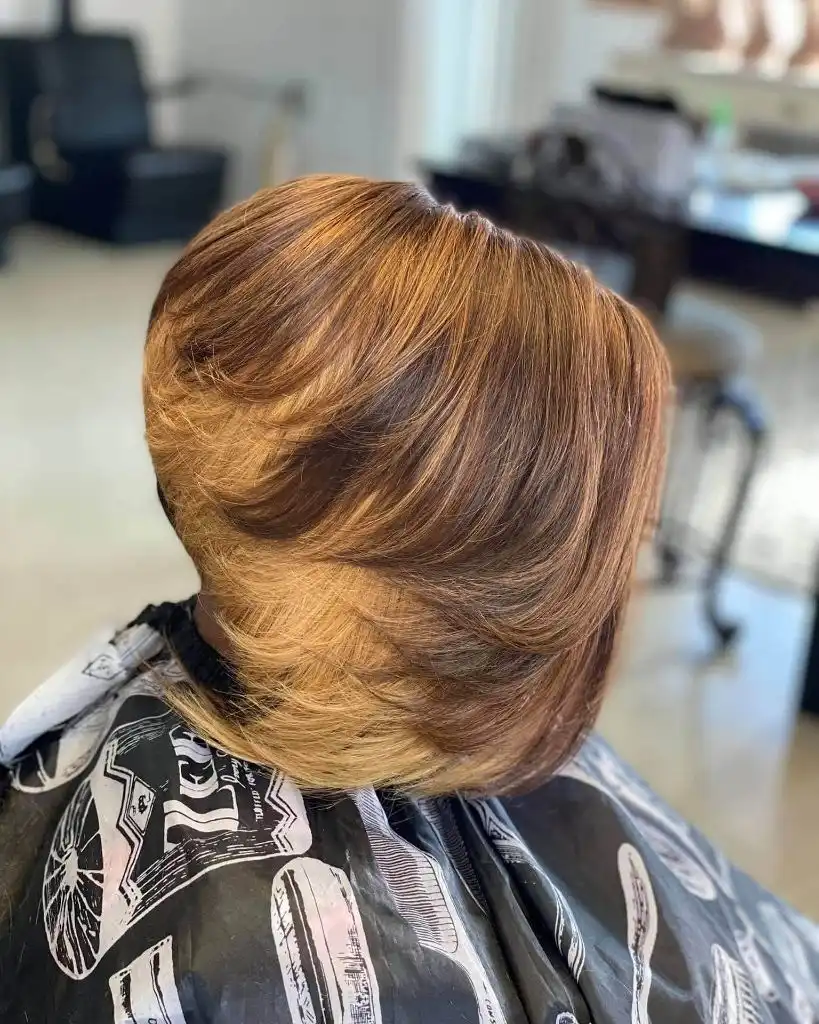
The supporting cast is quiet. A patterned black-and-white cape covers the shoulders, and a soft blurred salon background sits behind the head. The palette relationship is entirely between root shadow and copper mid, with no third colour introduced. The sharpest endpoint is the underside of the perimeter, where the copper darkens into the turned-under curl and creates a defined edge against the neck. Nothing else in the frame competes with the color.
Compared with the honey lift in the first item, this is the warmer, more autumnal cousin of the same architectural idea: dark root, warm body, defined dome. The trade-off is that a copper this saturated will pull brassy faster than a honey blonde will, so a copper-safe toning routine is worth building in from the first appointment rather than added later when the fade shows.