Winter Skirt Outfits for Women are easier to judge once you stop cataloguing individual pieces and start reading the composition. A skirt only works in relation to what sits above it, how much of the leg stays covered, where the palette repeats, and where the eye is allowed to rest. Proportion, scale, contrast, and negative space explain far more about why a look holds together than any single garment ever does.
As you scroll, compare where each hemline falls against the boot or the shoe, and notice which element is doing the loudest work before you notice its colour. The trade-off worth weighing is coverage against line: more layers mean more warmth and less visible structure. None of these arrangements is a rule, and several of them contradict each other on purpose.
1. Cream Slit Skirt Leads a Dark Top
A long cream skirt with a high front slit sets the terms here, taking up most of the vertical space from waist to ankle. Above it, a black knit turtleneck sits slightly bloused and is cinched by a wide dark belt with a gold-toned plaque. The division is roughly one-third dark and two-thirds pale, and the pale half clearly dominates the frame.
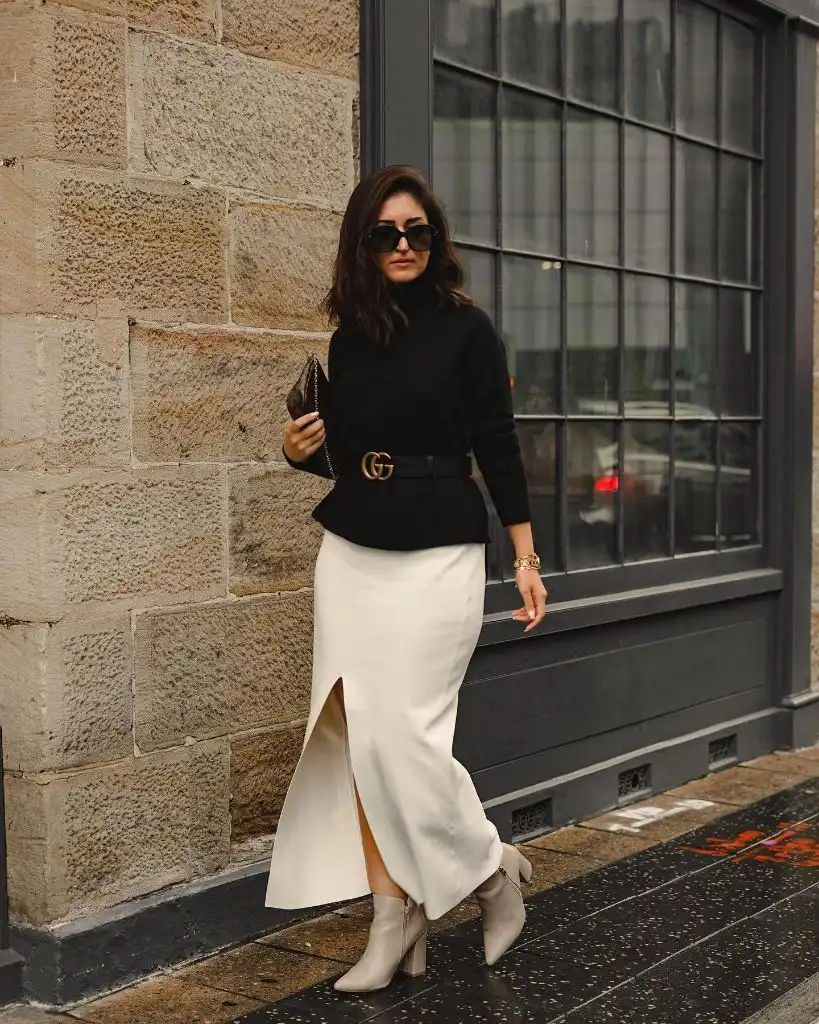
Everything else stays inside that two-colour agreement. The belt hardware finds an echo in a gold watch on the opposite wrist, and the small dark shoulder clutch repeats the top rather than competing with it. Pale grey ankle boots pick up the skirt’s tone, so the leg does not stop abruptly at the hem. The sharpest contrast in the whole outfit lands at the waist, which is exactly where the eye settles first.
The lesson is about where you place your only hard line. One belt, one point of high contrast, and the rest can stay tonal without looking unfinished. If the slit feels like too much exposure, the same proportion holds with a plain straight seam, since the visual work is being done by the length rather than by the opening.
2. Tiered Black Hem Carries the Whole Look
This one is built almost entirely from black, so the interest has to come from hem detail. A tiered maxi skirt with eyelet-style cutwork along each panel edge builds three horizontal bands down the leg, each wider than the last. A cropped leather-looking biker jacket sits above it, ending high at the hip, which stops the skirt’s volume from beginning too late.
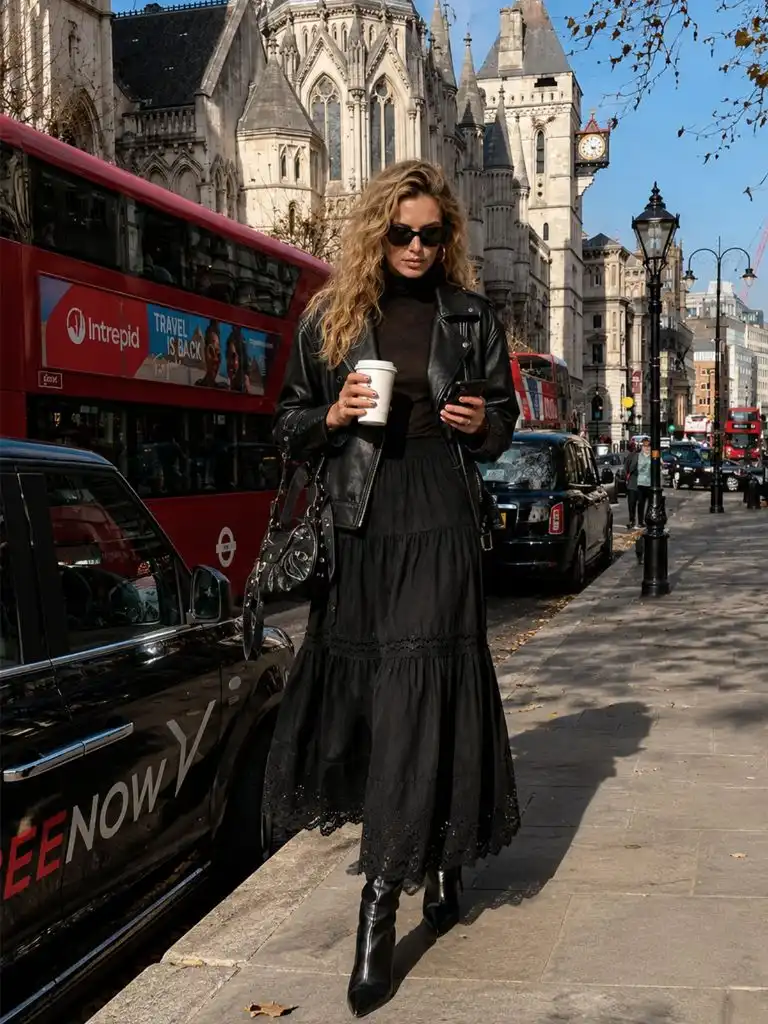
Because the palette is closed, texture carries the hierarchy: glossy jacket, matte openwork skirt, high-shine pointed boots at the endpoint. A studded silver-toned bag supplies the only hardware, and a brown turtleneck underneath is the single break in the black field, subtle enough that most people would read the whole thing as monochrome. Direct sunlight does the rest, catching the cutwork so the pattern still registers at distance.
Compared with the cream-and-black split above, this reads as one continuous colour field, and it asks far more of the fabric to stay interesting. It is also the harder version to wear in low light, where the eyelet detail disappears and the outfit flattens into a plain silhouette with nothing to look at.
3. Diagonal Plaid Takes Over the Frame
Scale is the entire argument in this look. A full plaid skirt cut on the diagonal falls to the ankle and flares wide enough to move on its own, filling the lower two-thirds of the picture. The check runs in brown, black, and cream at a large repeat, so the pattern reads as geometry rather than as surface texture.
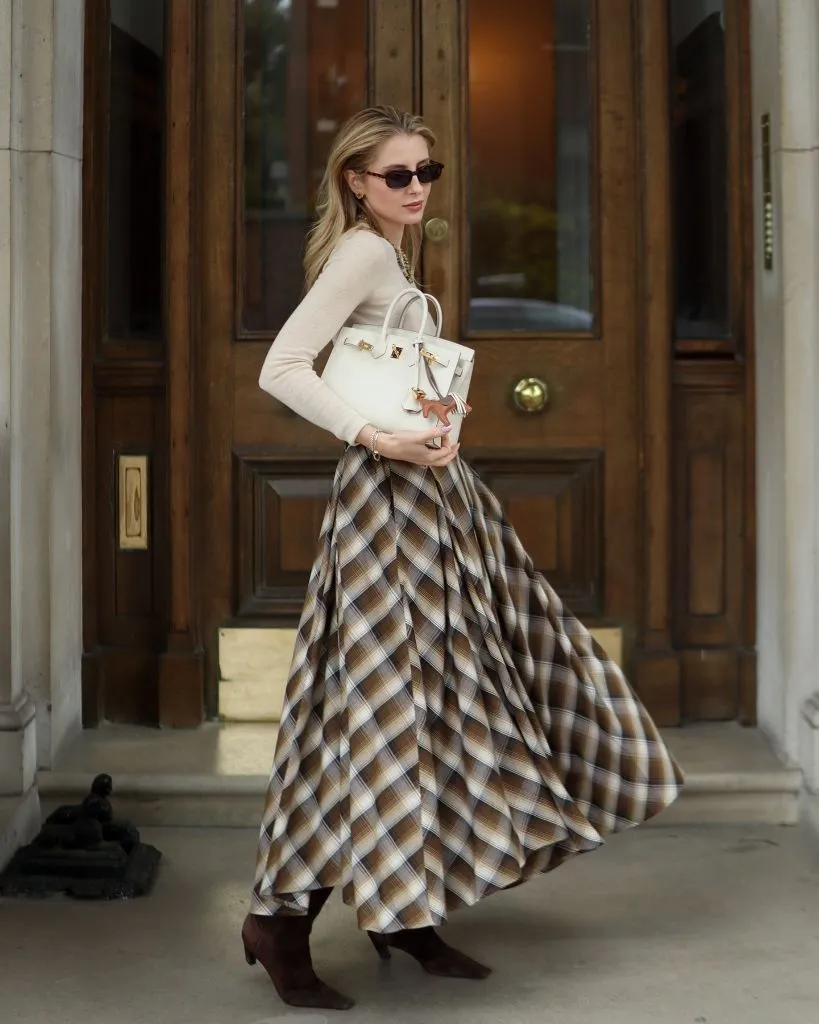
A close-fitting cream long-sleeve top does almost nothing by design, giving the skirt an uninterrupted run from waist to floor. The white top-handle bag lifts the lightest tone out of the plaid and sits at the midpoint, while dark brown suede-looking boots pick up the darkest. Small dark sunglasses and layered gold jewellery stay at the scale of punctuation, and nothing else in the frame is allowed a pattern.
If the volume feels like a lot, the same diagonal check works in a narrower A-line and loses very little, because the bias direction is what makes those lines read. Push it further instead by matching the boot to the darkest stripe rather than approximating it, which tightens the bottom of the palette considerably.
4. Navy Column Anchors a Grey Knit
Here the skirt is a plain dark column, and the composition depends on how short the top is. A grey cropped knit ends just above the waistband, leaving a narrow strip of visual break high on the body, and the navy-black maxi runs straight down from there with a small side split opening near the ankle.
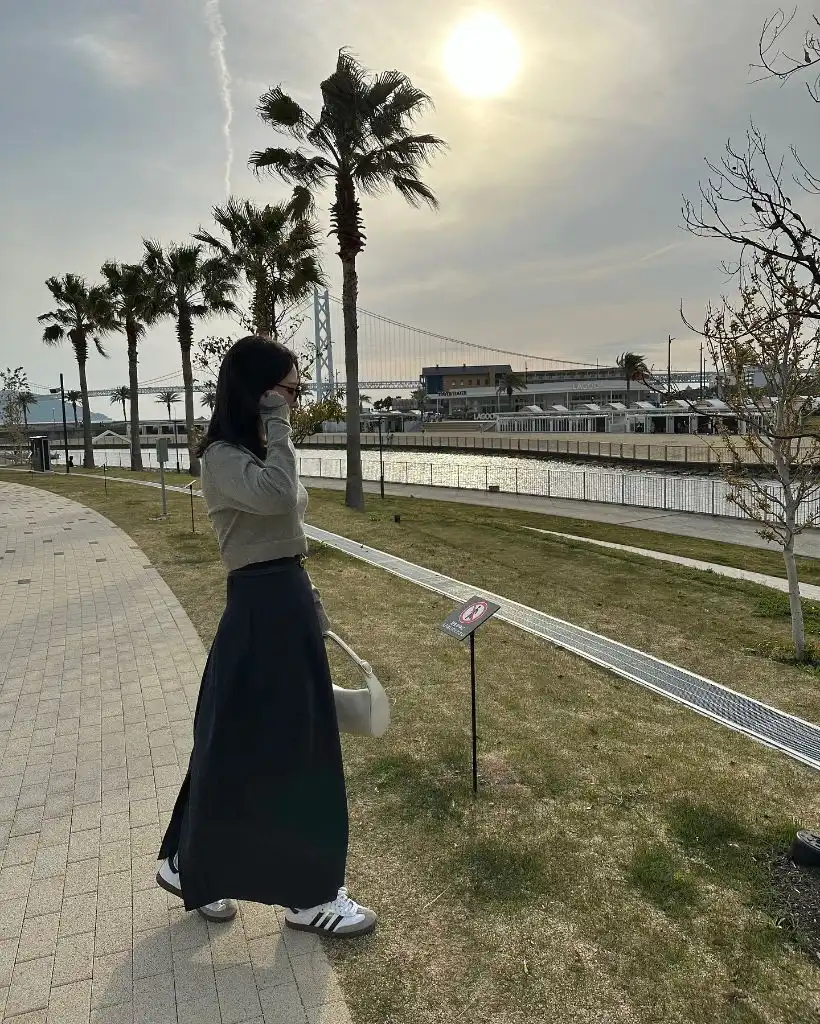
The supporting pieces are deliberately low effort. A cream crescent shoulder bag interrupts the dark field at hip level and shares its tone with the knit, and white striped sneakers close the look with the only bright endpoint. Since the skirt has no pattern and barely any shape, the outfit leans on those two pale points, bag and shoe, to keep the silhouette from reading as one unbroken shadow.
The honest limitation is that a long straight skirt worn with flat sneakers needs the hem to clear the ground, or the line drags and frays at the back. Among winter skirt outfits for women built for actual walking, this is the most forgiving version, but hem length is the one measurement you cannot fudge.
5. Yellow Beanie Interrupts a Black Perimeter
Volume above, volume below, and a single acid note at the very top. A boxy black wrap jacket with wide sleeves and a tie belt covers the torso completely, and beneath it a full black maxi skirt widens toward the floor. The yellow ribbed beanie is the only saturated colour anywhere in the frame, and it sits at the highest point.
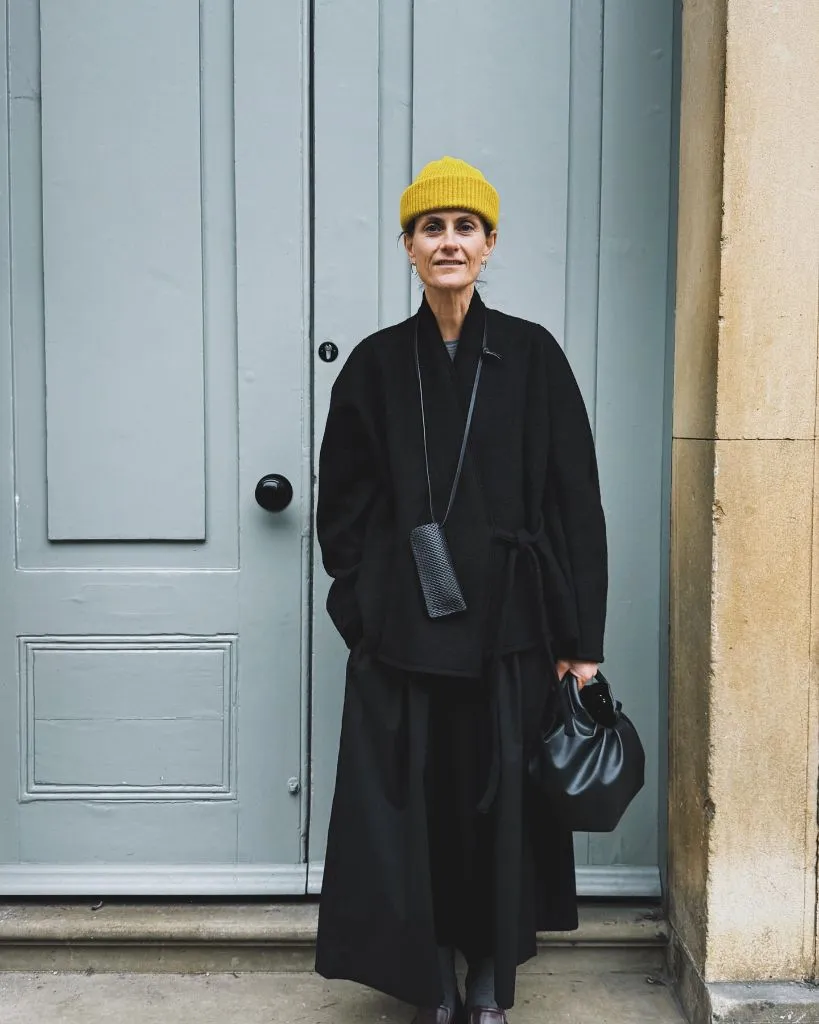
The rest of the palette holds still so that beanie can do its job. A slim black phone pouch on a long cord draws a vertical line down the jacket’s front and breaks up the wide chest, while a soft gathered black bag hangs at the hip and adds a rounder shape against all those straight edges. The pale grey-green door behind isolates the outfit as one dark mass with a bright cap.
The transferable idea is that a single high-chroma accessory can carry an entire neutral look, provided it stays alone. That same rationing appears throughout the broader logic of layered winter outfits for women, where texture does the heavy lifting and colour is spent sparingly. Swap the yellow for rust and the structure still holds.
6. Tan Shearling Softens Deep Green Leather
Seated, the proportions read differently, and the jacket becomes the widest thing in the frame. A tan shearling-style biker with a thick cream collar and turned-back cuffs stops at the high hip, and a dark green leather-looking midi skirt takes over below it, catching light in flat panels across the thigh rather than in soft folds.
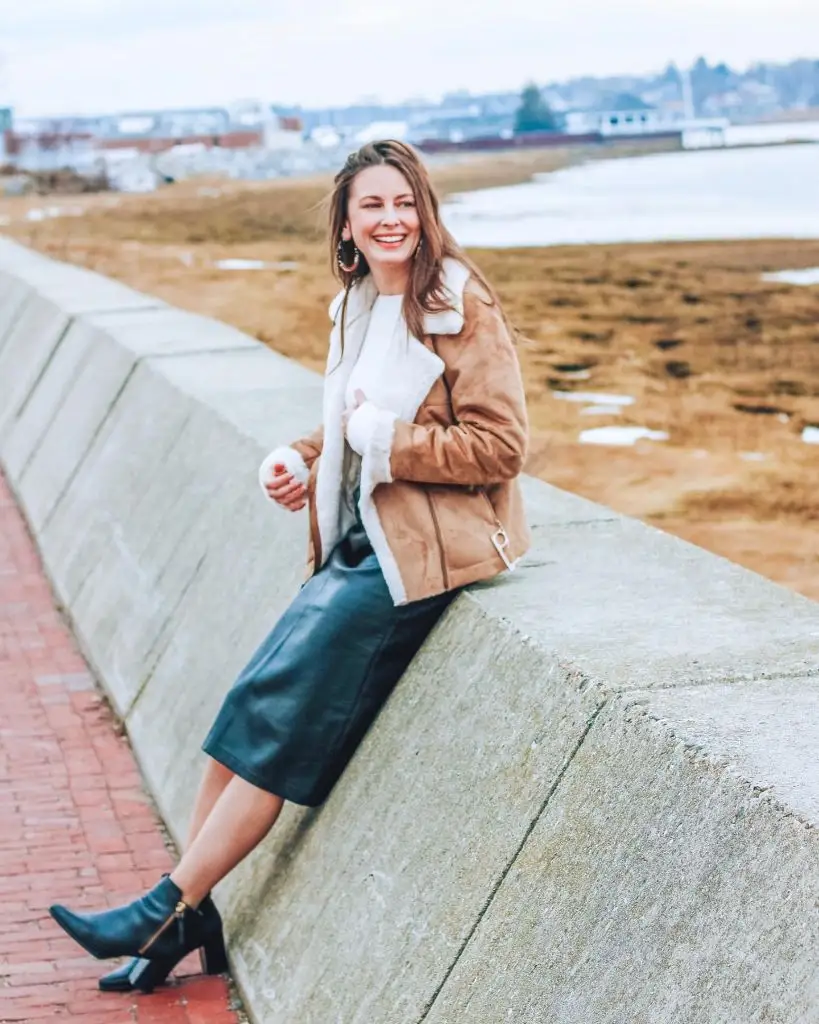
A cream knit sits under the jacket and matches the shearling trim, so the upper half reads as two tones of the same warm family. The green skirt is the coolest note and the only one, which is why it holds attention even while partly hidden. Black ankle boots with a low block heel end the leg without introducing a third colour, and large drop earrings sit where the hair parts.
Worth noting how much bulk a shearling-style collar adds once you sit down; the volume gathers at the chest and visually shortens the neck. If that trade-off bothers you, the same warm-against-cool pairing works with a flatter suede jacket and loses none of the tension between the two temperatures.
7. Red Mini Cuts Through Black Layers
Against a busy decorated background, this outfit keeps itself to three flat blocks. A black turtleneck covers the entire upper body, a red leather-looking mini skirt with a straight waistband and patch pockets sits at the natural waist, and opaque black tights run from the hem down to the boot without a single break in tone.
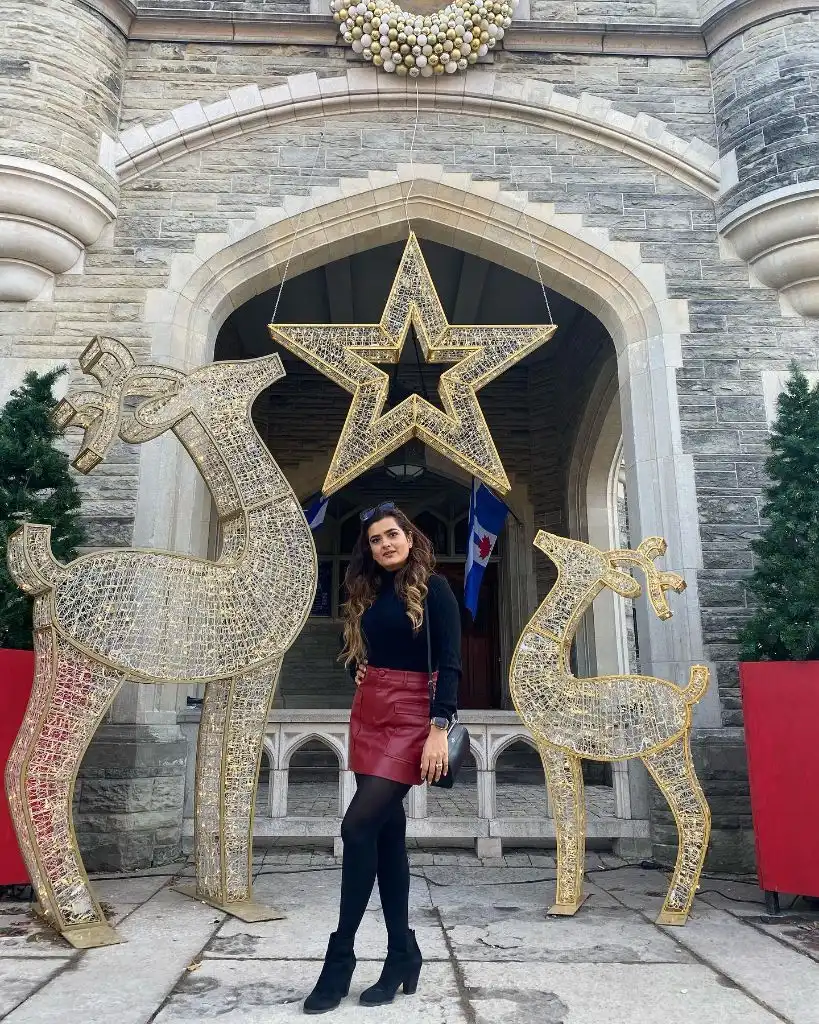
The red is the only colour and it occupies the smallest area, which is precisely what makes it read as loud. Black tights and black ankle boots merge into one continuous dark leg, so the skirt looks shorter and the waist looks higher than either really is. A small black crossbody, sunglasses pushed up into the hair, and a slim watch all stay inside the black field.
This is the most literal use of a bright block in the set, closer in method to the yellow beanie above than to any of the tonal looks, but placed at the centre of the body rather than the crown. Placement changes the reading entirely: mid-body colour pulls attention to the waist, colour up high lifts it.
8. Leopard Print Meets an Olive Bomber
Photographed from behind and slightly below, this look is mostly about hair and hem. An olive bomber-style jacket sits blouson at the waist with the sleeves pushed slightly up, and below it a short leopard-print skirt flares out in a soft flounce. Long dark hair falls past the jacket’s hem, so the print appears only in the gap between hair and boot.
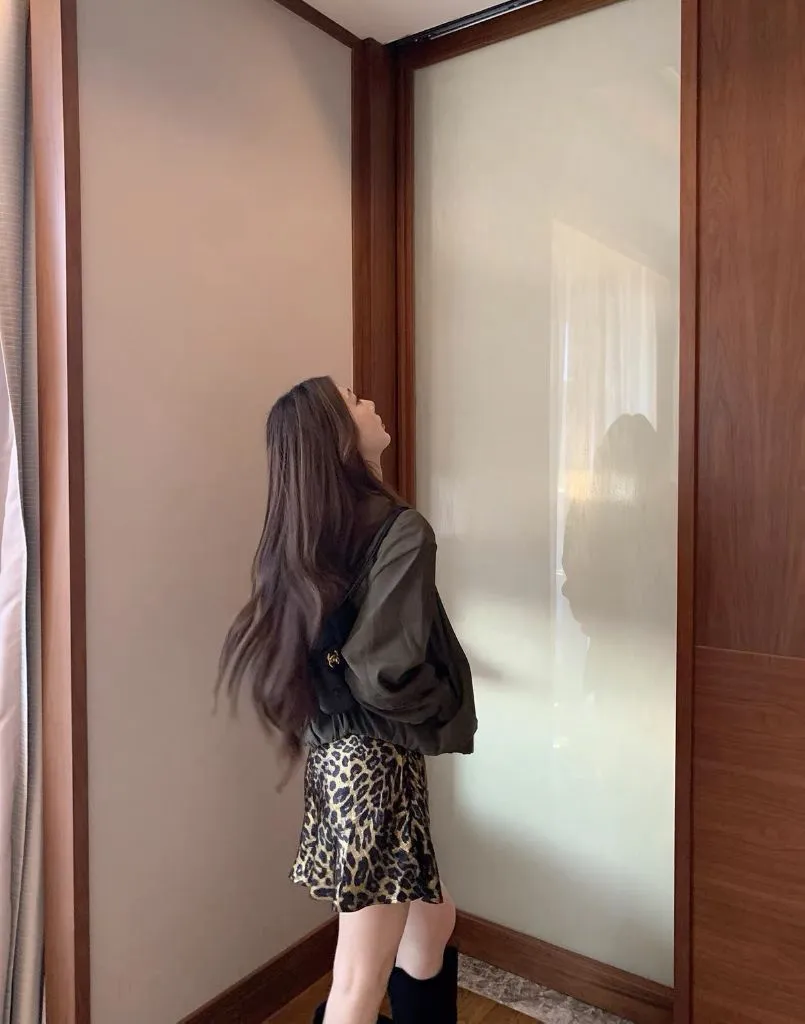
A small quilted black bag with a gold-toned clasp anchors the mid-back, and tall black boots crop the leg just below the knee, framing the print between two dark zones. The leopard’s tans and browns share a family with the olive, which is why the combination reads warm rather than clashing. The wood panelling and frosted glass behind repeat that same brown-cream range almost exactly.
Among winter skirt outfits for women that use animal print, the useful move here is confining the print to a narrow horizontal band. If you want it to register more strongly, shorten the jacket or tie the hair back; if you want less of it, a longer coat will nearly erase it altogether.
9. Fitted Black Sharpens the Same Print
The same print, styled tighter. A fitted black long-sleeve top with a small mock neck clings from shoulder to hip, and the leopard mini beneath it flares out at the exact point where the body narrows. Where the previous look buried the print under a loose jacket, this version draws a hard vertical line directly above it.
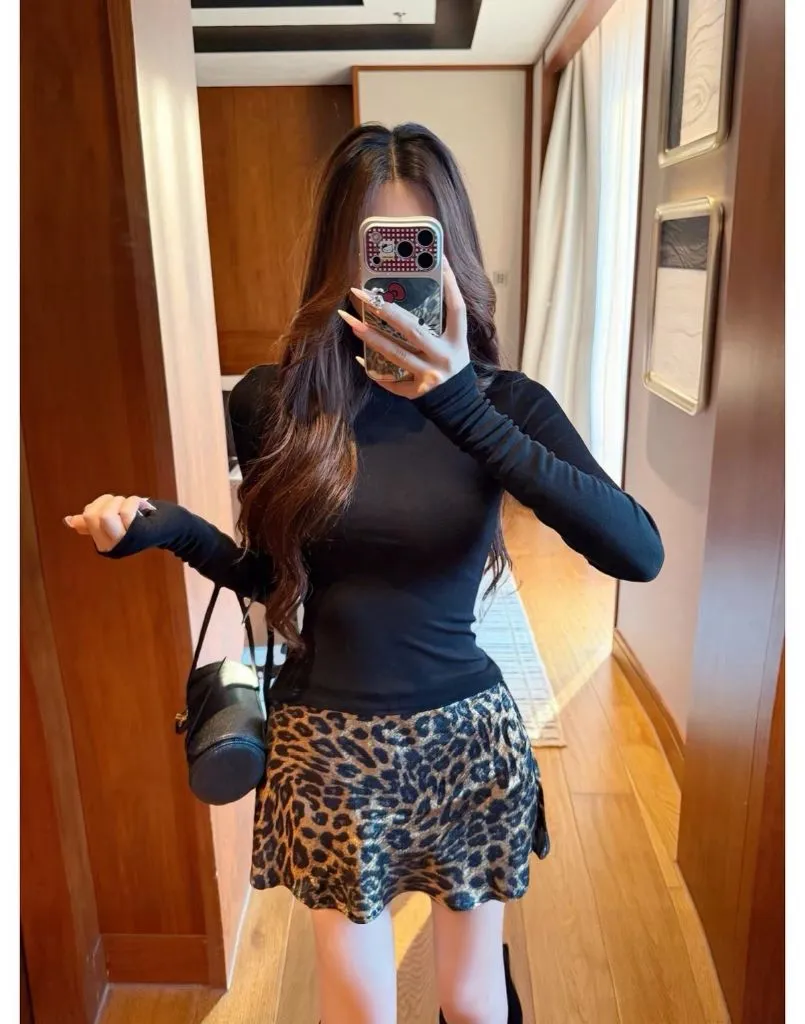
The consequence is that the print gets more room and more attention, and the proportions shift from soft to structured. A small black barrel bag hangs low on one side, black boots return at the bottom of the frame, and the interior keeps the palette to black, brown, and warm wood. The only genuine texture contrast is matte knit sitting against the skirt’s faint sheen.
I like that the difference between these two looks comes down to one variable, the fit of the top, rather than a different skirt. It is a cheap experiment to run in front of a mirror, and it tells you quickly whether you want the print framed and contained or released and open.
10. Brushed Plaid Frames Tan Suede Boots
Warm and cool sit side by side inside one skirt here. A brushed plaid mini in grey, brown, and cream has a soft, slightly hairy surface that reads fuzzy even in a still image, and it stops mid-thigh. Above it a ribbed cream turtleneck fits close to the body, its vertical rib running against the plaid’s grid.
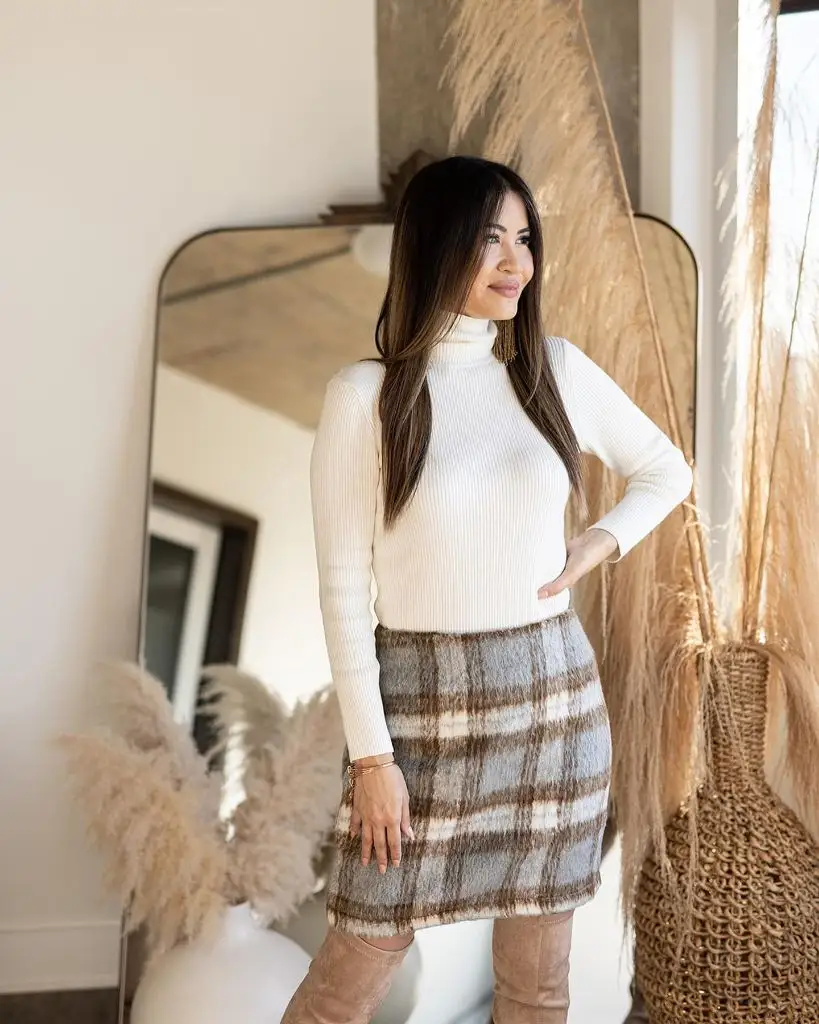
Tan suede-looking over-the-knee boots rise to meet the hem, so the leg stays covered and the midsection remains uninterrupted. They pull the brown out of the plaid while the turtleneck answers the cream, leaving the grey as the only unclaimed tone. Long fringed gold earrings and thin bracelets sit at the two ends of the arm, and the dried grasses behind repeat the same beige field.
Brushed surfaces like this pill and flatten wherever a bag strap rides, so the texture is the appeal and the maintenance cost at the same time. If you want the identical warm-cool mix without that upkeep, a flat woven check in the same three colours behaves considerably better across a season.
11. Grey Tweed Balances Sheer Black Lace
Two textures, one stacked on the other, both quiet. A black open-knit long-sleeve top with a high neck reads semi-sheer where the light passes through the sleeves, and a grey herringbone-looking pencil skirt with a pleated waist detail sits just above the knee. Opaque black tights extend the darkness below the hem.
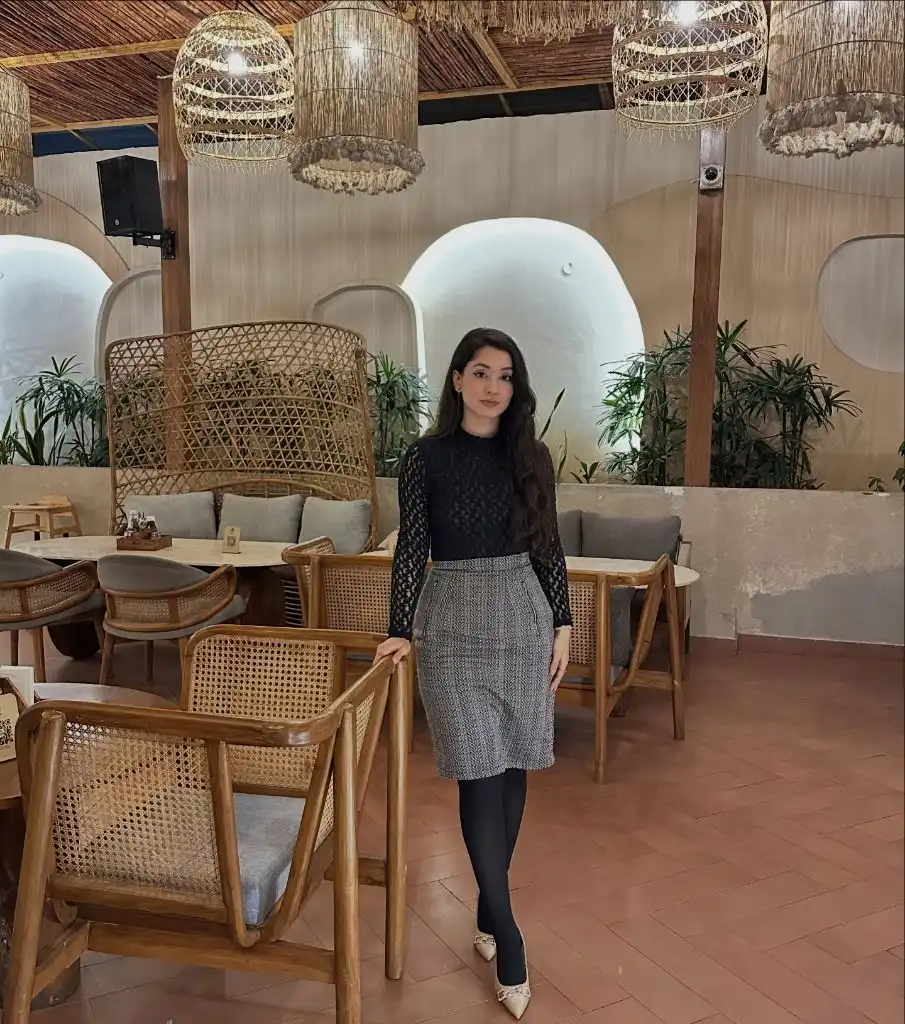
The grey skirt is the lightest value in the outfit and it lands at the middle, which keeps the eye at hip height rather than at the face or the feet. Cream bow-trimmed flats supply the single pale endpoint and the only softness in an otherwise geometric arrangement. Rattan chairs and terracotta tile behind add a warmth the clothing itself declines to carry.
The principle worth taking is placing your lightest value in the centre of a dark column; it shortens the torso slightly but sharpens the waist in exchange. If you would rather lengthen the line instead, move the grey up to the top half and let the skirt go dark.
12. Long Coat Extends a Short Skirt
A floor-skimming black coat does the framing, hanging open in two straight panels that run well past the knee on either side. Between them sits a short grey checked mini with a belted waist, a black turtleneck above it, and sheer grey tights below. The coat’s length is the reason the skirt looks as brief as it does.
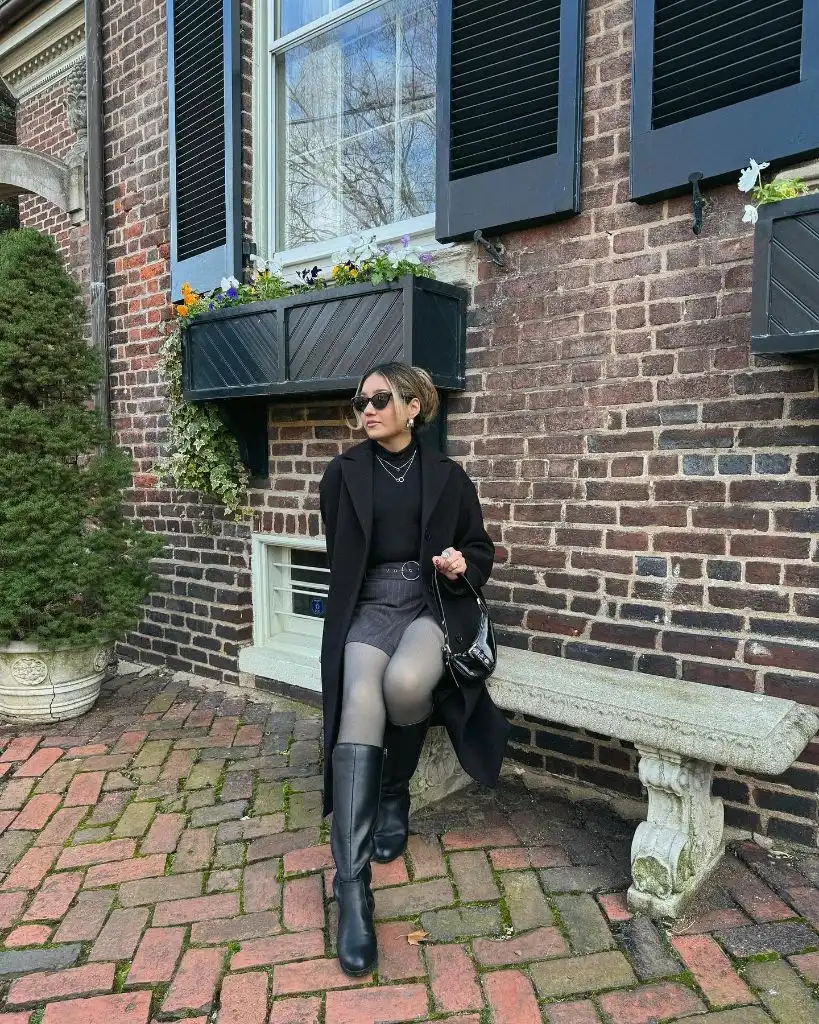
Tall black riding-style boots close most of the gap and give the leg a firm endpoint, leaving only a narrow strip of tights visible between hem and shaft. Layered silver chains, small dark sunglasses, and a compact glossy black bag all stay within the established palette. Against red brick and dark shutters, the outfit reads as one dark vertical with a single grey window at the waist.
For anyone drawn to winter skirt outfits for women that rely on a long coat, the measurement that matters most is the space between boot shaft and hem. Keep it narrow and the leg reads long; widen it and the look starts breaking apart into three unrelated pieces.
13. Oversized Knit Swallows the Hemline
Proportion is pushed about as far as it will go here. An oversized cream knit with dropped shoulders and wide sleeves covers the torso and most of the hip, and only a scalloped white ruffled hem shows beneath it. The skirt, whatever its real length, is functioning as a trim rather than as a garment.
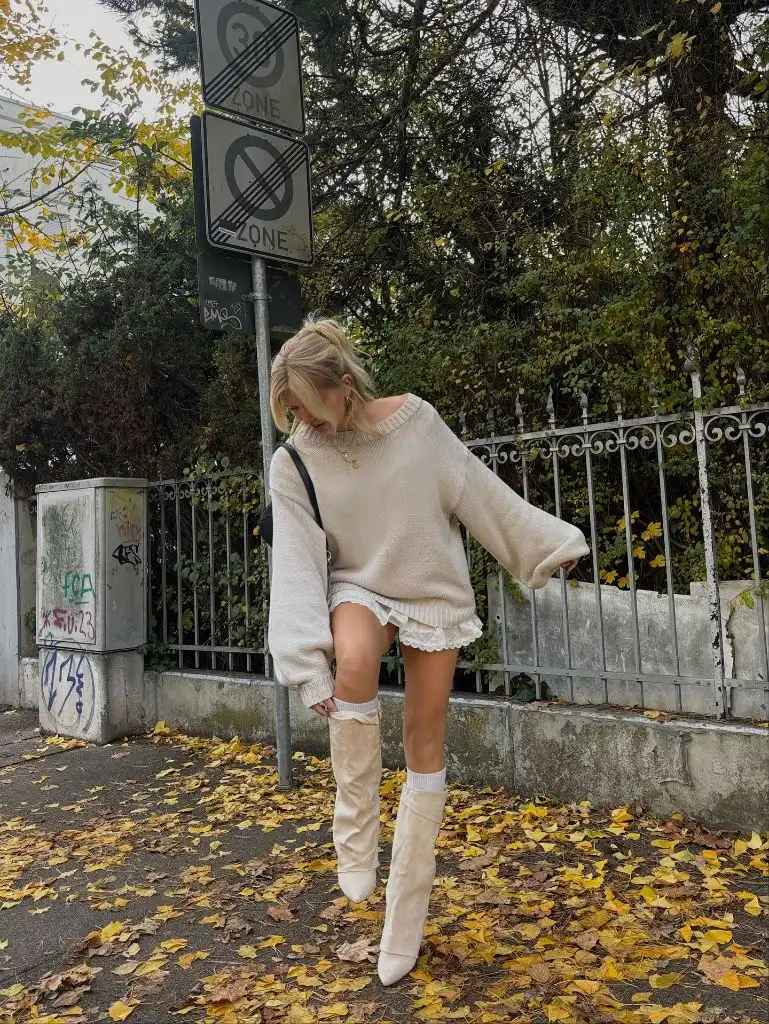
Cream slouchy knee boots continue the same tone upward, and short white socks fold over their tops, adding a second horizontal line just above the shaft. A black shoulder strap crosses the knit and is the only dark element in the whole frame. Yellow fallen leaves and grey pavement supply all the contrast the outfit refuses, holding the clothing itself inside one narrow band of off-white.
The honest catch is that a hem this brief under a bulky knit needs constant adjusting as you move, and cream boots mark quickly in wet weather. As a tonal exercise, though, it shows clearly how much work a single black strap does for an otherwise flat palette.
14. Navy Midi Separates Black Top and Sneakers
Night light, and a two-part dark outfit. A ribbed black top with a square neckline ends cleanly at the natural waist, and a navy midi skirt with a front split carries the look down to mid-calf. The navy is just light enough against the black to register as a separate block rather than a continuation of it.
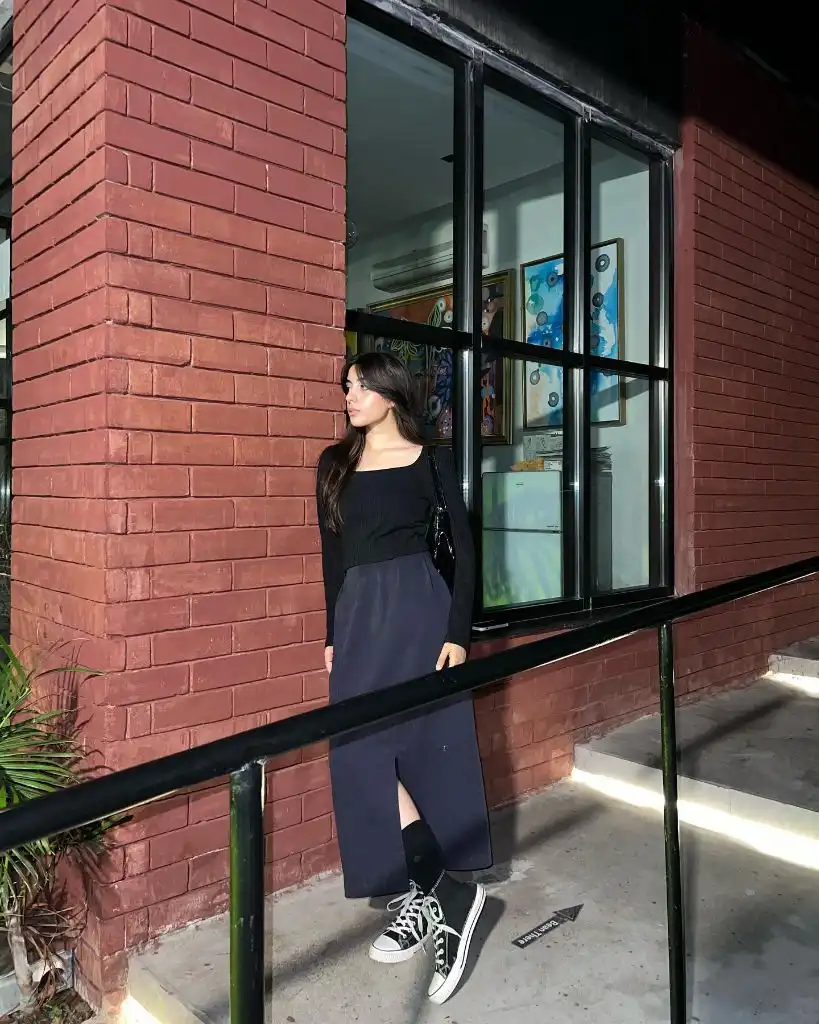
Black high-top canvas sneakers with cream soles and short black socks finish the leg, and that cream sole is the only bright line in the composition. A small black shoulder bag with a rounded flap stays close to the body and adds nothing new. Red brick and a dark window frame push the figure toward silhouette, which is where the navy-against-black distinction becomes most legible.
Set beside the sneaker-and-maxi pairing earlier in this set, this one reads more deliberate because the skirt stops short of the ankle and the shoe becomes fully visible. If you want the same ease with a longer hem, keep the split and let the sole colour go brighter.
15. Leather Bomber Hides a Red Base
The jacket takes almost half the frame. A black leather-looking bomber with a wide collar and an elasticated hem sits boxy across the shoulders, and a red top shows only as a narrow strip down the centre front where the zip has been left open. Below it, a short dark skirt with a slight flare and opaque tights close things off.
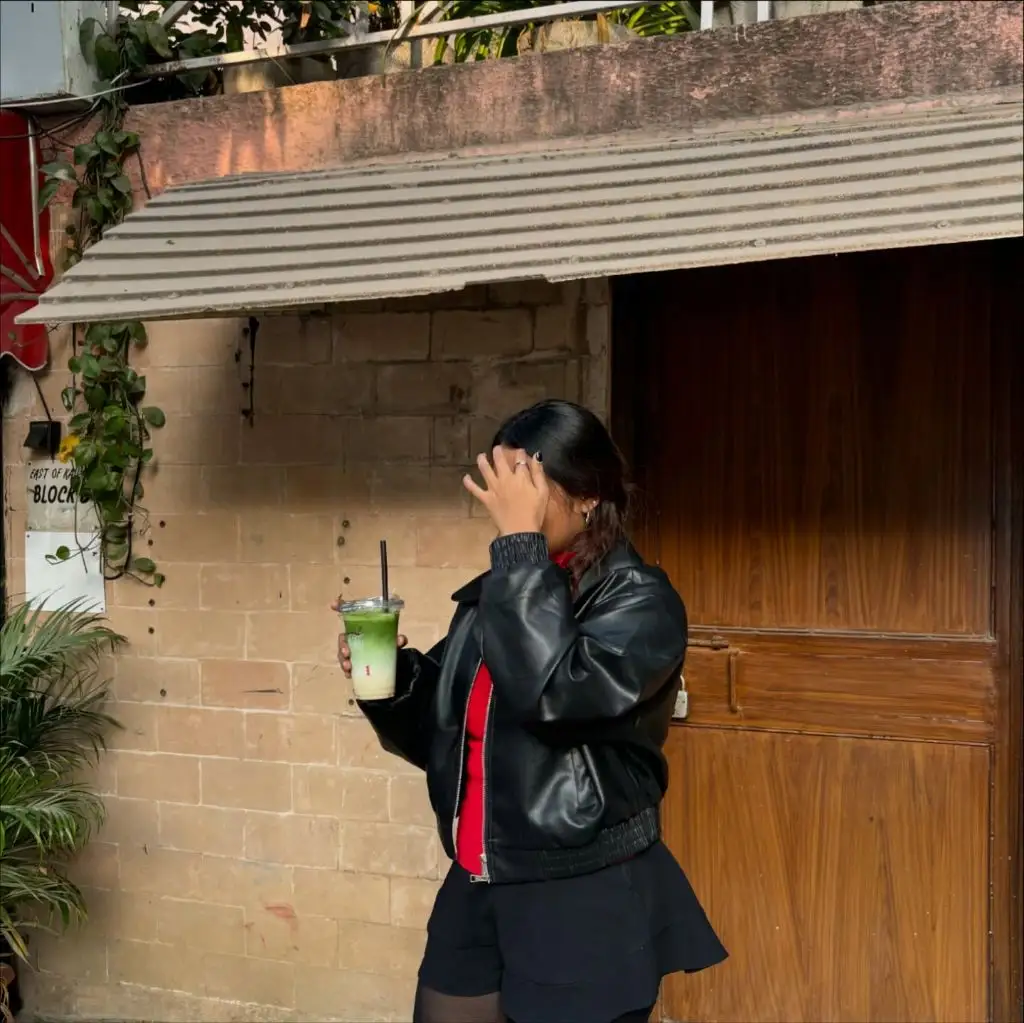
That sliver of red is the entire colour story, and it is deliberately partial: you see enough to register it and not enough to read the garment. A pale green iced drink held at hip height ends up functioning as a second accent, whether by accident or instinct. Silver rings and small hoops are the only hardware, and the ochre brick and wooden door warm the frame considerably.
If you want the red doing more, unzip further or let it show at the collar; zipped shut, it reduces to nothing at all. With an open jacket, the visible area of a base layer stays adjustable in a way that most colour decisions in an outfit simply are not.
16. Dotted Midi Breaks Up a Beige Jacket
Shot from above on a crosswalk, so the print has to compete with the road. A white midi skirt scattered with widely spaced black dots runs down the centre of the frame, and a boxy sand-coloured zip jacket with a flat collar sits above it, its sleeves long enough to cover the wrist entirely.
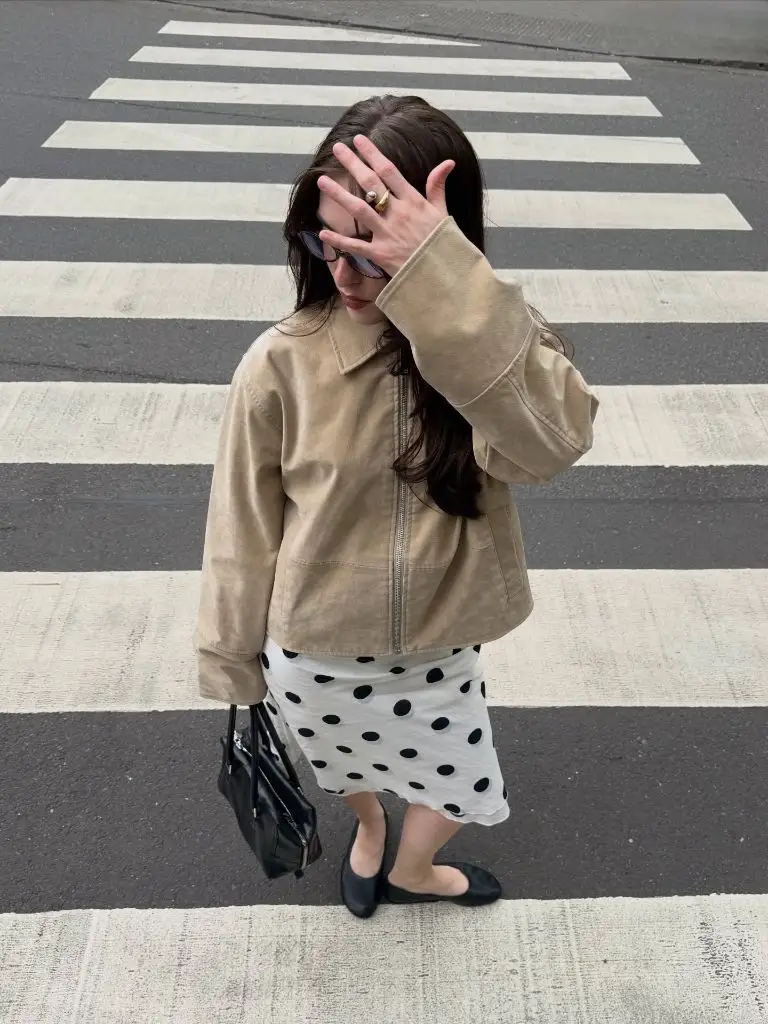
The jacket’s warm neutral separates the black dots from the black accessories instead of letting them merge: a soft leather-looking top-handle bag at the hip and rounded black flats at the hem. The dot spacing is generous, which keeps the skirt reading light rather than busy, and the crosswalk’s own white bars turn into an accidental second pattern underneath the first.
The workable principle is that a mid-tone jacket buffers a graphic print from hard black accessories. That same buffering logic runs through most chic winter work outfits, where a neutral third colour keeps two strong elements from colliding awkwardly at the waist.
17. Pink Blazer Sets Against White Volume
Colour temperature is the mechanism here rather than layering. A bright fuchsia blazer hangs open over a softer pink camisole, and a long white skirt with body and a little stiffness falls to the ankle beneath both. The two pinks sit a full step apart in intensity, which is why the pairing reads as considered instead of accidentally mismatched.
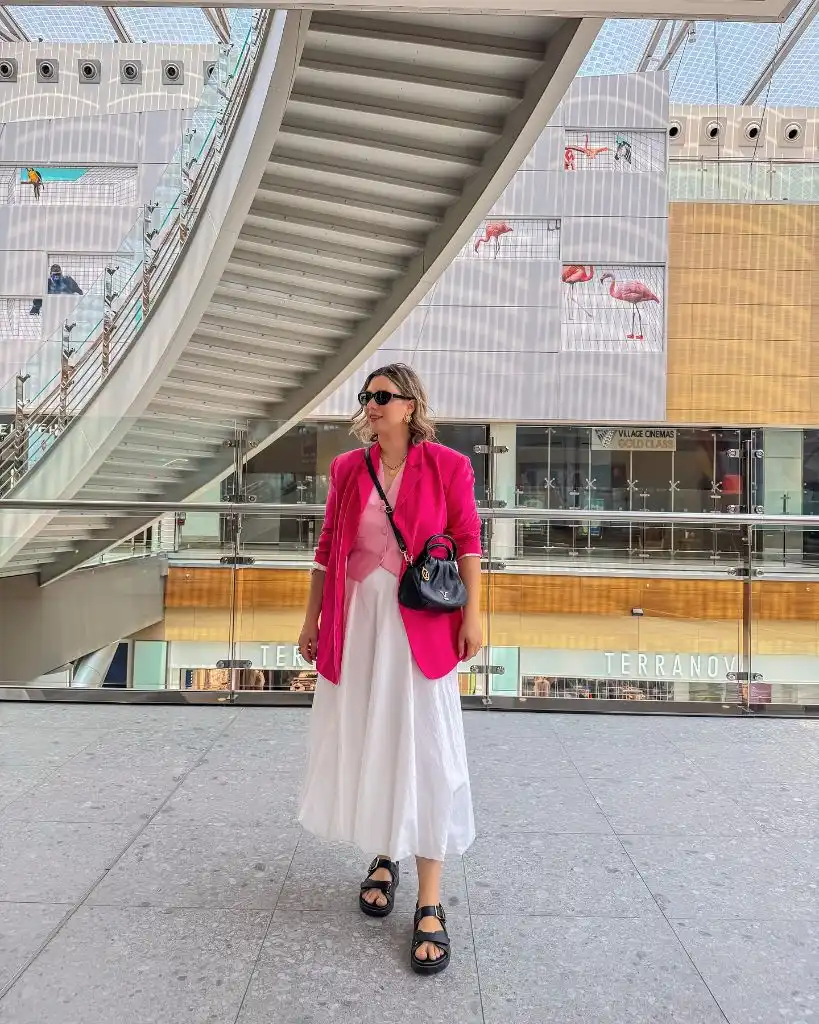
White takes the largest share of the frame and stays completely plain, giving the two pinks somewhere to go. A small black top-handle bag and chunky black sandals bracket the outfit at hip and floor, performing the same job at both ends, and dark sunglasses complete that black trio. The cool grey glass and steel of the atrium behind pushes the pink forward by contrast.
This is the lightest-weight look in the set and the one that needs the most help in real cold, since heavier hosiery and a closed shoe change it substantially. Left as it is, the detail worth borrowing is the two-tone pink: one hue, two saturations, no attempt at an exact match.
18. Brocade Mini Brightens a Textured Cardigan
A short skirt in a blue-and-gold brocade-looking print is the only busy surface in the frame, and it sits directly beneath a chunky teal cardigan cropped at the waist. The two blues are close without being identical, and the cardigan’s heavy rib reads matte against the skirt’s faint metallic glint. The material is not identifiable, so that sheen is the useful detail rather than any fabric claim.
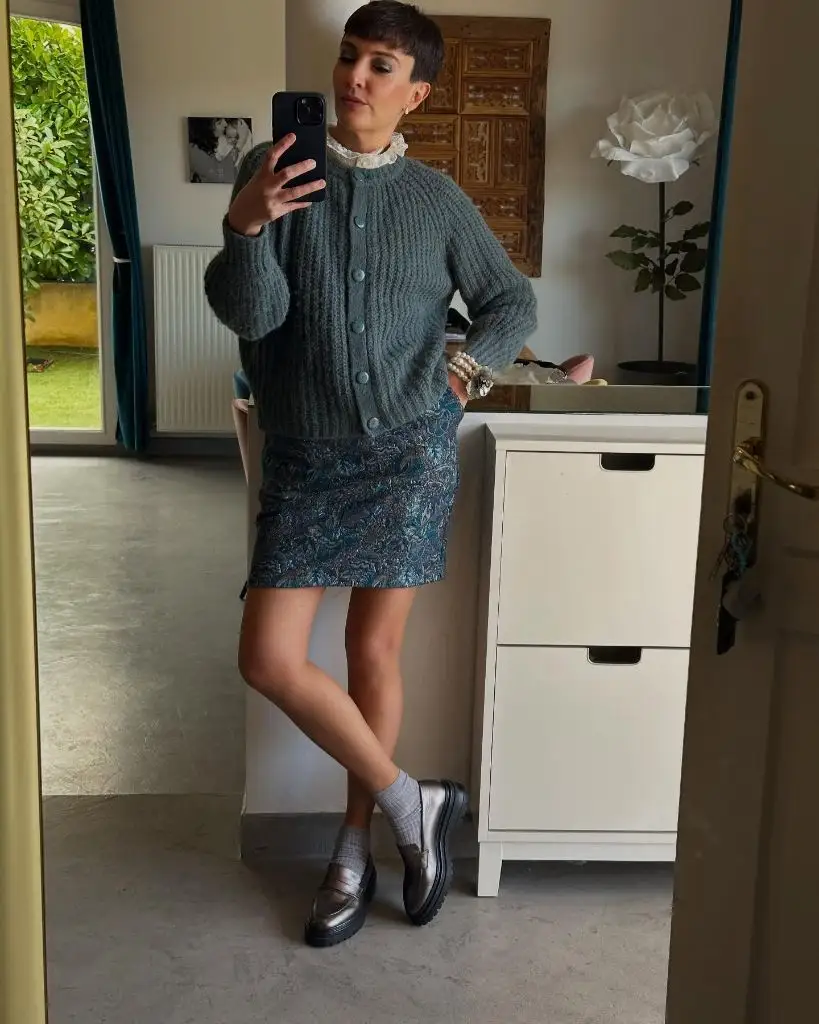
A ruffled cream collar appears above the cardigan’s neckline, adding a small light frame near the face, and a pearl-style bracelet repeats that cream halfway down the arm. Grey ribbed socks and silver chunky-soled loafers give the leg a deliberately heavy endpoint, balancing the delicacy of both print and collar. The teal curtain at the window ties straight back to the knit.
What makes this hold is the pairing of one ornate element with three plain ones. The lesson transfers to any patterned mini: pick the loudest surface first, then let the shoe be heavy and the knit be dull, and the print never tips over into costume.
19. Cream Sheer Hem Ends a Grey Column
Cropped at the shoulders, this image reduces the outfit to a two-part column. A soft grey knit blouses over the waistband and is pushed up along the sleeves, and a cream straight midi skirt continues below it, finishing in a translucent panel that lets the floor show faintly through the very bottom of the hem.
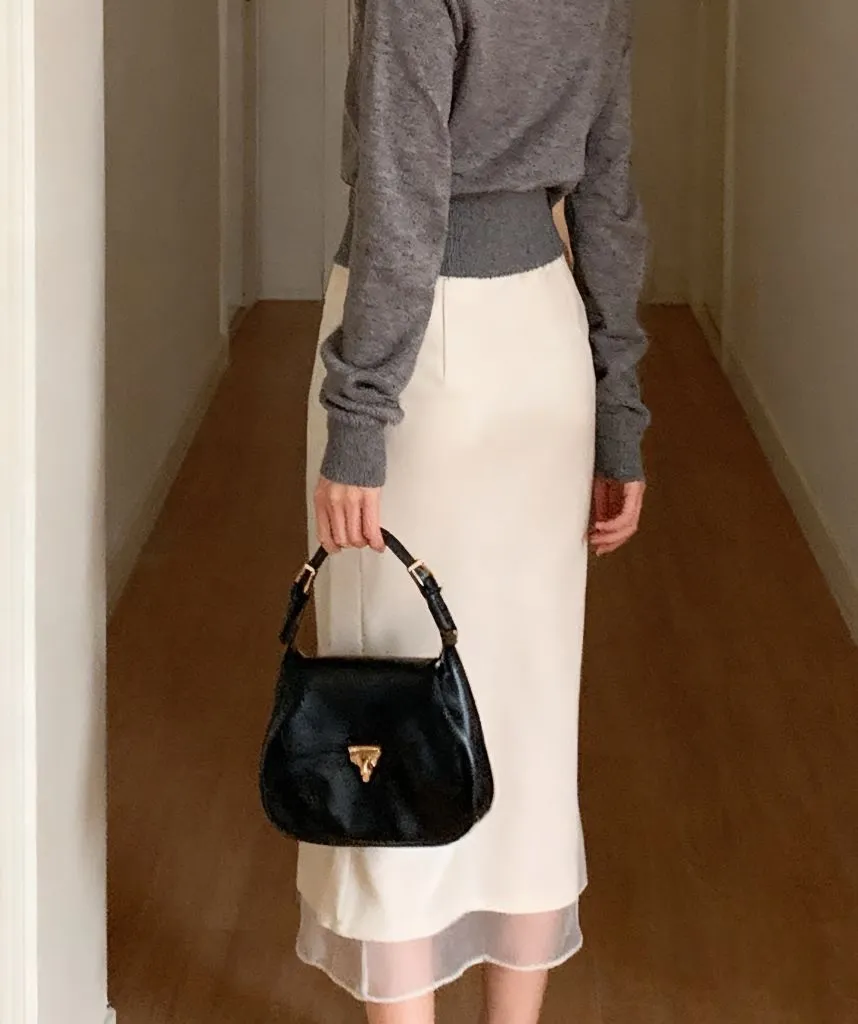
That see-through hem is the detail worth noticing, since it stops the skirt from ending in a hard line and eases the transition to the wooden floor. A small glossy black shoulder bag with a gold-toned clasp hangs at knee level and supplies the single dark note, positioned exactly where the two garment blocks meet the leg. Nothing else interrupts the grey-to-cream gradient.
Compared with the first look in this set, which used a similar cream skirt with a black top and a hard belt, this version removes every sharp line and reads notably quieter for it. Among winter skirt looks, it depends most on fabric behaviour and least on styling decisions.
20. Navy Check Skirt Quiets a Matching Knit
Almost everything here is navy, and the interest comes from a change in weave rather than in colour. A slouchy navy sweater with a small bow-tie collar sits full through the sleeves and hip, and a long checked skirt in the same navy family runs to the ankle in a tight, dark grid that only resolves up close.
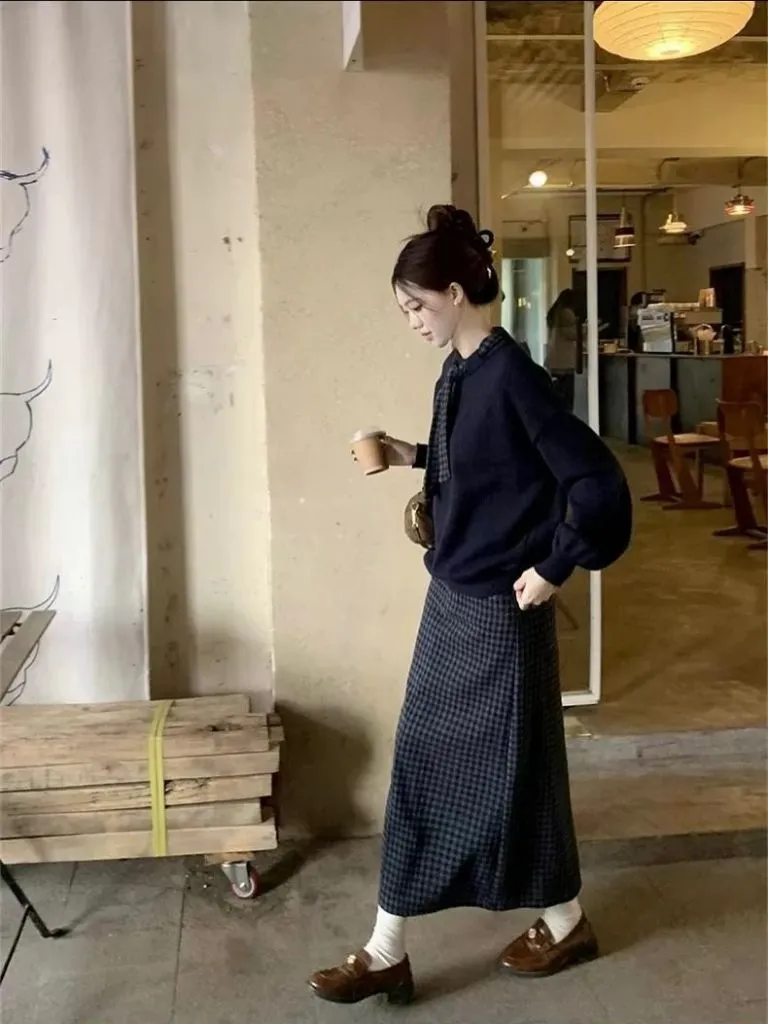
Because both halves share a colour, the check does the separating instead of contrast, and the eye travels down slowly. A small patterned belt bag worn high at the waist marks the join, white socks create a brief bright break at the ankle, and brown loafers with a low heel are the only warm tone anywhere. The pale concrete café interior stays empty behind.
Two dark navies of slightly different tone can look accidental under flat indoor light, so the check is doing real work here. If you are copying this, either commit to the pattern break or match the two pieces precisely, because the middle ground is where the whole thing goes wrong.
21. Beige Monotone Holds a Single Knot
Tonal from neck to knee. A beige high-neck top gathers into a knot at the centre of the ribcage, and a matching-looking beige mini skirt with two large flap pockets and metal-look buttons sits just above the knee. That single knot is the only structural event on the upper body, and it lands at the narrowest point.
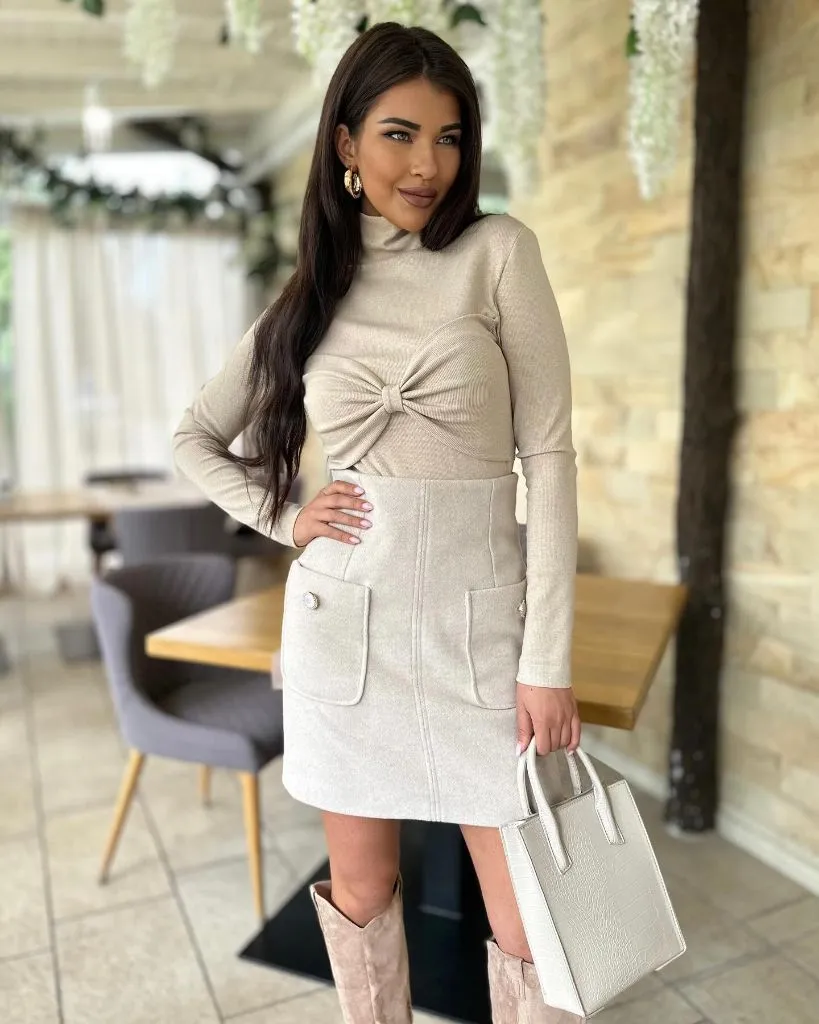
Pale suede-looking boots and a light croc-textured tote continue the same sand range, so the outfit reads as one colour field carrying four surface treatments: ribbed knit, brushed skirt, textured bag, soft boot. Gold hoop earrings and long dark hair supply the contrast the clothing itself declines. The stone wall and hanging white blossoms behind sit in almost the same key.
Head-to-toe neutral like this lives or dies on texture variation, and there is just enough of it. The trade-off is visibility, since the look nearly merges with the pale wall behind it and would disappear in most bright interiors. Add one dark shoe and the whole arrangement gains an endpoint.