Winter dressing carries a quiet kind of pressure that no one names directly. The season asks you to stay warm, but it also asks you to look considered while doing it, and those two goals can feel like they work against each other. You do not owe anyone a performance of effortlessness in freezing weather. Chic winter outfits are not about choosing discomfort for the sake of appearance — they are about finding the version of warmth that already matches the way you want to present yourself.
A good cold-weather outfit begins before a single piece is chosen, with a clear sense of what you want the layers to do together rather than apart. The useful question is not which coat is trending but how proportion, texture, and tonal range behave once everything is stacked on the body at once. This article looks at twenty-three real outfits and reads each one through four variables: the relationship between structure and softness in each silhouette, the way color is distributed or withheld across layers, the role of visible texture in breaking monotony, and the balance point where accessories either anchor or interrupt the composition. Each section is built from a single photograph and describes only what is genuinely visible in it.
1. A Gray Knit Grounds a Dark Base Below the Waist
The strongest detail here is the textured gray sweater sitting over a black mini skirt, creating a clear tonal division at the waist. The knit has a marled, slightly heathered quality with visible cable or twist texture, and it falls just past the hip. Below, sheer dark tights connect the skirt to black ankle boots, and a black crossbody bag with a structured strap sits against the sweater.
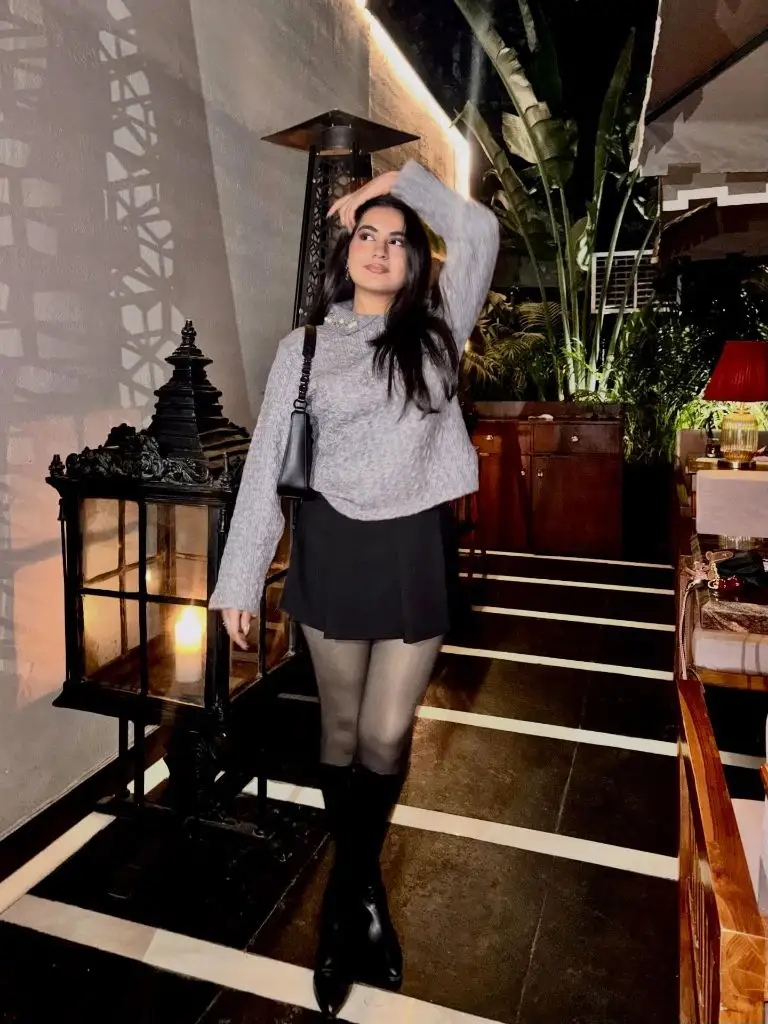
Photo via Instagram
The division works because the lighter knit draws the eye upward while the darker lower half recedes into a single unbroken line from hem to boot. The tights act as a connector rather than a separate element — they do not interrupt the dark column, and the boots continue it. The crossbody bag’s black strap repeats the lower palette against the gray chest, which keeps the outfit from splitting into two disconnected halves. A large ornamental lantern and warm indoor lighting sit in the background, and the amber glow reads well against the cool gray tone of the sweater, giving the image a sense of temperature contrast that reinforces the seasonal weight of the look.
This is a clear example of how a single mid-tone layer can carry an otherwise dark outfit without competing with it. The knit does not need pattern or embellishment to hold attention because its texture does that work. When layering dark and mid-tone pieces for winter outfit ideas, the principle is that visible texture in the lightest piece earns the right to sit at the center of the composition.
2. A Belted Cape Sharpens an All-Black Foundation
The first thing that registers is the dark teal-black wool cape belted at the waist with a wide leather belt and gold buckle. The piece has a high stand collar and falls to roughly mid-thigh, with the volume of the cape draping over both arms. Beneath it, the outfit appears entirely black — a dark top, what looks like a short skirt or shorts, and sheer dark tights. Leather gloves in the same dark tone complete the accessories, and oversized sunglasses sit high on the face.
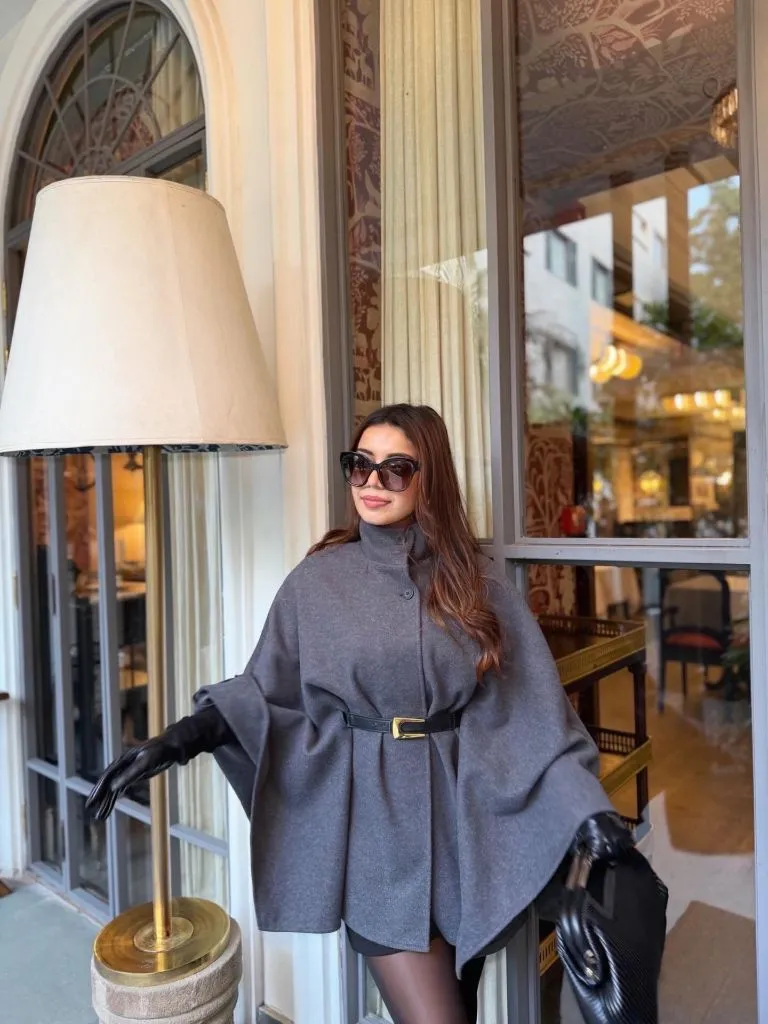
Photo via Instagram
The belt is doing the most important structural work here. Without it, the cape would read as a blanket draped over the body with no defined shape. The cinch at the waist creates an hourglass proportion inside what is otherwise a very wide, flowing garment, and the gold buckle provides the only metallic interruption in an entirely dark palette. The gloves extend the dark tone past the wrists, which means the skin showing is limited to the face and a small band of leg between the cape hem and the boots. This restraint makes the silhouette feel deliberate rather than heavy. The background — an elegant facade with glass doors, brass fixtures, and a fabric lampshade — echoes the structured warmth of the outfit.
The appeal is the tension between volume and definition. A cape offers no structure of its own, so the belt becomes the entire architecture of the look. The transferable principle is straightforward: the wider and more shapeless a winter outerwear piece is, the more a single cinching element at the waist changes what the entire silhouette communicates.
3. Fur Trim Softens a Structured Black Coat
The eye goes first to the fur-trimmed cuffs on what appears to be a dark, structured coat or cape in a heavy black fabric. A brown leather belt cinches the waist over a dark turtleneck base, and a quilted chain-strap bag in black sits at the hip. The hair is styled in long, loose waves with a lighter highlight through the midsection, and small hoop earrings are visible. Leather gloves with matching fur trim mirror the cuffs.
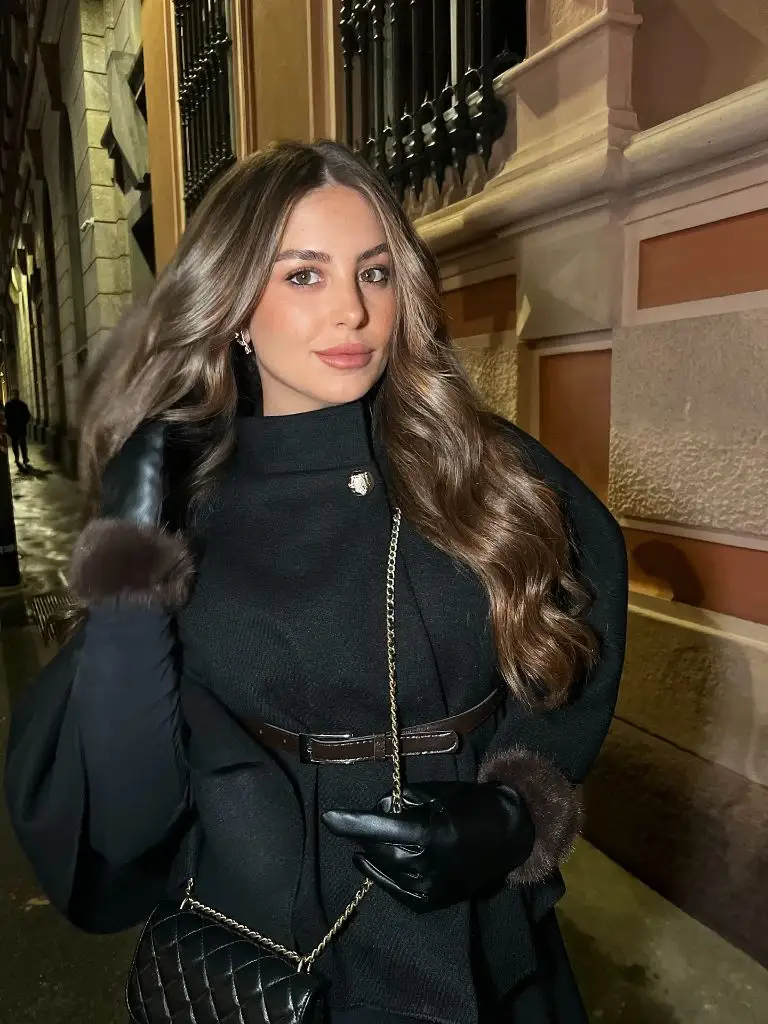
Photo via Instagram
The fur at the cuffs introduces a soft, organic texture into an outfit that is otherwise defined by smooth, flat surfaces — the leather of the belt, the quilted pattern of the bag, and the matte finish of the coat fabric. This contrast between the plush fur and the sleek leather is what keeps the look from reading as one-note despite being almost entirely black and dark brown. The brown belt is the warmest tone in the composition and it draws the eye to the narrowest point of the body, giving the outfit its proportional anchor. The European-style architecture visible in the background — stone facade, iron balcony railings — gives the image a nighttime urban context that suits the formality of the layering.
This is the kind of chic winter outfit where detail placement matters more than color range. Two small bands of fur at the wrists accomplish what a bold color or a statement print might do in a warmer season. The lesson is that textural accents at the extremities — cuffs, collar, hem — can carry the interest in a monochrome look without breaking its tonal discipline.
4. Burgundy Tights Interrupt a Black Blazer Dress
The most immediate visible element is the rich burgundy or wine-colored tights worn under an oversized black double-breasted blazer with satin lapels, styled as a dress. A small structured bag in a matching deep red hangs from one hand by a chain strap, and black pointed-toe heels finish the lower line. Round sunglasses with metallic frames sit on the face. The setting is an outdoor patio space with wicker chairs, tall bar tables, and trees overhead.
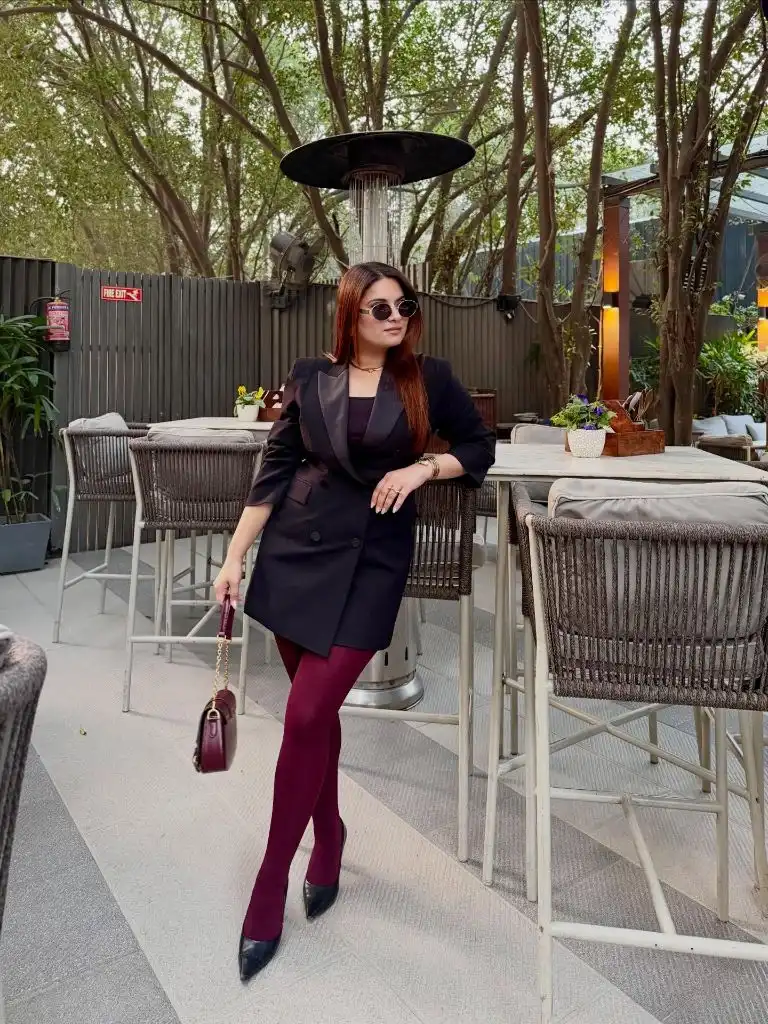
Photo via Instagram
The burgundy tights are doing something very specific to this outfit: they prevent the black blazer-as-dress silhouette from reading as purely evening or purely corporate. The color is warm enough to feel seasonal without drifting into festive territory, and because it covers the entire leg from hem to ankle, it creates a strong unbroken vertical of color. The satin lapels on the blazer catch light differently from the matte body of the jacket, which adds a subtle tonal shift within the black itself. The matching bag pulls the tights’ color into the accessory tier, and the black heels bookend the composition by returning to the blazer’s base tone.
The best detail is the coordination between the tights and the bag — the same wine tone appearing in two separate zones of the outfit without being exact or forced. When working with bold winter accessories, the takeaway is that a strong leg color can transform outerwear into a complete look, but it needs at least one echo elsewhere to avoid reading as accidental.
5. A Lavender Faux Fur Jacket Lifts a Dark Leather Base
The standout element is a shaggy-textured faux fur jacket in a soft lavender or pale lilac, worn draped over the shoulders rather than zipped or buttoned. Beneath it, a black outfit — what appears to be a top and leather shorts or a short skirt — is visible, paired with black sheer tights. A small structured bag with metallic lettering, reading what appears to be Michael Kors, hangs at the center. The setting includes modern wooden slat fencing and white planters with tropical greenery.
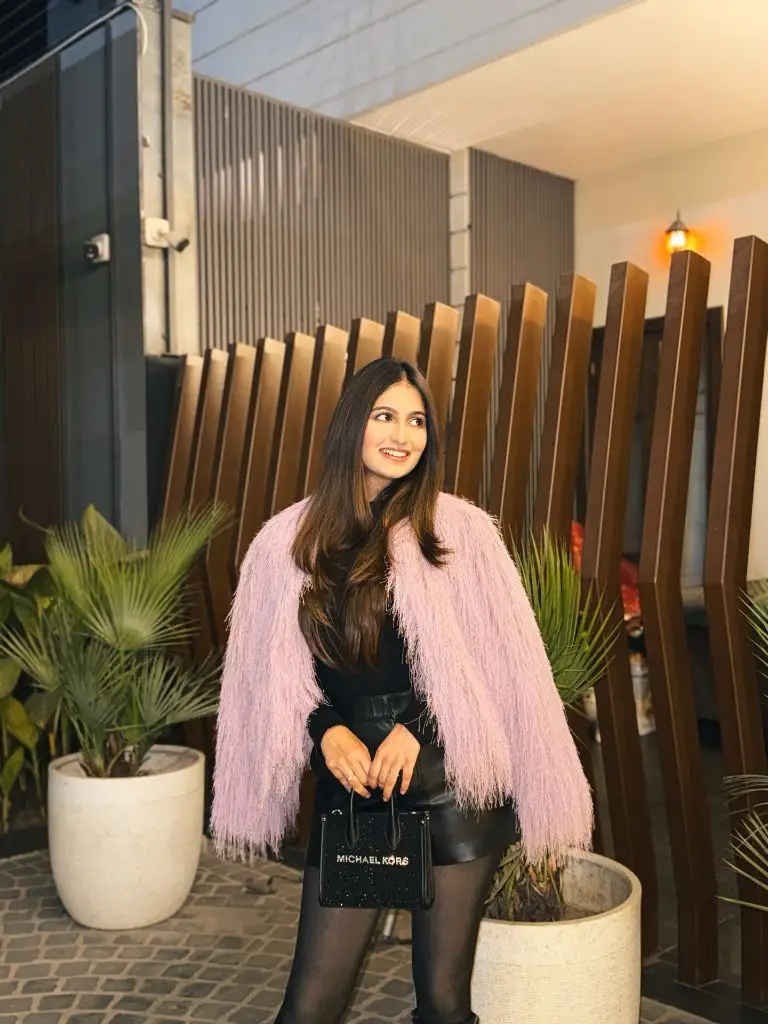
Photo via Instagram
The lavender fur is carrying all of the visual weight because everything else in the outfit defaults to black. This is a deliberate ratio — roughly eighty percent of the visible surface is dark and minimal, and the remaining twenty percent is loud, textural, and colored. The shaggy texture of the jacket catches light unevenly, which gives it movement even in a still image, and the pale color sits far enough from the black base that there is no ambiguity about the contrast being intentional. The bag sits at the junction between the jacket and the dark base and provides a grounding point. The modern outdoor setting, with its clean lines and neutral-toned planters, does not compete with the jacket’s statement.
The strength here is restraint everywhere except in one piece. The outfit would not work the same way if the bag were also bright or if the tights were colored — the lavender needs the dark surround to read as a deliberate choice rather than a cluttered one. This principle applies broadly to statement winter layers: the louder the texture or color of one piece, the quieter everything else should be.
6. A Leather Jacket Anchors Wide Trousers and Tan Boots
The visible composition leads with a black leather bomber-style jacket over a warm tan or rust-toned turtleneck, tucked into high-waisted black wide-leg trousers. A brown leather belt with a small gold buckle marks the waist. Tan suede or leather pointed-toe boots are visible at the hem, and a brown half-moon or hobo-style bag hangs from one hand. Sunglasses rest on the face. The background shows a stone-clad building with green awnings marked with what appears to be a venue name, and a green vintage-style post box stands nearby.
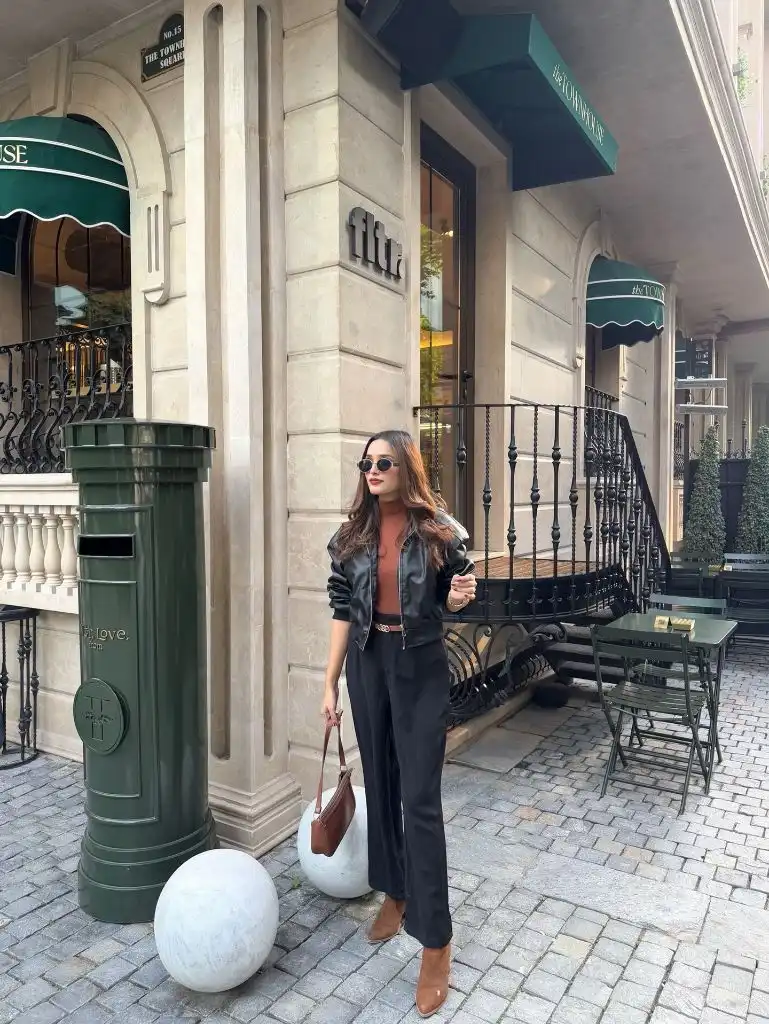
Photo via Instagram
This outfit distributes its warm tones across three vertical levels — the turtleneck at the chest, the belt at the waist, and the boots at the ground — which prevents the brown-tan family from clustering in one zone. The black jacket and trousers act as a frame, and the warm tones are placed inside that frame at strategic intervals. The wide-leg trouser creates a strong vertical below the hip, and because the boots are a lighter tone than the trousers, the eye travels downward to the hem rather than stopping at the waist. The bag in the same brown family gives the composition a fourth point of warmth without introducing a new color. The green awnings and stone backdrop feel European and contribute to an overall reading of structured daywear.
The value is in the distribution. Three separate warm elements at chest, waist, and foot create rhythm inside a dark base, and no single one dominates. When building an outfit around winter color combinations, placing the accent tone at multiple heights prevents it from reading as an afterthought pinned to just one spot.
7. A Brown Leather Trench Frames a Black Mini and Tall Boots
The dominant piece is a long brown leather trench coat, open at the front, revealing a fitted black turtleneck mini dress underneath. Tall black boots rise to just below the knee, leaving a band of bare leg between the dress hem and the boot top. A black bag with a visible gold double-G clasp — consistent with a Gucci Marmont silhouette — is held at the midsection. Large tortoiseshell-toned sunglasses frame the face. The background is a grand wooden double door set in a stone or rendered facade, with classical proportions.
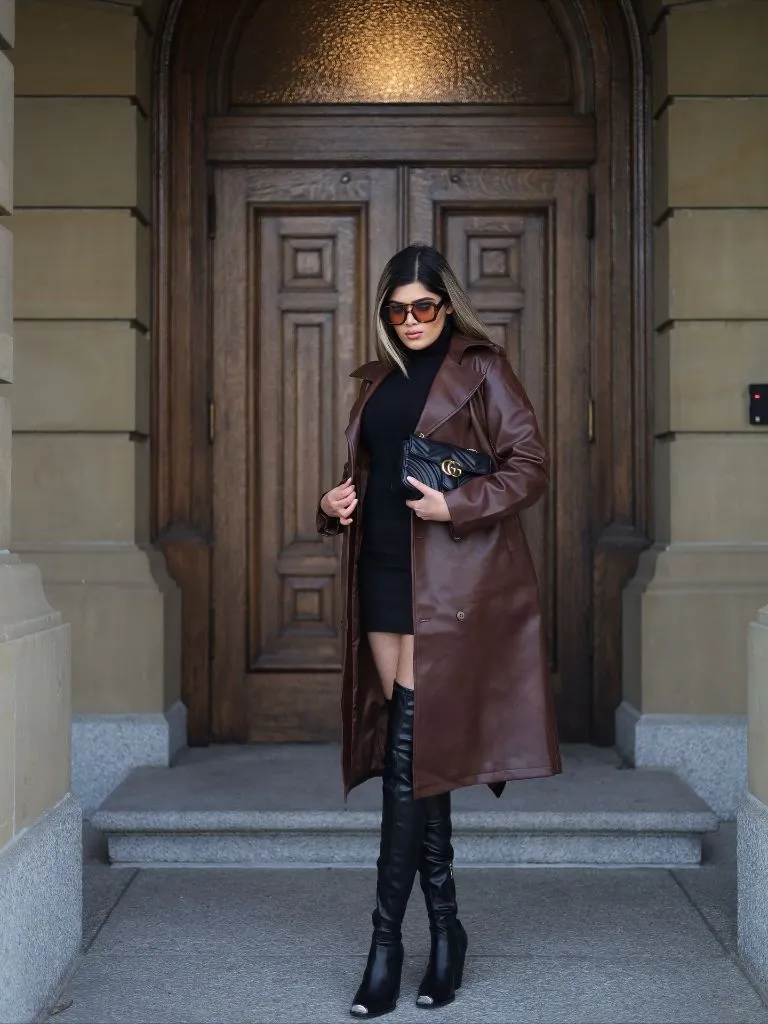
Photo via Instagram
The leather trench creates a strong vertical frame on either side of the body, and because it is open, the black dress beneath reads as a column of contrast running down the center. The brown leather has a slight sheen that differentiates it from a matte wool coat — it catches light along the lapels and at the fold of the belt, which adds dimension. The tall boots and the dress are in the same black, so the center of the body reads as one unbroken dark line from neck to knee, with the brown coat wrapping around it. The bare leg between the hem and the boot top is the only skin visible below the face, and it provides breathing room in an otherwise fully covered look. The architectural doorway behind mirrors the vertical symmetry of the outfit itself.
This is a silhouette built on framing. The coat does not provide warmth as a buttoned layer — it acts as a visual border that contains and defines the outfit inside it. The principle is that an open coat in a contrasting tone turns the body into a composition of foreground and frame, and the interior outfit needs to be simple enough to read clearly within that structure.
8. A White Vest Lengthens a Leather Skirt and Knit Pairing
The first detail that lands is a long sleeveless white vest or gilet that falls past the knee, worn over a fitted black ribbed turtleneck and what appears to be a black leather pencil skirt ending just above the knee. Black sheer tights continue the dark line below the skirt, and black heeled boots with a squared or slightly pointed toe sit at the base. A taupe or light brown structured bag with metallic hardware hangs at the hip. Gold bracelets and bangles are stacked at the wrist. The setting shows red louvered shutters, a white arched window, and warm afternoon light.
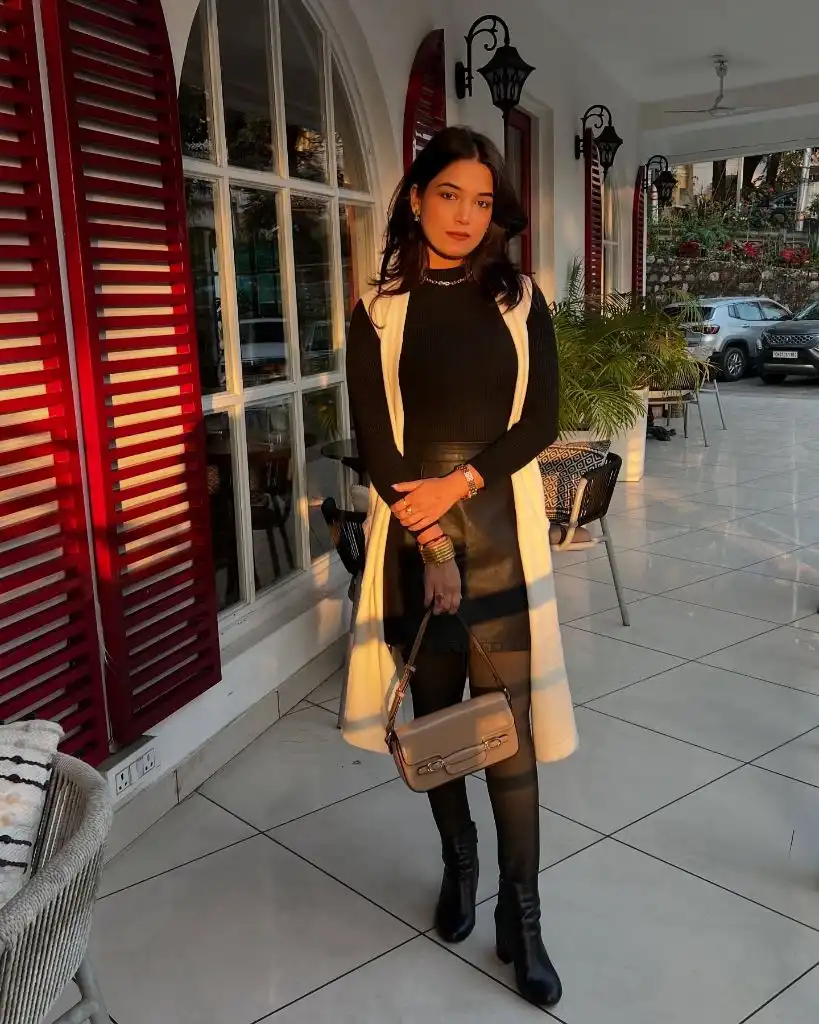
Photo via Instagram
The white vest is the longest piece in the outfit, and because it has no sleeves, the black sleeves of the turtleneck show through on either side. This creates a layered visual where the white vertical runs down the center and the dark pieces frame it from the arms and legs. The leather skirt adds a slight sheen at the mid-body, breaking the matte texture of the knit above and the tights below. The gold bangles clustered at one wrist introduce warmth at the forearm, and the taupe bag sits tonally between the white vest and the dark base, acting as a bridge. The red shutters in the background are the boldest color in the image, and they sit behind the figure without competing because the outfit’s own palette is neutral enough to absorb a vivid backdrop.
I like the way the vest does two things at once — it adds a layer of warmth across the torso while simultaneously drawing a long vertical line that makes the outfit read as taller. When considering layering pieces for chic winter outfits, a sleeveless coat or vest in a contrasting light tone can restructure the proportions of everything beneath it without adding bulk.
9. A Black Knit and Leather Skirt Hold a Minimal Silhouette
This section is worth noting for what it can and cannot support visually. The image shows a fitted black ribbed turtleneck tucked into a black leather mini skirt, with dark gray or charcoal tights and black heeled ankle boots. Gold bangles sit at one wrist and a chain necklace rests at the collarbone. The setting is a warmly lit cafe interior with wooden furniture, botanical-print cushioned chairs, arched built-in shelving, and hanging lantern-style lighting with trailing greenery.
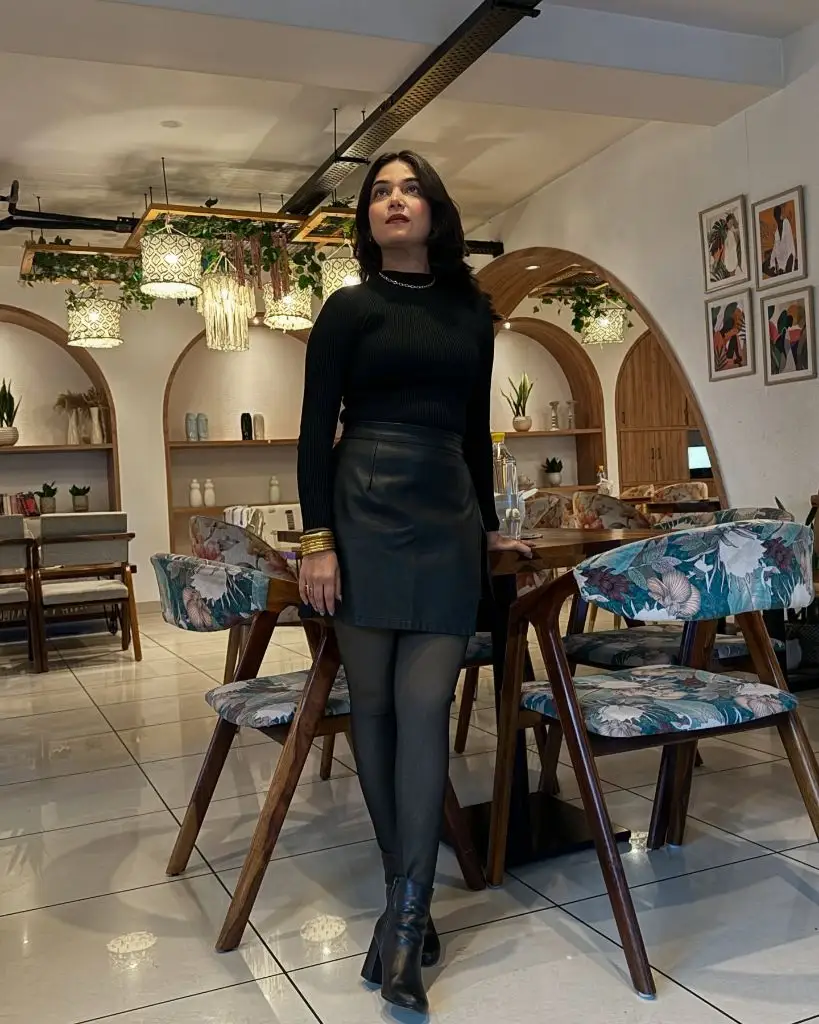
Photo via Instagram
Because the entire outfit is black or near-black, the photograph is less about color strategy and more about texture differentiation. The ribbed knit reads differently from the smooth leather of the skirt, and the semi-sheer tights introduce a third surface quality below the hem. These three textures — matte rib, smooth leather, sheer knit — are the only variation across the body. The gold bangles and necklace provide the sole metallic interruption, and they are placed at opposite ends of the upper body, which distributes the accent without clustering it. The warm-toned cafe interior — the wooden arches, the amber lantern light, the green trailing plants — provides all of the color context for the outfit, and the dark palette feels grounded rather than severe in this setting.
The effect is that restraint in color forces the eye to read texture instead. This outfit does not need a contrasting layer or a visible bag to feel complete because the material variety within the black family is doing that work. The principle is that when every piece shares the same tone, surface finish becomes the primary design variable.
10. A Dark Utility Jacket Pairs With Wide Denim and Pointed Boots
The visible composition starts with a dark charcoal or near-black utility-style jacket with large flap chest pockets and button closures, worn over a black turtleneck. Below, dark indigo or charcoal wide-leg jeans or trousers are cuffed slightly at the ankle, revealing black pointed-toe ankle boots with a low heel. The setting is an urban sidewalk with a raw concrete wall, vertical metal bars, and a weathered industrial door. Minimal accessories — small hoop earrings and what appears to be a phone partially visible in one hand.
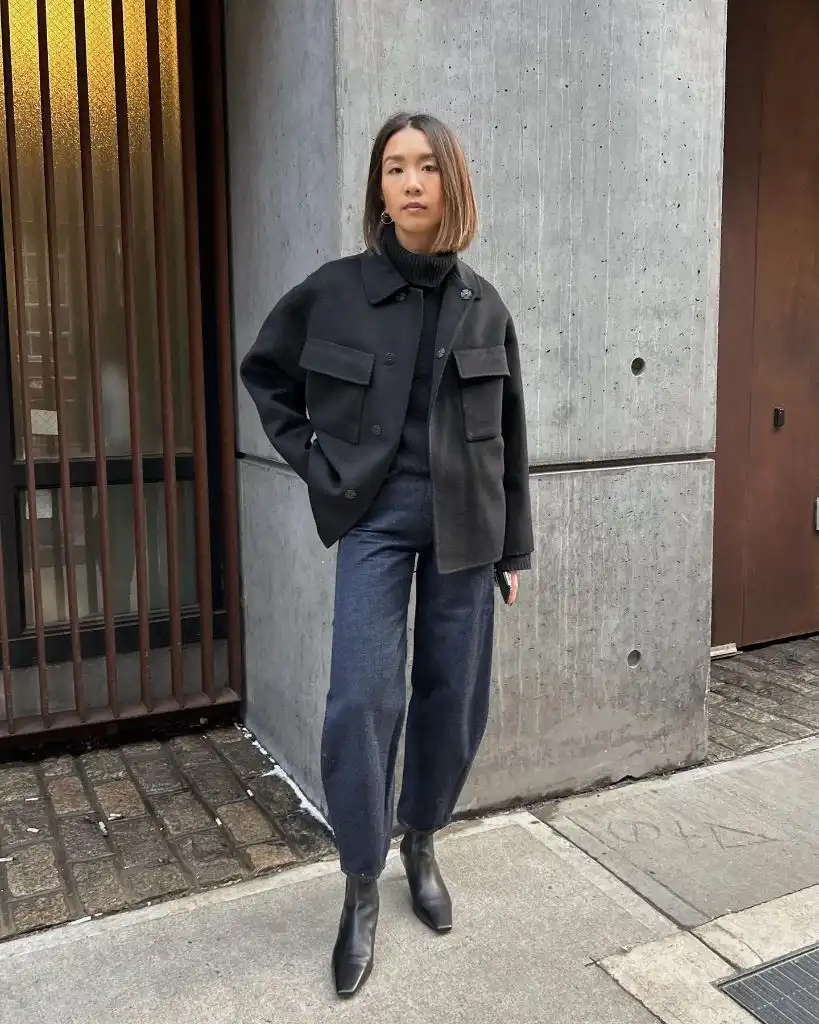
Photo via Instagram
The jacket’s boxy, cropped shape is the structural anchor. It ends at the hip, and the wide trousers begin there, which means the silhouette shifts from narrow-shouldered and square at the top to wide and cylindrical at the bottom. The pointed toe of the boots sharpens the very end of that wide column, which prevents the lower half from reading as heavy. The palette stays within a very narrow range — black, dark charcoal, deep indigo — and the textures do the differentiation: the felted wool of the jacket, the ribbed knit of the turtleneck, the denim weave of the trousers, and the smooth leather of the boots. The concrete and metal backdrop reinforces the utilitarian mood without adding warmth or softness to the reading.
The strength here is proportion management. A boxy jacket over wide trousers could easily read as shapeless, but the cropped length and the pointed boots create two counterpoints that define the silhouette from above and below. The transferable idea for structured winter layering is that a short, square top layer needs a sharp detail at the foot to complete the proportion.
11. A Burgundy Turtleneck Warms a Gray Skater Skirt
The first thing the eye registers is the rich burgundy or wine-red fitted turtleneck, which sits against a flared gray skater skirt in what appears to be a wool or jersey knit fabric. A floral silk scarf in coordinating burgundy and cream tones is tied at the neck. Burgundy or wine-colored tights extend the top’s color below the skirt, and a small structured burgundy handbag with a rounded flap is carried at the side. Round gold-framed sunglasses sit on the face. The background shows a festive storefront with holiday garlands and a green-and-gold painted facade.
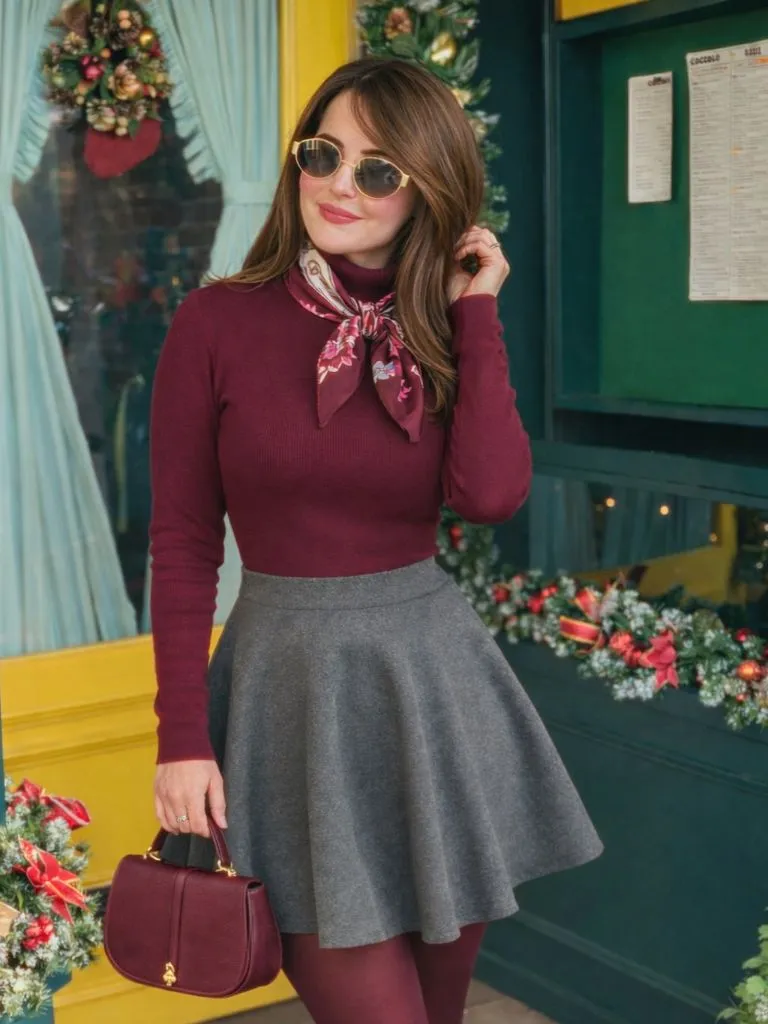
Photo via Instagram
The burgundy appears in four places — turtleneck, tights, scarf, and bag — and the gray skirt acts as the single interruption in that warm red column. This ratio means the gray does not compete; it provides a visual pause at the waist that separates the two fields of burgundy. The scarf is the most considered detail: its floral pattern introduces cream and softer pink tones that lighten the overall mood, and its placement at the neck bridges the gap between the turtleneck and the face. The skater-skirt silhouette adds movement and width at the hip, which balances the fitted top above. The festive green storefront behind creates a complementary color relationship with the burgundy — red and green sit opposite on the color wheel — but this appears incidental to the outfit’s own internal logic.
The best detail is the scarf’s role as a tonal bridge. It softens the transition between the saturated burgundy body and the face, adding pattern without weight. When building a monochrome winter outfit, a small printed accessory at the neckline can introduce visual complexity without disrupting the single-color commitment.
12. A Burgundy Leather Jacket Carries a Minimal Black Short Set
The dominant piece is a cropped, oversized jacket in a deep burgundy or oxblood leather with a glossy, slightly crinkled finish. Below it, black high-waisted shorts are visible over sheer black tights, and black pointed-toe heeled pumps finish the line. A metallic rose-gold or champagne-toned bag with hardware details hangs from one arm. The setting is a warmly lit dining space with a long set table, candles in glass votives, dark flowers, and a curved banquette in cream and warm wood tones.
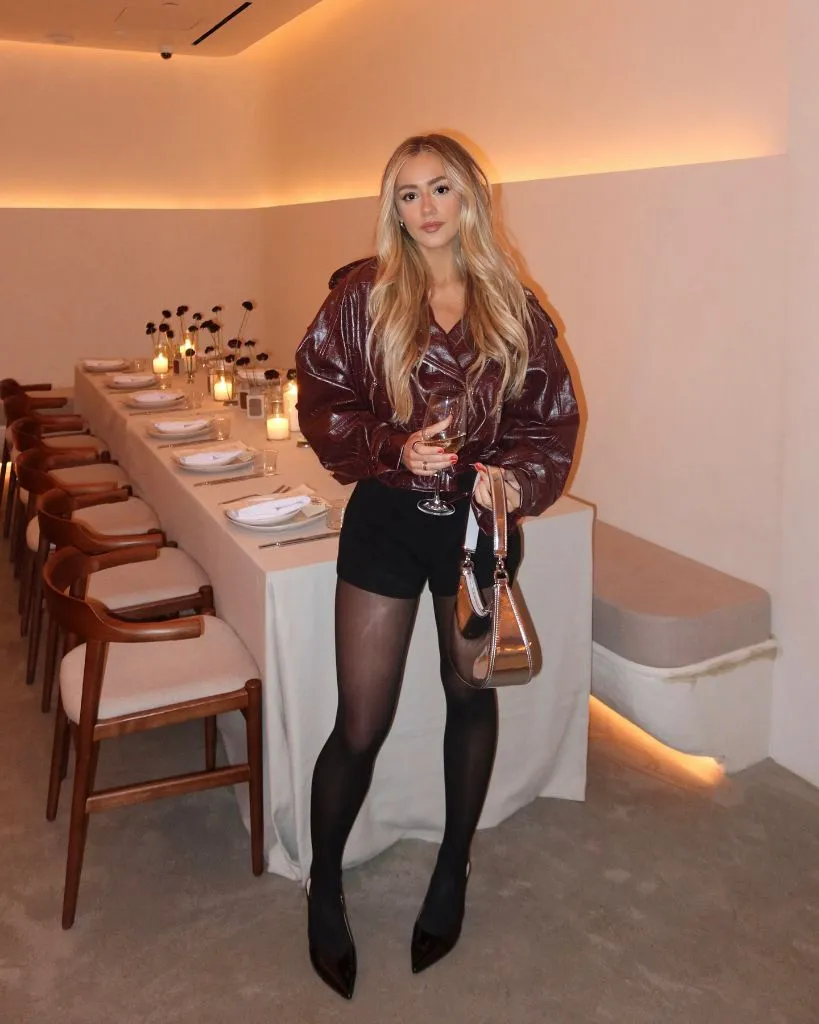
Photo via Instagram
The jacket’s oversized shape and glossy texture command attention because everything below it is deliberately minimal — the black shorts, tights, and pumps form a single dark, lean line. The burgundy leather catches the warm interior lighting, which amplifies its depth and gives the surface a wet-look quality. The metallic bag introduces a third tone that is neither the burgundy nor the black, sitting between them as a warm neutral. The candlelit background and cream-toned seating create an intimate, warm-lit context that makes the deep leather tone read as rich rather than harsh. The sheer tights keep the leg looking lightweight despite the heavy visual weight of the jacket above.
This is a study in top-heavy proportion used intentionally. The oversized jacket with dropped shoulders creates all of the visual volume, while the lower body stays narrow and long. The transferable idea here is that a bold winter jacket in a deep color works most cleanly when the outfit beneath is pared back to a dark, unbroken vertical — this gives the jacket permission to carry the entire statement.
13. Bold Coats in Red and Olive Create a Color Contrast Between Two Figures
Two figures stand side by side on a London-style residential street. One wears a bright red oversized leather or coated coat, belted, with a beige cap and a black quilted Chanel-style flap bag. The other wears an olive green leather or coated coat with shearling-style lining visible at the edges, paired with a lavender cap bearing a visible logo and a lavender quilted chain-strap bag. Both coats are long and voluminous. The street behind shows white Victorian-era townhouses and bare autumn trees.
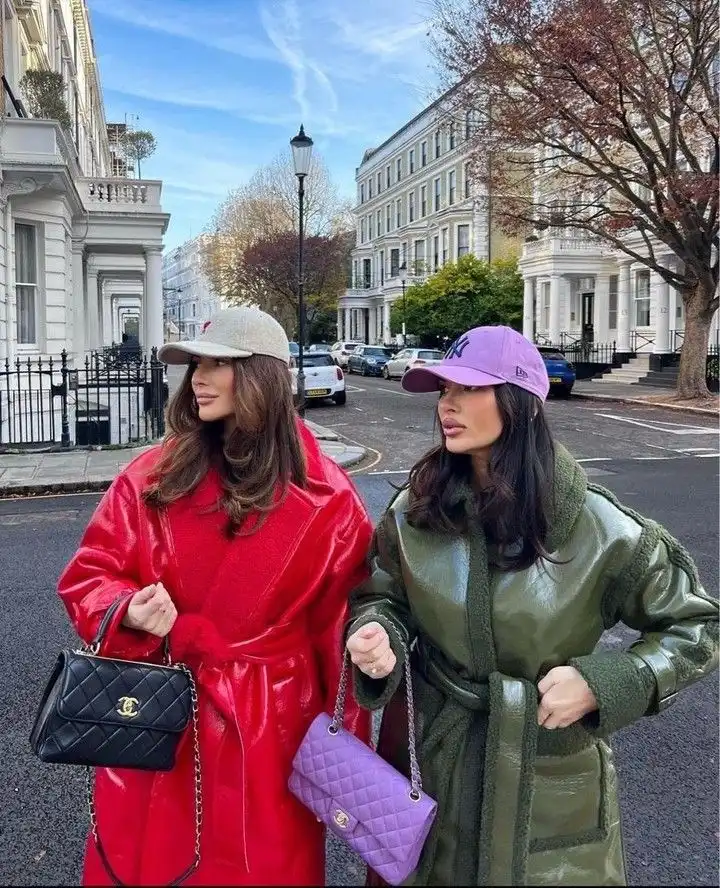
Photo via Instagram
The image is most useful as a study in how two strong coat colors behave next to each other. The red and olive sit far apart on the color wheel but share similar saturation, which is why neither one overwhelms the other. Each figure anchors their coat with a different accent strategy: the red coat gets a neutral beige cap and a black bag, keeping its supporting pieces quiet, while the olive coat gets a lavender cap and matching lavender bag, which introduces a contrasting cool-toned accent. Both approaches work, but they communicate differently — the first reads as letting the coat speak alone, and the second reads as building a secondary color story within the look. The Victorian white facades and bare trees provide a neutral, desaturated backdrop that lets both coats register fully.
What stands out most is how the bag color choice changes the mood of each coat. The same olive coat with a black bag would read more serious; the lavender lifts it. When choosing winter coat accessories, the principle is that the bag and headwear are not afterthoughts — they actively set the temperature of the entire composition.
14. A Mint Sequin Skirt Adds Texture Beneath a Soft Sweater
The visible outfit centers on a light mint or pale seafoam green sequin midi skirt paired with a soft, slightly fuzzy white or very pale mint sweater with balloon sleeves. Silver or metallic pointed-toe flats are visible at the hem, and a small round crossbody bag in a pearlescent or champagne finish hangs from a chain strap. Chandelier-style earrings provide the only other accessory detail. The figure stands on stone steps in front of a gray stone building with a dark wooden paneled door.
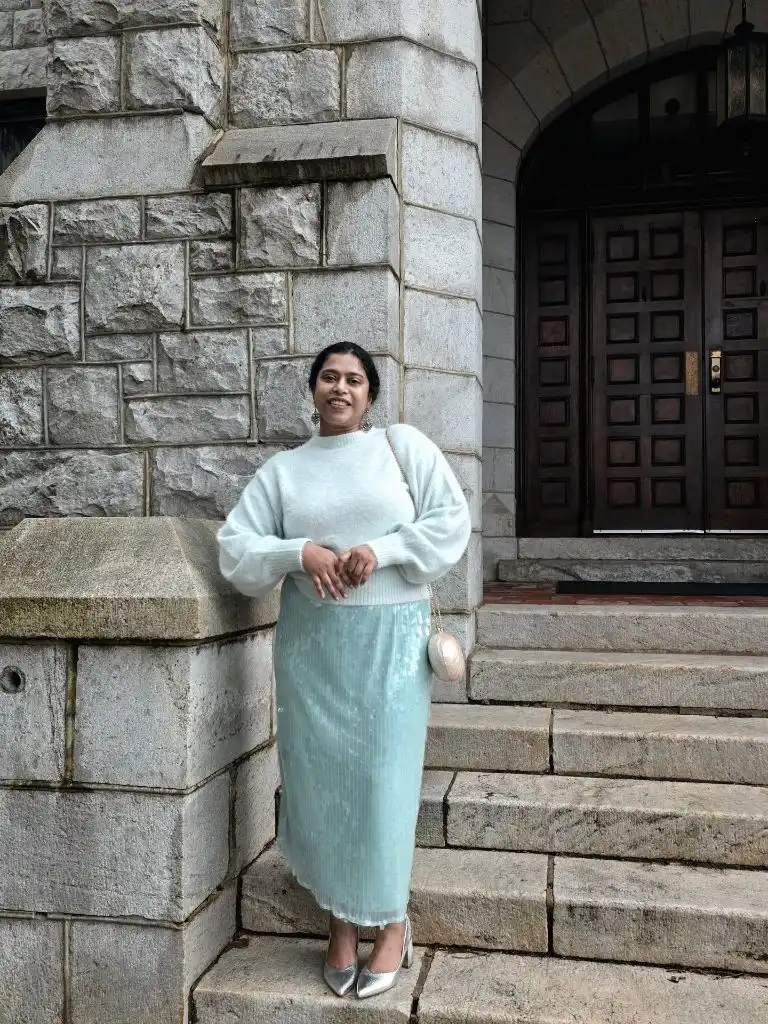
Photo via Instagram
The sequin skirt introduces a reflective, textured surface that contrasts with the soft matte finish of the sweater, and this contrast is the central design relationship. Both pieces live in the same cool, pale tonal family — mint and white — so the outfit reads as monochrome, but the sequins prevent it from reading as flat. The balloon sleeves of the sweater add volume at the arm, which balances the weight of the long skirt below. The silver flats keep the metallic quality from the sequins running to the very bottom of the look, and the pearlescent bag echoes that shimmer at the hip. The gray stone backdrop and dark wooden door are neutral enough to let the pale palette register without competition.
The appeal is the commitment to one tonal world. Sequins in a pale, cool tone risk looking washed out, but the fuzzy texture of the sweater and the stone-gray context give the outfit enough contrast to hold. For anyone exploring textured winter dressing, the lesson is that sequins do not need to be dramatic — they can serve as a subtle surface variation within a quiet palette.
15. A Cream Faux Fur Coat Dominates a White Tonal Look
The entire visible outfit is built in cream and white tones. A voluminous faux fur coat with a shaggy texture falls to mid-thigh, worn over what appears to be a white knit turtleneck visible at the collar. White opaque tights and white pointed-toe heeled boots or mules complete the lower line. No bag is visible. The figure stands against a classical stone facade with arched windows and dark-framed glass, and the floor is dark gray stone paving.
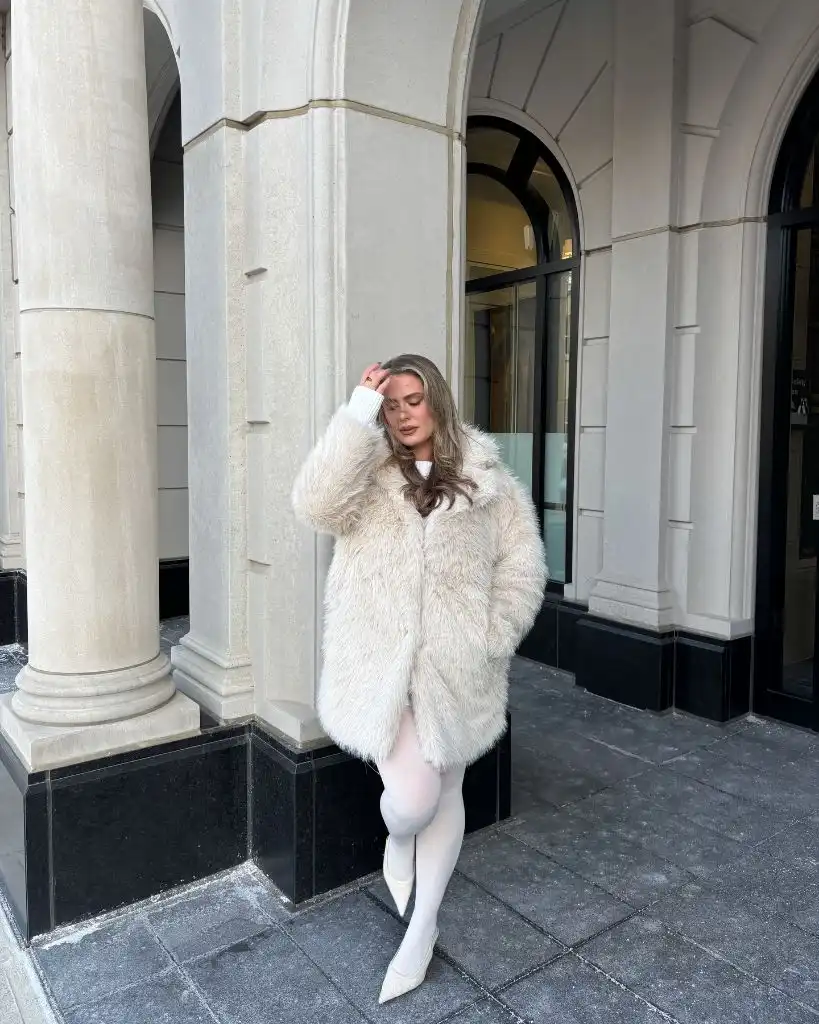
Photo via Instagram
This is an exercise in tonal dressing where the fur’s texture is the only variable. The cream of the coat, the white of the tights, and the white of the boots sit so close together that the body reads as a single pale column, and the shaggy surface of the fur is what keeps it from looking flat. The dark stone floor and the dark window frames behind create a strong contrast border that actually helps define the white silhouette — without that dark surround, the outfit might lose its edges. The pointed toe of the boots adds sharpness at the very end of the look, which counterbalances the softness and volume of the fur above.
The effect is that the fur coat becomes the entire outfit rather than one layer within it. When a single piece commands this much visual space, every supporting element must either continue its tone or disappear. For building chic winter outfits around a single statement piece, the principle is to match everything else so closely that the statement piece’s texture becomes the only thing the viewer reads.
16. A Black Blouse and White Trousers Split the Silhouette at the Waist
The outfit divides cleanly at the waist: a black high-neck blouse with draped or billowing sleeves sits above white or cream high-waisted tailored trousers with a wide leg and pressed front pleat. A black belt with a gold buckle marks the division, and a black leather bag with a visible gold clasp is held at the waist. Pearl or gold drop earrings and a hair clip gathering an updo are the accessory details. The setting is a grand hotel or lobby interior with marble floors, ornate plaster ceiling details, gold chandeliers, black columns, and upholstered seating.
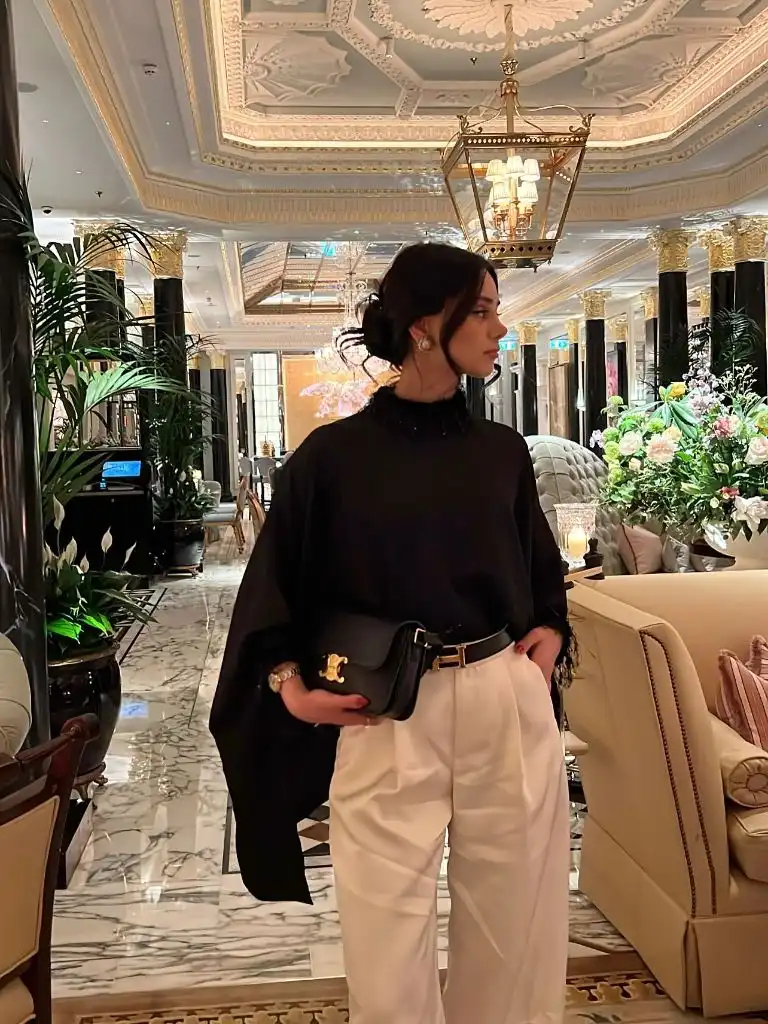
Photo via Instagram
The high-contrast split — black above, white below — is the structural foundation, and the gold belt and bag hardware are the elements that bridge the two halves. The billowing sleeves of the blouse create volume and movement at the arm, while the wide-leg trousers create a matching width at the bottom, which means the silhouette is wide at both ends with a defined narrow point at the belted waist. The marble floor and gilded ceiling contribute to a formal, high-contrast environment that mirrors the outfit’s own black-and-white discipline. The updo keeps the neckline clean and allows the high collar of the blouse to frame the face directly.
This is a silhouette that depends entirely on the belt to function. Without the cinch, the wide top and wide bottom would merge into a column with no shape. The transferable principle is that high-contrast splits — dark top, light bottom or vice versa — need a defined waist-marking accessory to give the eye a place to rest and the proportions a place to hinge.
17. A Burgundy Fuzzy Top Balances a Dark Satin Skirt
The most visible detail is a sleeveless or cap-sleeve top in a burgundy or deep wine fuzzy-textured fabric — mohair or brushed knit — worn with a dark satin or silk midi skirt that has a subtle sheen. The figure sits in a restaurant setting with glass windows reflecting nighttime lights and greenery. A dark bag — possibly patent leather — is visible draped over one shoulder. Small hoop earrings and a subtle ring are the only accessories.
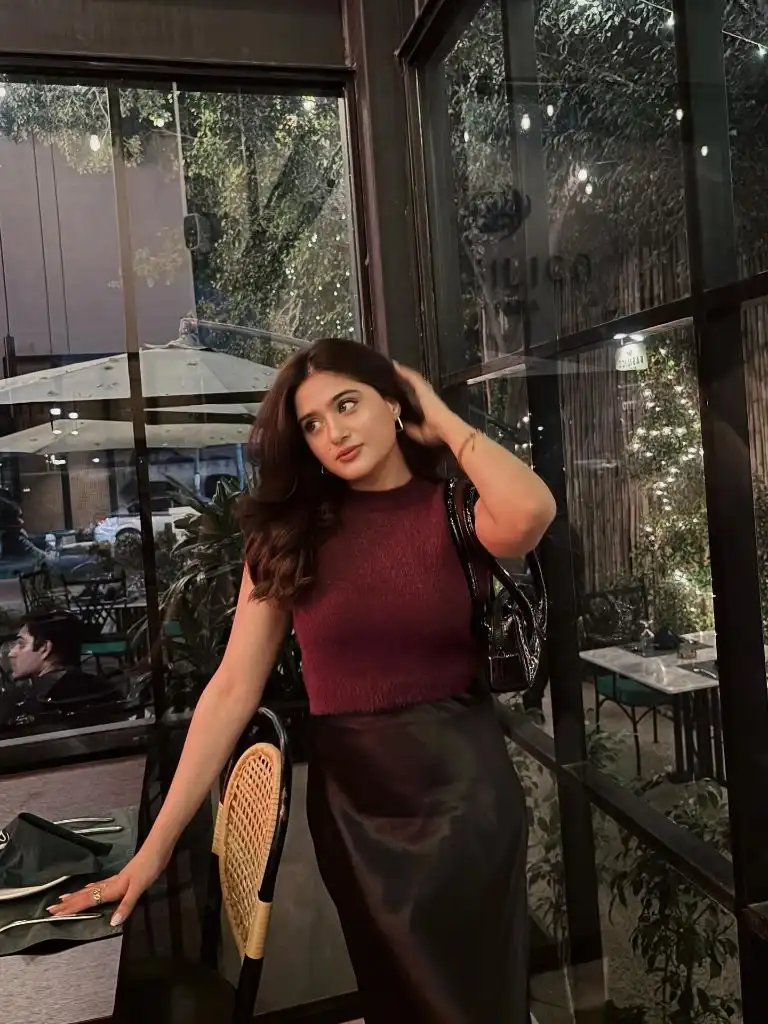
Photo via Instagram
The texture contrast between the fuzzy top and the smooth satin skirt is doing the compositional work. Both pieces are dark and warm-toned, so the visual interest comes not from color difference but from the way light interacts differently with each surface — the fuzzy knit absorbs light and reads as matte, while the satin reflects it and reads as luminous. The bare arms suggest this is either a mild winter context or an indoor dining look where outerwear has been removed, and the image is most useful as a study in how to pair textures for an evening meal rather than a full outdoor winter ensemble. The ambient restaurant lighting — reflections in glass, soft overhead glow — enhances the satin’s sheen and deepens the fuzzy knit’s richness.
The appeal is the simplicity of two textures working against each other in a narrow color range. No statement accessory or layering trick is needed because the surface contrast between fuzzy and smooth creates enough visual tension. When building evening winter looks, this pairing demonstrates that fabric choice can replace color as the primary source of interest.
18. A Striped Shirt Under a V-Neck Sweater Reads as Smart Layering
The visible outfit consists of a black V-neck sweater layered over a striped button-down shirt — the collar, cuffs, and shirttail are all visible, extending beyond the sweater at the neck, wrists, and hem. Below, black tailored trousers sit at the waist, and a white structured shoulder bag with a gold chain strap rests against the torso. The setting is a festive outdoor terrace with Christmas ornaments, string lights, red and gold baubles on trees, a wreath around a clock, and a brick fireplace visible in the background.
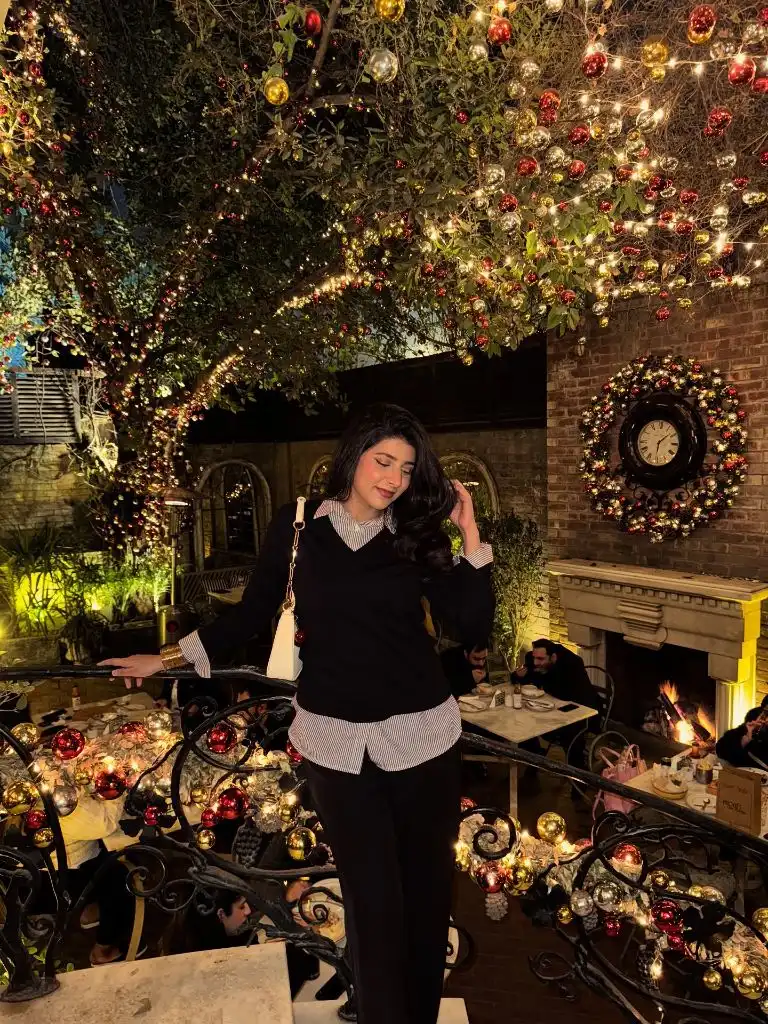
Photo via Instagram
The layering is doing all of the design work here. The striped shirt provides visual detail at three points — neck, wrists, and hem — which creates a frame of pattern around the solid black sweater. This gives the sweater a context it would not have on its own and prevents the all-black combination of sweater and trousers from reading as plain. The white bag is the brightest element and draws attention to the upper body, where the most interesting layering decisions are happening. The festive backdrop adds color and warmth, but the outfit itself stays entirely neutral — black, white, and the thin stripes of the shirt — which means it does not compete with the setting.
The value is in the visible borders. The shirt is not just a warmth layer; it is a design element that defines the sweater’s edges. The transferable lesson is that when wearing a solid dark sweater over a patterned or lighter shirt, letting the collar, cuffs, and hem all show turns a practical winter layering decision into a considered visual structure.
19. A Navy Utility Jacket Sits Over Denim With Tall Brown Boots
The composition leads with a navy utility or safari-style jacket with four visible front pockets and gold-toned button details, belted at the waist with a black leather belt. Beneath, denim shorts or a very short denim skirt is partially visible. Tall brown leather boots in a straight-shaft, pointed-toe silhouette rise to just below the knee. A small crossbody bag with a visible monogram pattern hangs at the hip. Dark sunglasses are pushed up into the hair. The setting is an outdoor courtyard with a white stucco wall, a large palm or cycad in a concrete planter, and rows of red poinsettia plants.
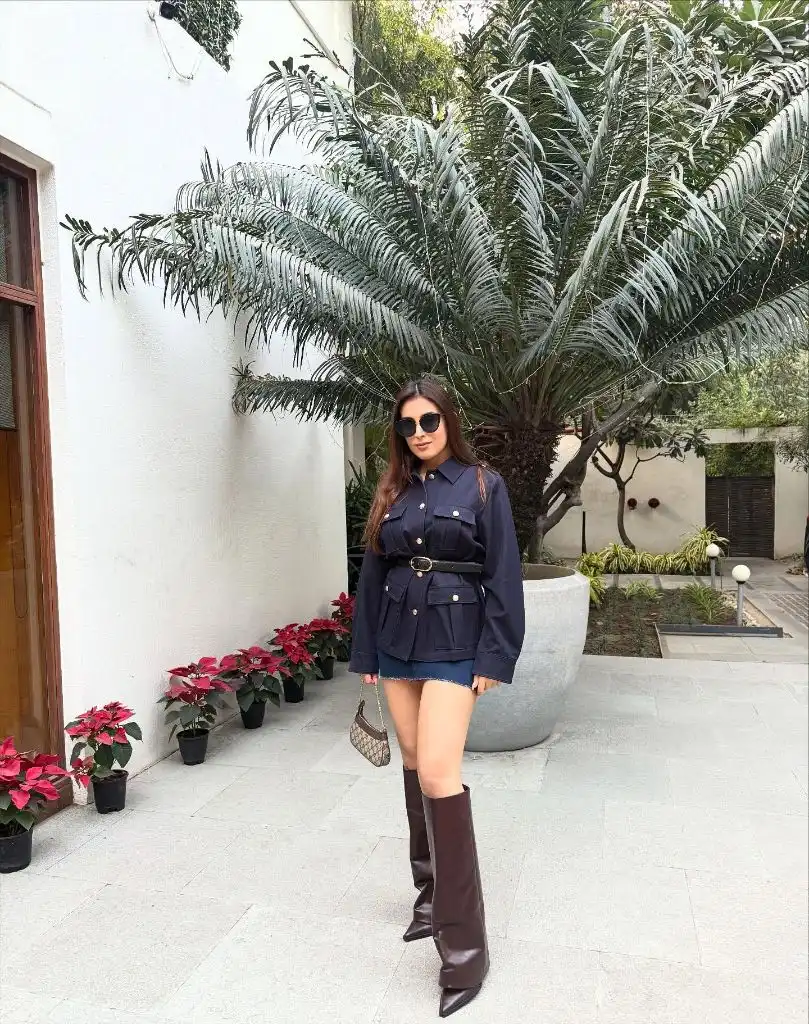
Photo via Instagram
The tall boots are the element that elevates this from a warm-weather outfit to something that reads as transitional or mild-winter appropriate. They cover the calf entirely and their brown tone is warm enough to complement the navy jacket without matching it exactly. The gold buttons on the jacket echo the warm tones of the boot leather, creating a diagonal connection from the chest to the foot. The belt cinches the jacket at the waist, which is necessary because the boxy pocket-heavy shape would otherwise obscure the figure’s proportions. The poinsettias and the overall light suggest a warm climate in a cooler season, which contextualizes the bare-leg approach.
This is a look that openly straddles seasons, and the photograph supports it — the boots and jacket suggest winter, while the denim shorts and bare legs suggest something milder. The useful reading here is about how a structured jacket and tall boots can shift a summer base into cooler territory, which matters for anyone dressing in regions where winter is mild rather than frigid.
20. A White Blazer Opens Up a Dark Turtleneck Dress
The visible outfit places a cream or off-white double-breasted blazer with gold buttons over a dark navy or black turtleneck mini dress. Sheer black tights extend below the hem, and the legs end in what appears to be heeled boots or shoes, though they are partially cropped. A gold chain-strap bag is visible crossing the chest. The figure holds a glass of dark red wine. The setting is an outdoor terrace or courtyard with wrought-iron furniture, white balustrades, and warm evening lighting.
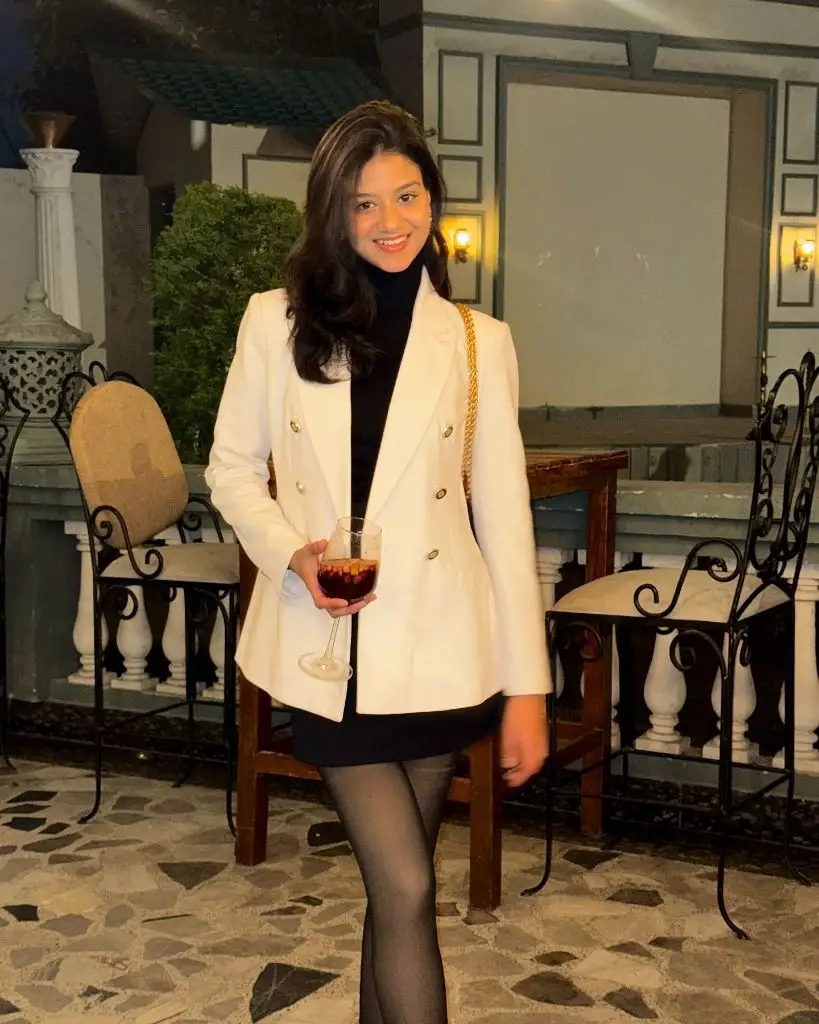
Photo via Instagram
The white blazer is doing what a contrasting outer layer does best — it defines the shoulders, frames the dark dress inside it, and introduces brightness at the top of the silhouette. The gold buttons echo the gold of the chain bag strap, which creates a small metallic thread running from the chest to the hip. The dark turtleneck dress provides a continuous dark base from neck to thigh, and the sheer tights extend that dark line below, so the blazer is the only interruption in the vertical. The evening courtyard setting, with its ornamental iron and warm light, gives the outfit a social-occasion context that suits the blazer’s formality and the wine glass in hand.
The best detail is the way the blazer’s structure contrasts with the soft knit of the dress beneath. A blazer adds architecture to a body-conscious dress, and the double-breasted closure with its gold buttons gives it enough formality to read as intentional evening layering. The principle is that a light-colored blazer over a dark base can reframe a simple knit dress into something that reads as composed for an event.
21. A Camel Coat Anchors a Turtleneck and Knee-High Boot Pairing
The outfit leads with a long, tailored camel coat falling below the knee, worn over a camel or tan ribbed turtleneck sweater. A dark belt with a visible gold logo buckle cinches the coat at the waist. Below, what appears to be a dark skirt or shorts is partially visible, and tall black knee-high boots with a chunky sole complete the lower line. A small black clutch or wallet is held in one hand, and large dark sunglasses frame the face. The setting is the interior of what is clearly the Galleria Vittorio Emanuele II in Milan — the ornate mosaic floor, arched glass ceiling, and visible Giorgio Armani and Louis Vuitton storefronts confirm the location.
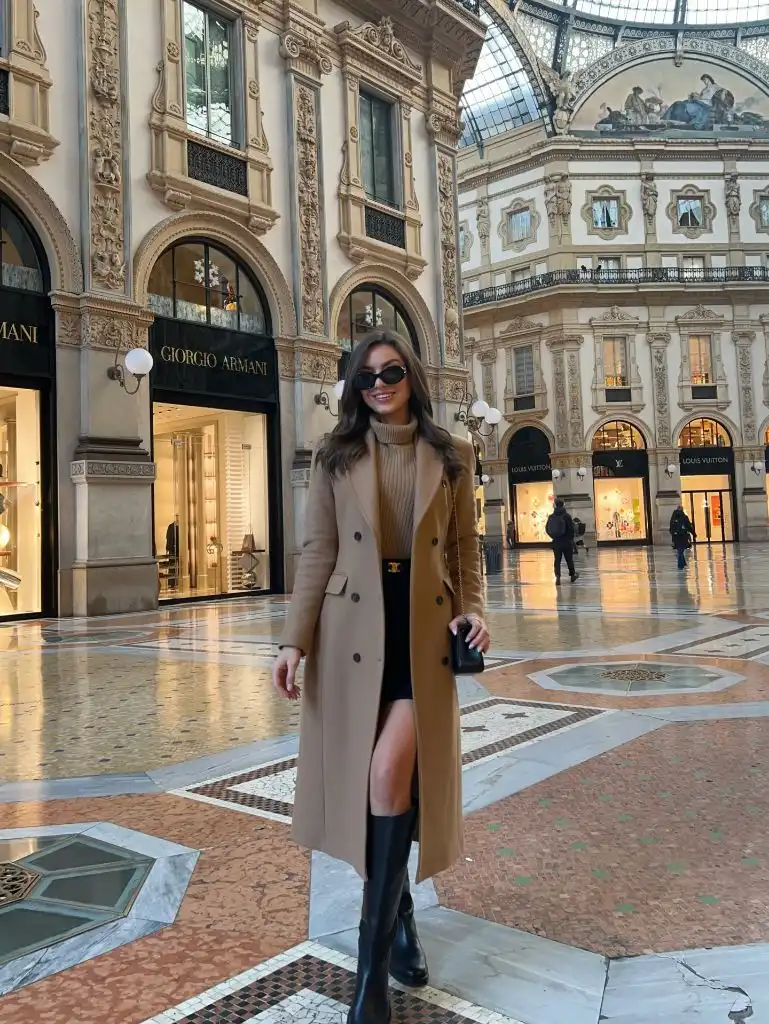
Photo via Instagram
The camel coat and the turtleneck sit in nearly the same tonal family, which creates a tonal column from neck to knee in warm beige. The black boots and belt interrupt that column at two points — waist and calf — providing structural contrast without breaking the warmth of the overall palette. The gold buckle at the waist picks up the warm amber tones of the coat and sweater, tying the metallic detail to the textile palette rather than standing apart from it. The ornate galleria setting, with its gilded mosaic floor and classical architecture, amplifies the polished quality of the outfit — but the coat would read as equally considered on a plain sidewalk. The sunglasses add a note of visual shielding that suits the composed formality of the silhouette.
The effect is that tonal dressing in warm neutrals creates a continuous visual line that needs only one or two dark interruptions to feel complete. This is one of the most straightforward demonstrations of how chic winter outfits work — a single warm-toned column with dark boots and a belt to mark the structure. The transferable lesson is that matching your coat to your knitwear in tone elongates the body visually and lets the boots provide the only contrast.
22. A Long Beige Coat and Gray Polo Layer for Casual Winter Walking
The outfit is built for walking and reads as relaxed daywear. A long beige or oatmeal wool coat falls to the ankles, worn open over a gray polo-collar sweater with visible button placket, layered over a white collared shirt. Dark indigo wide-leg jeans and white low-top sneakers with a gum or tan sole complete the lower half. A dark baseball cap with embroidered text, a brown crossbody strap, and small earrings are the only accessories. Text overlaid on the image reads “What to Wear in Rome.” The backdrop is a weathered stone wall and an old green-painted wooden door with iron ring handles.
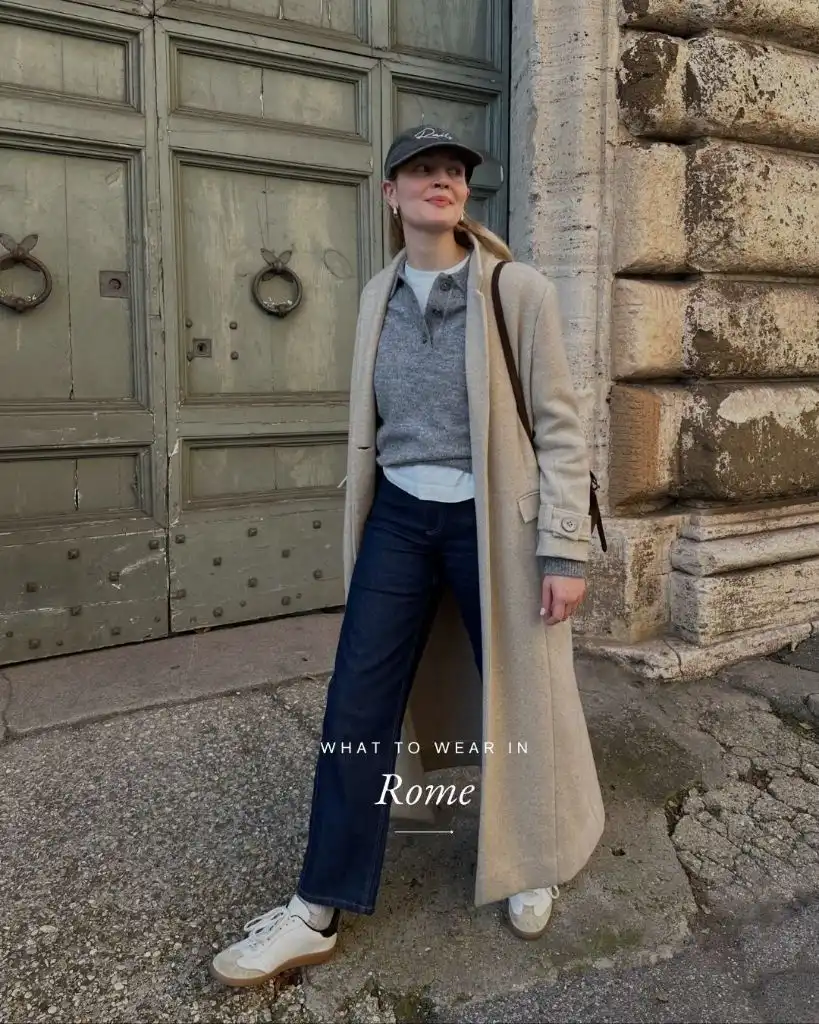
Photo via Instagram
This outfit uses three visible layers at the torso — coat, sweater, shirt — and each one is a different tone: beige, gray, white. The tonal gradient from dark at the outermost layer to light at the innermost creates depth without pattern or texture contrast. The wide-leg jeans bring visual weight to the lower body that balances the long heavy coat above, and the white sneakers lighten the base, echoing the white shirt visible at the collar. The baseball cap is the most casual element and it shifts the reading of the long coat from formal to relaxed, which is the most deliberate styling choice visible here. The Roman stone backdrop and old wooden door give the outfit a travel context where comfort and walkability clearly matter.
The strength here is the gradient layering — each layer is slightly lighter than the one above it, and this gives the torso dimension even though no single piece demands attention. When dressing for winter travel days, the principle is that a clear tonal progression across your layers can replace accessories and statement pieces as the main source of visual interest.
23. A Dark Faux Fur Coat and Cognac Gloves Add Warmth in a Car
The final image shows a figure seated in the back seat of a car, wearing a dark brown or espresso-toned faux fur coat with a plush, dense texture. Cognac or tan leather gloves are worn on both hands, and the warm leather tone contrasts with the darker fur. Small gold hoop earrings are visible. The hair is pulled back, and the face is softly lit by exterior light coming through the car windows. The background is the interior of a dark car — leather headrests, a seatbelt, and blurred city lights through the rear window.
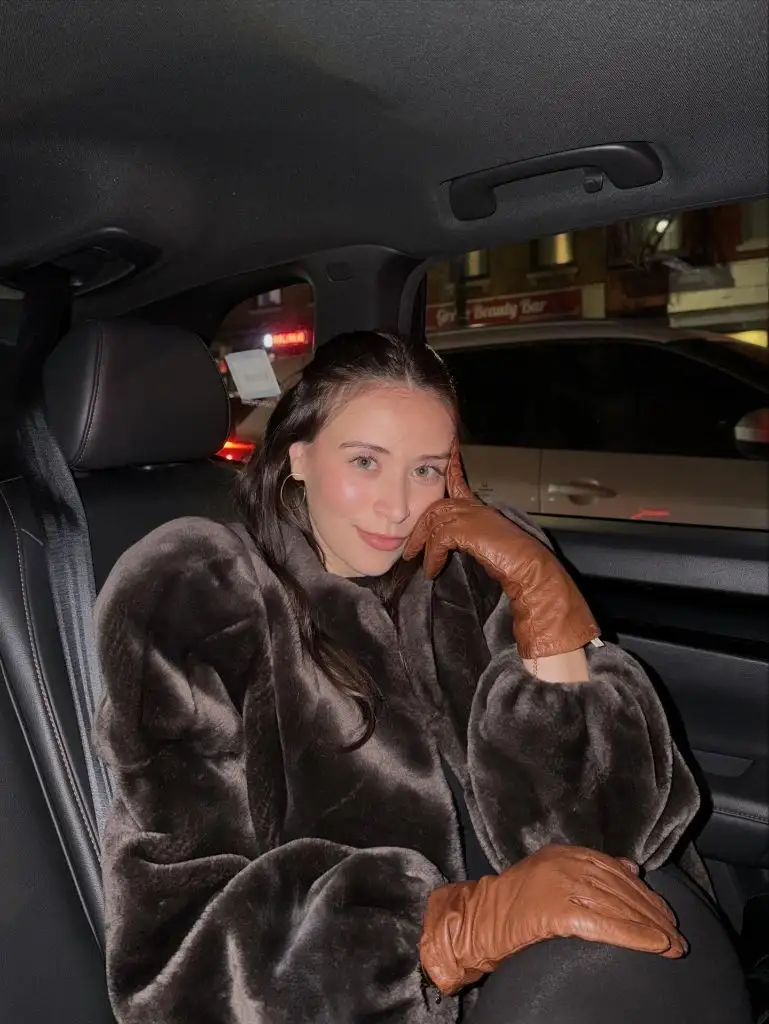
Photo via Instagram
This image offers less outfit information than most in the article because the figure is seated and the coat covers nearly everything. What is visible, though, is a deliberate color relationship between the espresso fur and the cognac gloves — two brown tones that sit close enough to feel coordinated but far enough apart to read as distinct. The fur’s texture is dense and smooth compared to the shaggy faux furs seen earlier in this article, and this gives the coat a more structured, polished reading. The gold hoops provide a small metallic accent that ties to the warm brown palette. The car interior is dark and neutral, which means the coat and gloves are the only visual information available.
The appeal is the intimacy of the moment and the restraint of the palette. Only two materials are visible — fur and leather — and they are doing all of the work. The final takeaway from this collection of chic winter outfits is that warmth itself can be the aesthetic: when the coat and the gloves are chosen with this level of tonal care, nothing else needs to be visible for the look to feel fully resolved.

1 thought on “Chic Winter Outfits 2027 Stylish Looks to Keep You Cozy”