Choosing a hairstyle for the holiday season should not feel like performing for an audience that has already decided what festive means. Christmas hairstyles in 2026 carry no single obligation. You are allowed to wear your usual color and simply change the shape, or keep the shape and shift everything with one dramatic tone. The season belongs to you more than it belongs to any visual formula, and the photographs ahead reflect that range honestly.
The useful question is not which style looks most like Christmas but which visible decisions actually change the reading of a hairstyle when holiday context surrounds it. Across these twenty images, the variables worth watching are color placement, meaning where a tone begins and how far it travels; proportion, meaning the balance between volume at the crown and weight at the ends; texture, meaning the difference between a deliberate wave and a controlled smooth surface; and shape, meaning whether the silhouette is gathered, loose, split, or structured. A single shift in any one of those four elements can move a hairstyle from everyday to seasonally intentional without requiring a complete change. That is the framework each section ahead applies to its own photograph, one image at a time.
1. A Messy High Bun Frames the Earring and Neckline
The strongest detail here is the placement of the bun itself, sitting high enough on the crown to lengthen the visible line of the neck. The hair is dark brunette, gathered loosely with wisps falling around the face and ears. A black sleeveless top exposes the shoulder and collarbone, and a small decorative earring catches light just below the jawline.
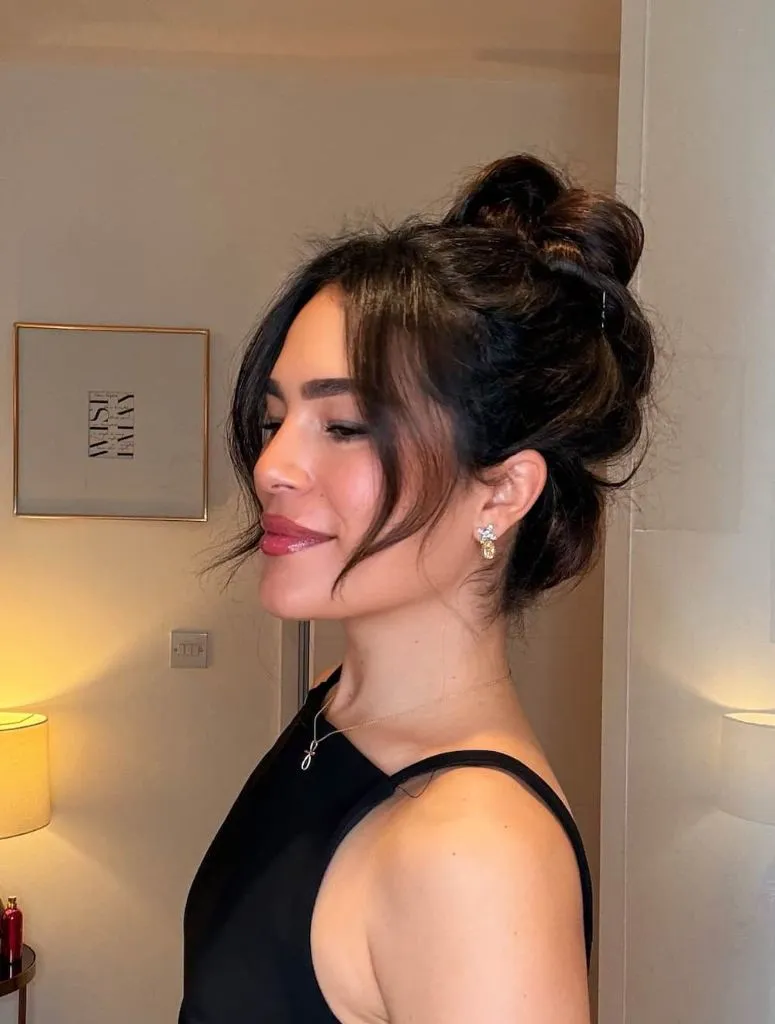
Photo via Instagram
The updo works because it does not compete with the accessories or the neckline. The loose pieces around the face soften what could otherwise read as severe, and the volume at the top of the bun is unstructured enough to feel relaxed rather than formal. The earring placement becomes visible precisely because the hair has been pulled away from the ear without being pinned flat. The warm-toned room light behind the subject adds a slight golden cast to the dark strands, which keeps the overall reading warm rather than stark. That interplay between a holiday updo approach and relaxed texture is what gives this look its balance.
This is a study in how much a simple gathered shape can change the emphasis of a look. The bun does not need ornament or color because the proportional shift, moving all the weight from the shoulders to the crown, already creates a different silhouette. Anyone working with long dark hair can use this principle: height at the crown opens the neck, and loose face-framing pieces keep it from reading rigid.
2. Warm Brunette Highlights Soften a Medium-Length Wave
The first thing that registers is the warmth of the highlights. This is a medium-length brunette style, roughly shoulder to collarbone, with soft waves that move through caramel and toffee tones woven into a darker chocolate base. The subject is photographed in profile, head tilted slightly forward, against what appears to be a salon interior with light-toned flooring.
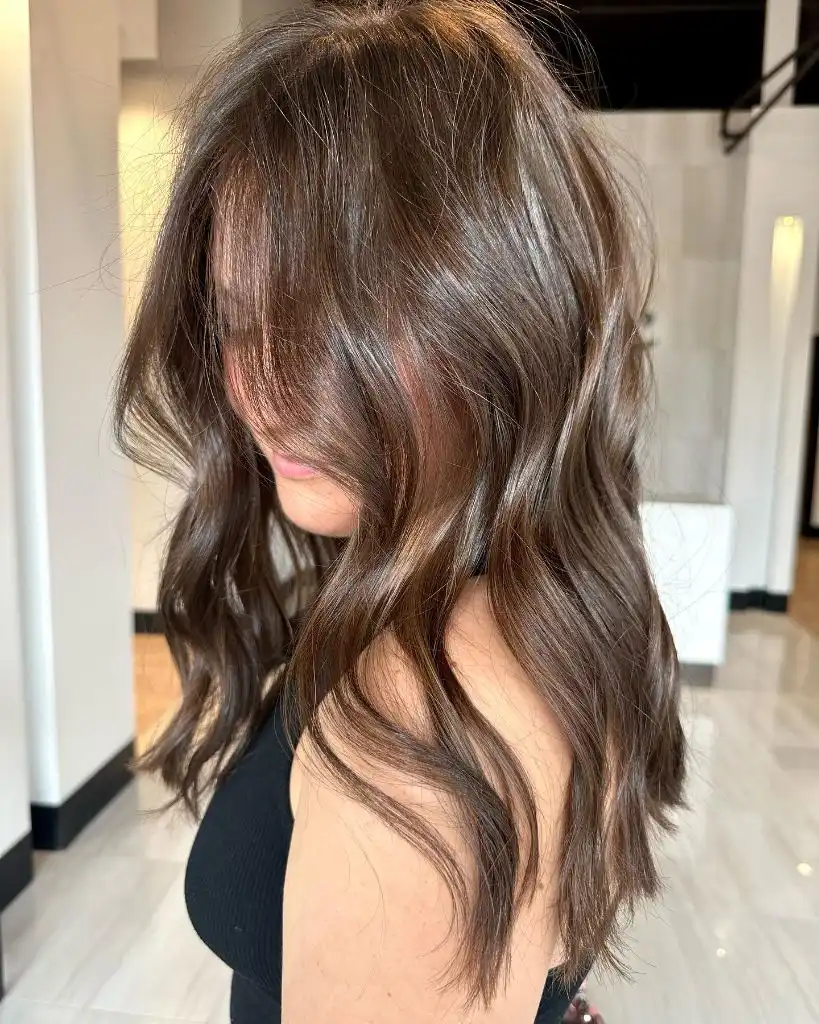
Photo via Instagram
The highlight placement is concentrated through the mid-lengths and ends, leaving the root area darker and more natural. This creates depth without making the lighter tones look applied or striped. The waves are loose and slightly irregular, which allows the light to catch different sections unevenly and that variation is what makes the color look dimensional rather than flat. The black top the subject wears functions as a neutral base that pushes the hair color forward visually. Nothing in the frame fights for attention with the tonal work.
The appeal is in the restraint of the placement. The highlights do not reach the root, and they do not dominate the ends. They sit in a middle zone that reads as sun-touched warmth, which is a quiet way to carry seasonal richness without a dramatic color shift. The transferable principle is straightforward: warmth in the mid-lengths reads natural, and leaving the root darker gives the whole look a longer visual lifespan.
3. Long Waves With a Center Part Balance Volume Evenly
Volume is the first thing visible here. The hair is long, past the collarbone, with large barrel-curled waves that fall symmetrically on either side of a soft center part. The base color is a rich medium brown with warm undertones, and the subject wears a white knit top against a pale paneled background. The overall frame is warm, polished, and centered.
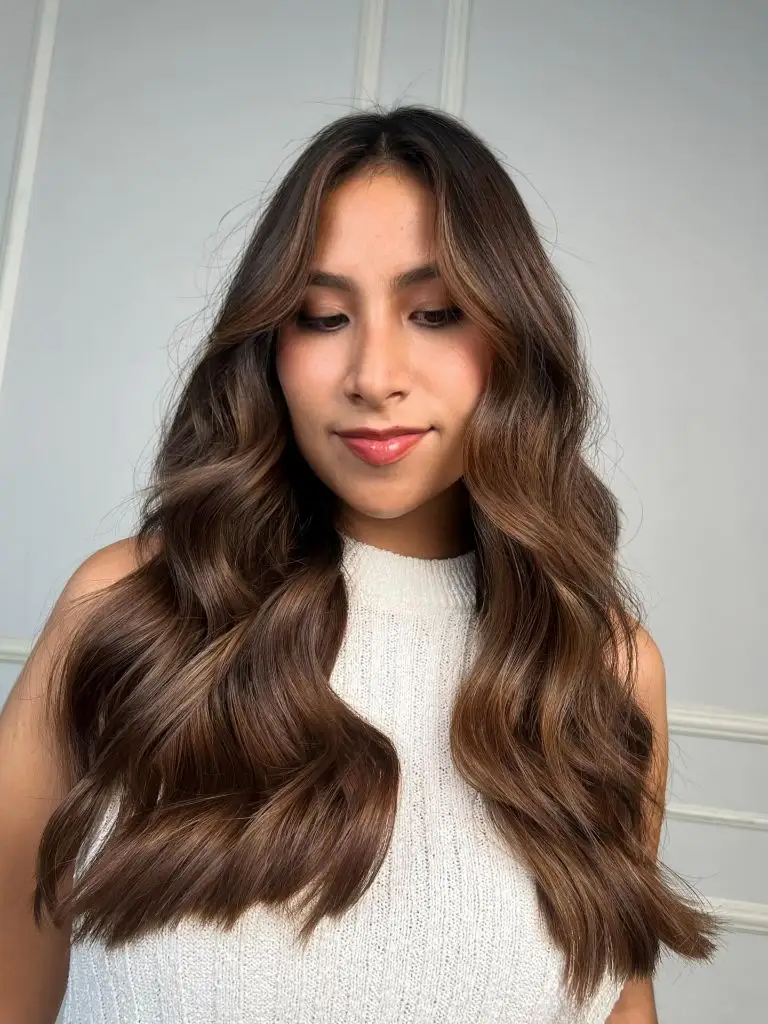
Photo via Instagram
The center part is doing more work than it appears to. By splitting the hair evenly, it distributes the weight of those waves equally across the shoulders, which prevents the style from looking heavier on one side. The curls themselves are uniform in size but not identical in direction, which avoids the rigid, roller-set look that large waves can sometimes produce. The white top anchors the bottom of the frame and pushes the eye upward into the color and movement of the hair. For anyone considering festive wave styling, this kind of even distribution is worth studying.
The strength here is that the style does not rely on any color technique or accessory to create its impact. The single variable doing the work is shape: the size and regularity of the wave combined with the symmetry of the part. That combination reads as polished without reading as stiff. If volume is the goal, a center part with evenly sized waves is one of the most reliable ways to achieve it without sacrificing movement.
4. Platinum Curls Carry Old Hollywood Warmth Forward
The visible color here is a cool-toned platinum blonde with soft, wide-set curls swept to one side. The subject wears a black sleeveless top and is photographed against a dark background, which isolates the hair and face in a way that emphasizes the brightness of the blonde against the surrounding darkness. The curls sit close to the head without excessive volume, creating a sleek, sculpted silhouette.
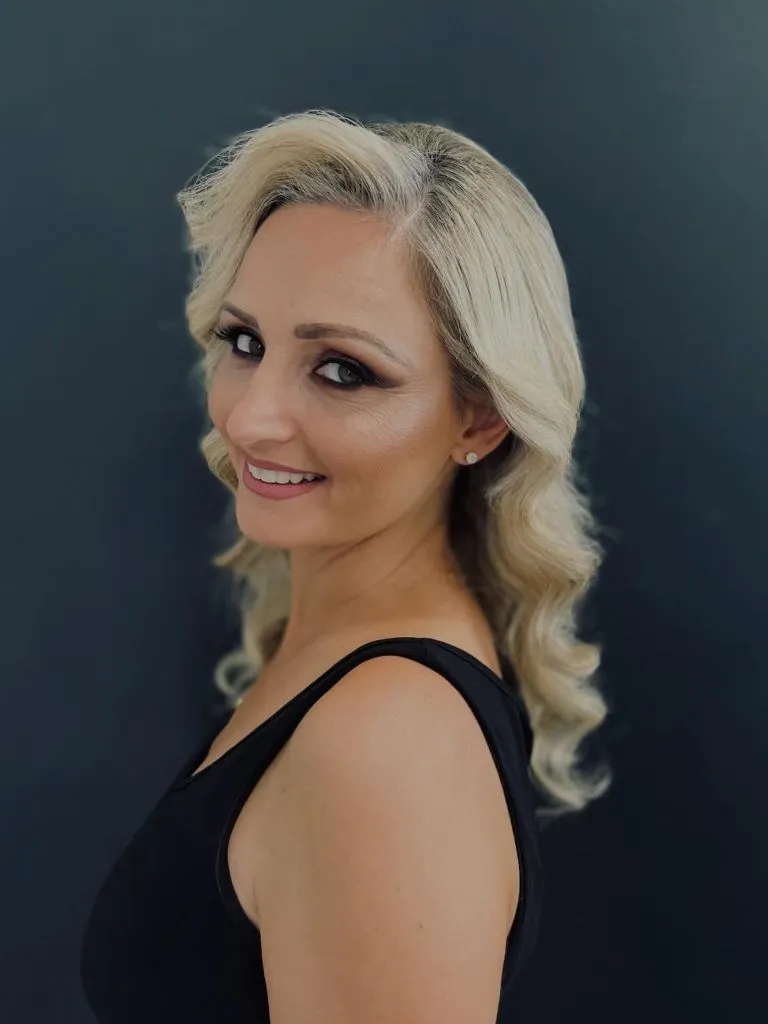
Photo via Instagram
The dark background is critical to how this style reads. It turns the platinum into the brightest element in the frame, which gives the hair a luminous, almost glowing quality. The side-swept direction creates asymmetry that adds interest without disrupting the clean lines of the curls. The curls themselves are structured but not tight, falling in smooth S-shapes rather than spirals. The black top mirrors the background and keeps the lower part of the frame unified, so the eye stays on the hair and face. This photograph does not show a Christmas-specific element, and the useful reading is about how color contrast between hair and environment can shift the entire feeling of a style.
I like the way the platinum reads almost silver under this lighting. A cool blonde against a dark surround carries a winter quality on its own, without requiring any ornament or seasonal signifier. The principle here is that backdrop matters: the same platinum in a bright room would read entirely differently. Controlling what surrounds the hair is part of the styling decision.
5. Copper Tones With Long Soft Movement Read as Natural Warmth
The color is a warm, true copper that runs evenly from roots to ends with only minor variation in depth. The hair is very long, falling well past the shoulders, with loose, soft waves that are more undulation than curl. The subject wears a muted gray-brown salon cape, and the background shows a bright, minimal salon space with a plant and an arched mirror.
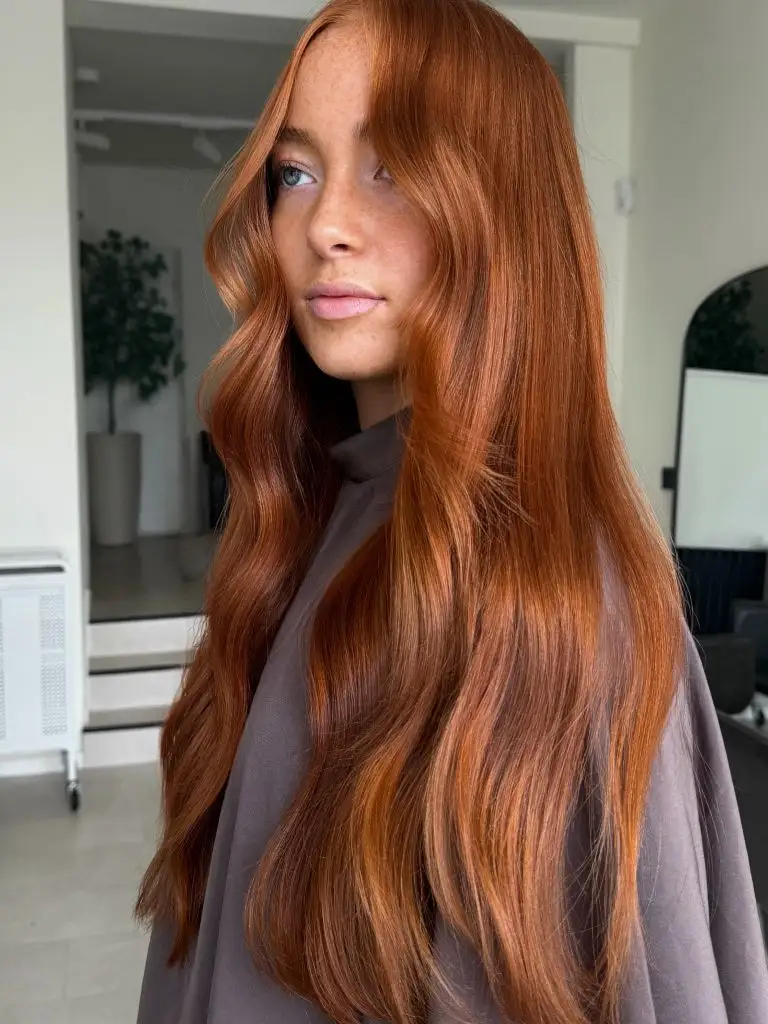
Photo via Instagram
The even application of the copper tone is what makes this read as natural rather than fashion-colored. There are no visible panels, no contrasting lowlights, and no dramatic root shadow. The color simply exists uniformly, which gives it a quality closer to natural red hair than to a salon transformation. The soft waves support that reading by avoiding any structured curl pattern. The neutral salon cape and bright background let the color speak without competition. This is one of the warmest tones in the entire article, and it connects directly to warm hair color ideas that carry well through the colder months.
The best detail is the consistency of tone across the full length. In a season that often favors dramatic shifts and bold contrasts, an all-over color applied evenly is its own kind of statement. The transferable idea is that uniform tone on long hair creates its visual interest through the way light moves across waves rather than through color variation. The length and the movement do the work that highlights would do on a shorter cut.
6. Red-to-Orange Gradient Creates a Vivid Warm Shift
The immediate impression is intensity. The hair moves from a deep, saturated red at the roots through a gradient that reaches bright copper-orange at the ends. The length is medium, sitting around the shoulders, with loose waves that catch the light unevenly and amplify the color transition. The subject wears a light-colored top, and a shoulder tattoo is visible in the lower portion of the frame.
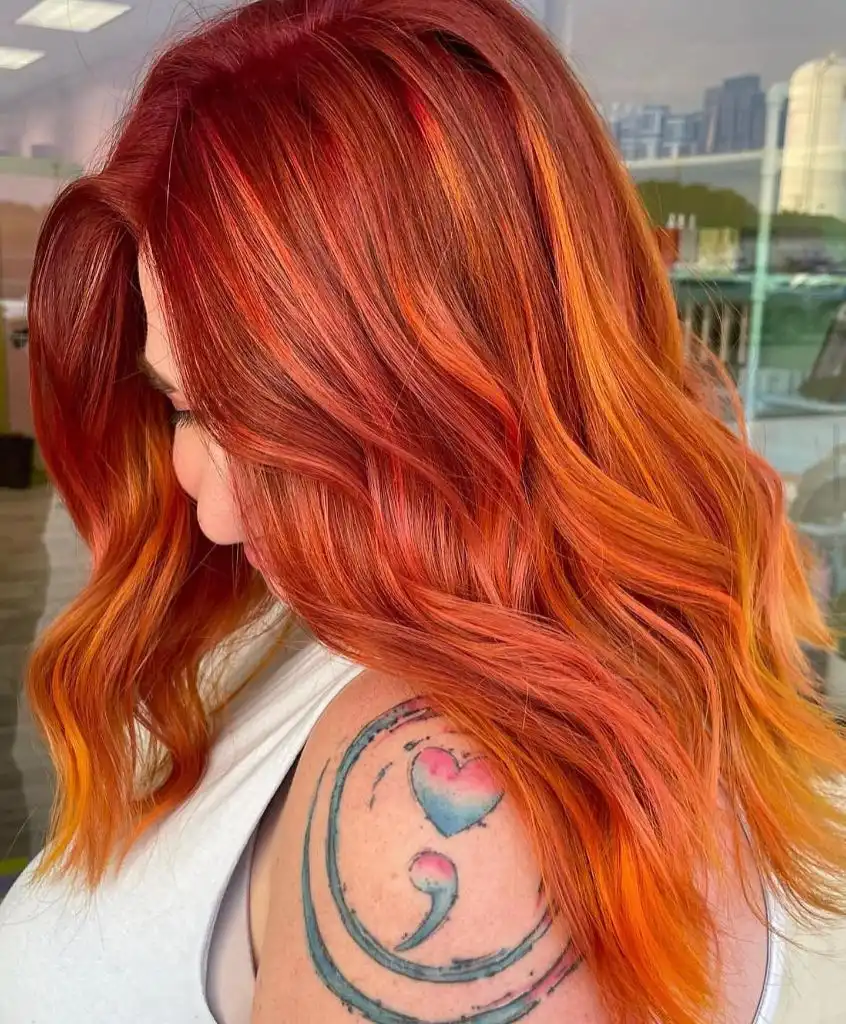
Photo via Instagram
The gradient works because the transition between red and orange is continuous rather than banded. There is no hard line where one color stops and the next begins, which allows the waves to blend the tones naturally as the hair moves. The deepest red sits near the crown and the brightest orange occupies the very tips, so the eye is drawn downward through the color story. The light background and the light top both recede, ensuring that the hair dominates the visual field entirely. For anyone drawn to bold seasonal color choices, this kind of gradient demonstrates how two warm tones can coexist without competing.
The effect is unmistakably seasonal without relying on any Christmas-specific motif. Red and orange together read as fire, as autumn turning to winter, as warmth against cold. The useful takeaway is that a gradient with closely related warm tones can be vivid without being jarring, as long as the transition between them is soft and the wave pattern helps the colors blend optically.
7. A Green and Red Split Anchors Holiday Color Boldly
The split is immediate and deliberate: the left side of the hair is a deep emerald green, and the right side is a saturated cranberry red. The hair falls in medium-length waves, and the back view shows the two colors meeting roughly at the center part. The background is warm and slightly blurred, with what appears to be a Christmas tree with white and red ornaments visible behind the subject.
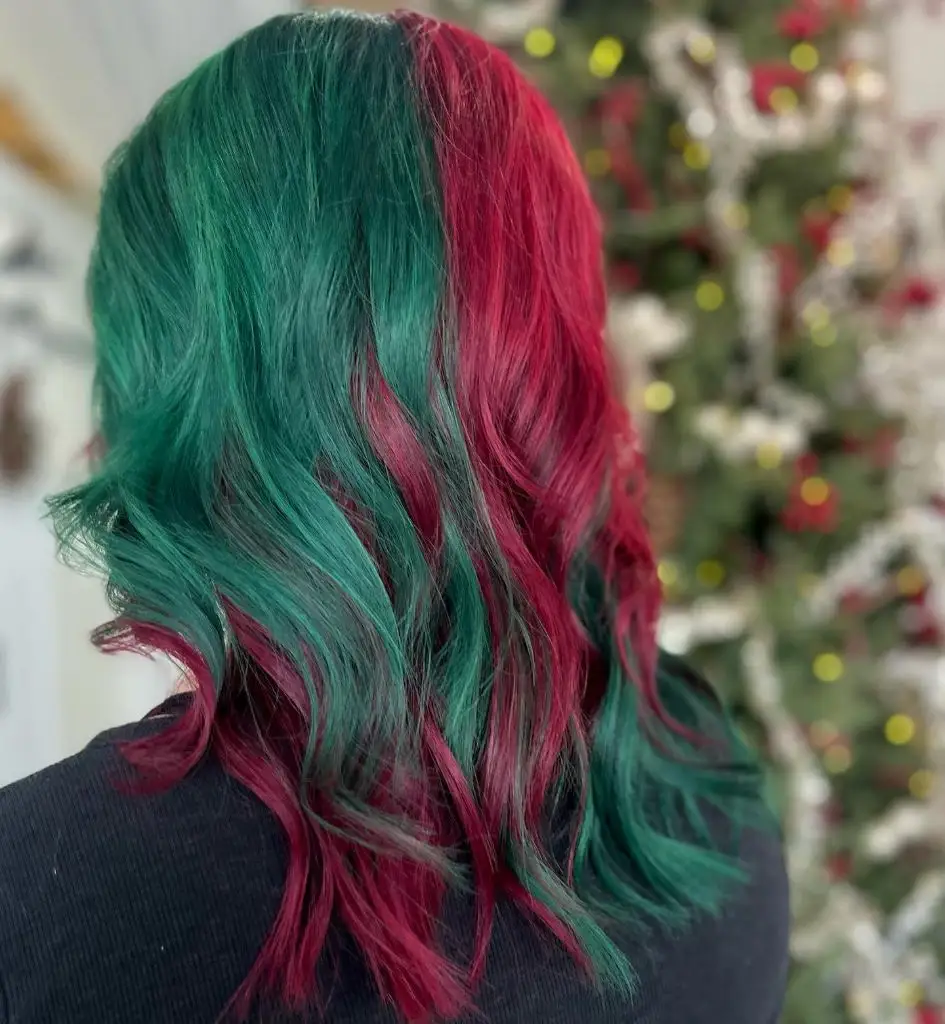
Photo via Instagram
The holiday context in the background confirms what the color split already suggests, but the style would carry seasonal energy even without the tree. The green and red are nearly equal in saturation, which prevents one side from overpowering the other. The waves help the two colors interact at the center back, where a few strands cross over and create a narrow zone of blending. The overall silhouette is relaxed, and the medium length keeps the color from overwhelming the frame. This is the most explicitly Christmas hairstyles reference point in the article, using the classic red-green pairing in the most direct way possible.
This is the kind of commitment that only works if both colors are given equal weight. A weaker green next to a strong red would read as unfinished, and vice versa. The principle is about balance: when two opposing tones share a frame, their saturation and placement need to be deliberate enough that neither side reads as an afterthought.
8. Subtle Highlights Lift a Smooth Brunette Blowout
The hair is long, smooth through the mid-lengths, and curled inward at the ends in a polished blowout finish. The base color is a cool-toned medium brown, and fine highlights in a slightly lighter caramel shade are threaded through the mid-section without reaching the root area. The back view shows the hair against a dark slatted backdrop, and the curled ends create a rounded, bouncy silhouette at the bottom.
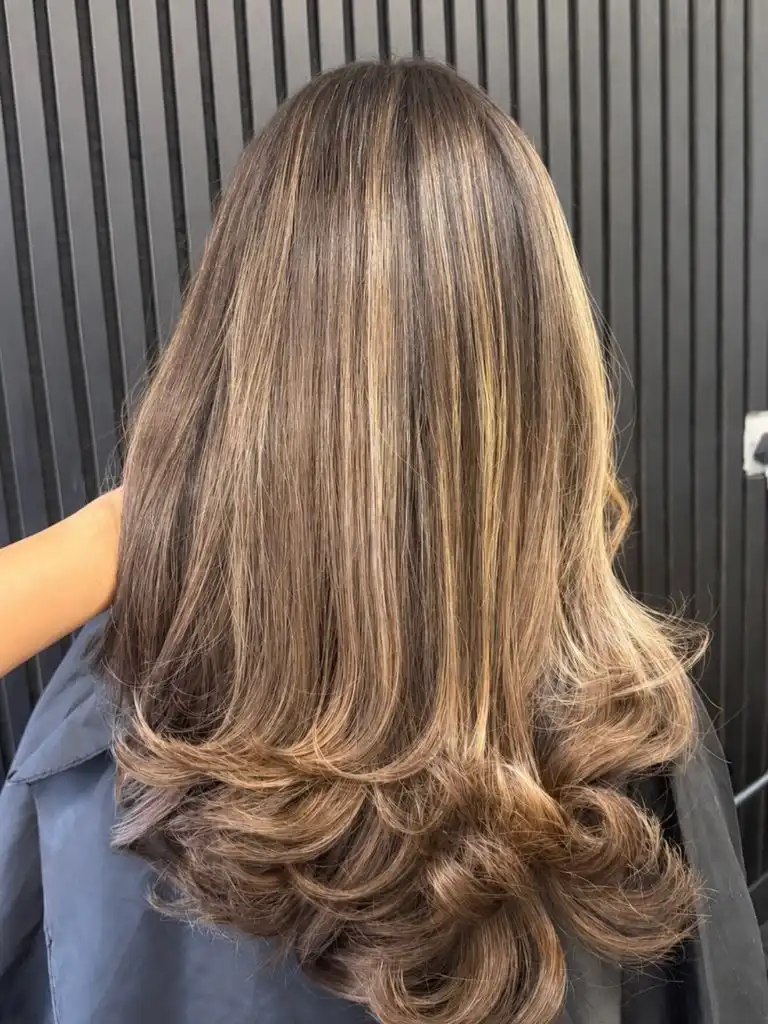
Photo via Instagram
The restraint of the highlight placement is what makes this style work for a polished setting. The lighter tones are visible but never dominant, sitting inside the natural fall of the hair rather than framing the face or concentrating at the ends. The smooth shaft through the upper half creates a sleek surface that contrasts with the volume of the curled ends, and that contrast gives the style its structure. The dark backdrop amplifies the subtle color variation by providing a uniform surround that lets the eye pick up on small tonal differences. This kind of polished brunette finish translates well across formal holiday events.
The value is in the blowout shape itself. The inward curl at the ends creates a self-contained silhouette that does not fan out or lose its boundary. For anyone seeking a Christmas hairstyle that reads as finished and intentional without relying on bold color or accessories, this photograph demonstrates that the shape of the ends can carry the entire look on its own.
9. Loose Bronde Waves Build Dimension Through Movement
The hair is long, falling past the shoulder blades, with a bronde tone that shifts between warm brown and sandy blonde depending on where the light catches it. The waves are loose, with varying sizes that create a textured, lived-in quality. The subject wears a black long-sleeved top and holds a checkered wallet or clutch, and sunglasses sit pushed back on the head. The background is a plain cream wall.
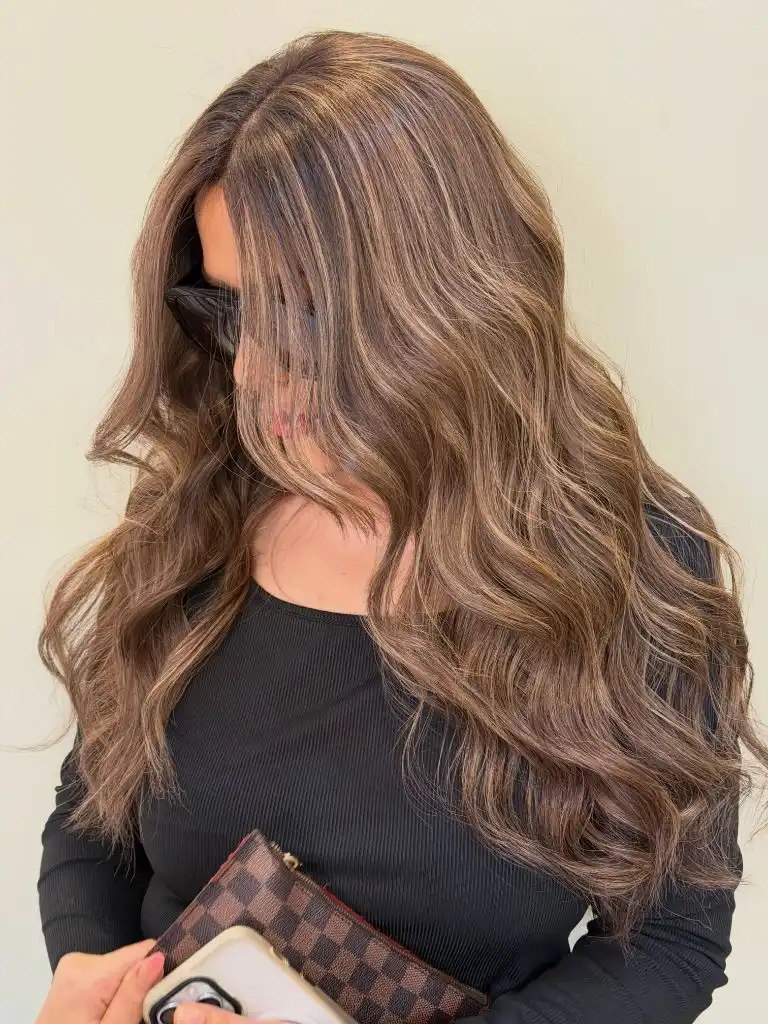
Photo via Instagram
The bronde tone is doing its best work in the areas where the waves lift away from the head, because those sections catch more light and read blonder, while the sections that fall flat read browner. This creates dimension that is built into the movement of the hair rather than painted on in fixed panels. The sunglasses add a visual break near the crown, giving the top of the head a different reading than the cascading lengths below. The black top and dark clutch anchor the lower frame and push the warmer hair tones forward. Across winter hair color approaches, this kind of tonal ambiguity between brown and blonde remains one of the most versatile.
What stands out most is the way this color resists a single label. It is not brown and it is not blonde, and that in-between quality makes it adaptable to nearly any seasonal context. The takeaway is that a color with built-in variation needs less styling effort, because the movement of the hair itself changes the tone throughout the day.
10. Long Chocolate Waves Ground a Warm Understated Base
Viewed from the back, this is a long brunette style with soft, elongated waves that fall past the mid-back. The base color is a warm chocolate brown with very subtle lighter threads visible in the mid-lengths when the light hits them. The subject wears a black long-sleeved top and olive-toned pants, and the background is a warm beige wall.
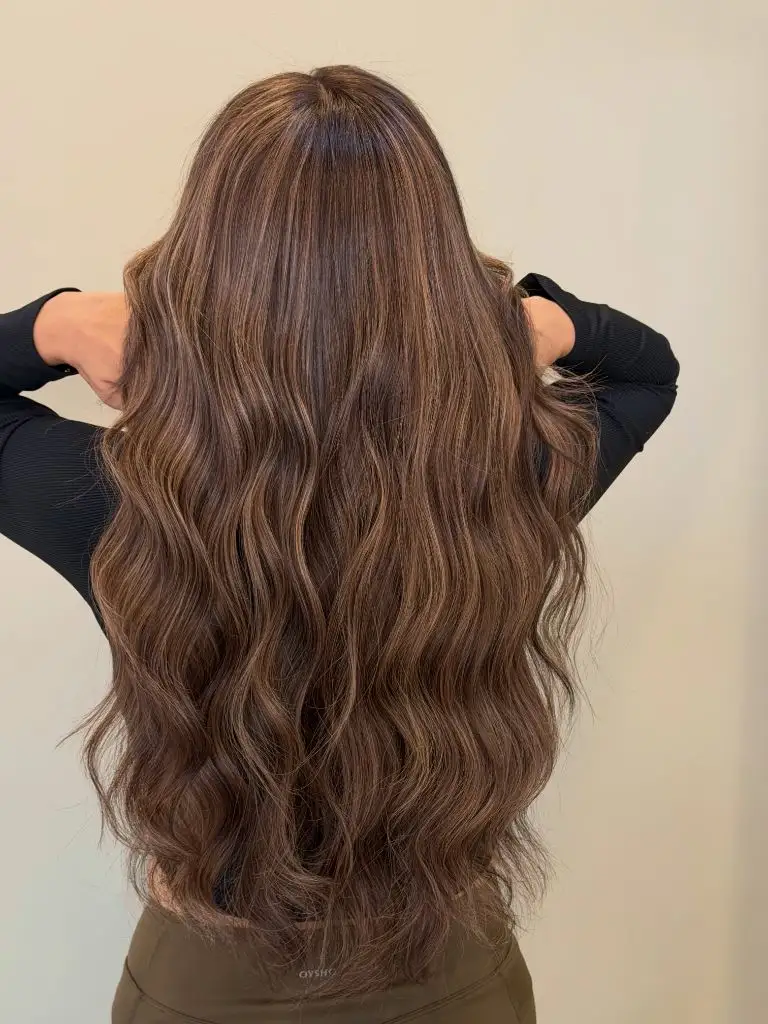
Photo via Instagram
The wave pattern here is gentler than in the previous sections, with wider spacing between the curves. This creates a sense of weight and flow rather than bounce. The color is close to a single tone, with only the faintest variation visible, which gives the entire length a unified, rich appearance. The black top and beige wall both serve as neutral frames that do not distract from the hair itself. The olive-toned lower garment adds a slight warmth to the bottom of the frame that echoes the warmth in the brown. Anyone exploring long hairstyle options for the holidays will recognize this as a foundation that accepts almost any accessory or color accent.
The appeal is in the simplicity. There is no dramatic technique on display, no bold color, no structural updo. The hair is simply long, warm, and well-maintained, and the wave gives it enough movement to avoid looking flat. The principle worth carrying forward is that a strong base color with minimal intervention can be its own kind of seasonal statement, particularly when the length provides enough surface for the light to work across.
11. Face-Framing Layers Open a Medium Brunette Cut
The most notable detail is the curtain-style framing around the face. The hair is medium length, falling just past the shoulders, with a warm brown base and lighter honey-toned highlights concentrated at the front sections. The layers flip outward slightly near the jawline and below, and the subject wears a dark brown top with a small sun-shaped pendant necklace. The background shows an oval standing mirror.
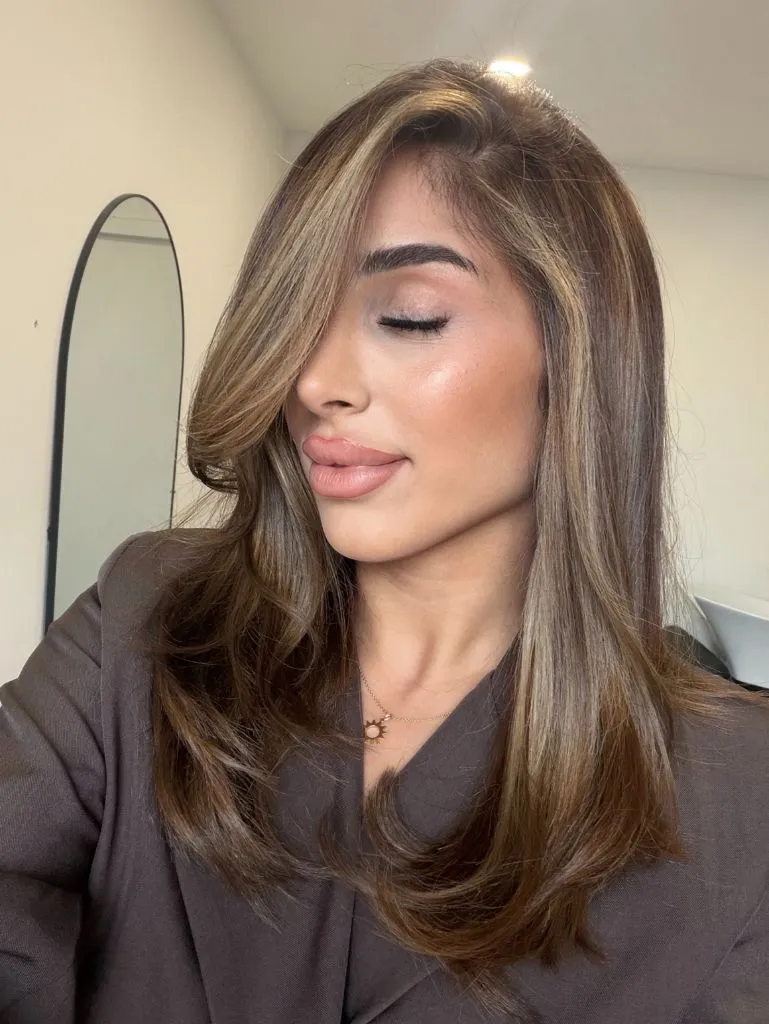
Photo via Instagram
The face-framing highlights are doing the structural work in this photograph. By placing the lightest tones at the front pieces, the colorist has created a natural border around the face that draws the eye inward. The slight flip at the ends of those front layers adds outward movement that keeps the silhouette from falling flat against the cheeks. The pendant necklace sits at the midpoint of the exposed neckline and adds a small point of interest that the eye can rest on between the hair and the clothing. This type of placement is a reliable approach within seasonal face-framing techniques because it changes the reading of the face without requiring a full color change.
The strength here is in the specificity of the lighter placement. The highlights are not scattered throughout the hair. They are concentrated exactly where they change the frame of the face, and they stop before they reach the back sections. That selectivity is what separates intentional face-framing from general highlighting, and it is a principle that applies regardless of base color or hair length.
12. A Tartan Headband Interrupts Platinum Blonde Waves
The first visible detail is the tartan headband, a padded red plaid band sitting across the crown and pushing the blonde waves back from the face. The hair is a cool platinum blonde with wide, soft curls that fall over the shoulders. The subject wears a red wool coat with gold buttons, a red tartan blouse, burgundy leather gloves with fur cuffs, and carries a burgundy handbag. The setting is an exterior stone building with a wreath on the door.
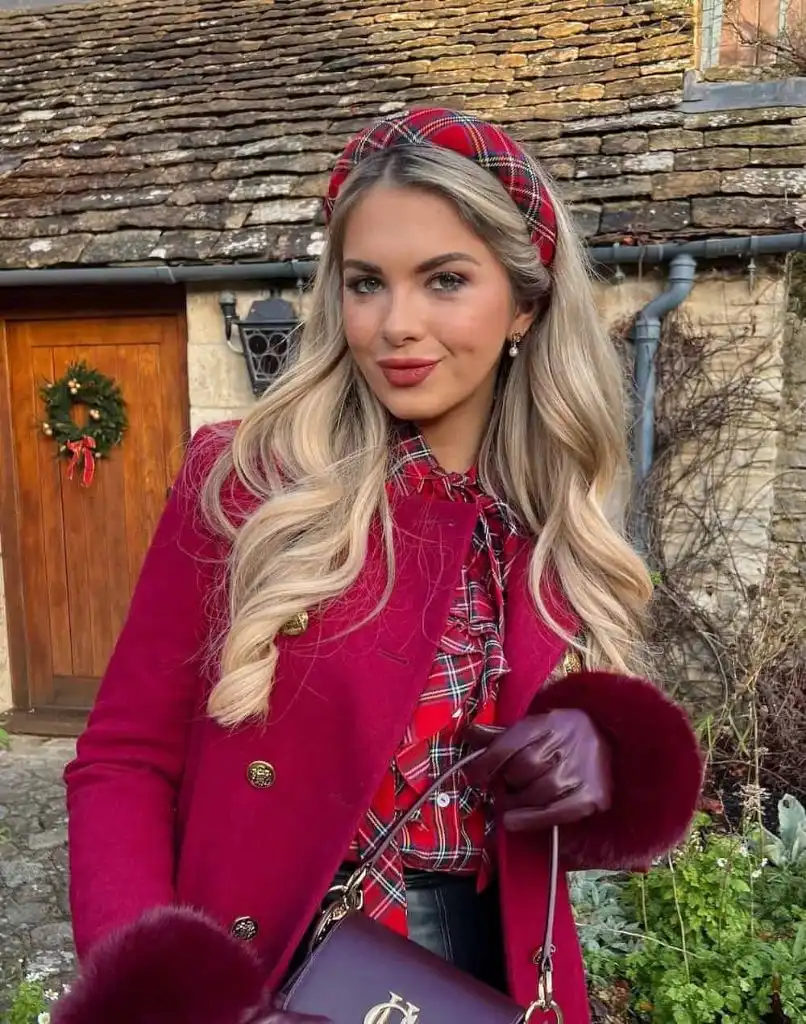
Photo via Instagram
This is the most accessory-rich photograph in the article, and the headband is the element that connects the outfit to the hairstyle. Without it, the blonde waves would exist in a separate visual register from the deep reds and burgundies of the clothing. The headband bridges that gap by sitting at the boundary between hair and forehead, pulling the tartan pattern directly into the hairstyle itself. The cool blonde against the warm reds creates a temperature contrast that is deliberate and effective. The stone building and wreath provide an unmistakable seasonal context that amplifies the holiday reading of the entire look. This is one of the clearest examples of how a hair accessory choice can redefine the relationship between hair and outfit.
This is a look that depends on coordination rather than any single element. The headband alone would not carry the same weight without the matching tartan blouse beneath it, and the blonde would not pop without the surrounding reds. The transferable principle is that a single accessory in a coordinating pattern can merge a hairstyle with an outfit more effectively than any color treatment.
13. Black Ribbon Bows Anchor a Textured Bubble Braid
The structure is immediately visible: a low ponytail divided into three or four segments by black satin ribbon bows, creating a bubble braid effect. The hair is a warm blonde, and the segmented sections are gently pulled apart to create rounded, organic shapes between each tie. The subject wears a black sheer-sleeved top, and the back view shows the braid falling along the center of the upper back against a neutral warm background.
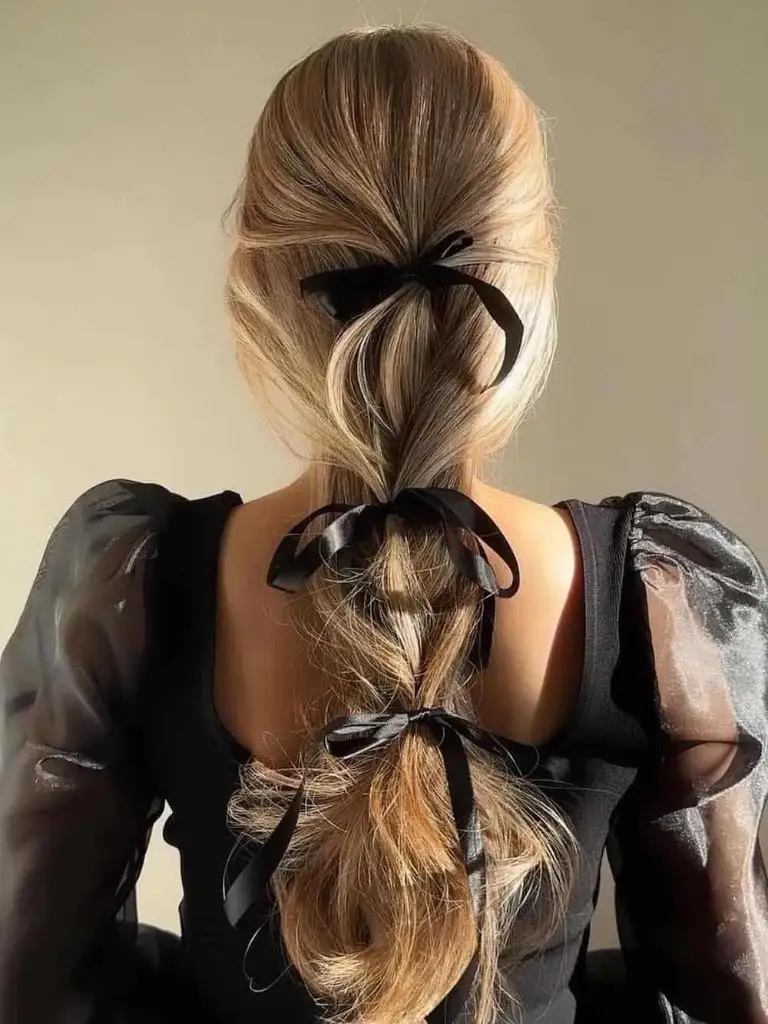
Photo via Instagram
The black ribbons are doing two things simultaneously. They provide the structural divisions that create the bubble shape, and they add a color contrast that breaks the warm blonde into distinct sections. Without the ribbons, this would read as a loose, slightly messy ponytail. With them, it becomes deliberate and styled. The sheer black sleeves echo the ribbon color without competing with it, and the warm background keeps the overall tone soft. The pulled-apart sections between the bows are varied in size, which prevents the braid from looking mechanical or overly uniform. This approach to Christmas hairstyles uses accessory placement rather than color to create its seasonal feeling.
The best detail is the irregularity of the bubble sections. Each one is a slightly different shape, which gives the braid an artful, handmade quality. The principle at work is that structured accessories can impose a pattern on otherwise formless hair, and the contrast between the rigid symmetry of the bows and the soft asymmetry of the pulled sections creates visual tension that holds the eye.
14. A Low Chignon Sharpens a Clean Silhouette
The hair is gathered into a smooth, tight low bun positioned at the nape of the neck. The color is a deep, cool-toned dark brown, and the surface of the hair from the crown to the bun is sleek and nearly free of flyaways. The subject wears a black spaghetti-strap top and a single thin gold hoop earring. The background is a plain white wall, and the photograph is taken from the back at a slight angle.
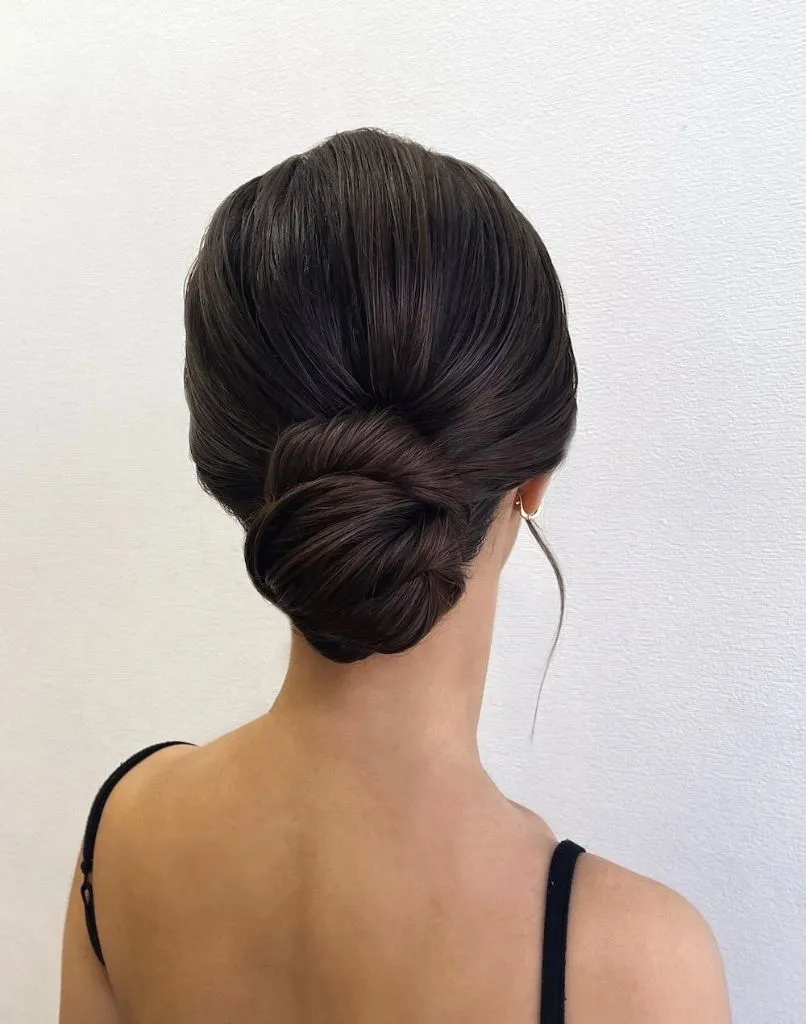
Photo via Instagram
The smoothness is the defining characteristic. Every strand appears to follow the same direction from the part to the bun, and the bun itself is folded and tucked rather than twisted, which creates a rounded, knot-like shape at the nape. The simplicity of the surrounding elements, the thin strap, the single earring, the blank wall, ensures that nothing distracts from the precision of the hair. The cool undertone of the dark brown is visible where light hits the top of the head, and it reads as almost black without quite reaching that depth. For anyone drawn to elegant updo styling, this is about as pared-back as the form gets.
This is the kind of hairstyle that earns its impact through control. There is no texture, no color play, no accessory. The entire effect comes from the smoothness of the surface and the precision of the shape at the nape. The takeaway is that a chignon does not need embellishment to read as formal or seasonal; the silhouette carries enough information on its own.
15. A Velvet Bow Lifts Curled Ends Into Focus
The view is from behind, showing dark brunette hair pulled into a half-up style secured with a large black velvet bow at the crown. The lower half of the hair falls in bouncy, barrel-curled ends that reach the mid-back. The subject wears a black coat and is photographed on a Parisian-looking street with cobblestones and storefronts visible in the background.
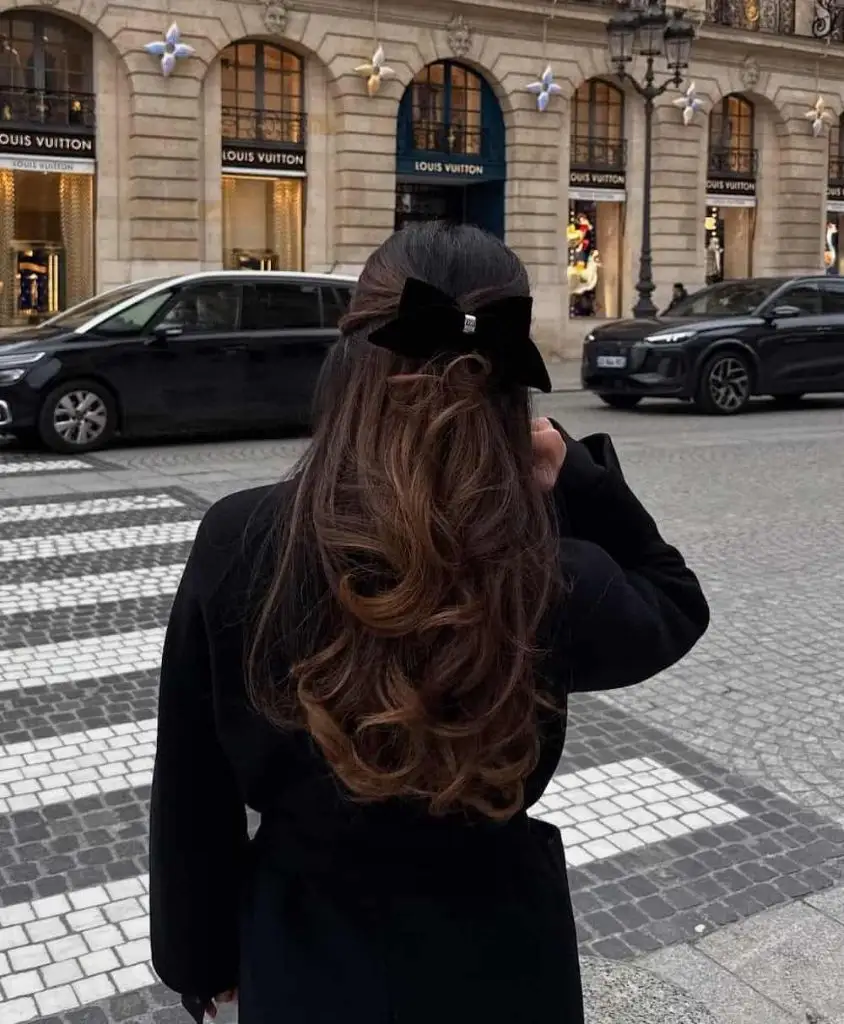
Photo via Instagram
The velvet bow is the element that changes this from a standard half-up to something with deliberate holiday weight. Its size is substantial enough to read as a focal point rather than a functional clip, and the velvet texture adds a tactile richness that contrasts with the smooth, shiny surface of the curled hair beneath it. The curled ends catch light from the street, and the slight warmth in the brown becomes more visible at the tips where the curls are widest. The urban background provides a contrast between the softness of the hairstyle and the hard geometry of the architecture, which elevates the reading of the bow and curls as intentionally styled rather than casual.
The effect is one of easy formality. The bow does the heavy lifting, and the curled ends provide the movement and volume that make the lower half of the hair look full and finished. The principle worth noting is that a single large-scale accessory placed at the crown can shift a simple half-up into something occasion-appropriate without requiring any change to the hair color or cut itself.
16. Cool Ash Brunette Quietens a Textured Medium Length
The hair is medium length, falling just past the shoulders, with a cool ash-brown tone that avoids warmth entirely. The texture is a soft, natural wave with visible layers through the ends. The subject wears a black tank top, and the back view shows a salon setting with clean white and light-toned surfaces. A pink strap, possibly from a bag, is visible across the back.
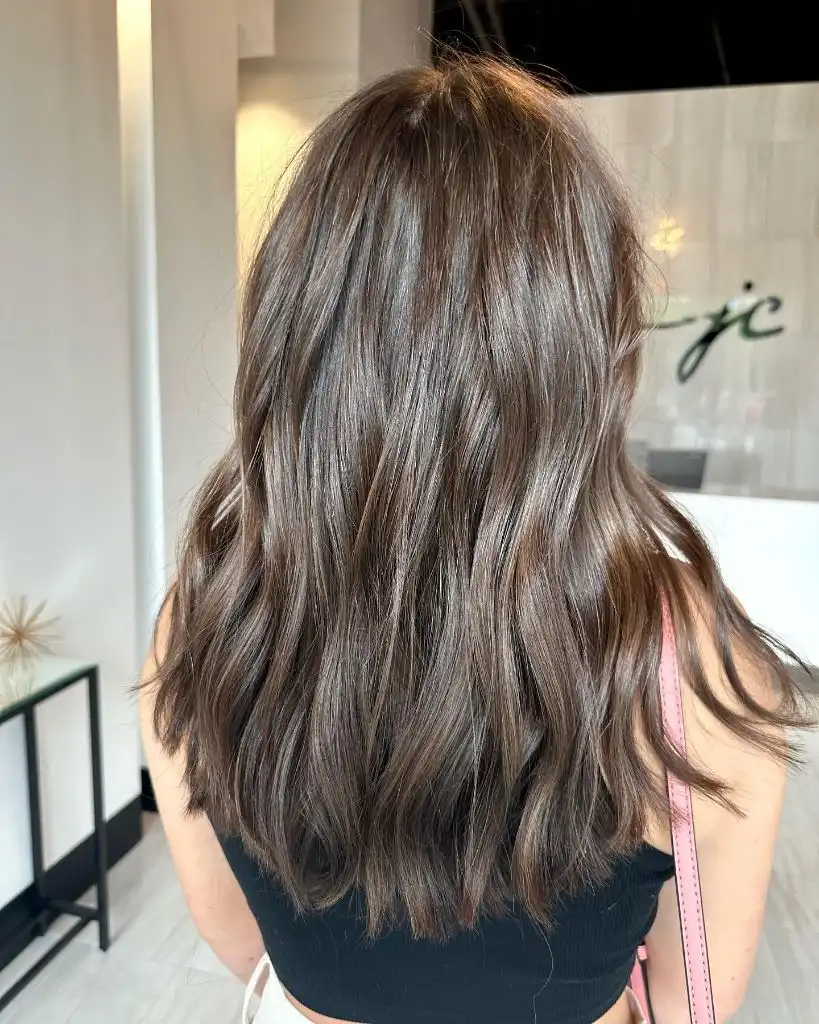
Photo via Instagram
The cool tone is the defining feature. There is no visible warmth in this color, no golden or caramel thread. The ash leans slightly toward a smoky gray-brown that reads as contemporary and understated. The texture is minimal, with just enough wave to prevent the hair from looking flat, but not enough to create defined curls. The layers are visible through the ends, where some strands sit slightly higher than others, creating a soft, tapered edge rather than a blunt line. The clean salon background and the black top both recede, letting the color itself hold the center of the reading. This represents one end of the Christmas hairstyles spectrum, where cool restraint replaces warm seasonal color entirely.
The value is in the temperature of the color. In a season dominated by warm reds, golds, and coppers, a deliberately cool brunette makes a quiet counter-statement. The transferable idea is that holiday hair does not require warmth, and a cool ash tone carries its own kind of seasonal weight, particularly when paired with simple styling and minimal accessories.
17. A Red and White Split Creates Sharp Contrast on Short Hair
This is a short pixie-length style viewed from above, with a dramatic two-tone split: the back and crown area is a vivid, saturated red, and the front and sides are a cool platinum white. The two colors meet in a roughly diagonal line across the top of the head. The subject wears glasses and a light-colored top, and the photograph is taken from a slightly elevated angle looking down.
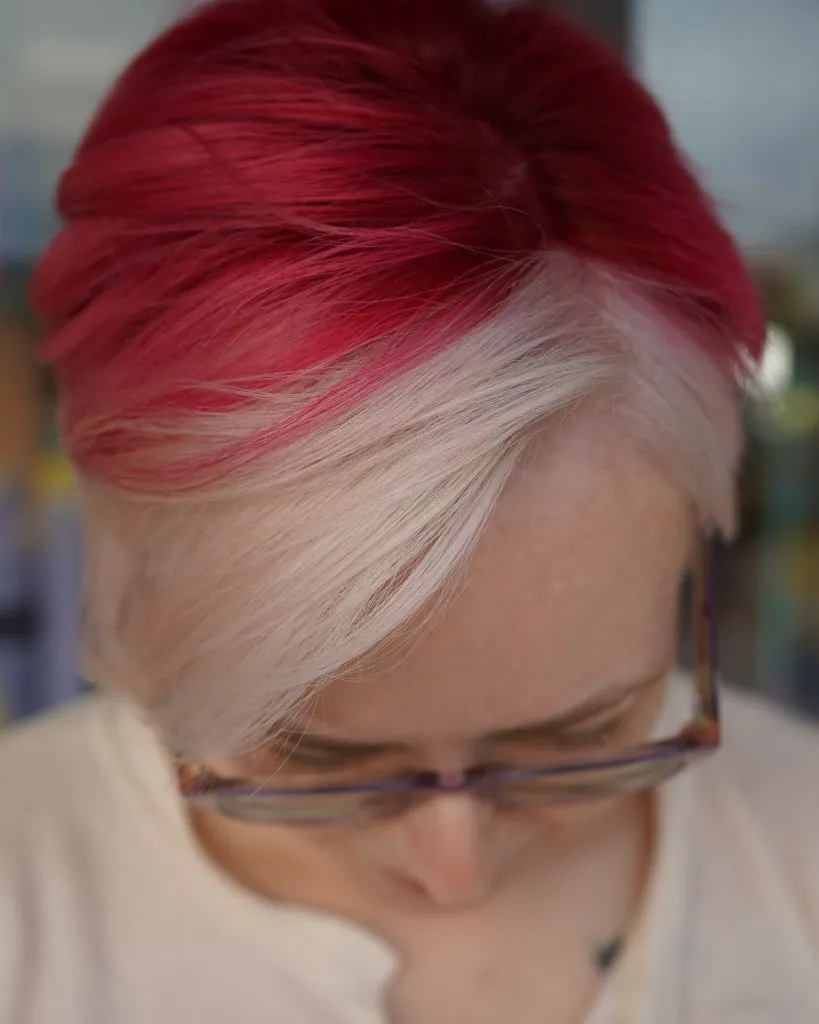
Photo via Instagram
The angle of the photograph emphasizes the color division more than a straight-on view would. The red occupies the back half of the head and reads as intense and warm, while the platinum white occupies the front and reads as cool and bright. The line between them is not perfectly straight, which gives the split a slightly organic quality that avoids looking too graphic or costumey. The short length means there is very little hair to work with, so the color is doing all of the communicative work. There is no texture, no curl, no accessory to contribute. The glasses provide a visual anchor on the face that connects the two color zones. Among short hair color techniques, this kind of bold split is one of the most impactful because there is no length to dilute the color choice.
This is a commitment piece. The short length means the color is always visible and always leading the impression. The principle is clear: when hair is this short, color becomes structure. There is no movement or shape to fall back on, so the tonal decision carries everything, and a two-color split on a pixie is about as direct a seasonal statement as hair can make.
18. Green-to-Pink Gradient Carries Holiday Energy Vertically
The hair is long and straight, with a bright emerald green at the roots that transitions into a vivid hot pink through the mid-lengths and ends. The gradient is applied in a vertical fashion, with the green dominating the top third and the pink taking over the lower two-thirds. The subject wears a black salon cape, and the photograph shows the hair from a slightly elevated back view in what appears to be a salon interior with dark walls.
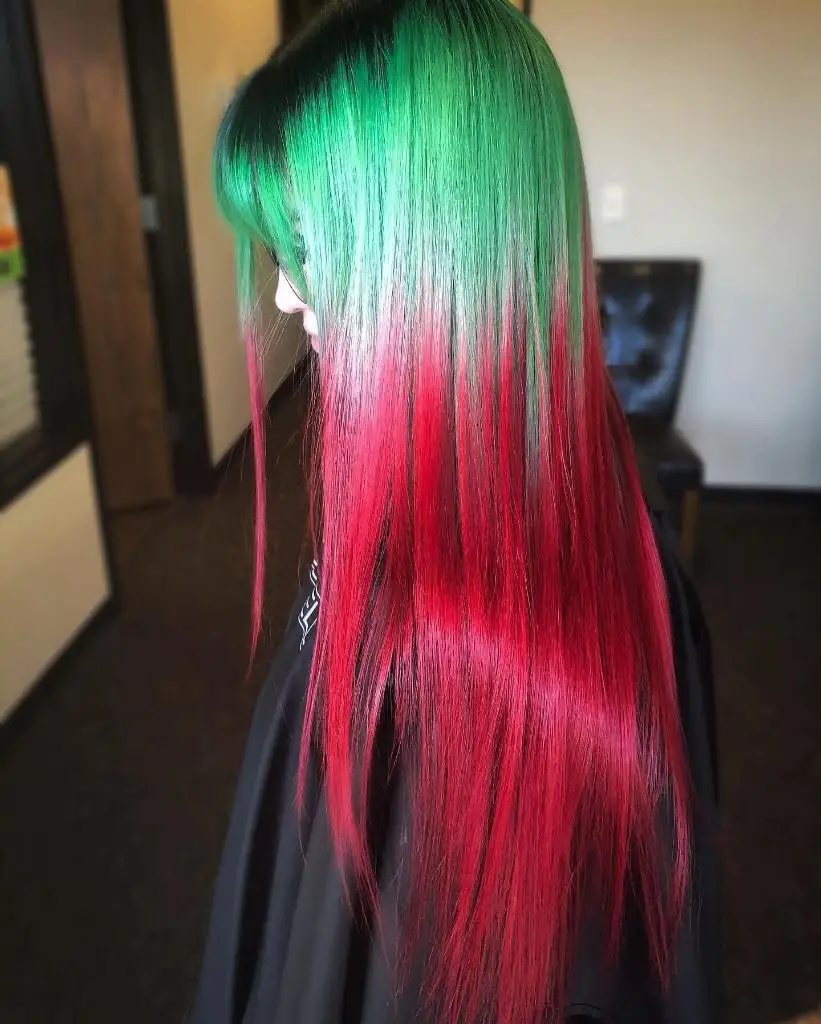
Photo via Instagram
The straightness of the hair is essential to how the gradient reads. Unlike the wavy styles earlier in the article, the straight texture here creates clean, uninterrupted lines of color that make the transition from green to pink extremely legible. The green is a true emerald rather than a teal or mint, and the pink is a hot, almost neon magenta rather than a pastel or rose. Together they create a high-saturation pairing that is undeniably festive without being literally red-and-green Christmas. The dark salon walls amplify the brightness of both colors by providing a deep surround that makes the green and pink appear to glow.
The strength here is in the clarity of the color zones. Because the hair is straight, the viewer can see exactly where the green ends and the pink begins, and the narrow transition zone between them is just wide enough to feel intentional. The lesson is that dramatic color work benefits from simple styling: straight, smooth hair lets the color do the talking, while heavy texture or curls would fragment these tones into a less readable pattern.
19. Cranberry-Pink Waves With Gift Box Accessories Commit Fully
The color is a deep cranberry pink that runs from roots to ends, with subtle variation between darker and brighter strands creating internal dimension. The hair is long, with soft waves, and is photographed from the back. Small miniature gift box ornaments in red and gold are clipped into the hair near the crown, functioning as holiday-specific accessories. The subject wears a gray knit top.
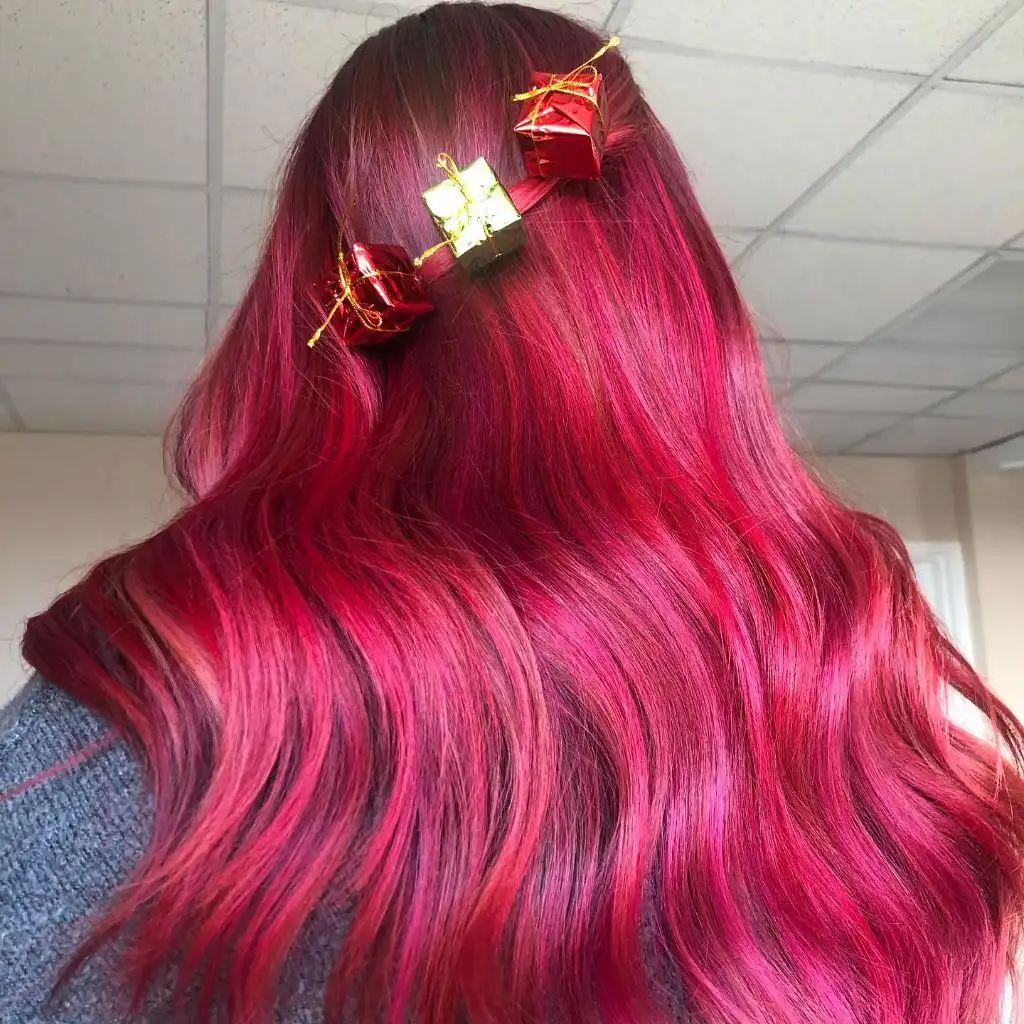
Photo via Instagram
The gift box accessories are the most overtly seasonal element in the entire article. They sit near the crown, clustered in a small group, and their red and gold metallic surfaces catch light against the matte pink of the hair. The cranberry-pink base provides a warm, saturated canvas that complements the red of the ornaments without matching it exactly, and that near-match creates a more sophisticated pairing than an identical match would. The waves add enough movement to keep the long length from looking flat, and the gray top provides a neutral ground that does not compete. This kind of holiday hair accessory styling works precisely because the base color already carries seasonal energy, so the ornaments feel like an accent rather than the whole idea.
What stands out most is the willingness to commit. This is not a subtle nod to the season; it is a full embrace, from the all-over cranberry color to the literal gift boxes in the hair. The principle is that maximum seasonal commitment works best when every element, color, accessory, and texture, points in the same direction. Half-measures would undermine the reading.
20. Long Jet Black Hair Grounds Everything With Depth
The hair is very long, falling well past the mid-back, and the color is a uniform jet black with no visible highlights, lowlights, or color variation. The texture is mostly straight with a very slight natural wave near the ends. The subject wears a black salon cape, and the photograph is taken from the back in a bright, warmly lit room with a couch, a plant, and white walls visible in the background.
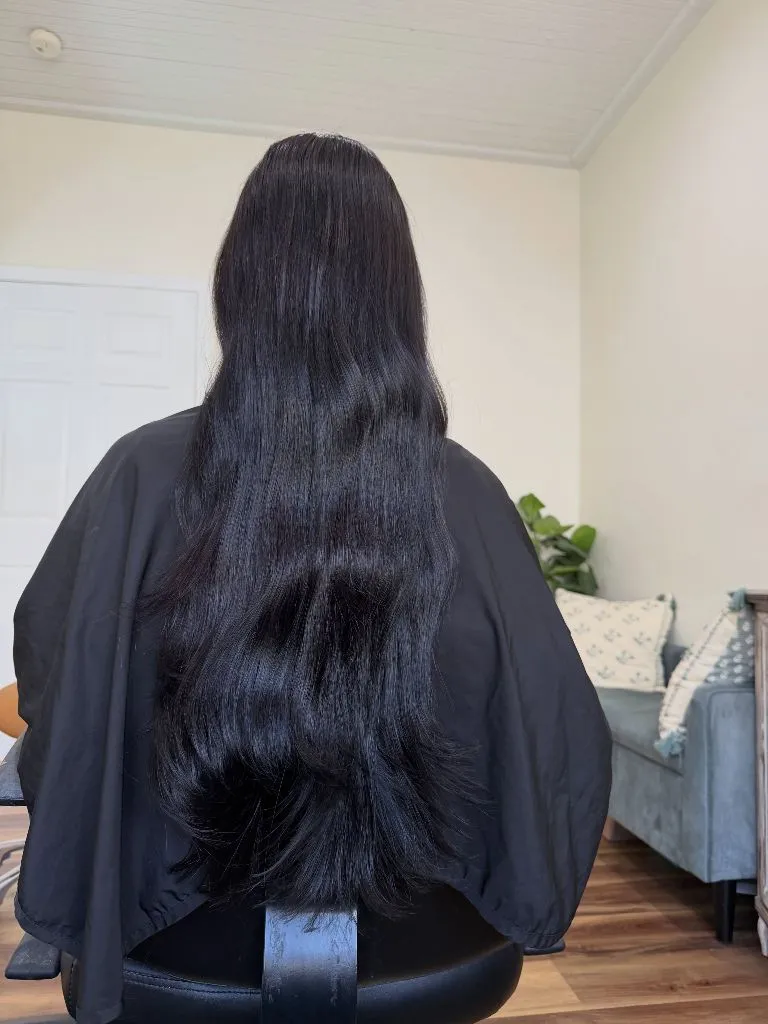
Photo via Instagram
The uniformity of the black is what gives this photograph its weight. There is no tonal variation to break the surface, so the entire length reads as a single continuous element. The light from the room catches the surface of the hair in places, creating a natural sheen that is the only source of visual variation. The bright, warm background creates a strong contrast with the cool darkness of the hair, which makes the black appear even deeper than it might against a darker surround. The slight wave near the ends is the only textural element, and it softens the terminus of the hair just enough to prevent it from looking cut in a hard line. Compared to the vivid color options explored in earlier sections, this style demonstrates that the absence of color intervention is its own kind of choice.
The appeal is in what has not been done. No lightening, no toning, no accessory, no structural styling beyond the natural fall. In a collection of Christmas hairstyles that includes split colors, gradients, and ornament clips, this final image serves as a reminder that uncommitted hair, hair left to be exactly what it already is, carries a presence of its own. The principle is simply that depth and length, without any modification, can hold a frame as completely as any technique.