A stronger core supports almost everything you do — better posture at your desk, easier lifting, steadier balance and less strain on your lower back. The good news is that you do not need a gym membership, a pile of equipment or an hour to spare. Ten focused minutes at home, done consistently, is enough to build real core strength.
This guide walks through a complete no-equipment ab workout: a gentle warm-up, eight moves that target the whole core rather than just the muscles you see in the mirror, and a weekly schedule that builds strength without overdoing it. All you need is a mat or a soft floor and clothes you can move in — the ideas in Gym Outfit Ideas for Your Next Workout are a good place to start if your workout wardrobe needs a refresh.
Key Takeaways
- Slow, controlled movements with good form build more strength than fast, sloppy repetitions.
- Engage your core by drawing your navel gently toward your spine through every exercise.
- Aim for 3 to 5 ab sessions per week, with at least one rest day between hard sessions.
- Visible definition takes weeks to months and depends on overall body fat, not just ab work.
- Spot reduction does not work — diet and full-body movement matter as much as the exercises.
Why Ten Minutes Is Enough
The core is a group of muscles that wraps around your torso: the rectus abdominis at the front, the obliques at the sides, the deep transverse abdominis underneath, and the muscles of the lower back and pelvic floor. Because these muscles work together all day to stabilise you, they respond well to short, focused sessions. Ten minutes of deliberate work, with each repetition done well, trains the whole group more effectively than a long session done on autopilot.
Short sessions have another advantage: they are easy to keep. A ten-minute routine fits before breakfast, during a lunch break or while dinner cooks, and a routine you actually do three to five times a week will always beat an ambitious plan you abandon. Comfortable clothing helps too — soft, stretchy layers like the ones in Cute Leggings Outfit Ideas make it easy to move from the couch to the mat without a full outfit change.
The 10-Minute Routine
Work through the moves in order, resting briefly between them. Focus on the muscle contracting rather than on speed, and exhale during the hardest part of each movement. If you are new to core work, start with the warm-up and the first four exercises, then add the rest as you feel stronger.
Warm-Up: Cat-Cow Stretch
Start on all fours with hands under shoulders and knees under hips. Inhale as you drop your belly and lift your chest into cow pose, then exhale as you round your spine and draw your navel toward your spine into cat pose. Move slowly for 5 to 8 repetitions, matching each breath to the movement. This wakes up the spine and the deep core before the harder work begins.
Crunches and Bicycle Crunches
For crunches, lie on your back with knees bent and feet flat. Rest your hands lightly behind your head or cross them over your chest, then exhale as you lift your head and shoulders, keeping your lower back pressed into the mat. Aim for 3 sets of 10 to 15 repetitions, and let your abs do the lifting — never pull on your neck.
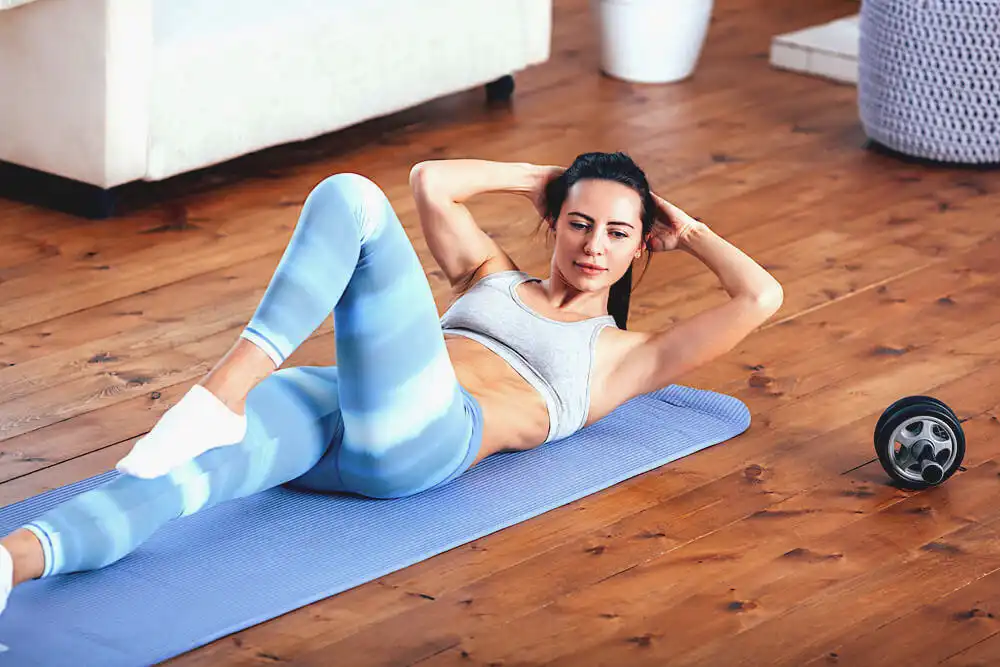
Photo via resveralife.com
Bicycle crunches add rotation for the obliques. With hands behind your head and legs lifted to a 90-degree bend, bring your right elbow toward your left knee while extending your right leg, then alternate in a smooth pedalling motion. Keep your lower back flat and twist from your core, not your neck. Aim for 3 sets of 10 to 12 repetitions per side.

Photo via eatthis.com
Leg Raises for the Lower Abs
Lie on your back with legs straight and hands under your lower back for support if needed. Press your lower back into the mat and slowly lower your legs toward the floor without letting them touch, then use your lower abs to lift them back up. If your lower back lifts off the mat, you have gone too far — shorten the range. Aim for 3 sets of 10 to 15 repetitions, bending the knees to make it easier.
Plank and Side Plank
The plank trains the entire core at once. Lower onto your forearms with elbows under your shoulders and hold your body in a straight line from head to heels, drawing your navel toward your spine. Hold for 30 to 60 seconds, for 3 sets, keeping your gaze slightly forward and your hips level — no sagging, no piking up.
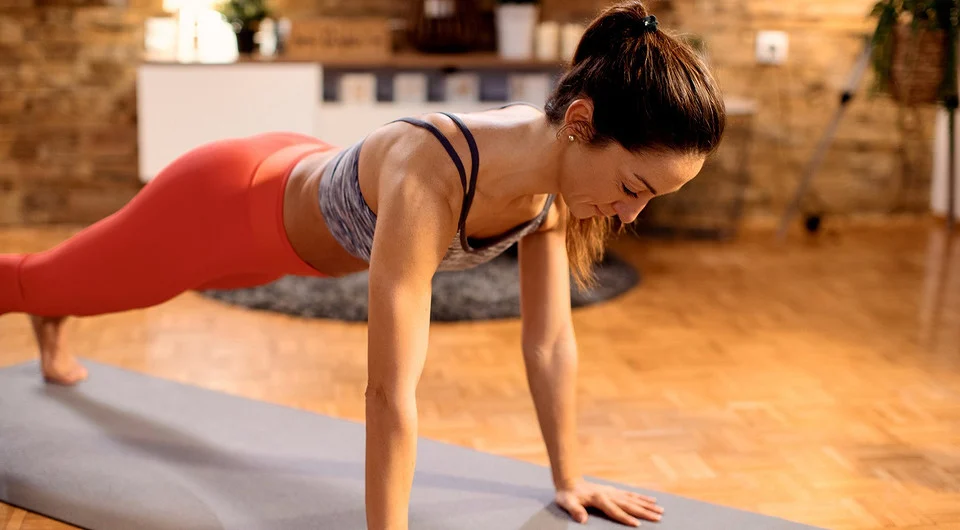
Photo via lisa.ru
For the side plank, lie on your side with your forearm under your shoulder and lift your hips into a straight line, engaging the obliques. Hold for 20 to 40 seconds per side, for 3 sets. Bending the bottom knee makes it easier; lifting the top leg makes it harder.
Russian Twists and Bird-Dog
Sit with knees bent, lean back slightly and twist your torso from side to side, bringing your hands toward the floor beside your hips. Keep your spine long and let the twist come from your torso. Aim for 3 sets of 10 to 15 repetitions per side, keeping your feet down for stability or lifting them for a greater challenge.
Finish with the bird-dog: on all fours, extend your right arm forward and left leg back at the same time, keeping your hips level and your back flat, then alternate sides. Move slowly — stability is the point. Aim for 3 sets of 8 to 10 repetitions per side.
Your Weekly Schedule
Three to five sessions a week is the sweet spot for most people. A simple pattern is the full routine on Monday, Wednesday and Friday, with rest or light activity — a walk, gentle stretching — on the other days. Muscles grow stronger during recovery, so rest days are part of the programme, not a break from it.
Photo via icytales.com
Building the habit is easier when the week is planned. A short weekly planning moment — the kind described in Sunday Reset Checklist for Home and Body — is a good time to pick your workout days and lay out your gear. And remember that food supports the work: muscles need protein to recover, so the ideas in High-Protein Diet for Women pair well with a regular core routine. On rest days, cosy layers like the ones in Simple Leggings Outfits with Casual Cozy Layers keep you comfortable while your muscles recover.
Common Mistakes to Avoid
Pulling on your neck: during crunches, your hands should only support your head. If your neck aches afterwards, your abs were not doing the work — cross your arms over your chest instead.
Letting your lower back arch: an arched back during leg raises or planks strains the spine. Keep your lower back pressed into the mat or your hips level, and shorten the movement if you cannot hold the position.
Using momentum: rushing through repetitions lets momentum, not muscle, do the work. Slow down, control each movement, and feel the muscle contract.
Holding your breath: exhale during the effort — the lift in a crunch, the twist in a Russian twist — and inhale as you return. Steady breathing helps the deep core engage.
Forgetting the deep core: the visible six-pack muscles get the attention, but the transverse abdominis is the corset underneath. Drawing your navel gently toward your spine in every exercise trains it.
What Results to Expect
Most people notice improved core strength and endurance within a few weeks — planks feel steadier, posture improves, everyday movements feel easier. Visible muscle definition takes longer, typically several weeks to months, and depends heavily on overall body fat, which is shaped by diet and full-body activity rather than ab exercises alone. That is not a reason to skip the work: a strong core pays off in ways the mirror does not show. A balanced approach to nutrition, including the nutrients covered in Essential Vitamins for Women, supports recovery and steady progress.
Frequently Asked Questions
How often should I do ab workouts?
Aim for 3 to 5 sessions per week, with at least one rest day between hard sessions. Your muscles need recovery time to grow stronger, so daily intense core work is counterproductive. Light stretching or walking on rest days is fine.
Can I get visible abs without changing my diet?
Visible definition depends largely on overall body fat percentage. Ab exercises strengthen the muscles underneath, but if they are covered by a layer of fat they will not show. A balanced diet and regular full-body exercise are usually needed to reduce body fat.
How long until I see results from ab workouts?
Improved strength and endurance often show within a few weeks. Visible changes in definition typically take several weeks to months of consistent effort, combined with a healthy diet and full-body activity. Your starting point and consistency matter more than any single exercise.
What is the transverse abdominis?
It is the deepest layer of abdominal muscle, wrapping around your torso like a natural corset to stabilise your spine and pelvis. Engaging it by drawing your navel gently toward your spine is key to a strong core and better posture.
Do I need equipment for an effective ab workout?
No. Bodyweight exercises like crunches, planks, leg raises and bird-dogs are very effective on their own. A mat makes floor work more comfortable, but it is the only thing you truly need.
Final Thoughts
Ten minutes, a mat and a little floor space are all it takes to start building a stronger core. Begin with the warm-up and the first few exercises if you are new, add the rest as you grow stronger, and keep the schedule steady at three to five sessions a week. Strength shows up first, definition follows with time and a balanced diet — and a core that supports everything else you do is worth far more than the mirror alone can show.
Disclaimer: This article is for general informational purposes only and does not constitute medical or professional advice. Always consult your doctor or a qualified healthcare provider before starting any new exercise program, especially if you have pre-existing health conditions, back pain, or are pregnant or postpartum. Stop immediately if you experience sharp pain or discomfort.