There is a quiet pressure around blonde hair in winter that nobody really names out loud. The light changes, your skin tone shifts, and suddenly a shade that felt effortless in July starts looking disconnected. You do not have to chase a completely new color every season, and you do not owe anyone a dramatic transformation just because the calendar moved. Winter blonde hair color ideas work best when they follow what your hair is already doing rather than fighting against it.
The useful question is not whether to go warmer or cooler but how much contrast your blonde actually needs to hold its shape through shorter, flatter daylight. A good decision here starts before the color appointment, in the space where you consider root depth, highlight placement, tonal warmth or neutrality, and how much visible dimension you want between the darkest and lightest points. Those four variables — depth at the root, where the brightness sits, the undertone family, and the range between high and low — are what separate a blonde that reads as considered from one that simply reads as maintained. The twenty looks that follow move through that spectrum one image at a time, each offering a different answer to the same set of questions.
1. Soft Root Shadow Grounds a Cool Blonde Finish
The first detail that registers here is the shadow at the root, a cool-toned mid-blonde that darkens to roughly a level seven before releasing into paler, almost platinum lengths. The hair is long, center-parted, and styled with a loose bend that keeps the weight toward the bottom third. A dark brown salon cape frames the lower half and pushes the color contrast forward.
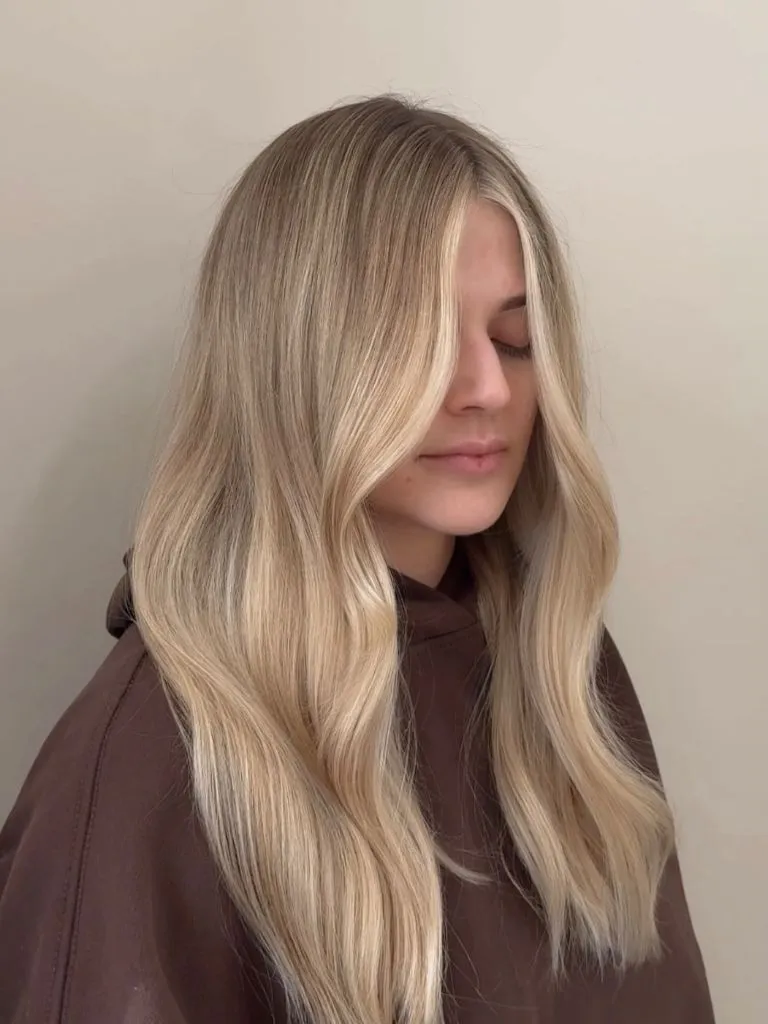
Photo via Instagram
The root depth here is doing most of the structural work. Without it, the pale ends would flatten into a single value that reads less like intention and more like regrowth that got lucky. The shadow gives the eye a starting point — something to travel from — so the lighter pieces at the mid-lengths and ends register as placement rather than uniformity. The loose wave adds just enough movement to catch light at different angles without breaking the vertical line of the part.
This is a winter blonde built on restraint at the crown. The darkness is modest, maybe two levels deeper than the lightest strand, but that small gap is enough to create the illusion of thickness and to give the color story a beginning and an end. Anyone considering a cooler blonde for the season could start here: keep the roots honest and let the ends do the talking.
2. Warm Honey Tones Carry Volume in Bouncy Waves
A warmer register takes over in this image. The hair reads as a rich honey blonde, sitting somewhere between a dark level eight and a golden level nine, with very little separation between the root and the mid-shaft. The styling is a full, bouncy blowout with large barrel curls that turn under at the ends. A dark brown leather jacket and a small gold pendant necklace sit below.
Photo via Instagram
The warmth in this blonde gains its richness from the uniform tone rather than from high-contrast highlights. Because the color stays within a narrow band — no sharp jumps from dark to light — the curls read as voluminous and glossy instead of streaky. The leather jacket works as a frame here, its dark chocolate surface making the golden hair feel brighter by proximity. The gold pendant quietly repeats the warm metal family in the hair, and that kind of tonal echo keeps the overall impression cohesive.
The appeal is the way warmth and volume reinforce each other. A cooler or more highlighted version of this same length and curl pattern would scatter light differently, likely reading thinner. For anyone drawn to a winter blonde that feels rich rather than icy, this demonstrates how staying within one tonal family can give the hair a weight and gloss that dimension alone does not always provide.
3. Bright Face-Framing Pieces Open a Darker Base
Length and brightness increase together in this photograph. The hair falls well past the collarbone with large, swooping waves, and the lightest pieces — a buttery, almost sandy blonde — are concentrated heavily around the face and through the front sections. The back and crown appear at least two to three levels darker, closer to a medium blonde or dark blonde. A black top recedes entirely, letting the color do the talking.
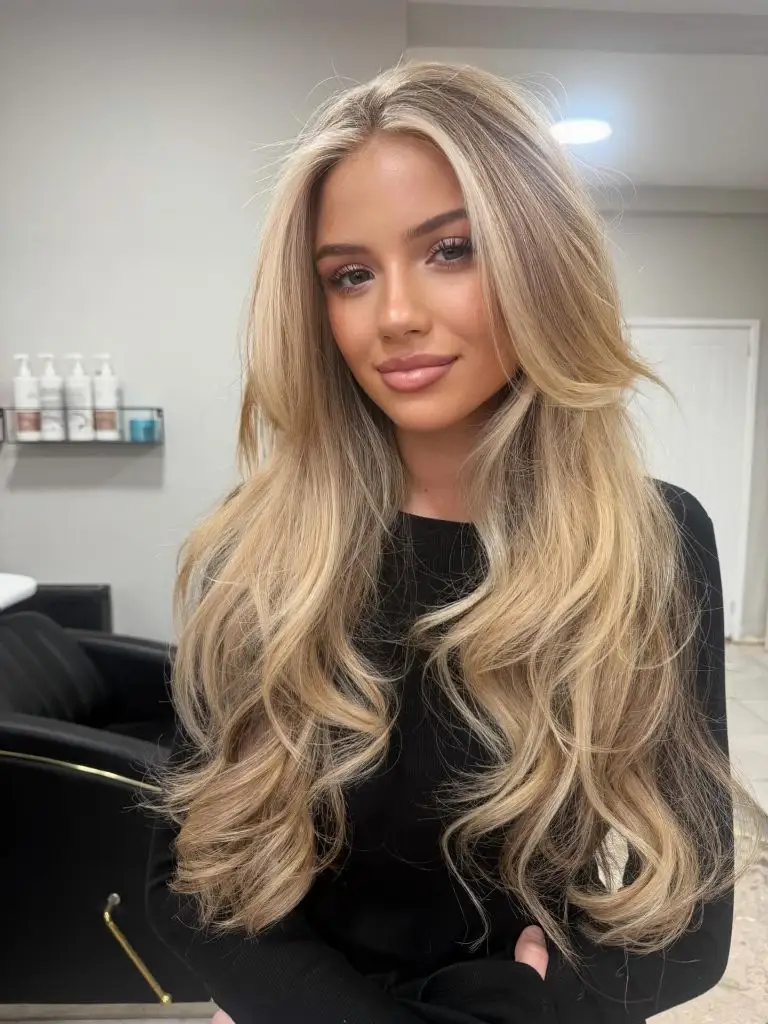
Photo via Instagram
The placement strategy here is deliberate: the brightest value sits where it meets the skin and catches the most direct light. This creates a natural frame around the face without requiring the entire head to carry that same level of lift. The darker mid-section and back provide weight and density, and because the waves are large and open rather than tight, the transition between the two zones looks graduated rather than striped. The background — a salon setting with hair products on a shelf — confirms this is freshly done work.
The best detail is the ratio between bright and dark. There is enough contrast to read as dimensional but not so much that the face-framing pieces look disconnected from the rest. For winter blonde hair color ideas that aim to keep brightness visible while still deepening the overall impression, this kind of concentrated front placement is a practical answer.
4. A Platinum Sweep Sharpens Volume at the Crown
This image leads with sheer volume and a dramatically light, cool-toned blonde that borders on platinum through the top layers, settling into a slightly warmer sandy tone underneath. The hair is swept to one side across the face, with large loose waves creating significant lift at the crown and through the mid-lengths. A black blazer or structured jacket sits below the shoulders, and the setting is a salon with marble-toned wall detail.
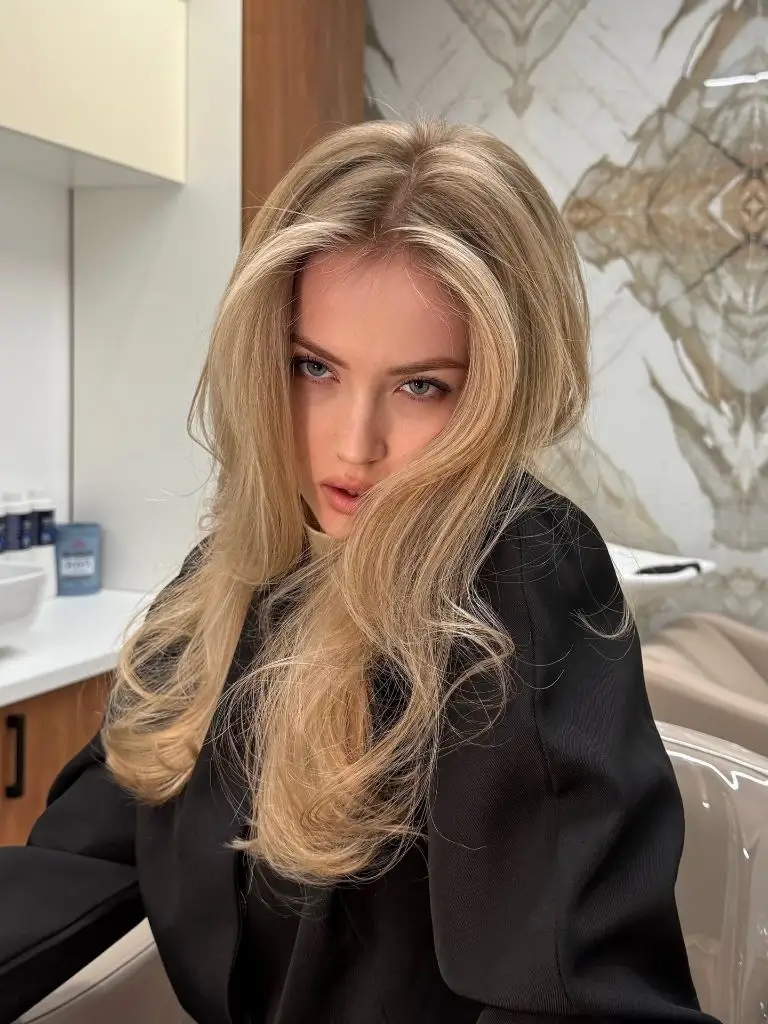
Photo via Instagram
The platinum value at the top is what generates the visual drama, but the slightly warmer underlayer prevents the look from flattening into one bleached sheet. That subtle warmth underneath acts as a shadow without actually being dark — it just reads as depth when the hair moves. The side-swept direction amplifies the volume at the crown and creates a diagonal line across the face that lengthens the overall silhouette. The black jacket provides the strongest possible value contrast, which makes the lightest strands appear even brighter.
This is the kind of winter blonde that commits fully to lightness rather than hedging with darker roots. The success depends on internal dimension — the cooler and warmer layers working together within a narrow range — rather than visible root contrast. The transferable principle is that very light blonde does not have to look flat if the warmth shifts even slightly between layers.
5. Dark Roots Anchor Warm Balayage Through Long Waves
A significant root shadow defines this image, with the darkest visible value sitting at a level five or six — solidly brunette — before transitioning through a warm caramel mid-section into buttery blonde ends. The hair is long, past the mid-back, and styled in defined, medium-width waves. The person faces away, wearing a black top, and the background is a busy salon with dark furniture and mirrors.
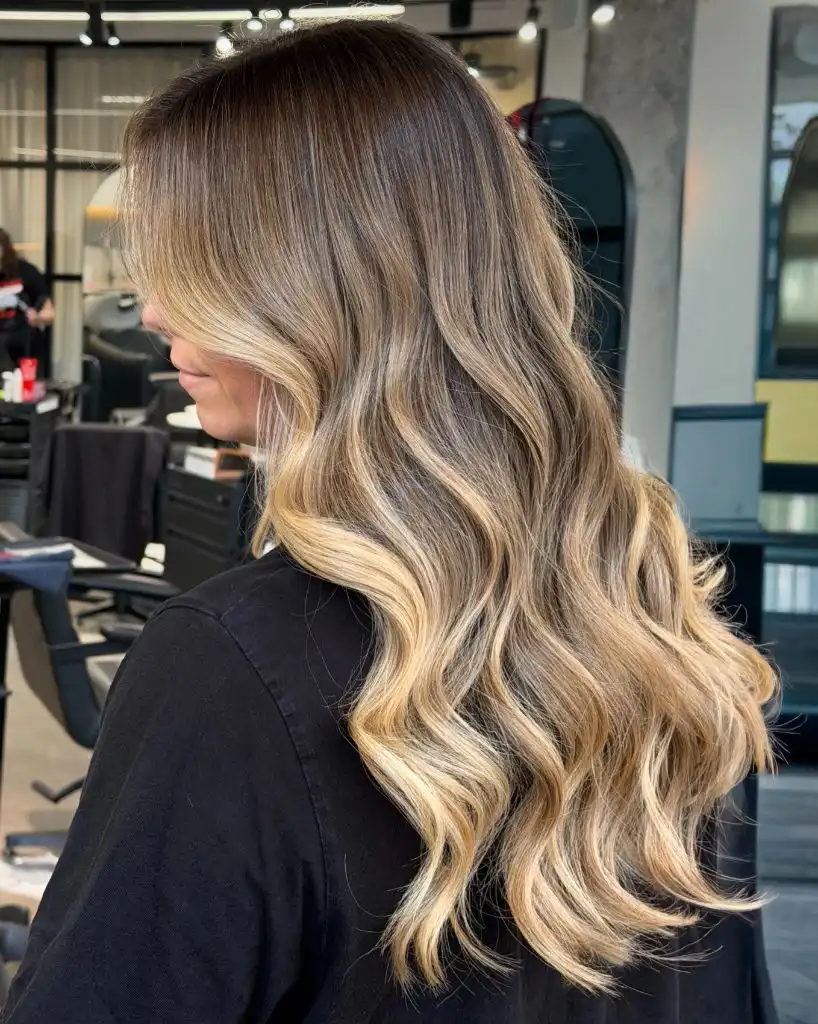
Photo via Instagram
The range of value here is the widest in the article so far. From root to tip, there are at least four or five levels of lift, and the transition is smooth enough to read as a single graduated story rather than two separate colors meeting in the middle. The waves help that transition by breaking the color into curved segments, so the eye moves through warm-dark, warm-medium, and warm-light in a rhythm rather than a hard line. The salon background, though busy, actually helps demonstrate how the color reads in imperfect, mixed lighting.
The strength here is the commitment to a full journey from dark to light. This is not a subtle shift; it is a visible map of depth and brightness. For anyone whose natural base is closer to brunette, this shows that a winter blonde balayage can honor the root color rather than hiding it, using the darkness as the anchor that makes the lighter ends feel earned.
6. Layered Curls Lift a Cool Ash Blonde
Large, layered curls create significant outward movement in this photograph, and the color is a cool ash blonde with enough variation between the surface strands and the underlayers to suggest either a fine highlight pattern or a very well-blended balayage. The lightest pieces sit across the face-framing sections and through the top layer, while slightly deeper tones appear where the curls separate. A black top sits well below the frame of the hair.
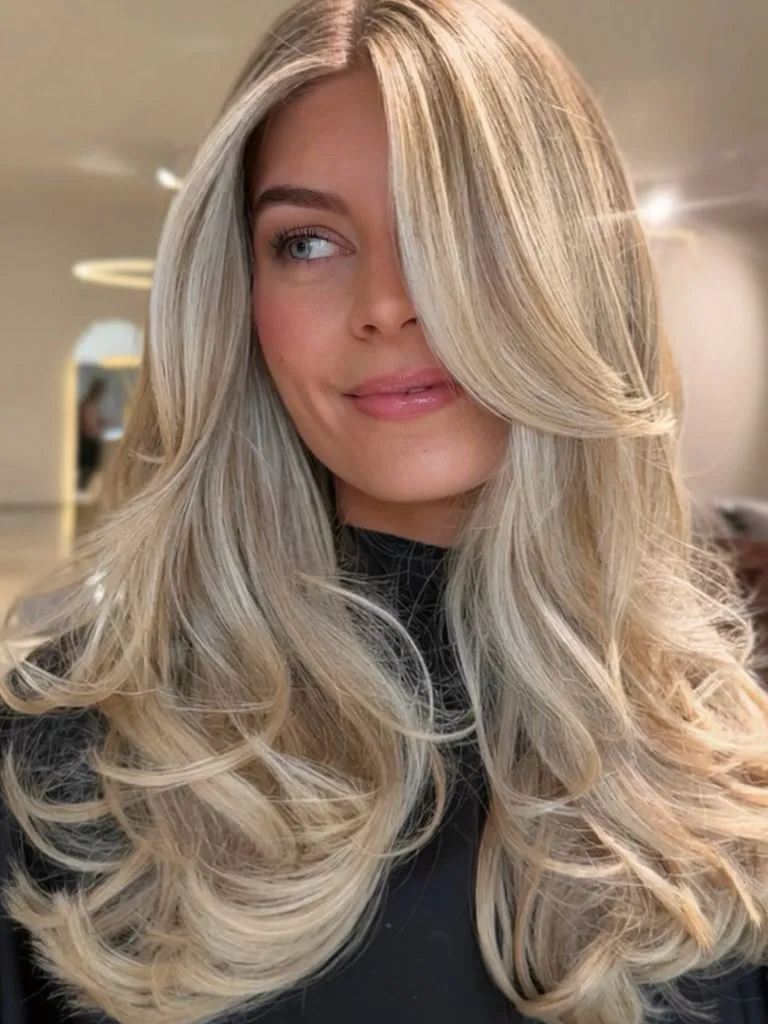
Photo via Instagram
The curls are doing double duty here, functioning as both a styling choice and a color-display mechanism. Each curl catches and releases light at its curve, which reveals the tonal variation that would be less obvious if the hair were straight. The face-framing pieces are lighter but not sharply so — they feel more like the first place light would naturally hit rather than a deliberate departure from the rest. The cool undertone across the entire head keeps the palette unified even where the value shifts.
I like the relationship between the curl structure and the dimensional color. Neither element would be as effective alone — the curls without the variation would look monochromatic, and the variation without the curls would be harder to read. For anyone exploring cool-toned winter blonde hair, this is a reminder that styling and color placement are two halves of the same visual conversation.
7. A Neutral Ash Blend Reads as Understated Depth
Viewed from the back, this hair shows a carefully blended neutral-to-ash blonde that sits within a tight range of values. The roots are perhaps one and a half to two levels deeper — a cooler, mousy blonde — and the lengths lighten gently into a soft sandy ash. The texture is a medium wave with minimal separation, and the overall impression is smooth and low-contrast. The person wears a white top, and the background is a clean, light-toned interior.
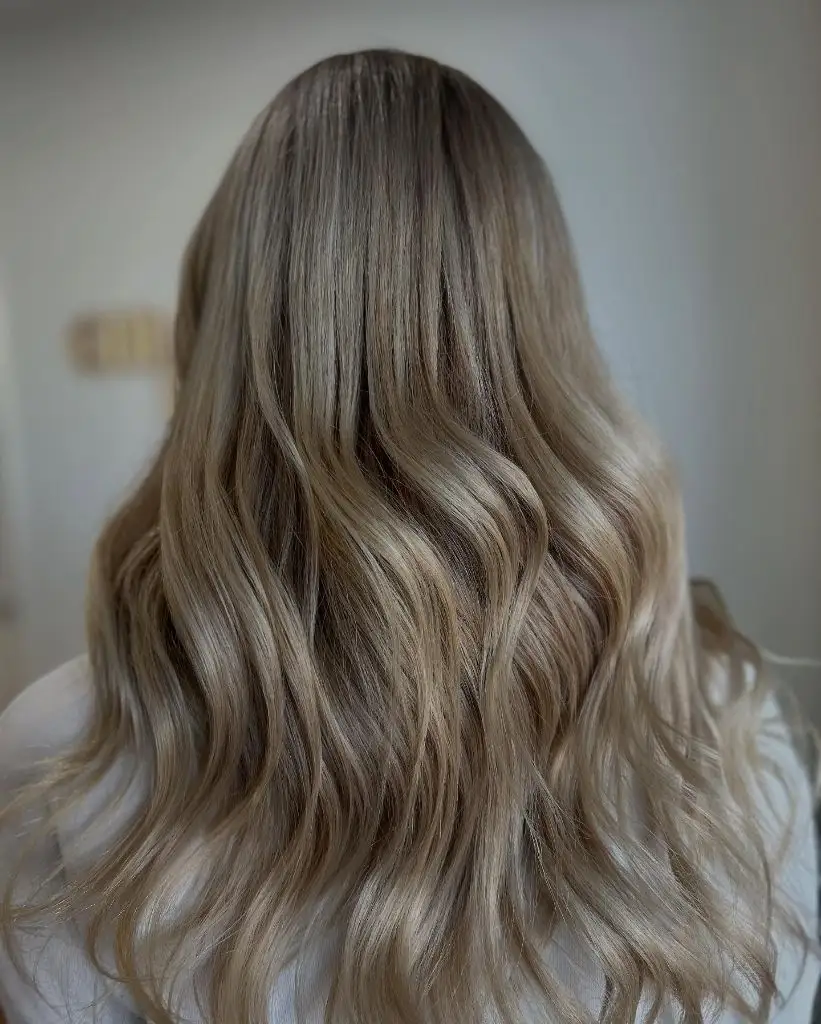
Photo via Instagram
This photograph does not show the face, so the useful reading is about color behavior from behind — how the blonde reads in terms of density, transition, and tonal family when there is no face framing to guide the eye. The answer is that this low-contrast approach looks thick and healthy. The narrow value range means the eye does not jump between light and dark sections; instead, it glides along the wave pattern, picking up the gentle shift from root to end. The white top reflects light upward, which slightly lifts the perceived brightness of the lower lengths.
The effect is a winter blonde that does not announce itself. It reads as natural, almost as if the hair simply never got very dark in the first place. This is useful for anyone who wants a seasonal shift that lives in subtlety — adjusting undertone and depth by just enough to register without requiring anyone to notice or comment.
8. Bright Blonde Ribbons Balance a Warm Mid-Section
Seen in profile from the right, this hair presents a clear highlight pattern with bright, nearly platinum blonde ribbons running through a warmer golden base. The lengths fall past the shoulder with a loose, undone wave, and the lightest pieces are distributed fairly evenly from the mid-shaft to the ends rather than concentrated at the face. The person sits in a salon chair, wearing a black cape.
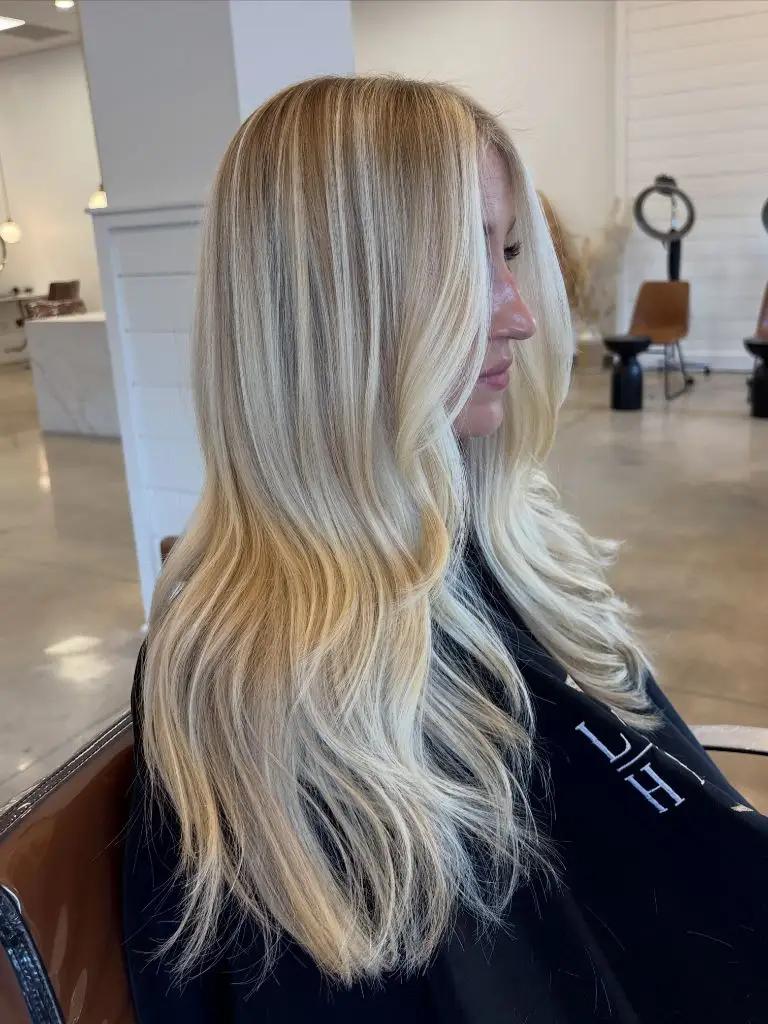
Photo via Instagram
The highlight pattern here creates a striped rhythm that is more traditional than the melted balayage seen in earlier sections. The ribbons of lighter blonde are distinct enough to register individually, especially where they catch the salon lighting from above. The warm base between them prevents the overall look from going too cool — it holds a golden center that keeps the palette grounded. The loose wave opens up the strands just enough to show the interplay between the two tones.
The value is the even distribution. Because the brightness is not concentrated in any one zone, the winter blonde reads as consistent from root area to ends, and from front to back. This is worth noting for anyone who prefers visible highlights over seamless blending — the structure of the placement becomes the design, and the result is clarity rather than ambiguity.
9. Sleek Straight Blonde Creates a Clean Silhouette
The straightest texture in this set, this image shows a smooth, sleek blow-dry with no visible wave or curl. The color is a bright platinum blonde through the lengths, with a slightly warmer or darker root area of about one to two levels’ difference. The hair is parted slightly off-center and falls past the collarbone. The person wears a black sleeveless top and smiles directly at the camera, with a blurred office or salon background.
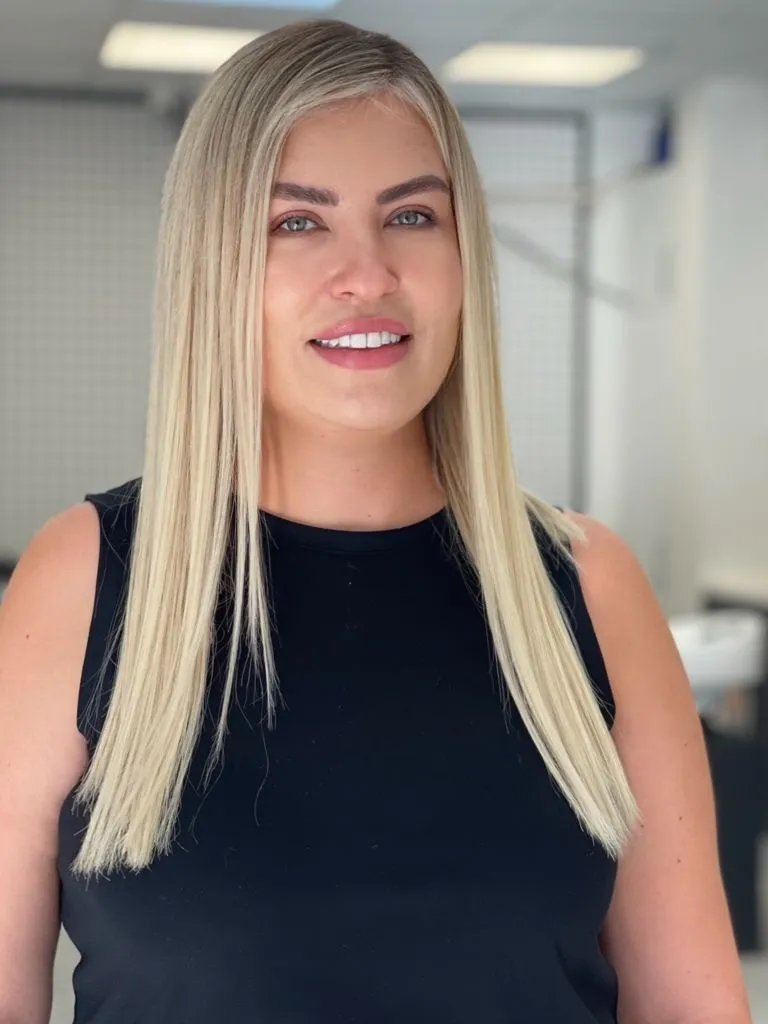
Photo via Instagram
Straight hair reveals color with a different logic than waves. There are no curves to interrupt the light, so the eye reads the shade continuously from root to end. Here, that means the slight root shadow is plainly visible as a soft darkening at the top, and the platinum lengths below appear almost seamless in their brightness. The sleek finish adds gloss, which amplifies the lightness. The black top provides a stark frame that pushes the hair forward as the primary visual element in the portrait.
This is a winter blonde that relies on simplicity. Without waves, curls, or pronounced layering to create dimension, the color and the finish carry the entire look. The principle here is that very light blonde and a straight texture demand clean, even color — any patchiness or banding would be immediately visible. Smoothness becomes both a styling and a color requirement.
10. Natural Highlights Frame a Soft Center Part
A more natural, unstructured look arrives in this photograph. The hair is long and mostly straight with soft bends at the ends, and the color reads as a natural dark blonde to light blonde with what appears to be a sun-kissed highlight pattern. The face-framing pieces are lighter, and the interior sections show slightly more depth. The setting includes dried pampas grass and warm, neutral decor, and the person wears a black t-shirt.
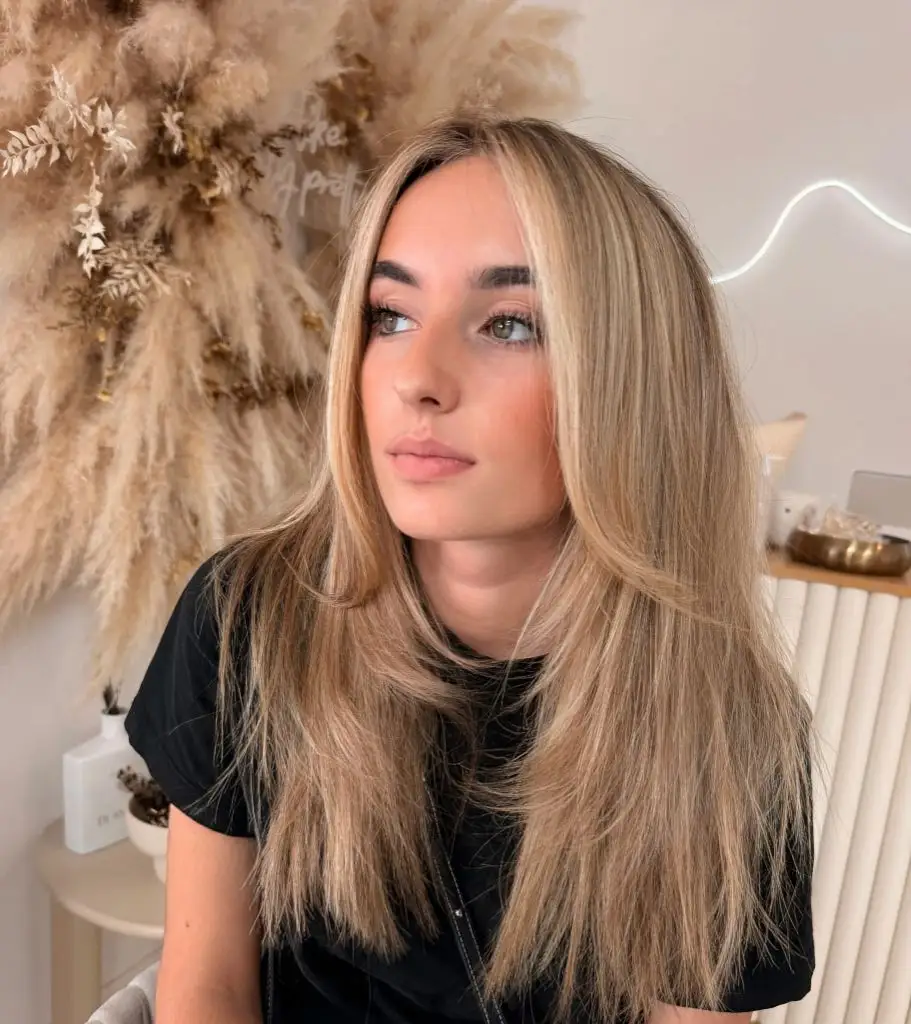
Photo via Instagram
The warm, textured background gives this image a different context than the salon shots. The pampas grass and neutral palette create a lifestyle setting that makes the hair color feel lived-in rather than freshly processed, whether or not that is actually the case. The highlight placement follows a pattern that mimics natural lightening — brighter where the hair falls forward, slightly deeper where it layers behind — and the lack of strong curl or wave lets the color do the speaking without distraction.
What stands out most is how the environment and the color work together to communicate ease. The blonde is not trying to be the brightest or the most dimensional; it is simply sitting comfortably within its range. For anyone building a winter blonde that does not look obviously salon-done, the restraint in both the highlighting pattern and the styling is the lesson.
11. A Warm Caramel Undertone Softens Straight Lengths
Seen from behind, this hair shows a warm, caramel-to-honey blonde that is remarkably smooth and straight through most of its length before turning gently under at the very ends. The roots are a warm level six or seven, transitioning without a hard line into lighter, golden-toned ends. The person wears a black salon cape, and the background shows a window with decorative ironwork.
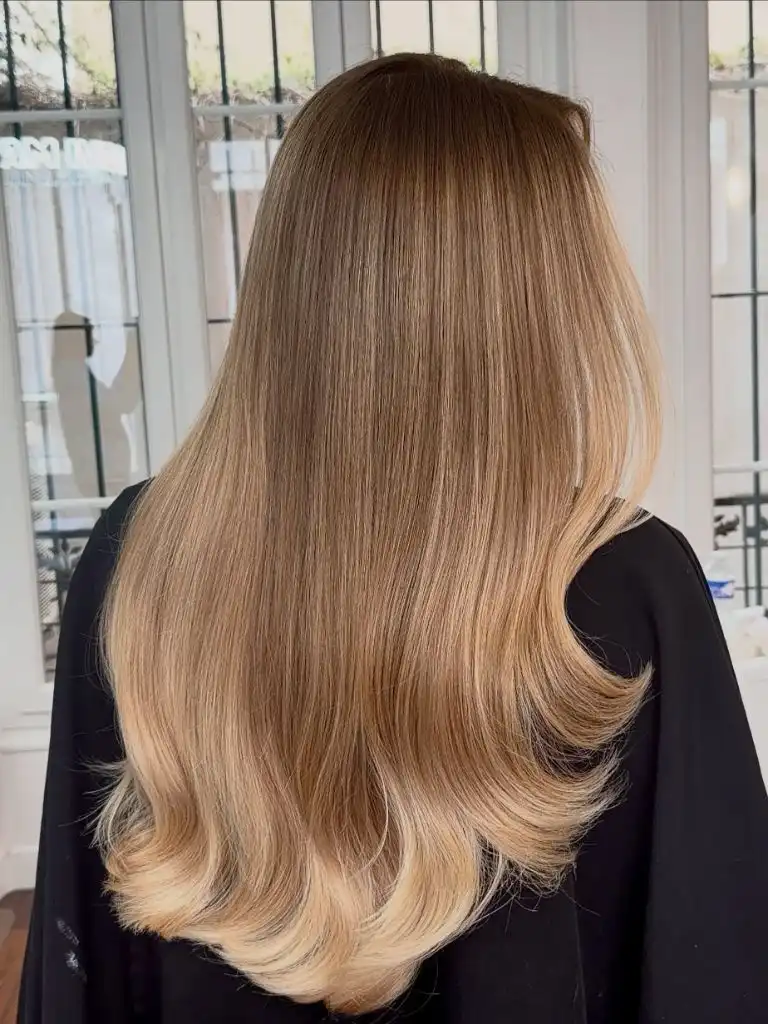
Photo via Instagram
The turn at the ends is the one gesture of styling here, and it works because the rest of the hair is so controlled and smooth. That small flip catches light on the underside, revealing a slightly lighter value where the hair curls outward, which gives the impression of brightness at the perimeter even if the color there is similar. The warm undertone — distinctly golden, leaning almost peach in certain sections — ties the root and the ends together into a cohesive palette without needing cool-toned interruption.
The appeal is the gloss. This warm winter blonde gains its impact almost entirely from the reflective quality of the smooth surface. Dimension here is minimal, but the shine creates its own version of visual interest. The principle is that a healthy, smooth canvas makes even a narrow color range look intentional and complete.
12. Golden Strawberry Tones Change the Warmth Register
The warmest blonde in this collection appears in this image. The color leans into a golden strawberry range — there is a visible peach-pink warmth through the lengths that distinguishes it from the honey and caramel tones seen earlier. The hair is long, with a soft wave and a gentle side part, styled in a smooth blowout shape. The person wears a black top with partial text visible, and the background features the same window ironwork as the previous image.
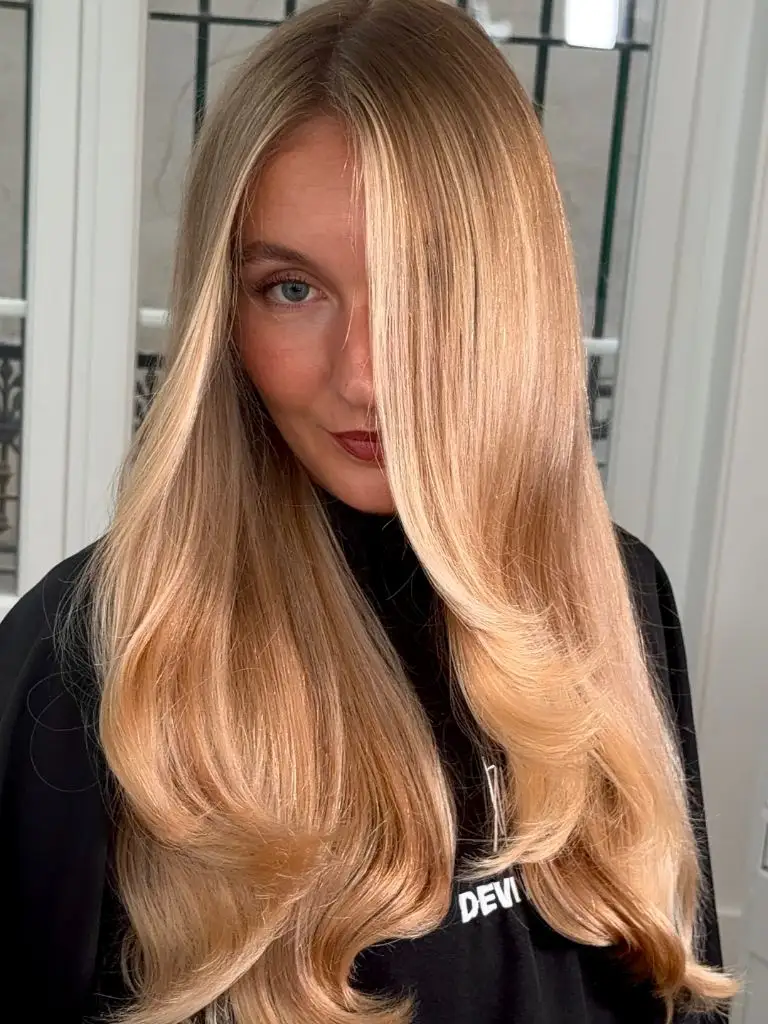
Photo via Instagram
The strawberry warmth in this shade reads as a genuine departure from the neutral and cool blondes that dominate most winter blonde conversations. It is a tone that does not occur naturally for most people, which means it requires a more deliberate choice, and that deliberateness shows. The peach undertone interacts with the skin differently than a golden or ashy blonde would, warming the complexion visibly. The smooth blowout style keeps the focus on the color itself rather than on texture or movement.
The effect is a winter blonde that refuses the assumption that cold months require cool tones. This strawberry-gold variation proves that warmth can look seasonally appropriate if the depth is right and the finish is polished. For anyone whose skin reads warmer in winter, this warmer tonal family might be more flattering than the ash and platinum directions that tend to dominate seasonal mood boards.
13. Full Curls Interrupt a Platinum Surface
A cloud of platinum-to-white blonde curls fills this frame, almost entirely covering the face. The curls are tight and bouncy, with the lightest value approaching a true platinum at the outermost pieces and slightly warmer, sandier tones appearing deeper within the layers. The person wears a beige or tan blazer over a white top, with a gold watch visible on the wrist.
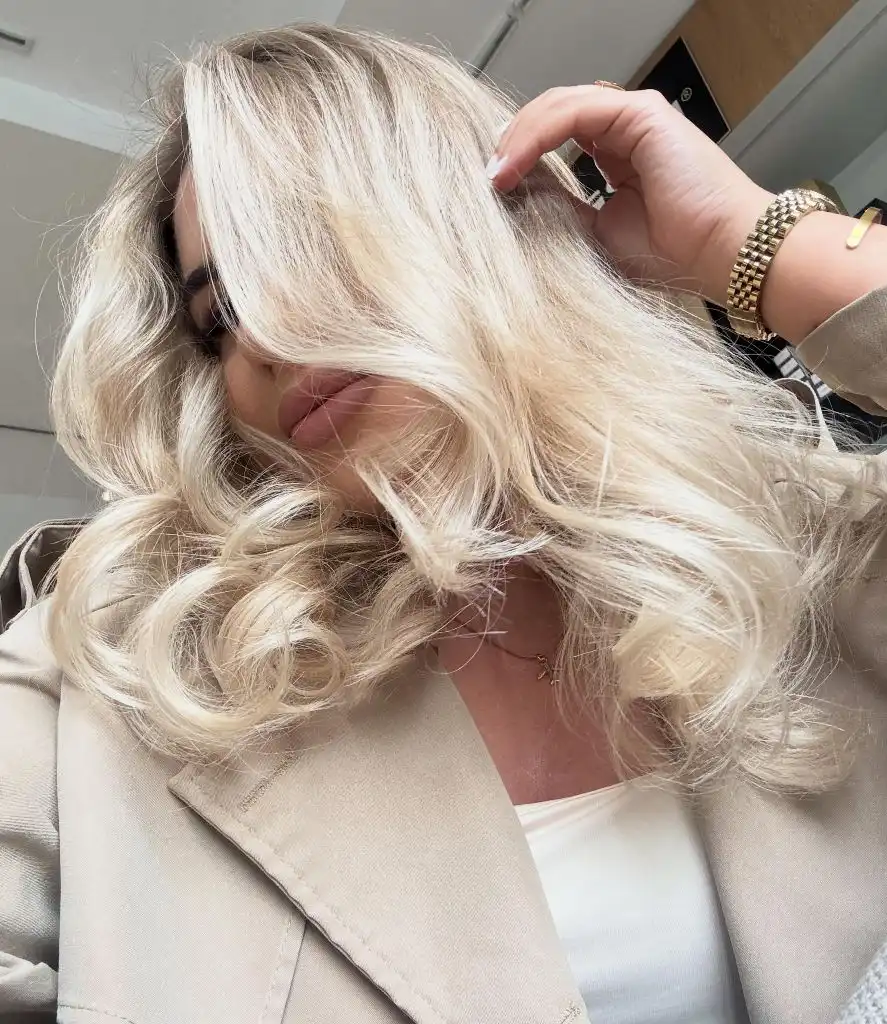
Photo via Instagram
The styling overwhelms the frame by design, and the color benefits from this approach. Tight curls create more surface area per strand, which means more opportunities for light to bounce, and when the overall shade is this light, the result is almost luminous. The warmer tones that appear in the interior of the curls are not a separate color — they are likely the same blonde reading differently because of shadow between the curls. The beige blazer and gold watch reinforce the warm-neutral palette without competing with the hair.
The strength here is the interplay between curl density and high-level lightness. The volume and the brightness together create something that reads as bold without relying on dark contrast or dramatic placement. The takeaway is that platinum winter blonde does not always need a visible root shadow to look dimensional — texture alone can generate enough variation in value to keep the eye interested.
14. Rose-Tinted Waves Add Softness to a Neutral Blonde
Viewed from behind, this hair shows medium-width waves in a neutral blonde that leans very slightly toward a rose or champagne undertone. The color is consistent from about three inches below the roots — where a faint, slightly deeper root area ends — through to the tips. The texture has a satin-like sheen, and the person wears a light pink or mauve top. The background is a salon interior with warm, low-key lighting.
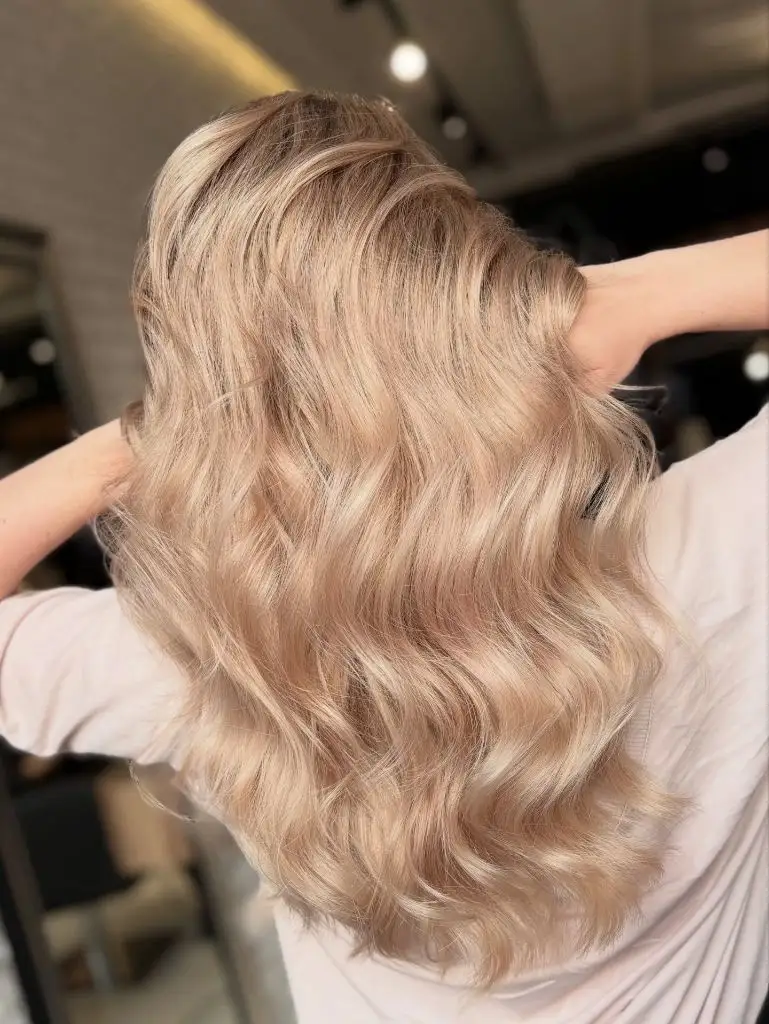
Photo via Instagram
The rose undertone is subtle enough that it could easily be mistaken for a trick of the lighting, but the pink-toned top supports the reading — the two share a quiet warmth that feels coordinated, whether intentionally or not. The waves are evenly distributed, creating a rhythmic pattern of light and shadow that gives the blonde surface more visual texture than its actual value range would suggest. The salon lighting, warm and slightly amber, pushes the champagne direction further.
The best detail is the undertone choice. Neutral blonde sits on a knife’s edge between warm and cool, and this version tips it just slightly toward rose, which softens the overall impression without adding obvious warmth. For anyone exploring winter blonde options and finding both gold and ash too committed, this champagne-rose territory offers a middle path with genuine personality.
15. A Dimensional Balayage Frames Long Relaxed Waves
This image shows long, loosely waved hair with a balayage that creates clear but smooth transitions between a medium-dark blonde root and brighter, golden-toned ends. The color range covers roughly three levels of lift, with the brightest pieces appearing through the mid-lengths and front. The setting is a dark-walled salon with black furniture and a hanging plant in the background.
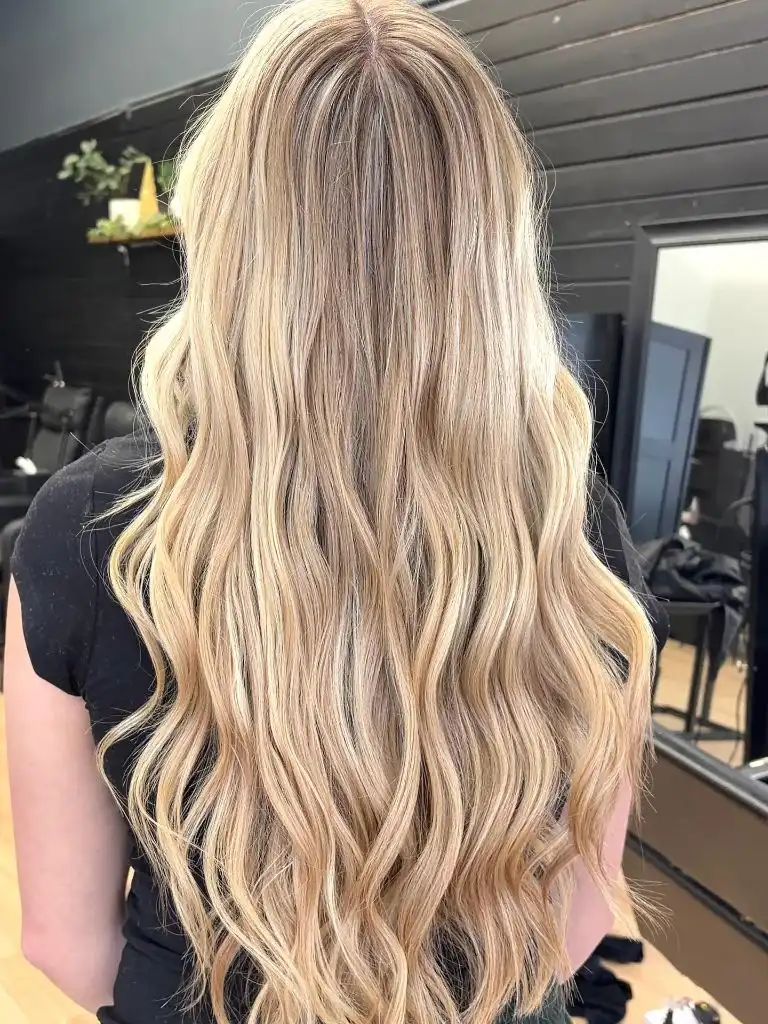
Photo via Instagram
The dark background is doing meaningful work here, creating a value contrast with the hair that amplifies the perception of brightness in the lighter pieces. The balayage transition itself is well-graduated — there are no harsh lines between the darker root zone and the lighter mid-section — and the loose waves open up the strands to reveal the range more effectively than a straight texture would. The brightness through the front sections suggests that face-framing lightness was part of the intention, though the rear view here shows the same logic extending throughout.
This is a balanced version of the dark-root-to-bright-end technique seen earlier, but with a narrower range and a warmer palette overall. The restraint in the contrast keeps it from reading as a two-tone look. The applicable principle is that a moderate amount of depth at the root can carry an entire winter blonde through cooler months without ever looking stark.
16. Gentle Waves Quiet a Bright Blonde All Over
A back view again, this time showing long hair with soft, barely-there waves in a bright, warm-leaning blonde that is remarkably even in tone from root to end. There is no significant root shadow, and the color reads as a single, consistent value across the entire surface. The person wears a floral-printed blouse with a red-and-pink pattern on a light background.
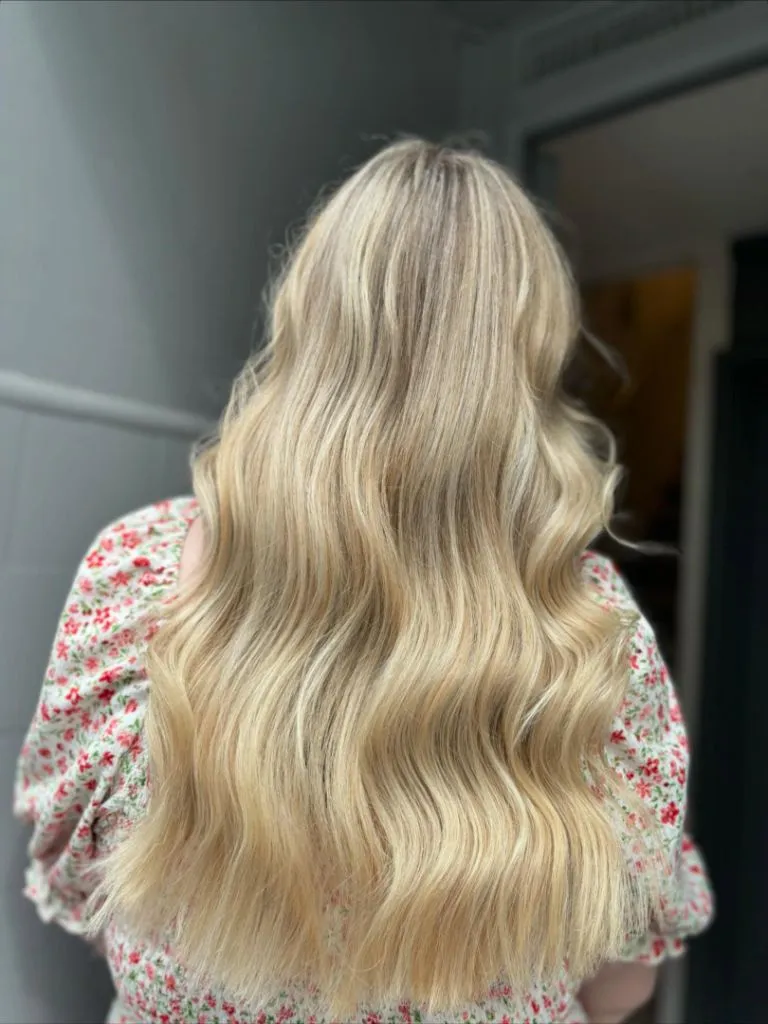
Photo via Instagram
The consistency here is what distinguishes this from the other looks. Without root depth, highlight contrast, or balayage graduation, the visual interest comes entirely from the wave pattern and the light it catches. The gentle bends are enough to create soft stripes of brightness and shadow along the lengths without introducing the kind of movement that would break the smooth impression. The floral blouse adds color and pattern below, which creates a bottom frame that is busier than the hair itself — a contrast that actually makes the blonde feel calmer.
The effect is a winter blonde that reads as one note played clearly rather than a chord. This is genuinely difficult to achieve because any variation in lift or tone would be immediately visible across such a consistent surface. The lesson is that single-process, all-over blonde has its own visual logic, and when it is done well, its simplicity becomes the statement.
17. A Sharp Root Contrast Defines Sleek Straight Lengths
This front-facing image presents one of the highest-contrast looks in the collection. The roots are a clear medium brunette, perhaps a level six, and the transition into a cool, pale platinum blonde happens within just a few inches. The hair is perfectly straight, long, and center-parted, with no wave or curl to soften the color shift. Black-framed glasses, a black hoodie with white drawstrings, and a neutral gray background fill out the frame.
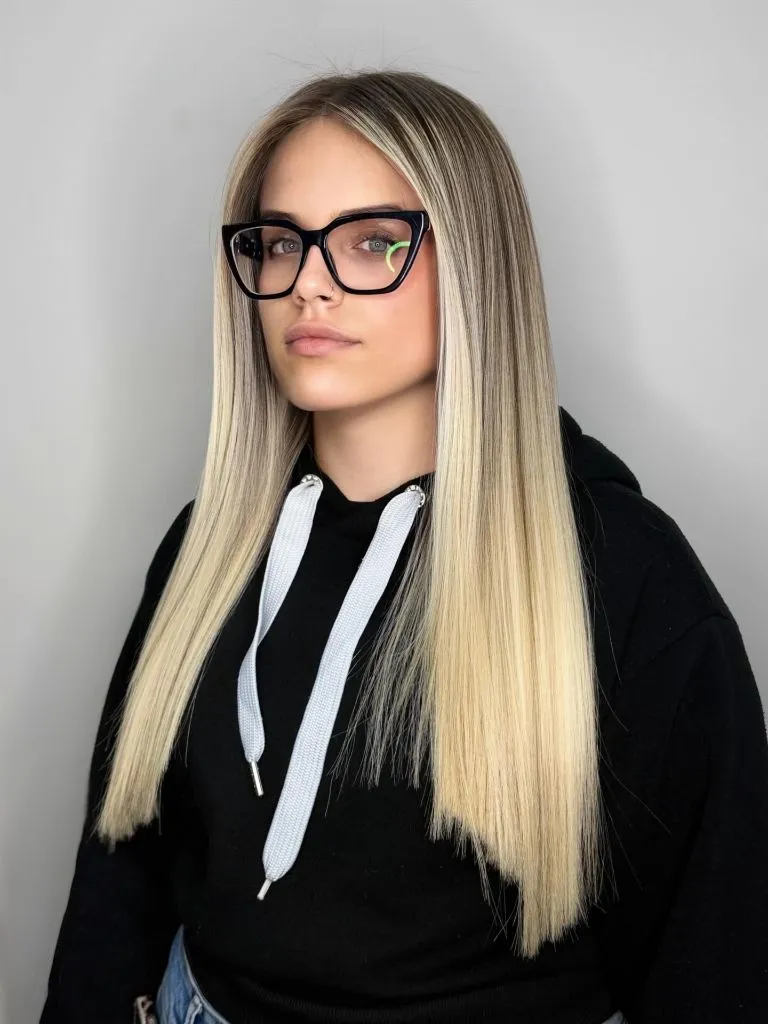
Photo via Instagram
The straight texture makes the root contrast explicit. There are no curls or bends to blur the transition, so the shift from dark to light is visible and deliberate. The black glasses and black hoodie repeat the darkness of the root, creating a frame-within-a-frame effect where the bright blonde lengths are sandwiched between dark elements above and below. The gray background stays neutral, refusing to push the blonde warmer or cooler than it actually is. This is an honest portrait of a high-contrast winter blonde in flat, even light.
The appeal is the intentional visibility of the root. Rather than blending or disguising the grow-out zone, this look incorporates it as a structural element — the dark crown grounds the lighter ends and gives the overall shape a top-heavy anchor. For anyone who has ever apologized for visible roots, this is a compelling case that the contrast can be the design itself.
18. A Soft Grow-Out Pattern Balances Warm Blonde Lengths
Here the root area is visible as a darker blonde-to-light brunette, and the lengths fall into a warm, golden blonde with a slight wave and a natural, unpolished finish. This photograph does not show a salon-fresh result; the texture appears lived-in, with some dryness at the ends and a gentle spread of color that suggests time has passed since the last service. The person wears a black salon cape, and the background shows a blurred salon interior.
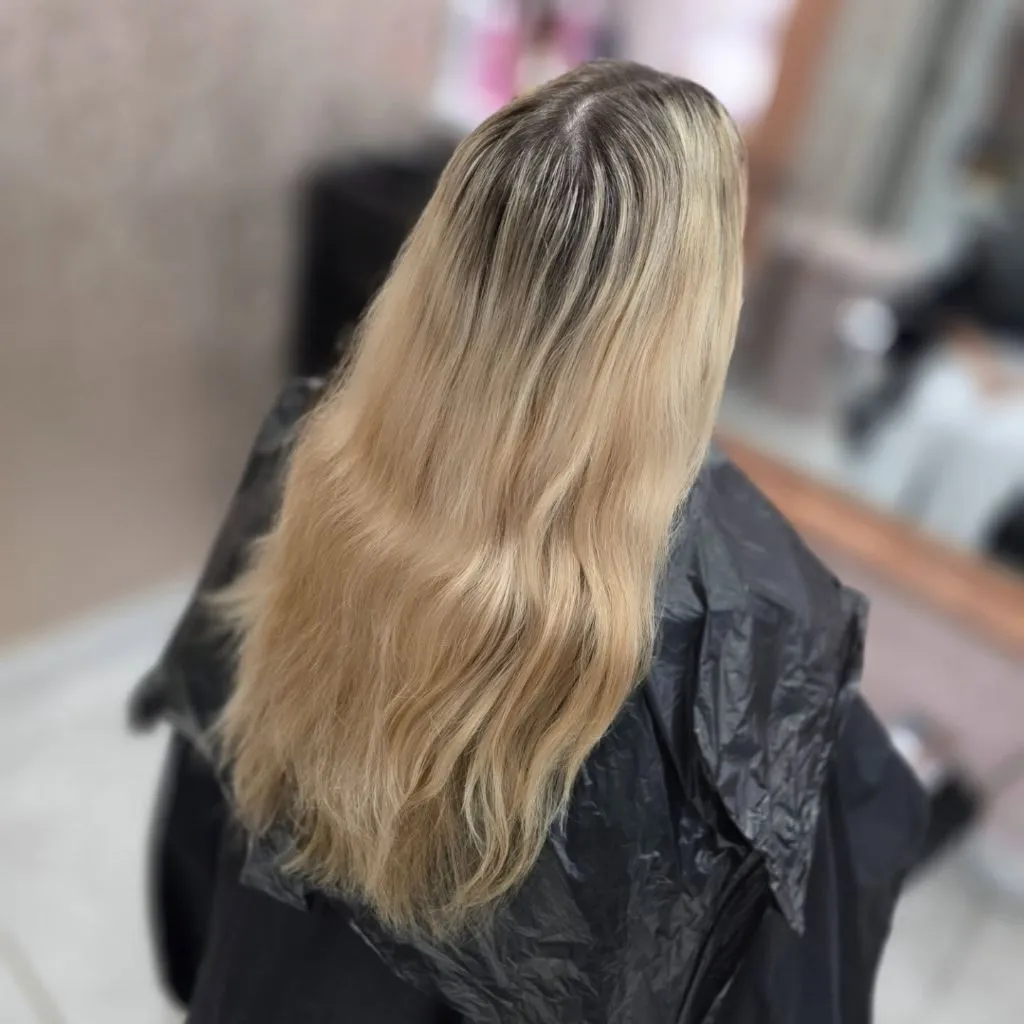
Photo via Instagram
The honesty of this image is its strongest quality. The grow-out is real and visible, and the warm blonde lengths are not perfectly toned — there is a slight brassiness and unevenness that reads as authentic rather than editorial. The natural texture, with its slight wave and lack of smoothing product, reinforces this. The photograph shows a blonde in its middle life rather than its debut, and that is useful information for anyone trying to understand what a particular shade will look like between appointments.
This is a realistic portrait of winter blonde maintenance. The color still reads as warm, attractive, and intentional even with the visible root and the less-than-perfect finish. The transferable principle here is that a warm blonde with a gradual grow-out often ages more gracefully than a cool one, because the warmth bridges the gap between natural root and processed length more sympathetically.
19. Cool Volume Lifts a Multidimensional Ash Blonde
A dramatic side-swept style dominates this image, with the hair falling in large, voluminous waves across the face and past the shoulders. The color is an ash-to-champagne blonde with visible internal dimension — cooler, almost silver-toned strands layered against slightly warmer beige tones. The setting is a salon with a warm accent wall visible behind, and the person wears a dark navy or black top.
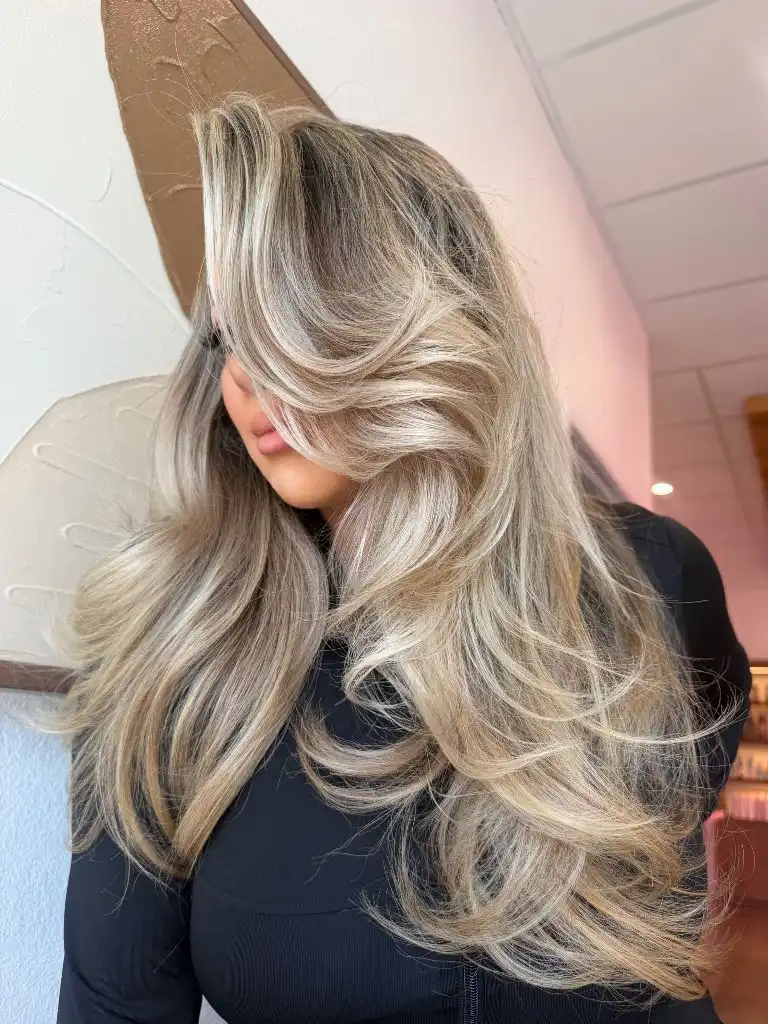
Photo via Instagram
The volume here is considerable, and it reveals the dimensional color work more effectively than a flatter style would. As the large curls separate and overlap, the cooler silver-toned strands surface against the warmer beige undertones, creating a push-and-pull between warm and cool that is visible only because of the movement. The warm accent wall behind adds an amber cast to the edges of the hair, which slightly shifts the reading of the ash tones toward something more neutral — an interesting demonstration of how winter blonde reads differently depending on its surroundings.
What stands out most is the interplay between the two undertone families. This is not a single-note ash blonde or a single-note warm blonde; it lives between the two, and the volume allows both sides to be visible simultaneously. The takeaway is that multidimensional ash blondes gain clarity from big, open styling — without the volume, much of this tonal conversation would be hidden.
20. A Blended Neutral Blonde Finishes With Quiet Confidence
The final image returns to a calmer register. The hair is long with a soft, medium wave, and the color reads as a blended neutral blonde — not clearly warm or cool, sitting comfortably in the middle. The roots carry a slightly deeper tone, but the transition is so gradual that it barely registers as a shadow. The person faces away, wearing a light or neutral-toned shirt, with the background largely blurred.
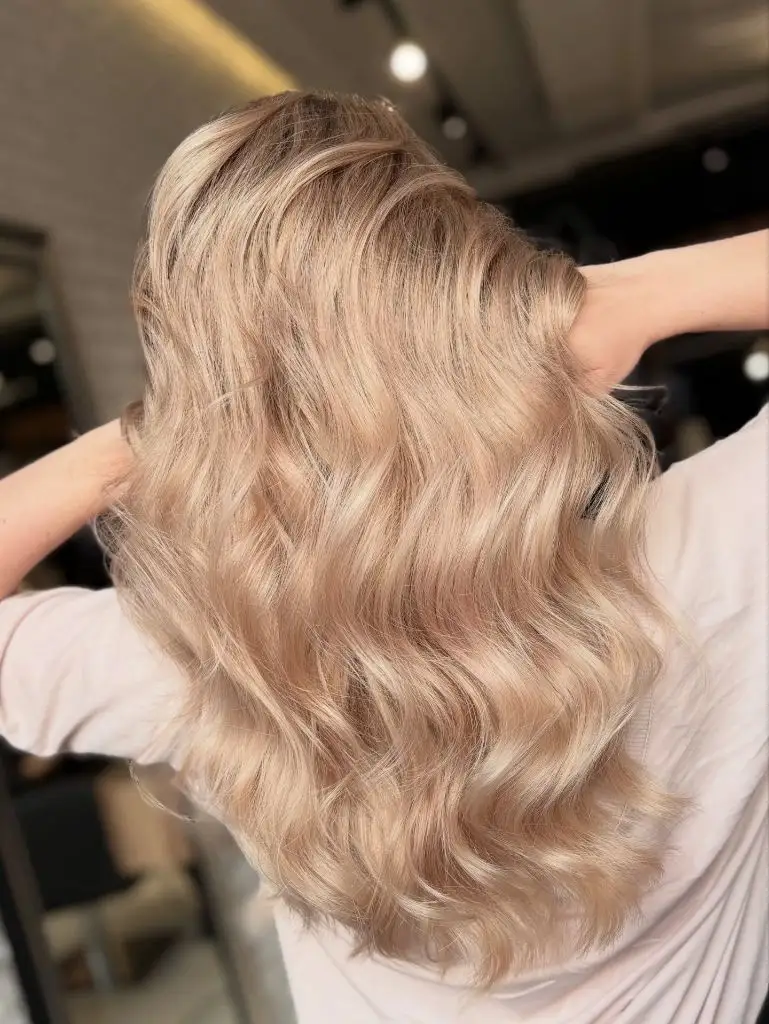
Photo via Instagram
The neutrality of this blonde is its defining quality. It does not lean gold, it does not lean silver, and it does not make a strong statement in either direction. The wave pattern is gentle enough to add visual interest without creating dramatic light-and-shadow contrast, and the root transition is soft enough to look entirely natural. The light shirt blends into the lower frame rather than contrasting with it, which reinforces the overall impression of quietness and tonal harmony.
The value is the versatility embedded in the neutrality. A blonde that commits to neither warm nor cool can move through different lighting environments, clothing palettes, and seasonal contexts without ever looking mismatched. For anyone wrapping up a search through winter blonde hair color ideas, this is worth considering as the least risky, most adaptable endpoint — a color that does not need the right context to look right.