Style pressure after forty often arrives disguised as helpfulness. Someone frames a suggestion as a correction, a guideline as a limit, and suddenly getting dressed feels like solving a problem you never actually had. Trendy outfits for women over 40 do not require a different rulebook than outfits for anyone else. They require the same things every good outfit requires: a sense of proportion, a point of view, and the confidence to leave something out. You get to wear what interests you and skip what does not.
The useful question when looking at any outfit is not whether it follows a rule but whether the visible choices reinforce each other. A good decision begins before color or brand, at the level of silhouette and proportion. This article moves through more than twenty real outfits, and the variables worth paying attention to across all of them are balance between fitted and loose, the role color plays as either anchor or interruption, how fabric weight and texture create or reduce structure, and where accessories land in relation to the overall shape. Those four things, proportion, color placement, texture, and accessory restraint, do more work than any single garment. The photographs that follow show a wide range of approaches, and each one earns its logic differently.
1. A Red Hoodie Softens Striped Seersucker Pants
The strongest detail here is the washed coral-red hoodie sitting against light blue-and-white striped seersucker pants. The hoodie has a relaxed kangaroo pocket and a slightly cropped hem that lands just at the hip, and the pants fall in a straight, ankle-length cut. The combination reads casual and considered at the same time, with dark flip-flops keeping the base simple.
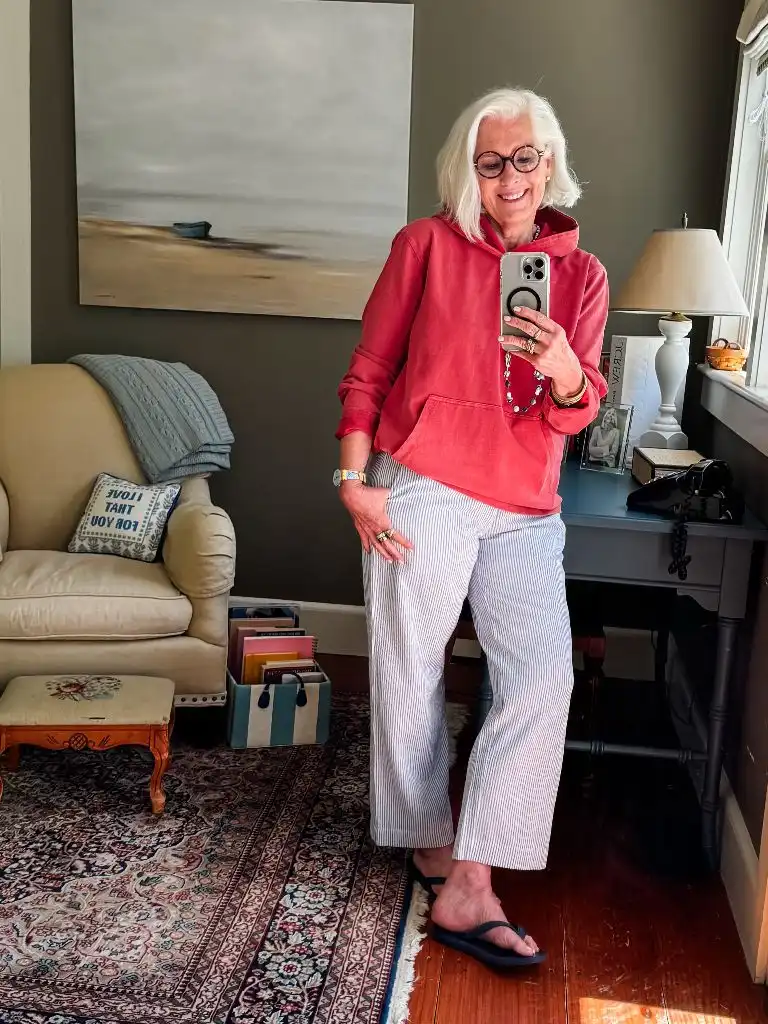
Photo via Instagram
The proportion works because the hoodie volume stays contained above the waist while the pants carry their own width below it. Neither piece dominates. The red reads warm against the cool blue stripes, and that temperature contrast gives the outfit its energy without needing a third color. The beaded necklace and stacked bracelets add small points of detail near the face and wrist, but they do not compete with the hoodie’s color. Round tortoiseshell glasses frame the face quietly and echo the warm undertone of the top.
The appeal is in the plainness of the pairing. A hoodie and seersucker pants should not work this easily, but the shared relaxation of both pieces makes the combination feel like one thought rather than two compromises. The transferable principle is that when both halves of an outfit share the same level of ease, color contrast alone can provide all the structure you need, and casual outfit ideas built on that logic tend to hold up well.
2. A White Button-Down Anchors Medium Wash Denim
The visible center of this outfit is a crisp white cotton button-down with the sleeves rolled to three-quarter length, worn untucked over medium-wash straight-leg jeans. The shirt falls just past the hip, and the jeans have a subtle red contrast stitch running along the outseam. Black pointed ballet flats with a small metal buckle detail finish the lower half, and a black quilted handbag with silver hardware hangs from the right hand.
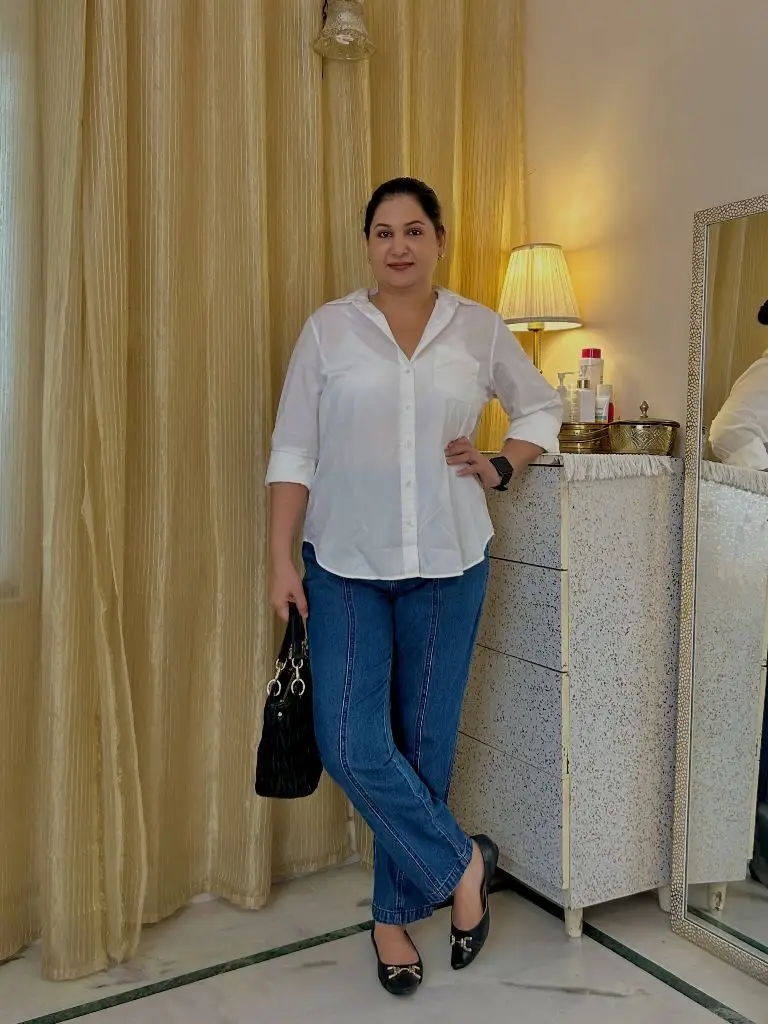
Photo via Instagram
The white shirt does most of the visual work here by creating a clean, bright field that makes the denim read as the supporting piece rather than the lead. The untucked hem gives the silhouette a column shape from shoulder to mid-thigh, and the jeans continue that line without tapering sharply. Black appears only at the feet and in the bag, which means the dark tones frame the outfit from below and to the side without interrupting the white-and-blue core. A dark watch on the left wrist provides one more small anchor point.
This is a reminder that the most reliable version of smart-casual dressing often involves the fewest decisions. The white shirt and denim combination has been around long enough that its success depends entirely on fit and proportion rather than novelty. The principle worth borrowing is that a shirt worn at its natural length, without tucking or cropping, can create a calm vertical line that makes everything else feel organized around it.
3. Puffed Sleeves Lift a Simple Jeans Pairing
The lead detail is a white cotton blouse with exaggerated puff sleeves gathered at the shoulder and ending just below the elbow. The blouse has vertical pintuck detailing down the front and a soft eyelet or embroidered texture across the fabric. It sits over light-wash wide-leg jeans, and bright red pointed mules with a flat or low profile draw the eye straight to the ground line.
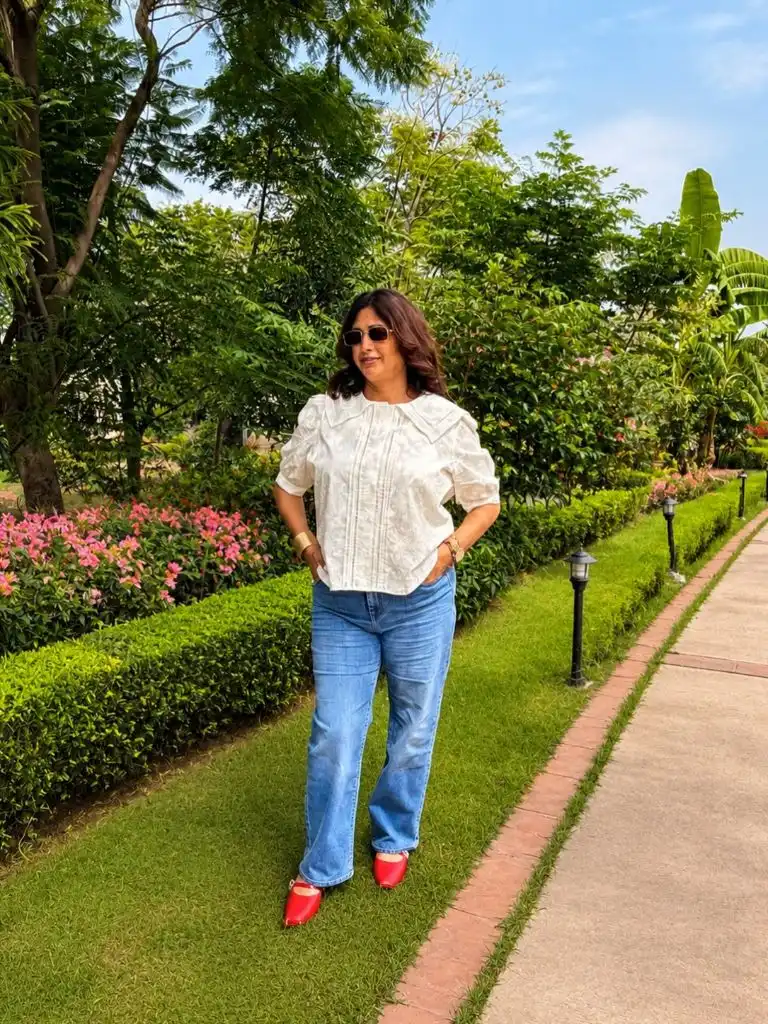
Photo via Instagram
The puff sleeves carry all the structural interest in the upper body, and the pintuck lines running vertically counterbalance that width by drawing the eye downward. The jeans are wide enough to echo the volume of the sleeves, so the silhouette reads as deliberately generous rather than mismatched. Red at the feet functions as an interruption, a single point of saturated color against an otherwise white-and-blue palette. A gold cuff bracelet on the right wrist adds warmth without competing with the sleeve shape, and sunglasses sitting on the face complete the accessories without adding clutter.
The best detail is the relationship between the textured blouse and the plain denim. One piece has surface interest and shape; the other has neither, and that imbalance is exactly what makes the outfit feel composed. For anyone exploring spring fashion ideas, the transferable lesson is that volume in a top works best when the bottom half stays quiet in texture, even if it matches in width.
4. A Floral Shirt Refines a Satin Midi Skirt
A dark navy button-front shirt with a large-scale botanical print in silver and pale green dominates the upper half of this outfit. The shirt has three-quarter sleeves rolled at the cuff, and its collar is slightly embellished with what appears to be beadwork or metallic detailing at the points. Below, a pale champagne or blush satin midi skirt falls straight to just above the ankle, and dark pointed shoes complete the base.
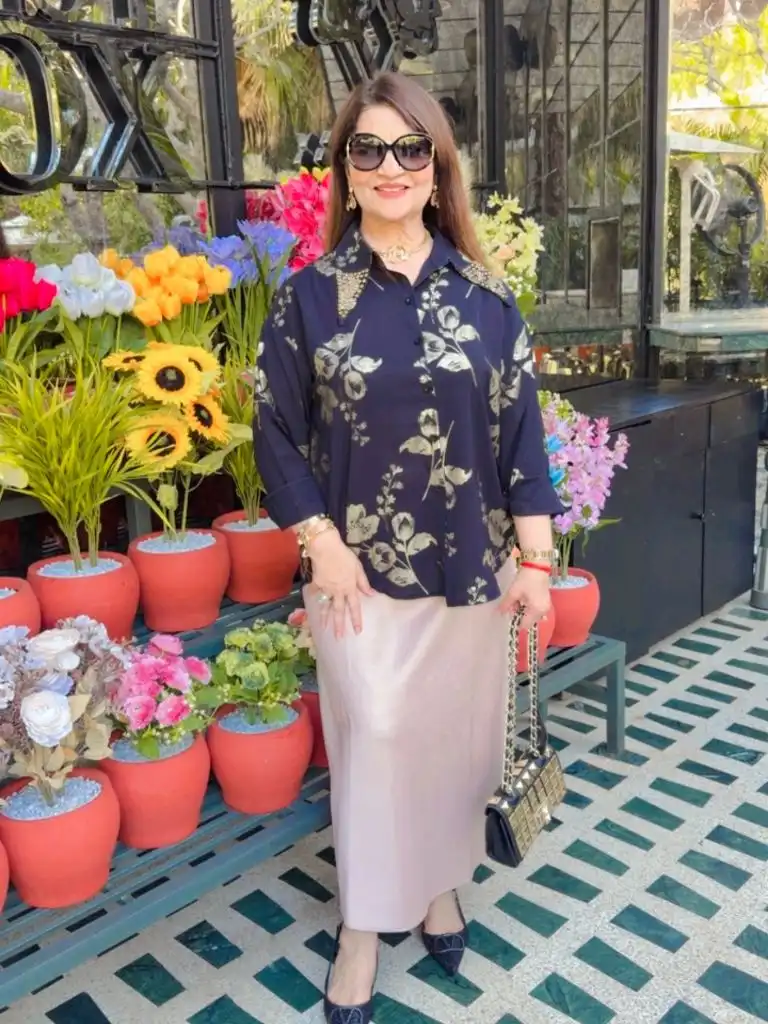
Photo via Instagram
The contrast between the matte, printed shirt and the luminous satin skirt creates a clear textural division at the waist. The dark navy reads as heavy and grounded, while the satin catches light and lifts the lower half. This texture shift does the work that color contrast might do in another outfit. Gold jewelry at the neck, wrists, and ears ties the warm tones of the skirt back into the upper body, and a small metallic handbag held at the side echoes that warmth. The floral print is large enough to read as graphic rather than fussy.
The strength here is in the fabric pairing rather than the color story. Matte against shine, heavy against fluid, dark against light: those three oppositions running along the same vertical line create visual richness without complexity. The principle is that when a printed piece feels too strong on its own, setting it against a single-tone fabric with a contrasting finish can settle the whole outfit into balance.
5. Linen Buttons Ground a White Summer Set
The entire outfit is white. A sleeveless linen top with a round neckline and large natural-tone buttons running down the center sits over white linen shorts that end several inches above the knee. Nude strappy sandals with a low platform, a small woven straw handbag with bamboo handles, and a chunky multicolored stone necklace provide the only color variation in the frame.
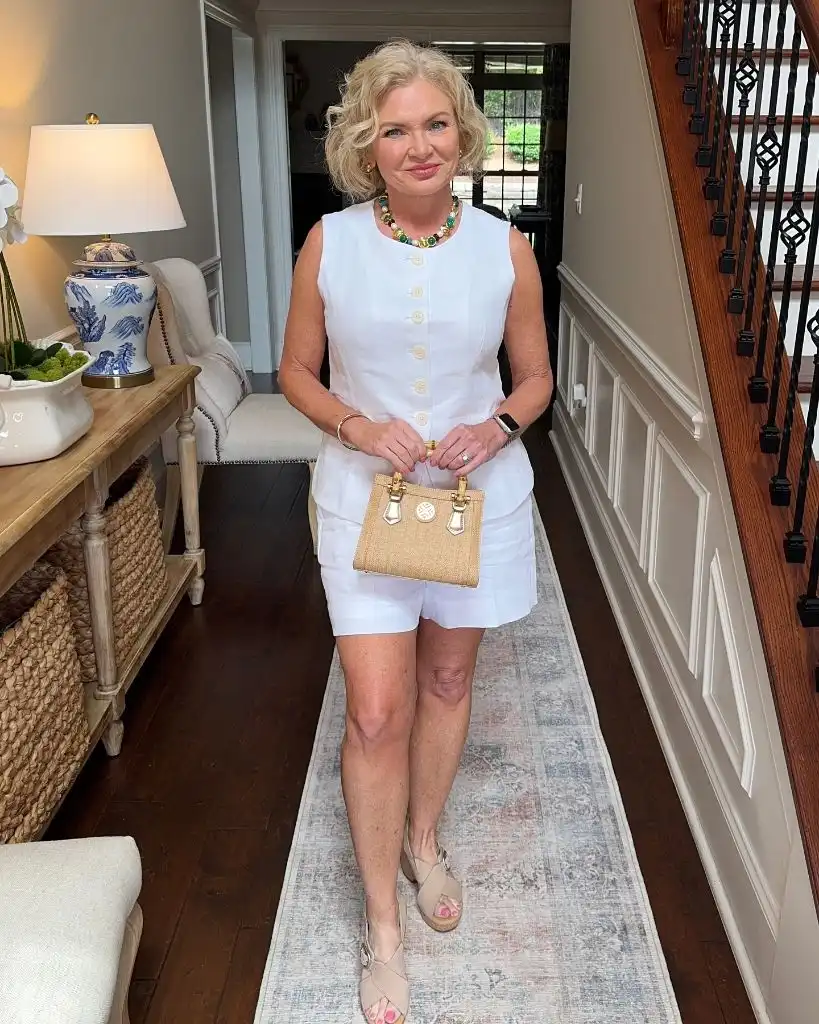
Photo via Instagram
The buttons are the structural anchor of this outfit. Without them, the top would read as a simple shell, but the line of large buttons creates a central vertical seam that gives the eye a path from neckline to hem. The straw bag adds texture at the center of the body, and its warm tan tone connects to the nude sandals below, creating a secondary color thread that runs through the outfit without interrupting the white. The multicolored necklace sits at the collarbone and provides the only true color event, and its placement near the face means it draws attention upward. Visible in the summer wardrobe essentials category, this kind of monochrome set relies on accessories for all its personality.
This is the kind of outfit that only works if the fit is precise, because a single color and a single fabric offer no distraction. The takeaway is that monochrome linen needs at least one strong textural element, here the buttons and the straw bag, to avoid reading as a uniform rather than a choice.
6. A Crossbody Bag Sharpens a Red Knit and Denim Look
The eye goes first to the saturated coral-red crewneck sweater worn over light-wash, slightly flared jeans. A crossbody bag with a monogram-print canvas body and a wide branded strap in dark green and gold sits diagonally across the torso. The jeans have a wide leg that just covers the top of the shoes, and the overall silhouette is relaxed but upright.
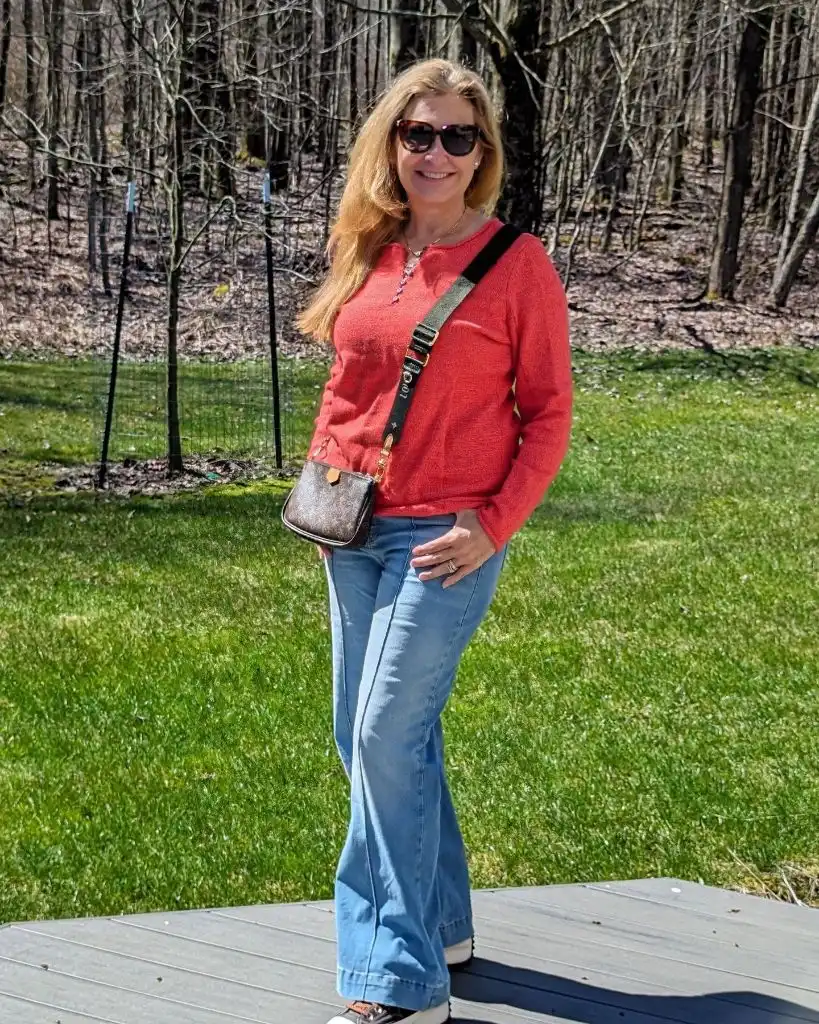
Photo via Instagram
The crossbody strap creates a diagonal line that cuts across the red field of the sweater, and that single line adds geometric structure to what would otherwise be a very soft, round silhouette. The bag sits at hip level, which anchors the waist and breaks the sweater into two visible sections. Light denim below cools the warmth of the red, and the flare of the jeans widens the silhouette gradually from knee to hem, giving the lower body its own sense of movement. Tortoiseshell sunglasses on the face pick up the warm brown tones of the bag.
I like the way the bag does more compositional work than any other single element. It introduces a third color family, adds a hard diagonal to a soft outfit, and defines the waist all at once. The transferable principle is that a structured crossbody bag worn over a loose knit can function as a belt, a color accent, and an architectural line simultaneously, which is useful for anyone building everyday outfit combinations.
7. Blue Florals Balance White Linen Cropped Pants
A loose blue-and-white floral blouse with a V-neckline and three-quarter sleeves sits over white linen cropped pants that end just above the ankle. The blouse has a gathered or pintucked front that creates soft vertical lines through the body. Tan wedge sandals, a silver chain necklace with a large pendant, and a smartwatch on the left wrist complete the visible accessories.
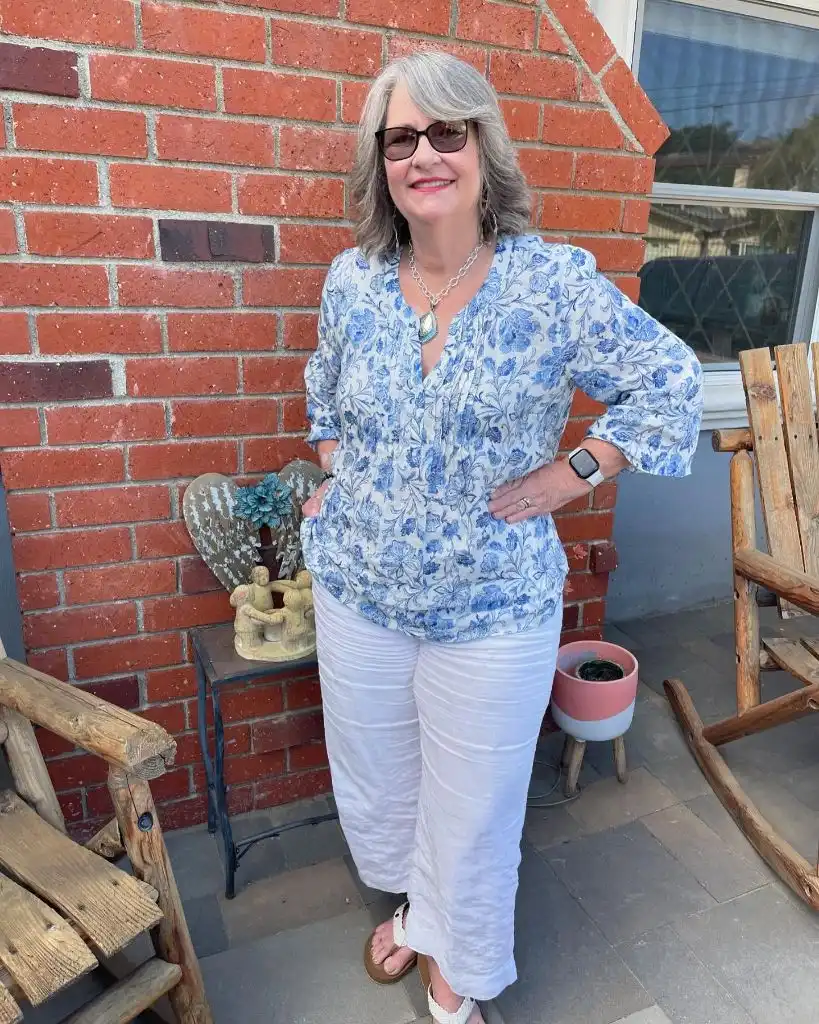
Photo via Instagram
The blue in the blouse echoes through the outfit only at the top, which means the lower half, all white, functions as a visual rest. That division gives the floral print room to be detailed without overwhelming the outfit. The gathered front of the blouse adds texture that catches light differently from the flat linen pants, and that textural contrast reinforces the top-bottom separation. Tan wedges keep the footwear warm and grounded, connecting to the skin tone rather than introducing another color. The pendant necklace draws a vertical line from the neckline down the center of the chest, which mirrors the pintuck lines of the blouse.
The value is in the color restraint. Only two tones, blue and white, carry the entire outfit, and every accessory either matches one of them or stays neutral. This is a useful framework for printed tops: when the print already contains enough visual information, the rest of the outfit can afford to say nothing at all, and the result feels effortlessly put together.
8. Navy Trousers Carry a Silk Tee With Quiet Authority
A white or champagne silk short-sleeve tee with a relaxed fit is tucked loosely into navy blue tapered trousers. The trousers sit at a mid-rise and taper to the ankle, showing a clean break above navy suede loafers. The mirror selfie shows a bedroom setting with grey carpet and a silver-framed full-length mirror, and a dark newsboy cap hangs on the mirror’s corner.
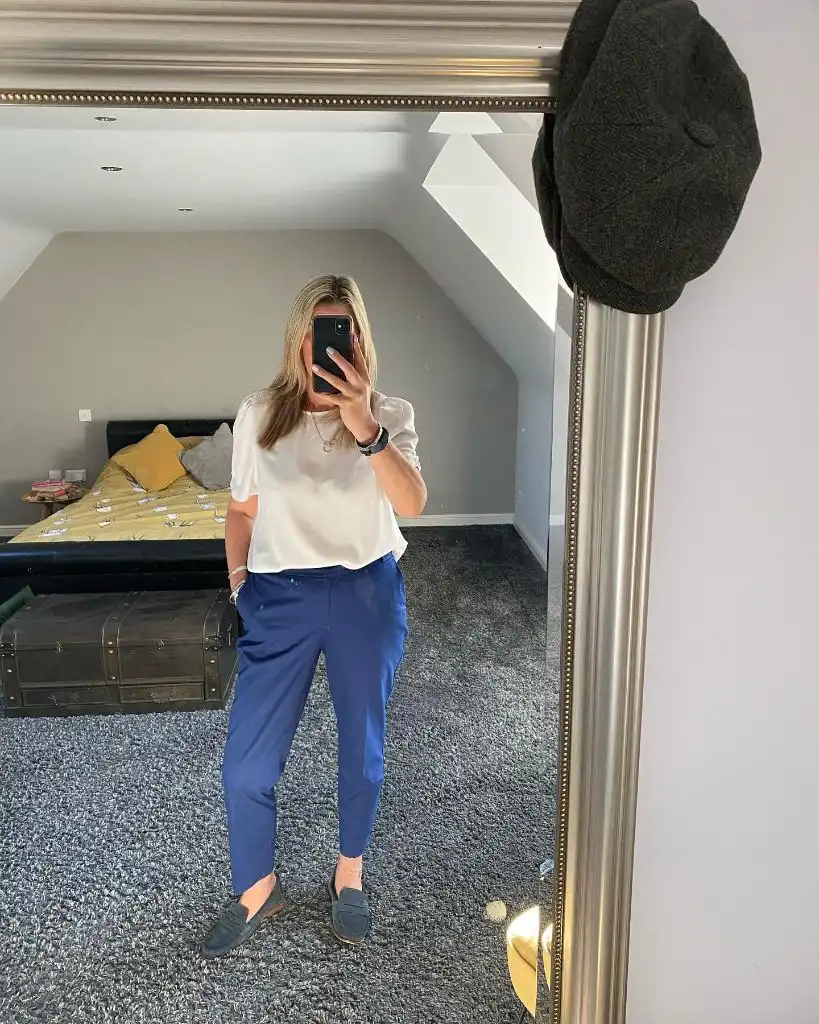
Photo via Instagram
The tonal connection between the navy trousers and the navy loafers creates an unbroken dark line from waist to floor, and the white tee floating above that line reads as the single point of contrast. The silk fabric catches light in a way that cotton would not, which gives the top a slight luminosity that separates it from a basic tee even though the shape is identical. The loose tuck keeps the waist defined without making the silhouette rigid, and the ankle-length trouser cut shows just enough of the shoe to register the loafer shape.
This is a study in how few pieces are needed when each one is doing its job. Two colors, two textures, and a single silhouette line from shoulder to ankle. The principle is that matching shoe and trouser tone extends the leg visually, and when the upper body offers a clean contrast, the outfit reads as both simple and intentional, a combination that belongs in any discussion of minimalist style approaches.
9. A Floral Mini Dress Opens the Silhouette Completely
The photograph shows the same bedroom and mirror as the previous image, but the outfit is entirely different: a green floral mini dress with short puffed sleeves and a fitted waist that flares into a skirt ending above the knee. The print appears to be small white and yellow flowers on a green ground. White leather loafers with a tassel detail finish the look, and the silhouette is open from the mid-thigh down.
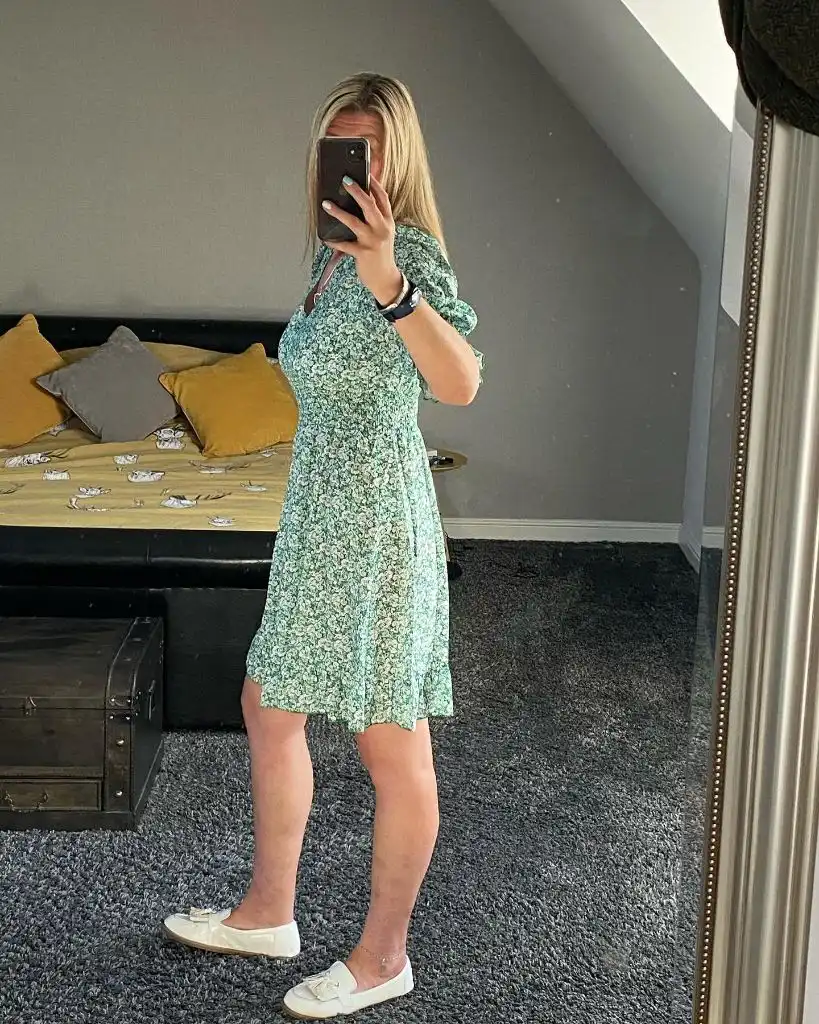
Photo via Instagram
The puffed sleeves and the flared skirt create volume at two points, shoulder and hem, while the fitted waist compresses the middle. That hourglass shaping is entirely structural and comes from the dress construction rather than from any accessory or styling trick. The green ground of the print is cool enough to keep the dress from reading as overly warm, and the small scale of the floral pattern adds texture without graphic weight. White loafers at the feet lighten the base and connect back to the white elements in the print, creating a subtle thread that ties top and bottom together.
The effect is that one piece does everything: it provides color, shape, texture, and movement all at once. For anyone who gravitates toward dress outfit inspiration, the lesson is that a well-constructed dress with built-in volume shifts needs almost no accessorizing, and letting the dress speak alone is a legitimate and often stronger choice than layering over it.
10. A Powder Blue Poncho Quietens a Dark Base
The upper body is wrapped in a powder blue oversized poncho or cape-style knit that falls in a soft triangular shape to below the hip. A paisley-print scarf in blue, lavender, and soft red is wrapped around the neck, sitting on top of the poncho. Below the poncho, dark slim trousers are partially visible. A tan Prada satchel hangs from the left forearm, and large black sunglasses sit on the face. The overall palette moves from light blue at the top through dark at the bottom.
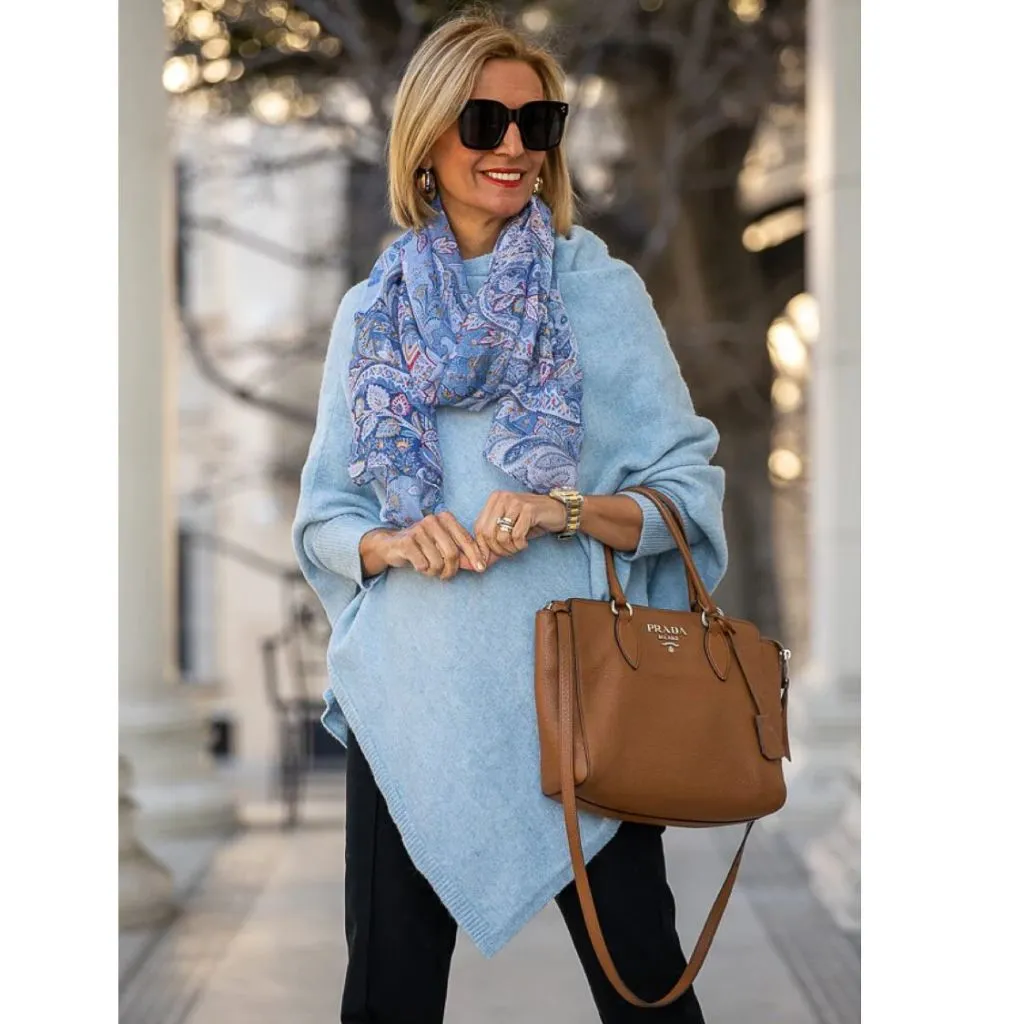
Photo via Instagram
The poncho changes the silhouette completely by removing all definition from the torso and replacing it with a draped triangle. That geometric simplicity means the scarf, the bag, and the sunglasses carry all the detail work. The paisley scarf introduces pattern near the face without competing with the poncho because its blue tones are close enough to the poncho shade to feel like an extension rather than an interruption. The tan bag is the warmest element and sits at the exact point where the poncho ends, which anchors the transition from blue to black. Gold jewelry at the wrist catches light and adds a small warm accent.
What stands out most is the color gradient from top to bottom: powder blue at the shoulder, pattern at the neck, dark at the legs, tan and gold at the accessories. That gradient gives the outfit a sense of organized movement, and the principle is that an oversized, shapeless upper piece can still read as polished when the color story moves deliberately from light to dark.
11. A Brocade Coat Frames a Light Blue Shift
A light blue brocade coat with a silver botanical pattern stands open over what appears to be a matching or coordinating light blue shift dress beneath. The coat falls to just above the knee, and the dress or skirt beneath it is slightly shorter. A triple strand of pearls sits at the collarbone, and dark flat shoes complete the lower line. The setting is a formal living room with a fireplace, floral drapery, and decorative porcelain on the mantel.
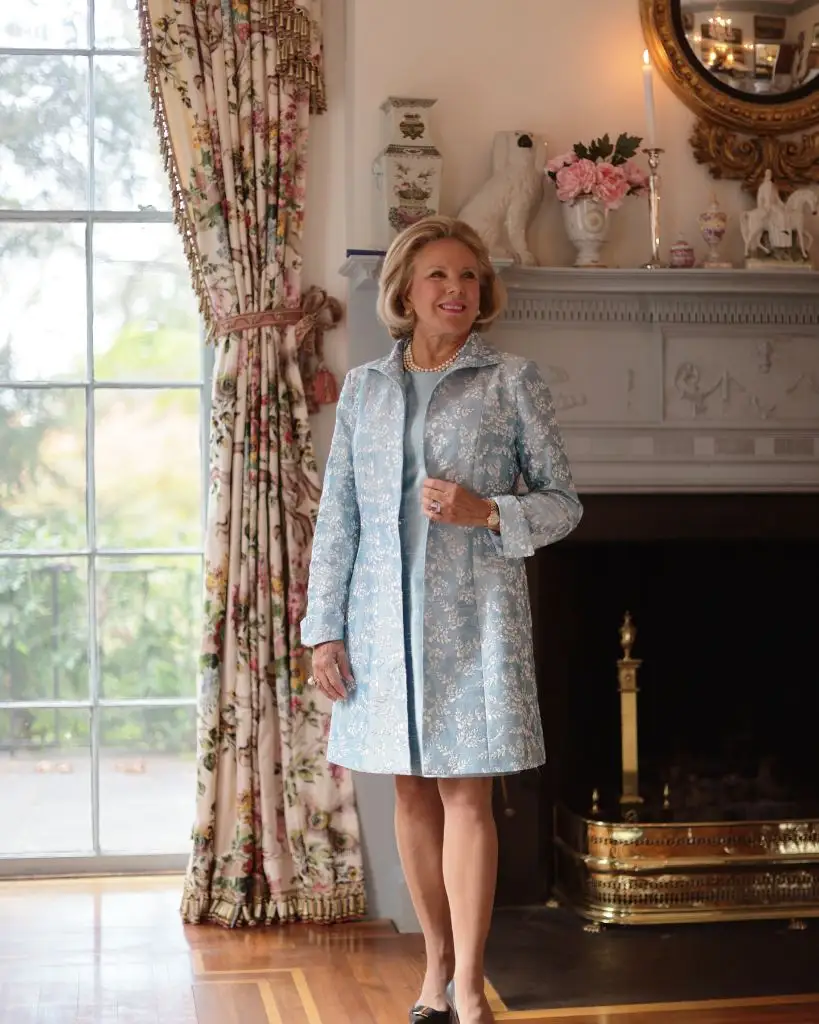
Photo via Instagram
The brocade fabric does the heaviest visual lifting. Its woven botanical motif in silver and white against the blue ground gives the coat surface richness without needing color variation. Wearing the coat open reveals the solid lighter blue beneath, and that layering creates depth: the coat reads as the decorative frame around a quieter inner piece. Pearls at the neck add a formal signal that matches the room, and dark flats keep the feet grounded without introducing another color. The hemline just above the knee is proportionally balanced with the coat length, meaning neither piece overwhelms the other. This outfit represents a more dressed-up register within elegant styling for women.
The appeal is in the restraint of the color palette. Everything is blue, silver, and white, with dark shoes as the only departure. The principle is that a richly textured fabric can carry all the visual interest an outfit needs, and when the texture is that strong, the wisest move is to keep everything else within the same tonal family.
12. A Denim Jacket Grounds Stacked Bracelets
This photograph is a close-up rather than a full outfit shot, which means the visible information is limited to the upper body. A light-wash oversized denim jacket is the main garment, and multiple layered bracelets, including beaded strands, pearl strands, and a colorful friendship-style bracelet, are stacked on both wrists. A hot pink phone case with a smiley-face grip is held in front of the chest. The setting appears to be a bathroom with white subway tile visible in the background.
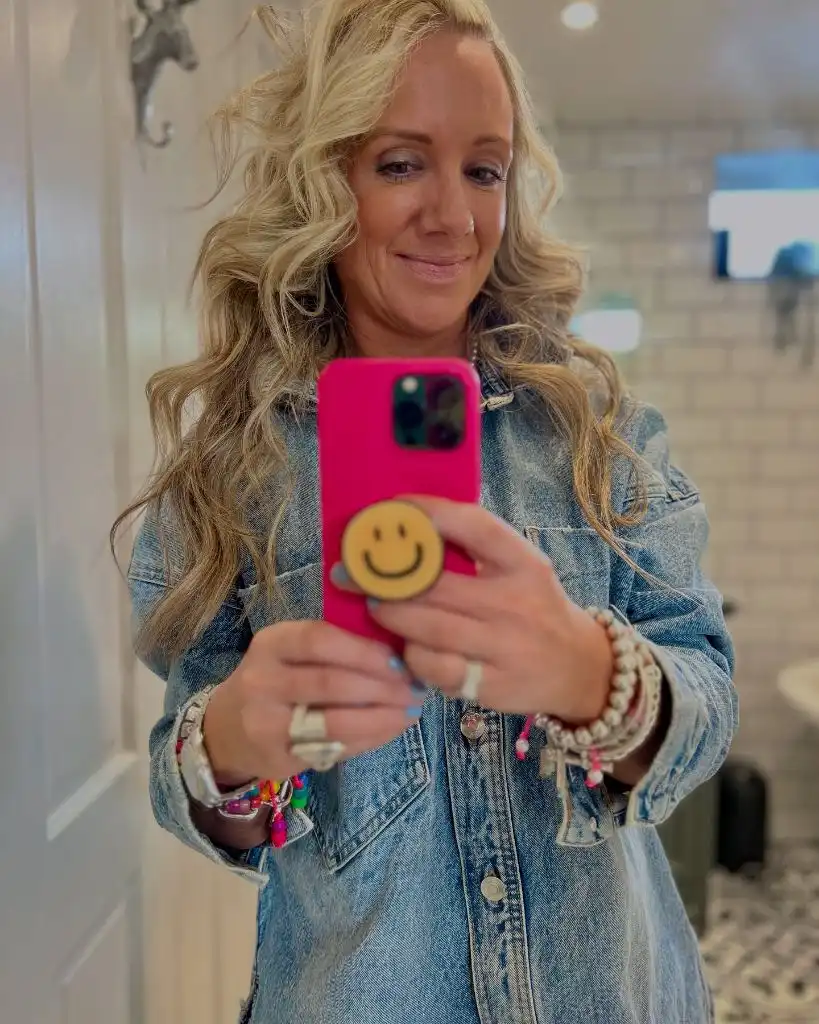
Photo via Instagram
Because the image only shows from the chest up, the readable content is about the denim jacket and the accessory layering rather than a complete outfit. The oversized fit of the jacket creates a wide, relaxed shoulder line, and the light wash has enough variation in its fading to add surface texture. The stacked bracelets are the detail that carries the most personality: mixing pearls with colorful beads and small charms creates a playful, collected-over-time quality that contrasts with the plainness of the denim. The pink phone case introduces a bright pop that, intentionally or not, becomes part of the color composition.
This is a section where the image can support a discussion about accessory layering and denim weight but cannot confirm anything about the complete silhouette. The useful principle is that an oversized, plain jacket becomes a canvas for wrist accessories, and mixing textures at the bracelet, pearls with matte beads with metallic charms, keeps the stacking from looking uniform.
13. A Tweed Blazer Sharpens a Cafe Silhouette
A double-breasted herringbone tweed blazer in warm tan and brown sits over a white crewneck top and medium-wash jeans. The blazer has a structured shoulder and hits at the hip, and a dark woven leather bag rests against the chair behind. Round tortoiseshell sunglasses, a delicate gold necklace, and a small square gold watch on the left wrist complete the accessories. The setting is an outdoor cafe terrace.
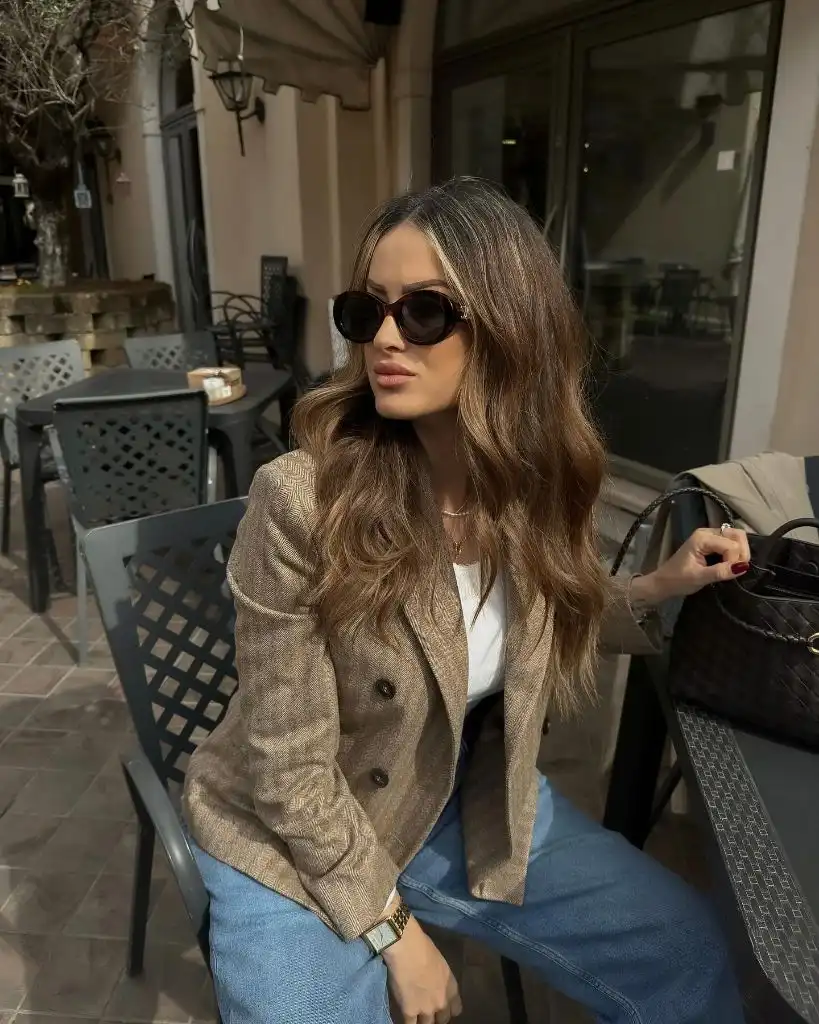
Photo via Instagram
The blazer gives this outfit all of its structure. Without it, the white tee and jeans would read as entirely casual, but the tweed fabric, the double-breasted button placement, and the defined shoulder transform the same base into something that feels intentional enough for any smart casual occasion. The warm brown of the herringbone connects to the tortoiseshell sunglasses and the gold watch, which means the warm tones repeat at three different heights: face, wrist, and torso. The jeans act as the cool counterpoint, their blue pulling the palette back toward neutral.
The strength here is in what the blazer does to pieces that would otherwise feel underdressed. It adds weight, pattern, and formality without changing the comfort level of the outfit underneath. The transferable principle is that a structured blazer in a textured fabric can upgrade a tee-and-jeans base more effectively than any other single addition, and the key is choosing a blazer with enough surface interest that it does not need to be paired with other dressed-up pieces.
14. A White Cape Lifts Plaid Ankle Trousers
A cream or ivory wool cape with a high collar and button closure is worn over a cream ribbed turtleneck sweater, and the lower half shows grey plaid ankle-length trousers. Cognac-brown pointed slingback pumps and a structured cognac suede tote with bamboo handles provide the warm accent. Tortoiseshell sunglasses and what appears to be blonde hair falling past the shoulder complete the visible details.
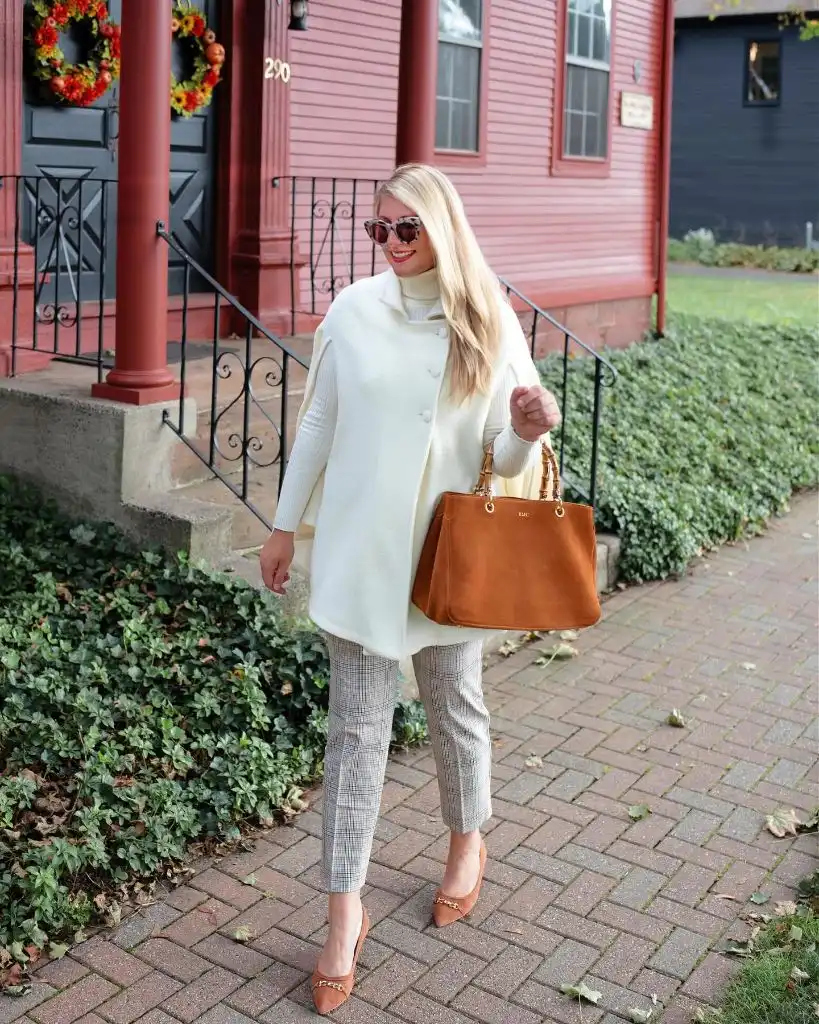
Photo via Instagram
The cape replaces what a coat would normally do but adds a different kind of volume. Instead of structured sleeves and a defined torso, the cape creates a smooth, rounded silhouette from shoulder to hip, and the plaid trousers emerging below provide the first point of visible pattern and structure. That transition from soft and shapeless to fitted and patterned gives the outfit a sense of reveal. Cognac at the shoes and the bag creates a warm thread that ties the lower half to the arm, and the cream-on-cream layering of cape over turtleneck makes the upper body feel intentionally tonal.
The best detail is how the cape and the plaid serve opposite visual functions. The cape removes structure; the plaid reintroduces it. That push and pull creates interest that a simple coat over the same trousers would not achieve. The principle is that outerwear with an unconventional shape can reframe ordinary pieces, and layered autumn outfits benefit from mixing a structural bottom with an unstructured top layer.
15. A Navy Blazer Anchors a Pleated Midi Skirt
A double-breasted navy blazer with gold buttons sits over what appears to be a light-colored top, and a tan or camel pleated midi skirt falls to mid-calf. Dark brown leather knee-high boots emerge below the skirt hem, and a red crossbody bag with a bamboo handle adds the single point of saturated color. Round sunglasses and long blonde hair are visible. The backdrop is a New England-style sidewalk covered in autumn leaves.
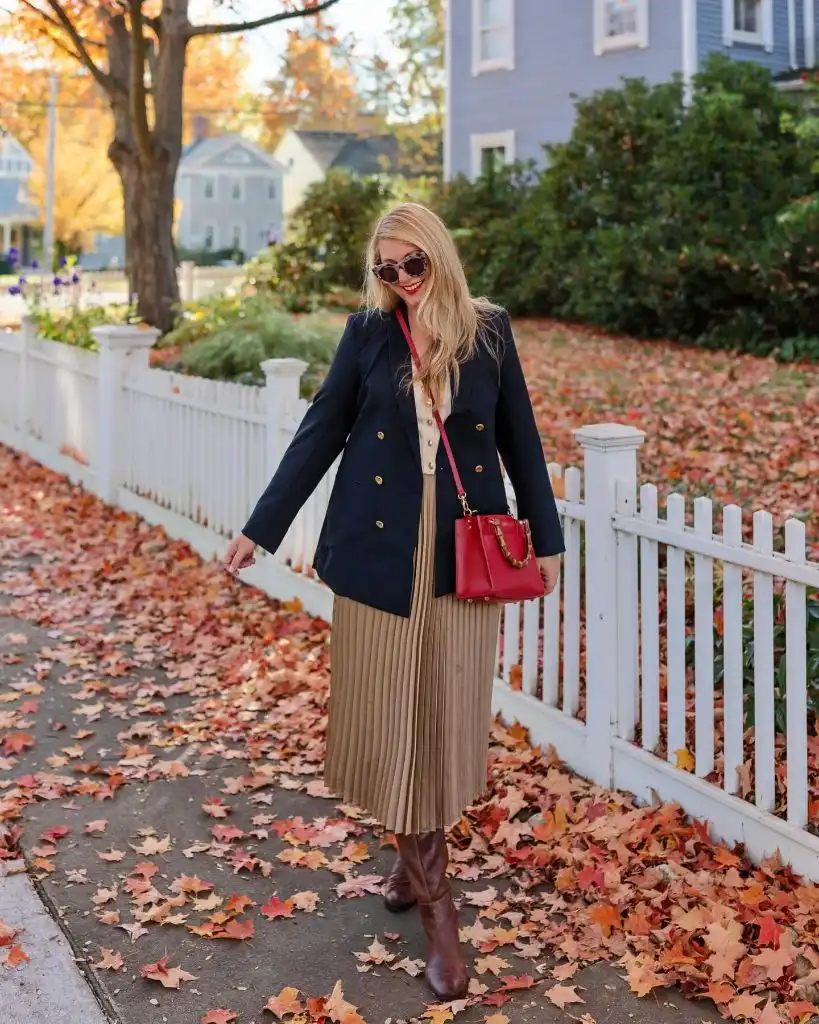
Photo via Instagram
The pleated skirt provides all the movement in this outfit. Each pleat catches light at a slightly different angle, which gives the tan fabric a sense of depth that a flat skirt would not have. The navy blazer sitting above is matte and structured, and that contrast between the fluid lower half and the rigid upper half creates a visual tension that reads as deliberate. Gold buttons on the blazer pick up the warm tone of the skirt, and the brown boots extend that warmth downward. The red bag is the only color that breaks from the navy-and-tan story, and its placement at hip level draws the eye to the exact point where the blazer meets the skirt.
The effect is classic without feeling static, and that is entirely because the pleats introduce movement that the blazer cannot. The principle here is that a structured blazer paired with a moving skirt creates a more interesting silhouette than either piece would create with a matching partner, and using one bold color accessory, here the red bag, as an accent that focuses attention can organize a multi-toned outfit.
16. A Fur Jacket Changes the Weight of a Knit
A deep chocolate-brown faux fur jacket with a zip front is worn open over a brown knit sweater with the word “KIND” printed in dark letters across the chest. The photograph is a close-up from approximately the waist up, so the lower body is not fully visible, though what appears to be a dark brown skirt or trousers is partially shown. Large tortoiseshell sunglasses cover much of the face, and the setting is a rural outdoor area with a weathered barn and corrugated iron roof.
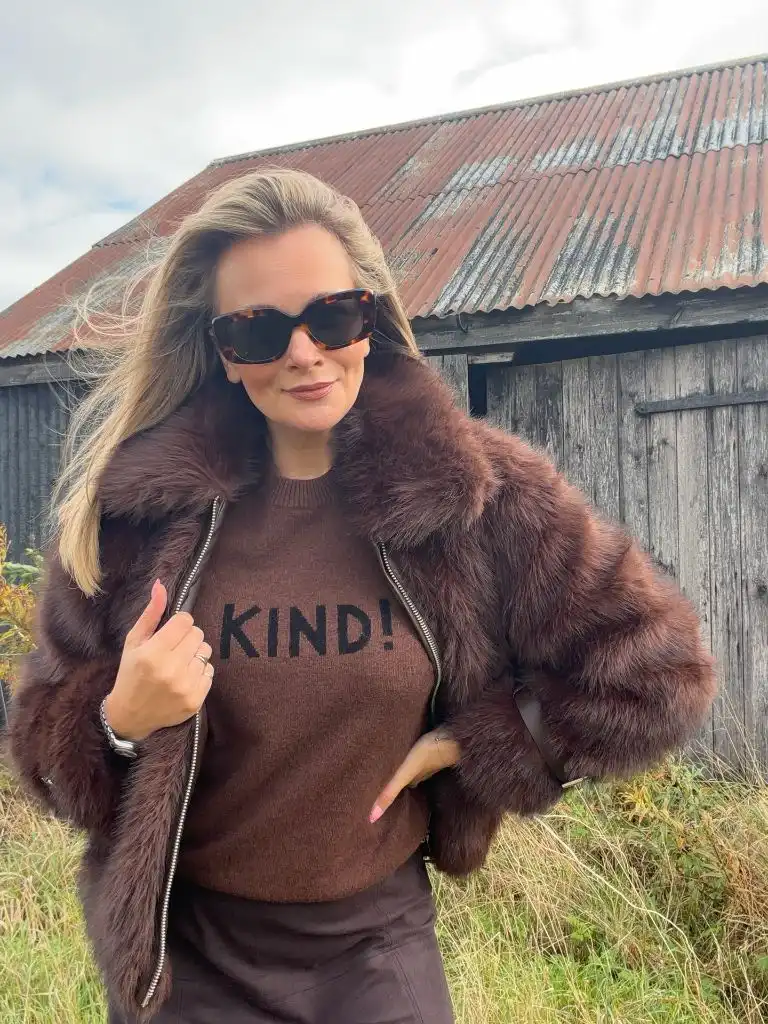
Photo via Instagram
The entire outfit operates within a single color family: deep brown, chocolate, and dark mahogany. That tonal commitment means the differences between pieces come entirely from texture rather than color. The fur jacket has a plush, high-pile surface that catches light in rounded highlights, while the knit sweater beneath is flat and matte. That textural gap is what makes the two pieces legible as separate garments rather than a single block. The tortoiseshell sunglasses belong to the same brown family and extend the tonal story to the face, creating a monochrome effect that runs from eyewear to hemline.
The value is in proving that a monochrome outfit does not flatten when the textures vary enough. The fur gives the outline its weight, the knit gives the interior its simplicity, and the interplay between them keeps the eye moving. The transferable principle is that tonal dressing in a dark, warm color needs texture range to avoid looking heavy, and winter outfit layering done well almost always relies on this kind of surface variation.
17. A Trench Jacket Opens Over a Pale Tonal Base
A beige or sand-colored short trench-style jacket with a relaxed cut and wide collar sits open over a pale blue crewneck or V-neck sweater. White relaxed-fit trousers with a slight roll at the ankle complete the lower half, and beige platform sneakers with a gum sole keep the footwear in the same tonal range. A dark burgundy leather tote rests on the step behind, and round sunglasses are held at the forehead. The setting is a concrete outdoor area with green trees in the background.
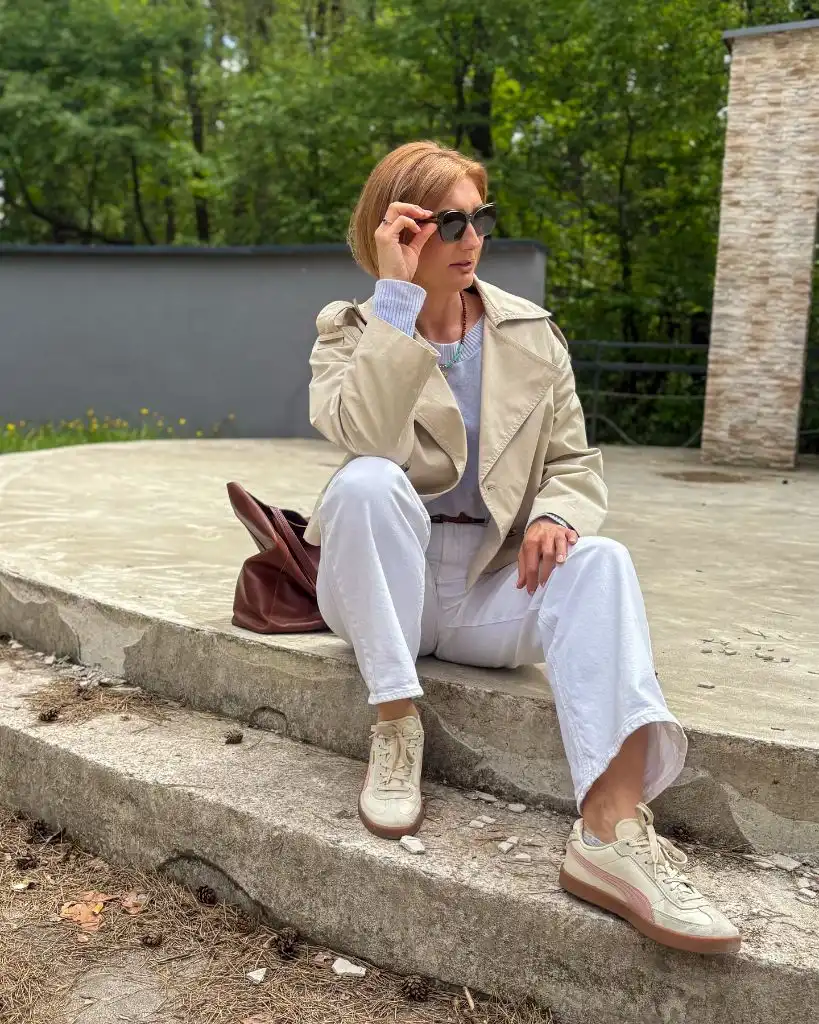
Photo via Instagram
The palette here sits in a very narrow range: beige, white, pale blue, and cream, with only the burgundy bag stepping outside it. That restraint means every piece blends into the next, and the effect is a fluid, column-like silhouette where individual garments are subordinate to the overall tone. The platform sneakers add a small amount of height and a visual anchor at the base, and their beige-and-gum combination mirrors the jacket color almost exactly. The pale blue sweater is the coolest tone in the outfit and provides just enough temperature contrast to keep the palette from feeling washed out.
This is the kind of outfit where the burgundy bag becomes the compositional key. Without it, the palette might read as too uniform, but the single dark accent sitting behind the body gives the whole frame a point of depth. The principle is that a tonal outfit in light neutrals benefits from one darker element placed off-center, and that placement creates a sense of dimension that monochrome alone cannot achieve.
18. A Sage Utility Jacket Frames a Cream Shirt
The visible portion of this outfit is a sage green utility-style jacket with a snap-button closure worn open over a cream or pale yellow textured shirt with a popover-style collarless neckline. The shirt collar is popped slightly, and the jacket sleeves are pushed to the forearms, revealing the shirt cuffs beneath. A delicate gold chain necklace and gold hoop earrings are the only accessories visible. The photograph is cropped from roughly the chest up.
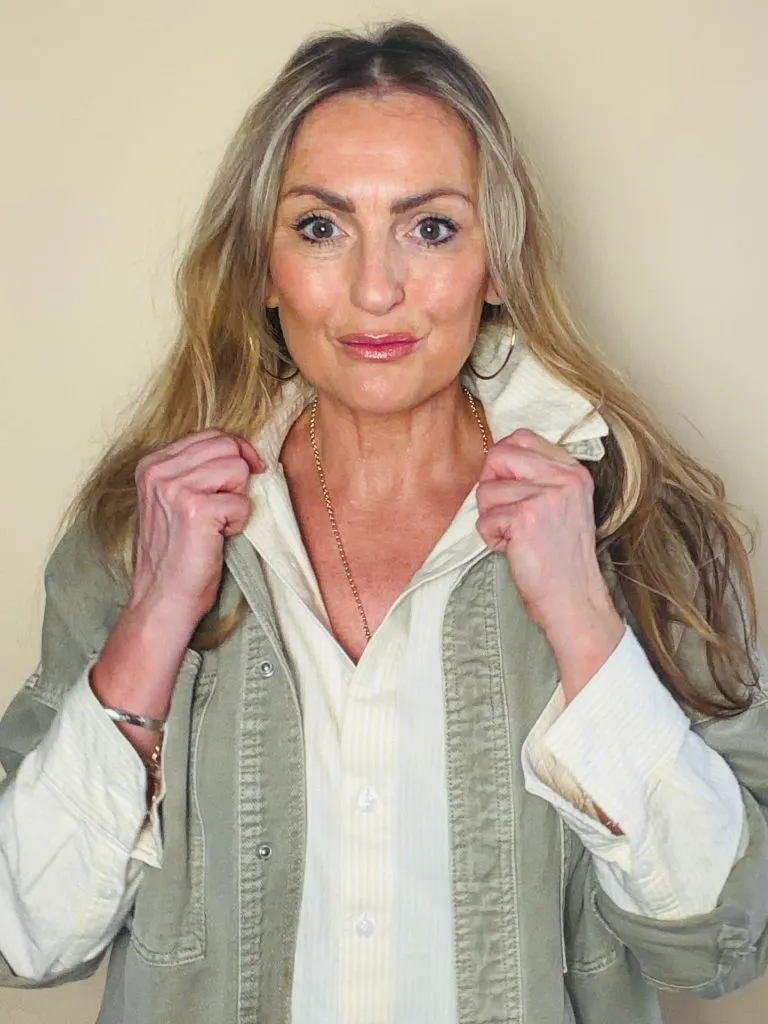
Photo via Instagram
Because the image is cropped tightly, the readable information is limited to the layering relationship between the jacket and the shirt and the accessory choices near the face. The sage green is muted enough to read as a neutral, and the cream shirt beneath it provides a lighter base that makes the green visible without competing with it. The texture of the shirt, which appears to have a subtle stripe or seersucker quality, adds surface interest that the flat cotton of the jacket does not share. Pushing the jacket sleeves up creates a casual, undone quality and shows the contrast between the two fabrics at the forearm.
The appeal is in the controlled layering of two neutral pieces where the only decorative elements are gold at the ears and neck. This image cannot confirm the full silhouette, but what it shows is that layered neutral combinations depend on subtle differences in color temperature and fabric weight to register as intentional rather than haphazard. The principle is that popping a collar and pushing up sleeves are small gestures that make a layered top half look active rather than passive.
19. An Oversized Plaid Shirt Dress Carries Bold Pattern
A full-length button-front shirt dress in a large-scale orange, teal, and white plaid falls to approximately ankle length in a voluminous, billowing silhouette. The short cap sleeves are wide, and the dress appears to have no defined waist, creating a tent-like shape from shoulder to hem. Clear transparent mule sandals are visible at the feet. The setting is an indoor space with a woven floor vase and a contemporary art print on the wall.
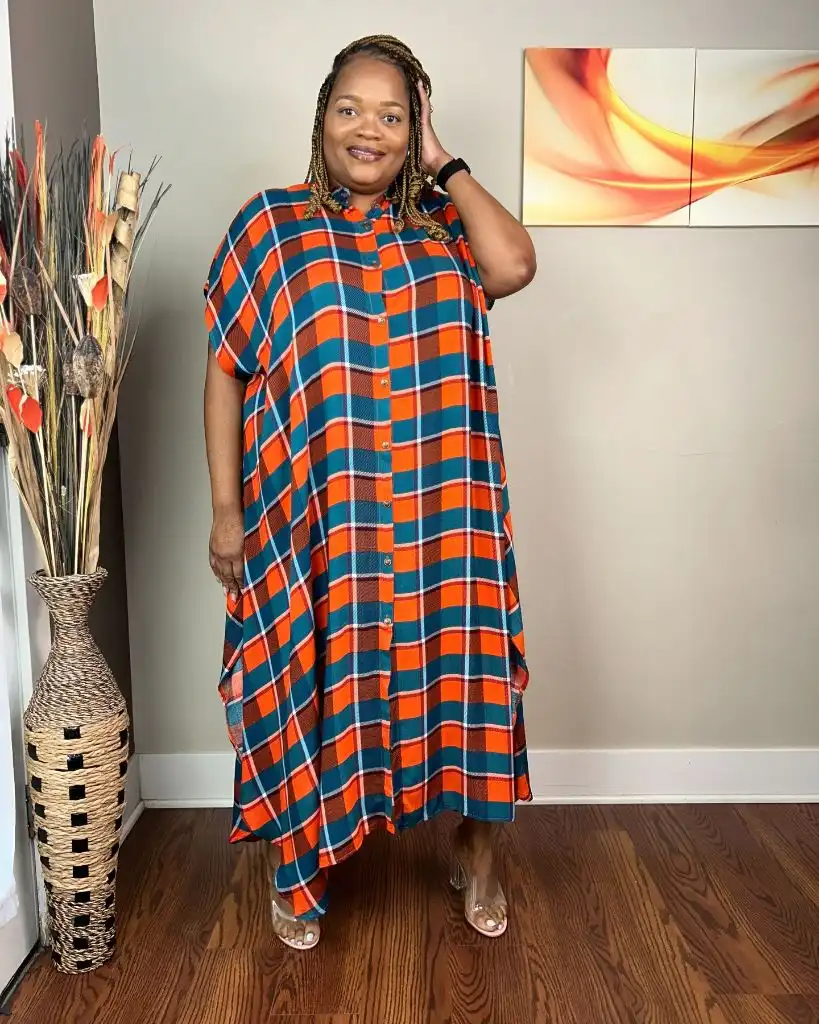
Photo via Instagram
The scale of the plaid does most of the work here. Large blocks of orange and teal in a diagonal grid pattern create a graphic quality that reads more like a textile art piece than a traditional garment pattern. The oversized silhouette lets the plaid unfold without interruption, and the lack of a defined waist means the pattern reads as a continuous surface from shoulder to floor. Clear sandals at the feet are a smart choice because any colored shoe would have introduced a competing element at the base of a very loud pattern. The result is that the dress is the entire visual event, and everything else disappears.
This is a deliberate maximalist approach where one piece carries every function: color, pattern, shape, and statement. The transferable principle is that when a pattern is this bold and a silhouette is this generous, the best accessory decision is near-invisibility, because the garment is already doing everything that needs to be done and additional elements would only dilute its impact.
20. A White Blouse Frames a Seated Denim Moment
A white textured button-front blouse with wide, slightly belled sleeves is worn with the top button open, and the cuffs fall well past the wrist. The lower half shows dark indigo denim jeans in a relaxed straight cut. The figure is seated cross-legged on a beige boucle chair or ottoman, barefoot, with red-painted toenails the only visible color accent. The background is a clean, muted lavender-grey wall.
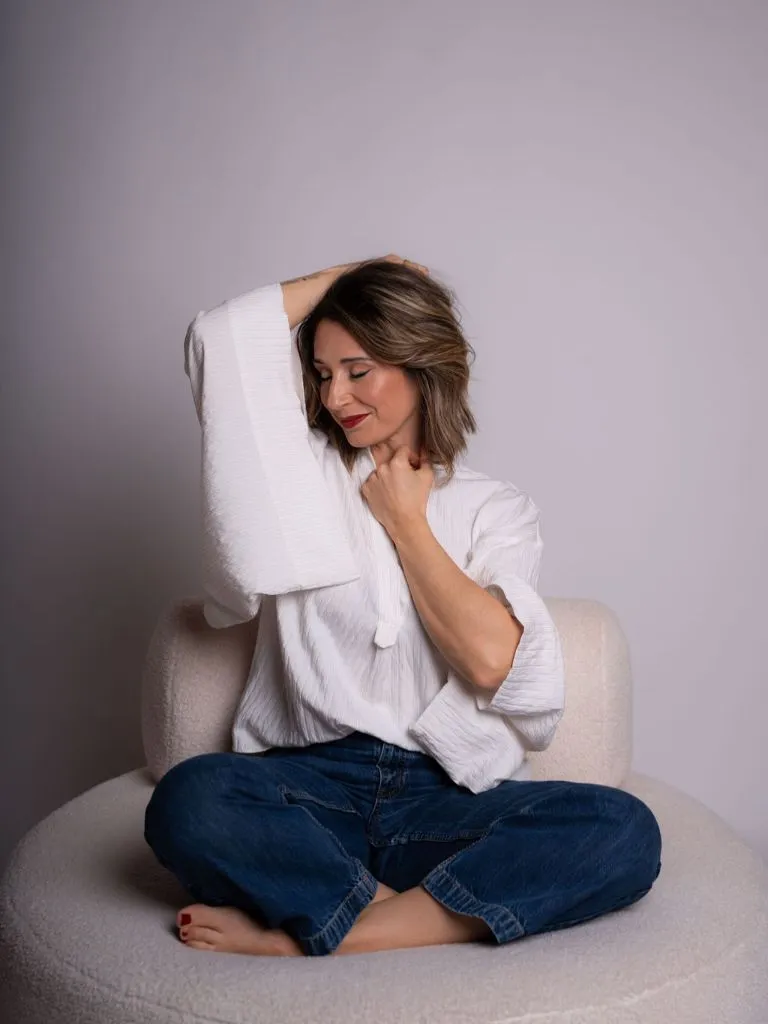
Photo via Instagram
The white blouse and dark denim pairing is one of the most common combinations in casual dressing, but the details here elevate it beyond the ordinary without adding anything extra. The wide, slightly oversized sleeves give the blouse a sculptural quality that a fitted sleeve would not have, and the texture of the fabric, which appears to have a subtle crinkle or plisse finish, adds surface variation that catches light unevenly. The seated pose folds the denim into soft shapes that contrast with the blouse’s drape, and the bare feet introduce an intimacy that a shoe choice would formalize.
The best detail is the red toenail polish, which is the only saturated color in the entire frame. That tiny point of red against the white, indigo, and beige creates a focal point at the lowest part of the composition, and its unexpectedness is what makes it interesting. The principle is that a deliberate lack of accessories can be its own styling choice, and a quiet outfit like this benefits from approaches discussed in classic wardrobe foundations.
21. A Sleeveless Vest Suit Sharpens a Sporty Base
A tan or olive-gold sleeveless vest with a notched lapel and patch pockets is worn over a white cropped polo-style top that ends just above the high waist of matching wide-leg trousers. A white baseball cap, oversized gradient sunglasses, and drop earrings accessorize the upper body. A two-tone structured handbag in cream and brown hangs from the right hand. A Chanel-style brooch is pinned to the left lapel of the vest. The backdrop is a large outdoor mosaic mural.
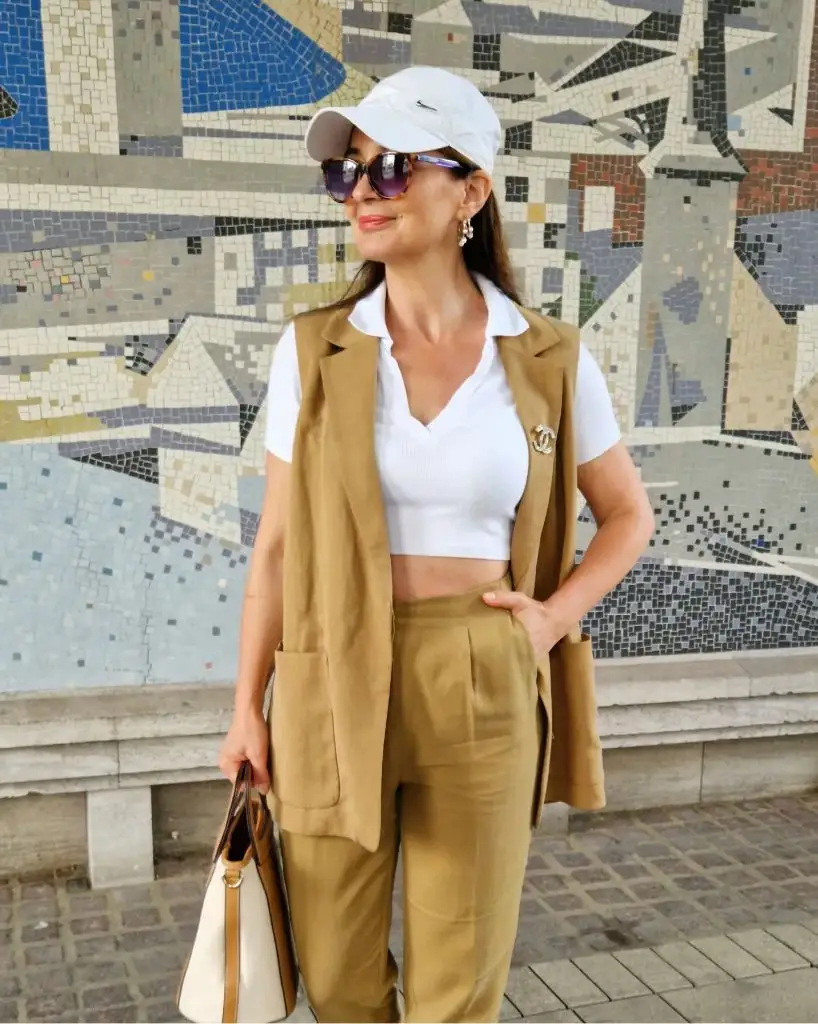
Photo via Instagram
The vest-and-trouser set creates a suiting silhouette without sleeves, and the white cropped polo beneath introduces a sporty element that prevents the outfit from reading as strictly tailored. That tension between suiting and sportswear is the central idea of the look. The baseball cap reinforces the athletic side, while the structured bag and the lapel brooch pull toward formality, and the outfit sits comfortably in the middle because neither influence dominates. The wide-leg trouser gives the lower body a fluid line that balances the structured vest above.
The effect is that the outfit reads as both polished and relaxed, which is difficult to achieve without the kind of intentional mixing shown here. The brooch on the lapel is a small signal of formality that does a disproportionate amount of work. The transferable principle is that mixing a sporty base piece, here the polo and cap, with a suiting structure changes both: the suit feels more approachable, and the sportswear feels more styled and purposeful.
22. Red Stripes Meet a White Linen Maxi Skirt
A red-and-white horizontal striped short-sleeve knit top is tucked into a white linen maxi skirt that falls to the ankle. Red flat sandals match the red of the top, and a woven straw tote with dark leather handles hangs from the left hand. A gold watch on the right wrist and oversized black sunglasses are the other visible accessories. The setting is a cobblestone street in front of a black-and-white half-timbered building with an ornate dark metal door.
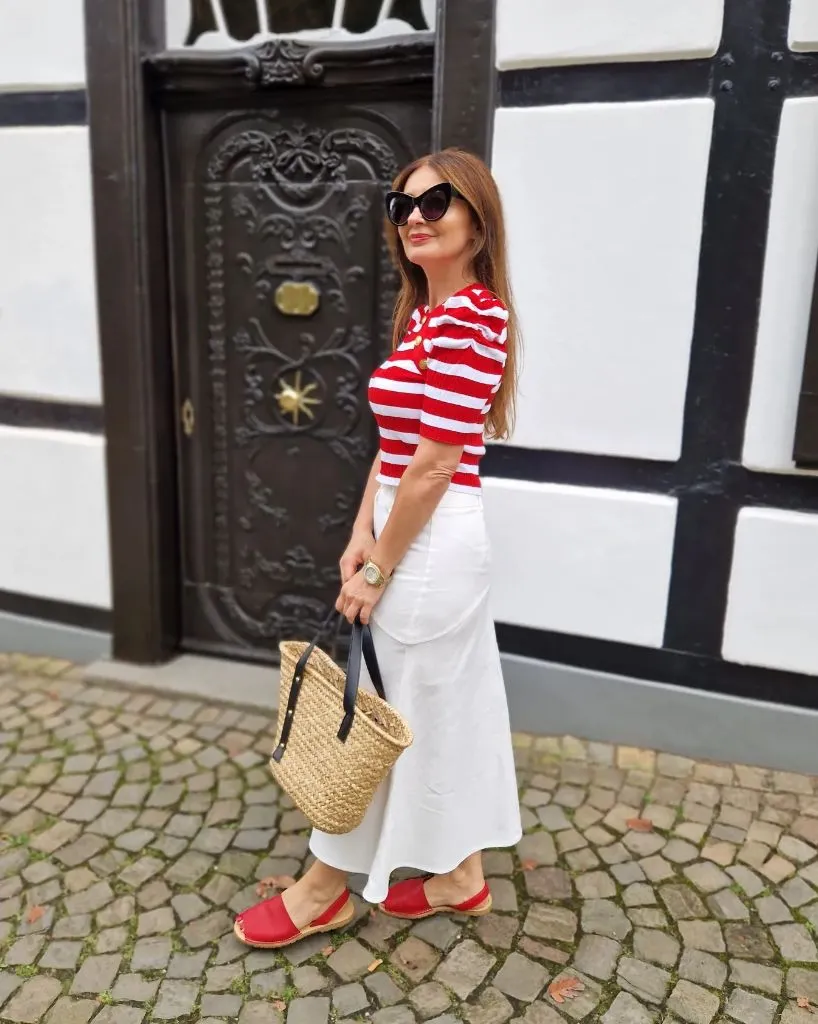
Photo via Instagram
The red operates at three points: the stripes, the sandals, and the inside of the tote’s leather trim. That repetition creates a red circuit that runs from the top of the outfit to the feet and back to the hand, giving the eye a continuous loop rather than a single landing point. The white linen skirt is the resting space between those red moments, and its length and weight provide a grounding effect that keeps the stripes from feeling too graphic. The straw tote introduces a third texture, woven against knit against linen, and its natural tone provides warmth without adding another color.
This is a clear example of how color repetition across separate garments creates cohesion. The outfit has only two real colors, red and white, but they appear in three different textures and at three different heights, which is enough variety to feel dynamic. The principle is that repeating a bold color at the extremities, head and feet or top and bag, creates a frame that holds even a simple outfit together.
23. A Grey Cardigan Grounds Black Wide-Leg Trousers
A light grey button-front cardigan with brown or tortoiseshell buttons is worn open over a white crewneck tee. Black wide-leg trousers with a drawstring waist fall straight to the ankle, and black-and-white retro-style sneakers finish the base. A small black crossbody bag on a striped black-and-white strap cuts diagonally across the torso. The setting is an indoor living space with framed photographs on a wooden cabinet and polished hardwood floors.
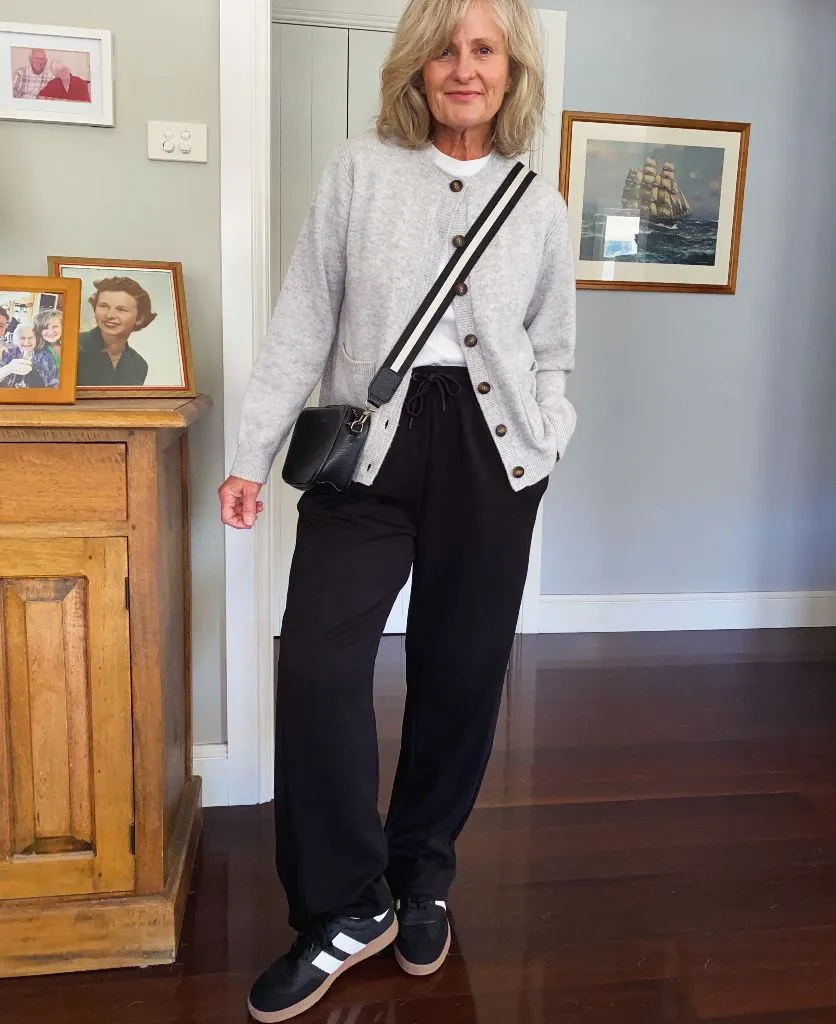
Photo via Instagram
The color story is greyscale with no warm accent: grey, white, black, and the small tortoiseshell buttons as the only hint of brown. That cool, stripped-back palette puts all the emphasis on silhouette and proportion. The cardigan sits at the natural waist and stops before the hip, which means the black trousers create a long, unbroken dark line from waist to ankle. The striped bag strap echoes the black-and-white of the sneakers, and those two diagonal and horizontal striped elements add rhythm to an otherwise solid-color outfit. The sneakers keep the register firmly casual and connect this look to a category of trendy outfits for women over 40 who prioritize comfort without sacrificing visual clarity.
The strength here is that nothing competes. Every piece is quiet enough to let the overall shape speak, and the shape, wider at the leg, relaxed at the cardigan, fitted nowhere, reads as deliberately modern. The principle is that a greyscale outfit depends entirely on good proportions, and when the proportions are right, the absence of color becomes a style choice rather than a gap.