A vision board is a collage of images, words, and phrases that represent the life you want to build — the goals, feelings, and milestones you are working toward. Done well, it is not a wish list you hope the universe delivers. It is a daily prompt that keeps what matters in front of you and nudges you toward the next real step.
This guide walks through the whole process: getting clear on your goals before you touch a pair of scissors, choosing images that actually mean something to you, building the board step by step, and using it every day so it stays alive. A good time to start is during a weekly reset, like the one in Sunday Reset Checklist for Home and Body, when you already have space to think about the week ahead.
Key Takeaways
- Start with clarity, not scissors — a board without clear goals is just a pretty collage.
- Focus on 3–5 life areas with 1–3 specific goals each, so the board says something instead of everything.
- Choose images for emotional resonance, not just looks — pick what makes you feel something.
- Place the board where you will see it within the first 30 minutes of your day.
- Review and update it monthly, and pair it with one small action at a time.
What a Vision Board Is — and What It Is Not
A vision board works as a daily visual reminder of what you want, why you want it, and what you are doing next to move toward it. When you see images connected to your goals every day, your brain begins to notice related opportunities — psychologists point to the reticular activating system, the brain’s filter for what deserves attention. Research on visualization and mental practice also suggests that picturing the steps toward an objective can improve motivation and performance.
The honest part first: a board on its own will not make anything happen. Research by psychologist Gabriele Oettingen at NYU found that pure positive fantasy about the future can actually decrease motivation, because the brain confuses imagining the achievement with achieving it. What works better is picturing the wish and the best outcome, then the obstacle, then a plan — a method she calls WOOP: Wish, Outcome, Obstacle, Plan. A vision board is most powerful when it sits next to that kind of honest planning, not instead of it.

Photo via thebeautyboost.net
Step 1: Get Clear on Your Goals First
Before collecting a single image, spend 20–30 minutes reflecting on what you actually want. Pick three to five life areas that matter most right now — health, career, relationships, home, creativity, travel, money — and write one to three specific goals for each. A board where every area competes for attention says nothing; a focused board speaks clearly.
Ask yourself three questions for each area: What do I want? How will I know I have it? What is one small step I could take this week? Make each goal concrete — what, how much, by when — and write it in the present tense, in words you can believe: “I am building a life I love” rather than a vague “be happy.” Write down feelings too, not just things. The feeling you want — calm, proud, free — is often the real goal underneath the object.
Step 2: Gather Your Materials and Images
Physical or Digital?
Both formats work, and the choice is personal. A physical board — poster board, scissors, glue, a marker, and a stack of pictures from magazines or printouts — takes one to three hours and gives you something tangible on the wall. A digital board, made in Canva or Pinterest or even a phone photo album, takes 30–60 minutes and travels with you as a wallpaper or lock screen. Some people do both: a physical board at home and a digital version on their phone.
Collect Freely, Then Filter
Start by collecting without judging — tear out or save anything that catches your eye. Then filter: keep only the images that make you feel something when you look at them. Emotional resonance is the test. A beautiful photo of a house means nothing if the feeling you want is freedom, not square footage. Aim for three to five pictures per area, roughly 9–15 in total. Add words and short phrases in your own handwriting or printed type — one short line per area, in the present tense.
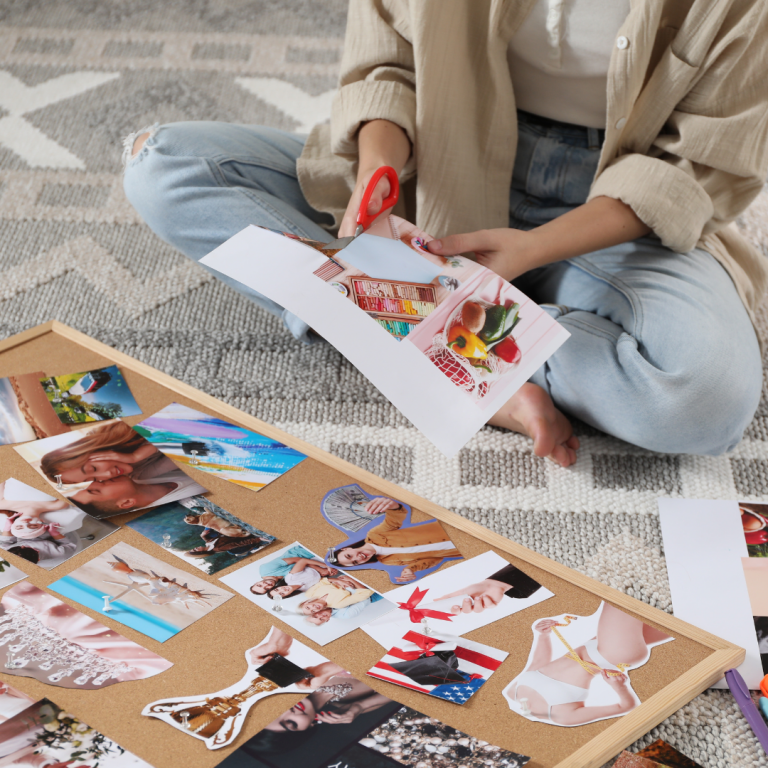
Photo via isayabelle.com
Step 3: Build Your Board
Arrange everything before you glue or save anything. Give each life area its own zone on the board, put the goal that matters most in the centre or at the largest size, and leave some white space — a crowded board is hard to read at a glance. Think in layers: larger images first, then smaller ones, then words and affirmations on top.
Once the layout feels right, secure everything in place. Then step back and assess: does the board feel like you? Does each zone make you feel the way you want to feel? If a section feels flat, swap the image. The board should pull you in, not just look tidy. Your goals deserve the same considered presentation you give the rest of your life — the way a confident outfit, like the polished options in Classy Business Casual Outfits or the relaxed polish of Classy Casual Work Outfits, reflects the person you are becoming.
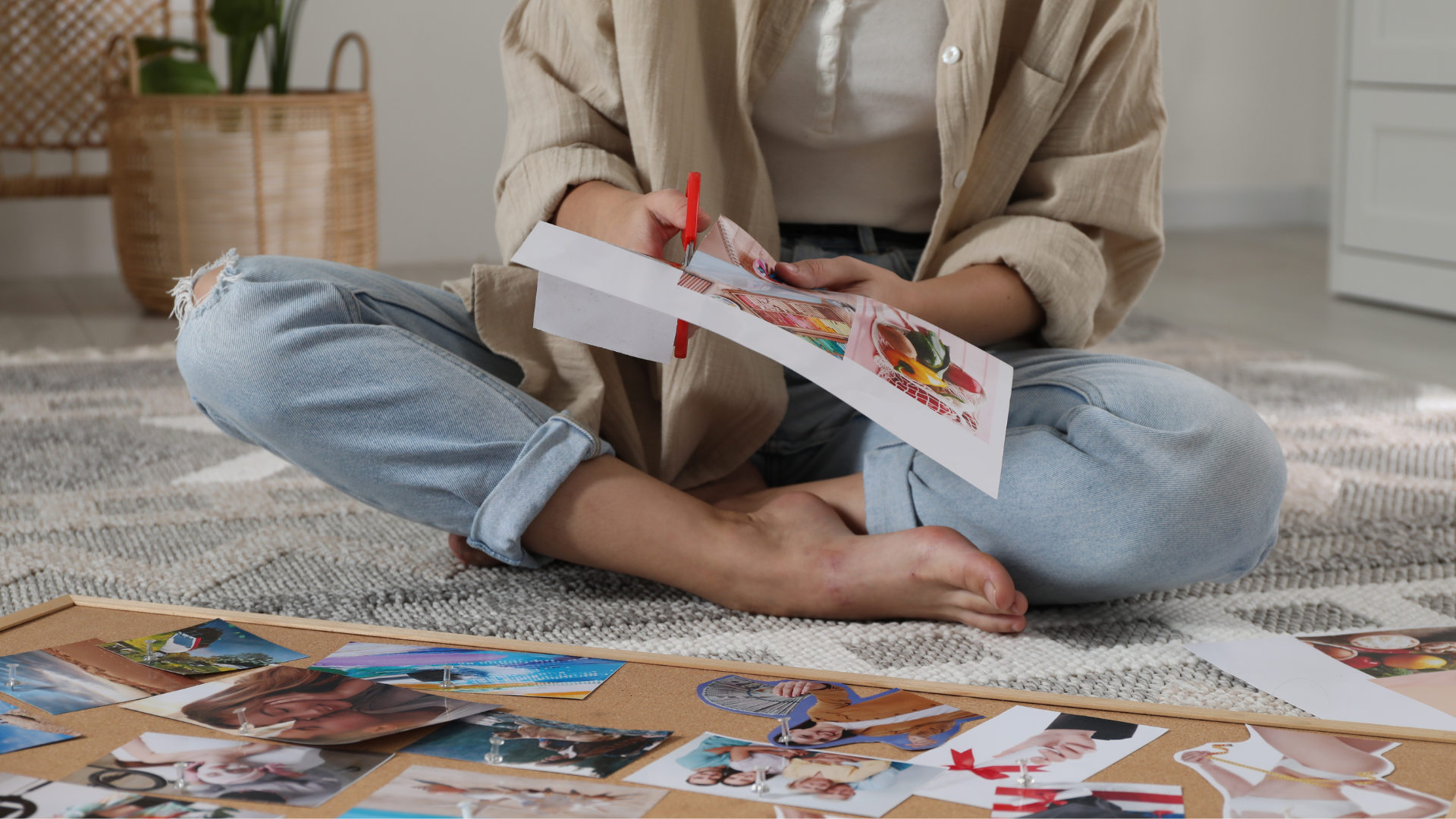
Photo via albapsicologos.com
Step 4: Place It and Use It Every Day
Place It Where You Will Actually See It
A board in a drawer is worthless. Put it where your eyes land several times a day — beside your bed, above your desk, on the wall you face while you have your morning coffee — ideally within the first 30 minutes of your day. If your board is digital, make it your phone wallpaper or home screen widget. The point is not decoration; it is daily contact. Seeing your goals every morning shapes what you notice and what you choose for the rest of the day.
Use It Every Day
This is the step that turns a poster into a practice. Spend a minute or two with your board each morning. Do not just glance at it — look at one part and let yourself feel what it would be like to be living that. Then take one small action connected to it: buy the book, take the walk, send the message. On the day you make your board, make one small wish from it come true right away — that first action tells your brain the board is real, not decoration.
Review the board once a month and plan for it to run about a year. Check off a goal the evening it comes true, and replace it with the next one. Expect about half of what goes on a yearly board to come true — that is an honest number, and it is a good one. The board is not a test you pass or fail; it is a compass you keep checking. Students often find the same focus useful for study goals too, and a simple, put-together look — like the easy campus ideas in College Outfit Ideas: Casual Campus Style — keeps mornings simple so the goals stay front of mind.

Photo via cjelaval.qc.ca
Common Vision Board Mistakes to Avoid
Starting with images instead of goals: without clarity first, you end up with a collage of other people’s dreams. Reflect before you collect.
Packing in too much: a board with every life area shouting at once says nothing. Three to five areas, with the biggest image going to the goal that matters most.
Choosing images for looks alone: if an image does not stir a feeling, it will not stir action. Resonance beats aesthetics.
Hiding the board: a board you never see cannot motivate you. Placement is half the method.
Forgetting the action: visualization without a next step is daydreaming. Pair every glance with one small, concrete action.
Frequently Asked Questions
How long does it take to make a vision board?
A physical board takes one to three hours from start to finish, including the reflection time. A digital board on Canva or Pinterest can be done in 30–60 minutes, depending on how much time you spend selecting images. There is no set timeline — take the time your goals deserve.
Should my vision board be physical or digital?
Either works. A physical board is tangible and hard to ignore on a wall; a digital board travels with you as a phone wallpaper. Some people make both. Choose the format you will actually look at every day.
How often should I look at my vision board?
Daily, ideally in the morning. Spend a minute or two with it — look at one section, feel what it would be like to live it, and take one small action connected to it. A quick daily glance beats a long monthly stare.
Do vision boards actually work?
A board on its own will not make things happen. What it does is keep your goals visible, which shapes what you notice and what you act on — and research on visualization shows a small but reliable positive effect on motivation and performance. The board works when it is paired with honest planning and small, consistent actions.
When should I update my vision board?
Review it once a month and refresh it at least once a year. Check off goals as they come true, replace them with new ones, and remove anything that no longer fits. A board that never changes eventually becomes wallpaper you stop seeing.
Final Thoughts
A vision board that motivates is built on clarity, not decoration. Get clear on what you want, choose images that make you feel it, place the board where you cannot miss it, and pair every glance with one small action. Half your board may come true in a year — and the half that does will have started with the moment you sat down, decided what matters, and put it where you could see it every day. The rest of your life can reflect the same intention, from the goals on your wall to the ease of everyday style in Casual Style Inspiration: Oversized Outfits and Brown Outfit Ideas for Everyday Looks.
Disclaimer: This article is for general informational purposes only and does not constitute professional, psychological, or financial advice. Goal-setting tools like vision boards support motivation and planning, but they do not replace professional guidance for health, career, or financial decisions.