There is a particular kind of pressure that comes with choosing a shorter cut. People around you will have opinions. They will tell you what suits your face, what flatters your age, what a bob is supposed to look like. But the truth is that a-line bob haircuts exist in so many forms that the only person who needs to feel right about the angle is you. A cut like this does not require justification. It requires clarity about what you actually want to see in the mirror.
The useful question is not whether an a-line bob will work on you but which version of it reflects the balance you are already drawn to. This article moves through twenty distinct photographs, and each one handles the same structural idea differently. The variables worth watching are proportion, meaning how steep the angle runs from back to front, and then texture, whether the surface is blown smooth or left with some bend. After that, the decisions become about tone, placement of weight, where the perimeter falls relative to the jaw and chin, and how much movement the cut allows or prevents. Some of these are sharp and architectural. Others are loose and lived-in. The range is the point, and the details inside each image are where the real information sits.
1. A Sharp Angle Frames the Jaw With Precision
The first detail the eye registers is the steep diagonal line running from the shortened back to the longer front pieces. The hair is jet black, blown completely smooth, and the angle is dramatic enough that the longest strands reach well below the chin while the back sits high against the nape. The surface has a glass-like finish with no visible texture or layering breaking the perimeter.
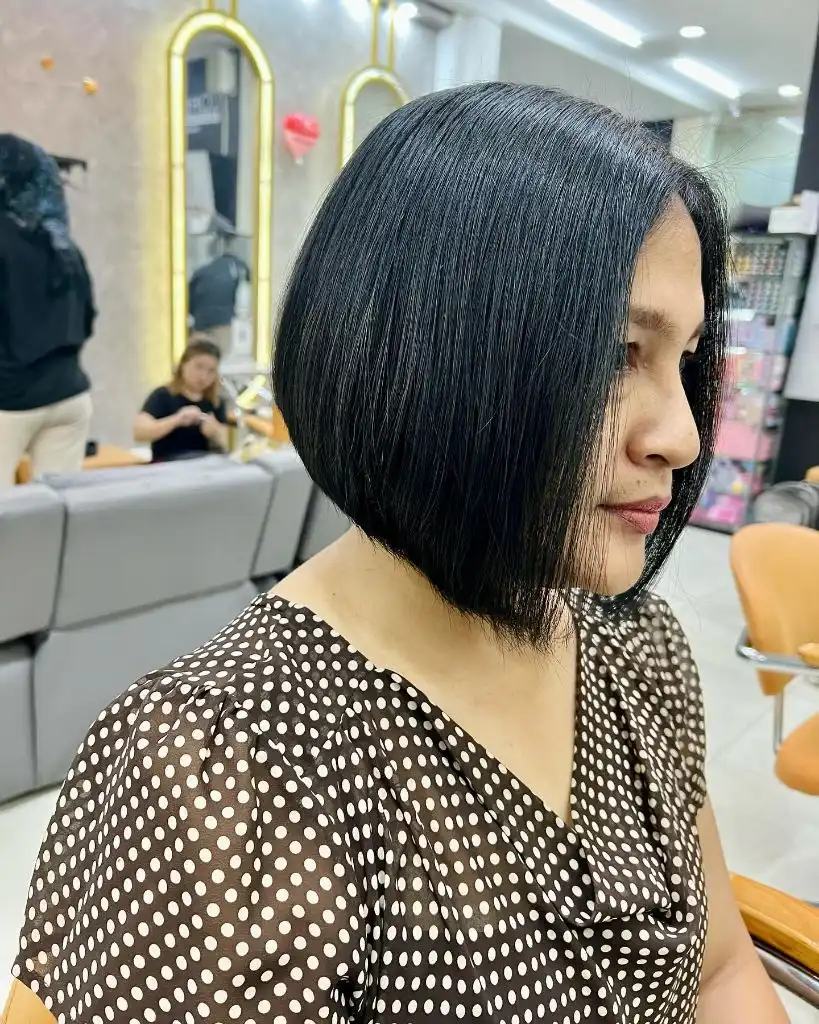
Photo via Instagram
The salon setting visible in the background, with its gold-framed mirrors and waiting area, confirms this is a freshly completed cut, and that context matters because the precision of the line depends on how recently it was shaped. The polka-dot blouse creates a visual rhythm against the unbroken dark surface of the hair, and that contrast between the busy pattern below and the clean geometry above makes the angle read even steeper than it might against a plain top. The weight sits entirely at the front, pulling the eye forward and down along the jawline.
This is a cut that announces its structure openly. The lack of layering means the perimeter does all the talking, and every centimeter of angle is visible. If you are drawn to a version of the a-line bob that leaves no ambiguity about its shape, the principle here is simple: keep the surface smooth and let the diagonal carry the entire design.
2. Bangs Soften an Otherwise Geometric Perimeter
The dark brown bob here sits at a moderate angle, shorter in the back and reaching roughly to the jawline at the front. What changes the reading is the presence of soft, side-swept bangs that break across the forehead and partially cover one eye. The texture is smooth but not as rigidly blown-out as a salon finish, giving the hair a natural density without visible flyaways.
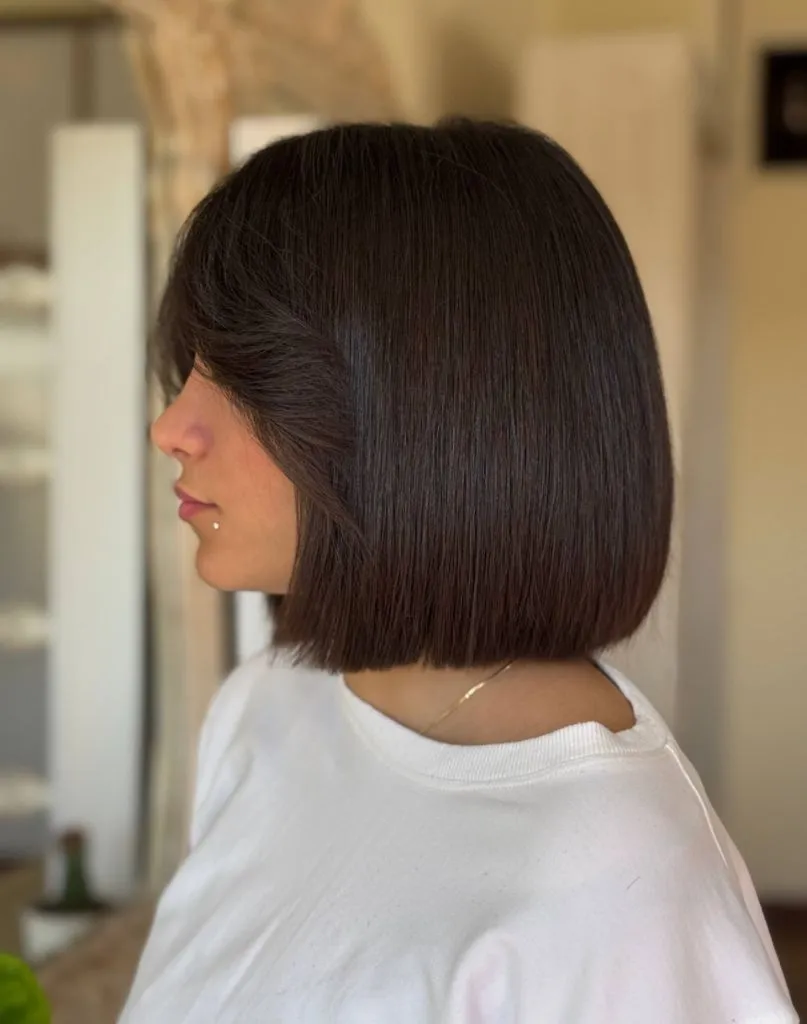
Photo via Instagram
The white t-shirt and the warm, stone-toned background keep the focus entirely on the cut. Without competing color or pattern, the shape of the bob reads clearly, and the bangs become the strongest visible detail. They introduce a horizontal line across the forehead that interrupts the vertical drop of the sides, and that interruption softens what would otherwise be a fairly sharp geometric silhouette. The back appears slightly stacked, creating a rounded fullness at the crown that gives the profile a sense of volume even though the overall length is short.
The appeal is the way the bangs redistribute attention. In most a-line shapes, the eye follows the angle downward. Here, the fringe catches the gaze first and holds it near the face before the angle takes over. That layered entry point is worth considering for anyone who wants the angled structure without the severity.
3. A Center Part Opens the Face Against Dark Hair
The hair here is a rich dark brown, parted cleanly down the center, and the cut falls in a straight, blunt line that angles slightly from the back to just past the chin. The finish is smooth and flat-ironed, with no visible wave or curl. A black fabric mask covers the lower face, which shifts attention entirely to the hair’s line and the way it frames the eyes and forehead.
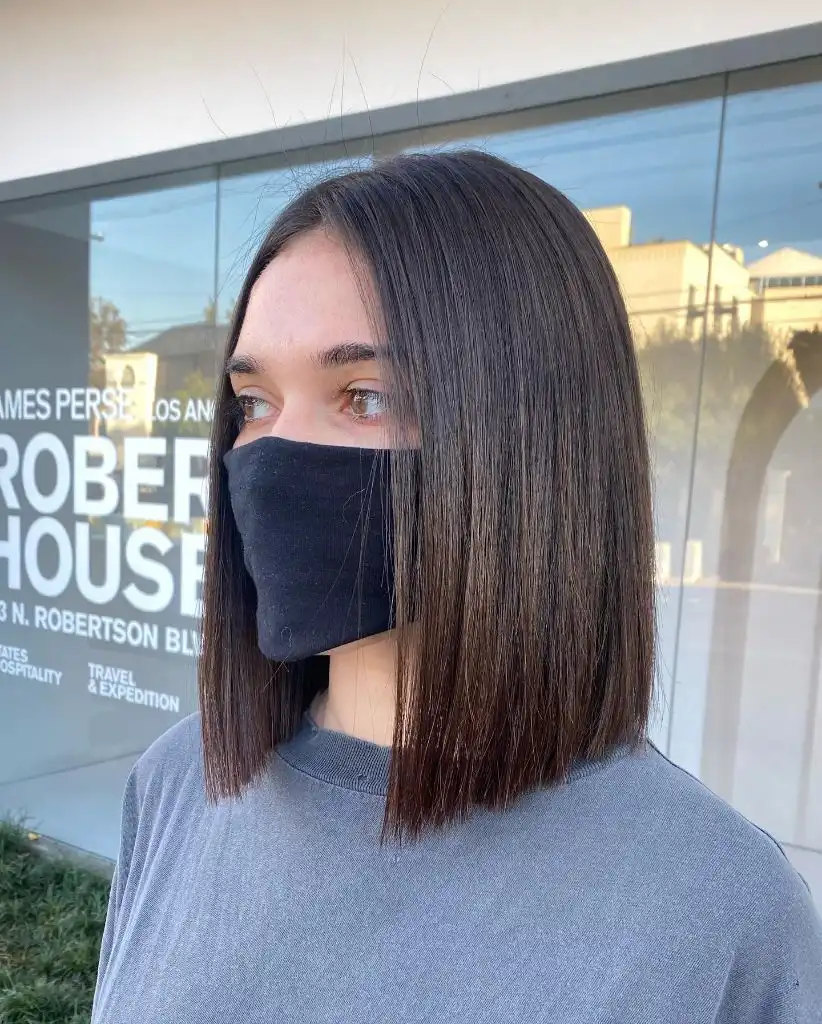
Photo via Instagram
The outdoor setting, with what appears to be a storefront window behind the subject, introduces natural light that catches the surface of the hair and reveals its true density. The center part creates two symmetrical curtains of hair that hang with equal weight on both sides, and that symmetry gives the cut a composed, deliberate quality. The grey t-shirt does not compete for attention, so the perimeter line and the parting are the only two structural decisions on display. The angle here is gentler than the first image, which means the shape reads less as architecture and more as a refined everyday cut.
The strength here is the restraint. A center part on a blunt bob can look heavy, but the slight forward angle prevents the sides from feeling static. The principle is that symmetry does not have to mean rigidity when even a mild angle introduces enough directional pull.
4. Dark Color Carries Weight to the Front
This is a longer a-line shape in near-black hair, with the front pieces falling well past the chin and the back sitting closer to the nape. The surface is smooth and straight, with a center part that allows both sides to fall forward. A watermark from a salon is visible on the hair, confirming this as a professional result. The subject holds one hand up near the collarbone, and a forearm tattoo is partially visible.
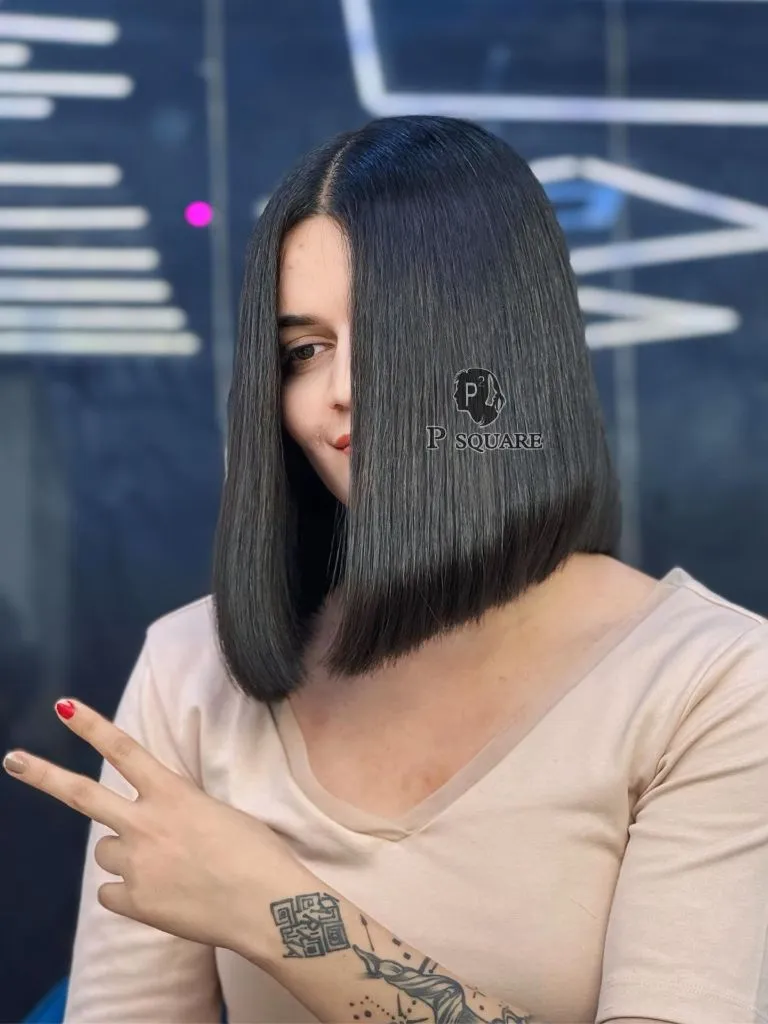
Photo via Instagram
The dark, moody background with horizontal light strips gives the image a studio quality, and that controlled lighting reveals how cleanly the ends are cut. There is no visible thinning or texturizing at the perimeter, which means the full density of the hair is preserved all the way to the tips. The pale pink top offers a soft contrast to the dark hair without pulling focus, and the slight lean of the subject’s head forward lets the longer front pieces swing away from the face, showing the interior angle of the cut. The weight distribution is heavily biased toward the front, which makes the jawline the focal point.
The effect is one of drama without complication. The cut relies on only two decisions, the steep angle and the absence of layers, and both are executed with clean precision. For anyone with thick, dark hair, the takeaway is that density itself becomes a design element when the perimeter is sharp enough to contain it.
5. Warm Brown Tone Balances a Longer Front
The hair is a warm, reddish-brown tone that catches the light and reveals subtle variation from root to end. The cut is a moderate a-line, with the front falling to the collarbone and the back sitting a few inches shorter. The texture is smooth but not perfectly flat, with a slight natural bend visible near the ends. A center-left part directs most of the hair to one side.
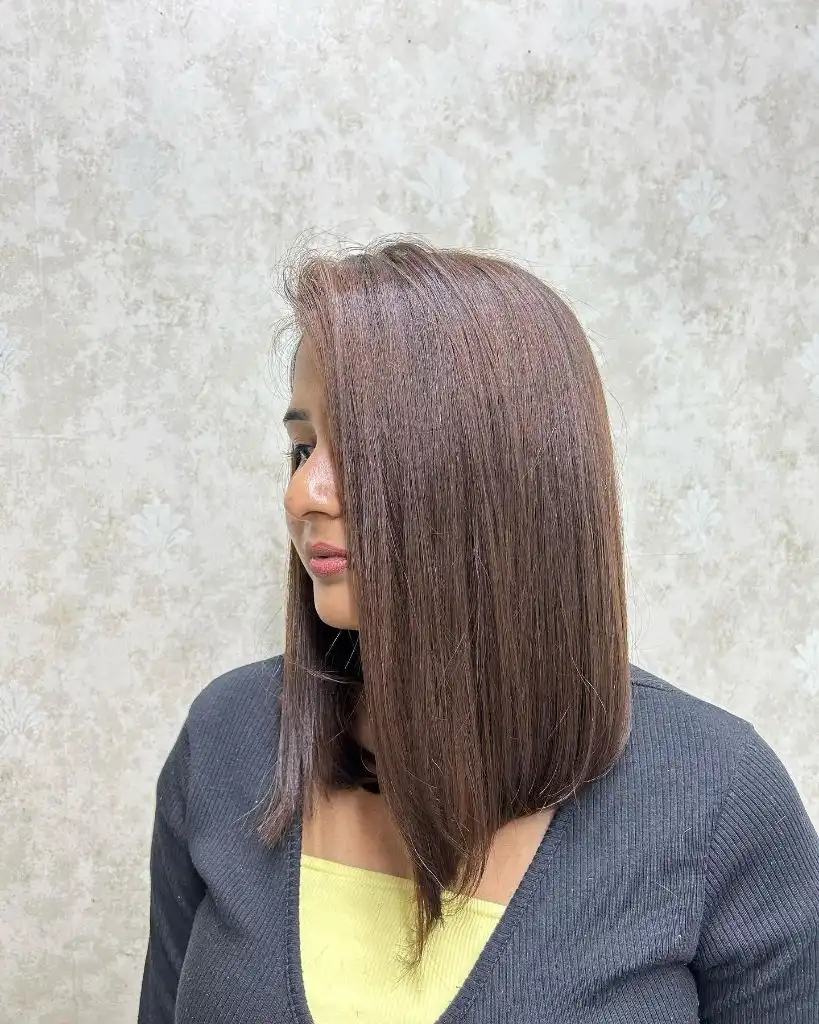
Photo via Instagram
The textured grey wall behind the subject provides a neutral backdrop that lets the warm hair color take center stage. The dark cardigan and the glimpse of a yellow layer underneath create a color stack that echoes the warmth in the hair without matching it directly, and that indirect repetition feels considered rather than coordinated. This photograph sits at the longer end of the a-line spectrum, closer to what might be called a lob, and that additional length means the angle is more gradual. The result is a shape that reads as polished without the sharpness of a shorter, steeper version.
I like the way the warm tone and the soft ends work together here. The color adds visual weight that the looser texture would otherwise reduce, and that balance keeps the cut from looking casual. The transferable idea is that hair color and cut angle are not separate decisions; the tone can reinforce or soften the structural message.
6. Chin-Length Sides Ground a Relaxed Silhouette
This bob falls right to the chin with a subtle angle, and the dark brown hair has a natural, slightly tousled quality that distinguishes it from the slicker versions earlier. The part is roughly center, and the ends have a soft bend rather than a ruler-straight line. The overall impression is a shape that has been cut precisely but styled without much intervention.
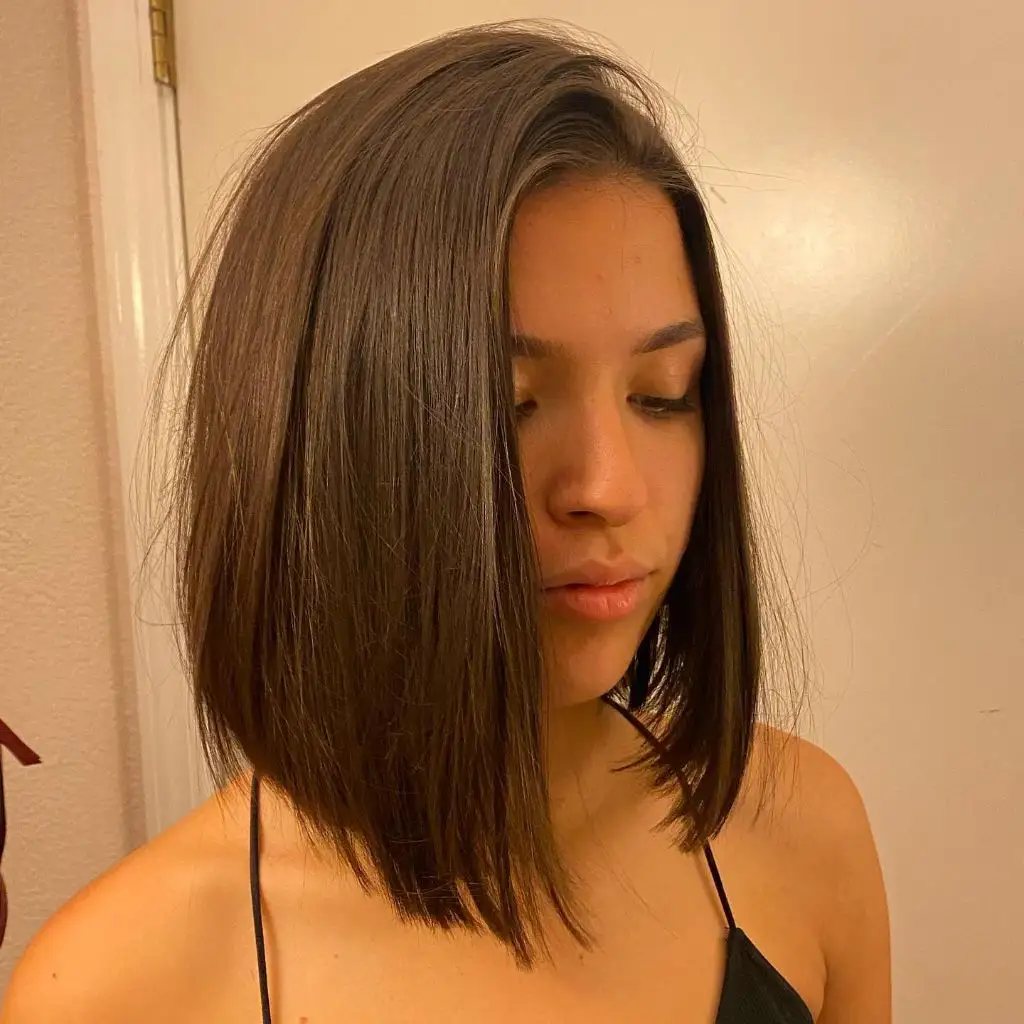
Photo via Instagram
The warm, low lighting and the plain wall behind the subject give this a casual, at-home feeling that contrasts with the salon shots elsewhere in this series. That context is part of the information: this is what a well-cut a-line bob looks like outside of the styling chair, with natural fall and no finishing tools visible in the result. The black strap of a top is just visible at the shoulder, and the simplicity of the clothing keeps the focus on the hair’s shape. The ends are blunt but not heavy, suggesting some internal layering or texturizing that prevents the perimeter from looking blocky.
The value is in seeing the cut in a lived-in state. Most a-line bob photographs show the cut at its most controlled, and this image is useful precisely because it does not. The principle is that a good angle should still read clearly even when the styling is minimal and the texture is left alone.
7. A Stacked Back Lifts Volume at the Crown
The back of this bob is the primary subject, and it reveals a stacked construction where shorter, graduated layers at the nape push the hair upward, creating visible volume and a rounded shape at the crown. The hair is very dark, nearly black, and the surface is smooth with a slight natural sheen. The front is not visible in this shot, though the angle clearly drops forward based on the side profile.
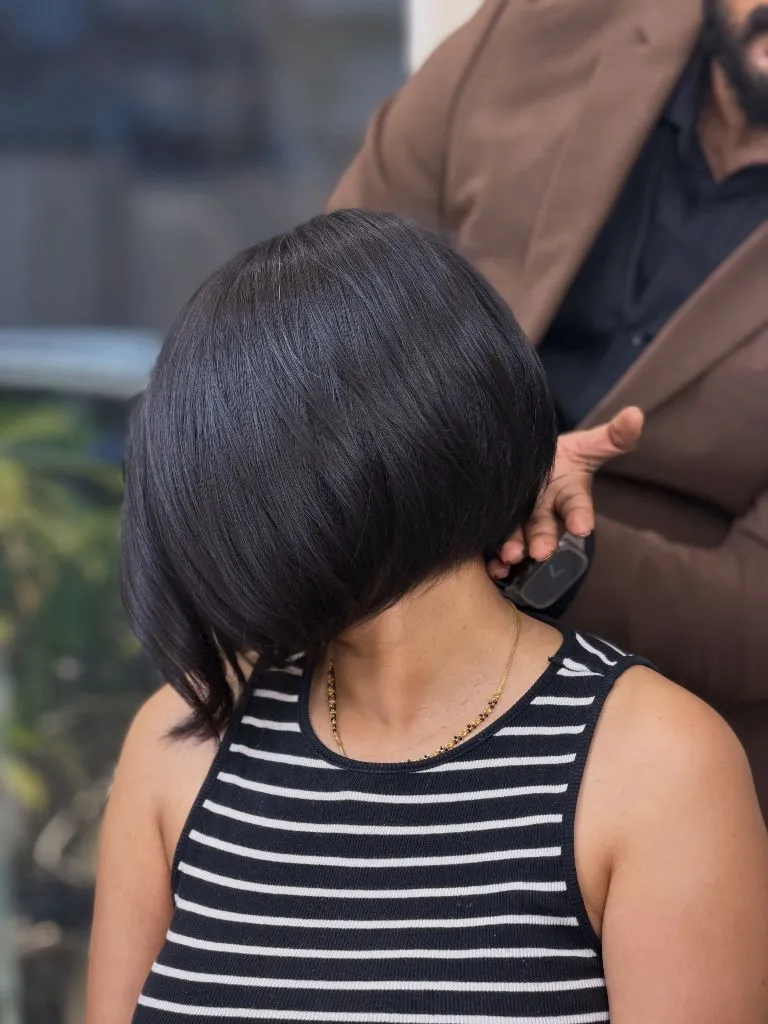
Photo via Instagram
The striped tank top and the gold necklace provide small reference points, but the real information is in the back of the cut itself. A person in a brown jacket is partially visible behind the subject, and the outdoor light illuminates the graduation clearly. The layers at the nape are cut close and stacked tightly, which is what generates the lift. This is a more technical construction than a simple one-length bob, and the rounded silhouette it creates is distinct from the flat, angular profiles in other photographs here. The weight sits at the mid-back of the head rather than falling toward the front.
This is the section where the image shows something specific that other photos here cannot: the back architecture of a stacked bob. The front angle is implied but not visible, so the useful reading is about volume engineering at the nape. The principle is that back construction determines how much body the crown carries, and that decision matters as much as the front angle.
8. Side-Swept Layers Quiet a Strong Angle
The dark hair is cut into a moderate a-line shape with the front reaching roughly jaw length. The part is off-center, and the hair sweeps across the forehead and one side of the face in a way that partially obscures the eye. The finish is smooth with some natural body, and the subject is photographed in what appears to be a salon, with product shelves visible behind.
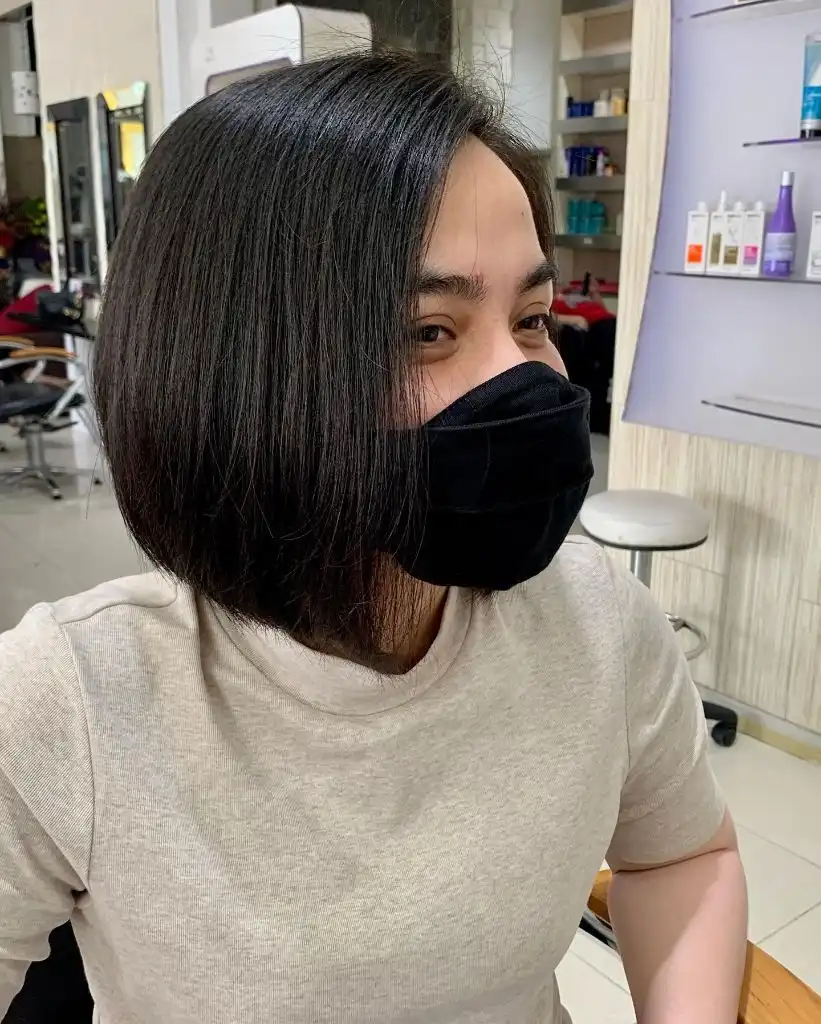
Photo via Instagram
The black face mask and the beige t-shirt create a muted palette that lets the hair’s shape dominate the frame. The side-swept direction of the hair adds a diagonal movement across the face that works in concert with the a-line angle below, and those two diagonals, one across the forehead and one along the perimeter, give the cut a sense of motion even in a still photograph. The salon setting with its stools and product display is softly blurred, keeping attention on the foreground. The ends appear to have some weight removed through texturizing, which prevents the tips from looking blunt and heavy.
The best detail is the relationship between the two diagonals. The sweep at the top and the angle at the bottom create a kind of visual parenthesis around the face, and that framing effect is flattering without being obvious. If your hair tends to fall forward naturally, working with that direction rather than fighting it can make the angle feel effortless.
9. Shoulder-Length Ends Anchor a Softer Shape
The cut here is a longer a-line bob, or lob, with the front pieces reaching just past the shoulders and the back sitting several inches shorter. The dark brown hair is smooth and straight, and the part is slightly off-center. The subject is photographed in a hallway with natural light coming from the side, and a teal-green button-up shirt is visible.
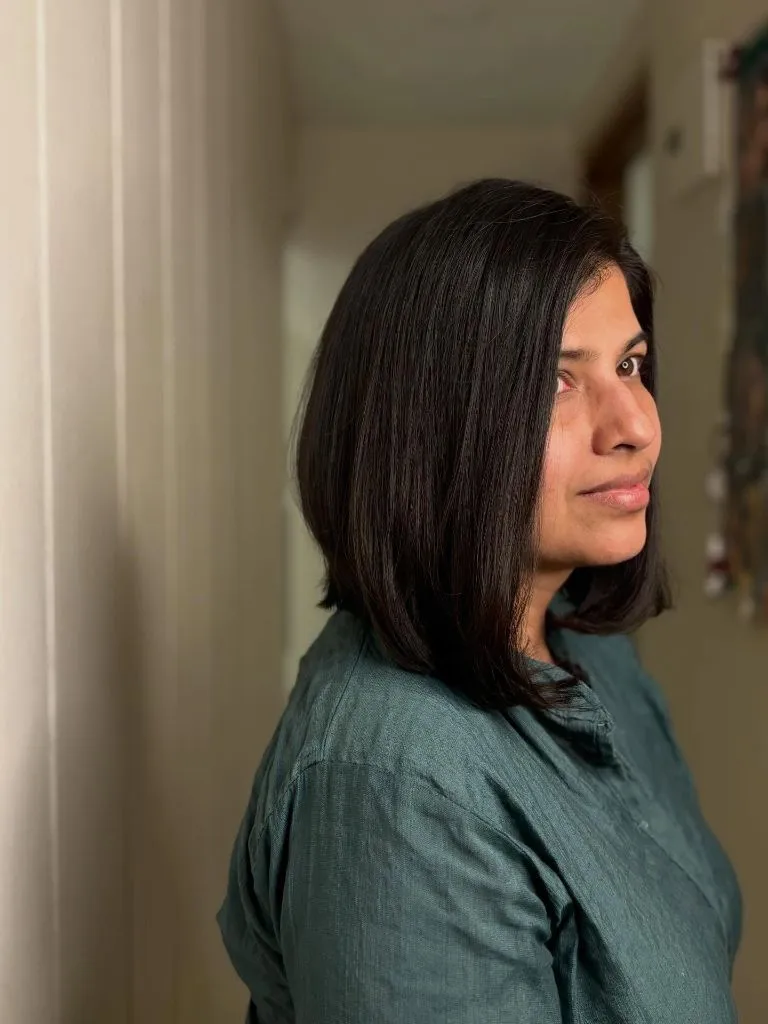
Photo via Instagram
The natural light reveals the true color of the hair, which is a rich dark brown without any visible highlights or color treatment. The hallway setting with its off-white walls provides a quiet, domestic background that reads very differently from the salon contexts elsewhere. The teal shirt adds a color note that is cool against the warm brown of the hair, and that temperature contrast makes both read more clearly. The longer front length means the angle is gradual, and the cut reads more as a shaped long bob than a dramatic angular piece. A small decorative element is visible on the wall behind, adding a touch of context without distraction.
The strength here is the proportion between the cut’s length and the subject’s frame. A longer a-line has to be judged differently than a chin-length version because the angle is spread over more distance. The principle is that a gentle slope can carry just as much intention as a steep one when the ends are kept clean and the finish is controlled.
10. Platinum Blonde Changes the Weight of a Bob
The hair is a warm platinum blonde, cut into a short bob that sits just below the jaw. The subject has her eyes closed and is making a playful expression, and the text overlay reads “please be good.” The background is a curtain of metallic silver tinsel, suggesting a celebratory or festive context. The white off-shoulder top matches the lightness of the hair.

Photo via Instagram
The silver tinsel and the white clothing create an almost monochromatic frame around the blonde hair, and in that light environment, the bob’s shape has to work harder to be seen. What makes it visible is the slight shadow at the roots and the natural fall of the hair away from the face, which creates depth even in a pale palette. The cut itself appears to be a moderate a-line, slightly shorter at the back with a forward fall toward the jaw, though the angle is gentle. The hoop earring on one side catches a small amount of light and adds a metallic accent that ties into the background.
The effect is that blonde hair at this lightness reduces the visual weight of any cut. A bob that would look dense and structured in dark hair reads as airy and light in platinum. The takeaway is that color lightness and cut structure exist in direct relationship, and choosing one always affects how the other is perceived.
11. Warm Blonde Volume Redefines the Perimeter
The hair is a warm, buttery blonde with visible root depth, and it has been styled with volume and a slight wave that gives the bob a rounded, full silhouette. The subject is photographed from a low angle with one hand near the chin, and the light blue knit sweater provides a cool contrast to the warm hair. The cut appears to sit between the chin and the jaw.
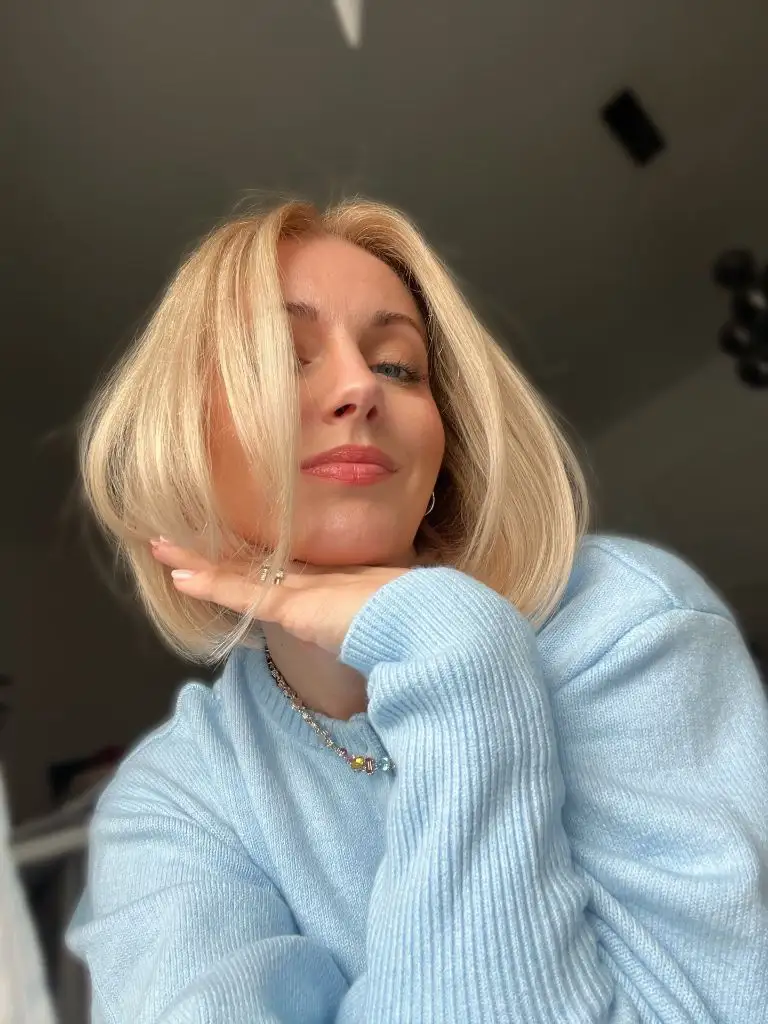
Photo via Instagram
The low camera angle changes how the bob’s perimeter reads, making the volume at the sides appear even fuller. The deeper roots at the crown add a shadow that grounds the lighter ends and prevents the blonde from looking flat or one-dimensional. The blue sweater is a deliberate or fortunate color choice because it sits on the cool side of the spectrum and lets the golden tones in the hair appear warmer by contrast. A beaded necklace is just visible at the neckline, and the light catches the hair’s surface unevenly, revealing the natural texture beneath the styled shape.
What stands out most is how different this bob reads from the sleek, dark versions earlier. The same structural concept, shorter back and longer front, is present but almost hidden under the volume and texture. The principle is that styling decisions can transform the personality of an a-line bob so completely that two identical cuts can look like different haircuts depending on whether the surface is smooth or full.
12. A Sleek Platinum Surface Sharpens Every Line
This is a very smooth, straight platinum blonde bob photographed from a three-quarter angle. The hair is parted to one side and falls across one eye, with the back sitting higher than the front in a clean a-line angle. The surface is flat-ironed to a high-shine finish, and the color is an even, cool-toned blonde from root to tip. The subject wears a dark navy top.
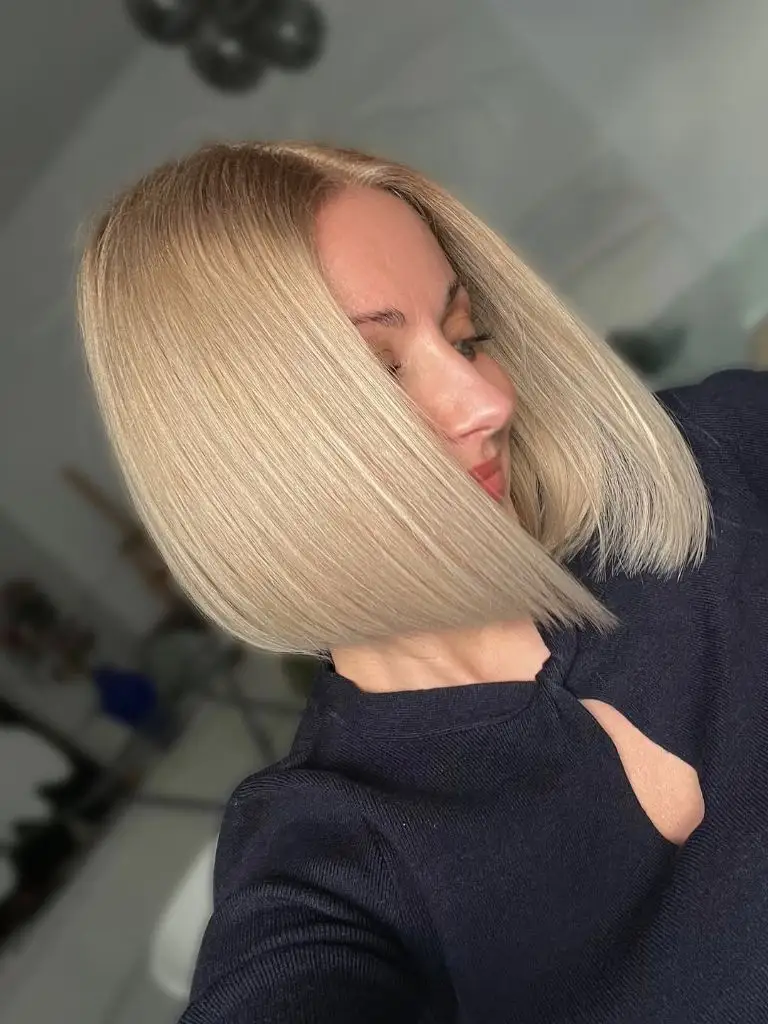
Photo via Instagram
The dark navy top creates a strong contrast against the pale hair, and that dark-light boundary at the shoulder and neckline makes the perimeter of the bob extremely visible. Every angle and every cut line is exposed by the combination of the smooth surface and the contrasting background. The hair’s platinum tone is consistent enough that there is no visible banding or warmth, which gives the overall effect a cool, almost metallic quality. The way the hair swings forward and covers one eye adds movement to what is otherwise a very controlled, architectural shape.
This is a study in how finish amplifies structure. The same angle on textured or wavy hair would read as casual; on this mirror-smooth surface, it reads as sharp and deliberate. The transferable idea is that flat-ironed styling on a bob does not just change the texture but fundamentally changes the message of the cut itself.
13. A Short Pixie-Bob Blends Two Silhouettes
The cut in this image sits between a pixie and a bob, with very short layers at the crown and nape that taper into slightly longer pieces at the sides and front. The color is a cool silver-grey blonde with visible dark roots, and the subject is photographed in profile. Extensive tattoos cover both arms, hands, and the neck, and a white halter top and white watch are visible.
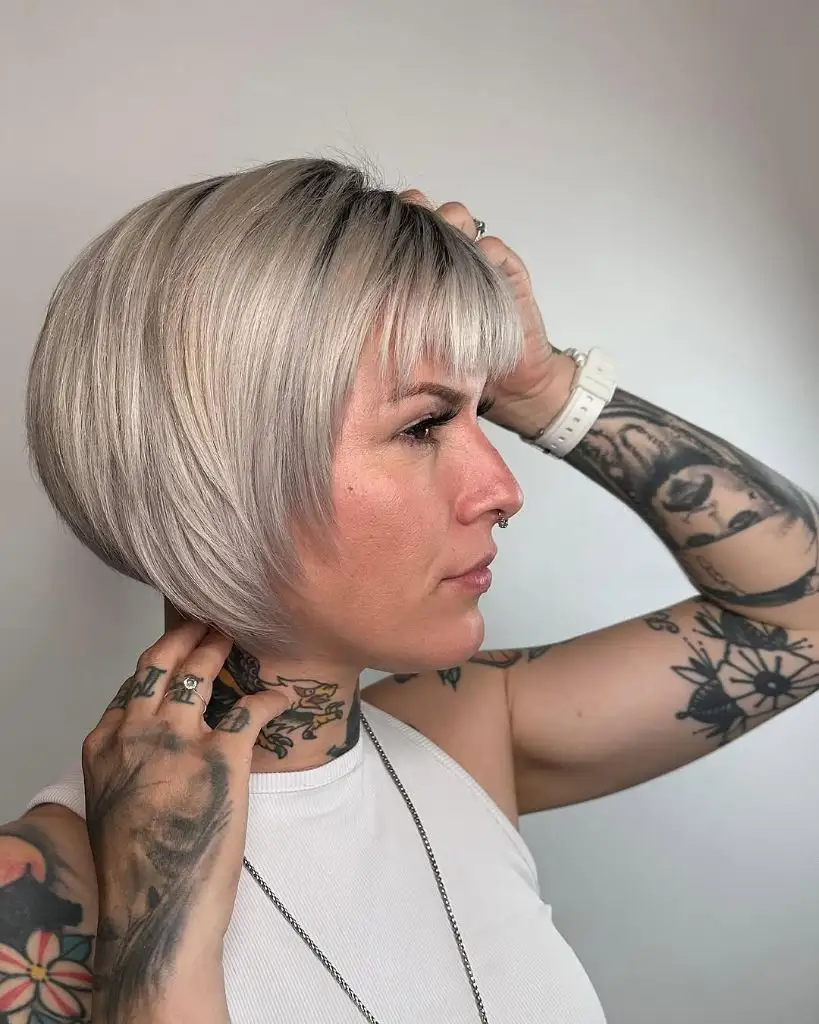
Photo via Instagram
This photograph does not show a traditional a-line bob, and that is worth naming directly. The cut is shorter and more graduated than the others in this series, sitting closer to a pixie-bob hybrid. The useful reading is about how the a-line principle of shorter back to longer front still applies even at this compressed length. The wispy bangs at the forehead and the slightly longer side pieces create a micro-angle that echoes the steeper versions elsewhere. The tattoos and the silver hair together create a visual personality that is more punk-adjacent than polished, and the white top and accessories keep the palette clean against all that detail.
The appeal is the proof that the a-line concept scales down. Even at near-pixie length, the shorter-to-longer graduation creates directional movement. The principle for anyone considering a very short version is that the angle does not need to be dramatic to be structurally present.
14. Neutral Ash Tones Quiet the Angle
The hair is a neutral ash-brown, parted to one side, and cut into a chin-length bob with a subtle a-line shape. The surface is very smooth and straight, with the ends cut in a perfectly blunt, clean line. The subject is photographed in profile against a light curtain backdrop, and a black off-shoulder top is partially visible.
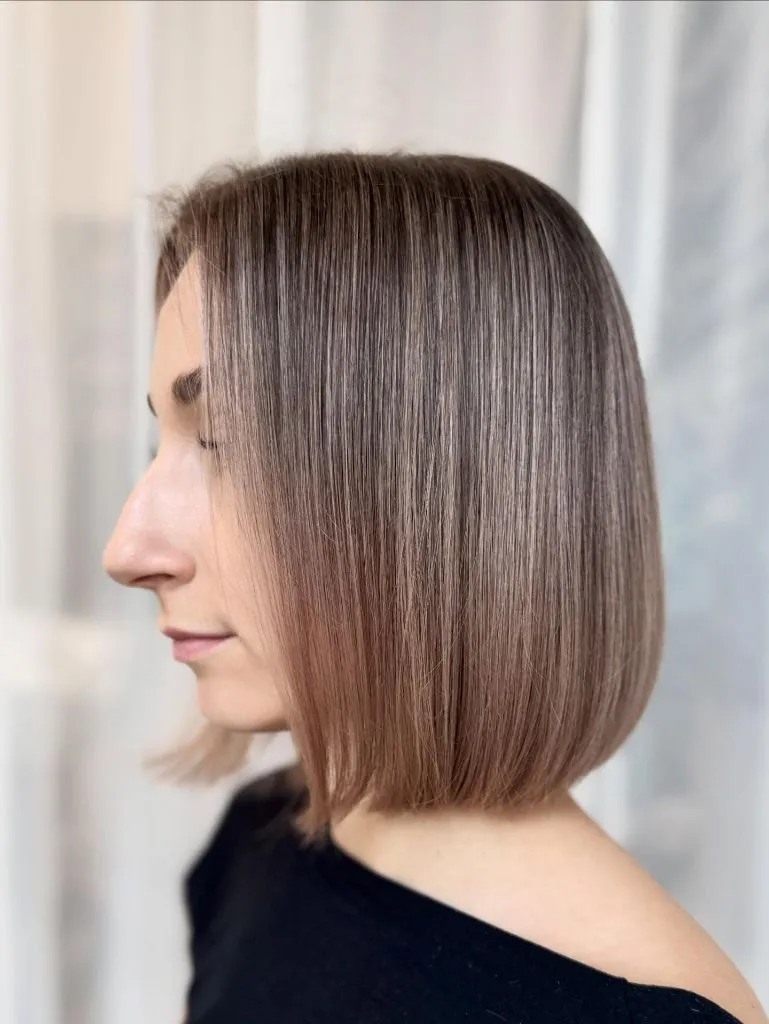
Photo via Instagram
The light, neutral backdrop and the muted ash tone of the hair work together to create an image that is almost monochromatic. There is very little contrast anywhere in the frame, and that absence of contrast is the point: it shifts all attention to the shape of the cut itself. The blunt perimeter is perfectly level when viewed from the side, and the a-line angle is so gentle that it reads more as a natural fall than a deliberate architectural choice. The black top introduces the only real contrast in the frame, anchoring the bottom of the image and drawing a line where the hair ends and the clothing begins.
The value is in the quietness. Not every a-line bob needs to announce itself. This version uses a muted tone and a gentle angle to create a shape that is precise but not dramatic. The transferable lesson is that color temperature can either amplify or mute the structural decisions in a cut, and choosing an ash tone inherently softens visual impact.
15. Warm Caramel Highlights Define the Back
The image shows the back of a bob in a warm brown tone with visible caramel and golden highlights concentrated at the mid-lengths and ends. The cut sits just below the chin, with a slight angle from back to front visible from this rear view. The subject wears a salon cape, and a wall sconce lamp and mirror edge are visible in the background.
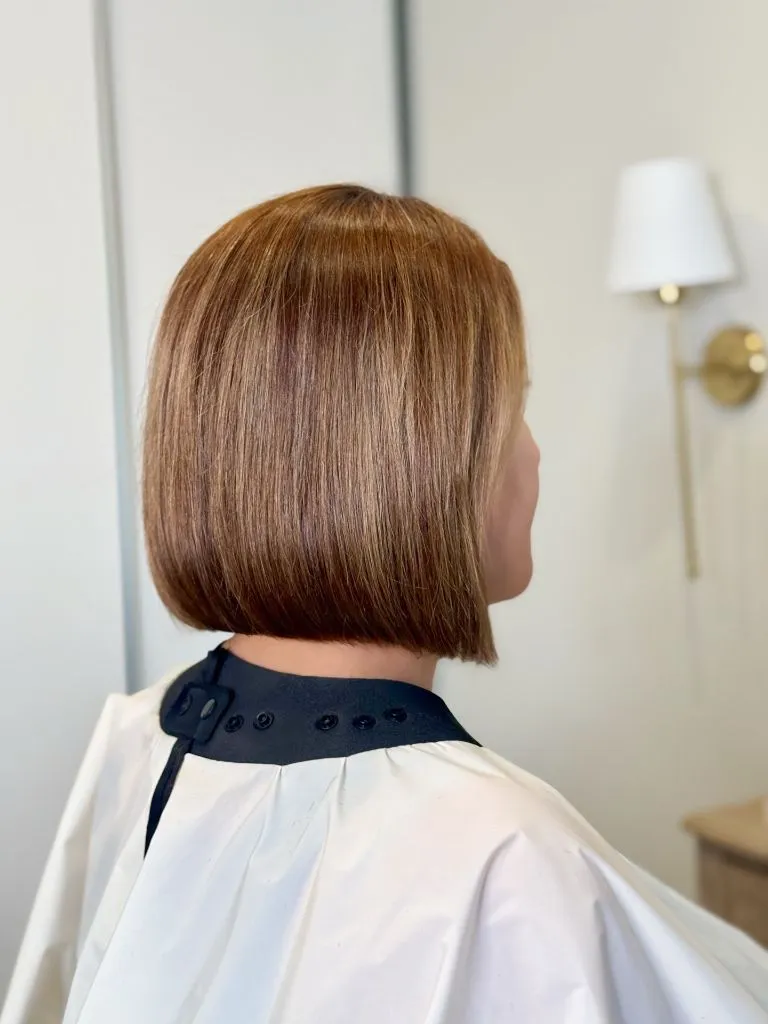
Photo via Instagram
This back view provides structural information that side and front angles cannot. The cut appears to be slightly graduated at the nape, with the lowest layer sitting close to the neck and the outer layers falling just past. The warm highlights are doing architectural work here: they catch the light at different points along the hair’s surface and make the graduation visible in a way that a single-process color would not. The salon cape and the elegant sconce in the background confirm this is a freshly completed result, and the light from the lamp adds a warm glow that enhances the golden tones in the highlights.
The best detail is how the color placement reveals the cut’s structure. Highlights at the perimeter of a bob act like a highlighter on a blueprint, tracing the lines of the shape and making them legible. The principle is that highlight placement on a shorter cut should follow the cut’s geometry rather than fighting it.
16. A Long Angled Front Creates Dramatic Forward Pull
The hair is very dark, almost black, and the a-line angle is among the steepest in this series. The back appears to sit at or above the nape, while the front pieces extend well past the chin, creating a significant length differential. The surface is smooth and straight, and the subject is photographed in a salon cape against a pale cream background. The same wall sconce from the previous image is visible, suggesting the same salon.
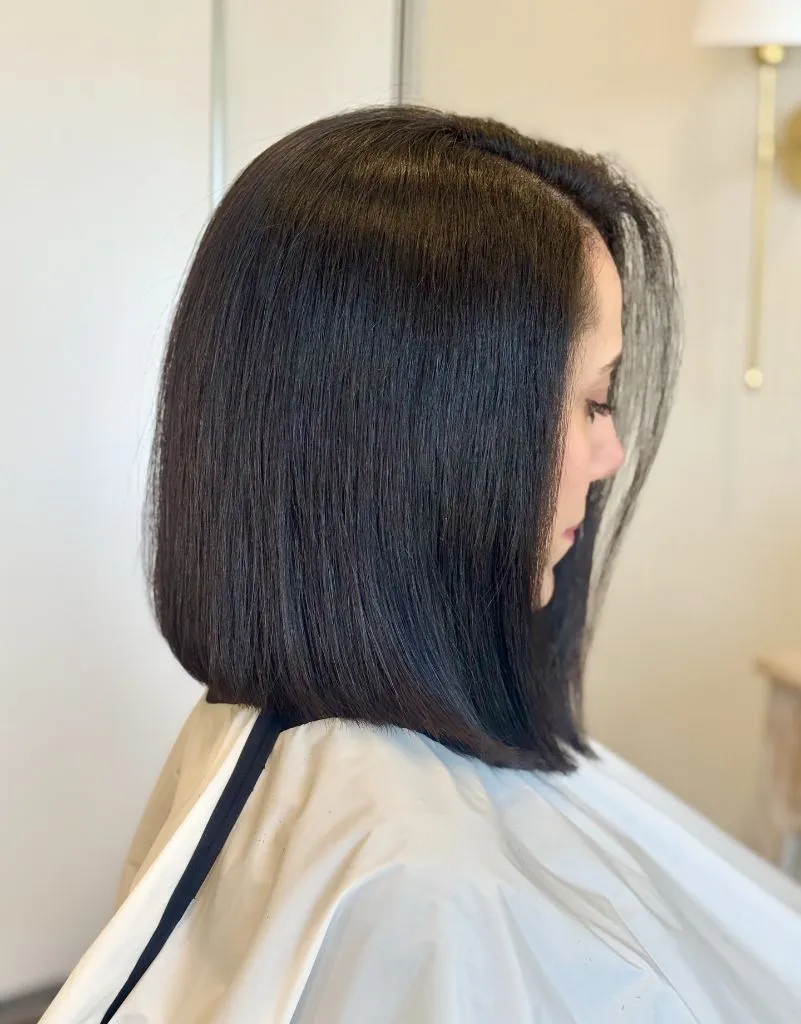
Photo via Instagram
The steep angle is the dominant feature, and the dark color makes it even more pronounced because there is no tonal variation to soften the line. The hair swings forward in a single clean plane, and the longest pieces reach nearly to the collarbone while the back is dramatically shorter. The pale salon cape and the cream-colored wall provide a light background that maximizes the contrast with the dark hair, making the perimeter line readable from any distance. The side part directs the majority of the hair to one side, which adds asymmetry to the already dramatic angle.
This is the most overtly architectural cut in the series. The angle is steep enough that the shape reads as a deliberate geometric statement rather than a soft graduation. The takeaway is that dark, single-process color on a steep a-line creates maximum contrast between the hair and everything around it, and that contrast is what makes the line feel sharp.
17. A Chin-Length Cut With Minimal Effort Reads Clean
The dark brown hair is cut to just below the chin in a short bob with a very subtle angle. The subject is photographed looking to the side, and the setting appears to be a boutique or salon with exposed stone walls, wooden shelves displaying products, and a sheer white curtain. Gold hoop earrings and a chain choker necklace are visible, and the cream-colored sweater with a dark collar trim adds a polished detail.

Photo via Instagram
The setting is doing significant work in this image. The exposed stone, the curated product shelves, and the linen curtain together establish a context of considered taste, and the hair reads in that context as intentionally understated. The bob’s angle is so gentle that without the other images in this series for comparison, it might read as a straight bob rather than an a-line. The gold accessories, the hoop earring and the choker, add warmth and small points of contrast against the dark hair. The cream sweater’s relaxed drape suggests that the overall approach here is effortlessness rather than precision.
The appeal is the understatement. A barely-there angle still creates a subtle directional movement that a completely blunt bob does not have, and that small difference is enough to keep the shape from feeling static. The principle is that restraint in the angle can be just as deliberate as drama.
18. A Center Part Anchors a Sharp Dark Bob
The dark brown to black hair is cut into a precise a-line bob with a clean center part. The front pieces fall to just past the chin, and the back is noticeably shorter, creating a clear angular line. The surface is straight and smooth, and the subject is photographed in what appears to be a salon with circular lights visible in the blurred background. A beige tank top with lace detail and a silver chain necklace are visible.
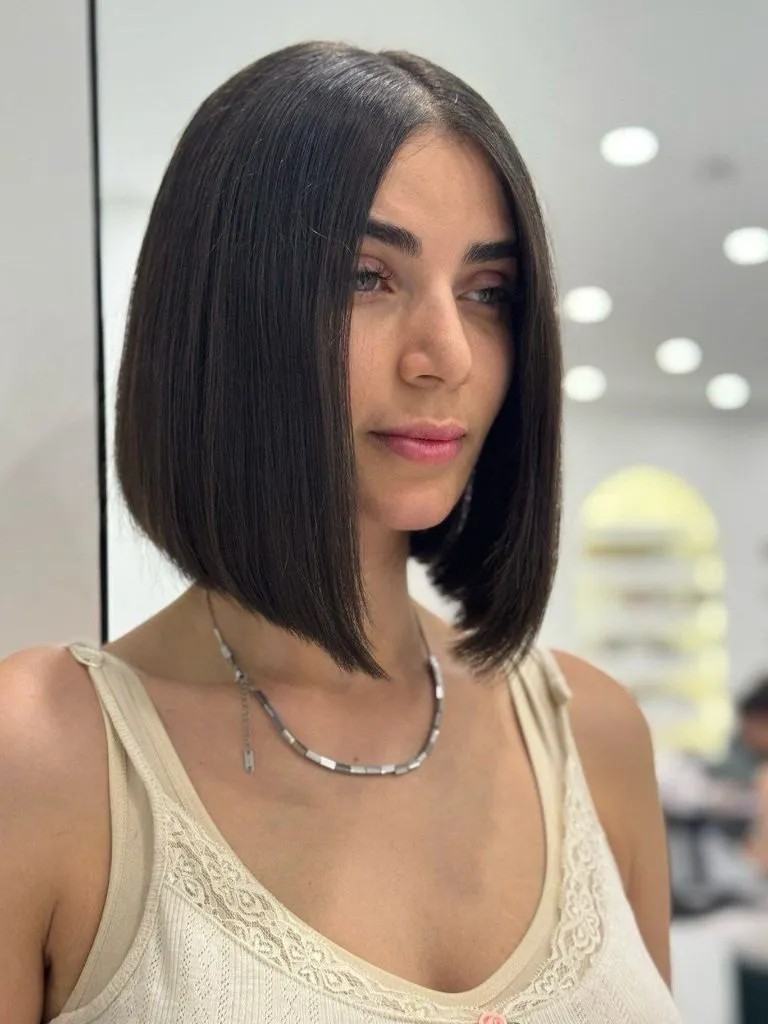
Photo via Instagram
The center part divides the angle into two symmetrical slopes, and that symmetry gives the cut a formal, balanced quality. The blurred salon lights in the background create small bokeh circles that add depth to the image without competing with the hair’s lines. The beige lace-trimmed tank is a soft, neutral base that allows the dark hair to sit as the strongest visual element. The silver necklace catches a small amount of light at the collarbone, creating a horizontal accent that contrasts with the two diagonal lines of the bob’s perimeter. The hair’s density appears to be thick, and the blunt ends hold their line cleanly without any visible thinning.
The strength here is the geometry. Two diagonal lines meeting at a center part creates a V-shape that frames the face like an inverted triangle, and that framing is inherently flattering because it narrows attention toward the chin and jawline. The transferable principle is that a center part on a steep a-line bob doubles the angle’s visual impact.
19. Textured Waves Interrupt a Defined Cut Line
The hair is a dark brown with visible caramel and honey-toned highlights, and it has been styled with loose, defined waves that create significant texture and movement. The cut appears to be a bob sitting just above the shoulders, and the waves obscure the precise perimeter line. The image is taken from behind and slightly to the side, showing the back and one side of the head.
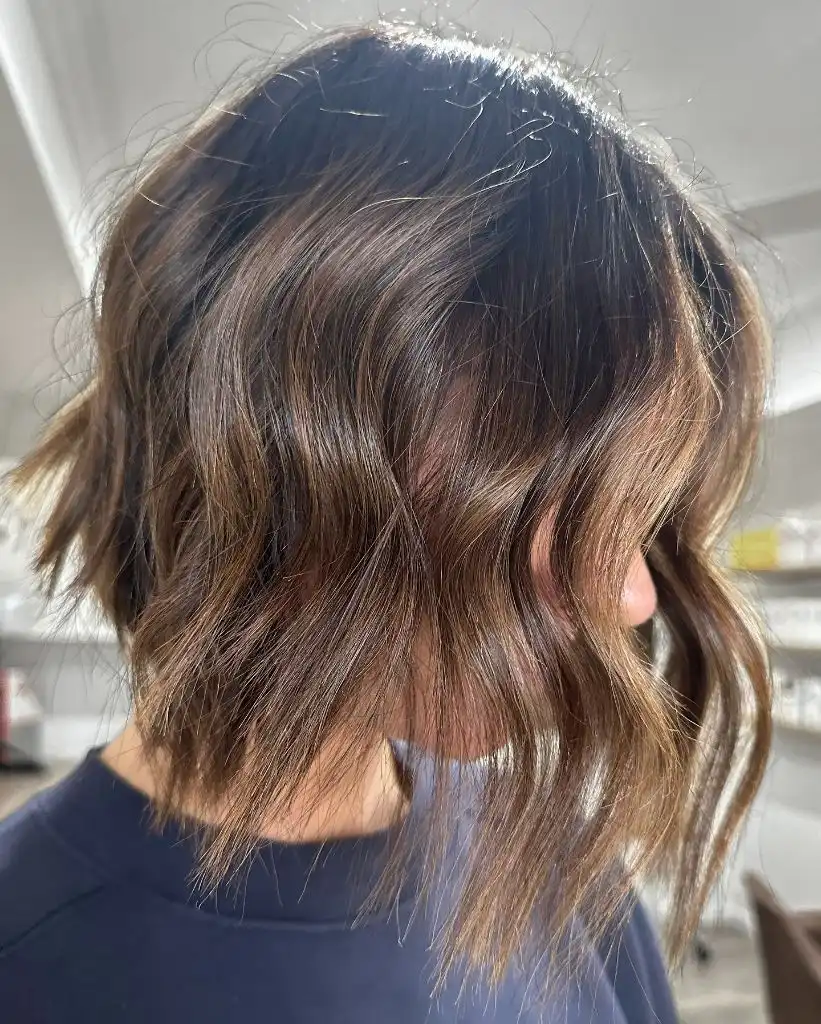
Photo via Instagram
This is the first image in the series where texture significantly disrupts the a-line shape. The waves create a zigzag silhouette that replaces the clean diagonal with an organic, irregular edge. The highlights are concentrated at the mid-lengths and ends, and because the hair is waved, those lighter pieces catch light at the peaks of each curl, creating a pattern of light and shadow that flat hair would not produce. The dark navy top is partially visible at the bottom of the frame, and its solid color provides a still baseline against the busy texture above.
The effect is a cut that feels relaxed and unstructured, even though the underlying shape still carries the a-line graduation. The takeaway is that waves and texture do not erase an a-line bob’s angle; they translate it into a different language, one of movement rather than geometry, and either translation is valid.
20. Lived-In Texture Makes a Bob Feel Personal
The dark brown hair is cut to approximately chin length and styled with a loose, natural wave that gives it body and movement. The part is slightly off-center, and the face-framing pieces have a soft bend that falls around the cheekbones. The subject is photographed straight on against a light interior background, and a striped t-shirt in grey, navy, and burgundy is visible.
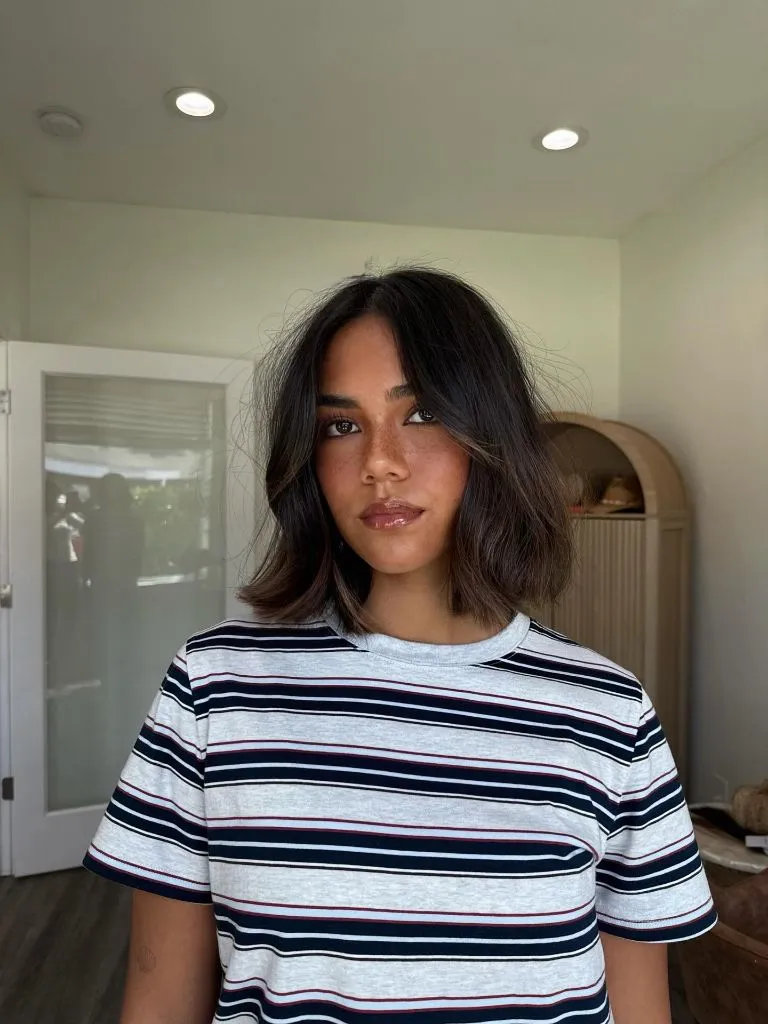
Photo via Instagram
The frontal angle of this photograph shows how the slight wave creates volume at the sides, giving the bob a width that the slick, straight versions earlier in the series do not have. The face-framing pieces curve inward toward the cheekbones, which softens the overall silhouette and creates a contrast between the wider outer shape and the narrower framing near the face. The striped shirt introduces horizontal lines that play against the organic curves of the hair, and that interplay between the rigid stripes and the soft waves gives the image a casual energy. The light background and the natural, unfussy styling suggest this is a day-after or second-day look.
This is a bob that does not need to look freshly styled to work. The natural texture and the relaxed wave give it a personal quality that over-styled versions sometimes lack. The principle is that a cut’s true test is not the salon mirror but the second morning, and a shape that still reads clearly with natural movement has been well constructed.
21. A Textured Chop Grounds a Shoulder-Length Cut
The hair is a warm medium brown, cut to just above the shoulders with visible texture and a slight wave at the ends. The subject is photographed in profile in what appears to be a beauty retail space, with product displays and a blue chandelier-style fixture visible behind. A white sleeveless V-neck top and a gold chain necklace are visible, and the overall impression is casual and fresh.
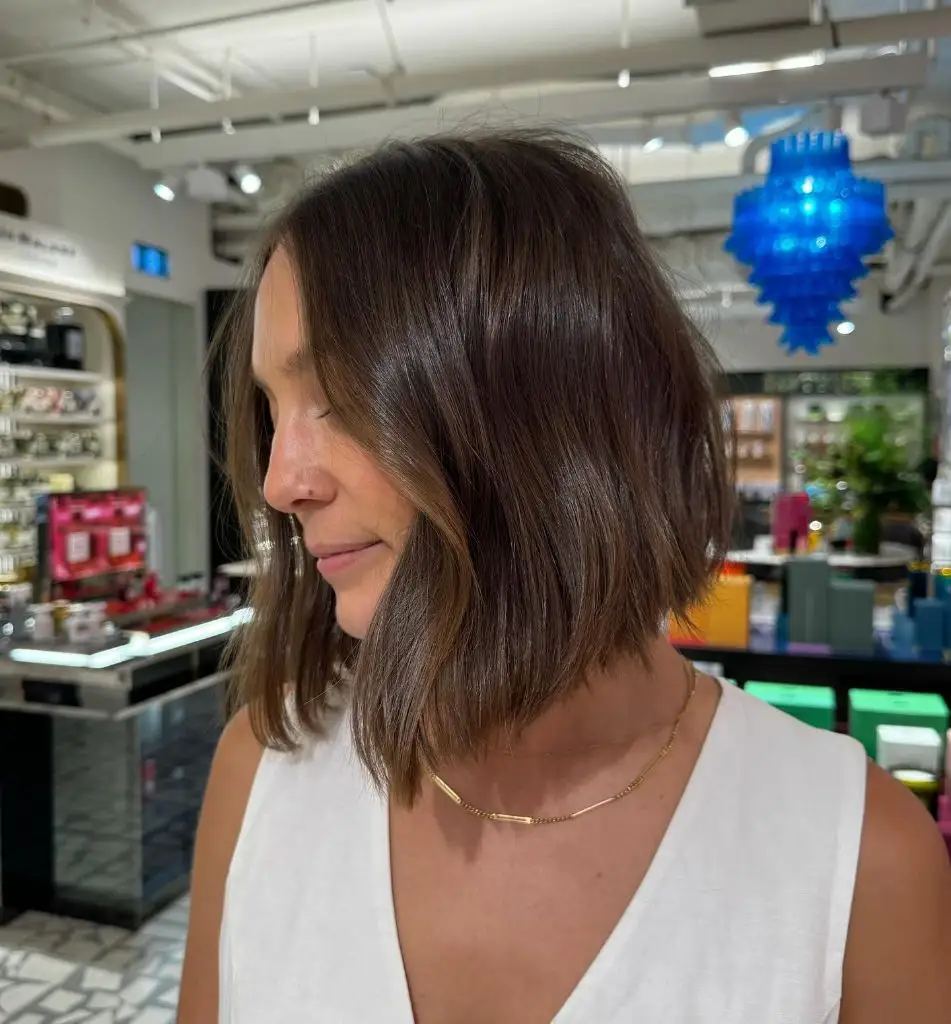
Photo via Instagram
The colorful retail environment, with its product displays and bright fixtures, creates an energetic backdrop that could overwhelm a simpler image, but the hair holds its own because the warm brown tone and the textured movement give it enough visual weight. The white top and the gold necklace keep the subject’s palette simple, which helps. The cut appears to have some internal layering that encourages the ends to flip and bend naturally, and that movement gives the perimeter an irregular quality that distinguishes it from the blunt, architectural cuts earlier. The angle from back to front is gentle, with the front pieces sitting only slightly longer than the back.
What stands out most is the approachability. This is a version of the a-line shape that does not require precision styling or a flat iron to look complete. The transferable idea is that a textured, layered approach to the a-line bob trades sharpness for warmth, and that trade is often the right one for everyday wear.
22. A Longer Starting Point Reveals the Decision Ahead
The hair here is a warm, medium brown with natural highlights from sun or prior color, and it falls several inches past the shoulders in a layered, somewhat shapeless length. The subject is photographed looking down in what appears to be the same retail space as the previous image, with a Tom Ford display and colorful products visible. A black salon cape with snap buttons is visible at the chest.
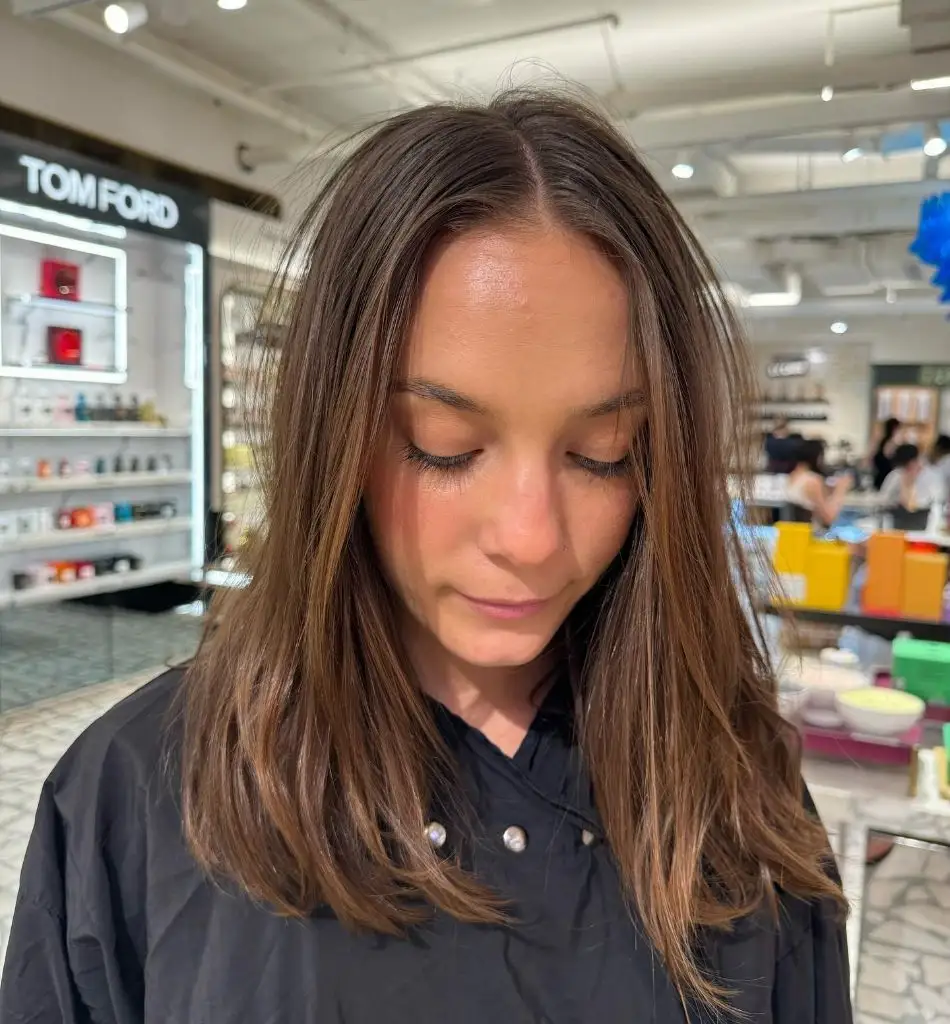
Photo via Instagram
This image appears to be a before photograph, showing the starting length before a cut. The hair has a natural, somewhat flat quality at the roots with more texture and movement at the ends, and the overall shape lacks the defined perimeter that a deliberate cut provides. The salon cape confirms the context, and the retail setting is the same as the previous image, suggesting these two photographs document a transformation. The warm brown tone is pleasant, and the natural sun-lightened pieces at the mid-lengths add dimension, but without a defined cut line, the shape does not communicate intention the way the other bobs in this series do.
The value is comparative. Placed alongside the finished bobs, this image shows what an a-line cut is solving for: it is taking length without shape and replacing it with a perimeter that has direction and purpose. The principle is that the difference between grown-out hair and a defined cut is not just length but legibility.