Choosing a haircut should not feel like accepting a correction disguised as advice. The phrase “flattering for your body type” has been used so often that it can start to sound like a polite way of saying something less kind, and that pressure does not belong in the chair or in front of the mirror. Haircut ideas for plus-size women deserve the same visual attention given to any other set of references — grounded in what a cut actually does, not in what it is supposed to fix.
A good decision begins before you pick a length or a color. The useful question is not which cut makes you look smaller but which cut makes you feel like the finished version of yourself. This article judges each image by proportion, meaning how a cut relates to the shoulders and jawline; by movement, meaning where the hair travels and what it frames; by texture, whether smooth or full or somewhere between; and by contrast, including tonal shifts, sharp edges against soft ones, and where structure meets softness. Twenty images follow, one per section, each read for what is genuinely visible and what that visibility suggests about the decisions behind it.
1. A Warm Copper Bob Softens Strong Shoulders
The first detail that registers is color — a warm, coppery strawberry blonde that catches light across the entire mid-shaft and falls into slightly deeper tones near the roots. The cut is a medium-length bob that ends just past the collarbone, with the ends turned gently inward. The back view shows smooth, straight hair with a slight curve at the bottom perimeter.
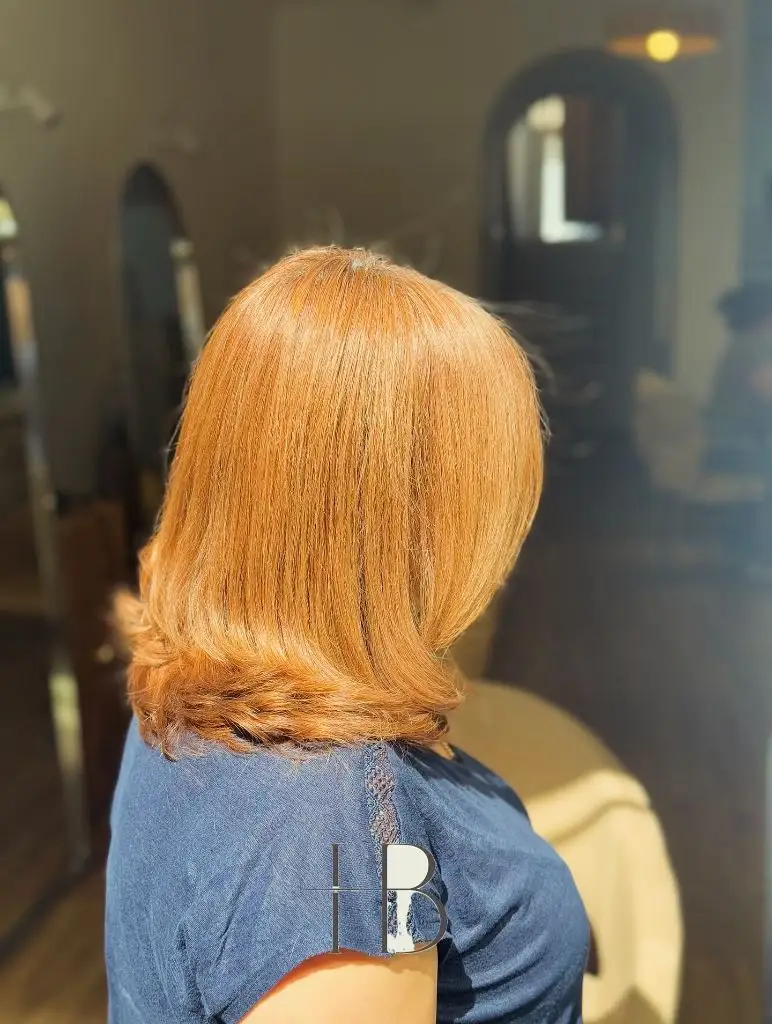
Photo via Instagram
The inward turn at the ends creates a contained shape that draws the eye toward the center of the back rather than outward across the shoulders. Against the dark blue denim top, the copper tone reads as deliberate — the contrast between warm hair and cool fabric gives the color more presence than it would have against a neutral background. The length sits at a point that neither competes with the neckline nor disappears behind the shoulders, which keeps the silhouette clean from this angle. A shape like this depends on smooth texture to hold its line.
The appeal is the restraint of the curve. It does not flip outward or stack heavily — it simply bends inward just enough to close the shape. When a single-length bob ends with a quiet inward sweep, the perimeter does the work of creating structure without requiring layers. That principle holds whether the hair color leans warm or cool: a clean bottom line reads as intentional.
2. Curtain Bangs Frame a Round Face Quietly
The front-facing view here shows a medium-length cut in a rich chocolate brown, with curtain bangs that part softly at the center and sweep toward the temples. The layers begin around the chin and build outward toward the shoulders, creating visible volume at the lower half of the hair. The overall silhouette is rounded, widest near the jawline and tapered toward the crown.
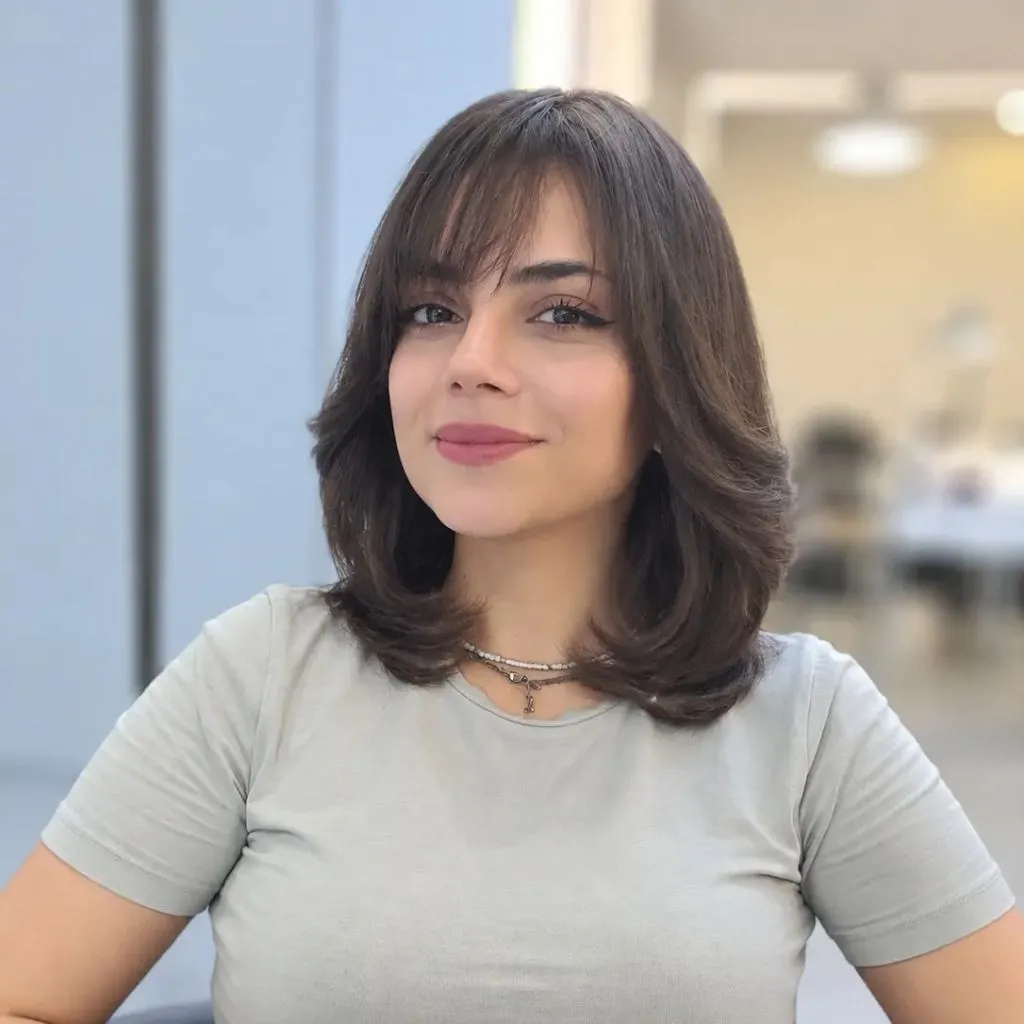
Photo via Instagram
The bangs do most of the framing here. They sit lightly across the forehead without covering it entirely, and the center part keeps the face open while the side pieces angle toward the cheekbones. This creates a vertical channel down the middle of the face that quietly lengthens the visual proportion. The layers at the bottom flip outward just slightly, which balances the narrower top section and gives the whole shape a sense of being wider at the bottom — a proportion that reads as full and considered rather than heavy. The gray t-shirt and thin choker both stay understated enough to let the hair lead.
This is the kind of cut that works by distributing weight visually. The bangs break the forehead line, the layers add movement below the jaw, and the center part holds everything in a readable frame. For anyone considering a layered cut for a rounder face, the lesson is that soft bangs and face-framing layers do not need to be dramatic to shift proportion — placement matters more than volume.
3. Layered Waves Carry Volume Without Heaviness
A side profile shows dark brown hair that falls past the shoulders in wide, soft waves. The layers are visible from the crown downward, with shorter pieces near the face and longer ones reaching toward the mid-back. The wave pattern is loose and consistent, curving outward at the ends rather than curling tightly. The setting appears to be a salon, with warm lighting and green plants in the background.
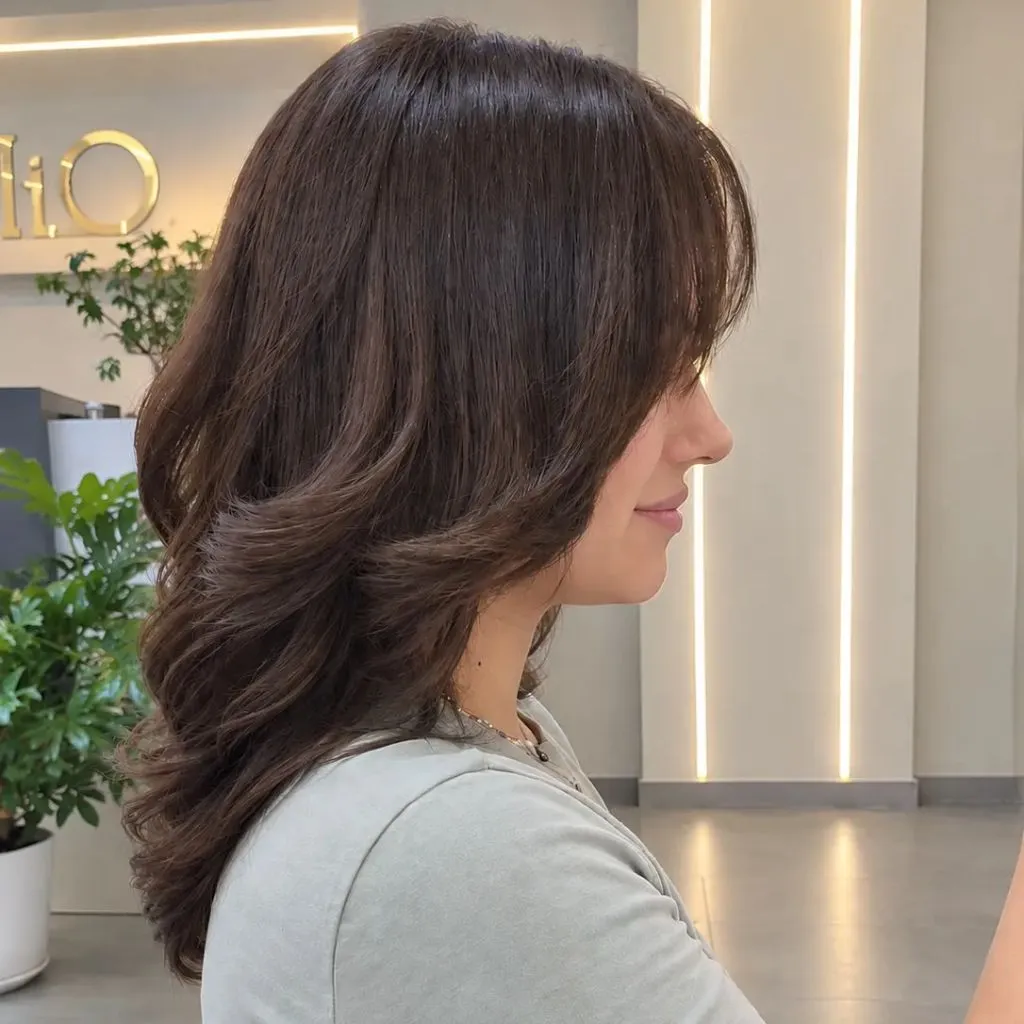
Photo via Instagram
The wave gives each layer its own visible arc, which means the hair reads as having depth rather than flat weight. From this angle, the face-framing piece near the cheek is noticeably shorter than the back layers, and it curves inward slightly — a small decision that changes how the jawline is read. The overall movement flows backward and downward, pulling the eye along the length rather than letting it settle at any one point. The neutral-toned top and the bright greenery behind create a calm frame that keeps attention on the hair texture and the rhythm of the layers.
The strength here is how the volume distributes itself. There is no single heavy section; instead, each layer takes its own curve and the fullness builds gradually from the crown to the ends. That graduated volume is especially useful when considering haircut ideas for plus-size women who want fullness without bulk. The transferable principle is that layers cut at different starting points, rather than one uniform length, create the kind of movement that carries its own visual lightness.
4. Long Straight Hair Anchors a Simple Silhouette
This back view shows dark brown hair that falls well past the shoulders, nearly reaching the mid-back. The hair is mostly straight with a very subtle outward flip at the very ends. There are no visible layers — the perimeter line is relatively even, though not perfectly blunt. The tone is a natural medium-dark brown with some lighter strands catching light at the lower portion, suggesting either natural sun-lightening or a faded previous color treatment.
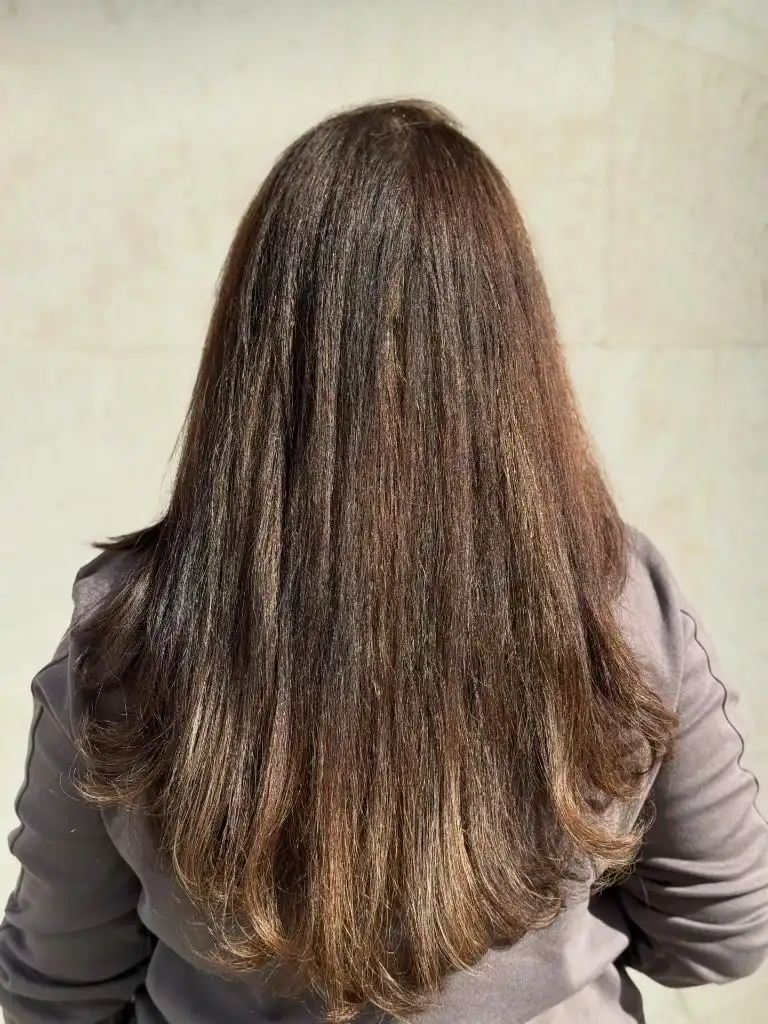
Photo via Instagram
The lack of layering means the weight of the hair sits at the bottom, and from the back, the silhouette is a simple vertical rectangle that widens slightly at the ends. This is neither dramatic nor overly styled, and that plainness is part of what makes it useful as a reference. The muted brown top blends closely with the hair tone, which reduces visual interruption between the body and the hair — everything reads as one continuous line. The light-catching strands at the lower half add just enough dimension to keep the surface from looking flat.
This is a photograph that shows what long, single-length hair looks like without styling intervention, and that honesty is its value. It does not demonstrate a layered cut or a color technique — it shows a baseline. For anyone weighing whether to add layers to long straight hair, this image is a useful comparison point: the shape is clean but static, and the ends carry all the visual weight, which is a proportion worth understanding before deciding whether to change it.
5. Dark Hair With Prada Frames Grounds a Polished Look
The front view shows long, dark brown-black hair that falls straight past the shoulders, with a subtle center part and very slight inward curve at the ends. The person wears oversized square sunglasses with translucent frames and holds a small cappuccino cup. The hair is smooth and sleek, with visible shine running the length of the strands. The background is a light stone or travertine wall.
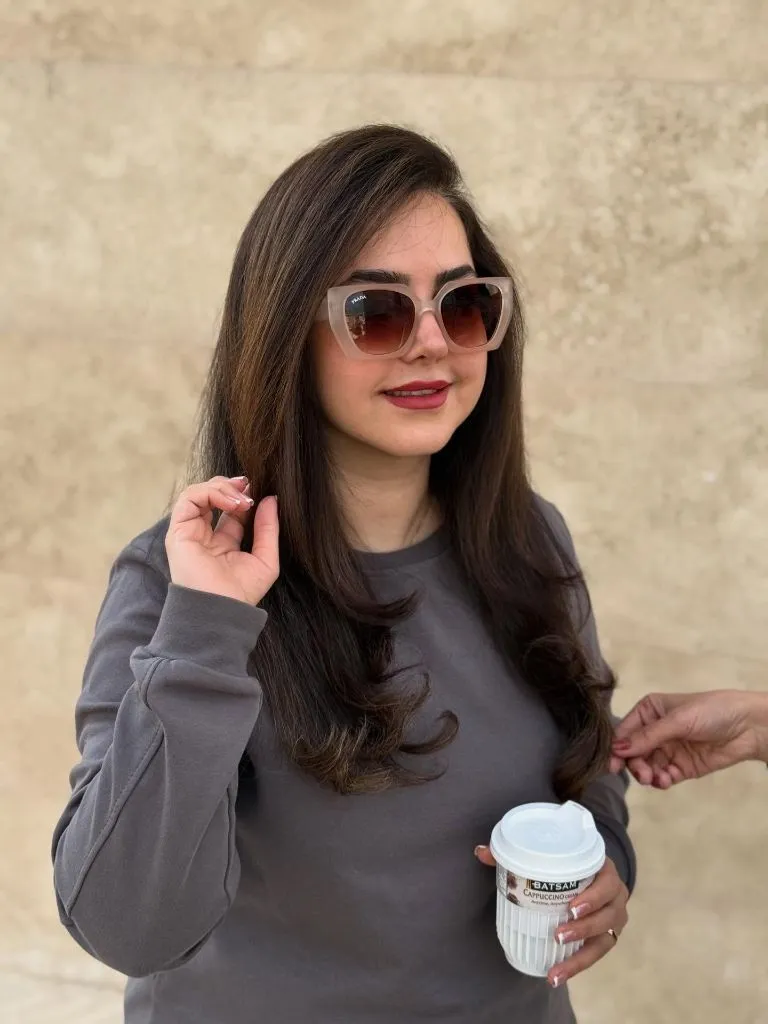
Photo via Instagram
The sunglasses are doing significant work here — they create a strong horizontal line across the upper face that the straight, vertical fall of the hair frames on either side. This cross-axis effect gives the look a sense of structure that the hair alone, being one length and without bangs, might not produce. The gray sweatshirt is relaxed and tonal, nearly matching the stone wall, which means the dark hair and the sunglasses become the two highest-contrast elements in the frame. The coffee cup adds a human, casual note that keeps the polish from feeling rigid.
What stands out most is how the accessories compensate for the simplicity of the cut. The hair itself is minimal — long, smooth, unstyled beyond a blowout — but the sunglasses create the kind of facial framing that bangs or layers might otherwise provide. The takeaway is that a simple, long haircut does not need to do all the proportion work alone. When choosing long hairstyles, the accessories worn near the face can share the burden of framing, which is a useful thing to remember.
6. Deep Burgundy Waves Build Richness at the Ends
The hair here is a deep, saturated burgundy-brown — nearly black at the roots, shifting to a dark wine tone through the mid-lengths and into the curled ends. The waves are wide and deliberate, rolling outward and then back in large arcs that create visible movement from the chin to the chest. The cut appears to be long and layered, with the face-framing pieces curving away from the face. A green floral-print top is partially visible.
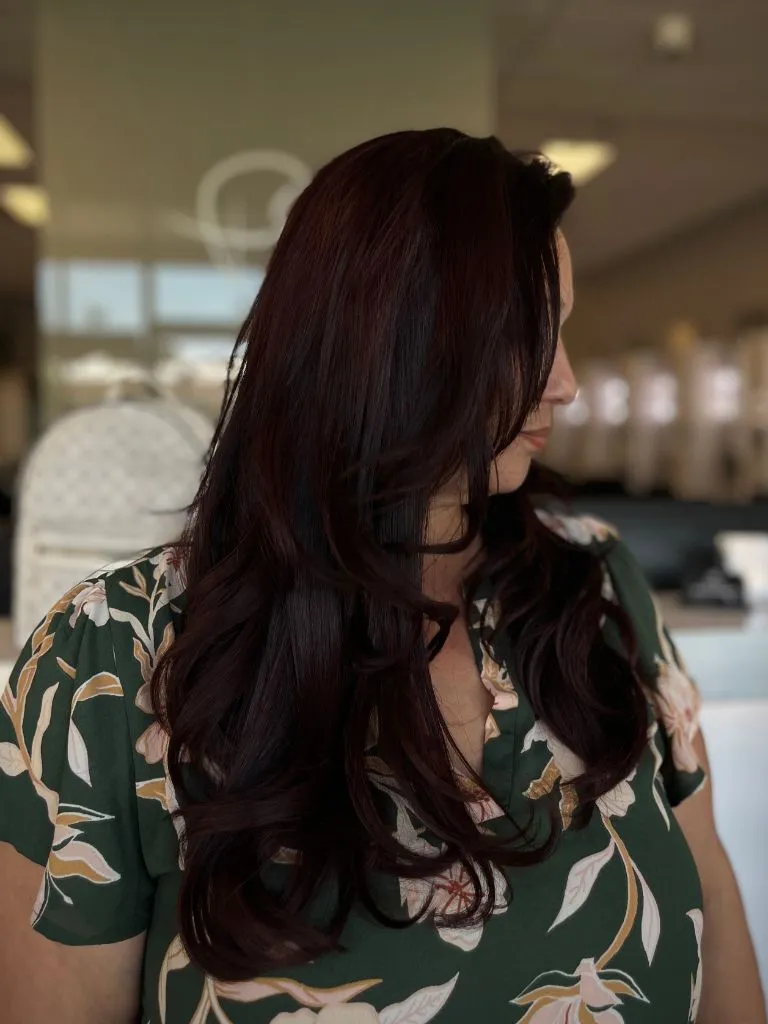
Photo via Instagram
The color is the dominant element. It reads as rich without being bright — the burgundy only fully reveals itself where light hits the curve of a wave, while the roots and the inner sections stay closer to black. This creates a tonal depth that makes the hair look thicker and more dimensional than a flat single shade would. The floral top introduces warm golds and greens that do not compete with the hair color but do establish a palette — the burgundy feels deliberate rather than isolated. The curled ends create a wide bottom silhouette that balances the narrower root section.
The effect is one of considered opulence. Every curve in the wave pattern catches a slightly different shade of the same color family, which gives the impression of complexity even though the actual technique may be straightforward. For anyone exploring rich hair color options, this image demonstrates that depth comes from how light interacts with movement, not just from the color formula itself. A dark base with a wine-toned overlay creates this kind of result without requiring heavy highlights.
7. A Bronde Gradient Balances Dark Roots and Light Ends
From the back, this hair shows a clear gradient from medium brown at the roots to a warm, sandy blonde at the ends. The transition happens gradually through the mid-lengths, with no harsh line of demarcation. The hair is straight with a very slight bend at the ends, and the length reaches past the shoulder blades. A black long-sleeve top creates a dark frame below.
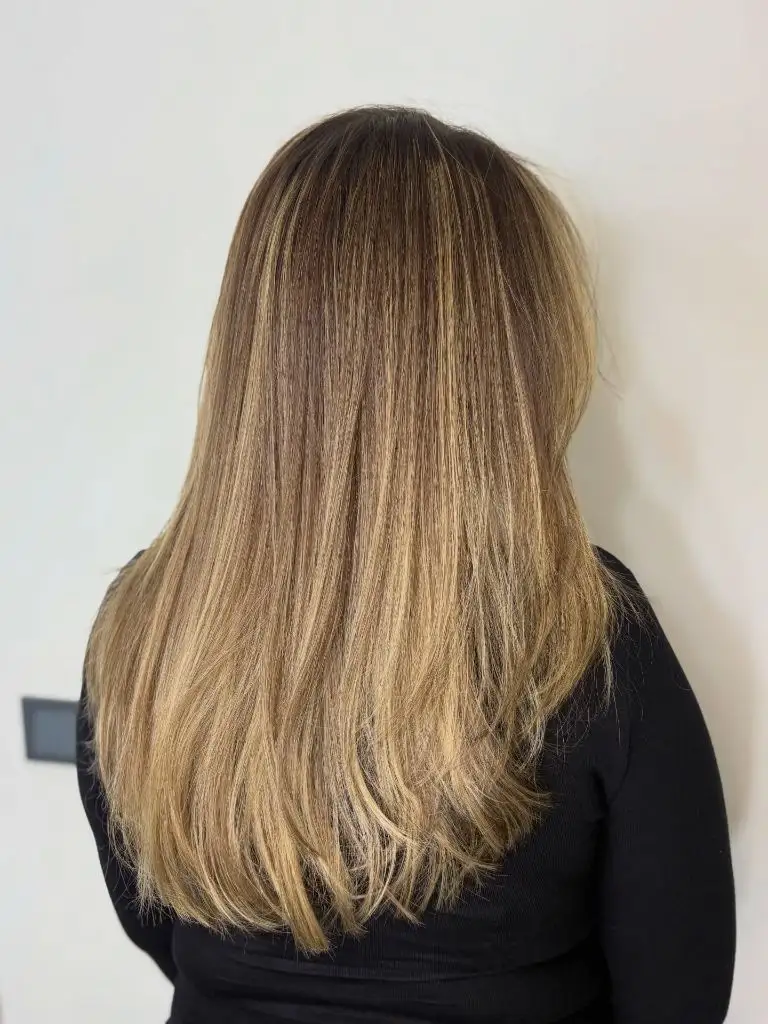
Photo via Instagram
The gradient creates a natural visual taper — the darker roots anchor the top of the head while the lighter ends feel open and airy. This tonal shift draws the eye downward along the length, which elongates the perceived proportion of the hair relative to the shoulders. The black top beneath acts as a third tonal zone, moving the sequence from brown to blonde to black, and that contrast at the hem of the hair makes the blonde ends read brighter than they might against a lighter garment. The hair is not heavily layered; the shape is mostly one length, which keeps the gradient clean and readable.
I like the simplicity of the color decision here. There are no face-framing highlights, no chunky sections, no dramatic placement — just a slow shift from dark to light, root to tip. For plus-size women considering a balayage or ombre approach, the principle is that a gradual color transition on longer hair creates visual length and movement even when the cut itself is minimal. The gradient does the work that layers would do in a different cut.
8. Slicked-Back Hair Opens the Face Completely
This image is a side profile showing short-to-medium hair slicked back tightly against the head, with the strands tucked behind the ear and ending just past the jawline. The hair appears damp or product-set, with visible separation between individual strands. The color is a cool-toned bronde with darker roots and lighter mid-lengths. The person wears a light beige or cream blazer, and the background is a neutral warm tone.
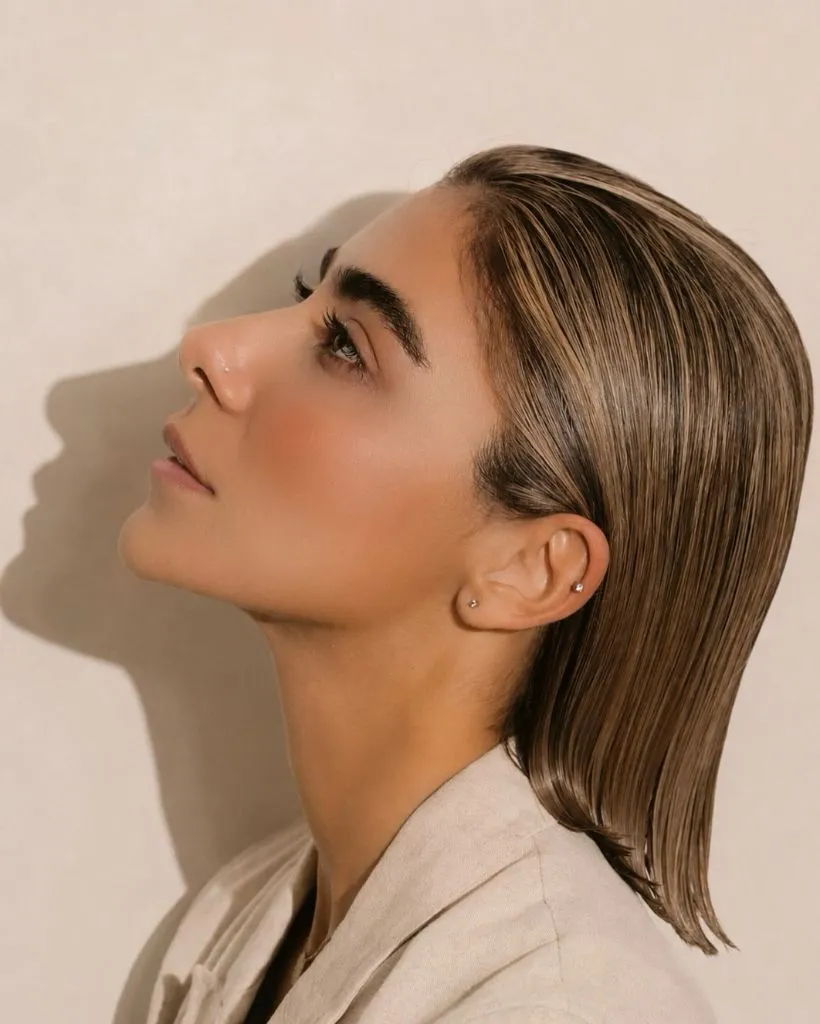
Photo via Instagram
This styling choice removes nearly all volume from the hair, which means every line of the face — the jawline, the cheekbone, the forehead — is fully exposed and unframed. The wet-look texture adds a deliberate, editorial quality that signals intention rather than neglect. Without the softening effect of loose hair around the face, the blazer collar becomes the nearest frame, and the small stud earrings register more clearly than they would with hair covering the ears. The warm shadow cast on the wall adds depth to an otherwise minimal composition.
The best detail is the confidence of the exposure. Slicking hair back is often discussed as a styling trick for certain face shapes, but this photograph does not appear concerned with that calculation — it reads as a pure aesthetic choice. The transferable idea is that pulling hair away from the face entirely can be its own form of bold hairstyle statement, and that the absence of framing is itself a framing decision. Not every haircut idea needs to be about softening.
9. Defined Curls With Bangs Create Their Own Architecture
The front view shows tightly defined spiral curls falling past the shoulders, with curly bangs covering the forehead and blending into the side sections. The hair color is a deep, natural dark brown-black. The curls are uniform in size and bounce, suggesting a well-maintained curl pattern or a fresh styling. The person wears pink-toned glasses and a dark gray-black t-shirt, and the background includes a teal-arched mirror and purple balloons, indicating a salon setting.
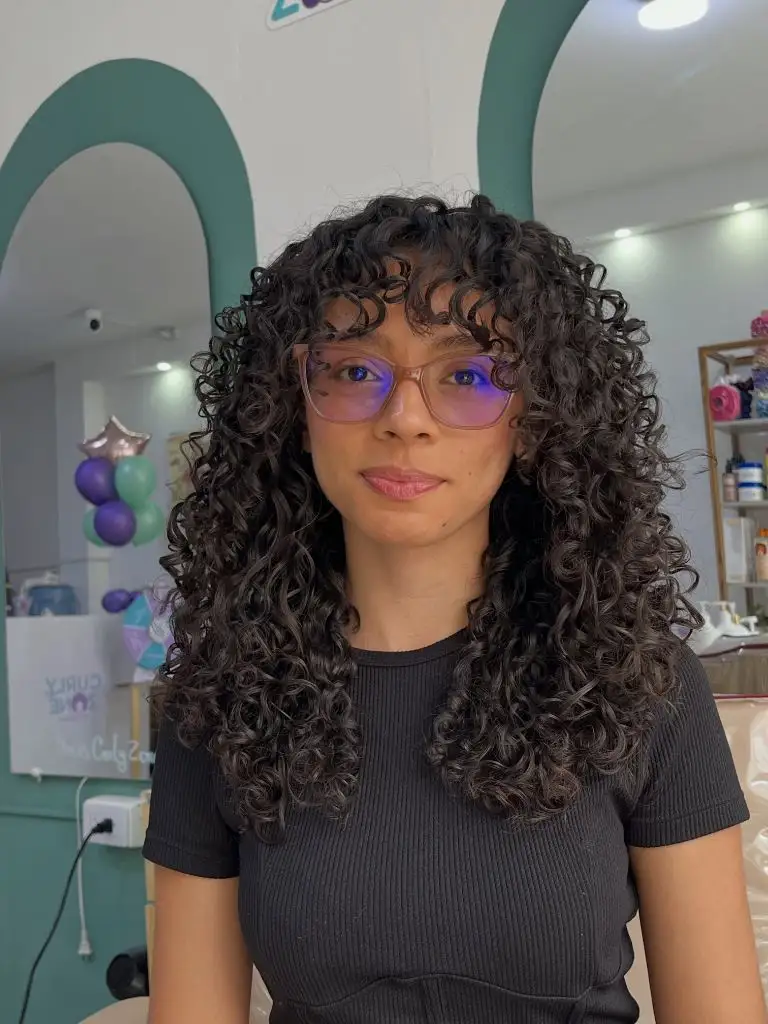
Photo via Instagram
The curls create a wide, rounded silhouette that is widest at the shoulders and tapers slightly toward the ends and the crown. The curly bangs are doing important structural work — they break the forehead line and create a soft horizontal emphasis across the top of the face that balances the width of the curls below. The glasses add another horizontal element, and together the bangs and frames create a layered set of lines across the upper face that give the eye multiple stopping points. The dark t-shirt disappears beneath the curls, letting the hair shape define the entire upper silhouette.
This is a cut that creates its own geometry. The curls do not need layers to generate volume or movement — the curl pattern itself provides both, and the bangs provide the structural interruption that keeps the shape from reading as shapeless. For anyone with natural curls considering curly hair with bangs, the principle visible here is that curly bangs should match the texture of the rest of the hair so the framing feels integrated, not imposed.
10. A Stacked Bob Sharpens the Neckline
This is a back view of a short, stacked bob in a very dark brown or near-black tone. The cut is shortest at the nape and gradually lengthens toward the front, creating the classic stacked or graduated shape. The surface is smooth and straight, with visible shine. The neckline is cut clean and slightly angled. The setting appears to be a salon with light-colored furniture visible in the background.
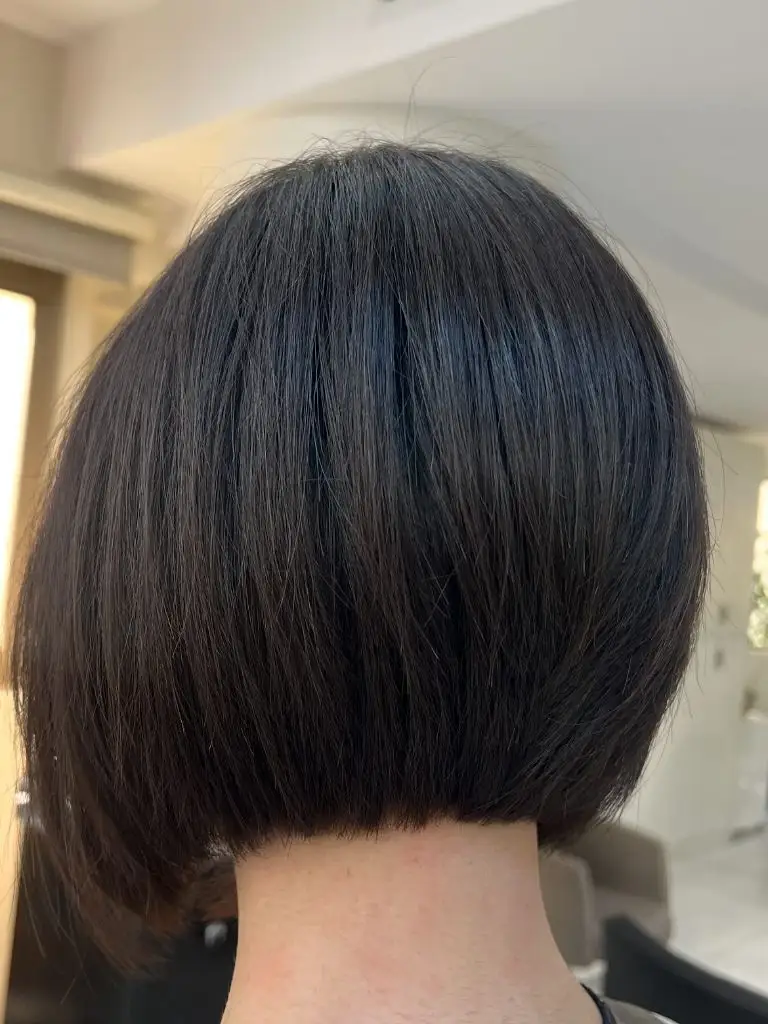
Photo via Instagram
The graduation from short at the back to longer at the front creates a visible diagonal line that gives this simple cut its sense of direction. From the back, the rounded shape at the crown contrasts with the sharp, clean nape line — soft above, precise below. The smooth finish is essential to this reading; if the texture were wavy or tousled, the graduation would be less visible and the shape would lose its architectural quality. The dark tone absorbs light rather than reflecting it, which emphasizes the shape of the cut over the surface of the hair.
The strength here is the clean nape. In many short bob variations, the back of the head does most of the visual work, and this one demonstrates why precision at the neckline matters. The stacking adds just enough volume at the crown to keep the shape from looking flat, but the real anchor is the sharp bottom line. Any plus-size woman considering a short cut should note that a defined nape line creates structure that reads as deliberate from every angle.
11. Long Black Waves Carry a Glamorous Weight
This front-facing image shows long, jet-black hair styled in large, voluminous waves that cascade past the shoulders and onto the chest. The waves are wide and bouncy, with a visible middle part and face-framing layers that curve away from the face starting at the cheekbones. The person wears a black crewneck top, and mirrors are visible in the background, indicating a salon environment.
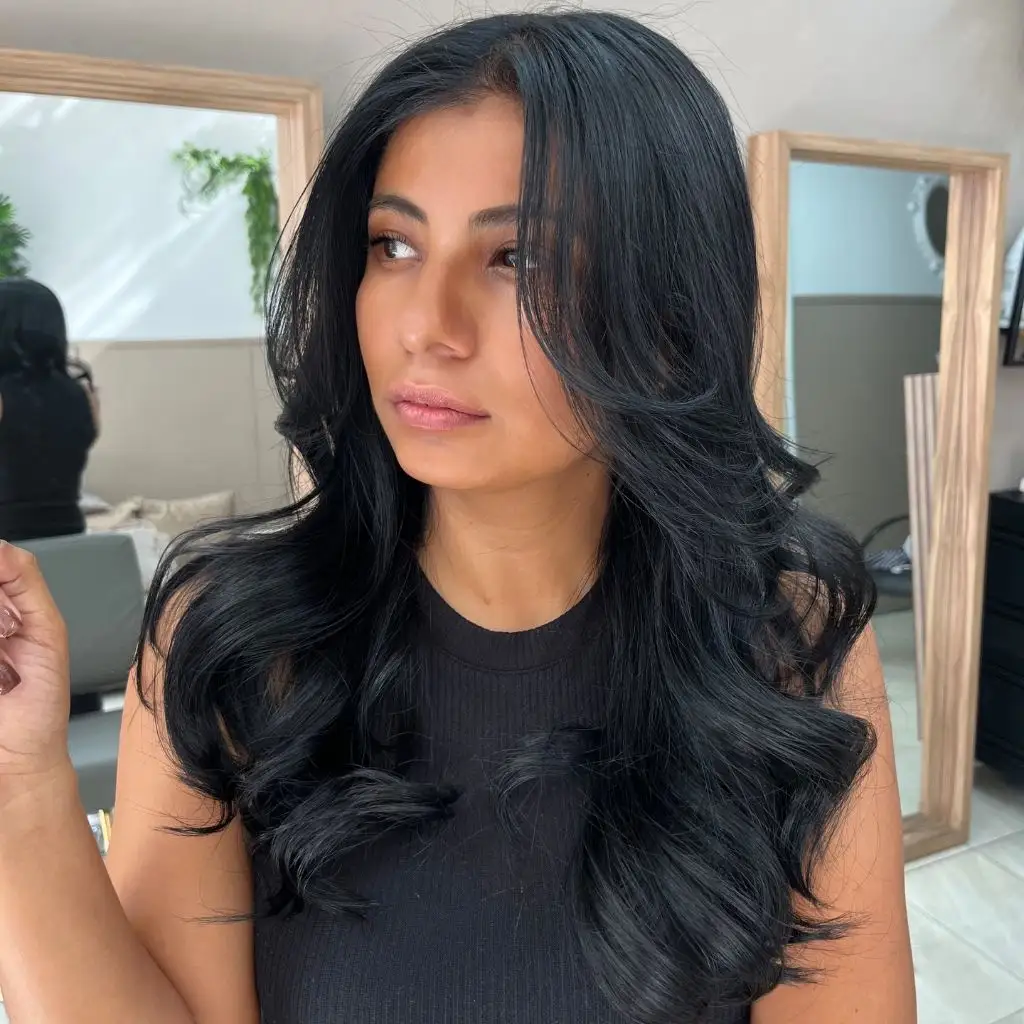
Photo via Instagram
The volume is the dominant feature. The waves create a wide silhouette that extends beyond the shoulders on both sides, and the face-framing pieces lift away from the face rather than falling against it, which opens the area around the cheekbones and jaw. The black-on-black combination of hair and top creates a single dark field from the shoulders up, and within that field, the wave pattern provides all the visual texture and variation. The mirrors behind reflect additional angles of the waves, reinforcing the sense of fullness. The center part keeps the volume symmetrical, which gives the shape a balanced, intentional quality.
The appeal is the unapologetic volume. There is no attempt to reduce or tame the fullness — instead, the waves are styled to maximize it, and the result reads as confident and complete. For plus-size women who want voluminous long hairstyles, this image shows that big hair does not need to be softened or apologized for. The proportion works because the waves are consistent and the part is centered — symmetry and repetition give large shapes their sense of order.
12. A Sharp Ombre Separates Two Distinct Zones
The back view shows long hair with a stark two-tone effect: dark brown-black roots transition into a bright, warm blonde from roughly the ear line downward. The blonde section is styled in soft, loose waves, while the darker root section lies flat and smooth. The contrast is pronounced — this is not a blended balayage but a more dramatic ombre with a visible shift point. The person wears a black salon cape.
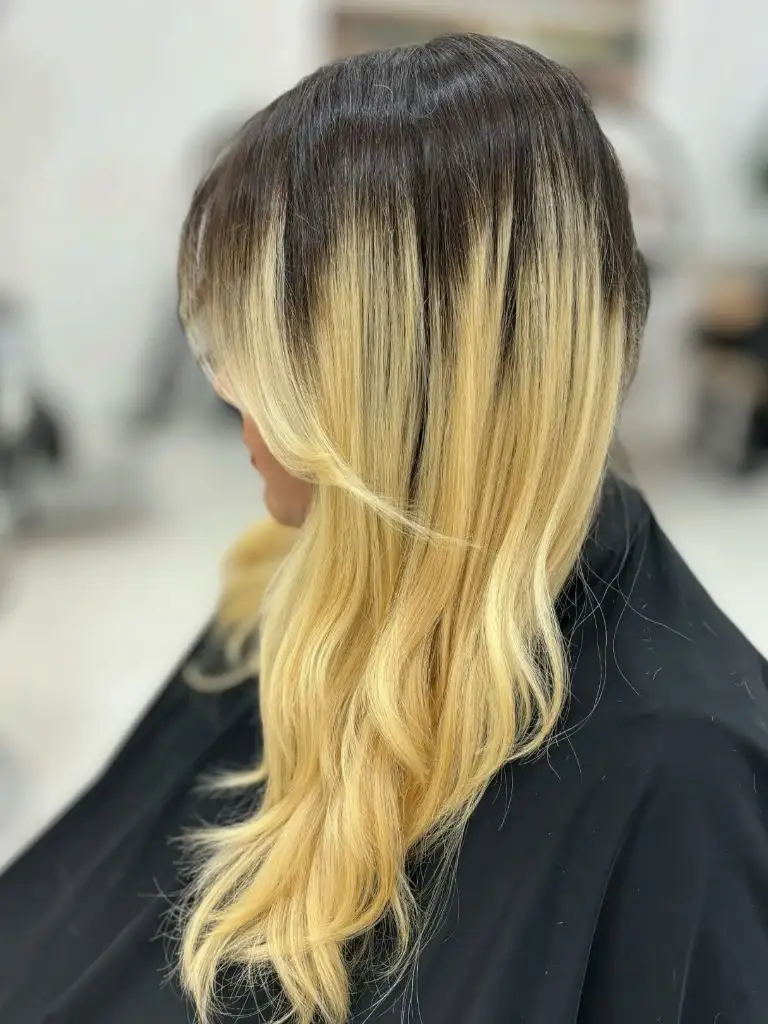
Photo via Instagram
The sharpness of the color transition creates two distinct visual zones: the dark upper section, which is compact and close to the head, and the bright lower section, which catches light and moves with the waves. This separation changes how length is perceived — the blonde half appears longer and lighter, while the dark half appears denser and more anchored. The salon cape removes any clothing context, which means the only visual information is the hair itself, and in that isolation, the contrast between the two zones becomes even more legible. The warm tone of the blonde leans golden rather than ashy, which gives the lighter section a soft glow.
The value is in the boldness of the break. Where a gradual ombre whispers, this one states clearly where one color ends and the other begins. That directness is a useful reference for anyone weighing how far apart two tones can sit without looking accidental. The principle is that a dramatic ombre color effect reads as intentional when both zones are individually finished — smooth on top, waved on the bottom — rather than treated as one.
13. Golden Blonde Waves Lift a Dark Base Outfit
This image shows long, warm golden-blonde hair styled in large, bouncing waves that fall past the shoulders. The hair has a slight strawberry undertone and catches warm, dim light that gives it a glowing quality. The person wears a dark, likely black, sleeveless top and sits on what appears to be a light-colored bed or seating area with a curtain nearby. The setting has a warm, amber mood.
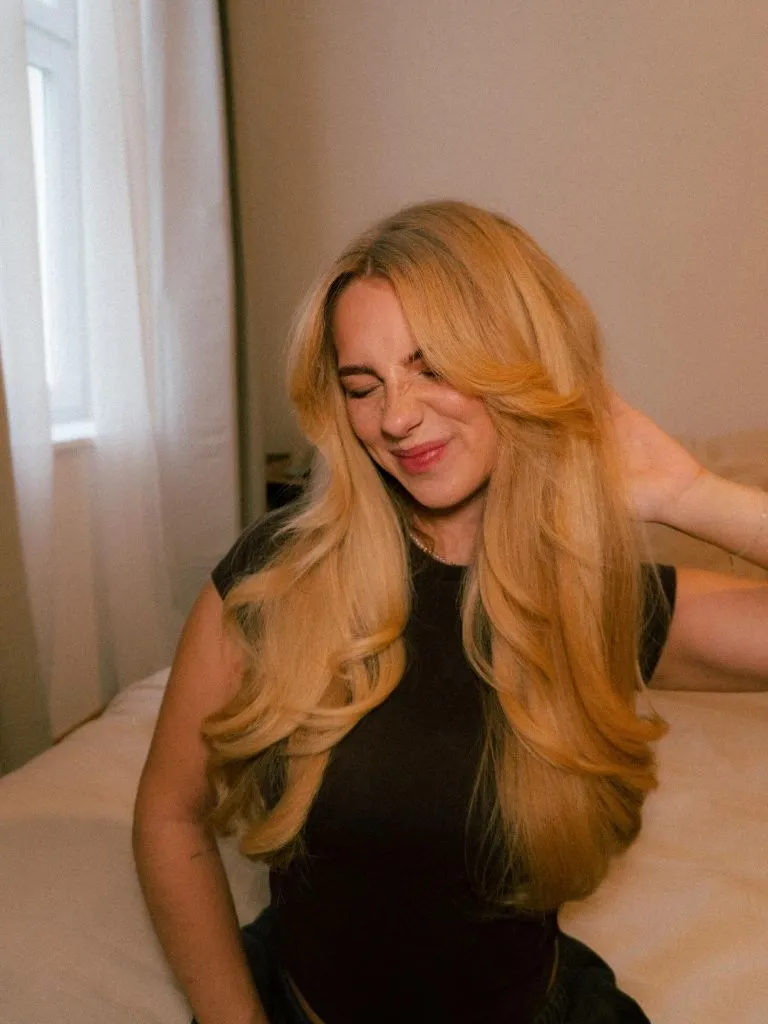
Photo via Instagram
The warm lighting and the warm hair color work together to create a golden-hour effect that saturates the blonde and deepens the shadows in the waves. The dark top provides strong contrast below, which makes the hair appear even brighter and more voluminous by comparison. The waves are not tightly curled — they are wide, rolling arcs that create a sense of weight and movement simultaneously. The overall silhouette is wide at the bottom and narrower at the crown, with the waves building outward as they descend. The casual setting and relaxed posture give the styling a lived-in quality that prevents it from reading as formal.
This is a look that relies on tonal harmony between the hair and the environment. The golden tones in the hair, the amber light, and the warm background all reinforce each other, and the dark top provides the one interruption that keeps everything from blending into a single warm wash. For anyone considering warm blonde as a hair color for fuller figures, the lesson is that golden tones photograph warmly and generously, especially in soft lighting, and that contrast with a dark neckline keeps the brightness from becoming diffuse.
14. An Angled Bob Grounds Itself With a Clean Perimeter
This side view shows a short, angled bob in dark brown-black, cut shorter at the back and longer toward the front, with a face-framing piece that reaches just past the chin. The texture is straight and slightly tousled at the surface, with a few flyaway strands. The back is not stacked but tapers cleanly. The person wears a dark brown or charcoal crewneck top, and the salon background includes gold-toned tools and reflective surfaces.
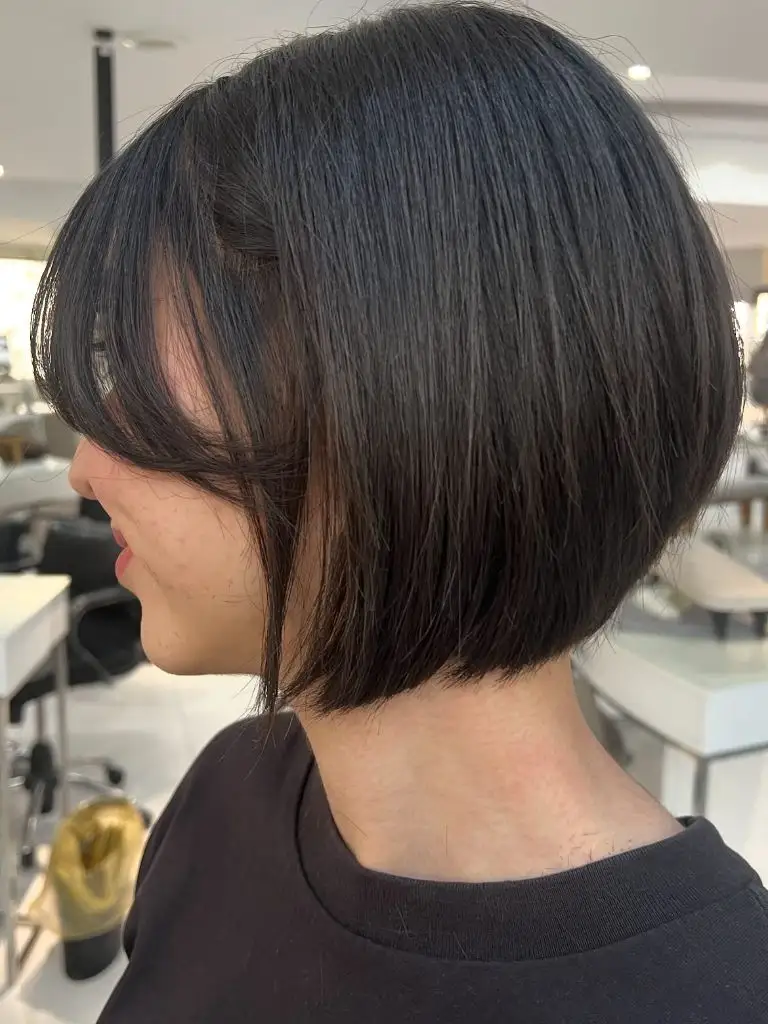
Photo via Instagram
The angle from back to front creates a visible diagonal line that gives the cut its sense of direction and movement. The longer piece at the chin provides a small amount of face framing without the fullness of layers, and the shorter back keeps the nape clean and the silhouette compact. The tousled surface texture prevents the cut from looking too severe — it adds a casual softness that the angle alone would not provide. The dark hair against the dark top reduces the visible boundary between hair and clothing, which lets the shape of the cut itself carry more attention than the color.
The effect is architectural but approachable. The clean angle does the structural work, while the slight tousle does the softening work, and neither overwhelms the other. This kind of short angled bob is a strong reference among haircut ideas for plus-size women because the diagonal line creates visual movement around the jaw and neck without adding bulk. The principle is that a well-angled bob gains personality from surface texture — even a small amount of disruption at the surface changes how the line reads.
15. Warm Chestnut With a Blunt Hem Reads as Polished
This back view shows medium-length hair in a warm chestnut brown with visible reddish undertones. The cut ends in a relatively blunt, straight line just past the shoulders. The surface is smooth and straight, with a noticeable shine that suggests healthy hair or a fresh treatment. A salon mirror and styling tools are visible in the background. The person wears a white t-shirt.
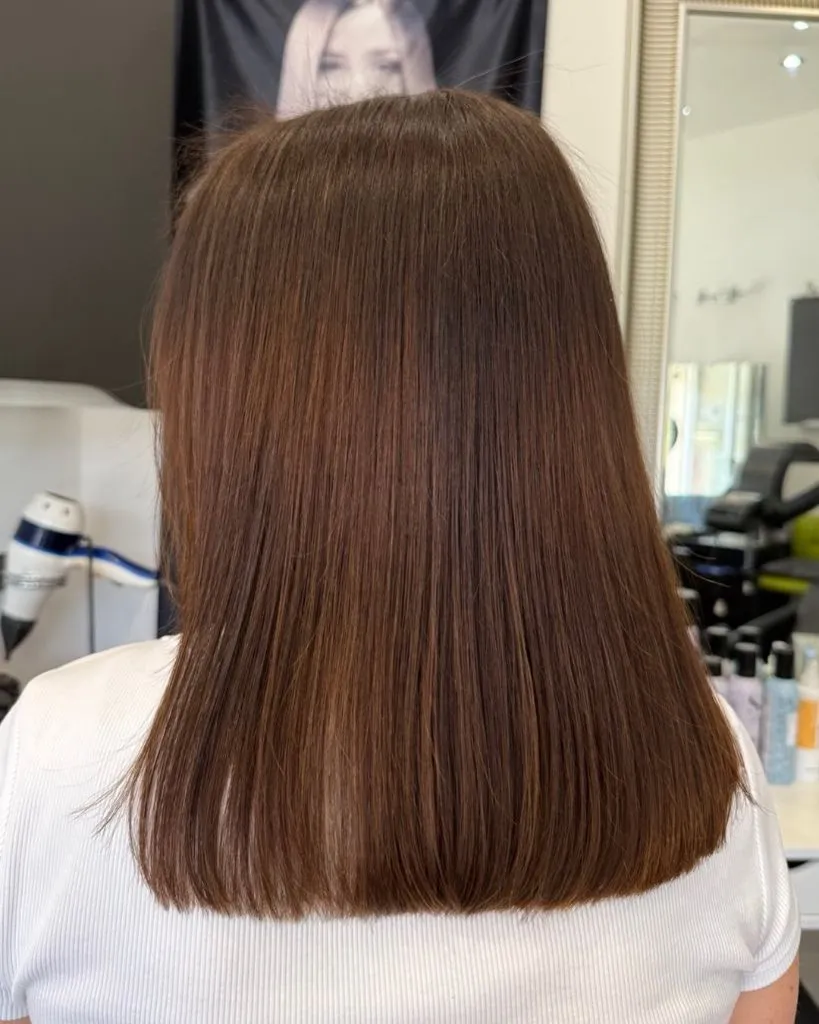
Photo via Instagram
The blunt hem is the central feature. It creates a single, unbroken horizontal line at the bottom of the hair that reads as clean and decisive. There are no visible layers, no graduation, no texturing at the ends — just a straight cut that produces a rectangular silhouette from the back. The warm chestnut tone catches light evenly across the smooth surface, and the reddish undertones add warmth without being overtly red. Against the white t-shirt, the color appears richer and deeper than it might against a darker garment, which suggests that the clothing beneath a one-length cut can significantly affect how the color is perceived.
This is the definition of low-drama precision. The cut makes one decision — a clean, blunt line — and the color supports it with a single, consistent tone. There is nothing to distract from the shape. For anyone who values simplicity in their hair approach, the lesson here is that a blunt cut at medium length only reads as polished when the surface is smooth enough to hold the line. Texture or wave would soften the hem and change the character entirely, which makes maintenance and styling for a smooth finish part of the commitment.
16. Layered Ends Interrupt a Straight Fall
The back view shows medium-to-long dark brown hair with layers that become visible in the lower third, where the ends curl and flip outward in various directions. The upper portion of the hair is relatively smooth and straight, while the bottom portion has clear movement and texture. The color is a uniform dark brown without highlights. The person wears a light beige or tan knit top, and a rectangular light panel is visible in the background.
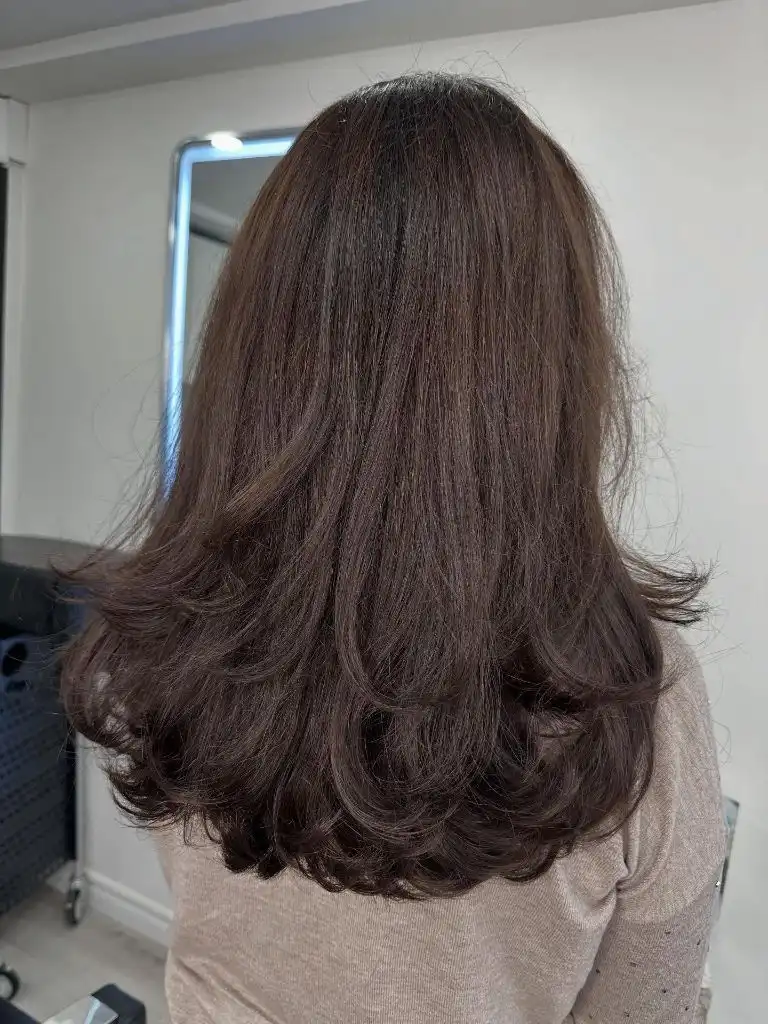
Photo via Instagram
The contrast between the smooth upper section and the active lower section is the most readable element here. The straight fall from the crown to the mid-back establishes a calm vertical line, and then the layered ends disrupt that line with curves and flips that add width and visual energy at the bottom. This bottom-heavy movement changes the silhouette — from the back, the hair appears wider at the ends than at the top, which creates a triangular shape. The beige top provides a neutral background that neither competes with nor supports the dark hair; it simply recedes.
The appeal is the honesty of the layering. These ends are not perfectly curled in one direction — they flip both inward and outward, which suggests either natural behavior at this length or a deliberate loose styling. That imperfection gives the cut a lived-in quality that a more uniform curl pattern would not. The principle worth noting is that layers in the lower third of long hair create the most visible movement when the upper section remains smooth, because the contrast is what makes both sections legible.
17. A Textured Short Cut Changes the Proportion Completely
This side view shows a short layered cut in a warm reddish-brown or auburn tone. The layers are choppy and textured, with visible movement throughout — shorter at the nape and crown, longer through the top and the face-framing section. The hair is styled with volume at the crown and a slight flip at the ends. The person wears a plain white t-shirt, and the background is a brightly lit salon space.
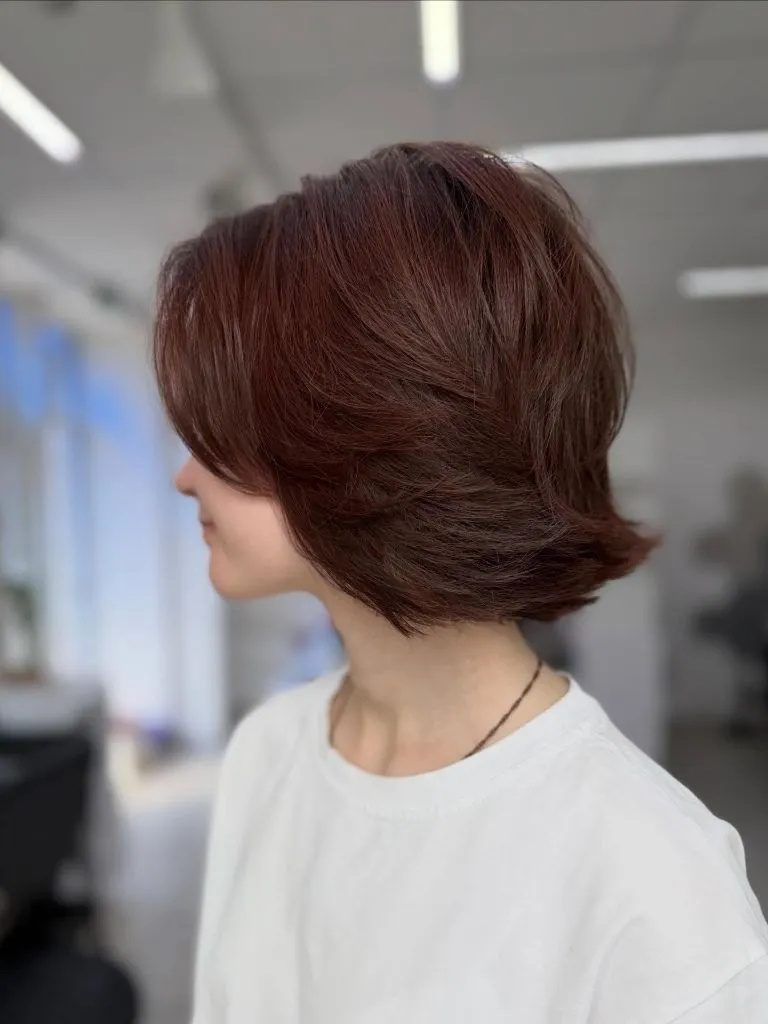
Photo via Instagram
The short length and the layered texture combine to create a silhouette that is compact but full of internal movement. The volume at the crown lifts the overall shape, and the shorter nape keeps the back clean while the longer top pieces sweep forward and outward. The warm auburn color adds to the sense of energy — it is a shade that catches light on every textured surface, which makes each individual layer more visible than it would be in a darker tone. The white t-shirt provides a stark, clean background that lets the shape and color of the cut dominate the frame.
The best detail is how the layers create a sense of deliberate disorder. Nothing is perfectly smooth or perfectly aligned, but nothing looks accidental either — every piece appears placed with intention, even if that intention is looseness. Among the many short haircut options for women, this kind of textured, layered short cut is particularly interesting because it generates visual complexity without requiring length. The principle is that texture and color working together can give a short cut the visual weight that length provides in a longer style.
18. Dark Brown With Subtle Warm Ends Creates Quiet Depth
This back view shows long, dark brown hair with very subtle warm tones emerging at the lower third — not a deliberate ombre, but a natural-looking gradation where the ends appear slightly lighter and warmer than the roots. The hair is straight with a very gentle inward curve at the tips. The length reaches the mid-back. The person wears a dark gray or charcoal t-shirt, and the background includes what appears to be a kitchen or cafe setting with glass shelves.
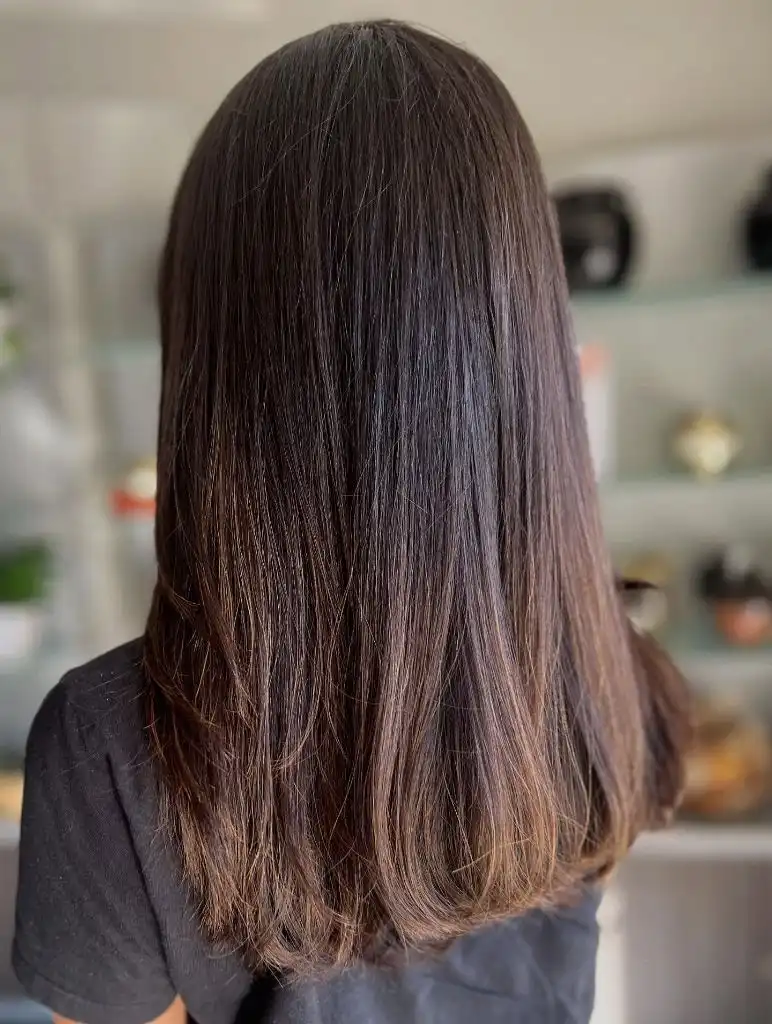
Photo via Instagram
The subtlety of the color variation is the key here — it is barely there, but it prevents the long dark fall from reading as completely flat. The warmer ends catch light differently than the cooler roots, and that slight shift gives the hair a sense of depth that a single uniform shade would lack. The inward curve at the tips is minimal, just enough to prevent the ends from looking blunt or chopped, and it creates a slightly rounded bottom perimeter that softens the overall shape. The dark t-shirt blends with the upper portion of the hair, which has the effect of making the lighter ends the most distinct part of the silhouette.
The value is in what is almost not there. This is not a statement color or a dramatic cut — it is a careful maintenance of natural-looking hair with just enough warmth at the ends to add dimension. For anyone who prefers a natural-looking hair color approach, this image demonstrates that even a very slight tonal shift at the ends can change how the eye reads the entire length. Quiet depth does not require visible technique.
19. Long Black Layers With Flipped Ends Build Width Intentionally
From the front, this image shows long, jet-black hair with visible layers that begin around the collarbone and extend to the chest. The ends are styled in outward flips that create a wide, wing-like shape at the bottom. The center part is clean and straight. The person wears a white short-sleeve top, and the background is a green foliage wall with a gray panel.
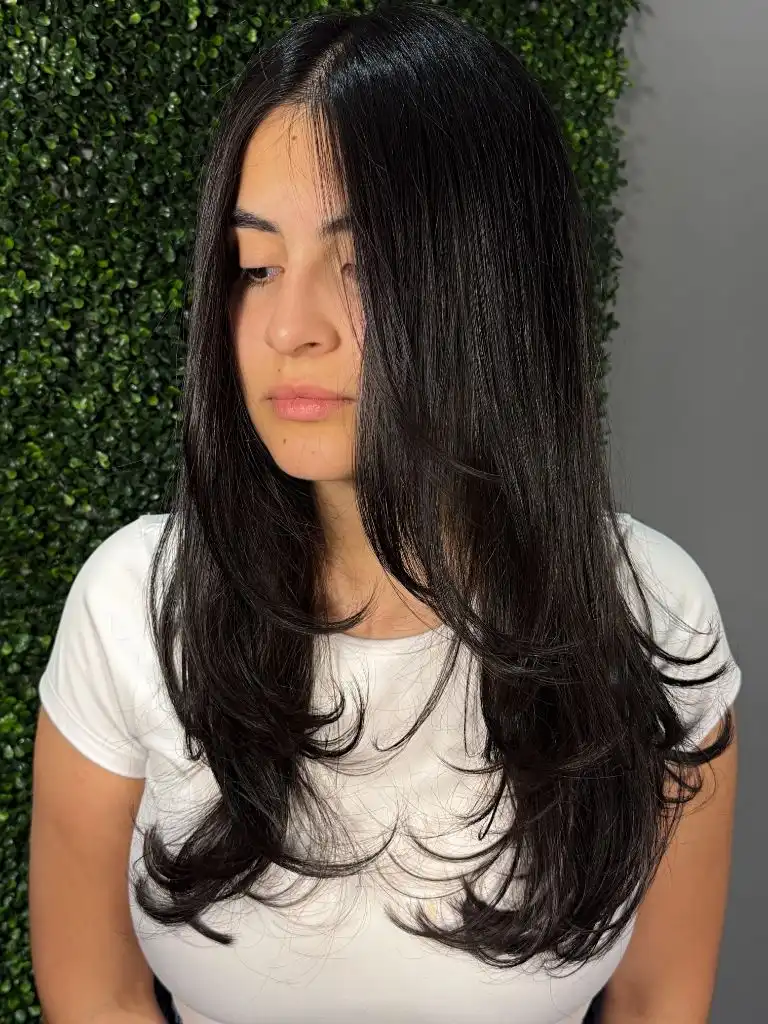
Photo via Instagram
The outward flips at the ends are the most prominent styling detail. They create a series of visible curves along the bottom perimeter that widen the silhouette significantly compared to what a straight or inward-curling style would produce. The layers start high enough to be visible from the front, and each layer takes its own outward curve, which builds a cascading effect. The green foliage wall adds a natural, textured background that contrasts with the sleek black surface of the hair, and the white top provides a bright base that makes the dark hair stand out sharply.
This is a deliberate choice to build width at the ends rather than contain it. The flipped layers read as styled and intentional — this is not accidental volume but a chosen shape. The photograph does not show the back or the profile, so this section can only speak to the front-facing proportion, where the widened ends balance the narrower crown and center part. The transferable principle is that outward-flipped layers create horizontal emphasis wherever they end, so the placement of the shortest layer determines where the widest point of the silhouette will land.
20. A Smooth Back View Confirms the Layered Shape
This final image shows the back view of the same or a very similar long, jet-black layered cut. The hair falls past the shoulder blades, and the layers are visible through slight variations in length at the ends. The surface is smooth and straight through the upper two-thirds, with a gentle inward curve at the bottom that collects the ends into a rounded shape. The same white top and green foliage background are visible.
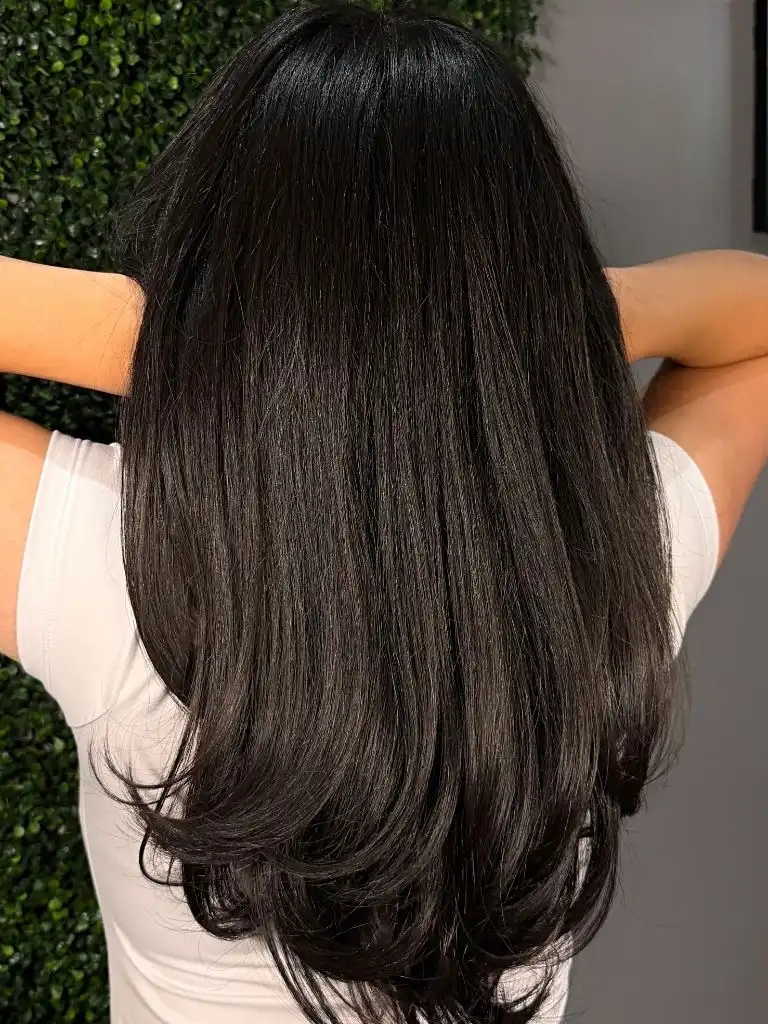
Photo via Instagram
From the back, the same hair reads quite differently than it did from the front. The outward flips are not visible here — instead, the ends curve gently inward, creating a contained, rounded shape that tapers toward the bottom center. This means the front and back of this cut produce two different silhouettes: wide and active from the front, smooth and collected from the back. The smooth surface reflects light in long vertical streaks that emphasize the length and the health of the hair. The green wall and white top remain consistent, confirming this is the same cut seen from a different angle.
The effect is completeness. Seeing the same layered haircut from multiple angles reveals that a single cut can produce different readings depending on the viewpoint, and that both readings need to be considered when choosing a style. The front shows movement and width; the back shows smoothness and containment. For plus-size women evaluating a layered cut, the lesson is that the back view matters as much as the front, and the best cuts are the ones that hold their shape — and their intention — from every direction.