November tends to reward nail designs that work as composed surfaces rather than isolated color choices. When you study the sets below as whole compositions — considering how proportion, contrast, texture, and negative space interact across all ten fingers — the ones that hold together best are usually the ones where every element serves a single visual hierarchy. That relationship between dominant surface and supporting detail matters more than any individual shade, and it becomes especially clear as early winter outfits shift toward darker, richer palettes that frame the hands differently.
Before scrolling, notice three things in each set: where the lightest point falls, how much of the nail bed is left exposed versus covered, and whether the design asks you to read each finger individually or as one continuous field. Some of these lean toward maximum surface activity; others depend on a single quiet gesture repeated ten times. The trade-off between complexity and cohesion runs through all of them, and neither approach is automatically stronger. What matters is whether the secondary elements know their job relative to the dominant one, and no single formula governs that.
1. Gold Texture Fractures a Dark Metallic Field
A dark metallic base — somewhere between gunmetal and deep bronze — covers every nail from cuticle to tip. The surface is not smooth; it reads as crackled or fractured, with irregular gold-toned shapes breaking through the darker layer. The nails are long with a coffin-shaped silhouette, and the overall impression is of a single continuous material rather than ten separate designs.
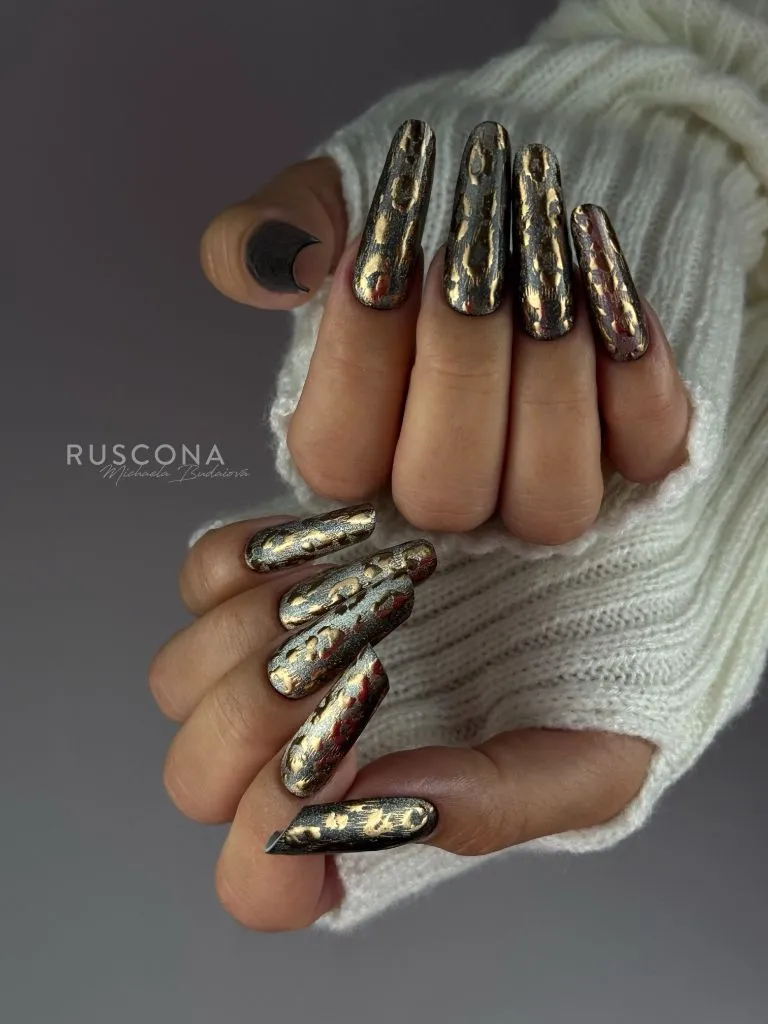
The gold fragments do not follow a repeating pattern, which keeps the texture from looking mechanical. On some nails the gold reads warmer, almost copper; on others it leans cooler, closer to pewter. The thumb, visible at the upper left, appears to carry the darkest concentration of the base shade, which gives the hand a natural focal gradient from thumb to pinky. The white knit sleeve sitting against the wrist provides the only true contrast in the frame, and it sharpens the metallic surface by giving the eye a clean resting point.
This kind of allover textured finish is striking but leaves little room for modulation — every finger competes at the same volume. If you wanted to quiet it slightly, reserving the crackle effect for two or three accent nails while keeping the rest in a flat version of the dark base would introduce a hierarchy that the current version deliberately avoids. The upkeep consideration is real: any tip wear on a finish this reflective will show immediately.
2. Warm Gradient Tips Meet Chrome Droplets
Here the composition splits cleanly between a translucent base that reveals the natural nail bed and vivid gradient tips that move from pink through orange into yellow. The nails are long stiletto shapes, and the color sits primarily in the outer third, leaving the lower two-thirds essentially bare. Small chrome-finish droplet shapes are placed on several nails, each one catching light differently.
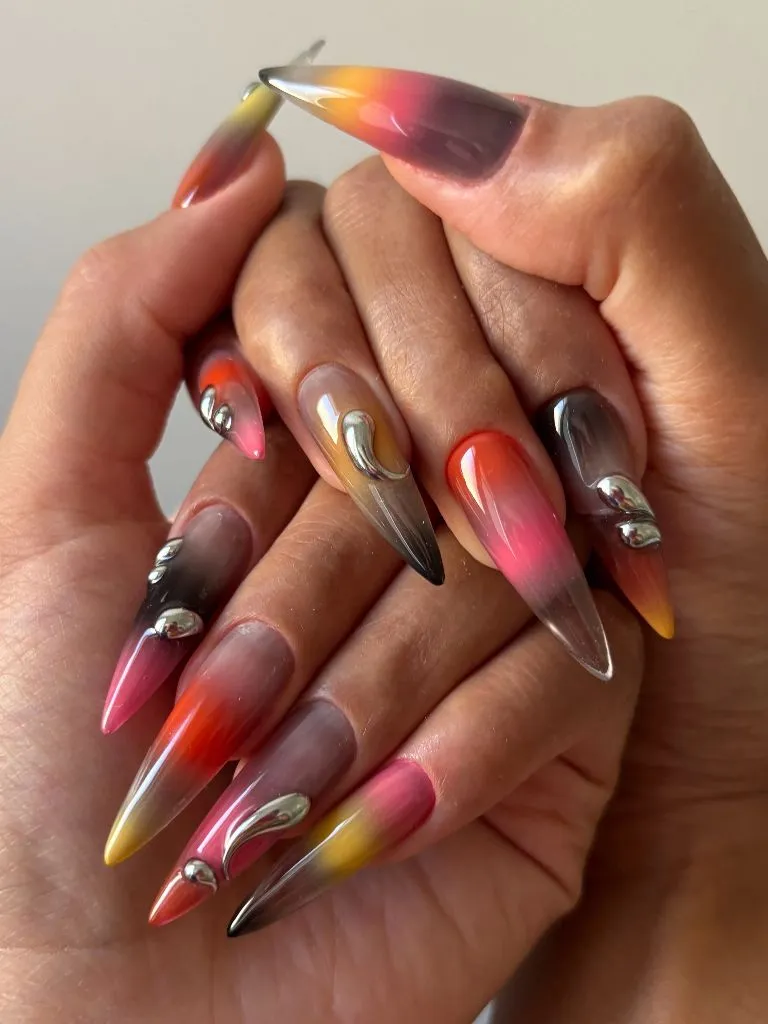
The gradient itself transitions smoothly enough that no hard line separates the colors, but the chrome droplets introduce a completely different surface quality — reflective and dimensional against the flat, translucent base. A few nails carry a darker smoky tone near the cuticle area, which adds depth without pulling attention from the tips. The palette reads as a sunset compressed onto each nail, and the stiletto shape amplifies the directional energy by drawing the eye toward the colored endpoint.
Compared with the allover metallic texture in the previous set, this design uses negative space as a structural element. The bare nail bed is doing real work: it creates breathing room so the tips can be vivid without the hand looking overloaded. For anyone drawn to early winter outfits that already carry a lot of dark fabric, this kind of warm-toned nail provides a visible counterpoint at the wrist without requiring a bold accessory.
3. Black Tips Anchor a Milky Almond Shape
A soft milky-white base dominates these almond-shaped nails, with small black heart shapes placed on select fingers and thin black tips applied to others. The overall read is minimal — the white occupies most of the visible surface, and the black elements are small enough that they function as punctuation rather than pattern.
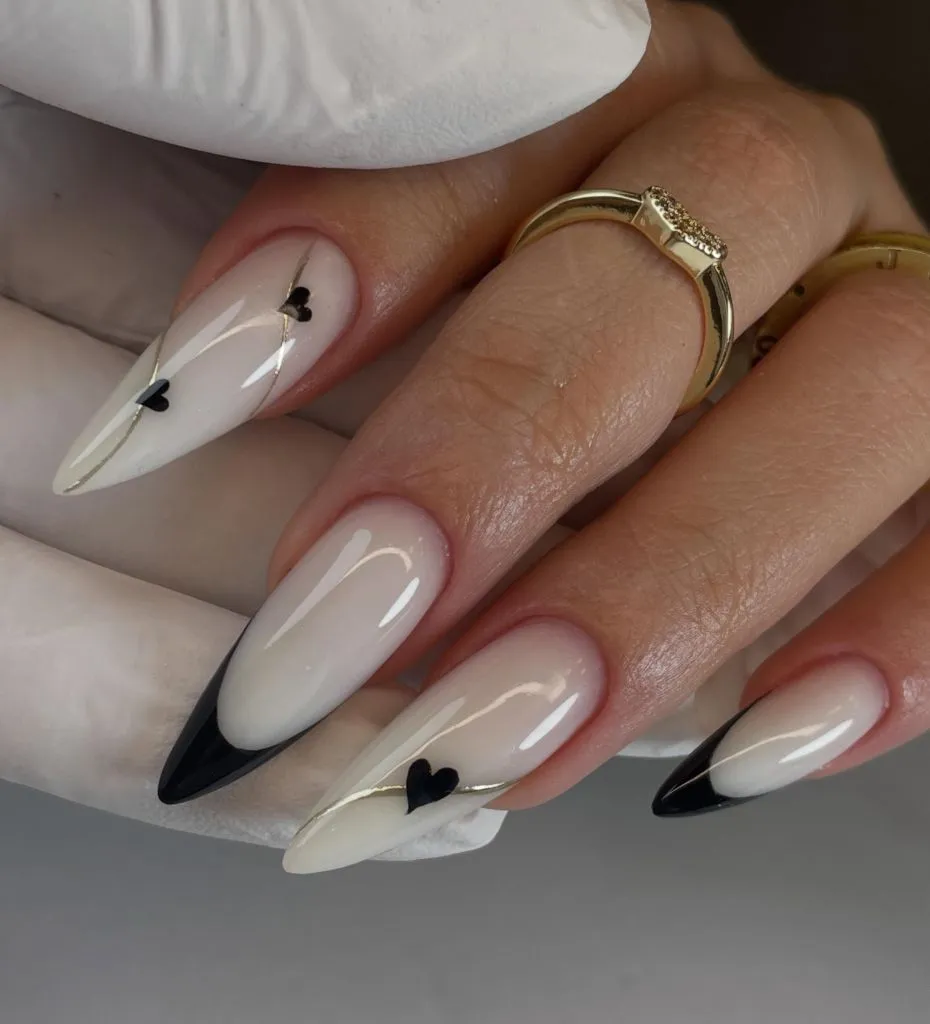
A fine gold or metallic line sits just above the black tip on at least one nail, adding a third material without introducing a third color at significant scale. The hearts are flat and graphic, cleanly rendered, which keeps them from reading as handpainted or freeform. The gold ring on the middle finger echoes the metallic line on the nail, creating a quiet loop between jewelry and manicure that ties the hand together. Against the soft white field, even a small black shape carries significant visual weight.
The restraint here is the point. Every black element is small relative to the white field it sits in, so the hierarchy never wavers. If you added black to more than three or four nails, the balance would tip and the milky base would start reading as background rather than as the dominant surface. I like that the design trusts the white to do most of the work.
4. Tortoiseshell Tips Frame a Bare Nail Bed
Square-shaped nails with a natural pink base carry tortoiseshell-patterned tips — amber and dark brown splotches contained within the last few millimeters of each nail. A thin gold line separates the patterned tip from the bare base on several fingers, creating a precise border that keeps the organic pattern from bleeding downward.
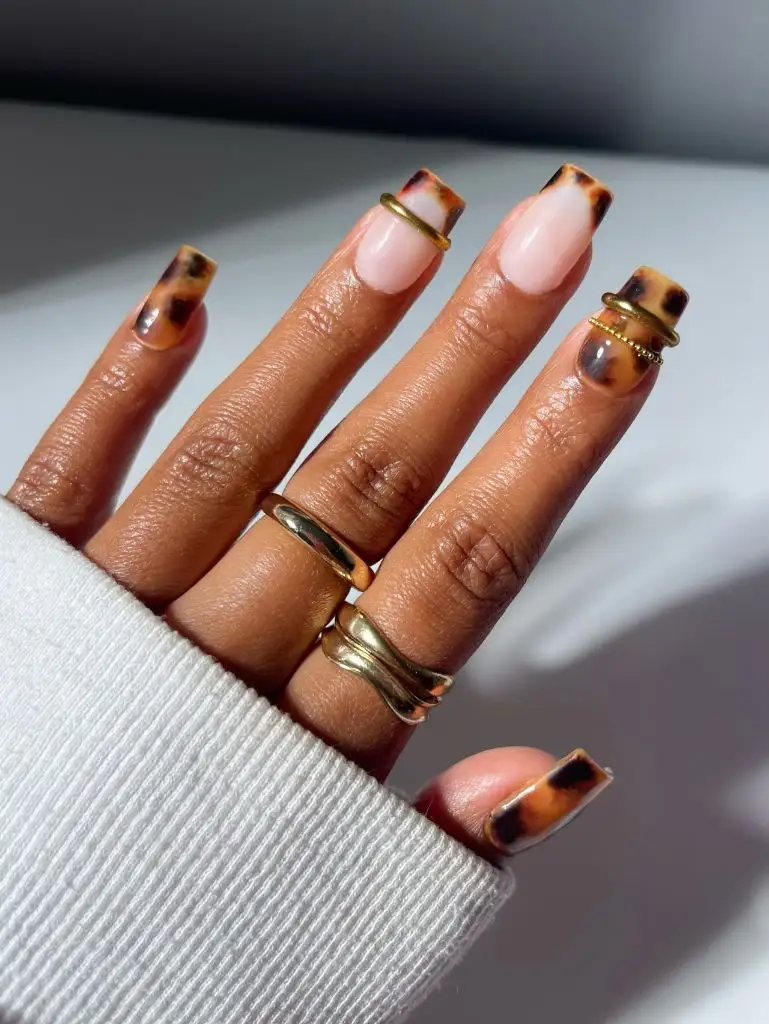
The tortoiseshell pattern varies slightly from nail to nail, which prevents the set from looking like a decal application even if it might be one. Gold rings stacked on multiple fingers repeat the warm-metal tone of the separator line, reinforcing a palette that stays entirely within the amber-to-brown range. The white sleeve at the wrist pushes the warm tones forward by contrast, much the way it functioned in the first set above, though here the overall effect is far quieter because the patterned area is so small.
This is a useful model for keeping a printed or patterned element under control: confine it to a defined zone and border it with a clean line. The design would also translate well to shorter nails, since the tip area scales proportionally — something that cannot be said for every style in this set. For anyone assembling early winter outfits around brown and camel tones, this palette slides in without friction.
5. Glitter Apple Motifs Break a Pink Field
Medium-length square nails alternate between a full glittery pink coverage and a sheer milky base with hand-painted red apple motifs. The accent nail — the ring finger — carries a three-dimensional-looking apple shape with a tiny green leaf, sitting against a pale pink background. The remaining nails split between sparkly pink tips and clean sheer surfaces.
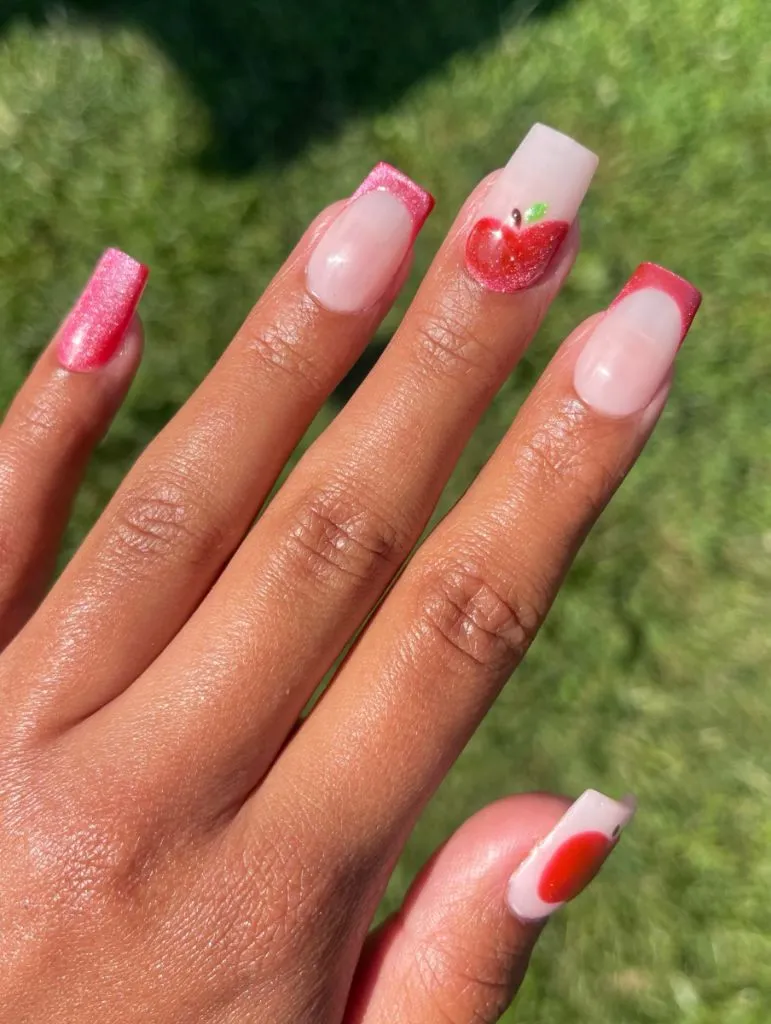
The apple motifs introduce a figurative element that none of the previous sets have used, and they shift the design from abstract pattern into illustration. The glitter on the fully covered nails and the French-tip nails catches outdoor light visibly, adding a textural layer that the flat-painted apples do not share. This surface contrast — sparkle against matte illustration — keeps the two types of nails from competing directly, because they operate on different visual registers.
The playful subject matter limits where this design fits tonally. It reads as seasonal and specific rather than versatile, which is not a weakness but is worth acknowledging. If the apples were removed and the set relied only on the pink glitter gradients, it would become a much more neutral design — proof that a single illustrative accent can define the entire character of a manicure.
6. Burgundy Dots Soften a Short Oval Shape
Short oval nails are split across three treatments: a deep burgundy-brown solid, a sheer pink base with burgundy dot clusters, and a sheer pink base with a thin burgundy French tip. The middle finger carries the densest dot pattern, creating a focal nail that draws the eye to the center of the hand. The overall length is notably short compared with every set above.
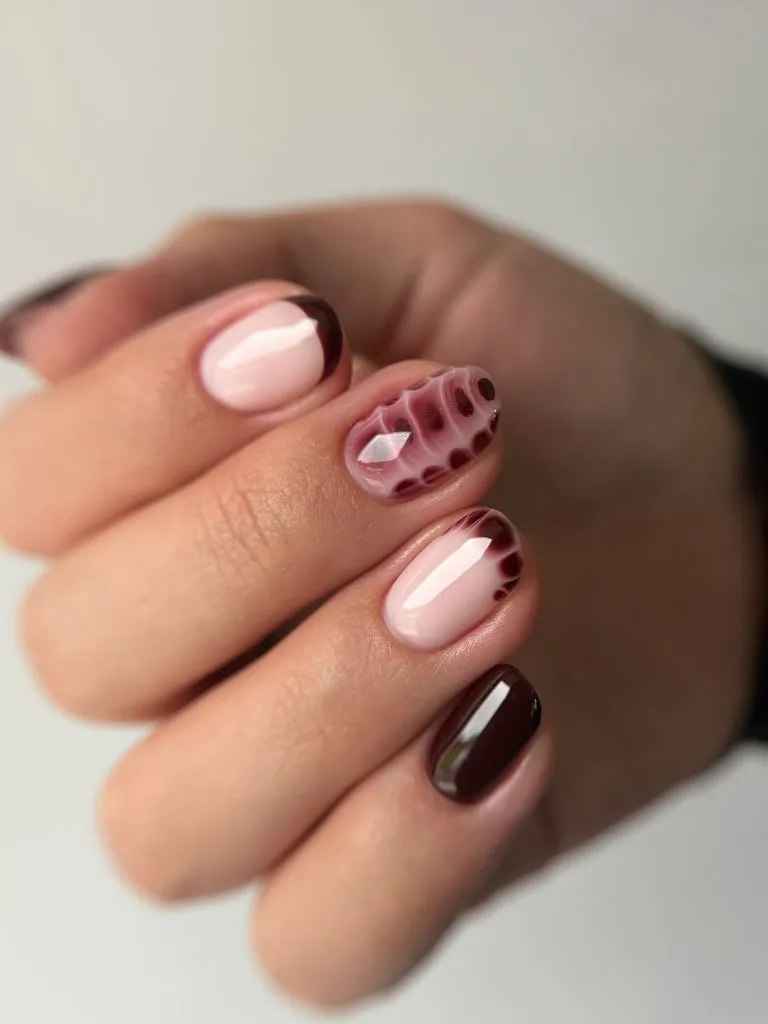
The dot pattern on the accent nail has a slightly raised, blooming quality — the dots look as if they were dropped onto a wet surface and allowed to spread, which gives them an organic softness that a precisely stamped dot would lack. The solid burgundy pinky anchors the color at the edge of the hand, while the thin-tipped nails keep the middle ground quiet. The sheer pink base is doing the same job as the bare nail bed in the tortoiseshell set above: providing negative space so the colored elements can register without crowding.
After several long-nail sets, this one demonstrates that visual interest does not require length. The design stays legible at a short scale because the elements are sized for the available surface rather than miniaturized from a longer template. The honest limitation is that the blooming-dot effect on the accent nail may be difficult to replicate at home — it looks like it depends on product consistency and timing rather than just brush control.
7. Warm Leaves Contrast a Dark Shimmer Base
Short, natural-length nails carry three different finishes: a warm caramel-brown solid, a dark brown-black shimmer, and a pale neutral base with small painted leaf and floral motifs in autumn tones. Both hands mirror the pattern, with the accent nail on each hand positioned at the ring finger.
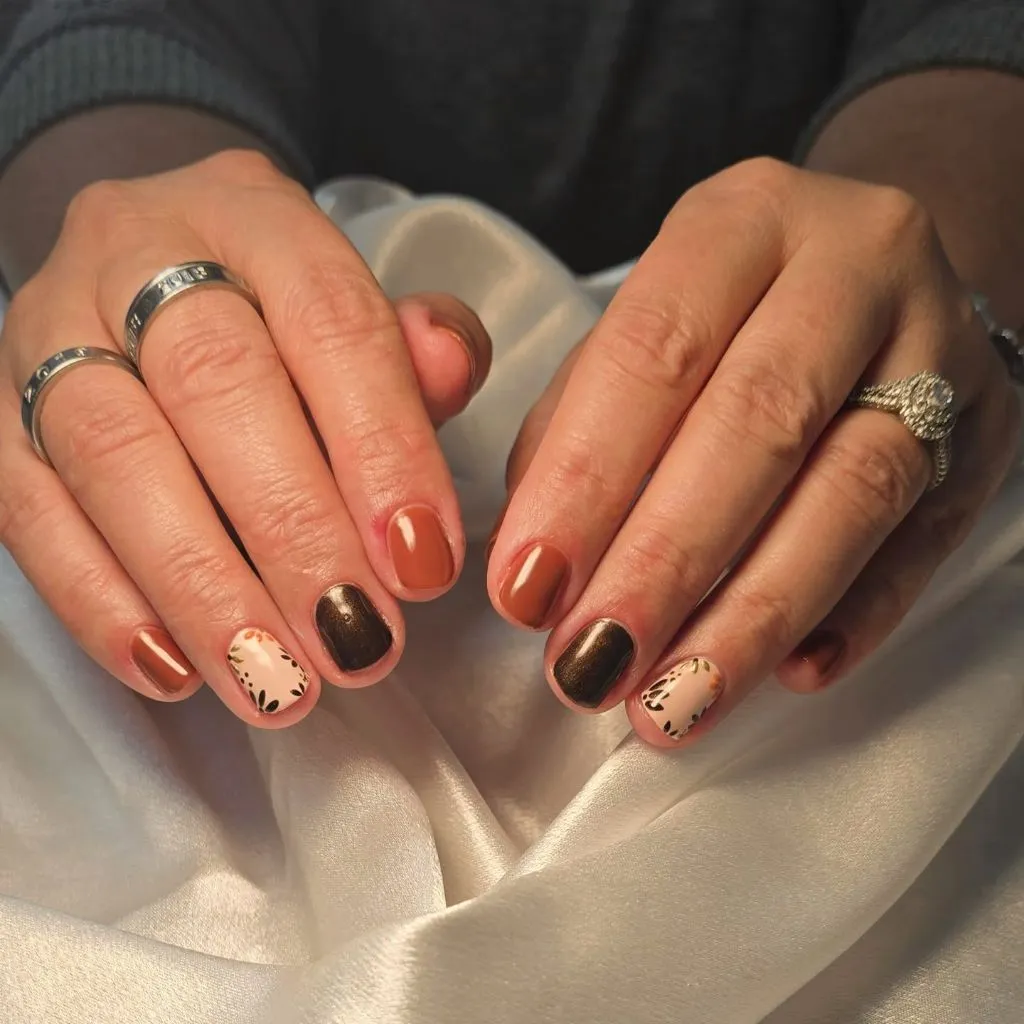
The leaf motifs — tiny branches, small leaves in rust and olive — are painted in fine lines against the lightest nail in the set, which gives them maximum legibility. The dark shimmer nails read almost black in shadow but catch a warm bronze tone in the light, linking them to the caramel solids through undertone rather than through value. Silver and gold rings on both hands add metallic interruptions that the nails themselves avoid, creating a division of labor between jewelry and manicure.
This is a practical cold-weather palette that would sit comfortably alongside most brown, olive, or black clothing without demanding attention. The illustration work is delicate enough that it could pass unnoticed at a distance, revealing itself only up close — a quality that suits anyone who prefers nail art that operates at conversational range rather than across a room. If you browse ideas for pairing nails with early winter outfits, this tonal approach is worth studying.
8. White Polka Dots Repeat Across Burgundy
Every nail on both hands carries the same design: a deep burgundy-red base with small white polka dots scattered irregularly across the surface. The nails are medium-length ovals, and there is no accent nail — the uniformity is the design decision.
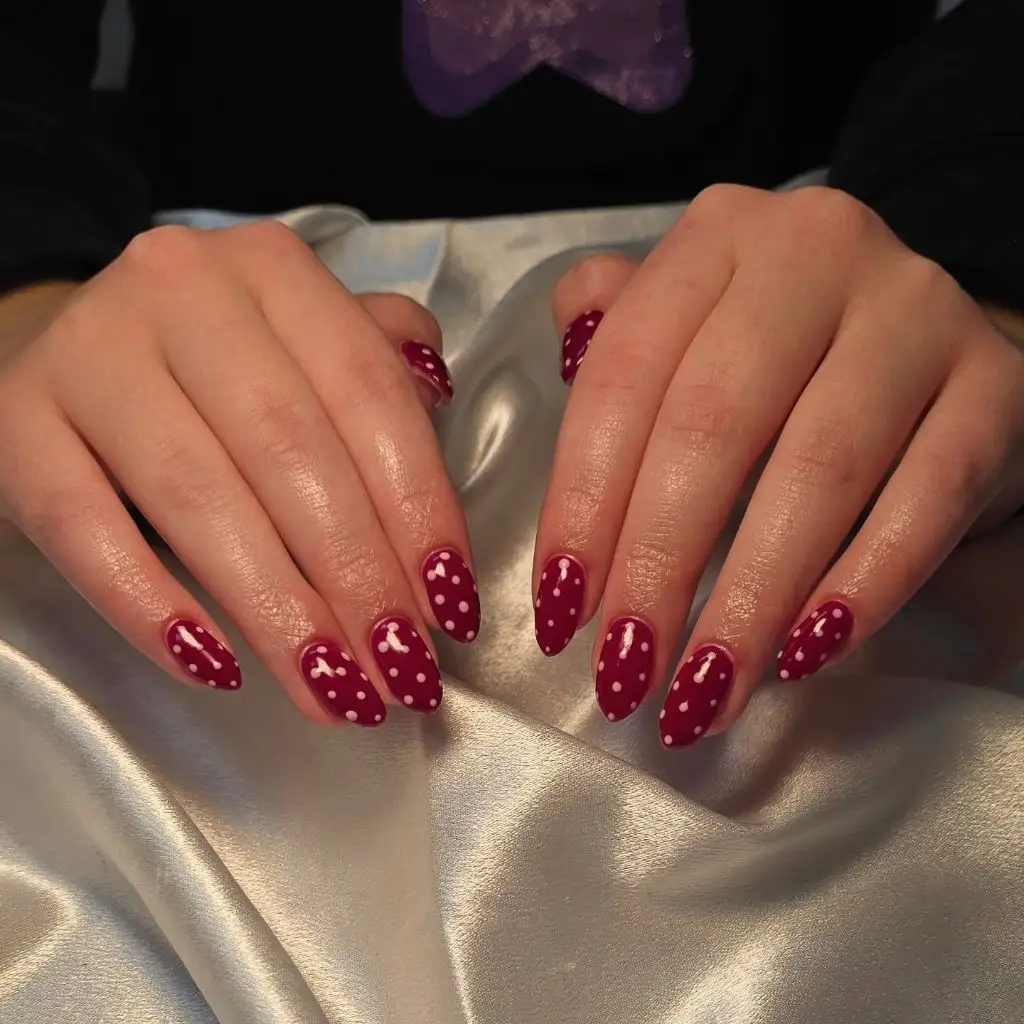
The dots are not perfectly gridded; their slightly irregular spacing gives the pattern a hand-applied quality. The burgundy base is glossy, which means the white dots sit on a reflective surface that shifts in tone as the light moves across the curve of each nail. There are no metallic accents, no secondary colors, and no variation between fingers — the entire visual interest comes from the two-element relationship of dark base and light dot.
Uniformity across all ten nails is an underrated compositional choice. It turns the hand into a single surface rather than a gallery of individual designs, and it relies entirely on the strength of that one pattern to hold attention. The limitation is that there is nowhere for the eye to rest; every nail operates at the same level of activity. Compared with the sets that use accent nails or bare bases, this feels more like a textile than a curated arrangement.
9. Bronze-to-Black Gradient Anchors at Cuticle
Almond-shaped nails display a gradient that moves from a warm bronze or copper tone near the cuticle into a deep, near-black brown at the free edge. One accent nail features a circular agate-like design outlined in gold, introducing a single figurative element into an otherwise abstract set.
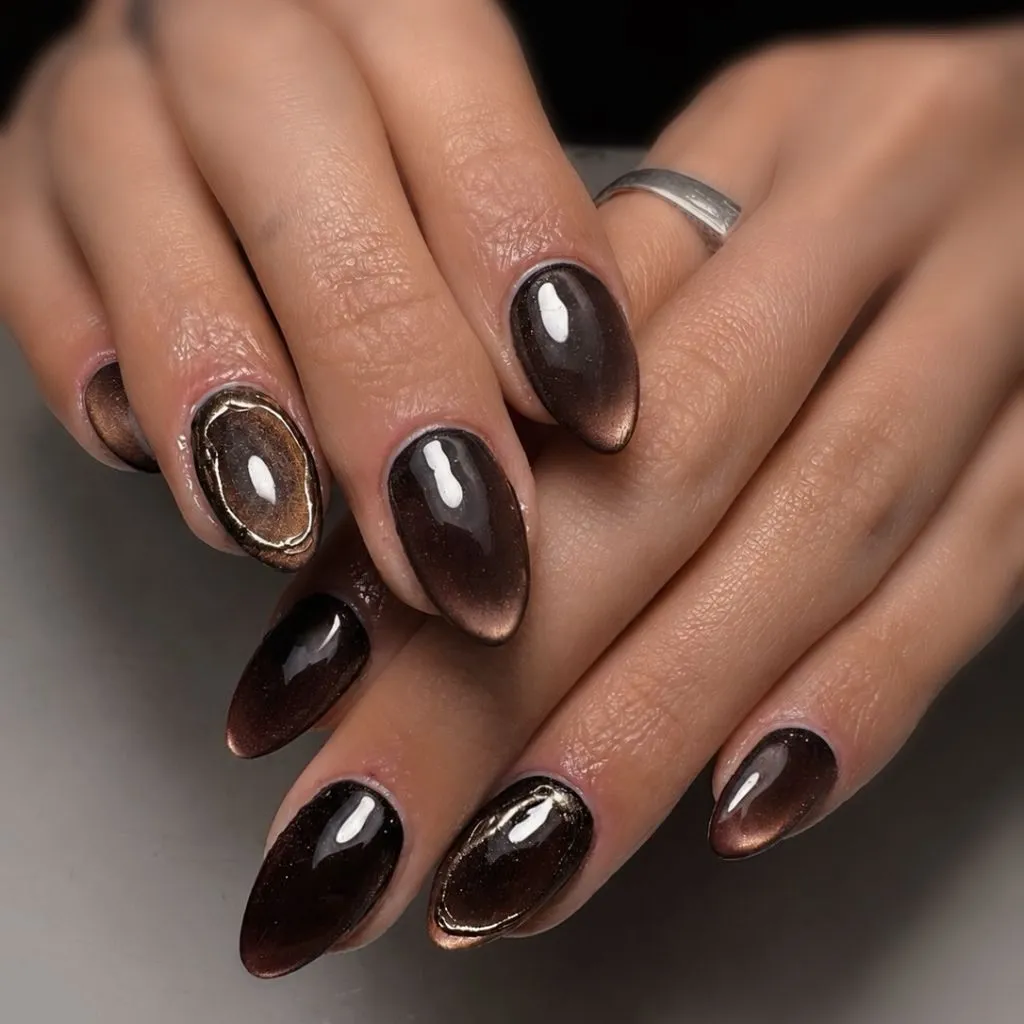
The gradient direction here is the opposite of what most ombre nails use — rather than going dark at the base and light at the tip, the warmth starts at the cuticle and deepens outward. This creates an interesting visual effect where the nail appears to emerge from light and travel into shadow. The surface is highly glossy, and the dark tips catch the strongest reflections, adding a liquid quality to the endpoint. A simple silver ring on one finger stays cool-toned against the warm palette, introducing a quiet temperature contrast.
I find the reversed gradient direction more flattering than the conventional arrangement because it draws attention toward the hand rather than toward the tips. The agate accent nail adds personality but does not disrupt the hierarchy — it reads as a variation on the same color story rather than as a separate design. Growing out would reveal the bronze zone first, which means the shift in appearance at the cuticle line would be relatively gentle.
10. Leopard Print and Florals Share a Stiletto
Extra-long stiletto nails alternate between a soft peachy-pink solid and a brown leopard-print pattern accented with small gold studs. The middle finger carries a three-dimensional white flower placed directly on the leopard surface, creating the most complex single nail in the set.
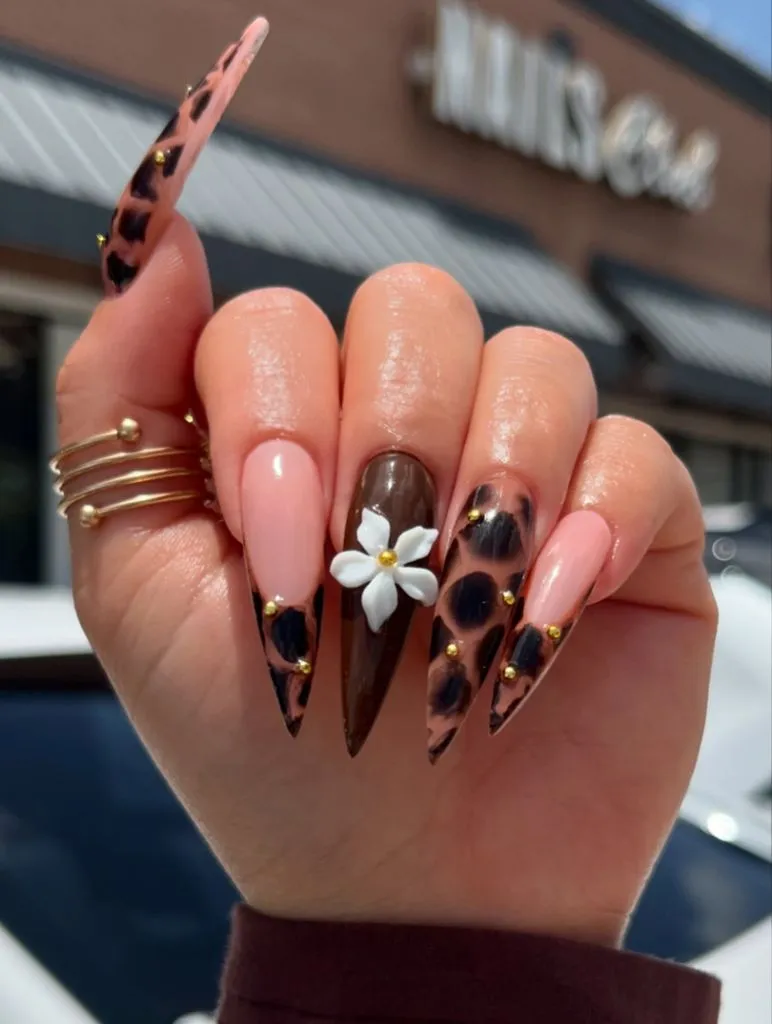
The leopard pattern uses a pink-toned base with dark brown and black spots, which ties it chromatically to the solid peach nails rather than sitting in a separate palette. The gold studs are tiny — small enough that they register as texture rather than as individual embellishments. The 3D flower on the center nail introduces a white element that nothing else in the set echoes, making it an intentional focal outlier. The stiletto shape elongates each design element, giving the leopard spots more room to read as pattern rather than as noise.
This is the most layered design in the set so far: print, dimension, metallic hardware, and solid color all coexist. Whether that reads as richly composed or overloaded depends on context. The 3D flower is the element most likely to snag or lift over time, which is the practical trade-off for the sculptural effect. Against a plain sleeve, this set would command significant visual attention at the wrist.
11. Plum Solids Meet a Sculpted White Spiral
Long coffin-shaped nails in a saturated plum or magenta shade are interrupted by a single white accent nail featuring a sculpted spiral or unicorn-horn texture. Another accent nail appears to carry a marbled pink-and-purple pattern. Gold chain-link jewelry on the fingers and a cobblestone background frame the composition in warm tones.
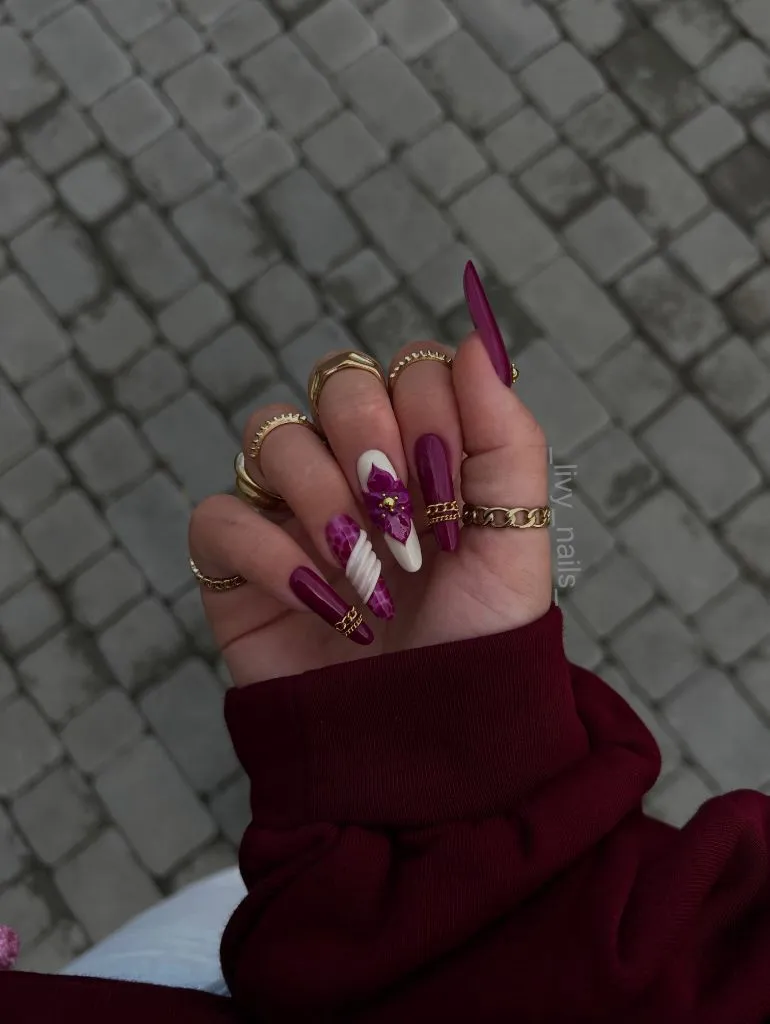
The white spiral nail is the clear focal point — it introduces a completely different color, texture, and dimensionality into a set that is otherwise flat and monochromatic. The plum shade is deep enough to read as jewel-toned, and its glossy surface reflects the ambient light in a way that keeps it from looking flat on camera. The marbled accent nail bridges the gap between the plum solids and the white spiral by containing both colors in a blended form, functioning as a transitional element.
The sculpted texture on the white nail requires maintenance awareness — any raised surface is more vulnerable to chipping or catching than a flat finish. The plum-to-white contrast is high enough that growing out would become visible relatively quickly at the cuticle. For sets built around deep berry tones, limiting the white to a single nail is what keeps this from splitting into two competing halves.
12. Stained-Glass Fragments Fill Every Nail
Short-to-medium oval nails are covered in a multicolored, cell-like pattern that resembles stained glass or a mosaic. Each irregular shape is outlined in a dark border, and the fills include silver glitter, gold, teal, burgundy, amber, and a cool grey. No two nails carry the same arrangement.
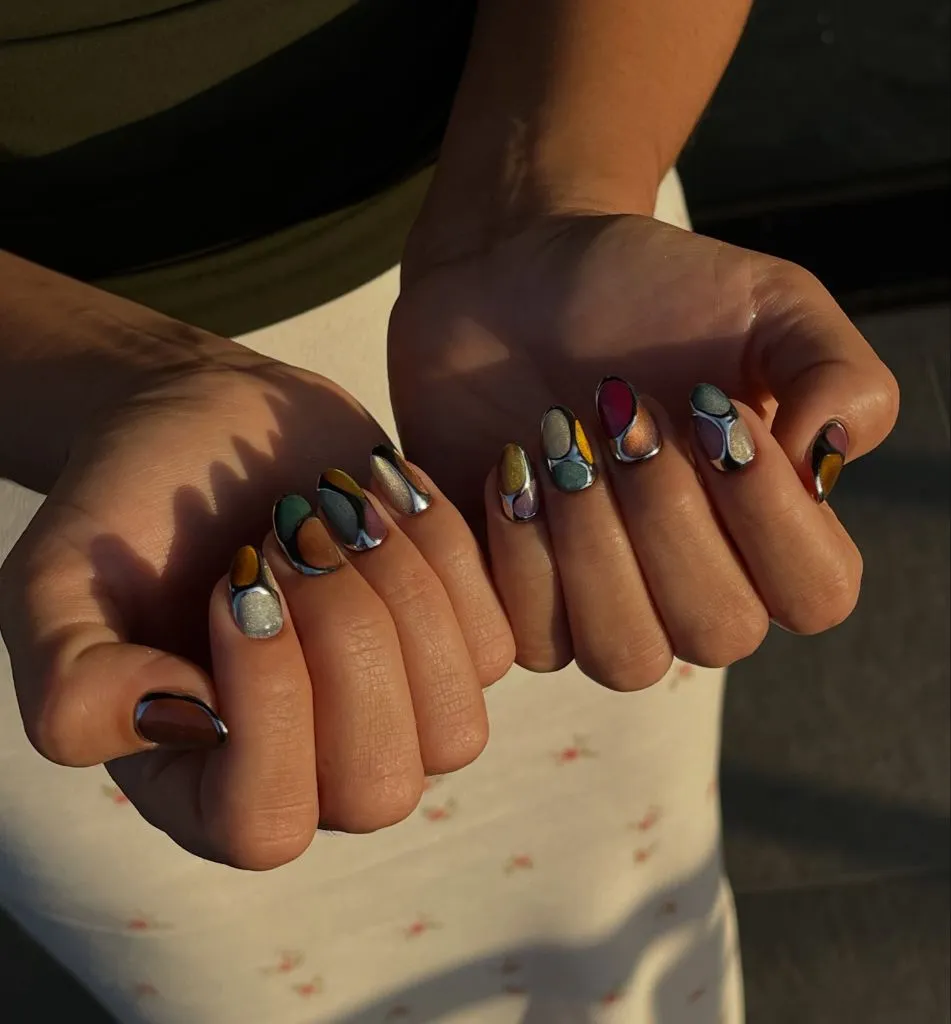
The dark outlines are the structural element holding the design together — without them, the colors would bleed into each other and lose definition. The palette mixes warm and cool tones freely, which should create dissonance but does not because the black border network treats every color as equally contained. Some cells appear to have a chrome or metallic finish while adjacent cells are matte, adding a surface-level variation that operates independently of the color variation.
This is one of the most complex designs in the entire set, and its success depends on the quality of the outlining. If the borders were uneven or varied in thickness, the mosaic effect would collapse into messiness. The design is maximalist by nature and does not scale down easily — on very short nails, the cells would become too small to read as distinct shapes. It works best when the hand is held still and viewed closely, which makes it more of a conversation piece than an everyday background element.
13. Glossy Black Covers a Short Square Shape
Short square nails are painted in a solid, high-gloss black with no variation between fingers. The finish is mirror-reflective, and the nails are trimmed close to the fingertip. A small pearl-beaded ring on one finger is the only accessory visible.
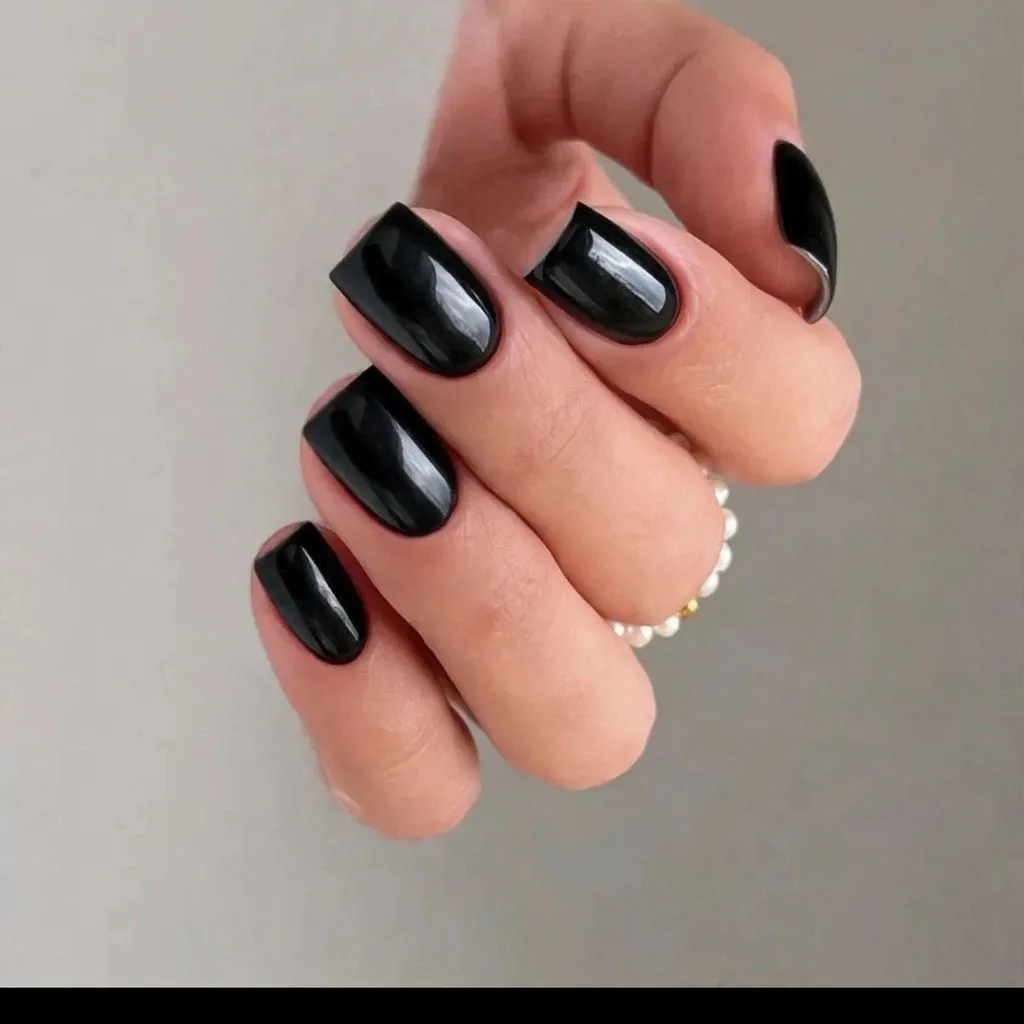
After the elaborate stained-glass set, this reads as a deliberate reset — all complexity stripped away in favor of a single unbroken color field. The gloss is doing all the visual work; without it, these would simply be short black nails. The reflective surface creates bright highlight lines along each nail curve, giving a dimensional quality to what is otherwise the flattest possible design choice. The pearl ring introduces the only contrasting element, and its small scale keeps it from competing with the nails.
Solid black at this length is arguably the most versatile option in the entire collection. It requires no design skill to maintain, pairs with virtually any palette in clothing, and the short length minimizes both breakage and the visibility of tip wear. The limitation is that any imperfection in application — streaks, cuticle flooding, uneven edges — is maximally visible on a dark, glossy, unadorned surface. Execution has to be clean because there is nothing else to look at.
14. Speckled Chartreuse Commands the Almond Silhouette
Medium-length almond nails are coated in a vivid chartreuse or yellow-green shade with visible dark speckles throughout, giving the surface a textured, almost egg-like appearance. The color is saturated and bright, and it covers every nail uniformly with no accent variation.
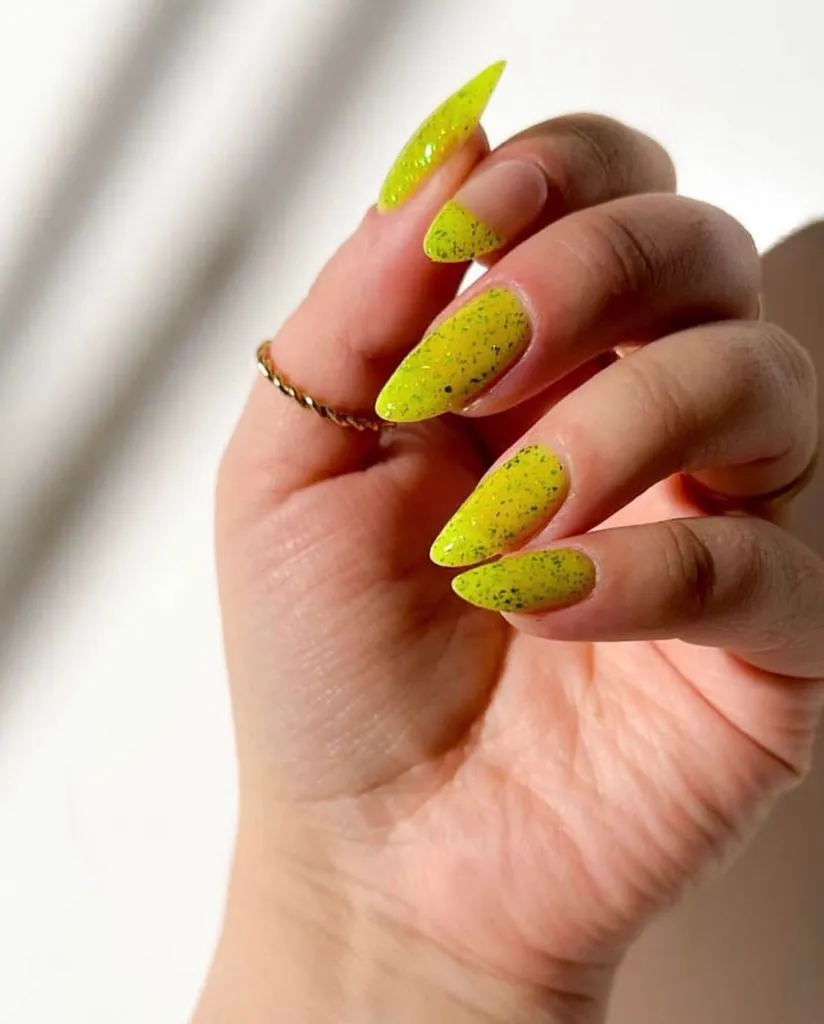
The speckles appear to be embedded in the polish rather than painted on top, which gives the surface a granite-like depth that a flat chartreuse would not have. The color itself is the boldest single shade in this entire set — it sits at the opposite end of the spectrum from the burgundies and browns that dominate most of the collection. A thin twisted gold ring on one finger is the only accessory, and its warm metal reads as nearly invisible against such a loud nail color.
This is a polarizing choice that depends entirely on how much chromatic contrast you want between your hands and everything else you are wearing. Against dark or neutral clothing, chartreuse nails function almost like jewelry — a single bright point that the eye travels to immediately. Against lighter or warmer tones, they risk looking disconnected. The speckle texture helps slightly by breaking up the color field, but this is still fundamentally a commitment to visibility.
15. Black Florals and Crocodile Texture Alternate
Short rounded nails mix four treatments: solid black, a sheer base with a black airbrushed floral shape, a sheer base with a black crocodile or reptile-scale texture, and a sheer French-style tip with a small crystal. The designs alternate across the fingers of each hand, creating a varied but tonally unified set.
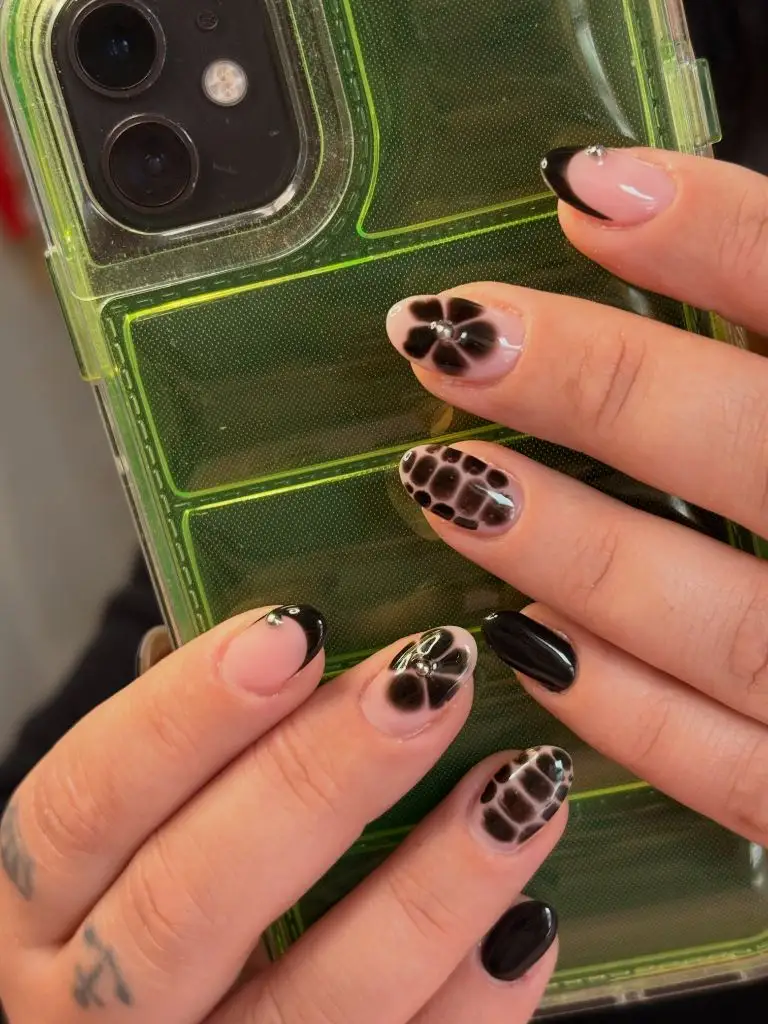
The visual link between the different treatments is the shared black palette — every design element uses black against a sheer or nude base, which means the eye reads tonal consistency even though the techniques vary widely. The crocodile-textured nails are the most unusual element, introducing a raised or embossed quality that the flat florals and solid nails do not share. Small crystals placed at the cuticle area of certain nails add a point of light that the matte black elements absorb, creating a material contrast at a tiny scale.
Mixing multiple techniques within a single tonal range is a sophisticated approach that avoids the visual competition that usually comes with variety. The risk is that at a glance, the different textures may not register — someone might simply see “black nails” and miss the crocodile detail entirely. Whether that matters depends on whether you view nail art as something designed for close reading or for immediate impact. This set rewards the former.
16. Black Tips Sharpen a Shimmery Nude Base
Short natural-shaped nails carry a sheer, slightly shimmery nude-toned base with clean black French tips. The tips are painted in a traditional curved line, and the shimmer in the base catches light as a subtle pearlescent glow rather than as visible glitter particles.
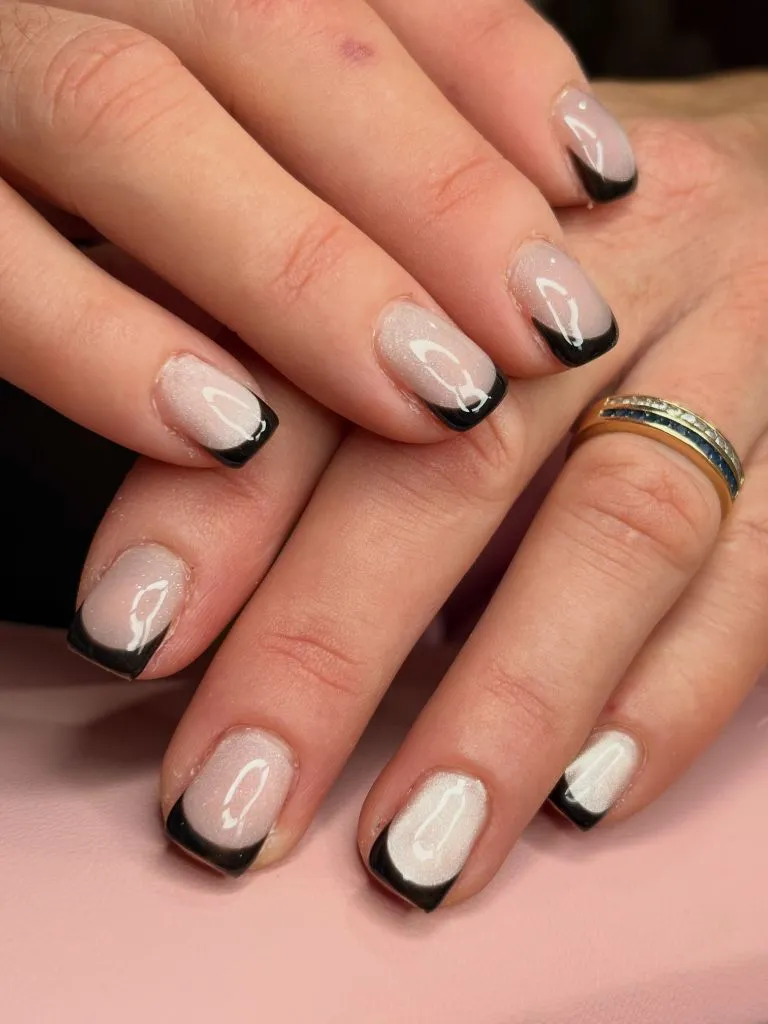
The black tip against the soft shimmer base creates a clean endpoint that gives the short nails a more defined silhouette than the nude base alone would provide. Every nail carries the same treatment, and the consistency turns the set into a uniform frame around each fingertip. A gold ring with blue stones on one finger introduces a color that nothing in the nail design references, which means the jewelry operates independently rather than as an extension of the manicure palette.
This is the most wearable design in the collection for anyone who needs their nails to function as a quiet background element. The black tip is visible enough to read as a deliberate choice but restrained enough that it does not compete with rings, watches, or gestures. For those exploring how nails interact with early winter outfits in darker fabrics, a black French tip echoes sleeve hems and coat edges without requiring a full dark nail.
17. Blush Shimmer Fades Toward Silver Tips
Short-to-medium oval nails display a soft gradient from a pink or blush tone near the cuticle to a silvery shimmer at the free edge. A single small crystal or pearl is placed at the center of each nail, acting as a repeating motif across all ten fingers.
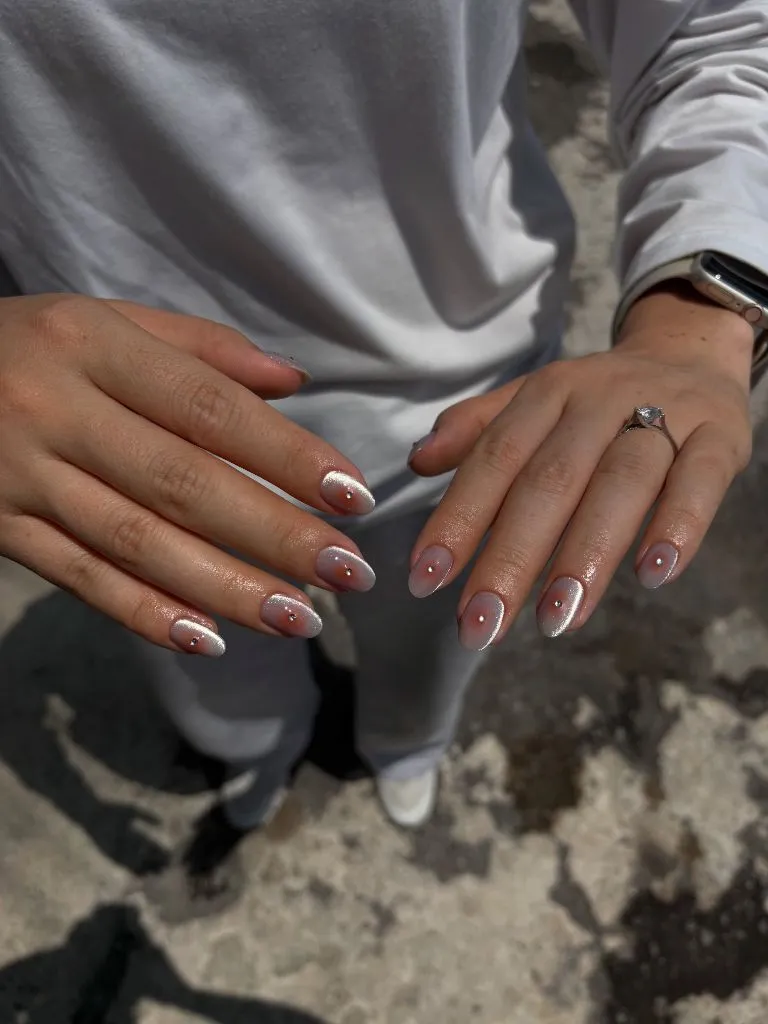
The gradient is gentle — more of a color temperature shift than a dramatic ombre. The blush warmth near the cuticle cools into a chrome-like silver as it reaches the tip, and the transition is smooth enough that no midpoint line is visible. The small pearls or crystals placed at the nail center create a vertical axis on each finger, drawing the eye inward rather than toward the edges. The overall effect is luminous and soft, registering more as a finish quality than as a color choice.
Compared with the bold chartreuse or the complex stained-glass sets, this design operates almost entirely through surface quality rather than through color or pattern. Its visual weight is very low, which makes it one of the most adaptable options here but also one of the easiest to overlook in a photograph. In person, the shimmer shift would be more apparent with hand movement, which is an advantage that the camera does not capture.
18. Pastel Marble Swirls With Pearl Accents
Medium-length almond nails are covered in a marbled pattern that mixes soft pink, lavender, pale blue, and white. Small pearl-like spheres are placed on several nails, and the overall surface has a matte or satin quality rather than a glossy one.
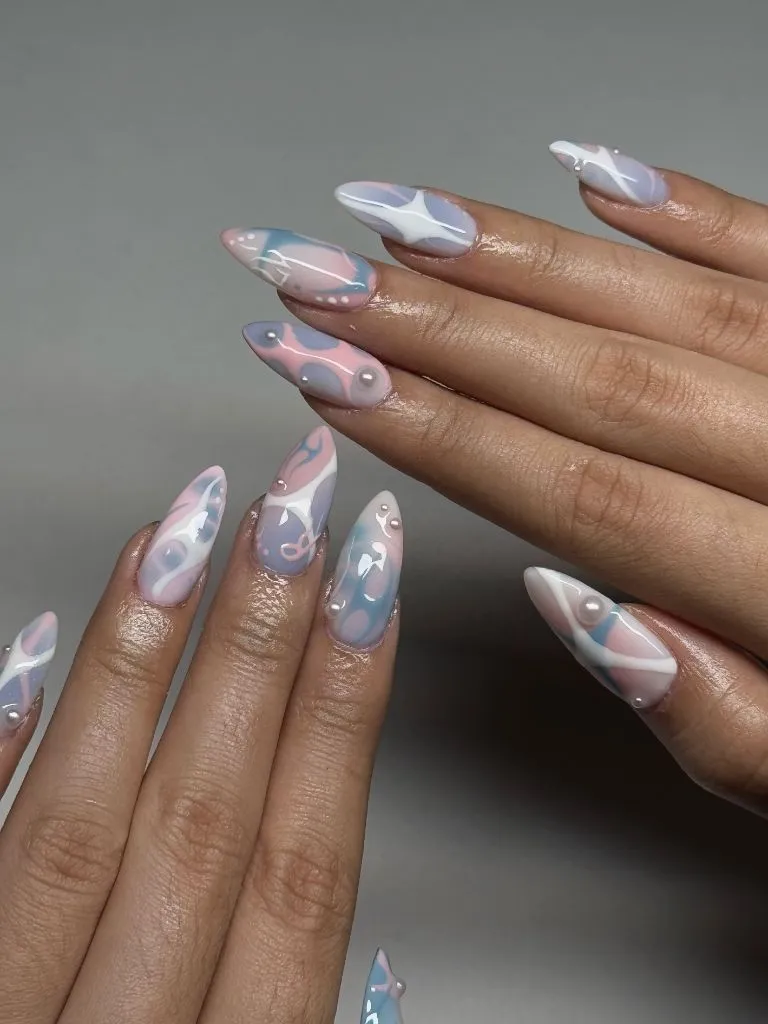
The marbling technique creates flowing, organic shapes that differ on every nail, and the color palette stays within a narrow range of cool pastels. White acts as the lightest element in the swirl, providing contrast against the pink and blue tones, while the lavender sits between them as a bridging shade. The pearl accents are three-dimensional and placed asymmetrically, which prevents them from looking like a grid or a stamp. The satin-looking finish reduces reflections, which means the marble pattern reads more clearly than it would under high gloss.
The palette here is decisively cool and light — this sits at the opposite end of the tonal spectrum from the deep burgundies, plums, and browns that dominate November nail palettes. Whether that contrast with the season is appealing or dissonant is a matter of personal preference. The matte finish helps ground the pastels slightly, preventing them from reading as purely spring or summer. The pearls would be the first element to lift or detach with daily use.
19. Mixed Textures Across an Eclectic Autumn Set
Short rounded nails present a different treatment on nearly every finger: olive green with a glossy, almost jelly-like finish; deep burgundy with small metallic studs; sheer pink with a white swirl pattern; tortoiseshell amber and brown; and a bare-looking nail with a tiny gold crescent. Each nail operates as an individual composition.
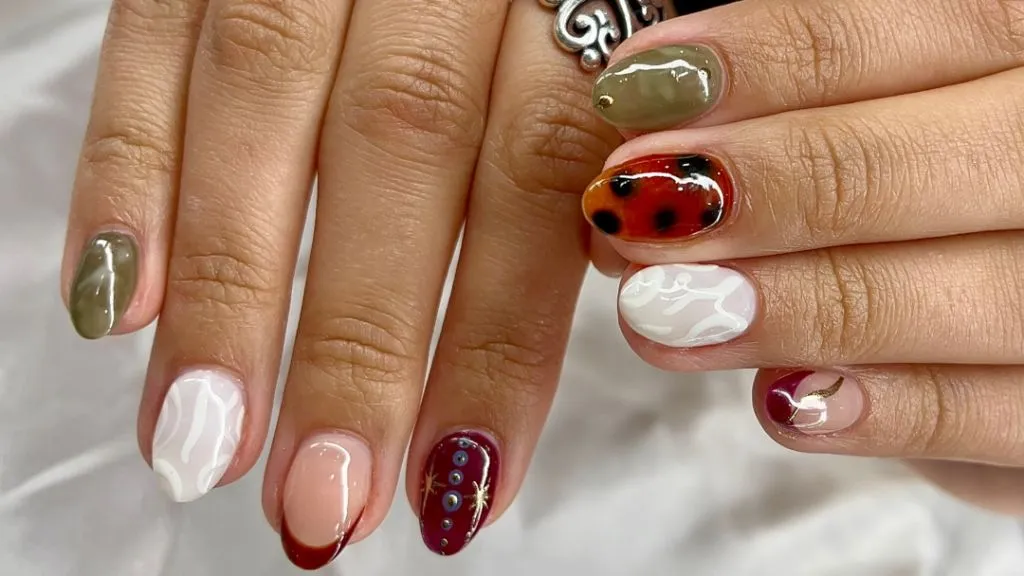
The unifying thread is the autumnal palette — olive, burgundy, amber, and cream all belong to the same seasonal color family, even though the finishes and techniques vary dramatically from finger to finger. The jelly-like olive nail and the tortoiseshell nail share a translucent quality that the opaque burgundy does not, creating an internal texture contrast that keeps the set from reading as random. Silver jewelry with an ornate design adds another material to the composition without disrupting the warm palette.
Eclectic sets like this work when the palette holds even as the techniques diverge. Remove the color cohesion and it would look like five different manicures on one hand. The practical advantage is that no single nail needs to be perfect — minor imperfections are absorbed by the variety rather than exposed by uniformity. I appreciate that the scale of each design element is calibrated to the short nail length rather than being a shrunken version of a longer design.
20. Warm Brown Solids Read as a Single Color Field
Medium-length almond nails in a warm, mid-tone brown — somewhere between chestnut and terracotta — are applied as a solid, glossy coat across all visible fingers. The hand is photographed against a brown leather-looking bag in a similar tonal range, creating a near-monochromatic frame.
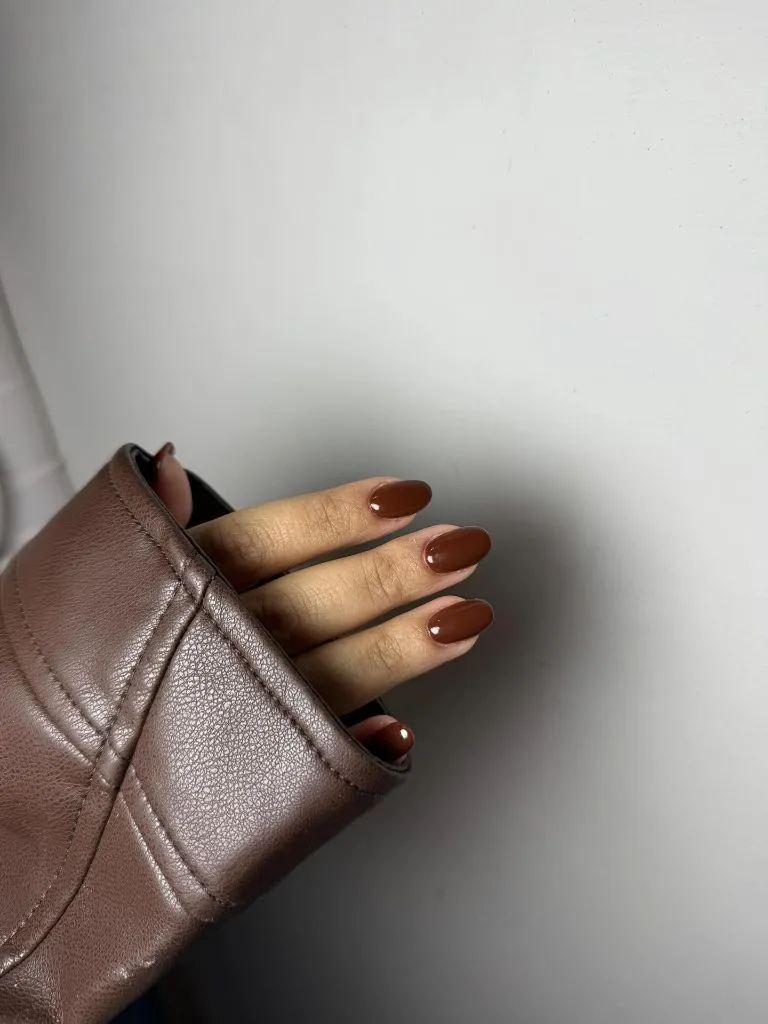
The nail color and the bag surface are close enough in tone that the hand appears to blend into its context rather than standing apart from it. The gloss on the nails creates a slightly different reflective quality than the matte-looking grain of the bag, and that surface difference is what separates the two elements from merging entirely. There is no accent nail, no design, no hardware — the composition is built entirely on the relationship between a single color and its environment.
This is the quietest option in the collection, and its effectiveness is entirely context-dependent. Against the brown bag, it creates a considered, tonal look; against a white shirt, it would simply be brown nails. The lesson is that a solid nail color gains or loses visual interest based on what surrounds it, and planning nails as part of an overall palette — rather than in isolation — is what turns a simple choice into a composed one.
21. Autumn Solids Rotate Across Each Finger
Short oval nails carry a different solid color on each finger: dark chocolate brown, warm red, bright orange, and mustard yellow. Both hands mirror the sequence roughly, creating a gradient effect from warm to cool as the eye moves across the fingers.
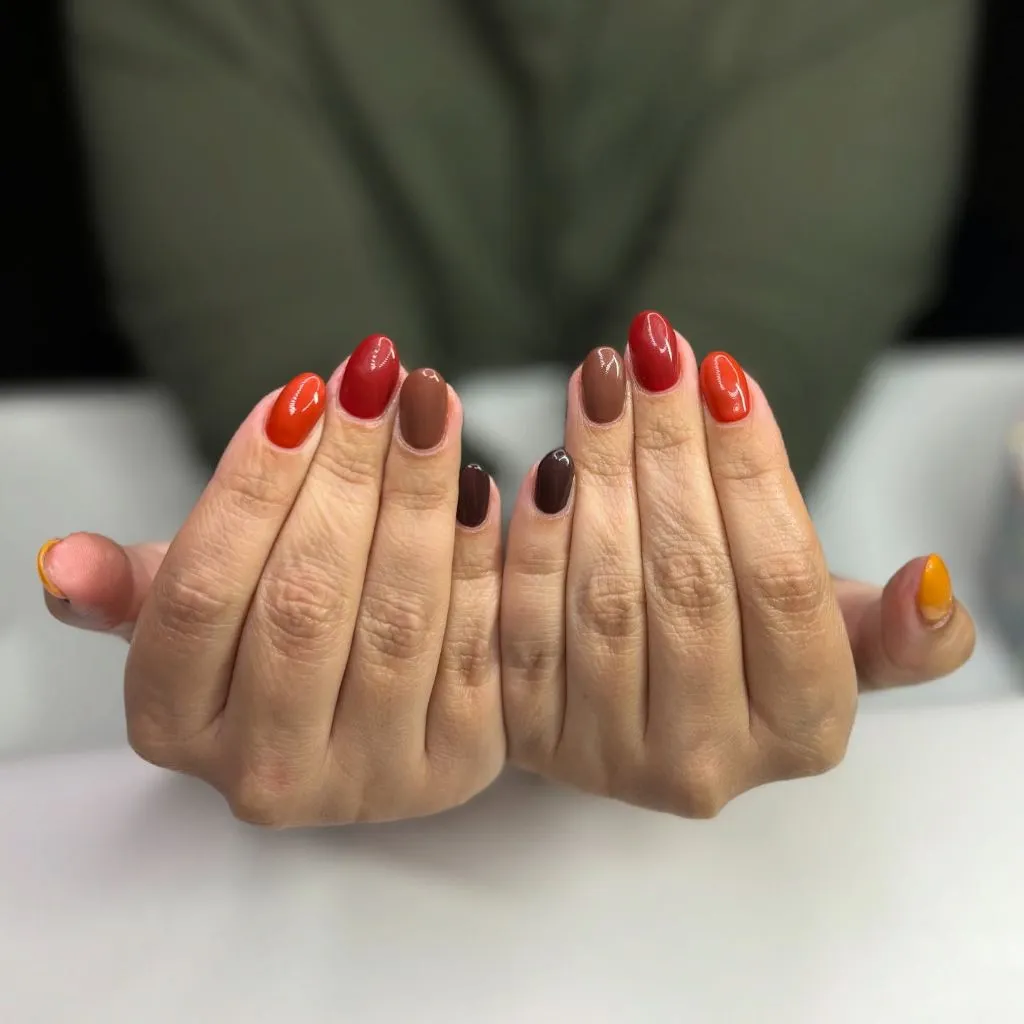
The colors are all glossy and opaque, and each one is applied as a clean, unadorned coat. The progression from mustard through orange and red to dark brown follows a natural value scale — light and warm at the pinky, darkening toward the index — which gives the hand a sense of directed movement. The olive-toned sleeve visible in the background sits comfortably within the same warm palette, acting as a neutral context that none of the nail colors clash against.
Rotating solids is a simple concept that depends entirely on the palette being harmonious. These four shades share enough warmth and saturation that they read as a family rather than as disconnected choices. If any single shade were swapped for a cool tone — a blue or a grey — the unity would break. The practical advantage over more complex designs is maintenance: each nail can be touched up independently without needing to match a pattern or blend.
22. Colorful Striped Tips Sit on a Clean Base
Medium-length square nails feature a pink-toned sheer base with thin, multicolored striped tips. Each tip carries parallel lines in red, green, orange, and dark brown or plum, arranged as a compressed rainbow at the free edge. A fine white border separates the colored stripes from the sheer base on most nails.
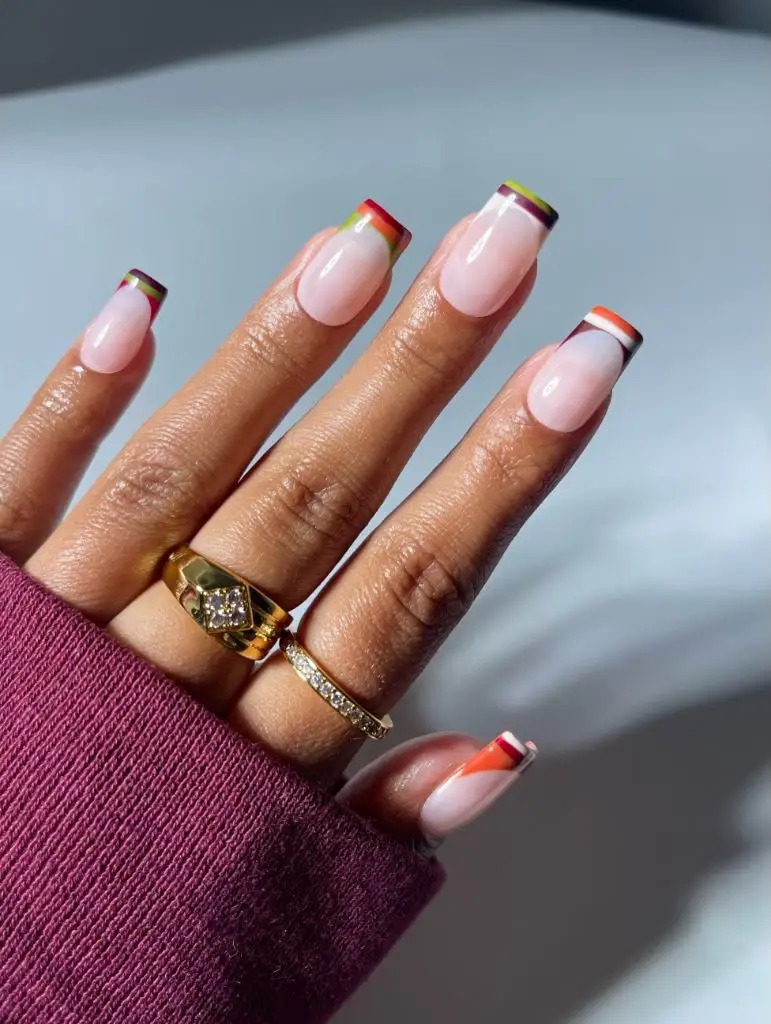
The stripes are contained within a very narrow zone — just the last few millimeters of each nail — which means the majority of the visible surface remains clean and neutral. The white border line acts as a frame within a frame, isolating the color activity from the calm base. Gold rings with pavé detailing on the hand add a warm metallic element that the nails do not reference, but the overall composition stays cohesive because the ring scale is small relative to the nail area.
After twenty-one designs that range from maximalist mosaics to monochromatic solids, this one lands in a middle ground: colorful but disciplined, playful but spatially contained. The striped tip is essentially a compressed version of the rotating-solids concept from the previous set, organized linearly instead of distributed across fingers. The constraint of keeping all the color in the tip zone is what prevents it from overwhelming the hand, and the white separator line is the small detail that makes that constraint legible.