Holiday dressing carries a quiet pressure that rarely gets named. There is an expectation that you will arrive looking festive but not costume-like, warm but not shapeless, considered but not overdone. Christmas outfits for women sit at that exact intersection, and the tension between those demands is real. You do not owe anyone a red dress or a sequined top. You get to decide how much the season shows up in what you wear and how much of the outfit simply belongs to your own eye.
A good decision about holiday dressing begins before color. The useful question is not whether the outfit reads as seasonal but whether the proportions, textures, and contrast levels hold together on their own terms. The photographs in this article work through those variables one at a time. Some lean into rich brown fur against crisp white wool. Others anchor the look with a single visible accessory and let the coat do the rest. A few introduce pattern or bright color, but even those depend on proportion and placement rather than the color itself to carry the effect. What matters across all of them is the relationship between weight, structure, and the kind of breathing room each silhouette allows. The details worth studying are where the belt sits, how the scarf changes the neckline, what the boot does to the hemline, and how much the bag interrupts or reinforces the tonal range of everything around it.
1. A Dark Fur Scarf Sharpens a White Coat
The strongest visible detail here is the contrast between the cream wool coat and the deep brown fur scarf that runs from the neck past the waist. The scarf does not drape loosely; it sits close and is belted into the coat at the waist with a dark leather belt and gold hardware, which turns two separate pieces into one read. The pointed black boots and dark leather gloves repeat the dark tone without adding a new color.
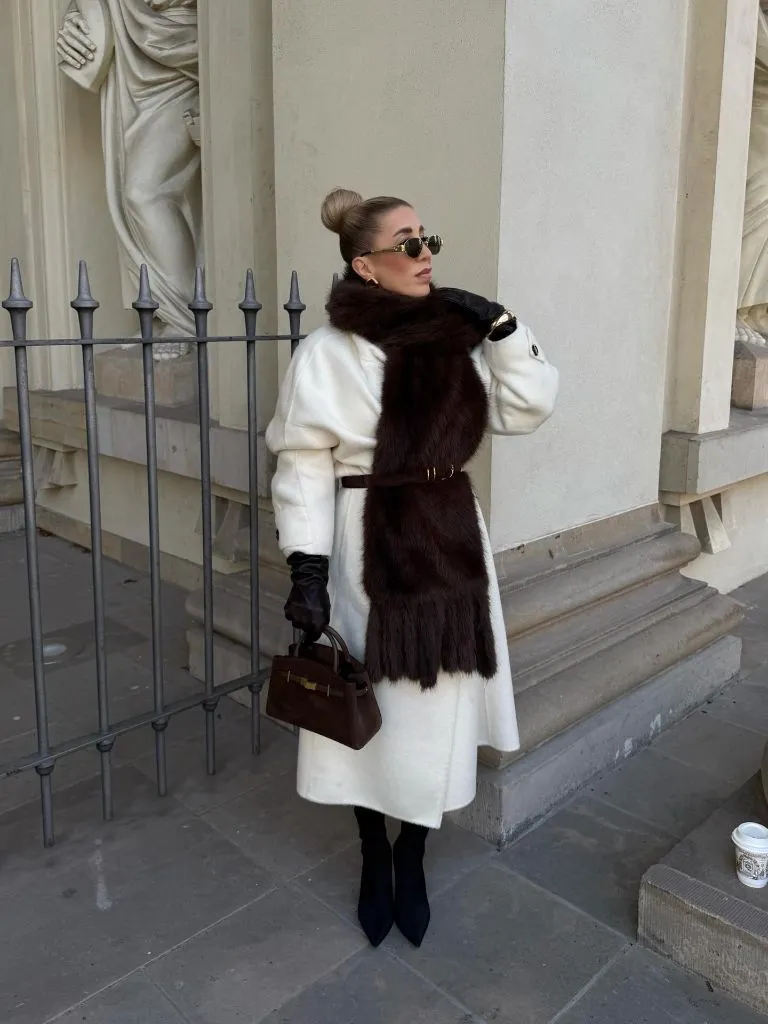
Photo via Instagram
The proportion works because the white coat is the largest surface area in the frame and the scarf breaks it vertically down the center, drawing the eye from the collar to the hem. The belt creates a defined waist, which gives the full-length coat structure rather than volume. The boots disappear against the dark tights, extending the leg line. Every dark element — scarf, belt, gloves, boots — sits on a different plane, so the eye moves through the outfit rather than stopping at one point. The tonal range is narrow, only cream and deep brown, and that restraint is what makes the chic winter coat styling feel composed rather than busy.
This is a study in vertical interruption. When a single contrasting element runs the full length of a lighter base, it narrows the visual read of the coat and adds formality without changing the actual garment. The principle transfers to any long coat: one unbroken dark line through the center changes the silhouette more than a different cut would.
2. Fur Framing Opens a Dark Silhouette
A white-grey fur vest sits over a fitted black mini dress, and the fur extends from the shoulders to just below the waist, framing the upper body in a wide, textured border. The dress beneath is short enough that the hem sits well above the knee, and the over-the-knee black leather boots close the gap between the skirt and the ground. Black leather gloves with fur-trimmed cuffs echo the vest without matching it exactly.
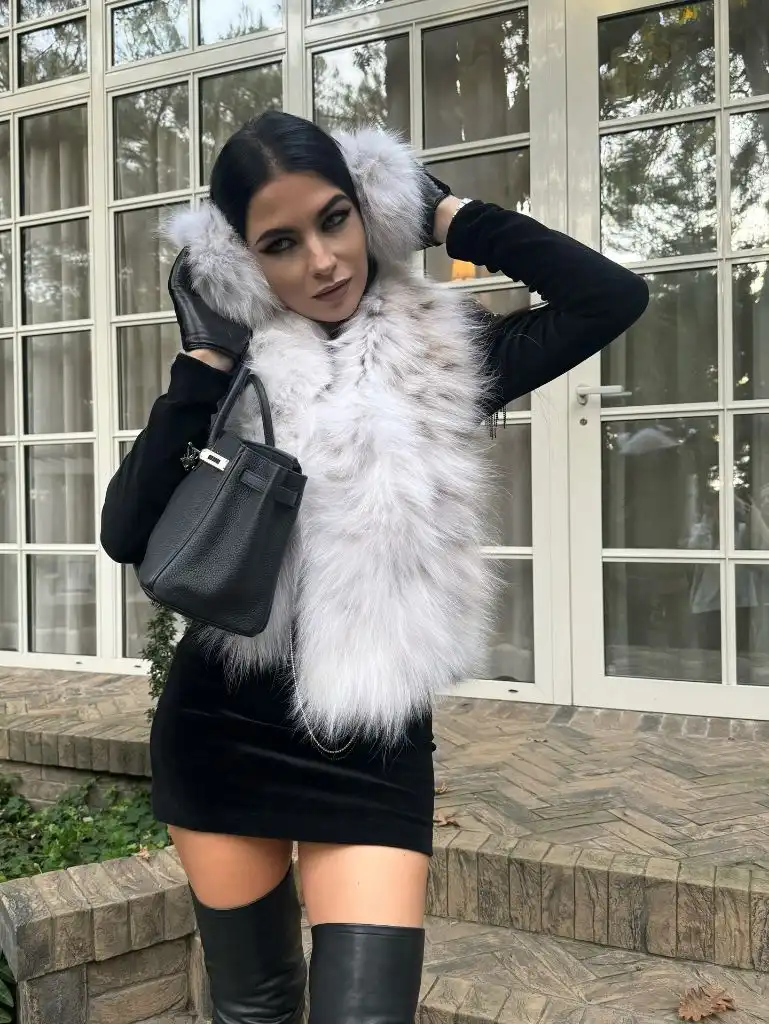
Photo via Instagram
The vest creates a wide shoulder line that tapers to a narrow waist, and because the dress is entirely black, the body reads as a single dark column with the fur layered on top like a frame. The boots reinforce the dark column from the knee down, and the small structured black bag tucked under the arm does not compete with the vest for attention. The fur earmuffs match the vest and close the look at the top of the frame. The window of visible skin between the skirt hem and the boot top is narrow, which keeps the proportions controlled rather than exposed.
The appeal is the layering order. The fur sits on top of the dark base rather than being built into it, which means the look could shift entirely by removing the vest. A Christmas outfit built around a removable texture piece gives the wearer control over how much visual weight the outfit carries through the evening.
3. Crystal Buttons Anchor a Feathered Hem
The visible standout is the white mini dress with oversized crystal buttons arranged in a double-breasted line down the front. The buttons catch light and function as the focal point of the outfit. The hem is trimmed with white ostrich-like feathers that add movement and texture at the lowest edge. The sleeves are long with a slight bell shape, and the neckline sits at the collarbone in a clean round cut.
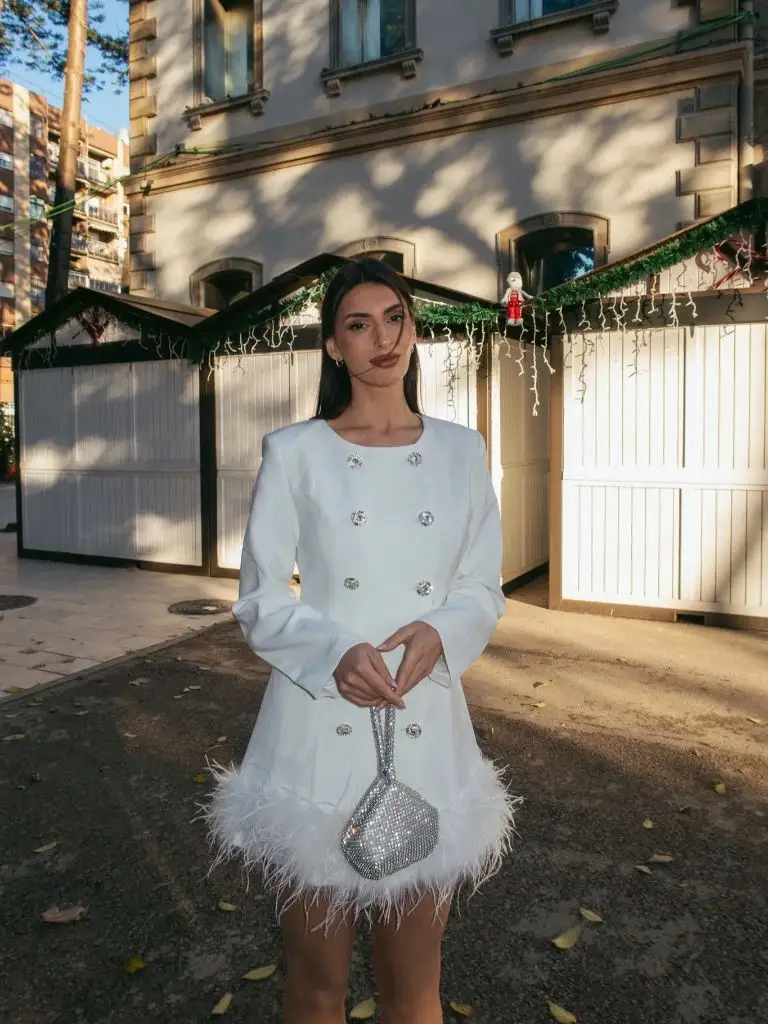
Photo via Instagram
The silhouette is A-line and ends above the knee, which gives the feather trim room to move without looking heavy. The sparkly silver pouch bag in hand reinforces the crystal tone of the buttons without introducing a new material language. The background shows Christmas market stalls with garland and lights, and the white of the dress holds its own against the warm holiday setting. The absence of a coat or scarf makes the dress the entire statement, which means every detail on it — the button placement, the feather density, the sleeve shape — has to carry more weight than it would under outerwear.
The best detail is the proportion between the buttons and the feathers. Both are decorative, but they occupy opposite ends of the dress and different textures — hard and reflective at the top, soft and kinetic at the bottom. That separation keeps the dress from reading as overdone because each embellishment has its own zone.
4. Stripes Make a Sequin Top Feel Grounded
Red and white vertical stripes in wide-leg pants dominate the lower half of this look, and a textured silver-white cardigan sits on top, trimmed and tied at the neck with a red satin bow. Red platform shoes and a red structured bag hold the color below and to the side, while a decorated Christmas tree fills the background. The curly hair is left loose, and red circular earrings pick up the stripe color at the face.
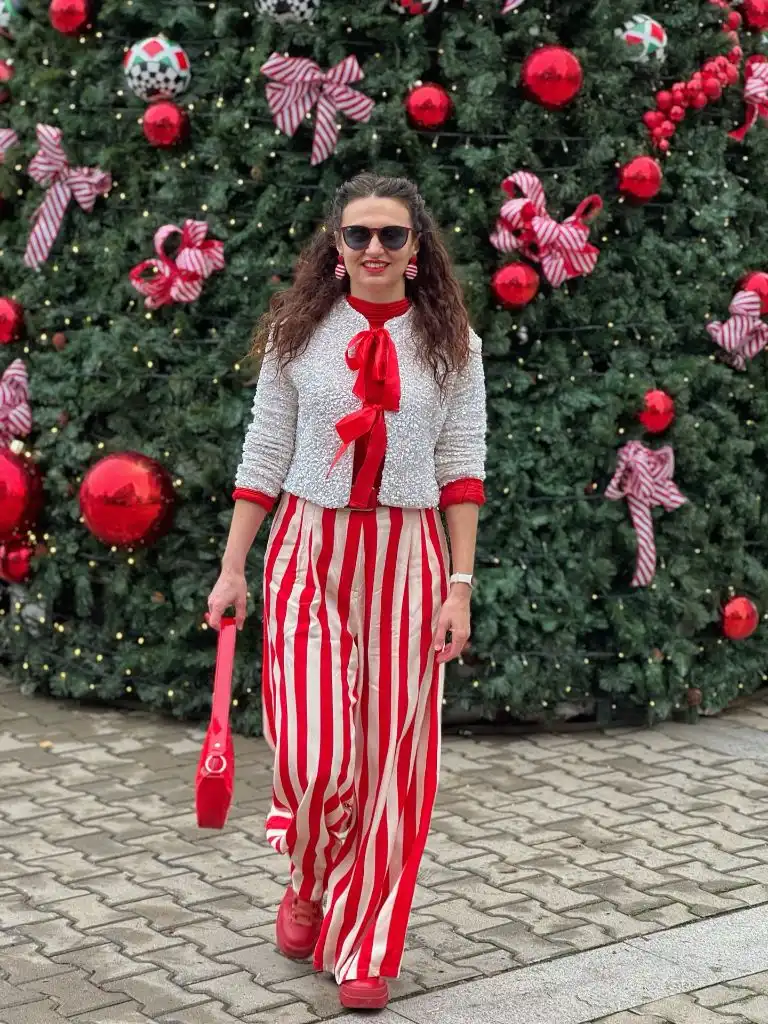
Photo via Instagram
The pants are the anchor. Their stripe pattern is bold enough to read as the primary design decision, and everything else responds to it. The silver cardigan could overwhelm the stripes if it were longer, but its cropped length means the stripes occupy the majority of the frame. The satin bow acts as a bridge between the sparkle of the cardigan and the flat matte of the pants. The red accessories — shoes, bag, earrings — repeat the red from the stripes and distribute it through different planes of the outfit. The Christmas tree behind works because its red ornaments and ribbons continue the palette without the outfit needing to reference the setting.
This is the most overtly festive look in this group, and its strength is distribution. The red appears in five separate places, but each one is a different material — satin, leather, plastic, fabric, enamel — so the repetition reads as coordination rather than uniform. That principle holds for any holiday palette: scatter the color but vary the surface.
5. Leopard Print Grounds a Heavy Fur Coat
A dark brown fur coat, dense and mid-length, covers most of the frame, and beneath it a cream silk blouse is visible at the collar. The lower half shows a leopard print fabric — likely a skirt or trouser — that introduces pattern without brightness. A large chocolate-brown leather tote with minimal hardware hangs from the forearm. Gold dome earrings and a slicked-back low hairstyle keep the focus on the coat and the pattern below it.
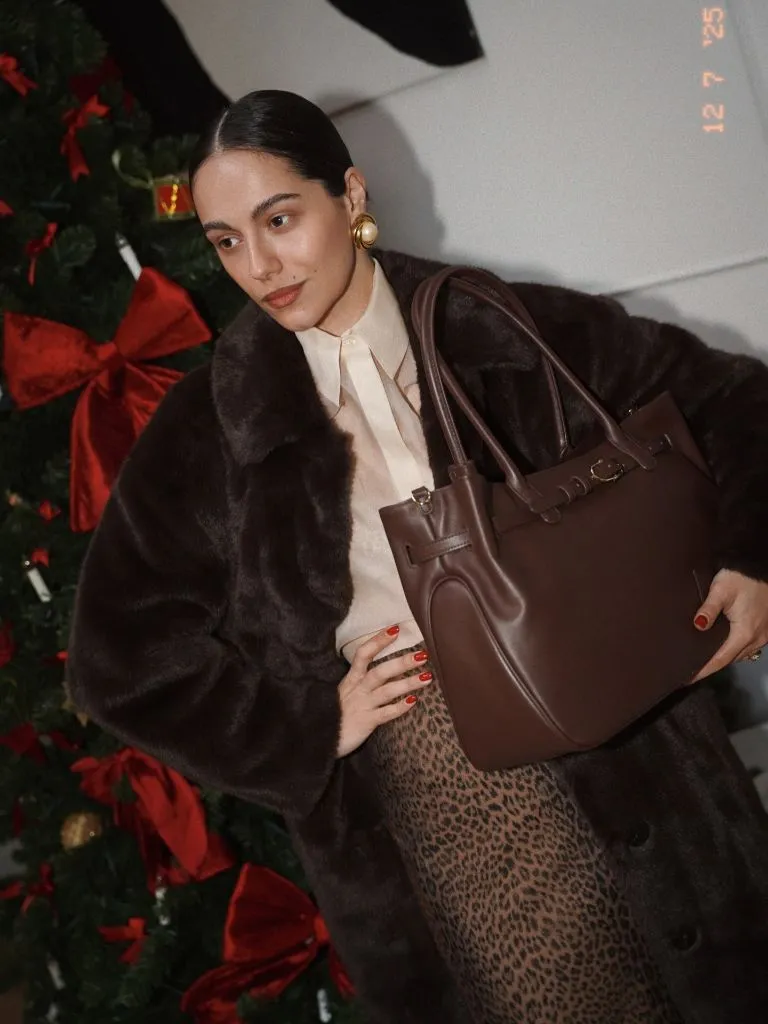
Photo via Instagram
The coat is heavy and could easily flatten the look into a single dark mass, but the leopard print prevents that by introducing visual activity at the lower edge. The cream blouse provides a lighter value at the neckline, which lifts the eye before the fur takes over. The tote bag matches the fur in color but differs in texture — smooth leather against dense pile — so the two dark brown surfaces do not merge. The red nail polish visible on one hand is the only warm accent and it reads as a small deliberate interruption rather than an additional color commitment. A Christmas tree with red bows sits behind, and the date stamp in the corner suggests this was taken in December.
The value is in the tonal stacking. Three shades of brown — fur, leather, print — sit next to one another without competing because each has a different surface behavior. When building winter outfits in dark tones, the principle is to vary the texture even when the color stays the same.
6. A Cape Silhouette Changes the Coat Conversation
The outerwear here is not a coat with sleeves but a cape-like piece in deep chocolate brown, possibly wool or heavy felt, that falls to mid-thigh and drapes over the arms without defining them. The hands emerge below the hem in black leather gloves holding a small black structured clutch. Sheer black tights and tall black leather boots with a moderate heel complete the lower half. The natural hair is worn out and full, and the setting is a stone archway with a heavy wooden door.
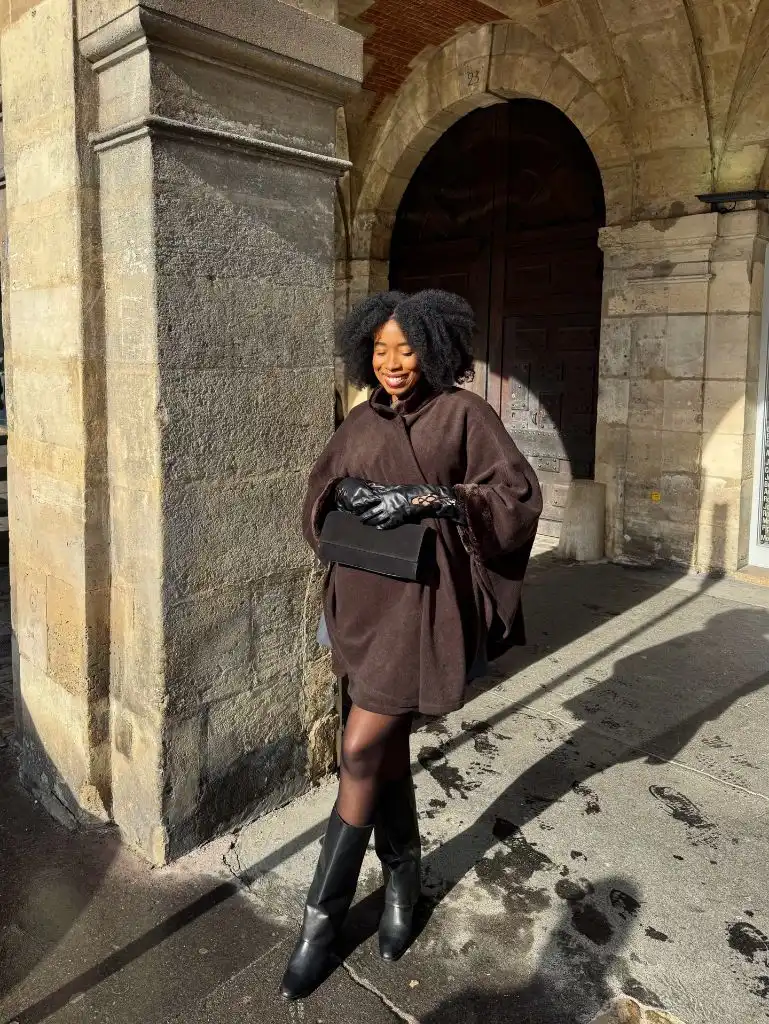
Photo via Instagram
The cape changes the proportions fundamentally. Without visible sleeves or a defined shoulder line, the upper body reads as a draped volume rather than a structured shape. The boots and tights below are fitted and narrow, and that contrast between the wide upper silhouette and the slim lower line is what gives the outfit its architecture. The clutch is small and dark enough to disappear into the look, which suggests it was chosen to not compete with the cape. The stone background adds weight and texture that suits the heavy fabric; a lighter, brighter setting would have made the same piece feel denser.
The strength here is the silhouette contrast between top and bottom. A wide, unstructured upper half needs a clean, narrow lower half to read as intentional rather than shapeless. This applies to capes, oversized wraps, and any outerwear that removes the shoulder as a reference point for the eye.
7. Grey Wool Carries a Monochrome Without Effort
A long grey wrap coat with a tie belt sits open over grey wide-leg trousers and a white T-shirt. The tone of the coat and the trousers is close but not identical, which gives the monochrome depth rather than flatness. A cream ribbed beanie adds a lighter value at the top of the frame, and a tan leather bag with a woven strap hangs from one arm. The other arm holds a bundle of pine branches and red winter berries wrapped in white paper.
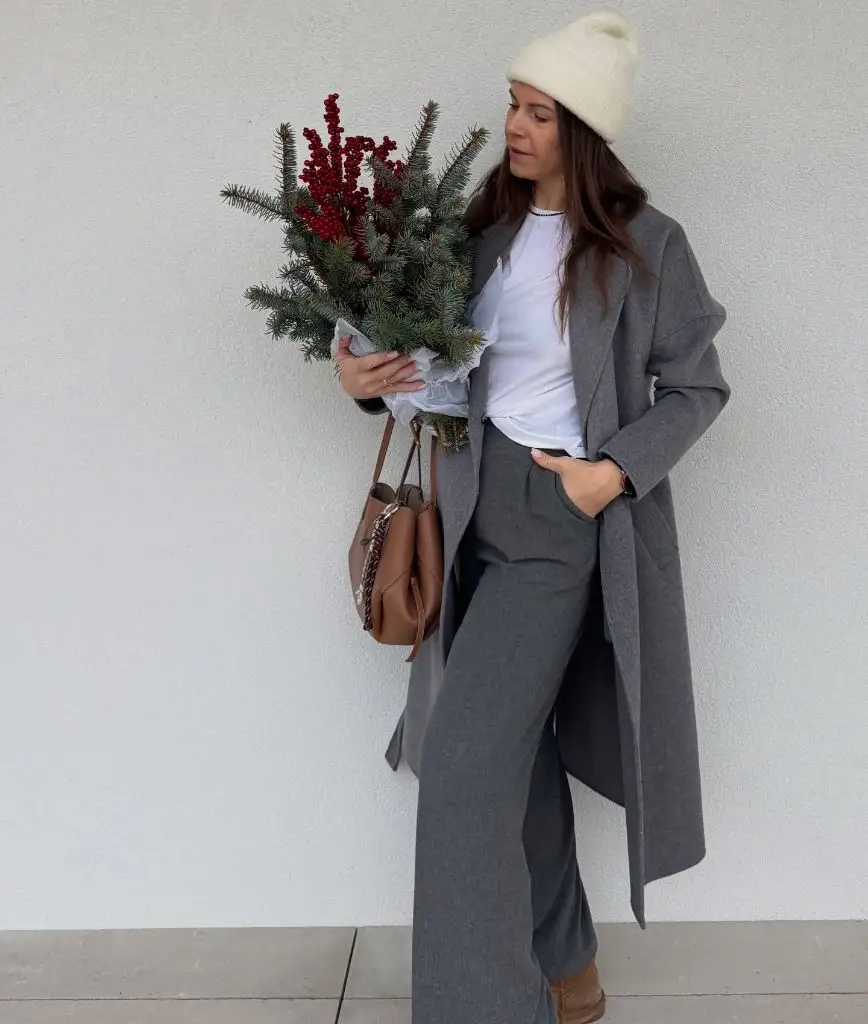
Photo via Instagram
The two greys working together is the organizing idea. The coat is slightly lighter and has more drape, while the trousers are slightly darker and hold their shape. That tonal gap is narrow enough to feel unified but wide enough to keep the outfit from reading as a suit. The white shirt underneath creates a visible break at the chest, and the beanie lifts the value at the crown of the head, so the monochrome does not feel heavy. The tan bag is the only warm tone and it anchors the midpoint of the body. Readers interested in seasonal capsule wardrobe ideas might note how this look uses just three neutral tones to create a full outfit.
The effect is ease. Nothing here is trying to announce itself, and the Christmas reference lives entirely in the berries and branches rather than in the clothing. That restraint is a valid approach to holiday dressing: let what you carry, not what you wear, mark the occasion.
8. Plaid Brings Warmth Without Adding Color Noise
A long plaid coat in muted beige and brown tones buttons down the front over what appears to be a cream cable-knit sweater. A cream or white fur hat sits high on the head, and black knit mittens cover the hands. A soft beige knit scarf wraps around the neck, and the overall palette stays within warm neutrals against a snow-covered setting with a stone building behind.
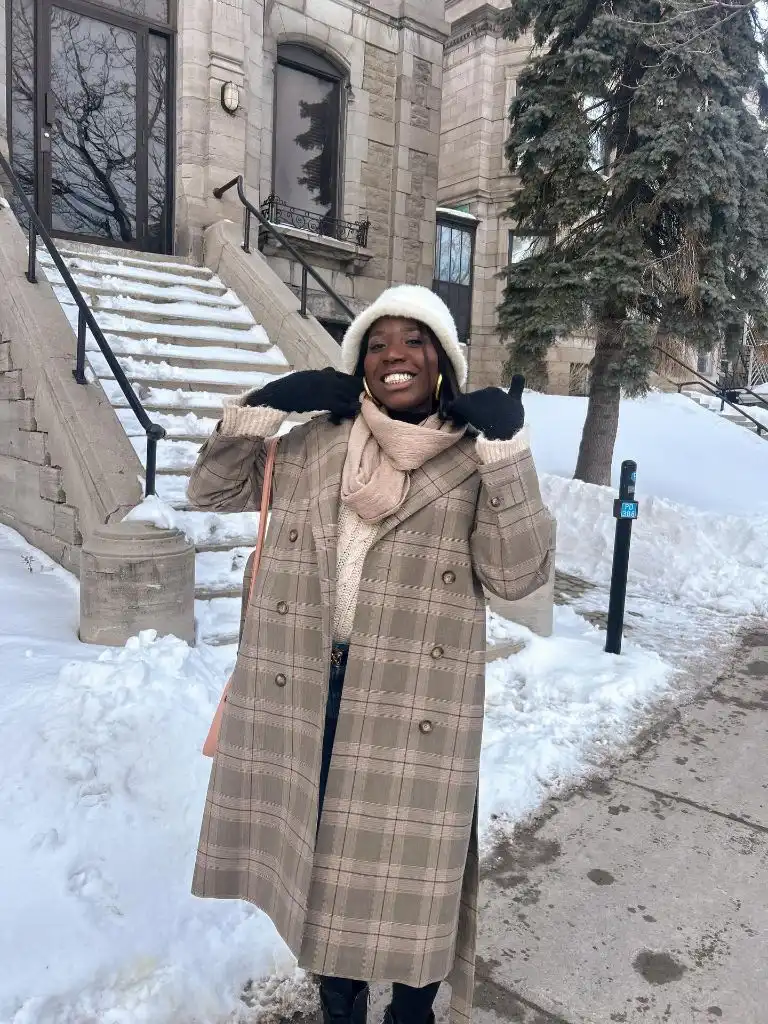
Photo via Instagram
The plaid pattern is quiet — the lines are thin and the color difference between the check and the ground is subtle, so the coat reads as textured rather than patterned from a distance. The cream scarf and hat blend into the lighter tones of the plaid, extending the warm palette upward. The black mittens are the sharpest contrast in the frame and they draw the eye to the hands, which is an unusual focal point that gives the look a sense of gesture. The snow in the background makes the warm tones feel warmer by contrast, and the stone steps behind add solidity to a soft outfit.
I like the way the pattern holds its restraint. Plaid at this scale and in these tones does not announce itself the way a bold tartan would, and that makes the coat function as a neutral. The transferable idea is that Christmas outfits for women do not require holiday color when the texture and warmth of the pieces already signal the season.
9. White Trousers Lift a Brown Fur Coat
A rich brown fur coat — dense, glossy, likely mink or a convincing faux — falls to just above the knee and dominates the frame. Below it, wide white trousers drop to the ankle and sit over what appears to be white or light-toned shoes barely visible at the hem. A small structured crossbody bag in dark brown leather sits at the hip, a black velvet or fabric headband holds back the hair, and oval gold-framed sunglasses catch the light.
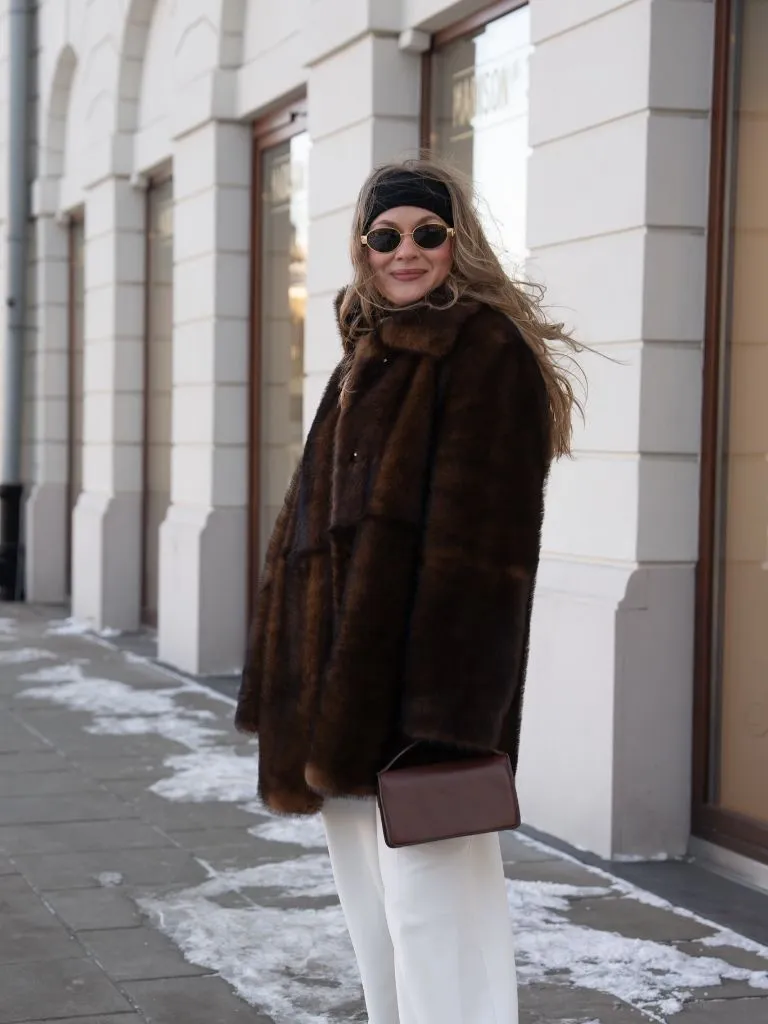
Photo via Instagram
The white trousers do the most work in this outfit. Without them, the fur coat would sit over dark legs and the look would read as a single dense block of brown. The white opens the lower half and creates a clear division between the coat’s heavy texture and a clean, lighter base. The crossbody bag is small enough that it does not interrupt the coat surface, and placing it at the hip keeps the vertical line intact. The headband and sunglasses are the only accessories at the face, and both are low-profile, which lets the fur remain the dominant texture.
The strength here is the value split. A dark, textured upper half over a light, smooth lower half creates a visible boundary at the waist without needing a belt. For any outfit built around statement outerwear, the bottom half can either match or oppose the coat, and opposition tends to give the coat more room to breathe.
10. A Red Puffer Holds Its Own at a Market
A bright red puffer jacket, waist-length with a high collar and front zip, fills the upper frame with saturated color. Below it, grey jeans or trousers are partially visible. A small embroidered crossbody bag with a floral or baroque pattern sits across the body. The setting is a Christmas market at dusk with a lit Ferris wheel behind, and the figure is sipping from a clear mug.
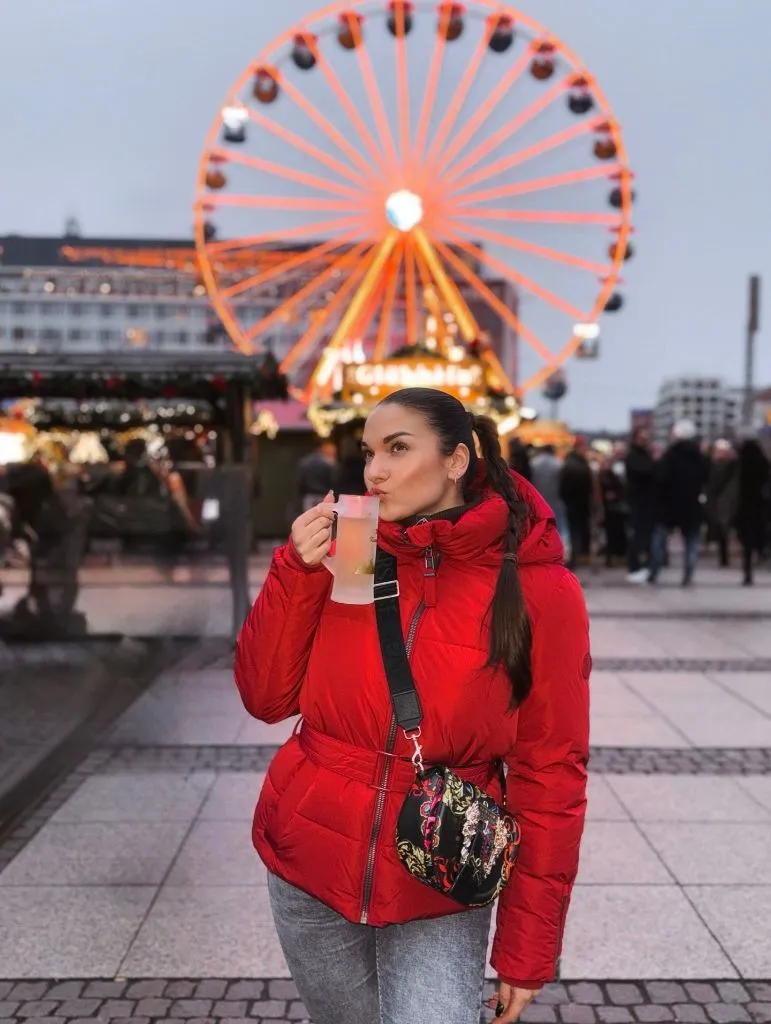
Photo via Instagram
The red of the jacket is strong enough to compete with the carnival lighting behind it, and that is the point — this is a piece that was chosen to hold its saturation against a visually busy background. The grey jeans cool the palette below the waist and prevent the red from spreading through the whole outfit. The embroidered bag introduces pattern but at a small scale, functioning more as texture than as a competing design. The mug in hand and the market setting ground the look as practical rather than editorial, and that context matters because it shows how a single bold color piece can carry an entire Christmas outing without additional layering or accessorizing.
This is a practical read. The puffer jacket does not need structure or tailoring to make an impression because the color does that work. The lesson is that volume and saturation can replace complexity — one loud piece over quiet basics is a complete thought, especially when the setting already provides visual richness.
11. Texture Mixing Anchors a Snow-White Dress
A white cable-knit turtleneck maxi dress runs from neck to ankle, and over the shoulders sits a shaggy grey fur shrug or bolero that covers the upper arms but stops well above the waist. A black fur ushanka hat, tinted purple sunglasses, and black buckled boots are the only dark elements. The setting is deep snow with evergreen branches, and the white of the dress nearly merges with the snow behind it.
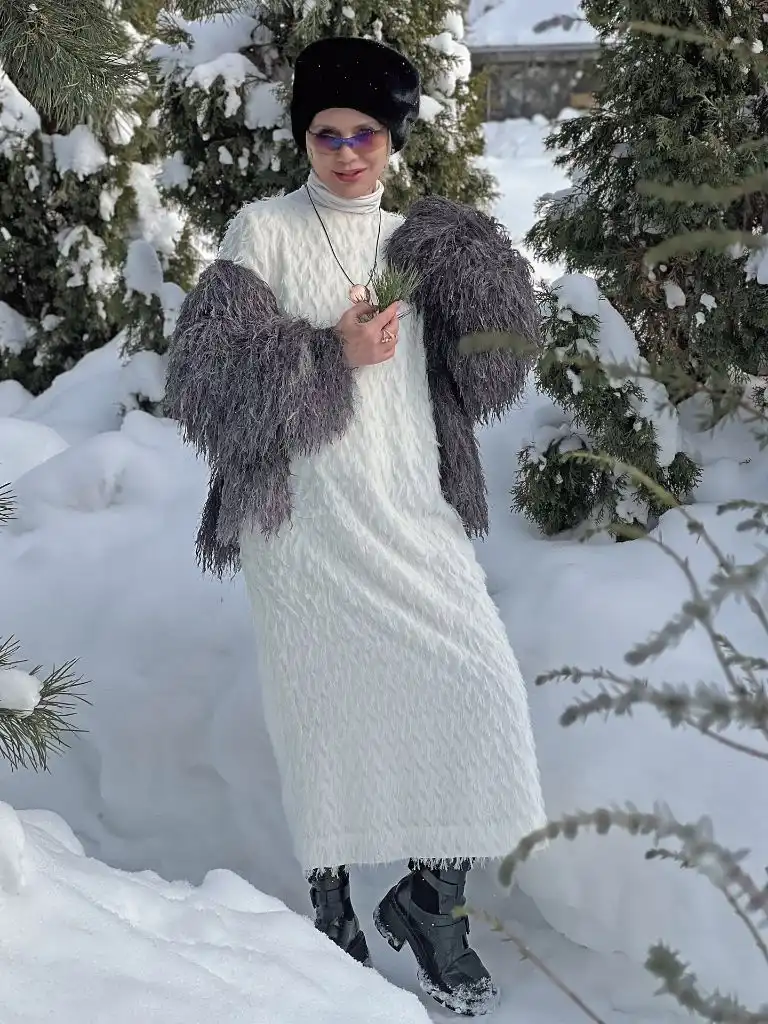
Photo via Instagram
The dress and the landscape share a color, and that camouflage effect is deliberate — the outfit reads as part of the environment rather than standing against it. The grey shrug breaks the white surface at the shoulders and introduces a completely different texture: long, shaggy pile against tight cable knit. The black hat and boots bookend the outfit with weight at the top and bottom, preventing the white from floating. The purple-tinted glasses are a small eccentric note that signals personality without changing the tonal logic. The cable-knit pattern gives the white dress surface interest that a smooth white fabric would not have, and that texture is doing the work that color would do in a different outfit.
What stands out most is the way the shrug sits. It covers just enough of the shoulder and upper arm to create a second silhouette on top of the dress silhouette. The idea is useful anywhere heavy knitwear is involved: a short, textured layer over a long, smooth one creates proportion without adding bulk.
12. A Fur Coat Over a Simple Tee Reads as Statement
A voluminous brown faux fur coat, open at the front, shows a plain white crew-neck T-shirt beneath. A dark grey Nike baseball cap sits low on the head, and bold red lipstick is the sharpest color in the frame. Gold statement rings on both hands and a small black pouch clutch complete the accessories. The fur is long-pile and warm-toned, and the coat appears to fall past the hip.
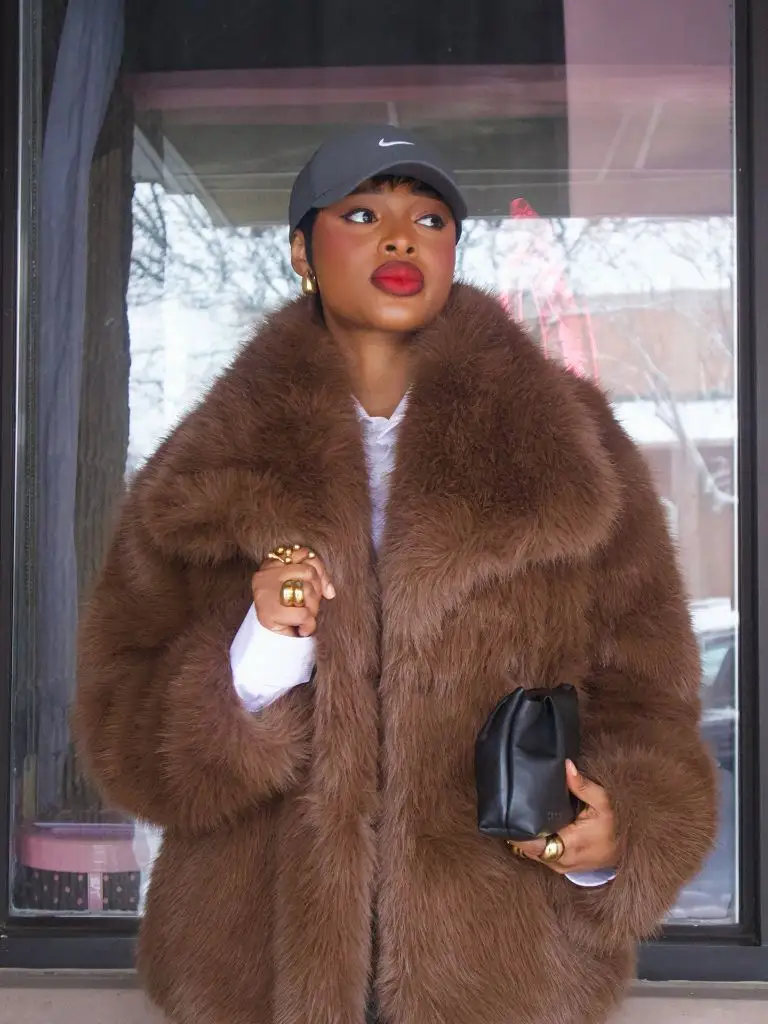
Photo via Instagram
The coat is the obvious focal point, but the white T-shirt underneath is what gives it context. Without the casual base, the fur would read as formal; with it, the coat becomes the single elevated piece in an otherwise low-key outfit. The baseball cap reinforces the casual register and pushes the fur further into contrast with its surroundings. The red lip operates as the only warm saturated color outside the coat, and it sits at the face, which pulls attention upward. The gold rings add reflective detail at the hands without competing with the fur. The overall effect is that one luxurious texture carries the look while everything else stays deliberately plain.
The appeal is the tension between the coat and everything underneath it. This approach works for any occasion where you want the outerwear to do all the signaling — keep the base neutral and unstructured, and let the coat’s texture announce the level of the outfit on its own terms.
13. Tonal Cream Layers Build Quiet Warmth
A tan or camel shearling jacket with a wide collar sits over a cream turtleneck, and cream cable-knit wide-leg pants extend to the shoe line. A shearling or fleece beret in off-white crowns the head, and round gold-framed sunglasses sit on the face. A monogram-print handbag with leather trim and a decorative charm hangs from the arm. The setting shows a building with a sign reading “The Cozy,” and dried ornamental grasses fill the background.
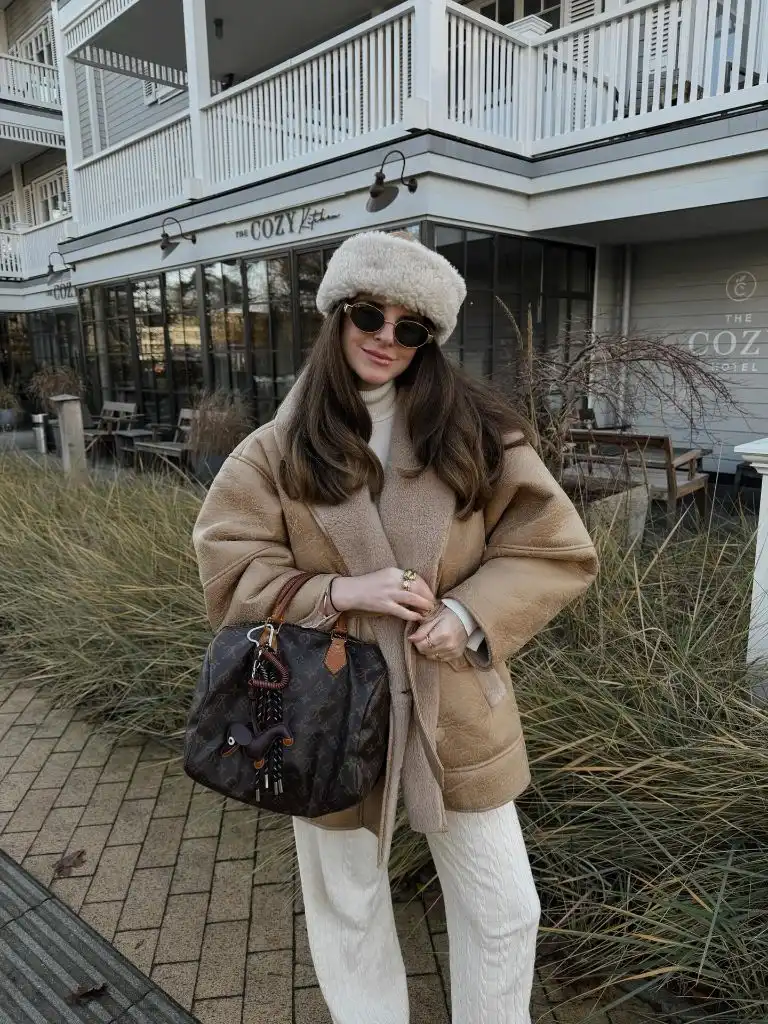
Photo via Instagram
The tonal range from beret to shoe is narrow — cream, off-white, tan, light brown — and that discipline is what makes the look cohesive despite the variety of textures involved. The shearling jacket has a different surface than the cable-knit pants, which differ again from the smooth turtleneck, so the eye registers variety through texture rather than color. The bag introduces the darkest value in the outfit and sits at the center of the body, acting as a visual anchor point. The beret softens the top of the frame and removes the need for styled hair to carry any visual weight. Readers thinking about holiday hair styling might notice how the hat simplifies that decision entirely.
This is the quietest outfit in the group and also one of the most controlled. When every piece lives within a two-shade range, the construction has to be precise because there is no color to distract from a proportion mistake. The principle is that tonal dressing demands better fit and more texture variation than high-contrast dressing does.
14. Neon Color Interrupts a Snowy Palette
An oversized orange faux fur coat fills the frame with saturated color, and a wide scarf in blended neon pink, orange, and lime green wraps around the neck and falls down the chest with visible fringe. Green ribbed tights or leggings cover the legs, and a yellow layer is partially visible at the waist. A colorful knit headband and white shearling mittens round out the accessories. The setting is a snow-covered forest path with heavy white drifts on every branch.
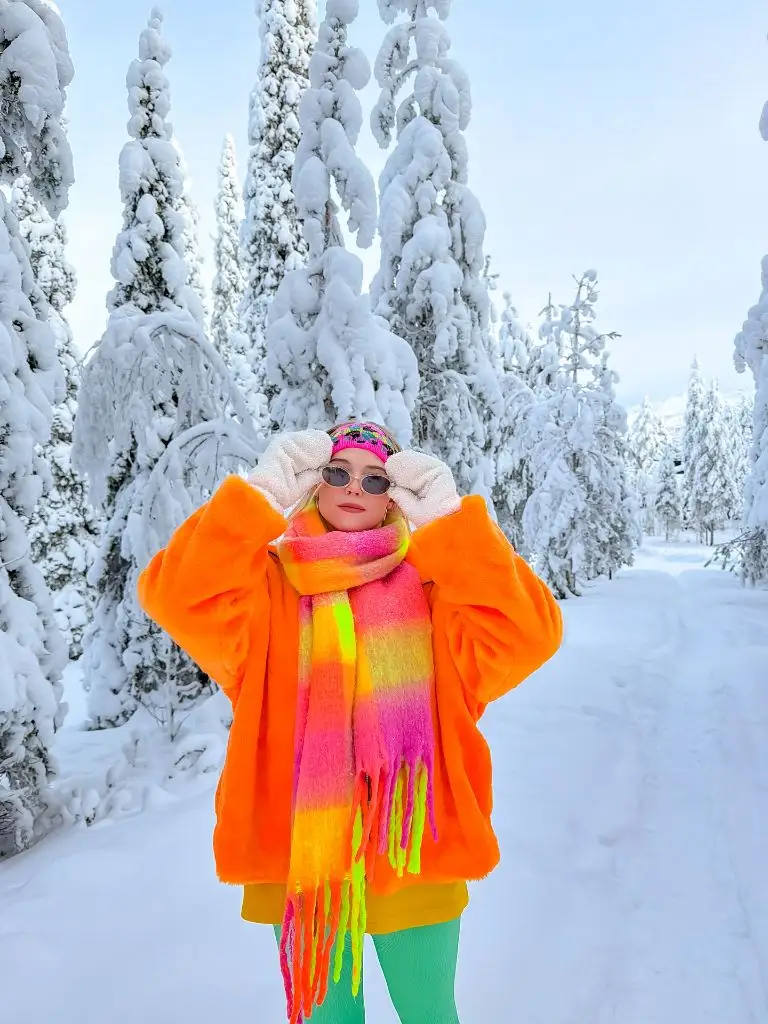
Photo via Instagram
This photograph does not show a traditional Christmas outfit in any conventional sense, and that is precisely its value in this article. The neon palette against the white snow creates a contrast so extreme that the outfit functions almost as a landscape intervention. The scarf blends three colors that would each be loud on their own, and their proximity to the orange coat means the eye does not settle on one hue but moves constantly. The green tights extend the scarf’s lime tone downward, which gives the color story a vertical logic rather than a random scatter. The white mittens match the snow and create two quiet pauses at the hands.
The effect is joyful refusal. This is an outfit that rejects the muted, the safe, and the expected, and it does so with enough internal color logic to hold together. The transferable idea is not that everyone should wear neon to a holiday gathering but that confidence in a palette — any palette — reads as more considered than timid color chosen out of obligation.
15. Denim Softens a Long Fur Coat
A long, dark brown shaggy fur coat reaches past the knee and sits open over light-wash wide-leg jeans. A matching brown fur hat — possibly a papakha or round fur cap — covers the crown of the head. A small cognac crossbody bag in smooth leather sits at the hip, and tan suede boots are visible at the hem of the jeans. The setting is the entrance to a European-style café or restaurant with a Christmas wreath on the wooden door and ivy climbing the stone columns.
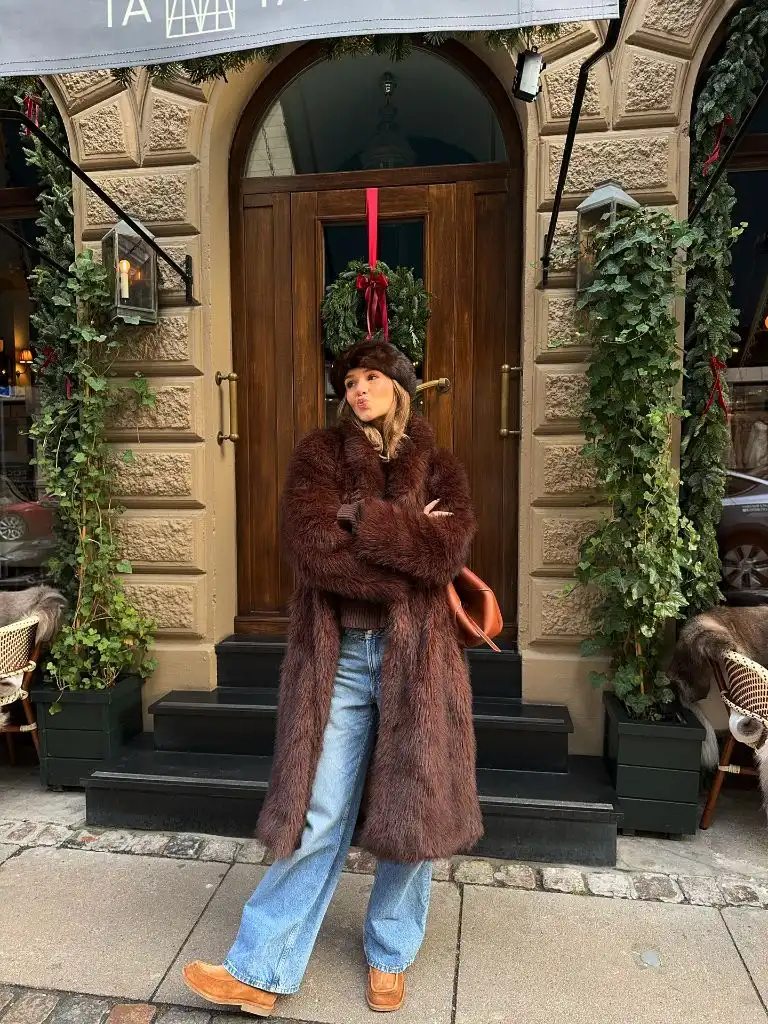
Photo via Instagram
The jeans do critical work. A coat this dense and dark could easily pull the whole outfit into heavy formality, but the light-wash denim breaks the tone and introduces a casual register that loosens the look. The suede boots are lighter than the coat and warmer than the jeans, sitting in between the two values and bridging them. The fur hat matches the coat so precisely that the two create a frame — dark above and dark at the sides, with the lighter face and jeans creating the focal zone between them. The crossbody bag is understated enough to disappear against the coat. Thinking about how different seasonal outfit frameworks handle formality, the denim here functions as a deliberate downshift.
This is a lesson in register mixing. The fur reads as evening or formal, the jeans read as weekend, and together they land somewhere that works for a Christmas dinner, a holiday market walk, or a gathering that does not have a dress code. The principle is that denim under outerwear resets the formality of almost any coat.
16. Matching Tone From Collar to Hem Builds Formality
Every visible element in this outfit shares the same deep chocolate brown: the long wool coat, the fur collar, the wide-leg trousers, the leather gloves, and the structured croc-embossed handbag. The only variation is surface — smooth wool, plush fur, soft leather, and stamped leather — and that variation is the entire design. The setting is a stone garden wall with a gravel path extending behind, and the light is soft and flat.
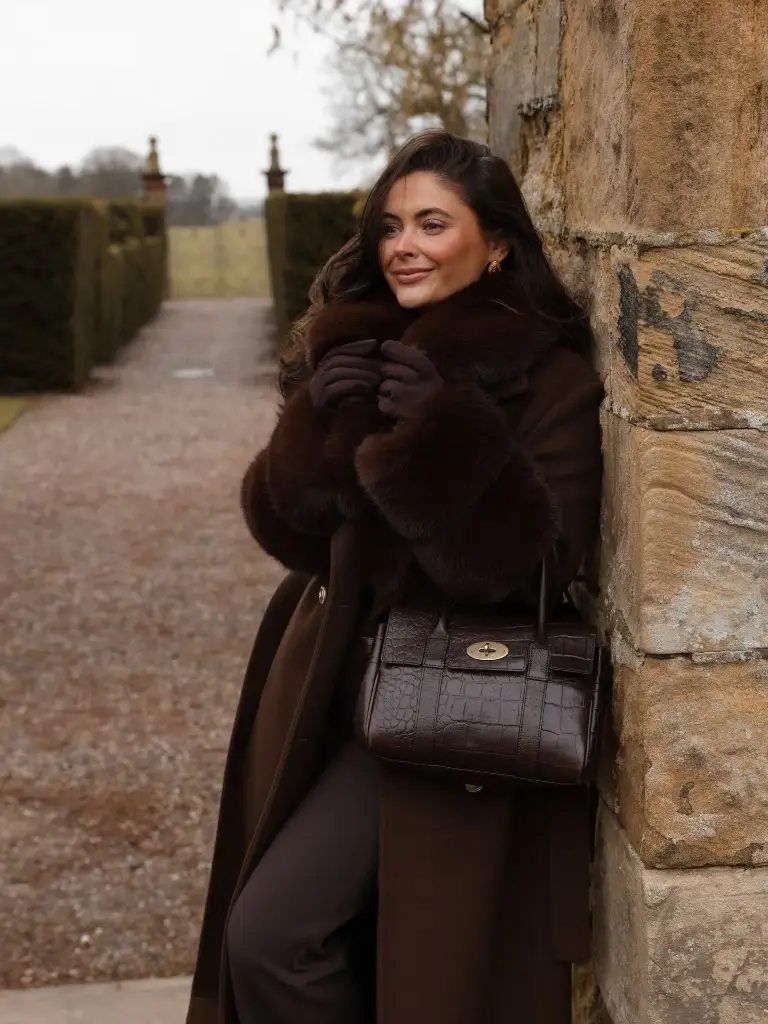
Photo via Instagram
When color is removed as a variable, texture becomes the only way to create visual movement, and this outfit uses that constraint fully. The fur at the collar is the softest and most voluminous texture, so it draws the eye to the face. The coat body is smoother and more structured, transitioning into trousers that share the tone but hold a different drape. The handbag’s crocodile embossing introduces a geometric pattern into an otherwise smooth lower half. The gloves disappear into the coat sleeves at certain angles, which elongates the arm and reinforces the unbroken color column.
The strength here is commitment. Full tonal matching can read as flat if the textures are not varied enough, but here there are at least four distinct surfaces within one color, and each one reflects light differently. Christmas outfits for women built around one tone gain their complexity from how many ways that tone can appear across the body.
17. A Fur Stole Refines an Oversized Blazer
A chocolate brown oversized blazer, likely a boyfriend cut, sits as the main outerwear piece, and a dark brown fur stole drapes around the neck and falls past the waist. Black opaque tights, pointed black heeled boots, and a brown leather bag with visible hardware complete the lower half. Round gold-framed sunglasses and a sleek high bun keep the face area clean. The background is an ornate iron gate with a moorish-inspired pattern, and fallen autumn leaves sit on the ground.
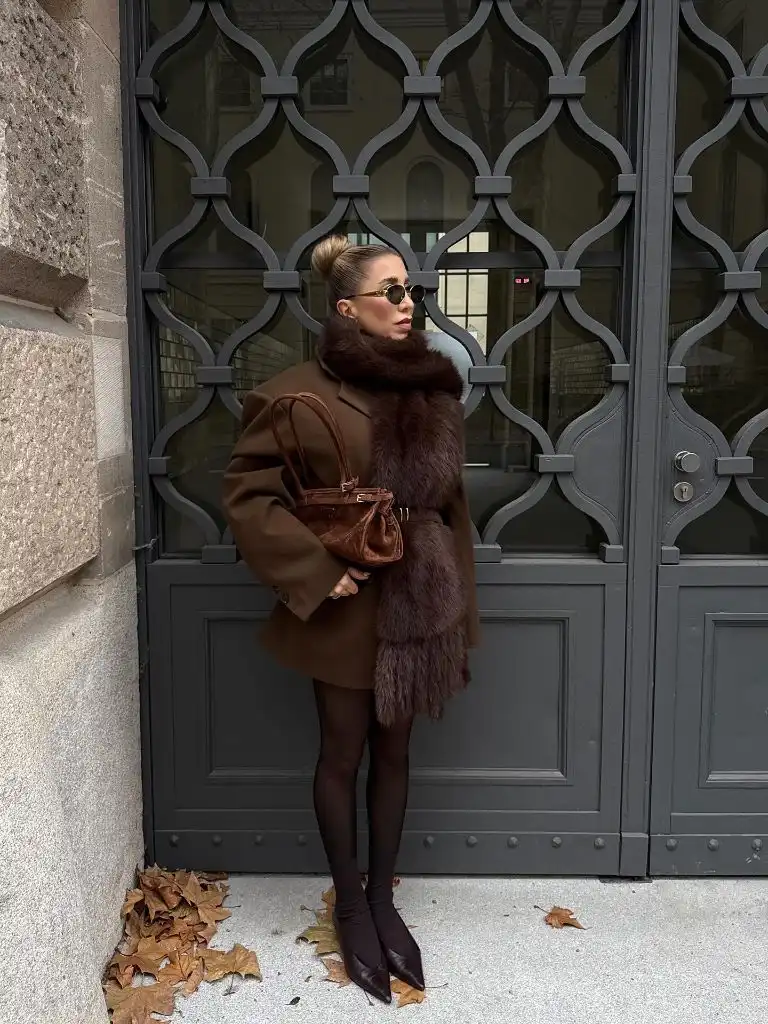
Photo via Instagram
The blazer on its own would read as borrowed or underdone, but the fur stole transforms it into something deliberate. The stole adds mass at the shoulder and chest, which offsets the oversized drape of the blazer and gives it a defined upper body. The tights and boots are dark and minimal, so the lower half recedes and the eye stays with the coat-and-stole combination. The bag sits at the center of the body in a tone that bridges the blazer brown and the stole brown. The iron gate behind adds an ornamental quality to the frame that suits the dressed-up register of the fur.
The value is in the stole as a modifier. It changes the reading of an ordinary blazer from casual to considered without requiring a different coat. The approach works for any outerwear that feels too simple on its own — a single fur or textured scarf draped over the shoulders can reframe an existing wardrobe piece into something that reads as intentional holiday dressing.
18. Fur-Trimmed Gloves Carry a Minimal Look
A dark charcoal pinstripe blazer or coat sits over what appears to be a black top, and the lower half shows medium-wash jeans. The most notable accessories are black leather gloves trimmed with cream fur at the cuffs, which introduce the only light texture in the frame. Large amber-tinted aviator sunglasses, pointed black boots, and a small espresso cup on a wooden table complete the visible elements. The setting is a café with raw concrete walls.
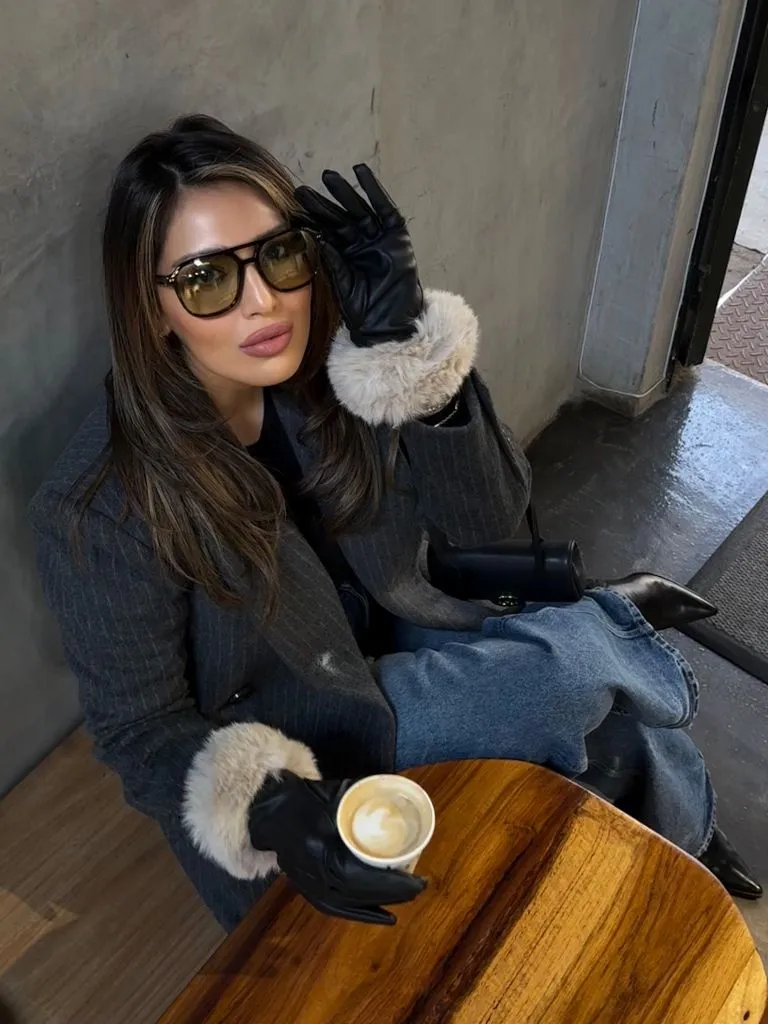
Photo via Instagram
This photograph does not show a full outfit in the way the others do — the figure is seated and much of the lower body is cropped — so the useful reading is about the accessories and how they define the visible portion. The fur-trimmed gloves are doing the work that a scarf or hat would do in a standing shot: they signal winter, they add a texture contrast, and they draw the eye to the hands and face. The pinstripe of the blazer introduces a subtle line pattern that the jeans and black top do not share, so the blazer reads as the structured piece in an otherwise casual set. The espresso and the raw concrete setting lower the formality further.
The best detail is the fur trim. It is small enough to be a detail rather than a statement, but it changes the register of the gloves from purely functional to decorative. The transferable idea is that when an outfit is kept quiet, one textured accessory can carry the seasonal signal without requiring the rest of the look to participate.
19. Logo Print Gives a Puffer Jacket Graphic Weight
A black puffer jacket with an allover white circular logo print fills the upper frame, and matching logo-printed mittens extend the graphic down the arms. Black trousers or ski pants sit below, and black oversized sunglasses cover the eyes. The hair is styled in loose waves with a center part, and a black turtleneck is visible at the neckline. The background is a snowy forest road with blue sky.
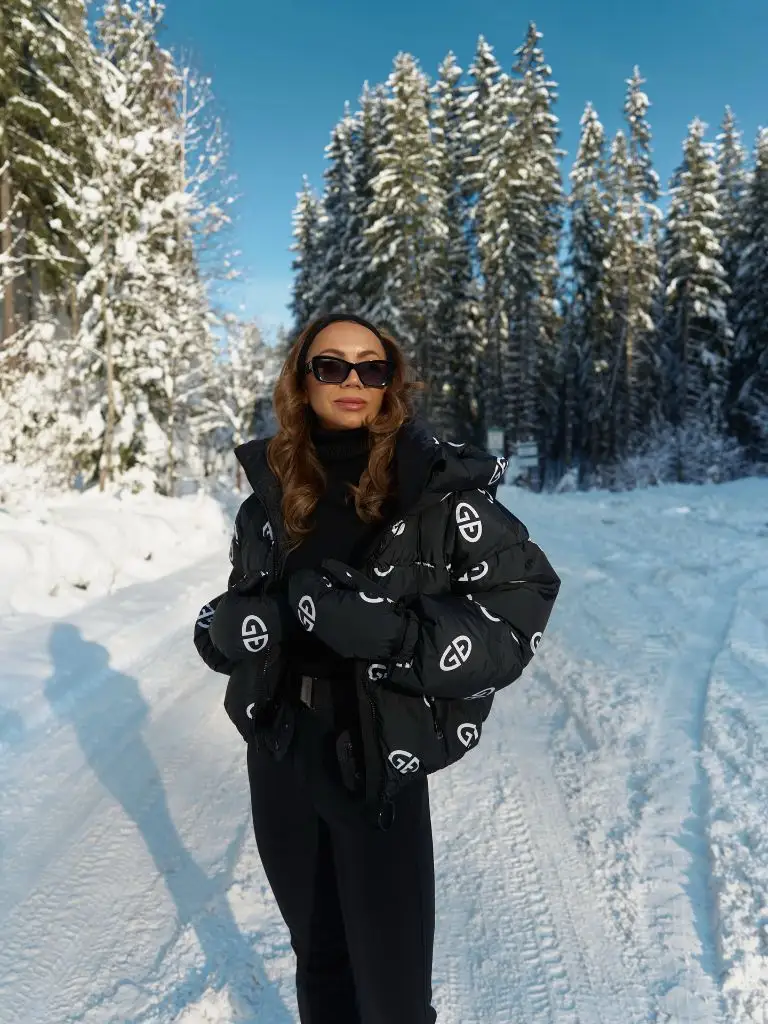
Photo via Instagram
The logo print is the defining feature, and it turns a standard puffer silhouette into something with graphic rhythm. The white logos repeat at regular intervals across the black surface, which gives the jacket a pattern density that reads differently from a solid puffer. The matching mittens are an unusual coordination choice — most outfits match hat and scarf rather than gloves — and they extend the print to the extremities, which makes the jacket’s visual field feel larger. The all-black lower half disappears against the jacket’s dark base, which keeps the graphic confined to the torso and arms.
The effect is brand-forward without being loud. The print is monochromatic and geometric, so it functions more like a textile pattern than advertising. For anyone considering cold-weather accessories and outerwear, the coordination between jacket and gloves is a way to extend a single design idea across the body without requiring multiple separate statement pieces.
20. A Faux Fur Coat Quietens an Urban Setting
A mid-length beige-brown faux fur coat with a shawl collar sits over a black hoodie or crewneck, and the lower half shows black straight-leg trousers and grey low-top sneakers. A burgundy soft-leather bucket bag hangs from one arm, and a brown silk headscarf covers the hair. Slim oval sunglasses and pearl stud earrings sit at the face. The setting is stone steps in front of a classical building with sculpted figures and fallen leaves.
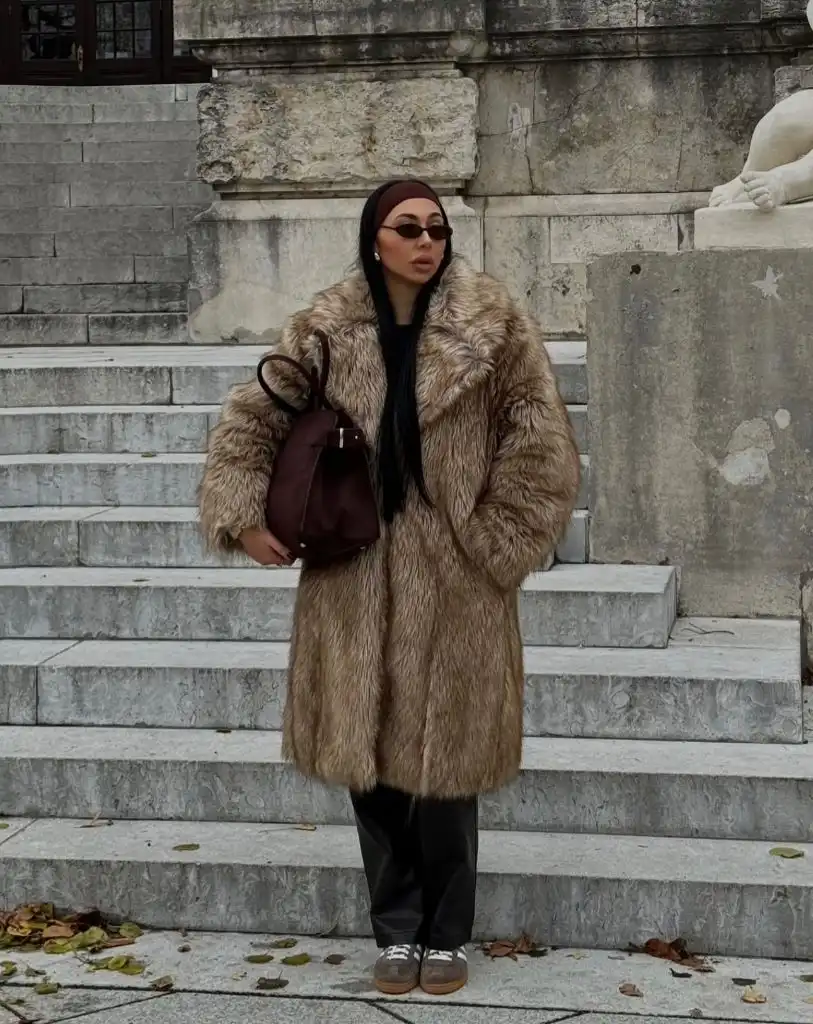
Photo via Instagram
The sneakers change everything about this outfit. Without them, the fur coat and headscarf would read as polished and formal; with them, the outfit settles into a relaxed, street-level register that works for daytime errands or a casual holiday walk. The burgundy bag is the only color outside the neutral range, and it sits against the beige fur without clashing because both are warm-toned. The headscarf is a styling choice that streamlines the silhouette above the coat collar — it removes the variable of hair and gives the coat’s shawl collar a clean surface to frame. For those exploring style ideas for different age groups, this outfit demonstrates that a fur coat does not impose a dress code on the rest of the body.
This is a study in mixing registers. The coat belongs in one world, the sneakers in another, and the headscarf in a third. Together they create a look that does not commit to a single aesthetic, and that flexibility is its strength for a season when events range from formal dinners to afternoon markets.
21. A Long Coat Structures Denim From Above
A long charcoal grey pinstripe coat, reaching past the knee, sits buttoned or clasped over a black top and medium-wash wide-leg jeans. A black structured bag with visible gold hardware hangs from a long strap, and black pointed-toe ankle boots sit below the denim hem. The figure holds a coffee cup in one hand and rests the other on the wooden table. The setting is a café with a grey textured wall.
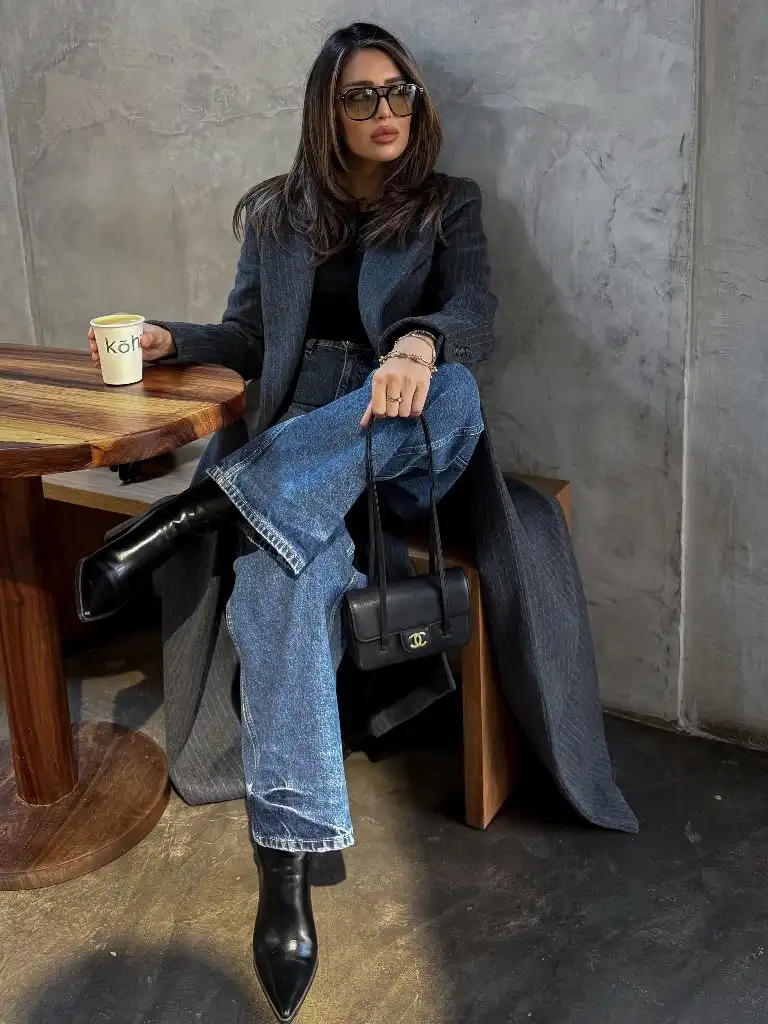
Photo via Instagram
The coat gives this outfit its posture. Without it, the jeans and black top would read as entirely casual, but the long line of the coat, its structured shoulder, and the pinstripe pattern impose a formality that the jeans absorb rather than resist. The bag is positioned so it hangs at the mid-thigh, breaking the coat’s surface at a natural point. The boots are just sharp enough to reinforce the coat’s register without looking overdressed. The coffee cup functions as a prop that keeps the look grounded in daily life rather than editorial posing.
The appeal is the coat’s ability to redefine everything beneath it. A long, structured coat over relaxed denim is a framework that works for nearly any holiday situation where you want to look considered without looking dressed up. The proportion — coat longer than the visible jeans — is what makes it work, because the structured piece occupies more visual real estate than the casual one.
22. A Beanie Softens a Pinstripe Overcoat
The same charcoal pinstripe overcoat appears here in a standing full-length shot, now worn open with a black beanie pulling the look in a more relaxed direction. Jeans, black pointed boots, and a small black crossbody bag with gold clasp hardware are visible beneath. The glasses have a tortoiseshell or amber tone and sit prominently on the face. The setting is a narrow urban sidewalk next to a building with white-trimmed windows and a small sign.
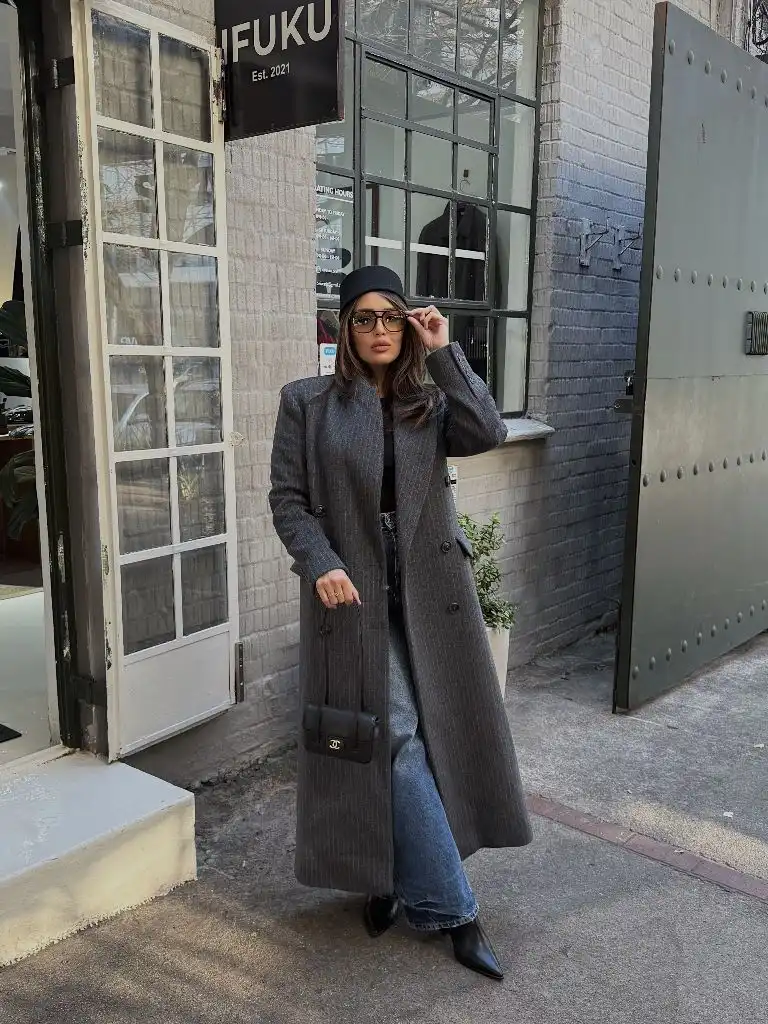
Photo via Instagram
The beanie introduces a roundness and softness at the top of the frame that the coat’s sharp shoulders and straight lines do not offer on their own. That small shift at the crown of the head changes the way the entire silhouette reads — less boardroom, more street. The coat is open in this shot, which allows the jeans and black top underneath to participate more actively in the look. The crossbody bag sits at the hip and is compact enough that it does not interfere with the coat’s drape. The pointed boots are consistent with the previous café shot, reinforcing that this coat anchors a versatile wardrobe approach to seasonal dressing.
This is the companion to the previous section, and together they demonstrate a useful principle. The same coat changes meaning based on what sits on the head — no hat reads as polished, a beanie reads as relaxed. When your outerwear is strong enough, the accessories become the controls that adjust the formality up or down.
23. A Suede Jacket Bridges Seasons Over a Slip Dress
This image shows a brown suede oversized shirt-jacket over a white satin slip dress with black lace trim at the bodice and hem. The feet are in black strappy heeled sandals, round sunglasses sit on the face, and a dark studded mini bag is tucked under one arm. The hair is in a messy top knot. The setting is a city sidewalk with glass storefronts, and there is no visible snow, holiday decoration, or cold-weather context.
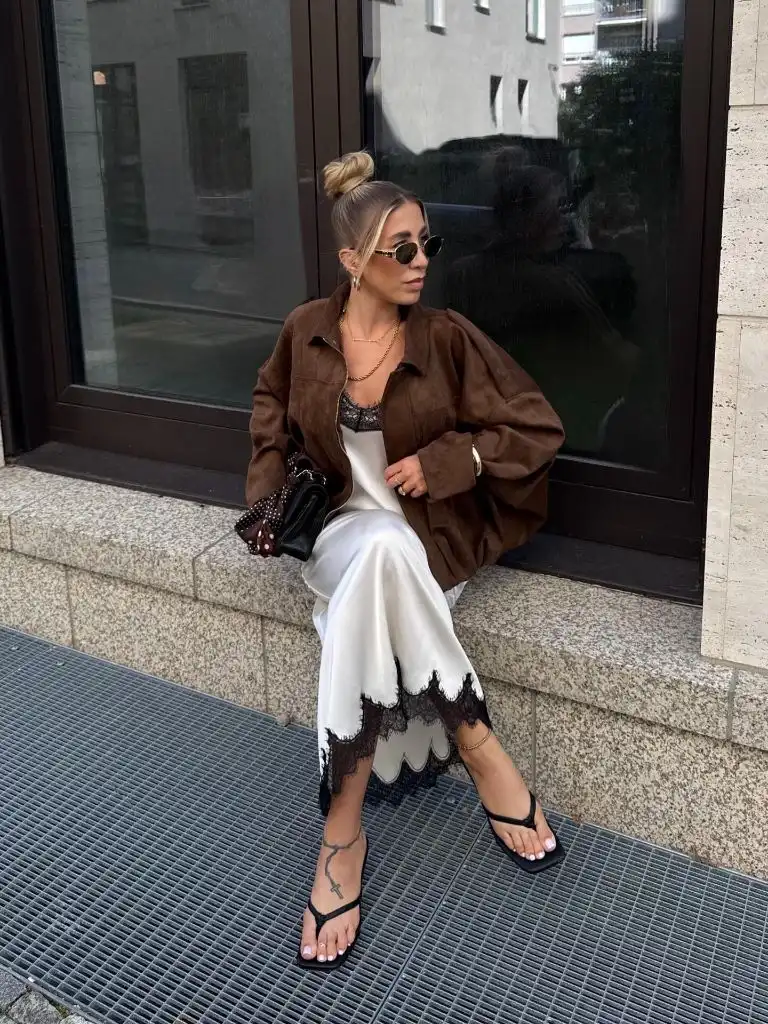
Photo via Instagram
This photograph does not support a direct Christmas reading. There is no cold-weather layering, no seasonal texture, and the sandals indicate warmer conditions. The useful analysis here is about the layering principle rather than the season. The suede jacket over the satin slip dress creates a material tension — rough over smooth, structured over fluid — that generates visual interest regardless of when it is worn. The black lace trim on the dress echoes the dark tones of the sandals and bag, creating a secondary layer of coordination beneath the jacket. The jacket’s collar and cuffs frame the slip dress rather than covering it, so both pieces remain visible and active in the composition.
The value is in the material contrast. Suede over satin is a combination that works because the two fabrics behave so differently — one absorbs light, the other reflects it. That principle holds across seasons: pairing a matte, textured layer over a smooth, reflective base gives any outfit a built-in depth that neither piece could achieve alone.
24. A Dramatic Collar Frames the Whole Outfit
A long coat in deep chocolate brown features an oversized cream or white shawl collar that extends from the neck past the chest, creating the widest point of the silhouette at the upper body. White wide-leg trousers sit below, and a dark brown structured bag and gold cuff bracelets are visible. The hair is in a sleek top knot, round gold-rimmed sunglasses cover the eyes, and a lace-trimmed black top is barely visible beneath the collar. The setting is a park bench surrounded by autumn leaves, and a coffee carrier sits on the bench.
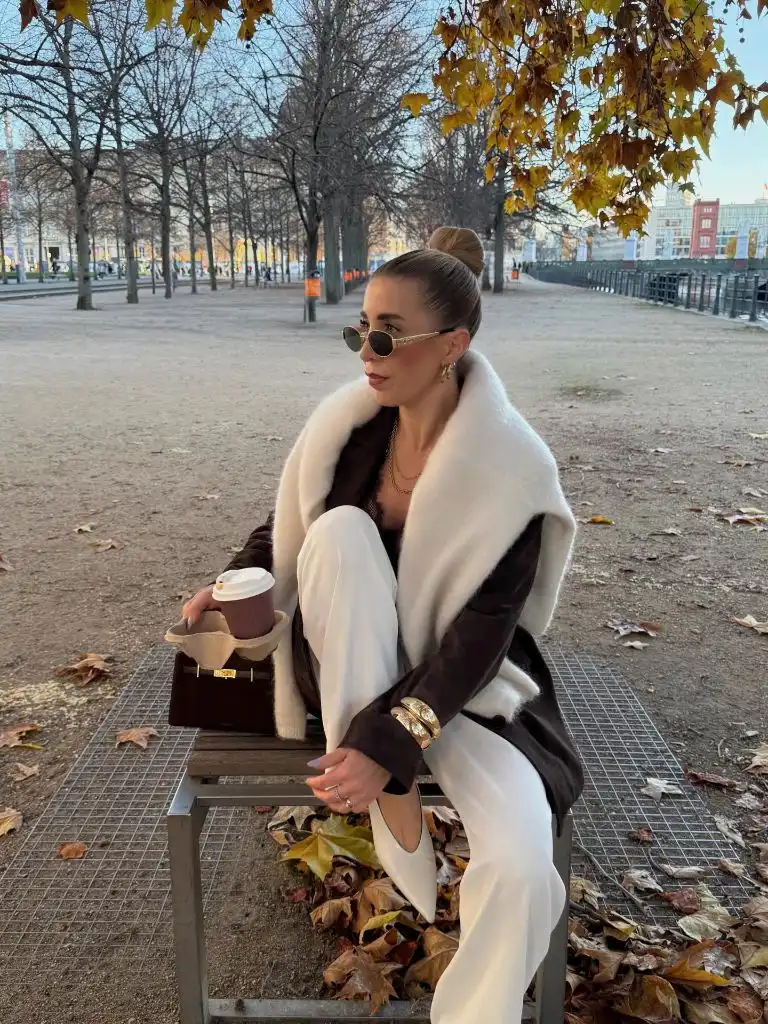
Photo via Instagram
The collar is the architecture of this outfit. It widens the shoulder line dramatically and frames the face in a light value that lifts the eye upward away from the dark body of the coat. Below the collar, the coat narrows to the waist and the white trousers pick up the collar’s tone, creating a visual link between the top of the frame and the bottom. The dark brown of the coat body and the bag sit in between, working as a middle value that holds the two white zones apart. The gold cuffs at the wrists add a metallic accent that neither the coat nor the trousers offer, and they signal a level of deliberate accessorizing and outfit finishing that casual layering would not.
The best detail is the collar’s proportion to the rest of the coat. It is large enough to function as a second garment — almost a built-in scarf — and that means the outfit does not need a separate neckpiece. When a coat carries its own framing at the neckline, everything else can stay minimal, and the result is a look that reads as complete the moment it is put on.