Why do some people bounce back from a surprise in seconds while others need a day to adjust? Why does one person crave routine while their partner thrives on spontaneity? Much of the answer is temperament — the inborn foundation of how you react to the world, present from birth and remarkably stable across a lifetime.
This guide unpacks the science behind temperament, including the nine dimensions identified by researchers and the three broad types they describe. Understanding your own natural style — and the styles of the people around you — makes relationships easier, work smoother and self-criticism quieter. It even shapes everyday choices, from how you plan your week with the Sunday Reset Checklist for Home and Body to the way you dress for your day, whether that is a structured look from Classy Business Casual Outfits or something relaxed like Casual Style Inspiration: Oversized Outfits.
Key Takeaways
- Temperament is biologically based, present from birth, and distinct from personality.
- Researchers identified nine dimensions, including activity level, adaptability and intensity of reaction.
- About 40% of children are “easy”, 10% “difficult” and 15% “slow-to-warm-up”, with the rest a mix.
- Temperament is stable over time, but how it shows up can adapt to environment and experience.
- Understanding temperament builds “goodness of fit” — it is a tool for compassion, not a label.
What Exactly Is Temperament?
Temperament is the biologically based foundation of personality. It describes how you approach and react to the world: your typical mood, your energy level, how quickly you warm up to new people, and how intensely you respond to change. It shows up in infancy — some babies settle easily and others startle at every sound — and it remains relatively stable throughout life.
That stability is what makes temperament so useful to understand. Your natural tendencies are not flaws to fix or habits you failed to outgrow. They are the raw material you were born with, and knowing them lets you build a life that fits rather than one that constantly fights your wiring.
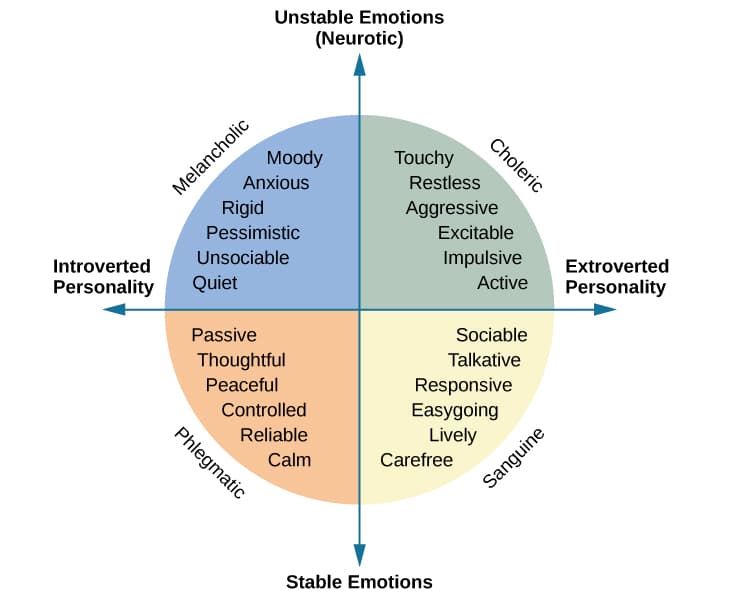
Photo via fiveable.me
Temperament Versus Personality: What Is the Difference?
Temperament is the “how” of behaviour: your natural style, intensity and typical mood. It shows up in how quickly you react, whether you prefer routine or spontaneity, and how you handle surprises. Personality, by contrast, is the “what”: the values, beliefs and learned habits that shape your choices over time.
Think of temperament as the raw material and personality as what gets built on top of it. Life experience, culture and reflection all shape personality, which keeps evolving through adulthood. Temperament stays comparatively steady underneath. Understanding the difference helps you see that a tendency toward intensity or caution is a starting point, not a verdict — you can build coping strategies and habits around it without trying to become someone else.
The Nine Dimensions of Temperament
The New York Longitudinal Study, led by psychiatrists Stella Chess and Alexander Thomas, followed children from infancy and identified nine dimensions that together describe a person’s temperament.
- Activity level: how much physical movement a person typically shows.
- Rhythmicity: how regular biological functions like sleep and hunger are.
- Approach or withdrawal: the first reaction to new situations or people — moving toward them or holding back.
- Adaptability: how easily a person adjusts to changes in routine or environment.
- Intensity of reaction: how much energy goes into emotional responses, whether joy or frustration.
- Threshold of responsiveness: how much stimulation it takes to trigger a reaction.
- Quality of mood: the general tendency toward positive or negative emotions.
- Distractibility: how easily outside stimuli interrupt focus.
- Attention span and persistence: how long a person stays with a task despite obstacles.
Everyone sits somewhere different on each dimension, and the combination is what makes a temperament unique. Two people can share a high activity level yet differ completely in adaptability or mood — which is why broad labels never tell the whole story.
The Three Broad Temperament Types
Based on the nine dimensions, Thomas and Chess grouped children into three broad types. The labels are descriptive, not judgements — each type carries its own strengths.

Photo via theschoolofcivilcelebrancy.co.uk
Easy Temperament — About 40%
Easy-temperament children are adaptable, generally positive in mood and regular in their routines. They warm up to new situations quickly and tend to go with the flow. As adults, they are often the steady, flexible people in a group — though their ease can sometimes mean their own needs get overlooked.
Difficult Temperament — About 10%
The “difficult” label is unfortunate, because it describes intensity rather than character. These children react strongly, have irregular routines and tend toward negative moods. As adults, that same intensity often fuels passion, determination and honesty. The challenge is channelling strong reactions, not eliminating them.
Slow-to-Warm-Up Temperament — About 15%
Slow-to-warm-up children are low in activity, cautious and mildly reactive. They need time to adjust to new people and situations, and they dislike being rushed. As adults, they are often thoughtful, observant and deep — people who say little at first and a great deal once they trust you.
The remaining 35% show a mix of these types, which is a useful reminder that most people do not fit neatly into one category. The types are a starting point for understanding, not a sorting system.

Photo via missionprephealthcare.com
Practical Tips for Navigating Different Temperaments
Observe before judging: notice your own natural reactions and those of the people around you. Patterns in mood, energy and handling of change tell you more than any label.
Embrace the differences: temperament is not a choice, and different styles complement each other. A high-energy person and a calm one can balance a household or a team beautifully.
Seek goodness of fit: aim for compatibility between temperament and environment. If you are slow-to-warm-up, give yourself time before big social events instead of forcing immediate engagement. In work or study, that might mean choosing environments that suit your style — a structured office day in a smart, tailored look for one person, a flexible campus day in College Outfit Ideas for Casual Campus Style for another.
Understand, do not excuse: temperament explains tendencies but does not remove responsibility. Knowing a child has a low threshold for stimulation helps you adjust activities — it does not make rudeness acceptable.
Adapt, do not try to change: while temperament is stable, behaviour can adapt. A naturally intense person can practise calming techniques before a tense meeting; a cautious person can build a habit of saying yes to one new thing a week.

Photo via visible.edu
Common Misconceptions About Temperament
Confusing temperament with personality: temperament is the “how” — style, intensity and mood. Personality is the “what” — values, beliefs and learned behaviour. They are related but not the same.
Believing temperament is easily changed: the core is stable and innate. Expression can adapt, but expecting someone to fundamentally change their temperament usually leads to frustration on both sides.
Attributing all behaviour to temperament: environment and experience matter enormously. A child’s outburst may be hunger or tiredness rather than temperament, and an adult’s bad day may be exactly that.
Assuming one type is better: no temperament is superior. An easy temperament is not better than a slow-to-warm-up one — the latter often brings thoughtfulness and depth that the former lacks. Personal style works the same way: a polished, minimal look from Clean Girl Outfits suits one temperament, while a relaxed, layered look suits another. Neither is better — the fit is what matters.
Looking after your overall wellbeing supports every temperament. Steady nutrition, good sleep and the nutrients in Essential Vitamins for Women help any natural style show up at its best.
When to Seek Professional Guidance
If you are concerned about extreme or persistent behavioural patterns in a child, speak to a paediatrician or child development specialist. Temperament can offer insight, but it should never replace professional diagnosis or treatment for a mental health condition, and it is not a basis for labelling others with clinical terms. A professional can provide an accurate assessment and appropriate guidance.
Frequently Asked Questions
Is temperament the same as personality?
No. Temperament is the biologically based “how” of behaviour — natural style, mood and intensity. Personality is the “what”, including values, beliefs and learned behaviours that develop over time. Temperament forms the foundation on which personality is built.
Can I change my temperament?
The core of your temperament is stable, so you cannot change it entirely. Its expression, however, can adapt through environment, experience and conscious effort — a naturally intense person can learn strategies to manage reactions, even though the underlying tendency remains.
How does temperament affect relationships?
Temperament shapes how you approach conflict, express affection and handle change. A slow-to-warm-up person may need more time to trust, while an easy person adapts quickly. Understanding these differences helps partners, friends and colleagues find a goodness of fit and reduce misunderstandings.
Are there good or bad temperaments?
No temperament type is inherently good or bad. Each has strengths and challenges — the intensity of a “difficult” temperament can fuel passion and determination. The key is understanding your style and working with it, not judging it.
When does temperament develop?
Temperament is present from birth or early infancy, making it one of the earliest aspects of individuality. It is largely established within the first few months of life and remains relatively stable, even as its expression evolves with experience.
Final Thoughts
The most useful first step is simply to observe your own natural reactions without judgement. Notice whether you prefer a predictable schedule or thrive on last-minute changes, how quickly you warm up to new people, and how intensely you react when plans shift. The goal is not to change your core wiring but to work with it — building environments, routines and relationships that fit you and the people you care about. Temperament, understood well, is a tool for compassion, not a box to squeeze into.
Disclaimer: This article is for general informational purposes only and is not a substitute for professional medical or psychological advice. If you are concerned about a child’s behavioural patterns, developmental delays, or a mental health condition, please consult a paediatrician, child development specialist, or licensed mental health professional. Temperament insights are a tool for understanding, not for diagnosis.